Talk to an Expert

How is Blockchain Shaping Identity Management for 2026?

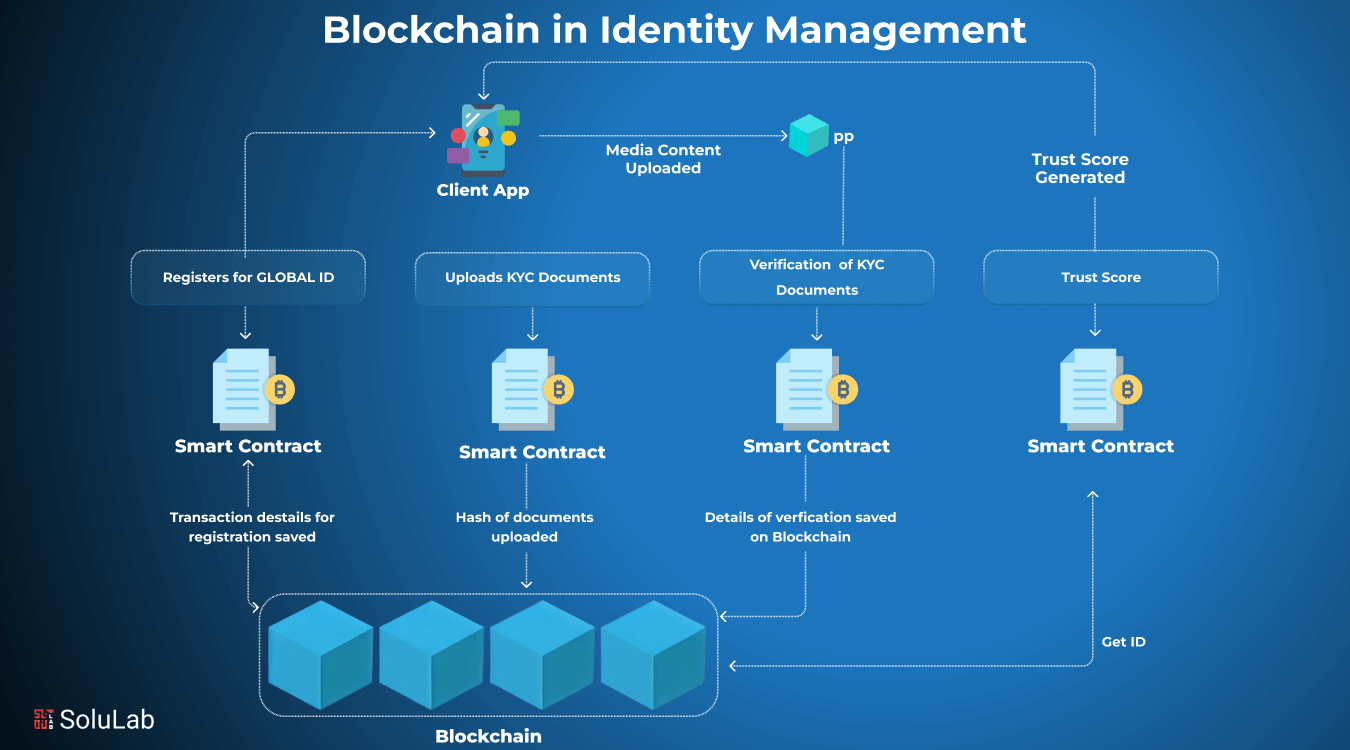
Blockchain in Identity Management

Blockchain in identity management offers a decentralized, secure way to control personal data, solving risks linked to centralized databases. Traditional systems rely on government IDs stored in vulnerable servers, leading to frequent breaches.

Leading blockchain development companies are building self-sovereign identity (SSI) platforms that empower users with secure ownership of their blockchain identity. Global spending on digital identity services is projected to hit $3.58 billion by 2026, driven by innovations like Layer 1 Blockchains and AI agents automating verification and fraud detection.

This blog explores challenges of legacy ID systems, how blockchain-based identity verification systems fix them, and future trends, especially in the UAE, where blockchain-based biometric identity management is gaining momentum.

Traditional Challenges in Identity Management

According to the 2024 IBM Cost of a Data Breach Report, the average global breach cost has surged to $4.45 million, underlining the vulnerability of centralized systems. Blockchain technology offers a decentralized alternative that reduces these risks by shifting identity control away from vulnerable central servers.

Today’s identity systems face four major challenges:

1. Identity Theft

With users sharing personal data across numerous platforms, identity theft is rampant. Centralized storage makes these platforms a target, over 4.8 million records are compromised daily, according to the Breach Level Index. These alarming numbers fuel demand for blockchain use cases in secure digital identity.

2. Combination of Usernames and Passwords

The average user manages around 100 online accounts, increasing exposure to phishing and password fatigue. Traditional systems are ill-equipped for this scale. Decentralized Identifiers (DIDs) and verifiable credentials eliminate the need for passwords, an innovation led by many Blockchain development companies.

3. KYC Onboarding Costs and Inefficiencies

Traditional KYC involves multiple intermediaries, making onboarding slow and expensive. A 2023 Thomson Reuters survey found that financial firms spend over $48 million annually on KYC, with onboarding often taking 3–5 days. Blockchain-as-a-Service streamlines this with automated, secure onboarding systems powered by AI agents and smart contracts.

4. Lack of User Control over Personal Data

Users often lack visibility and control over how their Personally Identifiable Information (PII) is shared. This creates compliance risks under GDPR and CCPA. By enabling self-sovereign identity (SSI), blockchain technology returns data ownership to users. It’s an approach embraced by top blockchain development companies building solutions that align with responsible AI and automated compliance via AI agents for Enterprises.
CTA1

How Blockchain Works in Identity Management?

Blockchain technology is reshaping the future of digital identity services, solving long-standing issues in traditional systems by enhancing security, transparency, and user control.

1. Decentralized Identity Systems

Unlike centralized databases vulnerable to breaches, blockchain in identity management distributes data across a network of nodes, removing single points of failure. This empowers users with full control over their information. Blockchain-based identity management in the UAE is rapidly adopting this decentralized model through Blockchain-as-a-Service, enabling secure, user-owned identity ecosystems.

2. Immutable and Tamper-Proof Records

Data stored on a blockchain is immutable; it cannot be altered or erased. Each change is recorded as a new block, forming an unchangeable audit trail. This makes blockchain identity verification systems highly resistant to fraud and manipulation compared to traditional methods.

3. Smart Contracts for Instant Verification

Smart contracts automate identity verification by executing predefined rules. When someone shares their identity, the contract validates it instantly, removing the need for third-party verification.

This not only speeds up onboarding and KYC processes but also reduces errors. Leading blockchain development companies leverage smart contracts to build secure identity frameworks across industries.

4. Public and Private Key Encryption

Instead of passwords, blockchain identity platforms use cryptographic keys. Users have a public key (like a digital ID) and a private key (like a signature). When identity data is shared, it’s signed with the private key and verified by the public key, ensuring that only the rightful owner controls access, which is building a foundation for blockchain-based biometric identity management and other advanced solutions.
Key Features of a Blockchain in Identity Management

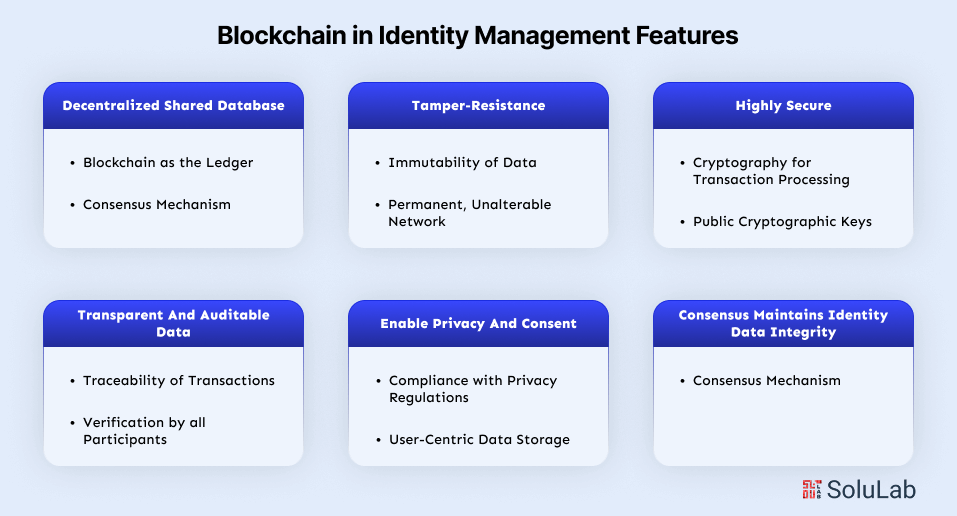
Blockchain in Identity Management Features

Blockchain based identity management introduces a paradigm shift in how we handle and secure personal information. Here are the key features of utilizing blockchain in identity management:

1. Decentralized, Shared Database (Distributed Ledger)

  • Blockchain as the Ledger: Unlike centralized identity management systems, blockchain-based identity management operates on a decentralized, shared database or distributed ledger. Every participant in the network maintains a copy of the ledger, ensuring transparency and eliminating the need for a central authority.
  • Consensus Mechanism: Transactions are added to the ledger through a consensus mechanism, requiring agreement from the majority of participants. This process enhances security and prevents unauthorized alterations to the identity data.

2. Tamper-Resistance

  • Immutability of Data: Once identity information is recorded on the blockchain, it becomes tamper-resistant. The design of blockchain technology ensures that information once added to the ledger, cannot be changed, backdated, or altered by any single entity.
  • Permanent, Unalterable Network: The permanence of identity data on the blockchain establishes an unalterable network, maintaining the integrity of personal information and preventing fraudulent activities.

3. Highly Secure

  • Cryptography for Transaction Processing: Blockchain systems utilize cryptography, a fundamental aspect of computer science, to secure the processing and storage of transactions. This cryptographic protection ensures that personally identifiable information remains confidential and secure.
  • Public Cryptographic Keys: Instead of storing sensitive information directly on the blockchain, public cryptographic keys are used. This means that verification of information can occur without exposing the actual details, adding an extra layer of security.

4. Transparent and Auditable Data

  • Traceability of Transactions: Every participant in the blockchain network can trace the recorded transactions, ensuring transparency in the identity management process.
  • Verification by All Participants: The distributed nature of the ledger allows everyone in the network to verify data, creating an auditable trail of information. This openness improves accountability and confidence among stakeholders.

5. Enables Privacy and Consent

  • Compliance with Privacy Regulations: Blockchain-based identity management aligns with privacy regulations by providing users with control over their data. Compliance with rules that mandate explicit user consent before data sharing is a key feature.
  • User-Centric Data Storage: Users store their data, reducing the risk of unauthorized access. Because blockchain is decentralized, it has no one center of control or failure.

6. Consensus Maintains Identity Data Integrity

  • Consensus Mechanisms: Blockchain employs consensus mechanisms to validate transactions and govern the network. This ensures the accuracy and integrity of identity data by preventing the inclusion of inaccurate or potentially fraudulent information.

In brief, blockchain-based identity management offers a decentralized, tamper-resistant, highly secure, transparent, and privacy-focused solution. The integration of consensus mechanisms further enhances the reliability of identity data, making blockchain a transformative technology in the field of identity management.

Benefits of Blockchain in Identity Management

From the perspective of the user, employing identity management using blockchain

offers several advantages:

  • Unique Identifier

Every user registering on the blockchain identity management system receives a distinctive identity number. This unique ID encompasses all personally identifiable information encrypted and stored on the user’s device, supported by IPFS. Users can share these unique IDs with third parties, facilitating direct authentication through the blockchain identity management system.

  • Consent Control

The blockchain identity management system refrains from storing any user information directly. Utilizing smart contracts, the system enables controlled data disclosure, preventing any manipulation of data on the blockchain. This approach ensures heightened security for identity holders, as no transaction involving user information can occur without explicit user consent. Users maintain control over their personally identifiable information.

  • Decentralization for Enhanced Security

Personal identification documents are not stored on a centralized server in the blockchain identity management system. Instead, all user documents that serve as identifiers are stored on their devices, backed by IPFS. This decentralized storage strategy safeguards against large-scale data breaches. By utilizing blockchain identity management with IPFS, the system prevents hackers from stealing identifiable information. The decentralized nature ensures the absence of a single point of failure (SPOF), enhancing overall system resilience.

  • Universal Ecosystem

Blockchain identity management transcends geographical boundaries, creating a universal ecosystem. Users can seamlessly utilize the platform across borders to verify their identity. This feature emphasizes the global applicability and accessibility of the blockchain identity management system.

Blockchain Identity Management Use Cases

Blockchain-based identity management has garnered significant attention for its transformative potential across various industries. Below are several compelling blockchain identity management use cases that highlight the diverse applications of this technology:

1. Financial Services: Secure Transactions: Blockchain identity management ensures secure and transparent financial transactions. Users can establish their identity seamlessly, reducing the risk of fraud and enhancing the overall security of financial interactions.

2. Patient Data Security: Blockchain in identity management offers a robust solution for securing patient data. Medical records can be stored in a tamper-resistant and decentralized manner, allowing authorized individuals, such as healthcare providers, seamless and secure access.

3. Citizen Identity Verification: Governments can leverage blockchain identity management to enhance citizen identity verification processes. This can streamline public service delivery, and voting systems, and reduce identity-related fraud in public programs.

4. Product Authentication: Blockchain identity management ensures the authenticity of products in the supply chain. By tracking and verifying each step of a product’s journey, consumers can trust the origin and integrity of the goods they purchase.

5. Credential Verification: Academic credentials, certifications, and degrees can be securely stored and verified on the blockchain. This ensures that individuals can easily prove their educational qualifications without the need for intermediaries.

6. Digital Onboarding: Blockchain identity management simplifies digital onboarding processes for online platforms. Users can securely verify their identity, reducing the risk of identity theft and providing a seamless and trustworthy experience.

7. Automated Legal Processes: Smart contracts enabled by blockchain identity management can automate various legal processes. This includes contract execution, property transactions, and other legal agreements, reducing the need for intermediaries and enhancing efficiency.

8. AI-Driven Identity Verification: AI agents integrated with digital identity services enable real-time identity checks across sectors. In healthcare, AI agents in Healthcare validate patient data securely. For corporations, AI agents for Enterprises automate onboarding and detect fraud, ensuring trust and compliance. For example, tools like SEON’s reverse phone lookup help verify phone numbers during onboarding, adding an extra layer of fraud detection and enhancing the reliability of identity verification systems.

9. Enterprise Access & Zero Trust Security: Enterprises are shifting to zero-trust security powered by Blockchain-as-a-Service. With AI agents for Enterprises, access is managed dynamically across locations and devices. Leading Blockchain development companies offer scalable solutions for secure enterprise identity.

10. Identity Wallets & Self-Sovereign IDs: Decentralized identity wallets like the EU EUDI Wallet and the UAE’s digital ID let users control their data. Blockchain for identity management and blockchain identity management UAE empower citizens to verify identities privately using digital identity services.

These use cases exemplify the versatility and adaptability of blockchain identity management across different sectors, showcasing its potential to enhance security, streamline processes, and create more trustworthy ecosystems. As the technology continues to mature, we can anticipate even more innovative applications in the realm of identity management.

Future Trends in Blockchain Identity Management

As blockchain in identity management continues to grow, we’re seeing new trends shape the way individuals and organizations secure and control their digital identity services. The focus is shifting toward privacy-first, decentralized solutions that put users in charge, powered by advanced blockchain identity technologies.

1. Decentralized Identity Solutions

Decentralized identity gives people full control over their personal information. Instead of relying on governments or big tech, identities are created and verified directly on the blockchain, making them tamper-proof and secure. These solutions are gaining momentum globally, especially in regions like the Blockchain in UAE ecosystem, where trust, compliance, and data ownership are top priorities.

2. Interoperability and Standardization

As more blockchain-based identity verification systems emerge, the need for universal standards is growing. The future of blockchain and digital identity lies in making systems work together. Seamless data sharing across platforms and networks will be key for worldwide adoption and for delivering frictionless user experiences across industries.

3. Self-Sovereign Identity (SSI)

Self-sovereign identity means users decide what information they share, and with whom. This model removes third-party intermediaries and protects privacy by using blockchain’s immutable ledger. SSI is also foundational to blockchain-based biometric identity management, enabling safe and simple access to digital services without compromising user control.

4. Biometrics and Multifactor Authentication

Adding biometrics like fingerprints or facial recognition strengthens blockchain identity systems. When combined with multifactor authentication and cryptographic keys, it creates powerful protection against identity theft. This approach is gaining interest from enterprises using blockchain and digital identity to improve security and compliance.

5. Enhanced Privacy Features

Technologies like zero-knowledge proofs allow users to prove who they are without sharing unnecessary details. This balances the transparency of blockchain with the need for privacy, critical for meeting regulations like GDPR. These privacy-driven innovations are fueling growth in blockchain identity management UAE, helping users and businesses stay compliant while maintaining trust.
CTA2

Final Words

Blockchain in identity management is changing how we protect and control our personal data. With tools like blockchain-based identity verification systems and digital identity services, users now have more security and control than ever before.

Adoption is growing fast, especially in places like the UAE, where blockchain-based biometric identity management is gaining traction. This shift toward blockchain and digital identity offers real benefits for both users and businesses.

At SoluLab, a leading blockchain development company, we help companies build secure, easy-to-use blockchain identity solutions. Whether you’re in the UAE or anywhere else, our team can guide you in using blockchain to simplify and protect identity management.

Want to learn more? Let’s talk about how we can upgrade your identity system with blockchain.

FAQs

1. How does blockchain improve identity security?

Blockchain in identity management improves security by removing single points of failure. Instead of storing identity data in one central system, blockchain distributes it across multiple nodes. This makes it nearly impossible for hackers to tamper with records. Encryption and smart contracts ensure only authorized parties can access personal data.

2. What is self-sovereign identity, and why does it matter?

Self-sovereign identity (SSI) gives people control over their own digital identity. With blockchain-based identity verification systems, users decide what data to share, and with whom. This reduces the risk of identity theft and supports data privacy, especially useful in countries like the UAE where digital identity is on the rise.

3. How does blockchain handle cross-border ID verification?

Blockchain and digital identity systems enable real-time, borderless verification. Since all identity data is stored securely on-chain, organizations worldwide can validate credentials without repeated checks. This is especially relevant for digital identity services in global trade and compliance-heavy sectors like finance and healthcare.

4. What’s SoluLab’s role in blockchain identity solutions?

SoluLab specializes in blockchain in identity management, offering tailored solutions like blockchain-based biometric identity management and cross-chain integrations. Whether you’re an enterprise in the UAE or a global firm, our team helps implement secure, scalable, and compliant digital identity frameworks.

5. How can businesses benefit from SoluLab’s identity solutions?

Businesses and individuals can enhance privacy, reduce fraud, and streamline KYC using SoluLab’s blockchain identity management services. We bring deep experience in Blockchain in the UAE, helping enterprises adopt Layer 1 Blockchains, smart contracts, and AI-powered compliance tools to future-proof their digital identity services.

What are the Benefits of Using Digital Identity with Blockchain in 2025?

Benefits of Using Digital Identity with Blockchain

Blockchain digital identity has transformed the verification of our identities—securely, confidentially, and universally. By 2026, over 5.2 million digital ID wallets are anticipated, indicating a transition from conventional IDs to more intelligent, decentralized alternatives.

With digital identity verification in blockchain, users gain full ownership of their data and can share only what’s necessary, when it’s required. This shift is not just about convenience; it’s about building trust and transparency in digital interactions.

This article will examine the primary benefits of utilizing digital identification through blockchain, including improved privacy and expedited cross-border access. So let’s get started!

What is Blockchain Digital Identity, and Why is it Essential?

Before addressing fresh uses of identity management in blockchain, it is essential to determine the importance and benefits of digital identity. Why is the use of blockchain technology in digital identification causing concern? The concept of digital identity has grown extremely broad, resulting in the assumption that it only refers to publicly accessible personal information online. You’d be incorrect if you thought your digital identity was limited to your social media profiles, email addresses, and home address.

Digital identity displays a person’s finest actual and online personas. Your online presence, which includes images, purchase decisions, website usage trends, and bank account information, forms a part of your digital identity. However, discrepancies exist in how digital identity is displayed across numerous platforms, such as banking systems, social networking sites, and telecom networks.

The relevance of digital identity would be the basis for answering the question, “What is digital identity management in blockchain?” The customer onboarding process must be sped up while accuracy is guaranteed. Digital identity is also necessary for combating fraud and money laundering, which are inextricably linked. With digital identity management, government services to people may be streamlined and standardized.

The capability of social transformation projects and the assurance of economic advantages for diverse communities by citizen welfare measures highlight the need for blockchain and identity management. One such digital identification application example is Singapore’s Smart Nation plan’s National Digital Identification, or NDI, system. The NDI system would make citizens’ involvement in e-government services more secure.

Issues With the Current Identity Management System

The issue of digital identity remains significant. If it’s paper-based, like birth certificates stored in a town hall basement, it might be lost, subject to identity theft, or vulnerable to fraud. Digital identity management reduces bureaucracy and expedites business processes within enterprises by enabling improved interoperability between departments and other organizations. However, if this digital identity is stored in a centralized institution, it remains a target for hacking. Since 2017, almost 600 million pieces of personally identifiable data, including addresses and credit card details, have been stolen from companies.

The vast majority of current digital identity management solutions require improvement and modernization. Identity portability and verification are now feasible anywhere, at any time, thanks to digitization. But being digital alone is insufficient; identity needs to be secure and private. A comparison between Multi-Chain vs. Cross-Chain solutions can be crucial in determining the future of secure identity management, as both approaches offer different methods of data sharing and verification across multiple blockchain networks. Numerous sectors face challenges due to current digital identity management techniques, signaling a strong need for more advanced, decentralized solutions.

  • Government

The requirement for interoperability between departments and levels of governmental services leads to excessive bureaucracy. Overall process durations and costs lengthen as a result.

  • Healthcare

The majority of people on the planet do not have access to quality healthcare. The lack of interoperability across healthcare providers (hospitals, clinics, insurance firms, doctors, pharmacies, etc.) results in ineffective healthcare, delayed care, and unhappy patients.

Related: AI Agents in Healthcare

  • Education

It’s estimated that 200,000 fake academic degrees are peddled each year in the United States. Unqualified candidates are employed as a result of the challenges in verifying the validity of these credentials, which damages institutions’ and hiring companies’ reputations.

Read Our Blog: Role of AI in Education Industry

  • Banking

Users’ access to their bank accounts is less secure when login details like passwords are required.

  • Businesses in General

The requirement to preserve client and employee personal data breaches is a cause of corporate liability. Due to GDPR infringements, as in the British Airways case, or just as a result of a loss of customer confidence and associated brand harm, personal data breaches may result in significant penalties.

CTA1

How Blockchain Digital Identity Acts As A Problem Solver?

Blockchain technology is demonstrating efficacy as a robust solution to worldwide identity issues. Blockchain for digital identity is revolutionizing the management and verification of identities for individuals and businesses through a decentralized, secure, and user-controlled framework.

  • Eradicates Centralized Vulnerabilities: Conventional identification methods depend on central databases frequently targeted by cybercriminals. Blockchain and digital identity together mitigate this risk by disseminating data throughout a secure network, therefore diminishing single points of failure.
  • Helps Users to Manage Their Data: Blockchain enables consumers to control access to their personal data, rather than having third parties own their identifying information. This guarantees confidentiality and selective dissemination.
  • Provides Data Integrity: Each ID record maintained on a blockchain is time-stamped and impervious to tampering. Upon verification, it cannot be modified without consensus, hence maintaining elevated levels of confidence.
  • Facilitates Cross-Border Verification: Decentralized systems enable universal identity verification across institutions and boundaries, making them suitable for global travel, finance, and digital services.
  • Increases Access to Legal Identification: Millions lacking formal documentation may now establish digital identities on the blockchain, therefore addressing the worldwide identity disparity.

How Does Blockchain for Digital Identity Verification Work?

For an understanding of the benefits of blockchain-based identification systems, it is essential to understand their underlying mechanisms. The integration of cryptographic techniques, key management, and decentralized consensus guarantees the security, privacy, and tamper-resistance of digital identification.

  • Immutable Records Using Hashing

Blockchain safeguards identification information using cryptographic hashes, which serve as unique digital identifiers for each data entry. Upon the addition of a user’s identification information to the network, it is converted into a static hash. Any alteration to this data modifies the hash, rendering illegal changes easily identifiable. This assures that digital identity verification in blockchain is reliable and impervious to manipulation.

  • Secure Access Utilizing Public-Private Key Pairs

Every individual is allocated a distinct pair of keys: a public key (serving as a digital address) and a private key (used for access authorization). Access to identity data is restricted to individuals with the appropriate private key, hence guaranteeing safe and user-governed verification procedures.

  • Decentralized Trust via Consensus

Blockchain networks utilize consensus techniques such as Proof of Stake or Proof of Authority to authenticate new entries. Upon submission of identification credentials, they are verified by many separate nodes. This decentralized approval mechanism obviates the necessity for central authority and secures the integrity of identification data throughout the network.

  • Privacy by Design

Blockchain systems provide selective disclosure, allowing individuals to reveal only particular aspects of their identities. This mitigates data exposure, augments privacy, and facilitates adherence to data protection rules.

  • Global Interoperability

In contrast to isolated conventional identity systems, blockchain IDs are transferable. Individuals may authenticate their credentials across several platforms and jurisdictions without redundant manual procedures, optimizing processes from onboarding to KYC.

Benefits of Using Digital Identity With Blockchain 

Benefits of Using Digital Identity With Blockchain 

With the advent of Bitcoin in 2008, blockchain technology arose, giving an efficient, transparent, and decentralized system distributed across a network of computers with the help of a blockchain development company. Have you ever imagined gaining complete control of your personal data and deciding how it is used? Managing and safeguarding your online identity is now a reality thanks to blockchain services. It has already altered areas such as finance, banking, healthcare, and insurance, and it is now set to redefine digital identity management.

Several significant benefits of using blockchain in identity management are listed below:

  • User-Owned Identity

Blockchain digital identity enables individuals to be independent of centralized entities for the issuance or management of their personal credentials. Users dictate the timing, location, and recipients of their information, facilitating genuine data ownership.

  • Tamper-Proof Verification

Identity data recorded on the blockchain is unalterable. Once included, it cannot be modified or removed without agreement, so rendering identity fraud, document tampering, and impersonation far more challenging to perpetrate.

  • Faster and Frictionless Access

Blockchain-based IDs expedite verification processes for onboarding to banking applications, age verification for digital services, and applications for public benefits while removing delays associated with paperwork.

  • Selective Disclosure for Privacy

Users may disclose just the essential data necessary for verification—such as validating age without disclosing a birthdate—thereby augmenting privacy and mitigating data leakage threats.

  • Cross-Platform and Borderless Use

Digital identity on blockchain is transferable. It operates flawlessly across applications, platforms, and nations—perfect for travelers, expatriates, and international professionals requiring universal acknowledgment.

DO YOU KNOW?
The global blockchain market, valued at $3 billion in 2020, is projected to witness remarkable growth in the coming years. This market is anticipated to reach a staggering $39.7 billion by 2025.

  • Cost Savings for Institutions

Organizations also get advantages by decreasing compliance expenses, removing middlemen, and automating verification procedures using smart contracts.

  • Built-in Compliance Support

Blockchain identifiers may be structured to comply with KYC/AML rules, GDPR, and other international standards, facilitating audits and enhancing regulatory transparency.

How Blockchain Works in Online Verifiable Identity?

How Blockchain Works in Online Verifiable Identity?

Blockchain technology has the potential to revolutionize online verifiable identity by providing a secure, transparent, and decentralized platform for managing digital identities. Here’s a step-by-step explanation of how blockchain works in online verifiable identity:

  • Decentralized Identifiers

Decentralized identifiers (DIDs) are used by blockchain-based identification systems to validate and securely share identities with verified parties. By ensuring openness, effectiveness, and tamper-proof administration of digital identities, these cryptographic keys do away with the need for several identity papers.

  • Distributed Ledger Technology

Each component of a blockchain has a significant function. DLT, or distributed ledger technology, offers security and openness. It serves as an impenetrable database that keeps track of all transactions and updates identification data.

  • Tokens

Tokens serve as identity representations in the digital realm. Without divulging all of your personal information, you may authenticate your identity using tokens. However, the capacity of the blockchain to encrypt and retain data immutably is a prerequisite for all of this.

  • Encryption

You are the only one with access to the data kept on a block since you are a registered user. Unless you add to the encrypted data, it will remain untouched. By doing so, you deter identity thieves and safeguard your personal information.

  • Immutability

A crucial characteristic of blockchain technology is immutability, where finished transactions are time-stamped, cryptographically signed, and consecutively added to the ledger. Without the consent of all parties involved, the records kept on the blockchain cannot be changed or distorted.

Blockchain systems are an effective tool because of the integration of DIDs and other crucial components. They assist in enhancing the blockchain ecosystem’s safety and confidentiality.

CTA2

Conclusion

The future of identification is in decentralized, granting individuals total ownership over their data while ensuring that verification is rapid, safe, and impenetrable. Blockchain-based digital identification facilitates a revolutionary transition from antiquated, centralized systems to dynamic, user-centric frameworks that are global and designed for the digital era. This technology is establishing a more intelligent identity infrastructure for the future, encompassing safe onboarding, real-time verification, and privacy-centric sharing.

SoluLab specializes in developing scalable and secure identification systems customized for diverse sectors. As a reputable blockchain development company, we have enabled international clients with custom blockchain ecosystems that enhance identity management and regulatory compliance. Morpheus Network is a blockchain-based SaaS platform transforming the logistics sector through the integration of blockchain technology, IoT, and real-time communication technologies. 

Ready to explore how blockchain can transform your identity systems or business infrastructure? Let us collaborate to create something exceptional!

FAQs

1. How does blockchain improve the security of digital identities?

Blockchain ensures that digital identity data is encrypted, time-stamped, and stored across a decentralized network. This structure makes it nearly impossible for unauthorized parties to alter or tamper with identity information, significantly reducing the risk of fraud or data breaches.

2. Can blockchain digital identities be used across different platforms and countries?

Yes, one of the major benefits of digital identity on blockchain is its portability. A verified blockchain ID can be used globally across various platforms, industries, and borders, making it ideal for cross-border transactions, digital services, and travel.

3. Is it possible to control what information I share through a blockchain-based identity?

Absolutely. Blockchain-based identity systems support selective disclosure, allowing users to share only the necessary information (e.g., verifying age without revealing full birthdate), enhancing privacy while still meeting verification requirements.

4. How does digital identity verification in blockchain help organizations?

Organizations can streamline onboarding, reduce verification costs, comply with regulatory requirements, and prevent identity fraud more effectively. Blockchain also automates trust through smart contracts, reducing the need for manual checks.

5. What industries benefit most from blockchain digital identity solutions?

While blockchain identity benefits nearly every sector, industries like finance, healthcare, logistics, education, and government services see the greatest impact due to their high demand for secure, efficient, and compliant identity management.
