Talk to an Expert

How is Blockchain in Banking Modernizing the Industry?

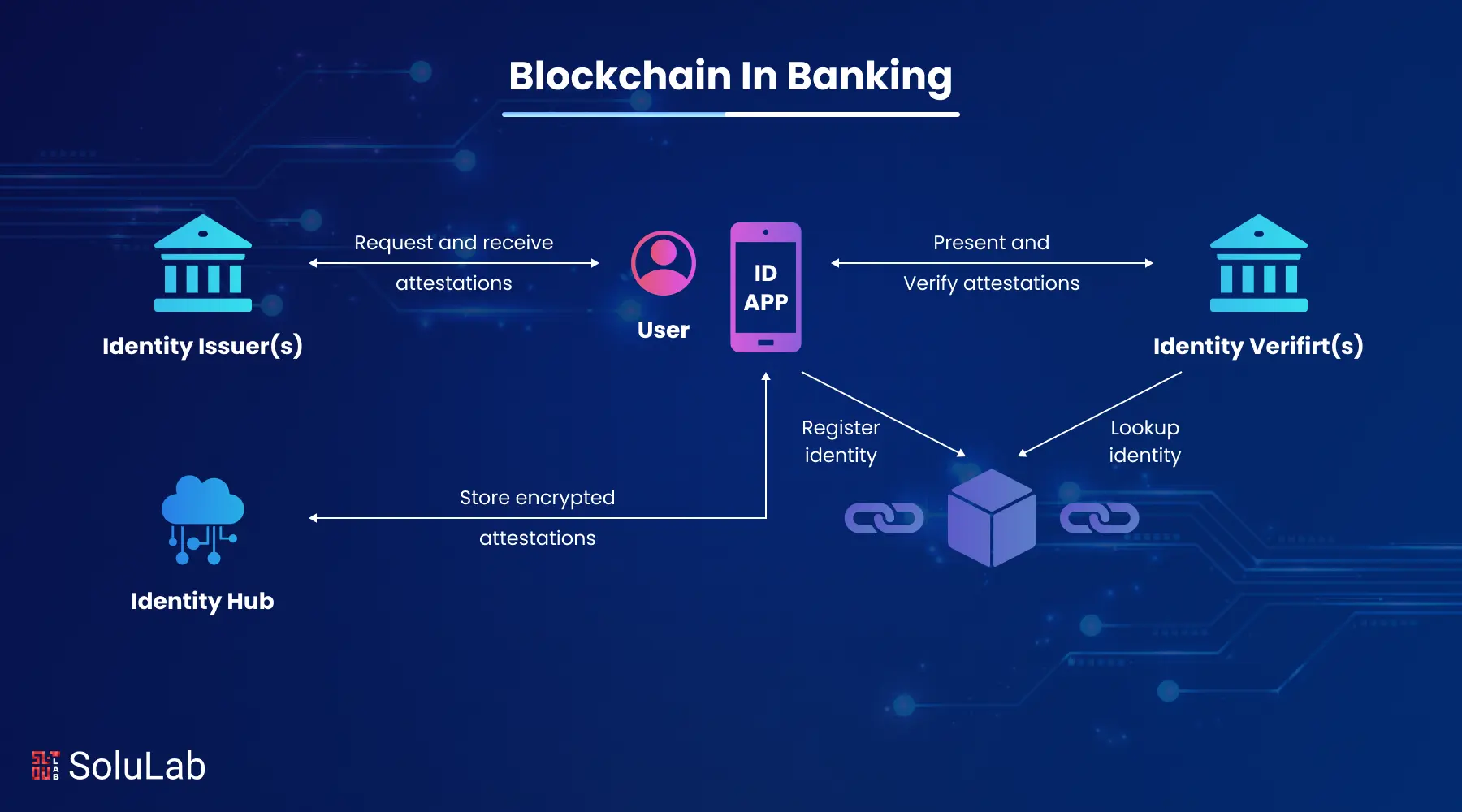
Blockchain in Banking

Traditional banking systems are often slow, expensive, and heavily dependent on intermediaries. Whether it’s cross-border payments taking days or the risk of fraud in financial transactions. Blockchain technology is solving these challenges by offering faster transactions, enhanced transparency, and security. It eliminates the need for middlemen. 

Banks now settle payments in real time while reducing costs. Smart contracts automate processes like loan disbursements and KYC, making operations more efficient and trustworthy.

Banks save up to 40% on operational costs, including compliance and document handling, by using blockchain for payments and KYC. In this blog, we’ll break down how blockchain is revolutionizing the banking industry with real-world examples

What is Blockchain in Banking?

Blockchain in banking refers to the use of blockchain technology to improve how banks handle transactions, data storage, and customer verification. At its core, blockchain is a secure, decentralized digital ledger that records transactions in a transparent and tamper-proof way. 

In banking, this means faster money transfers, reduced fraud, lower operational costs, and improved transparency. Instead of relying on multiple intermediaries, blockchain allows banks to complete cross-border payments almost instantly, with real-time tracking and verification. 

It also enhances security through encryption and reduces the risk of data breaches. Additionally, processes like KYC (Know Your Customer) and loan approvals can be automated using smart contracts, making banking more efficient and customer-friendly. 
CTA- 1

Key Implementation Models for Blockchain in Banking

Blockchain technology offers multiple implementation models in banking, each tailored to different levels of control, transparency, and collaboration depending on the use case and security needs.

1. Consortium Blockchains

Consortium blockchains are semi-decentralized networks governed by a group of banks or financial institutions. They offer better scalability and security while maintaining trust among known participants, ideal for shared services like interbank settlements or trade finance.

2. Private Blockchains

Private blockchains are controlled by a single organization, typically used within a single bank. They provide high levels of security, fast transaction speeds, and privacy, making them suitable for internal auditing, customer verification, or loan processing.

3. Public Blockchains

Public blockchains are open to everyone and fully decentralized. While less common in traditional banking due to privacy concerns, they are useful for issuing digital currencies or offering transparent financial services like P2P lending or crowdfunding.

Practical Blockchain Use Cases Reshaping Banking in 2025

Blockchain technology is transforming the banking industry by offering faster, safer, and more efficient solutions. Here are key use cases where blockchain is making a real difference in banking:

1. Cross-Border Payments: Blockchain allows near-instant international transactions with reduced fees and no need for multiple intermediaries. This not only speeds up the process but also brings transparency and real-time tracking to cross-border payments.

2. Fraud Prevention: With its tamper-proof ledger and secure encryption, blockchain helps banks detect and prevent fraud more effectively. It reduces the risk of double spending, data manipulation, and unauthorized access.

3. KYC (Know Your Customer): Banks can store and share verified customer data securely using blockchain. This reduces duplication, shortens onboarding time, and ensures compliance with regulations while improving the overall customer experience.

4. Smart Contracts: Smart contracts automate agreements between parties without human involvement. In banking, they can streamline processes like loan disbursement, insurance claims, and trade finance, ensuring faster and error-free execution.

5. Trade Finance: Blockchain simplifies trade finance by reducing paperwork, minimizing delays, and ensuring transparency across all participants in a trade deal. It allows real-time verification of documents and payments, increasing trust.

6. Syndicated Loans: Managing syndicated loans typically involves multiple banks and lots of paperwork. Blockchain ensures all parties have access to the same up-to-date information, reducing errors, delays, and operational costs.

7. Asset Tokenization: Banks can use blockchain to convert physical assets into digital tokens, making them easier to trade and manage. This opens up new investment opportunities and enhances liquidity in the market.

8. Clearing and Settlement: Traditional clearing and settlement can take days. Blockchain enables real-time or same-day settlement by providing a single source of truth, reducing counterparty risk, and freeing up capital.

Read Also: RWA Tokenization In Traditional Banking
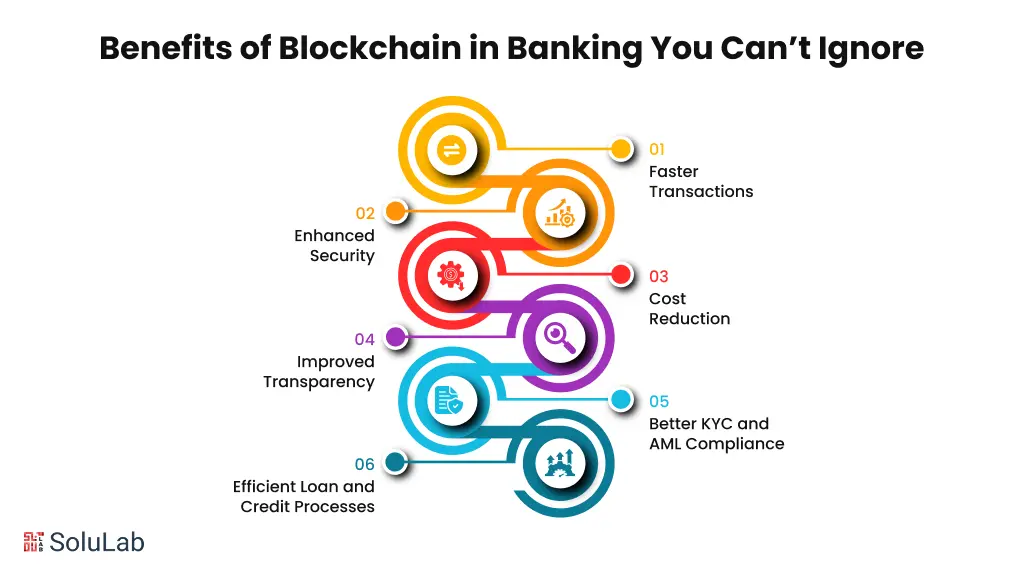
Top Benefits of Blockchain in Banking You Can’t Ignore

benefits of Blockchain in Banking

Blockchain is transforming the banking sector by making financial operations faster, safer, and more transparent. Here’s how it’s benefiting banks and customers alike:

  • Faster Transactions: Traditional banking systems take days for cross-border payments. Blockchain enables real-time or near-instant fund transfers by eliminating intermediaries, reducing settlement time, and increasing efficiency across international and domestic transactions.
  • Enhanced Security: Blockchain records are encrypted and stored across a decentralized network, making it nearly impossible to alter or hack data. This significantly reduces fraud, identity theft, and other security breaches in banking.
  • Cost Reduction: By removing third parties and automating processes through smart contracts, blockchain helps banks save on administrative and processing costs. It streamlines operations like clearing, settlement, and compliance checks.
  • Improved Transparency: Every transaction on the blockchain is recorded and time-stamped, creating an unchangeable audit trail. This builds trust with customers and simplifies regulatory reporting for banks.
  • Better KYC and AML Compliance: Blockchain allows secure sharing of verified customer data among institutions. This reduces duplication in Know Your Customer (KYC) and Anti-Money Laundering (AML) efforts, saving time and ensuring compliance.
  • Efficient Loan and Credit Processes: Smart contracts automate loan approvals, disbursements, and repayments. This speeds up the lending process, reduces paperwork, and minimizes errors or delays in credit evaluation.

Future of Blockchain in Banking

As more banks explore their potential to change the way banking services are provided. Blockchain is expected to become an essential component of the banking system as the need for quicker, safer, and more transparent processes grows. Blockchain will likely be used more often in the upcoming years for digital identity verification, real-time settlements, and cross-border payments. 

To simplify KYC, lower fraud, and save compliance expenses, banks may work together on shared blockchain networks. Smart contracts may further automate processes like trade financing and loan disbursement. Blockchain could be crucial to achieving financial equality. 

This would enable rural and unbanked communities to access banking services safely. Blockchain is anticipated to transition from trials to widespread implementation as laws and technology advance, redefining innovation, efficiency, and trust in the financial industry.

Real-World Examples of Blockchain in Banking

Banks around the world are actively using blockchain to improve operations, security, and reduce costs in real-world applications.

1. JPMorgan Chase – JPM Coin

JPMorgan created JPM Coin, a digital currency used for instant money transfers between institutional clients. It helps speed up transactions, especially for cross-border payments, while ensuring transparency and security using blockchain.

2. ICICI Bank – Blockchain for Trade Finance

ICICI Bank in India has used blockchain to execute trade finance and remittance transactions. This reduces paperwork, speeds up processing, and offers real-time tracking of documentation between exporters and importers.

3. HSBC – Forex Trade Settlement

HSBC uses blockchain to settle billions in foreign exchange trades through its platform “FX Everywhere.” This ensures faster settlements and reduces the need for manual reconciliation between banks.

4. YES Bank – Smart Contracts for Vendor Financing

YES Bank has implemented blockchain-based smart contracts to automate vendor financing. It minimizes delays, reduces fraud, and ensures that payments are released automatically when contract terms are met.

5. SBI – Blockchain Consortium BankChain

State Bank of India is part of the BankChain consortium, using blockchain for KYC, loan processing, and fraud prevention. It improves collaboration among banks and enhances customer verification across institutions.
CTA-2

Conclusion

Blockchain is changing the banking industry by making processes faster, safer, and more transparent. Across the globe, both private and public banks are testing and adopting blockchain. As adoption grows, we can expect more efficient financial systems that benefit both banks and their customers. 

Token World partnered with SoluLab to create a secure, scalable platform for emerging blockchain projects. Solutions included GenAI integration, smart contract auditing, compliance frameworks, and community engagement strategies, boosting investor confidence and delivering seamless token launches with innovative tokenomics and multi-chain interoperability.

Partner with SoluLab, a trusted blockchain development company in the USA, to build secure, scalable, and smart banking solutions.

FAQs

1. Why is it important to implement Blockchain in banking?

Implementing blockchain helps banks streamline processes, improve trust through transparency, reduce fraud risks, and offer more efficient customer services—all while saving costs.

2. Is blockchain secure for banking?

Yes, blockchain uses advanced cryptography and decentralized verification, making it highly secure and tamper-proof compared to traditional systems.

3. Will blockchain replace traditional banking systems?

Not entirely. Instead, it will complement and enhance existing systems by making them more efficient, transparent, and secure over time.

4. How does blockchain affect loan processing?

By automating documentation and verification through smart contracts, blockchain speeds up loan approvals and reduces the chances of fraud or delays.

5. Can blockchain reduce banking fraud?

Absolutely. Its transparent and immutable ledger makes tampering nearly impossible, reducing the risk of internal and external fraud.

 

Time to Reimagine Financial Sector with Four Pillars – AI, ML, IoT, and Blockchain

Table of Contents

[fusion_builder_container hundred_percent="no" equal_height_columns="no" menu_anchor="" hide_on_mobile="small-visibility,medium-visibility,large-visibility" class="" id="" background_color="" background_image="" background_position="center center" background_repeat="no-repeat" fade="no" background_parallax="none" parallax_speed="0.3" video_mp4="" video_webm="" video_ogv="" video_url="" video_aspect_ratio="16:9" video_loop="yes" video_mute="yes" overlay_color="" video_preview_image="" border_size="" border_color="" border_style="solid" padding_top="" padding_bottom="" padding_left="" padding_right=""][fusion_builder_row][fusion_builder_column type="1_1" layout="1_1" background_position="left top" background_color="" border_size="" border_color="" border_style="solid" border_position="all" spacing="yes" background_image="" background_repeat="no-repeat" padding_top="" padding_right="" padding_bottom="" padding_left="" margin_top="0px" margin_bottom="0px" class="" id="" animation_type="" animation_speed="0.3" animation_direction="left" hide_on_mobile="small-visibility,medium-visibility,large-visibility" center_content="no" last="no" min_height="" hover_type="none" link=""][fusion_text] Today, complex financial operations have become easier with smart technology. Financial industry is one of the industries that has been majorly impacted by the influence and implementation of technology. However, technologies have been changing the way financial sectors have been operating and delivering financial services to their customers. Combination of technology and financial sector sounds a little vague without getting deeper into details, doesn’t it? So, how exactly smart technologies such as artificial intelligence (AI), internet of things (IoT), blockchain and machine learning (ML) can benefit financial sector? This article discusses about how AI, IoT blockchain in financial sector have been providing a strong pillar for finance along with machine learning too. Finance sector has always been demanding more from the company, more from the government, more from the customer. Why is this? This is because of the inefficiency or challenges faced by the finance sector to balance the demand and supply or maintain a smooth cash flow. AI IoT Blockchain ML in Financial sectors Connecting AI and IoT for financial services provide enhanced interoperability between all financial operations and provide a better sharing of data and information.
According to Mckinsey, with blockchain based platforms and IoT, the financial sector is estimated to make an economic revenue generation of USD 11.1 trillion by 2025.

AI, IoT, Blockchain in Financial sector, along with ML 

Machine Learning

Machine learning is a scientific approach of complex algorithms that use statistical models to improve the performance of a particular task. Using machine learning and predictive analysis, financial sectors can operate efficiently. With predictive analytics, financial companies can make a useful report of the outcomes of the potential future. This prediction is arrived with the help of the current data influenced by current operations and transactions. ML in finance The current business performance is also an important factor used to predict the future outcomes of a financial operations or transaction. Not every outcome is easy to predict though. This is not a fortune teller. Machine learning uses mathematical models, statistical models that gather current data and plots a pattern between the inter-related data. From the inter-related data, the models built provide potential outcomes for the specific operation for which the prediction model was built. This outcome is used to make better, more efficient and smarter decisions in terms of saving money, making smarter investments, identifying investment mistakes, accomplishing a balanced demand and supply.

Artificial Intelligence

One of the major issues faced in the financial sector is financial crimes such as money laundering, illegal transfers, fake claims, etc. With the help of artificial intelligence, fraud detection in financial sectors can be enhanced. Detection of fraudulent activities and mal-practices can be identified easily. This is possible by feeding red alert data into the artificial intelligence supercomputer. AI in finance For example, say two individuals are trading inside information via SMS. This critical information is fed into the supercomputer in such a way that the super computer constantly keeps searching all phone communications and text messages with the location boundaries set within the AI system. Further, when the supercomputer comes across any conversation or SMS that contains tags similar to the critical information or red alert data fed in the super computer, a red alert message or notification is sent to the concerned person. Then, the concerned personnel can take appropriate necessary action even before the malpractice could occur. This puts a full stop to many financial mal-practices.

Internet of Things

Internet of Things connects different smart devices together. This in turn increases the operating efficiency by enhancing the interoperability between devices. Now, what would happen if the internet of things is built to go beyond a device and enhance the interoperability between the two departments. Imagine, what if the internet of things is built to go beyond departments and increase the interoperability between different financial institutions across countries. Wouldn’t that be an apple for the eye? IoT in Finance Yes, with IoT, it is possible to interconnect devices  across departments to efficiently share data and information. Also, with the help of internet of things, financial institutions can verify data in real-time. One can track transactions of payments made and payments to be received in real-time. For example, now put all the above-mentioned features of internet of things in online banking. It would allow the user as well as the financial institution to track payments in real-time. This ensures that the end user receives the payment on time and the person who sent it does not become a victim of financial theft too. With the internet of things, security and privacy is enhanced for all operations and transactions. In addition, one can monitor data anytime, anywhere.

Blockchain

Blockchain is decentralized platform that operates with no central authority or a third-party service. Thus, there is no middlemen between the seller and the buyer. Both the parties can directly connect with each other anytime , anywhere for any operation to transact any amount they agree upon. Hence, blockchain also provides an environment of freedom for the financial sector. Since the number of middlemen interference is reduce, the costs of transaction also reduce. Also, there is no extra charge levied on the user for using blockchain services too. Moreover, blockchain also stores the financial data with high-encryption. Each data holder is given a unique decryption key. Without this key, no data can be decrypted. Thus, the financial data is protected, secured and safe. This increases a sense of trust between the parties with enhanced transparency.
Read More: Top 5 Hyperledger blockchain development companies in Los Angeles

Signing off: AI, IoT, blockchain and ML in financial sector will bring revolution

Undoubtedly, all these technologies are used vividly. And, why not? They offer the possibility to achieve goals and accomplish financial tasks and transactions in a timely manner. These four pillars help financial institutions to resolve customer queries and requests. Also, they allow the financial sector as a whole to make smarter decisions and make smarter investments. This, in turn, would help all industries that depend on the financial sector too. What other ways do you think that AI, IoT, Blockchain in financial sector along with ML will benefit the entire industry? [/fusion_text][/fusion_builder_column][/fusion_builder_row][/fusion_builder_container]

How Could Blockchain Technology Change Finance?

Blockchain in Finance

With a substantial increase in recent times, the cryptocurrency market has reached a valuation of trillions of dollars. A significant portion of this success can be attributed to the potential applications of the underlying blockchain technology. Given that blockchain emerged alongside digital currencies, it comes as no surprise that its applications in the financial sector hold great promise.

In essence, blockchain in financial services can be understood as a decentralized ledger that records transactions. For financial service providers, this technology has the potential to facilitate faster and more cost-effective transactions, automate contracts, and enhance security. While blockchain technology has yet to achieve widespread adoption, several financial institutions are already leveraging its capabilities.

What are the Benefits of Blockchain in Finance?

The Ethereum blockchain transforms business networks, shared operating models, and processes in banking and finance, resulting in increased openness, inclusivity, security, efficiency, reduced costs, and novel products and services. It facilitates the issuance of digital securities within shorter timeframes and at lower unit costs, enabling greater customization. This customization aligns digital financial instruments with investor demands, expanding the investor market, minimizing costs for issuers, and mitigating counterparty risk. Over the past five years, the technology’s maturation for enterprise-grade applications has showcased these advantages:

  • Security: Ethereum’s distributed, consensus-based architecture eliminates single points of failure and minimizes the need for intermediaries, resulting in a tamper-proof and hack-resistant platform. It enables the creation of secure applications that are immune to fraud and malicious third-party interference.
  • Transparency: Ethereum operates on shared standards, protocols, and processes, acting as a single, centralized source of truth for all network participants, promoting transparency and trust.
  • Trust: The transparent and immutable ledger facilitates collaboration, data management, and agreement reaching among various parties in a business network, enhancing trust and fostering efficient operations.
  • Programmability: Ethereum supports the development and execution of smart contracts, which are tamper-proof and deterministic software that automates business logic, leading to increased trust and efficiency.
  • Privacy: Ethereum offers market-leading tools for granular data privacy across all software stack layers, enabling selective data sharing in business networks. This approach significantly improves transparency, trust, and efficiency while preserving privacy and confidentiality.
  • High Performance: Ethereum’s private and hybrid networks are designed to handle hundreds of transactions per second and periodic network activity surges, ensuring consistent performance.
  • Scalability: Ethereum facilitates interoperability between private and public chains, providing each enterprise solution with the global reach, resilience, and integrity of the main net.

A new report from Jupiter Research predicts that blockchain in finance deployments will allow banks to achieve significant cost savings in cross-border settlement transactions. The report suggests that banks could save up to $27 billion by 2030, representing a reduction in costs of over 11%. Ethereum, in particular, has already proven its potential to disrupt the industry, delivering cost advantages of over 10 times compared to traditional technologies. Financial institutions recognize that distributed ledger technology has the potential to save billions of dollars for banks and major financial institutions over the next decade.

How Does The Digitization of Financial Instruments Impact Finance?

The digitization of financial instruments, including digital assets, smart contracts, and programmable money, propels the advantages of blockchain to new heights. It enables unparalleled levels of connectivity and programmability among products, services, assets, and holdings. These digitized instruments will revolutionize the operations of commercial and financial markets, establishing a paradigm shift where value is generated at every touchpoint. Digital financial instruments provide businesses with the following benefits:

1. Authenticity and Scarcity: Digitization ensures data integrity, establishing a single source of truth for asset provenance and full transaction history.

2. Programmable Capabilities: Governance, compliance, data privacy, identity (KYC/AML attributes), system incentives, and stakeholder participation features can be integrated within the digital assets.

3. Streamlined Processes: Enhanced automation increases operational efficiency, enabling real-time settlement, audit, and reporting, and reducing processing times, errors, and delays.

4. Economic Benefits: Automated and efficient processes lead to decreased infrastructure, operation, and transaction costs.

5. Market Reactivity: Digital securities offer greater customization than standardized securities and can be issued quickly, allowing issuers to create tailored financial instruments that meet investor demand.

6. New Products and Markets: Digital asset tokenization enables secure, scalable, and rapid asset transfers, fractionalized ownership of real-world assets, tokenized micro-economies, and more.

By combining these benefits, governance systems become more transparent and accountable, business models become more efficient, incentive alignment among stakeholders improves, liquidity increases, the cost of capital decreases, counterparty risk is reduced, access to a broader investor and capital base is granted, and the door is opened to all other digital financial instruments.

Blockchain in FinTech Case Study

Uses For Blockchain In The Financial Services Industry

Of the numerous applications of blockchain in finance, a few key uses include:

  • Secure and Efficient Money Transfers: Facilitate fast, secure, and low-cost cross-border and domestic money transfers.
  • Enhanced Transaction Security: Offer an immutable ledger system, ensuring the integrity and security of financial transactions.
  • Automated Smart Contracts: Enable the creation of self-executing contracts, reducing the need for intermediaries and streamlining processes.
  • Secure Customer Data Storage: Provide a decentralized and tamper-proof platform for storing sensitive customer data, enhancing privacy and security.

Let’s delve deeper into how financial institutions could integrate blockchain technology to address the aforementioned scenarios and explore the potential motivations driving their adoption.

1. Money Transfers: Blockchain financial services, beginning with Bitcoin, was created to facilitate fund transfers between two parties (point A to point B) without the need for a central authority. As blockchains have developed, they’ve enabled faster and more cost-effective transactions. A notable example is Ripple, a company that utilizes blockchain for financial services for RippleNet, a global payments network. RippleNet processes transactions within five seconds, with a minimal cost of a fraction of a cent. Financial institutions leveraging blockchain technology can offer more efficient money transfer services. International money transfers that could take hours or days using traditional methods can now be completed in seconds at a fraction of the cost.

2. Enhanced Transaction Security: Financial institutions are frequently targeted by fraudulent activities. Digital payments, in particular, pose the risk of information theft during the transaction process as they pass through payment processors and banks. blockchain in the financial industry leverages cryptographic algorithms to process and record transaction blocks. This cryptography offers a potential solution for financial companies to mitigate risks associated with transaction processing.

3. Automated Smart Contracts: The introduction of Ethereum in 2015 marked a significant milestone in blockchain in the financial industry. It was the first blockchain to incorporate smart contracts, which are self-executing contracts triggered when predefined conditions are met. Contracts play a crucial role in the financial services industry, and companies allocate substantial resources to their management. Self-executing smart contracts have the potential to streamline this process significantly. For instance, an insurance company could utilize smart contracts to expedite the claims process. Upon a client’s claim submission, it would be automatically reviewed by the codes programmed into the blockchain for financial services. If the claim is deemed valid, the smart contract will execute and initiate payment to the client.

4. Customer Data Storage: To prevent fraud and money laundering, most financial organizations must conduct identity verification processes with their clients. While this process is vital for business integrity, it can be time-consuming and costly. An alternative solution is to leverage blockchain technology with AML monitoring software to store customer data securely and transparently. When a company completes the Know-Your-Customer (KYC) process with a new client, it can add the client’s data to the financial services blockchain. Subsequently, other financial institutions can utilize this KYC data rather than repeating the process independently. This approach not only streamlines the process for financial companies but also reduces the burden on clients, eliminating the need for multiple KYC processes for different financial accounts.

How Does Blockchain Impact Different Industries of Finance

Blockchain Impact on Different Industries of Finance

Before delving into the specific industries that can benefit from blockchain technology, let’s briefly explore the foundational concepts and benefits of blockchain.

Capital Markets

Capital markets are a platform for issuers seeking capital to connect with investors who have the appropriate risk and return profiles. Raising capital can be challenging for issuers, including entrepreneurs, startups, and large organizations. Firms must navigate increasingly stringent regulations, longer time to market, interest rate volatility, and liquidity risk. Emerging markets face additional challenges, such as a lack of rigorous monitoring, comprehensive regulation, and sufficient market infrastructure for issuing, settlement, clearing, and trading.

Blockchain for financial services offers several benefits for capital market use cases, including:

  • Eliminating single points of failure through decentralized utilities.
  • Streamlining capital market activities, reducing costs, and decreasing settlement times.
  • Digitizing processes and workflows, reducing operational risks, such as fraud, human error, and overall counterparty risk.
  • Digitizing or tokenizing assets and financial instruments, making them programmable and easier to manage and trade. Tokenization also broadens market access through increased connectivity and the possibility of fractionalized ownership, resulting in increased liquidity and reduced cost of capital.

Asset Management

In the face of rising demands for enhanced liability risk management, more agile decision-making frameworks, and navigating the complexities of evolving regulations, venture capital firms, private equity firms, real estate funds, and specialty markets are turning to blockchain in finance industry for innovative solutions. Blockchain’s capabilities can effectively streamline asset and stakeholder management, offering a range of benefits:

  • Automated Fund Launch: Streamlined and efficient fund launch processes.
  • Seamless Stakeholder Engagement: Digitized assets and services facilitate seamless stakeholder engagement.
  • Digitization of Portfolio and Holdings: Wider market access, enhanced liquidity, and fractionalization of assets through digitization.
  • Customizable Privacy Settings: Built-in privacy features ensure transaction confidentiality.
  • Programmable Rights and Obligations: Voting and shareholder rights and obligations embedded in digital assets for enhanced user experience and reduced human error risks.
  • Incentive Mechanisms: Creation and enforcement of incentive mechanisms to encourage participation and deter unethical activities.
  • Improved Governance and Transparency: Enhanced governance and transparency for investors and stakeholders.
  • Efficient Cap Table Management: Streamlined and efficient management of cap tables.
  • Automated Fund Administration: Automated fund administration processes for increased efficiency.
  • Automated Transfer Agency: Automated transfer agency services for seamless asset management.

Global Payments And Remittances

In today’s world, global payments and remittances involve numerous intermediaries charging fees for their services. Sending $200 internationally can take 2 to 7 days and cost an average of 6.94%, resulting in a $48 billion reduction in remittances due to fees and intermediaries. Blockchain financial services has the potential to streamline payment and remittance processes, reducing settlement times and significantly lowering costs.

Here are some of the potential benefits of using blockchain for payments and remittances:

  • Rapid and secure domestic retail payments
  • Rapid and secure domestic wholesale and securities settlement
  • Rapid and secure cross-border payments
  • Real-time gross settlement between central banks, commercial banks, and independent banks
  • Digitized KYC/AML data and transaction history, reducing fraud risks and enabling real-time authentication
  • Automated regulatory oversight and auditing
  • Multiple forms of payment-enabled on the blockchain, including tokenized fiat, stablecoins, and cryptocurrencies

Banking and Lending

Core banking services encompass transactions, loans, mortgages, and payments, many of which depend on traditional execution processes. For example, it takes 30 to 60 days for individuals to secure a mortgage and 60 to 90 days for small and medium enterprises to obtain a business loan due to processes such as information verification, credit scoring, loan processing, and funds distribution.

Blockchain technology can revolutionize banking and lending services by streamlining processes, minimizing counterparty risk, and reducing issuance and settlement times. It offers several key benefits:

  • Authenticated documentation and KYC/AML data: Financial services blockchain enables real-time verification of financial documents, reducing operational risks and allowing for instant verification.
  • Streamlined credit prediction and credit scoring markets: By instantaneously gathering user activity and authorized data across a network, blockchain in financial services can improve credit prediction and credit scoring processes.
  • Automated syndicate formation, underwriting, and disbursement of funds: Blockchain can automate processes such as syndicate formation, underwriting, and disbursement of funds, including principal and interest payments, reducing costs, delays, and friction associated with syndication.
  • Facilitated collateralization of assets: The digitization of assets through blockchain enables real-time asset management, tracking, and enforcement of regulatory controls, facilitating asset collateralization.

Trade Finance

Trade finance encompasses the infrastructure, processes, and funding that facilitate international trade supply chains. However, the industry heavily relies on paper-based processes, which are prone to security vulnerabilities and lengthy transaction times, often taking 90-120 days to process letters of credit, verify documents, and establish trust among stakeholders. Blockchain technology has the potential to upgrade trade finance by digitizing the entire trade finance lifecycle, enhancing security, and improving efficiency. It can enable increased transparency in governance, reduced processing times, lower capital requirements, and mitigate risks associated with fraud, human error, and overall counterparty risk.

Specifically, blockchain can facilitate the following advancements in trade finance:

  • Digitized and authenticated documentation, such as letters of credit and bills of lading, as well as KYC/AML data, with real-time verification of financial documents.
  • Asset digitization to expedite settlement times.
  • Creation of more efficient financing structures through shared secure networks and digitized processes.
  • Establishment of a consistent financing vehicle throughout the entire trade lifecycle, eliminating the traditional practice of negotiating independent finance vehicles for each stage of the trade.

Insurance

In property and casualty insurance, fraud is a prevalent concern, and claim assessments often take an extended duration. Blockchain technology offers a solution by securely streamlining data verification, claim processing, and disbursement, resulting in significantly reduced processing times. Here are the key benefits:

  • Secure Data Verification: Authentic documentation and KYC/AML data are stored on the blockchain, reducing the risk of fraud and facilitating efficient claim assessments.
  • Automated Claims Processing: Smart contracts automate claims processing, eliminating manual intervention and ensuring accuracy and efficiency.
  • Parameterized Contracts: Automated parameterized contracts are used to trigger payments upon the occurrence of specific risks, ensuring prompt and seamless claim settlements.
  • Automated Disbursement: Insurance payments are automatically disbursed through the blockchain in financial services, ensuring timely and secure transfer of funds to policyholders.
  • Tokenized Reinsurance Markets: Tokenized reinsurance markets facilitate policy reinsurance in open marketplaces, moving away from traditional broker-based and relationship-driven systems.

Financial Services Industry

Blockchain technology has the potential to revolutionize the financial services industry by offering several compelling advantages. Here are the main benefits of blockchain in finance:

  • Efficient Payment Processing: Blockchain enables fast and cost-effective payment processing, with transactions settling in seconds and fees as low as $0.01. This can result in significant cost savings for both financial institutions and their customers.
  • Reduced Costs in International Transactions: Blockchain deployments are projected to save banks a substantial amount of money on cross-border transactions, potentially reaching $27 billion by the end of 2030.
  • Secure Recordkeeping and Reporting: Blockchain provides a distributed and tamper-proof record of transactions, allowing financial institutions to use it for recordkeeping and regulatory reporting, ensuring compliance and transparency.
  • Accelerated Financial Services: The rapid settlement capabilities of blockchain can enhance various financial services. Lenders can fund loans more swiftly, vendors can receive payments sooner, and stock exchanges can settle securities transactions almost instantaneously.
  • Improved Risk Management: The immutability of blockchain records enables more effective risk management in finance. Financial institutions can use blockchain to accurately track and monitor transactions, reducing the risk of fraud and errors.

Challenges Of Implementing Blockchain For Financial Companies

Implementing blockchain in the financial industry presents several challenges:

  • Widespread Adoption Requirement: Blockchains need widespread adoption for optimal performance. This is particularly significant in financial services, where numerous companies collaborate and require a shared transaction handling method. For instance, to transfer funds using blockchain, all participating banks must have adopted the technology.
  • Lack of Interoperability: Different blockchains often lack interoperability, hindering communication between them. To address this, several blockchain networks focused on interoperability solutions, such as Polkadot, are under development.
  • High Cost and Time Investment: Switching to blockchain technology can be expensive and time-consuming, especially due to the scarcity of skilled blockchain developers. Smaller finance companies in particular may hesitate to commit to overhauling existing systems.
  • Immutable Data: While the immutability of blockchain data is an advantage, it also poses challenges for financial companies that frequently need to modify stored data. Implementing blockchain would require these companies to adjust their methodologies.
  • Regulatory Uncertainty: Given the nascent and rapidly evolving nature of blockchain technology, regulators have yet to catch up. Governments are likely to establish policies that impact blockchain and the companies that use it.

Blockchain Solutions

Conclusion

In conclusion, the transformative potential of blockchain in finance is immense. By leveraging blockchain for financial services, the industry can achieve unparalleled levels of transparency, security, and efficiency. The adoption of blockchain in financial services is set to revolutionize traditional banking, insurance, and investment sectors, paving the way for blockchain financial services to become a cornerstone of the modern financial ecosystem. Financial services blockchain solutions offer significant benefits, including reduced fraud, lower costs, and faster transactions. As the blockchain in finance industry continues to evolve, it is clear that blockchain in the financial industry will play a pivotal role in shaping its future.

Companies like SoluLab are at the forefront of this transformation, providing cutting-edge solutions for blockchain and financial services. Their expertise in blockchain technology in finance ensures that businesses can seamlessly integrate blockchain into their operations, enhancing their capabilities and competitiveness. As we look to the future, the collaboration between finance and blockchain will continue to grow, driving innovation and creating new opportunities in the blockchain finance industry. The synergy between blockchain fintech and traditional finance promises a dynamic and resilient financial landscape, underscoring the critical role of blockchain finance in driving progress and prosperity.

FAQs

1. What is the role of blockchain in finance?

Blockchain in finance provides a secure, transparent, and efficient method for recording and verifying transactions, reducing fraud and operational costs.

2. How does blockchain for financial services improve security?

Blockchain for financial services enhances security by using cryptographic methods to protect transaction data, making it tamper-proof and resistant to unauthorized access.

3. What are the benefits of using blockchain in financial services?

The benefits of using blockchain in financial services include faster transaction times, reduced costs, improved transparency, and enhanced security.

4. How are blockchain financial services transforming traditional banking?

Blockchain financial services are transforming traditional banking by streamlining processes, reducing the need for intermediaries, and increasing transaction speed and accuracy.

5. What impact does blockchain technology have on the financial services blockchain?

Blockchain technology significantly impacts the financial services blockchain by providing a decentralized ledger that ensures transparency and security, thereby increasing trust in financial transactions.

6. How is blockchain in the finance industry driving innovation?

Blockchain in the finance industry drives innovation by enabling new financial products and services, such as decentralized finance (DeFi), smart contracts, and real-time cross-border payments.

7. Why is blockchain fintech considered a game-changer for the finance sector?

Blockchain fintech is considered a game-changer for the finance sector because it offers innovative solutions that enhance efficiency, reduce costs, and open up new avenues for financial inclusion.
