Talk to an Expert

Why AI Smart Contracts Are the Future of Business?

AI Smart Contracts

Traditional smart contracts are based on fixed rules. They do what they’re told, nothing more. But modern businesses need more than that. They need smart systems that can adapt, predict, and respond automatically. So, businesses are combining AI and smart contracts to build faster, smarter, and more flexible systems.

These new-age contracts bring together the power of blockchain and artificial intelligence. You gain self-operating agreements that can think, learn, and make decisions based on live data, giving your business a competitive edge in speed, efficiency, and accuracy.

82% of businesses using AI-powered automation report a reduction in operational costs of at least 25% within a year.

If you’re a growing business looking for smarter, scalable systems, AI-based smart contract automation might be exactly what you need. Let’s begin!

What Are AI Smart Contracts?

A smart contract is like a digital agreement that runs automatically on a blockchain. It follows set rules and executes actions like sending payments, without needing human input once it’s live. 

An AI smart contract is a smart contract enhanced with AI algorithms. This means it can learn from data, understand patterns, and make decisions on its own, just like a human would, but faster and without errors.

Unlike basic smart contracts that can only do what they’re told in advance, AI-powered smart contracts can adapt in real time. They process live data, make sense of changing conditions, and respond automatically. 

Example: Citi used AI-powered smart contracts in 2023 to automate trade finance with Maersk and the Panama Canal Authority. Payments were auto-triggered on shipping milestones, cutting manual work and saving hundreds of thousands in fees.

How Are Traditional Smart Contracts Different from AI Smart Contracts?

Most businesses today use traditional smart contracts, which are rule-based programs on a blockchain. They only follow pre-written instructions. Once deployed, they can’t adapt or change unless someone updates the code manually. This makes them reliable, but not flexible.

Now, compare that with AI smart contracts; they are smarter, more adaptive, and data-driven. By combining machine learning, natural language processing (NLP), and real-time analytics, AI contracts can learn from data, make predictions, and even adjust themselves based on new inputs. Here’s a simple table to show the key differences:

Feature Traditional Smart Contracts AI Smart Contracts
Logic Type Predefined, rule-based Dynamic, learning-based
Ability to Adapt No Yes (automated decision-making)
Use of Real-Time Data No Yes
Intelligence Level Basic, fixed Advanced (can interpret & learn)
Example Use Case Fixed rental payments Dynamic pricing or insurance claim automation

With AI smart contracts, your business can benefit from automation that thinks. These contracts can read data, understand behavior patterns, and act accordingly, saving time, reducing errors, and increasing efficiency.

If you’re considering adding this level of intelligence to your blockchain systems, it’s smart to partner with an experienced AI development company that understands both AI and blockchain infrastructure.
How Does AI Improve Blockchain Smart Contracts?

AI in Blockchain Smart Contracts

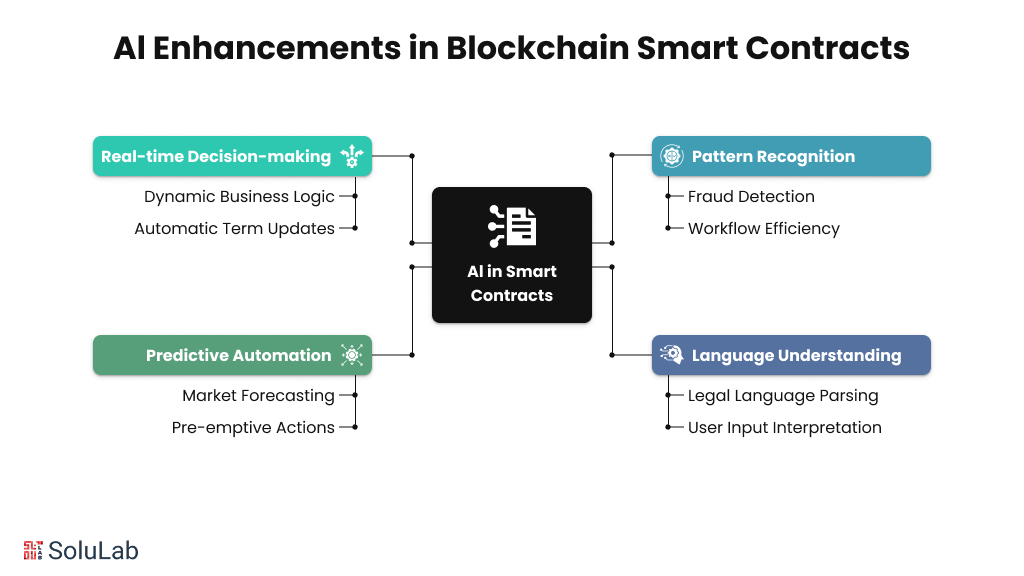
AI is more than just a trend; it makes smart contracts smarter and more useful for businesses. Here’s how AI smart contract development services can enhance blockchain solutions:

1. Real-time decision-making:

  • Reacts instantly to changing data
  • Updates contract terms automatically
  • Enables dynamic business logic

2. Pattern recognition:

  • Detects fraud and suspicious activity
  • Identifies inefficiencies in workflows
  • Flags unusual transaction trends

3. Language understanding:

  • Parses complex legal language 
  • Interprets user inputs accurately
  • Supports automated contract reviews

4. Predictive automation:

  • Forecasts market movements
  • Automates pre-emptive actions
  • Reduces manual interventions

This combination is especially powerful in AI in DeFi smart contract management, where fast market changes need flexible contracts. If you’re wondering how to integrate AI with smart contracts, our experienced AI smart contract development company is here to guide you step-by-step.

CTA- 1

Why Should Your Business Invest In AI Smart Contract Development?

With AI smart contracts, companies gain more control, better decision-making, and smarter automation, all without needing to constantly rewrite the code. There are multiple benefits of AI-powered smart contracts for businesses:

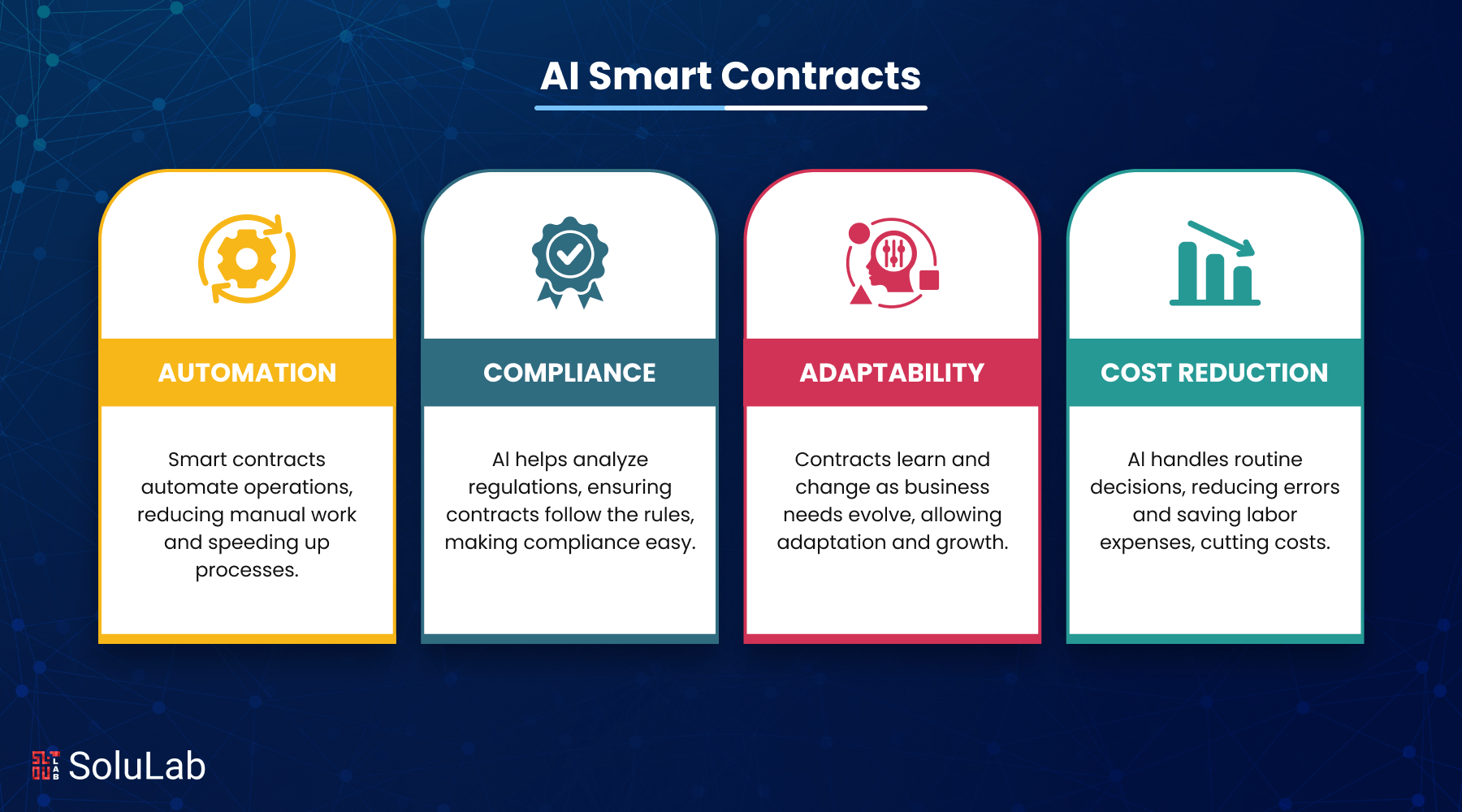
  • Automate operations with smart contracts that reduce manual work and speed up processes.
  • Cut costs by letting AI handle routine decisions, reducing errors, and saving labor expenses.
  • Stay compliant easily, as AI helps analyze regulations and ensures your contracts follow the rules.
  • Adapt and grow with contracts that learn and change as your business needs evolve.

This is how smart businesses stay competitive in today’s fast-moving digital world.

Read Also: Top 10 Smart Contract Development Companies in 2025
Which Industries Are Already Using AI Smart Contracts?

Industries Using AI Smart Contracts

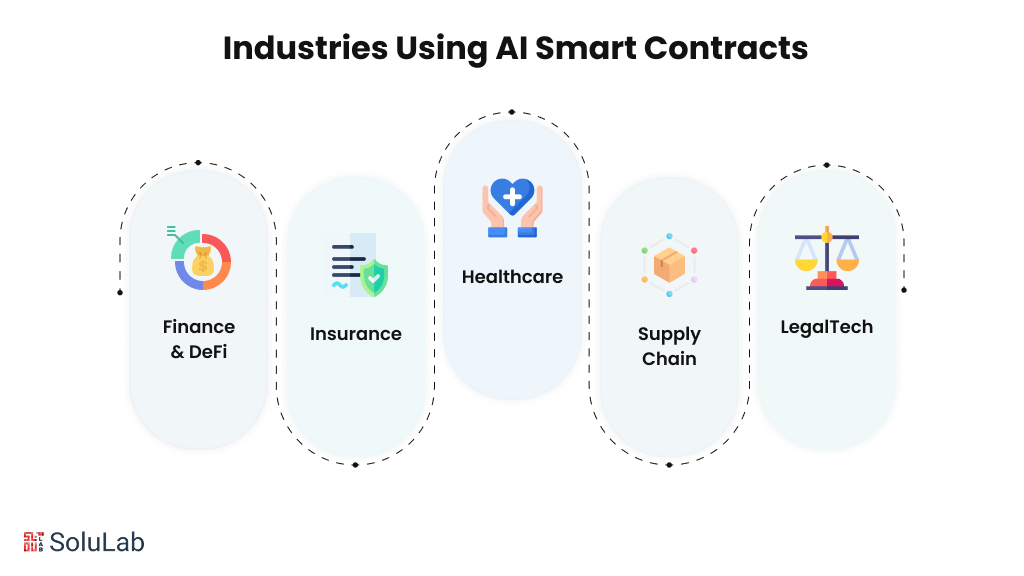
Many industries are quickly adopting AI smart contracts to automate tasks, cut costs, and improve accuracy. Here are some real-world examples showing where these technologies make a big difference:

1. Finance & DeFi

In finance, especially in DeFi smart contract management, AI smart contracts are used for things like automatic loan approvals, credit scoring, and fraud detection.

Example: Celsius Network uses AI combined with smart contracts to offer personalized loan rates and automate loan handling. This reduces risks and speeds up transactions.

2. Insurance

The insurance industry benefits from AI-based smart contract automation by automatically approving claims once AI verifies the documents.

Example: Etherisc uses AI-powered blockchain smart contracts to quickly process claims, reducing manual work and errors.

3. Healthcare

Healthcare providers use blockchain smart contracts with AI to manage patient consent and control data access safely, while following privacy rules.

Example: Medicalchain blends AI and smart contracts to let patients control who sees their medical records, improving security and transparency.

4. Supply Chain

In supply chains, AI smart contracts help with smart routing and demand forecasting to make deliveries faster and reduce waste.

Example: IBM Food Trust uses AI and blockchain smart contracts to track food supplies in real time, making sure products are safe and high quality.

5. LegalTech

Legal technology companies use AI smart contract automation to create contracts that can adjust to new data and help understand complex agreements.

Example: Hyperstart offers AI-powered smart contract templates that update automatically, speeding up contract management and reducing errors.

Why Your Business Needs AI Smart Contracts?

Today’s digital world moves fast, and your business needs tools that keep up. AI smart contracts let you:

  • Quickly adapt to changing market conditions and business needs
  • Build stronger trust with clear, transparent processes
  • Future-proof your operations with flexible, smart automation

Working with the right partner, like an AI smart contract development company USA, means your contracts are not just smart, they’re secure, scalable, and built to last. Plus, a thorough AI smart contract audit ensures your system stays safe and reliable as it grows.
CTA-2

Conclusion

AI is not the future anymore; it is the present of blockchain technology. Businesses that use AI-powered smart contract solutions gain a real advantage by automating processes, improving decisions, and moving faster than their competitors. If your business wants to stay ahead, our AI in Web3 Development can help you get started right away.

SoluLab, a leading smart contract development company in USA, can render you the best services for AI integration in your business operations. We have worked with numerous businesses to boost their businesses with automation and AI. One such project is Digital Quest, a travel business that partnered with SoluLab to create an AI-powered chatbot for enhanced engagement and travel recommendations.

AI smart contracts are already changing how industries work. Why wait to be left behind when you can lead the change? Contact us now!

FAQs

1. What are AI smart contracts?

AI smart contracts are blockchain contracts powered by artificial intelligence. They don’t just follow fixed rules; they can learn and adapt automatically to improve automation and decision-making for businesses.

2. What is an AI smart contract audit, and why is it important?

An AI smart contract audit is a thorough check of AI-enabled smart contracts to ensure they are secure, reliable, and error-free. Audits help businesses avoid costly bugs and vulnerabilities before deployment.

3. How do Blockchain Smart Contracts differ from AI smart contracts?

Blockchain Smart Contracts typically run on fixed rules that execute predefined tasks. In contrast, AI smart contracts add intelligence by using data to make adaptive, real-time decisions, making them more flexible and powerful.

4. How do I hire AI smart contract developers?

To hire AI smart contract developers, look for experts skilled in both blockchain coding and AI technologies. Our agency offers vetted developers who can build secure, efficient, and scalable AI smart contracts tailored to your needs.

5. Why should I choose an AI smart contract development company USA?

An AI smart contract development company USA combines local market knowledge with technical expertise, offering reliable and compliant AI blockchain solutions tailored for American enterprises.

 

Top 12 Crypto-Friendly Countries To Watch Out for in 2026

Top Crypto Friendly Countries

How to say crypto is growing? As of 2024, $10.6 trillion plus crypto transactions have happened around the globe. People and institutions are shifting their thoughts and financial system.  Countries are adopting crypto while managing the security and tax laws; this change is for future growth.

Nations like Switzerland, Singapore, and El Salvador are building legal frameworks, infrastructure for crypto adoption. The largest crypto-using nation U.S. growing its bitcoin reserve. Today, more than 560 million people are using crypto across the world. This is why investors are looking for the best crypto-friendly countries to invest in. 

If you are also one of them or someone who wants to explore worldwide opportunities for crypto-friendly solutions, the blog is for you. Let’s begin! 

Why Are Countries Becoming Cryptocurrency-Friendly in 2026?

Globally, countries are adopting crypto to enhance decentralization, innovation, and the economy. In recent years, investors have been eyeing the cryptocurrency-friendly countries due to tax incentives and blockchain infrastructure. Not only these, but the regulations’ clarity and security over customer transactions attract the global traders. 

The governments are supporting crypto investment firms by giving them freedom and offering long-term operational certainty. Although security rules remain strict, the entrepreneurship over crypto is highly encouraged. This creates jobs, financial inclusion, blockchain growth, and a digital global economy.

Top 12 Countries That Are Crypto-Friendly in 2026

This article explores twelve standout countries that are crypto-friendly, offering strong foundations for digital assets businesses. Each country has its own strengths and growth strategies.

Top 12 Countries That Are Crypto-Friendly

1. Switzerland

2. Singapore

3. El Salvador

4. United Arab Emirates (UAE)

5. Portugal

6. Estonia

7. Germany

8. Malta

9. The U.S.A

10. The U.K

11. Canada

12. Hong Kong

Switzerland: Europe’s Crypto Valley

Switzerland leads with precision and trust. Its regulations, precise laws, and innovation-centric mindset create secure digital assets for traders. That’s why a good surge in crypto companies in Switzerland is seen lately.

  • The Crypto Valley in Zug hosts 1,000+ blockchain startups as of early 2026.
  • FINMA provides licensing clarity for ICOs, custody services, and digital exchanges.
  • No capital gains tax on personal crypto holdings supports long-term investors.
  • Swiss banks have offered integrated crypto trading and wallet services since 2023.
  • Switzerland supports Web3 with AI-powered crypto wallet development hubs, attracting crypto investment firms.

Singapore: Asia’s Fintech Beacon

Singapore is known for being one of the crypto-friendly countries with investor protection and secure crypto exchange platforms.

  • The Monetary Authority of Singapore (MAS) introduced legal licensing regulations for crypto exchange firms in 2024. 
  • However, in 2026, MAS made it mandatory for every cryptocurrency dealer.
  • Corporate tax remains low at 17%, attracting blockchain startups from across Asia.
  • Over 400 fintech firms support flash loan bots and MPC wallet tech in 2026.
  • Government-backed sandbox programs help scale AI-integrated crypto wallets.

El Salvador: The Bitcoin Nation

El Salvador is the first country to accept Bitcoin as legal tender. The government has built policies around it to bring stability to the nation’s financial situation. 

  • Bitcoin has been accepted nationwide since 2021; Chivo Wallet has 4.5 million users in 2026.
  • Bitcoin City offers no capital gains, property, or income taxes on crypto earnings.
  • Government bonds are backed by Bitcoin, funding infrastructure, and attracting global capital.
  • The national blockchain curriculum has been taught in public universities since 2023.
  • El Salvador ranks in the top 5 for crypto wallet downloads in Latin America.

United Arab Emirates: The Middle East’s Digital Finance Hub

UAE, particularly Dubai and Abu Dhabi, is leading Web3 adoption through business-friendly policies.

  • VARA licenses over 50 crypto firms as of Q1 2026 in Dubai alone.
  • DMCC hosts over 600 crypto-related businesses in its free zone.
  • Zero income tax and customs duties draw in exchange platforms and wallet developers.
  • UAE’s National AI Strategy integrates smart crypto payment systems in public services.
  • Blockchain tech is used actively in the property, logistics, and finance sectors.

Portugal: A European Crypto Haven

Portugal’s relaxed tax structure makes it ideal for investors and freelancers dealing with digital assets.

  • No VAT or capital gains tax for individual crypto investors (non-professional traders).
  • Lisbon’s blockchain community has grown 40% year-over-year by mid-2026.
  • Digital nomad visa boosts crypto freelancing and remote blockchain work.
  • The government is exploring e-Euro stablecoin pilots through private partnerships.
  • Blockchain associations offer education, wallet development support, and investor programs.

Estonia: Digital-First and Blockchain-Ready

Estonia’s e-residency and digital-first approach make it a hotspot for crypto exchange registrations.

  • Over 3,500 crypto firms have registered via the e-residency platform since 2020.
  • Transparent crypto licenses have been issued under updated AML laws since late 2023.
  • Local firms develop AI Copilot tools to assist with crypto compliance.
  • National e-wallet ID program supports multicurrency wallet integration.
  • Blockchain solutions are used in government e-services, from land records to e-voting.

Germany: Regulated Yet Forward-Looking

Germany offers one of the EU’s most structured yet innovation-friendly crypto ecosystems.

  • Long-term crypto holdings (over one year) are exempt from capital gains tax.
  • BaFin has licensed banks for digital custody services since 2021.
  • Frankfurt is home to multiple blockchain research labs funded by EU grants.
  • The national blockchain strategy includes use cases in identity, finance, and logistics.
  • Web3 educational programs are now included in 25+ universities across the country.

Malta: The Blockchain Island

Malta’s proactive legal frameworks offer transparency and strong protections for crypto ventures.

  • VFAA offers a three-tier licensing system based on service type, including exchanges, custody, and ICOs.
  • MDIA supports blockchain platform audits and certifications to reduce fraud.
  • Tax exemptions on long-term digital asset holdings promote a holding culture.
  • Partnerships with universities help develop talent for crypto wallet security roles.
  • Over 100 blockchain and crypto startups registered between 2022 and 2024.

United States of America: Strategic Crypto Reserve

The United States has over 50 million crypto users and a wide investor base. In the US SEC and CFTC take care of market activity while providing clear regulations and guidelines over digital assets.

  • States like Texas, New York, and Wyoming are leading in regulatory clarity, crypto reserve, and tax incentives. 
  • Access to deep venture capital markets boosts the success of crypto exchanges.
  • Prominent U.S. crypto exchange companies like Coinbase, Kraken, and Gemini shape global trading trends.
  • Advanced AI integration supports smart crypto wallets and arbitrage tools.
  • Regulatory frameworks allow ICOs and asset-backed token offerings under SEC oversight.

United Kingdom: Regulatory Framework

Similar to the U.S., the United Kingdom also has the Financial Conduct Authority (FCA) to look after crypto activity. Since 2023, over 250 cryptocurrency firms have registered the digital asset licensing. 

  • The UK introduced a new rule, from January 1, 2026, crypto companies must collect detailed reports. That should contain the company user’s crypto transaction data. 
  • The FCA Sandbox enables testing of AI-powered crypto wallets and fintech apps.
  • UK initiatives like the Cryptoassets Taskforce focus on long-term blockchain integration.
  • Favorable legal conditions allow crypto investment firms to scale securely.
  • Firms like eToro, Revolut, and Bitstamp thrive under the UK’s flexible licensing norms.

Canada: Uprising Crypto Country

Canada recently developed the stablecoin reserve and positioned itself as one of the crypto-friendly countries in 2026. Currently, more than 6 crypto ETFs trade publicly while maintaining the regulations and security. 

  • All crypto exchanges must register with the Canadian Securities Administrators (CSA) and IIROC.
  • Crypto transactions are taxed as capital gains, bringing clarity to investors.
  • Provinces like British Columbia and Ontario lead in blockchain development and AI wallet innovations.
  • Canada’s cold climate and low-cost electricity attract crypto mining firms from across the globe.
  • Crypto investment firms actively operate in Toronto and Montreal due to regulatory transparency.

Hong Kong: Asia Crypto Riser

Hong Kong regulates the crypto market with the Securities and Futures Commission (SFC). The cryptocurrency firms’ licensing is handled by Virtual Asset Service Providers (VASPs). 

  • Hong Kong’s recent stablecoin bill introduced a regulatory framework to enhance the security and growth.
  • Low taxation policies and ease of business attract international blockchain startups.
  • Strategic location between East and West enhances market access across Asia.
  • Initiatives like the FinTech Innovation Hub foster collaboration in crypto R&D.
  • Success stories like Bitfinex and ANX International showcase strong operational growth in the region.

How to Choose the Right Crypto-Friendly Country?

Selecting the right base for crypto operations depends on multiple factors. Here’s a quick comparison:

Factor Description
Regulatory Clarity Countries like Switzerland, Malta, Singapore, the U.S., and Hong Kong offer well-defined frameworks.
Tax Benefits El Salvador and Portugal offer zero tax on capital gains for individuals.
Government Support UAE, Canada, and Estonia promote crypto through national AI and digital agendas.
Business Setup Ease Estonia allows full remote setup via e-residency.
Financial Infrastructure Germany, Canada, and Switzerland integrate banking with crypto services.
Tech Innovation Singapore, UAE, and Hong Kong push AI-powered wallets and flash bots.
Market Potential El Salvador, the UK, and the UAE offer high adoption rates and institutional interest.

Crypto Development Company

Final Thoughts

2026 is a turning point for crypto enthusiasts, as many countries are providing tax relaxation and adopting crypto for digital payments. The twelve countries mentioned above are laying a strong foundation for the digital economy through the development of blockchain, AI, and cryptocurrency. However, among the mentioned nations, Switzerland is one of the top crypto countries due to high tax relaxations. 

Although the UK and Canada also reserve Bitcoin and include that in employee pensions, they still need a wider strategic plan. Investors must choose the right country to unlock greater profits, opportunities, and potential in the long-term run in the crypto world. 

If you are looking to build a long-term Bitcoin strategy, consider consulting with The Bitcoin Way, a trusted Bitcoin consultancy helping individuals and organizations integrate Bitcoin safely and strategically.

SoluLab, the leading cryptocurrency development company, is here to support you. We offer reliable and secure solutions for crypto businesses across the globe, including the U.S. and Europe. If you are interested in crypto-friendly solutions, contact us today!

FAQs

1. What makes a country crypto-friendly in 2026?

Clear regulations, low taxes, strong infrastructure, and open policies make a country crypto-friendly. Governments now support startups and encourage blockchain.

 2. Why are crypto investment firms choosing countries like Canada and Singapore?

These countries offer legal clarity, tax relief, and strong digital finance ecosystems. Firms also benefit from innovation grants and infrastructure.

3. Is the U.S. still leading in crypto adoption?

Yes, the U.S. leads in users, innovation, and exchange platforms. States like Wyoming offer tax benefits and regulation clarity.

4. Which countries offer zero tax on crypto gains? 

El Salvador and Portugal offer zero tax on individual crypto profits. This attracts investors, traders, and remote blockchain workers.

5. Why is Hong Kong considered a crypto hub in Asia?

 Hong Kong combines low tax, business ease, and strong regulation. Strategic location also gives access to global crypto markets.

6. Can anyone start a crypto exchange in these countries?

Yes, with proper licenses and compliance, anyone can. Countries like Estonia and Malta support global founders via digital systems.

A Beginners Guide To Blockchain-based Wallet And How Do They Work

It’s not so long when we got introduced to cryptocurrencies like Bitcoin, Ethereum, and Ripple. They were the talk of the town even before the people had a proper knowledge about it. The concept of blockchain wallets is still not known by many of us. Both of them are linked and interdependent but different. It is important to understand both the terms to get started working with digital currencies and its investments.  

digital wallet


BLOCKCHAIN WALLETS

Most of us know that blockchain technology is an encrypted system that helps in protecting the information from the third party. In the same way, digital currencies need protection too just like our money in our accounts. Cryptocurrencies cannot make transactions like sell, buy, exchange through normal bank accounts, therefore, it needs blockchain wallets to go ahead with the transactions.

Blockchain wallet is just like a digital wallet, only the difference is that the transactions are made by buying/selling the cryptocurrencies and not with actual money in our banks or wallets. Just like digital wallets give access to make transactions using the money in our banks, the blockchain wallets help to make the transaction through cryptocurrency.  

In simple words, blockchain wallets are needed for making the transactions using cryptocurrencies. Blockchain wallets do not save the information of cryptocurrencies, they record and keep a track of all the transaction of cryptocurrencies like buying, sell, exchange.

HOW BLOCKCHAIN WALLETS WORK?

Blockchain wallets or Cryptocurrency wallets work on a system which stores private and public keys, this system enables the users to make safe and validated transactions while buying, selling, exchanging one or multiple cryptocurrencies.

As mentioned above, blockchain wallets do not save cryptocurrencies. So, the question arises that how are transactions made, and how are cryptocurrencies are sent?

Blockchain wallets save the private and public keys which help in the interaction and exchange of the cryptocurrencies. When one user sends the cryptocurrency, it has a public key assigned and to buy the cryptocurrency, both public and private key(assigned to a specific user) has to match. When both the keys matches, the amount is added from one user and gets deducted from another. Obviously, there is no actual exchange of money or coins are involved. The transaction is visible just in the wallets of the specific users/buyer/seller.

Read more -:  Bitcoins are an acceptable mode of payment….where?

TYPES OF WALLETS

Software Wallets:

Software wallets are the downloadable or accessible systems which can be used through various devices depending on the type for which each one is made for. The software can be used on laptops, desktops, mobile phones depending upon the type of wallet.

Software wallets are further divided into 3 categories:

  • Desktop:

FEATURE: Through desktops, the software could be downloaded or accessed online and can only be used through the device it is installed on and cannot be used on any other device. If a user is looking for stable and not so often used wallets, then this is the most suitable one.

DRAWBACK: Many times, a virus enters the desktop system which might be hazardous to the information and funds.

  • Online

FEATURE: These are available on the web browser and so, are available on all types of devices like desktop, laptop, and mobile phones.

DRAWBACK: The private keys are saved online while using the software online which makes the information prone to be released to the third party, leading the information to a risk.

  • Mobile

FEATURE: Mobile makes the wallet accessible anytime, anywhere and also makes the fund transfer easy with the help of QR codes.

DRAWBACK: If our phone gets into the wrong hand, information could be revealed.

No wallets or transactions could lead to problems if one is attentive in using wallets and making the transactions. Safety measures are a must while making fund transfer in every case.

Hardware Wallets:

Hardware wallets are accessed through an offline process. The information and currencies are saved in a hardware device like USB. To access these wallets and use them to make transactions, one has to connect to the internet and enter the pin. This is the safest form of wallets as all the information is saved offline and is not prone to any unsafe activities on the internet.

Paper Wallets:

Paper wallets are usually used along with the software wallets. Paper wallets are used by generating a pair of key(public or private) from a software application which is then gets printed onto a paper to make the transaction possible. The currency has to be transferred to public address on paper after which when funds are needed to be unlocked, the currency is transferred from paper to software wallet, the process generally known as sweeping. This can be done either by scanning the QR codes or by adding the keys manually.


Read more – How to use blockchain and cryptos to improve dental practice?

HOW TO GET A CRYPTO WALLET AND SECURE IT?

One of the most famous and easy place to acquire crypto wallets are the web browsers and app stores. Also, there are many online stores known for providing crypto wallets. Myetherwallet.com, IMtoken, Gnosis, MyTrezor, Crowdwiz are some of the famous and most used digital wallets.

Keeping a check on the walletes and securing them depends upon its type and service providers. It has been observed that offline wallets are comparatively more secure than online wallets. But it has also been increasingly implemented the ways to secure the online wallets. the most important part to secure each type of wallets are the keys, as if you lose it your coins are prone to be lost easily. Some precautions to be taken to keep your wallet scures are:

  • Software should be updated timely without any delays.
  • Additional keys should be added for unbreakable security passwords.
  • Wallet should be regularly updated.  

In the trend where cryptocurrencies are on a hype, it is important to understand about the wallets thoroughly. There are various crypto wallets used by people like coinbase, trezor, electrum etc. With these wallets getting too much into fashions there are various blockchain development companies bridging a way to successful digital currency transactions. It is a way of investing money in a platform and earning thereafter.    

No doubt, the blockchain-based wallets aka digital wallets are about to change customer’s online shopping experience forever!

External Opportunities And Threat For Blockchain Start-ups Going Into 2019


The year 2017 proved to be huge for the ICOs (Initial Coin Offerings). And from these ICOs the blockchain start-ups have managed to raise a whopping amount of $1.3 billion in the year 2018 which as compared to the mainstream VC is more than the triple amount generated.

These ICOs allow the investors to become the part of the company. What differentiate these ICOs from others is the use of cryptocurrencies like bitcoin and ether in it instead of the cash. In recent years it has been observed that the blockchain start-ups have shown a lot of growth with most of it through the non-financial market segments.

As per experts, blockchain can help create better public services. According to an IBM study it is predicted that more than 90 percent of the government organisations are planning to incorporate blockchain-powered platforms in their work in the upcoming years.

Therefore, the upcoming year 2019 is definitely going to create a mark of its own for the blockchain start-ups. There are many trends that will impact these blockchain start-ups.

Upcoming blockchain regulations

From the past many years with the help of regulators both blockchain- based solutions and the blockchain- based infrastructure were largely unsupervised which had both positive as well as negative impact for the blockchain start-ups. As with the help of these unregulated environment the blockchain starts-ups had the freedom to innovate which results in for a number of solutions for both the financial and non-financial segments.

Well on the other hand due to this unregulated environment the bigger organisations such as banks and other institutes avoid staking claims in the blockchain environment.

In the year 2017, it was observed that many countries opted different aspects to regulate in the blockchain start-ups. Example- In Japan bitcoin was made part of the legal tender by the authorities while in China cryptocurrency markets were ruffled with the ban on virtual currency. Trends like this are expected to continue in the year 2019 as well.

Read more -: Enterprise blockchain development with hyperledger fabric and composer

War against Crypto volatility

As the market of cryptocurrencies is still emerging volatility has come up as the complicated issue which many businesses are facing. Due to the intrepid nature of the industry it is seen that the transactions lead to changing values which causes drop in the coin value.

However, to overcome this problem CanYo.io is launched which is a cryptocurrency-based online marketplace which protects both the buyer as well as the seller from losing the values when a cryptocurrency transaction is conducted.

ICOs will still fuel a large number of blockchain start-ups

Buying and selling of bitcoin is the traditional method for the crypto investors to make money. But as the crypto markets are becoming extremely volatile in the recent years ICOs has come up as the perfect investing platform for the investors who are looking to turn the profit into cryptocurrency.

ICOs became more and more popular and this increased popularity is the reason that many countries are opting regulate blockchain-related platforms. ICOs offer these blockchain start-ups quick and easy access to cash which is the main advantage of using the ICOs.

It has been observed that the value of the ICOs is continuously rising. In the year 2017 it was recorded $103 million in April which in the month of May rose to $232 million, $462 million was recorded in the month of June and a whopping $574 million was recorded for the month of July.

With these increasing numbers analysts predict that this trend will more increase in the upcoming years with the increase in the blockchain uses.

Read more –  Cost of ICO launch

Foray into non-financial industries

The main moto for The blockchain development was as a transactional platform for the cryptocurrencies but with its several advantages it is also being used in non- financial industries which means that blockchain start-ups can operate in other fields also where trust and security are the base.

Slow reception in some market segments

The strength of the blockchain is its weakness as well that is it allows transactions to be stored in public ledger. As with this public ledger the concern of privacy will emerge for the confidential transactions. This has led to slowing of the incorporation of the blockchain in some industrial segments.

The solution coming up for dealing with this problem is the development of the private blockchain networks where the members can only be added with the help of invitations and several other policies and norms.

Scalability issues

Scalability has come up as another big issue for the blockchain start-ups. Due to this the Bitcoin got splitted into two crypto coins recently due to disagreement among the stakeholders on how to scale. The traceability feature of blockchain works as it stores each transaction complete details on the storage nodes which led to increment in the block sizes and also the time to validate individual transactions.

This led to slowing of blockchain transaction as t was lowered to only seven transaction per second which is way too low for an industry where thousand of transactions are taking place every second.

The cryptocurrency networks such as Bitcoin and Ethereum are constantly working to increase these transaction volumes.

The blockchain industry is still developing potential and has a long way to go but will provide many opportunities for development of innovative blockchain start-ups in the upcoming years.
