


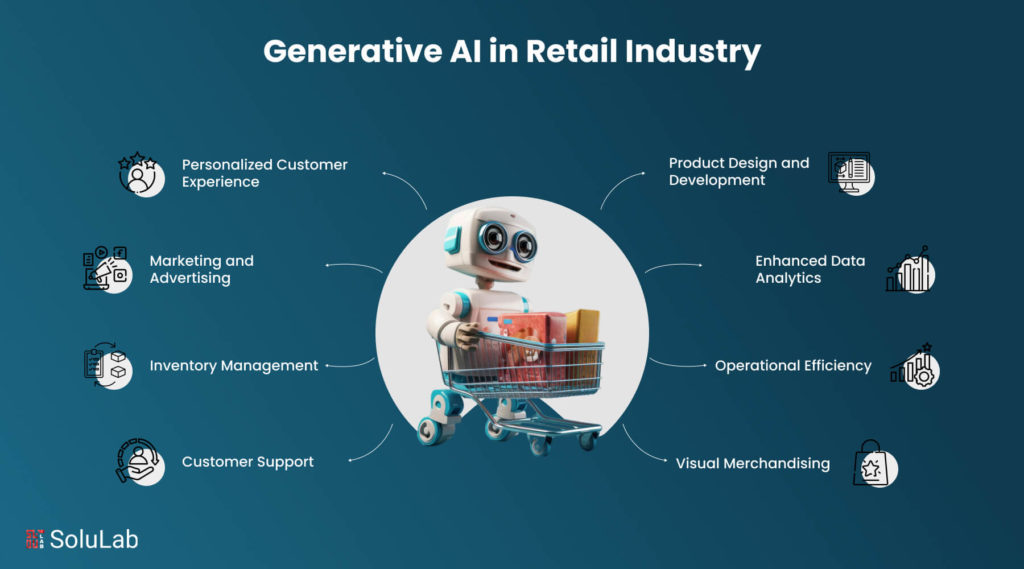
Retailers are always looking for methods to improve the shopping experience and leave a lasting impression in order to boost sales by fostering consumer loyalty, promoting repeat business, and encouraging return visits. While there are many ways to achieve these goals, a key factor in gaining client loyalty and pleasure is personalizing the purchasing experience.
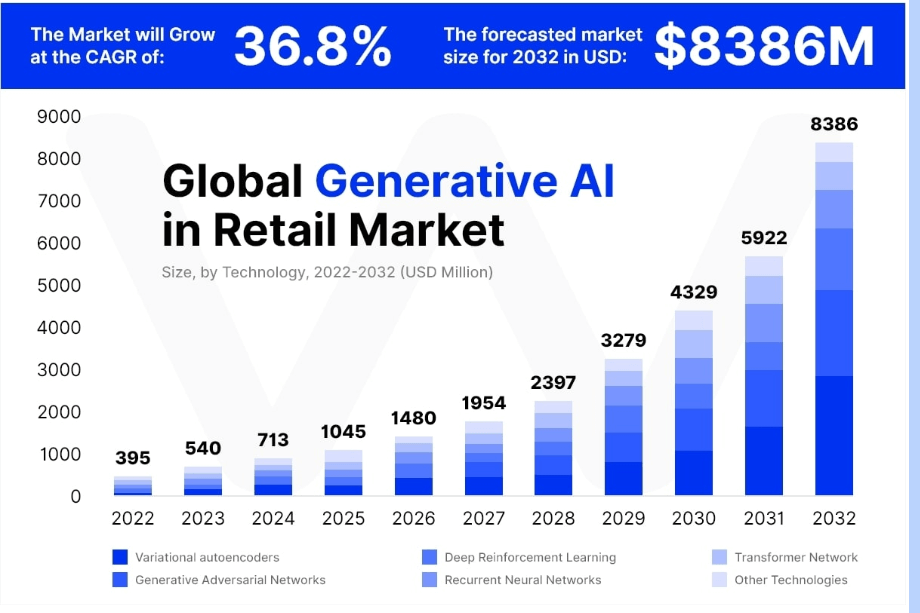
A recent analysis of customer interaction from Twilio stated that spending money on digital consumer engagement increased sales by 90%. Additionally, according to the survey, 86% of consumers said that having a personalized experience has increased their brand loyalty. The projected expansion of generative AI in retail industry globally by 2032 is seen in the graphic below.
We will go into the area of generative AI in retail in this comprehensive blog post, examining how it is transforming the sector and outlining its advantages and future possibilities.
Generative AI is rapidly transforming the retail industry, introducing innovations that enhance customer experiences and streamline operations. By leveraging advanced algorithms and machine learning, generative AI for retail enables businesses to create personalized shopping experiences, predict consumer trends, and optimize supply chain management. These capabilities are redefining how retailers interact with customers and manage their resources, ultimately driving efficiency and profitability.
Artificial intelligence in retail is enhancing customer engagement through personalized recommendations and dynamic content generation. Generative AI can analyze vast amounts of data from customer behavior, preferences, and purchase history to tailor product suggestions and marketing messages. This level of personalization not only improves customer satisfaction but also increases conversion rates and brand loyalty. For instance, AI-driven chatbots and virtual assistants can provide real-time support and product recommendations, creating a seamless shopping experience that caters to individual needs.
Moreover, generative AI is revolutionizing inventory and supply chain management. By predicting demand more accurately, retailers can optimize their stock levels, reduce waste, and ensure that popular products are always available. This predictive capability helps in managing logistics more efficiently, from warehousing to distribution, minimizing costs and improving delivery times. Generative AI can also simulate various market scenarios, helping retailers make informed decisions about pricing strategies, promotional campaigns, and product launches.
The impact of generative AI on retail extends to visual merchandising and store layout optimization as well. AI-powered tools can generate virtual store layouts and product displays, allowing retailers to experiment with different designs and configurations before implementing them in physical stores. This not only saves time and resources but also enhances the aesthetic appeal and functionality of retail spaces. By integrating generative AI, retailers can stay ahead of consumer trends, respond swiftly to market changes, and create more engaging and efficient shopping environments.
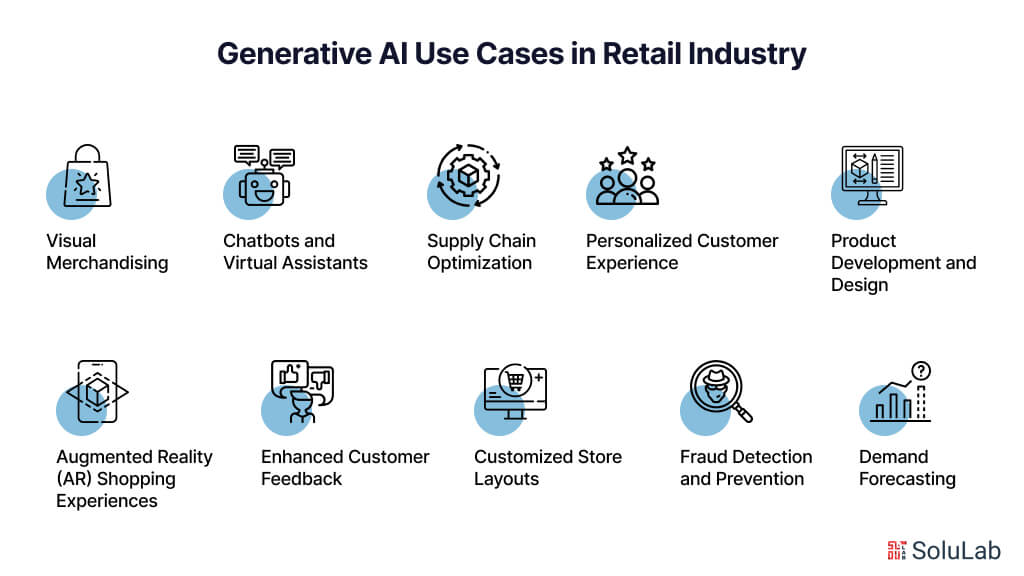
The retail industry is undergoing a significant transformation with the advent of generative AI technologies. Using the power of generative AI, retailers can enhance various aspects of their operations, from customer engagement to inventory management. Here are some key generative AI use cases in the retail industry:
Generative AI can analyze vast amounts of customer data to create highly personalized shopping experiences. By understanding individual preferences and behaviors, AI can generate tailored product recommendations, customized marketing messages, and unique shopping experiences. This application not only increases customer satisfaction but also drives sales and customer loyalty.
Managing inventory efficiently is crucial for retail success. Generative AI can predict demand trends by analyzing historical sales data, market trends, and other influencing factors. This predictive capability helps retailers optimize stock levels, reduce overstock and stockouts, and improve overall inventory management.
Generative AI applications in visual merchandising include creating dynamic and engaging store displays. AI can generate various design layouts and product placements that are visually appealing and likely to attract customers. This technology can also simulate customer interactions with these displays to further refine merchandising strategies.
Retailers often need to produce large volumes of content for product descriptions, social media posts, and marketing campaigns. Generative AI can automate the creation of this content, ensuring it is compelling, relevant, and aligned with the brand voice. This not only saves time but also ensures consistency across different platforms.
One of the most innovative generative AI applications in retail is virtual try-on technology. By using AI to generate realistic images of customers wearing different outfits or accessories, retailers can offer a virtual fitting room experience. This reduces the need for physical trials, enhances online shopping, and reduces return rates.
Generative AI-powered chatbots and virtual assistants can provide real-time customer support, handle inquiries, and facilitate transactions. These AI-driven interfaces can generate human-like responses and assist customers 24/7, improving the overall shopping experience and operational efficiency.
Accurate demand forecasting is essential for planning and resource allocation. Generative AI models can analyze complex datasets to generate precise demand forecasts. These insights help retailers in planning procurement, production, and distribution strategies effectively.
Generative AI can be used to implement dynamic pricing strategies. By analyzing market conditions, competitor prices, and consumer demand, AI can generate optimal pricing models. This ensures that retailers remain competitive while maximizing profit margins.
Generative AI applications extend to supply chain management, where AI can generate optimized logistics and distribution plans. By predicting potential disruptions and suggesting alternative routes or suppliers, AI enhances the resilience and efficiency of the supply chain.
Related: Generative AI in Supply Chain
Generative AI can refine customer segmentation by analyzing complex datasets to identify patterns and behaviors that may not be immediately apparent. By generating detailed customer profiles, retailers can tailor their marketing and sales strategies more effectively. This advanced segmentation helps in targeting the right audience with personalized offers, improving conversion rates and customer retention.
In product development, generative AI can analyze market trends, customer preferences, and historical sales data to generate innovative product designs and concepts. This application accelerates the design process, allowing retailers to quickly bring new products to market that are more likely to resonate with customers.
Generative AI can enhance security by generating models that detect fraudulent activities in real-time. By analyzing transaction patterns and customer behavior, AI can identify anomalies and flag potential fraud. This proactive approach helps in minimizing losses and protecting customer data.

Generative AI can analyze social media, customer reviews, and other online content to gauge public sentiment about products and brands. This sentiment analysis helps retailers understand customer perceptions and adapt their strategies accordingly. Additionally, AI can predict emerging trends, allowing retailers to stay ahead of the market.
Generative AI can optimize physical store layouts by simulating customer movement and interaction within the store. By generating various layout configurations, AI can identify the most effective arrangements that enhance the shopping experience and maximize sales. This application is particularly useful for large retailers and supermarkets.
Related: Generative AI in Manufacturing
Generative AI can create customized training programs for retail employees by analyzing their performance data and identifying areas for improvement. AI-generated simulations and interactive modules can provide realistic training scenarios, helping employees to develop their skills more effectively.
Generative AI can automate the process of collecting and analyzing customer feedback. By generating detailed reports on customer satisfaction and areas for improvement, AI helps retailers to respond quickly to customer needs and enhance their service quality.
Retailers are also increasingly using tools like Uniqode: Dynamic QR code generator to place QR codes on receipts, packaging, or store signage—allowing customers to instantly access feedback forms, loyalty surveys, or product support pages. This seamless touchpoint encourages higher participation and adds convenience to the post-purchase experience.
Generative AI can enhance AR shopping experiences by creating realistic and interactive digital representations of products. Customers can use their smartphones or AR glasses to visualize how products would look in their homes or on themselves. This application enhances the online shopping experience, reducing the uncertainty that often comes with purchasing products without seeing them in person.
Thus, generative AI offers a wide range of applications in the retail industry, from improving customer experience and operational efficiency to enhancing security and sustainability. By using these advanced technologies, retailers can stay competitive and adapt to the changing market conditions.
Read Also: Voice AI Agents In Conversions and Sales
Generative AI has the potential to revolutionize the retail industry, offering a multitude of benefits that can enhance both customer experience and operational efficiency. Here are some of the key advantages of utilizing Generative AI models in retail:
By leveraging the power of Generative AI models, the retail industry can transform various aspects of its operations, from enhancing customer engagement to optimizing backend processes, leading to increased profitability and sustained competitive advantage.
Read Also: AI In Marketing
The future of retail will create a dramatic transformation with the integration of Generative AI technology. As this advanced form of artificial intelligence continues to evolve, it will unlock unprecedented opportunities for innovation and efficiency across the retail sector. Here are some key areas where Generative AI is expected to shape the future of retail:

Generative AI in retail, particularly its predictive skills, will improve supply chain management by lowering waste and increasing efficiency. It will enable retailers to foster product innovation and sustainability, harmonizing with changing customer desires for environmentally responsible activities.
However, as generative AI becomes more widely used, ethical concerns about data privacy and algorithmic bias need to be addressed. By handling these obstacles responsibly, retailers can capitalize on AI’s ability to generate value for both enterprises and society, paving the way for a future of retail innovation and customer focus.
SoluLab, a leading Generative AI development company, uses modern AI technology to deliver innovative solutions across various industries. By utilizing Generative AI automation, SoluLab streamlines complex processes and enhances efficiency, making significant impacts in sectors like healthcare and manufacturing. Their expertise in Generative AI for data analysis enables businesses to derive actionable insights from vast datasets, driving informed decision-making. In healthcare, SoluLab’s Generative AI applications improve patient care through advanced diagnostics and personalized treatment plans. In manufacturing, they optimize production lines and perform predictive maintenance. Additionally, SoluLab ensures robust Generative AI for compliance, helping organizations adhere to regulatory standards seamlessly. With a focus on delivering tailored AI solutions, SoluLab empowers businesses to transform their operations and achieve remarkable outcomes.
Generative AI refers to algorithms that can create new content, such as text, images, or data, based on input data. In the retail industry, it works by analyzing large datasets to generate personalized recommendations, automate inventory management, create marketing content, and enhance customer service.
Generative AI enhances the customer experience by offering personalized shopping recommendations, creating customized marketing messages, and enabling virtual shopping assistants. It can analyze customer preferences and purchase history to suggest products that match individual tastes, making shopping more efficient and enjoyable.
Generative AI optimizes inventory management by predicting demand, reducing overstock and stockouts, and automating restocking processes. It uses historical sales data and market trends to forecast inventory needs, ensuring that retailers maintain the right product levels and minimize waste.
Generative AI can produce tailored marketing content, such as email campaigns, social media posts, and product descriptions. By analyzing customer data and market trends, it generates content that resonates with target audiences, improves engagement, and drives sales.
While generative AI offers numerous benefits, challenges include data privacy concerns, the need for high-quality data, and the potential for biases in AI algorithms. Retailers must ensure they have robust data governance practices and work to eliminate biases to maximize the effectiveness of generative AI solutions.


