


The ultimate stage of artificial intelligence research is Artificial General Intelligence (AGI). Simply said, artificial general intelligence (AGI) is a system that, like the human mind, processes, learns, adapts, and understands information. While AI is tailored to specific tasks, AGI seeks to achieve a more general and adaptable type of machine intelligence. Its objective is to provide machines the flexibility and capacity to solve problems needed to perform a variety of activities. In this blog post, we’ll examine the idea of artificial general intelligence (AGI), discussing its history, numerous applications, potentials, and hazards, as well as how this instrument may change artificial intelligence as we know it.
Beyond artificial intelligence lies Advanced General Intelligence, or AGI. AGI is flexible, understands context, and develops on its own, whereas AI is limited by predetermined guidelines. Also known as a subfield of theoretical artificial intelligence (AI) research called artificial general intelligence (AGI) aims to create AI that can think like a human and even teach itself. However, there is disagreement in the field on what really qualifies as “intelligence” and how to quantify it, and not all AI researchers think it is even feasible to create an AGI system.
AGI is sometimes referred to as universal AI or strong AI. These hypothetical types of AI are distinct from weak AI, often known as narrow AI, which can only carry out certain or specialized activities within predetermined bounds. AGI would be capable of independently resolving a wide range of challenging issues in several knowledge disciplines.
It resembles a system that obeys commands, gains knowledge from mistakes, deduces solutions from issues, and adjusts to novel situations.

Opinions on how AGI may someday be implemented vary because it is still purely theoretical. Ben Goertzel and Cassio Pennachin, two AI researchers, state that “general intelligence” does not imply the same thing to all researchers. But in a “loose sense,” artificial intelligence (AGI) is defined as “AI systems that have a reasonable level of self-understanding and autonomous self-control and can solve a variety of complex problems in a variety of contexts, as well as learn to solve new problems that they weren’t aware of when they were created. There are several theoretical perspectives on how artificial general intelligence (AGI) may be developed due to the vague and dynamic character of both AI research and the idea itself. While some of these include approaches like deep learning and neural networks, others suggest employing computational neuroscience to build large-scale human brain models.
Artificial General Intelligence (AGI) is a concept in computer science that describes intelligent systems capable of performing tasks at a level indistinguishable from human intelligence. Unlike narrow AI systems, which specialize in specific areas, AGI aims to achieve broad versatility and adaptability, enabling it to handle diverse tasks effectively. This would include reasoning, learning, problem-solving, and decision-making across multiple domains without requiring task-specific programming. The hallmark of AGI is its ability to process vast amounts of data at exceptional speeds, allowing it to not only match but potentially surpass human cognitive capabilities.
Currently, AGI remains a theoretical concept discussed primarily in research and science fiction, as no true AGI system exists. However, the successful development of AGI would mark a groundbreaking moment in technology, fundamentally changing industries, societies, and how we interact with machines. It could potentially automate complex human activities, enhance innovation, and unlock solutions to challenges that are currently beyond human capacity.
To be classified as truly general, AGI must exhibit a range of essential cognitive capabilities:
These core abilities form the backbone of AGI, enabling it to operate seamlessly in dynamic and unpredictable environments.
Artificial intelligence can be categorized into three primary types, one of which is artificial general intelligence (AGI).
Weak AI, also known as narrow AI, includes two subcategories: reactive machines and limited memory machines. Reactive machines can respond to immediate inputs or stimuli but lack the ability to retain or learn from past experiences. In contrast, limited memory machines can store historical data to enhance their performance over time. Despite these capabilities, weak AI is restricted to performing specific tasks within a narrow scope.
Strong AI, commonly referred to as AGI, replicates human-like intelligence. Unlike narrow AI, which is task-specific, strong AI can learn how to perform one task and transfer that knowledge to tackle entirely new challenges. This adaptability allows strong AI to solve complex problems and handle scenarios it hasn’t been explicitly trained for, demonstrating advanced reasoning and cognitive skills similar to humans.
Artificial superintelligence is a hypothetical form of AI that would surpass human intelligence by learning and evolving at an unprecedented pace. ASI is believed to be the key to creating self-aware AI systems. In this state, AI could operate independently, potentially disregarding human instructions or its originally intended objectives.
While most AI systems available today fall under the category of weak AI, many researchers believe we are gradually progressing toward the realization of artificial general intelligence.
Artificial general intelligence (AGI), or AI with a level of intelligence comparable to that of humans, is still a theoretical concept and research objective, even though artificial intelligence (AI) currently covers a wide range of technologies and research directions that deal with machine and computer cognition.
General intelligence is “the ability to learn anything (in principle),” according to AI researcher Peter Voss. His requirements said that AGI’s capacity for learning would have to be “autonomous, goal-directed, and highly adaptive.” Generally speaking, artificial general intelligence (AGI) is defined as AI that can equal human cognitive power and is classified as strong AI. (Artificial super intelligence [ASI] is another term for AI that falls within the strong AI category; it is AI that is superior to the capabilities of the human brain.)
Comparatively, as most AI now in use has been tailored to certain activities and purposes, it would be considered weak AI, or narrow AI. Though they still depend on some degree of human programming for accuracy and training, these AI systems may nonetheless be quite strong and sophisticated, with uses ranging from voice-activated virtual assistants to autonomous car systems.
These are a few instances of AI in use today:
In computer science, artificial general intelligence (AGI) refers to a system that possesses full or complete knowledge and cognitive computing skills. True artificial intelligence (AGI) systems do not yet exist; they are still the stuff of science fiction. In theory, these systems’ performance would be identical to that of a person. But because artificial intelligence (AGI) can access and analyze massive amounts of data at rates never seen before, its broad intellectual powers would surpass those of humans.
Real AGI ought to be able to do tasks and talents at the human level that no current machine is able to do. While AI is capable of many jobs today, it is not yet capable enough to be classified as human or general intelligence.
An AGI system ought to possess the following knowledge and skills:
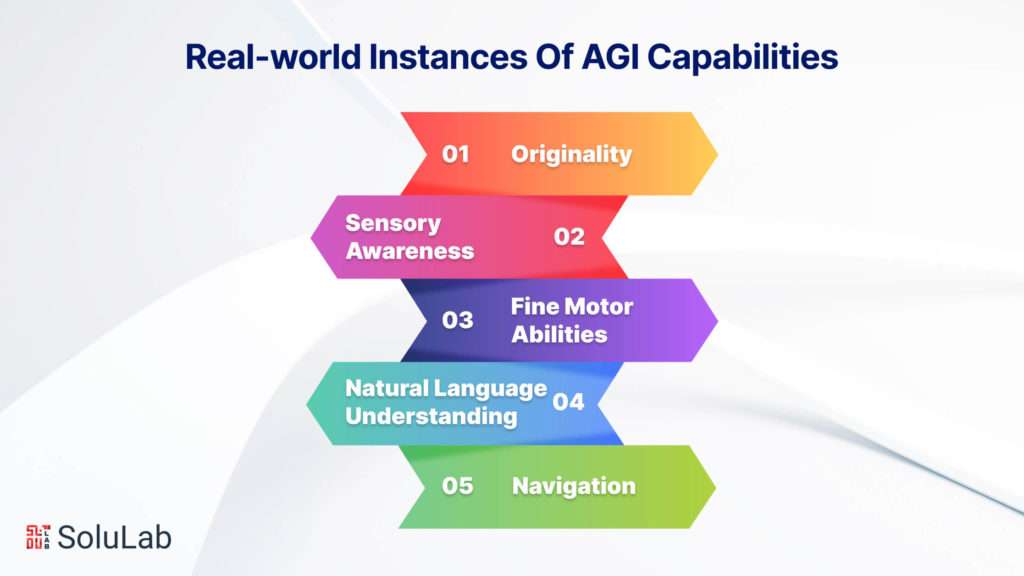
Five real-world instances of AGI capabilities are as follows:
1. Originality. Theoretically, an AGI system might read, understand, and enhance human-generated code.
2. Sensory Awareness. Since color perception is a subjective sort of perception, AGI would be very good at it. In still photos, it would also be able to distinguish between three dimensions and depth.
3. Fine Motor Abilities. Taking a set of keys out of a pocket is one example of this, requiring a certain amount of creative vision.
4. Natural Language Understanding (NLU). Human language is very context-dependent in its meaning. NLU would be made possible by the amount of intuition possessed by AGI systems.
5. Navigation: A geographic position may be determined using the current Global Positioning System (GPS). When completely developed, AGI would surpass current technologies in its ability to project movement through physical surroundings.
Additionally, AGI systems are expected to have advanced capabilities, such as the following, according to AI researchers:
Advanced machine learning methods, especially neural networks, and deep learning models provide the basis of AGI. Machines can now learn on their own, adapt to a variety of situations, and comprehend intricate patterns thanks to these advanced systems. Another important component of developing general intelligence is natural language processing, or NLP, which enables robots to understand and communicate with human language. Artificial General Intelligence (AGI) is facilitated by reinforcement learning, in which robots learn by making mistakes. AGI development may soon undergo a radical shift thanks to quantum computing, which has previously unheard-of processing capability. AGI development calls for a broad range of knowledge, bringing together experts in disciplines as disparate as computer science, neurology, psychology, and ethics.
AGI have the potential to have a positive influence on a variety of sectors and aspects of daily life.
Furthermore, the ability of AGI to solve problems could be crucial in formulating plans for reducing poverty, promoting economic stability, and responding to natural disasters.
Consequently, AGI offers an alluring chance to tackle intricate worldwide problems, positioning it as a potent ally in addressing matters ranging from public health emergencies to climate change.
There aren’t any real AGI systems available currently. Nonetheless, there are instances of limited artificial intelligence systems that mimic or even surpass human capabilities in some domains. Research on artificial intelligence is concentrated on these systems and the potential applications of AI in the future.
Here are a few instances of such systems:
1. Watson from IBM. Supercomputers like Watson can do computations that regular computers are unable to. They use artificial intelligence (AI) in conjunction with their enormous processing capacity to do research and engineering jobs that were previously unattainable, including simulating the Big Bang hypothesis of the universe’s creation or the human brain.
2. Knowledgeable Systems. These AI-driven systems simulate human decision-making. They may, for instance, forecast molecular structure and provide medication recommendations based on patient data.
3. Autonomous Vehicles. These AI-driven cars follow traffic laws and regulations and can identify other cars, pedestrians, and objects on the road.
4. Intelligence Ross. Known alternatively as the AI attorney, ROSS is a legal expert system. In less than three seconds, it can extract information from around one billion text documents, evaluate the data, and give accurate answers to challenging queries.
5. AlphaGo. This is yet another instance of limited intelligence that is particularly good at tackling a certain kind of problem. A computer program called AlphaGo is capable of playing the board game Go. Go is an intricate game that is challenging for people to learn. In a five-game duel in 2016, AlphaGo defeated Lee Sedol, the world champion.
6. Model of Language Producing Transformer with Prior Training. OpenAI’s GPT-3 and GPT-4 are public releases of their software that can produce human language autonomously. Every time, the technology can simulate general human intellect. While the material can occasionally be mistaken for human-written content, AI output is frequently faulty.
7. AIs for Music. Dadabots is an artificial intelligence program that can produce a stream of its own rendition of music given a corpus of preexisting music.
The functionality of several of the previously mentioned examples may be enhanced if AGI were to be used. Self-driving automobiles, for instance, need a person there to manage decision-making in murky circumstances. The same holds true for linguistic models, legal systems, and algorithms that create music. These fields encompass both AI-automatable jobs and those that need a greater degree of abstraction and human intellect.
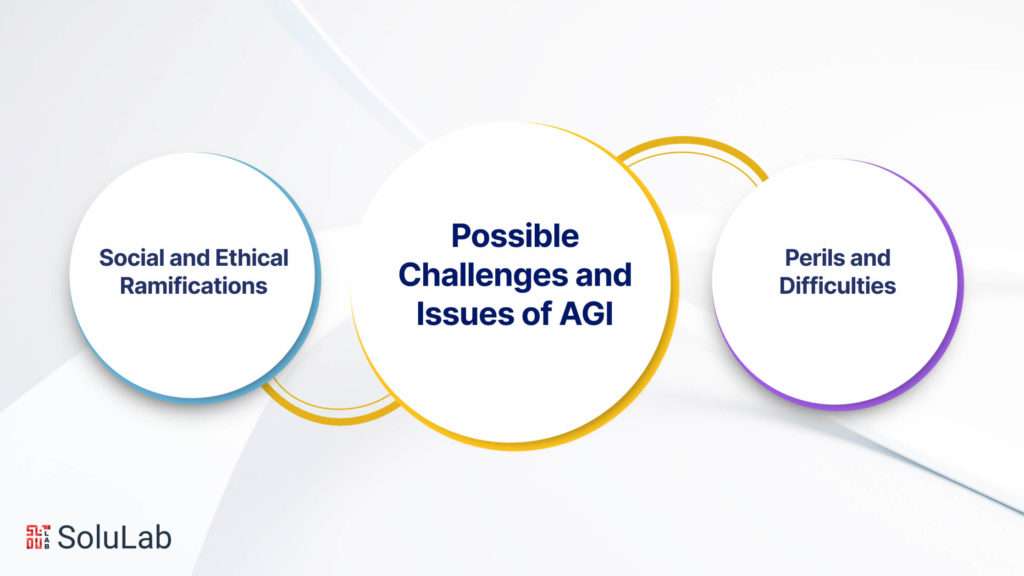
The world of artificial general intelligence (AGI) is complicated and full of obstacles to overcome. It is imperative that we address the possible challenges and concerns that may occur as we proceed with the development and deployment of AGI. This section examines the complex terrain of artificial general intelligence AI, illuminating the challenges that scientists, technologists, and society at large must overcome to achieve AGI. These challenges range from technological impediments to moral quandaries.
The notion that computers may have cognitive capacities similar to those of humans raised a number of ethical and societal issues, including:
It is imperative to strike a balance between innovation and ethical responsibility, which calls for the development of rules and multidisciplinary cooperation.
Read Also: Use Cases Of AI Agents
Advanced General Intelligence (AGI) research and development has enormous potential, but there are also certain hazards and difficulties that should be carefully considered.
Numerous resources offer valuable insights into the subtleties of this emerging discipline of Advanced General Intelligence AI (AGI) for those who are curious about learning more.
There is a lot of discussion on when, if at all, we will be able to build artificial general intelligence (AGI). Many prominent computer scientists and businesspeople predict that artificial general intelligence (AGI) will emerge in the next decades:
AGI’s future, however, is still up for debate and the subject of continuous study; some academics even contend that it will never be possible to achieve AGI. According to AI researcher Goertzel, there is no “thorough and systematic theory of AGI” and “many different routes to AGI, involving the integration of different sorts of subsystems,” making it challenging to quantify the development of AGI objectively. Instead, it’s a “patchwork of overlapping concepts, frameworks, and hypotheses” that are “sometimes contradictory, but often synergistic.”
Sara Hooker of the research center Cohere for AI stated in an interview that the future of artificial intelligence (AGI) is essentially a philosophical concern. Because we work in a scientific subject, it might be challenging at times to be in this profession.

Finally, “A Guide to Artificial General Intelligence” summarizes the vast field of AGI, shedding light on its complexities, possibilities, and implications for both technology and humankind’s future. This guide gives readers a thorough knowledge of this constantly changing area by going beyond the basics of artificial intelligence to explore real-world applications. SoluLab is a top artificial intelligence development company that leads the way in AGI innovation by providing customized services and solutions that maximize AGI’s limitless potential. Businesses may set off on a voyage of exploration, innovation, and expansion with our team of skilled artificial general developers, use AGI to open up new avenues and promote long-term success. With SoluLab, implement the power of artificial intelligence and lead your company into a future of unimaginable possibilities and boundless potential. Contact us today!
AGI refers to a form of artificial intelligence that possesses general cognitive abilities similar to humans, enabling it to understand, learn, and adapt to a wide range of tasks and contexts. Unlike narrow AI, which is designed for specific tasks, AGI aims to emulate human-like intelligence across various domains.
Achieving AGI remains a significant challenge, and experts have varying opinions on the timeline for its realization. While rapid advancements in AI technologies have brought us closer to AGI, significant obstacles such as understanding human cognition, achieving robustness and reliability, and addressing ethical concerns still need to be overcome.
AGI has the potential to revolutionize numerous industries and domains, including healthcare, finance, education, transportation, and more. Its ability to understand and learn from diverse data sources can lead to breakthroughs in personalized medicine, autonomous vehicles, intelligent tutoring systems, and beyond.
AGI raises profound ethical questions regarding autonomy, privacy, bias, accountability, and the impact on the job market. Ensuring the responsible development and deployment of AGI requires careful consideration of these ethical implications and proactive measures to mitigate potential risks.
Businesses can harness AGI to optimize processes, make data-driven decisions, enhance customer experiences, and drive innovation. By leveraging AGI-powered solutions, organizations can gain a competitive edge by unlocking new insights, improving efficiency, and staying ahead of AI trends.
While AGI remains a theoretical concept, there are examples of advanced AI systems that exhibit capabilities approaching AGI. These include language models like OpenAI’s GPT-3, which can generate human-like text, and reinforcement learning agents that demonstrate complex decision-making in simulated environments.
SoluLab is at the forefront of AGI development, offering tailored AI development services and solutions to businesses seeking to leverage the power of AGI. With a team of expert AI developers and a focus on innovation, SoluLab empowers businesses to navigate the complexities of AGI and unlock new opportunities for growth and success.


