Talk to an Expert

How AI in Marketing Is Changing the Way Brands Connect with Audiences?

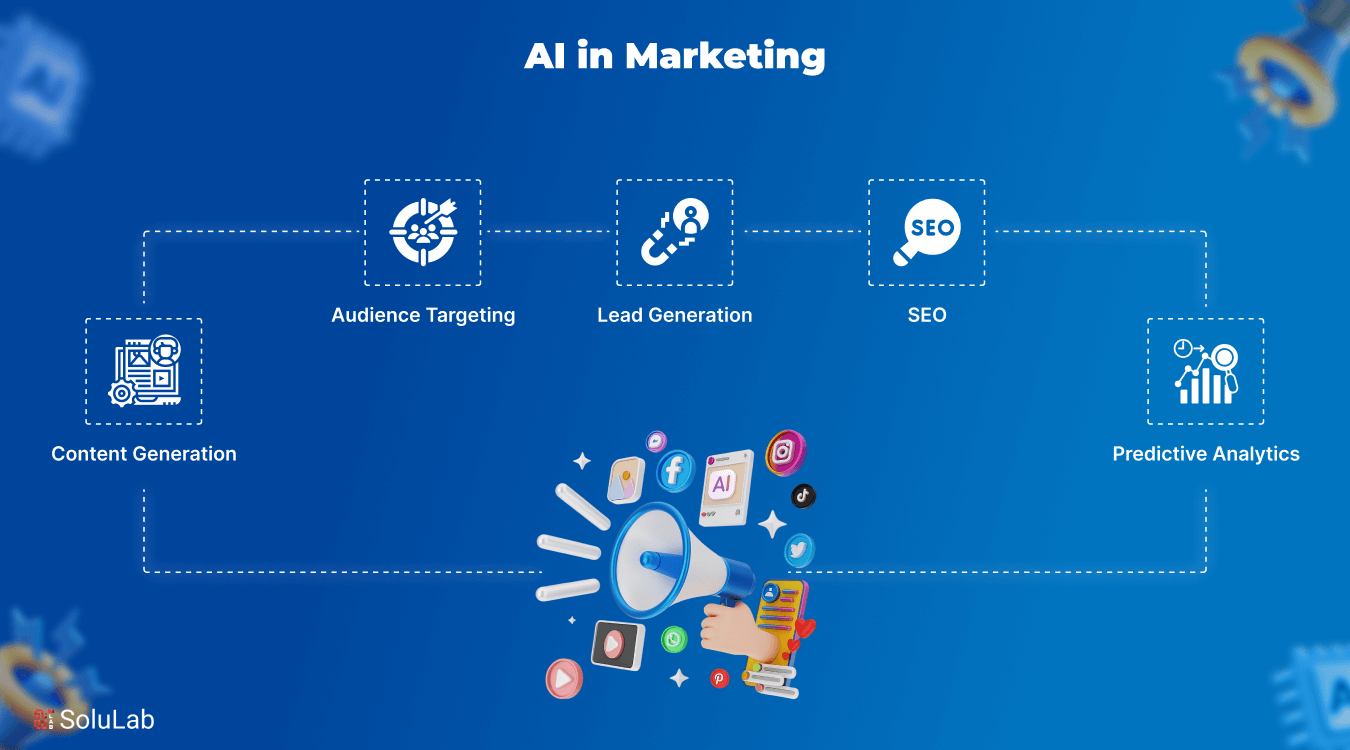
AI in Marketing

AI is changing how businesses connect with their audiences. It involves using artificial intelligence to develop, execute, and continuously improve your marketing strategy. Whether it’s optimizing email campaigns, boosting ad performance, or enhancing customer journeys, Artificial intelligence is improving marketing.

Especially in AI in B2B marketing, it offers powerful solutions for lead scoring, predictive analysis, and account-based marketing. But here’s the catch: AI is a tool, not a replacement. The smartest brands don’t rely on it blindly—they use it as an assistant.

This blog will explore how to leverage AI solutions in marketing smartly, how to implement AI in marketing, examples, and more. 

What is AI in Marketing?

Artificial intelligence in marketing is the application of AI technologies to automate, optimise, and personalise different marketing activities. You can use AI to write blogs or social media captions or send email campaigns, and use AI to do customer segmentation, chatbots, and predictive analysis. Using AI to create custom coded email templates are hand-crafted email designs built using HTML and CSS.Unlike drag-and-drop editors, they give full creative and functional control.

A significant use of AI has been for market research, where the machine learning process to study consumer information and patterns of behavior is analyzed more efficiently compared to conventional methods. AI, in general, optimizes the process of making decisions, increases the workload of the staff, and opens the territory for more focused and efficient marketing policies.

The world market of AI has grown to 638 5billion in 2025, and by 2034, the world AI market is projected to attain 3.68 5trillion with a growth of ~19.2% CAGR.
Benefits of AI in Marketing

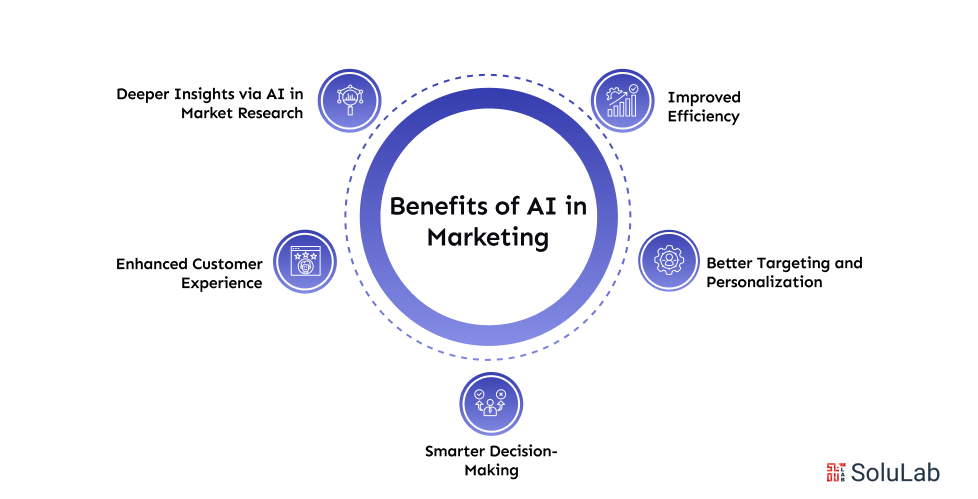
Benefits of AI in Marketing

AI is changing how businesses connect with customers by bringing speed, precision, and personalization to every stage of the marketing funnel. Here are the key benefits of using AI in marketing:

1. Improved Efficiency: Reduce repetitive tasks with email campaign management services—precision targeting, automated A/B testing, and granular performance analytics so every campaign isn’t just sent, but strategically engineered for measurable growth. AI in marketing automation helps marketers save time and focus on creative strategies that drive results. 

2. Better Targeting and Personalization: AI analyzes customer behavior and preferences to deliver highly targeted messages. This ensures more relevant content, increasing engagement, retention, and conversions.

3. Smarter Decision-Making: With predictive analytics and trend forecasting, AI in sales and marketing allows businesses to make data-driven decisions, optimize campaigns, and improve ROI.

4. Enhanced Customer Experience: AI-powered chatbots, recommendation engines, and voice assistants provide real-time support and personalized interactions, making the user journey smoother and more satisfying.

5. Deeper Insights via AI in Market Research: AI tools quickly process large datasets to uncover patterns, competitor strategies, and consumer trends, giving marketers a sharper edge in planning and execution.

CTA1

Practical Use Cases of AI in Marketing

AI in marketing isn’t just about fancy tools, it’s about working smarter. From brainstorming ideas to personalizing user journeys, here’s how marketers are using AI in everyday tasks:
  • Content Ideation and Optimization: Struggling with what to post next? AI can analyze trends, competitors, and audience interests to suggest fresh content ideas. It also helps refine tone, grammar, and structure so your blogs, emails, or captions connect with your audience. According to Coschedule, almost 75% of marketers believe AI gives them a competitive edge.
  • Ad Enhancement and Targeting: AI helps craft better ad creatives, headlines, and copy by analyzing what clicks with your audience. It also fine-tunes targeting, ensuring your ads reach the right people at the right time, boosting ROI without wasting budget.
  • Scaling A/B Testing: Testing two versions is great, but what if you could test ten? AI makes it possible to run A/B tests at scale, analyze results instantly, and suggest winning combinations you no longer need to put hours of manual effort.
  • Intuitive Customer-Facing Chatbots: Gone are the days of robotic replies. AI-powered chatbots understand context, answer FAQs, recommend products, and even upsell—all while chatting like a human. It’s like having a 24/7 support team that never gets tired.
  • SEO: AI tools simplify keyword research, optimize headlines, and improve meta descriptions. They even spot gaps your competitors are missing. AI becomes your behind-the-scenes SEO expert, helping you climb the search ranks faster. And if your team lacks deep SEO knowledge, many companies choose to hire SEO experts who can translate AI-generated insights into practical, high-impact strategies
  • Personalization: AI helps you go beyond using just the customer’s name. It studies user behavior to serve product recommendations, email content, and even website layouts, to make customers feel like your brand “gets” them.
  • Market Research: It can scan customer reviews, social media trends, and survey responses in minutes, giving you real-time insights to shape smarter marketing decisions.

How to Implement AI in Marketing?

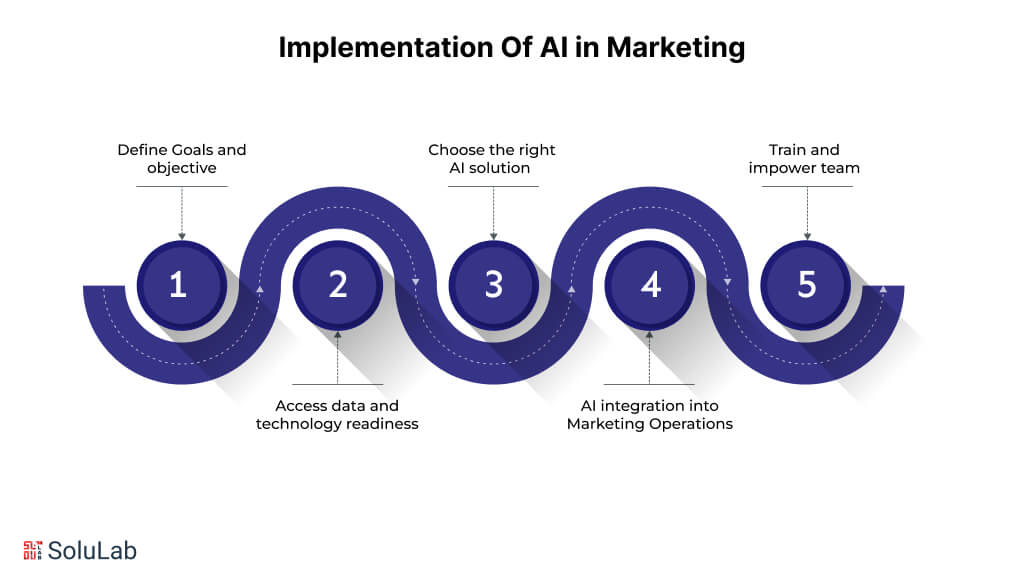
Implementation Of AI in Marketing

Putting AI into your marketing strategy seems like a complicated and intimidating task, but when it is separated into several important steps, it becomes easier. So this is how you can begin:

1. Clarify objectives 

Before using AI, know what you want. Is it what you desire to do for more customers? Boost sales? Enhance the experience of the client? It will offer you preconceived, measurable objectives that will also help you determine whether your AI marketing strategy is effective. The first thing to do is to try to target specific regions where AI can make the most significant impact and expand as you achieve success.

2. Grant Quality and accuracy of data

Remember that AI models learn from what is provided to them in data. To have greater insights and results of AI, there should be an investment in quality data.

3. The right tools should be selected.

Begin by looking at AI tools that are in line with your ambitions, whether it is mail automation, content generation, or predictive analytics. Marketers who undergo b2b marketing training are better equipped to select the right platforms and leverage AI capabilities effectively. It should have platforms that can be built with ease and have scalability as the marketer expands their networks.

4. Make customer experience a priority

Artificial intelligence must augment, but not replace, human interaction. Use it to make campaigns more customized and create anticipation of user needs, as well as decrease response time. An improved experience results in increased engagement and commitment in the long run.

5. Lay down a feedback loop in advance

Wait, don’t gather ideas. Keep real-time data and make use of AI to monitor and see what is working. The feedback from your team and customers on a regular basis can assist you in streamlining the strategies and keeping AI up to date and in place.

Real World Example of AI in Marketing

Here are some AI applications in marketing:

Example #1: Zomato – Personalized Push Notifications

Ever noticed how Zomato knows the exact moment your stomach starts growling? Right around lunch or late-night snack time, your phone buzzes with a tempting. That’s not just clever copy it’s AI at work.

Zomato tracks your order history, the time you usually order, your favourite dishes, and even your location. So if you’re a regular butter chicken fan from Delhi who usually orders dinner at 8 PM, Zomato’s AI gets that pattern. Come 7:45 PM, boom—there’s a push notification with your favourite restaurant’s special deal on butter chicken.

And it’s not just about timing. If it’s raining in your area, you might see: “Perfect weather for samosas and chai? It’s hyper-personalized marketing—Zomato’s way of whispering exactly what you want to hear, just when you want to hear it.

Example #2: Netflix – Content Recommendations

Do you feel like Netflix is reading your mind when it suggests your next show? That’s not magic—it’s machine learning at play.

Every time you watch something—whether it’s a crime thriller, romantic comedy, or a documentary—Netflix notes your preferences. Suppose you’ve been binge-watching true crime dramas lately. Netflix takes that as a cue and lines up more shows in that genre, complete with gripping thumbnails, dark color palettes, and intriguing taglines.

What’s more impressive is how Netflix adapts its artwork. If you’re into romance, that same thriller might show a tender moment on the cover. Prefer action? Expect to see a scene with explosions or intense chase sequences. This isn’t random—it’s Netflix customizing your entire experience based on what makes you click “play.”

Example #3: Amazon – Pricing & Product Suggestions

Ever wondered how Amazon always tempts you with things you didn’t know you needed until you saw them?

You bought a yoga mat, and suddenly there’s a deal on resistance bands, water bottles, and athleisure wear. That’s AI doing its thing—like your personal shopping assistant who never sleeps.

Amazon’s AI looks at your past purchases, search behaviour, wish lists, and even what others with similar buying habits are purchasing. It then curates your home screen to show you what you’re most likely to buy next.

That same yoga mat may cost you ₹899, but someone browsing from a different city or at a different time might see it for ₹849. Amazon adjusts prices in real-time based on demand, competition, and even how many times you’ve viewed a product.

Future of AI in Marketing

AI won’t just assist with tasks like content creation or ad targeting; it will predict what your audience wants before they even know it.

The new thing will be hyper-personalization. Think about sending emails that are always written differently depending on how a reader feels or what they have bought. Within seconds of analysing tremendous volumes of data, AI will enable brands to make swift choices and be ahead of trends.

Voice, visual will be a part of routine strategies. It will not just be moving tools into the automation; the tools will become thoughtful associates. It can also help change background elements from images to create cleaner, more professional-looking graphics.

Furthermore,  expect AI-powered interactions that feel more human than ever—chatbots that understand tone, context, and emotion.
CTA2

Conclusion

The generative AI in marketing revolution is reshaping the ways brands interact, customize, and expand campaigns. And it is not optional anymore, AI is a must as it leads to smarter content creation and even a hyper-personalized experience. Companies that are interested in remaining relevant should leverage the change and incorporate AI into their marketing processes. 

This is something that can be accomplished more efficiently and sooner when a fitting AI app development company is teamed up. It is time to embrace the strength of AI to develop a more relevant, targeted, and meaningful marketing strategy that will really resonate with the target audiences.

Digital Quest, a travel business, partnered with SoluLab to develop an AI-powered chatbot using Generative AI. The chatbot enhanced customer engagement by offering real-time, personalized travel recommendations and hassle-free reservations. It also integrated user feedback and multi-language support, resulting in improved user experience and high ROI.

SoluLab, an AI development company, can help you create and deploy campaigns using AI and scale your business. Contact us today to discuss further. 

FAQs

1. How does AI improve email marketing campaigns?

AI analyzes open rates, click-through data, and user behavior to personalize subject lines and content. It ensures emails are timely and relevant—key elements of successful AI in content marketing strategies.

2. How can AI help with customer segmentation?

AI analyzes large datasets to group customers based on behavior, preferences, and purchase history. This enables more personalized targeting, a major advantage of AI in sales and marketing.

3. What is the role of AI in ad targeting?

AI identifies ideal customer profiles, predicts click behavior, and automatically adjusts ad placements for better performance. It makes ad spending more efficient by using AI applications in marketing.

4. How is AI transforming healthcare marketing?

AI in healthcare marketing is used to personalize patient communication, predict healthcare needs, and automate appointment reminders. It helps build trust and increase engagement in a highly sensitive industry.

5. How do I choose the right AI app development company?

Look for a company with experience in AI application development, strong case studies, and a clear understanding of your business needs. The right partner ensures smooth integration and long-term value.

How Can Generative AI Help Your Business in Sales?

Generative AI in Sales

Struggling to hit your sales targets despite having a strong team and a good product? Businesses today face similar challenges: stretched resources, long sales cycles, and low conversion rates. It’s frustrating to see efforts fall short, especially when competition is fierce and customer expectations are higher than ever.

However, generative AI is a tool that’s changing how businesses approach sales. From writing personalized emails and follow-ups to generating pitch content and analyzing buyer behavior, generative AI can save hours of manual effort while boosting efficiency.

Research shows that 51% of companies that are integrating AI are seeing revenues increase by 10% and 80% higher productivity.

In this blog, we’ll break down how generative AI can support your sales team, increase productivity, and improve close rates. If you’ve been wondering whether AI is worth the hype, this article will help you see its real-world potential.

What is Generative AI?

Generative AI, or Generative Adversarial Networks (GANs), is a subtype of artificial intelligence (AI) centered on developing new material or data from existing patterns and instances.

Unlike standard AI models, which are developed for specialized tasks such as categorization or prediction, generative AI seeks to produce innovative outputs that seem like human-created data.

Here’s a far more straightforward explanation:

“Generative AI involves deep-learning algorithms that can produce high-quality text, images, and additional content according to the data they were instructed on.”

The Role of Generative AI in Sales

Generative AI is reshaping sales by creating personalized content, improving customer interactions, and improving processes for faster conversions and better decision-making.

1. Personalized Sales Emails: Generative AI can craft highly personalized sales emails based on customer data, behavior, and interests. This helps sales teams engage prospects more effectively and improve open and response rates.

2. Automated Proposal Generation: It can instantly generate sales proposals tailored to client needs, saving time and ensuring consistency. This reduces manual work and speeds up the sales cycle significantly.

3. Chatbots and Virtual Assistants: AI-powered chatbots handle routine queries, qualify leads, and offer instant responses. This frees up human reps for complex tasks and ensures 24/7 customer engagement.

4. Data-Driven Insights: Generative AI analyzes large volumes of customer data to uncover trends and buying signals. Sales teams can use these insights to prioritize leads and refine their approach.

5. Sales Training and Roleplay: AI can simulate real customer scenarios for training purposes. Sales reps can practice conversations and get feedback, helping them improve their pitch and handle objections more confidently.

Generative AI in Sales: What the Stats Are Saying

As reported by McKinsey, around 75% of the benefits of utilizing Generative AI are observed in four major areas:

  • Customer Operations
  • Marketing & Sales
  • Software engineering
  • Research and Development (R&D)

The following data demonstrates how generative AI for sales and marketing is used:

  • According to a recent study, companies that use generative AI for sales outreach experience an average 25% increase in response rates 
  • As per Market.Us, the Generative AI in Sales Market size is expected to be worth around USD 873.2 Million by 2033, growing at a CAGR of 10.9%. 
  • Salesforce discovered that 84% of users said it helped increase sales at their organization by enhancing and speeding up customer interactions.
  • According to Gartner, by 2027, 95% of seller research workflows will begin with generative AI, up from less than 20% in 2024.
  • According to a HubSpot study of sales executives, 94% believe it boosts sales and can help locate new clients.

How to Use AI to Supercharge Your Sales Strategy?

Artificial intelligence (AI) is transforming sales, offering new ways to boost productivity, enhance customer engagement, and drive revenue growth. Here’s how you can effectively start using AI for sales strategies:

1. Lead Generation and Scoring

Artificial intelligence in sales and marketing can significantly improve lead generation by analyzing large amounts of data to identify potential customers. Platforms like Microsoft Dynamics 365 Sales, enhanced by AI capabilities, allows businesses to automate lead scoring and streamline the qualification process effectively.

AI-powered tools can assess the likelihood of leads converting into customers based on their past behaviors, interactions, and demographic information. This process, known as lead scoring, allows sales teams to prioritize high-value prospects and tailor their approach accordingly.

2. Personalized Customer Experiences

Generative AI in marketing and sales can create highly personalized content and communication strategies. By analyzing customer data, AI can generate customized emails, social media posts, and product recommendations that align with individual preferences and behaviors. This level of personalization helps build stronger relationships and increases the chances of closing sales.

3. Sales Forecasting

Accurate sales forecasting is crucial for planning and strategy. AI in sales enablement can analyze historical sales data, market trends, and economic indicators to predict future sales performance. This allows sales teams to make informed decisions, allocate resources effectively, and set realistic targets.

4. Chatbots and Virtual Assistants

AI-powered chatbots and virtual assistants can handle routine inquiries, provide instant responses to customer queries, and guide potential customers through the sales funnel. These tools are available 24/7, ensuring that customer interactions are efficient and consistent, ultimately freeing up sales representatives to focus on more complex tasks.

5. Enhanced Customer Insights

AI in sales and marketing can provide deeper insights into customer behavior and preferences. By analyzing data from various touchpoints, AI helps sales teams understand customer needs better and tailor their strategies accordingly. This leads to more effective communication and higher conversion rates.

6. Predictive Analytics

AI B2B sales tools can use predictive analytics to identify the best times to contact prospects, suggest optimal pricing strategies, and recommend upsell and cross-sell opportunities. By leveraging these insights, sales teams can improve their chances of closing deals and maximizing revenue.

By integrating AI for sales processes, you can unlock new levels of efficiency and effectiveness, ultimately driving better results for your business.

CTA1

Top Benefits of Using Generative AI in Sales

The benefits when implementing generative AI in sales are as follows:

  • Better Lead Generation: By analyzing customer data, generative AI for sales may more precisely identify potential leads, increasing conversion rates.
  • Personalized Customer Interactions: Sales teams may improve engagement and forge closer bonds with customers by creating customized messages and content that are based on their preferences.
  • Effective Sales Processes: By automating time-consuming chores like creating proposals or emails, sales representatives may concentrate on higher-value duties.
  • Improved Sales Forecasting: By analyzing past sales data and industry trends, generative AI for sales may produce more precise sales predictions that support strategic decision-making.
  • Cost Reduction: Generative AI lowers operational expenses related to sales operations by optimizing workflows and enhancing productivity.
  • Real-time Sales Support: AI-driven technologies may help sales representatives in real-time during client contacts, boosting productivity and closing rates.
  • Competitive Edge: By providing data-driven insights and more intelligent sales methods, leveraging innovative AI technologies provides firms with a competitive edge.
  • 24-hour Availability: Generative AI tools like chatbots and virtual assistants can operate round the clock without breaks. This ensures customers get instant support at any time, improving service quality and reducing the need for large support teams.

Generative AI Use Cases in Sales

Generative AI Use Cases in Sales

Generative AI applications in Sales are rapidly transforming the industry, offering numerous advantages that streamline processes and enhance outcomes. According to a HubSpot survey, the top uses of sales AI include content generation (18%), reaching out to potential prospects (16%), and analyzing data and research (16%). Here are 14 practical generative AI use cases in sales, categorized into content generation, task automation, and data analysis.

1. Content Generation

Earlier, sales representatives had to invest a lot of time and effort into creating pitches, sales emails, proposals, and lead-nurturing content manually. Now, generative AI can automate much of this work by using preset rules and customer data to generate these materials. This allows sales teams to focus more on high-value tasks like building and maintaining client relationships.

AI can also create automated drip campaigns and personalized message sequences sent over time through various channels to keep leads engaged without human involvement. Additionally, it can adjust messages based on lead interactions, assist with lead scoring, and ensure content stays relevant throughout the customer journey.

2. Task Automation

Lead Research Generative AI tools assist sales reps in researching leads within their CRM systems. For example, a sales representative at a technology startup in San Francisco could ask the AI tool to generate a list of top software development firms in the Bay Area. The tool compiles detailed profiles of these companies, including services offered, key contacts, and office locations. The sales rep can then import this information directly into the CRM system for future outreach and relationship building.

3. Proposal Generation

Generative AI marketing can aid sales teams in crafting proposals by generating customized content tailored to customer preferences and business insights. Sales representatives can input specific details about a client’s needs, such as industry, project scope, and desired outcomes. The AI tool then generates a comprehensive proposal document, including relevant information, pricing details, and value propositions customized to the client’s requirements. This streamlines the proposal creation process, ensuring consistency and accuracy in presenting sales offers to potential customers.

4. Contact Management

Generative AI can simplify CRM data entry for sales representatives, saving time in large enterprises with complex sales processes. Sales reps can use natural language prompts to efficiently input contact information. For instance, typing “schedule a demo with Acme Corporation for next Tuesday at 10 AM” would automatically create a calendar event and update the CRM with the scheduled demo details, including contact information and meeting notes.

5. Chatbots and virtual sales assistants

Virtual AI assistants and chatbots that help with customer inquiries, lead qualification, and even closing deals can be powered by generative AI. These AI-powered tools have human-like conversations and provide real-time answers to queries. In order to provide a smooth experience for both customers and sales teams, these solutions use natural language processing (NLP) technology to comprehend and react to complicated customer requests.

6. Real-time Sales Coaching

Generative AI tools can provide real-time coaching to sales reps by analyzing their interactions, such as emails, live chats, and video conferences. Organizations can customize their AI tools by feeding them large amounts of past sales interaction data. For example, if a customer asks about pricing, the AI tool can generate a cue card with effective responses based on successful past interactions. This assists sales reps in confidently and accurately addressing customer inquiries. Additionally, generative AI can identify ineffective behaviors, such as overselling during initial discussions, and highlight patterns leading to unsuccessful outcomes. This feedback empowers sales reps to refine their approach by emphasizing understanding customer needs before pitching product features.

7. Accurate Forecasting

Generative AI’s capability to analyze large volumes of unstructured data, such as sales interactions, can significantly improve forecast accuracy. For example, if a sales forecast predicts a surge in demand for a specific product line, the organization can ramp up inventory and allocate resources to meet anticipated customer needs. Conversely, inaccurate forecasts can result in excess inventory or shortages, impacting profitability and customer satisfaction. Generative AI tools analyze historical sales data, market trends, and customer preferences to predict demand more accurately.

8. Sales Analytics

Generative AI revolutionizes sales analytics by providing critical insights for informed decision-making and strategy refinement. It analyzes sales data to uncover patterns, trends, and key performance indicators, utilizing machine learning to predict future sales performance. Moreover, AI offers prescriptive analytics by providing actionable recommendations to enhance sales outcomes. Real-time analytics, sentiment analysis, pipeline assessment, and sales rep performance evaluation are among the areas where generative AI can empower sales teams with valuable insights.

9. Sentiment Analysis

Generative AI can evaluate customer feedback, reviews, and social media comments to assess sentiment and uncover potential insights. This enables sales teams to address customer concerns, leverage positive feedback, and refine sales messaging to better connect with their target audience.

10. Improve Reporting System 

With AI recommendations, managers can also share missing sales documents with the team via a document viewer to enhance accessibility and performance. AI tools can detect individuals experiencing a decline in performance and create personalized reports highlighting individual strengths and weaknesses, along with recommendations for improving performance.

Related: Generative AI in Customer Service

Generative AI vs. Traditional Sales Tools

Aspect Generative AI Traditional Sales Tools
Creativity Produces fresh content and concepts based on input data and detected patterns Depends on fixed templates and predefined strategies
Customization Delivers tailored recommendations and responses specific to individual needs Provides generic solutions and responses
Automation Automates the creation of content and customer interactions, minimizing manual effort Typically requires manual input and handling for each interaction
Learning Capability Continuously improves and learns over time through data analysis and feedback Has limited ability to adapt or improve without human intervention
Scalability Easily scales to manage large amounts of data and interactions May have difficulty managing increased workload without extra resources
Flexibility Rapidly adjusts to changing market trends and customer preferences Usually less flexible and requires significant reconfiguration to adapt
Insight Generation Generates insights and analytics from data patterns and customer interactions Provides basic reporting and analytical capabilities
Integration Seamlessly integrates with existing systems and workflows Integration might require significant customization and development
Cost-effectiveness Can reduce costs through automation and enhanced efficiency Initial costs might be higher, with the potential for long-term benefits
Innovation Promotes innovation by creating new ideas and approaches Relies on traditional methods and established techniques

How to Integrate Generative AI in Sales?

Implementing generative AI in sales requires a thoughtful approach that connects technology with your sales strategy to drive real results. Here’s how to do it effectively:

  • Align AI goals with sales objectives: Before implementation, ensure AI initiatives directly support your sales goals, like lead generation, conversion rates, or customer engagement. This keeps AI usage purposeful and ensures a measurable impact on business outcomes.
  • Ensuring data quality, consistency, and integration: Generative AI thrives on clean and consistent data. Organize, label, and centralize customer and sales data across systems to ensure accurate outputs and reliable performance from AI tools.
  • Understanding how AI will impact a sales team: Introduce AI in a way that supports rather than replaces your sales team. Train them to use AI tools to save time on repetitive tasks and focus more on building customer relationships.
  • 4. Integrating AI with existing sales technologies: Make sure generative AI tools can plug into your CRM, email platforms, and analytics systems. This creates a smooth workflow without disrupting your team’s current processes.

CTA2

Final Words

From creating personalized outreach and generating pitch content to analyzing customer data and forecasting trends, it brings speed, precision, and scale to your sales process. When implemented thoughtfully, it helps your team to focus more on relationships and closing deals rather than routine tasks. If done right, generative AI can boost productivity, efficiency, and revenue across your sales funnel.

ShopSmart partnered with SoluLab to improve its retail operations. By integrating generative AI, data analytics, and automated inventory systems, they boosted sales conversions, improved customer retention, and cut operational costs. The result: smarter retail experiences, optimized inventory, and faster decision-making across 500+ stores.

SoluLab, a top generative AI development company in the USA can help you integrate AI systems into your business to scale faster. Contact us today to discuss further. 

FAQs

1. How can Generative AI help my sales team?

Generative AI helps sales teams save time, reduce manual tasks, and improve personalization at scale. It can write tailored emails, summarize meeting notes, suggest next-best actions, qualify leads, and more. This allows representatives to focus more on building relationships and closing deals.

2. How does Generative AI support lead generation?

Generative AI can help identify ideal prospects by analyzing CRM and third-party data, scoring leads based on behavior, and crafting tailored outreach messages. It can even suggest follow-up actions and segment leads into nurture tracks, helping sales teams focus on the hottest opportunities.

3. Will Generative AI replace salespeople?

No, Generative AI is a tool, not a replacement. It enhances the work of sales teams by handling repetitive tasks and providing insights. Human creativity, trust-building, and strategic thinking are still critical parts of the sales process that AI can’t fully replicate.

4. How do I get started with Generative AI for my sales team?

Start small! Identify one or two areas where your sales process feels slow or repetitive. Then test GenAI tools like HubSpot AI, ChatGPT integrations, or Salesforce Einstein to automate those functions. Over time, expand as your team grows comfortable with AI support.

5. How can SoluLab help my business implement generative AI for sales effectively?

SoluLab specializes in developing and integrating AI solutions tailored to your specific business needs. They address key challenges to ensure that your generative AI implementation is smooth and effective. To explore our customized generative AI development services, contact us today!
