


Enterprises face the difficulty of handling enormous amounts of data in today’s digitally driven world, as well as navigating the complexity of many data kinds, especially from emerging sources like Internet of Things (IoT) devices and linked technologies. The situation is made more complex by the notable trend towards cloud computing, which is pushing companies to use technology and services more strategically in order to maximize the value of their data assets rather than just buying equipment. In light of this, the idea of “data agility” becomes imperative. It represents an organization’s capacity to adjust and react effectively to the changing requirements of global data management. Given the significant effect that erroneous master data may have on an organization’s income, this agility is crucial. Adopting cutting-edge data management solutions becomes essential in a market where AI (Artificial Intelligence) and ML (Machine Learning) are having an increasingly significant impact. In the current competitive world, an effective Master Data Management (MDM) strategy is essential for organizational success. MDM solutions are essential for future-proofing data repositories and Big Data analysis, serving as the fundamental source of truth in the corporate world. Through the exploration of new data categories and the extraction of deeper insights from a variety of data kinds, they enable companies to improve their capacity for making decisions.
The term “master data” describes the vital, core information that an organization needs to run its operations and make wise decisions. This data, which often changes infrequently, includes essential details on the main entities that are the subject of commercial transactions. Although master data is not transactional, it is essential to the definition and direction of transactions. Typically, customers, goods, workers, suppliers, and locations are the key domains of master data. These domains may all be further broken down into sub-domains, offering thorough segmentation and categorization according to different characteristics and circumstances. Complete segmentation and categorization improve data use and manageability, supporting strategic data use across a range of corporate processes and decision-making contexts. Master data management calls for an all-encompassing strategy that goes beyond basic lists and explores a more complex, organized, and integrated handling of these many kinds of data.
It’s critical to distinguish master data from other forms of data that are frequently seen in enterprises.
Any company that wants to manage data effectively must be aware of these differences in order to properly classify and handle various types of data for maximum business efficiency and insight.
MDM is more than just the combination of tools, procedures, and technology for organizing, managing, and protecting master data in a business. Ensuring that this essential data is precise, standardized, and widely accessible throughout an enterprise and its subsidiaries, MDM goes beyond a purely technological fix to include critical business procedures and policy modifications that are frequently required to maintain the integrity of master data.
An MDM strategy must be organized around six core disciplines in order to be as effective as possible. These disciplines are all essential to putting up a strong MDM program.
To summarize, master data management (MDM) extends beyond the conventional confines of a technology solution. It adeptly navigates the complex paths of organizational politics and technical obstacles, guaranteeing that master data persists as an unblemished, dependable, and uniform asset throughout the firm. In order to ensure that master data not only fulfills its immediate functional purpose but also creates a long-lasting foundation for managing data in a constantly changing business landscape, a strong MDM strategy should incorporate these six disciplines holistically.
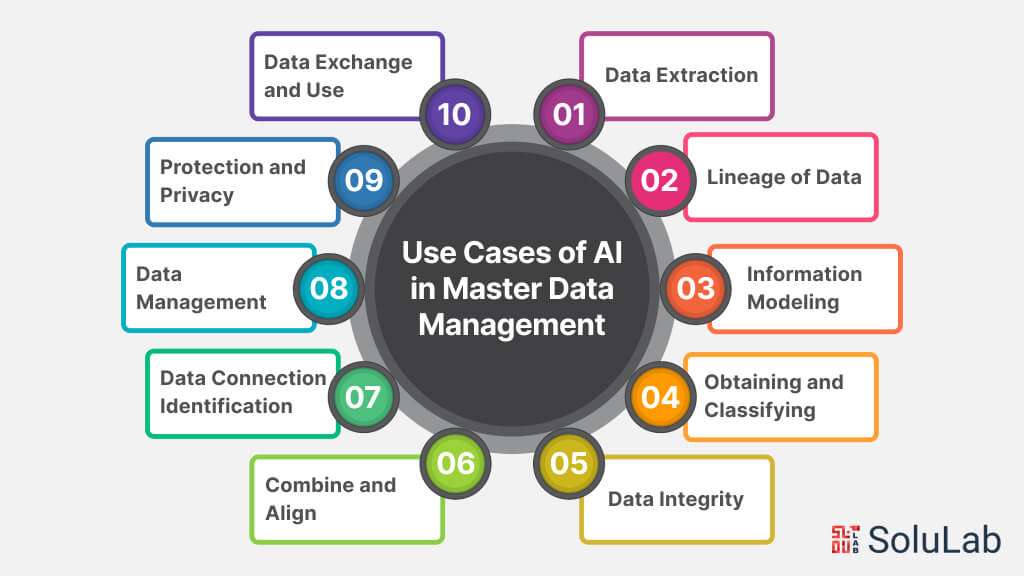
The introduction of AI into master data management (MDM) signals the beginning of a new phase in data efficiency and optimization. Businesses across a range of sectors are using AI-powered solutions to expedite MDM procedures and extract useful insights from their data. Artificial Intelligence is transforming the way businesses handle their master data, from strengthening data governance to boosting data quality. This section delves into particular applications of AI in MDM, examining actual scenarios where AI-powered solutions are revolutionizing data management procedures.
It has been acknowledged that navigating the complex and large-scale master data landscape is a complex problem, especially in light of the excessive amount of continually created data. IDC estimates that 64.2 Zettabytes (ZB) of data were created or replicated globally in 2020, and that number is expected to expand at a compound annual growth rate (CAGR) of 23% from 2020 to 2025. According to the Businesses at Work Study by Okta, enterprises—especially bigger ones—use an average of 175 apps, while smaller ones use an average of 73. This underscores the necessity for effective data management. When one considers that data lakes are predicted to increase at a 30% compound annual growth rate, the need for effective data management techniques is evident.
Under such circumstances, it is not practical nor sustainable to use manual methods to examine data, particularly when it is spread across millions of columns from several sources. The use of clustering, data similarity evaluation, and semantic tagging procedures in master data management machine learning approaches has emerged as a critical tool. These machine-learning techniques may automate the complex tasks of domain identification and master data discovery, which will streamline the discovery process, improve scalability, and increase overall productivity.
Understanding and visualizing the data’s origin, transportation, and transformations is crucial in the intricate ecosystem of master data management. This is especially true when it comes to complying with regulations, preserving data quality, and carrying out well-informed business choices. This path, which is commonly referred to as data lineage, may be carefully charted and tracked with the use of artificial intelligence (AI) technologies, which are increasingly playing a key role in streamlining and improving this essential component of MDM. Data lineage mapping may be efficiently automated master data management by AI technologies because of their capacity to analyze technical metadata and identify relationships using machine learning-based relationship discovery. This enables companies to catalog the sources and kinds of master data as well as the complex routes that this data takes as it moves between different sources and applications across the whole organization.
A general AI engine in the master data management domain might function as a useful illustration of the features included in contemporary data management systems. An engine like this does more than just list master data sources and the domain types that they belong to. Additionally, it creates a comprehensive map that shows how master data moves between different applications and sources throughout the whole business environment.
Digital commerce, cloud data warehousing, and data lakes, application modernization—particularly in master data management—and other digital transformation initiatives all depend heavily on data modeling. MDM is made easier and more scalable for operational and analytical use by creating a centralized MDM hub that is used as a single source of truth by applications and analytical data storage. As a result, the hub must effectively maintain master data models to guarantee that the fundamental characteristics and hierarchies are the same in all sources.
Artificial intelligence plays a crucial role in this intricate situation by offering sophisticated and automated solutions to problems related to data modeling in MDM. Schema matching is one of the primary jobs where AI shines; this procedure is essential to obtaining coherence and alignment in data models across various data sources. Schema matching is the process of finding and connecting characteristics, or groups of attributes, across semantically related master data models. This may be challenging since data varies and changes over time across many organizational platforms.
The maintenance of master data is a difficult process that gets much more so when a large amount of data from many sources is added to it. The two essential elements of the MDM domain are the “Acquisition” and “Categorization” of master data, which include integrating the data and appropriately classifying it within the overall data model. These components experience increased scalability, decreased error margins, and increased efficiency when used in the context of artificial intelligence in MDM.
AI for automated master data ingestion and onboarding can significantly improve the MDM master data management process during the “Acquisition” phase. The process of locating and classifying fields in data sources and then matching them to master data models may be greatly streamlined and automated with the use of AI technologies such as genetic algorithms, named entity recognition (NER), and natural language understanding (NLU). This data integration and structuring procedure is not just for file-based data; it can also be applied to data from API endpoints and integrated into application operations. The productivity of business operations that exchange master data with partner and customer apps is improved by this wide applicability. This capacity is best demonstrated by AI-driven solutions, which streamline and expedite the acquisition process by automating data integration and ingestion. simplifying and accelerating the acquisition stage in MDM.

A fundamental need of master data management is ensuring its flawless quality, which has a direct impact on the reliability, precision, and usefulness of the operational features and insights that are obtained from it. Within this framework, artificial intelligence is particularly noteworthy as a revolutionary enabler, cleverly integrating into different aspects of master data quality assurance to improve correctness and dependability while also introducing a great deal of automation into related procedures.
Ensuring the correctness, completeness, and consistency of master data across all domains is a critical task related to its quality. Artificial Intelligence (AI) makes sense of this complexity by using a combination of machine learning methods, including probabilistic, heuristic, and deterministic approaches, together with Natural Language Processing (NLP). These solutions enable businesses to streamline the data quality assurance process and improve its scalability and efficiency by automating the challenging tasks of master data profiling, cleaning, and standardization.
Because organizational data is so complex and has so many facets, the match and merge activity in MDM master data management is essential to improving data quality and integrity. This activity involves carefully identifying and merging duplicate records, which is an extremely difficult task. Artificial intelligence plays a crucial role in this situation by providing accuracy, scalability, and a certain level of automation to the matching and merging processes while taking into account a changing data environment.
Deduplication is closely related to the match and merge activity and is worth considering carefully because it entails searching through large amounts of data from various applications for duplicate master data records and then wisely combining them into a single, authoritative version that is known as the “golden record.” A golden record is the embodiment of one complete picture, containing precise information that has been gathered and organized from several sources.
In the current context of digital transformation, businesses are paying close attention to expanding their comprehension of company procedures and client interactions. They use a variety of methods, including value stream mapping, business ecosystem modeling, and consumer experiences and journeys. These approaches seek to guarantee that optimization efforts are in line with overall company results rather than favoring particular functional areas and to reveal insights that may be concealed inside departmental silos.
Master Data Relationship Discovery is a crucial component of this strategy, particularly when it comes to the use of AI in master data management. This procedure entails a thorough investigation of the relationships between several master data domains, including supplier, product, and customer data. This makes it possible to comprehend and control end-to-end business processes holistically.
Master Data Governance (MDG) describes how to precisely control and guarantee data security, quality, and accessibility within an organization. It entails painstakingly coordinating the standards, procedures, and rules that specify how data is used, managed, and distributed within an organization. By combining data quality, management, and policy enforcement in a seamless manner, artificial intelligence (AI) in master data management plays a critical role in optimizing and automating many aspects of the Millennium Development Goal (MDG).
An AI engine for master data management, for example, can show how AI can efficiently expedite the process of connecting business glossary definitions, rules, and data owners to master data. By combining domain discovery, data similarity analysis, and Natural Language Processing (NLP) applications, this kind of AI engine may automatically increase these associations’ productivity and accuracy. This improvement has a major positive impact on cross-functional cooperation in master data governance by guaranteeing that different business facets are precisely and efficiently managed and integrated in a seamless manner.
Safeguarding the confidentiality and integrity of master data is critical in the broad field of master data management, particularly in the context of a data-driven operational and technical landscape. Artificial intelligence greatly improves the capacity to protect, handle, and maximize private and sensitive information using accurate, automated, and flexible methods.
When it comes to master data privacy and security, artificial intelligence functions as a resolute sentinel, always keeping an eye out for, recognizing, and categorizing sensitive data as well as implementing proactive safeguards in real time to preserve its confidentiality and integrity. It makes its way across the complex and varied terrain of data, identifying private and sensitive information, linking it to the appropriate privacy policies, and dynamically applying pertinent security regulations to protect the data from misuse and illegal access.
As we get closer to a time where data is the foundation of strategic initiatives and decision-making, the exchange and use of master data inside an organization’s boundaries are essential to coordinating dependable and insight-driven operations. Intelligent automation, predictive analytics, and dynamic data management are integrated across the data lifecycle by using AI to enhance the effectiveness and strategic value of master data exchange and utilization.
By adding intelligence and flexibility to the processes of producing and using data for analytical endeavors, artificial intelligence (AI) enhances the talents and productivity of scientists, data curators, and business analysts. It balances the diversity and complexity of data, suggests relevant master data ahead of time, and guarantees that data consumption and sharing take place in an efficient, safe environment that complies with data governance guidelines.
Artificial Intelligence is a powerful tool for improving master data management because of its ability to mimic cognitive functions like learning and problem-solving. Combining AI and MDM creates a mutually beneficial partnership that improves the effectiveness, precision, and intelligence of an organization’s data management procedures.
Organizations may become more insightful, accurate, and efficient in navigating the intricate web of their data ecosystems by combining AI’s analytical and predictive capabilities with MDM. AI’s automated master data management skills not only reduce mistakes and speed up processing, but they also extract richer, more detailed insights from data, giving organizations the knowledge they need to make better, more strategic decisions. As such, AI in master data management is more than just a technology improvement; it’s a strategic advancement in the handling, interpretation, and value extraction of corporate data.
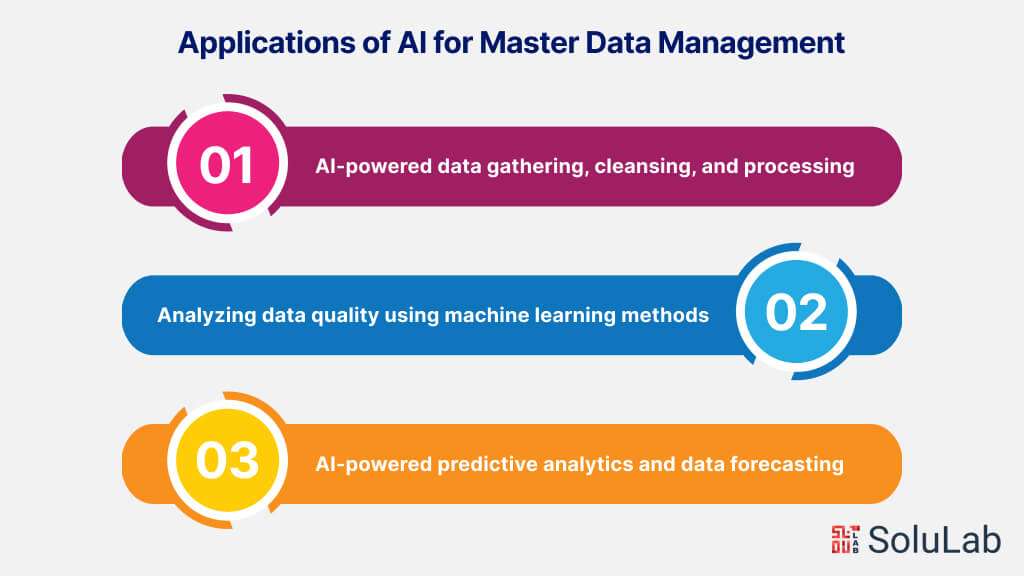
The use of AI in master data management highlights how incorporating cutting-edge technology into conventional data management procedures may have a revolutionary impact. With automated data collection, cleansing, predictive analytics, and data quality enhancement, artificial intelligence (AI) improves master data management (MDM) and increases accuracy, foresight, and alignment with corporate objectives. Businesses can now traverse complicated data environments with more intelligence, agility, and accuracy thanks to these developments.

A Guide to AI in Master Data Management concludes by highlighting the revolutionary potential of AI in streamlining master data management procedures. SoluLab, a top AI development company, provides specific AI development services designed to increase the effectiveness of master data management. Businesses may simplify data governance, enhance data quality, and obtain actionable insights for well-informed decision-making by utilizing AI in MDM. Discover how AI can improve master data management with SoluLab, and use AI-driven solutions to propel success and creativity in data-driven settings.
Master Data Management (MDM) is a process that involves managing the organization’s critical data to provide a single point of reference. AI enhances MDM by automating data cleansing, matching, and enrichment processes, thereby improving data quality and consistency.
AI is utilized in various aspects of MDM, such as entity resolution, data deduplication, data classification, data standardization, and data enrichment, to ensure data accuracy, completeness, and consistency.
Businesses can effectively leverage AI in MDM by investing in AI-powered MDM platforms or integrating AI algorithms into existing MDM systems. Additionally, hiring AI developers or partnering with AI development companies like SoluLab can help customize AI solutions to meet specific MDM needs.
AI development services enable businesses to create custom AI solutions tailored to their MDM requirements. By hiring AI developers, organizations can access expertise in AI technologies and algorithms to build advanced MDM solutions that drive efficiency and innovation.
Challenges in implementing AI in MDM include data privacy concerns, integration with legacy systems, ensuring algorithm transparency and fairness, and the need for skilled AI talent. Addressing these challenges requires careful planning, collaboration, and adherence to best practices in AI development.
SoluLab, as an AI development company, offers specialized AI development services to help businesses leverage AI in Master Data Management effectively. Our team of expert AI developers collaborates with clients to design and implement AI-powered MDM solutions that optimize data management processes and drive business value.


