Talk to an Expert

How Telegram Tap-to-Earn Bot Games Showcase the Future of AI & Blockchain Gaming?

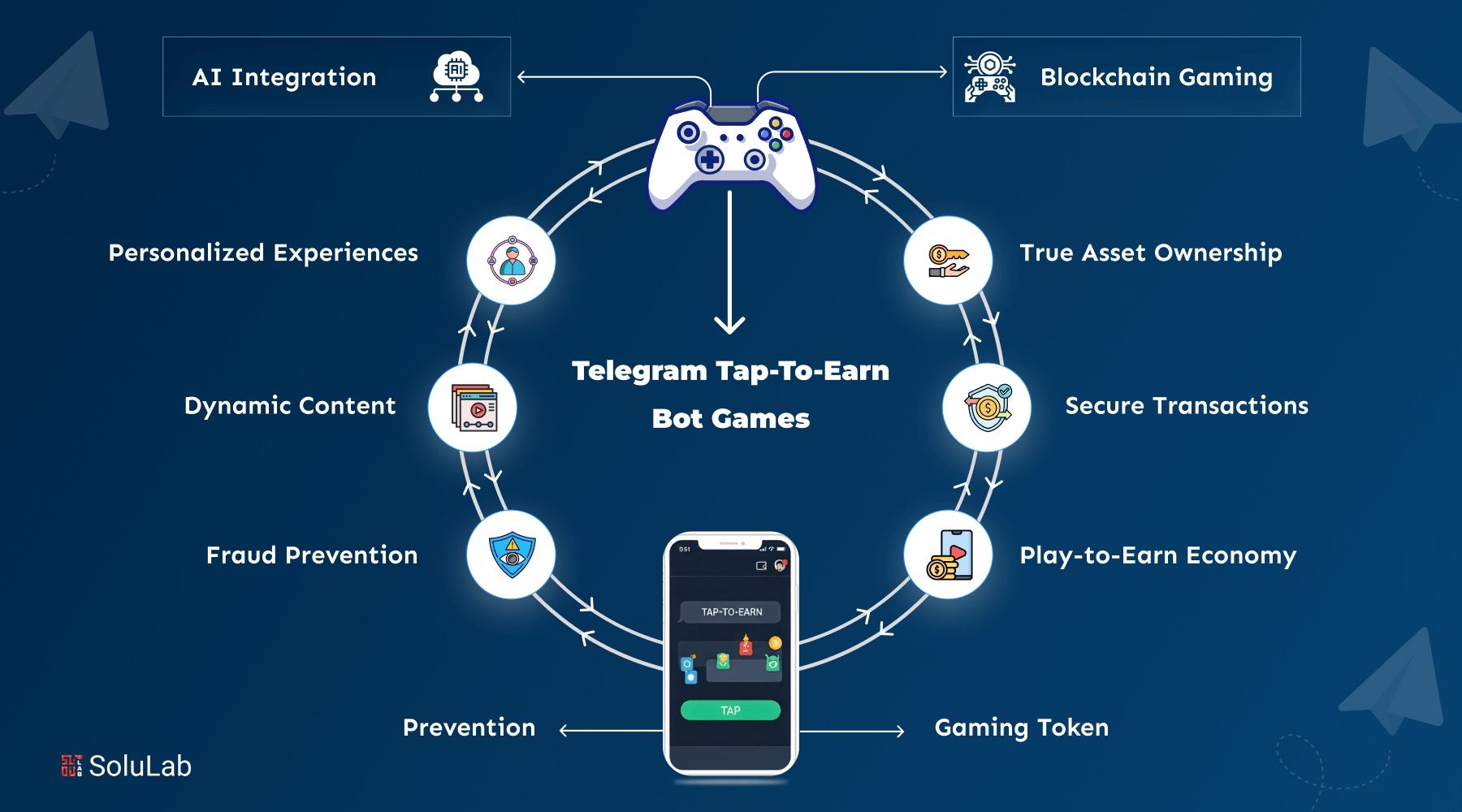
Telegram Tap-to-Earn Bot Games

Tap-to-Earn (T2E) is quickly adopting AI and blockchain technology and making a new wave of innovation. Several entrepreneurs, developers, and investors are taking a keen interest in these games. These simple models are changing how players interact and monetize. Unlike many Web3 games, these bots offer instant access inside Telegram chats. 

TapSwap reached over 55 million users globally, with 18 million daily active users by late 2024.

Through the integration of AI and blockchain, T2E and online gaming are raising the standards beyond entertainment. They showcase the future of scalable, secure, and rewarding gaming ecosystems that appeal to players while opening new opportunities for businesses and startups.

What is a Telegram Tap-to-Earn Bot Game?

A Telegram Tap-to-Earn bot game is a mini-application hosted directly within the Telegram platform. These games require no downloads, separate accounts, or complex onboarding. Players engage by tapping, completing micro-tasks, or interacting with automated challenges to earn in-game rewards.

Unlike conventional games, these bots combine gaming, earning, and social engagement in one ecosystem. The instant accessibility and freedom of choice make them attractive compared to traditional Web3 gaming

Telegram Tap-to-Earn vs. Other Game Models

Let’s check how these T2E games are different from Web3 games and what makes them viral among users. 

Feature Telegram Tap-to-Earn Bot Games Traditional Web3 Games
Access & Onboarding Launch instantly inside Telegram chats with no downloads or wallets needed. Instant play keeps users engaged. Require browser access, wallet extensions, and long onboarding, creating friction.
Wallet Integration Secure integration with Tonkeeper or MetaMask inside Telegram Mini Apps ensures seamless token earning. Wallet connections are often fragmented, making transactions slower and less intuitive.
Community Growth Games spread organically via group chats, leaderboards, and invites. Depend heavily on external marketing and paid campaigns for growth.
Development Costs Bots, APIs, and contracts reduce deployment costs and time. Full-scale Web3 infrastructure demands higher costs and longer timelines.
User Experience Combines gaming, earning, and social interaction within one platform. Experiences are fragmented across gaming, wallets, and social channels.

Blockchain Integration in Tap-to-Earn Games

Blockchain integration powers the core value of Telegram Tap-to-Earn games. It ensures security, ownership, and transparent economies.

1. Immutable Asset Ownership 

Blockchain records every purchase or transfer permanently. This transparency guarantees that player-owned assets remain secure and verifiable at all times. Players trust the ecosystem more.

2. Cross-Game Usability 

Items such as characters, weapons, or skins can be carried across games. This interoperability increases value for players and expands opportunities for developers.

3. Decentralized Transactions 

Every token movement occurs on decentralized networks. This reduces risks of fraud and makes transactions faster, fairer, and verifiable by all participants.

4. Reduced Cheating Risks 

Blockchain validation ensures fairness. Once assets and rules are coded into smart contracts, manipulation becomes almost impossible, reducing cheating and hacks.

The Role of AI in Tap-to-Earn Bot Games

Artificial intelligence transforms how players experience these games. AI makes personalization, fairness, and monetization smarter.

1. Dynamic Difficulty Adjustment 

AI tracks player actions in real time and adjusts challenges. Players remain engaged without becoming frustrated or bored. Balanced gameplay builds loyalty.

2. Personalized Rewards 

Machine learning identifies individual preferences and tailors rewards accordingly. Players receive offers aligned with their habits, which strengthens satisfaction.

3. Smart Monetization 

AI predicts which players prefer video ads, banners, or in-app purchases. Targeted recommendations increase conversions without disrupting gameplay.

4. Predictive Engagement Analytics 

AI analyzes player retention and churn risk. This data helps developers improve content, ensuring players return consistently over time.

Tokenomics, Micro-Economies and Monetization Models

Tokenomics forms the backbone of Tap-to-Earn games. A balanced economy ensures sustainability, growth, and value. Micro-economies within these games enable players to earn, trade, or stake tokens. 

AI enhances these models with tailored incentives, subscription suggestions, and revenue optimization. Monetization channels include in-game ads, cosmetic upgrades, and reward-based video ads. 

Blockchain ensures tokens retain value through scarcity mechanisms like burns. Together, these models create sustainable revenue for developers while rewarding players for engagement.

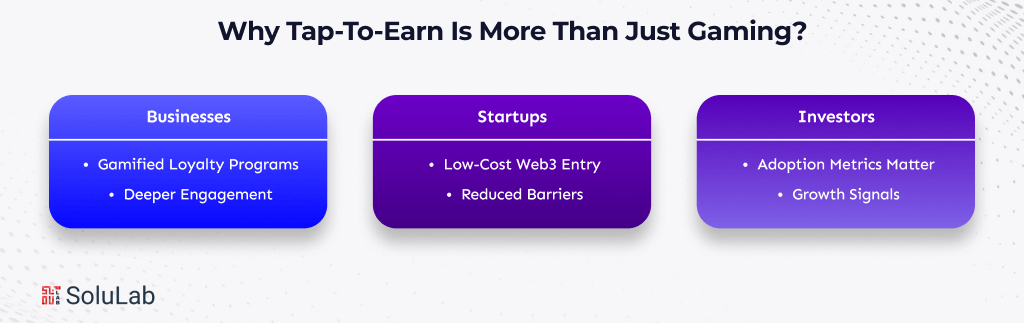
Why Tap-to-Earn Is More Than Just Gaming?

Tap-to-Earn represents more than entertainment. It is a proof-of-concept for scalable Web3 economies.

  • Businesses can adapt gamified customer loyalty programs using tokenized incentives. Customers engage deeper and return more often.
  • Startups find a low-cost entry point into Web3 through bots instead of heavy infrastructure investment. This reduces barriers to innovation.
  • Investors view user adoption metrics in Tap-to-Earn as signals of broader blockchain gaming potential. Strong engagement forecasts market growth.

This model provides a blueprint for integrating AI, blockchain, and social gaming into multiple sectors.
Why Tap-to-Earn Is More Than Just Gaming

How to Overcome AI and Blockchain Game Development Challenges?

AI and blockchain integration in games is not an easy task; there will be challenges. But every challenge has a solution. Let’s check some challenges you might face during AI and blockchain game development, and what the solutions are.

  • Scalability and Server Load Management

High traffic can overwhelm servers during rapid adoption. Cloud-based infrastructure, sharding, and load balancing distribute demand. Optimized engines and database tuning ensure smooth operations under heavy loads. Developers must scale efficiently to protect performance.

  • Botting and Cheating

Bots exploit games by tapping faster than humans. Timestamp checks, behavior analysis, and dynamic task changes counter these risks. Advanced cheat detection software and frequent audits reinforce trust and fairness within the ecosystem.

  • Designing Sustainable Tokenomics

Unbalanced supply or inflation can destroy token value. Developers must monitor token flow, introduce burns, and expand utility cases. Incentives for staking or participation prevent sell pressure and support a strong economic model.

  • Player Retention

Repetitive gameplay reduces engagement. Regular updates, meaningful rewards, and seasonal events keep players active. Building communities through leaderboards or group challenges strengthens long-term interest and loyalty within the game.

  • Designing an Engaging User Interface

Confusing UI designs drive churn. Responsive layouts, intuitive navigation, and consistent branding are critical. Testing and iteration ensure the interface adapts to player needs. Unique characters or interactive visuals enhance user satisfaction.

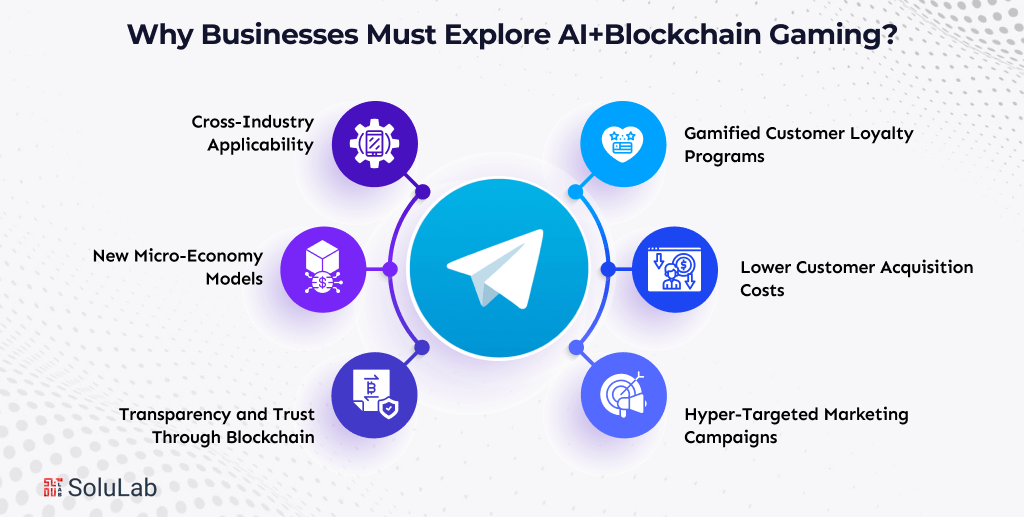
Why Businesses Should Care About AI+Blockchain Gaming?

As of now, you might have already understood the importance of AI and blockchain in the gaming industry. Here are some convincing reasons:
Why Businesses Must Explore AI+Blockchain Gaming

  • Gamified Customer Loyalty Programs

Businesses can design blockchain-based loyalty tokens that reward customer actions. A Deloitte survey found that gamified loyalty programs can increase engagement rates by up to 47%, improving retention.

  • Lower Customer Acquisition Costs

AI-driven personalization reduces marketing spend by targeting the right users. According to McKinsey, personalization can drive 40% more revenue growth while lowering acquisition costs.

  • Hyper-Targeted Marketing Campaigns

AI analyzes user behavior such as purchase history and activity patterns. This enables businesses to launch tailored campaigns that raise conversion rates by 10-15% compared to generic promotions.

  • Transparency and Trust Through Blockchain

Blockchain records are immutable, creating verifiable proof of ownership and transactions. PwC reports that 45% of consumers trust blockchain systems more than centralized databases for digital value.

  • New Micro-Economy Models

Businesses can tokenize in-game assets, loyalty points, or digital goods. These tokens can be exchanged, staked, or burned, creating sustainable value ecosystems that boost long-term engagement.

  • Cross-Industry Applicability

AI+Blockchain gaming models apply to multiple industries. Retail brands can tokenize rewards, financial firms can gamify investments, and entertainment companies can build fan economies around exclusive digital assets.

If you are thinking of developing a game that gives a wide virtual world experience with catchy rewards, consider consulting a third party. It is a good choice for AI and blockchain solutions and integration.

Future of AI & Blockchain Gaming Beyond Telegram

AI and blockchain integration in gaming is widening the innovative ideas and shaping the world’s technology. Not just games, from daily actions to global economics, AI, and beyond, blockchain solutions simplify complex actions. 

  • In the near future, gaming platforms will become cross-platform assets. These are usable in the virtual world, metaverse, and traditional gaming consoles. 
  • AI will expand personalization, analyzing behavior across networks to deliver unified experiences. 
  • Blockchain economies will underpin not just games but entire social and business ecosystems. 
  • Telegram Tap-to-Earn bots mark the first step in a broader transformation where AI, blockchain, and gaming converge to define future digital engagement.

Blockchain Development Company

Conclusion

AI and blockchain integration in games is a great innovative step. As discussed above, this brings several futuristic ideas and transformations in world economics and technology. So, if you are also thinking of building AI+blockchain games or want custom changes, then consult SoluLab. 

We, at Solulab, a top blockchain game development company, aid you in designing scalable, secure, and transparent solutions. Our expert team and enhanced technology applications help you in building a user-friendly ecosystem and craft your ideas into real-world applications. 

If you are also looking for AI and Blockchain solutions, contact us today to get started!

FAQs

1. What makes Telegram Tap-to-Earn bot games different from other Web3 games? 

Telegram Tap-to-Earn games run directly inside chats, require no downloads, and spread virally through communities, making them faster, cheaper, and more engaging than traditional Web3 models.

2. How does blockchain improve security and ownership in Tap-to-Earn games? 

Blockchain ensures every asset and transaction is transparent and permanent. This guarantees real ownership, reduces fraud, and builds stronger trust among players within the gaming ecosystem.

3. What role does AI play in enhancing Tap-to-Earn gameplay? 

AI personalizes player rewards, adjusts difficulty in real-time, and predicts engagement trends. These improvements keep players interested, reduce churn, and make gameplay rewarding without overwhelming users.

4. Why should businesses or startups consider SoluLab for AI+Blockchain game development? 

SoluLab offers tailored blockchain and AI development with proven expertise. The team builds secure, scalable, and user-friendly ecosystems, making it easier for startups and enterprises to launch innovative Web3 solutions.

5. Could Tap-to-Earn games influence industries beyond gaming? 

Yes. The tokenized incentives and AI-driven engagement models can be applied to loyalty programs, e-commerce, or even workplace training, proving that this concept can reshape multiple industries outside gaming.

How AI in Gaming is Changing the Future of Industry?

AI in gaming

In the year 2020, online gaming experienced a remarkable surge as the global COVID-19 pandemic confined game enthusiasts to their homes, leading them to seek new avenues to fulfill their gaming desires. Though the initial growth trend has since stabilized, online gaming remains highly popular, boasting over 2.5 billion active gamers worldwide. As we look to the future, AI emerges as a transformative force with the potential to upgrade the gaming industry. NPCs (more details later) play a pivotal role in this transformation. According to Statista, by 2027, a staggering majority of residents in the US (64%) and UK (70%) are projected to be classified as gamers, reflecting the expanding significance of the gaming market.

In the gaming industry, the Artificial Intelligence (AI) market is projected to experience significant growth, with an anticipated increase of USD 4.50 billion from 2023 to 2028. This expansion is driven by several key factors. Central to this growth is the increasing adoption of Augmented Reality (AR) and Virtual Reality (VR) technologies. These immersive technologies provide enhanced gaming experiences, attracting a wider audience. Additionally, the proliferation of free-to-play models has increased accessibility and affordability, broadening the market’s reach. Furthermore, the gaming industry, with a growing population of millennials and Gen Z who favor digital and interactive experiences, is propelling the market forward. These factors combine to create a strong growth trajectory for the AI in Games Market.

AI in gaming market

What Is AI in Gaming?

AI stands for responsive and adaptive video game experiences. These interactive experiences are driven by AI-powered non-player characters (NPCs) that exhibit intelligent and creative behavior, resembling human players. AI serves as the engine that dictates an NPC’s actions and reactions within the game world. The future of AI in gaming is promising, as it is not a novel concept. However, in recent times, it has transcended its traditional role to become a transformative force that is reshaping both the process of game development and the interactive experiences players enjoy. AI-powered games progressively shift the control of the gaming experience toward the player, whose actions and choices contribute to finalizing the game’s narrative and outcomes.

In game design, AI procedural generation, also known as procedural storytelling, refers to the algorithmic creation of game data, replacing the traditional approach where each element is manually crafted by a developer. This technique allows for the generation of environments, characters, quests, and other game assets, resulting in unique and varied experiences with each playthrough.

In response to the burgeoning demand for gaming experiences, a myriad of startups and established enterprises have ventured into the virtual world, offering AI-driven gaming solutions and platforms. Significant investments in this sector underscore the growing influence of AI in the entertainment industry, particularly in games utilizing play-to-earn tokens.

For instance, in January 2021, Latitude, an AI app development company specializing in AI-generated infinite stories within video games, secured $3.3 million in venture funding. Osmo, an interactive play business, bolstered its growth prospects with a substantial investment of $32.5 million. Additionally, Gosu Data Lab, a Lithuanian AI gaming firm, garnered a notable $5 million in funding, aiming to analyze gaming data and enhance player skills through AI-driven insights.

These prominent examples illustrate the increasing prevalence of AI in gaming industry, emphasizing its advantages and potential to upgrade the industry.

Use Cases of AI in the Gaming Industry

AI in Gaming use cases

The integration of AI in the Gaming Industry has been an interactive experience by crafting and adaptive gameplay. Non-player characters (NPCs) exhibit intelligent and imaginative behavior, mimicking human-like actions and decision-making. The future of AI in gaming is profound and continues to expand, transforming numerous aspects of gaming by enhancing engagement, adaptability, and responsiveness. Additionally, the rise of play-to-earn tokens is revolutionizing the gaming landscape, allowing players to earn real-world value through in-game achievements. For those who wonder how AI and video games intertwine, here are key areas where the uses of artificial intelligence in gaming are propelling the industry forward.

1. Non-Player Characters (NPCs)

One of AI’s most impactful applications is in the application of AI in gaming, particularly in the creation of non-player characters (NPCs). These NPCs exhibit intelligent behaviors that mimic those of real players, enhancing the immersion and dynamism of games. However, they are pre-programmed to follow automated rules that cannot be directly controlled by players. This allows for more realistic interactions between characters and players, resulting in a unique and personalized gaming experience for each individual.

Leading gaming companies such as SEED (EA) have recognized the potential of AI-enabled NPCs and are actively leveraging this technology. They utilize AI to train NPCs by simulating the behaviors and strategies of top players. This results in NPCs that can adapt and respond to players’ actions in a more natural and intelligent manner, creating a more engaging and challenging gaming experience.

2. Image Enhancements and AI Upscaling

AI has another noteworthy application of AI in gaming known as “AI Upscaling,” which focuses on enhancing visuals. The core principle behind this technique is the transformation of a low-resolution image into a higher-resolution one while maintaining a similar visual appearance. This remarkable technique not only revitalizes classic games but also empowers players to experience visuals and improved resolutions, even on older hardware.

NVIDIA’s DLSS technology serves as an exceptional example of AI’s capabilities in image enhancements. NVIDIA researchers have successfully implemented AI-driven upscaling in games such as “Cyberpunk 2077” and “Control,” resulting in higher-resolution graphics and improved frame rates. This advancement enables players to seamlessly navigate and alter scenes within these games, creating a truly immersive and visually stunning gaming experience.

3. Procedural Content Generation (PCG)

Artificial intelligence in gaming holds tremendous potential in PCG. It enables game developers to create richer and more diverse worlds by simplifying the complex process of game asset generation at an accelerated rate to meet users’ demands. Additionally, AI can generate interactive narratives based on past storylines.

For instance, AI Dungeon 2, a text-based adventure game, utilizes OpenAI’s GPT-3 language model to provide infinite adventures and possibilities. In AI Dungeon 2, players progress through the game by giving relevant prompts and directing AI to create unique storylines for their characters to interact with.

4. Player-Experience Modeling (PEM)

Artificial intelligence in gaming is exemplified by player experience modeling (PEM), a prevalent AI trend that mathematically simulates gamers’ experiences to forecast their preferences for enjoying or disliking a game. This AI analyzes players’ proficiency and emotional states to adjust the gaming mechanics. Based on gamers’ skill levels, AI can modify the game’s complexity in real time, tailoring it to their interests, thus enhancing interactivity and adaptability. This customization ensures a more engaging and immersive gaming experience that caters to individual preferences and skill levels.

CTA1

5. Data-Mining and Real-Time Analytics

Every day, 2.5 billion gamers worldwide produce around 50 terabytes of data. This massive volume of data presents a significant challenge for gaming companies, as they must monitor it closely to identify opportunities and take proactive measures before players leave the game. Consequently, gaming businesses are increasingly utilizing artificial intelligence in gaming and machine learning in live streams to mine data and extract actionable insights.

DemonWare, an online multiplayer game, exemplifies the successful use of AI in gaming by employing real-time AI data analytics.

6. Player Sentiment Analysis

How AI is changing the gaming industry can be seen in AI sentiment analysis, which plays a pivotal role in uncovering players’ preferences and optimizing their gaming experiences. This technology analyzes player feedback, reviews, and various data sources to gain insights into their choices regarding game levels, menu designs, and opponents.

Game developers leverage AI sentiment analysis to scrutinize player feedback, enabling them to identify which aspects of their games resonate most with players and areas that require refinement. For instance, League of Legends, a renowned Riot Games title, employs AI sentiment analysis to monitor player discussions across multiple platforms. This data empowers Riot Games developers to make informed decisions regarding game updates and improvements, ultimately enhancing the overall gaming experience.

7. Cheat Detection in Multiplayer Games

How AI is changing the gaming industry is evident in the fight against cheating, which poses a significant challenge by adversely affecting the player experience and leading to dire consequences for gaming platforms. As the risks of cheating escalate, players worldwide find themselves vulnerable to opponents who employ underhanded tactics to gain an unfair edge. Consequently, there is an urgent need to leverage artificial intelligence (AI) to scrutinize players’ movement patterns and discern instances of cheating.

Several renowned online games, such as PlayerUnknown’s Battlegrounds (PUBG), have already incorporated AI technology to analyze player patterns and thwart cheating attempts. Notably, PUBG has garnered media attention for its strict stance against cheating, resulting in the banning of professional players who violated the game’s rules.

8. Testing and Debugging

Utilizing AI-driven testing and debugging tools, developers can efficiently manage numerous intricate test cases at a significantly accelerated pace compared to manual testing. These automated tools possess the capability to scan extensive codebases, detect errors, identify bugs, and suggest potential fixes.

By automating these time-intensive and labor-intensive tasks, developers are empowered to pinpoint and eliminate unnecessary elements within the game structure, enhancing their productivity. This automation streamlines the game testing process, demonstrating how AI is changing the gaming industry, resulting in increased speed and efficiency.

9. Virtual Assistants

AI-driven assistants have emerged as a powerful tool to enhance the user experience and foster interactivity and adaptability. These virtual assistants leverage natural language processing (NLP) to decipher players’ queries and provide tailored responses that cater to their quests. By offering pertinent information and guidance throughout the gameplay, these assistants not only aid players in their journey but also contribute to increased user engagement and retention rates, showcasing the AI in the Gaming Industry.

Different Types of AI in the Gaming World

In modern game development, artificial intelligence (AI) plays a crucial role in enriching the player’s experience. AI applications in gaming are inseparable, as AI drives the behavior of non-player characters (NPCs) and the overall dynamics of the game. Here are some of the key types of AI used in game development:

  • Rule-Based AI

In games, rule-based AI operates on a predefined set of instructions and conditions, guiding the actions and behaviors of non-player characters (NPCs). These rules dictate how NPCs interact with players and their surroundings, ensuring consistent behaviors and predictable outcomes.

For example, in a racing game, if the player veers off the track, the rule-based AI may trigger actions such as slowing down the player’s car and displaying a message urging them to return to the designated track. This ensures that the game’s AI responds in a consistent and predictable manner, maintaining a sense of fairness and challenge for the player, which highlights the advantages of AI in gaming.

  • Machine Learning AI

Within games, Machine Learning AI enables NPCs to learn and adapt based on accumulated experience and data. This allows NPCs to enhance their behaviors gradually through training and feedback loops. For instance, in a sports simulation game, if a player persistently employs a specific tactic, the machine learning AI can learn and adjust to the player’s strategies over time, resulting in a more challenging gameplay experience, showcasing the evolving role of AI in the gaming industry.

  • Finite State Machines

Non-Player Characters (NPCs) behaviors are modeled through finite state machines (FSMs). FSMs utilize a sequence of states, each symbolizing a specific behavior or action. They are particularly valuable in games where NPCs must respond to changing game states while adhering to state-driven behaviors.

For example, in a platformer game, a hostile character may use a finite state machine to transition between various states—from patrolling to chasing or even attacking when the player character enters a specific proximity—highlighting the role of AI in the gaming industry.

  • Behavior Trees

Behavior Trees (BTs) provide a hierarchical framework for organizing non-player character (NPC) behaviors. They consist of nodes representing actions, conditions, and sequences. Each node defines a specific task or decision-making process, allowing developers to design complex NPC behaviors in a modular manner.

For example, in an open-world role-playing game, a shopkeeper NPC may utilize behavior trees to carry out various tasks based on the time of day and player interactions. These tasks may include restocking items, engaging with customers, and closing the shop at night, illustrating the impact of AI in the gaming industry.

DO YOU KNOW?
In the years to come, the United Kingdom is projected to surpass Japan in terms of user penetration in the gaming industry. It is estimated that by 2027, a remarkable 70% of UK residents will be classified as gamers, highlighting the significant growth and importance of the gaming market within the country. As of 2022, the UK holds the 6th position in a Newzoo ranking, generating an estimated revenue of $5.7 billion, further solidifying its position as a key player in the global gaming arena.

  • Pathfinding AI

Pathfinding AI plays a crucial role in optimizing the movement of non-player characters (NPCs) within virtual environments. This AI considers obstacles, terrain features, and changes in the environment to ensure efficient navigation from one point to another.

For example, in a strategy game, when a player commands a unit to move to a distant location, the pathfinding AI comes into action. It meticulously calculates the optimal route, taking into account obstacles and selecting the shortest path. This ensures that the unit reaches its destination swiftly and efficiently, showcasing the significance of AI-powered PCG games and enhancing the overall gameplay experience.

  • Reinforcement Learning AI

Incorporating Reinforcement Learning (RL) into Non-Player Characters (NPCs) enables them to acquire optimal behaviors through iterative trial and error. Utilizing RL, NPCs continually enhance their decision-making capabilities by analyzing the results of their actions and adapting their strategies to accomplish long-term objectives.

A notable example of RL in action can be seen in fighting games, where reinforcement learning AI can train itself to refine its combat techniques. Through numerous matches, the AI learns from each outcome, gradually developing advanced fighting strategies. This ongoing process transforms the AI into a skilled and formidable opponent for the player, showcasing the role of artificial intelligence in the gaming industry and offering a challenging and engaging gaming experience.

Innovations of AI in Games

The gaming industry is making significant strides with the integration of AI innovations. These advancements are changing the way games are created and played by offering more immersive and personalized experiences. From crafting smarter NPCs to fine-tuning gameplay balance, AI is transforming various aspects of game development. Here are some notable innovations in AI that are correcting the future of gaming:

1. AI and Realistic NPCs

Advancements in AI-powered PCG games have led to the creation of NPCs that exhibit lifelike behaviors, emotions, and interactions. These NPCs possess the ability to make realistic decisions in social interactions and provide adaptive responses based on player actions. This enhanced level of NPC sophistication enriches the storytelling and immersion within game worlds, making them feel more vibrant, responsive, and alive.

2. AI and Proactive Game Design

Incorporating artificial intelligence (AI) into game design opens up exciting possibilities for innovation. AI can assist in creating procedurally generated stories, optimizing level designs, and introducing adaptive game mechanics, enhancing creativity and player engagement. From analyzing player data to inform design decisions to crafting intricate puzzles and weaving engaging narratives, AI empowers game developers to push the boundaries of interactivity.

3. AI and Procedural Generation

Through the incorporation of AI advancements, procedural generation has undergone a transformative evolution. AI’s intelligent capabilities enable the creation of intricate and diverse game worlds, complete with unique levels, environments, quests, and challenges. This approach grants players immersive experiences and endless replayability options, ensuring continuous enjoyment and engagement.

4. AI and Game Analytics

Through the utilization of AI-powered analytics tools, developers are empowered to decipher player data, anticipate trends, and refine game features. This data-centric approach not only enhances game performance but also discerns player preferences, guides future updates, and identifies fraudulent activities.

5. AI and Game Difficulty Adjustment

In real-time, AI in games examines player behavior and gameplay data. This allows for adjustments to the difficulty levels, encounter challenges, and item drop rates. As a result, an engaging and balanced experience is created for each player, tailored to their individual skills.

6. AI-Assisted Game Testing

Through the use of AI-assisted game testing, the testing process is automated, leading to the identification of bugs and optimization of game performance before release. This changes the approach not only to enhance the overall quality of games but also to expedite development cycles. As a result, players can enjoy seamless gaming experiences from the very first day, fostering a higher level of satisfaction.

Emerging AI Trends in Gaming

AI Trends in Gaming

AI has become a linchpin, propelling the creation of captivating user experiences. As we journey deeper into the use of AI in gaming, we will uncover how it, alongside other technologies, is getting into the future of this vibrant industry. Let’s delve into the prominent AI trends in gaming that have emerged in recent years.

Generative AI in Gaming

Generative AI offers developers the power to create infinitely developing content, granting players a novel and distinct experience with each visit to the platform. Games such as No Man’s Sky and Minecraft exemplify this concept by ensuring that players will never exhaust the possibilities of the virtual world.

Moreover, generative AI games foster the development of highly realistic NPCs that possess the ability to evolve, learn, and adapt as the game progresses. This constant evolution introduces an element of unpredictability and replayability, keeping players engaged and immersed in the gaming experience.

Cloud-Based Gaming

The future of gaming lies in streaming, allowing players to seamlessly access and enjoy high-end games online from any device, including smartphones. Cloud-based gaming eliminates the need for downloading or installing games on devices, and it does not require expensive gaming consoles or personal computers. Players can resume their progress anytime, on any device, so they never have to worry about losing their hard-earned achievements.

Artificial intelligence in the gaming industry plays a crucial role in cloud gaming. Powered by Deep Neural Networks (DNNs), AI helps cloud servers deliver optimal performance, ensuring that even older hardware can provide a smooth and immersive gaming experience.

Blockchain and NFT

Non-fungible tokens (NFTs) serve as the backbone of in-game economies, empowering players to engage in digital token trades, thereby enhancing the rewarding aspect of gameplay. NFT games harness the potential of blockchain technology to precisely track and safeguard player ownership rights, fostering a more inclusive and transparent ecosystem in online gaming.

Native AI gaming plays a pivotal role in the world of NFTs. AI-powered analytical tools enable developers to scrutinize player data, uncovering insights into their preferred asset types. This data-driven approach empowers game creators to craft highly targeted content and tailor gaming experiences to each player’s unique preferences, resulting in a more immersive and personalized gaming journey.

AR, VR, and Metaverse

By incorporating augmented reality (AR), virtual reality (VR), and the metaverse into gaming, AI introduces captivating new possibilities for interactive online gaming experiences. Picture yourself, as a player, able to craft a personalized virtual world and invite friends to join you. This immersive experience, facilitated by AI’s ability to design intricate virtual scenes, promises to be both thrilling and engaging.

Challenges of AI in Gaming

While artificial intelligence offers numerous applications and advantages in video games, it is crucial for gaming companies to carefully evaluate the ethical challenges that accompany its growing presence. Here are some of the key ethical concerns associated with AI in gaming Industry:

1. Data Privacy

Artificial Intelligence (AI) often utilizes users’ data as a foundation for generating responses. However, this practice raises legitimate concerns regarding data privacy and protection. It is crucial to question what kind of data is being collected, how it is stored, and who has access to it. Responsible AI development companies must prioritize transparency about their usage of this data and implement robust security measures to safeguard users’ information. By doing so, they can foster trust and maintain the integrity of their gaming experiences, especially in Native AI gaming.

2. Game Addiction

To address ethical considerations in AI-driven games, developers should implement measures to mitigate the risk of addiction. One approach is to set time limits or provide warning messages that remind players to take regular breaks. This would discourage excessive screen time and promote healthier gaming habits.

DO YOU KNOW?
In 2022, the gaming industry experienced a contraction, shrinking to approximately $182 billion in total market value. Notably, mobile gaming contributed significantly to this revenue, generating an impressive $92 billion alone.

3. Offensive Content

With the increasing sophistication and personalization of AI powered PCG games, game characters might engage in offensive language, generate harmful content, or exhibit violent behaviors. This can pose a significant concern, especially for younger players who are highly impressionable and learn rapidly.

To address the challenges of potentially harmful game content, game developers have a responsibility to ensure that their characters do not promote offensive or damaging actions. In cases where such content is necessary for the game’s narrative, developers should include clear warnings or age restrictions to prevent players from implementing these actions in real life.

The Future of AI in Gaming

Undoubtedly, artificial intelligence (AI) has upgraded various industries, and the gaming sector is no exception. Throughout the years, AI in video games has become a transformative force, continuously pushing the boundaries of what can be achieved in the virtual world. It has changed how games are developed, experienced, and enjoyed by players.

One of the most noteworthy impacts of AI on gaming is its ability to offer enhanced interactivity, including high-level graphics and visuals, limitless combinations of stories, more realistic non-player characters (NPCs), and personalized experiences. Additionally, gaming companies are utilizing AI’s predictive analytics capabilities to analyze player behavior and anticipate winning teams. The benefits of artificial intelligence in gaming are evident in these advancements, improving both game development and user engagement.

Looking ahead, Native AI gaming will play a pivotal role in empowering the development of online games and propelling the gaming industry into a new era. As AI game development continues to heighten the realism of player experiences, it is anticipated that new opportunities for creators will arise, enabling them to monetize their gaming platforms. The application of AI in gaming will be crucial in shaping these future developments.

However, as AI becomes more integrated into gaming, discussions surrounding AI ethics, data privacy, and responsible business practices will become crucial. Organizations will need to implement responsible AI policies to ensure the ethical future of AI in gaming. Consequently, governments may impose strict regulations in the future, necessitating the use of explainable AI in gaming.

CTA2

How SoluLab Is Helping To Change The Industry With AI?

The integration of Native AI gaming is not just the future—it’s actively taking place in the way games are developed, played, and experienced. AI game development is transforming everything from game design and player interactions to in-game environments and adaptive challenges.

SoluLab, an AI development company, can assist you with implementing advanced AI techniques in gaming, including AI-driven character behavior, storytelling, and personalized gaming experiences. Our expertise in the applications of AI in gaming ensures that your gaming projects are equipped with the latest innovations to captivate and engage players.

We developed an AI-powered chatbot for Digital Quest, a travel business aiming to improve user engagement and customer service. The chatbot, built using Generative AI, provides personalized travel recommendations and streamlines reservations by extracting relevant data from Digital Quest’s website. SoluLab ensured the chatbot was user-friendly, secure, and tailored to meet the specific needs of the travel industry. With ongoing support and multi-language capabilities, the chatbot has significantly enhanced customer interaction and delivered a cost-effective solution for Digital Quest. For further assistance, feel free to Hire AI Developers from our AI development company.

FAQs

1. How is AI in gaming influencing game development?

The future of AI in gaming is transforming game development by enhancing character behavior, personalizing player experiences, and creating adaptive challenges. AI development companies are utilizing advanced techniques to bring more realism and engagement to games.

2. What are some examples of AI applications in the gaming industry?

Examples include AI-driven NPC behavior, procedural content generation, and predictive analytics for player behavior. These applications contribute to more immersive and interactive gaming experiences.

3. How does AI impact the economic aspects of the gaming industry?

AI impacts the economic aspects by optimizing game design and development processes, which can lead to increased revenue through enhanced player engagement. Additionally, the introduction of P2E tokens and play tokens can influence Market Capitalization in the gaming sector.

4. Can you explain the role of AI in Play-to-Earn (P2E) games?

In P2E games, AI helps create dynamic game environments and balanced gameplay. AI technologies are used to manage in-game economies, personalize player experiences, and ensure fairness, which enhances the overall value of play to earn tokens.

5. How can I get help with AI integration for my gaming project?

If you’re looking to integrate AI into your gaming project, consider reaching out to an AI consulting company or AI development company. These companies can offer expertise in applying AI technologies to enhance your game’s features and performance.

6. How do AI development companies contribute to the gaming industry?

AI development companies contribute by providing specialized tools and expertise to implement AI technologies in games. This includes developing AI systems for character behavior, game design, and player interaction, leading to more engaging and immersive gaming experiences.
