Talk to an Expert

How AI Development Is Driving Fintech Innovation in Australia?

AI in Australian Fintech Industry

Managing finances isn’t always smooth. Many Australians still face long loan approval times, bulky banking interfaces, and limited access to personalized financial advice. On the other hand, fintech companies face rising compliance costs and pressure to deliver faster, safer services.

From automating tedious processes to detecting fraud in real-time, AI solutions are transforming the way the fintech industry operates in Australia. With the rise of AI applications in fintech, startups and banks alike are delivering smarter, more personalized financial experiences. 

At the same time, AI agents in financial services are helping businesses stay compliant and agile in the face of strict regulations. In this blog, we’ll explore how AI is in fintech, use cases, and look at what the future holds. Let’s get started!

The Rise of Fintech in Australia: Overview

AI in the Australian finance industry has over 800 fintech companies operating across the country, and it’s one of the fastest-growing tech sectors in the region. Sydney and Melbourne have become major hubs, attracting both local startups and global players.

Supportive regulations, like open banking and the Consumer Data Right (CDR), have made innovation easier and safer. In fact, Australia’s fintech adoption rate hit 58%, one of the highest in the world. 

Within the financial services and insurance industries, 39% of businesses have adopted AI, utilizing it for various applications, including customer service chatbots and automation of routine tasks.

CTA1

Benefits of AI in Fintech for Australian Consumers

AI in the financial industry is improving the financial geography in Australia, offering consumers smarter, faster, and more secure services. Here are some of the benefits: 

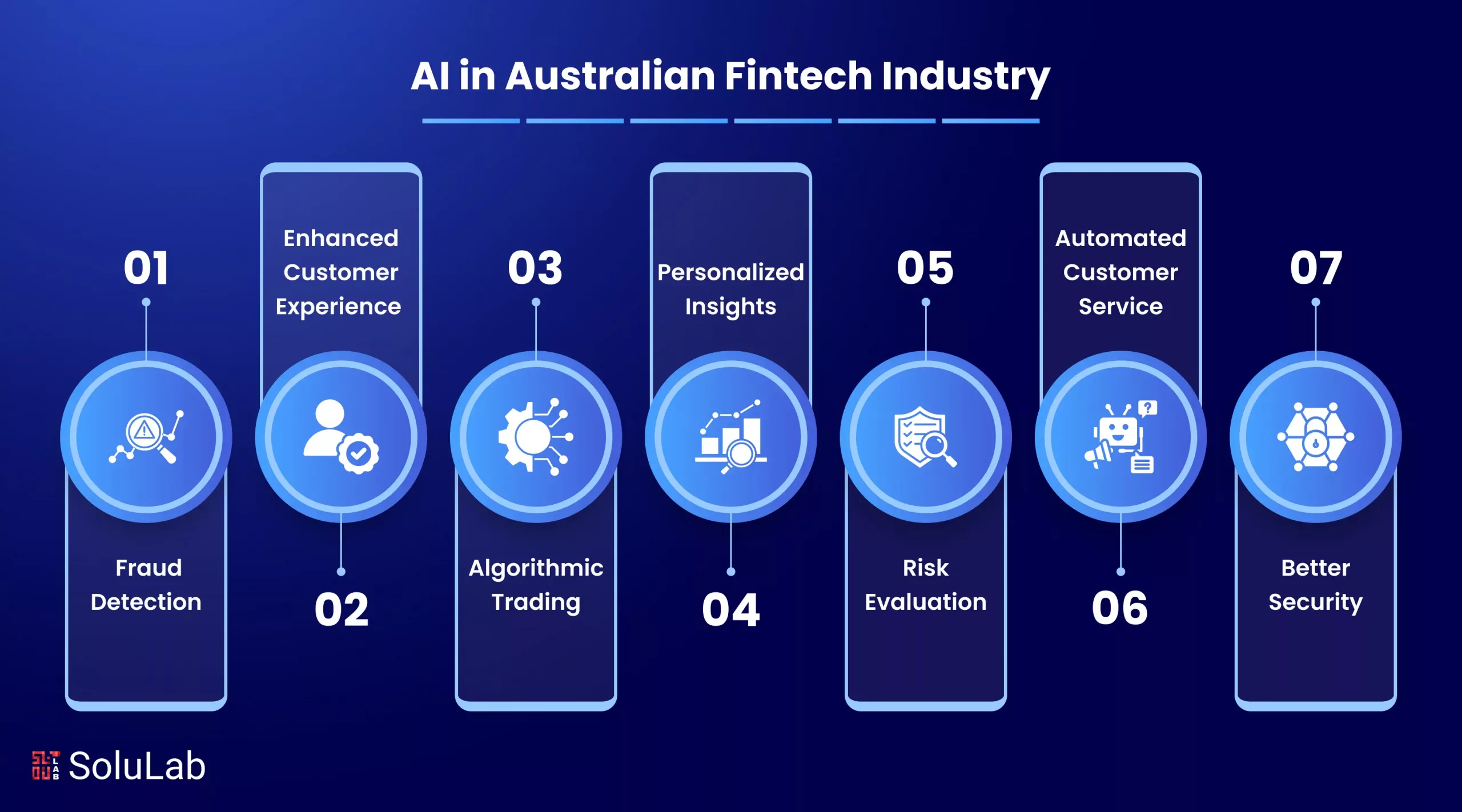
1. Fraud Detection

By analyzing vast amounts of transaction data, AI systems can identify unusual patterns and flag potential fraudulent activities before they arise. For example, the Commonwealth Bank of Australia (CBA) has implemented AI-driven systems to detect and investigate financial crimes more efficiently and protect customers’ assets. 

2. Enhanced Customer Experience

Gone are the days of long wait times for customer support. Due to AI integration in financial solutions, AI-powered chatbots and virtual assistants now provide instant, 24/7 assistance. They handle routine inquiries and offer personalized financial advice. CBA’s virtual assistant, “Ceba,” is a prime example, assisting customers with various banking needs and improving overall satisfaction.

3. Algorithmic Trading

For investors, AI enables algorithmic trading by analyzing market trends, historical data, and even social media sentiment to execute trades. This technology enables faster, more efficient trading decisions, potentially maximizing returns and minimizing risks. 

4. Personalized Financial Recommendations

AI analyzes individual spending habits and financial goals to offer tailored advice. Robo-advisors, powered by AI, provide personalized investment strategies, making financial planning more accessible and affordable for a broader audience. This personalization enhances customer engagement and satisfaction. 

5. Risk Evaluation

Assessing creditworthiness has become more accurate with AI. By evaluating a wide range of data points, including transaction history and employment records, AI models can predict potential risks. This leads to more informed lending decisions and better risk management for financial institutions. 

6. Automated Customer Service

AI improves customer service by automating routine tasks such as account inquiries and transaction processing. This reduces operational cost, plus allows human agents to focus on more complex issues, overall efficiency, and the responsiveness of financial services. 

7. Better Security

Beyond fraud detection, AI enhances cybersecurity by monitoring for potential threats. It can detect anomalies in user behavior, flagging suspicious activities that may indicate security breaches. 
Use Cases of AI in the Fintech Industry

Use Cases of AI in the Fintech Industry

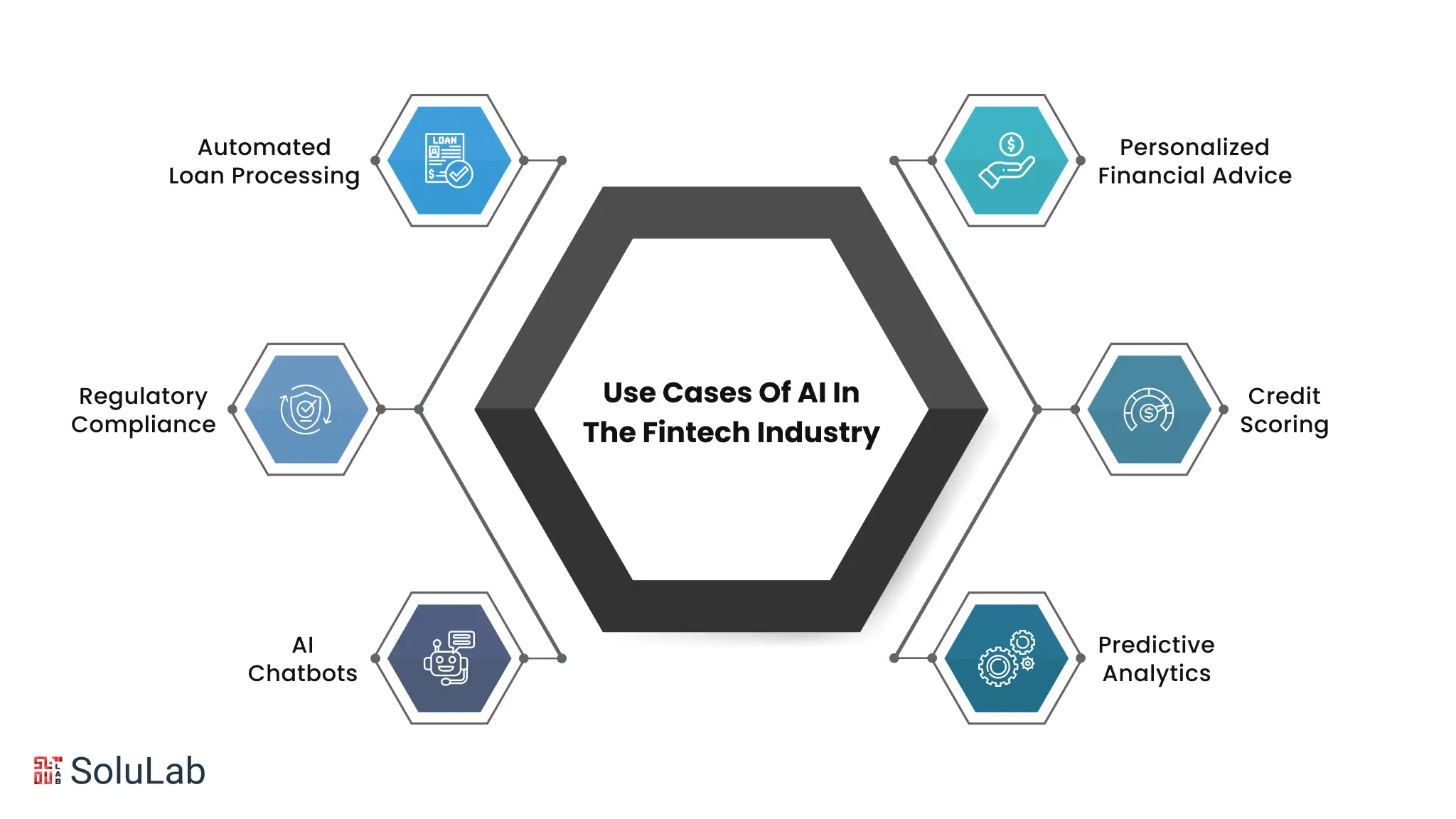
Artificial Intelligence (AI) is rapidly transforming the fintech space, offering innovative solutions across various sectors. From enhancing security to personalizing financial services, AI’s capabilities are vast and continue to expand. Here are some AI use cases in fintech you should know: 

  • Automated Loan Processing

The days of universal financial advice are long gone. These days, AI-powered platforms provide personalized suggestions based on user spending patterns, financial objectives, and risk tolerance. Users are empowered to make wise choices regarding saving, investing, and budgeting because of this customisation.

  • Personalized Financial Advice

By evaluating enormous statistics, such as credit history, income, and even social media activity, artificial intelligence is changing loan approvals. In addition to speeding up the approval process, this technology improves accuracy and equity, opening out credit to a wider range of people.

  • Regulatory Compliance

It can be difficult to figure out the complex web of financial regulations. By automating compliance checks, tracking transactions in real time, and identifying possible infractions, AI simplifies this process. This ensures prompt adherence to regulatory standards while simultaneously minimizing manual labor.

  • Credit Scoring

People without long credit histories are frequently overlooked by traditional credit rating techniques. AI modifies this by analyzing data from other sources, such as energy bills and social media posts, to provide a more thorough and inclusive evaluation of creditworthiness.

  • AI Chatbots

AI-powered chatbots have improved customer service in the financial industry. These virtual assistants improve customer experience while lowering operating expenses by answering common questions, responding instantly, and being available 24/7.

  • Predictive analytics

AI is used in predictive analytics to foresee consumer behavior, market trends, and possible hazards. Fintech businesses may optimize investment strategies, make proactive judgments, and customize services for each client by evaluating both historical and current data.

Read More: Asset Tokenization Regulations for Australia

The Future of AI in Australian Fintech

The Australian fintech sector is poised for significant disruption and growth fueled by advancements in Artificial Intelligence. Here are some future trends you’ll see in the upcoming years:

1. Highly Personalized Financial Planning

Consider AI would know your financial goals, risk tolerance, fears, and personality. This information could develop a flexible financial plan for your changing life.

Generative AI in the fintech industry might change your budget and savings goals. It may advise financial storm techniques if you’re unexpectedly laid off. This hyper-personalization, powered by advanced AI models, would be improving financial planning, making it more adaptive and responsive to individual needs.”

2. Emotionally Intelligent Chatbots

Ignore robot responses! AI chatbots will learn to read your mood and reply accordingly. Stressed about a low bank balance? This AI buddy would offer budgeting advice, encouragement, and income-boosting strategies with empathy. 

Suppose a chatbot that can answer financial questions and provide emotional assistance in difficult circumstances. A more holistic and supportive financial experience would result.

3. Lifestyle-specific AI-powered insurance

Insurance has been one-size-fits-all. AI could tailor an insurance policy to your lifestyle. This AI-powered health insurance plan might evaluate your fitness tracker data and reward healthy habits with lower premiums. 

Car insurance may also analyze your driving habits and commute traffic jams to determine your risk profile and change your coverage. Personalized insurance may be cheaper and more suited to your requirements.

4. Financial Product Predictive Maintenance

Financial goods require frequent upkeep, like autos. In predictive financial product maintenance, AI can spot issues before they happen. AI could analyze your investment portfolio and anticipate its performance in different market scenarios. 

It may then suggest portfolio tweaks to reduce risk and maximize profits. AI might also monitor your buying habits and identify cash flow gaps, helping you avoid financial stress. This preventive approach would protect your finances.

5. Debt Management with AI

AI could help manage debt and achieve financial freedom. Consider a system that analyzes your loans and credit cards and develops a customized payback schedule. 

The AI could negotiate reduced interest rates with lenders for you. Automation and support could make debt management easier and less stressful.

CTA2

Conclusion

To wrap it up, AI in finance is changing the game for Australia. From faster loan approvals to smarter fraud detection, it’s making financial services more efficient, secure, and user-friendly. With Australian startups leading the charge and strong government backing, the country is well on its way to becoming a global fintech hub. 

AI-Build partnered with SoluLab to develop a scalable, AI-powered CAD solution using generative models like GANs and CNNs. The result? Automated design generation, real-time error detection, and enhanced customization—reducing manual effort and boosting productivity. 

SoluLab, a top AI development company in Australia, can help you automate your business to scale faster and stay competitive through a practical AI solution. Contact us today to discuss further!

FAQs

1. What is AI in fintech?

AI in fintech refers to using artificial intelligence technologies like machine learning, natural language processing, and predictive analytics to improve financial services.

2. Why is AI important for fintech companies in Australia?

AI helps fintechs improve operations, reduce human error, deliver faster services, and offer personalized customer experiences—all crucial in a competitive market.

3. Is AI in fintech regulated in Australia?

Yes, AI applications must comply with financial regulations, privacy laws, and guidelines under frameworks like the Consumer Data Right (CDR).

4. How does AI improve credit scoring?

AI evaluates non-traditional data like utility payments or social behavior to offer a fairer and more inclusive assessment of creditworthiness.

5. Are AI chatbots replacing human agents in fintech?

Not entirely. AI chatbots handle routine queries, but human agents still manage complex or sensitive issues. It’s more about collaboration.

 

AI in Finance: A Comprehensive Guide for Financial Leaders

AI in Finance

The financial services sector is changing due to artificial intelligence (AI). It is used everywhere, from improving customer experiences to changing processes and generating substantial cost savings. 

The AI market in finance is expected to grow at a remarkable 30.6% compound annual growth rate (CAGR) from its 2024 valuation of $38.36 billion to $190.33 billion by 2030. This rapid adoption highlights the crucial role AI plays in transforming the financial services industry. ​

In this blog, we’ll explore how artificial intelligence is giving the financial industry a competitive edge. The Current State of AI Implementation in Finance.

The Role of Artificial Intelligence in Finance

Role of AI in Finance

AI in finance is reshaping how financial services are delivered, making them more efficient, accurate, and customer-centric. The integration of AI in financial services allows institutions to handle large datasets, which are essential for making informed decisions. The following are some of the key areas where AI is making a significant impact:

  • Data Analysis and Pattern Recognition

AI systems can process and analyze enormous volumes of financial data far more quickly and accurately than humans. Machine learning algorithms, a core component of AI, are particularly adept at recognizing complex patterns in data. These patterns can provide valuable insights into market trends, customer behavior, and potential risks. By using AI, financial institutions can gain a deeper understanding of the market dynamics and make more informed investment decisions.

  • Predictive Analytics

Predictive analytics is another powerful application of AI in finance. By analyzing historical data, AI algorithms can forecast future market movements, helping investors and financial managers to anticipate changes and adjust their strategies accordingly. This capability is especially useful in high-frequency trading, where split-second decisions can lead to significant gains or losses.

  • Risk Management

Effective risk management is crucial in the financial sector, and AI is enhancing this aspect significantly. AI-powered risk assessment tools can evaluate vast amounts of data to identify potential risks and vulnerabilities. These tools can detect subtle signs of financial instability or fraudulent activities that may not be apparent to human analysts. By providing early warnings, AI helps institutions mitigate risks and protect their assets.

  • Fraud Detection

AI is instrumental in detecting and preventing fraud in financial transactions. Machine learning algorithms can evaluate transaction trends and detect abnormalities that might suggest fraudulent activity. Natural language processing (NLP) can also be used to analyze textual data from emails, social media, and other sources to detect potential fraud schemes. By implementing AI-driven fraud detection systems, financial institutions can significantly reduce the incidence of fraud and enhance the security of their operations.

  • AI and Customer Service in Finance

Customer service is a critical area where AI is making a substantial impact. Financial institutions are using AI to provide more personalized and responsive customer service. 

Read Also: AI in Australian Fintech Industry

  • Chatbots and Virtual Assistants

Chatbots and virtual assistants driven by AI are becoming more prevalent in the financial industry. These tools can handle a wide range of customer queries, from account balances to transaction details, providing instant responses and freeing up human agents to handle more complex issues. Advanced chatbots can also offer personalized financial advice based on the customer’s transaction history and financial goals.

AI Development Solutions

  • Personalized Financial Products

AI allows financial companies to provide individualized financial goods and services. By analyzing customer data, AI can identify individual needs and preferences, allowing institutions to tailor their offerings accordingly. For example, AI can recommend specific investment products, loan options, or insurance policies that best match a customer’s financial situation and goals.

Read Blog: Top 10 AI Development Companies in Finance

  • AI in Investment Strategies

Investment strategies are also being transformed by AI. The ability of AI to process and analyze large datasets allows for more sophisticated and effective investment strategies. Here are some ways AI is optimizing investment decisions:

  • Algorithmic Trading

Algorithmic trading, often known as automated trading, utilizes artificial intelligence algorithms to carry out transactions at ideal moments. These algorithms can analyze market data in real time and execute trades within milliseconds, taking advantage of market opportunities that human traders might miss. This high-speed trading can lead to significant profit gains while minimizing risks.

  • Portfolio Management

AI is also improving portfolio management by continuously monitoring market conditions and adjusting investment portfolios accordingly. Machine learning models can optimize asset allocation to maximize returns and minimize risks. By using AI, portfolio managers can make more informed decisions and achieve better investment outcomes for their clients.

Why Are Fintech Companies Using AI?

Fintech organizations are using Artificial Intelligence (AI) for a variety of reasons. Here are some tangible ways that Artificial Intelligence development services could assist firms in the financial sector:

1. Data Analysis and Decision Making

AI can move vast volumes of data faster and more efficiently than humans. This is significant because fintech organizations sometimes have to make judgments based on rapidly changing and evolving data.

2. Improved Customer Experience

AI enables fintech development businesses to adapt their services for each consumer by knowing their individual wants and preferences. As a result, AI in fintech businesses may offer a more personalized experience, which is expected to increase client happiness and loyalty.

3. Establish a Competitive Edge

The use of artificial intelligence in the financial services industry might help your company stay ahead of the competition. As more firms join the finance market, those who can utilize AI to create a competitive advantage will most likely win in the long term.

4. Fraud Detection and Security

Artificial intelligence systems aid in the detection of fraudulent behavior patterns in real-time. It improves security and mitigates financial hazards. Machine learning algorithms, in conjunction with artificial intelligence, examine massive amounts of data to detect abnormalities and flag questionable transactions.

5. Scalability and Innovation

AI drives technological innovation by allowing fintech businesses to rapidly create and deploy new services. By utilizing AI-driven insights, your company may remain ahead of the competition and respond to changing market needs.

6. Lower Expenses

Artificial intelligence (AI) for financial operations lowers costs in a number of ways, including by automating tedious jobs and identifying and stopping fraud. For instance, banks utilize chatbots driven by AI to answer customer support questions, freeing up human staff to work on more difficult jobs.

Related: Generative AI in Customer Service 

7. Making Additional Services Available

Financial institutions may develop and produce new goods, services, and customer solutions with the use of AI. AI has aided banks in creating Robo-advisory systems, for instance, which utilize algorithms to assist customers in managing their finances.

5 Ways AI Will Change the Investment World

5 Ways AI Will Change the Investment World

Artificial intelligence (AI) will transform the investment landscape by introducing a range of advanced tools and capabilities. Here are seven ways AI will revolutionize the world of investing:

  • Advanced Analytics

AI finance tools excel at analyzing historical data and market trends, providing more accurate predictions of future price movements for stocks, bonds, and other assets. By identifying patterns that were previously undetectable, AI enables investors to make more informed decisions, anticipate market fluctuations, and ultimately enhance their profitability while minimizing losses.

Related: AI Agents in Healthcare

  • Enhanced Risk Assessment and Management

Artificial intelligence in fintech allows investors to evaluate the risks associated with various investment options more accurately. By analyzing factors such as volatility, liquidity, and asset correlation, AI helps investors make safer and smarter choices. This improved risk assessment ensures better-informed investment decisions and enhances overall portfolio management.

  • Personalized Investment Recommendations

AI platforms utilize machine learning techniques to offer personalized investment recommendations based on individual goals, preferences, and risk tolerance. By considering factors like age, income, and investment objectives, these AI-driven systems tailor suggestions to meet unique investment needs, providing a more customized and effective investment strategy.

  • Behavioral Analysis

AI systems can analyze investors’ behavioral patterns and sentiments from various sources, including financial reports. By understanding these sentiments, AI helps investors avoid emotional decision-making and maintain discipline during market fluctuations. This behavioral analysis contributes to more rational and strategic investment decisions.

  • Real-time Market Monitoring

AI in investing enables continuous monitoring of market data and news in real-time, something humans cannot achieve on their own. AI tools can swiftly identify relevant information and significant events, alerting investors immediately. This real-time market monitoring allows investors to react promptly to market shifts and adjust their strategies as needed.

What is ML in Finance?

Machine Learning (ML) in finance refers to the use of algorithms and statistical models that enable computer systems to learn from historical financial data and make predictions or decisions without being explicitly programmed. In simple terms, it helps financial institutions analyze large datasets, identify patterns, and automate tasks. 

For example, banks use ML for credit scoring, fraud detection, algorithmic trading, and customer service chatbots. In investment management, ML models help in predicting stock prices, optimizing portfolios, and managing risk. What makes ML powerful in finance is its ability to continuously improve as more data becomes available, making financial operations faster, smarter, and more accurate.

Leading Industries Using AI Technology

Because of its disruptive potential, artificial intelligence in fintech is widely used across a variety of sectors. Below is a list of a few of these industries:

  • Healthcare: AI assists physicians in diagnosing patients, finding malignant cells, and creating individualized treatment strategies.

Read Blog: Artificial Intelligence in Healthcare

  • Retail Sector: AI-driven chatbots assist with product recommendations, product sales and cross-selling, and customer service.
  • Banking and Finance Sector: Artificial Intelligence for fintech is utilized by banking solution companies for fraud detection, investment advice, and loan approval procedures.
  • Automotive: AI is utilized in the automotive industry for enhanced driver assistance systems, driverless cars, and infotainment systems. 
  • Tourism: Artificial intelligence plays an important part in travel planning by recommending tourist sites based on customer interests and discovering new places.

Real-World Use Cases of AI in Finance

Here are 5 real-world use cases of AI in finance that financial leaders can learn from:

1. JPMorgan Chase – Contract Review Automation (COiN)

JPMorgan uses its AI tool COiN (Contract Intelligence) to review legal documents and extract important data. It processes 12,000+ agreements in seconds, saving over 360,000 hours of legal work annually.

2. HDFC Bank – AI-powered Chatbot “Eva”

HDFC uses Eva, an AI chatbot developed by Senseforth, to handle over 5 million queries from customers, delivering instant responses and reducing the load on customer service teams.

3. ICICI Bank – AI for Fraud Detection

ICICI uses AI and machine learning models to monitor millions of transactions. Their system flags anomalies, helping reduce financial fraud and unauthorized activity.

4. Mastercard – AI for Cybersecurity & Fraud Prevention

Mastercard uses AI algorithms to analyze transaction data and detect fraudulent behavior in milliseconds. This real-time detection helps minimize fraud and protect cardholders globally.

5. Upstox – AI for Stock Recommendations

Indian brokerage Upstox uses AI-driven analytics to give users stock suggestions based on historical data, trends, and sentiment analysis, making investing easier for retail customers.

Future of AI in Finance

The future of AI in finance is bringing rapid changes to the industry. The BFSI sector is using Agentic AI, which enables systems to autonomously interpret scenarios and initiate real-time actions, enhancing customer engagement and operational efficiency. Globally, institutions like JPMorgan Chase are investing heavily in AI, with applications ranging from fraud detection to personalized wealth management.

However, the integration of AI also raises concerns about job displacement. Anthropic’s CEO warns that AI could eliminate up to 50% of entry-level white-collar jobs within the next five years.  Conversely, entrepreneurs like Mark Cuban argue that AI will create new roles, emphasizing the need for strategic implementation. 

As AI continues to grow, financial leaders must balance innovation with ethical considerations, ensuring transparency and fairness in AI-driven decisions. 

Hire AI Developers

The Bottom Line

From risk management to fraud detection and smarter decision-making, AI is changing how the industry operates. The key? Embrace it strategically. Start small, scale wisely, and always keep data ethics in mind. 

This isn’t about replacing people—it’s about empowering them with better tools. So, whether you’re revamping workflows or exploring predictive analytics, now’s the time to lead with innovation. By integrating AI-powered chatbots and Voice AI agents in banking, SoluLab aimed to enhance customer engagement, streamline operations, and provide personalized financial solutions in its recent project named Aman Bank.

SoluLab, an AI development company, with its team of experts, can help you create models for algorithmic trading, fraud detection, risk management, and personalized financial services.

FAQs

1. Can AI help detect financial fraud?

Yes, AI can detect unusual patterns and flag suspicious transactions faster than traditional methods. It continuously learns from new data, making fraud detection smarter and more accurate over time.

2. How does AI improve risk management in the financial sector?

AI improves risk management by analyzing large volumes of data to identify potential risks and predict future risk scenarios. AI models can assess credit risk by evaluating borrower data and transaction patterns, detect market risks through real-time analysis of market conditions, and prevent fraud by identifying unusual transaction patterns. These capabilities enable financial institutions to develop more effective risk mitigation strategies and reduce potential losses.

3. How can financial leaders align AI strategies with business goals?

Start by identifying pain points AI can solve, like reducing costs, improving compliance, or enhancing customer experience. Then, choose AI solutions that directly support those business outcomes.

4. How can financial institutions ensure compliance with regulations using AI?

Financial institutions can use AI to automate the monitoring and reporting processes required for regulatory compliance. AI systems analyze transactions and documents to identify compliance issues, generate necessary reports for regulatory authorities, and ensure adherence to anti-money laundering (AML) regulations. This reduces the risk of regulatory penalties and enhances the institution’s ability to comply with ever-evolving regulatory requirements.

5. How does SoluLab help financial institutions leverage AI?

SoluLab helps financial institutions leverage AI by developing custom AI solutions tailored to the unique challenges of the finance industry. Our expertise includes creating advanced AI models for algorithmic trading, fraud detection, risk management, and personalized financial services. By partnering with SoluLab, financial institutions can access innovative AI tools that enhance their operations, improve decision-making, and offer superior customer experiences. Contact SoluLab today to learn how we can help you harness the power of AI for smarter investments and risk management.
