Talk to an Expert

How AI Agents are Transforming the Healthcare Sector?

AI agent In healthcare

When you hear healthcare, doctors are the first thought on your mind, right? But what if you learn that AI agents are entering the healthcare sector? 

Yes… AI agents in healthcare have been transforming today’s dynamic environment collaboratively with humans. These AI-powered virtual assistants help doctors diagnose diseases, streamline hospital operations, provide 24/7 patient support, and much more.

With machine learning (ML) and natural language processing (NLP), these intelligent systems are reducing human errors while improving treatment accuracy. AI agents are all set to play a crucial role in delivering personalized, data-driven healthcare solutions that benefit both providers and patients.

In this blog, there is everything you need to know about AI Agents in healthcare from its applications, key components, and benefits to the future.

What are AI Agents in Healthcare?

AI agents are working on transforming the healthcare sector by taking up multiple roles from form consulting to doctors with diagnoses and treatments for more personalized support towards every patient. They act as intelligent software that works by studying loads of data, identifying the patterns, predicting any health risks, improving early intervention, and providing more effective treatment strategies.

Apart from diagnosis and treatment, AI agents in healthcare also play a pivotal role in taking care of patients and providing support. They can easily offer personalized information and answers to questions about their conditions. Going through patient records, genetic information, and medical images is easier for AI-powered healthcare agents allowing doctors to make more informed decisions. 

AI chatbots are available 24/7 to give people access to medical advice, reduce the burden on healthcare professionals, and increase patient satisfaction. These agents possess the ability to remotely monitor patient health and detect possible risks early to alert when medical attention is required. 

Key Statistics on Artificial Intelligence in Healthcare 

Market Growth: The global AI in healthcare market is projected to reach $188 billion by 2030, growing at a CAGR of 37% from 2022 to 2030.

Adoption: Around 20% of healthcare organizations have already integrated AI models, and 90% of hospitals are expected to use AI for early diagnosis and remote patient monitoring by 2025.

Efficiency: AI has helped reduce 20% of physicians’ time spent on administrative tasks and is estimated to save healthcare organizations $3.6 billion worldwide through AI-driven chatbots.

Regional Impact: North America dominates the AI healthcare market with a 59.1% market share, while the European Union is the second-highest contributor, expected to generate $50.24 billion by 2028.

AI in Medical Advancements: AI-powered tools successfully detected 68% of COVID-19 cases that were misdiagnosed as negative, and AI played a crucial role in helping Moderna optimize its COVID-19 vaccine.
Core Elements of AI Agents in Healthcare

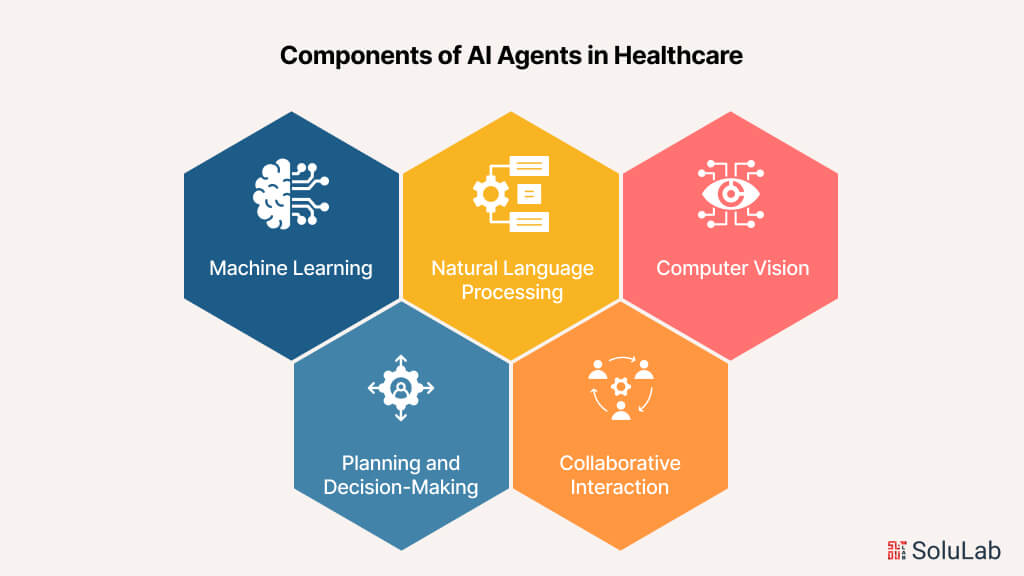
Components of AI Agents in Healthcare

AI agents are transforming healthcare through various functions like improving diagnosis, personalizing care, and automating tasks. Here are key components of agent artificial intelligence that help with its functioning:

  • Machine Learning

AI agents work on the information they are trained with using patient records and medical images which helps them with identifying patterns to predict outcomes. The application of AI agents also allows them to personalize treatment, detect any early or existing disease, and predict possible risk factors. 

  • Natural Language Processing 

Natural Language Processing(NLP) enables AI agents to develop a better understanding and interpret human-like language. This allows them to analyze patient queries, take out information from medical records, and even generate reports accurately.

  • Computer Vision

AI agents can easily understand and even interpret medical images such as X-rays and other concerned scans, the benefits of AI agents in healthcare are better analyzing diseases at an early stage, identifying tumors, and also assist surgeons during procedures. 

  • Planning and Decision-Making

AI agents in healthcare can analyze data and make decisions according to their knowledge about the environment and the patient. This helps them in recommending treatments, predicting potential complications, and planning a regime of patient care.

  • Collaborative Interaction

AI agent in healthcare is designed to interact with humans in a user-friendly way. This will help in providing clear explanations, responding to questions, and adapting to individual user preferences.
CTA1

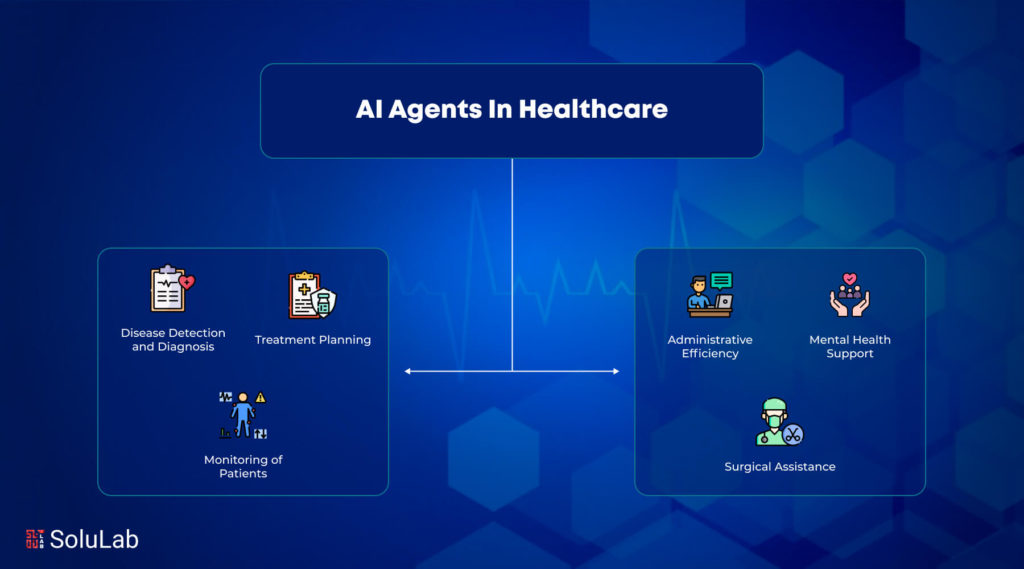
Applications of AI Agents in Healthcare

AI Agents powered by machine learning, natural language processing, and computer vision are being deployed in healthcare domains. Take a look at the application of AI agents in healthcare: 

  • Disease Detection and Diagnosis

The ability of AI-powered healthcare agents to read medical images like X-rays, mammograms, and MRIs to detect any abnormality possible at the earliest to improve survival rates and treatment outcomes. AI agents can also analyze patient data, medical history, symptoms, and genetic information to provide diagnosis based on patient history. 

  • Treatment Planning

AI agents in healthcare algorithms can understand patient data and medical history to create personalized treatment plans that are tailored according to the patient’s needs and risks associated with health with the procedure. AI can also accelerate discovery by identifying potential drug candidates, predicting drug efficacy, and even optimizing drug development processes.

  • Monitoring of Patients 

Another application of AI agents is seen in managing and monitoring patients via AI wearables such as sensors. Using sensors vital signs, activity levels, and medication adherence in a patient can easily be monitored, enabling remote patient care and intervention at times. 

  • Administrative Efficiency 

AI agents in healthcare play an important role in automating medical billing and coding processes, lowering administrative burdens, and increasing efficiency. This enables AI-powered healthcare agents to optimize appointment scheduling, reduce wait times, and enhance patient experiences.

  • Medical Research and Development

It is easier for AI bots to examine vast amounts of data from medical records and research articles than it is for humans, which aids in spotting trends and developing insights that could lead to therapeutic discoveries. AI agents in healthcare can assist with clinical trial design and recruiting, hence expediting the development of new medicines.

  • Personalized Medicine

AI agents in healthcare have been used to identify genetic predispositions, predict drug responses, and tailor treatment according to patient data. This personalized approach can result in the improvement of treatment effectiveness and reduction of possible side effects. 

  • Mental Health Support

Another essential use of AI-powered healthcare agents is chatbots or virtual assistants. They are involved to help with mental health issues some may face and provide support for the same. Resources and support are made accessible to patients as a necessary care. It can also read data to know if the patient has required mental health support in the past and provide early intervention. 

Related: Chatbots in Healthcare

  • Surgical Assistance

AI-powered systems can assist surgeons in performing complex procedures with precision and accuracy. It can also use real-time data during the surgery to provide support and guidance to surgeons. 
Advantages of Using AI Agents in Healthcare

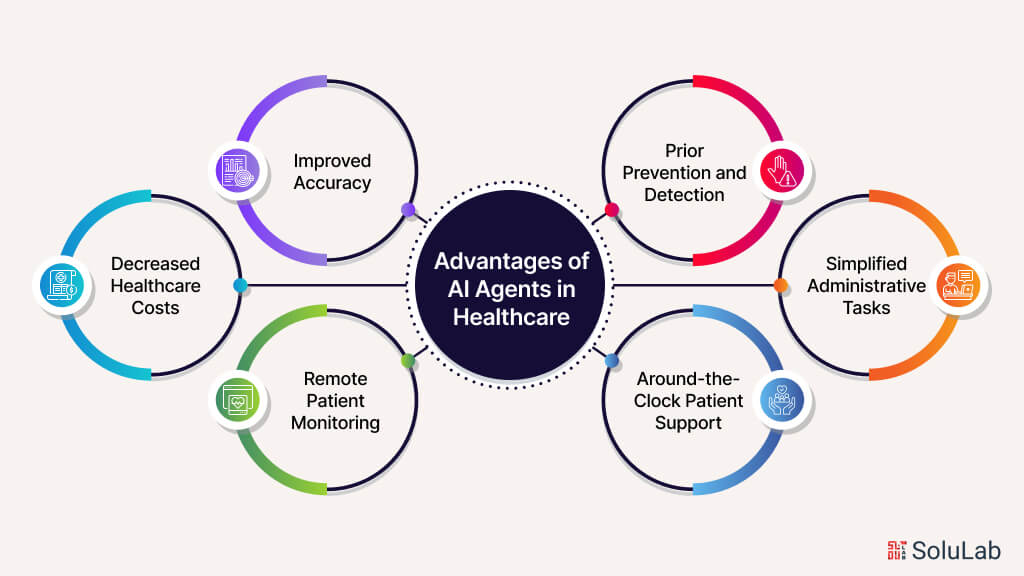
Advantages of AI Agents in Healthcare

AI agents in healthcare are of many uses from disease detection to surgical assistance. Here are some benefits of aI agents in healthcare:

  • Improved Accuracy

With the use of AI agents in healthcare analyzing vast amounts of data at once has become much easier with greater speed and accuracy than humans ever could. This not only results in leading to more precise diagnoses but also better treatment plans and predictions. 

  • Prior Prevention and Detection 

AI agents can identify health risks at a much faster pace, you can think of it as AI agents can sense the disease. This allows timely treatment and interventions to prevent or cure the disease. 

  • Simplified Administrative Tasks

Many of the tasks that healthcare workers have to perform can be done by AI agents to free the workers’ time. Allows them to allocate more of their time to other essential activities such as diagnosing and treating patients, this could help to enhance healthcare services

  • Around-the-Clock Patient Support

Chatbots can schedule appointments, direct tens of patients to relevant information, and give simple medical advice. Thus, patient satisfaction might be increased since patients are more engaged and prepared for their health conditions.

Read Our Blog: Top Use Cases Of AI Agents

  • Remote Patient Monitoring

Using big data analysis, AI agents can look for signs that the patient is in decline, or that they are experiencing some health issues. This is beneficial to patients who have undergone surgery since they can be constantly monitored remotely thus actions taken timely.

  • Decreased Healthcare Costs

With the help of AI agents, total expenses for healthcare can be significantly reduced due to improved performance, reduced prevalence of errors, and earlier diagnosis of illnesses. Through automation, early identification of costly issues can prevent their growth when solutions are implemented on time.

How to Build an AI Agent for Healthcare?

Building an AI agent for healthcare necessitates a well-structured approach that incorporates the most recent advances in artificial intelligence, machine learning, and healthcare technology.  The following are the essential phases in creating an efficient AI-powered healthcare agent.

Step 1. Define the Purpose and Use Case

Before development begins, it’s crucial to identify the specific problem the AI agent will solve. Some common use cases include:

  • Virtual health assistants for patient engagement
  • AI-powered diagnostics and disease detection
  • Automated administrative support (billing, scheduling, etc.)
  • Personalized treatment recommendations based on patient history

Step 2. Gather and Process Medical Data

AI agents require large amounts of high-quality healthcare data to function effectively. This includes:

  • Electronic Health Records (EHRs)
  • Medical imaging data (X-rays, MRIs, CT scans)
  • Genomic and clinical trial data
  • Real-time patient monitoring data from wearables and IoT devices

Data preprocessing, cleaning, and anonymization are essential to comply with regulations like HIPAA and GDPR while ensuring accuracy.

Step 3. Choose the Right AI Model and Algorithms

The choice of AI model depends on the agent’s intended function:

  • Machine Learning (ML) for predictive analytics for patient outcomes
  • Natural Language Processing (NLP) for chatbots and voice assistants
  • Computer Vision for medical image analysis for disease detection
  • Deep Learning for drug discovery and precision medicine

Popular frameworks like TensorFlow, PyTorch, and Scikit-learn help develop robust AI models for healthcare applications.

Step 4. Train and Test the AI Model

The AI agent must be trained using labeled healthcare datasets. This involves:

  • Supervised Learning: Training with annotated medical images or patient records
  • Unsupervised Learning: Identifying hidden patterns in patient data
  • Reinforcement Learning: Improving decision-making in real-world scenarios

The model is then validated and tested against real-world medical cases to ensure accuracy and reliability.

Step 5. Ensure Compliance and Security

Since healthcare data is sensitive, the AI agent must adhere to strict security and compliance protocols, including:

  • HIPAA (Health Insurance Portability and Accountability Act)
  • GDPR (General Data Protection Regulation)
  • FDA and CE approvals for AI-powered medical devices

Data encryption, access control, and ethical AI principles must be implemented to ensure trust and security.

Step 6. Deploy and Integrate with Healthcare Systems

Once tested, the AI agent is deployed and integrated into existing healthcare IT infrastructures, such as:

  • Electronic Health Record (EHR) systems
  • Telemedicine platforms
  • Hospital management software
  • Wearable health monitoring devices

Cloud-based and edge AI solutions ensure scalability, allowing healthcare providers to implement AI seamlessly across different locations.CTA2
Future of AI Agents in Healthcare

With time, AI technology will undergo more advancements which raises the possibility that we will have increasingly sophisticated bots capable of handling challenging tasks in the near future. There will be AI bots that can converse with patients and adjust to achieve the best possible results—all while analyzing data about the patient. 

Artificial intelligence in drug discovery has the potential to revolutionize the world on a scale never seen before, allowing new life-saving treatments to be developed faster. It can also improve the process of approaching health identity by allowing agents to deliver concrete, specific treatment options based on a person’s genetic profile, habits, and medical history.  Overall, it is up to AI agents to transform the healthcare sector in a way that is proactive, preventative, and patient-centered.

The most efficient method of fostering trust between AI and doctors is through the transparency of AI healthcare agents’ decision-making and their dependency. This will further provide the groundwork for a future in which artificial intelligence will assist doctors in providing high-quality treatment to patients.

The Final Word

AI agents are no longer just futuristic concepts—they are actively transforming healthcare by improving diagnostics, optimizing operations, and enhancing patient care. But to create an endurable AI agent, it is necessary to spend a lot of time on preparation and to follow moral principles. 

SoluLab, a trusted AI agent development company, specializes in creating intelligent healthcare AI solutions that meet your business needs. Whether you’re looking to develop AI-driven diagnostics, automate administrative tasks, or enhance patient engagement with AI chatbots, our experts ensure holistic development with compliance and security at the core. 

SoluLab was approached by a mental health non-profit organization to create a chatbot-powered platform that may offer mental health assistance services. With that people with limited digital literacy can now receive mental health support services. If you have a similar business idea, our team of experts is always ready to render the best solutions possible. Get in touch with us now!

FAQs

1. What can be achieved for AI agents in healthcare?

AI agents in the healthcare industry are capable of many different jobs including Scheduling appointments and regulating re-fill, frequently asked medical questions, general health information, patient health records are updated and personal advice to different patients and adding value to the work of physicians, for example, in treatment and data processing.

2. Is the usage of AI agents liberated for the application in the medical field?

In the context of AI in the healthcare industry, the issues of data security and privacy are paramount. AL agents are designed to be secure; nonetheless, it is advisable to choose a solution from a trustworthy supplier who prioritizes such aspects.

3. In what ways does the patient experience improve with the introduction of AI agents?

AI agents offer consulting and support 24/7. They can schedule appointments, reply to inquiries, and remind a patient about the prescription, which means that getting healthcare is even more manageable and can be proactive.

4. Will AI agents be able to provide emotional support someday?

Still, it is challenging to offer profound spiritual support even though AI agents are always in the process of evolution. However, the AI language algorithms can determine language features and simple ideas of how to provide emotional support such as writing down one’s feelings or recommending certain thoughts.

5. How can Solulab help with AI Agents? 

Solulab will help you integrate AI agents into your healthcare practice if you so wish. Our areas of specialization are the development of AI agents to ensure that they meet all the planned and expected needs of a client who has contracted out for a service at a certain specification, combined with current systems integration with other applications and systems and your electronic health records, and effective management of the increasing patient records and protection from loss, misuse, and unauthorized access.

15 Best AI Agent Use Cases for Enterprises & Real-World Applications

Use Cases Of AI Agents

AI agents are improving enterprise workflows by operating as a coordinated crew, with each agent specializing in different business functions. Just like a well-structured team, they collaborate to understand employee intents, route requests, retrieve information, and resolve issues. Whether it’s resetting passwords, processing time-off requests, or managing software access, these AI agents work together to deliver smooth and efficient support experiences.

According to Statista AI agents are poised to become the next step in the evolution of AI for businesses in our increasingly digital society, whether they are used to automate mundane tasks or optimize complex workflows. Their learning capacity, adapting, and making smart choices create novel possibilities for innovation and applications in various fields. 

If you are planning to adopt AI agents for your enterprise, this article is for you as it explores their key use cases across various business functions, including IT support, HR, finance, sales and marketing, and more.

Future of AI Agents in Business

1. Innovations and trends

AI agents in business have a bright future due to various trends and advancements. AI agents—AI-powered virtual assistants—are becoming smarter with advances in natural language processing, machine learning, and cognitive computing. AI agents can better comprehend and forecast consumer demands with these technologies, improving customer service and operational efficiency.

Integration of AI agents across corporate functions is a major trend. In addition to customer support, AI agents are employed in sales, marketing, and HR. This wide range of applications helps firms automate activities, analyze big data, and make quick decisions.  These platforms simplify the creation of sophisticated AI bots that can have complex conversations and do complex jobs. 

2. Estimates for the Next Decade

Technology is likely to impact healthcare and transportation in the coming decade. AI agents in the healthcare industry are improving and automating tasks assisting in diagnosis, and personalizing treatment plans, ultimately improving efficiency and patient outcomes. In artificial intelligence (AI), tremendous advancement is expected. Experts expect AI to improve its natural language processing and problem-solving skills, making human-machine interactions more natural. The adoption of driverless vehicles is a significant AI prediction over the next decade. 

Real-World Examples of AI Agents

Take a look at some AI agent applications in different industries:

1. E-Commerce AI Agents

AI agents are being used by e-commerce platforms to improve the buying experience. These agents can Place orders automatically. Even they can track and send out shipment updates and make image-based product searches easier. This AI agent can remind people about carts that are left behind. For example, 35 percent of Amazon’s revenue comes from its AI-powered recommendation system. 

2. Sales and Marketing AI Agents

Sales and marketing procedures are being improved by AI sales agents by creating lists of leads. They can customize messages. Plan and carry out advertising campaigns and analyze competitors.

One excellent illustration of an AI agent enhancing lead creation is Find AI. Find AI’s agents can identify and qualify leads with remarkable accuracy by letting users define extremely specific search parameters. By using AI, users can give more targeted results by understanding the user intent and going beyond basic keyword searches. 

3. Customer Support AI Agents

AI-driven customer service is progressing beyond basic chatbots. Chatbase and other contemporary AI customer service representatives perform tasks on behalf of users, such as processing refunds and changing passwords. Customers support AI agents can make product recommendations and address complicated technical support concerns.

Top AI Agents Use Cases in 2025

AI agents, with their ability to process vast amounts of data and make decisions, are transforming various industries. Here are 15 detailed use cases of AI agents across different sectors:

1. AI Agents in Healthcare

AI agents are revolutionizing the healthcare industry by enhancing patient care, streamlining administrative tasks, and aiding in medical research. Here are some specific use cases:

a. Patient Diagnosis and Treatment

AI healthcare agents analyze medical records, lab results, and imaging data to assist doctors in diagnosing diseases. For instance, IBM’s Watson can read millions of pages of medical literature and compare patient data to suggest potential diagnoses and treatment plans.

b. Predictive Analytics

AI agents in healthcare use predictive analytics to foresee patient outcomes. By examining historical data, these agents can predict the likelihood of readmissions, complications, or the progression of diseases, allowing for proactive intervention.

c. Virtual Health Assistants

Virtual health assistants, powered by AI, interact with patients through chatbots or voice assistants. They provide medical advice, answer health-related queries, and remind patients to take their medications, improving adherence and health outcomes.

d. Administrative Efficiency

AI agents streamline administrative tasks such as scheduling appointments, managing patient records, and handling billing. This reduces the workload on healthcare staff, allowing them to focus more on patient care.

e. Drug Discovery and Development

AI agents accelerate drug discovery by analyzing biological data and predicting the efficacy of new drugs. They identify potential drug candidates, optimize clinical trial designs, and reduce the time and cost involved in bringing new medications to market.

Read Also: Vertical AI Agents

2. AI Agents in Finance

The finance industry is leveraging AI agents to enhance security, improve customer service, and optimize investment strategies. Here are some prominent use cases:

a. Fraud Detection

AI agents detect fraudulent activities by analyzing transaction patterns and identifying anomalies. They can flag suspicious transactions in real time, helping financial institutions prevent fraud and protect customers.

b. Customer Service

AI-powered chatbots and virtual assistants provide 24/7 customer service, answering queries, resolving issues, and guiding customers through financial products and services. This agent in AI improves customer satisfaction and reduces operational costs.

c. Investment Management

AI agents analyze market trends, financial news, and economic indicators to provide personalized investment advice. Robo-advisors like Betterment and Wealthfront use AI to create and manage investment portfolios tailored to individual risk profiles and financial goals.

d. Risk Management

AI agents assess risk by analyzing vast amounts of financial data. They predict market fluctuations, identify potential risks, and suggest strategies to mitigate them, helping financial institutions make informed decisions.

e. Compliance and Regulation

AI helps financial institutions comply with regulatory requirements by monitoring transactions, ensuring adherence to rules, and generating compliance reports. This reduces the risk of non-compliance and associated penalties.

3. AI Agents in Retail

AI Agents in Retail: Retailers are using AI agents to enhance customer experiences, optimize supply chains, and increase sales. Here are some specific use cases:

a. Personalized Shopping Experiences

AI agents in retail industry analyze customer behavior, preferences, and purchase history to recommend products tailored to individual tastes. This personalization increases customer satisfaction and drives sales.

b. Inventory Management

AI agents predict demand for products by analyzing sales data, market trends, and seasonal patterns. This helps retailers manage inventory more effectively, reducing overstock and stockouts.

c. Pricing Optimization

AI agents dynamically adjust prices based on factors such as demand, competition, and market conditions. This ensures competitive pricing while maximizing profits.

d. Visual Search

AI-powered visual search allows customers to upload images of products they are interested in. The AI agent then finds similar products in the retailer’s catalog, enhancing the shopping experience.

Related: Generative AI In Retail Industry

e. Customer Support

AI chatbots provide instant customer support, answering queries, handling returns, and assisting with purchases. This reduces the workload on human staff and improves customer satisfaction.

CTA1

4. AI Agents in Insurance

 The insurance industry is harnessing the power of AI agents in insurance to improve processes, customer service, and risk assessment. Here are some key use cases:

a. Claims Processing

AI agents automate the claims processing workflow by verifying documents, assessing damages, and determining claim validity. This speeds up the process and reduces errors, leading to faster payouts and improved customer satisfaction.

b. Risk Assessment

AI agents analyze data from various sources, such as social media, sensors, and historical claims data, to assess risk more accurately. This helps insurers price policies appropriately and reduce fraudulent claims.

c. Underwriting

AI agents assist underwriters by analyzing applicant data and predicting the likelihood of claims. This enables more accurate risk evaluation and policy pricing, leading to better decision-making.

Read Also: Impact of AI on the Insurance Sector

d. Customer Service

AI chatbots and virtual assistants handle customer queries, provide policy information, and assist with claims. This AI agent use cases improve customer experience by providing quick and accurate responses.

e. Fraud Detection

AI agents detect fraudulent activities by analyzing patterns and anomalies in claims data. They identify suspicious claims and flag them for further investigation, reducing the incidence of fraud.

5. AI Agents in Hospitality

The hospitality industry is leveraging AI agents in hospitality to enhance guest experiences, streamline operations, and improve efficiency. Here are some notable use cases:

a. Personalized Guest Experiences

AI agents analyze guest preferences and behavior to offer personalized recommendations and services. This includes room preferences, dining options, and activity suggestions, enhancing the overall guest experience.

b. Automated Check-In and Check-Out

AI-powered kiosks and mobile apps allow guests to check in and check out seamlessly without human intervention. This reduces wait times and improves operational efficiency.

c. Virtual Concierges

AI virtual concierges provide guests with information about the hotel, local attractions, and services. They can also handle requests such as room service, reservations, and transportation, improving guest satisfaction.

d. Predictive Maintenance

AI agents monitor equipment and systems within the hotel to predict maintenance needs. This prevents breakdowns, reduces downtime, and ensures a smooth operation.

e. Revenue Management

AI agents analyze market trends, demand patterns, and competitor pricing to optimize room rates and maximize revenue. This helps hotels achieve higher occupancy and profitability.

6. AI Agents in Supply Chain Management

AI agents are changing supply chain management by enhancing visibility, optimizing logistics, and improving decision-making. AI agents for supply chain are used for demand forecasting, inventory management, and route optimization, helping businesses streamline operations and reduce costs. Here are some specific use cases:

a. Demand Forecasting

Artificial intelligence agents analyze historical sales data, market trends, and external factors to predict demand for products. This helps businesses plan their inventory and production more accurately.

b. Inventory Optimization

AI agents optimize inventory levels by predicting demand, monitoring stock levels, and suggesting replenishment orders. This reduces carrying costs and minimizes stockouts.

c. Route Optimization

AI agents optimize delivery routes by considering factors such as traffic conditions, weather, and delivery windows. This reduces transportation costs and improves delivery efficiency.

d. Supplier Management

AI agents evaluate supplier performance by analyzing data on delivery times, quality, and costs. This helps businesses choose the best suppliers and negotiate better terms.

Related: Generative AI for Supply Chain

e. Risk Management

AI agents identify potential risks in the supply chain, such as disruptions, delays, or quality issues. They suggest mitigation strategies to ensure smooth operations and minimize impact.

7. AI Agents in Legal Services

The logistics industry is making use of AI agent logistics to optimize supply chains, enhance efficiency, and improve decision-making. Here are some key use cases:

a. Legal Research

AI agents assist lawyers in legal research by analyzing vast amounts of legal documents, case law, and statutes. They provide relevant information and precedents, saving time and improving accuracy.

b. Contract Analysis

AI agent for law firms analyzes contracts to identify key terms, potential risks, and compliance issues. They can also automate contract generation, review, and management, improving efficiency and reducing errors.

c. Document Review

AI agents for the legal industry streamline document review processes by identifying relevant documents, categorizing information, and highlighting key points. This speeds up the review process and reduces the workload on legal professionals.

d. Predictive Analytics

AI agents predict case outcomes by analyzing historical data, case law, and judge rulings. This helps lawyers assess the strength of their cases and make informed decisions.

e. Client Management

AI agents enhance client management by automating tasks such as scheduling, billing, and communication. This improves client service and allows lawyers to focus on legal work.

Read Also: AI Agent in Legal Document Management

8. AI Agents in Automotive

The automotive industry is leveraging AI agents to improve vehicle safety, enhance user experiences, and optimize manufacturing processes. Here are some key use cases for AI agents in the automotive industry:

a. Autonomous Driving

AI agents power autonomous vehicles by processing data from sensors, cameras, and LIDAR systems to navigate and make driving decisions. This enhances safety and reduces the need for human intervention.

b. Predictive Maintenance

AI agents monitor vehicle performance and predict maintenance needs by analyzing data from sensors and onboard diagnostics. This prevents breakdowns, reduces downtime, and extends the lifespan of vehicles.

c. In-Vehicle Assistants

AI-powered in-vehicle assistants provide drivers with real-time information, navigation, and entertainment. They can also monitor driver behavior and suggest breaks or adjustments to improve safety.

Read Also: Future of Generative AI in Automotive Industry

d. Manufacturing Optimization

AI agents optimize manufacturing processes by analyzing production data, identifying inefficiencies, and suggesting improvements. This increases productivity and reduces costs.

e. Supply Chain Management

AI agents enhance supply chain management by predicting demand, optimizing inventory levels, and managing supplier relationships. This ensures timely delivery of parts and materials, reducing production delays.

9. AI Agents in Social Media

Social media platforms are utilizing AI agents to enhance user experiences, manage content, and improve security. Here are some notable use cases:

a. Content Moderation

AI agent in media monitor and moderate content to ensure it adheres to community guidelines. They detect and remove inappropriate, harmful, or spam content, creating a safer and more enjoyable user environment.

b. Personalized Recommendations

AI agents analyze user behavior, preferences, and interactions to provide personalized content recommendations. This includes suggesting friends, groups, pages, and posts that align with individual interests, increasing user engagement.

c. Sentiment Analysis

AI agents perform sentiment analysis on user posts and comments to gauge public opinion and sentiment toward brands, products, or topics. This helps companies understand their audience and tailor their marketing strategies accordingly.

d. Social Media Advertising

Social media AI agents optimize social media advertising campaigns by targeting specific demographics, analyzing ad performance, and suggesting adjustments. This maximizes ad effectiveness and return on investment.

e. Trend Analysis

AI agents analyze social media data to identify emerging trends, hashtags, and viral content. This provides valuable insights for businesses and marketers to stay ahead of the curve and engage with trending topics.

10. AI Agents in Telecommunications

The telecommunications industry is leveraging AI agents to enhance network management, improve customer service, and optimize operations. Here are some key use cases:

a. Network Optimization

AI agents monitor network performance and predict potential issues, such as congestion or outages. They optimize network traffic and resources to ensure smooth and reliable connectivity.

Related: Generative AI in Telecom

b. Customer Support

AI-powered virtual assistants handle customer inquiries, troubleshoot issues, and provide technical support. This reduces wait times and improves customer satisfaction by offering prompt and accurate assistance.

c. Fraud Detection

Agent in AI detects fraudulent activities, such as unauthorized access or identity theft, by analyzing patterns and anomalies in network usage. They help prevent fraud and protect customer data.

d. Predictive Maintenance

AI agents predict maintenance needs for network infrastructure by analyzing data from sensors and equipment. This prevents downtime, reduces maintenance costs, and extends the lifespan of network components.

e. Personalized Services

AI agents analyze customer data to offer personalized services and recommendations, such as tailored subscription plans or value-added services. This enhances customer loyalty and increases revenue.

11. AI Agents in Education

The education sector is utilizing AI agents to enhance learning experiences, personalize education, and streamline administrative tasks. Here are some key use cases:

a. Personalized Learning

AI agents analyze student performance and learning styles to create personalized learning plans. They provide tailored recommendations, resources, and exercises to help students learn more effectively.

b. Intelligent Tutoring Systems

AI-powered tutoring systems offer real-time feedback and support to students. They can explain complex concepts, provide additional practice, and adapt to the learner’s pace, enhancing understanding and retention.

c. Automated Grading

AI agents automate the grading process by assessing assignments, quizzes, and exams. This reduces the workload on educators, ensures consistent evaluation, and provides students with timely feedback.

d. Student Support

AI chatbots provide students with 24/7 support, answering questions about course material, deadlines, and administrative processes. This enhances student engagement and satisfaction.

e. Administrative Efficiency

AI agents streamline administrative tasks such as enrollment, scheduling, and record-keeping. This reduces the administrative burden on staff and ensures accurate and efficient operations.

12. AI Agents in Agriculture

The agricultural industry is leveraging AI agents to improve crop management, optimize resource use, and enhance productivity. Here are some notable use cases:

a. Precision Farming

AI agents analyze data from sensors, drones, and satellite imagery to monitor crop health, soil conditions, and weather patterns. This enables precise application of water, fertilizers, and pesticides, improving crop yields and reducing waste.

b. Predictive Analytics

AI agents predict crop yields and identify potential issues such as pest infestations or disease outbreaks. This allows farmers to take proactive measures and optimize their farming practices.

c. Autonomous Machinery

AI-powered autonomous machinery, such as tractors and harvesters, perform tasks such as planting, weeding, and harvesting with high precision and efficiency. This reduces labor costs and increases productivity.

d. Supply Chain Optimization

AI agents optimize the agricultural supply chain by predicting demand, managing inventory, and coordinating logistics. This ensures timely delivery of produce and reduces post-harvest losses.

e. Sustainable Farming

AI agents promote sustainable farming practices by analyzing environmental data and suggesting eco-friendly farming techniques. This helps farmers minimize their environmental impact and conserve resources.

13. AI Agents in Energy

The energy sector is adopting AI agents to optimize energy production, enhance grid management, and promote sustainability. Here are some key use cases:

a. Predictive Maintenance

AI agents monitor energy infrastructure, such as power plants and transmission lines, to predict maintenance needs and prevent failures. This ensures a reliable energy supply and reduces maintenance costs.

b. Energy Management

AI agents optimize energy consumption by analyzing usage patterns and adjusting settings in real time. This helps businesses and households reduce energy costs and improve efficiency.

c. Renewable Energy Optimization

AI agents manage renewable energy sources, such as solar and wind, by predicting energy production and optimizing integration with the grid. This maximizes the use of renewable energy and reduces reliance on fossil fuels.

d. Demand Response

AI agents enable demand response programs by predicting energy demand and adjusting supply accordingly. This helps balance the grid, reduce peak load, and prevent blackouts.

e. Smart Grids

AI agents enhance the operation of smart grids by analyzing data from sensors and meters to optimize energy distribution and detect issues. This improves grid reliability and efficiency.

Read Also: x402 Protocol for Building Next-Gen AI Agents

14. AI Agents in Real Estate

The real estate industry is adopting AI agents to enhance property management, improve customer service, and optimize transactions. Here are some key use cases:

a. Property Valuation

AI agents analyze market trends, property features, and historical data to provide accurate property valuations. This helps buyers, sellers, and investors make informed decisions.

b. Virtual Property Tours

AI-powered virtual assistants offer virtual property tours, providing potential buyers or renters with detailed information and answering questions in real time. This enhances the property viewing experience and saves time.

c. Tenant Screening

AI agents assist property managers in screening tenants by analyzing application data, credit scores, and rental history. This ensures a thorough and efficient screening process.

d. Predictive Maintenance

AI agents monitor building systems and infrastructure to predict maintenance needs and prevent issues. This ensures well-maintained properties and reduces maintenance costs.

e. Market Analysis

AI agents perform market analysis by analyzing data on property sales, rental rates, and market trends. This provides valuable insights for real estate professionals and investors to make strategic decisions.

15. AI Agents in Logistics

The logistics industry is harnessing AI agents to optimize supply chains, enhance efficiency, and improve decision-making. Here are some key use cases:

a. Route Optimization

AI agents optimize delivery routes by considering factors such as traffic conditions, weather, and delivery windows. This reduces transportation costs and improves delivery efficiency.

b. Warehouse Management

AI agents manage warehouse operations by analyzing inventory levels, predicting demand, and optimizing storage space. This reduces operational costs and improves efficiency.

c. Predictive Maintenance

AI agents monitor equipment and vehicles to predict maintenance needs and prevent breakdowns. This reduces downtime and maintenance costs, ensuring smooth operations.

d. Demand Forecasting

AI agents analyze historical sales data, market trends, and external factors to predict demand for products. This helps businesses plan their inventory and production more accurately.

e. Risk Management

AI agents identify potential risks in the supply chain, such as disruptions, delays, or quality issues. They suggest mitigation strategies to ensure smooth operations and minimize impact.

CTA2

Conclusion

From handling simple password resets to organizing complex workflows, AI agents are improving how enterprise teams operate. Whether you’re troubleshooting IT issues, processing leave requests, or preparing for customer calls, there’s an AI agent ready to streamline your workday.

As teams continue to explore new ways to leverage AI agents like Atom, the possibilities are limitless. The best part? This is only the beginning of how these intelligent assistants will improve workplace interactions and eliminate time-consuming tasks.

If you’re ready to identify the top AI agent use cases for your organization and start implementing them, keep reading. Sight Machine, a leading AI company in the digital manufacturing space, partnered with SoluLab to overcome resource constraints and enhance its product capabilities. SoluLab designed a scalable technical architecture, integrated generative AI models, and developed advanced analytics. Their collaboration improved Sight Machine’s digital twins’ platform, boosting performance, scalability, and user experience. SoluLab An AI agent development company has a team of experts to help you build AI agents across industries. Reach out to us today.

FAQs

1. What are the types of agents used in development?

There are 5 types of AI agents used– simple reflex agents, model-based reflex agents, goal-based agents, utility-based agents, and learning agents. Each type varies in complexity, from basic condition-response actions to advanced learning and decision-making capabilities.

2. What are the major use cases where AI is used?

AI is used in healthcare for diagnosis and drug discovery, finance for fraud detection and algorithmic trading, logistics for route optimization and inventory management, customer service for chatbots and virtual assistants, and marketing for personalized recommendations and ad targeting.

3. What is an example of a good AI agent?

A good AI agent is Google Assistant, which uses natural language processing (NLP) and machine learning to execute tasks, answer queries, and interact with users effectively, providing personalized and context-familiar assistance.

4. Are AI agents secure for business applications?

Yes, the majority of AI agents follow strict security protocols with data encryption and access controls. However, it is suggested that businesses must regularly update and monitor them to prevent any sort of vulnerabilities.

5. How do AI agents improve customer service?

AI agents automate responses, handle queries, and provide personalized support through chatbots and virtual assistants. They enhance customer experience by reducing wait times and offering 24/7 assistance.
