Talk to an Expert

What Are the Key Green Finance Trends for 2026?

key Green Finance Trends

What if every dollar you invested could help fight climate change and grow your wealth?
That’s exactly the promise of green finance, a rapidly expanding movement reshaping global financial systems. As the world races toward net-zero targets, investors, governments, and corporations are turning to sustainable funding models that strike a balance between profit and purpose.

By 2026, green finance is no longer a niche concept; it’s becoming the foundation of responsible economic growth. From AI-powered ESG assessments to tokenized carbon credits and climate-linked bonds, technology and policy reforms are driving a new era of eco-conscious investment.

In this blog, we’ll explore the key green finance trends for 2026, the innovations, frameworks, and opportunities that are redefining how money moves toward a sustainable future.

Why 2026 Is a Pivotal Year for Green Finance?

The year 2026 marks a critical turning point for global finance systems as sustainability shifts from being an optional strategy to a core financial priority. The momentum toward green finance, which supports environmentally responsible investments, is accelerating due to several key global and regional developments.

1. Stricter Global ESG Regulations

Governments and financial regulators across the EU, UAE, and Asia-Pacific are enforcing tighter ESG (Environmental, Social, and Governance) compliance standards. By 2026, major economies are expected to align their corporate disclosure norms with IFRS Sustainability Standards, making transparent sustainability reporting mandatory for both public and private institutions.

2. Post-COP28 Commitments Coming into Effect

The outcomes of COP28 are translating into actionable finance targets in 2026. Countries are channeling more funds into renewable energy, climate adaptation, and carbon neutrality projects, creating massive opportunities for green bonds, sustainability-linked loans, and climate-focused fintech innovations.

3. Technology and Finance Converge

With the AI integration, blockchain, and data analytics, financial institutions are developing smarter, traceable, and verifiable sustainability models. By 2026, these technologies will be standard tools for measuring carbon impact, assessing ESG risks, and tokenizing green assets for greater transparency. Financial automation platforms like AccessPay are playing a key role in bridging legacy banking systems with modern ESG-compliant infrastructure.

4. Investor Behavior Is Changing Fast

Institutional and retail investors are demanding ethical and climate-conscious portfolios. This shift is pushing banks, asset managers, and fintech startups to embed sustainability into their products. As a result, green investing is becoming a mainstream growth driver rather than a niche segment.

5. Transition from Pledges to Measurable Impact

Unlike the previous decade, where green finance often revolved around voluntary goals, 2026 focuses on accountability and impact measurement. The emphasis is on quantifying results, carbon reduction achieved, biodiversity preserved, and energy efficiency improved, turning sustainability into a tangible financial metric.

Top Green Finance Trends Shaping 2026 Ahead

Trend #1. Tokenized Green Bonds & Blockchain Transparency

Businesses are using blockchain technology to issue digital green bonds. This creates tamper-proof records and faster secondary trading, key benefits for investors and regulators. This innovation is driving major trends in green finance and reducing transaction costs for institutional players. For businesses, it’s a practical way to raise capital while proving sustainability commitments.

For example, over $10 billion in tokenized bonds have already been issued globally by mid-2025. Settlement costs are reduced by up to 80% through smart contract automation, and major institutions like BlackRock and Abrdn are actively exploring blockchain-based issuance.

A standout case is Hitachi’s 10 billion yen ($69 million) digital green bond issued in 2023, which featured real-time ESG metrics streaming to investors and instant settlement capabilities.

Trend #2. AI-Driven ESG Scoring

Artificial Intelligence can scan huge ESG (Environmental, Social, Governance) data sets in real time and deliver accurate risk reports. Companies that adopt AI will stay ahead of the top green finance trends and build stronger trust with investors. 

Leading platforms include:

  • Persefoni for end-to-end emissions tracking
  • Sylvera for AI-powered carbon credit ratings
  • Planet Labs for satellite-based forest carbon monitoring using machine learning

Collectively, the top 15 SMEs in AI-driven carbon management have raised over $160 million, with Planet Labs alone securing $95 million in Series C funding.

For enterprises, AI tools make compliance easier and help identify profitable, climate-friendly investments.

Trend #3. Carbon Credit Marketplaces

Voluntary carbon markets are expanding quickly, making them a highlight of the latest trends in sustainable finance. Digital MRV (measurement, reporting, verification) tools let businesses buy, sell, and retire carbon credits. This is central to any sustainable green finance strategy and gives companies a new way to offset emissions or create new revenue streams.

Platforms like Xange combine satellite data, blockchain, and AI to offer fully transparent carbon credit systems that meet the highest ESG standards for monitoring and verification.

Trend #4. Embedded Green Finance

New fintech APIs now add “green by default” features directly into enterprise software. With these integrations, clients can automate compliance, track ESG goals, and launch new services faster. This is becoming one of the most important green and sustainable finance opportunities for software providers and financial institutions alike.

Real-world example includes Tide UK, whose business banking app shows the carbon footprint per transaction.

CTA1

Technology Enablers for Sustainable Finance

For modern enterprises aiming to lead in green finance trends, the right technology stack is critical. Modern infrastructure is the backbone of green, sustainable finance and drives measurable impact. Here are the key enablers explained in straightforward terms:

1. Cloud & Edge Computing

  • Provides real-time carbon tracking and energy-use monitoring across multiple facilities or trading desks.
  • Scales easily so global green finance companies can process ESG data without latency or heavy on-prem costs.
  • Microsoft Azure Cosmos DB supports containerized, climate-resilient financial apps.

2. Smart Contracts on Blockchain

  • Automate compliance for ESG-linked loans, green bonds, and carbon credit trades.
  • Reduce manual audits and human error, vital for sustainable and green finance projects where transparency builds investor trust.

3. API-First Platforms

  • Offer seamless integration with banking systems, trading engines, and third-party ESG data sources.
  • Enable quick rollout of new sustainable finance trends such as tokenized green bonds or carbon-offset marketplaces.

By combining these elements, scalable cloud infrastructure, blockchain-based smart contracts, and flexible APIs, enterprises can implement green and sustainable finance solutions that are both cost-effective and audit-ready. 

Opportunities for Enterprises & Financial Institutions

Companies that act early on green finance trends 2025 and the broader green finance trends shaping 2026 can win investor trust, meet stricter regulations, and stand out in a crowded market. Acting now provides three key advantages:

New Revenue Streams: 

Offer ESG-as-a-service, launch white-label carbon marketplaces, or create platforms for sustainable and green finance trading. These solutions attract climate-focused investors and corporate clients seeking measurable impact.

  • Lower Capital Costs: Early adoption of sustainable finance trends makes it easier to qualify for sustainability-linked loans and green bonds, reducing borrowing costs while meeting compliance standards.
  • Brand Leadership: Companies that integrate green and sustainable finance solutions signal long-term commitment to ESG goals and can secure premium partnerships with banks, asset managers, and large green finance companies. Companies like UPS and SIDBI in India demonstrate how sustainability drives premium partnerships.

While established green finance companies set the pace, agile mid-market firms can leapfrog them by partnering with technology agencies that specialize in blockchain, AI, and API development.

How to Implement Green Finance Solutions in 2026?

How to Implement Green Finance Solutions

As global finance shifts toward sustainability, the next challenge for businesses, investors, and governments is implementation, turning green finance concepts into measurable impact. Here’s a step-by-step look at how organizations can practically integrate green finance strategies and technologies in 2026:

1. Assess Infrastructure & ESG Goals

Begin by reviewing your current finance systems, reporting processes, and sustainability targets. Conduct a gap analysis to identify areas where green finance trends and sustainable finance trends can create the most impact. Look for opportunities to integrate tools like carbon accounting platforms, automated ESG reporting dashboards, or blockchain-based transaction tracking. 

This step ensures your enterprise aligns with regulatory expectations and global ESG standards, while also identifying quick-win areas for ROI.

2. Select the Right Tech Stack

Choose technologies that are proven, scalable, and compliant with evolving trends in green finance. For example:

  • Web3 smart contracts for automated ESG compliance and real-time verification of green bonds.
  • AI-powered predictive analytics to score ESG risks, track sustainability KPIs, and forecast carbon impact.
  • Cloud platforms and APIs to capture, store, and share real-time carbon data across your enterprise systems.

These solutions not only make your green and sustainable finance operations more efficient but also position your company as a leader in sustainable and green finance adoption.

3. Pilot and Scale

Deploy a pilot for a single product or service line, such as a tokenized green bond platform or an AI-driven ESG dashboard. Measure performance, calculate ROI, and refine workflows. Once validated, scale across multiple products or geographies. 

This phased, data-driven approach keeps you ahead of trends in sustainable finance, reduces operational risk, and builds confidence with investors, regulators, and corporate partners.

How Our Development Agency Accelerates Adoption?

Our leading blockchain development company helps enterprises implement the latest trends in green finance with scalable technology. We deliver:

  • Custom Blockchain Platforms for issuing and managing tokenized assets like green bonds and verifiable carbon credits.
  • AI-Powered ESG Dashboards that automate reporting and provide real-time analytics aligned with global standards.
  • Secure API Integrations that embed sustainable green finance capabilities, such as automated carbon tracking, into your existing banking or trading systems.

This combination of blockchain, AI, and cloud architecture ensures your business can adopt top green finance trends quickly while maintaining enterprise-grade security and compliance.

CTA2

Conclusion

2026 is set to shape the future of green finance companies and business innovation. From AI-powered ESG analytics to blockchain-enabled carbon trading, technology is driving faster, smarter, and more transparent finance solutions. 

Companies that focus on green finance trends, sustainable finance trends, and green and sustainable finance now will be best positioned to attract investors, reduce risk, and stay ahead of competitors. 

For business enterprises, adopting these trends is not just about compliance; it’s about growth, efficiency, and leading the market in sustainability-driven finance.

FAQs

1. How Can Startups and SMEs Enter the Green Finance Space?

Startups can integrate sustainability metrics into their business models early — through carbon-tracking APIs, green payment gateways, or tokenized funding models. Partnering with fintech or blockchain developers can help them build compliance-ready green finance platforms at scale.

2. How Can Companies Prevent Greenwashing in 2026?

By adopting data-backed verification systems such as blockchain-based ESG ledgers, AI-driven performance audits, and third-party sustainability scoring. Authenticity and verifiable proof of impact are the only ways to maintain compliance and trust.

3. How Can My Business Benefit from Adopting Green Finance Practices?

Green finance practices help businesses attract eco-conscious investors, qualify for government incentives, and enhance brand reputation. They also lead to operational savings through energy-efficient processes and stronger access to ESG-aligned funding opportunities.

4. How Can Enterprises Measure the Impact of Their Green Finance Strategy?

Enterprises can track performance using carbon accounting systems, AI-based ESG dashboards, and blockchain analytics. Measuring reductions in emissions, energy usage, and waste output helps calculate both environmental and financial returns.

5. How Can SoluLab Help Implement Green Finance Solutions?

SoluLab develops AI and blockchain-powered platforms that enable ESG tracking, green asset tokenization, and transparent carbon credit systems. Our solutions help financial institutions, fintechs, and enterprises align their business goals with sustainability and compliance standards.

Enhancing Financial Security in Virtual Gaming Environments

Financial Security in Virtual Gaming

As the popularity of online gaming continues to rise, ensuring the security of financial transactions becomes increasingly important. Players need to trust that their personal and financial information is protected when engaging in virtual gaming environments. This article explores the measures taken to enhance financial security and maintain trust in the industry.

The Significance of Secure Payment Gateways

Secure payment gateways are essential in the online gaming industry, acting as the backbone of financial transactions. These systems ensure that players’ financial data is encrypted and protected from unauthorized access. By using advanced encryption technologies, payment gateways safeguard sensitive information, such as credit card details, during transactions. This level of security is crucial for maintaining player trust and preventing fraud.

In the context of online sweepstakes casinos, secure payment gateways play a pivotal role. They not only facilitate smooth transactions but also help in building a safe gaming environment. Players can engage in gaming activities with confidence, knowing that their financial information is secure. This trust is vital for the growth and sustainability of online gaming platforms.

Modern payment gateways also incorporate sophisticated fraud detection systems that can identify suspicious patterns and unusual transaction behaviors in real-time. These systems utilize artificial intelligence and machine learning algorithms to analyze multiple data points, including transaction history, location data and device information. This multi-layered approach to security helps prevent fraudulent activities before they can impact players’ accounts, creating a more secure gaming environment for all participants.

The integration of tokenization technology represents another significant advancement in payment gateway security. This process replaces sensitive card data with unique identification symbols, maintaining the security of payment information while allowing for seamless transactions. Tokenization not only reduces the risk of data breaches but also simplifies compliance requirements for gaming platforms, as they no longer need to store actual card numbers in their systems. This technology has become particularly valuable for players who make regular deposits, as it provides a secure way to save payment information for future use.

The emergence of mobile payment solutions has further revolutionized secure payment gateways in online gaming. These platforms must now accommodate various mobile wallet services while maintaining rigorous security standards. Advanced API integration allows for a seamless connection with multiple payment providers, offering players greater flexibility without compromising security. Additionally, the implementation of device fingerprinting technology helps identify and authenticate mobile devices, adding another layer of protection for transactions made through smartphones and tablets.

Technological Advancements in Payment Security

The evolution of payment technology has significantly enhanced security measures in virtual gaming platforms. Innovations such as biometric authentication and blockchain technology have introduced new layers of security. Biometric authentication, for instance, uses unique biological traits like fingerprints or facial recognition to verify a player’s identity, reducing the risk of unauthorized access.

Blockchain technology, on the other hand, offers a decentralized approach to transaction verification, ensuring transparency and reducing the likelihood of fraud. These technological advancements not only enhance security but also improve the overall user experience by providing fast and reliable transaction processing. As a player, staying informed about these technologies can help you choose platforms that prioritize your security.

Two-factor authentication (2FA) has emerged as another crucial security enhancement in online gaming platforms. This additional security layer requires players to verify their identity through multiple methods, typically combining something they know (like a password) with something they have (such as a mobile device for receiving verification codes). The implementation of 2FA has significantly reduced unauthorized access attempts and account takeovers, making it an essential feature for any serious gaming platform.

Advanced encryption protocols, particularly the implementation of quantum-resistant cryptography, are becoming increasingly important as computing power continues to evolve. This forward-thinking approach to security ensures that encrypted data remains protected even against future technological threats, including quantum computers. Gaming platforms that invest in these cutting-edge security measures demonstrate their commitment to long-term data protection, giving players confidence that their financial information will remain secure even as technology advances.

The integration of artificial intelligence-driven behavioral analytics has emerged as a game-changing security feature. These systems can learn and adapt to individual player patterns, from typical deposit amounts to preferred gaming times and device usage. When unusual patterns are detected, such as sudden large transactions or logins from unfamiliar locations, the system can automatically trigger additional verification steps or temporarily freeze accounts. This proactive approach to security helps prevent unauthorized access and fraudulent transactions before they occur while maintaining a smooth experience for legitimate players.

Best Practices for Maintaining Security in Online Gaming

To maintain a secure environment in online gaming, operators must adhere to industry best practices. This includes implementing robust encryption methods and complying with regulatory standards such as the Payment Card Industry Data Security Standard (PCI DSS). These measures ensure that financial transactions are conducted securely, protecting both players and operators from potential threats.

Players also have a role to play in maintaining security. By choosing reputable gaming platforms and using secure payment methods, players can minimize the risk of fraud. Additionally, staying informed about the latest security practices and technologies can help players make informed decisions about where to play. This proactive approach contributes to a safer and more enjoyable gaming experience.

Regular security audits and penetration testing have become standard practices for maintaining robust security systems. These assessments help identify potential vulnerabilities before they can be exploited by malicious actors. Gaming platforms that conduct frequent security evaluations can quickly adapt to emerging threats and implement necessary updates to their security protocols. This ongoing commitment to security testing demonstrates a platform’s dedication to protecting its users’ financial interests.

The implementation of real-time monitoring systems has become a crucial component of security best practices. These systems utilize advanced analytics to track transaction patterns and user behavior, enabling immediate detection of suspicious activities. When unusual patterns are detected, automated systems can temporarily suspend transactions and alert security teams for investigation. This proactive approach to security helps prevent fraudulent activities before they can cause significant damage, while machine learning algorithms continuously improve detection accuracy based on new data and emerging threat patterns.

The implementation of automated backup systems and disaster recovery protocols has become essential for maintaining security in online gaming environments. These systems ensure that financial transaction data and player account information are regularly backed up and can be quickly restored in case of system failures or cyber attacks. Gaming platforms now employ redundant server architectures and geographically distributed data centers to maintain service continuity and protect against data loss. This infrastructure investment demonstrates a commitment to maintaining the integrity of financial transactions and protecting player assets even in worst-case scenarios.

Keeping An Eye Out For Potential Scams

Scammers are always on the lookout for unsuspecting victims and the virtual gaming world is no exception. It’s essential for users to be vigilant and recognize red flags that might indicate a scam. Be wary of unsolicited messages claiming you’ve won a prize or offering free coins in exchange for personal information. These are often phishing attempts designed to steal your data. It’s crucial to verify the authenticity of any communication by contacting the gaming platform directly through official channels. Think of scammers as digital pickpockets; staying alert and cautious can help you avoid falling prey to their tricks. By maintaining a healthy dose of skepticism and double-checking any suspicious offers, users can better protect themselves from potential scams.

The Role of Regulatory Compliance in Enhancing Security

Regulatory compliance is a cornerstone of financial security in the online gaming industry. Adhering to established standards and regulations ensures that gaming platforms operate within a framework that prioritizes player safety. Compliance with regulations such as PCI DSS demonstrates a commitment to protecting sensitive information and maintaining the integrity of financial transactions.

For players, understanding the importance of regulatory compliance can help in identifying trustworthy platforms. Reputable gaming sites will often display certifications or badges indicating their adherence to industry standards. By choosing platforms that comply with regulations, players can enjoy a secure gaming experience, knowing that their financial information is protected.

International regulatory cooperation has become increasingly important in maintaining security across borders. As online gaming platforms often operate globally, coordination between regulatory bodies in different jurisdictions helps ensure consistent security standards and effective enforcement of protective measures. This international collaboration has led to the development of unified security protocols and shared databases of known security threats, creating a more robust and standardized approach to player protection across different regions and platforms.

Other Security Protocols

The evolution of data privacy regulations, such as GDPR and similar frameworks, has significantly impacted security protocols in online gaming. Gaming platforms must now implement sophisticated data management systems that not only protect player information but also provide transparency about how data is collected, stored and used. This includes maintaining detailed audit trails of data access, implementing strict data retention policies, and providing players with tools to control their personal information. These requirements have led to the development of more robust security infrastructures that benefit both operators and players by establishing clear guidelines for data protection and privacy rights.

The implementation of Know Your Customer (KYC) and Anti-Money Laundering (AML) protocols has become increasingly important in regulatory compliance. These measures require gaming platforms to verify the identity of their users and monitor transactions for suspicious activities. While some players might view these requirements as cumbersome, they play a vital role in preventing financial crimes and ensuring the legitimacy of gaming operations. Platforms that maintain strict KYC and AML policies demonstrate their commitment to operating within legal frameworks and protecting their users.

Conclusion

In the ever-evolving world of virtual gaming, financial security remains a top priority for both users and platforms. Secure payment gateways, technological advancements and regulatory compliance all play critical roles in enhancing security measures. Users, too, must remain vigilant and adopt best practices to protect themselves from potential scams and threats. As gaming environments continue to innovate, the collaboration between users and platforms in maintaining security will be pivotal in creating a safe and enjoyable experience for all. By staying informed and proactive, users can confidently navigate the virtual gaming world, knowing that their financial and personal information is well-protected.

Future of Finance: Decentralized Crypto Exchange With Leverage Trading

Decentralized Crypto Exchange trading

Our strategies for trading and investing in these digital assets are always changing along with the cryptocurrency industry. One of the most recent and exciting advancements in cryptocurrency trading is the advent of decentralized exchanges or DEX. How can you improve the way you trade? Leveraged trading that is decentralized allows you to make more money.

Let’s learn more about how decentralized leverage trading exchanges operate, as well as about their benefits, drawbacks, and potential to influence financial technology in the future.

What is DEX Trading?

Decentralized exchange, or DEX for short, is a direct cryptocurrency trading platform that eliminates the need for middlemen to manage money transfers. DEXs employ blockchain-based smart contracts to replace traditional institutions in the facilitation of asset exchange. By doing away with the opaqueness of conventional financial systems, this strategy fully transparently processes transactions.

DEXs minimize centralization issues and counterparty risk in the crypto ecosystem by eschewing third-party wallets. Because of their permissionless composability, DEXs are a crucial component of decentralized finance (DeFi) and offer a strong platform for the creation of sophisticated financial products.

By borrowing money, traders can increase their exposure to an asset through leverage. This raises the possibility of losses even as it might enhance possible gains. Leverage trading usually includes middlemen like banks or brokers in conventional finance. Decentralized leverage trading, on the other hand, allows users to gain access to leveraged positions using blockchain-based smart contracts.

Important Features of DEX Leverage Trading Platforms

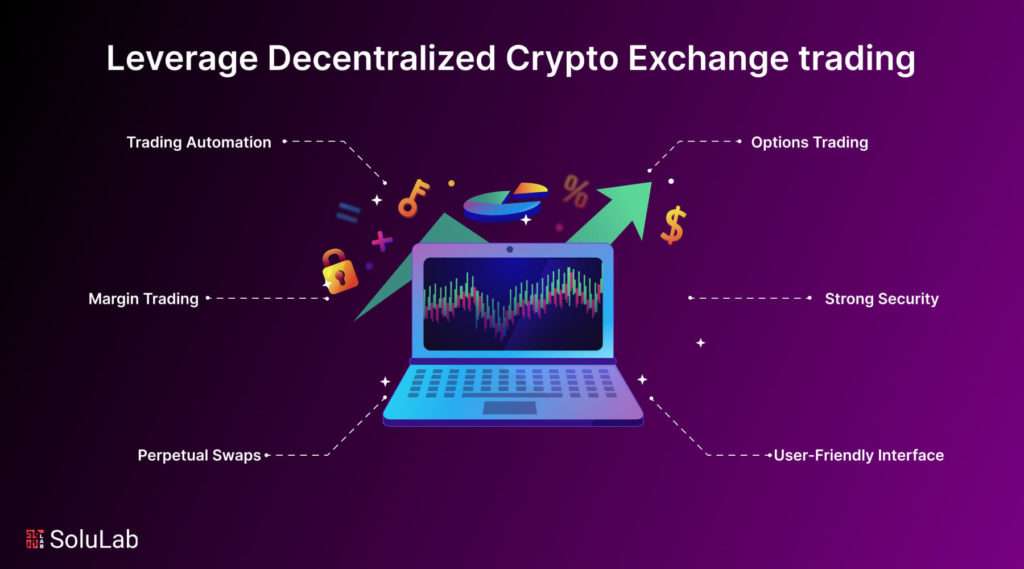
  • Trading Automation: The platform should provide configurable trading automation tools that let traders execute pre-planned deals quickly and effectively without requiring human assistance.
  • Margin Trading: One should be able to use leverage for a variety of assets, including forex, commodities, and cryptocurrencies. Margin needs and risk management techniques should be made evident on the platform.
  • Perpetual Swaps: In order to facilitate traders’ use of leverage, the platform ought to accommodate perpetual contracts for a variety of assets that have no ends. There should be easy access to clear information about financing fees and related expenses.
  • Options Trading: Traders should be able to use leverage to purchase and sell options contracts on a variety of assets. The platform must to give precise details on premiums and related expenses.
  • Strong Security: Smart contracts should be used in the platform’s construction to enable automated transactions on a secure blockchain network. User data and payments are further protected through the use of encryption, two-factor authentication, and frequent security assessments.
  • User-Friendly Interface: Trading costs, margin requirements, and other important information should all be made clear on the platform through an easy-to-use interface. To help new users, there should also be tutorials and educational materials available.

Advantages of Decentralized Leverage Trading

Advantages of Decentralized Leverage Trading

Businesses might gain many advantages from the development of decentralized leverage trading crypto exchanges in the following ways:

  • Permissionless Access

Entry obstacles are typically imposed by traditional banking systems, which demand that users fulfill specific requirements or undergo an extensive onboarding procedure. One of the main benefits of DEX is that it provides permissionless access, enabling anybody with a cryptocurrency wallet and an internet connection to begin trading right away. Because of its accessibility, financial markets become more democratic, enabling those who would not have had access to conventional finance because of socioeconomic, regional, or legal limitations.

  • Security

In the financial industry, where money loss or theft can have disastrous repercussions, security is crucial. Decentralized exchange with leverage runs on blockchain networks and protects user funds and transactions via cryptographic methods. Blockchain transactions are resistant to fraud and manipulation because they are transparent and unchangeable. Furthermore, because a decentralized leverage trading crypto exchange has no dependence on centralized servers, it is less vulnerable to single-point-of-failure hacking assaults.

Related: Creating the Next Decentralized Application

  • Censorship Resistance

Exchanges for decentralized leverage trading are immune to censorship, which means that no central authority can halt or reverse transactions on them. Financial intermediaries, including banks and governments, have the authority to impose transaction limitations or freeze account balances in the context of conventional finance. By enabling peer-to-peer trading between users without the intervention of third parties, decentralized exchanges remove this danger. This resilience to censorship is especially useful in areas where people may look for alternatives to traditional banking services due to autocratic regimes or shaky financial systems.

  • Transparency

Blockchain technology, which logs all transactions on a public ledger accessible to everyone with an internet connection, is based on the fundamental idea of transparency. This transparency is used by a decentralized leverage trading cryptocurrency exchange to give consumers instant access to trading information, including trade history, order book depth, and market liquidity. Because users are able to independently confirm the correctness and fairness of transactions, this openness increases trust and confidence in the reliability of the trading platform. Since all trading activity is available to the public, the openness of decentralized exchanges also lowers the possibility of insider trading and manipulation of the markets.

  • Lower Fees

Decentralized leverage trading usually charges less than those for centralized trading. This is due to the fact that decentralized exchanges function without the use of middlemen like clearinghouses or brokers, who frequently charge for their services. Decentralized exchanges, on the other hand, do away with the need for middlemen by using automated smart contracts to enable trading directly between users. Users benefit from increased profit margins, decreased trading costs, and more control over their financial activities as a consequence.

  • Control Over Funds

Self-custody—a decentralized financial concept that grants users complete control over their cash at all times—is one of its core tenets. Users may trade straight from their cryptocurrency wallets on decentralized leverage trading platforms, eliminating the need to transfer money to a centralized exchange or give it to a third party. This removes the possibility of money being lost or stolen as a result of fraud, insolvency, or exchange hacking. Furthermore, consumers may take their assets out whenever they want without being constrained by centralized exchanges’ withdrawal policies or waiting periods because they still have authority over their money. In the decentralized finance ecosystem, this financial sovereignty and autonomy are crucial to preserve.

CTA1

Impact on Traditional Financial Systems 

Decentralized crypto exchanges (DEXs) with leverage trading have the potential to disrupt traditional financial systems in several ways:

  • Reduced Dependence on Intermediaries: By enabling peer-to-peer trading without the need for intermediaries like banks or brokers, DEXs reduce reliance on centralized institutions. This could lead to disintermediation and a shift in the balance of power within the financial industry.
  • Increased Accessibility: DEXs provide access to financial services for individuals who are underserved or excluded by traditional banking systems. This includes people in regions with limited banking infrastructure or those who face barriers to entry in traditional financial markets.
  • Global Market Access: With decentralized exchanges, traders can access global markets 24/7, regardless of their location. This facilitates cross-border transactions and removes barriers to international trading that may exist in traditional financial systems.
  • Innovation and Competition: The emergence of DEXs fosters innovation and competition within the financial industry. Traditional financial institutions may be forced to adapt and innovate to remain competitive in the face of decentralized alternatives.

Challenges and Considerations With Decentralized Crypto Exchange Challenges and Considerations With Decentralized Crypto Exchange

Decentralized exchanges with leverage and decentralized leverage trading platforms offer exciting opportunities for investors and traders, but they also present several challenges and considerations that must be carefully addressed.

Regulatory Challenges and Compliance Issues

  • Uncertain Regulatory Landscape: The regulatory environment surrounding decentralized finance (DeFi) and leverage trading is still evolving, leading to uncertainty for market participants and platform operators.
  • Know Your Customer (KYC) and Anti-Money Laundering (AML) Compliance: Regulators may require decentralized exchanges with leverage to implement KYC/AML procedures to mitigate financial crime risks, despite the pseudonymous nature of blockchain transactions.
  • Compliance with Securities Laws: Some jurisdictions may classify leveraged trading products as securities, subjecting decentralized platforms to additional regulatory requirements and potential legal challenges.

Risks Associated with Smart Contract Vulnerabilities

  • Smart Contract Risks: Decentralized leverage trading platforms rely on smart contracts to execute trades and manage collateral. Smart contract vulnerabilities, such as coding errors or malicious exploits, could lead to significant financial losses for users.
  • Auditing and Security: Conducting thorough security audits of smart contracts and implementing robust security measures are essential to mitigate the risks of exploitation and ensure the integrity of the platform.

Market Manipulation and Liquidity Challenges

  • Market Manipulation: Decentralized markets are susceptible to manipulation and insider trading, posing risks to investors and the integrity of the platform. Without proper oversight and monitoring mechanisms, malicious actors may exploit liquidity pools and engage in fraudulent activities.
  • Liquidity Challenges: Ensuring sufficient liquidity is essential for the efficient functioning of decentralized leverage trading platforms. Low liquidity can lead to slippage, increased transaction costs, and limited trading opportunities, negatively impacting user experience and market stability.

Related: DeFi Development – Use Cases, Challenges & Future

Strategies for Mitigating Risks and Ensuring Responsible Trading Practices

  • Transparency and Disclosure: Platforms should provide transparent and comprehensive information about their operations, including risk factors, fees, and trading mechanics. Educating users about the risks associated with leverage trading is crucial for promoting responsible trading practices.
  • Risk Management Tools: Implementing risk management tools, such as stop-loss orders and margin requirements, can help users manage their exposure to market volatility and prevent excessive losses.
  • Community Governance: Decentralized leverage trading platforms can benefit from community-driven governance mechanisms that empower users to participate in decision-making processes and enforce best practices.
  • Collaboration with Regulators: Working closely with regulators and policymakers to address regulatory concerns and ensure compliance with applicable laws and regulations is essential for the long-term viability of decentralized exchanges with leverage.

Addressing these challenges and considerations requires a collaborative effort from platform operators, developers, regulators, and users to build a resilient and trustworthy ecosystem for decentralized leverage trading. By implementing robust security measures, promoting transparency, and fostering responsible trading practices, decentralized platforms can mitigate risks and maximize the potential of leverage trading in decentralized finance.

Opportunities for Innovation and Growth

The intersection of decentralized finance (DeFi) and leverage trading opens up a myriad of opportunities for innovation and growth. Here’s a closer look at some of the key areas where decentralized leverage trading platforms can drive innovation:

Exploration of Potential Innovations

  • Algorithmic Trading Strategies: Decentralized leverage trading platforms can leverage algorithmic trading strategies to automate trading decisions and optimize trading outcomes. Smart contracts can execute predefined trading strategies based on market conditions, technical indicators, and risk parameters, offering users access to sophisticated trading tools.
  • Decentralized Margin Lending: Introducing decentralized margin lending protocols allows users to borrow assets against their existing holdings, enabling leveraged trading without relying on centralized intermediaries. Decentralized margin lending platforms can provide liquidity to traders while earning interest on deposited assets, creating a new avenue for passive income generation.
  • Cross-Chain Interoperability: Enhancing cross-chain interoperability enables seamless asset transfers and trading across different blockchain networks. Decentralized leverage trading platforms can leverage interoperability solutions to access a broader range of assets and liquidity pools, improving market efficiency and user experience.

Opportunities for Financial Inclusion and Empowerment

  • Access to Global Markets: Decentralized leverage trading platforms democratize access to financial markets, allowing users worldwide to participate in leveraged trading without geographic restrictions or intermediaries. This opens up opportunities for individuals in underserved or unbanked regions to engage in wealth creation and financial empowerment.
  • Reduced Barriers to Entry: By eliminating barriers to entry, such as account minimums, credit checks, and geographic limitations, decentralized leverage trading platforms foster financial inclusion and empowerment for individuals who may have been excluded from traditional financial systems. Users can access leverage trading with minimal capital requirements, leveling the playing field and promoting economic equality.

Collaborations Between Traditional Finance and Decentralized Platforms

  • Innovation Synergies: Collaboration between traditional financial institutions and decentralized platforms can drive innovation and adoption in both sectors. Traditional finance brings expertise in regulatory compliance, risk management, and market infrastructure, while decentralized platforms offer agility, transparency, and innovation in fintech solutions.
  • Hybrid Financial Products: Collaborative efforts between traditional finance and decentralized platforms can lead to the development of hybrid financial products that combine the best features of both worlds. For example, tokenized securities and synthetic assets issued on decentralized platforms enable fractional ownership and 24/7 trading, while complying with regulatory requirements and investor protections.
  • Market Liquidity and Integration: Integrating decentralized leverage trading platforms with traditional financial markets enhances liquidity and market depth, benefiting both retail and institutional traders. Collaboration between centralized exchanges, liquidity providers, and decentralized platforms facilitates seamless asset transfers and trading, driving innovation and adoption across the financial ecosystem.

CTA2

Conclusion

Crypto exchange systems that combine decentralized finance with leverage trading provide consumers with unparalleled access to financial markets while adhering to decentralization, security, and transparency ideals. While problems persist, continued innovation and growth are paving the path for a future in which decentralized finance is crucial to creating the global financial environment. As the DeFi exchange market matures, the creation of decentralized leverage trading crypto exchanges is set to open up new avenues of opportunity and revolutionize the way we approach finance.

For businesses and entrepreneurs looking to capitalize on the opportunities presented by decentralized crypto exchanges, SoluLab offers comprehensive development services tailored to meet their unique needs. As a leading decentralized exchange development company, SoluLab specializes in building secure, scalable, and feature-rich decentralized trading platforms that empower users to trade with confidence. Whether you’re launching a new decentralized exchange or enhancing an existing platform, SoluLab’s team of experienced developers and blockchain experts can help you navigate the complexities of decentralized finance and leverage trading. Contact us today to learn more and embark on your journey towards building the future of finance.

FAQs

1. What is decentralized leverage trading, and how does it differ from traditional trading?

Decentralized leverage trading allows users to trade financial assets with borrowed funds, amplifying potential gains or losses. Unlike traditional trading, which often relies on centralized intermediaries like banks or brokers, decentralized leverage trading occurs directly between users on blockchain-based platforms, offering greater transparency, accessibility, and control over one’s funds.

2. What are the risks associated with decentralized leverage trading?

While decentralized leverage trading offers opportunities for enhanced returns, it also carries inherent risks, including the potential for significant losses. Factors such as market volatility, smart contract vulnerabilities, and liquidity challenges can expose traders to heightened risks. It’s essential for users to conduct thorough research, implement risk management strategies, and only trade with funds they can afford to lose.

3. How can decentralized leverage trading contribute to financial inclusion?

Decentralized leverage trading platforms democratize access to financial markets by removing barriers to entry, such as geographic restrictions, account minimums, and credit checks. This enables individuals worldwide, including those in underserved or unbanked regions, to participate in leveraged trading and wealth creation, promoting financial inclusion and empowerment.

4. What regulatory considerations should users be aware of when engaging in decentralized leverage trading?

Users should be aware of the regulatory landscape surrounding decentralized finance (DeFi) and leverage trading, which varies by jurisdiction. Regulatory concerns may include compliance with Know Your Customer (KYC) and Anti-Money Laundering (AML) regulations, securities laws, and investor protection measures. It’s important for users to stay informed about regulatory developments and ensure compliance with applicable laws and regulations.

5. How can SoluLab assist businesses interested in developing decentralized crypto exchanges with leverage trading features?

SoluLab offers comprehensive development services for businesses looking to build decentralized crypto exchanges with leverage trading capabilities. Our team of experienced developers and blockchain experts can design, develop, and deploy secure, scalable, and feature-rich trading platforms tailored to your specific requirements. Whether you’re launching a new exchange or enhancing an existing platform, SoluLab provides end-to-end support to help you navigate the complexities of decentralized finance and leverage trading. 

Top 10 Financial Software Development Companies in 2026

The worldwide financial software market is anticipated to expand at a compound annual growth rate (CAGR) of 7.2% between 2018 and 2023, according to research by Market Research Future. Some of the major drivers of this development are the expanding requirement for advanced analytics tools, the adoption of cloud-based solutions, and the rising need for effective financial management systems.

This article talks about financial technology software and some of the best financial software companies in 2026.

Understanding Financial Software Development

The development of software programs that are expressly created for financial institutions, businesses, and individuals to handle and automate different financial operations and transactions is referred to as financial software development. With the help of this specialized software, financial tasks like accounting, budgeting, financial analysis, risk management, investment management, and more can be done more efficiently, accurately, and accurately.

Financial software companies specializing in developing financial software are essential in helping the financial industry satisfy its many demands. These businesses focus on developing reliable and secure software solutions that are specifically suited to the needs of banks, insurance companies, asset management organizations, brokerage firms, accountancy firms, and other financial service providers. To provide top-notch solutions, they combine their proficiency in software creation with an in-depth understanding of financial procedures and rules.

To design, create, test, and implement financial software solutions, these businesses collaborate with competent software developers, financial domain specialists, and data scientists. To secure the privacy, accuracy, and accessibility of financial data, they adhere to stringent security requirements and industry best practices.

The Top Financial Software Development Services Include the Following:

  • Custom Software Development: They create tailored software solutions to meet the unique requirements of their clients. This involves understanding the client’s business processes, conducting a thorough analysis, and developing software that aligns with their specific needs. To support development efforts, companies increasingly turn to software offshoring and nearshoring in Eastern Europe, Latin America, Southeast Asia, and India where a combination of technical expertise, time zone alignment, and cost efficiency offers practical advantages.
  • Integration Services: A Financial software development company integrates its solutions with existing systems and platforms, such as accounting software, enterprise resource planning (ERP) systems, and customer relationship management (CRM) software. This ensures seamless data flow and enables efficient cross-system operations.
  • Maintenance and Support: These companies provide ongoing maintenance and support services to ensure the smooth functioning of software applications. This includes bug fixes, software updates, and technical assistance to address any issues or concerns.
  • Security and Compliance: Given the sensitive nature of financial data, security is a top priority. Financial software development companies implement robust security measures to protect against cyber threats and ensure compliance with industry regulations, such as the Payment Card Industry Data Security Standard (PCI DSS) and the General Data Protection Regulation (GDPR).

Criteria for evaluation

To evaluate financial software development companies, consider the following criteria:

  • Expertise and technical skills: Evaluate the company’s financial software development expertise, including knowledge of financial software frameworks, protocols, and platforms. Consider their proficiency in financial software development languages, data analytics, cloud integration, security, and compliance.
  • Experience and track record: Assess the company’s experience in delivering successful financial software projects across different industries and domains. Evaluate their track record regarding project complexity, scalability, and client satisfaction. Consider the company’s longevity and established reputation in the financial software development space.
  • Innovation and R&D efforts: Examine the company’s commitment to innovation and ongoing research and development in financial software. Consider their investment in emerging technologies, patents, and contributions to the financial software community. Evaluate their ability to provide cutting-edge solutions and stay ahead of industry trends.
  • Range of services and solutions: Assess the company’s financial software companies and solutions portfolio. Consider their ability to offer end-to-end financial software development services, including strategy, consulting, architecture design, development, integration, and maintenance. Evaluate their capabilities in developing custom financial software applications tailored to client requirements.
  • Client reviews and testimonials: Review client feedback, testimonials, and case studies highlighting successful financial software projects delivered by the company. Look for client satisfaction, project outcomes, and the company’s ability to meet client expectations and deadlines.

Here is a List of the Top Financial Software Development Companies in 2026

1. SoluLab

SoluLab is a market-leading financial software development company, well known for offering stable and high-quality financial software solutions that assist organizations in streamlining their operations and boosting their bottom line. Their advanced technology and expertise enable them to deliver innovative financial software solutions that help clients optimize operations, enhance customer experience, and navigate regulatory requirements effectively.

It offers the knowledge and experience to support you in achieving your objectives, whether you’re wanting to design a fraud detection system, a mobile banking app, or a financial management platform. SoluLab is the go-to option for companies wishing to use the power of financial software to spur development and success because of its focus on innovation, quality, and client happiness. They offer a comprehensive range of software products and services to banks, asset managers, insurance companies, and other financial institutions.


$25-$49


50-249


2014


Los Angeles, CA, USA


ZeCash, Chichin

2. Fiserv

Fiserv is a prominent provider of financial software solutions, serving banks, credit unions, investment firms, and other financial organizations. Their comprehensive suite of offerings includes core banking systems, payment processing platforms, risk management tools, and digital banking solutions. Fiserv is recognized for its deep industry knowledge and its commitment to helping clients adapt to the evolving financial landscape. Their software solutions empower financial institutions to deliver seamless digital experiences, streamline operations, and improve efficiency.


$115


23,000


1984


Wisconsin, USA


Centra Credit Union, Zelle LLP

3. Temenos

Temenos is a leading global provider of banking software solutions. They cater to financial institutions of all sizes, ranging from small community banks to large multinational banks. Temenos offers a wide range of software products, including core banking systems, digital banking solutions, payments software, and advanced analytics tools. Their scalable and flexible software solutions enable banks to enhance customer experience, drive operational efficiency, and accelerate digital transformation. Temenos is known for its commitment to innovation, providing cutting-edge technology that helps banks stay ahead in a highly competitive market.


$110


4,000


1993


Geneva, Switzerland


Atlantic Union Bank, Bank Leumi, Baxter Credit Union

4. SAP

SAP is a renowned enterprise software company that provides financial management systems to organizations across various industries. Their financial software solutions encompass accounting, treasury management, financial planning, and analytics. SAP’s software integrates with other business functions, such as supply chain management and human resources, to provide a holistic view of an organization’s financial operations. With its robust and integrated software suite, SAP enables businesses to make data-driven financial decisions, automate processes, and ensure compliance with regulatory requirements.


$120


100,000


1972


Walldorf, Germany


Ford Motors, Coca Cola, DHL

5. Oracle

Oracle Financial Services offers comprehensive software solutions for banks and financial institutions. Their offerings cover a wide range of areas, including core banking systems, risk and compliance solutions, financial crime prevention, and customer analytics. Oracle Financial Services is known for its deep industry expertise and its ability to support complex financial operations. Their software suite enables financial institutions to streamline processes, manage risk effectively, and enhance customer engagement through personalized experiences.


$115


12,000


1984


Texas, USA


eBay, Airbnb

6. SS&C Technologies

SS&C Technologies is a global provider of investment and financial software solutions. They specialize in catering to asset managers, wealth managers, insurance companies, and other financial institutions. SS&C’s software suite covers investment management, trading and order management, portfolio accounting, risk management, and more. Their advanced technology and domain expertise enables them to deliver solutions that streamline operations, improve decision-making, and drive efficiency for their clients. SS&C Technologies is trusted by financial professionals worldwide for its robust and scalable software platforms.


$125


22,000


1986


Connecticut, USA


Banks, hedge funds, asset managers, insurance companies

7. SimCorp

SimCorp focuses on providing investment management software and services to asset managers, fund managers, and institutional investors. Their comprehensive software suite covers front-to-back office operations, including portfolio management, order management, risk and compliance, and performance measurement. SimCorp’s integrated software platform enables investment professionals to manage complex portfolios, mitigate risks, and optimize performance. They are known for their deep understanding of the investment management industry and their commitment to delivering innovative solutions that address industry challenges.


$110


1,700


1979


Copenhagen, Denmark


Norges Bank, Zurich Insurance Group

8. Calypso Technology

Calypso Technology specializes in providing cross-asset trading and risk management software to financial institutions. Their solutions cover a wide range of areas, including trading, risk analytics, collateral management, and treasury operations. Calypso’s robust and scalable software platform helps client streamline their trading operations, manage risk effectively, and improve operational efficiency. They are known for their advanced technology, comprehensive functionality, and ability to adapt to evolving market requirements.


$120


1,200


1990


London, UK


Banks, asset managers, and insurance companies

9. Bloomberg L.P.

Bloomberg is a renowned provider of financial software and data services. Their software suite includes trading platforms, risk management tools, investment analytics, and market data solutions. Professionals in the financial industry widely use Bloomberg’s powerful software applications for making informed investment decisions, managing risk, and monitoring market trends. Their extensive financial data coverage, real-time market information, and sophisticated analytics tools make them a trusted partner for financial professionals worldwide.


$130


19,000


1981


New York City, NY


Bank of America, Citi group, Goldman Sachs

10. Broadridge

Broadridge provides technology solutions and services to the financial industry. Their offerings include investor communications, securities processing, data and analytics, and wealth management technology. Broadridge’s comprehensive suite of solutions helps financial institutions improve operational efficiency, enhance regulatory compliance, and deliver superior client experiences. They are known for their industry expertise, innovation, and ability to support the unique needs of banks, broker-dealers, asset managers, and other financial organizations.


$115


15,000


1981


New York City, NY


BlackRock, State Street, Morgan Stanley

Final Words

In conclusion, financial application development is a dynamic and rapidly growing field that plays a crucial role in the modern financial landscape. Financial software development companies combine their technical expertise with a deep understanding of financial processes to create tailored software solutions that enhance efficiency, accuracy, and security in financial operations. As the demand for advanced financial management systems continues to rise, these companies are poised to drive innovation and empower financial institutions and organizations with cutting-edge software applications.

A financial software solution may be designed by talented financial software developers, QAs, PMs, and business analysts. SoluLab provides financial software development services for a number of additional businesses in addition to banking, insurance, and investing. Through its financial software innovations, SoluLab specializes in building seamless and intelligent environments that help businesses increase compliance, efficiency, and security.

1. What services do top financial software development companies offer?

Top Fintech Software Development Companies offer a range of services including mobile banking apps, payment gateways, trading platforms, and blockchain solutions. They also provide tailored software solutions to meet specific financial industry needs.

2. Why should I hire dedicated developers for financial software development?

Hiring dedicated developers ensures you have a skilled team focused solely on your project, leading to faster delivery, better customization, and ongoing support tailored to your financial software needs.

3. How do I choose the right custom software development company for my financial project?

Choosing the right custom software development company involves evaluating their experience in the financial sector, checking their portfolio, understanding their technology stack, and assessing their ability to provide scalable and secure solutions.

4. What makes a Fintech Software Development Company stand out in the industry?

A leading Fintech Software Development Company stands out by offering innovative solutions, maintaining compliance with industry regulations, and providing robust security features. Their ability to customize software to meet client-specific needs also sets them apart.

5. What are the benefits of partnering with a custom software development company for financial projects?

Partnering with a custom software development company allows you to develop software that is uniquely suited to your business requirements, providing flexibility, scalability, and a competitive edge in the financial market.

3 Benefits of Using Salesforce in Financial Industry

In the financial services sector, Salesforce stands head and shoulders above the other customer relationship management (CRM) and cloud computing platforms out there. That’s because the Salesforce Financial Services Cloud was designed with financial services in mind, allowing you to connect with your clients more personally than ever before.

As Regional Vice President, I’ve worked with many financial services companies to support their digital transformation and business process improvements. I’ve seen firsthand how Salesforce makes a difference in this industry for three main reasons:

  • The security and trust features
  • Their investment in understanding the financial services industry
  • The degree of customizability to suit unique company needs

Below, I dive into each of these three points to show how Salesforce can help take your financial services company to the next level.

SECURITY AND TRUST FEATURES

Salesforce is known as the most secure CRM platform available. It’s not only the system the Department of Defense uses, but also the platform chosen by U.S. Bank, Transamerica, Western Union, and numerous other financial institutions for its robust features and reliable data security.

Financial services companies don’t just need to be vigilant against external hacks — they also have to ensure that client information isn’t shared across business lines. These special security needs are well served by Salesforce’s security and trust features. Salesforce features provide advanced configurations for top security, boosting trust among your clients as they share their most sensitive data with you.

DEEP UNDERSTANDING OF THE INDUSTRY

Salesforce Financial Services Cloud was created with the input of wealth management companies and independent software vendors. This is representative of the time Salesforce has invested in understanding the financial services industry.

Through consultations with industry experts and ongoing events for financial services professionals, Salesforce has come to truly understand the financial industry — and it shows in their products. You can be confident that your Salesforce solution will be able to meet your specific needs, especially with the customizations available.

HIGH LEVEL OF CUSTOMIZABILITY

Financial service companies vary widely; from banking and insurance to wealth management and investing, each sector of financial services operates very differently.

Salesforce has the customizability to support them all. Financial advisors, for instance, can leverage Salesforce to deliver personalized relationships to each of their clients. Bankers can use the platform to gain more insight about their customers and identify opportunities to convert and cross-sell their target market. All sectors can benefit from the technology’s ability to streamline client communications, increase data security, and integrate omni-channel efforts.

In fact, Salesforce has so many options that our clients can sometimes feel overwhelmed by the possibilities — that’s where we come in to help.

We encourage our clients to avoid trying to boil the ocean. Instead, as you implement Salesforce, focus on the key areas and problems that need to be addressed. For your organization, the focus may be on risk management, financial reporting timeliness, or regulatory compliance. Identify the top challenges you need your technology solution to help solve. This allows you and your implementation partner to develop a minimum viable product that will address your key needs, and then build and expand on that solution.

As a starting point, aside from using Salesforce Financial Cloud, we have found that many financial services companies benefit from customizing and using:

  • Sales Cloud: to find clients and grow accounts to improve the lead-to-loyalty cycle
  • Marketing Cloud: for help with (GDPR-compliant) marketing automation
  • Service Cloud: to increase client satisfaction and improve customer support
  • Community Cloud: to provide clients with excellent self-service options and account portals
  • Einstein AI: to leverage AI-powered predictions and recommendations to improve internal decision making, increase productivity, and create a better customer experience

How is Data Science Revolutionizing the Finance Industry?

In recent years, the ability of data science and machine learning to cope with a number of principal financial tasks has become an especially important point at issue. Companies want to know more what improvements the technologies bring and how they can reshape their business strategies.

To help you answer these questions, we have prepared a list of data science use cases that have the highest impact on the finance sector. They cover very diverse business aspects from data management to trading strategies, but the common thing for them is the huge prospects to enhance financial solutions.

Automating risk management

Risk management is an enormously important area for financial institutions, responsible for company’s security, trustworthiness, and strategic decisions. The approaches to handling risk management have changed significantly over the past years, transforming the nature of finance sector. As never before, machine learning models today define the vectors of business development.

There are many origins from which risks can come, such as competitors, investors, regulators, or company’s customers. Also, risks can differ in importance and potential losses. Therefore, the main steps are identifying, prioritizing, and monitoring risks, which are the perfect tasks for machine learning. With training on the huge amount of customer data, financial lending, and insurance results, algorithms can not only increase the risk scoring models but also enhance cost efficiency and sustainability.

Among the most important applications of data science and artificial intelligence (AI) in risk management is identifying the creditworthiness of potential customers. To establish the appropriate credit amount for a particular customer, companies use machine learning algorithms that can analyze past spending behavior and patterns. This approach is also useful while working with new customers or the ones with a brief credit history.

Although digitalization and automatization of risk management processes in finance are in the early stages, the potential is extremely huge. Financial institutions still need to prepare for this change by automating core financial processes, improving analytical skills of the finance team, and making strategic technology investments. But as soon as the company starts to move in this direction, the profit will not make itself wait.

Managing customer data

For financial firms, data is the most important resource. Therefore, efficient data management is a key to business success. Today, there is a massive volume of financial data diversity in structure and volume: from social media activity and mobile interactions to market data and transaction details. Financial specialists often have to work with semi-structured or unstructured data and there is a big challenge to process it manually.

However, it’s obvious for most companies that integrating machine learning techniques to managing process is simply a necessity to extract real intelligence from data. AI tools, in particular, natural language processing, data mining, and text analytics, help to transform data into information contributing in smarter data governance and better business solutions, and as a result – increased profitability. For instance, machine learning algorithms can analyze the influence of some specific financial trends and market developments by learning from customers financial historical data. Finally, these techniques can be used to generate automated reports.

Predictive analytics

Analytics is now at the core of financial services. Special attention deserves predictive analytics that reveals patterns in the data that foresee the future event that can be acted upon now. Through understanding social media, news trends, and other data sources these sophisticated analytics conquered the main applications such as predicting prices and customers lifetime value, future life events, anticipated churn, and the stock market moves. Most importantly such techniques can help answer the complicated question – how best to intervene.

Real-time analytics

Real-time analytics fundamentally transform financial processes by analyzing large amounts of data from different sources and quickly identifying any changes and finding the best reaction to them. There are 3 main directions for real-time analytics application in finance:

Fraud detection

It’s an obligation for financial firms to guarantee the highest level of security to its users. The main challenge for companies is to find a good fraud detecting system with criminals always hacking new ways and setting up new traps. Only qualified data scientists can create perfect algorithms for detection and prevention of any anomalies in user behavior or ongoing working processes in this diversity of frauds. For instance, alerts for unusual financial purchases for a particular user, or large cash withdrawals will lead to blocking those actions, until the customer confirms them. In the stock market, machine learning tools can identify patterns in trading data that might indicate manipulations and alert staff to investigate. However, the greatest thing of such algorithms is the ability of self-teaching, becoming more and more effective and intelligent over time.

Consumer analytics

Real-time analytics also help with better understanding of customers and effective personalization. Sophisticated machine learning algorithms and customer sentiment analysis techniques can generate insights from clients behavior, social media interaction, their feedbacks and opinions and improve personalization and enhance the profit. Since the amount of data is enormously huge, only experienced data scientists can make precise breakdown.

Algorithmic trading

This area probably has the biggest impact from real-time analytics since every second is at stake here. Based on the most recent information from analyzing both traditional and non-traditional data, financial institutions can make real-time beneficial decisions. And because this data is often only valuable for a short time, being competitive in this sector means having the fastest methods of analyzing it.

Another prospective opens when combining real-time and predictive analytics in this area. It used to be a popular practice for financial companies have to hire mathematicians who can develop statistical models and use historical data to create trading algorithms that forecast market opportunities. However, today artificial intelligence offers techniques to make this process faster and what is especially important – constantly improving.

Therefore, data science and AI made a revolution in the trading sector, starting up the algorithmic trading strategies. Most world exchanges use computers that make decisions based on algorithms and correct strategies taking into account new data. Artificial intelligence infinitely processes tons of information, including tweets, financial indicators, data from news and books, and even TV programs. Consequently, it understands today’s worldwide trends and continuously enhances the predictions about financial markets.

All in all, real-time and predictive analytics significantly change the situation in different financial areas. With technologies such as Hadoop, NoSQL and Storm, traditional and non-traditional datasets, and the most precise algorithms, data engineers are changing the way finance used to work.

Deep personalization and customization

Firms realize that one of the key steps to being competitive in today’s market is to raise engagement through high-quality, personalized relationships with their customers. The idea is to analyze digital client experience and modify it taking into account client’s interests and preferences. AI is making significant improvements in understanding human language and emotion, which brings customer personalization to a whole new level. Data engineers can also build models that study the consumers’ behavior and discover situations where customers needed financial advice. The combination of predictive analytic tools and advanced digital delivery options can help with this complicated task, guiding the customer to the best financial solution at the most opportune time and suggesting personalize offerings based on spending habits, social-demographic trends, location, and other preferences.

Conclusion

For financial institutions, the usage of data science techniques provides a huge opportunity to stand out from the competition and reinvent their businesses. There are vast amounts of continuously changing financial data which creates a necessity for engaging machine learning and AI tools into different aspects of the business.

7 ways Machine Learning will impact the Finance Industry

ML and accountants

As digital transformation continues to make headlines, nearly all business professionals agree that advanced technologies are going to significantly change the way we live and work over the next decades.

One of the most widely discussed digital trends in the enterprise is the use of machine learning to automate procedural tasks. 

As the backbone of the enterprise, finance has been leading the charge in leveraging machine learning to deliver real-time insights, inform decision making and drive efficiency across the enterprise. Therefore, finance will be one of the first business units to see the impact of these technologies on day-to-day activities—in everything from automating payments to calculating risk and maintaining records.

  • Clearing invoice payments

Today, accounts receivable or treasury clerks struggle to clear invoice payments when customers combine invoices in one payment, pay incorrect amounts or do not include invoice numbers with their payments. To clear the invoice, the employee either has to manually add up various invoices that might match the payment amount, or contact the customer to clarify some information. In the case of a short payment, the employee either has to ask for approval to accept the short payment or request the remaining amount from the customer. 

An intelligent system could help by immediately suggesting invoices that might match the paid amount and, based on established thresholds, automatically clear the short payments or automatically generate a delta invoice.

  • Auditing expense claims

Another transactional finance task that could benefit from ML-enhanced automation is expense claim auditing. Finance employees must ensure that receipts are genuine, match claimed amounts and are in line with company policy. While the claim process can be simplified using state-of-the-art travel-and-expense solutions, the auditing is still manual.

What if machine learning could support this process, audit 100 percent of all claims, and send only questionable claims to a manager for approval? The machine could read receipts (even in a foreign language), ensure they are genuine, and match them against the policy. 

  •  Determining bonus accruals

Today, the accounting team spends a significant amount of time determining bonus accruals. The team looks at the current headcount salaries and bonus plans, and tries to forecast all KPIs in compensation plans. Based on that, finance managers try to calculate the most accurate accrual (and maybe add a buffer, just in case). But in fact, we often find out later that, the accuracy is more a matter of luck.

Deploying ML solutions, we could leave this calculation to a machine that uses all available system data and predictive analytics capabilities to come up with an unbiased accrual. Additionally, this would give accounting teams more time during the precious closing period for activities that require human intervention or judgment. 

  • Mapping risk assessments

In assessing commercial proposals for services projects, finance teams are tasked with evaluating each project individually based on the customer characteristics, such as maturity, industry, size, current system landscape and so on, as well as the complexity of the products to be implemented. To make this assessment, finance often relies on managers who have experience with similar projects. While this works to some extent, these decisions are still limited by these individuals’ perspectives.

Machine learning could instead allow teams to access all of the implementation projects the company has ever completed, anywhere in the world, over the last 40 years. Using this data, teams could then map the proposed project against all historical projects and come up with a better-informed risk assessment. This could in turn allow finance managers to provide a better offer to customers using a lower risk uplift, or ensure that there is enough cover in case the risk is high. This capability could significantly increase the company’s revenue and margin.

  • Calculating detailed analytics

Today, almost everybody in financial planning and analysis receives countless calls asking for information such as, “What was our revenue last quarter for this product?” or “What has our growth been over the last five years in this line of business?”

Digital assistants can already answer questions on weather forecasts, stock quotes and so forth. What if they could provide the latest financial results and give decision makers instant access to information? What if finance teams could speak to their ERP systems the way we are already speaking to Siri or Alexa and get an immediate response or a clarifying question? For instance: “For which region?” “In EUR or USD?” or even, “I will send a detailed report to your inbox immediately.”

  • Automating approval workflows

Today, approval workflows are mostly based on two-dimensional matrices that list various conditions based on which approval levels are triggered. But these approval workflows do not consider the broader circumstances. Is the requestor new in the role and might require more supervision? Have previous requests from this requestor been rejected/approved? Is this an exception we usually grant in this scenario? 

Intelligent workflows could allow finance teams to distinguish and filter out the true exceptions from the standard low-risk exception that is usually approved anyway. This way, employees do not need to wait for approvals and feel empowered, while still limiting the risk to the corporation.

  • Transforming the finance role

One of the first questions asked of any CFO looking to leverage these technologies is how will this impact jobs in finance? First, the skills required of those in the finance function will drastically change. Transactional jobs will become less critical, while business partnering, cross-functional knowledge and tech savviness will become more important. These systems must be built, maintained and integrated into existing operational systems and processes. However, while the resources required for these transactional tasks will be fewer, the fast-changing business models driven by digitization will require additional finance resources to be developed and supported.

Many other functions besides finance, including HR, procurement and legal, will be equally affected. The best thing leaders can do to prepare for the impact of machine learning technology is to strive to develop a learning culture, so employees can stay ahead of what is coming. Now is the time for CFOs to educate and prepare themselves on this topic, so they can lead their teams in adapting when the time is right.