Talk to an Expert

How Non-Fungible Tokens Are Changing the Digital World?

How Non-Fungible Tokens Are Changing the Digital World?

In recent years, the digital landscape has witnessed a transformation that has left the world in awe. A new wave of innovation and disruption has swept through the realms of art, entertainment, real estate, and more, reshaping the way we perceive and interact with the digital world. Non-Fungible Tokens (NFTs), heralded as the future of digital ownership and representation, have played an instrumental role in this paradigm shift. NFTs have transcended the boundaries of traditional digital assets and have introduced a concept that is poised to redefine the very essence of ownership, authenticity, and value in the virtual realm. This phenomenon is not merely a passing trend but a substantial force that is rewriting the rules of the digital world. In this blog, we will explore how Non-Fungible Tokens are leaving an indelible mark on the digital landscape, ushering in a new era of possibilities and reshaping the way we perceive, create, and trade in the digital space.

Understanding NFTs

The advent of Non-Fungible Tokens (NFTs) has brought about a transformative shift in the digital world. To grasp the full extent of their impact on the digital realm, it is essential to delve into the fundamentals of NFTs, understanding what makes them unique, how they are created, and the implications for ownership and authenticity.

A. What Makes an NFT Unique?

NFTs derive their uniqueness from their cryptographic properties and the underlying blockchain technology. Unlike traditional digital assets, NFTs are indivisible, irreplaceable, and cannot be exchanged on a one-to-one basis. Each NFT is a distinct entity with a specific digital signature, making it impossible to forge or replicate. This uniqueness is at the core of NFTs’ value proposition in the digital world.

The impact of NFTs on the digital world is profound in the way they confer ownership and authenticity to digital content. Artists, creators, and even individuals can mint NFTs to represent digital art, music, videos, and virtual assets, establishing a sense of ownership that was previously elusive in the digital realm.

B. How are NFTs Created?

The process of creating NFTs is a testament to the revolutionary power of blockchain technology. NFTs are generated through a process called minting, which involves registering a digital asset on a blockchain. This process creates a unique token associated with the asset, effectively transforming it into an NFT.

The ownership and provenance of NFTs are stored securely on the blockchain, providing a transparent and immutable record of transactions. As a result, the creation and transfer of NFTs are not only secure but also entirely transparent, enhancing trust and authenticity in the digital world.

C. Ownership and Authenticity in the Digital Realm

The impact of NFTs on the digital world extends to the concepts of ownership and authenticity. Prior to NFTs, establishing ownership and proving the authenticity of digital assets were significant challenges. NFTs provide a solution to these issues by allowing creators and buyers to assert ownership with confidence.

Ownership of NFTs is cryptographically verified and recorded on the blockchain, eliminating doubts about the legitimacy of ownership claims. This has profound implications for artists, creators, and collectors, who can now monetize their digital works with a sense of security that was previously unattainable.

In essence, NFT in the digital world has transformed by introducing a novel, secure, and transparent method of asserting ownership and authenticity for a wide range of digital assets. This newfound assurance has opened up exciting possibilities for creators, collectors, and investors, reshaping the way we interact with and perceive the value of digital content.
CTA1

NFTs in Art and Creativity

The world of art and creativity has been profoundly impacted by the emergence of Non-Fungible Tokens (NFTs). Here, we explore how NFTs have revolutionized this space, serving as a game-changer for digital artists while also making significant waves in traditional art markets.

A. NFTs as a Game-Changer for Digital Artists

Digital artists, who have long grappled with the challenge of proving ownership and authenticity of their creations, have found a lifeline in NFTs. NFTs provide a groundbreaking solution, enabling artists to mint their digital works as unique tokens on blockchain platforms.

This development has been nothing short of revolutionary. Digital artists can now attach a sense of rarity and ownership to their creations, allowing them to sell their art directly to a global audience. With NFTs, artists have the potential to earn royalties every time their work is sold or traded on NFT marketplaces.

The impact of NFTs on the digital world in the realm of art is immense. It has democratized the art world, breaking down traditional barriers to entry and recognition for digital artists. Through NFTs, artists can gain more control over their work and financial opportunities they may have struggled to find in the past.

B. Impact on Traditional Art Markets

The emergence of NFTs has not only transformed the digital art landscape but also made waves in traditional art markets. This disruption stems from the growth of NFT marketplaces and the way they have reshaped the dynamics of buying and selling art.

NFT marketplaces, such as OpenSea, Rarible, and SuperRare, have become the platforms of choice for trading NFT art. NFT marketplace development and features have made it easier for artists to mint NFTs, connect with collectors, and secure the value of their digital creations. As NFT marketplaces have matured, they have provided a seamless bridge between digital and traditional art markets, enhancing accessibility and liquidity for art buyers and sellers.

The art world has had to adapt to this evolving landscape. Traditional art institutions and galleries are increasingly exploring partnerships with NFT marketplaces to connect with a broader, tech-savvy audience. As a result, the impact of NFTs on the digital world is not confined solely to the digital realm but extends its influence to the broader art industry.

In brief, NFTs have ushered in a new era of possibilities for artists and collectors alike. They have democratized the art world, providing digital artists with opportunities and control, while also disrupting traditional art markets and opening doors for collaboration and innovation. The NFT marketplace development services have played a pivotal role in these transformations, reshaping how we perceive and engage with art in the digital age.
NFTs in the Gaming Industry

NFTs in the Gaming Industry

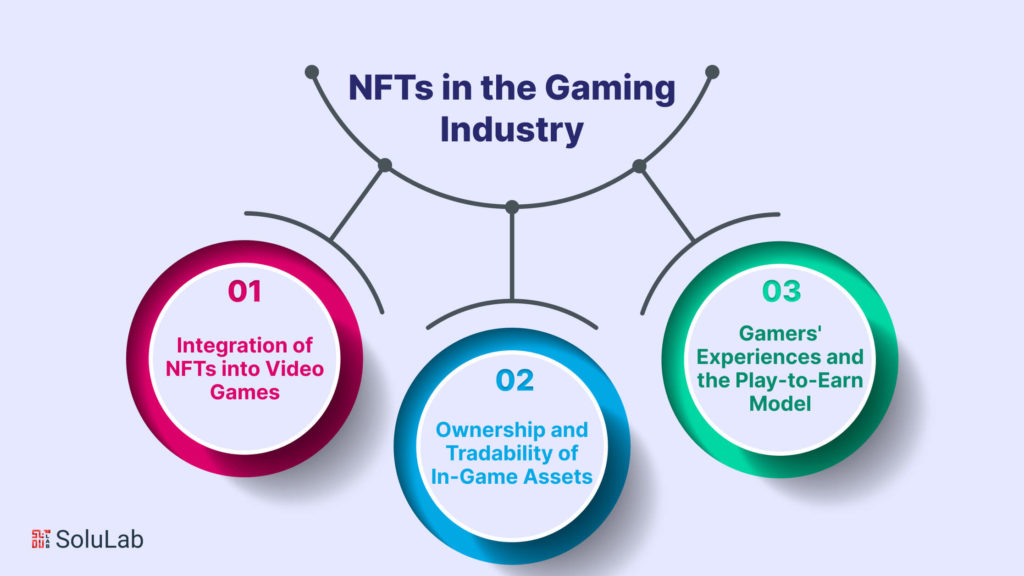
The gaming industry has been significantly impacted by the introduction of Non-Fungible Tokens (NFTs), leading to novel experiences and economic opportunities for both players and developers. Here, we explore the integration of NFTs into video games, ownership and tradability of in-game assets, and how NFTs have given rise to the “play-to-earn” model.

A. Integration of NFTs into Video Games

Traditionally, in-game assets like skins, weapons, and character outfits were owned by the game developers, limiting players’ control over their investments. With the advent of NFTs, these assets can now be tokenized and owned by players as verifiable digital possessions. Game developers are leveraging blockchain technology to create unique NFTs representing these in-game items.

This integration allows players to buy, sell, and trade their assets in a decentralized marketplace. These assets can be used across multiple games that support the same standards, providing players with a sense of ownership and control over their digital collections.

B. Ownership and Tradability of In-Game Assets

NFTs enable true ownership of in-game assets. Players have the freedom to trade, sell, or even lend their digital items, giving them a stake in the gaming ecosystem beyond their gameplay skills. This has led to a thriving secondary market for in-game assets, where players can monetize their investments by selling rare or sought-after items to other players.

Moreover, ownership of in-game assets becomes truly provable through the blockchain, reducing the risk of fraud or counterfeit items. The transparent and immutable nature of the blockchain ensures that the asset’s history and authenticity can be easily verified, making it a safe and trustworthy environment for players and collectors.

C. Gamers’ Experiences and the Play-to-Earn Model

NFTs pioneered the notion of “play-to-earn” in the gaming industry. Traditionally, gamers spent countless hours playing without direct financial gains. With NFTs, they can now accumulate valuable in-game assets that have real-world value. This shift has attracted a new audience of players who see gaming as a way to generate income.

In play-to-earn games, players can earn NFTs through gameplay, and these NFTs can be sold on marketplaces for cryptocurrencies or exchanged for other digital or real-world assets. This model has the potential to empower players, particularly in regions with limited economic opportunities, to earn a living by engaging in their favorite pastimes.

However, the play-to-earn model also comes with challenges, including concerns about the balance between gameplay and income generation, the potential for pay-to-win scenarios, and the need for regulations to protect players from exploitation.

In short, the integration of NFTs into the gaming industry has brought about a paradigm shift in the way players perceive and interact with in-game assets. The ownership, tradability, and play-to-earn model are transforming the gaming experience, opening new doors for both gamers and developers. As NFTs continue to evolve, they are likely to shape the future of gaming in ways that we have yet to fully explore.

NFTs in Real Estate and Virtual Land

The innovation of Non-Fungible Tokens (NFTs) extends beyond the realms of digital collectibles and gaming, venturing into the world of real estate and virtual land. This development brings forth the tokenization of real-world assets, virtual land ownership within metaverse platforms, and its potential impact on the real estate industry.

A. Tokenization of Real-World Assets

NFTs have paved the way for the tokenization of real-world assets, such as real estate properties. Tokenization involves breaking down physical assets into digital tokens, making them easily tradable and divisible. Through NFTs, individuals can hold digital ownership rights to specific portions or properties within the real estate market.

This tokenization opens up a range of possibilities, from enabling fractional ownership where multiple investors can hold shares in a single property to simplifying the process of buying and selling real estate. NFTs offer transparency and security by recording ownership and transaction history on a blockchain, reducing the need for intermediaries and enhancing trust in real estate transactions.

Real estate NFTs are often listed on NFT marketplaces, facilitating easy trade and providing a global platform for investors and buyers. Businesses and developers looking to engage in real estate tokenization can hire top NFT developers to create customized NFT marketplace development services that cater to their specific needs.

B. Virtual Land Ownership in Metaverse Platforms

Metaverse platforms, immersive virtual environments where people interact and socialize in digital spaces, have seen a surge in virtual land ownership through NFTs. Within metaverse worlds, parcels of virtual land are represented as NFTs, allowing users to purchase, develop, and trade virtual real estate.

Virtual land in metaverses serves various purposes, from creating digital businesses and virtual storefronts to hosting events and social gatherings. Some popular metaverse platforms include Decentraland, The Sandbox, and Somnium Space, where virtual land ownership has become a fundamental aspect of the user experience.

This development has encouraged businesses and entrepreneurs to invest in virtual land, further boosting the metaverse’s growth. Virtual landowners can develop their properties to generate revenue or simply hold them as digital assets with the potential for appreciation.

C. The Potential Impact on the Real Estate Industry

The integration of NFTs in real estate and virtual land ownership has the potential to disrupt the traditional real estate industry. Here are some of the potential impacts:

  • Accessibility: Real estate tokenization can lower the barriers to entry, making it possible for a broader range of investors to participate in real estate markets.
  • Efficiency: NFTs can streamline the buying and selling process by reducing paperwork and the involvement of intermediaries.
  • Globalization: NFTs enable cross-border investments, allowing investors to diversify their portfolios across different countries.
  • Liquidity: Fractional ownership and NFT-based real estate can increase liquidity, making it easier for investors to exit their positions.
  • Metaverse Integration: As virtual land ownership becomes more popular, the metaverse may emerge as a new dimension for real estate transactions and business opportunities.

In brief, NFTs have brought real estate into the digital age, offering new avenues for investment and diversification. The tokenization of real-world assets and virtual land ownership within metaverse platforms have the potential to revolutionize the real estate industry and redefine how we interact with both physical and digital properties. Businesses looking to leverage this trend can explore the services of top NFT developers to create their own NFT marketplace development solutions.
Challenges and Controversies

Challenges and Controversies

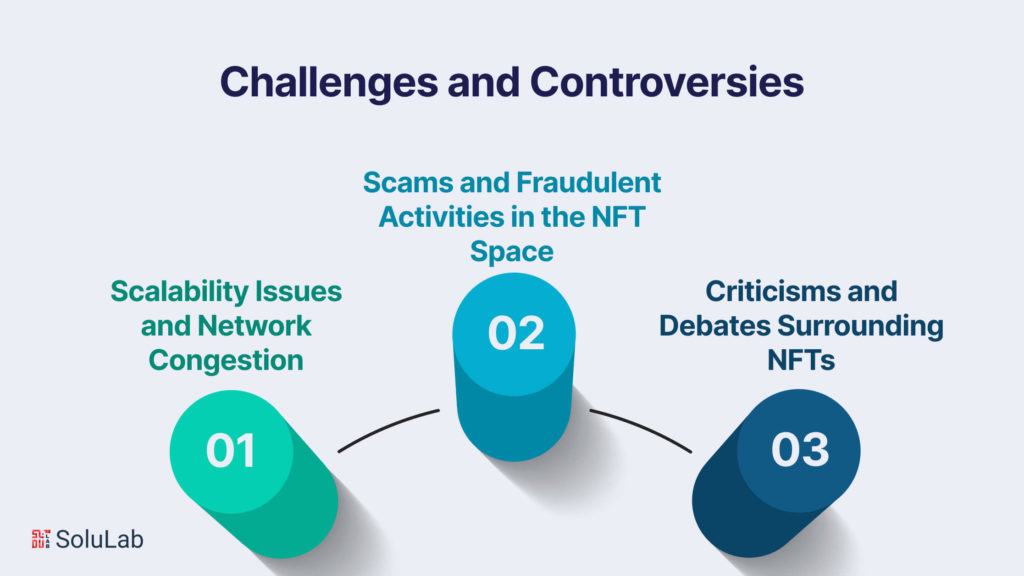
While Non-Fungible Tokens (NFTs) have gained significant attention and adoption, they are not without their share of challenges and controversies. In this section, we’ll explore some of the key issues that have emerged.

A. Scalability Issues and Network Congestion

One of the primary concerns associated with NFTs is the scalability of blockchain networks, particularly Ethereum. As NFTs gained popularity, they led to network congestion and increased transaction fees. The limited capacity of Ethereum and other blockchains has resulted in slow transaction times and high gas costs, making it less accessible for creators and collectors. These scalability issues have prompted discussions about the need for blockchain upgrades and the exploration of Layer 2 solutions to improve the overall NFT ecosystem.

Developers and blockchain communities are actively working on addressing these scalability challenges, but until a scalable solution is widely implemented, network congestion remains a significant hurdle for NFT enthusiasts.

B. Scams and Fraudulent Activities in the NFT Space

The rapid growth of the NFT market has attracted the attention of scammers and fraudsters. There have been instances of fake NFT listings, counterfeit art, and even fraudulent NFT marketplaces. These activities undermine trust in the NFT ecosystem and can lead to financial losses for unsuspecting buyers and creators.

It’s crucial for participants in the NFT space to exercise caution, conduct due diligence, and be aware of the risks associated with fake NFTs and deceptive practices. Emerging NFT marketplaces and services must implement rigorous verification and authentication processes to reduce the prevalence of scams.

C. Criticisms and Debates Surrounding NFTs

NFTs have sparked various criticisms and debates within the digital, artistic, and environmental communities. Some common criticisms include:

  • Environmental Concerns: The energy consumption associated with blockchain networks, particularly in the case of proof-of-work chains like Ethereum, has raised concerns about the carbon footprint of NFTs. These concerns have led to discussions about transitioning to more eco-friendly blockchain technologies.
  • Speculative Bubbles: Some argue that the NFT market has seen speculative bubbles, with overinflated prices for digital assets that may not hold long-term value. The concern is that this speculative behavior could lead to a market crash.
  • Exclusivity and Elitism: NFTs are seen by some as a means for wealthy individuals and celebrities to profit from their digital assets, leaving little room for emerging artists and creators. The question of whether NFTs are democratizing or exacerbating inequalities is a topic of ongoing debate.
  • Lack of Regulation: The lack of regulatory oversight in the NFT space has raised questions about consumer protection, copyright infringement, and legal challenges in case of disputes.

In response to these criticisms, the NFT community and industry are actively engaged in discussions about how to address these issues. This includes exploring more energy-efficient blockchain alternatives, promoting inclusivity supporting emerging artists, and advocating for responsible and ethical practices in the NFT space.

In conclusion, while NFTs have opened up new opportunities and possibilities, they are not immune to challenges and controversies. Addressing scalability, fraudulent activities, and criticisms are essential steps for the NFT ecosystem to mature and establish itself as a sustainable and responsible part of the digital world.
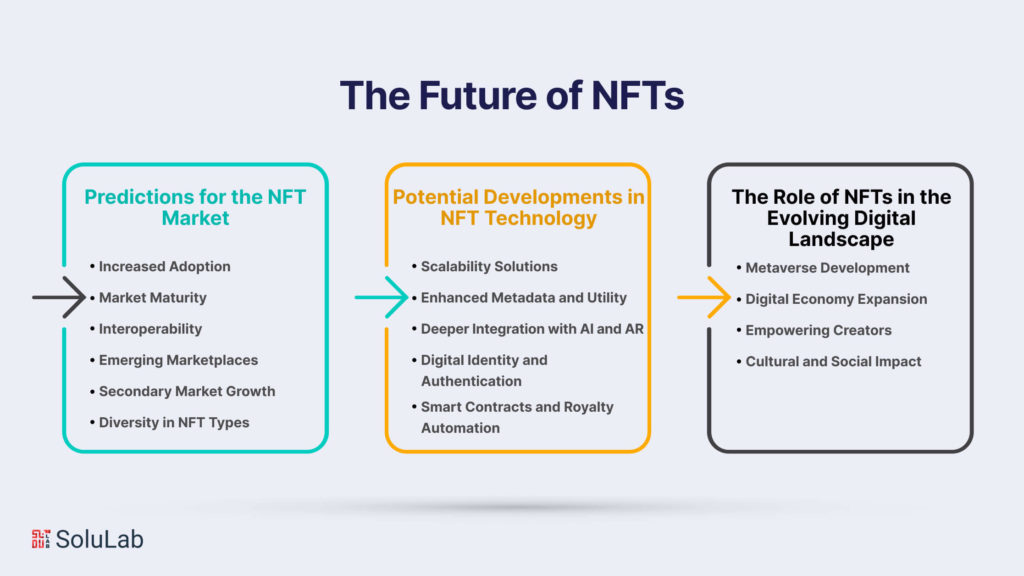
The Future of NFTs

Future of NFTs

As Non-Fungible Tokens (NFTs) continue to reshape various industries and capture the imagination of creators and collectors, it’s essential to consider what the future holds for this innovative technology. In this section, we’ll explore predictions for the NFT market, potential developments in NFT technology, and the evolving role of NFTs in the digital landscape.

A. Predictions for the NFT Market

The NFT market has shown remarkable growth, and its trajectory is likely to continue in the coming years. Here are some predictions for the NFT market:

  • Increased Adoption: NFTs are expected to see broader adoption in industries beyond art and gaming. Sectors like fashion, education, and healthcare may incorporate NFTs for provenance, authentication, and unique experiences.
  • Market Maturity: As the NFT market matures, we can anticipate increased regulation and standardization to address challenges related to fraud, copyright issues, and environmental concerns. This regulatory clarity may help build trust among users.
  • Interoperability: The development of cross-chain NFT solutions may promote interoperability between different blockchain ecosystems, making it easier for users to access and trade NFTs across multiple platforms.
  • Emerging Marketplaces: NFT marketplaces will continue to evolve, offering features such as social interactions, virtual exhibitions, and new ways to showcase and trade digital assets.
  • Secondary Market Growth: The secondary market for NFTs is expected to grow as collectors and investors seek opportunities for trading, flipping, and investing in digital assets. High-value NFTs may appreciate over time.
  • Diversity in NFT Types: New forms of NFTs, such as time-based NFTs, multi-chain NFTs, and NFTs representing real-world assets, will likely emerge, expanding the diversity of the market.

B. Potential Developments in NFT Technology

NFT technology is not static; it continues to evolve and expand its capabilities. Some potential developments include:

  • Scalability Solutions: Scalability issues will drive the development of Layer 2 solutions and the transition to more energy-efficient blockchains, reducing environmental concerns.
  • Enhanced Metadata and Utility: NFTs may become more programmable and dynamic, with metadata that can be updated, and NFTs can carry additional utility beyond ownership, such as granting access to exclusive content or experiences.
  • Deeper Integration with AI and AR: NFTs may be used in conjunction with artificial intelligence (AI) and augmented reality (AR) technologies, creating interactive and adaptive digital experiences.
  • Digital Identity and Authentication: NFTs may play a role in digital identity verification, helping to secure online interactions and protect users’ data and assets.
  • Smart Contracts and Royalty Automation: Smart contracts linked to NFTs will enable automated royalty payments to creators whenever their NFTs are resold, enhancing the fairness of the digital art market.

C. The Role of NFTs in the Evolving Digital Landscape

NFTs are poised to play an integral role in the ongoing transformation of the digital landscape:

  • Metaverse Development: NFTs will become foundational to metaverse environments, enabling users to own, create, and trade digital assets within these immersive virtual worlds.
  • Digital Economy Expansion: NFTs will extend beyond collectibles and art, infiltrating the digital economy as integral components in e-commerce, virtual real estate, and decentralized finance (DeFi) systems.
  • Empowering Creators: NFTs will empower creators and artists by providing more direct access to their audiences, bypassing intermediaries, and granting them greater control over their work and intellectual property.
  • Cultural and Social Impact: NFTs will continue to influence and shape cultural trends, art movements, and the ways we connect and interact in digital spaces.

In conclusion, the future of NFTs appears bright, with the potential for broader adoption, technological advancements, and a growing role in shaping the evolving digital landscape. As NFTs continue to mature, they will bring new opportunities and challenges, ultimately redefining how we perceive and interact with the digital world.
CTA2

Conclusion

In conclusion, the rise of Non-Fungible Tokens (NFTs) has ushered in a transformative era, reshaping how we interact with digital assets and the broader digital world. The impact of NFTs goes well beyond the creative and collectible realms, reaching into areas such as real estate, digital identity, and the metaverse. The emergence of NFT marketplace platforms and white-label NFT marketplace solutions has laid the foundation for a vibrant ecosystem where creators and collectors can connect, exchange, and create value in entirely new ways. These innovations have provided opportunities for entrepreneurs to explore and develop niche marketplaces tailored to specific industries and niches.

As we journey forward, the enduring significance of NFTs in the digital realm becomes more evident. The potential for NFTs to disrupt, innovate, and influence various facets of our digital lives is substantial. This is a world where the boundaries of ownership, creativity, and entrepreneurship are being redefined. It’s a world where opportunities for innovation are boundless, and where the role of NFTs in shaping the future of the digital landscape remains central. The NFT ecosystem continues to evolve, promising a future where the possibilities are as diverse as the digital assets themselves.

SoluLab, a leading blockchain and software development company, plays a pivotal role in the dynamic world of Non-Fungible Tokens (NFTs). As NFTs continue to transform the digital landscape, SoluLab has been at the forefront of innovation, offering NFT marketplace development solutions and white-label NFT marketplace services that empower businesses and entrepreneurs to explore the vast potential of this groundbreaking technology. With a strong commitment to blockchain technology, SoluLab is enabling clients to create custom NFT marketplaces that cater to specific industries and niches, ensuring they stay ahead in the rapidly evolving NFT ecosystem. Their expertise and dedication contribute to the enduring significance of NFTs, driving the digital realm toward a future that is more inclusive, innovative, and interconnected.

FAQs

1. What exactly is an NFT?

An NFT, or Non-Fungible Token, is a digital asset representing ownership or proof of authenticity of a unique item or piece of content, stored on a blockchain. Unlike cryptocurrencies like Bitcoin or Ethereum, NFTs are indivisible and each one has its own distinct value.

2. How can I create my own NFT?

To create your own NFT, you can use various NFT marketplaces like OpenSea, Rarible, or Mintable. You’ll need a digital wallet, connect it to a compatible marketplace, and then follow the platform-specific steps to mint your NFT. You’ll typically need to upload your digital content, set metadata, and determine any royalties for future resales.

3. Are NFTs environmentally friendly?

NFTs on certain blockchains, like Ethereum, have faced criticism for their environmental impact due to energy-intensive proof-of-work consensus mechanisms. However, the industry is actively exploring more eco-friendly solutions through the adoption of proof-of-stake blockchains and Layer 2 scaling solutions to mitigate these concerns.

4. How can NFTs be used in the real estate industry?

NFTs have the potential to revolutionize real estate by enabling the tokenization of property, making it easier to buy, sell, and trade real estate assets. They also offer fractional ownership opportunities, which can lower barriers to entry for real estate investment and make property ownership more accessible to a wider audience.

5. What are white label NFT marketplace solutions?

White label NFT marketplace solutions are customizable platforms provided by companies like SoluLab that allow businesses to create their own NFT marketplaces. They offer a pre-built infrastructure with the flexibility to be tailored to specific needs, industries, and branding, facilitating entrepreneurs and businesses in launching their NFT trading platforms more efficiently.

How to Choose the Best Whitelabel NFT Development Company?

How to Choose the Best Whitelabel NFT Development Company?

The world of NFTs (Non-Fungible Tokens) has taken the digital landscape by storm, revolutionizing how we perceive and trade digital assets. As the demand for NFTs continues to surge, the need for robust NFT marketplaces and platforms has become increasingly evident. This is where whitelabel NFT development companies come into play, offering customizable solutions to create your own NFT marketplace. In this comprehensive guide, we’ll explore the intricacies of selecting the best whitelabel NFT development company to ensure your venture’s success.

What is a Whitelabel NFT Development Company?

A Whitelabel NFT Development Company is a specialized entity in the NFT (Non-Fungible Token) ecosystem that focuses on providing customizable solutions for creating NFT marketplaces. These companies offer ready-made software, tools, and services that empower businesses and entrepreneurs to swiftly launch their own NFT platforms. Rather than constructing a marketplace from the ground up, clients can procure a whitelabel solution and adapt it to their brand’s unique requirements.

The term “whitelabel” denotes that the solution is provided in a way that allows clients to rebrand and customize it as if it were their own product. In the context of NFT development, a whitelabel solution refers to a pre-built NFT marketplace platform that can be tailored to match a specific brand’s identity and requirements. This approach is particularly advantageous for businesses seeking to enter the NFT market promptly without the extensive time and resources required for custom development.

Whitelabel NFT development companies are proficient in developing white-label NFT marketplace software and offer services catered to this specific niche. They possess expertise in blockchain technology, including knowledge of various blockchain networks such as Ethereum, Binance Smart Chain, and others commonly used for NFT development. Their solutions often come with a range of features and functionalities that can be customized to meet the client’s needs. Additionally, reputable Whitelabel NFT development companies provide ongoing support and maintenance to ensure the platform remains secure and up-to-date.

Read Our Blog Post: Why Should You Start Your Own NFT Marketplace Business?

A whitelabel NFT development company specializes in providing customizable NFT marketplace solutions to businesses and entrepreneurs looking to establish their presence in the NFT space quickly and efficiently. Their expertise lies in crafting pre-built NFT platforms that can be rebranded and tailored to match the client’s specific requirements, making them an invaluable resource for those looking to navigate the burgeoning world of NFTs.

Why Choose a Whitelabel NFT Solution?

Why Choose a Whitelabel NFT Solution?

Advantages of Choosing a Whitelabel NFT Development Company

  • Time Efficiency: Building a custom NFT marketplace from scratch can be a time-consuming process, involving extensive development, testing, and refinement. Whitelabel solutions significantly reduce development time, allowing you to launch your NFT platform faster and seize opportunities in the market swiftly.
  • Cost-Effective: Developing a bespoke NFT platform can be expensive due to the associated development, testing, and ongoing maintenance costs. Whitelabel solutions are often more budget-friendly, as they leverage pre-existing technology and infrastructure.
  • Proven Technology: Whitelabel NFT solutions are built on tested and proven technology. When you choose a reputable whitelabel NFT development company, you can leverage their experience and expertise to ensure a stable and secure platform. This is especially crucial in the NFT space, where security and reliability are paramount.

Check Our Blog Post: Top NFT Development Companies To Look At In 2024

  • Customization Options: While whitelabel solutions come with pre-built features and functionalities, they are highly customizable. This means you can tailor the platform to match your brand’s identity and meet your specific requirements. You retain control over the design, features, and user experience.
  • Security and Compliance: Security is of utmost importance in the NFT space, given the value of digital assets being traded. Whitelabel NFT development companies typically implement robust security measures, including encryption, multi-factor authentication, and regular security audits. Moreover, they often stay updated with regulatory changes and can help ensure your platform complies with relevant laws and regulations.

CTA1

  • Scalability: Your NFT marketplace should be prepared to handle increased traffic and transaction volumes as your user base grows. Reputable whitelabel solutions are designed to be scalable, allowing your platform to expand seamlessly without significant disruptions.
  • User-Friendly Interface: A user-friendly and easy to use interface is vital for attracting and retaining users. Many whitelabel NFT solutions come with well-designed user interfaces that provide an intuitive and visually appealing experience for your users.
  • Support and Maintenance: Establishing and maintaining an NFT marketplace requires ongoing support and maintenance. Reliable whitelabel NFT development companies offer support services to address any issues or updates that may arise. This ensures that your platform remains up-to-date, secure, and responsive to user needs.
  • Ownership and Control: When you choose a whitelabel NFT marketplace, you retain ownership and control over your platform. This means you can make decisions about its future development, monetization strategies, and branding without being tied to a third-party platform’s limitations.
  • Community and Ecosystem: Whitelabel NFT development companies often have established communities and ecosystems of users and developers. Joining such an ecosystem can provide you with valuable networking opportunities, partnerships, and insights into industry trends.

Key Factors to Consider When Choosing a Whitelabel NFT Development Company

Key Factors to Consider When Choosing a Whitelabel NFT Development Company

Selecting the best whitelabel NFT development company is a pivotal decision that can significantly impact the success of your NFT marketplace venture. 

1. Define Your Project Goals and Requirements

Before you start your search for a whitelabel NFT development company, you must have a clear understanding of your project’s goals and requirements. Ask yourself:

  • What is the niche or industry you’re targeting with your NFT marketplace (e.g., art, music, gaming, collectibles)?
  • What specific features and functionalities do you need in your NFT platform?
  • What is your budget for development, maintenance, and ongoing support?
  • Do you have any legal or regulatory considerations, such as compliance with local laws or licensing agreements?
  • Having a well-defined project scope and goals will guide your search and help you identify the company that can best meet your needs.

2. Research Whitelabel NFT Development Companies

Start your research by identifying a list of potential whitelabel NFT development companies. You can do this through a number of means:

  • Online searches: Use search engines and NFT-related forums and communities to find companies that offer whitelabel NFT solutions.
  • Industry referrals: Seek recommendations from industry peers, fellow entrepreneurs, or NFT enthusiasts who have experience working with such companies.
  • NFT marketplaces: Explore existing NFT marketplaces to see if they offer whitelabel solutions or partnerships with development companies.
  • Compile a list of companies that seem promising and align with your project goals.

Know More: How to Build the Best White-Label NFT Marketplace?

3. Assess Reputation and Experience

The reputation and experience of a whitelabel NFT development company are crucial factors to consider. Here’s how to assess them:

  • Portfolio: Review the company’s portfolio of past projects. Look for successful NFT marketplaces they have developed and launched. Pay attention to the diversity of industries and niches they have worked in.
  • Client testimonials: Seek out client testimonials and reviews. Reach out to past clients if possible to gather feedback about their experiences with the company.
  • Case studies: Some companies provide detailed case studies of their projects, highlighting challenges and solutions. Review these to gain insights into their problem-solving abilities.
  • A reputable and experienced company is more likely to deliver a high-quality product and provide reliable support.

4. Technology Stack and Blockchain Expertise

Since NFTs are blockchain-based, it’s crucial that the NFT development company has expertise in blockchain technology. Evaluate:

  • Their knowledge of blockchain networks: Ensure they are well-versed in the blockchain network you plan to use for your NFT marketplace, whether it’s Ethereum, Binance Smart Chain, Flow, or another.
  • Smart contract proficiency: NFTs rely on smart contracts for functionality. Assess the company’s capability to create and audit smart contracts for security and reliability.
  • Scalability: Inquire about their ability to design a scalable NFT platform that can handle growing user traffic and transaction volumes.
  • A solid understanding of blockchain technology is essential to ensure the security and efficiency of your NFT marketplace.

Related: 5 Best White Label NFT Marketplaces In The World

5. Customization Options

NFT marketplaces should be highly customizable to align with your brand identity and specific requirements. Evaluate:

  • The degree of customization offered by the whitelabel NFT solution. Can you modify the platform’s design, features, and functionalities to suit your vision?
  • User interface and user experience (UI/UX): Ensure that the platform’s UI/UX can be tailored to create an engaging and user-friendly environment.
  • White labeling options: Confirm that you have the freedom to rebrand the platform completely, so it appears as your unique product.
  • Customization is essential to differentiate your NFT marketplace from competitors and align it with your brand.

6. Security Measures

The security of your NFT marketplace is paramount, as it deals with valuable digital assets. Inquire about the security measures the company implements, including:

  • Encryption: Data encryption to protect user information and transactions.
  • Multi-factor authentication (MFA): Additional layers of security to prevent unauthorized access.
  • Regular security audits: Routine assessments to identify and address vulnerabilities.
  • Compliance with industry standards: Ensure that the company follows security best practices and complies with relevant industry standards.
  • Security breaches can lead to significant reputational and financial damage, so this aspect should not be overlooked.

7. Scalability

Your NFT marketplace should be capable of accommodating increased traffic and transaction volumes as your user base grows. Assess:

  • The platform’s scalability options: Can it handle growing demand without performance degradation or downtime?
  • Load testing: Inquire if the company conducts load testing to ensure the platform’s ability to handle peak usage periods.
  • Scalability ensures that your NFT marketplace can evolve and expand along with your success.

Read Also: How will White-Label NFT Marketplace Development Benefit your Business?

8. User-Friendly Interface

A user-friendly interface is crucial for attracting and retaining users. Evaluate:

  • The platform’s user interface (UI) design: Is it intuitive, visually appealing, and easy to navigate?
  • User experience (UX): Does the platform provide a seamless and enjoyable experience for users?
  • A well-designed UI/UX can significantly impact user engagement and conversion rates.

9. Support and Maintenance

Building and maintaining an NFT marketplace is an ongoing process. Inquire about the support and maintenance services offered by the company, including:

  • Response time for addressing issues or inquiries.
  • Availability of ongoing updates and improvements.
  • Technical support channels and their responsiveness.
  • A reliable support system ensures that your NFT marketplace remains secure and up-to-date.

10. Licensing and Ownership

Understand the licensing terms and ownership rights associated with the whitelabel solution. Ensure that:

  • You have full control and ownership of your NFT marketplace to avoid legal complications in the future.
  • Licensing agreements are clear and align with your business goals and objectives.
  • Legal clarity is essential to protect your long-term interests.

11. Cost and Pricing Structure

While cost-effectiveness is a key advantage of whitelabel solutions, carefully review the pricing structure and associated fees. Be aware of:

  • Initial development costs.
  • Ongoing maintenance and support fees.
  • Any hidden or unexpected costs that may arise during development and operation.
  • Budget transparency is crucial for managing your financial resources effectively.

Related: What are the Key Features of the White-Label NFT Marketplace?

12. Community and Ecosystem

A strong community and ecosystem can be valuable in the NFT space. Consider whether the whitelabel NFT development company has:

  • An active user community or developer community.
  • Partnerships or collaborations within the NFT industry.
  • A network of experts and enthusiasts who can provide insights and support.
  • Being part of a thriving community can open doors to networking opportunities and industry trends.

13. Compliance and Legal Considerations

NFTs are subject to various regulatory considerations in different jurisdictions. Ensure that the whitelabel solution complies with relevant laws and regulations in your target market. Consult with legal experts if needed to address compliance issues effectively.

CTA2

Conclusion

Choosing the best whitelabel NFT development company is a critical decision that can greatly impact the success of your NFT marketplace. Carefully evaluate each company’s reputation, experience, technology stack, customization options, security measures, and support services.

Remember that the NFT space is continuously evolving, so staying informed about the latest trends and developments is essential. With the right whitelabel NFT development company and a well-thought-out strategy, your NFT marketplace can thrive in this exciting and dynamic ecosystem, opening up new opportunities for your brand and users alike.

On the path towards a future driven by NFTs, SoluLab stands as a reliable partner, leading businesses towards success by leveraging its proficiency in whitelabel NFT marketplace development services. With innovation as its guiding force, SoluLab empowers enterprises to explore new horizons, revolutionize commerce, and establish their unique presence in the digital realm.

Together with SoluLab, you embark on a transformative journey—a journey characterized by innovation driving advancement and turning aspirations into reality. Connect with SoluLab today to enter the realm of white-label NFT marketplaces, where the possibilities are endless, and opportunities know no bounds.

FAQs

1. What is a Whitelabel NFT Development Company?

A whitelabel NFT development company specializes in providing ready-made, customizable solutions for creating NFT marketplaces. These solutions allow businesses to launch their NFT platforms quickly, without building them from scratch.

2. Why should I choose a whitelabel NFT solution over custom development?

Whitelabel NFT solutions are often more cost-effective and time-efficient compared to custom development. They leverage pre-existing technology, reduce development time, and offer customization options, making them a practical choice for entering the NFT market swiftly.

3. What factors should I consider when choosing a whitelabel NFT development company?

Consider factors such as the company’s reputation, experience, technology stack, customization options, security measures, scalability, user interface, support, legal considerations, and pricing structure.

4. How important is security when selecting a whitelabel NFT development company?

Security is crucial in the NFT space due to the value of digital assets. Ensure that the company implements robust security measures, including encryption, multi-factor authentication, and regular security audits, to protect your platform and users.

5. Can I customize a whitelabel NFT solution to match my brand’s identity?

Yes, one of the advantages of whitelabel NFT solutions is their high degree of customization. You can often tailor the platform’s design, features, and functionalities to align with your brand’s identity and specific requirements.

6. What blockchain expertise should a whitelabel NFT development company have?

The company should have proficiency in blockchain technology, including knowledge of the specific blockchain network you plan to use (e.g., Ethereum, Binance Smart Chain). They should also be skilled in creating and auditing smart contracts.

7. How can I ensure ongoing support and maintenance for my whitelabel NFT platform?

When choosing a whitelabel NFT development company, inquire about their support and maintenance services. Ensure they offer timely responses to issues, regular updates, and technical support to keep your platform secure and up-to-date.

8. Is scalability a feature provided by white-label NFT marketplaces?

Indeed, white-label NFT marketplace solutions are intentionally crafted to be scalable, capable of handling a burgeoning user base, surges in transactions, and the growing inventory of NFTs. The foundational infrastructure is primed for high performance, simplifying the process for businesses to manage heightened demand and extend their reach within the market.

How to Build the Best White-Label NFT Marketplace?

How to Build the Best White-Label NFT Marketplace?

The world of digital assets is continually evolving, and at the forefront of this evolution lies the concept of white-label NFT marketplaces. These innovative platforms have garnered significant attention for their ability to revolutionize the way non-fungible tokens (NFTs) are bought, sold, and traded. In this exploration, we delve into the core components of white-label NFT marketplaces, highlighting their benefits and shedding light on key terms that shape this dynamic landscape.

At its essence, a white-label NFT marketplace is a pre-built, customizable platform that enables individuals or businesses to create their own NFT marketplace without developing the software from scratch. This approach offers a ready-to-use framework that can be tailored to suit specific branding, features, and requirements. White-label solutions provide the foundation for launching a personalized NFT marketplace, complete with functionalities like listing, bidding, and trading NFTs seamlessly.

The allure of white-label NFT marketplaces lies in their versatility and speed-to-market. By leveraging a white-label solution, entrepreneurs and enterprises can bypass the complexities of coding and programming, allowing them to focus on strategic aspects such as user experience, branding, and monetization strategies. This accelerated approach significantly reduces development time and costs while ensuring a professional, feature-rich marketplace that aligns with the organization’s vision.

Getting Any Results in Your Search for the Ideal White-Label NFT Platform?

In the ever-evolving realm of NFTs, the quest for the ideal white-label marketplace platform demands careful consideration of various factors. As you navigate the vast landscape of options, it’s crucial to assess and compare the offerings of these platforms to ensure a seamless NFT journey. Are you ready to dive into the process of selecting the perfect white-label NFT platform? Let’s explore three key areas that warrant your attention.

  • Evaluating Features of the Best White-Label Marketplace Platforms

When you’re seeking the optimal white-label NFT platform, features take center stage. The platform’s capabilities should align with your unique requirements, whether you’re an artist, creator, or enterprise. 

Consider essential features such as user-friendly interfaces, secure payment gateways, robust search and filtering options, and integration with multiple blockchain networks. The ability to facilitate smooth interactions between buyers, sellers, and collectors is pivotal. A well-structured platform ensures that your NFT marketplace becomes a thriving hub for creative exchange.

  • Comparing Costs and Pricing Models

Financial considerations play a pivotal role in your decision-making process. As you delve into the world of white-label NFT platforms, comparing costs and pricing models is essential. Some platforms charge a percentage of each transaction, while others offer subscription-based pricing. 

It’s imperative to comprehend the fee structures and their implications on your potential earnings. Striking a balance between the features you require and the pricing that fits your budget ensures a sustainable and lucrative NFT venture.

  • Analyzing Scalability, Customization Options, and Support Services

Scalability is the cornerstone of a successful NFT marketplace. Will the platform be able to handle increased traffic as your user base grows? Moreover, customization options are paramount. Your NFT marketplace should reflect your brand’s identity, allowing you to tailor the platform’s look and feel to resonate with your target audience. 

While you’re at it, delve into the realm of support services. A responsive and knowledgeable support team ensures that you can swiftly navigate any technical hiccups or inquiries that arise on your NFT journey.

As you embark on the journey of selecting the ideal white-label NFT platform, remember that your choice will shape your NFT venture’s trajectory. By thoroughly evaluating features, comparing pricing models, and analyzing scalability and support, you’ll be equipped to make an informed decision that aligns with your vision. So, are you prepared to step into the realm of white-label NFT platforms and usher in a new era of creative exchange? Your NFT journey awaits.

How Do You Select the Right Technology Stack for Your White-Label NFT Marketplace?

How Do You Select the Right Technology Stack for Your White-Label NFT Marketplace?

Selecting the technology stack for your white-label NFT marketplace is a crucial first step in building a successful platform. The right stack ensures efficiency, scalability, and compatibility with the latest trends. Consider the following factors when making your decision:

Exceptional Design and User Experience (UX)

  • Craft an Intuitive User Interface

Your NFT marketplace should have a user-friendly interface that makes navigation and usage seamless. Intuitive design enhances user engagement and encourages exploration.

  • Implement Responsive Design

Users access platforms from various devices. Create a responsive design that adapts to different screen sizes, ensuring a consistent experience for desktop and mobile users.

CTA1

Features and Functionality Should Your White-Label NFT Marketplace Embrace

  • User Registration and Authentication

Implement secure and user-friendly registration and login processes. Consider two-factor authentication for added security.

  • NFT Listing and Management

Enable users to easily list, manage, and showcase their NFTs. Include features like high-quality images, descriptions, and customizable metadata.

Search and Discovery: Enhance user experience with robust search and discovery mechanisms, including filters, categories, and sorting options.

  • Secure Transactions and Payments

Implement a secure payment gateway that supports various cryptocurrencies. Ensure transaction history and details are transparent and easily accessible.

  • Wallet Integration

Seamless integration of users’ crypto wallets simplifies transactions and asset management. Compatibility with popular wallet providers is crucial.

  • Social Sharing and Engagement Features

Enable users to share NFTs on social media platforms, fostering community engagement and increasing visibility.

  • Analytics and Reporting

Provide users with insightful data on their NFT performance, sales, and user engagement. Analytics help users make informed decisions.

Read Our Blog Post: White Label NFT Marketplace – The Best Way of Launching NFT Platform

Effective Customization and Branding

  • Utilize White-Labeling Options

A white-label NFT marketplace offers customization possibilities. Allow users to personalize their storefronts, profiles, and listings, aligning with their brand identity.

  • Offer Custom Themes and Templates

Provide a range of themes and templates that users can choose from to create a unique and attractive storefront.

Security and Privacy Measures 

  • Blockchain Integration for Transparency

Leverage blockchain’s transparency to ensure the provenance and authenticity of NFTs. Users can verify ownership and history through blockchain records.

  • Secure Smart Contracts

Implement secure and audited smart contracts to guarantee the execution of transactions and the automatic distribution of royalties.

  • Data Encryption and Privacy Settings

Prioritize user data protection by encrypting sensitive information and providing privacy settings for user profiles and transaction histories.

Building the best white-label NFT marketplace involves careful consideration of technology, design, features, and security. By following these steps, you’ll be well on your way to creating a platform that offers an exceptional user experience and supports the growth of the NFT ecosystem.

Read Also: 5 Best White Label NFT Marketplaces In The World

How to Choose a White-Label NFT Marketplace Development Company?

How to Choose a White-Label NFT Marketplace Development Company?

  • Researching Potential Partners

When selecting a white-label NFT marketplace development company, thorough research is essential. Start by identifying potential partners through online searches, industry forums, and recommendations. Look for companies that specialize in blockchain technology, NFT development, and white-label solutions. Compile a list of potential candidates to proceed with.

Read Blog: What are the Key Features of the White-Label NFT Marketplace?

  • Evaluating Experience and Portfolio

The experience of the development company is a critical factor. Examine their portfolio to gauge their expertise in creating NFT marketplaces. Review their previous projects to see if they align with your vision and requirements. Look for features, designs, and functionalities they’ve implemented in their previous works to ensure they match your expectations.

  • Client Reviews and Testimonials

Client reviews and testimonials provide insights into the development company’s performance from the perspective of those who have worked with them before. Search for reviews on platforms like Clutch, Upwork, or Google, as well as on social media and industry-related forums. Positive reviews and satisfied clients are indicators of a reliable and capable partner.

  • Cost and Pricing Models

While cost shouldn’t be the sole determinant, it’s a crucial aspect to consider. Different development companies might offer varying pricing models, such as fixed pricing, hourly rates, or project-based quotes. Compare these pricing models against your budget and project requirements. Remember that a balance between cost and quality is vital; a lower cost may not always translate to the best results.

What are the Future Trends in White-Label NFT Marketplaces?

What are the Future Trends in White-Label NFT Marketplaces?

  • Integration of Emerging Blockchain Technologies

As white-label NFT marketplaces guide to evolve, the integration of emerging blockchain technologies will play a significant role. Blockchain networks beyond Ethereum, such as Polkadot and Solana, are gaining traction for their scalability and interoperability features. 

These networks offer improved transaction speeds and reduced fees, addressing some of the limitations of the current NFT ecosystem. This integration opens the door for artists, collectors, and investors to explore new possibilities while maintaining the security and authenticity that blockchain technology provides.

  • Enhanced User Experience through AI and AR

The future of white-label NFT marketplaces will likely see the integration of Artificial Intelligence (AI) and Augmented Reality (AR) technologies to enhance user experiences. AI can personalize recommendations based on user preferences, increasing engagement and discoverability. 

AR, on the other hand, can allow users to visualize NFTs in real-world settings, enabling a more immersive interaction with digital assets. This fusion of AI and AR will transform the way users interact with NFTs, making the experience more interactive and dynamic.

  • Cross-Platform Compatibility

With the increasing adoption of NFTs, cross-platform compatibility will become a prominent trend. White-label NFT marketplaces will likely focus on creating seamless experiences across different devices and platforms, including desktop, mobile, and even gaming consoles. 

This ensures that users can access and manage their NFTs from various sources, promoting broader engagement and utility of these digital assets.

Read Our Blog: White Label NFT Marketplace: Find Out Its Pros And Cons

  • NFT Fractional Ownership Models

Fractional ownership of NFTs is poised to revolutionize the NFT marketplace landscape. This trend involves breaking down ownership of a high-value NFT into smaller, tradable fractions.

Investors can own a portion of valuable NFTs, making the market more accessible to a wider range of participants. White-label NFT marketplaces are expected to incorporate secure fractional ownership mechanisms, enabling users to invest in premium NFTs without committing to the entire purchase.

How to develop the best White-Label NFT Marketplace?

How to develop the best white-label NFT marketplace?

Developing the best white-label NFT marketplace involves a strategic approach encompassing several key steps:

  • Pre-Development Strategy: Market Research and USP

Before initiating development, thorough market research is essential to identify trends and gaps in the NFT marketplace landscape. Defining a unique selling proposition (USP) will set your platform apart. Understanding the target audience, popular niches, and potential competitors helps tailor the marketplace’s features and design.

  • Choosing the Development Approach: Custom vs. Pre-Built

Decide whether to build from scratch or leverage pre-built solutions. Custom development offers more flexibility and tailored features, while pre-built platforms save time and costs. Partnering with a reputable white-label NFT marketplace development company is crucial for technical expertise and guidance.

Read Also: How will White-Label NFT Marketplace Development Benefit your Business?

  • Design and Functionality Planning: User-Centric Approach

User experience (UX) and user interface (UI) design play a pivotal role. Intuitive navigation, appealing aesthetics, and seamless interactions are vital. Plan features like user registration, NFT listing, auctions, wallet integration, search mechanisms, and analytics dashboards to ensure a comprehensive marketplace.

  • Technical Development: Front-End and Back-End

The front-end development involves implementing UI/UX designs and ensuring responsive interfaces for various devices. On the back end, establish a robust database architecture and integrate NFT smart contracts for secure ownership verification. Implement user authentication, real-time auction mechanics, payment gateways, and wallet management.

  • Testing and Launch: Quality Assurance and Promotion

Rigorous testing of functionality, security, and performance is crucial. Conduct soft launches and beta testing to gather user feedback and make necessary refinements. Develop a marketing strategy involving content marketing, SEO, social media campaigns, and partnerships with artists to create buzz around the launch.

  • Post-Launch Optimization and Maintenance

Continuously gather user feedback and iterate on the platform. Monitor and maintain the marketplace by fixing bugs, implementing security updates, and enhancing scalability. Consider potential revenue streams such as transaction fees, premium features, or subscription models to sustain the platform.

  • Cost Analysis and ROI

Conduct a comprehensive cost analysis, factoring in development, maintenance, and operational expenses. Assess potential revenue streams to calculate the return on investment (ROI) over time, ensuring the marketplace’s sustainability.

  • Future Trends and Innovation

Stay attuned to emerging trends in NFT marketplaces, such as virtual reality (VR) and augmented reality (AR) integrations, fractional ownership, and enhanced discoverability. Be prepared to adapt and innovate to remain competitive in the evolving landscape.

CTA2

Conclusion

In the realm of NFT marketplaces, the quest for the ideal solution culminates in the creation of the best white-label NFT marketplace. Assembling this pinnacle of innovation requires a thorough understanding of the market’s nuances and an adept approach to development. A paramount consideration lies in the choice of a reliable partner, such as SoluLab, a pioneering white-label NFT marketplace development company.

The journey commences with comprehending the significance of a white-label NFT platform. This endeavor isn’t solely about technology; it’s about crafting an experience that resonates with users and creators alike. While cost remains a factor, it pales in comparison to the value derived from a platform that seamlessly blends customization, security, and user-friendliness.

Building the best white-label NFT marketplace necessitates transcending the ordinary. It demands harnessing cutting-edge technology while staying attuned to the pulse of the NFT ecosystem. In this pursuit, a trusted partner like SoluLab emerges as a guiding light. Their expertise in white-label NFT marketplace development ensures that every facet – from smart contracts to user interfaces – is meticulously curated to foster success. Contact SoluLab today to embark on your NFT journey.

FAQs

1. What is a white-label NFT marketplace?

A white-label NFT marketplace is a platform that allows businesses to create their own branded NFT marketplace without having to build it from scratch. It provides pre-built solutions that can be customized to match the brand’s identity.

2. Why should I consider a white-label NFT marketplace?

A white-label NFT marketplace offers a cost-effective and time-efficient solution for launching your own NFT platform. It eliminates the need for extensive development and allows you to focus on branding and user experience.

3. What factors contribute to building the best white-label NFT marketplace?

The best white-label NFT marketplace is built on a reliable platform, offers robust customization options, ensures security for NFT transactions, provides user-friendly interfaces, and offers scalability as your platform grows.

4. How much does it cost to create a white-label NFT marketplace?

The cost of a white-label NFT marketplace can vary depending on the features, customization, and complexity you require. It’s recommended to consult with a white-label NFT development company for a tailored quote.

5. What is the role of a white-label NFT development company in this process?

A white-label NFT development company that specializes in creating customizable NFT marketplace solutions. They handle the technical aspects, security, and customization, allowing you to focus on branding and marketing.

6. Can I customize the look and feel of my white-label NFT marketplace?

Yes, most white-label NFT marketplace solutions offer extensive customization options, including branding, design, and user interface adjustments, ensuring your marketplace aligns with your brand identity.

9 Top NFT Art Marketplaces in 2026

NFT Art Marketplaces

Finding a unique new project to buy or selling a brand-new work of art may depend on which NFT marketplaces are the finest. Additionally, NFT markets provide more than just places to buy & sell digital art; they also serve as a gateway to a society of ardent creators and collectors.

The fees you will pay as well as the type of art which is sold – does it fit your style? – must be taken into account in order to select the finest NFT marketplace for you. even the cryptocurrency and blockchain that will be utilized. There are plenty to choose from, and our guide to NFT cryptocurrency can be useful. The majority of NFT marketplaces utilize Ethereum, but some are switching to newer blockchains because of their lower gas fees (which you’ll pay to construct your NFT) and lower carbon impact.

The best NFT art marketplaces for buying and selling digital art are listed below. Any of these marketplaces should meet your needs, even if you’re buying, selling, or even just inquisitive about NFT. Anyone working in the creative sector today ought to at least be aware of what an NFT marketplace is and how it operates, even if you don’t currently have any plans to use one.

Top NFT Art Marketplaces in 2026

1. OpenSea

One of the best and most prominent NFT marketplaces, OpenSea, was founded in 2017. By 2025, three blockchains will be supported: ETH, $MATIC, & Klatyn. On OpenSea, you can pretty much find any sort of NFT. You can use categories to trade some of the most popular NFT projects, including CryptoPunks, Decentraland, and others. On OpenSea, you can trade with any of them. One of OpenSea’s key benefits is the mining tool. Authors, artists, & designers can use this mining tool to create their own NFT collections and goods. You can also mint your Non-Fungible Token immediately on the Ethereum network via OpenSea’s website. People may now instantaneously convert their efforts into NFTs thanks to this.

2. Rarible

Rarible, a significant NFT marketplace also running on the Ethereum blockchain, is a community-owned platform. Rarible places a greater emphasis on the social aspect of their business than other businesses. Users can track one another and monitor overall user behavior. Rarible offers the same ability for users to create their own ERC-721 coin that OpenSea does. Additionally, you can add royalties and design your smart contract similarly to a minter. That sounds amazing, huh? There is more. Furthermore, Rare offers $RARI, the first officially recognized cryptocurrency within the NFT sector. Engaging on the Rarible is all you need to do to start earning $RARI.

3. NBA Top Shot

Owners of the platform are the NBA & Women’s NBA. By tokenizing every NBA great player’s crucial moments, it aims to encapsulate each player’s outstanding performance into NFTs within the type of cards. Other items that famous athletes wear are also transformed into NFTs. The rights of ownership and credibility are granted to NBA Top Shot users. Since the release of these tokens, there has been a considerable surge in demand for card tokens. NBA Top Shot has created a private Digital Art Marketplace using the Flow Blockchain via Dapper Labs that only allows users to trade NFTs on their website.

4. Larva Labs

CryptoPunks was one of the first NFTs built on the Ethereum network. It has 10,000-pixel art figures, each with a unique personality. Initially offered for free, there was now only one choice left: purchase. Remember that purchasing one is actually a costly venture. The cheapest CryptoPunk costs 72.89 ETH or approximately $222,379.36 The backdrop colors of these Punk NFTs stand for numerous concepts. No punks are featuring blue backgrounds available, and no bids are now being accepted. The owner of the red-background punks is selling them. Last but not least, there will be a live auction featuring punks with purple backgrounds.

5. NiftyGateway

NiftyGateway, one of the major NFT markets, collaborates with very well artists and businesses to create Nifties (NFT Collection). Your Nifties can be shown in the metaverse, added to a collection, or stored in a Bitcoin wallet. For a customer of exclusive NFTs, Nifty Gateway is a high-end secondary market where they can purchase limited edition NFTs. However, owing to NiftyGateway’s restrictions on the kinds of NFTs that are offered, you will not be able to view all of the popular projects, including crypto punks, bored monkeys, etc. like you could on OpenSea. NiftyGateway is a terrific platform for artists and customers to create and trade premium, exclusive NFT collections.

6. SuperRare

SuperRare is dedicated to creating unique, priceless NFT art. It positions itself as a better iteration of Rare. It is more expertly handled, has a cleaner interface, and has a more streamlined, minimalistic appearance. You must upload your artist profile in order to register as a creator. You should plan on getting 85% of the total sale price for each piece of art you sell. This is because SuperRare charges a 15% fee on all selling its assets. The creators will receive royalties totaling 10% of all subsequent sales. The 3% buyer transaction fee is the responsibility of the bidder for each transaction. Currently, SuperRare only takes ETH as payment. Other forms of payment are not accepted.

7. Foundation

The foundation is an additional communal NFT marketplace platform here on the list. It simply exists to advance the cultures of Bitcoin, NFT, and digital art. The foundation promotes the voices of underprivileged people, which facilitates NFT trading. The Foundation team’s decision as to what type of art is shown on any platform’s website is final. Due to the site’s focus on Digital Art Marketplace, the team has a strong reputation for managing live auctions and streamlining the online bidding process. NFT producers will get 85% of the sale, similar to SuperRare. The foundation keeps 15% of the donation. Each extra NFT sold will result in a 10% royalty payment to the artist. Anyone can register for a Foundation account to start earning NFTs. The clock starts to count backward from 24 hours as soon as customers submit their initial proposals and they match the baseline pricing of a particular NFT. If a user submits a bid within the final 15 minutes of the countdown, the countdown is prolonged by an extra 15 minutes.

8. MakersPlace

If you’re trying to locate and purchase one-of-a-kind digital pieces of art, MakersPlace is a great place to start. This network connects a number of writers, painters, and designers of digital artists who wish to sell their original artwork to customers around the globe. Every single NFT on the website has been printed and digitally autographed by the artist. They were the primary focus when developing MakersPlace. Artists have the ability to specify the number of editions they wish to distribute when uploading their work on MakersPlace. The Ethereum-based blockchain handles everything for them, enabling them to concentrate on running MakersPlace and cultivating their clientele. From our perspective, truly exceptional. keeps documents in a safe area with access restricted to the original creator and any subsequent owners.

9. Axie Market

The decentralized video game Axie has a global NFT platform called the Axie market. The platform features a vibrant ecosystem of 3rd party games and applications, as well as more than 2 million active users. Users of the platform can create new Axies, adorable digital animals with Pokemon-like appearances that you can grow and use in the game. These creatures can be purchased or traded on popular markets like UniSwap or the Axie Marketplace. Axies are primarily used in-game for warfare. Due to the growing ubiquity of Axie Infinity, users have a sizable market for trading.

Final Words

Now that we’ve discussed the best NFT marketplaces for you to hop in. Trading NFTs is going to become more and more popular as time goes on and the metaverse grows. Add your name to the list of those who want to know more about NFTs faster by doing so right away. By picking the best market to trade NFTs on, you may increase your return on investment. To avoid fraud, exercise common sense and research before starting to invest. Choose a market that fulfills your buying and storage needs based on the NFTs you desire as well as the cryptocurrency you plan to use for transactions.

SoluLab offers a fully customized white-label NFT marketplace for art, equipped with support for multiple blockchains. This platform enables artists to seamlessly trade their art NFTs and provides buyers with a user-friendly bidding and purchasing experience. With SoluLab’s expertise, individuals can establish a strong digital presence in the crypto trading world by creating their own white-label NFT art marketplace website. They can mint, list, and sell their favorite masterpieces effortlessly through this unified platform. To stand out in the competitive NFT development space, individuals are encouraged to hire skilled NFT developers from SoluLab, known for their agile development approach and steadfast commitment to delivering exceptional business outcomes. Contact SoluLab today to embark on your NFT journey.

CTA2

FAQs

1. What are NFT art marketplaces, and why are they popular?

NFT art marketplaces are online platforms where artists can tokenize their digital artworks as non-fungible tokens (NFTs). They have gained popularity due to their ability to provide artists with a new revenue stream, secure ownership records, and opportunities for collectors to invest in unique digital art pieces.

2. How do I buy NFT art on these marketplaces?

To purchase NFT art, you typically need a cryptocurrency wallet and some cryptocurrency (usually Ethereum). Browse the marketplace, find the artwork you like, place a bid, and if accepted, the NFT is transferred to your wallet.

3. How do NFT Art Marketplaces work?

NFT Art Marketplaces work by allowing artists to upload their digital artwork, mint them into NFTs, and list them for sale. Buyers can then purchase these NFTs using cryptocurrency, with ownership and provenance recorded on the blockchain, ensuring authenticity and rarity.

4. How do I choose the right NFT Art Marketplace to buy or sell art?

Selecting the right NFT Art Marketplace depends on factors like fees, community, ease of use, and the type of art you are interested in. Research each platform to find one that aligns with your goals and preferences.

5. What is the advantage of using a white label NFT Art Marketplace?

Using a white label NFT art marketplace can save you time and development costs. It provides a ready-made platform that you can tailor to your needs, giving you a competitive edge in the market.

6. How can I hire NFT developers for my NFT Art Marketplace?

To hire NFT developers for your NFT Art Marketplace, you can reach out to specialized development agencies like SoluLab. They have expertise in blockchain and NFT development, making them a valuable resource for building your platform.

5 Best White Label NFT Marketplaces In The World

5 Best White Label NFT Marketplaces in the World

A White Label NFT marketplace is a platform that lets you get into the digital market quickly. This allows the digital entrepreneur to build an NFT marketplace with all of the platform’s modifications and features. A White Label marketplace might be built using a variety of blockchain networks. These connections are entirely based on the user’s wish and technological requirements. Customers may use this platform to swiftly put their White Label NFT platforms into the market, assuring immediate popularity for their company.

White Label NFT Market Overview

This White label NFT Marketplace is completely customizable, allowing you to customize it to your unique requirements. White-label item NFT Marketplace, like other NFT platforms, permits users to trade NFTs over many domains. White labeling refers to the process of modifying an existing product. It is equivalent to renaming an established product.

The NFT Marketplace provides ready-to-use solutions, saving you time and money on platform development. Pre-built solutions are widely accessible, and you may tweak them to meet your specific requirements. It is the most popular alternative among businesses due to its low cost.

Why Should You Go for White Label NFT Marketplace Development in 2023?

The temptation of White Label NFT Marketplace Development beckons like a glittering light of possibility in the intriguing universe of 2023. Imagine entering a world where you don’t have to build everything from the start, saving you valuable time and money! It’s similar to having a magic wand of technology at your disposal with these pre-built solutions, offering you the flexibility of scalability and personalization.

This white label NFT marketplace software has strong security mechanisms in place to ensure the privacy of all transactions and data. What’s more, the finest part? You will not require a master’s degree in technology to handle it all, thanks to these intuitive user interfaces and continuing assistance. So, welcome the new age by empowering your business with a Whitelabel NFT Marketplace, where endless possibilities coexist with innovative thinking and creativity.

Expansion of the White Label NFT Market

White labeling NFT Marketplace Development is possible on several major blockchains, including Binance Smart Chain, Cardano, Ethereum, Solana, and Polygon. Developers tailor the White label NFT Marketplace to market demands in order to attract individuals from all over the world to the system and give the most market-ready NFT marketplace platform for consumers. Blockchain white-label uses these procedures to construct white-label NFT markets.

  • Figure out the blockchain network
  • UX development
  • Develop tokens
  • Smart contract coding
  • Including IPFS storage
  • Combining the backend and frontend
  • Bug fixing and beta testing
  • Installation on the client’s server

What Makes The Platform Unique?

  • A Low-Cost Platform: The major benefit of a white-label NFT marketplace is that it is less expensive than designing a proprietary solution. To begin, the initial development costs of developing an NFT marketplace from scratch will be lowered. With a white-label NFT marketplace, you won’t have to pay continuous maintenance charges, as would be required with an unique marketplace, because your service provider would look after the platform’s operation and be accessible anytime you need them.
  • Integrated Security: Because each NFT token is unique, greater care must be given while proving ownership of these NFT tokens. As a result, special care must be taken while developing security measures for the NFT market. Subpar data encryption procedures, for example, might jeopardize data security and integrity. A white label NFT marketplace, on the other hand, offers built-in security and does not require any further effort. Furthermore, since the development firm extensively tested and validated the white-label NFT marketplace platform, you have nothing to worry about the time and cost of security audits.
  • Effortless Customization: You may have the customization and flexibility of a customized NFT store without the expensive cost or prolonged development time by using the best white-label NFT marketplace. It offers particular features devoted to your NFT project, as well as a changeable design and domain name, to ensure that your NFT marketplace correctly represents the identity of your game. By customizing your NFT marketplace, you may differentiate yourself from other gaming projects, provide more value to your clients, and increase your income per transaction and conversion rate.

Key Features of White Label NFT Marketplaces: Empowering Your Digital Marketplace

A white label NFT marketplace serves as a customizable and ready-to-use platform that allows entrepreneurs, businesses, and developers to create their own branded NFT trading platforms. These platforms offer a range of features that enable customization, scalability, and user engagement, providing a unique digital marketplace experience. Let’s explore some of the key features that make white label NFT marketplaces stand out:

  • Customization Options: NFT marketplaces provide a high degree of customization, allowing users to tailor the platform’s design, branding, and user interface to match their vision. This ensures that the marketplace reflects the unique identity of the creator or brand, fostering a sense of ownership and familiarity among users.
  • Scalability: White label NFT marketplaces are built to handle increasing user traffic and transaction volumes. They offer scalability solutions that allow the platform to grow and adapt as the user base expands, ensuring a seamless experience for both creators and collectors.
  • Blockchain Integration: Integration with various blockchain networks is a crucial feature of white label NFT marketplaces. These blockchain platforms enable the creation, listing, and trading of NFTs on popular blockchains like Ethereum, Binance Smart Chain, and more. This integration ensures the security, transparency, and provenance of digital assets.
  • User-Friendly Interface: To draw in and keep people, a user-friendly interface must be easy to use. White label NFT marketplaces prioritize intuitive navigation and streamlined workflows, making it easy for creators to mint NFTs and for collectors to explore, purchase, and manage their digital assets.
  • Asset Management Tools: Effective asset management tools are integral to white label NFT marketplaces. Creators should be able to upload their digital files, customize metadata (such as descriptions and attributes), set pricing, and manage their NFT collections. Similarly, collectors need tools to track and manage the NFTs they own.
  • Royalty and Revenue Distribution: Many white label NFT marketplaces offer built-in royalty mechanisms that allow creators to earn a percentage of the sale price whenever their NFT is resold in the secondary market. This feature ensures that artists continue to benefit from the increasing value of their creations even after the initial sale.
  • Security Measures: Security is paramount in NFT marketplaces. White label solutions implement robust security measures, including two-factor authentication, encryption, and secure wallet integrations, to safeguard user accounts and digital assets from unauthorized access.
  • Integration with External Services: Integration with external services such as payment gateways, identity verification providers, and virtual reality platforms enhances the functionality of white label NFT marketplaces, enabling users to access a broader range of features and services.

CTA1

5 Best White Label NFT Marketplaces in the World

1. SoluLab

SoluLab stands as a prominent player in the realm of NFT marketplace development, offering top-tier white label solutions that empower businesses and entrepreneurs to create their own NFT trading platforms. With a strong focus on innovation and technology, SoluLab provides the top white label NFT marketplace development services that encompass customization, scalability, security, and user engagement. Their expertise in blockchain technology ensures seamless integration with various blockchain networks, enabling the creation and trading of NFTs with transparency and authenticity.

For those seeking the best white label NFT marketplace development services, SoluLab remains a reliable choice, catering to a diverse range of industries and providing solutions that align with the ever-evolving NFT landscape. If you’re considering entering the NFT market, SoluLab offers insights into white label NFT marketplace costs and a wide array of features that can be tailored to your needs.

blockchainappfactoryicon

2. Blockchain App Factory

Blockchain App Factory has earned a reputation as a leading provider of white label NFT platforms, delivering comprehensive solutions that cater to the needs of businesses and individuals looking to venture into the NFT space.

With their in-depth knowledge of blockchain technology and NFT ecosystems, Blockchain App Factory offers customizable white label NFT marketplace solutions that boast scalability, security, and user-centric design. Their commitment to innovation and industry trends positions them as a reliable partner for anyone seeking to establish a presence in the NFT marketplace arena. When exploring white label NFT marketplace cost and development options, Blockchain App Factory’s expertise ensures a seamless transition into the world of NFT trading.

inoruicon

3. INORU

INORU has made its mark by providing cutting-edge white label NFT marketplace solutions that empower entrepreneurs and businesses to tap into the NFT revolution. Offering a comprehensive suite of services, INORU specializes in developing white label NFT platforms that embody customization, user engagement, and blockchain integration.

As the demand for NFTs continues to surge, INORU offers an array of features that align with the dynamic needs of the NFT market. Their expertise in white label NFT marketplace development services ensures that businesses can create a unique platform tailored to their brand, all while gaining insights into the white label NFT marketplace cost. INORU’s commitment to innovation and technology cements its position as a top player in the white label NFT marketplace landscape.

appdupeicon

4. AppDupe

AppDupe has established itself as a trailblazer in the realm of white label NFT marketplace solutions, providing businesses with the tools to create their own NFT trading platforms. With a focus on user experience and functionality, AppDupe offers customizable white label NFT platforms that encompass a wide range of features, from asset management to community engagement. Their expertise in white label NFT marketplace development services is complemented by their commitment to staying abreast of industry trends and technologies.

As businesses explore the potential of NFTs, AppDupe offers insights into white label NFT marketplace cost and a seamless path to establishing a foothold in the NFT ecosystem.

turnkeytownicon

5. Turnkeytown

Turnkeytown is a driving force in the realm of white label NFT platforms, equipping entrepreneurs with the tools they need to launch their own NFT marketplaces. Their white label NFT marketplace development services encompass a spectrum of features, from customizable designs to secure blockchain integration.

Turnkeytown’s commitment to innovation and technology shines through in their white label NFT marketplace solutions, which are designed to cater to the diverse needs of the NFT ecosystem. As the NFT market continues to flourish, Turnkeytown provides valuable insights into white label NFT marketplace cost and a pathway for businesses to venture into the exciting world of NFT trading.

Conclusion

In the dynamic world of NFTs, white label NFT marketplaces have emerged as a cornerstone for entrepreneurs, artists, and businesses looking to harness the potential of this revolutionary technology. With features like customization, scalability, security, and community engagement, these platforms empower creators and collectors to engage in transparent, secure, and innovative NFT trading experiences. As the demand for NFTs continues to grow, the role of white label NFT marketplace development services becomes increasingly vital.

Among the top-tier white label NFT marketplace companies, SoluLab stands out as a trailblazer in the field. With a focus on innovation and technology, SoluLab offers comprehensive solutions that cater to the diverse needs of businesses and individuals aiming to venture into the NFT landscape. Their expertise in blockchain technology and NFT ecosystems ensures seamless integration, secure transactions, and user-centric design. By providing insights into white label NFT marketplace cost, SoluLab offers a tailored pathway for those seeking to establish their presence in the NFT marketplace arena. Whether you’re an artist, entrepreneur, or business, SoluLab’s best white label NFT marketplace development services pave the way for a future where NFT trading thrives, creating a digital economy that’s as unique as the NFTs themselves.

If you’re excited to step into the world of NFTs and create your own white label NFT marketplace, SoluLab is here to guide you on your journey. As a leading provider of white label NFT marketplace development services, SoluLab offers a wealth of expertise, innovation, and technology to help you build a platform that stands out in the competitive NFT landscape.

With customizable solutions that encompass scalability, security, and user engagement, SoluLab empowers you to craft a unique NFT trading experience tailored to your brand. Gain insights into white label NFT marketplace cost and tap into a range of features designed to meet the evolving demands of the NFT ecosystem. Step into the future of NFT trading with confidence – partner with SoluLab today and embark on a path toward NFT success.

CTA2

FAQs

1. What is a white label NFT market?

An adaptable platform known as a white label NFT marketplace enables people, organizations, and entrepreneurs to develop their own customized NFT trading platforms.

2. What are the key features of white label NFT marketplaces?

White label NFT marketplaces offer a range of features, including customization options, scalability, blockchain integration, user-friendly interfaces, asset management tools, royalty mechanisms, and community engagement features. These features collectively enhance the trading experience for creators and collectors.

3. How does SoluLab stand out as a white label NFT marketplace company?

SoluLab is a prominent player in the field of white label NFT marketplace development services. With a focus on innovation and technology, SoluLab provides customizable solutions that cater to the diverse needs of businesses and individuals. Their expertise in blockchain technology and NFT ecosystems ensures seamless integration and secure transactions, making them a reliable partner in the NFT landscape.

4. What is the white label NFT marketplace cost?

The complexity, functionality, customization, and other services needed for the platform can all affect the white label NFT marketplace price. It’s recommended to consult with a white label NFT marketplace provider like SoluLab to get a detailed understanding of the cost based on your specific requirements.

5. How can I get started with my own white label NFT marketplace?

To get started with your own white label NFT marketplace, reach out to a reputable provider like SoluLab. We will guide you through the process, from understanding your needs and customizing the platform to integrating blockchain technology and launching your marketplace. With our expertise, you can step into the world of NFT trading confidently.

How will White-Label NFT Marketplace Development Benefit your Business?

How Will White Label NFT Marketplace Development Benefit your Business?

In the dynamic realm of digital commerce, non-fungible tokens (NFTs) have emerged as a disruptive force, transforming how we perceive and trade digital assets. As the popularity of NFTs soars, businesses are seeking innovative ways to tap into this trend and unlock new revenue streams. This guide delves into the world of white label NFT marketplace development, unraveling their advantages in the development process and exploring a plethora of options to create a winning marketplace. Join us on a journey to discover the potential of white-label NFT marketplace development and its profound impact on the digital landscape.

Demystifying NFT Marketplaces

Before delving into the intricacies of white-label NFT marketplace development solutions, let’s reiterate the essence of NFTs and their significance in the digital domain. Non-fungible tokens are unique digital assets built on blockchain technology, offering proof of ownership and authenticity for digital items. Unlike cryptocurrencies, NFTs cannot be interchanged on a one-to-one basis, making each token a distinct digital entity. This distinctiveness has sparked a paradigm shift, turning digital art, music, virtual real estate, and more into coveted items of ownership.

NFT marketplaces are the virtual hubs where these unique tokens change hands, creating a marketplace for digital collectibles. However, as the NFT landscape evolves, so does the complexity of these marketplaces. Enter white label nft marketplace development solution—a concept gaining momentum as businesses seek to capitalize on the NFT frenzy.

Unveiling the Power of White-Label NFT Marketplaces

White-label NFT marketplaces offer businesses a pre-designed and customizable platform that can be tailored to align with their brand identity and quickly introduced to the market. The term “white label” indicates that the brand produces only the label, while other elements, such as software, are sourced from a third-party provider. This approach accelerates the time it takes to enter the market and significantly reduces development efforts.

Read Also: What is White Label NFT Marketplace, and How Does it Work?

For businesses aiming to venture into the digital commerce landscape, white-label NFT marketplaces offer an enticing solution. By harnessing white-label solutions, businesses can establish a tailored NFT for businesses that resonate with their audience and embody their brand identity. This approach also brings cost savings, enabling businesses to allocate resources effectively and focus on other crucial aspects of their operations.

Advantages of White-Label NFT Marketplaces: Paving the Path to Success

Advantages of White-Label NFT Marketplaces: Paving the Path to Success

  • Accelerated Time-to-Market

While traditional marketplace development can be time-consuming, a white-label NFT marketplace expedites the process. With the underlying framework already in place, customization becomes the primary focus. This streamlined approach ensures that businesses can seize market opportunities swiftly, ensuring they stay ahead in a rapidly evolving landscape.

  • Cost-Efficient Innovation

Developing an NFT marketplace from scratch entails intricate coding, testing, and debugging. The financial implications of building an entire marketplace can be daunting, particularly for startups and small businesses. White-label solutions alleviate this burden by offering a cost-efficient way to create a fully functional marketplace without exorbitant development costs.

  • Enhanced Security and Trust

Security is paramount in the NFT space, where valuable digital assets are at stake. White-label NFT marketplace solutions come equipped with pre-configured security measures and protocols, minimizing the risk of vulnerabilities. Trust is crucial in the digital landscape, and white-label solutions ensure users’ assets remain secure.

Read Our Blog: What are the Key Features of the White-Label NFT Marketplace?

  • Customization and Scalability

White label nft marketplace development solution strikes a balance between scalability and customizability. While the core framework is pre-built, businesses can tailor various elements to align with their branding and user experience requirements. This flexibility guarantees that the marketplace caters to the specific needs and preferences of the target audience.

  • Simplified Integration

Integrating complex features like wallet compatibility, payment gateways, and user interfaces can be intricate and time-consuming. White-label solutions often come with these integrations pre-configured, allowing businesses to concentrate on delivering a seamless user experience rather than grappling with technical complexities.

CTA1

The White-Label NFT Marketplace Development Process: Blueprint for Success

The White-Label NFT Marketplace Development Process: Blueprint for Success

Creating a successful white-label NFT marketplace solution involves a structured process that encompasses various stages. This journey transforms a concept into a fully functional platform, ensuring businesses can capitalize on the NFT craze effectively.

1. Selecting the Optimal Blockchain Network

Choosing the right blockchain network is pivotal, as it impacts the marketplace’s performance, scalability, and compatibility. Ethereum, Binance Smart Chain, and Flow are among the popular choices, each with its strengths and trade-offs. Selecting the ideal network lays the foundation for a successful marketplace.

2. Designing Platform Tokens

Platform tokens serve as the backbone of the NFT marketplace, facilitating transactions within the platform. The choice between ERC-721 and ERC-1155 standards depends on the nature of the digital assets to be traded. The creation of platform tokens is a critical step that ensures seamless user interactions.

3. Crafting Smart Contracts

Smart contracts are the heart of any NFT marketplace development, automating and securing transactions within the platform. These self-executing contracts ensure transparency, eliminate intermediaries, and enhance security. Developing robust smart contracts requires a team well-versed in blockchain technology.

4. User-Centric Interface

The user interface (UI) plays a pivotal role in user engagement and satisfaction. A well-designed and intuitive UI enhances user experience, encouraging visitors to explore the platform further. IPFS storage is often integrated to securely store NFT data, contributing to the overall user experience.

Read Our Blog Post: What are some White-Label NFT Marketplace Solutions?

5. Rigorous Testing and Quality Assurance

Thorough testing is imperative before launching the marketplace. This phase includes beta testing, security audits, and quality assurance to identify and rectify any issues that might compromise the platform’s performance, security, or user experience.

6. Launch and Ongoing Support

With testing complete, the marketplace is ready for launch. Users from around the world can access the platform and begin trading NFTs. An efficient support team ensures that users’ queries and concerns are addressed promptly, fostering a positive user experience.

Navigating the NFT Landscape: Exploring Leading White-Label NFT Marketplace Solutions

The white-label NFT marketplace space offers a multitude of options to businesses seeking to establish their presence in the NFT realm. A diverse range of solutions, each with its unique features and capabilities, empowers businesses to create tailored marketplaces that resonate with their audience. The white-label NFT marketplace space is a great option for businesses looking to establish themselves in the NFT world. There are many different solutions available, each with its own unique features and capabilities. This allows businesses to create tailored marketplaces that appeal to their target audience. Benefits of using a white-label NFT marketplace include:

  • Reduced costs: White-label marketplaces are typically much cheaper to set up and maintain than custom-built marketplaces.
  • Quicker time to market: White-label marketplaces can be up and running in a fraction of the time it would take to build a custom marketplace.
  • Scalability: White-label marketplaces can be easily scaled up or down to meet the needs of your business.
  • Flexibility: White-label marketplaces offer a high degree of flexibility, allowing you to customize the platform to meet your specific requirements.

Read Our Blog: 9 Trending White-Label NFT Marketplace Solutions

If you’re looking to get into the NFT world, a white-label marketplace is a great option. With so many different solutions available, you’re sure to find one that’s perfect for your business. Let’s dive into some prominent white-label NFT marketplace solutions that have captured the attention of the digital commerce landscape:

Navigating the NFT Landscape: Exploring Leading White-Label NFT Marketplace Solutions

1. Opensea Clone: Empowering Market Entrants

The Opensea Clone, inspired by the pioneering NFT marketplace development Opensea, serves as a foundation for entrepreneurs and investors to develop their NFT marketplaces. Leveraging the Ethereum blockchain, Opensea Clone replicates the success of the original platform, enabling businesses to create NFT marketplaces using a proven model. As Opensea continues to shape the NFT landscape, Opensea Clones offers a streamlined path for businesses to venture into the NFT market.

2. Rarible Clone: Navigating the NFT Horizon

Built on the Ethereum blockchain, the Rarible platform has amassed a substantial following. Rarible Clone solutions provide a similar experience, enabling users to trade a diverse range of NFTs within the Ethereum ecosystem. As Rarible continues to soar in popularity, Rarible Clones presents a compelling proposition for businesses aiming to capitalize on the NFT revolution.

3. Enjin Clone: Embracing Blockchain Innovation

The Enjin Clone stands out as a unique solution that mirrors the Enjin platform’s ability to facilitate the trade of digital assets on the Ethereum blockchain. A versatile marketplace, the Enjin Clone accommodates a multi-chain ecosystem, empowering businesses to create NFT marketplaces that seamlessly interact with various blockchain networks. Customizability and adaptability are hallmarks of the Enjin Clone, ensuring businesses can tailor their marketplace to suit their vision.

4. Sorare Clone: Fusing NFTs and Sports

For businesses interested in the convergence of NFTs and sports, the Sorare Clone offers an avenue to explore collectible football-related items. Utilizing the Ethereum blockchain, the Sorare Clone introduces a fantasy football game that unites users across the globe. Tailored to football enthusiasts, this specialized marketplace focuses on NFTs related to the world’s most beloved sport, creating a unique space for fans and collectors.

Read Also: 5 Best White Label NFT Marketplaces In The World

5. SuperRare Clone: Nurturing Creativity

The SuperRare Clone empowers businesses to launch NFT marketplace development akin to the popular SuperRare platform. Built on the Ethereum blockchain, the SuperRare Clone offers a range of functionalities, including purchasing, bidding, selling, and creating digital artworks. Artists, creators, and collectors can leverage the SuperRare Clone to showcase their creative expressions and connect with a community that values digital artistry.

A Vision of the Future: Redefining Commerce with White-Label NFT Marketplaces

The realm of digital commerce stands on the cusp of transformation, propelled by NFTs and blockchain technology. In this ever-evolving landscape, white-label nft marketplace stands as a testament to adaptability and efficiency. As businesses aspire to harness the potential of NFTs and engage with a global audience, white-label solutions emerge as a bridge between ambition and accomplishment.

The journey from ideation to a fully functional marketplace is a labyrinth of challenges, and the white-label approach serves as a guiding light. With reduced development time, enhanced security, scalability, and customization, the white-label nft marketplace empowers businesses to navigate the intricate NFT landscape with confidence.

An Opportunity Unveiled: Navigating the Future with SoluLab

As NFTs continue to redefine industries, businesses require a trusted partner to navigate this transformative journey. SoluLab, a distinguished blockchain and white-label NFT marketplace development company, specializes in delivering cutting-edge solutions for white-label NFT marketplace development. Boasting a team of seasoned experts well-versed in blockchain technology, SoluLab empowers businesses to materialize their visions into NFT marketplaces that resonate with their target audience.

SoluLab’s ethos revolves around innovation, security, and scalability, ensuring that your white-label NFT marketplace development company becomes a beacon of success in a competitive landscape. Collaborating with SoluLab opens doors to the limitless potential of NFTs, facilitating the establishment of a digital commerce ecosystem that transcends geographical boundaries.

In a world where innovation is the currency of progress, SoluLab’s proficiency in white-label NFT marketplace development propels businesses toward uncharted realms of growth. Embark on a transformative journey and partner with SoluLab to materialize your aspirations in the era of digital innovation.

CTA2

Conclusion

The emergence of NFTs has unleashed a paradigm shift in digital ownership and commerce. White-label NFT marketplaces offer businesses a conduit to embrace this revolution, providing a versatile, cost-effective, and customizable solution. By embracing the potential of white-label NFT marketplaces, businesses bridge the gap between imagination and execution, navigating the intricate NFT landscape with poise. As NFTs reshape industries, white-label solutions stand as the bedrock for businesses to thrive in a world ripe with possibilities.

In the journey toward an NFT-powered future, SoluLab emerges as a trusted ally, guiding businesses toward success through its expertise in white-label NFT marketplace development. With innovation as its compass, SoluLab propels businesses to venture into uncharted territories, reshaping commerce and carving their niche in the digital ecosystem.

Together with SoluLab, you embark on a journey of transformation—a journey that embodies innovation propels progress, and realizes visions. Connect with SoluLab today to step into the world of white-label NFT marketplaces, where the future is boundless and opportunities are limitless.

FAQs

1. What is a white-label NFT marketplace?

A white-label NFT marketplace is a fully prepared solution that businesses can customize and brand as their own. It allows them to quickly enter the NFT market without the extensive time and resources required for building a marketplace from scratch. Essentially, businesses focus on their unique branding and offerings, while the underlying software and infrastructure are provided by a third-party provider.

2. How does white-label NFT marketplace development save time and resources?

Developing an NFT marketplace from scratch demands significant time, effort, and expertise. White-label solutions come with pre-built frameworks, smart contracts, and security measures, reducing development time significantly. This enables businesses to enter the market faster and allocate resources towards other crucial aspects of their operations.

3. What are the cost benefits of using a white-label NFT marketplace?

Traditional NFT marketplace development involves extensive coding, testing, and ongoing maintenance costs. With white-label solutions, development costs are significantly lower due to the existing infrastructure. Businesses can allocate their budgets more efficiently, ensuring a faster return on investment and reduced financial risks.

4. How does white-label NFT marketplace development ensure security?

Security is a top concern in the NFT space due to the high-value digital assets involved. White-label solutions usually come with pre-configured security layers and protocols that have been thoroughly tested. This helps in minimizing security vulnerabilities, protecting user data, and ensuring the safe trading of NFTs within the marketplace.

5. Can I customize a white-label NFT marketplace according to my brand?

Yes, white-label NFT marketplace solutions offer a high degree of customization. While the core framework is pre-built, businesses can customize various elements such as the user interface, branding, color scheme, and features to align with their brand identity and user experience preferences.

6. Do white-label NFT marketplaces offer scalability?

Absolutely. White-label NFT marketplace solutions are designed to be scalable, accommodating a growing number of users, transactions, and NFTs. The underlying infrastructure is already optimized for performance, making it easier for businesses to handle increased demand and expand their market presence.

7. What kind of ongoing support is provided with white-label NFT marketplaces?

Reputable white-label NFT marketplace providers offer ongoing technical support to ensure smooth operations. This includes addressing technical issues, implementing updates, and providing assistance whenever needed. Having a reliable support system ensures that businesses can maintain their marketplace’s functionality and address user concerns effectively.

8. Can white-label NFT marketplace development cater to specific industry niches?

Yes, white-label NFT marketplace solutions can be tailored to specific industry niches and use cases. Whether it’s art, gaming, music, virtual real estate, or any other niche, white-label solutions provide the flexibility to design a marketplace that caters to the unique needs and preferences of the target audience.

Top 15 White Label NFT Marketplace Companies in 2025

Top 15 White Label NFT Marketplace Companies in 2023

NFTs have received a lot of attention during the past several years. Following the development of blockchain technology, this tendency occurred. A new technology called blockchain has been getting a lot of interest. Numerous businesses and industries are employing this technology because they understand how important it is for protecting data and transactions. The NFTs’ triumph did not come about overnight. Over time, it has amassed a powerful market empire. Now, a horde of business owners are swarming to the NFT area to launch their new ventures. For all of those business owners, developing a white label NFT marketplace is among the best approaches to launch a company.

White Label NFT marketplace Overview

White-labeling is the process of redesigning an already existing product. It’s more equivalent to changing the name of an already-existing product. In the business sector, this behaviour is quite legal. You can customise the platform using the white-label nft marketplace in order to suit your unique ideas and interests.

Above all, the white-label nft marketplace development offers a ready-made answer. You are not required to put out immediate time and effort as an entrepreneur in building the platform. Pre-built solutions are easily customizable to look precisely how you want them to. They are readily available. White label nft marketplace versions of the popular NFT markets, including OpenSea, Rarible, & Foundation, are available.

Due of its low cost, this choice is the most preferred by business owners. On a tight budget, you might be able to get this solution for your company.

What Makes White Label NFT Marketplace Special?

A white label-based NFT marketplace platform is the most well-liked platform in the crypto sector for generating billion-dollar gains. As a result, the most popular justification for business owners to pick it is to build a white-label NFT marketplace.

Cost-effective Platform

The biggest benefit of a white-label NFT marketplace is its much cheaper cost when compared to creating a custom solution. The early development expenditures of creating an NFT marketplace from scratch will be reduced, to start. With a white-label NFT marketplace, you won’t have to pay continuing maintenance fees as you would with such a custom marketplace because your service provider will look after the platform and be accessible anytime you need them.

Built-in Security

Due to the unique nature of each NFT token, more care must be taken when establishing ownership of these NFT tokens. As a result, when creating security measures for the NFT market, extra consideration must be given. Data security and integrity, for instance, could be compromised by subpar data encryption techniques. On the other side, a white-label NFT marketplace has built-in security and doesn’t require any more work. Furthermore, you won’t have to worry about the effort and price of security auditing because the development company thoroughly tested & audited the white-label NFT marketplace platform.

Seamless Customizations

You may get the customization & flexibility of a custom NFT shop with a white-label NFT marketplace without the expensive cost or protracted development time. To guarantee to ensure your NFT marketplace properly reflects the branding of your game, it contains specific features dedicated to your NFT project as well as a configurable design and domain name. By personalizing your NFT marketplace, you may stand out from other gaming projects, give your customers more value, and boost your revenue per transaction & conversion rate.

Read more: White Label NFT Marketplace – The Best Way of Launching NFT Platform

Top 15 White Label NFT Marketplace

1. Appdupe 

A notable creator of white-label NFT markets is AppDupe. Finest white label NFT marketplace have been developed and delivered by the company at the leading edge of the industry.

The end-to-end functionality of their specialised NFT marketplace platform will be catered to your unique business requirements.

They have a youthful, talented staff of experts who can design your ideal solution in accordance with your requirements. When selecting an NFT marketplace development company, this ought to be at the top of your list.

2. Askgalore

Additionally, Askgalore Digital is a white label NFT marketplace development company that aids business owners in creating their own NFT marketplaces. By offering a practical and secure solution, they assist young business owners in launching their own enterprises in the NFT sector.

The company is knowledgeable with a variety of blockchain technologies, including TRON, Solana, PolkaStarter, Ethereum, and Binance Smart Chain. Additionally, their partnerships with top security companies ensure that you may provide a secure white-label NFT marketplace platform.

3. TurnkeyTown

When it comes to delivering high-caliber services, TurnkeyTown is like Picasso. The business focuses in providing top-notch services for the development of NFT markets.

Their clients have gained the finest earnings and return on investment as a result. The white-label NFT marketplace platform will support the NFT marketplace’s operations with personalisation and best-in-class features.

4. Netset Software

Another leading NFT marketplace development business with many years of experience is Netset Software Company. They have offered thorough solutions based on numerous blockchain networks throughout the years, including Ethereum, Polygon, Solana, Cardano, Binance Smart Chain, PolkaStarted, and many others, including Ethereum, Polygon, Solana, Cardano, and others.

The most widely used White-label options include OpenSea clones, Foundation clones, Rarible clones, SuperRare clones, and others. You may get any of these choices, though, if you get in touch with them.

5. Clarisco

Spend money on their white-label NFT marketplace  to earn a sizable income. They provide full-service NFT development, giving you the option to decide what kind of blockchain network to utilise to create your NFT marketplace.

Additionally, they offer special services if you wish to construct a multi-chain NFT marketplace. To find out more about them, you ought to speak with them at least once.

6. Chaincella

Due to their enormous advantages, businesses are being driven to use white-label solutions. Chaincella, a different renowned NFT marketplace development firm, offers white-label fully prepared NFT marketplace development.

Personalization and their user-centric approach set them apart from the competitors. They are wholly committed to helping their clients get the best services available. You may quickly learn all about them simply by visiting their attractive website.

7. INORU

INORU is an established company that provides a variety of services to assist business owners in starting their NFT Company. They start by thinking ideas for their white-label NFT marketplace, and they’ll thoroughly evaluate the platform before making it public.

They ensure that the client obtains the best services available and offer exceptional customer service. Additionally, their ready-to-use, affordable white-label solution makes it simple for you to launch an NFT marketplace.

8. Coinfactory

The top white label development services for blockchain and NFT markets are provided by Coinfactory.

They offer the most straightforward method for immediately starting an NFT marketplace. Why spend more than six hours building an NFT marketplace when you have a readily available solution? is the company’s guiding principle.

They respect your time and help you by providing a script that has already been written for launching your NFT business.

9. Sellbitbuy

Using blockchain networks including Ethereum, Flow, Matic, BSC, and many others, a top NFT marketplace development business provides NFT marketplace development services.

Any of the following blockchains will be integrated to produce your fully functional NFT marketplace. Their improved security, which is suited even for next-generation devices, is a key aspect of their services.

Therefore, if maintaining the trust of your consumers is still a top priority for you, this is a great option for growing your NFT market.

10. Sofocle

Another well-established white label NFT marketplace developer that prioritises offering security services to its clients is Sophocles.

Their primary objective in developing their white-label NFT marketplace platform is to deliver services that are secure and technically sound.

Their pre-built NFT solution enables you to create a solid foundation for your NFT business. You can visit the website to find out more about their products and services since it is accessible to the general public.

11. BitDeal

As evidenced by its enhanced security requirements, which include a cyber security check, penetration test, bug bounty, as well as other new components in the Crypto Exchange Script process, BitDeals satisfies the needs of the global market.

They also make it easy for business owners to build up their NFT trading platforms by offering more straightforward source codes for Bitcoin exchanges.

12. Maticz

Maticz offers startups and other businesses wishing to enter the global digital trade sector high-quality blockchain development services.

Their white-label solutions are effective in a wide range of industries, providing dependable solutions to broaden the company universe.

13. Knownorigin

KnownOrigin is one of the oldest and biggest NFT Marketplaces in the world and is built on the Ethereum Blockchain. enabling the discovery, collection, purchase, and sale of NFTs of digital art. Artists can create unique, one-of-a-kind digital treasures in the form of NFTs using the KnownOrigin platform. Blockchain technology enables an innovative method of defining digital ownership.

14. Blockchain apps Developer

The Blockchain app developer wants to restructure your company to be much more profitable and favourable on the NFT platforms. They work in the most reliable way possible to assist their client in developing their exclusive secondary market. They are committed to expanding your business by offering technology solutions that are compatible with the blockchain.

15. CryptoCurrency Exchange Script

The CryptoCurrency Exchange Script is a script development company that offers top-notch services in creating a marketplace for clone scripts to support NFT markets. They offer a large number of clone scripts available that may be modified and launched. They lay the foundation for better NFT marketplace development strategies that incorporate cutting-edge technology elements.

The programming language is a fantastic option for developing your NFT Marketplace, and the Cryptocurrency Exchange script is one of the best.

Final Thoughts

There is no indication that the white-label NFT marketplace is slowing down or declining. There is no doubting the popularity and profitability of online markets.

These platforms have exceeded the $700 million deal as predicted, and their current prices are in the billions, showing that the market is becoming extremely promising. This encourages everyone, even commoners, to take part in the service. Because of increasing sales and tradability, NFT white label markets have a promising future.

Your firm may be able to expand its horizons as it explores the new market opportunity of digital trading in the modern tech world if you invest in a white-label NFT Marketplace development alongside your convenient company.

White Label NFT Marketplace – The Best Way of Launching NFT Platform

White Label NFT Marketplace The Best Way of Launching NFT Platform

In today’s digital age, technology and the most recent breakthroughs are increasing exponentially. NFTs have received a lot of criticism, similar to any other Web3-based technology. The transformation and development of the white label NFT marketplace from an exotic phrase to a watchword for 2022 is just amazing.

These criticisms were unfounded because the NFT market crossed the billion dollar threshold in 2021. For Web3 firms hoping to cash in on the NFT boom, NFT-based business models seem to be the next “big thing.”

According to them, the development of the NFT market is more promising than that of other models. This blog will examine the growth of the white label NFT marketplace and explain why it’s thought to be a wise move for business owners to enter the profitable NFT industry. Let’s spend some time getting to know the white label NFT marketplace development before going into more detail about the subject.

Importance of NFT Marketplaces?

The “NFT marketplace” is a digital platform that allows NFT trading, where members have unlimited freedom to buy, sell, or exchange digital assets according to the forum’s structure. Some of the best NFT marketplaces available at the moment include Foundation, OpenSea, Rarible, Binance, Nifty Gateway, and Axie Infinity.

Business Model of NFT Marketplace

Owners of NFT marketplace platforms make money by charging commissions on all transactions that are successful on those platforms. Its ability to produce significant revenue has been the primary impetus for startups and business owners to launch their NFT ventures.

NFT Marketplace Development 

Your strategy will determine the actual cost of creating a feature-rich NFT marketplace. The quantity of features, tech stacks, integration with both a third-party API, development time, developer cost, and amount of customisation are a few noteworthy aspects. To start the process of developing your NFT marketplace, there are two options.

Development From Scratch

Starting a full-fledged NFT marketplace company from scratch is difficult and technically challenging. However, creating such platforms needs ongoing financial support and technical know-how. It might cost between $80K and $100K to construct the market from the ground up (even more). For existing business owners for whom investing extra money is not a concern, this solution is suitable. But this approach is unsuitable for business owners looking for a cost-effective answer. Keep trying; a right fit substitute is out there in the form of the “white label NFT marketplace.”

Using White-label Solutions

A pre-made and scalable system, the White Label NFT Marketplace enables the trading of NFTs, including a wide range of collectibles & digital assets. For business owners and entrepreneurs who wish to quickly enter the market with their NFT endeavour, these options make the process simpler.

By selecting this option, one can create a platform that is similar to a well-established NFT marketplace (such as OpenSea, Rarible, etc.), receive all of its features and functionalities, adapt it to suit their company’s needs, and launch it to great success.

Essenstial Features of a White label NFT Marketplace

Your NFT marketplace must undoubtedly include eye-catching features if you want it to stand out among industry titans like OpenSea and others and make a good impression on the target market. The following features are a must-have when using the white label NFT marketplace:

  • Enticing storefront
  • Enhanced filter option
  • Advanced token search
  • Wallet integration
  • Bidding option
  • Multiple payment gateways
  • Fund management
  • NFT ranking
  • Fiat currency support
  • Multi-device compatibility

Read more: White Label NFT Marketplace: Find Out Its Pros And Cons

Why White Label NFT Marketplace is the Right Pick for you

Now let’s examine each of the advantages of the white label NFT market individually. Let’s begin:

Time and Cost 

By choosing white-label technologies, you can establish an NFT marketplace while saving money and resources. As a result, building a white-label NFT market is less expensive than starting from scratch.

Customizable as per Specifications

The ability to customise it is the key bonus feature that lends white-label NFT marketplace creation more credibility. The platform owner can adjust the platform with the assistance of the development team in accordance with the latter’s business requirements. In the eyes of users, the platform becomes much more distinctive as a result.

Impeccable Security Layers are Assured

The white-label NFT marketplace solution has robust security mechanisms (by default) that safeguard it from all kinds of cyberattacks and other vulnerabilities. Moreover, the users who visit your platform feel elated to use it for conducting NFT trading.

Tested Multiple Times

Since the white-label NFT marketplace is a pre-made solution, it would have been tested by subject matter experts thoroughly multiple times, and there is no chance for any bugs and technical hiccups.

Integration Of wallet

The white-label NFT marketplace completely satisfies the platform users by integrating a wallet by default. The feature saves entrepreneurs from shedding more dollars from their pockets to develop a new wallet and integrate it into the platform.

Best White-label NFT platforms of 2023

The white label NFT marketplace solutions that might simplify your marketplace launch procedure must be known in order to leverage the spectacular NFT marketplace business model. The following is a list of white label NFT marketplace solutions available in different countries that consumers highly esteem for their potential and ability to make business operations simpler. Let’s get going:

OpenSea Clone

OpenSea

With increasing user traffic and a comparatively high level of market tradability, OpenSea continues to be one of the biggest decentralised NFT marketplace whitelabel ever. It was the first NFT marketplace to cross the $1 billion threshold in the digital arena thanks to an expanding user base. The platform generated well over $3.5 billion in NFT trading in August 2021, shocking NFT enthusiasts around the world. Popular investors like Mark Cuban, Kevin Durant, and others have contributed to the marketplace’s valuation reaching over $1 billion, placing it above rival NFT platforms. Due to OpenSea’s unparalleled fame, the 20th Century Fox partners produced and marketed an unique edition of Deadpool Two exclusive virtual posters.

Rarible Clone

Rarible

Developed on the Ethereum blockchain, Rarible launched CryptoKitties in 2017 to enter the cryptocurrency industry. It is also recognised as the world’s first and most well-known NFT marketplace. It gave makers and collectors an additional preference and area to collaborate in order to comprehend and adjust to their distinct demands. In addition to that, but despite stiff competition from other marketplaces, Rarible has up until now managed to keep its originality. Technology can advance quickly because to the platform’s user-friendly design. Rarible Clone is the most exclusive NFT marketplace with a variety of domains. The Rarible clone has alluring features, such as finding collections, sophisticated filter choices, tailored feeds, etc.

Enjin Clone

enjin marketplace

Similar to the Enjin platform, an exclusive White Label NFT platform dubbed Enjin Clone enables trading of digital assets from other domains through the Ethereum Blockchain Network. It is a fully-customizable asset trading solution that has the best features. The execution of the required changes by businesspeople with the idea of successfully operating the NFT marketplace as Enjin in the blockchain space will make this ready-made, completely tested solution deployable.

Foundation Clone

Foundation

The third item on the list is Foundations clone, an easily available option that enables hassle-free buying, selling, and minting of digital assets. It is a practical option for business owners due to the inclusion of major features including digital asset listing, trade performance tracking, & multi-currency compatibility. Additionally, the solution aids business owners in developing an ideal community-focused NFT platform that is comparable to the Foundation NFT marketplace. In terms of choices for producing income, business owners can expand their clone’s revenue stream by including new revenue models like service fees, listing fees, as well as sales, which might make their enterprise a complete success.

Create Your Own White label NFT Marketplace In Just 48 Hours With us Solulab

You receive a fully customized NFT marketplace platform with support for different blockchains when you use Solulab’s custom NFT marketplace. where you may exchange your NFTs and give the purchasers a seamless bidding and purchasing experience. The main characteristics of the marketplace & reasons for integrating them into your own nft marketplace are listed below:

Features:

Launching an White-label NFT platform can help you increase your online visibility in the world of cryptocurrency trading. Utilize the integrated NFT marketplace to create, list, and sell your favorite works of art.

  • Admin Dashboard: Keep track of your buyers & NFT collections, and use powerful analytics to completely control transactional reporting.
  • Buyer Website and Application: Centralised setting for viewing and bidding on NFTs. Simple NFT transactions using FIAT money.

Versatility:

Solulab’s White-label NFT Marketplace target Tailor-made Solutions for almost Every Business around the market:

  • Art 
  • Sports
  • Digital Collectibles
  • Games
  • Accessories
  • GIFs

Development process

Extend the functionalities of the NFT marketplace platform with various tools to shine bright in the digital asset industry.

  • Blockchain Networks: Most stable and reliable multiple blockchain platforms to aid money transfer, process smart contracts, etc.
  • Smart Contracts: Implement swift sale agreements with your buyers using different smart contract techniques.
  • Wallets: Allow payments for your NFTs through various payment options.

What makes us different?

There are several key attributes of our feature-packed White-label NFT marketplace:

  • Minimal Gas Fees
  • Customizable (Centralised & Decentralised)
  • Royalties
  • Multiple Blockchain Support
  • Lazy Minting
  • Rent Ecosystem
  • Variable Platform Fees
  • Multi-Wallet Support

Conclusion

Today, there is a growing acceptance of the possibilities of non-fungible tokens. They have shown themselves to be adaptable and effective, able to inspire and determine the future of practically any business. We haven’t even begun to scratch the surface of NFTs’ remarkable superpowers, therefore it is reasonable to say that they will be with us for a very long time, possibly forever.

The necessity for as well as interest in the creation of more NFT marketplace platforms to expedite transactions and unite NFT evangelists will also be sparked by the NFTs’ increasing popularity. Numerous factors need to be considered while developing an NFT platform, including the target market, key features, development stages, marketplace security, the details and potential of the underlying blockchain technology, etc.


White Label NFT Marketplace: Find Out Its Pros And Cons

White Label NFT Marketplace Find Out Its Pros And Cons

The importance of succeeding within the competition is growing along with the reach of NFTs. The requirements of the NFT marketplace are an additional important factor to take into account. New NFT marketplaces are necessary as a result of the emergence of new producers, ideas, and initiatives. A White-label NFT marketplace is a monumental notion that has emerged to help overcome these obstacles.

Because they produce so many prosperous company magnates around the world, NFT markets are incredibly alluring to a wide range of end consumers. By using the white label solution strategy, you consciously participate in the NFTs market’s fierce competition. Contact the best white label products, such as the clones of Rarible, OpenSea, Sorare, Enjin, and others.

NFTs are the FUTURE, must have been something we’ve all heard. The internet world will present this new generation with thousands of different options, as Indian entrepreneur Anuj Jasani has stated. Unquestionably, it is opening up a gold mine for such untold numbers of business owners, artists, and NFT lovers. In the meantime, interest in using the NFT marketplace to invest has never subsided. To put it simply, it has begun to spread as wildfire rather than merely lighting up. With that in mind, if you want to investigate the vast Web 3.0 field, you may also learn a lot about white-label NFT businesses by reading this comprehensive blog.

What Is White Label NFT Marketplace?

We always attempt to avoid taking the long path while considering a task in order to get there more quickly. Now, we can use the same scenario here. Yes, you can obtain the whole source code for the in-use platform. You can rebrand them and introduce them in the lucrative NFT marketplace with just a little process. It sounds so plausible, doesn’t it?

What if I told you—the business owners—that you could alter it and deploy it any way you pleased? And its white-label NFT marketplace solution’s primary specialization encourages all entrepreneurs to launch their businesses at this very moment. So, are you prepared to seize your backup plan to go a bit closer to the NFT marketplace?

Can you White-Label The Pre-Existing NFT Platforms?

Without a doubt, everyone who wants to advance into this futuristic realm can do so on the web 3.0 spectrum. The web 3.0 space seems to have a lot of tricks in its sleeve that will stun viewers and transport them to a mesmerized state. The innovative blockchain technology enables NFT users to trade digital assets in a practical and simple manner. So you can pick the platform you want to copy and introduce it to this booming industry. To avoid having to start from scratch, all a potential entrepreneur needs to do is obtain the source code solution.

Find out the pros and cons of the White-label NFT Marketplace if you have already decided to use it.

Pros & Cons Of White-label NFT platform:

Pros & Cons Of White-label NFT platform

Without a doubt, it is a blessing for all business owners who want to further the development of the white-label NFT industry. Entrepreneurs can enjoy a wide range of additional benefits in addition to personalizing the features and enhancing the functionalities of their digital collectible trading platform.

Pros Of White-Label NFT Platform

1. Creating A Unique Brand Identity

It’s the brand that lingers in the minds of NFT traders and motivates them to use it in the future. In that circumstance, businesspeople such as you can lead in a significant way by developing a distinctive brand identity inside this cutthroat industry. Everything depends on the time and effort you put into curating and customizing your white-label solutions. With these amazing methods, staying at the top is very likely.

2. Increasing Your Brand Awareness

In addition to developing your brand identity inside this cutthroat NFT market, it’s critical for you to maintain your top position. In such a scenario, it is necessary to be able to raise brand awareness through the use of marketing strategies that will enable one to attract lots of NFT fans to their NFT marketplace. So, are you also prepared to establish a solid foundation and enhance your business’s reputation?

3. Effective Data

These NFTs’ data are heavily distributed across a decentralized network, protecting user information and making it visible to observers.

4. Agile Development

As we’ve mentioned, the simplest method is part of this white-label solution. You may then see the agile development method as a result of this. So you just envision your ideal NFT marketplace, seize the white-label product, and dash into your imaginative NFT world.

5. Highly Scalable

Because it tends to provide your NFT user with a flawless flow, there is no reason to consider its procedure in this top NFT marketplace. Additionally, it is capable of handling over 50,000 active NFT trades in a single instant.

Cons Of White-Label NFT Platform

1. Cost Fluctuations

The final cost of the procedure, however, cannot be determined if you go thru the NFT development procedure using a white-label solution because everything depends on the entrepreneurs’ preferences. One can either increase the number of features or remove those that are not essential for their NFT business. Additional security measures, as well as other development services, will be included with the respective costs. Additionally, it is established by the length of time required for the development process. It is considerably less than the scratch technique, but the choice is entirely up to you as the entrepreneur.

2. Humongous Web3 Development Team

To begin with, this is hardly a one-man project. Because you and other businesspeople will dive into this ocean. As a result, before entering the ocean, you must take everything into account and make the appropriate plans (NFT space). However, pushing into the blockchain development company may cost you more than you had anticipated. Still, it has been demonstrated that having a professional, enormous Web3 development corporation in your possession will immediately boost your venture.

Read more: The Complete Guide to White-Label NFT Marketplace

What Makes The Platform Special?

A white label-based NFT marketplace Software is the most well-liked platform in the crypto sector for generating billion-dollar gains. As a result, the most popular justification for business owners to pick it is to build a white label NFT marketplace.

1 Cost-effective Platform

The biggest benefit of a white-label NFT marketplace is its much cheaper cost when compared to creating a custom solution. The early development expenditures of creating an NFT marketplace from scratch will be reduced, to start. With a white-label NFT marketplace, you won’t have to pay continuing maintenance fees as you would with such a custom marketplace. Your service provider will look after the platform and be accessible anytime you need them.

2 Built-in Security

Due to the unique nature of each NFT token, more care must be taken when establishing ownership of these NFT tokens. As a result, when creating security measures for the NFT market, extra consideration must be given. Data security and integrity, for instance, could be compromised by subpar data encryption techniques. On the other side, a white label NFT marketplace has built-in security and doesn’t require any more work. Furthermore, you won’t have to worry about the effort and price of security auditing because the development company thoroughly tested & audited the white-label NFT marketplace platform.

3 Seamless Customizations

You may get the customization & flexibility of a custom NFT shop with a white-label NFT marketplace without the expensive cost or protracted development time. To guarantee to ensure your NFT marketplace properly reflects the branding of your game, it contains specific features dedicated to your NFT project as well as a configurable design and domain name. By personalizing your NFT marketplace, you may stand out from other gaming projects, give your customers more value, and boost your revenue per transaction & conversion rate.

How to create your own White Label Marketplace solutions

The platform’s owner has control over it, as well as the administration may add, remove, and modify features following their needs and preferences. A white label NFT marketplace has the advantage of requiring significantly less time to design and enabling companies to launch their platforms quickly. The steps to follow are as follows:

  • Blockchain Selection – This phase comprises choosing the best blockchain network for such an NFT market after conducting research. The ideal network should be chosen because each chain has distinct advantages over the long run.
  • Create Platform Tokens — At this point, a token standard must be developed for the NFTs included in the platform. The coin can follow either the ERC721 or the ERC1155 specifications.
  • Create and Integrate the Necessary Smart Contracts – Smart contracts are employed to carry out transactions and operations in a decentralized market. However, all of them operate automatically and do not require supervision or observation. For any decentralized white label market, they are a definite necessity. The invention and use of smart contracts are essential.
  • IPFS Storage Unification – User information is preserved on the blockchain ledger, whereas commercially available NFTs are stored in IPFS. You can integrate IPFS further into the market once you’ve put up the platform.
  • Design an Easy-to-Use Interface – The NFT marketplace’s user interface (UI) must be appealing and simple. Enhancing the site’s visual appeal benefits users and boosts site traffic. The UI is the first thing visitors notice when they arrive at a website, and a subpar UI might hurt the site’s popularity.
  • Run the Test in Beta Mode – In this area, the market is put to so many tests. The product is thoroughly tested by the testing team on a test network. With this method, the system is guaranteed to be free of faults, flaws, and errors.
  • Launch – You may now start promoting your service & opening up access to users worldwide. Visitors can always get assistance from qualified support staff with questions or issues.

Monetize The White-label Platform

The core of your bitcoin business is platform monetization. The white-label NFT Marketplace stands out more.

  • Commission – You may charge a commission for creating, putting available for sale, & purchasing NFT through your marketplace platform. As a result, the commission fee is one of the ways that the NFT marketplace makes money.
  • Listing Fee – You can set a price in your NFT Marketplace’s shop for listing user NFTs, & the marketplace fee is determined by the NFT’s pricing value.
  • Ad Spaces – To monetize your business, you must develop specific Advertising sections for companies within your marketplace platform.

Conclusion

From 2014 through 2022, NFTs progress slowly, but applications will be abundant. Some companies take advantage of the phenomenal expansion of NFT marketplaces to accelerate their growth. Surprisingly, the approaching years will bring a crew of new innovators and new ventures that will be highly profitable. But today, these issues are unimportant because there is a ready-made NFT marketplace solution. You now know the highlights of white label technology, including its features, benefits, and range. As a result, you now have the chance to look for and organize your tasks for building an NFT marketplace. You can use a white label NFT marketplace from a variety of top-tier leading organizations to expand your business.

Along with that, set out on your successful adventure among developers, industry leaders, and subject matter experts in the field of cryptocurrency. Create a champion for your company and embrace the potential income that will blow the competition away.


Things you need to know about NFT Marketplace

Things you need to know about NFT Marketplace

There have been many years of uncertainty and worry about the useful use cases that could propel the widespread use of blockchain technology. With the growing acceptance of NFTs, 2021 may mark the beginning of a new era for blockchain technology applications. A totally new standard for NFTs was established with the $69 million sale of an NFT art collection via digital artist Beeple. As a result, numerous singers, artists, and creators—including Sophia the AI robot—have started making and selling NFTs. An NFT marketplace, on the other hand, is crucial to list your NFT & making sure that it is simple to trade in. What role does the marketplace play in the NFT ecosystem, and how can you choose the best substitute? Along with a detailed list of NFT marketplaces, the discussion that follows seeks to educate you on everything there is to know about NFT marketplaces.

What is NFT?

NFT refers to digital assets which represent real possessions like works of art, music, virtual goods, and films that are associated with ownership documentation. There is no alternative way to duplicate NFTs like other tokens because NFTs have identifiable information with smart contracts.

Cryptocurrencies and NFTs are completely unrelated. The value of some cryptocurrencies is the same as that of other cryptocurrencies. In contrast, NFTs’ values weren’t comparable to those of any other NFTs. Because of this, a lot of artists and innovators are now investing in NFT Development & selling their ideas through the NFT Marketplace for enormous rewards.

What is the NFT Marketplace?

The only way to sell and buy NFTs is on NFT Marketplace. The only thing the NFT Marketplace is a place to store assets. To sell and buy your digital assets, there are a tonne of NFT Marketplaces available. However, not every market is the same.

Finding the right marketplace is necessary because each of them has its own special characteristics and functionalities. There are numerous well-known NFT marketplaces, including Opensea, Raible, and others. Unchangeable fact: NFT marketplace owners make more money than NFT developers.

Read more: The Complete Guide to White-Label NFT Marketplace

Functioning of NFTs

We now understand what an NFT is, some well-known examples of them, and the market for NFTs. Let’s learn about how they operate since it is crucial to select the best NFT marketplace. NFT is a public distributed ledger that records all transactions and serves as a digital form of an item. Blockchain is primarily recognized for its range of financial applications.

Along with the support provided by other blockchains for transactions on Ethereum, Ethereum is the most widely used blockchain platform for keeping NFTs. In order to “mint” or create an NFT, digital artifacts that reflect both tangible and intangible entities are typically used. Along with video game skins, the things may also include virtual avatars, designer footwear, collectibles, music, films, sports highlights, and art. In a world of NFTs, uncommon items like tweets have also gained recognition.

As a result, it is simpler to think of NFTs as physical collectibles only in the digital realm. The buyer has the option of receiving a digital file with exclusive ownership rights rather than a real painting. Another crucial element in any consideration of the greatest NFT marketplace is this. NFTs might only have one owner at any given moment.

Additionally, the NFTs’ distinctive data makes it simpler to verify ownership and transfer tokens between owners. It’s also vital to remember that an NFT’s owner or author may choose to store particular data there. The assurance of authenticity in ownership data is demonstrated by the idea of artists signing artwork by including signatures in the metadata of an NFT.

Advantages of the NFT Market

Advantages of the NFT Market

NFTs are dependent on blockchain technology, just like cryptocurrencies. Exchanges of non-fungible tokens are also true of this. As a result, your digital platform for NFT transactions has all of the advantages of blockchain. Let’s go over the main advantages.

  • Individuality

Each NFT has a unique digital ID and also distinguishing features. Through your marketplace, customers can gain instant access to exclusive assets. Indivisible tokens become highly sought after because of how unique they are.

  • Transparency

All NFT transactions are now visible in a distributed system thanks to blockchain technology. Consider it as a record of all activities that instantly displays all deals on your site.

  • Liquidity

The demand for cryptocurrency and NFT services keeps rising. People deliberately profit from digital assets because they value the lack of uniform regulation. As a result, the NFT market is now more liquid, which is being seen by many consumers.

  • Protection

Protection of NFT markets using blockchain technology can benefit from top-notch security features. Examples of these features include consensus algorithms and cryptography.

  • Decentralization

Establishing a white label Creating a decentralized platform for clients to exchange assets willingly without relying on traditional financial organizations, regulators, or groups is what the NFT marketplace entails. Blockchain technology is used to enable this decentralization.

  • Authenticity and distinct holding

Building an NFT marketplace also gives you the potential to win the trust and loyalty of your users. A non-fungible token has a single owner and can be verified if necessary, making it impossible to duplicate an NFT.

How much does it cost to set up an NFT market?

How Much Does it Cost to Setup an NFT Market

The complexity and number of features, the cost of the services offered by a particular NFT marketplace development business, and the technology selected all affect how much it will cost to construct an NFT marketplace website.

  • Estimation, research, design, and discovery

It is used to carry out a thorough examination of your business concept in order to determine the specifications that your NFT service would need. In this step, you should form the market, identify the necessary & optional NFT products, and assemble a team to conduct customer research. After completing this discovery step, you will be adequately informed of your primary difficulties, goals, scope, and audience. The anticipated cost is $11 200.

  • Development of the NFT marketplace

In addition to connecting systems to data flow and other functions, developers also construct architecture. The NFT platform’s user interface is created by user interface designers, who also include cloud synchronization, which improves the entire user experience.

  • Evaluation

You will need QA specialists to test your MVP once it is finished for bugs. As a result, any issue that is found needs to be fixed to ensure the high caliber of your goods.

  • Specialized Documentation and launching  

Bring your MVP to market and observe how users react to it. If your marketplace app is a success, you can add features and enhance it in every way you can think of over time. Making a document with all the necessary information regarding your application is a requirement at this stage.

The NFT Marketplace is growing

On an NFT marketplace, non-fungible tokens are different from equal fungible entities. Since the majority of NFTs are now digital, producers may discover new chances to offer their fans something unique and exceptional by creating new revenue streams.

Several well-known NFTs including Jack Dorsey’s first tweet and also the cartoon “Nyan Cat,”  to Beeple’s $69 million NFT. In 2020, the NFT market was estimated to be worth $250 million, according to a study by nonfungible.com and renowned tech tracking company L’Atelier BNP Paribas.

The NFT markets are expected to grow by 290% in 2020, according to the report. Additionally, NFT marketplaces have been successful in producing transactions of more than $1 billion, according to CryptoSlam. Therefore, it is simple to understand the grounds for thinking about the significance of NFT and an NFT market.

List of Top NFT Marketplace

You’ll see that the interesting new trends of NFTs include NFT marketplaces as a crucial component. NFT marketplaces have made it easier and much more flexible for people to access NFTs while also fixing long-standing problems with artists’ income streams. However, the topic of NFT marketplaces as a whole always comes back to the same question. Naturally, in order to maximize value, NFT producers and consumers would seek solutions to the question, “What is the ideal NFT marketplace?”

Most importantly, there is cause for concern regarding the significant growth in a variety of NFT markets. A summary of some of the well-known NFT marketplaces with such a detailed description can be quite helpful in this situation. Below is a collection of some of the well-known NFT marketplaces that may be able to assist you to discover new NFT terrain.

1. Solulab

Solulab White label marketplace

Launch & manage your NFT company in a matter of minutes. The Solulab White Label Marketplace has been available for some time but is slowly gaining popularity because of its excellent feature selection and straightforward onboarding procedure.

The platform’s abundance of templates and user-friendly UI/UX will surprise you when you use it for the first time. Solulab has successfully worked with a number of businesses, including Cigna, Centene, Merck, Biosplice, Quest Diagnostics, City Block Health, & others, showcasing its expertise via notable launches like White label NFT Marketplace, CEX/DEX, etc. Solulab is ranked as the best NFT marketplace development firm.

2. OpenSea

OpenSea

Several non-fungible token types, including arts, virtual social worlds, sports, censorship-resistant domains, collectibles, & trading cards, are offered by OpenSea. The inclusion of ERC1155 & ERC721 assets makes OpenSea an intriguing feature.

You can use it to buy, sell, and explore a variety of premium digital assets, including those from Decentraland, Axis, CryptoKitties, ENS brands, and others. More than 700 projects of all kinds are available on OpenSea, including digital art endeavors, TCG, name services like Ethereum Name Service / ENS, and collecting games.

One of the best features of OpenSea like an NFT marketplace is the item mining tool. Creators can design their products and build their own NFT collections using the minting tool. For producers creating their own smart contracts for games and digital artifacts, OpenSea is the ideal marketplace.

3. Nifty Gateway

NiftyGateway Logo

The next possible response to the question “What is the finest NFT marketplace?” is Nifty Gateway. It is undoubtedly one of the most reliable high-end NFT markets for trading in cryptographic works of art. The collaboration of Nifty Gateway with leading companies, athletes, and artists benefits the company. In actuality, the collaboration offers only one-of-a-kind pieces to interested crypto art collectors.

When it concerns crypto artwork marketplaces, it is challenging to be accepted on Nifty Gateway. As a result, famous innovators, companies, and top artists have access to this platform. The site uses three various auction formats, including time, silent, and “Buy It Now” auctions. Royalties are also possible with Nifty Gateway because artists can choose what portion of secondary sales they want to receive. It accepts payments via credit cards, and debit cards, including as a leading NFT marketplace (ETH).

4. SuperRare

SuperRare

One of the top options that springs to mind is SuperRare, another promising NFT market. The site places a strong emphasis on acting as a marketplace where individuals might exchange one-of-a-kind, limited-edition works of artwork. Genuine artwork is produced by a SuperRare network artist.

The artwork is then tokenized by the network into a crypto asset/collectible that can be owned and traded. Many business professionals applaud SuperRare for offering a fresh way to engage with art, culture, & collecting online. The most notable aspect of SuperRare emphasizes the rise of social networks above traditional marketplaces.

Digital collectibles can be appropriate for a social setting because they come with such a transparent record of ownership. Beginner artists with such a flair for originality and inventiveness may choose SuperRare. The native coin of the Ethereum network, Ether, is supported.

5. Rarible

Rarible

Without mentioning Rarible, any description of the top NFT marketplace will be lacking. It is a very straightforward and user-friendly NFT platform with few barriers to entry for artists. Rarible can therefore be used to its full potential by those who are only beginning to explore the world of NFT.

The user experience, which is affected by a confusing layout, suffers a little setback as a result. Its own token, RARI, is what makes Rarible intriguing. RARI is useful for rewarding platform users who are engaged.

Running on the Ethereum network, it charges 2.5% in transaction fees for each sale and, along with RARI and ETH, supports cryptocurrencies including WETH, ATRI, and DAI. Rarible is a trustworthy NFT marketplace for royalties as well since artists can choose the percentage of sales proceeds they want to receive from secondary sales.

Conclusion

Last but not least, it can be challenging to select the top NFT marketplace from among the available options. Each item on the list can be tailored to meet the needs of various target markets. Whenever it comes to turning their works into NFTs, experienced artists and newer producers have varied tastes. The worries about royalties and expenses related to NFT sales on the marketplaces, however, are distinct. You might locate the ideal market if you had a clear understanding of what NFT marketplaces are and instructions on how they operate. Choose from the top NFT marketplaces right now to make your decision!
