Talk to an Expert

Web 3.0 and Decentralized Finance (DeFi): The Financial Web

Web 3.0 and DeFi

The internet has undergone two major transformations, each marked by a shift in how we interact with it. The first, Web 1.0, was characterized by static websites that served as online brochures. Web 2.0 brought about the rise of social media and user-generated content, transforming the internet into a dynamic and interactive platform. Now, we stand at the precipice of Web 3.0 and DeFi, a new era of the internet that promises to be even more decentralized, democratized, and driven by user-ownership.

At the heart of Web3.0 lies the concept of decentralized finance (DeFi), a rapidly evolving ecosystem of financial applications built on blockchain technology. DeFi aims to remove the barriers and inefficiencies of traditional finance, creating a more open, transparent, and accessible financial system for all.

What is Web 3.0?

Web 3.0, often referred to as the “Semantic Web” or the “Decentralized Web,” represents the third generation of the internet. Unlike its predecessors, Web 3.0 is characterized by the convergence of advanced technologies, including artificial intelligence (AI), blockchain, and the Internet of Things (IoT), to create a more intelligent, decentralized, and interconnected web.

Key Features of Web 3.0:

  • Semantic Understanding:

Web 3.0 is based on enhancing the understanding of information. It aims to enable machines to comprehend and interpret information in a more human-like manner, fostering improved search capabilities and personalized user experiences.

  • Decentralization:

In contrast to the centralized models of Web 1.0 and Web 2.0, Web 3.0 emphasizes decentralization. Blockchain technology plays a crucial role in achieving this by providing a secure and transparent way to store and manage data.

  • Interoperability:

Web 3.0 aims to break down silos between different platforms and applications, promoting interoperability. This ensures that data and services can seamlessly interact and integrate across diverse systems.

  • User Empowerment:

Users in the Web 3.0 era have greater control over their data and digital identities. Decentralized technologies allow individuals to manage and share their information on their terms, enhancing privacy and security.

DeFi Development Solutions

Technologies Shaping Web 3.0:

  • Artificial Intelligence (AI):

AI is a cornerstone of Web 3.0, enabling machines to learn, reason, and understand context. This facilitates the creation of intelligent applications that can anticipate user needs and deliver more personalized experiences.

  • Blockchain Technology:

Blockchain, the technology behind cryptocurrencies like Bitcoin and Ethereum, is a fundamental building block of Web 3.0. Its decentralized and tamper-proof nature ensures trust and transparency in transactions and data management.

  • Internet of Things (IoT):

Web 3.0 leverages the vast network of interconnected devices in the IoT. This integration allows for the seamless exchange of data between devices, creating a more dynamic and responsive internet.

  • Extended Reality (XR):

Augmented Reality (AR) and Virtual Reality (VR) technologies contribute to the immersive experiences offered by Web 3.0. These technologies blur the lines between the physical and digital worlds, opening up new possibilities for communication and interaction.

Challenges and Considerations:

  • Scalability:

While blockchain is a foundational technology for Web 3.0, scalability remains a challenge. As the number of transactions increases, there is a need for scalable solutions to maintain efficiency.

  • Interoperability Standards:

Establishing interoperability standards is crucial for the seamless functioning of Web 3.0. Efforts are underway to develop protocols that enable different blockchain networks to communicate effectively.

  • Regulatory Landscape:

The regulatory environment surrounding Web 3.0 technologies, especially blockchain and cryptocurrencies, is evolving. Striking a balance between innovation and compliance remains a complex challenge.
What is Decentralized Finance?

Decentralized Finance


Decentralized Finance, commonly referred to as DeFi, represents a revolutionary shift in the traditional financial landscape. At its core, DeFi leverages blockchain technology to create an open and decentralized financial system that operates without the need for traditional intermediaries such as banks, brokers, or other financial institutions.

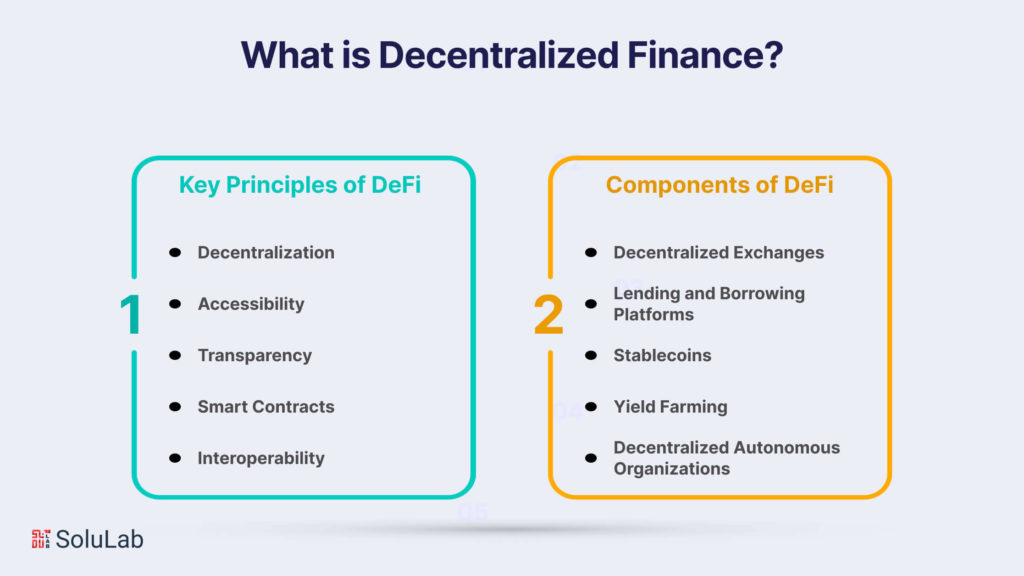
Key Principles of DeFi:

  • Decentralization:

DeFi platforms operate on decentralized networks, usually blockchain, where no single entity has control. This eliminates the need for intermediaries, fostering a more inclusive and transparent financial ecosystem.

  • Accessibility:

DeFi aims to make financial services accessible to anyone with an internet connection, thereby promoting financial inclusion globally. Users can access DeFi services without the constraints imposed by traditional banking systems.

  • Transparency:

The use of blockchain ensures transparency in transactions. Every transaction is recorded on a public ledger that can be audited and verified by anyone, enhancing trust and reducing the risk of fraud.

  • Smart Contracts:

Smart contracts, self-executing contracts with the terms directly written into code, play a pivotal role in DeFi. These programmable contracts automate and enforce the terms of agreements, reducing the need for intermediaries and minimizing the potential for disputes.

  • Interoperability:

DeFi protocols are designed in a way that they are interoperable, meaning they can easily interact and integrate with each other. This interoperability enhances the efficiency and flexibility of the decentralized financial ecosystem.

Components of DeFi:

  • Decentralized Exchanges (DEXs):

DEXs enable users to trade cryptocurrencies directly with one another without the need for a centralized exchange. Popular examples are Uniswap, SushiSwap, and PancakeSwap.

  • Lending and Borrowing Platforms:

DeFi platforms allow users to lend their cryptocurrencies and earn interest or borrow assets by providing collateral. Notable examples include Compound, Aave, and MakerDAO.

  • Stablecoins:

Stablecoins are cryptocurrencies pegged to the value of traditional fiat currencies, providing stability in a volatile market. USDC, DAI, and Tether (USDT) are popular examples.

  • Yield Farming:

Yield farming involves staking or lending cryptocurrencies to earn rewards, often in the form of additional tokens. This practice is prevalent in DeFi protocols seeking to attract liquidity.

  • Decentralized Autonomous Organizations (DAOs):

DAOs are entities governed by smart contracts and run by community members who hold tokens. They make collective decisions on the development and governance of the protocol.
Advantages of Decentralized Finance

Advantages of Decentralized Finance


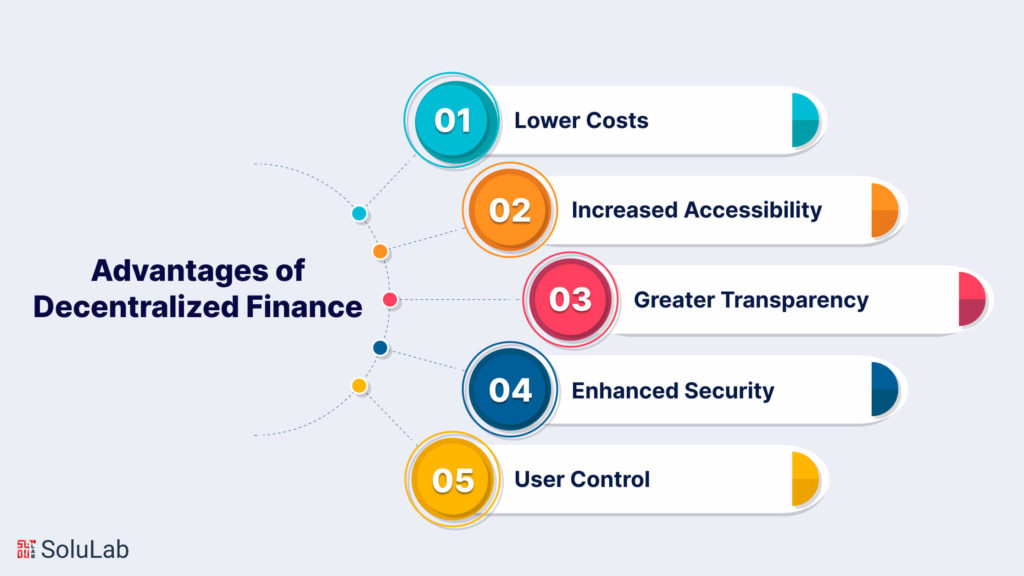
Decentralized finance (DeFi) is a rapidly growing ecosystem of financial applications built on blockchain technology. It offers a several advantages over traditional finance, including:

  • Lower Costs: DeFi eliminates intermediaries such as banks and brokerages, which can save users significant amounts of money on transaction fees. For example, a study by the Cambridge Centre for Alternative Finance found that DeFi users saved an average of 1.3% on fees compared to traditional exchanges in 2020. 
  • Increased Accessibility : DeFi is accessible to anyone with an internet connection, regardless of their location or financial status. This is in contrast to traditional finance, which can be difficult or impossible to access for people who are unbanked or underbanked.
  • Greater Transparency : DeFi transactions are recorded on a public blockchain, which makes them transparent to everyone. This authenticity can help to build trust and confidence in the system.
  • Enhanced Security : Blockchain technology is highly secure, which makes DeFi applications less vulnerable to fraud and hacking than traditional financial systems.
  • User Control: DeFi users retain control over their own funds and financial decisions. This is in contrast to traditional finance, where users often have to relinquish control of their funds to intermediaries.

In addition to these general advantages, DeFi also offers a number of specific benefits depending on the type of application being used. For example, DeFi lending platforms can offer borrowers lower interest rates than traditional lenders, while DeFi savings platforms can offer savers higher interest rates than traditional banks.

Here are some specific figures that illustrate the benefits of decentralized finance:

In 2020, the total value locked in (TVL) DeFi protocols reached over $14 billion. In 2021, the number of unique Ethereum addresses interacting with DeFi protocols increased by over 250%.

These figures show that DeFi is a rapidly growing and increasingly popular alternative to traditional finance. As the technology matures and more people become aware of its benefits, DeFi is likely to play an even greater role in the future of finance.

It is important to note that DeFi is still a relatively new technology, and there are some risks associated with using it. For example, DeFi applications can be subject to smart contract bugs, which can lead to the loss of funds. Additionally, the DeFi market is still relatively volatile, and the value of DeFi assets can fluctuate significantly.

However, the potential benefits of DeFi are significant, and it is a technology that is worth watching closely. DeFi has the potential to revolutionize the way we interact with money and financial services, and it could have a major impact on the global economy.
Benefits of DeFi in Web 3.0

Benefits of DeFi in Web 3.0


Decentralized finance (DeFi) and Web 3.0 are two closely intertwined concepts that are revolutionizing the way we interact with the internet and financial services. Web 3.0 is a vision for a more decentralized, democratized, and user-centric internet, while DeFi is a suite of financial applications that are built on blockchain technology to provide peer-to-peer financial transactions without the need for intermediaries such as banks or brokerages.

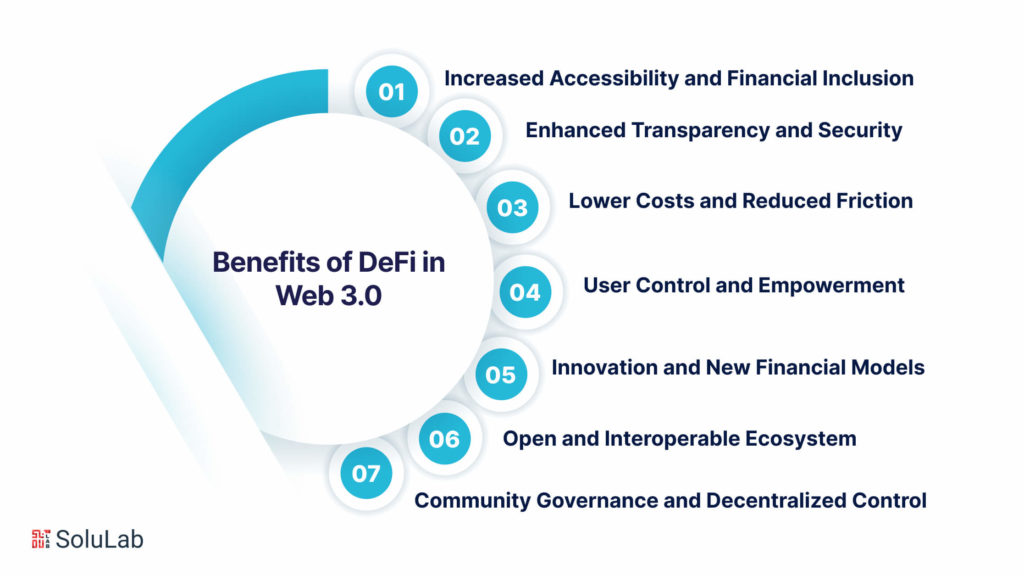
Here are some of the key benefits of DeFi in Web 3.0:

1. Increased Accessibility and Financial Inclusion: DeFi breaks down the barriers to financial inclusion by providing access to financial services to anyone with an internet connection. This is particularly beneficial for individuals and communities that have been underserved by traditional financial institutions.

2. Enhanced Transparency and Security: DeFi transactions are recorded on a public blockchain, making them transparent and traceable. This transparency promotes trust and accountability within the system. Additionally, blockchain technology provides a secure and tamper-proof environment for financial transactions, reducing the risk of fraud and manipulation.

3. Lower Costs and Reduced Friction: DeFi eliminates intermediaries, significantly reducing transaction fees and other costs associated with traditional financial services. This makes financial transactions more affordable and accessible to a wider audience.

4. User Control and Empowerment: DeFi users retain control over their own funds and financial decisions, empowering them to make informed choices about their finances. This contrasts with traditional finance, where users often have to relinquish control of their funds to intermediaries.

5. Innovation and New Financial Models: DeFi fosters innovation and the development of new financial models and services that are not possible in traditional finance. This openness encourages experimentation and the creation of novel solutions that cater to the needs of the Web 3.0 community.

6. Open and Interoperable Ecosystem: DeFi promotes an open and interoperable ecosystem where applications and protocols can interact seamlessly, enabling the creation of complex financial products and services. This open architecture fosters collaboration and innovation within the Web 3.0 space.

7. Community Governance and Decentralized Control: DeFi applications often incorporate governance mechanisms that allow users to participate in decision-making processes, promoting a decentralized and community-driven approach to financial governance. This decentralization aligns with the core principles of Web 3.0, empowering users to shape the future of the financial system.

Emerging Trends in Web 3.0 and DeFi

1. Cross-Platform Integration:

Trend: The future of Web 3.0 and DeFi is likely to witness increased cross-platform integration, allowing different decentralized applications (DApps) to work seamlessly together. This interconnectedness enhances the overall user experience by providing a more comprehensive suite of financial services.

Impact: Users can navigate a diverse range of financial activities seamlessly, promoting efficiency and expanding the scope of decentralized finance.

2. Enhanced Security Measures:

Trend: As the adoption of Web 3.0 and DeFi grows, there will be a heightened focus on enhancing security measures. Innovations in decentralized identity solutions and secure multi-party computation will mitigate risks associated with user data and transactions.

Impact: Improved security measures will instill greater confidence among users, fostering increased adoption of decentralized financial services.

The Role of AI and Machine Learning

1. Intelligent Automation in DeFi:

Trend: The integration of Artificial Intelligence (AI) and machine learning (ML) algorithms within DeFi platforms will become more prevalent. These technologies will enable intelligent automation for tasks such as risk assessment, market analysis, and smart contract execution.

Impact: DeFi users will benefit from more accurate predictions, automated decision-making processes, and improved risk management, making the financial web more robust and adaptive.

2. Personalized Financial Services:

Trend: AI and ML will play a pivotal role in tailoring financial services to individual user needs. Predictive analytics and personalized recommendations will be leveraged to offer customized investment strategies, lending terms, and other financial products.

Impact: Users will experience a more personalized and user-centric approach to finance, aligning with the overarching goal of Web 3.0 to prioritize individual empowerment.

Community Governance and Its Impact on the Financial Web

1. Maturation of DAOs:

Trend: Decentralized Autonomous Organizations (DAOs) will continue to evolve, becoming more sophisticated in their governance structures. DAOs will play a central role in decision-making processes related to protocol upgrades, project development, and resource allocation.

Impact: Enhanced DAO structures will lead to a more inclusive and democratic financial ecosystem, where users have a direct say in shaping the future of DeFi projects.

2. Regulatory Developments:

Trend: Community governance will extend beyond project-specific decisions to address broader regulatory concerns. DeFi communities will collaborate to establish industry standards and self-regulatory frameworks to navigate the evolving regulatory landscape.

Impact: This proactive approach to regulation will contribute to the legitimacy and long-term sustainability of decentralized finance, fostering greater trust among users and traditional financial institutions.

Web3 Development Services

Conclusion

The future outlook for Web 3.0 and Decentralized Finance is marked by dynamic trends and transformative technologies. The seamless integration of decentralized applications, advancements in AI and ML, and the maturation of community governance models will collectively shape a financial web that is more secure, personalized, and community-driven. 

As these trends unfold, the intersection of Web 3.0 and DeFi will continue to redefine the landscape of finance, offering users unprecedented opportunities for financial inclusion and empowerment. In the intersection of Web 3.0 and Decentralized Finance, we witness the dawn of a new era in the financial landscape. 

The shift towards decentralization, transparency, and user empowerment is reshaping how we perceive and engage with financial services. As the journey into Web 3.0 unfolds, the transformative power of decentralized finance will continue to redefine the contours of the financial web, paving the way for a more inclusive, efficient, and accessible global economy.

FAQs

1. What is Web 3.0, and how does it differ from previous versions?

Web 3.0 is the next evolutionary phase of the internet, characterized by increased decentralization, semantic understanding of data, and enhanced user experiences. Unlike Web 1.0 and Web 2.0, Web 3.0 leverages technologies like blockchain, AI, and the Internet of Things to create a more intelligent, decentralized, and interconnected web.

2. What sets Decentralized Finance (DeFi) apart from traditional finance?

DeFi operates on decentralized networks, typically blockchain, eliminating the need for intermediaries like banks. It provides open and accessible financial services to anyone with an internet connection, fostering global financial inclusion. Smart contracts automate transactions, reducing costs and increasing efficiency.

3. How does DeFi contribute to financial inclusion?

DeFi’s permissionless nature allows individuals without access to traditional banking services to participate in various financial activities, including lending, borrowing, and trading. It transcends geographical boundaries, providing financial services to the unbanked and underbanked on a global scale.

4. What role does blockchain play in DeFi?

Blockchain is fundamental to DeFi, providing a secure and transparent ledger for financial transactions. It ensures trust through decentralization, immutability, and transparency. Smart contracts, executed on blockchain platforms, automate and enforce financial agreements, reducing the need for intermediaries.

5. How can users benefit from DeFi’s smart contracts?

Smart contracts automate the execution of financial agreements, reducing the risk of human error and enhancing efficiency. Users can participate in various activities such as lending, borrowing, and trading with the assurance that smart contracts will execute transactions based on predefined rules.

6. What trends can we expect in the future of Web 3.0 and DeFi?

Emerging trends include increased cross-platform integration, enhanced security measures, and the integration of AI and machine learning in DeFi. The maturation of Decentralized Autonomous Organizations (DAOs) and proactive community governance in response to regulatory developments are also key trends shaping the future.

7. How does community governance work in DeFi?

Community governance in DeFi involves users having a direct say in decision-making processes related to project development, protocol upgrades, and resource allocation. Decentralized Autonomous Organizations (DAOs) play a central role in enabling community members to participate in shaping the future of DeFi projects.

Exploring Decentralized Finance (DeFi) in the Web3 Era

Exploring Decentralized Finance (DeFi) in the Web3 Era

The ever-evolving landscape of financial technology has seen the emergence of Decentralized Finance (DeFi) in the Web3 era. This groundbreaking shift combines the principles of decentralization, blockchain technology, and user-centric applications to redefine the way we perceive and engage with traditional financial systems. DeFi is a new financial system that is built on decentralized networks. This means that it is not controlled by any one entity, such as a government or bank. Instead, it is controlled by the people who use it. This makes DeFi more transparent and efficient than traditional financial systems.

DeFi applications are built on blockchain technology. This is a distributed ledger technology that allows for secure, transparent, and tamper-proof transactions. Blockchain technology is also what makes DeFi possible. DeFi applications are user-centric. This means that they are designed to be easy to use and understand. They are also designed to be accessible to everyone, regardless of their financial status.

DeFi has the potential to revolutionize the financial system. It can make financial services more accessible and affordable for everyone. It can also make the financial system more transparent and efficient. DeFi is still in its early stages of development. However, it has the potential to change the way we think about and use money.

Decentralized Finance (DeFi) in the Web3 Era

At the core of this evolution is the synergy between DeFi and Web3, representing the third era of the internet. Web3 emphasizes decentralization, user empowerment, and seamless interoperability. DeFi, nestled within Web3, embodies these principles, fostering a financial ecosystem that operates transparently, inclusively, and without the constraints of traditional intermediaries. DeFi is a new financial system that uses decentralized applications (dApps) to provide financial services without the need for traditional intermediaries such as banks and brokerages. DeFi dApps are built on top of blockchains, which are distributed ledgers that allow for secure, transparent, and tamper-proof transactions.

Web3 is a new version of the internet that is built on decentralized technologies such as blockchain. Web3 aims to give users more control over their data and to make the internet more open and accessible to everyone. The synergy between DeFi and Web3 has the potential to revolutionize the financial system. DeFi dApps can provide financial services that are more efficient, transparent, and accessible than traditional financial services. DeFi in Web3 can provide the infrastructure that DeFi dApps need to operate securely and efficiently.

Understanding Decentralized Finance (DeFi)

Decentralized Finance, or DeFi, refers to a paradigm shift in the traditional financial system. It leverages blockchain technology to create an open and permissionless financial ecosystem, enabling peer-to-peer transactions without the need for traditional intermediaries like banks. DeFi platforms aim to provide inclusive and accessible financial services to a global audience.

The core principle of DeFi is decentralization, meaning there is no central authority governing these financial systems. Smart contracts, which are self-executing contracts with the terms of the agreement directly written into code, play a central role in DeFi applications. This eliminates the need for intermediaries, reducing costs, and increasing transparency.

Evolution of DeFi in the Web3 Era

The DeFi in Web3 era marks a new phase in the development of the internet, characterized by decentralized protocols and user-centric applications. DeFi plays a pivotal role in this evolution, harnessing the power of blockchain and smart contracts to create a trustless and transparent financial infrastructure. The synergy between DeFi and Web3 technologies opens new possibilities for innovation and user empowerment.

As Web3 technologies advance, they bring about enhanced security, privacy, and user control. DeFi projects built on Web3 principles aim to provide users with full ownership of their assets and data, further aligning with the decentralized ethos.

CTA1

Significance of DeFi in the Current Financial Landscape

The significance of DeFi lies in its ability to democratize finance. Traditional financial systems often exclude large segments of the global population due to various barriers. DeFi, built on principles of decentralization and inclusivity, aims to address these shortcomings by providing financial services such as lending, borrowing, and trading in a permissionless and censorship-resistant manner.

In the context of Web3, where users are becoming more aware of their digital rights, DeFi aligns with the ethos of empowering individuals. It allows users to be in control of their financial activities without the need to rely on centralized entities. This shift has the potential to reshape the entire financial landscape, making it more accessible and equitable.

Core Concepts of Decentralized Finance

Core Concepts of Decentralized Finance

Delving into the core concepts of DeFi, we can unravel the intricate web of blockchain technology, smart contracts, and the role of digital assets within the DeFi framework. These foundational elements form the backbone of a decentralized financial landscape, facilitating trustless transactions, transparent processes, and novel financial instruments. Blockchain technology is a distributed ledger that records transactions in a secure and transparent manner. Smart contracts are self-executing contracts that are stored on the blockchain. Digital assets are assets that exist in digital form, such as cryptocurrencies and tokens.

DeFi uses these foundational elements to create a financial system that is not controlled by any central authority. This allows for trustless transactions, as there is no need for a third party to verify or approve transactions. DeFi also provides transparent processes, as all transactions are recorded on the blockchain. Finally, DeFi allows for the creation of novel financial instruments, such as decentralized exchange and lending platforms. DeFi is still in its early stages of development, but it has the potential to revolutionize the financial system.

  • Blockchain Technology in DeFi

Blockchain technology forms the backbone of decentralized finance. It serves as a distributed and immutable ledger, ensuring transparency and security in financial transactions. In the context of DeFi, blockchain enables the creation of smart contracts, which are self-executing contracts with predefined rules. These contracts automate various financial processes, including lending, borrowing, and trading, without the need for intermediaries.

  • Smart Contracts and Their Role

Smart contracts are the building blocks of DeFi applications. Coded to execute predefined conditions, smart contracts enable trustless and automated transactions. In DeFi in Web3, the synergy between DeFi and smart contracts becomes even more potent. Users can engage in financial activities with the assurance that the terms of the agreement will be executed precisely as coded, without reliance on centralized authorities.

  • Tokenization and Digital Assets in DeFi

Tokenization involves representing real-world assets as digital tokens on a blockchain. In the context of DeFi, this process is instrumental. Through tokenization, traditional assets like real estate or commodities can be represented as digital tokens, making them divisible and tradable on blockchain networks. This innovation enhances liquidity and accessibility, expanding the range of assets that can participate in Decentralized Finance Web3.

Key Components of the DeFi Ecosystem

A closer look at the key components of the decentralized finance (DeFi) ecosystem reveals the pivotal role played by decentralized exchange, automated market makers, and the integration of non-fungible tokens (NFTs). This dynamic ecosystem empowers users to trade directly, provide liquidity, and tokenize unique assets, amplifying the versatility and accessibility of financial services. Decentralized exchange (DEXs) allows users to trade cryptocurrencies without the need for a central authority. This is in contrast to centralized exchanges, which are typically operated by a single company or organization. DEXs are often seen as more secure and transparent than centralized exchanges, as they are not subject to the same risks of fraud or censorship.

Automated market makers (AMMs) are a type of DEX that uses algorithms to set prices for assets. This allows for more efficient trading than traditional order book-based exchanges. AMMs are also often seen as more secure than traditional exchanges, as they do not hold user funds on their own. Non-fungible tokens (NFTs) are digital assets that are unique and cannot be replicated. NFTs can be used to represent a wide variety of assets, including art, collectibles, and in-game items. NFTs are often traded on DEXs, and they can also be used to provide liquidity to AMMs.

  • Decentralized Exchanges (DEX)

decentralized exchange is a platform that facilitates the peer-to-peer trading of digital assets without the need for intermediaries. In a DEX, users retain control of their private keys and funds throughout the trading process, enhancing security. The integration of decentralized exchange within the DeFi ecosystem aligns with the overarching goal of removing central points of failure and providing users with full control over their assets.

  • Decentralized Lending and Borrowing Platforms

DeFi lending platforms enable users to lend their digital assets to others in exchange for interest or borrow assets by providing collateral. These platforms operate through smart contracts, automating the lending and borrowing processes. In the Web3 era, the decentralized nature of these platforms ensures that users have direct ownership and control over their funds, fostering trust in the lending and borrowing ecosystem.

  • Automated Market Makers (AMM) and Liquidity Pools

Automated Market Makers play a crucial role in decentralized exchange by providing liquidity through algorithmically determined pricing. Users can trade assets directly with smart contracts, and liquidity providers contribute assets to pools, earning fees in return. This innovative approach to liquidity, coupled with the decentralized nature of AMMs, enhances the efficiency and accessibility of trading within the DeFi ecosystem.

Challenges and Opportunities in DeFi

Challenges and Opportunities in DeFi

DeFi, like any other innovation, has its own set of challenges and opportunities. Regulatory considerations, security concerns, and the potential for financial inclusion and innovation all contribute to a complex landscape. Navigating this landscape requires a deep understanding of the complexities involved in order to create an environment that is conducive to responsible development. Regulatory considerations are one of the biggest challenges facing DeFi. DeFi protocols are often decentralized, which means that they are not subject to the same regulations as traditional financial institutions. This can make it difficult for DeFi protocols to comply with regulations, and it can also make it difficult for regulators to track and monitor DeFi activity.

Security concerns are another major challenge facing DeFi. DeFi protocols are often built on smart contracts, which are computer programs that run on blockchains. Smart contracts are not always secure, and there have been a number of high-profile cases of DeFi protocols being hacked. This has led to a loss of confidence in DeFi, and it has made it difficult for DeFi to attract mainstream adoption. Despite the challenges, DeFi also has the potential to revolutionize the financial system. DeFi protocols can provide financial services to people who are underserved by traditional financial institutions. DeFi can also be more efficient and less expensive than traditional financial institutions. If DeFi can overcome the challenges it faces, it has the potential to make a significant impact on the financial system.

  • Regulatory Landscape and Compliance

The decentralized nature of DeFi poses challenges in navigating regulatory landscapes. As governments and regulatory bodies grapple with the emergence of Decentralized Finance Web3, ensuring compliance becomes crucial. Striking a balance between the decentralized ethos of DeFi and regulatory requirements presents an ongoing challenge and an opportunity for the industry to mature responsibly.

  • Security Concerns in Decentralized Finance

Security is paramount in DeFi, given its reliance on smart contracts and blockchain technology. Instances of vulnerabilities and exploits have raised concerns. However, the dynamic nature of the DeFi exchanges also provides opportunities for continuous improvement. Innovations in security protocols and audits contribute to enhancing the robustness of DeFi applications.

  • Potential for Financial Inclusion and Innovation

One of the significant opportunities presented by DeFi is its potential to foster financial inclusion globally. By providing open and accessible financial services, DeFi has the capacity to reach the unbanked and underbanked populations. This aligns with the broader goals of Web3 technologies, which prioritize inclusivity and empowerment.

Real World Applications of DeFi

DeFi is not just a theoretical concept. It is already being used in real-world applications, such as traditional finance, cross-border transactions, and the tokenization of tangible assets. The adaptability of DeFi shows its potential to revolutionize industries, opening doors to new possibilities in realms ranging from traditional finance to healthcare. For example, DeFi can be used to create new financial products and services that are more efficient and accessible than traditional offerings. It can also be used to reduce costs and improve transparency in cross-border transactions. And, it can be used to tokenize tangible assets, such as real estate or gold, making them more easily tradable and accessible.

DeFi is still in its early stages of development, but it has the potential to change the way we think about finance and the way we do business. It is an exciting and innovative technology with the potential to make a real difference in the world. Navigating the DeFi landscape requires a keen understanding of the intricacies involved. DeFi protocols are complex, and it is important to understand the risks involved before investing in them. It is also important to stay up-to-date on the latest developments in DeFi, as the landscape is constantly changing.

  • DeFi in Traditional Finance

DeFi is not confined to the realm of digital assets. It has the potential to bridge the gap between traditional finance and Decentralized Finance Web3. Through tokenization and smart contracts, traditional assets can seamlessly integrate into DeFi applications, unlocking new avenues for investment and financial innovation.

  • Cross-Border Transactions and Remittances

The decentralized nature of blockchain and DeFi enables efficient and cost-effective cross-border transactions. Users can send and receive digital assets globally without the need for traditional banking infrastructure. This not only reduces transaction costs but also accelerates the speed of cross-border remittances.

  • Tokenization of Real Assets in DeFi

Real-world assets, such as real estate or art, can be tokenized and represented on blockchain networks. This opens up opportunities for fractional ownership, enabling a broader audience to invest in traditionally illiquid assets. DeFi facilitates the trading and transfer of these tokenized assets, unlocking liquidity in previously inaccessible markets.

Risks and Considerations for DeFi Participants

Risks and Considerations for DeFi Participants

Participation in DeFi comes with its own set of risks and considerations. From smart contract risks to market volatility, participants must navigate potential challenges with diligence. This section sheds light on the importance of due diligence, risk management, and the evolving nature of the DeFi landscape. Due diligence is the process of investigating a project or investment before participating in it. This includes researching the project’s team, its whitepaper, and its code. It is important to do your due diligence before participating in any DeFi project, as there have been cases of scams and fraud.

Risk management is another important consideration for DeFi participants. The DeFi market is volatile, and prices can fluctuate wildly. It is important to understand the risks involved before investing in any DeFi project. Finally, the DeFi landscape is constantly evolving. New projects are being launched all the time, and the landscape is constantly changing. It is important to stay up-to-date on the latest developments in DeFi in order to make informed decisions about where to invest.

  • Smart Contract Risks

While smart contracts automate processes in DeFi, they are not immune to risks. Vulnerabilities in smart contract code can lead to exploits and financial losses. Participants in the DeFi ecosystem must conduct thorough due diligence, including code audits and reviews, to mitigate the risks associated with smart contracts. The DeFi in Web3 era emphasizes the importance of community-driven audits and transparency in addressing these challenges.

  • Volatility and Market Risks

The decentralized nature of DeFi exposes participants to market volatility. Digital assets, subject to rapid price changes, can impact the value of collateral and influence lending and borrowing dynamics. Risk management strategies, such as diversification and decentralized stablecoins, become essential in navigating the dynamic DeFi landscape within the context of DeFi in Web3.

  • Importance of Due Diligence in DeFi Investments

Participating in DeFi requires a comprehensive understanding of the projects and platforms involved. Conducting due diligence on protocols, governance mechanisms, and the security posture of DeFi applications is critical. The DeFi in Web3 ethos encourages active community engagement, empowering participants to contribute to due diligence processes and collectively enhance the robustness of the DeFi ecosystem.

Future Trends and Innovations in DeFi

In the concluding segment, we take a look into the future of DeFi. Anticipated trends, including the integration with DeFi in Web3 technologies, the role of NFTs, and the potential for decentralized identity (DID) in finance, offer a glimpse into the ongoing narrative of innovation within the decentralized financial frontier.

DeFi is a rapidly evolving field, and it is difficult to predict exactly what the future holds. However, the trends discussed in this article suggest that DeFi has the potential to revolutionize the financial industry. By integrating with DeFi in Web3 technologies, DeFi can make it easier for people to access financial services and products. NFTs can be used to represent digital assets, which could be used to create new financial products and services. Decentralized identity could make it easier for people to control their own financial data.

  • Integration with Web3 Technologies

The integration of DeFi with Web3 technologies marks a significant trend. Web3, with its focus on decentralized and user-centric applications, aligns seamlessly with the ethos of Decentralized Finance Web3. The integration enhances user experiences, interoperability, and the overall sustainability of DeFi projects.

  • NFTs (Non-Fungible Tokens) in DeFi

Non-fungible tokens (NFTs), representing unique digital or real-world assets, are gaining traction in DeFi. NFTs introduce new dimensions to Decentralized Finance Web3 by enabling the inclusion of unique assets in lending, borrowing, and trading activities. The intersection of NFTs and DeFi presents innovative opportunities for creators, investors, and users alike.

  • The Role of Decentralized Identity (DID) in Finance

Decentralized Identity (DID) solutions contribute to the evolution of DeFi by enhancing user privacy, security, and accessibility. Users can have greater control over their identity information, reducing reliance on centralized authorities. The integration of DID in DeFi aligns with Web3 principles, emphasizing user empowerment and privacy.

CTA2

Conclusion

In conclusion, the exploration of Decentralized Finance (DeFi) within the Web3 era unravels a narrative that transcends the boundaries of traditional finance. This transformative journey navigates the intricacies of blockchain technology, smart contracts, and digital assets, weaving a tapestry of innovation that reshapes the financial landscape.

Navigating the DeFi ecosystem reveals key components that propel this financial revolution. decentralized exchange provides users with direct access to a variety of financial instruments, eliminating intermediaries and fostering a peer-to-peer ecosystem. Automated market makers and liquidity pools contribute to the fluidity of the market, enabling users to contribute and withdraw liquidity seamlessly. The integration of non-fungible tokens (NFTs) adds a layer of uniqueness and ownership to digital assets, expanding the scope of possibilities within DeFi.

In this narrative of innovation, SoluLab emerges as a key player, contributing significantly to the development and deployment of DeFi models. As a leading AI development company, SoluLab brings expertise, dedication, and a forward-thinking approach to the table. Whether businesses are exploring DeFi for creative endeavors or seeking innovative solutions, SoluLab’s role in this landscape is instrumental. The integration of DeFi in the Web3 era marks a significant milestone in the evolution of financial systems. The collaboration between decentralized principles, blockchain technology, and user-centric applications signifies not just a departure from traditional norms but a leap toward a future where financial empowerment is truly decentralized. The road ahead holds promises of innovation, challenges to be conquered, and a financial landscape where SoluLab continues to shine as a beacon of expertise and forward-thinking in the realm of Decentralized Finance Web3

Embarking on this journey has been a revelation—a testament to the resilience and adaptability of financial systems in the face of technological disruption. As we turn the page, let us carry the lessons learned and the visions glimpsed into the future, where Decentralized Finance in the DeFi in Web3 era becomes not just a concept but a lived reality for all.

FAQs 

1. What is decentralized finance?

Decentralized finance, often abbreviated as DeFi, refers to the ecosystem of financial applications and services built on blockchain technology. In a decentralized finance system, traditional financial intermediaries are replaced or augmented by smart contracts on blockchain platforms, promoting transparency, accessibility, and inclusivity.

2. How does DeFi align with Web3?

DeFi aligns with Web3 by embodying principles of decentralization, user empowerment, and interoperability. Web3, the third era of the internet, emphasizes decentralized protocols and user-centric applications. DeFi leverages blockchain and smart contracts to create a financial landscape that aligns with the ethos of Web3.

3. What role does a decentralized exchange play in DeFi?

A decentralized exchange (DEX) is a crucial component of DeFi, allowing users to trade digital assets directly without relying on centralized intermediaries. Defi DEX platforms facilitate peer-to-peer trading through smart contracts, enhancing security, reducing counterparty risk, and promoting a trustless environment within the DeFi ecosystem.

4. What are the key applications of DeFi?

DeFi applications are diverse and cover areas such as lending, borrowing, decentralized exchange, liquidity provision, and more. These applications provide financial services without traditional intermediaries, offering users access to a global and permissionless financial ecosystem.

5. How are NFTs integrated into DeFi?

Non-fungible tokens (NFTs) are integrated into DeFi by representing unique digital or real-world assets on blockchain networks. In the context of DeFi, NFTs can be used as collateral, traded on decentralized exchange, or utilized in various financial instruments. This integration adds a layer of uniqueness and innovation to DeFi protocols.

What is DeFi?

Decentralized Finance

As a means of offering financial services outside of the conventional banking system, decentralized finance is quickly gaining appeal. Decentralized Finance (DeFi) is a new world being shaped by the financial industry’s use of blockchain technology and the growth of decentralized financial services. This environment is defined by cheap transaction costs, secure transactions, worldwide accessibility to financial services, and the most recent DeFi developments dominating the industry.

Although there are a number of possible advantages to decentralized finance (DeFi), it’s crucial to be aware of the hazards before committing to anything. We will thus lead you through the fundamentals of decentralized finance, covering what it is, how it operates, and some of the main challenges you must be aware of before beginning, through our DeFi guide on decentralized finance development for businesses. 

So, let’s get started!

What is DeFi?

You must be wondering about what is decentralized finance or DeFi, in short. A financial system based on public blockchains is known as decentralized finance or DeFi. Open finance is made up of blockchain-based smart contracts, dApps (decentralized apps), digital assets, and protocols.

Most people are aware that Ethereum and Bitcoin are cryptocurrencies, but not many are aware that they are also open-source, large networks that let users create programs that facilitate financial transactions without the participation of centralized organizations.

Users may now engage with the Ethereum blockchain in a multitude of new ways that were previously impossible thanks to the advent of decentralized finance. Users may trade digital assets without utilizing a centralized exchange, receive interest on their cryptocurrency holdings, lend or borrow Ethereum-based assets, and more by using DeFi.

Offering consumers an alternative to the sometimes opaque and unreachable existing financial institutions is the goal of bringing about decentralized finance. DeFi aims to create a more inclusive financial system that benefits all users by improving the accessibility and usability of financial services.

What is DeFi Wallet?

A DeFi (Decentralized Finance) Wallet is a type of cryptocurrency wallet specifically designed to interact with decentralized finance applications and protocols.

In traditional finance, banks and financial institutions act as intermediaries to facilitate transactions and manage assets. DeFi aims to replace these intermediaries with decentralized protocols and smart contracts running on blockchain networks like Ethereum. DeFi applications include lending, borrowing, trading, yield farming, and more.

A Crypto DeFi Wallet allows users to securely store, send, and receive various cryptocurrencies and tokens, while also providing access to decentralized applications (DApps) and protocols within the DeFi ecosystem. These wallets typically offer features such as integration with decentralized exchanges (DEXs), staking, yield farming, and participation in liquidity pools.

Some popular DeFi Wallets include MetaMask, Trust Wallet, Coinbase Wallet, and Argent, among others. These wallets often provide users with greater control over their funds and financial activities, as well as opportunities to earn interest and rewards through various DeFi protocols.

How Does DeFi Work?

Financial services can be accessed through decentralized finance, eliminating the need for centralized middlemen. On the Ethereum blockchain, it makes use of smart contracts to facilitate peer-to-peer communication. A financial system requires two primary elements in order to function properly: the infrastructure required for operation and the currency required for operation.

  • Infrastructure: Writing decentralized applications is possible on Ethereum, a DeFi platform. Smart contracts, which define a set of requirements or guidelines by which an agreement can be established, can be created using Ethereum. A smart contract cannot be changed after it has been deployed.
  • Currency: Currency: A coin that can be used to communicate with every protocol available is required to build a safe, dependable decentralized finance system. Typically, DeFi’s currency is the DAI stablecoin. A decentralized stablecoin that is correlated with the US dollar is called DAI.

Comparing Decentralized and Traditional Finance

There are certain intrinsic decentralized distinctions between Decentralized Finance (DeFi) and fintech, even if DeFi is only an enhanced form of the finance system with the same fundamental functioning, which is lying in receiving and transferring money. that establishes blockchain app development services as a significant financial trend for the years 2021–2022, and beyond. So let’s continue to learn about the distinctions.

  • Institutions and staff do not oversee the operations of DeFi. In the DeFi context, smart contracts or coded algorithms do this function. DeFi apps operate automatically after a smart contract is put onto the blockchain; in traditional finance, financial processes are managed by middlemen like banks.
  • The ability of DeFi to use code transparency is one of the key characteristics that sets it apart from conventional banking applications. This gives everyone the ability to audit, which fosters user trust as everyone can comprehend the operation of the contract. Furthermore, because the transactions are pseudonymous, privacy concerns are never raised. However, since intermediaries oversee the monetary processes in conventional finance, security lapses are possible.
  • Another kind of blockchain application employed in the DeFi environment is called dApps development, and it is intended to function worldwide right from the start. The DeFi networks and services are accessible to everyone, regardless of where they live.In contrast, financial institutions’ services are limited to their local areas in the case of the traditional financial system. For example, you are limited to opening a bank account inside the nation in which the bank is located.
  • Applications for decentralized finance can be created and used by everyone. In contrast to modern finance, consumers engage with smart contracts directly via DeFi cryptocurrency wallets; there are no accounts or gatekeepers involved. 
  • The various DeFi products are combined to create the latest decentralized financial applications. For instance, new products may be created by combining prediction markets, stablecoins, and decentralized exchanges. On the other hand, each application in the old financial system is made specifically for a particular function.

Benefits of DeFi

Benefits of DeFi

Conventional banks are costly to operate and primarily administrative in nature. The lengthy transaction procedure has resulted in the exclusion of many people from the financial system due to its strict regulations. DeFi arrived to resolve a great deal of these problems. Here are a few of the primary benefits of DeFi:

  • Permission-less

Permissionlessness is one of the primary benefits of decentralized finance (DeFi). This implies that no one needs permission from a centralized authority in order to use DeFi applications and services. DeFi’s openness and accessibility—which let anybody with an internet connection join the vibrant ecosystem—are some of its key selling points.

Furthermore, because permission-less DeFi solutions are not susceptible to single points of failure, they are frequently safer than their centralized equivalents. They are therefore perfect for conducting financial transactions and holding value. Thus, one of the main draws for anyone interested in entering the decentralized financial space is the permissionless aspect of DeFi.

Related: Permissionless Blockchain

  • Cooperation

Developers may freely build upon established protocols, alter user interfaces, and include third-party apps with decentralized accounts. This kind of versatility is why DeFi conventions are sometimes referred to as “Money Legos.” It is possible to create new decentralized money apps by combining several DeFi products.

Stablecoins, for example, may be combined with decentralized trades and prediction markets to create an entirely new and far more advanced DeFi financial market in terms of scale and centers.

  • Transparency

DeFi facilitates a higher level of transparency and accessibility. Every activity is open to the public as the majority of DeFi protocols are built on the blockchain, a public ledger. Transactions are visible to all parties; but, unlike traditional banks, no individual is personally linked to these records.

All things looked at, the accounts merely post numerical addresses and are pseudo-anonymous. The majority of DeFi products are open source, thus users with programming knowledge may also examine or expand upon the source code. Because of local area connections, open-source programs are more secure and of higher quality than proprietary software.

  • Finance Control

Financial organizations have extensive control over how customers may utilize their money when they use traditional banking. If they believe there is fraudulent behavior, they have the authority to restrict the kinds of transactions that users may complete and to prevent access to their accounts.

On the other hand, people have greater control over their personal funds using decentralized financial solutions. Users may choose which assets to interact with and manage their own assets, for instance. This makes it harder for someone to take their money and enables them to conduct transactions directly with the parties involved. Decentralized finance, as a consequence, lets consumers avoid fraud and has greater control over their personal funds.

  • Possibility of Innovation

The DeFi ecosystem offers legitimate opportunities for innovation and the development of DeFi goods and services. DeFi is an open protocol that can be very helpful in creating financial solutions for a new era. Because it supports Ethereum and enables innovators to create new decentralized financial apps, the DeFi is becoming more and more significant.

Let’s continue to learn how to utilize DeFi and its practical uses now that you have an understanding of its benefits.

How is DeFi Used?

Before you begin utilizing DeFi, there are a few things you should be aware of.

  • Retrieve Your Wallet

You will require an Ethereum-compatible digital wallet in order to use DeFi. Users may safely keep thousands of NFTs and other cryptocurrencies in the wallet.

  • Purchase Related DeFi Cryptocurrency

You must buy a decentralized finance cryptocurrency asset, like ether, that is native to the Ethereum blockchain in order to communicate with DeFi. Considering your risk tolerance and investing objectives, pick the best option for you.

  • Link Your Digital Wallet to the Decentralized Marketplace

You may begin trading on a decentralized exchange as soon as you have a digital wallet and enough cryptocurrency for decentralized financing.

Use Cases of DeFi in Real-World

Every unbanked person on the planet might have their life completely changed by the increasing use of DeFi platforms and procedures. A few significant real-world use cases for DeFi are covered in this section.

  • Reducing Costs

The costs that international workers must pay on the remittance market front, where they transmit billions of dollars to their relatives overseas, are exorbitant. There is a chance that these expenses can be reduced by over 50% thanks to the developments in decentralized finance services. In addition to raising worker productivity, this promotes economic expansion.

  • Lending and Borrowing

The other difficult area that may be resolved by focusing on DeFi’s benefits is loans. Because of their poor credit history or absence of credit scores, the unbanked are now unable to obtain loans. By bringing lenders and borrowers together, the DeFi platforms do away with the need for credit checks. 

  • Finance for Assets

An extensive network that combines DeFi protocols and financial instruments has been established by the DeFi ecosystem, ranging from portals for lending and borrowing to stablecoins and tokenized BTC. DeFi developers have opened up a world of fresh opportunities for asset-decentralized finance and risk management by using irreversible smart contracts on Ethereum.

DeFi protocols have provided new means to obtain liquidity without relying on centralized exchanges, such as flash loans that are paid in a single transaction and the ability to collateralize loans using DeFi coins or digital assets.

  • Supply Chain Management

The term “DeFi” describes the transition from conventional, centralized financial institutions to peer-to-peer lending made possible by decentralized Ethereum blockchain systems. The supply chain management sector is already starting to see the effects of this paradigm-shifting movement, which presents a plethora of opportunities for improving inefficiencies and creating new channels for decentralized financing and untrustworthy collaboration.

By eliminating errors and adding transparency, blockchain technology is only preparing to handle more advanced DeFi platform use cases.

  • Yield Optimization

Applications for DeFi can be used to aggregate, stake, and maximize yields from interest-bearing investments, automating the process. Data analytics and optimization approaches are used in the process of yield optimization. In order to obtain the greatest rates on cryptocurrency transactions, computational approaches are applied in DeFi yield optimization.

Yield farming is another name for yield optimization. A smart contracts in DeFi manages the process of reinvesting your cryptocurrency winnings to help you get optimal returns through yield optimization.  

What Challenges Does DeFi Encounter?

DeFi Challenges 

Despite the fact that decentralized finance is a relatively new field that is always changing, there are certain drawbacks to DeFi. 

  • Poor Performance: The fundamental slowness of blockchain-based applications compared to their centralized counterparts has an impact on them. The designers of DeFi programs must take these limitations into account and then optimize their work.
  • High User Error Risk: DeFi programs give the user more accountability by removing the middlemen. For many people, this might be a drawback. When products are implemented on top of immutable blockchains, designing them to reduce the possibility of user mistakes presents a difficult task.
  • Inadequate User Experience: Currently, the user must put in more effort in order to use DeFi applications. In order for DeFi apps to become an essential part of the global financial system, they must provide a compelling reason for consumers to switch from the conventional system.
  • Cluttered Ecosystem: It might be challenging to locate the application that best suits a certain use case, thus users need to be able to recognize the best possibilities. Not only is it challenging to develop apps, but it’s also challenging to consider how such applications will integrate into the broader DeFi ecosystem.

What is the Future for DeFi Systems?

The newest digital product in an industry that has existed since the dawn of time is cryptocurrency. We are about to see the complete rebuilding of every financial service we currently utilize under the fiat scheme within the DeFi and open finance ecosystem.

Collateral is a key component of the initial generation of DeFi applications, which means that in order to borrow more DeFi cryptocurrency, you must first acquire a DeFi platform coin and then put it up as collateral.

The most recent versions of DeFi applications are also already causing a great deal of innovation in the insurance industry. Many of the DeFi loans that are made today are overcollateralized (the large asset cushion maintained in the reserve gives the loans an inherent sense of safety).

DeFi cryptocurrency wallets development have also shown signs of being the hub for all activity involving digital assets. Think of it as a dashboard that displays your assets as well as the amount that is restricted by various open finance protocols, such as loans, insurance policies, and pools. 

Additionally, a move toward decentralized decision-making and governance is evident. DeFi emphasizes the word “decentralized,” however the projects now have master keys that enable DeFi platform development suppliers to disable dapps in order to prevent instances of malicious code or to facilitate upgrades. On the other hand, the DeFi community is searching for methods to allow stakeholders to cast votes on choices, opening up a far larger set of DeFi use cases. 

Something new is occurring in the open financial system front: cryptocurrencies are creating money online and providing people methods to generate money on dapps. This is in response to all the rumors and proof of concepts around new DeFi possibilities that are being created and built. Every disruptive launch challenges our understanding of how money functions.

As observers, we find it fascinating that everyone with programming skills has the potential to shape the future of decentralized banking and money.

DeFi Development Services

The Bottom Line

Fintechs may get a competitive edge and open up new avenues for financial service delivery by implementing DeFi technology.

Fintechs may now provide their clients with more effective, transparent, and easily accessible solutions thanks to their use of DeFi. Fintech companies may offer cutting-edge financial services, automate procedures, cut expenses, and do away with middlemen by utilizing blockchain technology and smart contracts.

As a leading DeFi development company, SoluLab offers comprehensive solutions tailored to meet the diverse needs of clients seeking to leverage the potential of decentralized finance. With expertise in blockchain technology, smart contracts, and decentralized applications, SoluLab empowers businesses to build, deploy, and scale innovative DeFi solutions. Whether it’s creating decentralized exchanges, liquidity pools, lending platforms, or yield farming protocols, our team of experienced developers ensures the delivery of secure, scalable, and interoperable solutions. Partner with SoluLab to revolutionize your financial services with DeFi. Contact us today to discuss your project requirements and embark on a journey towards decentralized finance excellence.

FAQs

1.  What is DeFi (Decentralized Finance)?

DeFi, or Decentralized Finance, is the abbreviation for a group of blockchain-based financial services and apps. Unlike traditional finance, which relies on intermediaries like banks, DeFi aims to create an open and permissionless financial system, allowing individuals worldwide to access financial services without the need for intermediaries. These services include lending, borrowing, trading, asset management, and more, all executed through smart contracts on decentralized platforms.

2. How does DeFi differ from traditional finance?

DeFi differs from traditional finance in several key ways. Firstly, it operates on decentralized platforms, eliminating the need for intermediaries like banks. Secondly, DeFi applications are typically accessible to anyone with an internet connection, promoting financial inclusion. Additionally, DeFi protocols often offer greater transparency, security, and composability, enabling users to seamlessly interact with multiple applications and protocols.

3. What are the risks associated with DeFi?

While DeFi presents exciting opportunities, it also comes with risks that users should be aware of. These risks include smart contract vulnerabilities, impermanent loss in liquidity provision, market volatility, regulatory uncertainty, and the potential for hacks or exploits on decentralized platforms. It’s essential for users to conduct thorough research, understand the risks involved, and exercise caution when participating in DeFi activities.

4. How can I get started with DeFi?

To get started with DeFi, you’ll need a few basic tools and resources. First, you’ll need a cryptocurrency wallet that supports DeFi tokens, such as MetaMask or Trust Wallet. Next, familiarize yourself with decentralized exchanges (DEXs) like Uniswap or SushiSwap, where you can trade tokens directly from your wallet. You can also explore DeFi lending platforms like Compound or Aave to earn interest on your crypto assets. Remember to start with small amounts and gradually increase your involvement as you become more comfortable with the DeFi ecosystem.

5. How can SoluLab help with DeFi development?

SoluLab is a trusted DeFi development company with expertise in blockchain technology, smart contracts, and decentralized applications. Whether you’re looking to build a decentralized exchange, lending platform, yield farming protocol, or any other DeFi solution, SoluLab can provide comprehensive development services tailored to your specific requirements. With a team of dedicated developers and a proven track record of delivering high-quality projects, SoluLab is your ideal partner for navigating the complexities of decentralized finance. Contact us today to discuss your DeFi project and take the first step toward financial innovation.
