Talk to an Expert

Top 5 AI Developments of 2025 You Can’t Ignore for 2026

Top AI Developments You Can't Ignore

What if I told you that the way we use AI today will look completely outdated just a year from now?

Yes… You read that right!

Artificial Intelligence is evolving so rapidly that what was leading-edge in 2025 is already laying the groundwork for even bigger breakthroughs in 2026. From smarter AI agents and creative content generation to enterprise-scale automation and ethical frameworks, the shift is not just technological—it’s transformational.

In this blog, we’ll dive into the top 5 AI developments of 2025 that you absolutely can’t afford to ignore if you want to stay ahead in 2026. Whether you’re a business leader, a developer, or just curious about the future, these trends will give you a clear roadmap of where AI is heading next. Let’s get started!

Why 2025 is a turning point for AI?

2025: the year AI ceases to be a pilot project and becomes the default layer in products, workflows, and customer experiences. Several changes are converging:

  • Agentic AI is moving beyond chat to take actions across enterprise apps.
  • On-device & hybrid AI keep sensitive data local while tapping the cloud for heavy lifting—improving privacy, resilience, and latency.
  • Infrastructure jumps (e.g., next‑gen GPUs and application‑specific accelerators) are reducing training/inference expense while enabling multi‑model deployments.
  • AI‑native search and discovery are revolutionizing the way customers discover information and how marketers perform SEO.
  • Regulation and governance are coming of age, with firm deadlines that businesses have to comply with.

Why AI Developments of 2025 Matter for 2026?

AI is evolving at an exceptional pace. Innovations that emerged in 2025 are not just incremental improvements; they’re laying the foundation for transformative change in 2026.
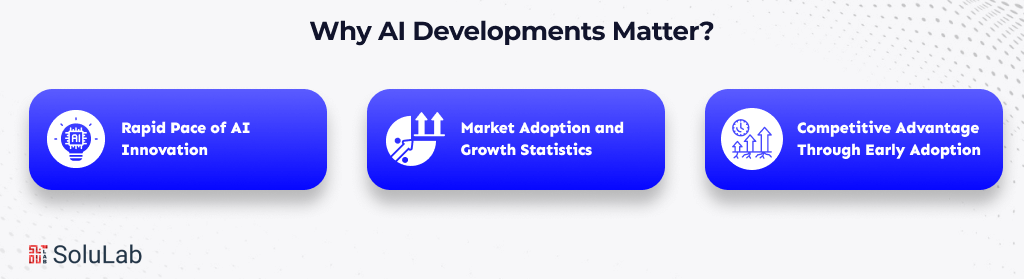
Why AI Developments Matter

1. Rapid Pace of AI Innovation

Every year, AI technologies become faster, smarter, and more capable. In 2025, we’ve seen breakthroughs in generative AI, AI-powered automation, and advanced predictive models that are already redefining industries. Staying updated with these trends ensures you’re prepared to leverage the next wave of innovation.

2. Market Adoption and Growth Statistics

The numbers speak for themselves: the AI market is projected to surpass $78 billion by 2030, with millions of active users adopting AI-driven solutions across sectors. Investments in AI startups reached $15 billion, reflecting the high confidence of investors and the rapid commercialization of AI technologies.

3. Competitive Advantage Through Early Adoption

Businesses that implement AI early gain a significant edge—from optimizing operations and reducing costs to creating innovative products and enhancing customer experiences. Understanding the trends of 2025 gives you the roadmap to leap ahead in 2026, rather than playing catch-up.

Top 5 AI Developments Every Business Should Know for 2026

#1. Agentic AI & Copilots

Agentic AI systems are goal‑driven AIs that are capable of planning, calling tools/APIs, and running multi‑step workflows with human approval. Suppose a “copilot” that doesn’t simply respond but accomplishes: writing content, submitting tickets, updating CRM, reconciling invoices, or choreographing a multi‑app workflow.

Example: GitHub Copilot and AI content copilots are becoming integral to workflows, saving time and boosting efficiency.

  • Enterprise copilots (e.g., in productivity suites and dev environments) are becoming the norm in addition to knowledge work and software delivery.
  • Domain-specific agents (finance, legal, HR, support, supply chain) support high-leverage, repeatable processes with well‑defined guardrails.
  • Human‑in‑the‑loop checkpoints and policy‑aware prompts maintain actions auditable and compliant.

Automation & productivity benefits

  • Time gain on repetitive activities (document preparation, QA, tagging, ticket triage).
  • Increased throughput in sales ops, customer success, and back‑office processing.
  • Decision support through retrieval‑augmented generation (RAG) and tool utilization.
  • Quality & consistency through templates, style guides, and action policies built into the agent.

Quick win concepts: Agentic knowledge base that responds with citations; auto‑triage and resolution through service‑desk bots; meeting‑to‑task pipelines; code review bots; finance close checklists.

#2. On‑Device & Hybrid AI

On-device AI delivers contextual intelligence to phones, laptops, and IoT endpoints—less network dependence and more privacy‑sensitive use cases unlocked. Hybrid AI solutions blend edge models for real‑time workloads with cloud models for more intensive reasoning, fine‑tuning, or batch analytics.

Example: AI-powered cameras, smart home devices, and personal assistants.

Why enterprises care:

  • Privacy & residency: Sensitive data never leaves the device (PII, PHI, financial).
  • Latency: Millisecond‑level responses for assistive UX, industrial control, or AR.
  • Cost control: Push frequent, lightweight inference to devices to save cloud expense.
  • Resilience: Applications remain functional while the network is interrupted.

Design pattern: Localize small, efficient models for summarization, intent detection, speech, and classification; escalate to more expansive cloud models for challenging reasoning or cross‑org retrieval; selectively sync with policy‑based data pipelines.

#3. AI Infrastructure Expansion

Training frontier models and serving multi‑tenant inference demand require massively parallel computers. The 2025 stack includes next‑gen GPUs and domain‑specific accelerators, increased memory bandwidth, reduced‑latency interconnects, and inference‑optimized instances.

Example: Healthcare diagnostics, real-time recommendation engines, and enterprise automation.

Business implications:

  • Faster, less expensive training & fine‑tuning—executable even for mid‑sized companies through managed services.
  • Larger context windows & multi‑modal capabilities become feasible at scale.
  • Multi‑model routing (pick the best model per task) reduces cost without sacrificing quality.

Enterprise takeaway: When the cost curve turns, projects that were “too costly” in 2024 tend to work in 2025—particularly with mixture-of-models and caching.

AI Development Company

#4. AI‑Native Search

Search is evolving from ten blue links to AI-generated answers, multi-turn refinement, and contextual shopping. For businesses, that implies SEO tactics will need to change to supply structured, high-trust content to AI overviews and other aggregators.

Example: AI search engines and platforms are making it easier to sift through massive datasets in real time

Effect on SEO & customer discovery:

  • E‑E‑A‑T signals (expertise, experience, author identity, citations) are paramount.
  • Structured data (schema.org, product feeds, FAQs) makes eligibility for AI summaries.
  • Content for question answering and task fulfillment attracts higher visibility.
  • First‑party data & communities become more important as organic traffic trends shift.

Practical actions today: Aggregate topical authority pages, have strong FAQs with citations, include product & review schema, post concise how‑to workflows, and measure attribution beyond last‑click.

#5. Model Ecosystem & Open Source

Model variety is plentiful, with proprietary frontier models for high‑end reasoning and open‑source models for economically priced, private use cases. Multi‑modal is the norm (text, code, image, audio, sometimes video). Long context + tool application + function invocation are table stakes.

Examples: Frameworks like Hugging Face Transformers, open-source diffusion models, and collaborative AI toolkits

How to select for business purposes:

  • Task complexity: For high‑stakes reasoning or complicated planning, go with top‑end proprietary models; for ordinary classification/summarization, open models are usually good enough.
  • Data sensitivity & residency: Favor on‑prem or VPC‑hosted open models where data should not exit your environment.
  • Latency & cost: Small, concentrated models are best for high‑volume, low‑complexity tasks.
  • Ecosystem fit: Verify SDKs, connectors, and MLOps support.
  • Benchmark on your data: Conduct head‑to‑head tests on representative tasks before committing.

Emerging Technologies Complementing AI Solutions

AI no longer operates in isolation. Its full potential is revealed when combined with other emerging technologies that provide data, speed, security, and connectivity. How the integration works:

1. Internet of Things (IoT) for Smart Environments

  • IoT devices generate vast amounts of real-time data from homes, offices, factories, and cities.
  • When AI analyzes this data, it enables smart automation, predictive maintenance, energy optimization, and personalized experiences.

Example: Smart factories using AI + IoT can predict equipment failures, optimize production, and reduce downtime, driving operational efficiency.

2. Blockchain for Secure & Transparent Data Handling

  • Blockchain provides immutable, decentralized, and tamper-proof data storage, which is critical for AI systems that rely on accurate and trustworthy datasets.
  • Combining AI with blockchain ensures secure decision-making, transparent audit trails, and enhanced trust across industries like finance, supply chain, and healthcare.

Example: AI-driven financial platforms use blockchain to validate transactions and detect fraud in real time.

3. 5G & Edge Computing for Faster, Decentralized Processing

  • 5G networks drastically reduce latency, enabling AI systems to process massive data streams in real time.
  • Edge computing moves AI processing closer to the data source (IoT devices, sensors), reducing dependency on centralized servers and cloud networks.

Example: Autonomous vehicles leverage AI + 5G + edge computing to make split-second decisions for safety and navigation.

Contact Us

Conclusion

The AI developments of 2025—Agentic AI, On‑Device & Hybrid AI, AI Infrastructure Expansion, AI‑Native Search, and Open-Source Model Ecosystems—are more than just technological trends. They are shaping the future of business, innovation, and everyday life.

To stay ahead in 2026, businesses need to embrace these innovations strategically, integrating AI into workflows, products, and services before competitors do. SoluLab, a leading AI development company, helps businesses build custom AI solutions tailored to their industry and goals.

Whether you’re a startup, SME, or enterprise, SoluLab ensures your business is ready for the AI-driven future of 2026 and beyond. Contact us to start now!

FAQs 

1. How does AI infrastructure expansion impact businesses?

Improved AI infrastructure—including cloud platforms, specialized GPUs, and scalable hardware—enables businesses to deploy larger, faster, and more efficient AI models, driving innovation across industries.

2. What industries can benefit most from these AI developments?

These AI trends impact healthcare, finance, manufacturing, education, marketing, and logistics, among others, helping companies innovate, automate, and optimize processes.

3. Why is it critical for businesses to adopt AI now for 2026?

AI is evolving rapidly, and early adoption allows businesses to gain a competitive edge. It optimizes operations and enhances customer experiences.

4. How long does it take to implement AI solutions in a business?

Implementation timelines vary based on complexity, but with a structured roadmap, AI solutions can be deployed in weeks to a few months, depending on the scope and integrations required.

5. How can SoluLab help businesses leverage AI trends?

SoluLab provides end-to-end AI development services, including consulting, custom solution development, integration with IoT/blockchain/5G, and post-deployment support. We help businesses adopt AI efficiently and stay competitive in 2026.

Top Artificial Intelligence (AI) Trends for 2024

Top Artificial Intelligence Trends

In the year 2024, the trajectory of artificial intelligence (AI) and its trends are set to persist in its transformative trajectory, intricately integrating into our daily routines, influencing diverse sectors, and instigating regulatory shifts. Concurrently, positions in the field of Artificial Intelligence (AI) have emerged as one of the swiftly expanding sectors on a global scale—a foreseeable outcome amidst the ongoing AI revolution. Across the spectrum, from burgeoning startups to colossal Fortune 500 enterprises, entities are actively leveraging the capabilities of AI to optimize their operational frameworks. Additionally, the assimilation of AI into everyday life has experienced a notable upswing.

As we stand at the threshold of 2024, the realm of AI continues to unfold, presenting a tapestry of advancements that promise to reshape industries, redefine user experiences, and challenge the boundaries of what we thought possible.

In this blog, we will explore top artificial intelligence trends for 2024. From personalized user experiences and ethical considerations in AI development to the synergy between quantum computing and artificial intelligence, we embark on a journey through the modern technologies and paradigms that will shape the narrative of AI this year.

So, without any further ado, let’s get started!

Brief Overview of the Current State of AI Technology

In the fast-paced realm of artificial intelligence (AI), the landscape is constantly evolving, ushering in new possibilities and reshaping existing paradigms. As we step into 2024, it becomes imperative to take stock of the current state of AI technology, gauging the strides made and anticipating the transformative trends that lie ahead.

AI, once confined to the realms of science fiction, has now become an integral part of our daily lives. Machine learning algorithms, neural networks, and sophisticated data analytics are driving innovations across industries, from healthcare and finance to entertainment and education. The capabilities of AI have expanded exponentially, enabling tasks that were once deemed impossible.

AI Development Services

Importance of Staying Updated on AI Trends

The dynamism inherent in the field of AI necessitates a proactive approach to staying informed about emerging trends. Businesses, researchers, and enthusiasts alike must keep pace with the rapid advancements to harness the full potential of AI for their respective endeavors. Understanding the latest trends not only facilitates technological adoption but also empowers decision-makers to make informed choices about integrating AI solutions into their operations.

Moreover, the intersection of AI with ethical considerations, privacy concerns, and societal impacts underscores the importance of responsible AI development. Staying updated on AI trends is not merely a strategic advantage but a responsible commitment to navigating the evolving ethical landscape that accompanies the progress of artificial intelligence.

Top 10 AI Trends to Watch Out in 2024

Top 10 AI Trends to Watch Out

1. The Next Wave in AI Evolution

As we embark on the journey into 2024, the landscape of Generative AI is poised for a groundbreaking transformation, transcending the current epitome represented by advancements like ChatGPT. The imminent emergence of a new generation, often referred to as Gen AI, promises to redefine the boundaries of AI capabilities, eclipsing conventional chatbots and image generators.

Anticipated as a top AI trend for 2024, Gen AI is set to be a multimodal powerhouse, proficient in comprehending and processing a diverse array of inputs, spanning text, voice, images, and even musical compositions. This revolutionary breed of AI will possess the unique ability to simultaneously generate various forms of content. Imagine crafting an article seamlessly paired with a relevant image or designing a stage play backdrop while effortlessly generating scripts in multiple languages. These augmented capabilities herald a new era of creative possibilities, offering users comprehensive and immersive experiences.

2. Tailored AI Models Revolutionizing Every Industry

In the artificial intelligence trends, the foundational models, crucial for the next wave of AI applications, are expected to witness continual growth in both size and capability. However, the expansion of these models comes at a steep cost for training, potentially making initial trial runs financially burdensome. Fortunately, a solution is emerging from the open-source community focusing on extensive language models (ELMs). Some are developing trial iterations of cutting-edge AI projects utilizing smaller ELMs. Customizing these compact language models to align with specific businesses or industries presents a more cost-effective alternative. Even developers of powerful closed-off models are now offering bespoke generative pre-trained transformers (GPT).

These advancements are propelling businesses towards the adoption of personalized enterprise models. The delicate balance between performance and privacy will play a pivotal role in determining model selection. As we delve into the top 10 artificial intelligence trends of 2024, the discourse surrounding open-source versus closed-source extensive language models is expected to intensify.

3. The Arrival of Artificial General Intelligence (AGI)

The year 2024 may witness the realization of Artificial General Intelligence (AGI), a form of intelligence capable of executing cognitive tasks currently exclusive to humans. Various organizations are actively engaged in endeavors to create technology that could surpass human intelligence. While the development is still in progress, the advent of AGI is poised to bring unprecedented power and introduce novel capabilities. 

The pivotal aspect of AGI is its generality, requiring the ability to perform a broad spectrum of intellectual tasks. AGI holds the potential to significantly contribute to the global economy, propel advancements in scientific exploration, and redefine the limits of achievable feats.

4. AI Transforming Software Development in 2024

The landscape of software development is evolving rapidly, with AI playing a pivotal role in enhancing not only the end-user experience but also the efficiency of developers. Many of us have experienced the impact of AI-powered features in applications, such as ChatGPT providing comprehensive information or other tools generating creative visuals and assisting in crafting engaging content.

As we delve into the top 10 trends in artificial intelligence, 2024 is poised to mark a significant milestone in the software development industry. AI is set to empower not just the users but also the developers themselves. Platforms like GitHub are at the forefront, enabling developers to harness the capabilities of AI to streamline the coding process. This evolution allows developers to spend less time on coding intricacies and more time creating software solutions tailored to meet the needs of customers.

5. The Need for Robust Data Security

As the adoption of AI technology continues to surge, the imperative for robust data security management experiences a parallel escalation. The utilization of AI in cybersecurity has become indispensable, addressing the burgeoning need effectively. AI-powered cybersecurity solutions are adept at detecting unfamiliar threats, real-time identification and mitigation of vulnerabilities, proactive response to security risks, and an array of other crucial functions. 

Businesses are increasingly turning to advanced threat detection solutions driven by AI to fortify the protection of customer data and confidential business information. With both enterprises and individuals relying on AI-powered security solutions to safeguard sensitive data, the pivotal role of AI in securing data and IT infrastructure is set to be mission-critical in 2024 and beyond.

6. Augmented Work Processes

In artificial intelligence trends set to dominate 2024, a pivotal focus revolves around leveraging AI to enhance and optimize various work processes. AI has the transformative potential to elevate human capabilities by expediting tasks, increasing efficiency, and bolstering safety measures across diverse industries. From content summarization and research tasks to document drafting, code generation, and even aiding in medical diagnoses, AI is positioned to play a multifaceted role in augmenting work functions.

A distinctive aspect of this trend is the customization of specialized AIs or intelligent virtual assistants tailored for specific industries. Whether in law, medicine, or software development, the integration of industry-specific AI solutions transforms these technologies into indispensable assistants. This approach not only opens up avenues for businesses to embrace tailored AI solutions but also aligns seamlessly with the overarching trend of enhancing work processes through the strategic application of artificial intelligence. As we navigate through the top AI trends for 2024, the augmentation of work processes emerges as a key driver of innovation and efficiency across diverse sectors.

7. The Emergence of Autonomous Vehicles and Intelligent Transport Systems

The integration of artificial intelligence into autonomous vehicles and Intelligent Transport Systems (ITS) represents a pioneering trend in the field of AI. Autonomous vehicles, equipped with sophisticated AI algorithms and sensor technologies, are revolutionizing the automotive industry by offering improved safety, increased efficiency, and optimized traffic management. Simultaneously, Intelligent Transport Systems leverage AI to create a holistic ecosystem that enhances transportation efficiency, contributing to the development of smart cities. These systems analyze vast datasets from various sources to streamline traffic flow, reduce congestion, and promote sustainable mobility solutions, marking a transformative shift in how we perceive and engage with transportation.

While the impact of AI in autonomous vehicles and ITS is profound, challenges such as regulatory frameworks, ethical considerations, and cybersecurity concerns must be addressed for widespread adoption. Despite these challenges, the continuous innovation driven by the integration of AI is reshaping the future of transportation, promising a landscape where intelligent mobility solutions play a central role in creating safer, more efficient, and environmentally conscious transportation networks.

8. Sustainable AI for Environmental Solutions

A burgeoning trend at the forefront of technological innovation is the rise of Sustainable AI, a paradigm that harnesses the power of artificial intelligence to address pressing issues in energy conservation and environmental sustainability. In the face of escalating climate change concerns, AI emerges as a transformative force, presenting novel solutions for energy efficiency, resource utilization, and pollution mitigation. 

The application of AI extends across diverse domains, ranging from optimizing the distribution of renewable energy to monitoring and mitigating carbon footprints, as well as revolutionizing waste management through intelligent sorting and recycling processes. This integration of AI into energy and environmental strategies marks a crucial stride towards sustainable development, offering not only ecological benefits but also unlocking new avenues for business growth and innovation.

Related: Geospatial AI

9. AI-Powered Personalization for Exceptional Customer Experiences

As AI trends set to dominate in 2024, a standout phenomenon is the extensive application of artificial intelligence to revolutionize customer experiences through unparalleled personalization. Advanced AI-driven recommendation technologies are increasingly proficient in analyzing vast datasets, and discerning intricate details of customer preferences, behaviors, and requirements. 

This newfound capability empowers businesses to deliver highly personalized products, services, and interactions, manifesting in tailored content recommendations on streaming platforms, individualized shopping experiences in e-commerce, and customized marketing messages. The profound level of personalization not only elevates the overall customer experience but also acts as a catalyst for heightened engagement, unwavering loyalty, and amplified revenue streams for businesses.

10. AI-Powered Cybersecurity for Seamless Experience

Last but not least frontier of the top 10 Artificial Intelligence trends is marked by the pervasive integration of artificial intelligence into cybersecurity measures. The sophisticated capabilities of AI are increasingly leveraged to bolster digital defenses, offering proactive and adaptive solutions to combat evolving cyber threats. AI-driven cybersecurity operates on multiple fronts, employing machine learning algorithms to analyze vast datasets, identify patterns, and detect anomalies in real time. This dynamic approach enables organizations to fortify their security posture, promptly addressing vulnerabilities and mitigating risks before they escalate.

The transformative impact of AI in cybersecurity extends beyond conventional threat detection, encompassing predictive analysis, automated response mechanisms, and behavioral analysis to discern abnormal activities. These AI-powered systems not only enhance the speed and accuracy of threat identification but also provide a proactive defense mechanism, staying one step ahead of cyber adversaries. As the threat landscape becomes more sophisticated, AI-powered cybersecurity emerges as a crucial trend, offering a resilient shield against the ever-evolving spectrum of cyber risks and ensuring the integrity of digital ecosystems.

Regulatory Landscape and Challenges

Regulatory Landscape and Challenges

With respect to artificial intelligence trends for 2024, the regulatory framework is undergoing significant evolution to keep pace with technological developments. Governments worldwide are actively shaping policies to govern AI, focusing on ethical considerations, data protection, and risk assessment. The year 2024 sees an increasing trend of international collaboration, with organizations like the United Nations and the OECD facilitating dialogues to establish unified AI standards. This collaboration aims to standardize ethical guidelines, address cross-border data governance challenges, and encourage knowledge-sharing among nations. Concurrently, addressing ethical concerns is a top priority, emphasizing responsible AI development through mechanisms such as transparency, fairness, and accountability. Public awareness and education initiatives are also gaining traction to bridge the gap between technological advancements and societal understanding, ensuring a harmonious integration of AI into various sectors while navigating the regulatory challenges ahead.

A. Evolving Regulatory Frameworks

1. Government Initiatives in AI Governance

In 2024, governments worldwide are recognizing the critical need for robust regulatory frameworks to govern the ever-expanding realm of artificial intelligence. Nations are actively formulating policies and regulations to ensure responsible AI development and deployment. Initiatives are underway to establish guidelines that balance innovation with ethical considerations, fostering an environment conducive to the growth of AI technologies.

Government bodies are focusing on:

  • Ethical Guidelines: Crafting ethical frameworks to guide AI research and development, addressing concerns related to bias, transparency, and accountability.
  • Data Protection: Formulating regulations to safeguard user privacy and ensure responsible data usage in AI applications.
  • Risk Assessment: Developing methodologies to assess and mitigate potential risks associated with advanced AI systems.

2. International Collaboration for AI Standards

Recognizing the global nature of AI development, there is a growing trend towards international collaboration to establish unified standards. Organizations, such as the United Nations and the OECD, are facilitating dialogue and cooperation among nations to create a harmonized approach to AI governance. Collaborative efforts aim to:

  • Standardize Ethical Guidelines: Establish a set of universally accepted ethical principles to guide AI development globally.
  • Cross-Border Data Governance: Address challenges related to data flow across borders, ensuring data protection and privacy compliance on an international scale.
  • Knowledge Sharing: Encourage the exchange of best practices and knowledge-sharing among nations to collectively tackle challenges and harness the benefits of AI.

B. Addressing Ethical Concerns

1. Responsible AI Development

Ethical considerations are at the forefront of discussions surrounding AI trends in 2024. The emphasis on responsible AI development is crucial to building trust among users and stakeholders. Key components of this initiative include:

  • Explainability and Transparency: Implementing mechanisms to make AI systems more understandable and transparent, reducing the “black box” nature of certain algorithms.
  • Fairness and Bias Mitigation: Integrating strategies to identify and rectify biases in AI models, ensuring fair and equitable outcomes across diverse user groups.
  • Accountability Mechanisms: Establishing frameworks to attribute responsibility in the event of AI-related issues or failures, fostering accountability in the development and deployment process.

2. Public Awareness and Education

As AI becomes more integrated into daily life, there is a pressing need to enhance public awareness and understanding of its capabilities and limitations. Governments, along with industry stakeholders, are focusing on:

  • Educational Programs: Implementing initiatives to educate the public about AI, its potential benefits, and the ethical considerations associated with its use.
  • Media and Communication Strategies: Promoting accurate and accessible information about AI through various media channels to dispel myths and address misconceptions.
  • Community Engagement: Involving communities in discussions about AI to gather diverse perspectives and ensure that the technology aligns with societal values and expectations.

As the regulatory landscape evolves, these efforts aim to strike a delicate balance, fostering innovation while safeguarding against potential risks and ethical concerns in the dynamic landscape of AI trends for 2024.

Hire AI Developers

Final Words

In wrapping up our exploration of the top 10 trends in artificial intelligence for 2024, it is evident that the AI landscape is poised for groundbreaking transformations. The dynamic synergy between evolving regulatory frameworks, international collaboration, and a steadfast commitment to responsible AI development underscores the pivotal role of ethics in guiding innovation. As we navigate this era of personalized healthcare, autonomous industries, and immersive human-computer interactions, the convergence of cutting-edge technology and conscientious governance is reshaping the future. Embracing the potential of AI in this landscape requires a keen understanding of evolving trends, and by staying informed, we can collectively harness the transformative power of artificial intelligence for the benefit of societies worldwide.

Looking to leverage the power of AI in your endeavors? SoluLab- an AI development company stands as a leading force in driving AI innovation, providing modern AI consulting services to meet the demands of the evolving technological landscape. Our expertise extends across various AI applications, from healthcare and business to education and beyond. If you’re ready to embark on a transformative journey with AI, explore how SoluLab can tailor solutions to your specific needs. Visit our website or contact us today to embark on a path of AI-driven success.

FAQs

1. What are the key trends shaping the field of Artificial Intelligence in 2024?

The top AI trends for 2024 encompass a diverse range of innovations, including personalized medicine, autonomous processes in industries, enhanced cybersecurity measures, AI integration in education, and sustainable environmental applications. These trends collectively represent the cutting-edge developments defining the AI landscape for the year.

2. What is the role of international collaboration in shaping AI standards?

In 2024, international collaboration is on the rise, with organizations like the United Nations and the OECD fostering dialogue among nations to create unified AI standards. This collaborative effort aims to standardize ethical guidelines, address cross-border data governance challenges, and encourage the exchange of best practices to navigate the global AI landscape.

3. How are governments addressing ethical concerns in AI development?

Governments are prioritizing responsible AI development by implementing mechanisms for transparency, fairness, and accountability. Efforts include making AI systems more understandable, identifying and rectifying biases, and establishing frameworks to attribute responsibility in the event of AI-related issues or failures.

4. What initiatives are in place to enhance public awareness and education about AI?

Public awareness and education initiatives are gaining traction, aiming to bridge the gap between technological advancements and societal understanding. Educational programs, media and communication strategies, and community engagement are being implemented to ensure that the public is informed about AI, its benefits, and the ethical considerations associated with its use.

5. How does SoluLab contribute to the AI landscape?

SoluLab stands as a leading force in driving AI innovation, providing innovative solutions tailored to meet the demands of the evolving technological landscape. With expertise across various AI applications, SoluLab’s AI developers offer transformative solutions for industries such as healthcare, business, and education. Explore how SoluLab can help you leverage the power of AI to achieve your goals by visiting our website or reaching out to us directly.
