Talk to an Expert

How to build your own NFT Marketplace on Solana?

NFT Marketplace on Solana

As reported by Delphi Digital, a crypto research platform, Solana’s market share within the NFT market has experienced significant growth, expanding from 6% to 14% in less than a year. This claim aligns with the data provided by Cryptoslam, an aggregator in the NFT space.

The Ethereum blockchain claimed 81% of the NFT sales volume, down 5% from 86% in 2022. While Solana possessed 14% of the total NFT sales volume, the next highest is tied between Immutable X, Cardano, Polygon, Flow, and BNB, each with only 1% of the NFT sales volume from February 2022 to February 2023.

Fundamentals Of NFTs

By exploring the value of non-fungible tokens, you can uncover the answer to “Why should I create NFTs on Solana?” NFTs, or non-fungible tokens, are unique crypto assets with distinct on-chain signatures. These represent various digital assets, including digital art, certificates, virtual collectibles, online tickets, and proof of ownership on blockchain networks.

The true value of Solana NFTs lies in their ability to verify the uniqueness of a specific asset through cryptographic proof. Before embarking on Solana NFT projects, it is vital to understand that NFTs come in various forms, such as MP3s, PDFs, JPEGs, MP4s, and PNGs. However, while these files serve as tangible aspects of NFTs, they can be copied like any other digital file.

When utilizing the Solana NFT maker tool, you are essentially minting NFTs or storing NFT metadata with unique cryptographic identifiers on the blockchain. Creating an NFT requires an on-chain transaction, and the details included in the NFT metadata will vary based on the type of NFT standard.

What Is An NFT Marketplace?

In digital asset exchange, Sol NFT marketplaces share similarities with e-commerce platforms, enabling the trade of various items. However, the distinction lies in the nature of the goods being traded. While e-commerce platforms facilitate the buying and selling of physical goods, Sol NFT marketplaces focus solely on digital assets known as NFTs.

To cater to the unique requirements of NFT trading, developers of NFT marketplaces integrate a range of globally accepted and recommended features. These features are designed to ensure a smooth and seamless trading experience for users, eliminating potential obstacles and enhancing the overall functionality of the marketplace.

The Top Features Of An NFT Marketplace

NFT marketplaces have emerged as prominent platforms for trading digital assets known as NFTs. These marketplaces share similarities with e-commerce platforms but cater specifically to NFTs. When building an NFT marketplace on Solana, developers integrate a range of globally accepted and recommended features. These features are designed to ensure a smooth and seamless trading experience for users, eliminating potential obstacles and enhancing the overall functionality of the marketplace. Some of the top features of an NFT marketplace include:

1. Crypto Wallet

In an NFT marketplace, the user’s crypto wallet serves as a crucial component, facilitating every NFT transaction. To ensure seamless trading, the user must establish a synchronized connection between their crypto wallet and the NFT Marketplace. Metamask and Coinbase stand as prominent examples of widely recognized NFT wallets in today’s market, which are often integrated by a solana NFT marketplace development company.

2. Shop Window

To enhance the visibility and marketability of NFTs, marketplaces must provide comprehensive information, including price, ownership details, and a detailed description. Additionally, implementing a shop window feature within NFT marketplaces can significantly increase the likelihood of successful sales by creating an engaging and user-friendly browsing experience for potential buyers.

3. Registration Process

An NFT marketplace must feature a powerful search engine, enabling users to swiftly locate NFTs related to music, videos, or photography. To ensure accuracy and relevance, the search algorithm should possess the ability to discern the user’s intent and purpose, presenting correct information instantaneously.

Read Blog: How to Build and Deploy Solana Smart Contracts?

4. A Search Feature

NFT marketplaces should facilitate the recording, storage, and presentation of comprehensive user history, including trading data, transaction history, and details of approved, purchased, and sold NFTs. This functionality necessitates the platform’s integration of robust user management capabilities.

5. User history

In order to facilitate efficient tracking and transparency, NFT marketplaces should possess the capability to meticulously record, securely store, and visually present the complete history of user interactions. This encompasses not only trading data and transaction records but also the documentation of NFTs that have been approved, purchased, and sold. If you’re looking to make NFT on Solana, the implementation of this feature necessitates the integration of comprehensive user management functionalities into the platform’s architecture.

6. Alerts

To enhance user engagement and facilitate timely decision-making, the NFT marketplace should incorporate a robust notification system. This system should leverage the user’s transaction and search history to send personalized alerts and notifications regarding new NFT listings. By receiving instant notifications, users can assess the potential value and relevance of the new NFT, enabling them to make informed decisions about their next actions within the marketplace, particularly in the context of Solana NFT marketplace development.

7. Support

To provide a seamless NFT trading experience for users, NFT marketplaces should incorporate a comprehensive customer support system that offers chat/live call options and a knowledge center to address all user inquiries effectively.

These key components help ensure a smooth NFT trading process. Having explored the structure and functioning of NFT marketplaces, let’s delve into why Solana stands out as the preferred platform for developing Solana NFT smart contracts.
CTA1

Why To Develop NFT Marketplace On Solana?

Solana, an open-source blockchain network, Increases transaction speeds through its innovative Proof of History (PoH) consensus model. Designed to support decentralized and scalable applications, Solana outperforms numerous legacy blockchains, such as Ethereum, in transaction processing speed and offers significantly lower gas fees. This has attracted entrepreneurs, investors, and content creators who flock to Solana not only to create NFTs but also to establish marketplaces facilitating NFT trading. Furthermore, the Solana NFT launchpad and minting provisions provide creators with unparalleled flexibility. Let’s explore the advantages of leveraging a Solana NFT marketplace for your business.

  • Transactions 

The Solana blockchain showcases its remarkable speed by processing an impressive 2500 transactions per second. This swiftness ensures that transactions made on any Solana custom NFT marketplace are completed instantaneously. However, it’s essential to note that transactions per second (TPS) are based on a metric that is calculated based on runtime data, such as measurements taken while a program is running subject to fluctuations over time.

  • Cost

Solana is the ideal platform for creating NFTs and NFT marketplaces of various sizes, thanks to its high throughput and low transaction fees of $0.00025. If you’re wondering how to create an NFT on Solana, the platform’s impressive throughput and incredibly low transaction fees make it the optimal choice for developing NFTs and NFT marketplaces of diverse scales.

  • Mempool Issue

Within the Solana network, there is no concept of a mempool. The mempool is a temporary storage area where processed transactions are held before they are validated and added to the blockchain. The absence of a mempool in Solana eliminates transaction delays, allowing for instant transactions on its Solana NFT marketplace. This feature enables faster and smoother trading experiences for users, ensuring that transactions are confirmed and processed swiftly.

  • Environment

Within the profitable Solana ecosystem, network congestion is effectively managed, enabling the simultaneous operation of multiple decentralized applications (dApps), smart contracts, and cryptocurrencies.

  • Programming

With its Rust-based software, Solana’s blockchain simplifies programming and enables the development of diverse applications. This flexibility makes Solana an ideal platform for building NFT marketplaces, dApps, and other solutions, offering developers a versatile environment to bring their ideas to life.

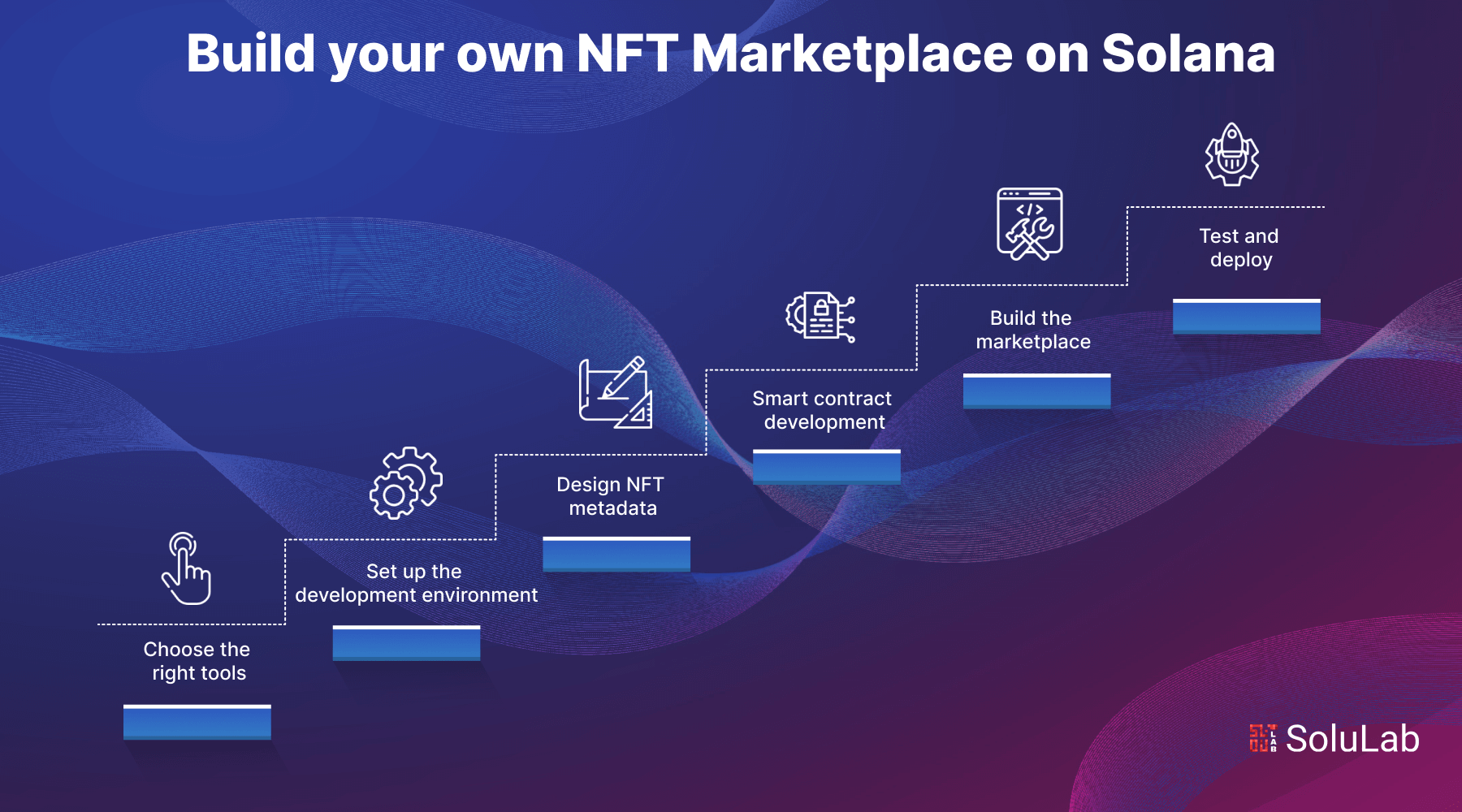
How To Create An NFT Marketplace On Solana?

NFT marketplaces have emerged as popular platforms for trading digital assets such as art, music, and collectibles. To ensure a seamless NFT trading experience for users, several key components must be incorporated into an NFT marketplace, including a user-friendly interface, a powerful search engine, comprehensive user history, and robust customer support. By integrating these features, Solana NFT development can provide users with an engaging and efficient trading environment.

1. SOL Wallet

Starting an NFT marketplace requires you to first set up a browser wallet. Given Solana’s compatibility with a wide range of browser wallets, you have the flexibility to choose your preferred platform. After creating your wallet, ensure it is funded with SOL tokens to facilitate transactions within your marketplace.

2. Metaplex Repository

To ensure easy hosting on GitHub pages, navigate to your GitHub account and fork the Metaplex repository. Afterward, proceed to copy all the Metaplex files onto your system.

  • On your desktop, create a new folder named “myNFTMarketplace.”
  • Copy the path to the newly created folder.
  • In your command line, navigate to the “myNFTMarketplace” folder using the “cd” command followed by the folder’s path.
cd /Users/yourusername/Desktop/myNFTMarketplace

To proceed, navigate to the folder you created and clone the repository there.

git clone https://github.com/yourusername/metaplex.git

To create a repository in your personal GitHub account, you can duplicate all the Metaplex repository files into your directory by following these steps:

1. Navigate to the Metaplex repository on GitHub.

2. Click on the “Fork” button in the top-right corner.

3. Select your personal GitHub account as the destination for the fork.

4. Click on the “Confirm fork” button.

5. Clone the forked repository to your local machine.

6. Change the directory to the cloned repository.

7. Add the original Metaplex repository as a remote.

8. Push your local changes to your forked repository.

3. Github Address

To ensure a successful online marketplace launch and maximize its success, consider implementing the following essential steps:

  • First, you will need to change the deployment address to your GitHub username.
  • Next, change the wallet address of your store.

This is where the public address of your browser wallet needs to be added, to tell the store who to give administrative access to.

Setting Up And Deploying The NFT Marketplace

You’re nearly there! Here are the final steps before your Solana marketplace for NFTs goes live:

1. In your command line, navigate to the “js” folder by changing the directory.

cd metaplex/js

To proceed, you must install all of the dependencies. To do this, run the following command:

yarn

This instruction is to download the required dependencies to work with the code. When you cloned the Metaplex repository, you only received the code that specifies the necessary packages and dependencies; the packages themselves were not downloaded.

The download process can take a while, but once it’s complete, the command will display “Done” at the end.

To verify if all the dependencies are functioning properly, run the following command:

yarn bootstrap

Before uploading your NFT marketplace to Github Pages, you can now test it locally.

To verify that the dependencies are in place and functioning as intended, run the following command:

yarn start

The compilation process may take a few minutes. Once complete, the terminal will display “Compiled successfully.” To view the newly created NFT marketplace, simply visit localhost:3000/#/.

The next step is to connect the marketplace to a wallet and enable NFT minting, making it live and functional.

To build the project files, use the following command:

yarn build

Once the process is finished, you will receive the message “Done” as output. You can now locate the build folder created within the js folder.

Next, switch the directory to the web folder.

cd packages/web

To deploy the application, navigate to the packages/web directory and execute the following command:

yarn deploy

Once the deployment is complete, the “Done” message will reappear, indicating a successful deployment. The provided command enables the deployment of your marketplace site to your GitHub repository. This deployment signifies that your marketplace is now live and accessible. You can now visit your Solana NFT marketplace hosted on GitHub Pages and built on the Solana blockchain.
CTA2

Launch Your NFT Marketplace on Solana with SoluLab!

In conclusion, building your own NFT marketplace on Solana offers a range of benefits, from low transaction fees and high speed to seamless scalability. By following the right steps, including setting up a wallet, forking the Metaplex repository, and incorporating essential features, you can create a platform to tap into the booming NFT ecosystem. Solana’s rapid growth makes it a prime choice for developers and entrepreneurs aiming to launch a successful NFT marketplace.

When it comes to ensuring a smooth and professional development process, partnering with an experienced NFT Marketplace Development Company like SoluLab can make all the difference. With a team of skilled blockchain developers and deep expertise in the NFT space, SoluLab can help you create a custom, scalable, and feature-rich marketplace on Solana or any other blockchain. Whether you’re looking to hire NFT developers or need end-to-end development support, SoluLab offers specific solutions to meet your business needs and deliver exceptional results.

Let us help you turn your vision into reality with a marketplace that stands out in the NFT field. Schedule a free consultation and get your marketplace project rolling. Contact SoluLab today for top-tier NFT development solutions!

FAQs

1. What is Solana NFT marketplace?

A Solana NFT marketplace is a platform that facilitates the buying, selling, and trading of NFTs built on the Solana blockchain. Unlike traditional marketplaces, Solana marketplaces are designed to handle high transaction volumes with lower fees, allowing users to trade Sol NFTs efficiently. These marketplaces often provide various features, including wallet integration, auction capabilities, and community engagement tools.

2. What are the key benefits of building an NFT marketplace on Solana?

Building on Solana offers advantages like high transaction speed, low fees, scalability, and strong security, making it ideal for NFT marketplaces that need to handle large volumes of transactions efficiently.

3. Do I need a technical background to build an NFT marketplace?

While having technical knowledge can help, it’s not necessary. By partnering with an NFT Marketplace Development Company like SoluLab, you can focus on your business objectives while we handle the technical development.

4. What is the cost of building an NFT marketplace on Solana?

The cost of development depends on various factors such as the complexity of the features, security requirements, and design elements. You can request a personalized quote from SoluLab to get an accurate estimate.

5. How can SoluLab help me develop my NFT marketplace?

SoluLab provides end-to-end development services for NFT marketplaces. From smart contract development to UX/UI design, we ensure your platform is robust, scalable, and user-friendly. You can hire NFT developers from our team to bring your vision to life.

6. How to build an NFT marketplace on Solana?

Building an NFT marketplace on Solana involves several steps, including defining your marketplace’s purpose, selecting a technology stack, and ensuring a seamless user experience. Begin by setting up a Solana NFT development environment, utilizing Solana’s blockchain capabilities. You can create smart contracts using Solana NFT smart contracts to manage transactions and ownership of NFTs. Employ a front-end framework to develop an engaging user interface, allowing users to easily navigate and trade their Sol NFTs.

7. What is the best Solana NFT marketplace?

Determining the best Solana NFT marketplace depends on your specific needs, such as user experience, transaction fees, and the types of NFTs offered. Popular options include Magic Eden, Solanart, and DigitalEyes, which have established themselves within the community. Consider factors such as platform security, community engagement, and the marketplace’s focus on specific NFT categories when choosing the right one for you.

Cardano Vs Polkadot Vs Solana

Cardano Vs Polkadot Vs Solana

Are you having trouble deciding whether to use the Polkadot, Solana, or Cardano blockchain for your company? According to the block data, 80% out of 100 companies use blockchain technology. Many organizations embrace blockchain technology for its advantages, including increased security and confidentiality. Each blockchain, however, has unique advantages that might or might not be appropriate for a certain project. 

Blockchains like Solana vs. Cardano vs. Polkadat continuously expand as chains add new blockchains, enhancing the ledger’s security. Only users of an approved system can access data on the blockchain, which is distinct because it fosters trust without requiring a reliable third party. 

So, how can you pick the ideal blockchain for your company? To do so, you need to know the main distinctions between Polkadot, Solana, and Cardano, the three well-known blockchains. This detailed guide will explain each blockchain and its features. 

Background of Each Blockchain 

Before deciding you need to have a brief understanding of each of the blockchain platforms to make a better and more informed decision

What is Cardano?

Charles Hoskinson, a co-founder of Ethereum, developed Cardano in 2015. The Cardano blockchain is openly accessible, the system is decentralized and open-source, and consensus is established by proof of stake. According to the ruling in Solana vs Cardano vs Polkadot can utilize its token, ADA to facilitate peer-to-peer (P2P) transactions. As a third-generation platform, Cardano is an improved version as opposed to Polkadot vs Solana.

Additionally, the blockchain platform seeks to provide financial services to unbanked individuals worldwide. Additionally, one intriguing component of Cardano is the way it uses its ‘eras’ to celebrate historical individuals in computer science and poetry. The goal of the Basho scaling and optimization phase is to provide additional functionality to Cardano. 

What is Polkadot?

June 2021 saw the launch of the open-source Polkadt blockchain. It makes blockchains more accessible and connected by permitting distinct chains to securely communicate and carry out transactions. It makes use of the Layer-1 blockchain known as the Kusama parachain. Over 100 para chains are supported by Kusama, and experts predict that number will continue to rise. As a component in your investment strategy, you can sell and buy DOT in addition to SOL, ADA, and DOT. Users can run customized platforms on top of a global network of personal blockchains with Polkadot, a cryptocurrecny. The Polkadot token (DOT), a cryptocurrency, serves two primary purposes inside the Polkadot blockchain network. 

  • With DOT, owners have the power to shape the protocol’s course. 
  • New DOTs are created by the Polkadot cryptocurrency network, which validates transactions by staking its money.  

Blockchain numerous applications are developed by Polkadot’s para-chains and fed into the main blockchain. In comparison to ADA, SOL, and DOT, this offers para-chain interactions utilization of the same amount of security to the main chain. 

CTA1

What is Solana?

Solana (SOL) adds to the discussion of SOL vs ADA vs DOT. An open-source initiative called Solana creates a novel, quick, layer-1 Blockchain without permission. To boost the capacity beyond what is feasible and popular blockchain while maintaining affordable pricing, Anatoly Yakovenko created Solana in 2017.

A synchronized engine, a form of proof of state, and a transforming proof of history technique are both used in Solana’s hybrid consensus model. Therefore, without putting scaling solutions in place, Solana can handle up to 710,000 operations per second. If you create a Solana token, a third-generation blockchain framework to facilitate the development of decentralized apps and smart contracts. The project facilitates a range of Defi systems and non-fungible token exchanges. One of the most influential parties in SOL vs ADA vs Polkadot at the moment is Solana. 

Benefits of Adoption of Each Blockchain

Blockchain technology provides special solutions, and a project’s particular requirement will determine which platform is the best. Let’s examine the advantages of embracing Cardano, Polkadot, and Solana: 

Cardano: Ecological and Research Strictness

Cardano is disconnected by its methodical approach, which is based on a layout design and peer-reviewed research. It is one of the most environmentally sustainable blockchains due to its proof of stake, and voting process, which guarantees energy efficiency. Cardano’s emphasis on formal verification helps developers by reducing errors and vulnerabilities. It is also an excellent candidate for projects needing long-term reliability, like digital identity, management, or supply chain tracking, due to its capacity for growth through Hydra Layer 2 solutions.

Polkadot: Scalability and Interoperability 

Polkadot’s distant embassies, or interoperability make it stand out its chain promotes a real web3 environment by enabling seamless communication and information sharing between numerous blockchains. Polkadot-adopting projects can create customized blockchains (parachains) that are customized for certain use cases, such as gaming or DeFi. Polkadot is perfect for cross-chain solutions and centralized applications that need to communicate between ecosystems because of its shared security paradigm, which lowers individual network liberties while preserving scalability.

Solana: Economical and Quick

Solana token services are a great option for hyper-performance apps because of their lightning-fast transaction rates and low fees. With its proof of history mechanism, it can handle more than 65,000 transactions per second, which makes it ideal for the NFT marketplace and decentralized exchanges. Due to Solana’s affordable prices, developers, and users can access it, enabling projects to grow without being constrained by fees. 

Every Blockchain has its advantages. Polkadot concentrates on interoperability, Cardano emphasizes sustainability, and security, and Solana is superior in terms of speed and cost. The objectives and priorities of the project will determine which one is best.

Technological Comparison of Blockchains

FeaturesCardanoPolkadotSolana
Mechanisms of ConsensusProof of StakeProof of Stake nominatedProof of Stake plus Proof of History
Speed of Transactions250 transactions per second1,000 transactions per second65,000 transactions per second
ScalabilityHydra Layer 2 Solution ScalesThrough parachains scalePoH enabled parallel processing scale
Efficiency of EnergyHigh (PoS included low power consumption)High (PoS mechanism optimized)Moderate (effective but requires more power than Cardano or Polkadot)  
InteroperabilityRestricted, sidechains will be used in plans to support cross-chain.Robust, built with the Relay Chain in mind for multi-chain interaction.Limited, interoperability is less important than sing-chain performance. 
Intelligence ContractsThe Haskell-based Plutus platform prioritizes formal verification. Uses parachains to support smart contracts.C, C++, and Rust are supported by the Solana runtime for high-performance applications. 
LeadershipCommunity vote for decentralized government.Active involvement of stakeholders in on-chain governance. On-chain governance is limited and depends on core developers. 
Ecosystem of DevelopmentCentered on methodical updates and academic rigor. Developer-friendly with substrate architecture for blockchain development. An environment with high performance designed for real-time applications. 
DecentralizationHigh (decentralization that will happen gradually with the addition of nodes)High decentralization is fostered by shared security. Moderate (has comparatively fewer nodes than Polkadot and Cardano)

Uses Cases of Each Blockchain 

1. Cardano

Creating the future of multi-chain, Cardano vs Solana, Polkadot is the foundation of cross-chain solutions and web3 because of its capability and interoperability. Among the notable use cases are:

  • Digital Identification Management: Initiatives, such as Atala PRISM use Cardano to offer, decentralized and safe identification solutions to both individuals and businesses. In developing nations where identification verification is difficult, this is extremely helpful.
  • Defi and Smart Contracts: Cardano offers decentralized finance applications, including stablecoins, lending platforms, and these exchanges through the Plutus smart contract platform.
  • Certification and Education: By enabling the organization to produce veritable certificates, Cardano’s blockchain has been utilized for credential verification, guarantee, authenticity, and blocking fraud.
  • Supply Management: Cardano makes it possible to trace products, transparently, and impenetrably throughout the supply chain because its blockchain guarantees authenticity, and stakeholder trust is increased. 

2. Polkadot

Creating the future of multi-chain, Polkadot is the foundation of cross-chain solutions and web3 because of its capability and interoperability. Among the notable use cases are: 

  • Cross-Chain DeFi: Polkadot facilitates communication between blockchain and decentralized financial systems. Parachains can be used by the project to build specialized training, staking, and lending ecosystems.
  • Development of Web3: Polkadot helps decentralized apps that depend on numerous changes for functionality and data by facilitating smooth communication between them. 
  • NFTs and Gaming: Producing games powered by blockchain and an NFT marketplace, where high performance and connectivity are crucial, is made possible by Polkadot’s scalability and multi-chain capabilities. 
  • Integration of IoT: Polkadot facilitates smooth data, sharing, and automation in sectors, including agriculture, logistics, and healthcare by connecting IoT devices across several networks. 

3. Solana 

Energizing high-efficiency apps, Solana is well known for its quick transactions and lower fees, making it perfect for real-time application applications. Important use cases consist of:

  • NFT Marketplace: Solana provides minimal cost and fast transaction velocity form and trading, powering, well-known MFT platforms, such as Metroplex and Magic Eden.
  • DeFi Solutions: Decentralized exchanges, taking protocols, and lending platforms are among the decentralized finance applications that Solana supports. It is desirable for high-frequency trading due to its low latency.
  • Decentralized Applications: Solana is used by developers to create a variety of dApps, such as data, storage systems, centralized social networking, networks, and payment gateways
  • Metaverse and Gaming: Solana is extensively used in the virtual world and Blockchain-based gaming, where capability and performance are essential for smooth user experiences.

Strengths and Weaknesses of Each Blockchain

BlockchainStrengthWeakness
Cardano

Proof of Stake uses less energy.

High security is guaranteed by rigorous verification and peer-viewed protocols.

Network resilience is improved by progressively increasing the number of active nodes. 

Innovation and updates may be delayed by a research-driven strategy.

In contrast to rivals, dApp and ecosystem adoption is still increasing. 

There is still work to be done on cross-chain communication.

Polkadot

Relay chain makes it possible for several blockchains to communicate with each other easily. 

By enabling parallel processing, parachains increase transaction throughput.

Substrate makes creating unique blockchains easier. 

New developers may find the parachain and architecture model difficult to understand. 

It takes a lot of technological know-how and funding to launch parachains.

Solana

Developers and users may find it appealing because of its low fees. 

Perfect for high-performance applications like Defi, NFTs, and gaming. 

Capable of processing more than 65,000 transactions per second. 

There may be centralization problems if there are fewer validators than rivals. 

Solana has seen outages and stability problems. 

Performance on a single-chain is prioritized over cross-chain capability. 

Investment Perspective

Cardano 

It is viewed as an extended, research-driven initiative from the perspective of investment. Investors looking for stability and steady growth are drawn to its emphasis on sustainability and reviewed by experts in development. Future demand for ADA may be fuelled by Cardano’s enterprise-level adoption because of its strong security capability via Hydra. Short-term gains are at risk, nevertheless, due to its lower rate of development and less active environment than rivals. ADA is valued by investors due to its solid base and promise to address practical issues and supply chain, identity management, and DeFi.

Polkadot

Investors choose Polkadot because of its distinct capability and interoperability, which established it as a major participant in the multi-chain web three future. It is appealing for developers and projects because it encourages creativity through the creation of specific para changes. DOT is an asset that requires a lot of staking and compensates investors for their involvement. Rapid adoption might be constrained by the para-chain’s integrity and great technical entry requirements. Polkadot is a good choice for investors who are looking to the future because of its potential to dominate cross-chain solutions.

Solana

Investors looking to gain exposure to a high-performing blockchain ecosystem, find Solana appealing. It has become the preferred platform for Defi, NFTs, and gaming because of its quick transactions and inexpensive costs. The adoption of SOLN industries with significant demand is linked to its growth potential. However, risk covers investors can be turned off by worries about centralization, risk, and network disruption. SOL provides excellent shot and medium-term investment opportunities for individuals who are interested in ecosystem expansion. 

The Final Word

To sum up, Cardano, Polkadot, and Solana arose from candidates in the blockchain market since they each have special advantages suited to particular use cases, Cardano’s focus on secure and sustainable platforms through research makes it appealing for long-term projects like supply chain, tracking, and digital identity management. Due to its exceptional scalability and interoperability, Polkadot is perfect for decentralized apps, cross-chain solutions, and Internet of Things integration. Meanwhile, Solana is the go-to option for advanced applications such as NFT marketplaces, DeFi, and blockchain-based games due to its speed and inexpensive transaction fees.

Your project goals, whether they are eco-friendly expansion, smooth, cross-chain, communication of blazing, or fast performance will determine which platform is best for you. Businesses and developers may ensure effective deployment and creation in the rapidly changing market by aligning their blockchain decisions with their objectives and knowing the relative benefits of each blockchain platform.

FAQs

1. Which is superior Cardano or Solana?

Solana prioritizes speed and scalability, whereas Cardnao’s Ouroboros emphasizes security. Cardano exhibits strong decentralization by running close to 2,600 validator nodes. Conversely, Solana has more than 1,300 validator nodes, requiring certain performance trade-offs with centralization. 

2. Which cryptocurrency should I buy?

With a staggering 57% of the market capitalization of the whole cryptocurrency industry, Bitcoin (BTC) is the top choice for cryptocurrency investing. Additionally, Bitcoin’s value just rose by an additional 125% to surpass $100,000.

3. Is it worth investing more in Solana?

If you think Solana has the potential to continue growing its ecosystem, accelerating and obtaining more ETF approvals, it could be a wise investment. It is still an inflationary token, though, is far more difficult to value than Bitcoin. 

4. Which is the better choice Cardano or Polkadot?

Polkadot wants the investors to be more involved and dedicated. The infrastructure of Cardano is double-layered, and Polkadot makes it possible to connect several blockchains to a single network. High transaction speed and cheap transaction fees are two of Cardano’s advantages. 

5. Can Polkadot surpass Ethereum?

Leading para-chain-based blockchain project Polkadot (DOT) is about to make a significant advancement that would allow it to overtake rivals like Solana (SOL), Cardano (ADA), and Ethereum (ETH).
