Talk to an Expert

Agentic RAG: What It Is, Its Types, Applications And Implementation

Agentic RAG

Large Language Models (LLMs) have revolutionized our interaction with information. However, their dependence on internal knowledge alone can limit the accuracy and depth of their responses, especially for complex queries. Retrieval-Augmented Generation (RAG) addresses this limitation by enabling LLMs to access and process information from external sources, resulting in more grounded and informative answers.

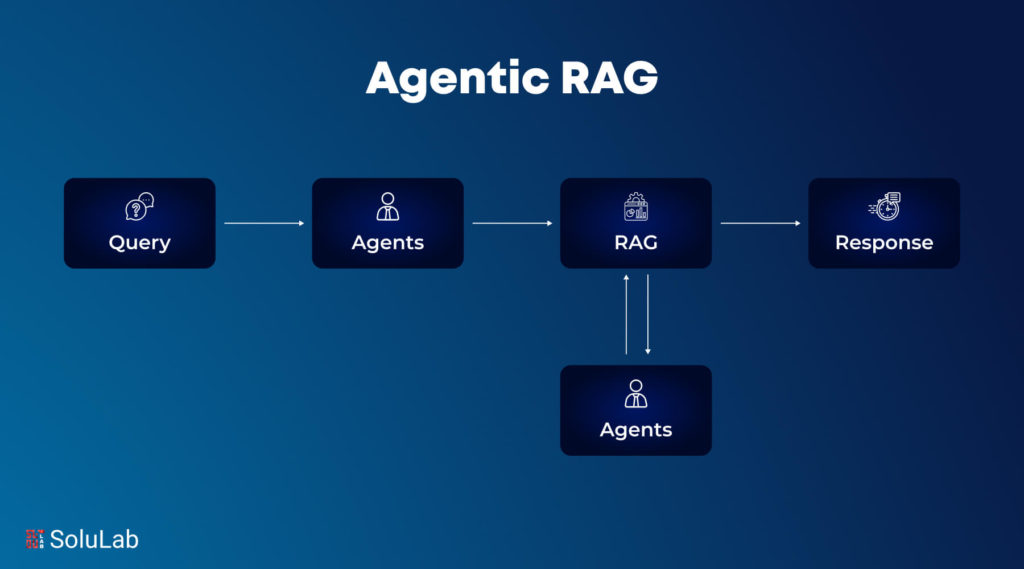
While standard RAG excels at handling simple queries across a few documents, agentic RAG takes it a step further and emerges as a formidable solution for question answering. The key differentiator of agentic RAG is the introduction of AI agents. These agents act as autonomous decision-makers, analyzing initial findings and strategically selecting the most effective tools for further data retrieval. This multi-step reasoning capability empowers agentic RAG to tackle intricate research tasks, such as summarizing, comparing information across multiple documents, and even formulating follow-up questions – all in an organized and efficient manner. This newfound agency transforms the LLM from a passive responder to an active investigator, capable of delving deep into complex information and delivering comprehensive, well-reasoned answers. agentic RAG holds immense potential for applications such as research, data analysis, and knowledge exploration.

Agentic RAG represents a significant leap forward in the field of AI-powered research assistants and virtual assistants. Its ability to reason, adapt, and leverage external knowledge paves the way for a new generation of intelligent agents that can significantly enhance our ability to interact with and analyze information.

In this article, we will delve into agentic RAG, exploring its inner workings, applications, and benefits for users. We will unpack the concept of agentic RAG, its key differences from traditional Agentic RAG types, the integration of agents into the RAG framework, their functionality within the framework, implementation strategies, real-world use cases, and finally, the challenges and opportunities that lie ahead.

Recent Developments With LLM And RAG

The recent developments in information retrieval and natural language processing (NLP), particularly with LLM and RAG, have ushered in a transformative era of efficiency and sophistication. These advancements have made significant strides in four key areas:

1. Enhanced Retrieval:

Optimizing information retrieval within RAG systems is pivotal for performance. Recent breakthroughs focus on developing reranking algorithms and hybrid search methodologies to enhance search precision. By employing multiple vectors for each document, a granular content representation is achieved, allowing for improved relevance identification.

2. Semantic Caching:

To minimize computational costs and ensure response consistency, semantic caching has emerged as a key strategy. It involves storing answers to recent queries along with their semantic context. This enables similar requests to be efficiently addressed without repeated LLM calls, facilitating faster response times and consistent information delivery.

3. Multimodal Integration:

This goes beyond text-based LLM and Retrieval-Augmented Generation (RAG) systems, integrating images and other modalities. It facilitates access to a wider range of source materials and enables seamless interactions between textual and visual data. This leads to more comprehensive and nuanced responses.

These advancements set the stage for further exploration into the complexities of agentic RAG, which will be delved into in detail in the forthcoming sections.

These advances pave the way for captivating explorations of agentic RAG, which will be comprehensively examined in subsequent sections.

What Is Agentic RAG?

Agentic RAG (Agent-based RAG implementation) revolutionizes question answering through an innovative agent-based framework. Unlike traditional approaches that solely rely on large language models (LLMs), agentic RAG employs intelligent agents to adeptly tackle complex questions. These agents act as skilled researchers, navigating multiple documents, synthesizing information, and providing comprehensive and accurate answers. The implementation of agentic RAG is scalable, allowing the addition of new documents managed by their sub-agents.

Imagine a team of expert researchers, each with specialized skills, working together to meet your information needs. Agentic RAG offers precisely that. Whether you need to compare perspectives from different documents, explore intricate details within a specific document, or create summaries, agentic RAG agents excel at handling these tasks with precision and efficiency. Incorporating NLP applications into agentic RAG enhances its capabilities and broadens its use cases.

Key Features And Benefits Of Agentic RAG:

  • Agentic RAG: This framework orchestrates the question-answering process by breaking it down into manageable steps, assigning appropriate agents to each task, and ensuring seamless coordination for optimal results.
  • Goal-Driven Agents: These agents have the ability to understand and pursue specific goals, enabling more complex and meaningful interactions.
  • Advanced Planning and Reasoning: Agents within the framework are capable of sophisticated planning and multi-step reasoning. They determine effective strategies for information retrieval, analysis, and synthesis to answer complex questions effectively.
  • Tool Utilization and Adaptability: Agentic RAG agents can leverage external tools and resources like search engines, databases, and specialized APIs to enhance their information-gathering and processing capabilities.
  • Context-Aware Decision-Making: Agentic RAG systems consider the current situation, past interactions, and user preferences to make informed decisions and take appropriate actions.
  • Continuous Learning: These intelligent agents are designed to learn and improve over time. As they encounter new challenges and information, their knowledge base expands, and their ability to tackle complex questions grows.
  • Customization and Flexibility: The Agentic RAG types framework offers exceptional flexibility, allowing customization to suit specific requirements and domains. Agents and their functionalities can be tailored to suit particular tasks and information environments.
  • Enhanced Accuracy and Efficiency: By combining the strengths of LLMs and agent-based systems, Agentic RAG achieves superior accuracy and efficiency in question answering compared to traditional approaches.
  • Broadening Horizons: This technology opens up opportunities for innovative applications in various fields, including personalized assistants, customer service, and more.

At its core, agentic Retrieval-Augmented Generation (RAG) changes question-answering with its robust and flexible approach. It leverages the collaborative intelligence of diverse agents to conquer intricate knowledge hurdles. Through its capabilities for planning, reasoning, employing tools, and ongoing learning, agentic RAG transforms the pursuit of comprehensive and accurate knowledge acquisition.

Differences Between Agentic RAG And Traditional RAG

By comparing agentic RAG and traditional RAG, we can gain valuable insights into the evolution of retrieval-augmented generation systems. In this article, we will focus on the key features that distinguish agentic RAG from its traditional counterpart, highlighting the advancements it brings.

Traditional RAG:

  • Heavy reliance on manual prompt engineering and optimization techniques.
  • Limited contextual awareness and static retrieval decision-making processes.
  • Unoptimized retrievals and additional text generation result in unnecessary costs.
  • Requires additional classifiers and models for multi-step reasoning and tool usage.
  • Static rules governing retrieval and response generation, limit flexibility and adaptability.
  • Sole reliance on the initial query for document retrieval, hinders the handling of evolving or new information.
  • Limited ability to adapt to changing situations or incorporate new information.

Agentic RAG:

  • Dynamically adjust prompts based on context and goals, reducing manual prompt engineering.
  • Consider conversation history and adapt retrieval strategies based on context.
  • Optimize retrievals, minimize unnecessary text generation, reduce costs, and improve efficiency.
  • Handle multi-step reasoning and tool usage, eliminating the need for separate classifiers and models.
  • Determine when and where to retrieve information, evaluate data quality, and perform post-generation checks on responses.
  • Perform actions in the environment to gather additional information before or during retrieval.
  • Adjust its approach based on feedback and real-time observations.

The distinct capabilities of agentic RAG highlight its potential to revolutionize information retrieval. By enabling AI systems to actively interact with and explore intricate environments, agentic RAG empowers these systems to engage more effectively with their surroundings. This leads to improved decision-making and efficient task completion through enhanced information retrieval capabilities.
CTA1

Diverse Applications of Agentic Reinforcement Learning

Within a RAG framework, agents display diverse usage patterns tailored to specific tasks and objectives. These patterns highlight the agents’ adaptability and versatility when interacting with RAG systems. Key usage patterns of agents in an RAG context include:

  • Employing Pre-existing RAG Pipelines as Tools

Agents can leverage existing RAG pipelines as tools to accomplish specific tasks or produce outputs. By utilizing these established pipelines, agents can simplify their operations and benefit from the capabilities inherent in the RAG framework.

  • Functioning Independently as RAG Tools:

Agents can operate autonomously as RAG tools within the framework. This autonomy allows agents to generate responses independently based on input queries, without relying on external tools or pipelines.

Related: Large Language Models Use Cases and Applications

  • Dynamic Tool Retrieval Based on Query Context:

Agents can retrieve relevant tools from the RAG system, such as a vector index, based on the context provided by a query at query time. This tool retrieval enables agents to adapt their actions according to the unique requirements of each query.

  • Query Planning Across Existing Tools:

Agents can analyze input queries and select appropriate tools from a predefined set of existing tools within the RAG system. This query planning enables agents to optimize tool selection based on the query requirements and desired outcomes.

  • Selecting Tools from the Candidate Pool:

When the RAG system offers a wide range of tools, agents can assist in selecting the most suitable one from the candidate tools retrieved based on the query. This selection process ensures that the chosen tool closely aligns with the query context and objectives.

Within a RAG framework, agents can leverage these usage patterns to execute various tasks effectively. By combining and customizing these patterns, complex RAG applications can be tailored to meet specific use cases and requirements. Harnessing these patterns enhances the overall efficiency and effectiveness of the system, enabling agents to accomplish their tasks seamlessly.

RAG Agents Categorized by Functionality:

RAG agents can be classified into distinct categories based on their functional capabilities. This spectrum of capabilities ranges from simple to complex, resulting in varying costs and latency. These agents can fulfill diverse roles such as routing, planning one-time queries, employing tools, utilizing ReAct (Reason + Act) methodology, and coordinating dynamic planning and execution.

1. Routing Agent

The routing agent makes use of a Large Language Model (LLM) to choose the best downstream retrieval augmented generation RAG pipeline. This decision-making process involves agentic reasoning, where the LLM analyzes the input query. This allows it to select the most appropriate RAG pipeline. This process exemplifies the core and basic form of agentic reasoning.

When determining the best routing for a query, two options arise: using a summarization retrieval augmented generation pipeline or a question-answering RAG pipeline. The agent analyzes the input query to ascertain whether it should be directed to the summary query engine or the vector query engine, both of which are configured as tools.

2. One-Shot Query Planning Agent

In query planning, a complex query is decomposed into smaller, parallelizable subqueries. These subqueries are then executed across various RAG pipelines, each utilizing different data sources. The responses obtained from these pipelines are amalgamated to form the final comprehensive response. This process involves breaking down the query, executing the subqueries across suitable pipelines, and synthesizing the results into a cohesive response.

Read Blog Also: Use Cases Of AI Agents

3. Tool Use Agent

In a standard Retrieval-Augmented Generation framework, a query is submitted to retrieve the most relevant documents that align semantically with the query. However, there are situations where additional information is necessary from external sources, such as APIs, SQL databases, or applications with API interfaces. This additional data acts as contextual input to enrich the initial query before it undergoes processing by the Large Language Model (LLM). In such scenarios, the agent can also leverage a RAG model.

4. ReAct Agent

ReAct: Integrating Reasoning and Actions with LLMs

Elevating to a more advanced level requires the incorporation of reasoning and actions executed iteratively for complex queries. This essentially consolidates routing, query planning, and tool utilization into a single entity. A ReAct agent capably handles sequential, multi-part queries while maintaining an in-memory state. The process unfolds as follows:

  • Upon receiving a user query, the agent identifies the suitable tool (if needed) and gathers its necessary input.
  • The selected tool is invoked with the input, and its output is stored.
  • The agent then retrieves the tool’s history, encompassing both input and output. Based on this information, it decides the next course of action.
  • This iterative process continues until the agent concludes tasks and responds to the user.

5. Dynamic Planning & Execution Agent

The most widely adopted agent is currently ReAct, but there is a growing need to handle more complex user intents. As more agents are deployed in production environments, there is an increasing demand for enhanced reliability, observability, parallelization, control, and separation of concerns. This necessitates long-term planning, execution insight, efficiency optimization, and latency reduction.

At their core, these efforts aim to separate high-level planning from short-term execution. The rationale behind such agents involves:

  • Outlining the steps necessary to fulfill an input query plan, essentially creating a computational graph or directed acyclic graph (DAG).
  • Identifying the tools, if any, required for executing each step in the plan and performing them with the necessary inputs.

This necessitates both a planner and an executor. The planner typically utilizes a large language model (LLM) to craft a step-by-step plan based on the user query. The executor then executes each step, identifying the tools needed to accomplish the tasks outlined in the plan. This iterative process continues until the entire plan is executed, resulting in the presentation of the final response.

How to Implement Agentic RAG?

Constructing an agentic Retrieval-Augmented Generation necessitates specialized frameworks and tools that streamline the creation and coordination of multiple agents. Although building such a system from the ground up can be intricate, there are several existing alternatives that can simplify the implementation process. In this regard, let’s delve into some potential avenues.

  • Llamalndex

LlamaIndex serves as a solid foundation for the development of agentic systems. It offers a wide range of functionalities to empower developers in creating document agents, managing agent interactions, and implementing advanced reasoning mechanisms like Chain-of-Thought.

The framework provides pre-built tools that facilitate interaction with diverse data sources, including popular search engines such as Google and repositories like Wikipedia. It seamlessly integrates with various databases, including SQL and vector databases, and allows for code execution through Python REPL.

LlamaIndex’s Chains feature enables the seamless chaining of different tools and LLMs, promoting the creation of intricate workflows. Additionally, its memory component aids in tracking agent actions and dialogue history, fostering context-aware decision-making.

To enhance its utility, LlamaIndex includes specialized toolkits tailored to specific use cases, such as chatbots and question-answering systems. However, proficiency in coding and a good understanding of the underlying architecture may be required to fully utilize its potential. Integrating llmops practices can further streamline the operations and maintenance of LLM-based systems, ensuring efficiency and reliability.

  • LangChain

Similar to LlamaIndex, LangChain provides a comprehensive set of tools for creating agent-based systems and managing interactions between them. It seamlessly integrates with external resources within its ecosystem, allowing agents to access various functionalities like search, database management, and code execution. LangChain’s composability allows developers to combine diverse data structures and query engines, enabling the construction of sophisticated agents that can access and manipulate information from multiple sources. Its versatile framework is adaptable to the complexities of implementing agentic RAGs.

Challenges: While LlamaIndex and langchain retrieval augmented generation offer robust capabilities, their coding requirements may pose a steep learning curve for developers. They must be prepared to invest time and effort to fully understand and leverage these frameworks to maximize their potential.

Challenges & Opportunities In Agentic RAG

With the rapid evolution of the AI landscape, agentic RAG systems have emerged as indispensable instruments in the realm of information retrieval and processing. However, like any nascent technology, agentic RAG comes with its own set of challenges and opportunities. In this section, we delve into these challenges, explore potential solutions, and unveil the promising prospects that lie on the horizon for agentic RAG. Incorporating meta llama into these discussions can provide deeper insights and enhance the capabilities of agentic RAG systems.

Challenges And Considerations:

While agentic RAG holds immense potential, it is not without its challenges. Here are some key challenges and considerations to take into account:

1. Data Quality And Curation

  • Challenge: Agentic RAG agents heavily depend on the quality and curation of the underlying data sources for their performance.
  • Consideration: To ensure reliable and trustworthy outputs, data completeness, accuracy, and relevance are crucial. Effective data management strategies and quality assurance mechanisms must be implemented to maintain data integrity.

2. Scalability And Efficiency

  • Challenge: As the system scales, managing system resources, optimizing retrieval processes, and enabling seamless communication between agents become increasingly intricate.
  • Consideration: Effective scalability and efficiency management are critical to preventing system slowdowns and maintaining responsiveness, especially as the number of agents, tools, and data sources increases. Proper resource allocation and optimization techniques are crucial for ensuring smooth operation.

3. Interpretability And Explainability

  • Challenge: Ensuring transparency and explainability in the decision-making processes of agentic RAG agents, which can provide intelligent responses, is a significant challenge.
  • Consideration: To build trust and accountability, it is crucial to develop interpretable models and techniques that can elucidate the agent’s reasoning and the sources of information utilized. Understanding how the system arrives at its conclusions is essential for users to trust its recommendations.

4. Privacy and security

  • Challenge: Agentic RAG systems demand careful attention to privacy and security due to their potential handling of sensitive or confidential data.
  • Consideration: To ensure the protection of sensitive information and maintain user privacy, robust data protection measures, access controls, and secure communication protocols should be implemented. Preventing unauthorized access, safeguarding against data breaches, and upholding user trust are crucial in ensuring compliance with regulations.

Opportunities:

Despite the challenges, agentic RAG presents exciting opportunities for innovation and growth in the field of information retrieval and processing. Here are a few key opportunities to consider:
1. Innovation and Growth

  • Continued advancements in fields like multi-agent coordination, reinforcement learning, and natural language understanding hold promise for enhancing the capabilities and adaptability of agentic RAG systems.
  • Integrating with emerging technologies such as knowledge graphs and semantic web technologies can unlock new possibilities for knowledge representation and reasoning.

2. Context-aware intelligence

  • Agentic RAG systems can potentially leverage vast knowledge graphs to comprehend contexts better, enabling them to establish intricate connections and draw inferences.
  • This enhanced context-awareness paves the way for more personalized and tailored responses, ultimately improving user experiences and boosting productivity.

CTA2

3. Collaborative ecosystem

  • To promote the extensive adoption and resolution of common challenges in agentic RAG, collaboration among researchers, developers, and practitioners is crucial.
  • By establishing a community that emphasizes the sharing of knowledge and cooperative problem-solving, the agentic RAG ecosystem can flourish, resulting in innovative applications and solutions.

While agentic RAG systems face significant obstacles, they simultaneously offer promising avenues for groundbreaking advancements. By proactively addressing these challenges and embracing opportunities for innovative problem-solving and collaborative efforts, we can unlock the full potential of agentic RAG, fundamentally transforming our future interactions with and utilization of information.

Conclusion

In conclusion, AI Development Company represents a significant advancement in the field of Retrieval-Augmented Generation (RAG), offering enhanced capabilities over traditional RAG methods. By integrating rag agent LLM and ai agent rag technologies, rag agents can more effectively retrieve and generate relevant information, streamlining complex processes and improving efficiency. You can hire AI Developers to Understand what retrieval augmented generation and exploring the different agentic RAG types allow for a comprehensive comparison between agentic RAG and traditional RAG, highlighting the superior adaptability and performance of the former.

The applications of retrieval-augmented generation (RAG) are vast, ranging from sophisticated retrieval augmented generation pipelines to practical retrieval-augmented generation use cases across various industries. Retrieval augmented generation examples illustrate its transformative impact, particularly when implemented with frameworks like langchain retrieval augmented generation. As businesses and developers continue to explore and leverage these technologies, the distinction between Traditional RAG vs Agentic RAG becomes increasingly clear, underscoring the importance of adopting these innovative solutions. SoluLab stands ready to assist in harnessing the full potential of Agentic RAG, providing expert guidance and development services to navigate this cutting-edge landscape.

FAQs

1. What is Retrieval-Augmented Generation (RAG)?

Retrieval-Augmented Generation (RAG) is a method that combines retrieval mechanisms with generative models to improve the accuracy and relevance of generated responses by incorporating external information.

2. What are the different types of Agentic RAG?

Agentic RAG types include various implementations that integrate AI agents and LLMs (Large Language Models) to enhance retrieval and generation capabilities, providing more accurate and contextually relevant outputs.

3. How does an AI Agent RAG differ from a traditional RAG?

AI Agent RAG, or Agentic RAG, utilizes intelligent agents and advanced LLMs to streamline and enhance the retrieval and generation process, making it more efficient compared to traditional RAG methods.

4. What are some practical retrieval-augmented generation use cases?

Retrieval-augmented generation use cases include customer support automation, content generation, data analysis, and personalized recommendations, where the RAG pipeline integrates external data for improved outcomes.

5. Can you provide an example of retrieval-augmented generation?

A retrieval-augmented generation example is a customer service chatbot that retrieves relevant information from a database and generates accurate, context-specific responses to customer queries.

6. What is the role of a rag agent LLM in RAG?

A rag agent LLM (Large Language Model) plays a crucial role in RAG by enhancing the generative capabilities through advanced language understanding and generation, making the retrieval process more efficient and accurate.

7. How does langchain retrieval augmented generation contribute to RAG implementations?

Langchain retrieval augmented generation contributes by providing a robust framework for integrating retrieval and generation processes, ensuring seamless and efficient implementation of RAG pipelines.

What is Retrieval Augmented Generation (RAG)?

Retrieval Augmented Generation

Imagine a world where chatbots can access every minor piece of data for you instantly within seconds accurately according to your questions. Artificial Intelligence has progressed from day one and continues to adapt and evolve with time for development. AI models are going beyond generating text and are constantly being trained to excel in every field with various functions and work as virtual assistants or helping hands to humans. They can actively research for required information and take relevant actions. This is where the Retrieval-Augmented Generation(RAG) comes in, it’s a game-changer in the world of natural language processing (NLP). Before that you should know what is retrieval augmented generation, Combining the strength of information with generating text to create even more informative and accurate data is the technique used by RAG.

What is Retrieval-Augmented Generation (RAG)

Retrieval-augmented generation is a technique that combines generating texts and information retrieval to create more accurate and informative content. But how exactly does it work? It works by retrieving significant information from a database or external source and using it to generate text. To better understand the workings of rag models look at their components:

  • Large Language Model (LLM): This Artificial Intelligence giant can already participate in question-answering, language translation, and even text generation. From rag retrieval augmented, it gets a very important increase in accuracy which is critical.
  • Information Retrieval System: This part works like a superhero’s search engine to look for the most appropriate data that could be of essence to the LLM.
  • Knowledge Base: RAG gets its information from this reliable source. Perhaps it could be a large-scale external resource or a database of a certain specific focus.

Why is Retrieval Augmented Generation Required?

Retrieval-augmented generation (RAG) is required to address the limitations of language models and help them generate a more accurate and informative response. Here are some reasons for which RAG is required:

1. Enhancing Factual Accuracy

Traditional language models have limited context windows, which means they are only able to provide a small amount of text at a time. RAG ensures that the text provided is highly accurate according to the real-time data making the data a reliable output.

2. Improving Relevance 

RAG always retrieves relevant information from a knowledge base and also ensures that the generated text is relevant to the user’s query or command. This is extremely crucial when a task demands factual accuracy. 

3. Expanding Knowledge

LLM retrieval augmented generation has a limited database of knowledge only as per what they are trained on. RAG allows them to access a vast base of information, expanding their knowledge and enabling them to handle more complex tasks. 

4. Enhanced Explainability

RAG gives access to a mechanism that explains the reasoning of the model. This is made possible by showing retrieved information, so users can understand how the model arrived at a response, and also increases trust and transparency.

The Synergy of Retrieval Based and Generative Models

RAG plays the role of the bridge between these two methods. In leveraging the abilities of both. Whereas generative models inspire the model, the information of the model is supplied by the retrieval models.

  • Retrieval-Based Models

Suppose you are the librarian specializing in a given area of knowledge. Similar procedures are involved in models based on retrieval augmented generation rag impaired working leads to concurrent memory that is explicit and completed during retrieval. They heavily use question-and-answer templates to solve problems and collect information. This ensures coherence and accuracy of the information as well as accuracy, especially for tasks with definite solutions.

Despite this, non-interactive models of retrieval have their limitations as well. They experience a problem in asking queries that have not been provided in the training or handling new circumstances not within the training regimen. 

  • Generative Models

On the other hand, generative models are playbook champions when it comes to the creation of new languages. They employ complex techniques of deep learning to analyze large amounts of textual content to identify the most basic forms and structures of language. This enables them to translate human languages and come up with new text forms, and in general to produce other forms of original literature. They are adaptable to situations and good when it comes to a shift in new scenarios.

However, contrary to this, generative models can sometimes trigger factual inaccuracy most of the time. Without that, their responses could be creative but incorrect, or as some individuals say, full of hot air.

AI Services

The Role of Language Models and User Input

In retrieval augmented generation applications language models and user inputs play a crucial role. Here’s how:

1. Boosting Creativity

LLMs can compose unique texts, translate from one language to another, as well as write different kinds of materials, be it code or poetry. The input provided by the user acts as a signal which then guides the creative process of the rag agent LLM towards the appropriate path.

2. Personalized Interactions

It hard codes practical user communications, while LLMs have the added capability to tailor connecting reactions based on what LLMs tumble from users. Take a chatbot for instance one that can remember your previous chats and the kind of responses you would like to have. 

3. Increasing Accuracy

It must also be noted that LLMs applications are continuously in the developmental process and acquiring knowledge. Reviews made by the users, especially the constructive ones assist in enhancing their understanding of language and their response correctness.

4. Guiding Information Retrieval

User input is incorporated in RAG systems commonly in the form of queries. It guides the information retrieval system to the most relevant information that was of concern to the formulation of the LLM.

5. Finding New Uses

Consequently, the users might bring to the LLM’s attention some situations and challenges, it was not acquainted with before. This could push LLMs to the extent of what they can achieve and result in identifying other possibilities in their utility.

Understanding External Data

Retrieval Augmented Generation (RAG) is not an ordinary assembly of articles; instead, it is a chosen collection of credible sources to substantiate the existence of RAG’s ability. Here’s how important external data is to RAG:

  • Knowledge Base

Therefore, RAG relies mainly on external data as a type of knowledge. This might be exemplified by databases, news archives, scholarly articles, and an organization’s internal knowledge database. 

  • Accuracy Powerhouse

 The LLM Operating Model also incorporates features that ensure that its answers to RAG are factual The LLM’s Operating Model feeds it with relevant data. This becomes very crucial for providing answers to questions and formulating information.

  • Keeping Up to Date  

Unlike static large language models, RAG utilizes external data to get the most up-to-date information externally. This ensures the timely responsiveness of RAG’s replies by the contemporary world.

  • The Value of Excellence

This means that it is important to realize that RAG’s answers are highly sensitive to the quality of the external data. Defects in the source of the data such as inaccuracies or bias may become apparent in the text. 

Benefits of Retrieval Augmented Generation 

Benefits of Retrieval Augmented Generation

Among gathering data from a larger database knowledge and giving the most informative and accurate results there are many other benefits associated with RAG systems. Here are the benefits of retrieval augmented generation:

1. Enhanced Accuracy

It must be mentioned that factual inconsistency, a major problem in LLMs, is addressed substantially by RAG. RAG ensures that there is an improvement in the accuracy of the response the LLM makes and factual veracity by relying on facts from outside the text.

2. Decreased Hallucinations

It might be interesting, which thus occasionally arises from the LLMs’ ability to generate false hallucinations. Thus, due to the prevention of such actions, the verification process that the company employs at RAG by utilizing the recovered data offers more reliable and credible results.

3. Current Information 

In this case, RAG employs the utilization of external data to acquire the most updated data as it is a quite different approach from the LLMs trained within the datasets. This ensures that the generated answers are relevant and recent to sufficiently meet the needs of the users.

4. Increased User Trust

This, it turns out, enhances the credibility of users to get information from RAG since one can support his arguments with sources. For an application like a customer service chatbot where reliability and credibility are paramount this is important.

5. Domain-Specific 

Expertise In this way, RAG helps to define the system in particular domains with the help of pertinent external data sources. This enables RAG to provide solutions that demonstrate the correctness and competency of the subject matter.

Approaches in Retrieval Augmented Generation

RAG System leverages various approaches to combine retrieval and generation capabilities. Here are the approaches to it:

  • Easy

Produce the required documents and seamlessly integrate the resulting documents into the generation process to ensure the proper coverage of the questions.

  • Map Reduce

 Assemble the outcome from the individual responses generated for every document as well as the knowledge obtained from many sources.

  • Map Refine

With the help of the iteration of answers, it is possible to improve the answers during the consecutive usage of the first and the following documents.

  • Map Rerank

Accuracy and relevance should be given the first precedence for response ranking, and then the highest-ranked response should be selected as the final response.

  • Filtering

 Employ the models to look for documents, and utilize those that the results contain as context to generate solutions that are more relevant to the context.

  • Contextual Compression

This eliminates the problem of information abundance by pulling out passages, which contain answers and provide concise, enlightening replies.

  • Summary-Based Index

Employ the use of document summaries, and index document snippets, and generate solutions using relevant summaries and snippets to ensure that the answers provided are brief but informative.

  • Prospective Active Retrieval Augmented Generation

 Find how to call phrases in order first, to find the relevant texts, and second, to refine the answers step by step. Flare provides a conditionally coordinated and dynamic generation process.

Applications of Retrieval Augmented Generation

Applications of Retrieval Augmented Generation

Now that you are aware of what is retrieval augmented generation and how it works here are the applications of RAG for a better understanding of how is it used:

1. Smarter Q&A Systems

RAG enhances Q&A systems by providing good content from scholarly articles or instructional content. This ensures that the answers are accurate, comprehensive, and informative retrieval augmented generation applications.

2. Factual and Creative Content

RAG can generate diverse creative textual forms including, for example, articles or advertisements. But it does not stop here. This way, the content of RAG is properly matched with the topic, and the information recovered is fact-based.

3. Real-World Knowledge for Chatbots

RAG allows chatbots to source and employ actual world data when in a conversation with people. RAG can be invoked by chatbots in customer service where information bundles can be accessed with the chatbot then providing accurate and helpful replies.

4. Search Outcomes Gain an Advantage

The refinement of the supplied documents and an enhancement of the matching process allow for the betterment of information retrieval systems as used by RAG. It transcends keyword search as documents that bear information necessary for a topic are located and educative snippets are provided to the user that capture the essence of the topic set and retrieval augmented generation applications.

5. Empowering Legal Research

RAG can be helpful to legal practitioners in that it aids in the process of research and analysis in some ways. There is a possibility that through RAG, attorneys can gather all the related case studies papers, and other records to support their case.

6. Personalized Recommendations

The integration of outside facts gives RAG additional opportunities to present user preferences in a matter that considers external input. For example, let RAG be applied in a movie recommender system where it not only provides movies from the user’s favorite genre but also special emphasizes the movies with the same genre

How is Langchain Used for RAG? 

It is worth noticing that langchain retrieval augmented generation plays the role of the assembler that links together the elements of the RAG app development system. It helps with the RAG process in the following ways. Have a look at langchain retrieval augmented generation:

  • Data Wrangling

External data sources are initially under the control of RAG, making it clear that LangChain helps in this case. The benefits include tools for processing, presenting, and checking data for consumption by the LLM.

  • Information Retrieval Pipeline

LangChain is in charge of data retrieval. The user input interacts with the chosen information search system; for instance, a search or knowledge engine to find the most relevant material.

  • LLM Integration

 LangChain is the middleman responsible for the data that is gathered and the LLM. Before passing the recovered data to the LLM for generation, it formats it, it might even summarize it or rewrite it in some manner.

  • Prompt Engineering

Depending on the LLM, the following prompts can be generated with LangChain. Arriving at a crisp and informative response for the LLM, LangChain combines data from the gathered material with the user question.

  • Modular Design

To start with, it is worth noting that LangChain is modular by its design. With regards to the RAG procedure, the developers can swap some components and reinvent the procedure that is needed. Due to this characteristic, RAG systems can be developed for specific objectives or goals.

The Future of RAG and LLMs

Language processing is undergoing a massive change with large language models and retrieval-augmented generation. Here’s a look at how the future may benefit from them:

1. Improved Factual Reasoning

The number of discovered relations will increase as well as the ability of LLMs to determine the relationships between the multiple pieces of information, and, therefore, provide more elaborate and thoughtful answers.

2. Multimodal Integration

Currently, RAG can be done as a text-based method, but there is scope that in the future, it can be combined with modes such as audio or visuals. The picture is an instrument that acquires related motion pictures alongside textual content information, which makes it possible for LLMs to offer significantly far more elaborated and encompassing innovative responses.

3. LLMs for Lifelong Learning

The current LLMs are trained with static datasets. As a result, despite the deficiencies of the LLMs’ responses when interacting with the RAG systems in the present, the integration may be able to expand the models’ learning processes in the future to improve response time and data storage.

4. Explanation and Justification

Retrieved information sources can enable LLMs to provide not only an answer to a given question but also to provide the reasoning behind it, through RAG systems. This will in turn help in enhancing the confidence of users in products being developed by AI.

5. Democratization of AI

Changes may occur in both RAG and LLMs, and people may get access to tools that can make using AI for actions such as research and writing articles easy and friendly.

Case Study

Final Words

Retrieval Augmented Generation RAG is a leap forward in natural language processing, it bridges the gap between vast databases and language models. RAG empowers users to access and have a deep understanding of information more efficiently and correctly. RAG has its approaches and benefits that make it a better choice for users in the long term. 

With ongoing research and new techniques being explored now and then the future of RAG stands strong in technology. You can expect more powerful RAG systems that will have the ability to transform interactions with technology and adhering information to access knowledge that will help with creating greater insights with ease and accuracy. 

As a RAG Development Services, SoluLab specializes in implementing cutting-edge technologies like RAG to create innovative and efficient AI solutions tailored to your business needs. Our team of experts is dedicated to delivering custom AI applications that enhance your operations, improve customer interactions, and drive business growth. Ready to harness the power of RAG for your business? Contact SoluLab today to explore how we can help you leverage AI to achieve your goals. Let’s innovate together!

FAQs

1. What Retrieval Augmented Generation?

The elements of RAG AI technology are classified into two categories, namely, the retrieval phase and the generation phase. It begins by extracting relevant information from external sources, documents, or databases of the organization. Subsequently, it employs this data to formulate an answer such as a text or an answer to a posed question.

2. How are the limitations of LLMs being addressed by RAG

LLMs tend to be easily distracted at times and can also give out wrong facts. This is catered by RAG, which ensures the LLM has real data when it is generating the replies, this ensures that the replies that the LLM sends are more dependable and relevant.

3. What challenges are being experienced by RAG?

We know that developing RAG models is an effective tool, but it is not unconstructive to recall that such models are not without limits. Another problem is ensuring that the material that is obtained is relevant. The other is that the model does not search for information in a recursive way; that is, it cannot build an improved search plan from the initial results. Gentlemen are at the moment involved in research on how to overcome the above constraints.

4. What are some of the real-life applications of RAG?

RAG has potential use in the following. It also has the potential to create smarter virtual assistants and chatbots, increase the volume of content being created for authors and marketers, and refine how firms deliver customer support.

5. How can SoluLab assist you with the implementation of RAG?

SoluLab can assist with RAG implementation for your business by structuring the data and indexing, helping you choose the right retrieval and generation model, and integrating your RAG system with applications and workflows. With this SoluLab can help you build an effective RAG system.
