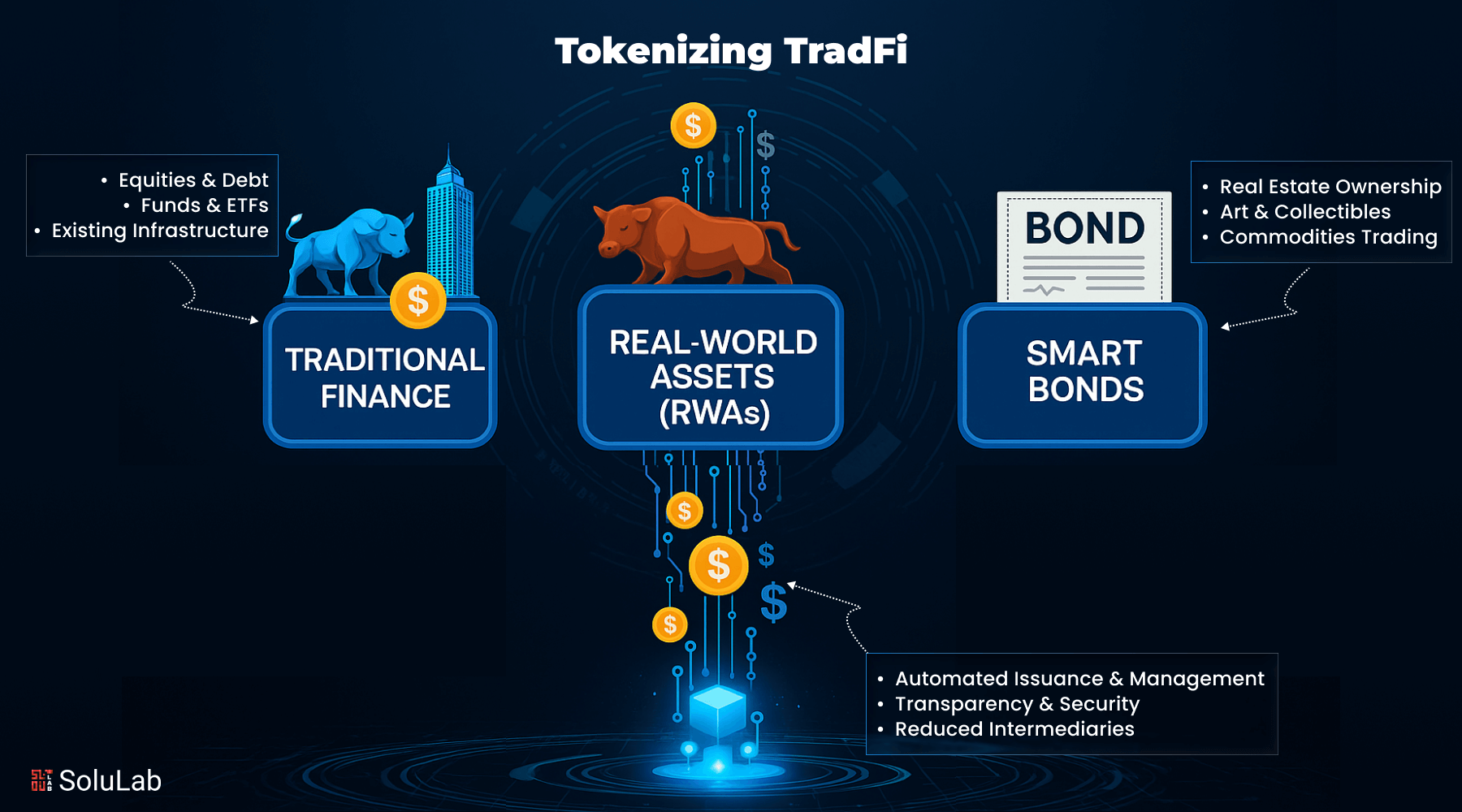
Talk to an Expert

Tokenizing TradFi: Real-World Assets & Smart Bonds

Tokenizing TradFi Real-World Assets

Have you ever thought that buying a piece of real estate or a government bond is as easy as a digital token? Maybe you should experience it now. The development of tokenized real-world assets and smart bonds is transforming the global financial system. Tokenization aims to bridge traditional finance (TradFi) and decentralized finance (DeFi).

Real estate, bonds, and private equity are now getting digitized into tokens. Isn’t it amusing and simple? This move’s main focus is quick transactions, transparency, and broader access. This blog provides information on the tokenization process and its impact on the real world. 

How DeFi and TradFi Support Each Other?

DeFi and TradFi bring unique strengths to the financial world. When combined, they create a powerful system that is faster, safer, and more open. DeFi uses smart contracts and blockchain to cut out middlemen, while TradFi offers regulation, investor trust, and global financial backing.

  • DeFi Strengths: Trustless, Transparent, 24/7

DeFi runs on blockchain protocols. It works without banks or brokers, offering global access around the clock. Users can track transactions in real-time, making the system fully transparent and auditable. Anyone with an internet connection can join.

  • TradFi Strengths: Regulation, Capital, Reach

Traditional finance brings regulation, stability, and deep capital pools. It protects users through laws, KYC checks, and trusted financial systems. Over 75% of people worldwide already rely on banks, giving TradFi unmatched reach and credibility.

  • Convergence Over Conflict: The Combinational Future

The future is not about DeFi replacing TradFi. It’s about working together. Hybrid models will power secure, fast, and accessible financial systems for everyone, combining DeFi innovation with TradFi reliability.

The Rise of Hybrid Finance and Tokenized RWAs

Hybrid finance uses blockchain to upgrade how financial institutions work. Tokenized real-world assets (RWAs) are leading this change, making assets more accessible and programmable.

1. How Tokenized Assets Bridge DeFi and TradFi?

Tokenized RWAs bring the speed of DeFi and the safety of TradFi into one system. They automate KYC, allow fractional ownership, and use smart contracts for real-time transactions.

2. Key Examples: Bonds, PE, Real Estate, Stablecoins

Let’s check out how tokenized RWAs are enhancing bonds, private equity, real estate, and stablecoins. 

  • Banks tokenize bonds for faster settlement and programmable interest payments.
  • Private equity firms automate cap tables and dividend flows using smart contracts.
  • Real estate developers sell property shares globally through fractional tokens.
  • Stablecoins help settle transactions instantly across borders.

3. Regulatory Catalysts Like MiCA Driving Change

The European MiCA regulation sets clear rules for digital assets. It boosts trust in tokenization. More countries are now creating similar legal frameworks to support this shift.
CTA1

Core Use Cases of Real-World Asset Tokenization

Tokenizing real-world assets helps many sectors. It improves access, efficiency, and transparency across various investment classes.

  • Real Estate and Private Equity

Property and fund shares can now be divided into tokens. This opens access for small investors and increases market liquidity.

  • Fixed-Income Instruments and Alternative Assets

Banks issue tokenized bonds that settle instantly. Even rare assets like art, wine, and music rights are entering the token market.

  • Stablecoins Powering Cross-Border Settlement

Stablecoins are known for being simple and quick global payment assets. These help in trade settlements across borders with their well-built-in compliance. 

Read Also: RWA-backed Stablecoins
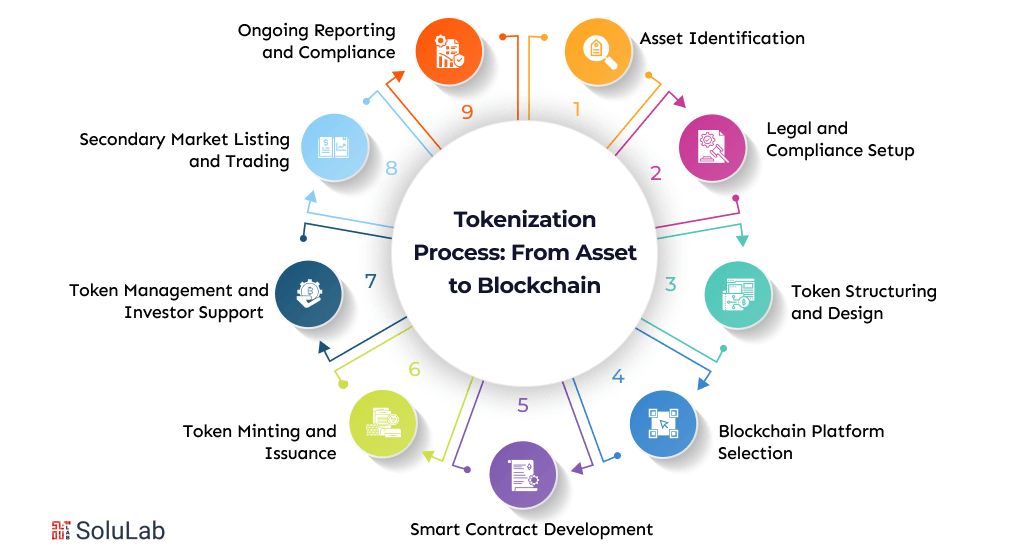
The Tokenization Process: From Asset to Blockchain

Tokenization Process From Asset to Blockchain

Tokenizing a real-world asset is not a one-step task. It requires a secure, structured approach that balances blockchain benefits with real-world rules. Each stage ensures the asset is legally sound, technically secure, and ready for digital trading. 

Here’s a simple breakdown of the full process:

1. Asset Identification

The process begins by identifying the asset. It could be real estate, artwork, a bond, or intellectual property. Owners must confirm legal title, clear any disputes, and validate the asset’s value through expert appraisal. Without proper identification, tokenization can’t move forward.

2. Legal and Compliance Setup 

Once the asset is verified, legal compliance comes next. This step ensures the tokenization process follows local laws, including KYC (Know Your Customer), AML (Anti-Money Laundering), and securities regulations. Legal experts help structure the token according to investor rights and jurisdiction-specific rules.

3. Token Structuring and Design

In this stage, developers decide how the token will function. They define the type, whether equity, debt, or utility, and set the total supply. Each token may represent a fraction of ownership or a debt claim. The team also defines rules for transfers, dividends, or voting rights.

4. Blockchain Platform Selection 

Not every blockchain fits every asset. The team chooses a platform like Ethereum, Polygon, or a private chain. The selection depends on asset size, transaction needs, security requirements, and gas fees. The right platform ensures scalability and smooth token operations.

5. Smart Contract Development 

Smart contracts automate the asset’s behavior. They enforce ownership, track transfers, distribute payouts, and execute rules without human intervention. Developers write and test these contracts carefully to match legal terms and prevent bugs or breaches.

6. Token Minting and Issuance 

After development, the digital tokens are created or minted, on the selected blockchain. Tokens are distributed to investors or asset owners, either through a public offering or private placement. This step marks the official entry of the asset into the digital space.

Read Also: RWA Tokenization In Traditional Banking

7. Token Management and Investor Support 

Token ownership needs ongoing oversight. Platforms or service providers help manage token records, update investors, and offer dashboards for tracking value or receiving returns. They also support audits and ensure reporting stays transparent.

8. Secondary Market Listing and Trading 

Once the token is live, it can be listed on approved exchanges or digital marketplaces. This enables buyers and sellers to trade freely, bringing much-needed liquidity to assets that were once hard to move. Compliance controls remain in place during trading.

9. Ongoing Reporting and Compliance 

Even after launch, reporting continues. Asset issuers must provide regular updates, track performance, and maintain full legal compliance. All activities, payouts, transfers, and audits are logged on-chain, offering unmatched transparency to both investors and regulators.

Positive Impact of Asset Tokenization

Tokenized assets bring powerful benefits to investors, asset owners, and markets. This technology is changing how financial systems work.

  • Retail investors could gain access to VIP markets without large capital funding or middleman involvement. 
  • Fractional ownership over the assets boosts liquidity. This allows easy buying and selling of assets. 
  • Also each an every transaction is noted on-chain and maintains the database. This gives regulators and auditors complete authority.  
  • Smart contracts cut costs by automating compliance, reporting, and dividend payouts.
  • New industries like energy, IP, and carbon credits use tokenization to streamline funding and ownership.

Read More: Asset Tokenization Regulations for Australia

The Future of Tokenized Real World Assets

Tokenized real-world assets are moving beyond pilot tests. This trend is building a new financial foundation across the globe. Central banks are testing CBDCs to improve settlements. Artificial Intelligence is now used for risk scoring and asset pricing. RWA ETFs and index tokens are making diversified portfolios more accessible to all. Governments and banks are joining the tokenization movement. They are creating legal standards and scaling platforms to manage large assets efficiently.
CTA2

Conclusion

Tokenization is changing how the world sees and trades real assets. It unlocks access, boosts liquidity, and brings trust through blockchain. At SoluLab, a top asset tokenization development company, we help businesses turn real estate, gold, and company shares into digital tokens. Our team studies your goals and builds the right token structure and technology to match.

Whether it’s improving transparency or reaching global investors, we ensure your assets are future-ready. With our end-to-end asset tokenization services, you gain more control, more value, and more opportunity. 

Contact SoluLab today to explore how digital tokens can reshape your financial future.

FAQs

1. What are tokenized real-world assets (RWAs)? 

Tokenized RWAs are digital versions of physical assets like real estate or bonds. These tokens represent ownership and can be traded easily on blockchain platforms.

2. How do DeFi and TradFi work together in asset tokenization?

DeFi brings speed and automation, while TradFi adds trust and regulation. Together, they create a balanced system that is secure, efficient, and accessible for all kinds of investors.

3. What types of assets can be tokenized today? 

Real estate, private equity, bonds, art, and even music rights can be tokenized. Anything valuable in the real world can become a digital asset with blockchain technology.

4. Why is tokenization considered a game-changer for retail investors?

Tokenization lowers entry barriers. Small investors can now buy fractional shares in premium assets that were once accessible only to high-net-worth individuals or institutions.

5. Can tokenized assets be insured or used for loans like traditional ones? 

Yes, tokenized assets are gaining recognition. Many platforms now support insurance and collateralization, allowing these tokens to function similarly to traditional assets in lending and risk management.

 

How Is Tokenization in Finance Making Investing Smarter and Faster?

Tokenization in Finance

The financial world is changing fast. One of the biggest changes happening right now is tokenization in finance. This means turning real things like property, stocks, or money into digital tokens that live on a blockchain. These tokens represent ownership or rights to a physical or financial asset. 

According to Boston Consulting Group, tokenized investment could be worth $16 trillion by 2030. That’s about 10% of the global economy. Why? Because tokenization in financial services solves a lot of the problems that traditional finance has like slow processes, high fees, and limited access.

To make this possible, companies often partner with an asset tokenization development company to build scalable systems backed by blockchain technology. These platforms are at the heart of enabling tokenization of assets safely and efficiently.

Traditional Finance vs. Tokenized Finance

In traditional finance, buying or selling assets can be slow and expensive. You need to go through banks, brokers, and clearinghouses. It can take days to complete a transaction. Also, only a few people often get access to high-value investments.

But tokenized financial assets are changing that.

With tokenization in finance:

  • You get real-time settlements.
  • Assets become liquid, even if they were hard to trade before
  • You can own just a fraction of a large asset (this is called fractional ownership).
  • People from anywhere in the world can invest, no matter their location.

Thanks to blockchain technology, this is now possible. It removes the middlemen, adds transparency, and makes the process much faster.

As a result, we are seeing the rise of new solutions in banking, fintech, and investing, many backed by real world asset tokenization strategies and even powered by AI agents in asset tokenization for added automation and intelligence.

Key Benefits of Tokenization in Finance

More and more companies are choosing finance tokenization because it offers major improvements over traditional finance. Here’s why:

Key Benefits of Tokenization in Finance

1. Efficiency

With tokenization, smart contracts can automatically handle tasks like transfers, payments, and recordkeeping. This reduces paperwork, lowers errors, and saves time. Businesses working with an asset tokenization development company can quickly set up secure and efficient systems.

2. Security

All transactions are stored on a blockchain, making them tamper-proof. That means no one can change or delete the data, which greatly reduces fraud.

3. Liquidity

Many high-value assets, like real estate or fine art, are hard to sell quickly. But tokenization of assets makes it possible to divide these into smaller parts (tokens) and sell them easily to more investors. This opens up new ways to raise money and trade faster.

4. Transparency

Since every transaction is recorded on the blockchain, both businesses and investors get full visibility into what’s happening. This builds trust and makes compliance easier.

5. Accessibility

Traditionally, investing in assets like real estate or private equity required large amounts of money. With tokenized investment, even small investors can own a fraction of valuable assets. This makes investing more inclusive.

The growing use of tokenization in finance​  shows how powerful this shift is. Companies are modernizing their operations and using platforms like an asset tokenization platform to handle everything from real estate to bonds.

Read Also: RWA Tokenization In Traditional Banking

Technology Behind Tokenization of Assets

The core technology behind tokenization in finance is blockchain. It is a secure, digital ledger that records every detail about an asset, who owns it, where it came from, and every transaction it’s ever gone through. This makes it reliable, transparent, and tamper-proof.

To make this system work smoothly, a few important tech pieces come together:

  • Smart contract development helps automate things like compliance checks, payments, or transfers, so there’s less need for middlemen.
  • Blockchain-as-a-Service lets companies launch their own blockchain apps quickly, without building everything from scratch.
  • Protocol layers, like Layer 1, Layer 2, and Layer 3 blockchain, help improve speed, reduce costs, and make different blockchain systems work together.

Companies that want to create secure and scalable solutions often partner with a blockchain consulting company. If you’re looking to build a reliable solution, it’s smart to work with an asset tokenization development company that already has experience in this space.

Types of Assets Being Tokenized in Financial Services

Now let’s talk about what can be tokenized. Actually, a lot of things!

This is where asset tokenization becomes powerful. You can create digital versions of real-world assets that are easier to buy, sell, and invest in.

Here are some examples:

1. Real estate tokenization: Instead of buying an entire property, investors can buy small shares. This makes investing more affordable and opens up real estate markets to global investors.

2. Equities and Bonds: Tokenization lets you add automation, like instant dividend payouts and faster settlement.

3. Private Equity: Startups and private companies can raise funds more easily and give investors a way to trade their shares.

4. Commodities like Gold or Oil: Storing gold can be expensive. But with gold tokenization, you can own it digitally without worrying about logistics.

5. Collectibles and NFTs: These are gaining popularity, too. Tokenization lets you prove ownership of rare or valuable items online.

Each of these categories improves transparency, reduces costs, and increases investor access. More importantly, they help create more liquid markets using tokenized financial assets.

Read Also: White-Label Tokenization Vs. Custom Blockchain

How Tokenization Enables Fractional Ownership and Global Access?

In the past, investing in big assets like commercial real estate or venture capital was only possible for wealthy individuals. But now, finance tokens have changed that. Investors can put in as little as $10 to own a part of these valuable assets.

This is called fractional ownership, and it offers some important benefits:

  • It opens investment opportunities to everyone, not just the rich.
  • It lowers the risk of putting all your money in one place.
  • It makes it easier to buy and sell shares in assets through secondary markets.

Many asset tokenization platform providers are creating the technology to make fractional ownership simple and accessible worldwide.

Some platforms also use AI agents in asset tokenization to help manage these digital assets better, improving customer service and automation.

Real-World Use Cases of Financial Tokenization

Tokenization is no longer just an idea; it’s actively changing how finance works. Both big companies and startups are using tokenization in financial services to improve asset management.

Some examples:

These examples highlight how real world asset tokenization and tokenization of assets are becoming mainstream. They prove that asset tokenization development companies are building real, working platforms that bring liquidity and transparency to traditional finance.

Best Platforms for Investing in Tokenized Assets

If you want to invest in tokenized investment​, you don’t need to be a tech expert or a wealthy investor anymore. Several platforms now make it easy to access real world asset tokenization, including things like real estate, stocks, bonds, and even private equity.

These platforms are designed to lower the entry barrier, increase transparency, and offer more liquidity, allowing everyday investors to benefit from tokenization in finance. Here are some of the best platforms to consider:

Best Platforms for Investing in Tokenized Assets

1. Token World

Token World is a secure and scalable crypto launchpad platform that simplifies the tokenization of assets, helping blockchain startups raise capital while giving investors access to vetted, high-potential projects. With built-in smart contract security, regulatory compliance support, and multilingual capabilities, it enables real world asset tokenization across sectors like real estate, DeFi, and healthcare. By integrating an AI agent in asset tokenization and leveraging advanced blockchain infrastructure, Token World offers a seamless, transparent, and investor-friendly Web3 experience.

2. RealT

RealT is a leading asset tokenization platform that focuses on tokenization of real estate. It allows users to buy fractional shares of rental properties. This is a perfect example of real world asset tokenization, where physical properties are converted into digital tokens for global investors.

3. tZERO

tZERO is well-known for offering tokenized financial assets like digital stocks. It’s one of the first platforms to follow U.S. SEC guidelines, making it ideal for investors looking for regulated and compliant solutions in tokenization in financial services.

4. Securitize

Securitize works with institutions to help them tokenize bonds, funds, and equity. As an asset tokenization development company, it offers secure infrastructure and helps businesses benefit from the tokenization of assets with ease.

Read Also: AI Tokenization For Asset Ownership

Compliance, Standards & Security in Tokenized Finance

When we talk about tokenization in finance, one thing is clear: trust matters. That trust is built on strong rules, secure systems, and clear global standards. Tokenization doesn’t remove compliance; it helps automate it.

1. Token Standards

In tokenized financial assets, standards are the foundation. Whether you’re dealing with finance tokens or NFTs, most digital assets follow well-known protocols like ERC-20, ERC-721, and ERC-1400. These standards:

  • Make sure tokens work across systems
  • Help protect investors
  • Allow easy integration with wallets and exchanges

They are especially important for companies offering asset tokenization platform services or building tools for the tokenization of assets.

2. Regulatory Considerations

Even though tokenized investment​ is digital, it must follow real-world laws. Many countries, like Singapore and the UAE, are leading with clear rules for digital assets. The space is getting more mature, especially around things like:

  • Security Token Offerings
  • The difference between ICO vs. STO
  • Rules for who can invest and how tokens are traded

Following these regulations isn’t optional; it’s essential. That’s why many companies work with a blockchain consulting company to stay compliant.

3. Security & Privacy in Tokenized Systems

Keeping data safe is just as important as compliance. That’s where modern blockchain features shine:

  • Role-based access: Control who sees or moves digital assets
  • Zero-knowledge proofs: Protect private details without revealing them
  • End-to-end encryption: Make sure every transaction is secure

Working with experts ensures these tools are built the right way from day one. We offer reliable smart contract development to keep everything secure and automated.

Read Also: Why Dubai, London & New York Lead in Real Estate Tokenization?

The Future of Tokenization in Finance

Tokenization is no longer just an idea; it’s becoming the backbone of finance.

  • Decentralized finance tokens will help assets move freely across different blockchains
  • An AI agent for finance tools will handle tasks like risk scoring and KYC
  • New layers of trust will emerge in the Decentralized Web3 Ecosystem 
  • Real-time asset tokenization development company services will bring assets online in days, not months

The shift is fast and real. Major institutions are already joining in, using real-world asset tokenization to unlock new markets, reduce costs, and grow faster.

With Tokenization in asset management, people and companies can trade 24/7, send money globally in minutes, and invest with less money upfront. Whether it’s decentralized finance tokens​, real estate tokenization, or gold tokenization this isn’t just a trend. It’s changing how the world handles money and investments.

Asset Tokenization Development Company

Conclusion

The rise of tokenization in financial services is reshaping how we store, trade, and grow assets. Whether you’re managing real estate, gold, or stocks, tokenization of assets offers more security, faster transactions, and global reach. It also brings transparency and automation through smart contracts, while keeping your business fully compliant.

If you’re a business looking to get started, partner with an expert Tokenization Platform Development Company like SoluLab. We’ve built plug-and-play platforms like Token World to help businesses tokenize assets in just a few days. 

Whether you are a well-established business or a startup, we can help you grow your business with technical support. Contact us today!

FAQs

1. What is tokenization in finance?

It means converting assets like stocks or property into digital tokens stored securely on blockchain networks.

2. Are tokenized assets secure?

Yes. With encryption, smart contracts, and strong compliance, digital tokens are often safer than traditional systems.

3. What types of assets can be tokenized?

Everything from real estate, bonds, and company shares to gold and NFTs.

4. How does tokenization benefit investors?

It offers easy access, liquidity, transparency, and the ability to buy small portions of large assets (fractional ownership).

5. How can my company get started?

Partner with a Tokenization Platform Development Company like SoluLab. Our experts help launch secure, regulation-ready platforms fast.


Top RWA tokenization Companies​ in 2026

Tokenization is the process of splitting actual assets into smaller pieces and using the blockchain to represent each piece as a distinct digital token. This method is already being used to trade various assets, including equities, bonds, commodities, fine art, and real estate.

Tokenization companies are opening up liquidity in formerly illiquid sectors by permitting fractional ownership, which increases the accessibility of high-value assets like real estate to a worldwide market.

Over the last two years, the Real-World Asset tokenization development industry has expanded by 80% and is still growing. It’s important to find out who the companies that supply tokenization infrastructure are, as they are expected to play a major role in this emerging sector

To help you comprehend this ecosystem, we will examine the top 10 leading tokenization companies that will be influencing the market in 2026. 

The Role of RWA Companies in Tokenization

Real-world asset (RWA) businesses form the backbone of the tokenization environment. These companies transition from the physical to the digital realm by tokenizing precious metals, masterpieces, and real estate. This transition allows businesses and investors to maximize their assets by leveraging blockchain technology to enhance productivity and security.

1. Development of Real-World Asset Tokenization: 

RWA companies are professionals at producing and implementing digital tokens that are representative of actual assets. They are in charge of creating tokenization for real-world assets

An owner of commercial real estate, for instance, might sign up with an RWA company to tokenize their assets, enabling fractional ownership and blockchain trade. 

2. Blockchain Integration

The smooth integration of tokenization systems with blockchain networks is essential for the success of tokenized assets. RWA firms provide the technical know-how to incorporate assets with superior blockchain systems, guaranteeing security, scalability, and dependability. 

These companies ensure that tokens from Ethereum, Binance Smart Chain, custom networks, and other platforms may be efficiently exchanged and managed.

3. Compliance Solutions: 

One of the biggest challenges in tokenizing is regulatory compliance, as tokenized assets typically fall under securities or commodities regulations. RWA companies provide end-to-end compliance solutions that address jurisdiction-specific requirements to manage this complexity. 

Tokenized assets will be more likely to meet the legal criteria for international transactions if Know Your Customer (KYC) and Anti-Money Laundering (AML) regulations are followed. 

Benefits of RWA Tokenization

By providing multifarious features that are unique in volatile markets, tokenization is changing asset ownership and investing. These consist of:

  • Enhanced Security: Tokenization enabled by blockchain technology increases security by encrypting each transaction and storing it in an immutable ledger. This secure documentation reduces the danger of fraud and boosts confidence.
  • Reduced Compliance Scope: By eliminating the need to maintain sensitive payment data tokenization, companies can assist companies in meeting the standards of the Payment Card Industry Data Security Standard (PCI DSS). 
  • Fraud Prevention: By exchanging tokens for sensitive data, such as card numbers, tokenization significantly decreases the risk of fraud and makes it more difficult for hackers to use stolen information.
  • Accessibility: Democratizing access to valuable assets, tokenization allows smaller investors to participate in marketplaces that were previously only accessible to wealthy individuals or organizations.
  • Efficiency: Employing smart contracts to automate transactions, tokenization reduces administrative expenses and settlement times. Platforms for tokenizing real estate are leading the industry.

Top RWA Tokenization Companies in 2026

solulab

1. SoluLab

SoluLab is a leading blockchain development company offering RWA tokenization solutions, helping businesses tokenize real-world assets such as real estate and commodities. Their company ensures secure, efficient, and scalable tokenization processes, empowering companies to integrate blockchain technology.

Its key features include tailored tokenization for various asset types, regulatory compliance, asset security, and large-scale tokenization for businesses of all sizes.


$25 – $49/ hr


50 – 249


2014


USA

MentTech

2. MentTech

At MentTech, we go beyond digitizing ownership our tokenization solutions unlock access, build trust, and create new investment opportunities in real-world assets. From real estate to security token offerings, we deliver secure, scalable, and compliant platforms.

We provide end-to-end RWA tokenization from strategy to development of equity, debt, and asset-backed tokens, with built-in compliance, investor portals, and KYC/AML integration. MentTech makes tokenization simple, secure, and ready for investment.


$30 – $50/ hr


50 – 249


2018


CA, USA

Tokeny Solutions

3. Tokeny Solutions

One of the leading companies in the RWA tokenization space is Tokeny Solutions. Tokeny is well-known for providing a stable, expandable platform that lets companies tokenize a variety of assets, including stocks, commodities, and real estate, all while guaranteeing complete adherence to international laws.

Key features include Tokeny infrastructure guarantees that tokenized assets meet worldwide regulatory standards, a key service offering. Tokeny lets enterprises create custom smart contracts, making tokenization flexible and adaptive, and works with powerful digital asset custody systems to protect tokenized assets.


NA


~40


2017


Luxembourg

Code Brew Labs

4. Code Brew Labs

Code Brew Labs is a leading real estate tokenization company that builds secure and efficient platforms using blockchain technology. They specialize in converting properties into blockchain-based digital assets, enabling fractional ownership and global trading. With over $4.5 billion in real estate digitized and compliance across 30+ jurisdictions, Code Brew Labs offers end-to-end solutions from strategy to deployment and support.

Key features include token creation aligned with specific property portfolios, platforms designed to meet global and regional regulatory standards, and automation of property transactions and ownership transfers.


$21 – $50/ hr


201 – 500


2013


India

Auroblocks

5. Auroblocks

Auroblocks is a blockchain technology studio with a focus on the tokenization of real-world assets (RWA). They provide turnkey solutions to digitize real estate, art, and private equity assets for compliance and increasing liquidity on their integrated platform. Its features are KYC/AML verification, investor accreditation, and a safe marketplace to exchange tokenized assets.

Here are some of the features of the company, including ensuring regulatory adherence with integrated KYC, AML, and investor verification processes, facilitating the transparent and regulated trading of tokenized real-world assets and managing the issuance and distribution of tokens, maintaining underlying assets, and ensuring compliance.


$25-$100/ hr


11 – 50


2018


Singapore

Blockchain App Factory

6. Blockchain App Factory

Blockchain App Factory is a leading RWA tokenization company known for building secure, customizable platforms that help businesses tokenize real-world assets like real estate, bonds, and commodities. Their end-to-end development services make them a top choice for enterprises entering the tokenized asset space.

Key features include support for multiple asset classes, regulatory compliance, and KYC integration with white label tokenization platforms.


$25/ hr


100 – 249


2017


India

Antier Solutions

7. Antier Solutions

Leading the way in RWA tokenization and blockchain development, Antier Solutions provides end-to-end services that assist companies in tokenizing assets such as commodities, private equity, and real estate. Its platform specializes in scalability, compliance requirements, and cross-chain interoperability.

Key features of the company include tokenization across different blockchains, giving investors a choice in ecosystems; tailor-made solutions for asset owners are excellent for organizations with complex assets or specific needs, and Antier ensures that tokenized assets meet all legal and regulatory requirements, reassuring investors and businesses.


$25 – $65 / hr


50 – 249


2010


India

ShamlaTech

8. ShamlaTech

Shamla Tech Solutions is a blockchain development firm specializing in Real-World Asset (RWA) tokenization. They offer customized solutions that enable businesses to automate tangible assets such as real estate, commodities, and intellectual property, improving liquidity, security, and global accessibility.

Key Features are fully customizable token development, regulatory-compliant smart contractsand secure wallet integration.


$50 – $99/ hr


150 – 250


2010


USA

BlockchainX

9. BlockchainX

BlockchainX is a top RWA tokenization firm providing end-to-end tokenization of real-world assets such as real estate, commodities, and art. With its stable infrastructure and regulatory compliance, BlockchainX enables firms to transform physical assets into easily tradable digital tokens.

Key Features of the company are support for multiple asset classes, smart contract-based automation, and regulatory-compliant token issuance.


$50/ hr


100 – 249


2017


India

Zeeve

10. Zeeve

Zeeve is a leading Web3 infrastructure provider specializing in Real-World Asset (RWA) tokenization. Their platform offers scalable, secure, and compliant solutions for enterprises aiming to digitize tangible assets like real estate, commodities, and private credit. With tools like Rollups-as-a-Service (RaaS) and support for standards such as ERC-3643, Zeeve simplifies the deployment of custom blockchains tailored for RWA projects.​

Key features include support for tokenization on 40+ blockchains, including Ethereum and Polygon; offers Rollups-as-a-Service for scalable and efficient blockchain deployments; and provides ISO 27001, SOC 2 Type II, and GDPR-compliant infrastructure.


NA


50 – 100


2021


USA

DePIN Development Company

Conclusion

The existence of RWA businesses has completely changed the handling and trading of real-world assets. Tokenization is changing many industries by improving asset management, raising transparency, and increasing liquidity due to technologies, including data tokenization companies, AI-driven solutions, and better token generation.

If you wish to investigate the potential of tokenization, these 10 leading RWA companies offer the know-how and resources to support you along this transition. These businesses are spearheading the adoption of asset tokenization, cryptocurrency trading, and real estate tokenization, positioning them for success in a market that is becoming more and more digital.

SoluLab, an asset tokenization development company, provides specialized solutions to sectors that want to tokenize their assets safely. Contact us today to discuss this further!

FAQs

1. What is RWA tokenization?

RWA tokenization refers to the process of converting real-world assets like real estate, commodities, or securities into digital tokens on a blockchain, enabling secure, transparent, and tradable assets.

2. Why is RWA tokenization important?

It improves liquidity, enhances transparency, reduces costs, and allows fractional ownership, making traditionally illiquid assets more accessible to a broader range of investors.

3. How does RWA tokenization benefit real estate investments?

Tokenization allows real estate properties to be divided into smaller, tradable units, making it easier for investors to buy and sell fractional ownership, improving liquidity.

4. Can tokenization apply to any real-world asset?

Yes, tokenization can apply to various assets, including real estate, commodities, stocks, and even intellectual property, allowing them to be traded digitally.

5. How do RWA tokenization platforms ensure security?

These platforms implement blockchain technology, ensuring secure transactions, encryption, and smart contracts that guarantee transparency and prevent fraud.

Tokenization of Real-World Asset – 2026 Guide

Real-World Asset Tokenization

The recent upswing in the cryptocurrency market has directed a substantial amount of wealth, which helped in the development of a strong worldwide decentralized framework. With a potential market size in the hundreds of billions of dollars, real-world asset (RWA) tokenization is one of the biggest market opportunities in the blockchain sector. Anything valuable might theoretically be tokenized and added to the chain.

Since more projects aim to tokenize a wide range of assets, including currency, commodities, real estate, and much more, tokenized RWAs are a developing market niche in the digital asset business.

According to projections from the Boston Consulting Group, global clearing and settlement costs alone may save as much as $20 billion a year through the tokenization of assets. Looking ahead to 2030, there’s a chance to get into the $16 trillion market for tokenized illiquid assets, which makes up only a tiny portion of the total notional value of holdings in both the public and private domains.

In this blog, we will provide a comprehensive and authorized source to help readers understand the complex environment of asset tokenization. This comprehensive guide demonstrates the conceptual, blockchain development technology, and practical elements of token development for real-world assets on the blockchain development company.

What are Real-World Assets (RWA)?

Tokenized real-world assets (RWAs) are powered by blockchain digital tokens that reflect tangible and traditional financial assets, including cash, commodities, stocks, credit,  bonds, artwork, and intellectual property. The tokenization of real-world assets represents a major change in how these assets can be used, exchanged, and managed, opening up a plethora of fresh prospects for both blockchain-powered investment services and a wide range of non-financial use cases based on cryptography and decentralized consensus.

Asset tokenization is one of the most promising applications for blockchain technology, featuring an estimated market size that includes practically all of humanity’s economic activities. The future of finance is on-chain, with hundreds of blockchains sustaining trillions of dollars in tokenized RWAs on a shared substrate of blockchain and distributed ledger technologically driven networks linked by a universal interoperability protocol.

Different Types of Real-World Assets

Types of Real-World Assets

Real asset tokenization opens avenues for diverse investment opportunities by digitizing tangible assets. Let’s look into the primary categories eligible for RWA tokenization:

1. Real Estate: Encompassing commercial, residential, and industrial properties, as well as natural resources, real estate offers intrinsic value and income streams through appreciation and rentals. However, it also entails maintenance costs and market fluctuations.

2. Commodities: Raw materials like oil, wheat, and gold constitute commodities, possessing inherent value and commonly traded on exchanges or through derivative contracts.

3. Infrastructure: Critical for economic activities, infrastructure comprises transportation systems, public utilities, and facilities like roads, power plants, and water treatment plants. These assets provide essential services to both businesses and communities.

4. Natural Resources: Essential for economic development and human survival, natural resources include renewable and non-renewable assets such as forests, minerals, and wind. These resources are pivotal for sustaining various industries and ecosystems.

Real-world asset tokenization revolutionizes investment landscapes, offering fractional ownership and liquidity to investors while streamlining processes and enhancing accessibility to traditionally illiquid assets.

Read Also: Tokenized US Treasury Platform Development

Tokenizing Real-World Assets

Real-world assets are tokenized by embodying their ownership rights as onchain tokens. This technique generates a digital copy of the underlying asset, allowing for on-chain administration of the asset’s ownership rights and bridging the gap between physical and digital assets. 

Tokenized assets provide more liquidity, greater access, transparent onchain administration, and lower transactional friction than traditional assets. In the context of financial assets, tokenizing RWAs also integrates the distribution, trading, clearing, settlement, and safeguarding processes into a single layer, resulting in a more simplified onchain financial system with lower counterparty risk as well as better capital mobilization.

Process of Tokenizing Real-World Assets

Tokenizing real-world assets involves a structured process with distinct stages:

1. Asset Identification

Selecting the real-world asset for tokenization, considering its market value, potential liquidity, and regulatory compliance.

2. Token Design

Defining the characteristics of the token, such as whether it’s fungible or non-fungible, and determining the token standard to be followed, such as ERC20 or ERC721. These specifications lay the foundation for the token’s functionality and interoperability.

3. Blockchain Integration

Choosing a suitable blockchain network, whether public or private, for issuing the tokens. Integration with protocols like Chainlink Cross-Chain Interoperability Protocol (CCIP) enhances the token’s accessibility across different blockchain platforms.

4. Offchain Data Integration

Leveraging high-quality offchain data from trusted sources like Chainlink oracles to ensure the accuracy and reliability of information related to the tokenized asset. Verification services such as Chainlink Proof of Reserve (PoR) can be utilized to uphold transparency regarding the assets backing the tokens.

5. Token Issuance

Deploying smart contracts on the selected blockchain network, minting the tokens according to the predefined specifications, and making them available for trading or utilization. This step marks the culmination of the tokenization process, providing stakeholders with access to fractional ownership and liquidity of the real-world asset.

Advantages of Real-World Asset Tokenization

Advantages of Real-World Asset Tokenization

Tokenizing real-world assets yields several advantages:

1. Enhanced Liquidity: Tokenization facilitates increased market liquidity for traditionally illiquid assets by providing globally accessible liquidity conditions through blockchain ecosystems. Chainlink’s Cross-Chain Interoperability Protocol (CCIP) further supports cross-chain activity, bolstering liquidity.

2. Improved Transparency: Tokenized assets, being represented on the blockchain, ensure transparency and auditable asset management. This transparency reduces systemic risks by accurately determining the level of leverage and risk within the system.

3. Increased Accessibility: Tokenized real-world assets expand the potential user base by simplifying access through blockchain-based applications. Fractional ownership enables a broader set of users to utilize assets that would otherwise be inaccessible to them, fostering greater inclusivity in asset ownership.

4. Cost Efficiency: Tokenization of real-world assets reduces transaction costs associated with traditional asset trading and management. Smart contracts streamline processes such as transfer of ownership, dividend distribution, and asset management, resulting in cost savings for investors and asset owners.

5. Fractional Ownership: Tokenization allows for the division of ownership into smaller, more affordable fractions. This democratizes investment opportunities, enabling individuals with limited capital to participate in asset ownership and diversify their investment portfolios.

6. 24/7 Market Access: Tokenized assets provide round-the-clock market access, allowing investors to trade assets anytime, anywhere. This eliminates the constraints of traditional market hours and geographical barriers, fostering a more dynamic and inclusive investment environment.

Read Also: Shitcoins vs Real Tokens

Challenges and Risks in Real-World Asset Tokenization

Tokenizing real-world assets comes with several risks and challenges that must be addressed for seamless buying, selling, and trading experiences. Here are some of them:

  • Regulatory Ambiguity: The evolving regulatory landscape governing tokenized assets creates uncertainty and compliance challenges. Varying regulations across jurisdictions can impede token issuance, trading, and ownership.
  • Standardization Deficiency: The absence of standardized practices and protocols for real-world asset tokenization can hinder interoperability, liquidity, and market adoption. This lack of standardization may result in inefficiencies, fragmentation, and limitations in scalability and accessibility.
  • Security Vulnerabilities: Blockchain-based systems are susceptible to fraud, cybercrimes, and security breaches. The irreversible nature of blockchain transactions exacerbates the impact of security incidents, posing risks to asset ownership.
  • Market Illiquidity: Despite potential liquidity enhancements, asset tokenization may face market illiquidity due to limited investor demand, technological constraints, and regulatory issues. This may lead to price volatility and challenges in trade execution.
  • Custody and Asset Management Challenges: Robust custody and asset management solutions are essential to safeguard tokenized assets against theft, fraud, and unauthorized access while ensuring regulatory compliance. Implementing such solutions may present operational and technological hurdles.
  • Market Fluctuations: The market for tokenized assets may be susceptible to fluctuations or manipulations through bots or algorithms. Inadequate management or monitoring of these entities can lead to market manipulation.
  • Technological Risks: Limited technology access and technical failures can result in network congestion, scalability issues, and interoperability challenges, disrupting the asset tokenization platform and causing financial losses.
  • Valuation Complexity: Determining the fair market value of tokenized assets, particularly real estate or artifacts, can be challenging. Varied valuation methodologies may lead to pricing discrepancies, complicating asset pricing.

Use Cases and Real-World Examples 

Here are some real-world examples of how RWA tokenization has been used to transform businesses:

  • USDT (Tether): The pioneering and most thriving example of currency tokenization to date. This project serves as a universal currency standard within the cryptocurrency realm.
  • Lofty: Through tokenization, residential real estate, including houses and condos, becomes more accessible for investment, enabling individuals to participate in the real estate market with greater ease.
  • Carbcoin: Our company’s successful carbon credit tokenization case. 4IRE designed a marketplace dedicated to carbon credits and created a native token to facilitate efficient and standardized trading.
  • Agrotoken: This project allows farmers to tokenize their harvest, such as grains, to exchange these digital assets for money, services, and other goods on digital exchanges. Tokenized grain is also accepted as collateral for loans.

Blockchain Protocols for Real-World Asset Tokenization

Due to varying features, selecting the appropriate blockchain protocol is critical when tokenizing real-world assets like real estate, commodities, and loans. Here are several options to consider:

1. Ethereum

Renowned for its robust smart contract functionality, Ethereum is a popular choice for real-world asset tokenization. It enables the seamless creation of programmable digital assets using blockchain. The ERC-20 standard is widely utilized for its interoperability and compatibility.

2. Hyperledger Fabric

With its modular architecture, Hyperledger Fabric is widely adopted for asset tokenization. It offers a range of privacy features and access controls, making it suitable for compliant asset tokenization solutions in domains such as finance and logistics.

3. Stellar

Stellar blockchain is favored for real-world assets with high transaction volumes or liquidity requirements. It facilitates fast and cost-effective transactions, supported by a built-in decentralized exchange for seamless asset trading.

4. R3 Corda

Designed primarily for enterprise applications, Corda by R3 emphasizes data security and privacy. It is well-suited for tokenizing assets like intellectual properties and real estate, particularly in sectors where regulatory compliance is crucial.

5. Tezos

Tezos stands out for its on-chain governance and strong verification capabilities, ensuring security and flexibility in asset tokenization. Its self-amending protocol supports the evolution of networks, offering long-term stability and compatibility for asset tokenization endeavors.

Factors to Take into Account Before Beginning the Token Economy

Before accessing the token development market, consider creating a solid business model aligned with tokenomics. Evaluate the smooth integration of tokens into your blockchain platform, assuring user-friendly interfaces. Prioritize cybersecurity steps to prevent attacks. Navigating regulatory compliance, including securities legislation, AML, and KYC standards, is critical for legal acceptability and user confidence.

1. Business Model

Establishing a robust business model is crucial when joining the token development market. It is critical to identify how tokens will be used inside your ecosystem, whether as a utility or a security, as well as comprehend the economic incentives for token holders. Assessing tokenomics’ feasibility assures alignment with corporate objectives, user engagement, and long-term sustainability. A well-defined business model establishes the foundation for a successful token development economy.

2. Platform Integration Process

The easy integration of tokens into your blockchain platform is an important factor. Assessing technical elements, such as selecting the proper blockchain and token standards, assures compatibility and functioning. The integration procedure should be consistent with the entire user experience and blockchain platform requirements. Strong technological infrastructure and user-friendly interfaces help to provide an easy transition into the token market, increasing user adoption and engagement.

Related: Top RWA Tokenization Companies in 2026

3. Cybersecurity

Cybersecurity is a critical consideration while engaging in the token economy. Token-based systems become ideal targets for cyber threats and assaults. Adopting robust cybersecurity measures, such as secure smart contract development, encryption, and frequent audits, is required to protect both the blockchain platform and user assets. A proactive approach to cybersecurity builds confidence among users while mitigating the dangers associated with any flaws in the token ecosystem.

4. Compliances

Before diving into the token economy, it is critical to understand the regulatory environment. Understanding and embracing applicable local and international legislation guarantees legal conformity. This includes resolving concerns such as securities laws, anti-money laundering rules, and Know Your Customer obligations. Collaborating with legal specialists to handle the complicated regulatory environment reduces legal risks and lays the groundwork for a safe and compliant presence in the token development economy.

Real-World Asset Trends for 2025

Real-World Asset Trends

Given the increased demand and popularity of real-world assets in recent years, it is safe to assume that their future seems quite positive. Here are seven RWA trends to watch in 2026:

1. Stablecoin Surge

The rising demand for stablecoins continues to reshape the landscape, offering stability and flexibility in cross-border payments and trading. This trend revolutionizes financial transactions, providing a reliable alternative to traditional currencies.

2. Tokenized Treasuries

Bridging the gap between conventional and decentralized finance, tokenized treasuries present new investment opportunities. These initiatives expand avenues for investment diversification and provide innovative solutions for capital allocation.

3. Private Credit Revolution

SMEs gain unprecedented access to debt capital through private credit solutions, transforming the financing landscape. This trend democratizes borrowing, allowing businesses to tap into various funding sources beyond traditional avenues.

4. Backed Non-Fungible Tokens (NFTs)

Collectible financing experiences a paradigm shift with the introduction of backed NFTs, enabling borrowing and lending against assets like art, coins, and stamps. This innovation brings tangible assets onto the blockchain, unlocking new avenues for asset-backed lending.

5. Consumer Brand NFTs

Engaging consumers through gamification elements and immersive experiences, consumer brand NFTs redefine customer interaction. Integration with the metaverse enhances brand loyalty and fosters unique digital experiences for consumers.

6. Climate and Regenerative Finance

Blockchain technology facilitates transparency and accountability in addressing environmental, social, and governance (ESG) concerns. Initiatives in climate and regenerative finance leverage blockchain’s capabilities to promote sustainability and drive positive social impact.

7. Tokenized Deposits and Bank Settlements

Tokenized deposits and wholesale bank settlements revolutionize banking operations, enhancing efficiency in managing transactions and cross-border settlements. This trend streamlines banking processes and fosters greater interoperability in the financial sector.

How to Make Profits from RWA Tokenization? 

The real-world asset tokenization sector is flourishing rapidly due to its distinctive advantages and prospects for non-fungible asset owners. Tokenizing assets allows these owners to unlock the liquidity of their unique belongings, enabling them to allocate funds to investment projects and potentially earn substantial returns on investment (ROI). By partnering with a reliable asset tokenization company like 4IRE, RWA owners can maximize profits from their precious assets in the decentralized finance (DeFi) landscape.

On the other hand, buyers of RWA tokens gain access to an array of earning opportunities, including:

1. Fractional Ownership: RWA tokens offer investors the unique opportunity to own a fraction of high-value assets such as real estate, gold, or fine art at a reasonable cost. Diversifying your portfolio with these rare and tangible assets can be a rewarding experience.

2. Rental Income: Investing in RWA tokens backed by rental properties grants you the right to a portion of the rental income generated by the building’s owner. This steady stream of passive income can provide financial stability and long-term growth.

3. Trading Opportunities: For crypto enthusiasts, RWA tokens present a lucrative trading opportunity. By monitoring market trends and executing timely trades on various exchange platforms, investors can capitalize on the volatile prices of these tokens and generate substantial profits.

4. Crowdfunding Projects: RWA tokens enable crowdfunding for exclusive purchases that might otherwise be inaccessible due to financial limitations. By pooling resources, investors can collectively acquire fractional ownership of high-value assets, participating in deals that offer significant return potential.

Related: ICO Vs Crowdfunding

5. Staking and Yield Farming: Certain RWA assets can be deposited into liquidity pools in exchange for an attractive annual percentage yield (APY). This staking and yield farming option provides a stable and passive income stream, allowing investors to earn rewards without actively trading.

By owning RWA tokens, individuals gain access to a tangible earning opportunity. This presents an excellent chance to diversify investment portfolios and venture into specialized niches that typically have high entry thresholds, making them inaccessible to retail investors with limited budgets.

CTA1

The Bottom Line

Finally, real-world asset tokenization based on blockchain development is an important moment in finance and ownership. This comprehensive guide highlights the diverse surroundings, including the philosophical underpinnings, technological complexities, and practical applications of asset token creation. The developing trends and advances in this field offer more accessibility, transparency, and efficiency. However, concerns like as security threats and regulatory difficulties necessitate careful thought. As blockchain development companies accept fractional ownership, decentralized finance, and diverse tokenized assets, key takeaways highlight the importance of a strategic business model, effortless blockchain platform integration, robust cybersecurity measures, and steadfast regulatory compliance. Successfully managing these factors assures a future in which real-world asset tokenization challenges existing frameworks, creating new possibilities for investors and changing global financial ecosystems.

Being a top real-world asset tokenization company, SoluLab empowers businesses in this sector by providing comprehensive solutions tailored to their needs. Utilizing expertise in blockchain technology, SoluLab assists clients in defining robust tokenization strategies, ensuring seamless integration, and navigating regulatory compliance. With a focus on cybersecurity and user experience, SoluLab enables clients to mitigate risks and enhance trust among stakeholders. Contact us today to start your journey towards unlocking the potential of real-world asset tokenization.

FAQs

1. What is real-world asset tokenization?

Real-world asset tokenization refers to the process of digitizing tangible assets, such as real estate, commodities, and artwork, by representing them as blockchain-based tokens. These tokens are backed by the underlying assets and can be traded or transferred electronically, offering benefits like fractional ownership and increased liquidity.

2. How does real-world asset tokenization work?

Real-world asset tokenization involves several steps, including asset selection, token specification, blockchain integration, off-chain data connection, and issuance. Assets are selected based on their intrinsic value and potential for tokenization. Tokens are then created according to predefined specifications and deployed on a blockchain network, ensuring transparency and security.

3. What are the benefits of real-world asset tokenization?

Real-world asset tokenization offers numerous benefits, including increased liquidity, fractional ownership opportunities, enhanced transparency, and accessibility to traditionally illiquid assets. It also streamlines processes like asset management and trading, while reducing transaction costs and minimizing barriers to entry for investors.

4. What are the challenges associated with real-world asset tokenization?

Challenges in real-world asset tokenization include regulatory uncertainty, lack of standardization, security vulnerabilities, market illiquidity, and complexities in custody and asset management. Navigating these challenges requires careful consideration of legal, technical, and operational aspects to ensure compliance and mitigate risks.

5. Is real-world asset tokenization suitable for all types of assets?

While real-world asset tokenization can be applied to a wide range of assets, not all assets may be suitable for tokenization. Factors such as regulatory compliance, asset divisibility, and market demand need to be considered before initiating the tokenization process. Assets with clear ownership rights, intrinsic value, and potential for liquidity are generally more conducive to tokenization.

6. How can SoluLab help businesses with real-world asset tokenization?

SoluLab offers comprehensive solutions to businesses seeking to tokenize real-world assets. Our expertise in blockchain technology enables us to assist clients in defining robust tokenization strategies, ensuring seamless integration, and navigating regulatory compliance. From asset selection to token issuance, SoluLab guides clients through every step of the process, using our technical prowess and industry experience to unlock the potential of tokenized assets. With a focus on security, transparency, and usability, SoluLab empowers businesses to harness the benefits of real-world asset tokenization and drive innovation in their respective industries.


Exploring Key Trends in Asset Tokenization for 2025

Exploring Key Trends in Asset Tokenization for 2024

In the financial realm, the transformative wave of asset tokenization is reshaping conventional investment paradigms, offering a glimpse into a future where assets are digitized, decentralized, and universally accessible. As we venture into the year 2025, this blog aims to unravel the key trends in asset tokenization. Defined by the conversion of both tangible and intangible assets into digital tokens on blockchain platforms, this innovative approach not only promises fractional ownership but also introduces unprecedented liquidity and inclusivity. Throughout this blog, we will navigate the intricate landscape, dissecting regulatory frameworks, delving into trending technologies, and examining how asset tokenization is permeating diverse sectors, from real estate to commodities.

Finally, the blog will cast a forward gaze, projecting the future trajectory, anticipating potential disruptions, and considering the overarching economic trends that will define the destiny of asset tokenization in the coming years. Join us on this exploration of 2025’s key trends, where the convergence of finance and technology is rewriting the rules of ownership and investment.

So, let’s get started!

What is Asset Tokenization?

The process by which a user generates digital tokens for representing physical assets or digital assets on a Blockchain or other distributed ledger is known as asset tokenization. Blockchain technology ensures that an item is completely immutable once you purchase tokens representing it, meaning that no one authority can remove or alter your ownership. Bitcoin transforms the issuance, management, and trading of assets and investments. 

One crucial component of decentralized finance is asset tokenization. Here is an example for you to better understand the area: let’s say you need to raise $50,000 and you own a property worth rupees $500,000. Now you don’t want to use your property as a security for that loan, or do you want to sell it to raise that money, so the ownership of that particular property might be converted into 500,000 tokens through ace tokenization each of which would represent 0.0002% of the property. Tokens are issued based on the public distributed ledger, such as Hedera Hashgrapg, which permits restricted buying or selling on various exchanges. 

Purchasing a token and title the owner to 0.0002% of the ownership of the asset. No one can take away the ownership of the investor who purchases the tokens in this case, shares of real estate become unchangeable due to distributed ledger tech technologies.

Significance of Asset Tokenization in the Financial Landscape

The emergence of asset tokenization trends represents a seismic shift in the traditional financial landscape, introducing a myriad of transformative possibilities and challenging age-old norms. At its core, asset tokenization brings a new level of efficiency, accessibility, and liquidity to a diverse range of assets, revolutionizing the way value is created and exchanged. One of the key advantages lies in fractional ownership, allowing investors to own a portion of high-value assets that were once out of reach, such as prime real estate or rare artworks. This democratization of ownership not only fosters financial inclusion but also broadens investment opportunities for a wider demographic.

Moreover, Tokenization of illiquid assets address the issue of liquidity in traditionally illiquid markets. By converting assets into digital tokens that can be traded on blockchain platforms, this innovative approach facilitates faster and more cost-effective transactions. Previously encumbered assets, such as private equity or non-listed securities, can now be bought or sold with relative ease. The enhanced liquidity not only benefits investors but also injects dynamism into markets that were historically characterized by prolonged settlement periods and limited trading windows.

Furthermore, the transparency and immutability inherent in blockchain technology contribute to increased trust and security. Smart contracts, self-executing contracts with the terms of the agreement directly written into code, automate and enforce the terms of transactions, reducing the need for intermediaries. This not only lowers transaction costs but also mitigates the risk of fraud, adding an extra layer of security to the financial ecosystem.

In essence, the significance of asset tokenization lies in its ability to redefine ownership structures, amplify market liquidity, and infuse a new level of trust and efficiency into the financial landscape. As we navigate the complexities of the evolving financial ecosystem, asset tokenization stands as a beacon of innovation, challenging traditional norms and unlocking unprecedented possibilities for investors, businesses, and the global economy at large.

What can be Tokenized?

Since tokenization enables both partial ownership and proof of ownership, the options are virtually limitless. Stablecoins, NFTs, sports teams, racehorses, artwork, celebrities, and examples in addition to conventional assets such as real estate, securities, and products. Login technology is used by businesses all over the world to tokenize nearly everything. Nonetheless, they are divided into four primary groups: 

  • Resources: any valuable thing that may be turned into cash is considered an asset. It is worth separating into two categories, commercial and personal assets listed on the balance sheet are considered as business assets.
  • Equity: it is possible to talk in equity share, but the assets are in the virtual form of security tokens that are kept in an online wallet. Shares are normally available for purchase over a stock exchange.
  • Funds: one kind of asset that investors can organize is an investment fund. Tokens representing each investor. A portion of the funds are given to them.
  • Services: offering products and services is one way for a firm to conduct business or raise money. Tokens can be used by investors to buy products or services from the supplier.

Emerging Technologies Shaping Asset Tokenization

Emerging Technologies Shaping Asset Tokenization

As we witness the convergence of blockchain, smart contracts, and artificial intelligence in the realm of asset tokenization, the synergy of these technologies is expected to redefine the very fabric of financial transactions. The transparent and decentralized nature of blockchain, coupled with the self-executing capabilities of smart contracts, creates a foundation of trust and efficiency. Moreover, the infusion of artificial intelligence and machine learning augments decision-making processes, elevating the sophistication of investment strategies and risk management. This harmonious integration not only addresses existing challenges in traditional financial systems but also opens doors to novel possibilities, offering a glimpse into a future where the tokenization of assets is not just a technological evolution but a catalyst for a more inclusive, transparent, and dynamic financial landscape. As these technologies continue to mature, their collective impact on asset tokenization promises to reshape the financial industry and unlock unprecedented opportunities for businesses and investors alike.

  • Blockchain and Distributed Ledger Technology

Central to the revolution of asset tokenization is the implementation of blockchain and distributed ledger technology (DLT). Blockchain, a decentralized and tamper-resistant ledger, ensures transparency and security in recording transactions. In the context of asset tokenization, blockchain provides an immutable record of ownership, enabling efficient tracking and verification of digital tokens. The distributed nature of the ledger also eliminates the need for a centralized authority, reducing the risk of fraud and enhancing the overall integrity of the tokenization process. As a foundational technology, blockchain underpins the transformative potential of asset tokenization, fostering trust and transparency in a decentralized financial ecosystem.

  • Smart Contracts and Their Role in Asset Tokenization

Smart contracts, self-executing agreements with coded terms, play a pivotal role in automating and enforcing the conditions of asset tokenization. These programmable contracts execute predefined actions when specified conditions are met, eliminating the need for intermediaries and streamlining complex processes. In asset tokenization, smart contracts govern the issuance, transfer, and redemption of digital tokens. They enable fractional ownership, automate dividend distribution, and ensure compliance with regulatory requirements. The use of smart contracts not only enhances the efficiency of asset tokenization trends but also reduces operational costs and minimizes the potential for human error. The intersection of blockchain and smart contracts marks a paradigm shift in how assets are managed and transacted, bringing a level of automation and efficiency previously unseen in traditional financial systems.

  • Integration of Artificial Intelligence and Machine Learning

Artificial intelligence (AI) and machine learning (ML) are increasingly becoming integral components in the asset tokenization landscape. These technologies contribute to the optimization of investment strategies, risk management, and decision-making processes. AI and ML algorithms analyze vast amounts of data to identify patterns, forecast market trends, and assess the value of Tokenization of assets. This predictive capability aids investors in making informed decisions, while also enabling automated trading strategies. Additionally, AI-driven compliance tools enhance regulatory adherence, ensuring that tokenization processes align with evolving legal frameworks. As the financial ecosystem continues to evolve, the integration of AI and ML in asset tokenization not only enhances efficiency but also opens new avenues for innovation and strategic decision-making in the dynamic world of digital assets.

Upcoming Trends That Might Dominate in 2025

At the end of 2023, a global survey found that roughly two-thirds of online retailers used tokenization in some capacity for their payment systems. The increasing reliability for safe, effective payment handling is demonstrated by the fact that 43% of these companies have adopted network tokens and over 50% are using takeaway tokens. Here are the top upcoming trends that might dominate in 2025: 

  • Democratization of Assets and Growth of Fractional Ownership

Taking down entry barriers by enabling fraction ownership, tokenization makes assets available to a larger group of investors. For individual investors with less money, the democratization of the ownership makes it easier to access asset classes like real estate, private, cutie, and high-value art that were previously unreachable, organization makes it simpler to purchase and sell shares of a liquid asset such as real estate or private property. It also promotes more participation within the worldwide economy by providing fractional ownership.

  • DeFi and Tokenization Interaction

Organizations and protocols are being used more and more to provide modern financial services and solutions by integrating tokenized assets into DeFi protocols, investors can profit from yield farming and staking strategies. Assets that are tokenized open up new credit access channels by serving as collateral for decentralized lending services. The possibilities of tokenized assets inside the Defi ecosystem are further by smart contracts, which make it possible to create intricate instruments for money and automate processes.

  • Beyond Digital Assets, Real-World Assets

Reorienting attention to the tokenization business is becoming more and more focused on organizing real-world assets, with platforms that allow actual property ownership, encoded income from rentals, and even the tokenization of complete real estate development projects, the real estate tokenization industries are still growing. By tracking products, conferring authenticity, and enabling safe and transparent transactions organizations can increase supply chain efficiency.

  • Institutional Adoption and Regulatory Development

To create a more secure and regulated environment for investors, government and regulatory agencies are putting more effort into creating a comprehensive and transparent framework for token securities. The tokenization market is expanding because of growing interest from large investors, including insurance, firms, hedge funds, and pension funds. To save investors and preserve market integrity, the emphasis is on improving security measures and making sure that regulations are followed.

Key Sectors Embracing Asset Tokenization

In the wake of the digital revolution, key sectors across the economic spectrum are fervently embracing asset tokenization as a catalyst for unlocking new avenues of liquidity, accessibility, and efficiency. From real estate to intellectual property, traditional assets are undergoing a profound transformation, becoming digital tokens on asset tokenization platforms. This paradigm shift not only democratizes ownership but also broadens investment opportunities in historically exclusive markets. The digitization of assets facilitates fractional ownership, allowing investors to participate in high-value ventures, thereby democratizing financial opportunities and reshaping the investment landscape.

As the asset tokenization guide continues to gain traction, its impact is distinctly visible across various sectors, each presenting unique opportunities and challenges. The versatility of this transformative technology extends beyond conventional financial instruments, reaching into tangible and intellectual realms. Here, we explore key sectors that are at the forefront of embracing asset tokenization and the implications for the future of each.

  • Real Estate

The real estate sector, known for its historically rigid investment structures, is experiencing a paradigm shift through asset tokenization platforms. These platforms offer a conduit for dividing real estate assets into digital tokens, enabling investors to own fractional shares of high-value properties. This not only lowers the barriers to entry for individual investors but also enhances liquidity in the real estate market. The transparency and efficiency introduced by blockchain technology in real estate transactions have the potential to revolutionize property investment, making it more accessible, tradable, and liquid. Asset tokenization platforms are facilitating a democratization of real estate ownership, unlocking a realm of opportunities for investors globally.

CTA1

  • Art and Collectibles

The art and collectibles market, long characterized by exclusivity and opaqueness, is undergoing a transformative wave through asset tokenization. By representing ownership of artworks and collectibles as digital tokens on blockchain platforms, these assets become divisible, tradable, and accessible to a broader audience. Art lovers and investors alike can now participate in the art market without the traditional barriers, fostering a more inclusive and dynamic ecosystem. Asset tokenization platforms are not only reshaping how art is owned and traded but also introducing new possibilities for artists to monetize their work and gain exposure. This fusion of technology and creativity marks a significant evolution in the art and collectibles sector, providing a glimpse into a more democratized and globally connected art market.

  • Intellectual Property

Intellectual property, including patents, trademarks, and copyrights, is undergoing a revolution in the era of asset tokenization. Traditionally Tokenization of illiquid assets and challenging to value, intellectual property assets are finding new life as digital tokens on blockchain platforms. Asset tokenization allows creators to tokenize their intellectual property, facilitating the fractional ownership of patents or copyrighted works. This not only unlocks new avenues for creators to monetize their intellectual assets but also provides investors with opportunities to participate in the potential financial success of groundbreaking innovations. The integration of asset tokenization platforms in the realm of intellectual property signifies a shift towards a more transparent, tradable, and accessible landscape for innovation and creativity.

  • Stocks and Equities

The traditional stock market is undergoing a digital transformation as asset tokenization platforms revolutionize the way stocks and equities are bought and sold. Digital tokens representing ownership shares in publicly traded companies offer a more efficient and accessible means of investment. Investors can engage in fractional ownership, reducing the financial barriers to entry and diversifying their portfolios. The implementation of blockchain technology ensures transparent and secure transactions, enhancing the overall integrity of the stock market. Asset tokenization platforms are democratizing access to equities, reshaping the dynamics of stock trading, and fostering a more inclusive financial environment.

  • Commodities

Commodities, ranging from precious metals to agricultural products, are entering a new era of digitization through asset tokenization platforms. Digital tokens representing ownership in physical commodities provide investors with a seamless and efficient way to participate in commodity markets. Fractional ownership allows for more flexible investment strategies, and the transparency of blockchain technology ensures the authenticity and origin of commodities. Asset tokenization platforms in the commodities sector are streamlining the trading process, reducing transaction costs, and democratizing access to these essential assets. This convergence of technology and commodities marks a significant step towards a more accessible and liquid commodity market.

Challenges and Opportunities in Digital Asset Tokenization

Challenges and Opportunities in Digital Asset Tokenization

In navigating the challenges and opportunities within digital asset tokenization, it is evident that the transformative power of this technology extends beyond its hurdles. As the industry grapples with security concerns, liquidity dynamics, and interoperability issues, the proactive adoption of mitigation strategies and standardization efforts becomes paramount. However, within these challenges lie unique opportunities for innovation, growth, and the redefinition of traditional financial paradigms. 

Embracing these challenges as catalysts for progress positions digital asset tokenization on the cusp of groundbreaking advancements, heralding a new era in finance where accessibility, security, and innovation converge to reshape the global economic landscape.

  • Security Concerns and Mitigation Strategies

While digital asset tokenization offers unprecedented opportunities, it is not without its challenges, and security remains a paramount concern. The immutable and transparent nature of blockchain technology, the backbone of asset tokenization, is a double-edged sword. On one hand, it enhances security by providing an unalterable record of transactions, but on the other, the exposure of sensitive information poses risks. Mitigating these concerns necessitates robust encryption, secure key management, and adherence to best practices in cybersecurity. Ongoing advancements in blockchain security protocols, coupled with education and awareness initiatives, are critical in fortifying the resilience of digital asset tokenization platforms against potential threats.

  • Liquidity and Market Dynamics

The liquidity landscape of digital asset tokenization introduces both challenges and opportunities. While tokenization enhances liquidity by fractionalizing traditionally illiquid assets, managing market dynamics becomes crucial. Market depth, order execution speed, and the ability to convert digital tokens to traditional currency seamlessly are factors that influence liquidity. Ensuring a balance between supply and demand is essential to prevent price volatility, and this requires continuous monitoring and strategic planning. Asset tokenization platforms must actively address these challenges, leveraging technological solutions such as liquidity pools and market-making algorithms to optimize trading environments and maintain stable market dynamics.

  • Interoperability Issues and Standardization Efforts

The interoperability of digital asset tokenization platforms is a critical concern as the ecosystem expands. Ensuring that tokens can seamlessly move across different blockchain networks is essential for a globally interconnected financial system. However, the lack of standardized protocols and interoperability frameworks poses challenges for seamless asset transfer. Standardization efforts within the industry, driven by collaborations and industry-wide initiatives, are crucial to overcoming these challenges. Establishing common standards for smart contracts, token formats, and cross-chain communication will enhance interoperability, fostering a more cohesive and efficient digital asset tokenization ecosystem.

  • Opportunities for Innovation and Market Growth

Amidst the challenges, the realm of digital asset tokenization is ripe with opportunities for innovation and market growth. The ability to Tokenization of Assets, from real estate to intellectual property, opens up new avenues for investors and businesses. Innovations in blockchain technology, such as layer-two scaling solutions and consensus mechanisms, contribute to the scalability and efficiency of digital asset tokenization platforms. Moreover, the evolving regulatory landscape offers an opportunity for the establishment of clearer frameworks, providing legal certainty and boosting investor confidence. As the industry matures, collaborative efforts between industry players, regulators, and technology innovators will drive further innovation, expanding the scope and impact of digital asset tokenization in the broader financial landscape. The journey ahead is marked by challenges, but the strategic navigation of these hurdles presents a roadmap for sustained innovation and transformative growth in the domain of digital asset tokenization.

Investor Perspectives on Digital Asset Tokenization

As the financial landscape undergoes a profound transformation with the advent of digital asset tokenization, investor perspectives have become a crucial lens through which to understand the evolving dynamics of the market. The surge in investor appetite for tokenized assets signifies a departure from traditional investment paradigms, fueled by the allure of fractional ownership, increased liquidity, and the promise of democratized access to once-exclusive markets. Yet, investors tread this uncharted territory with a keen awareness of the benefits and risks inherent in digital asset tokenization. This section delves into the nuanced perspectives of investors, exploring their appetites, the perceived advantages and challenges, and the influential role played by institutional investors in steering the course of adoption. In a landscape where innovation and uncertainty coexist, understanding investor sentiments provides a valuable compass for charting the future of digital asset tokenization.

  • Investor Appetite for Tokenized Assets

The evolving landscape of digital asset tokenization has piqued the interest of investors worldwide, reflecting a growing appetite for novel and diversified investment opportunities. The prospect of fractional ownership, increased liquidity, and the democratization of traditionally exclusive markets has resonated with a broad spectrum of investors, ranging from individual retail investors to institutional players. This surge in investor appetite for tokenized assets underscores a shift toward a more inclusive and dynamic investment environment where barriers to entry are lowered, and portfolios are diversified across a spectrum of tokenized assets.

  • Benefits and Risks Perceived by Investors

Investors navigating the realm of digital asset tokenization weigh a set of perceived benefits against potential risks. The benefits include enhanced liquidity, allowing for quicker and more flexible trading of assets, as well as fractional ownership, enabling investors to participate in high-value ventures. Additionally, the transparency and immutability of blockchain technology instill a sense of trust. However, investors are cognizant of risks such as market volatility, regulatory uncertainties, and cybersecurity threats. Striking a balance between the potential advantages and risks requires a nuanced understanding of the digital asset landscape, as well as a proactive approach to risk management strategies.

  • Role of Institutional Investors in Driving Adoption

Institutional investors are emerging as key players in propelling the adoption of digital asset tokenization to new heights. Their participation brings not only substantial capital but also a level of credibility and validation to the market. As institutional investors increasingly recognize the potential benefits of tokenized assets, from increased liquidity to improved efficiency, their engagement becomes a catalyst for broader market acceptance. The involvement of institutional players not only contributes to the maturation of the digital asset ecosystem but also sets the stage for regulatory frameworks to evolve, providing a more stable foundation for investors across the spectrum. In essence, the role of institutional investors is pivotal in shaping the trajectory of digital asset tokenization, turning it from a niche innovation into a mainstream investment avenue.

Future Outlook of Asset Tokenization

Future Outlook of Asset Tokenization

As we embark on the horizon of the financial frontier, the Tokenization of future trends of asset tokenization blockchain unveils a landscape defined by transformative innovation and unprecedented opportunities. Projections for the growth of asset tokenization paint a picture of a financial ecosystem where real-world assets seamlessly transition into digital tokens on blockchain platforms. The momentum gained by this evolution extends beyond the digitization of assets; it signifies a fundamental shift in how we perceive, invest in, and trade value. Anticipating the potential disruptive factors, from regulatory dynamics to technological advancements, the resilience of asset tokenization platforms underscores their capacity to navigate challenges and drive market evolution. In this dynamic interplay of technology, regulation, and economic forces, the future outlook of asset tokenization beckons a new era in finance, inviting stakeholders to explore, adapt, and shape the path forward.

  • Projections for the Growth of Asset Tokenization

The future of asset tokenization is poised for exponential growth, as projections indicate an era where traditional boundaries between physical and digital assets continue to blur. The momentum gained by blockchain technology and real-world asset tokenization is expected to propel the market into new dimensions. Projections anticipate an increase in the tokenization of diverse asset classes, ranging from real estate to fine art, as the technology matures, regulatory frameworks evolve, and market participants gain a deeper understanding of the benefits offered by digital asset tokenization. The democratization of investment opportunities and the increased liquidity of assets are likely to drive a surge in adoption, transforming the financial landscape into a more accessible and dynamic ecosystem.

  • Potential Disruptive Factors and Market Resilience

While the Tokenization of future trends is promising, it is not immune to potential disruptive factors that may shape its trajectory. Regulatory shifts, technological advancements, and unforeseen market dynamics could introduce challenges. However, the inherent resilience of blockchain-based asset tokenization platforms, coupled with ongoing efforts to address security concerns and enhance interoperability, positions the market to withstand disruptions. The ability to adapt and innovate in response to emerging challenges will be crucial for the sustained growth and resilience of the asset tokenization landscape.

  • The Role of Global Economic Trends in Shaping Asset Tokenization

Global economic trends play a pivotal role in shaping the future of asset tokenization. Economic shifts, geopolitical considerations, and changes in investor sentiment are expected to influence the adoption and evolution of digital asset tokenization. As economies increasingly embrace the digitization of assets, the role of blockchain in ensuring transparency and efficiency becomes more pronounced. Economic policies, such as those favoring financial inclusion and innovation, may catalyze the growth of asset tokenization. Additionally, the alignment of asset tokenization with broader economic trends, such as sustainability and decentralized finance (DeFi), may open up new frontiers for market expansion. Understanding and navigating these global economic currents will be essential for stakeholders in the asset tokenization space, positioning them to capitalize on emerging opportunities and mitigate potential challenges as the technology continues to redefine the future of finance.

CTA2

Conclusion

In closing, exploring key trends in asset tokenization for 2025 unravels a narrative of profound transformation within the financial realm. The convergence of blockchain, smart contracts, and artificial intelligence is reshaping traditional notions of ownership, liquidity, and market accessibility. As we navigate the challenges and opportunities presented by digital asset tokenization, the allure of fractional ownership, increased liquidity, and the democratization of exclusive markets emerge as a beacon guiding the financial landscape toward a more inclusive and dynamic future. Investor perspectives, regulatory frameworks, and technological advancements collectively shape a narrative where the fusion of real estate tokenization and blockchain technology not only redefines investment strategies but also challenges conventional financial paradigms.

In the pursuit of this transformative journey, SoluLab as an asset tokenization development company, emerges as a pioneering force in facilitating the tokenization of assets. With expertise in real-world asset tokenization, SoluLab provides innovative solutions that harness the power of blockchain technology to convert physical assets into digital tokens. Their comprehensive approach addresses security concerns, enhances liquidity dynamics, and ensures seamless interoperability, aligning with the evolving needs of the digital asset tokenization landscape. As a trusted partner, SoluLab plays a vital role in driving the future of finance, offering a bridge between traditional and digital assets through their solutions and expertise in the tokenization of assets. In the ever-evolving landscape of asset tokenization, SoluLab stands at the forefront, empowering businesses and investors to navigate the complexities of this transformative journey.

FAQs

1.  How does asset tokenization differ from traditional asset ownership?

Asset tokenization is the process of converting tangible or intangible assets into digital tokens on a blockchain. Unlike traditional ownership, asset tokenization allows for fractional ownership, enabling investors to own a portion of high-value assets. This innovation also enhances liquidity, making traditionally illiquid assets more accessible and tradable.

2. How do blockchain and smart contracts contribute to asset tokenization?

Blockchain technology provides the decentralized and tamper-resistant ledger essential for recording tokenized asset transactions. Smart contracts, self-executing agreements with coded terms, automate and enforce the conditions of asset tokenization. Together, blockchain and smart contracts enhance transparency, security, and efficiency in the tokenization process.

3. What are the benefits of tokenizing assets?

Know your customer verification suggestions can be made more efficient and regulatory compliance made easier with token assets. Additionally, they may effectively guarantee that every transaction complies with legal requirements. The use of smart contract automation is essential to achieving these benefits.

4. What is the current trend of real-world asset tokenization?

Forecast in pattern in the organization. The industry is a recent trend in the real world as tokenization. They consist of institutional interest in tokenization assets which has increased the tokenization integration with the current banking system.

5. How does SoluLab contribute to asset tokenization, and what sets them apart?

SoluLab is a leading blockchain development company that helps in facilitating the tokenization of real-world assets. Their expertise lies in providing innovative solutions that leverage blockchain technology to convert physical assets into digital tokens. SoluLab addresses security concerns, enhances liquidity dynamics, and ensures interoperability, playing a crucial role in driving the future of finance through its solutions and expertise in the tokenization of assets.
