Talk to an Expert

Everything You Need to Know About Real Estate NFT Marketplace


Everything You Need to Know About Real Estate NFT Marketplace

The seasons should modify the way the earth looks! The goal of this season is for virtual real estate to flourish. Actual real estate & digital cryptographic assets, or NFTs, are combined. NFT marketplaces are climbing the ladder using their revolutionary decentralization philosophy as they gather momentum daily. The trading forum that was created for individuals based on their preferred NFTs is evolving into the Real Estate NFT marketplace.

The cryptocurrency economy’s NFT sector is booming. The product variety in the NFT market is gradually expanding. It is anticipated that the additional real estate will have a greater impact on both the physical and virtual worlds. Here is all the information you need to know about real estate nft and the real estate marketplace

What is Real Estate NFT and Real Estate NFT Marketplace

An NFT is a programmed piece of real estate that users can visit in a virtual setting using their 3D avatar. Users can acquire NFTs tied to certain fields of land in the metaverse to signify sole ownership of their holdings. As developers create virtual worlds in which we can explore cities, interact in novel social settings, and even buy and sell, the super universe is rapidly being exploited. You can purchase real estate or land in these settings or video games. These virtual goods are traded as NFTs that are logged on the blockchain. A physical real estate NFT marketplace is produced by registering a tangible piece of real estate (such as your house, place of business, or workplace) on a blockchain.

These virtual worlds are created alongside NFT dwellings, just like in the real world, or you can buy a single NFT unit in an NFT building. In essence, NFT virtual real estate will have some traits with physical real estate. Additionally, the digital world as well as its premises—which are frequently imitations of actual locations—can also be impacted when important companies and businesses are involved. The real estate NFT marketplace is a platform that gathers traders together in an online forum to create, purchase, sell, and auction virtual properties all under one roof. This development’s main goal is to make it simpler to transact and exchange services between actual and virtual land. The trading strategies differ depending on whether markets are centralized or decentralized.

Features of Real Estate NFT

Real Estate NFT’s salient characteristics include:

  • Be entirely upfront about the full transfer of property ownership, not just a partial one.
  • Unlike in the case of music or art, there is no need to move or interact with the property in real estate NFT. Paperwork is the center of all work.
  • The only barriers in real estate that deter potential clients are rising marginal costs, brokerage cuts, as well as other minor fees. Utilizing NFT lowers all costs, resulting in outstanding pricing.
  • NFT merely skips a few phases in the property purchase process; it does not eliminate paperwork such as tax forms, deed forms, etc.

Utility, project specifics, and location are the primary determinants of property pricing in the metaverse, just like in other NFTs. Real estate has also been altered by blockchain technology, which has affected many other businesses. The intrinsic beauty of NFT is that it is designed to optimize tasks that still need to be completed in the actual world. We’ve outlined four possibilities NFT can help the real estate sector below.

  • Improve security and transparency in the industry 

Having your title document on paper has the drawback that it is very easy to lose, change, or tamper with. Real estate transactions may be safer and more productive with the encryption of tangible assets. Since NFTs are kept on a blockchain ledger, anyone may check their legitimacy by looking up their own history & previous transactions. Additionally, by minting your title deed or any additional document as an NFT, you may dramatically lower the possibility of malevolent actors manipulating papers because of the blockchain’s immutable record. Ownership of your property is assured.

  • High-speed, high-liquid exchange 

The transfer of assets is safe and almost instant using NFTS. Consider your present property-buying process. The entire procedure may take weeks or even months to complete using conventional methods. Even if there is an agreement, it may take several weeks to sign and exchange contracts. Although the real estate sector is notorious for its cumbersome procedures, NFTs can assist streamline and expedite these procedures. Transaction history & ownership are open to all users because the NFT runs on a decentralized ledger. Additionally, smart contracts can be used to automate and maintain the procedures and bureaucracy associated with transferring asset owners. When requirements are satisfied, this blockchain program automatically carries out commands.

  • Safe and automatic via smart contract 

Purchasing real estate using smart contract functionality can start a number of automated processes for dividends, payments, maintenance, and other things. Theoretically, selling NFT assets might be as easy as a few clicks, complete with digital verification of the transferee’s identity, money, and assets. Improved security & data integrity is two more reasons you would wish to adopt NFT for real estate, in addition to transparency, quick delivery, and unquestionable proof of ownership.

  • NFT and Proportional Ownership 

How investors can manage various investor projects is one of the fundamental practical applications. Each property is divided into tokens that function as shares using proportional ownership tokens. A deed can be divided into tokens to benefit joint investors and grant them ownership rights. With their own automation and regulations, several elements can be included in smart contracts. They can, for instance, individually hold each party accountable for their contributions, & in cases involving several investors, each party is answerable for the majority vote results. Partially owned tokens are currently managing to perform an additional step around that specific area of law, but full-asset tokens are among the regulatory areas that need attention at this early stage.

Read more: 15 Blockchain Companies Shaping the Real Estate Industry

How Does Real Estate NFT Work?

Real estate NFTs as well as other NFTs do not differ all that much. They are bought using the seller’s preferred cryptocurrency, kept in a digital wallet, and, if speculative, are resold for a profit to a buyer with the appropriate amount of funds. Because they represent a portion of a real estate project rather than a single goal or virtual asset, investments maintained as FO tokens behave more like equities. Since ownership is merely a share in a company, profits are paid as with any share-based investment. For instance, let’s say you owned one of the ten tokens issued by a company that makes investments in apartment buildings.

In such a situation, you would receive a check for 10% of the net profit at the end of an earnings cycle. You have the ability to severability, which allows you to sell those tokens whenever you choose, just like with all NFTs & shares. Some real estate investment crowdfunding platforms mandate that you hold your shares for a specific amount of time, and NFT-backed venues will likely also have a minimum hold time when they gain popularity.

  • The paperwork for NFT transferred assets must first be prepared. This includes binding them to a smart contract, obtaining permission, or taking other legal action to obtain a government clearance.
  • An NFT that contains legal information regarding an asset, such as documents, disclosures, reports, photographs, or videos, is mined.
  • Now, NFT may be integrated into the NFT marketplace platform, which focuses on real estate.
  • The deal is made through bidding, direct purchase, lending, or the purchase of any used goods.
  • Once a buyer has been chosen, a digitally signed smart contract involving them guarantees the transfer of all cryptocurrency from the buyer’s cryptocurrency wallet to the seller’s cryptocurrency wallet following the transfer of full ownership of the NFT.

Pros And Cons Of Investing In Real Estate NFTs

Pros: 

NFT real estate possesses many potentials for investment, including: 

  • Using an F-NFT or a conventional full NFT, you can arrange your eggs in the baskets of your choice. Additionally, you are free to trade, sell, or purchase property whenever you like. This also enables everyone, regardless of wealth/geography, to invest in real estate.
  • There is no requirement that you use a real estate broker. With other investors, you can immediately purchase, sell, & trade your real estate NFTs.
  • Purchasing NFT properties takes a shorter process with minimal waiting time. That’s because smart contracts used for real estate NFTs automate many methods, making it a very efficient way to buy and sell a property. 
  • The procedure of buying NFT homes is quicker and involves less waiting. This is so because real estate NFTs use smart contracts to automate numerous processes, making it a very effective way to acquire and sell a property.

Cons:

Investing in Real Estate NFTs has a number of drawbacks, including Real estate do have a lot of untapped potential in both the physical and digital worlds. But there are always dangers and drawbacks. Some of them are as follows:
  • You might not be able to recoup the whole purchase price when you sell your house. You could not get the return on your investment that you expected in the event that the value of your home drops.
  • As of right now, current law does not explicitly recognize the NFT as an asset. Since actual physical real estate cannot be immediately tokenized, the investor must hold the property through a legal corporation as a workaround.
  • The NFT is not yet specifically recognized as an asset by current legislation. Real estate that is actually physical cannot be instantaneously tokenized, so as a workaround, the investor must hold the property via legitimate business.
  • In contrast to real-world NFTs, virtual real estate NFTs might not be at risk in this regard. You could have to deal with unreported mortgages & unpaid real estate taxes after purchasing the property. If you don’t do the usual due diligence when purchasing real estate, you can run into more issues than you think.

How To Create a Real Estate NFT Marketplace

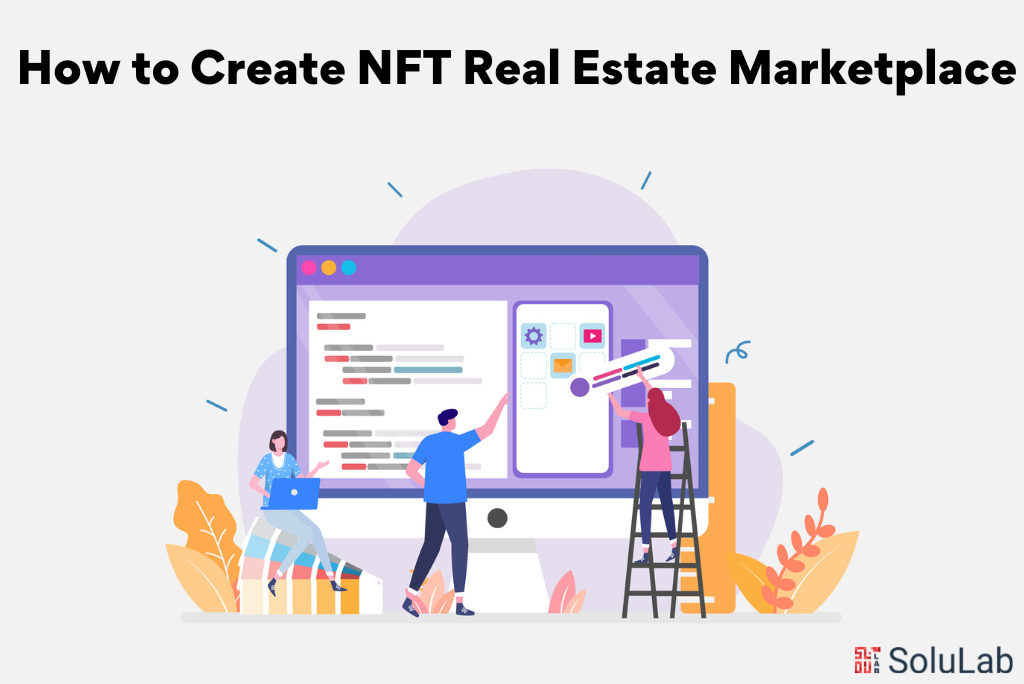
How to Create NFT Real Estate Marketplace

Requirement of Analysis

Business owners looking to establish a real estate marketplace must be aware of the client’s basic needs. These needs can be specified from the perspectives of investors, business partners, traders, NFT specialists, and qualified NFT real estate buyers. A more individualized marketplace will increase your chances of success. A proper NFT real estate marketplace must include a smart listing & bid interface that can handle heavy traffic volumes.

Market Research

An NFT in real estate is the ideal fusion of several technological possibilities. As blockchain technology advances, new market trends in technology emerge. An NFT marketplace development organization is now in charge of creating solutions that call for constant improvement. For companies offering NFT marketplace development services, industry research, periodicals, journals, and other educational tools can be beneficial. You can use this information to create highly personalized, scalable, and forward-looking NFT solutions.

Product Discovery

Once you’ve decided what you want to sell, it’s time to consider if the market or your intended audience will be satisfied. During this phase of product discovery, you can examine the potential of the real estate marketplace, as well as its key features and end goal. Clients can also use advanced prototype tools during this phase to view their production in real-time. In addition to being visually described, the user may also gather consumer insights in order to propose solutions and enhance the functionality of the product. A crucial part of the total procedure is this step. Based on the product, we can establish a fair management and development plan.

Design

After you have a product structure available, you can create an appealing marketplace design that will help your users interact with your product. To make your product user-ready for a variety of audiences, you should adhere to a multilateral product design strategy focusing on varied criteria. A strong design will rapidly convert viewers into potential buyers. In a busy interface, a fully functional NFT marketplace will be able to comprehend the most complex requests. To create an appealing and useful design, you will need a skilled group of NFT marketplace developers who can draw on their understanding of product design, the NFT real estate industry, and your target audience.

UI Development 

A completely functional interface for an NFT marketplace can be created during this stage. The functionalities can be incorporated into the fully working interface by both the NFT marketplace developers using the fundamental framework & programming languages to achieve the goals. Engaging UI developers that have a good understanding of the NFT market and who can materialize an appropriate product utilizing project documentation and design concepts is preferred. To build an NFT real estate marketplace, you will require the following technological resources: 

  • All of your data can be kept and utilized on a cloud network rather than on a server thanks to cloud storage. This provides you the freedom to both expand and restrict your operations in order to produce a seamless and comprehensive NFT offering. The APIs, web portals, & mobile applications that the cloud infrastructure offers are appropriate for automating and controlling solutions.
  • You can create a clever, secure, and safe environment for managing various data scopes with the aid of a proper DBMS. The idea is that there shouldn’t be any restrictions on the sustainability and dependability of data in an NFT real estate marketplace.
  • A blockchain development business may craft an engaging frontend and a potent backend that produce a customer-focused NFT marketplace using a variety of frameworks, computer languages, and scripts. The three main technologies utilized to create an NFT real estate marketplace are React.js, Express.js, and Node.js. To store NFTs, utilize a blockchain. Blockchain implementation is necessary to ensure safe and efficient operation. The execution of protocols bound within an NFT marketplace is made possible by smart contracts. Blockchain applications are implemented using frameworks such as Drizzle, Ganache, & Truffle. On the blockchain, there are numerous NFT marketplaces such as Ethereum, Binance Smart Chain, Solana, Cardano, & Polygon. The developers will create the Smart Contract and distribute it to your marketplace.

Establishing Blockchain Ecosystem

Creating a blockchain ecosystem has the following goals:

  • Ensure robust functionality
  • Continually follow the process
  • Adapt to the product’s ambitious Blockchain objectives 

Interconnect a crypto Wallet

One of the most important prerequisites for a multi-featured NFT real estate marketplace is a crypto wallet. It supports cryptocurrency use and offers secure gas fee transmission on both ends. To execute secure and seamless transactions in a blockchain-enabled NFT marketplace, you will need a crypto-compatible wallet with the necessary capabilities. You can also use a cryptocurrency wallet application development business to produce a tailored crypto wallet created for your market.

Testing

The software that will be listed on the platform needs to have every little and major chained feature, functionality, interface, and NFT examined. You look at the design, development, and other components that go into making an all-encompassing NFT marketplace solution.

Deploy

Once you have a product, you must deploy it on the server effectively and securely. Smart Contracts and external resources will be combined into a single, deployable bundle.

Launch

You can launch your NFT real estate marketplace on a variety of platforms after Design and Development. There are numerous ways to present your product to such a big audience, including prospective customers, partners, and investors.

Conclusion

So where to buy NFT real estate, The real estate markets of the metaverse can now include physical assets, sometimes known as “blended” NFTs. Expert agents for virtual trading environments will soon be accessible. Due to their simplicity, these NFTs will likely be adopted in the future by both tech-savvy & geriatric users. Our blockchain experts at Solulab will provide you with cutting-edge technologies if you’re considering creating your own Real Estate NFT Marketplace.

Top 9 Real Estate NFT Marketplace Platforms

Top 9 Real Estate NFT Marketplace Platforms

Explore non-fungible token (NFT) real estate firms if you’re seeking a novel approach to investing in real estate. These platforms let investors buy and trade property tokens using blockchain technology. Since each token is distinct, it offers a safer investment than conventional real estate.

The top nft real estate marketplace will be covered in this post, along with some tips that might help you better comprehend this new investment possibility.

What are Non-Fungible Tokens or NFTs?

NFTs, or non-fungible tokens, are digital assets having distinct provenance that can only be established through known history here on the Ethereum blockchain. They are frequently employed for tracking & authenticating tangible assets, such as works of art or gaming components.

NFTs are becoming more and more well-liked because they provide a safer option to invest in digital assets inside the metaverse. NFT artwork, music, or other works cannot be reproduced, making them more valuable and far safer investments than conventional assets like equities and bonds, which are simple to counterfeit.

Investment in real estate NFTs has a number of benefits. Some of them are as follows: On the Ethereum blockchain, real estate NFTs are operated. Investments in real estate and transactions as NFTs are distinctive and less likely to be similar to other NFTs.

Advantages of Real Estate NFT Marketplace 

Flexibility 

You have the choice of placing your eggs inside your selected baskets using either an F-NFT or a conventional complete NFT. Additionally, you are free to trade, sell, or purchase property whenever you like. This also enables everyone, regardless of wealth or geography, to invest in real estate.

Do it yourself

There is no requirement that you use a real estate broker. With other investors, you can immediately purchase, sell, & trade any real estate NFTs.

Faster sales transactions. 

The procedure of purchasing NFT properties is quicker and involves less waiting. This is so because real estate NFTs use smart contracts, which automate numerous processes, making it a very effective way to acquire & sell a property.

Anyone can invest 

The benefit of NFTs in real estate is that anyone in the globe can buy an NFT property. The traditional real estate industry, which can be extremely exclusive for those who can afford a particular house, is in opposition to this.

Disadvantages of Real Estate NFT Marketplace 

Although investing in real estate as NFTs, whether it be actual or virtual, can be quite profitable, there are a few drawbacks to consider before making a significant investment. Some of them are as follows:

Volatile

You may not able to recoup the whole cost of purchasing your property when you sell it. You might not get the same profit from your investment as you had hoped for in the event that the value of the property drops.

Directly own the real NFT property

Regrettably, NFTs are not recognised as property titles under existing law. Since actual physical real estate cannot be immediately tokenized, the investor must hold the property through a legal corporation as a workaround.

Current laws 

As NFTs in real estate are still relatively new, many nations still lack the necessary education regarding real estate tokenization. Legal ownership following your digital acquisition of a property like an NFT may still be ambiguous, and institutions must yet find a way to keep up with this new technology to alter how deeds are recorded.

Buying real estate NFTs 

In contrast to real-world NFTs, online real estate NFTs might not be at risk in this regard. You could have to deal with unreported mortgages & unpaid real estate taxes after purchasing the property. When purchasing real estate, if you skip the usual due research, you can encounter more issues than you anticipated.

Read more: What is the Future of Crypto Real Estate?

Top 9 NFT Real Estate Companies

Although NFT real estate firms have only recently entered the market, they are already having a significant impact. The top 12 NFT real estate marketplaces to avoid are listed below:

1. Decentraland

A virtual environment called Decentraland was established in 2015. The primary goal of the game is to construct and amass property in the NFT virtual area known as “land,” which can be broken up into pieces. Mana, the cryptocurrency token with this new digital world order, is used to purchase these land plots.

You will have permanent ownership of the land as soon as you register, create your digital wallet, & buy your chunk. You are free to do what you want with your digital environment since you have total control over it. This involves constructing things, making games, or producing art. You can lease or sell your land to the other players if you don’t want to utilize it yourself.

2. Polka City

A ground-breaking technology called Polka City enables users to own virtual properties and make money. Due to the contract-based nature of these NFT assets, it is simple for you to create income that is paid out in the native POLC coin.

Starting Polka City is a rather simple process. You can select the investment type that best suits your preferences when you register for our real estate marketplace. Furthermore, no new blockchain wallet is required. Using your current Ethereum wallet, you can start making money at Polka City.

3. SuperWorld

SuperWorld is a marketplace for digital assets where you can make your world and generate money off of it. You can trade, buy, and sell various NFT pieces of land, which in the actual world have an area of about 100m by 100m, using its real estate platform. In your planet, a stadium that size would be appropriate for concertgoers to attend live performances.

You can get going with ease in SuperWorld. All you’ll need is a concept for your planet; no coding expertise or familiarity with blockchain technology is required. Here, you’ll have the chance to make money off of your property through, to mention a few, analytics, gaming, digital commerce, & e-commerce.

4. Cryptovoxels

It feels like entering a completely different reality when one enters the Cryptovoxels virtual world & metaverse. The NFT platform, which was established in 2018, is a virtual space where you may purchase land and create your own tiny planet anyway you choose. This implies that you can modify your so-called voxel pieces of land to develop a game, produce art, or even launch your own company. You can even sell your land to other competitors on the market if you become weary of it.

The intriguing thing regarding Cryptovoxels is you are able to explore the marketplace without an Ethereum wallet. You can customize your avatar and have a real customer experience with day & night cycles, weather, as well as other factors. You can purchase land on the NFT Platform, OpenSea, once you’re ready to do so.

5. Upland

In order to map the real estate market, Upland, a virtual land marketplace, employs real-world locations. As a result, users can exchange their gained lands for genuine US dollars. Through its in-game companies, Upland also enables players to interact with other gamers in order to make money and make new friends.

Inside this new virtual economy, you can make money in real estate by renting out your houses, charging admission fees to guests, or selling your property at a profit. You can also make money at Upland by starting your own business.

6. Somnium Space

Somnium Space is a groundbreaking new platform that was founded in 2017 and released in 2018. It will revolutionize gaming & virtual reality (VR). The business developed an open-source software platform based on the Ethereum Blockchain that enables the purchase and customization of virtual assets like vacant land, parks, and structures.

Users of Somnium Space can now own virtual reality (VR) assets, including avatars and digital commodities. Integrating programmatic advertising plugins that track engagement rates and conversion rates into the VR games, develops a new economy where makers can immediately monetize their work.

7. The Sandbox

is a cutting-edge virtual environment fueled by Ethereum blockchain technology where users may create custom video games from the ground up using commercially available or pre-built building pieces. You must utilize $SAND, the platform’s utility token, and money, to purchase real estate and other assets via their marketplace.

Being able to construct virtual experiences like dioramas & games and place items like buildings, cars, or furniture gives purchasing land on Sandbox a lot of options. You have the ability to create Estates on this site if you own land.

8. Omni-PSI

A cutting-edge, ground-breaking new platform called Omni-PSI was developed in collaboration with OMNI Real Estate Group & Passive Income and released last year. It is said to be the first fractional real estate NFT marketplace platform in the world, allowing sellers and buyers of tokenized property to buy fractionalized assets—assets that are parts of properties rather than complete ones. Through their NFT marketplace, Omni-PSI collects money through their sales procedure. They buy the lot & rent it out after they hit a hard cap price particular to the property. Based on the number of shares each fractional NFT owner has, they each receive a portion of the rent that these renters pay.

9. Fraction

Fraction is a brand-new real estate company operating on the Ethereum blockchain that has obtained the necessary Thai SEC authorization. Including its $150 minimum purchase requirements to buy even a portion of an upscale real estate project, the company seeks to increase accessibility for everyone to invest in real estate. You can invest in a range of assets using Fraction’s plug-and-play platform, from tiny sums to private funds. This offers the benefit of demonstrating that the platform was created with your wants and objectives in mind.

Bonus: Propy

Propy is yet another shop for all of your real estate needs and is powered by Web3 Technology. They have everything covered, from discovering homes on their thorough list to owning them or even negotiating deals with sellers.

Propy debuted its NFT platform in the US last January 2022, enabling the purchase and sale of real estate as an NFT. The buyer can quickly access the legal paperwork proving ownership of the property by logging real estate transactions on the blockchain. It is important to understand that real-world property ownership is not fractional. They will acquire not only a Florida property but also a US-based company that holds title to the same land.

Conclusion

The methods by which we are able to use NFTs to invest in actual or virtual real estate will change while Ethereum blockchain technology develops. Even if its application in this sector is still very new and experimental, businesses and investors that share the vision already are starting to see NFTs’ potential as the real estate investments of the future. Institutions and people that are interested in participating in this developing field should monitor its progress and be ready to get involved when the right time comes.

This is a potential worldwide phenomenon waiting to happen with more time, knowledge, and understanding of what NFTs are, how they really operate, and the risks and laws surrounding both physical and virtual characteristics.
