Talk to an Expert

NFTs and DeFi: Powering a New Era of Gaming Economics

NFTs and DeFi A New Era of Gaming

In today’s rapidly evolving digital landscape, two revolutionary concepts have emerged to redefine the way we perceive ownership, value, and participation: Non-Fungible Tokens (NFTs) and Decentralized Finance (DeFi). While NFTs have sparked a craze in the art world by transforming unique digital assets into tradable commodities, DeFi has been disrupting traditional finance by ushering in decentralized financial systems. But what happens when these two powerful forces intersect? 

This blog delves into the exciting convergence of NFTs and DeFi, exploring how they are reshaping the new era of gaming economics and the broader digital economy. So, let’s get started!

The Intersection of NFTs and DeFi

The intersection of NFTs (Non-Fungible Tokens) and DeFi (Decentralized Finance) represents a groundbreaking fusion of technologies that promise to revolutionize how we perceive, trade, and utilize digital assets. Let’s delve deeper into this fascinating convergence:

  • NFTs Redefining Ownership: NFTs, as unique digital tokens, have enabled the representation of ownership in the digital realm like never before. In the context of gaming, this means that in-game assets, characters, skins, and more can be tokenized as NFTs, endowing players with true ownership. This, in turn, unlocks new economic opportunities as gamers can buy, sell, and trade their virtual items, thus creating a real market for digital collectibles.
  • DeFi’s Decentralized Financial Infrastructure: DeFi, on the other hand, has ushered in a decentralized financial ecosystem that operates without intermediaries like banks. DeFi ecosystem protocols leverage blockchain technology to create trustless systems for lending, borrowing, trading, and yield farming. This has enormous implications for gaming, as it allows for decentralized marketplaces for in-game assets, providing players with the ability to trade with greater autonomy and reduced fees.
  • NFTs as Collateral: One of the most intriguing aspects of this intersection is the concept of using Non-Fungible Tokens (NFTs) as collateral within DeFi. Gamers can lock up their valuable NFTs as collateral to secure loans or earn interest. This not only provides liquidity to gamers but also introduces a dynamic where in-game assets can be leveraged in the broader financial ecosystem.
  • Decentralized Exchanges for NFTs: The rise of decentralized exchanges (DEXs) specifically designed for NFTs further exemplifies this intersection. These DEXs allow users to seamlessly trade NFTs, often with minimal fees and without the need for intermediaries. This enhances liquidity in the NFT market, making it easier for gamers to buy, sell, and speculate on virtual items.
  • Fractionalization and NFT Pools: DeFi introduces the concept of fractional ownership of assets, and this is now being applied to NFTs. Gamers can collectively own NFTs through NFT pools or fractionalization, which is a game-changer in terms of access and investment in high-value virtual assets.

The fusion of NFTs and DeFi isn’t just a technological novelty; it’s altering the very fabric of digital economies, particularly in gaming. It’s paving the way for new economic models that allow gamers to monetize their skills and investments in virtual worlds, developers to fund projects in innovative ways, and investors to explore new horizons in asset ownership and trading. As we delve further into this blog, we’ll see how this intersection is catalyzing the “play-to-earn” phenomenon and redefining the gaming landscape in profound ways.
NFT Game Development Services

The Significance of Gaming in the Digital Economy

Gaming has ascended from a form of entertainment to a colossal industry that now plays a central role in the digital economy. With a market value surpassing $200 billion, it has outgrown traditional entertainment sectors and is becoming a dominant cultural force. Beyond its financial prowess, gaming is a wellspring of innovation, influencing technological advancements, from cutting-edge graphics and processing power to the development of virtual and augmented reality. These innovations often find applications in fields far beyond gaming, making it an essential driver of broader technological evolution.

Furthermore, gaming’s impact extends into the realms of education, social connection, and entrepreneurship. Gamification and serious games are transforming the way we learn and develop skills, while gaming’s capacity to foster social communities, friendships, and support networks is strengthening its social significance. The rise of content creators and streamers, drawing vast audiences on platforms like Twitch and YouTube, showcases how gaming has created new economic opportunities, leading to digital entrepreneurship. As the concept of the metaverse gains ground, gaming stands at the forefront, providing the infrastructure and user base for this connected digital universe. In essence, gaming is no longer confined to a screen; it is a driving force shaping the very fabric of the digital economy.

NFTs in Gaming

NFTs, or Non-Fungible Tokens, have taken the digital world by storm, and the gaming industry is no exception. To understand their impact, it’s crucial to grasp the concept of NFTs.

NFTs are fundamentally digital assets that indicate ownership of a one-of-a-kind object or piece of information. The non-fungibility of NFTs distinguishes them from regular cryptocurrencies such as Bitcoin or Ethereum. In other words, each NFT is one-of-a-kind, making it impossible to interchange with other tokens on a one-to-one basis. This uniqueness is made possible through blockchain technology, which records and verifies the authenticity of these digital assets.

How NFTs are Used in the Gaming World?

The gaming industry has seamlessly integrated NFTs into its ecosystem, offering players unprecedented opportunities and experiences. Here are some key ways in which NFTs are transforming the gaming landscape:

  • Ownership of In-Game Assets: NFTs allow gamers to have true ownership of in-game items, characters, skins, and other digital assets. Previously, players merely had a license to use these items within the game, but NFTs enable them to buy, sell, and trade these assets as they would physical collectibles.
  • Scarce and Valuable Items: Just like rare physical collectibles can be highly valuable, NFT-based in-game items can be scarce and desirable. Gamers often seek out limited-edition NFT items, which can appreciate in value over time.
  • Interoperability Between Games: Some NFTs are designed to be interoperable, meaning they can be used across multiple games and virtual worlds. This creates exciting possibilities for cross-game economies, where your sword from one game could be used in another.
  • Player-Generated Content: Gamers can create and sell their content as NFTs. This empowers creators to monetize their creations and gives players a sense of involvement in the gaming universe.
  • Provably Rare Collectibles: NFTs provide transparency in proving the rarity and authenticity of collectibles. This can be especially appealing to collectors and investors in the gaming world.

Overall, NFT in gaming has evolved from being a mere novelty to a fundamental component of the industry. They grant players greater control over their gaming experiences and open up a world of possibilities for virtual economies and creativity.

DeFi in Gaming

Decentralized Finance (DeFi) has emerged as a game-changing force in the financial sector. It’s a system that aims to decentralize traditional financial services, enabling peer-to-peer transactions, removing intermediaries, and promoting transparency. DeFi operates on blockchain technology, similar to cryptocurrencies like Bitcoin and Ethereum. However, it goes beyond digital currencies to offer a wide range of financial services, including lending, borrowing, staking, yield farming, and more.
The Integration of DeFi With Gaming

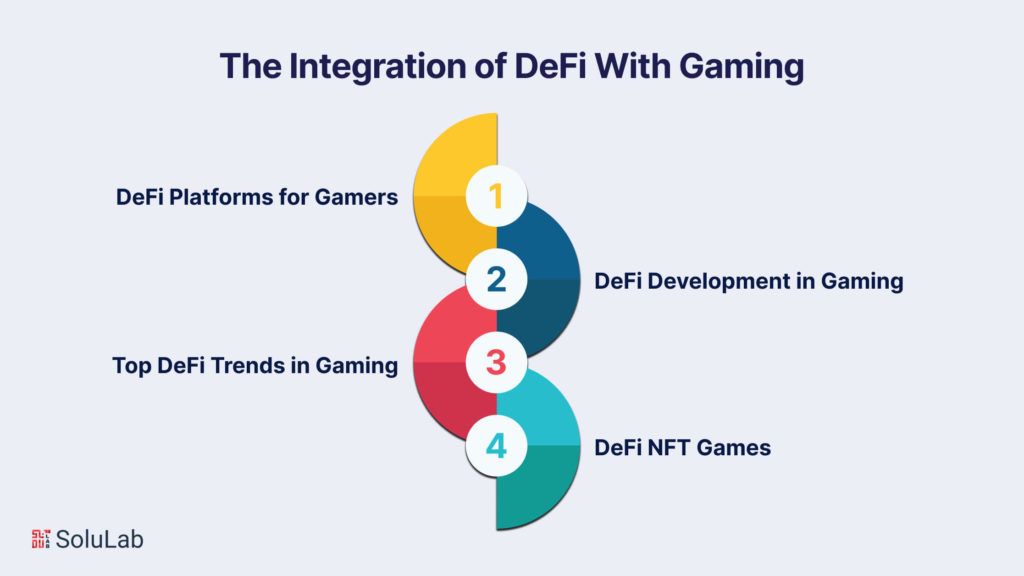
The Integration of DeFi With Gaming

In recent years, the gaming industry has begun to realize the potential of integrating DeFi into its ecosystem. This convergence of DeFi and gaming is creating exciting new opportunities for players and developers alike. Here’s how these two worlds are coming together:

  • DeFi Platforms for Gamers: DeFi platforms are being customized to cater to gamers. These platforms offer services such as in-game asset lending, borrowing, and yield farming. Gamers can earn rewards and income by participating in DeFi activities within the gaming ecosystem.
  • DeFi Development in Gaming: Game developers are incorporating DeFi development features into their games, making in-game economies more decentralized. For instance, players can lend their in-game assets to others and earn interest through smart contracts, similar to traditional DeFi lending.
  • Top DeFi Trends in Gaming: Games that leverage DeFi often follow the top trends in the DeFi space. This can include liquidity pools, decentralized exchanges, governance tokens, and more. Gamers can actively participate in these trends, potentially reaping financial benefits from their in-game activities.
  • DeFi NFT Games: The combination of DeFi and NFTs has given rise to DeFi NFT games. These games often feature NFTs that represent in-game assets or characters, which can be used in DeFi activities. Players can trade these NFTs or use them as collateral for loans.

Benefits of Decentralized Finance for Gamers

The integration of DeFi with gaming brings several benefits to players:

  • Financial Freedom: Gamers gain more control over their in-game assets and the ability to monetize them. They can earn income, trade assets, and participate in various DeFi activities.
  • Cross-Game Economies: DeFi allows gamers to use their assets across different games and platforms. This cross-game interoperability creates opportunities for building diversified in-game portfolios.
  • Transparency and Security: DeFi operates on blockchain technology, providing transparency and security. Players can trust the integrity of in-game transactions and DeFi activities.
  • Community Engagement: DeFi and gaming often involve active communities. Gamers can collaborate on governance decisions, stake tokens in their favorite games, and actively participate in shaping the gaming experience.

The integration of DeFi and gaming holds immense promise for the gaming industry. As DeFi lending platforms and DeFi NFT games continue to evolve, gamers can expect more opportunities to participate in decentralized finance while enjoying their favorite virtual worlds.
How NFTs and DeFi Complement Each Other in Gaming?

NFTs and DeFi Complement Each Other in Gaming

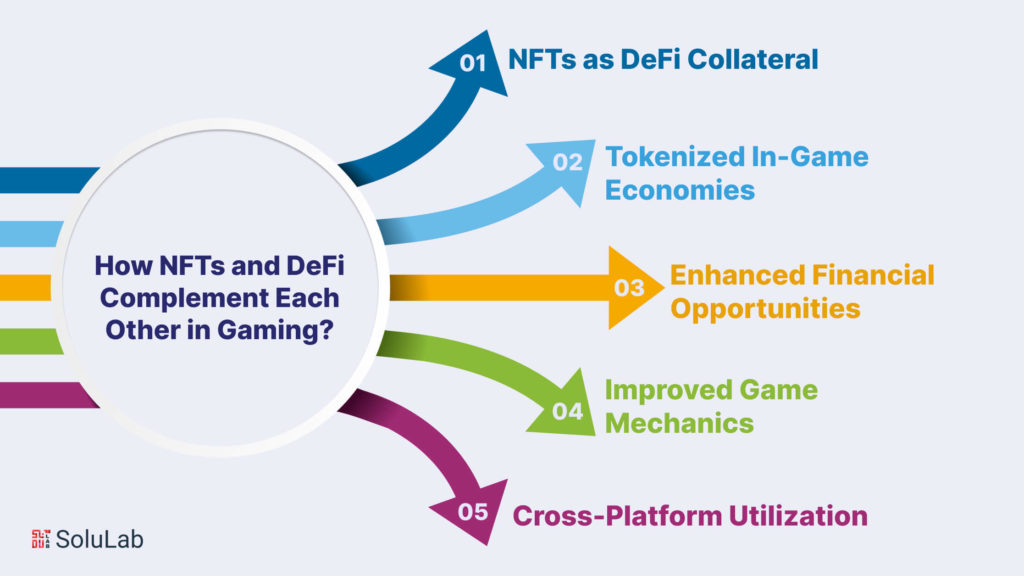
The synergy between Non-Fungible Tokens (NFTs) and Decentralized Finance (DeFi) in the gaming sphere is proving to be a game-changer. Their combination creates a potent force, unlocking a new dimension of possibilities for both players and developers.

  • NFTs as DeFi Collateral: NFTs serve as unique digital assets, providing authenticity, ownership, and scarcity. When these NFTs are used as collateral within the DeFi ecosystem, gamers can leverage their valuable in-game assets to access DeFi services like borrowing, lending, and yield farming. For instance, players can lock their rare in-game NFTs into smart contracts to secure loans or earn interest, all without losing possession of the assets.
  • Tokenized In-Game Economies: NFTs allow in-game items, characters, or land to be tokenized and authenticated on the blockchain. When these NFTs are integrated into DeFi protocols, they can become tradeable assets or staking instruments. This tokenization within DeFi platforms allows for the creation of robust in-game economies, where players can trade, lend, or stake their NFTs for additional value or rewards.
  • Enhanced Financial Opportunities: The fusion of NFTs and DeFi opens doors to new financial opportunities within gaming. Gamers can potentially earn passive income by staking their NFTs, lending rare in-game items, or participating in liquidity pools formed around these NFTs. Additionally, these integrated systems allow for the development of sophisticated gaming economies, where NFT-based assets can earn yield, further incentivizing players.
  • Improved Game Mechanics: DeFi’s concepts, such as decentralized governance, yield generation, and liquidity provision, can add intricate and rewarding mechanics to games using NFTs. Smart contracts can govern in-game economic models, offering players the chance to participate in community-based decision-making and gain from their contributions to the game ecosystem.
  • Cross-Platform Utilization: The amalgamation of NFTs and DeFi can transcend individual games, enabling players to use their NFT assets or earnings across multiple gaming platforms. This cross-platform utility empowers gamers to explore diverse gaming experiences while maintaining the value of their digital assets within the broader gaming ecosystem.

The seamless integration of NFTs and DeFi in gaming illustrates their mutual enhancement. As NFTs bring unique ownership and authenticity, DeFi amplifies these assets’ utility, turning them into active components of a decentralized financial ecosystem within the gaming world. This combination not only expands financial possibilities for players but also enriches the gaming experience as a whole.

Benefits for Gamers

Gamers are at the forefront of the NFTs and DeFi revolution within the gaming industry. The convergence of these technologies offers a plethora of benefits that empower players in exciting and innovative ways.

1. Ownership of In-Game Assets

One of the most notable advantages for gamers is the newfound ownership of in-game assets. Traditionally, players merely had a license to use digital items within a game. With NFTs, they gain true ownership of these assets. Whether it’s a rare sword, a unique character skin, or a parcel of virtual land, gamers can securely claim their digital possessions. NFTs serve as irrefutable proof of ownership, are recorded on the blockchain, and can be bought, sold, or traded like physical collectibles. This empowers players with a sense of agency over their in-game assets, which can be appreciated in value over time.

2. Earning Opportunities Through Gaming

NFTs and DeFi provide gamers with unprecedented earning opportunities. Here’s how these technologies enrich the gaming experience:

  • Income from In-Game Activities: Gamers can earn income by engaging in in-game activities, such as completing quests, participating in competitions, or contributing to the virtual world’s development. The rewards for their efforts are often distributed in the form of NFTs or cryptocurrencies, which can be traded or staked within DeFi platforms for additional income.
  • NFT Game Development Services: For creative gamers, NFT game development services have opened up avenues to design, develop, and monetize their virtual creations. By developing their games or NFT-based assets, gamers can generate income by selling them to other players or collectors.
  • Collateral for DeFi Loans: Gamers can use their valuable NFTs as collateral to secure loans within the DeFi ecosystem. This allows them to unlock liquidity while still retaining ownership of their prized in-game assets.
  • Trading and Speculation: NFTs can be traded on various marketplaces, and their values can be appreciated over time, particularly if they are rare or have historical significance in the gaming world. Gamers can invest in NFTs or speculate on their value, turning their gaming hobby into a source of potential financial growth.

3. NFT Game Development Companies

As NFTs and DeFi continue to gain traction, a burgeoning ecosystem of NFT game development companies is emerging. Gamers can benefit from this trend in various ways. They can collaborate with these companies to create and monetize their game assets or explore new gaming experiences crafted by these developers.

In essence, the combination of NFTs and DeFi not only enhances the gaming experience but also transforms it into a realm of financial opportunities and ownership rights. Gamers are no longer mere participants; they are now empowered creators and investors in the evolving world of NFT-based games and decentralized finance.
Challenges and Concerns in Implementing NFTs and DeFi in Gaming

Challenges and Concerns in Implementing NFTs and DeFi in Gaming

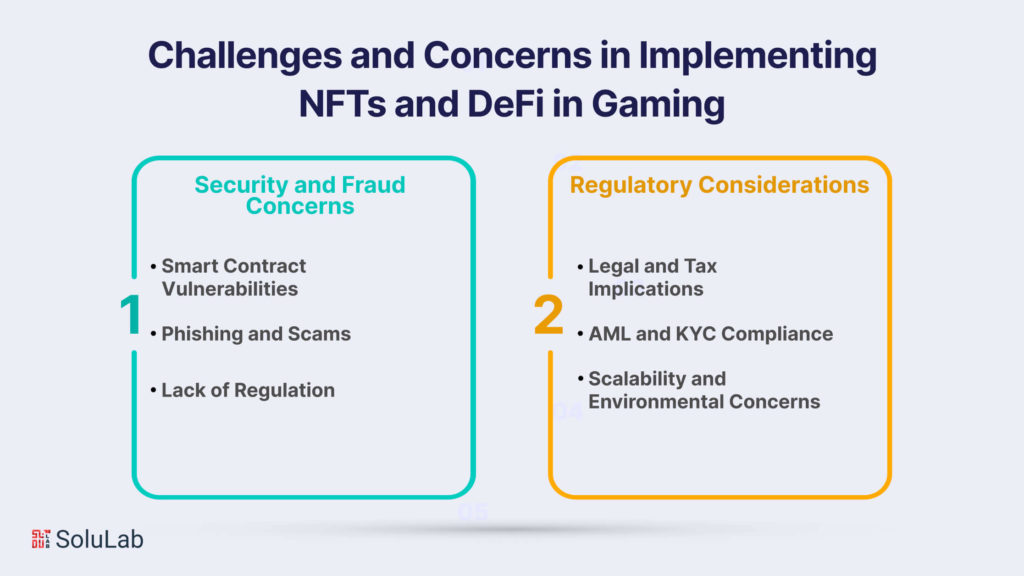
While the integration of NFTs and DeFi in gaming presents a myriad of exciting possibilities, it also comes with its share of challenges and potential risks that both players and developers should be aware of. Here, we delve into some of these concerns:

1. Security and Fraud Concerns

  • Smart Contract Vulnerabilities: NFTs and DeFi are built on smart contracts, which are not immune to vulnerabilities or exploits. Malicious actors can find and exploit weaknesses in these contracts, potentially resulting in financial losses for gamers. It’s crucial to conduct thorough audits of smart contracts and keep them up to date to mitigate these risks.
  • Phishing and Scams: The relatively new nature of NFTs and DeFi has attracted opportunistic scammers. Gamers may encounter phishing attempts, fake NFT marketplaces, or fraudulent DeFi platforms. Staying vigilant and using reputable services are essential precautions.
  • Lack of Regulation: The decentralized nature of DeFi and NFTs often means a lack of oversight and regulation. While this offers freedoms, it also leaves the space vulnerable to fraudulent schemes, rug pulls, and other illicit activities. As a result, investors and players are urged to do their due diligence before participating in any project or transaction.

2. Regulatory Considerations

  • Legal and Tax Implications: The intersection of NFTs, DeFi, and gaming introduces complex legal and tax questions. Different jurisdictions may have varying definitions of NFTs, cryptocurrencies, and their implications for taxation. Gamers should be aware of their responsibilities regarding the acquisition, sale, and use of NFTs, as well as DeFi activities.
  • AML and KYC Compliance: Anti-Money Laundering (AML) and Know Your Customer (KYC) regulations may come into play when using DeFi platforms or engaging in large NFT transactions. These requirements can impact the anonymity that many users in the crypto space value. As regulations evolve, users must adapt to stay compliant.
  • Scalability and Environmental Concerns: DeFi and NFTs, particularly those built on the Ethereum blockchain, have faced challenges related to scalability and high gas fees. These issues can affect the usability and affordability of gaming within these ecosystems. Additionally, the environmental impact of blockchain technology, notably proof-of-work blockchains, raises sustainability concerns.

It’s important for gamers and developers to navigate these challenges with a combination of vigilance and responsible usage. Staying informed, practicing due diligence, and adhering to the best security practices can help mitigate risks and foster a safer and more robust ecosystem for NFTs, DeFi, and gaming. Furthermore, as the regulatory landscape continues to evolve, staying compliant with relevant laws is paramount to ensure a seamless and secure experience.
Future Prospects of Implementing NFTs and DeFi in Gaming

Future Prospects of Implementing NFTs and DeFi in Gaming

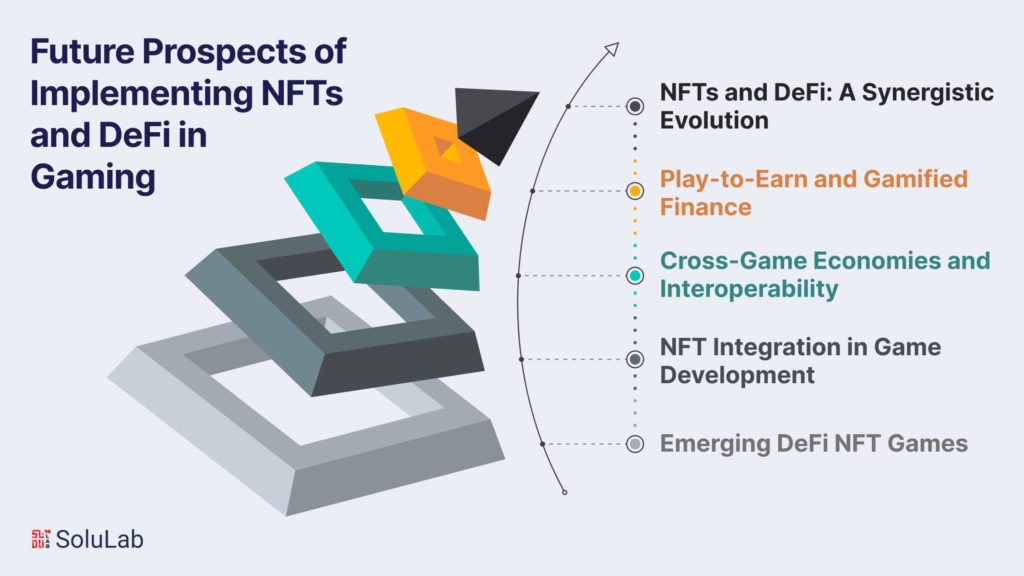
The future of the gaming industry is being dynamically shaped by the convergence of Non-Fungible Tokens (NFTs) and Decentralized Finance (DeFi). As these technologies continue to gain momentum, their impact on gaming is expected to be transformative.

  • NFTs and DeFi: A Synergistic Evolution

The synergy of NFTs and DeFi in gaming is anticipated to deepen. NFTs offer unique ownership of in-game assets, while DeFi provides a robust financial ecosystem. This combination is set to create even more complex and interactive in-game economies.

  • Play-to-Earn and Gamified Finance

The concept of “play-to-earn” is on the rise. Gamers can earn rewards, cryptocurrencies, and valuable NFTs by participating in games and DeFi activities. This gamified approach to finance may blur the lines between traditional gaming and financial services, offering players incentives to be more active within both ecosystems.

  • Cross-Game Economies and Interoperability

Cross-game interoperability will gain further prominence. Gamers will be able to use their NFT assets, such as characters, skins, or in-game items, across multiple games and platforms. This will lead to the development of comprehensive, cross-game economies where assets can be utilized seamlessly.

  • NFT Integration in Game Development

NFTs are expected to become an integral part of game development. Game studios may incorporate NFTs as core features, enabling players to have true ownership of in-game assets and making the creation of user-generated content more rewarding. NFT-based games are likely to proliferate, offering players new gaming experiences with the potential for financial benefits.

  • Emerging DeFi NFT Games

The emergence of DeFi NFT games, which integrate the principles of decentralized finance with NFTs, will continue to expand. These games often feature NFTs representing in-game assets that players can trade, stake, or use as collateral for loans. The synergy between DeFi and NFTs in gaming is expected to provide a growing array of financial opportunities for players.
DeFi Development Solutions

Concluding Remarks

In the entwined realms of gaming, Non-Fungible Tokens (NFTs) and Decentralized Finance (DeFi) have sparked a revolution. The fusion of these groundbreaking technologies is paving the way for a new era where players are not merely gamers but active participants in dynamic economies. The ownership of in-game assets, the prospect of earning through play, and the amalgamation of finance with gaming experiences are reshaping how we perceive digital entertainment. However, amidst the promises of this synergy, challenges like security concerns and regulatory ambiguities loom, requiring vigilance and adaptation from gamers and developers alike.

The future of NFTs and DeFi in gaming is as promising as it is transformative. As these technologies continue to evolve, the gaming landscape is on the brink of a monumental shift, where the traditional boundaries between gaming and financial ecosystems are blurring. The potential for cross-game economies, player-centric game development, and emerging DeFi NFT games point to a future that’s not just about entertainment but also about financial empowerment within gaming. Yet, in this burgeoning era of possibilities, education, caution, and adaptability are keys to embracing the revolution responsibly.

At SoluLab, as an NFT game development company and a DeFi development company, we stand at the forefront of integrating NFTs and DeFi into gaming experiences. Our expertise lies in delivering innovative solutions that bridge the realms of gaming and these transformative technologies. With tailored NFT game development services, pioneering DeFi integrations, and a commitment to pioneering the future of gaming, we invite you to take the first step toward this groundbreaking journey. Join us in crafting immersive gaming experiences that redefine ownership, finance, and the thrill of gaming. Contact us today and let’s redefine gaming together!

FAQs

1. What are NFTs, and how do they work in gaming?

NFTs, or Non-Fungible Tokens, are digital assets that represent unique ownership of items, characters, or in-game content. In gaming, NFTs allow players to truly own their in-game assets, which can be bought, sold, and traded. Each NFT is verifiably unique and is typically recorded on a blockchain, ensuring the authenticity and scarcity of the asset.

2. How do gamers earn money through NFTs and DeFi in gaming?

Gamers can earn money by participating in play-to-earn games that reward them with cryptocurrencies, NFTs, or other valuable in-game assets. They can also earn by lending their NFTs within DeFi platforms, staking assets, or creating and selling NFT-based game content. The combination of NFTs and DeFi opens up numerous opportunities for players to monetize their gaming activities.

3. Are there security risks involved with NFTs and DeFi in gaming?

Yes, there are security risks, including smart contract vulnerabilities, phishing scams, and a lack of regulation. It’s essential for players to be cautious and conduct due diligence when interacting with NFTs and DeFi platforms. Using reputable services, keeping software up to date, and staying informed about potential risks are vital precautions.

4. How do NFTs and DeFi impact traditional game development?

NFTs are transforming traditional game development by allowing players to own in-game assets and creating a new dimension of player involvement. Game studios are integrating NFTs into their games, incentivizing user-generated content, and making game economies more player-centric. DeFi is also being incorporated into game mechanics, enhancing financial opportunities for players.

5. What is the role of SoluLab in implementing NFTs and DeFi in gaming?

SoluLab specializes in NFT game development services and the integration of DeFi in gaming experiences. We work with game developers to create innovative solutions that leverage the power of NFTs and DeFi. If you’re looking to harness the potential of NFTs and DeFi in your gaming projects, SoluLab is your trusted partner for pioneering the future of gaming. Contact us today to start redefining gaming and finance together.

How Non-Fungible Tokens Are Changing the Digital World?

How Non-Fungible Tokens Are Changing the Digital World?

In recent years, the digital landscape has witnessed a transformation that has left the world in awe. A new wave of innovation and disruption has swept through the realms of art, entertainment, real estate, and more, reshaping the way we perceive and interact with the digital world. Non-Fungible Tokens (NFTs), heralded as the future of digital ownership and representation, have played an instrumental role in this paradigm shift. NFTs have transcended the boundaries of traditional digital assets and have introduced a concept that is poised to redefine the very essence of ownership, authenticity, and value in the virtual realm. This phenomenon is not merely a passing trend but a substantial force that is rewriting the rules of the digital world. In this blog, we will explore how Non-Fungible Tokens are leaving an indelible mark on the digital landscape, ushering in a new era of possibilities and reshaping the way we perceive, create, and trade in the digital space.

Understanding NFTs

The advent of Non-Fungible Tokens (NFTs) has brought about a transformative shift in the digital world. To grasp the full extent of their impact on the digital realm, it is essential to delve into the fundamentals of NFTs, understanding what makes them unique, how they are created, and the implications for ownership and authenticity.

A. What Makes an NFT Unique?

NFTs derive their uniqueness from their cryptographic properties and the underlying blockchain technology. Unlike traditional digital assets, NFTs are indivisible, irreplaceable, and cannot be exchanged on a one-to-one basis. Each NFT is a distinct entity with a specific digital signature, making it impossible to forge or replicate. This uniqueness is at the core of NFTs’ value proposition in the digital world.

The impact of NFTs on the digital world is profound in the way they confer ownership and authenticity to digital content. Artists, creators, and even individuals can mint NFTs to represent digital art, music, videos, and virtual assets, establishing a sense of ownership that was previously elusive in the digital realm.

B. How are NFTs Created?

The process of creating NFTs is a testament to the revolutionary power of blockchain technology. NFTs are generated through a process called minting, which involves registering a digital asset on a blockchain. This process creates a unique token associated with the asset, effectively transforming it into an NFT.

The ownership and provenance of NFTs are stored securely on the blockchain, providing a transparent and immutable record of transactions. As a result, the creation and transfer of NFTs are not only secure but also entirely transparent, enhancing trust and authenticity in the digital world.

C. Ownership and Authenticity in the Digital Realm

The impact of NFTs on the digital world extends to the concepts of ownership and authenticity. Prior to NFTs, establishing ownership and proving the authenticity of digital assets were significant challenges. NFTs provide a solution to these issues by allowing creators and buyers to assert ownership with confidence.

Ownership of NFTs is cryptographically verified and recorded on the blockchain, eliminating doubts about the legitimacy of ownership claims. This has profound implications for artists, creators, and collectors, who can now monetize their digital works with a sense of security that was previously unattainable.

In essence, NFT in the digital world has transformed by introducing a novel, secure, and transparent method of asserting ownership and authenticity for a wide range of digital assets. This newfound assurance has opened up exciting possibilities for creators, collectors, and investors, reshaping the way we interact with and perceive the value of digital content.

CTA1

NFTs in Art and Creativity

The world of art and creativity has been profoundly impacted by the emergence of Non-Fungible Tokens (NFTs). Here, we explore how NFTs have revolutionized this space, serving as a game-changer for digital artists while also making significant waves in traditional art markets.

A. NFTs as a Game-Changer for Digital Artists

Digital artists, who have long grappled with the challenge of proving ownership and authenticity of their creations, have found a lifeline in NFTs. NFTs provide a groundbreaking solution, enabling artists to mint their digital works as unique tokens on blockchain platforms.

This development has been nothing short of revolutionary. Digital artists can now attach a sense of rarity and ownership to their creations, allowing them to sell their art directly to a global audience. With NFTs, artists have the potential to earn royalties every time their work is sold or traded on NFT marketplaces.

The impact of NFTs on the digital world in the realm of art is immense. It has democratized the art world, breaking down traditional barriers to entry and recognition for digital artists. Through NFTs, artists can gain more control over their work and financial opportunities they may have struggled to find in the past.

B. Impact on Traditional Art Markets

The emergence of NFTs has not only transformed the digital art landscape but also made waves in traditional art markets. This disruption stems from the growth of NFT marketplaces and the way they have reshaped the dynamics of buying and selling art.

NFT marketplaces, such as OpenSea, Rarible, and SuperRare, have become the platforms of choice for trading NFT art. NFT marketplace development and features have made it easier for artists to mint NFTs, connect with collectors, and secure the value of their digital creations. As NFT marketplaces have matured, they have provided a seamless bridge between digital and traditional art markets, enhancing accessibility and liquidity for art buyers and sellers.

The art world has had to adapt to this evolving landscape. Traditional art institutions and galleries are increasingly exploring partnerships with NFT marketplaces to connect with a broader, tech-savvy audience. As a result, the impact of NFTs on the digital world is not confined solely to the digital realm but extends its influence to the broader art industry.

In brief, NFTs have ushered in a new era of possibilities for artists and collectors alike. They have democratized the art world, providing digital artists with opportunities and control, while also disrupting traditional art markets and opening doors for collaboration and innovation. The NFT marketplace development services have played a pivotal role in these transformations, reshaping how we perceive and engage with art in the digital age.

NFTs in the Gaming Industry

NFTs in the Gaming Industry

The gaming industry has been significantly impacted by the introduction of Non-Fungible Tokens (NFTs), leading to novel experiences and economic opportunities for both players and developers. Here, we explore the integration of NFTs into video games, ownership and tradability of in-game assets, and how NFTs have given rise to the “play-to-earn” model.

A. Integration of NFTs into Video Games

Traditionally, in-game assets like skins, weapons, and character outfits were owned by the game developers, limiting players’ control over their investments. With the advent of NFTs, these assets can now be tokenized and owned by players as verifiable digital possessions. Game developers are leveraging blockchain technology to create unique NFTs representing these in-game items.

This integration allows players to buy, sell, and trade their assets in a decentralized marketplace. These assets can be used across multiple games that support the same standards, providing players with a sense of ownership and control over their digital collections.

B. Ownership and Tradability of In-Game Assets

NFTs enable true ownership of in-game assets. Players have the freedom to trade, sell, or even lend their digital items, giving them a stake in the gaming ecosystem beyond their gameplay skills. This has led to a thriving secondary market for in-game assets, where players can monetize their investments by selling rare or sought-after items to other players.

Moreover, ownership of in-game assets becomes truly provable through the blockchain, reducing the risk of fraud or counterfeit items. The transparent and immutable nature of the blockchain ensures that the asset’s history and authenticity can be easily verified, making it a safe and trustworthy environment for players and collectors.

C. Gamers’ Experiences and the Play-to-Earn Model

NFTs pioneered the notion of “play-to-earn” in the gaming industry. Traditionally, gamers spent countless hours playing without direct financial gains. With NFTs, they can now accumulate valuable in-game assets that have real-world value. This shift has attracted a new audience of players who see gaming as a way to generate income.

In play-to-earn games, players can earn NFTs through gameplay, and these NFTs can be sold on marketplaces for cryptocurrencies or exchanged for other digital or real-world assets. This model has the potential to empower players, particularly in regions with limited economic opportunities, to earn a living by engaging in their favorite pastimes.

However, the play-to-earn model also comes with challenges, including concerns about the balance between gameplay and income generation, the potential for pay-to-win scenarios, and the need for regulations to protect players from exploitation.

In short, the integration of NFTs into the gaming industry has brought about a paradigm shift in the way players perceive and interact with in-game assets. The ownership, tradability, and play-to-earn model are transforming the gaming experience, opening new doors for both gamers and developers. As NFTs continue to evolve, they are likely to shape the future of gaming in ways that we have yet to fully explore.

NFTs in Real Estate and Virtual Land

The innovation of Non-Fungible Tokens (NFTs) extends beyond the realms of digital collectibles and gaming, venturing into the world of real estate and virtual land. This development brings forth the tokenization of real-world assets, virtual land ownership within metaverse platforms, and its potential impact on the real estate industry.

A. Tokenization of Real-World Assets

NFTs have paved the way for the tokenization of real-world assets, such as real estate properties. Tokenization involves breaking down physical assets into digital tokens, making them easily tradable and divisible. Through NFTs, individuals can hold digital ownership rights to specific portions or properties within the real estate market.

This tokenization opens up a range of possibilities, from enabling fractional ownership where multiple investors can hold shares in a single property to simplifying the process of buying and selling real estate. NFTs offer transparency and security by recording ownership and transaction history on a blockchain, reducing the need for intermediaries and enhancing trust in real estate transactions.

Real estate NFTs are often listed on NFT marketplaces, facilitating easy trade and providing a global platform for investors and buyers. Businesses and developers looking to engage in real estate tokenization can hire top NFT developers to create customized NFT marketplace development services that cater to their specific needs.

B. Virtual Land Ownership in Metaverse Platforms

Metaverse platforms, immersive virtual environments where people interact and socialize in digital spaces, have seen a surge in virtual land ownership through NFTs. Within metaverse worlds, parcels of virtual land are represented as NFTs, allowing users to purchase, develop, and trade virtual real estate.

Virtual land in metaverses serves various purposes, from creating digital businesses and virtual storefronts to hosting events and social gatherings. Some popular metaverse platforms include Decentraland, The Sandbox, and Somnium Space, where virtual land ownership has become a fundamental aspect of the user experience.

This development has encouraged businesses and entrepreneurs to invest in virtual land, further boosting the metaverse’s growth. Virtual landowners can develop their properties to generate revenue or simply hold them as digital assets with the potential for appreciation.

C. The Potential Impact on the Real Estate Industry

The integration of NFTs in real estate and virtual land ownership has the potential to disrupt the traditional real estate industry. Here are some of the potential impacts:

  • Accessibility: Real estate tokenization can lower the barriers to entry, making it possible for a broader range of investors to participate in real estate markets.
  • Efficiency: NFTs can streamline the buying and selling process by reducing paperwork and the involvement of intermediaries.
  • Globalization: NFTs enable cross-border investments, allowing investors to diversify their portfolios across different countries.
  • Liquidity: Fractional ownership and NFT-based real estate can increase liquidity, making it easier for investors to exit their positions.
  • Metaverse Integration: As virtual land ownership becomes more popular, the metaverse may emerge as a new dimension for real estate transactions and business opportunities.

In brief, NFTs have brought real estate into the digital age, offering new avenues for investment and diversification. The tokenization of real-world assets and virtual land ownership within metaverse platforms have the potential to revolutionize the real estate industry and redefine how we interact with both physical and digital properties. Businesses looking to leverage this trend can explore the services of top NFT developers to create their own NFT marketplace development solutions.

Challenges and Controversies

Challenges and Controversies

While Non-Fungible Tokens (NFTs) have gained significant attention and adoption, they are not without their share of challenges and controversies. In this section, we’ll explore some of the key issues that have emerged.

A. Scalability Issues and Network Congestion

One of the primary concerns associated with NFTs is the scalability of blockchain networks, particularly Ethereum. As NFTs gained popularity, they led to network congestion and increased transaction fees. The limited capacity of Ethereum and other blockchains has resulted in slow transaction times and high gas costs, making it less accessible for creators and collectors. These scalability issues have prompted discussions about the need for blockchain upgrades and the exploration of Layer 2 solutions to improve the overall NFT ecosystem.

Developers and blockchain communities are actively working on addressing these scalability challenges, but until a scalable solution is widely implemented, network congestion remains a significant hurdle for NFT enthusiasts.

B. Scams and Fraudulent Activities in the NFT Space

The rapid growth of the NFT market has attracted the attention of scammers and fraudsters. There have been instances of fake NFT listings, counterfeit art, and even fraudulent NFT marketplaces. These activities undermine trust in the NFT ecosystem and can lead to financial losses for unsuspecting buyers and creators.

It’s crucial for participants in the NFT space to exercise caution, conduct due diligence, and be aware of the risks associated with fake NFTs and deceptive practices. Emerging NFT marketplaces and services must implement rigorous verification and authentication processes to reduce the prevalence of scams.

C. Criticisms and Debates Surrounding NFTs

NFTs have sparked various criticisms and debates within the digital, artistic, and environmental communities. Some common criticisms include:

  • Environmental Concerns: The energy consumption associated with blockchain networks, particularly in the case of proof-of-work chains like Ethereum, has raised concerns about the carbon footprint of NFTs. These concerns have led to discussions about transitioning to more eco-friendly blockchain technologies.
  • Speculative Bubbles: Some argue that the NFT market has seen speculative bubbles, with overinflated prices for digital assets that may not hold long-term value. The concern is that this speculative behavior could lead to a market crash.
  • Exclusivity and Elitism: NFTs are seen by some as a means for wealthy individuals and celebrities to profit from their digital assets, leaving little room for emerging artists and creators. The question of whether NFTs are democratizing or exacerbating inequalities is a topic of ongoing debate.
  • Lack of Regulation: The lack of regulatory oversight in the NFT space has raised questions about consumer protection, copyright infringement, and legal challenges in case of disputes.

In response to these criticisms, the NFT community and industry are actively engaged in discussions about how to address these issues. This includes exploring more energy-efficient blockchain alternatives, promoting inclusivity supporting emerging artists, and advocating for responsible and ethical practices in the NFT space.

In conclusion, while NFTs have opened up new opportunities and possibilities, they are not immune to challenges and controversies. Addressing scalability, fraudulent activities, and criticisms are essential steps for the NFT ecosystem to mature and establish itself as a sustainable and responsible part of the digital world.

The Future of NFTs

Future of NFTs

As Non-Fungible Tokens (NFTs) continue to reshape various industries and capture the imagination of creators and collectors, it’s essential to consider what the future holds for this innovative technology. In this section, we’ll explore predictions for the NFT market, potential developments in NFT technology, and the evolving role of NFTs in the digital landscape.

A. Predictions for the NFT Market

The NFT market has shown remarkable growth, and its trajectory is likely to continue in the coming years. Here are some predictions for the NFT market:

  • Increased Adoption: NFTs are expected to see broader adoption in industries beyond art and gaming. Sectors like fashion, education, and healthcare may incorporate NFTs for provenance, authentication, and unique experiences.
  • Market Maturity: As the NFT market matures, we can anticipate increased regulation and standardization to address challenges related to fraud, copyright issues, and environmental concerns. This regulatory clarity may help build trust among users.
  • Interoperability: The development of cross-chain NFT solutions may promote interoperability between different blockchain ecosystems, making it easier for users to access and trade NFTs across multiple platforms.
  • Emerging Marketplaces: NFT marketplaces will continue to evolve, offering features such as social interactions, virtual exhibitions, and new ways to showcase and trade digital assets.
  • Secondary Market Growth: The secondary market for NFTs is expected to grow as collectors and investors seek opportunities for trading, flipping, and investing in digital assets. High-value NFTs may appreciate over time.
  • Diversity in NFT Types: New forms of NFTs, such as time-based NFTs, multi-chain NFTs, and NFTs representing real-world assets, will likely emerge, expanding the diversity of the market.

B. Potential Developments in NFT Technology

NFT technology is not static; it continues to evolve and expand its capabilities. Some potential developments include:

  • Scalability Solutions: Scalability issues will drive the development of Layer 2 solutions and the transition to more energy-efficient blockchains, reducing environmental concerns.
  • Enhanced Metadata and Utility: NFTs may become more programmable and dynamic, with metadata that can be updated, and NFTs can carry additional utility beyond ownership, such as granting access to exclusive content or experiences.
  • Deeper Integration with AI and AR: NFTs may be used in conjunction with artificial intelligence (AI) and augmented reality (AR) technologies, creating interactive and adaptive digital experiences.
  • Digital Identity and Authentication: NFTs may play a role in digital identity verification, helping to secure online interactions and protect users’ data and assets.
  • Smart Contracts and Royalty Automation: Smart contracts linked to NFTs will enable automated royalty payments to creators whenever their NFTs are resold, enhancing the fairness of the digital art market.

C. The Role of NFTs in the Evolving Digital Landscape

NFTs are poised to play an integral role in the ongoing transformation of the digital landscape:

  • Metaverse Development: NFTs will become foundational to metaverse environments, enabling users to own, create, and trade digital assets within these immersive virtual worlds.
  • Digital Economy Expansion: NFTs will extend beyond collectibles and art, infiltrating the digital economy as integral components in e-commerce, virtual real estate, and decentralized finance (DeFi) systems.
  • Empowering Creators: NFTs will empower creators and artists by providing more direct access to their audiences, bypassing intermediaries, and granting them greater control over their work and intellectual property.
  • Cultural and Social Impact: NFTs will continue to influence and shape cultural trends, art movements, and the ways we connect and interact in digital spaces.

In conclusion, the future of NFTs appears bright, with the potential for broader adoption, technological advancements, and a growing role in shaping the evolving digital landscape. As NFTs continue to mature, they will bring new opportunities and challenges, ultimately redefining how we perceive and interact with the digital world.

CTA2

Conclusion

In conclusion, the rise of Non-Fungible Tokens (NFTs) has ushered in a transformative era, reshaping how we interact with digital assets and the broader digital world. The impact of NFTs goes well beyond the creative and collectible realms, reaching into areas such as real estate, digital identity, and the metaverse. The emergence of NFT marketplace platforms and white-label NFT marketplace solutions has laid the foundation for a vibrant ecosystem where creators and collectors can connect, exchange, and create value in entirely new ways. These innovations have provided opportunities for entrepreneurs to explore and develop niche marketplaces tailored to specific industries and niches.

As we journey forward, the enduring significance of NFTs in the digital realm becomes more evident. The potential for NFTs to disrupt, innovate, and influence various facets of our digital lives is substantial. This is a world where the boundaries of ownership, creativity, and entrepreneurship are being redefined. It’s a world where opportunities for innovation are boundless, and where the role of NFTs in shaping the future of the digital landscape remains central. The NFT ecosystem continues to evolve, promising a future where the possibilities are as diverse as the digital assets themselves.

SoluLab, a leading blockchain and software development company, plays a pivotal role in the dynamic world of Non-Fungible Tokens (NFTs). As NFTs continue to transform the digital landscape, SoluLab has been at the forefront of innovation, offering NFT marketplace development solutions and white-label NFT marketplace services that empower businesses and entrepreneurs to explore the vast potential of this groundbreaking technology. With a strong commitment to blockchain technology, SoluLab is enabling clients to create custom NFT marketplaces that cater to specific industries and niches, ensuring they stay ahead in the rapidly evolving NFT ecosystem. Their expertise and dedication contribute to the enduring significance of NFTs, driving the digital realm toward a future that is more inclusive, innovative, and interconnected.

FAQs

1. What exactly is an NFT?

An NFT, or Non-Fungible Token, is a digital asset representing ownership or proof of authenticity of a unique item or piece of content, stored on a blockchain. Unlike cryptocurrencies like Bitcoin or Ethereum, NFTs are indivisible and each one has its own distinct value.

2. How can I create my own NFT?

To create your own NFT, you can use various NFT marketplaces like OpenSea, Rarible, or Mintable. You’ll need a digital wallet, connect it to a compatible marketplace, and then follow the platform-specific steps to mint your NFT. You’ll typically need to upload your digital content, set metadata, and determine any royalties for future resales.

3. Are NFTs environmentally friendly?

NFTs on certain blockchains, like Ethereum, have faced criticism for their environmental impact due to energy-intensive proof-of-work consensus mechanisms. However, the industry is actively exploring more eco-friendly solutions through the adoption of proof-of-stake blockchains and Layer 2 scaling solutions to mitigate these concerns.

4. How can NFTs be used in the real estate industry?

NFTs have the potential to revolutionize real estate by enabling the tokenization of property, making it easier to buy, sell, and trade real estate assets. They also offer fractional ownership opportunities, which can lower barriers to entry for real estate investment and make property ownership more accessible to a wider audience.

5. What are white label NFT marketplace solutions?

White label NFT marketplace solutions are customizable platforms provided by companies like SoluLab that allow businesses to create their own NFT marketplaces. They offer a pre-built infrastructure with the flexibility to be tailored to specific needs, industries, and branding, facilitating entrepreneurs and businesses in launching their NFT trading platforms more efficiently.

9 Best NFT Ideas and Examples 2025

Best NFT Ideas

After the enormous success in 2021, it seems doubtful that non-fungible tokens, or NFTs, would lose any of their appeal in the years to come. So that you can start an NFT business right now, we have put together a list of the top 9 NFT ideas and examples for you.

As everyone is aware, NFTs are pieces of art generated using Blockchain technology that has distinctive encryption codes that can be verified for ownership and authenticity. Anything from digital art to a song or an album could be considered the best nft art.

It is undeniable that NFTs are here to stay. To give you the most information to motivate you on your NFT adventure, we’ll strive to cover everything. In this post, we’ll discuss some of the most creative real-world NFT examples and the best and coolest NFTs ideas.

What are NFTs?

2021 has been a successful year for NFTs. The top NFT tokens were able to catch everyone’s attention in the business and consumer community globally thanks to record-breaking sales and ongoing print and electronic media coverage.

However, it continues to develop without any indications of slowing down. In 2021, OpenSea transacted $14 billion worth of business, which is 646 times as much as its sales of $21.7 million in 2020. Furthermore, Best NFTs art examples are used in industries including marketing, real estate, finance, and government.

Ever wonder what The New York Times, the NBA, Gucci, Paris Hilton, and Visa have in common? NFTs are to blame. It is now abundantly evident that there is no reasonable way to ignore non-fungible tokens in today’s dynamic environment.

After having stated that, it is time to jump right into the meat of this blog. Here is the whole list of the most original, creative, humorous, and best NFTs ideas.

9 Best NFT Ideas and Examples

1. Beeple’s “Everydays – The First 5000 Days”

It would be wrong to leave the amazing $69 million NFT auction off of the list of NFT inspirations. The NFT is a collection of five pieces of art that Beeple (Mike Winkelmann) has gathered daily since 2007 for 5,000 days. Winkelmann is still working on the project using the Octane and Cinema 4D programs.

It is the third most expensive piece of live artist art ever sold and the most costly NFT to date. The auction was conducted at the fine art auction house, and the artwork sold for $13,860 per piece.

2. CryptoPunks

NFTs are famous for their CryptoPunks. In 2017, Larva Labs created and distributed 10,000 CryptoPunk NFTs in the form of randomly generated coins that are redeemable with an Ethereum wallet. Resultantly, the value of CryptoPunks went way too high in the secondary market.

As of now, the cheapest CryptoPunk costs more than $100,000, and more than $1 billion CryptoPunks have been exchanged in the NFT series. A huge amount of money has been invested in CryptoPunks by Via, Odell Beckham, and Jay-Z.

3. Artificial Intelligence NFT

This NFT (iNFT) with artificial intelligence is built on the Ethereum Blockchain. Alice is the name of the character, and the more you converse with her, the more she learns and develops a personality. In her promotional film, she was questioned about how she felt about residing on the Blockchain.

Alice responds by saying she feels like a digital goddess and can assume any form she chooses. The business that built this NFT, Alethea AI, is prepared to continue the project and provide the groundwork for iNFTs in the future in light of the overwhelmingly positive feedback.

4. Paris Hilton’s Planet Paris

Paris Hilton has always been a devoted supporter of NFTs. NFTs have been the subject of articles by Hilton, TV program discussions, and even her own NFT series. Together with Blake Kathryn, she co-founded Planet Paris, a business that contains several quick movies that have made Hilton millions of dollars.

5. Louis Vuitton video game

In the premium market, exclusivity and brand recognition are essential components. There can therefore be nothing better for such a field than NFTs. Louis Vuitton entered the NFT market in a very distinctive way. They created a video game called Louis: The Game, in which players perform missions to locate NFTs that are concealed.

6. William Shatner’s memorabilia

William Shatner, a seasoned actor with more than 60 years of experience in the business, is well-known to everyone. In 2020, the actor formally unveiled a collection of his memorabilia in the form of NFTs that included a range of images taken throughout his illustrious career. In less than 10 minutes, more than 125,000 units were sold.

7. Nyan Cat GIF

The next contender on the list of amusing NFTs is “Nyan Cat GIF,” a beautiful example of original NFT art from the 2010s. On its tenth anniversary, the video’s creator turned it into an NFT to eventually auction it off. The price of the video, which was close to $852,300, shocked the entire world.

8. Cryptovoxels

Speaking of NFT ideas, next on the list is Cryptovoxels, a metaverse built on Blockchain that combines social networking, gaming, and business. The system is a user-driven virtual environment that utilizes the Ethereum Blockchain. The idea is something similar to Minecraft but incorporates a little bit of cryptocurrency. Users can construct art galleries, exchange land plots, and interact with other players.

9. The origins of the internet

In 1989, Sir Tim Berbers-Lee was the brains behind the creation of the World Wide Web. After 30 years, he made a staggering $5.4 million selling his initial 9,555 lines of source code as an NFT. The World Wide Web’s source code and various other items made by the creator were included in the Sotheby’s auction.

The selling is a display of pride and exclusivity rather than the buyer acquiring control of the internet. A significant portion of human history is now the buyers.

Examples of NFT art

While the ideas we covered above are fairly enough for the best nft ideas, there are some Other examples of NFT art you can consider if you want to separate out from the crowd. For instance, the blockchain-based artificial intelligence coin Alethea AI is an intelligent NFT (iNFT). These are one of the best coolest NFTs projects with a built-in AI personality that grows and learns as you interact with them. That seems really nice, doesn’t it?

On the other hand, you might investigate name registry services, other expanding market segment in the NFT industry. Shorter, simple-to-remember names associated with a crypto wallet can be registered using name registry services like ENS and Unstoppable Domains. By doing this, you can avoid dealing with the difficulties of a lengthy wallet address.

In addition, several businesses are increasingly utilizing AR technologies to develop distinctive NFTs. Consider Jadu Hoverboards, which are collectible hoverboards that can be used in The Mirrorverse, Jadu’s augmented reality game. You may even develop your own metaverse & AR cars if you’re interested in the technology.

Best NFTs that sell

You may get a good indication of what sells well as the coolest NFTs by taking a short glance at the most expensive NFTs in history. NFT art & collectibles are the undisputed winners. The two best-selling NFTs are The Merge by Pak & Everyday: The First 5000 Days by Beeple.

Similar to how it may be said that 2021 was dominated by NFT collectibles, new projects are still being released despite a decline in sales. This is demonstrated by the enormous success of the Bored Ape Yacht Club NFT collection. Millions of dollars worth of NFTs have also been sold by vintage collections like CryptoPunks.

In addition to these, utility plays a crucial role in determining an NFT’s success. A superb NFT idea by itself won’t suffice to succeed in a market where NFTs are oversaturated. Many collectors are long-term investors when they buy NFTs. In other ways, they are searching for advantages that go much beyond the scope of a PFP.

For this reason, the majority of the best NFT collections give their collectors a tonne of benefits. Take BAYC as an illustration. Members of the community receive benefits such as merchandise, NFT airdrops, access to a plot in The Sandbox, and sometimes even tickets to the yearly NFT festival ApeFest.

Conclusion

In conclusion, the world of NFTs is brimming with innovative ideas and examples that are transforming various industries, from art and music to gaming and real estate. These digital assets offer creators and investors a unique way to monetize and engage with their audience, fostering a new era of ownership and authenticity in the digital realm. Whether it’s through digital collectibles, virtual real estate, or tokenized art, NFTs are opening up a myriad of opportunities that are only beginning to be explored.

However, there are challenges in the NFT space, such as security issues, high transaction costs, and the complexity of creating and managing NFTs. This is where SoluLab steps in as a leading NFT development company. We offer comprehensive solutions, from building secure NFT platforms to providing ongoing support and integration services. Let us help you bring your NFT ideas to life. Contact us today to get started!

FAQs

1. What is an NFT development company?

An NFT development company specializes in creating and managing Non-Fungible Tokens (NFTs). These companies offer a range of services, including the design and development of NFT platforms, smart contract development, and integration with blockchain technology to ensure secure and seamless transactions.

2. What NFT services do you offer?

Our NFT services include end-to-end NFT platform development, smart contract creation, NFT marketplace development, and integration with various blockchain networks. We also offer consulting services to help you refine your NFT ideas and bring them to market successfully.

3. Why should I hire NFT developers?

You should hire NFT developers to ensure that your NFT project is built with the highest standards of security, scalability, and functionality. Professional NFT developers have the technical expertise to navigate the complexities of blockchain technology, ensuring your project is robust and ready for the market.

4. What qualities should I look for in an NFT developer?

When hiring an NFT developer, look for someone with a strong background in blockchain technology, experience with smart contract development, and a solid portfolio of previous NFT projects. Additionally, good communication skills and the ability to understand and implement your specific requirements are crucial.

5. What are some of the best NFT ideas?

Some of the best NFT ideas include digital art, virtual real estate, in-game items, music and videos, digital collectibles, tokenized physical assets, and membership or access tokens for exclusive content. These ideas leverage the unique properties of NFTs to create value and engagement.

6. How can I turn my NFT ideas into reality?

To turn your NFT ideas into reality, start by partnering with a reputable NFT marketplace development company. Our team at SoluLab can help you from the conceptualization stage through to development and deployment. We provide comprehensive support to ensure your Non-Fungible Token project is successful. Contact us today to discuss your ideas and learn how we can assist you in making them a reality.

How Brands are Using NFTs


How Brands are Using NFTs

Technology has been advancing at warp speed in the past few years.

One area that has been enjoying some of the most rapid advancements is blockchain.

That doesn’t mean solely cryptocurrencies like Bitcoin, Ethereum, and the slew of other cryptos being peddled on the crypto market.

Let’s look at non-fungible tokens (NFTs) and how brands can use NFTs in their marketing campaigns.

What Are NFTs?

While they’ve been around for a couple of years, NFTs have recently become a hot topic (and an even hotter investment).

What are they, and how do they work?

To understand non-fungible tokens (NFTs), we must first define the word “fungible.”

If something is fungible, it can be exchanged for something of equal or similar value. A typical example would be fiat currency (and even cryptocurrency). It’s fungible because you can trade it for goods of an equal value. You can also trade it for another currency if need be.

On the other hand, something that’s non-fungible is unique and therefore can’t be exchanged at equivalency. For example, a diamond is non-fungible as no two diamonds in the world are alike, and thus each has its unique value. You can’t trade one for another at equivalency.

A non-fungible token is a cryptographic asset created using blockchain technology.

What sets NFTs apart from cryptocurrencies (which are fungible tokens as they are identical to each other) is that they have unique identification codes and metadata to distinguish one NFT from another.

Because each NFT is unique, it cannot be traded or exchanged at equivalency with another NFT. The result is that each NFT is a digital collectible, a one-of-a-kind asset that can’t be replicated.

That’s where the craze for NFTs started. In 2017, CryptoKitties, a blend between Tamagotchi and trading cards, exploded onto the scene. Each kitten is unique and can be raised, reproduced, be traded— some for as much as $140,000.

NFT mania was born, and today, the interest in NFTs is only increasing.

Why Are Non-Fungible Tokens (NFTs) Important to Brands?

One of the main reasons NFTs are important to brands is that they can be used to represent digital files, such as art, audio, and video. They are so versatile, they can be used to represent other forms of creative work like virtual real estate, virtual worlds, fashion, and much more.

What does this have to do with your brand and marketing strategy?

Thanks to the global interest they’ve generated, NFTs have opened up new ways of brand storytelling and consumer interaction, which, as you know, are the two main pillars of an effective marketing strategy.

With NFTs, you can:

  • create unique brand experiences
  • increase brand awareness
  • encourage interaction
  • create interest in your brand and product

Ultimately, NFTs can help you increase conversions and drive revenue.

Here are ways brands are using NFTs to power their marketing.

6 Ways Brands Are Using NFTs

The concept of NFTs in marketing may be a bit difficult to grasp. Like most things that are difficult to understand, the best way is to look at examples.

Here are some nifty ways brands are using NFTs. Hopefully, you’ll get some inspiration from them.

1. Taco Bell GIFs

Research shows that 83 percent of millennials prefer to do business with brands that align with their values. That’s why brands need to support the causes they believe in openly (and genuinely).

While Taco Bell has been doing this for years through its foundation, it took it to a whole new level by selling taco-themed NFT GIFs to support the Live Más Scholarship.

Within 30 minutes of putting their 25 NFTs (dubbed NFTacoBells) up for sale on Rarible (an NFT marketplace), all the GIFs were gone. Each GIF started at a bidding price of $1. However, they all sold for thousands of dollars each, with one going for as much as $3,646.

Creating and selling NFTs was a clever move on Taco Bell’s part as it generated a lot of buzz on mainstream media and social media; that’s always good for business.

Like Taco Bell, you can use NFTs to kill two birds with one stone:

1. drive brand awareness

2. support a good cause

Both are potent factors that can help drum up business for your brand.

2. RTFKT Digital Sneakers

Looking for a way to disrupt the market and make a name for yourself?

NFTs can help you do that.

That’s what happened when a little-known Chinese virtual sneaker brand called RTFKT designed an NFT sneaker for the Chinese New Year and put it up for auction.

The sneaker sold for a whopping $28,000.

That’s quite impressive for a brand that’s barely two years old, especially considering they sold a sneaker that can’t be touched, let alone worn. Impressive as this was, it was still way behind the $3 million they generated from another NFT sneaker they designed in collaboration with the 18-year-old artist, FEWOCiOUS.

With NFTs still in their infancy, this is the right time for marketers to join the bandwagon. It’s a great way to grab attention and build a tribe of followers.

As a marketer thinking of ways to leverage NFT technology, you can take a cue from RTFKT. Create limited memorabilia to celebrate special milestones and holidays, and use them in your marketing campaigns around those holiday seasons. You can give them away to the first X number of customers or even auction them off as stand-alone products.

3. Grimes Videos

Six million dollars in 20 minutes.

That’s how much Grimes made from a collection of 10 NFTs auctioned on Nifty Gateway.

It’s clear that people are interested in NFTs, and brands can leverage that interest to market their products. For example, you can:

  • Partner with artists or auction sites and have your brand present in the auction.
  • Create an NFT and auction it for charity.
  • Run a contest (for lead generation) with NFTs being the prize.

Marketing is all about riding current trends and using your creativity to harness the excitement around them to draw attention to your brand.

4. Kings of Leon ‘When You See Yourself’ Album Launch

With so many musicians and bands around, the music industry has become very competitive. Building and keeping a loyal fanbase isn’t as easy as it used to be.

The Kings of Leon found a way to get around that.

They released their album, “When You See Yourself” in the form of an NFT.

The Kings of Leon are using three types of tokens for this first-of-its-kind album release. One type features a special album package, while the second offers live-show perks. The third type of token features exclusive audiovisual art.

While the album is available on all music platforms, the NFT version was only available on YellowHeart, priced at $50.

The sale of the NFTs was only open for two weeks, after which no more album tokens were created. This move made the tokens a tradeable collectible.

Being the first band to release an NFT version of an album put the Kings of Leon in the history books.

More than that, it put them in the hearts of their fans by allowing them to own a digital collectible. Now that’s an excellent way of fostering brand loyalty.

5. Beeple Artwork

Virtually unknown in mainstream art circles, Mike Winkelmann has become something of a legend.

He sold a JPG file for $69.3 million, making him the third-most-expensive living artist at the time of the auction.

The file is a piece of art sold as a non-fungible token and is the first digital-only NFT auctioned by Christie’s.

The two-week timed auction had to be extended by 90 seconds as a flurry of bids came in when the auction was about to close.

What lessons can brands learn from this?

Be quick to embrace new technologies and ideas. With the competition becoming more fierce with each passing day, you must be willing to take risks and be disruptive to outperform.

6. Nyan Cat GIF

A decade ago, the Nyan Cat GIF burst onto the digital scene with a colorful bang. Creator Chris Torres made an NFT version of the GIF that sold for over $500,000 on the crypto auction site, Foundation.

That’s right. An animated GIF from the past sold for over half a million dollars.

Chris, however, didn’t stop there. He organized an auction where classic memes are being auctioned off as NFTs. One of the memes, Bad Luck Brian, sold for over $34,000 on Foundation.

What can brands take away from this?

The lesson here is that your customers are willing to pay for great experiences. Capitalize on this by turning some of your best ads into NFTs. Create an event where you auction them off and make sure to publicize the event well.

Not only will this boost your brand awareness, but it will also help you reach new audiences in the tech space.

The Future of NFTs

Sure, NFTs are still relatively new, and their practical use is still limited. However, people love them and are willing to spend on them. These are sure indicators that they’re here to stay.

Like blockchain technology powering them, NFTs could play a significant role in the digital landscape of the future. That’s particularly true for marketers as non-fungible tokens have opened up new avenues for interacting with your audience and creating memorable experiences for them.

Remember, most common technologies we use today (like social media) seemed like fads when they started.

Read also: The Future of NFTs: More Than a Digital Collectible

Yet today, we depend on them for so many things in life. NFTs may seem like a craze today, but they bring to the table a lot of beneficial features (like transparency coupled with security) that break the limitations of current technologies we’re using.

Conclusion

NFTs are fantastic for creating memorable experiences for your customers. They’re also an excellent way of engaging with and interacting with your target audience.

While the technology is still in its infancy, brands need to pay close attention to it. More specifically, you need to research ways you can leverage NFTs in your marketing strategies. For example, you can mint luxury designs of your product, create memorable ad campaigns, or collaborate with NFT creators.

The bottom line is that NFT technology is here to stay, and it’s undoubtedly set to be a part of digital marketing.

Blog Credits: Neil Patel

Redeem-and-retain NFTs are the future of luxury goods

You get a push notification. Your favorite designer is releasing a new limited-edition pair of sneakers. No need to worry about waiting in line, clicking furiously to catch the drop on a buggy website, or dealing with scalpers. You cryptographically, provably own two items from this designer already, so your wallet is whitelisted. On release day, you send some ETH to the address on your own time. You get an NFT featuring a rendering of the sneaker that is wearable in all top metaverse venues. Before even collecting the shoes IRL, you are rocking them in your favorite online gathering place. You also try them on with the AR lens on your phone.

The redemption window opens, and you redeem the NFT for the physical item. No burning required: you get to keep the NFT as well as the physical version. The NFT itself, built on a mutable standard, simply toggles its ‘redeemed’ trait to YES. The sneakers arrive in the mail. The logo is impregnated with a polymer containing thousands of minuscule diamond particulates, creating a unique, scarcely visible, and unforgeable signature. You scan it with your smartphone camera and it takes you to the shoe’s corresponding NFT. For good measure, the tongue of the shoe also contains an NFC chip.

Wearing the shoes around, locational triggers grant you further experiences. Your wallet fills with goodies — a POAP here, a rebate there. You discover that the NFT comes with access to events thrown by the designer. Your ticket to their next art show consists of the chip embedded in the shoe. You earn a skin from attending the event and promptly use it to customize the digital version of your shoe. Basic biometric monitoring tracks your time spent wearing the shoe and builds a usage profile together with the locational data. Some users prefer stealth mode, but you don’t mind sharing the data — you permission its release to the manufacturer in exchange for a direct USDC payment to your NFT-associated wallet.

Later, you decide to sell the shoes. You strike a deal with a buyer, putting the NFT and the funds in escrow, while you mail the shoes. When they get the package, they scan the tag, safe in the knowledge that they are receiving the genuine item. They verify the shoes are in good condition and the escrow releases the NFT to the buyer and the funds to the seller.

Read this also : Fractional Nft Ownership: A Beginner’s Guide

This consumer lifecycle may seem far-fetched, but all the tools required to make it a reality exist today. As I’ll explain here, consumer products, especially high-end or luxury ones, significantly benefit from being paired with accompanying NFTs. The realization of these experiences is underway, and the more complete version is just a matter of time. The ‘digital twin’ or ‘phygital’ model will significantly outmatch standard luxury consumer experiences and I expect it to accelerate the mainstreaming of NFTs.

An NFT is a discrete digital payload. Sometimes the actual content of the NFT is present on the blockchain itself, as is the case with Artblocks or other on-chain art NFTs which are generated from code present on chain. No external reference required. More commonly, an NFT is just a pointer connecting the onchain object to an offchain data blob stored on IPFS or Arweave. (For a detailed guide to competing taxonomies of NFT on-chain-ness, see this piece from Takens Theorem.) Most NFTs exist “as is” — that is, they don’t offer a claim to anything other than a tradable receipt.

Increasingly, some NFTs come bundled with ancillary claims. They don’t just track the ownership of some scarce digital content but also give you access to services rendered by the issuer. Some examples include entry to events, membership in certain clubs, participation rights in future sales or drops, or admittance to shows and gigs.

Another dimension that can divide NFTs is their relationship to the real world. The vast majority are purely interested in the digital world. Arguably, the value of these digital-only NFTs is pure speculative premium. It scarcely needs mentioning that there is serious backlash emerging against NFTs, especially in the art community.

NFTs that entitle you to a real-world product aren’t as exposed to this accusation, because they possess an ultimate and easily assessed floor value. This is safer for brands and creators who might fear recriminations from their association with the NFT space. Countless brands are dealing with the fallout of poorly considered NFT drops which have soured their relationships with their fans.

Read this also : Benefits Of An NFT Marketplace On Cardano

The NFTs we discuss here fall into this latter category. They give you a claim on actual physical merchandise. The default model here is the burn, in which you destroy the NFT in exchange for the product, whether it’s a tungsten cube or a pair of socks. You can have either the NFT or the product; you can’t have both.

A new, better model is emerging, though. In practice, holders want to keep the digital product alongside the analog one. They have distinct, complimentary uses. The digital one can be used to provably flex in the digital world, where flexing mainly occurs these days; it can optionally serve as a persistent digital ticket, granting you access to subsequent experiences; it is a proof of purchase and can be used to institute strong anti-counterfeiting mechanics.

Consider Damien Hirst’s NFT art project, The Currency. As a holder, you can either keep the NFT, or burn it and receive the corresponding unique physical print.

But that’s an inferior model overall, because collectors would prefer to get the physical and keep the NFT. You don’t just hang the print on your wall. You put in on your IG, your Gallery and your Twitter. The NFT lets you prove that you actually own it.

Weirdly, Damien made all of the art up front. Perhaps he assumed that most fans would redeem the NFTs for the physical? In practice, it was about a 50/50 split. So now he has to physically burn 4,851 unique pieces of art.

[Note: in my first draft, I listed the example of Unisocks as an either/or case of physically-redeemable NFTs, because holders had to burn their tokens to redeem for the sock, but it turns out that post-burn Unisocks holders actually get another NFT back proving that they had redeemed, so it does function in practice like an ersatz redeem-and-retain token. Thanks to Will Price for pointing this out.]

In a sense, these NFTs are like tradeable receipts, which also carry the ghost of the product. The term ‘digital twin’ is getting traction as the default name for this idea. Other terms that have been floated include physi-digital and phygital. Bennett at Endstate says he prefers ‘entangled, borrowed from particle physics — which I like, because it suggests a unity despite the separation of the objects. To be pedantic, ‘digital twin’ implies a distinction and a mirroring, whereas the ultimate objective should be to get collectors to think of the NFT and the physical good as inherently the same thing, just existing in different metaphysical realms.

Personally, I have taken to calling these ‘full stack’ consumer products, because you get the entire item, from the physical instantiation to its platonic form in the digital rendering. (Cameron from Kong points out that you can take this even further, creating NFTs that consist of coordinates to render 3D printed objects [which you then anchor to the NFT with a chip], effectively uniting code and physical in a wholly unique data blob.)

This digital twin idea has been embraced by a number of brands, although the model itself has yet to stabilize. Burberry was an early mover in taking their brand to the metaverse, launching in 2021 a custom character in Mythical Games’ NFT-focused Blankos metaverse RPG, although the vinyl characters remained digital-only.

Last December, Adidas partnered with BAYC, selling 30k NFTs for 0.2 ETH apiece ($22m at the time), each redeemable for physical merch — hoodies, tracksuits, and beanies. Dolce & Gabbana released a set of mysterious glass boxes redeemable for a variety of merchandise options alongside digital access and benefits. Nike acquired RTFKT and issued the popular Cryptokicks collection, although that batch of sneakers were confined to the virtual world. Subsequent drops have extended to physical redemption for merchandise, which RTFKT calls ‘forging’. Nike’s patent hints at plans to unite the physical and the digital representation of the merchandise as well as track authenticity and provenance. From my survey of the current players in this space undertaken for this article, Nike/RTFKT in my opinion is the most advanced in their thinking and execution on the digital twin front.

Just a few days after I first published this article, Tiffany jumped into the fray with one of the most impressive offerings to date in the luxury/NFT space: called NFTiff, it is a 250 NFT issue of physical gem-encrusted pendants crafted to resemble existing Cryptopunks. Only existing Punks holders are eligible to mint an NFTiff; and they retail at a cool 30 ETH, the equivalent of 50,000 inflationary US dollars. In addition to the physical pendant, which will contain 30 gemstones and diamonds, holders get an accompanying digital twin NFT (independent of the Punk they already own).

This is interesting in a number of ways: instead of launching digital twin NFTs to accompany their own first party products, they chose to build on top of an established NFT franchise with a community of wealthy diehards. Punks owners like to flex (see their abundant PFPs on Twitter and LinkedIn) and they are, by definition, rich. Hardly a better audience for a luxury jewel-encrusted pendant retailing for 30 ETH. From an IP perspective this also demonstrates the strength of emerging NFT models. Cryptopunks owners Yuga Labs weren’t involved in the partnership; Yuga notes that their forthcoming Punks IP agreement allows owners to take advantage of their Punks’ likeness for derivative projects such as the NFTiff.

I think Tiffany’s offering is one of the most creative we have seen from a luxury brand to date. It wasn’t tone deaf — Tiffany’s EVP Product and Comms Alex Arnault is a proud Punks holder. They appealed to an existing hugely popular NFT franchise. The product will undeniably be popular. They avoid the accusations of ‘selling out’ by creating an actual product with a twinned NFT.

The reception was almost universally positive, which must have set off alarm bells among other luxury retailers hanging around the hoop. I imagine that there’s more than a few executives crafting presentations with titles like “NFTs are no longer toxic” and “we figured out how to issue NFTs without enraging Leftist Art Twitter.”

New web3 native brands have sprung up in this category. One pursuing the redeem and retain model is the footwear brand Endstate (disclosure: CIV portfolio company). They issue their own brand of sneaker-redeemable NFTs entitling buyers to both the rendered metaverse and the physical version. Rags uses Arx chips to create “soulbound NFT streetwear,” “[blending] the street futurism of the early 2000s with premium NFC enabled fashion.” Back in 2020, Zora facilitated the drop of 30 Nike sneakers customized by Reverse Land via the sale of the $REVERSE token. In March 2021, FEWOCiOUS teamed up with RTFKT and sold 600 NFTs for $3.1m, redeemable for physical sneakers. LNQ creates “blockchain enabled hardwear” including clogs and hoodies which come embedded with NFC chips, although the precise use cases are still vague.

A number of high-profile luxury brands are sniffing around the space, although they haven’t made their intentions clear just yet. Breitling and Vacheron Constantin invested in Arianee, a ‘digital passport for luxury goods’. PwC and others launched Virgo, a platform for luxury brand retail certification. Most notably, LVMH, Mercedes Benz, Prada and others launched the Aura blockchain consortium aiming to unite luxury brands under a single standard of traceability. Hublot for instance creates unique fingerprints based on visual cues from the watches which are embedded on the Aura blockchain and can be verified with a smartphone. Prada appears to be putting some of these tags into action too. Many of these initiatives tend to involve bespoke blockchain creation, which seems unnecessary. The digital twin model works fine with chip-embedded merchandise and an accompanying NFT.

‘Supply chain blockchain’ quackery has existed since at least 2016, but this new wave is different, and more promising. Merely entering data into a blockchain doesn’t make it special. What’s different here is that, like proof of work connecting computation to the physical world, the embedded chips or signatures link the physical goods to the NFT. And both collectors and issuers have an incentive to maintain the NFT record and to circulate the NFTs when the collectibles trade in the secondary market.

A number of startups are working to facilitate this transition. On the enabling side, Arx creates NFT/NFC chips designed to link merchandise with digital counterparts. IYK also produces NFC chips designed to be inserted into clothing that users can scan to unlock the linked NFT. Digital Twin (founded aptly by the Soto-Wright twins) works with jewelers and artists to create NFTs which are the counterparts to physical retail goods. Castle Island portfolio company TYB helps brands locate and reward their most loyal users and fans with NFTs and digital collectibles — many of which are now redeemable for physical products, alongside other perks. Appreciate uses NFTs to create proofs of purchase for buyers of luxury goods in order to drive post-purchase engagement between brands and buyers. Interestingly, Appreciate doesn’t mention “crypto” or “blockchain” anywhere on the website. In my view, crypto jargon is likely to be phased out and we will see a rebrand of “NFTs” in the consumer sector the same way “crypto” was rebranded to “web3” recently.

Most tech-savvy luxury brands probably thought about ‘doing an NFT’ last year. Hopefully, they thought better. Now that the hype has cooled, these brands will start to realize that the real innovation is not exploiting fans by selling them overpriced JPEGs with dubious utility, but by twinning merchandise with a persistent digital property. This elevates a hoodie from just a piece of cloth with a logo on it, to a verifiable representation of the brand in emerging digital spaces, a long-term ironclad communications channel between consumer and issuer, a counterfeit-resisting device, and a means of fair secondary exchange.

I believe that a large fraction of luxury consumer goods will eventually be issued this way. I cover a few more benefits of the model below.

Flexing is increasingly digital

Ultimately, this is the main reason I expect digital twins to catch on. Quite simply, the main place young people go to show off is online, not in the analog world. If you are super excited about a new luxury purchase, you rush to show it off on IG. You don’t even have to wear it much (or at all) IRL. More people that you care about will see it if you post it online.

Hexagon avis on Twitter are a good first demonstration of cryptographically-verifiable flexing. The problem is most people don’t care about images of Apes or Punks. You are flexing for a very narrow audience. A lot more people know about Gucci or Richard Mille.

Digital twins are a perfect match for this model of online-first flexing. They let you show off luxury physical goods you own, while also adding a new dimension of verifiability. You can prove that your sick ride you’re posing with isn’t a rental and that that AP or Grand Seiko is really yours. (Granted, you can rent NFTs. The meta at this point would then move to users putting identifying information in the NFT metadata to prove their ‘true’ ownership.)

What’s more, if metaverses actually take off (I can’t say I’m particularly impressed by any of the ones that exist today, but I am sure one will eventually be popular), you can strut around kitted out top to bottom in your verified Louis Vuitton trackies à la Richard Heart. Brands will likely want to push the NFT-verified approach, because they will want to participate in the top metaverses, but they won’t want a ton of counterfeits and unauthorized derivatives running around.

So NFTs allow you to flex not just your digital collectibles online, but actual physical luxury goods in a provable way. The future might be all about digital-only goods, but for now, people still like actual watches, cars, hoodies, and shoes.

Digital twins offer strong anti-counterfeiting properties

This is one of the strongest value propositions for digital twins. If you embed a tag linking the physical good to the NFT (in the above example, I consider an example in which DUST is used, but there are numerous ways to do this, mainly with NFC chips so far), sellers can have strong assurances that they are purchasing the genuine item, with a digital chain of custody tracing its ownership back to origin. Note that simply putting a QR code linking to the NFT on the product isn’t sufficient, because any counterfeiter could do this. Ideally, you’d want the tag to be embedded or, better, incorporated into the merchandise. You’d want this to be done in a non-revocable way, because if the chips can be removed and inserted into a compelling fake, you can be fooled. (Note that this is still better than default luxury goods counterfeiting, because you are still limited by the number of NFTs and linked chips, so you still escape illicit inflation.)

In a sense, the anti-counterfeiting properties of an NFT-twinned physical item mirrors the transition from physical cash to cryptocurrency. Like cash, luxury merch first had to differentiate itself based on hard-to-replicate physical properties, making clones difficult. But now with embeddable tags linking to persistent digital objects, counterfeiting is very difficult.

NFTs solidify the brand-consumer relationship

One thing I’ve noticed with NFTs, whether they’re music NFTs or artwork, is that creators feel a sense of ongoing obligation to their collectors, whether or not this is explicitly codified. It’s very common for creators to give priority access to future mints to buyers of past mints. This is trivial, as buyers often operate from persistent on-chain addresses, so these serve as a proxy for their identity. Imagine the logistical challenge of trying to do this with physical merchandise and paper receipts. How do you go about proving that you bought a specific product from a specific manufacturer years ago?

Digital twins simplify all of this, making it downright simple to identify fans and even determine their track record of allegiance to the brand. The NFT also opens up the prospect of a communications channel from the seller back to the buyer, to be used for promotions or payments (in either direction). And once these relationships are established, token-gated experiences, whether digital or analog, are trivial to implement. Lastly, it’s trivial to include provenance information so the collector (and anyone they might sell the item on to) can learn a bit more about the origin of the item itself.

NFTs offer better auction models

There’s nothing inherent about NFT auctions that makes them better than standard ‘drops’ done on ecommerce websites, but the fact is that the crypto industry has been innovating aggressively on the auction model for years and has dealt with the problems of congestion, botting, and spam under an extremely high stakes environment for a long time now. All things equal, I expect crypto to provide the best tools to foster fair auctions.

Zora calls the issue of botted sneaker launches the “Yeezy problem.” Imagine that Kanye wants to sell his sneakers at $220, but the market clearing price is $2000. This means he is installing a price ceiling, which naturally leads to shortages. So instead of queues, you get botted launches, where a few tech savvy folks instantly buy up the inventory and then scalp it on the secondary market. Kanye earns less (because he’s giving up 89% of his primary sneaker revenue) and his loyal but non HFT-savvy fans pay a huge markup. Zora suggests instead a dynamic pricing model, whereby you sell tokens equivalent to the amount of merch you want to produce, and let these float on the open market. They even suggest a model whereby creators would recognize revenue equal to the market value of the token or NFT at the time they are redeemed, rather than at the price of initial issuance. I am skeptical creators would want that, because you’d see strategic redemptions by holders at low prices. That saddles creators with undesirable unpredictability around revenue and margins.

Legacy luxury goods buying seems like a game of access, loyalty, and relationships (as with watches or limited-run sports cars), waiting in long lines (as with sneakers), or dealing with scalpers and sketchy secondary markets. With NFT auctions, prices can float in real time and rules can be formalized and rules around whitelists can be fair and transparent. There are also the standard additional benefits of using digital bearer assets for payments. Issuers don’t have to deal with chargebacks, and sales can be global (as long as issuers are willing to ship globally), unencumbered by payment system restrictions.

Merch-redeemable NFTs introduce new efficiencies for manufacturers

One interesting feature of full stack merchandise is the inventory management efficiencies that issuers can benefit from. Though there is scant precedent, most of these drops work as follows: there is an NFT sale, followed by periodic redemption windows in which holders can choose to redeem their NFT for the physical product. This is great for sellers because they get all the funds up front and only have to deliver the product later, with predictability around timelines. They don’t have to take as much inventory risk. In practice, not everyone will redeem their NFT too (although issuers will have to set expectations that the convertibility feature of the NFTs may eventually expire if they terminate their manufacturing run.)

As issuers gain more data about redemption profiles — trivially attributable to specific users, they will be able to better plan around product runs and redemption rates. Eventually manufacturers will be able to predict by product how many collectors are likely to redeem, and how many typically redeem per window. Undoubtedly they will be able to sell more NFTs than they have to make units of merchandise. Inventory management isn’t a sexy concept but it certainly is a plus for brands here.

Wearable NFTs open up a brand new design space

Other interesting applications become possible when you pair luxury consumer goods with the innate financialization of NFTs. You could lend your NFT to your buddy for a small fee so they can verified flex on IG for a week. You could borrow against your sneakers, with the repo agreement specifying that the lender gains custody of the NFT if you default — voiding your digital counterpart (significantly devaluing the physical product). As mentioned in the opening story, you could receive payments or other on-chain goodies from the manufacturer in exchange for visiting certain places, agreeing to share data, or triggering certain usage patterns. Secondary sales are safer and can involve escrow and existing p2p infrastructure.

Because your watch, hoodie, or necklace now contains a chip that is linked to your on-chain wallet and identity, you could in theory transform the device into an (extremely insecure) tool for contactless payments. Perhaps more usefully, you can prove cryptographically that you (or your on-chain alias) were at a specific place at a certain time. With sufficient ancillary infrastructure built up (this would require biometrics on the physical device proving that it’s ‘really you’ wearing it, you are effectively leaving a cryptographically-attested-to trail throughout the real world which you can selectively reveal when convenient or necessary. Your sneakers might one day be your crypto alibi.

Postscript: Do you need a blockchain?

A lot of this seems doable without a blockchain. For instance, you could maintain a personalized receipt of purchase between the brand and the buyer, issued via email and accessed with normal credentials. You could in theory build a marketplace to trade these receipts, although you’d have to define a standard from scratch and persuade people to use it. You can certainly embed an NFC chip in a piece of merchandise and link it to an entry in a corporate database containing the relevant metadata, but again, you’d have to develop some scheme to transfer that entry upon sale. You would need to find somewhere to store the record. You would have to bootstrap liquidity for all these uses. And there’s the additional issue of bit rot and all of the entropy associated with regular corporate databases, especially as these companies churn, get acquired, and go out of business. Blockchains aren’t great at many things, but retaining immutable, highly available data for long periods of time is one of their undisputed strengths.

So arguably, yes, you probably do need NFTs and blockchains to accomplish the things I am talking about here. NFTs give you digital persistence, and they exist on an open infrastructure that anyone can build on, query, and refer to. And there’s a huge market for NFTs that already exists, with lots of crypto-nouveau-riche buyers ready to go, and tons of already built financial infrastructure, so it just makes sense to build this there.

Yes, there’s might be a way to do some of this without blockchains, but why would you want to? It’s a bit like rolling up outside of Burning Man and pointing out that you don’t need to use that patch of land to throw a music and art festival in the desert. You could do it anywhere! Of course you could, but why would you start from scratch? Why wouldn’t you just… attend the gigantic, popular one that already exists?

NFTs started as a purely speculative market for digital-only goods. Over time, some of these came to possess artistic merit. In my view, there is a sound basis for the valuation of some purely digital NFT projects, especially those with clever mechanics around actually embedding the data on the blockchain. Generative projects, whether art or music, are also particularly compelling — they represent a novel artistic approach which aims to produce beauty and order with as little human oversight as possible. But it’s undeniable that most NFT projects are derivative, unoriginal, and frankly lame, and the NFTlash is well underway. Merchandise-redeemable NFTs offer brands a way to make their entry into this space without risking ripping off their clients. Moreover they offer a compelling value proposition, even if all of the pieces are still being assembled.

‘Physical’ NFTs seem very early to me. I am seeing a lot of fumbling around, false starts, and trial and error. But the category is compelling and gaining steam, despite the broader cooling off in NFT markets. A few years from now, I expect that people will think of purely analog luxury goods as a kind of anachronism. They will feel naked without their digital counterpart. Physical NFTs confer to the owner genuine, provable ownership, a persistent linkage with the issuer, and a conduit for safe secondary sales — not to mention the version you can wear in the metaverse . Given how much of our lives we spend online, it’s only a matter of time until the digital versions are more real than the analog ones.

Blog Credit : Medium
