Talk to an Expert

NFTs and DeFi: Powering a New Era of Gaming Economics

NFTs and DeFi A New Era of Gaming

In today’s rapidly evolving digital landscape, two revolutionary concepts have emerged to redefine the way we perceive ownership, value, and participation: Non-Fungible Tokens (NFTs) and Decentralized Finance (DeFi). While NFTs have sparked a craze in the art world by transforming unique digital assets into tradable commodities, DeFi has been disrupting traditional finance by ushering in decentralized financial systems. But what happens when these two powerful forces intersect? 

This blog delves into the exciting convergence of NFTs and DeFi, exploring how they are reshaping the new era of gaming economics and the broader digital economy. So, let’s get started!

The Intersection of NFTs and DeFi

The intersection of NFTs (Non-Fungible Tokens) and DeFi (Decentralized Finance) represents a groundbreaking fusion of technologies that promise to revolutionize how we perceive, trade, and utilize digital assets. Let’s delve deeper into this fascinating convergence:

  • NFTs Redefining Ownership: NFTs, as unique digital tokens, have enabled the representation of ownership in the digital realm like never before. In the context of gaming, this means that in-game assets, characters, skins, and more can be tokenized as NFTs, endowing players with true ownership. This, in turn, unlocks new economic opportunities as gamers can buy, sell, and trade their virtual items, thus creating a real market for digital collectibles.
  • DeFi’s Decentralized Financial Infrastructure: DeFi, on the other hand, has ushered in a decentralized financial ecosystem that operates without intermediaries like banks. DeFi ecosystem protocols leverage blockchain technology to create trustless systems for lending, borrowing, trading, and yield farming. This has enormous implications for gaming, as it allows for decentralized marketplaces for in-game assets, providing players with the ability to trade with greater autonomy and reduced fees.
  • NFTs as Collateral: One of the most intriguing aspects of this intersection is the concept of using Non-Fungible Tokens (NFTs) as collateral within DeFi. Gamers can lock up their valuable NFTs as collateral to secure loans or earn interest. This not only provides liquidity to gamers but also introduces a dynamic where in-game assets can be leveraged in the broader financial ecosystem.
  • Decentralized Exchanges for NFTs: The rise of decentralized exchanges (DEXs) specifically designed for NFTs further exemplifies this intersection. These DEXs allow users to seamlessly trade NFTs, often with minimal fees and without the need for intermediaries. This enhances liquidity in the NFT market, making it easier for gamers to buy, sell, and speculate on virtual items.
  • Fractionalization and NFT Pools: DeFi introduces the concept of fractional ownership of assets, and this is now being applied to NFTs. Gamers can collectively own NFTs through NFT pools or fractionalization, which is a game-changer in terms of access and investment in high-value virtual assets.

The fusion of NFTs and DeFi isn’t just a technological novelty; it’s altering the very fabric of digital economies, particularly in gaming. It’s paving the way for new economic models that allow gamers to monetize their skills and investments in virtual worlds, developers to fund projects in innovative ways, and investors to explore new horizons in asset ownership and trading. As we delve further into this blog, we’ll see how this intersection is catalyzing the “play-to-earn” phenomenon and redefining the gaming landscape in profound ways.
NFT Game Development Services

The Significance of Gaming in the Digital Economy

Gaming has ascended from a form of entertainment to a colossal industry that now plays a central role in the digital economy. With a market value surpassing $200 billion, it has outgrown traditional entertainment sectors and is becoming a dominant cultural force. Beyond its financial prowess, gaming is a wellspring of innovation, influencing technological advancements, from cutting-edge graphics and processing power to the development of virtual and augmented reality. These innovations often find applications in fields far beyond gaming, making it an essential driver of broader technological evolution.

Furthermore, gaming’s impact extends into the realms of education, social connection, and entrepreneurship. Gamification and serious games are transforming the way we learn and develop skills, while gaming’s capacity to foster social communities, friendships, and support networks is strengthening its social significance. The rise of content creators and streamers, drawing vast audiences on platforms like Twitch and YouTube, showcases how gaming has created new economic opportunities, leading to digital entrepreneurship. As the concept of the metaverse gains ground, gaming stands at the forefront, providing the infrastructure and user base for this connected digital universe. In essence, gaming is no longer confined to a screen; it is a driving force shaping the very fabric of the digital economy.

NFTs in Gaming

NFTs, or Non-Fungible Tokens, have taken the digital world by storm, and the gaming industry is no exception. To understand their impact, it’s crucial to grasp the concept of NFTs.

NFTs are fundamentally digital assets that indicate ownership of a one-of-a-kind object or piece of information. The non-fungibility of NFTs distinguishes them from regular cryptocurrencies such as Bitcoin or Ethereum. In other words, each NFT is one-of-a-kind, making it impossible to interchange with other tokens on a one-to-one basis. This uniqueness is made possible through blockchain technology, which records and verifies the authenticity of these digital assets.

How NFTs are Used in the Gaming World?

The gaming industry has seamlessly integrated NFTs into its ecosystem, offering players unprecedented opportunities and experiences. Here are some key ways in which NFTs are transforming the gaming landscape:

  • Ownership of In-Game Assets: NFTs allow gamers to have true ownership of in-game items, characters, skins, and other digital assets. Previously, players merely had a license to use these items within the game, but NFTs enable them to buy, sell, and trade these assets as they would physical collectibles.
  • Scarce and Valuable Items: Just like rare physical collectibles can be highly valuable, NFT-based in-game items can be scarce and desirable. Gamers often seek out limited-edition NFT items, which can appreciate in value over time.
  • Interoperability Between Games: Some NFTs are designed to be interoperable, meaning they can be used across multiple games and virtual worlds. This creates exciting possibilities for cross-game economies, where your sword from one game could be used in another.
  • Player-Generated Content: Gamers can create and sell their content as NFTs. This empowers creators to monetize their creations and gives players a sense of involvement in the gaming universe.
  • Provably Rare Collectibles: NFTs provide transparency in proving the rarity and authenticity of collectibles. This can be especially appealing to collectors and investors in the gaming world.

Overall, NFT in gaming has evolved from being a mere novelty to a fundamental component of the industry. They grant players greater control over their gaming experiences and open up a world of possibilities for virtual economies and creativity.

DeFi in Gaming

Decentralized Finance (DeFi) has emerged as a game-changing force in the financial sector. It’s a system that aims to decentralize traditional financial services, enabling peer-to-peer transactions, removing intermediaries, and promoting transparency. DeFi operates on blockchain technology, similar to cryptocurrencies like Bitcoin and Ethereum. However, it goes beyond digital currencies to offer a wide range of financial services, including lending, borrowing, staking, yield farming, and more.
The Integration of DeFi With Gaming

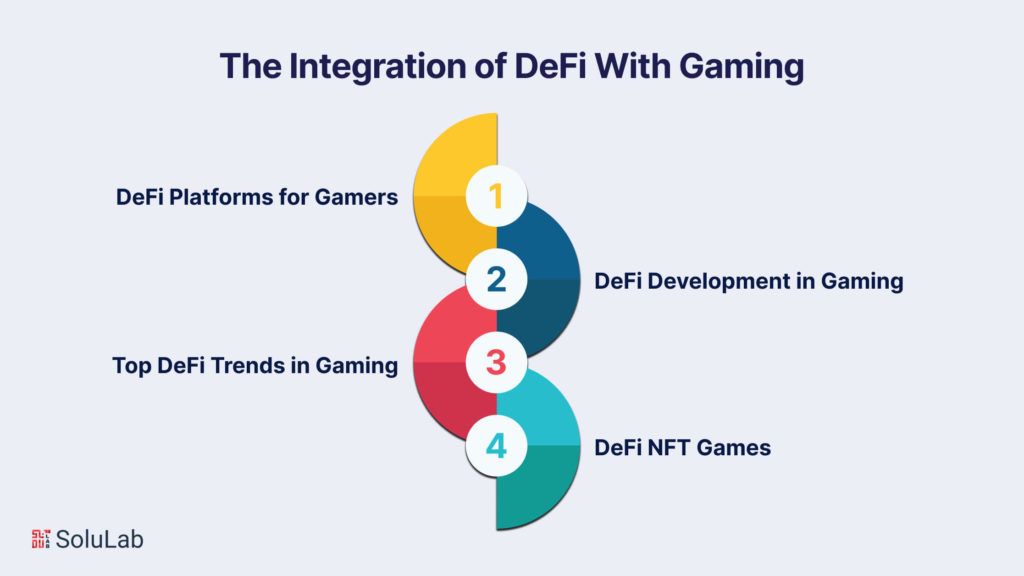
The Integration of DeFi With Gaming

In recent years, the gaming industry has begun to realize the potential of integrating DeFi into its ecosystem. This convergence of DeFi and gaming is creating exciting new opportunities for players and developers alike. Here’s how these two worlds are coming together:

  • DeFi Platforms for Gamers: DeFi platforms are being customized to cater to gamers. These platforms offer services such as in-game asset lending, borrowing, and yield farming. Gamers can earn rewards and income by participating in DeFi activities within the gaming ecosystem.
  • DeFi Development in Gaming: Game developers are incorporating DeFi development features into their games, making in-game economies more decentralized. For instance, players can lend their in-game assets to others and earn interest through smart contracts, similar to traditional DeFi lending.
  • Top DeFi Trends in Gaming: Games that leverage DeFi often follow the top trends in the DeFi space. This can include liquidity pools, decentralized exchanges, governance tokens, and more. Gamers can actively participate in these trends, potentially reaping financial benefits from their in-game activities.
  • DeFi NFT Games: The combination of DeFi and NFTs has given rise to DeFi NFT games. These games often feature NFTs that represent in-game assets or characters, which can be used in DeFi activities. Players can trade these NFTs or use them as collateral for loans.

Benefits of Decentralized Finance for Gamers

The integration of DeFi with gaming brings several benefits to players:

  • Financial Freedom: Gamers gain more control over their in-game assets and the ability to monetize them. They can earn income, trade assets, and participate in various DeFi activities.
  • Cross-Game Economies: DeFi allows gamers to use their assets across different games and platforms. This cross-game interoperability creates opportunities for building diversified in-game portfolios.
  • Transparency and Security: DeFi operates on blockchain technology, providing transparency and security. Players can trust the integrity of in-game transactions and DeFi activities.
  • Community Engagement: DeFi and gaming often involve active communities. Gamers can collaborate on governance decisions, stake tokens in their favorite games, and actively participate in shaping the gaming experience.

The integration of DeFi and gaming holds immense promise for the gaming industry. As DeFi lending platforms and DeFi NFT games continue to evolve, gamers can expect more opportunities to participate in decentralized finance while enjoying their favorite virtual worlds.
How NFTs and DeFi Complement Each Other in Gaming?

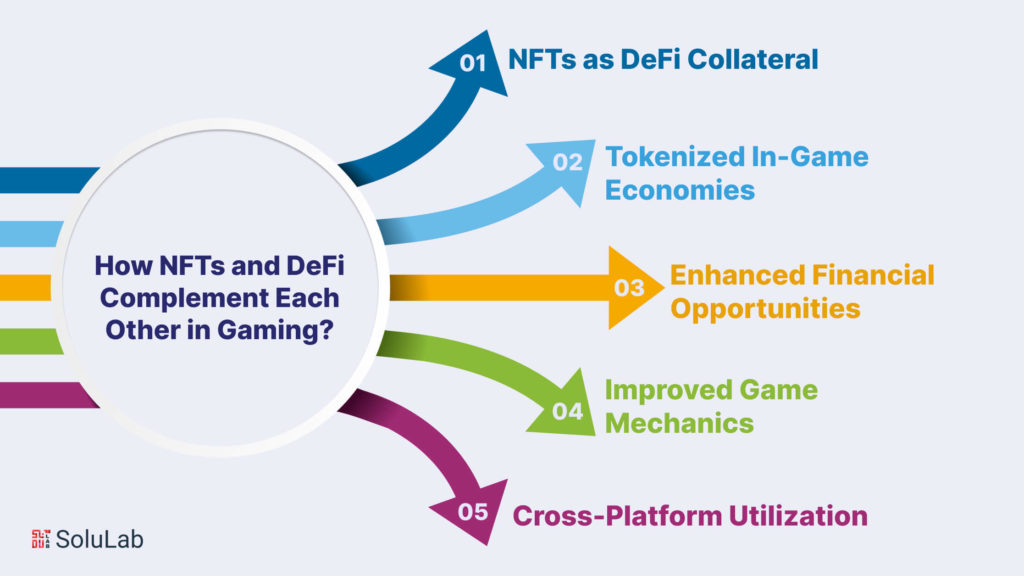
NFTs and DeFi Complement Each Other in Gaming

The synergy between Non-Fungible Tokens (NFTs) and Decentralized Finance (DeFi) in the gaming sphere is proving to be a game-changer. Their combination creates a potent force, unlocking a new dimension of possibilities for both players and developers.

  • NFTs as DeFi Collateral: NFTs serve as unique digital assets, providing authenticity, ownership, and scarcity. When these NFTs are used as collateral within the DeFi ecosystem, gamers can leverage their valuable in-game assets to access DeFi services like borrowing, lending, and yield farming. For instance, players can lock their rare in-game NFTs into smart contracts to secure loans or earn interest, all without losing possession of the assets.
  • Tokenized In-Game Economies: NFTs allow in-game items, characters, or land to be tokenized and authenticated on the blockchain. When these NFTs are integrated into DeFi protocols, they can become tradeable assets or staking instruments. This tokenization within DeFi platforms allows for the creation of robust in-game economies, where players can trade, lend, or stake their NFTs for additional value or rewards.
  • Enhanced Financial Opportunities: The fusion of NFTs and DeFi opens doors to new financial opportunities within gaming. Gamers can potentially earn passive income by staking their NFTs, lending rare in-game items, or participating in liquidity pools formed around these NFTs. Additionally, these integrated systems allow for the development of sophisticated gaming economies, where NFT-based assets can earn yield, further incentivizing players.
  • Improved Game Mechanics: DeFi’s concepts, such as decentralized governance, yield generation, and liquidity provision, can add intricate and rewarding mechanics to games using NFTs. Smart contracts can govern in-game economic models, offering players the chance to participate in community-based decision-making and gain from their contributions to the game ecosystem.
  • Cross-Platform Utilization: The amalgamation of NFTs and DeFi can transcend individual games, enabling players to use their NFT assets or earnings across multiple gaming platforms. This cross-platform utility empowers gamers to explore diverse gaming experiences while maintaining the value of their digital assets within the broader gaming ecosystem.

The seamless integration of NFTs and DeFi in gaming illustrates their mutual enhancement. As NFTs bring unique ownership and authenticity, DeFi amplifies these assets’ utility, turning them into active components of a decentralized financial ecosystem within the gaming world. This combination not only expands financial possibilities for players but also enriches the gaming experience as a whole.

Benefits for Gamers

Gamers are at the forefront of the NFTs and DeFi revolution within the gaming industry. The convergence of these technologies offers a plethora of benefits that empower players in exciting and innovative ways.

1. Ownership of In-Game Assets

One of the most notable advantages for gamers is the newfound ownership of in-game assets. Traditionally, players merely had a license to use digital items within a game. With NFTs, they gain true ownership of these assets. Whether it’s a rare sword, a unique character skin, or a parcel of virtual land, gamers can securely claim their digital possessions. NFTs serve as irrefutable proof of ownership, are recorded on the blockchain, and can be bought, sold, or traded like physical collectibles. This empowers players with a sense of agency over their in-game assets, which can be appreciated in value over time.

2. Earning Opportunities Through Gaming

NFTs and DeFi provide gamers with unprecedented earning opportunities. Here’s how these technologies enrich the gaming experience:

  • Income from In-Game Activities: Gamers can earn income by engaging in in-game activities, such as completing quests, participating in competitions, or contributing to the virtual world’s development. The rewards for their efforts are often distributed in the form of NFTs or cryptocurrencies, which can be traded or staked within DeFi platforms for additional income.
  • NFT Game Development Services: For creative gamers, NFT game development services have opened up avenues to design, develop, and monetize their virtual creations. By developing their games or NFT-based assets, gamers can generate income by selling them to other players or collectors.
  • Collateral for DeFi Loans: Gamers can use their valuable NFTs as collateral to secure loans within the DeFi ecosystem. This allows them to unlock liquidity while still retaining ownership of their prized in-game assets.
  • Trading and Speculation: NFTs can be traded on various marketplaces, and their values can be appreciated over time, particularly if they are rare or have historical significance in the gaming world. Gamers can invest in NFTs or speculate on their value, turning their gaming hobby into a source of potential financial growth.

3. NFT Game Development Companies

As NFTs and DeFi continue to gain traction, a burgeoning ecosystem of NFT game development companies is emerging. Gamers can benefit from this trend in various ways. They can collaborate with these companies to create and monetize their game assets or explore new gaming experiences crafted by these developers.

In essence, the combination of NFTs and DeFi not only enhances the gaming experience but also transforms it into a realm of financial opportunities and ownership rights. Gamers are no longer mere participants; they are now empowered creators and investors in the evolving world of NFT-based games and decentralized finance.
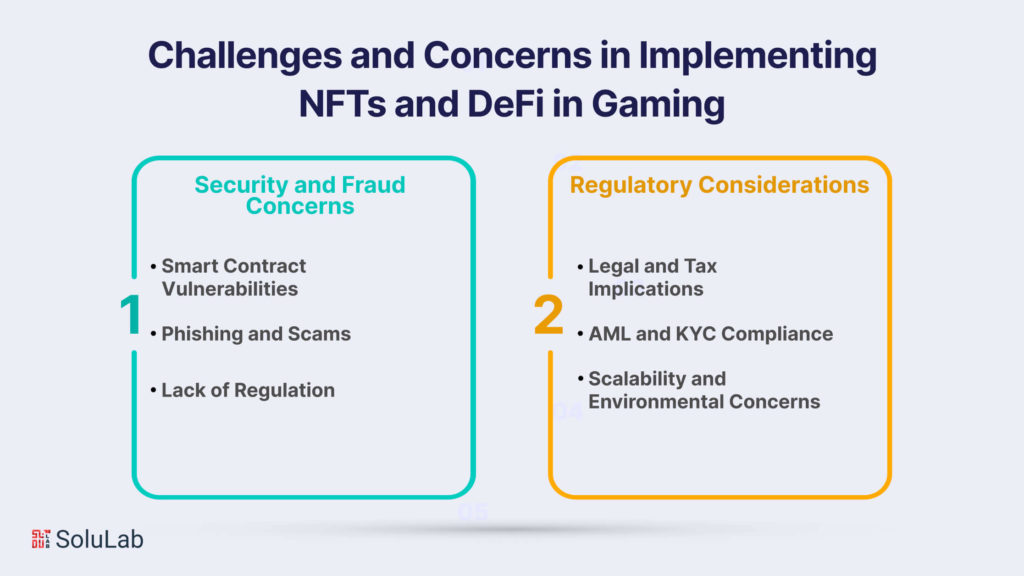
Challenges and Concerns in Implementing NFTs and DeFi in Gaming

Challenges and Concerns in Implementing NFTs and DeFi in Gaming

While the integration of NFTs and DeFi in gaming presents a myriad of exciting possibilities, it also comes with its share of challenges and potential risks that both players and developers should be aware of. Here, we delve into some of these concerns:

1. Security and Fraud Concerns

  • Smart Contract Vulnerabilities: NFTs and DeFi are built on smart contracts, which are not immune to vulnerabilities or exploits. Malicious actors can find and exploit weaknesses in these contracts, potentially resulting in financial losses for gamers. It’s crucial to conduct thorough audits of smart contracts and keep them up to date to mitigate these risks.
  • Phishing and Scams: The relatively new nature of NFTs and DeFi has attracted opportunistic scammers. Gamers may encounter phishing attempts, fake NFT marketplaces, or fraudulent DeFi platforms. Staying vigilant and using reputable services are essential precautions.
  • Lack of Regulation: The decentralized nature of DeFi and NFTs often means a lack of oversight and regulation. While this offers freedoms, it also leaves the space vulnerable to fraudulent schemes, rug pulls, and other illicit activities. As a result, investors and players are urged to do their due diligence before participating in any project or transaction.

2. Regulatory Considerations

  • Legal and Tax Implications: The intersection of NFTs, DeFi, and gaming introduces complex legal and tax questions. Different jurisdictions may have varying definitions of NFTs, cryptocurrencies, and their implications for taxation. Gamers should be aware of their responsibilities regarding the acquisition, sale, and use of NFTs, as well as DeFi activities.
  • AML and KYC Compliance: Anti-Money Laundering (AML) and Know Your Customer (KYC) regulations may come into play when using DeFi platforms or engaging in large NFT transactions. These requirements can impact the anonymity that many users in the crypto space value. As regulations evolve, users must adapt to stay compliant.
  • Scalability and Environmental Concerns: DeFi and NFTs, particularly those built on the Ethereum blockchain, have faced challenges related to scalability and high gas fees. These issues can affect the usability and affordability of gaming within these ecosystems. Additionally, the environmental impact of blockchain technology, notably proof-of-work blockchains, raises sustainability concerns.

It’s important for gamers and developers to navigate these challenges with a combination of vigilance and responsible usage. Staying informed, practicing due diligence, and adhering to the best security practices can help mitigate risks and foster a safer and more robust ecosystem for NFTs, DeFi, and gaming. Furthermore, as the regulatory landscape continues to evolve, staying compliant with relevant laws is paramount to ensure a seamless and secure experience.
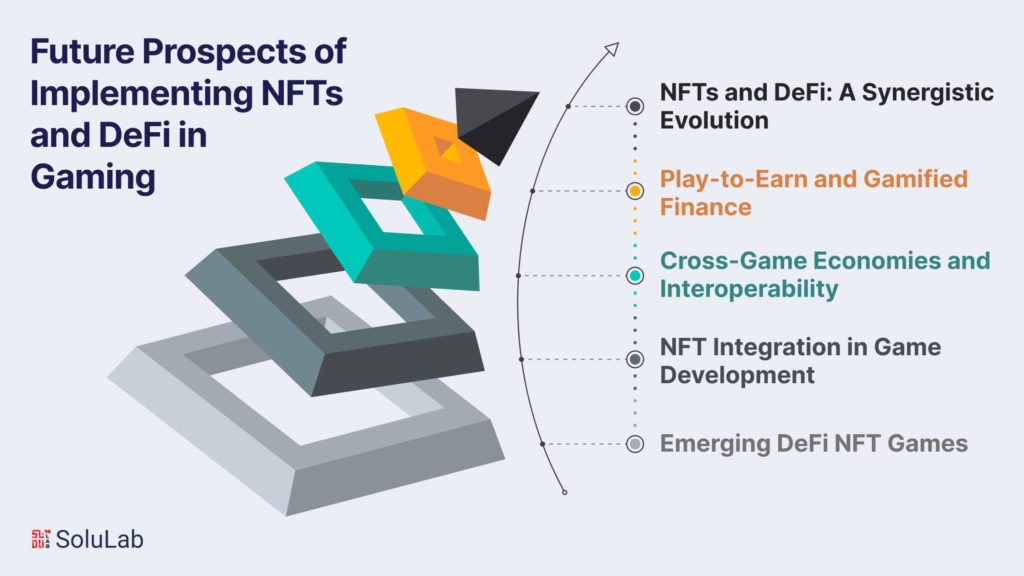
Future Prospects of Implementing NFTs and DeFi in Gaming

Future Prospects of Implementing NFTs and DeFi in Gaming

The future of the gaming industry is being dynamically shaped by the convergence of Non-Fungible Tokens (NFTs) and Decentralized Finance (DeFi). As these technologies continue to gain momentum, their impact on gaming is expected to be transformative.

  • NFTs and DeFi: A Synergistic Evolution

The synergy of NFTs and DeFi in gaming is anticipated to deepen. NFTs offer unique ownership of in-game assets, while DeFi provides a robust financial ecosystem. This combination is set to create even more complex and interactive in-game economies.

  • Play-to-Earn and Gamified Finance

The concept of “play-to-earn” is on the rise. Gamers can earn rewards, cryptocurrencies, and valuable NFTs by participating in games and DeFi activities. This gamified approach to finance may blur the lines between traditional gaming and financial services, offering players incentives to be more active within both ecosystems.

  • Cross-Game Economies and Interoperability

Cross-game interoperability will gain further prominence. Gamers will be able to use their NFT assets, such as characters, skins, or in-game items, across multiple games and platforms. This will lead to the development of comprehensive, cross-game economies where assets can be utilized seamlessly.

  • NFT Integration in Game Development

NFTs are expected to become an integral part of game development. Game studios may incorporate NFTs as core features, enabling players to have true ownership of in-game assets and making the creation of user-generated content more rewarding. NFT-based games are likely to proliferate, offering players new gaming experiences with the potential for financial benefits.

  • Emerging DeFi NFT Games

The emergence of DeFi NFT games, which integrate the principles of decentralized finance with NFTs, will continue to expand. These games often feature NFTs representing in-game assets that players can trade, stake, or use as collateral for loans. The synergy between DeFi and NFTs in gaming is expected to provide a growing array of financial opportunities for players.
DeFi Development Solutions

Concluding Remarks

In the entwined realms of gaming, Non-Fungible Tokens (NFTs) and Decentralized Finance (DeFi) have sparked a revolution. The fusion of these groundbreaking technologies is paving the way for a new era where players are not merely gamers but active participants in dynamic economies. The ownership of in-game assets, the prospect of earning through play, and the amalgamation of finance with gaming experiences are reshaping how we perceive digital entertainment. However, amidst the promises of this synergy, challenges like security concerns and regulatory ambiguities loom, requiring vigilance and adaptation from gamers and developers alike.

The future of NFTs and DeFi in gaming is as promising as it is transformative. As these technologies continue to evolve, the gaming landscape is on the brink of a monumental shift, where the traditional boundaries between gaming and financial ecosystems are blurring. The potential for cross-game economies, player-centric game development, and emerging DeFi NFT games point to a future that’s not just about entertainment but also about financial empowerment within gaming. Yet, in this burgeoning era of possibilities, education, caution, and adaptability are keys to embracing the revolution responsibly.

At SoluLab, as an NFT game development company and a DeFi development company, we stand at the forefront of integrating NFTs and DeFi into gaming experiences. Our expertise lies in delivering innovative solutions that bridge the realms of gaming and these transformative technologies. With tailored NFT game development services, pioneering DeFi integrations, and a commitment to pioneering the future of gaming, we invite you to take the first step toward this groundbreaking journey. Join us in crafting immersive gaming experiences that redefine ownership, finance, and the thrill of gaming. Contact us today and let’s redefine gaming together!

FAQs

1. What are NFTs, and how do they work in gaming?

NFTs, or Non-Fungible Tokens, are digital assets that represent unique ownership of items, characters, or in-game content. In gaming, NFTs allow players to truly own their in-game assets, which can be bought, sold, and traded. Each NFT is verifiably unique and is typically recorded on a blockchain, ensuring the authenticity and scarcity of the asset.

2. How do gamers earn money through NFTs and DeFi in gaming?

Gamers can earn money by participating in play-to-earn games that reward them with cryptocurrencies, NFTs, or other valuable in-game assets. They can also earn by lending their NFTs within DeFi platforms, staking assets, or creating and selling NFT-based game content. The combination of NFTs and DeFi opens up numerous opportunities for players to monetize their gaming activities.

3. Are there security risks involved with NFTs and DeFi in gaming?

Yes, there are security risks, including smart contract vulnerabilities, phishing scams, and a lack of regulation. It’s essential for players to be cautious and conduct due diligence when interacting with NFTs and DeFi platforms. Using reputable services, keeping software up to date, and staying informed about potential risks are vital precautions.

4. How do NFTs and DeFi impact traditional game development?

NFTs are transforming traditional game development by allowing players to own in-game assets and creating a new dimension of player involvement. Game studios are integrating NFTs into their games, incentivizing user-generated content, and making game economies more player-centric. DeFi is also being incorporated into game mechanics, enhancing financial opportunities for players.

5. What is the role of SoluLab in implementing NFTs and DeFi in gaming?

SoluLab specializes in NFT game development services and the integration of DeFi in gaming experiences. We work with game developers to create innovative solutions that leverage the power of NFTs and DeFi. If you’re looking to harness the potential of NFTs and DeFi in your gaming projects, SoluLab is your trusted partner for pioneering the future of gaming. Contact us today to start redefining gaming and finance together.

NFT Gaming Marketplaces: Creating Opportunities for Game Developers

NFT Gaming Marketplaces: Creating Opportunities for Game Developers

In the rapidly evolving landscape of digital entertainment, the emergence of Non-Fungible Tokens (NFTs) has sparked a revolutionary shift in the way we perceive and engage with virtual assets. Within the realm of gaming, NFTs have opened up a world of unprecedented opportunities for game developers, players, and digital asset enthusiasts. NFT Gaming Marketplaces have emerged as dynamic hubs that facilitate the creation, trade, and exploration of NFT-based gaming assets. These marketplaces not only empower developers to monetize their creations but also offer players the chance to own and trade digital collectibles with real value. This blog delves into the intricate dynamics of NFT Gaming Marketplaces, exploring the myriad features, benefits, and challenges that define this burgeoning sector within the gaming industry.

What is NFT Gaming?

NFT Gaming has emerged as a groundbreaking phenomenon within the gaming industry, offering unique opportunities for both game developers and players alike. By leveraging the blockchain’s decentralized and secure infrastructure, NFT Gaming introduces a new way to own and trade in-game assets, fostering a sense of ownership and value among gamers. This section delves into the fundamental aspects of NFT Gaming and its significance in revolutionizing the traditional gaming landscape

Understanding NFT Gaming

NFT gaming refers to the integration of non-fungible tokens (NFTs) within the gaming industry, enabling the creation of unique, verifiable, and scarce digital assets. These assets, represented by NFTs, can be utilized within various gaming ecosystems, providing players with true ownership of in-game items and assets. By leveraging blockchain technology, NFT gaming introduces a paradigm shift in the way game developers and players interact, allowing for the creation, exchange, and utilization of digital assets with inherent value and authenticity

Read Our Blog : NFTs in Gaming: Unlocking the Future of Virtual Collectibles

Exploring the Role of NFTs in Gaming

The role of NFTs in gaming is multifaceted, encompassing aspects such as asset ownership, digital scarcity, and enhanced gameplay experiences. NFTs enable game developers to create and deploy unique in-game assets that can be bought, sold, and traded by players. These assets can range from virtual goods, such as weapons and skins, to digital collectibles and game items, providing players with a sense of ownership and exclusivity. Additionally, NFTs facilitate the creation of robust gaming economies, allowing for the seamless exchange of digital assets between players, fostering a vibrant and interconnected gaming community.

CTA1

Significance of NFT Gaming Marketplaces

NFT gaming marketplaces play a pivotal role in the evolution of the gaming industry, serving as platforms for the exchange and distribution of NFT-based assets. These marketplaces enable game developers to showcase and monetize their creations while providing players with access to a diverse array of digital collectibles and in-game items. With the rise of NFT gaming marketplaces, developers can tap into new revenue streams and establish direct relationships with their player base. Moreover, these marketplaces foster a thriving ecosystem where players can discover, purchase, and trade NFTs, fostering a sense of engagement and immersion within the gaming community.

 Read Also : How is Gaming Contributing to the NFT Industry?

NFT Gaming Market Overview

With the continuous growth of NFTs in the gaming sector, it becomes crucial to understand the overarching impact these digital assets have had on the industry. This section explores the evolution of NFTs within the gaming industry, highlighting the transformative role they play in enhancing gaming experiences. By offering insights into the advantages NFTs provide to game developers, this segment aims to underscore the importance of integrating NFTs into modern gaming platforms.

  • Evolution of NFTs in the Gaming Industry

The adoption of NFTs within the gaming industry has witnessed a significant evolution, marking a transition from traditional in-game assets to digital assets with inherent value and scarcity. With the introduction of NFTs, game developers have been able to create and tokenize unique virtual assets, offering players verifiable ownership and control over their in-game items. This shift has propelled the gaming industry into a new era, where players can collect, trade, and utilize NFTs across various gaming platforms, fostering a dynamic and interconnected gaming landscape.

  • Impact of NFTs on the Gaming Ecosystem

The integration of NFTs has had a transformative impact on the gaming ecosystem, revolutionizing the way players interact with digital assets and virtual economies. NFTs have enabled game developers to introduce innovative gameplay mechanics, allowing players to truly own and manage their in-game items. Additionally, the implementation of NFTs has led to the emergence of vibrant gaming communities where players can participate in the creation and exchange of digital assets, fostering a sense of inclusivity and engagement. The integration of NFTs has not only enhanced the overall gaming experience but has also introduced new avenues for creativity, collaboration, and monetization within the gaming industry.

Read Also : The Future of NFT Marketplaces: Trends and Innovations

  • Advantages of NFTs for Game Developers

NFTs offer numerous advantages for game developers, providing them with a platform to create and distribute unique digital assets within their gaming ecosystems. One of the key advantages of NFTs is their ability to enable true ownership and scarcity of in-game assets, allowing developers to offer players exclusive and valuable digital collectibles. Moreover, NFTs facilitate direct player engagement, enabling developers to establish direct relationships with their player base and foster a sense of community and loyalty. Additionally, the integration of NFTs allows for the seamless integration of digital assets across different gaming platforms, providing developers with the opportunity to expand their reach and explore new avenues for growth and monetization.

Exploring Top Defi NFT Games

The rise of decentralized finance (DeFi) NFT Game has captured the attention of the gaming community worldwide. This section aims to delve into some of the leading top DeFi NFT Games that have garnered significant attention and user adoption. By analyzing the features, mechanics, and success stories of the top DeFi NFT Games, this segment aims to offer a comprehensive understanding of the innovative gameplay experiences they provide.

  • Analysis of Leading Defi NFT Games

The landscape of top DeFi NFT Games is characterized by a diverse array of titles and platforms, each offering unique gameplay experiences and opportunities for players and developers alike. These games leverage the principles of decentralized finance (DeFi) to integrate NFTs, enabling players to participate in various gaming activities while engaging with digital assets of tangible value. Through the analysis of leading top DeFi NFT Games, developers can gain insights into successful game mechanics, engagement strategies, and monetization models, facilitating the creation of immersive and rewarding gaming experiences.

  • Features and Mechanics of Top NFT Games

Best NFT Games encompass a range of features and mechanics designed to offer players engaging and interactive gameplay experiences. These games often incorporate elements such as play-to-earn models, asset trading, and digital ownership, providing players with avenues for skill development, asset accumulation, and social interaction within the gaming community. Moreover, Best NFT Games integrate blockchain technology to ensure transparent and secure asset management, fostering a sense of trust and reliability among players. By exploring the features and mechanics of Best NFT Games, developers can identify successful gameplay elements and leverage them to create compelling gaming experiences for their audiences.

 Read Also: How is Gaming Contributing to the NFT Industry?

  • Success Stories and User Adoption

Success stories within the realm of top DeFi NFT Games highlight the potential for innovation and growth within the gaming industry. These stories often showcase the journey of developers and players who have successfully leveraged NFTs to create valuable and immersive gaming experiences. Through successful user adoption, these games have been able to cultivate vibrant gaming communities, establish robust in-game economies, and provide players with opportunities for skill development and asset accumulation. By examining success stories and user adoption rates, developers can gain valuable insights into the strategies and tactics that have contributed to the success of top DeFi NFT Games, enabling them to implement similar practices within their own game development endeavors.

Building NFT Games in the Metaverse

Building NFT Games in the Metaverse

The concept of the metaverse has gained traction in recent years, creating new avenues for NFT integration within virtual environments. This section focuses on the integration of NFTs within the metaverse gaming experience and the unparalleled immersive opportunities they present. By exploring the potential of non-fungible tokens in the metaverse, this segment provides valuable insights into the future of gaming and digital asset ownership.

  • Integration of NFTs in Metaverse Gaming

The integration of NFTs within the metaverse has opened up new possibilities for immersive and interactive gaming experiences. By leveraging NFTs, developers can create and distribute unique in-game assets that players can utilize and trade within virtual environments. This integration allows for the seamless transfer of digital assets between different metaverse platforms, enabling players to engage with a diverse array of NFTs and virtual goods. Moreover, the integration of NFTs in the metaverse fosters a sense of digital ownership and exclusivity, allowing players to personalize and enhance their virtual identities and experiences.

  • Leveraging Non-Fungible Tokens for Immersive Experiences

The use of non-fungible tokens (NFTs) in metaverse gaming is instrumental in creating immersive and authentic gameplay experiences for players. NFTs enable developers to introduce unique and scarce virtual assets within the metaverse, providing players with a diverse array of digital collectibles, virtual land, and in-game items. Through the integration of NFTs, players can engage in activities such as virtual asset trading, customization of avatars, and participation in virtual events, fostering a sense of creativity and social interaction within the metaverse. Additionally, the integration of NFTs allows for the creation of personalized and exclusive virtual experiences, enabling players to express their individuality and identity within virtual worlds.

      Read Also : Top NFT Trends That Will Build Revenue Streams to the Business

  • The Future of NFT Games in the Metaverse

The future of NFT Games in the metaverse is characterized by a continuous evolution of immersive and interactive gaming experiences, enabled by the integration of blockchain technology and NFTs. As the metaverse continues to expand and evolve, NFT Games are expected to play a pivotal role in shaping the landscape of virtual economies, social interactions, and digital experiences. The future of NFT Game in the metaverse holds promises of enhanced gameplay mechanics, decentralized governance models, and collaborative storytelling, allowing players to participate in dynamic and engaging virtual environments. Moreover, the future of NFT Games in the metaverse is anticipated to witness the emergence of innovative gameplay elements, interactive narratives, and collaborative gameplay experiences, fostering a sense of community and engagement among players and developers alike.

NFT Gaming Platforms and Marketplaces

The emergence of various NFT gaming platforms and marketplaces has laid the foundation for a thriving ecosystem of digital asset trading and ownership. This section highlights the key features and characteristics of NFT gaming platforms, offering a detailed comparison of the best NFT marketplaces available for game developers. By examining the use cases of NFT marketplace integration in the gaming sector, this segment provides valuable insights into the potential of these platforms for the gaming industry.

  • Features and Characteristics of NFT Gaming Platforms

NFT gaming platforms are essential components of the NFT gaming ecosystem, serving as hubs where developers, players, and NFT collectors converge to explore and engage with digital assets. These platforms offer various features and characteristics that facilitate the creation, trade, and management of NFTs within the gaming context. Notable features may include NFT creation tools, marketplace functionalities, asset verification mechanisms, and user-friendly interfaces. Additionally, they often integrate blockchain technology to ensure asset ownership, scarcity, and authenticity, granting players and collectors the confidence to participate in NFT-based gaming activities.

  • Comparison of the Best NFT Marketplaces for Game Developers

Game developers seeking to explore NFT opportunities must carefully evaluate and select the best NFT marketplaces that align with their objectives. Each NFT marketplace presents its unique set of offerings, including marketplace fees, target audiences, and supporting blockchain networks. By comparing the best NFT marketplaces, developers can make informed decisions regarding the platforms most suitable for their game-related NFTs. The choice of marketplace often depends on factors such as transaction costs, marketplace popularity, target audience, and blockchain interoperability, among others. Understanding these marketplace distinctions aids developers in optimizing the reach and impact of their NFT gaming assets.

      Check Our Blog :How is Gaming Contributing to the NFT Industry?

  • Use Cases of NFT Marketplace Integration for Gaming

The integration of the best NFT marketplaces within gaming ecosystems extends beyond the mere trading of virtual assets. best NFT marketplaces present developers with a spectrum of use cases that can be harnessed to enhance in-game experiences and economic ecosystems. Game developers can utilize the best NFT marketplaces to mint, sell, and distribute in-game assets and NFT collectibles. Furthermore, they can implement interoperable NFTs to facilitate asset cross-utilization across various gaming titles or even metaverse environments. In addition, developers can leverage the best NFT marketplaces to establish dynamic player-driven economies, fostering active participation and virtual asset ownership. The diverse use cases of NFT marketplace integration serve as essential building blocks for the development of NFT-driven gaming ecosystems.

NFT Development Companies and Solutions

Amid the growing interest in NFT gaming, several development companies have stepped up to provide comprehensive solutions for game developers. This section provides an overview of leading NFT development companies and their services tailored to meet the specific needs of game developers. By shedding light on the solutions and offerings available for NFT gaming, this segment aims to guide developers in leveraging the expertise of industry-leading professionals for their gaming projects.

  • Overview of Leading NFT Development Companies

In the rapidly evolving NFT landscape, a multitude of NFT development companies offer solutions and services to game developers. These companies vary in terms of expertise, blockchain specialization, and service portfolios. By exploring an overview of leading NFT development companies, developers can identify strategic partnerships and service providers who can assist them in navigating the complexities of NFT integration. Such partnerships can range from minting NFTs to building custom best NFT marketplaces, integrating blockchain technology, or providing consultation services for optimizing NFT adoption within gaming projects.

  • Services and Offerings for Game Developers

NFT development companies cater to the diverse needs of game developers by offering an array of services and solutions. These services may encompass NFT creation, blockchain integration, smart contract development, marketplace development, and customized solutions tailored to specific gaming projects. Service providers understand the critical role they play in aiding developers to conceptualize, create, and launch NFT gaming assets that resonate with the gaming community. The NFT development industry also emphasizes the importance of security, authenticity, and transparency to instill confidence in both developers and players, ensuring that NFT assets uphold the expected standards of quality and value.

  • Building NFT Gaming Solutions with Industry Experts

Collaborating with NFT development companies and industry experts presents game developers with the opportunity to harness in-depth knowledge and insights. These collaborations often result in the creation of innovative NFT gaming solutions that are well-received by the gaming community. Industry experts can guide developers through the entire process of NFT integration, from ideation to execution, ensuring that NFT assets seamlessly align with the game’s objectives. By leveraging the expertise of NFT development companies and industry leaders, developers can refine their NFT strategy, enhance in-game experiences, and drive the success of their NFT gaming endeavors.

Creating NFT Games: Opportunities and Challenges

Creating NFT Games: Opportunities and Challenges

While NFT gaming presents numerous opportunities for game developers, it also brings forth a set of unique challenges that developers must navigate. This section explores the various opportunities within the NFT gaming space, emphasizing the strategies developers can employ to make the most of these opportunities. Simultaneously, it delves into the challenges faced in NFT game development and implementation, providing insights into the best practices for overcoming these obstacles.

  • Exploring Opportunities for Game Developers in the NFT Space

The NFT space presents game developers with an array of opportunities, providing a unique set of benefits that can elevate their projects. NFTs enable developers to monetize digital assets, attract a broader audience, enhance player engagement, and even create play-to-earn mechanics. Moreover, NFTs are instrumental in fostering a sense of ownership among players, transforming in-game assets into tangible digital collectibles. By exploring these opportunities, developers can make informed decisions about the role of NFTs within their games and their potential for growth and sustainability.

      Read  Our Blog  : Best Play To Earn NFT Games In 2023

  • Challenges Faced in NFT Game Development and Implementation

Despite the vast potential of NFTs in the gaming industry, developers must also navigate challenges unique to the NFT landscape. These challenges may include scalability issues, concerns regarding blockchain network congestion, and the need to ensure robust security measures to safeguard digital assets. Additionally, developers may encounter player skepticism and regulatory challenges related to digital asset ownership. It is essential for game developers to recognize and address these challenges, working towards practical solutions to ensure the successful integration of NFTs within their gaming projects.

  • Strategies for Success in NFT Game Creation

NFT Game creation necessitates a strategic approach to navigate the complexities of blockchain technology and digital asset integration. Developers must devise strategies to optimize in-game experiences, engage players, and establish successful economies within their NFT-driven gaming environments. Strategies for success encompass factors such as designing appealing NFT assets, implementing clear and user-friendly NFT mechanics, and fostering an active player community. Furthermore, developers should consider the importance of collaborating with industry experts, leveraging NFT marketplaces, and exploring interoperable NFTs to extend the reach and utility of in-game assets. By embracing these strategies, developers can embark on their NFT game creation journey with confidence and a well-defined plan for success.

The Future of NFT Gaming

The Future of NFT Gaming

As the NFT in gaming sector continues to evolve, it is essential to keep an eye on the emerging trends and innovations shaping the industry’s future. This section offers a comprehensive analysis of the latest trends and advancements in NFT gaming and marketplaces. By predicting the future growth and expansion of the NFT gaming industry, this segment aims to provide readers with a holistic understanding of the sector’s potential.

  • Emerging Trends in NFT Gaming and Marketplaces

The NFT gaming industry is marked by continuous innovation and evolving trends that shape the future of gaming ecosystems. Emerging trends within the NFT gaming landscape often include the integration of blockchain interoperability, the use of cross-chain NFTs, and the development of decentralized in-game marketplaces. Developers must stay attuned to these trends to remain competitive and provide players with engaging and relevant gaming experiences.

Check this Blog : Top NFT Trends That Will Build Revenue Streams to the Business

  • Potential Innovations and Developments in the NFT Gaming Sector

Innovations and developments within the NFT gaming sector hold the potential to transform the industry, introducing novel gameplay mechanics, advanced asset customization, and enhanced social interactions within gaming communities. Developers are exploring the possibilities of leveraging augmented reality (AR) and virtual reality (VR) technologies to offer immersive and interactive gaming experiences that blur the lines between physical and digital worlds. Additionally, the integration of artificial intelligence (AI) and machine learning (ML) within NFT gaming platforms is anticipated to introduce personalized and dynamic gameplay elements, fostering a sense of adaptability and player engagement.

  • Anticipated Growth and Expansion in the NFT Gaming Industry

The NFT gaming industry is poised for substantial growth and expansion, driven by the increasing adoption of blockchain technology, the rising interest in digital collectibles, and the growing community of NFT enthusiasts. As players and developers recognize the value and potential of NFTs in the gaming space, the industry is expected to witness the launch of innovative NFT projects, the establishment of robust gaming economies, and the proliferation of cross-platform gaming experiences. The anticipated growth and expansion in the NFT gaming industry highlight the significance of sustainable and future-forward strategies that foster innovation, inclusivity, and meaningful player interactions.

CTA2

Conclusion

In the ever-evolving landscape of NFT Gaming Marketplaces, the possibilities seem boundless, promising a future where digital experiences blend seamlessly with tangible value and ownership. As the bridge connecting the vision of developers with the reality of users, SoluLab has been instrumental in shaping the very foundations of this transformative industry. Our extensive expertise in NFT marketplace development, coupled with our commitment to innovation, has positioned us as a key player in the realm of NFT gaming. Through our comprehensive white-label NFT marketplace solutions, we empower game developers to unleash their creativity, drive engagement, and unlock new revenue streams in the world of gaming. Our dedicated team of NFT developers continues to pave the way for groundbreaking solutions that redefine the gaming industry, enabling the creation of immersive, secure, and value-driven gaming experiences.

By harnessing the power of NFTs, we enable seamless integration and collaboration between gamers, developers, and investors, fostering an ecosystem that thrives on trust, transparency, and innovation. Our white-label NFT game marketplace development services offer a gateway for game developers to showcase their creations and connect with a global community of players and enthusiasts. With a focus on user-centric design and cutting-edge technology, our solutions are tailored to meet the diverse needs of the modern gaming landscape, fostering an environment that nurtures creativity and growth.

As the world of NFT gaming continues to evolve, we remain committed to pushing the boundaries of what’s possible, striving to deliver best-in-class solutions that redefine the gaming industry’s future. SoluLab is not just a provider of services but a partner in the journey toward creating immersive gaming experiences that captivate audiences, drive engagement and unlock new dimensions of value and interaction. With our NFT Gaming marketplace development services, we aim to revolutionize the way gaming experiences are created, shared, and valued, ushering in an era of limitless opportunities for game developers, players, and enthusiasts alike.

FAQs

1. What is the significance of NFTs in the gaming industry?

NFTs, or Non-Fungible Tokens, have revolutionized the gaming industry by enabling the creation of unique in-game assets that players can own, trade, and use across various gaming platforms. They provide a means for gamers to truly own their digital assets, fostering a new era of digital ownership and value exchange within the gaming ecosystem.

 2. How can game developers leverage NFTs to enhance player engagement?

Game developers can leverage NFTs to create rare and unique in-game items, characters, and digital collectibles that players can buy, sell, and trade on NFT gaming marketplaces. By incorporating NFTs, developers can offer players a sense of ownership and value, driving increased engagement and fostering a vibrant gaming community.

3. What are the key features to consider when building NFT gaming platforms?

Key features to consider when building NFT gaming platforms include seamless integration with blockchain technology, secure and transparent transaction processing, user-friendly interfaces for buying and selling NFTs, robust asset management systems, and efficient trading functionalities to facilitate smooth and secure transactions.

4. How do NFT gaming marketplaces contribute to the growth of the gaming industry?

NFT gaming marketplaces contribute to the growth of the gaming industry by providing a platform for gamers and developers to create, trade, and collect unique digital assets. They foster a decentralized ecosystem that empowers players and content creators, leading to increased engagement, innovative gaming experiences, and new monetization opportunities within the gaming industry.

5. What are the benefits of using white-label NFT marketplace solutions for game development?

White-label NFT marketplace solutions offer game developers a customizable and cost-effective way to launch their own best NFT marketplaces without the need for extensive development resources. These solutions provide a ready-made platform that can be tailored to specific branding and functionality requirements, enabling developers to enter the NFT gaming market quickly and efficiently.

6. How can NFT development companies assist in the creation of innovative gaming experiences?

NFT development companies specialize in creating tailored solutions for integrating NFTs into gaming platforms. They offer expertise in blockchain technology, smart contract development, and NFT integration, enabling game developers to incorporate unique and valuable digital assets into their games, thereby enhancing player engagement and creating novel gaming experiences.

7. What are the best practices for integrating NFTs into the gaming ecosystem for maximum impact?

Best practices for integrating NFTs into the gaming ecosystem include ensuring a seamless user experience, implementing robust security measures to protect digital assets and transactions, offering engaging and valuable in-game NFTs, fostering a vibrant and supportive gaming community, and continuously innovating to stay ahead of evolving industry trends and player preferences.

Leverage NFT Technology to Foster Trust in Your Digital Identity

Leverage NFT Technology to Foster Trust in Your Digital Identity

In an increasingly digital world, where our online presence and interactions hold significant importance, the concept of digital identity has become more crucial than ever. Digital identity refers to the unique set of attributes, characteristics, and credentials that define an individual or entity in the online realm. However, the traditional methods of managing digital identities have faced challenges such as security breaches, data theft, and privacy concerns. In this era of rapid technological advancement, Non-Fungible Tokens (NFTs) have emerged as a groundbreaking solution to revolutionize the way we perceive and secure digital identities.

This article explores the intersection of NFT technology and digital identity, highlighting how NFTs can be harnessed to enhance trust and security in the digital realm. We will delve into the concept of NFT-based digital identities, discuss emerging trends, showcase notable NFT development companies, and explore potential solutions and services in the domain of NFT development for digital identity.

Before we dive into the implications of NFTs for digital identity, let’s begin with a basic understanding of what NFTs are and why they have gained such immense popularity.

What Are Non-Fungible Tokens (NFTs)?

Non-fungible tokens, commonly known as NFTs, are digital assets that represent ownership or proof of authenticity of a unique item or piece of content, often linked to a digital or physical entity. NFTs are non-fungible, which means each token is unique and cannot be exchanged for another on a like-for-like basis, in contrast to cryptocurrencies like Bitcoin or Ethereum which are fungible and can be transferred on a one-to-one basis. This uniqueness and indivisibility make NFTs ideal for representing digital identities.

NFTs are built on blockchain technology, which provides the immutable and transparent ledger necessary to ensure the authenticity and ownership of these digital assets. Ethereum is the most widely used blockchain platform for NFTs, but other platforms like Binance Smart Chain and Flow are gaining prominence in the NFT space.

The NFT Boom

The NFT craze began gaining mainstream attention in 2021, with artists, musicians, athletes, and collectors flocking to the space to create, sell, and buy digital assets represented as NFTs. High-profile NFT sales, such as Beeple’s artwork selling for $69 million and NBA Top Shot moments fetching substantial sums, demonstrated the enormous potential of NFTs.

Read Blog Post: Top 25 NFT Startups to Watch out in 2024

While NFTs initially found their footing in the world of art and entertainment, they have since transcended these boundaries and are being applied to a wide range of use cases, including digital identity.

NFTs and Digital Identity: A Perfect Match

NFTs and Digital Identity: A Perfect Match

The fusion of NFTs and digital identity brings forth a myriad of opportunities to address the challenges associated with online identification and authentication. Here’s how NFTs can be leveraged to foster trust in your digital identity.

1. Unique and Immutable Identification

NFTs excel at representing unique assets, and this quality can be directly applied to digital identity. When an individual or entity’s identity is represented by an NFT, it becomes a one-of-a-kind, tamper-proof representation that cannot be duplicated or forged. This uniqueness and immutability enhance the security and trustworthiness of the digital identity.

Related: Unlocking the Future: NFT Marketplace Development and Blockchain Technology Insights

2. Ownership and Control

One of the key issues with traditional digital identities is the lack of control individuals have over their own data. NFTs can change this paradigm by allowing users to own and control their digital identities. Users can decide what information is associated with their NFT identity and grant or revoke access to it as needed. This shift in control empowers individuals to protect their data and privacy.

CTA1

3. Transparency and Trust

The blockchain technology underlying NFTs ensures transparency and trust in the system. Every transaction, update, or interaction with an NFT-based digital identity is recorded on the blockchain, creating an auditable trail of activities. This transparency builds trust among users and entities relying on these digital identities.

4. Decentralization

NFT-based digital identities can be stored and managed in a decentralized manner, reducing the reliance on centralized authorities and single points of failure. Decentralized identity systems powered by NFTs distribute identity data across a network of nodes, making it more resilient to attacks and data breaches.

Related: Building Trust and Transparency in Your NFT Marketplace Ecosystem

5. Portability

NFT-based digital identities are highly portable. Users can carry their digital identity with them across different platforms and services, eliminating the need to create and manage separate identities for various online interactions. This convenience simplifies the user experience while maintaining security.

6. Verification and Authentication

Entities and services can easily verify and authenticate NFT-based digital identities by checking the blockchain for the associated NFTs. This streamlined process enhances security while reducing the risk of fraudulent activities and identity theft.

7. Enhanced Security

NFTs inherit the robust security features of blockchain technology, including cryptographic encryption and decentralization. This makes NFT-based digital identities inherently more secure compared to traditional username-password combinations or even biometric authentication methods.

Emerging Trends in NFT-Based Digital Identity

Emerging Trends in NFT-Based Digital Identity

As the adoption of NFTs for digital identity gains momentum, several trends are emerging that indicate the direction this technology is heading.

1. Metaverse Integration

The concept of the metaverse, a virtual shared space where users interact with each other and digital objects, is closely tied to NFTs and digital identity. NFT-based digital identities are poised to play a pivotal role in the metaverse, allowing users to seamlessly transition between virtual and real-world identities.

2. Identity Standards

Standardization of NFT-based digital identity protocols is essential to ensure interoperability across different platforms and services. Organizations like the Decentralized Identity Foundation (DIF) are actively working on defining these standards to facilitate widespread adoption.

Related: How To Launch Your Own NFT Marketplace Website in Less Than 2 Days?

3. Cross-Platform Compatibility

To realize the full potential of NFT-based digital identities, they must be compatible with a wide range of applications, services, and ecosystems. Developers are working on solutions that enable NFT identities to function seamlessly across diverse digital landscapes.

4. Privacy-Centric Solutions

Privacy remains a significant concern in the digital identity space. Emerging trends include the development of privacy-centric NFT-based identity solutions that give users granular control over what information is shared and with whom.

5. Identity NFT Marketplaces

Dedicated marketplaces for trading, buying, and selling identity NFTs are emerging. These marketplaces provide a platform for individuals and organizations to manage their digital identities and access related services.

NFT Development Solutions for Digital Identity

NFT Development Solutions for Digital Identity

Implementing NFT-based digital identity solutions requires a comprehensive approach that encompasses several key components. Let’s explore some of the essential NFT development solutions for digital identity.

1. Identity Minting

Identity minting refers to the process of creating identity NFTs. NFT development companies offer user-friendly interfaces and tools that allow individuals and organizations to mint their unique digital identities on the blockchain. These identity NFTs serve as the foundation for the entire digital identity ecosystem.

2. Identity Management

Once identity NFTs are created, they need to be effectively managed. Identity management solutions provided by NFT development companies enable users to update, modify, and customize their digital identities as needed. This includes adding or removing attributes, verifying information, and setting access controls.

3. Authentication and Verification

Authentication and verification solutions are essential to establish trust in digital identities. NFT-based digital identities can be authenticated by verifying the associated NFTs on the blockchain. NFT development companies often provide tools and APIs for easy integration into existing authentication systems.

4. Privacy Controls

Privacy is a paramount concern in the digital identity space. NFT development solutions for digital identity often include privacy controls that allow users to determine what information is shared and with whom. These controls empower individuals to safeguard their personal data.

5. Integration with Ecosystems

For NFT-based digital identities to be effective, they must seamlessly integrate with a wide range of applications and services. NFT development companies offer integration solutions that enable developers to incorporate NFT identities into their platforms, whether it be social media, financial services, or metaverse environments.

Know More: How to Build an NFT Marketplace like Binance?

6. Decentralized Storage

To enhance security and reduce reliance on centralized entities, NFT development solutions often incorporate decentralized storage options. Identity data can be stored across a distributed network of nodes, ensuring redundancy and resilience.

7. User-Friendly Interfaces

User experience is a critical factor in the adoption of NFT-based digital identities. NFT development companies prioritize creating intuitive and user-friendly interfaces that make it easy for individuals to manage and interact with their digital identities.

NFT Development Services for Digital Identity

NFT Development Services for Digital Identity

In addition to development solutions, NFT development companies offer a range of services to support the implementation and maintenance of NFT-based digital identities. These services play a pivotal role in ensuring the success and sustainability of digital identity projects.

1. Consultation and Strategy

NFT development companies often provide consultation and strategy services to help organizations define their digital identity goals, assess their specific needs, and develop a roadmap for implementation. These services are crucial for aligning digital identity initiatives with broader business objectives.

2. Custom Development

Not all digital identity projects are the same, and customization may be required to meet unique requirements. NFT development companies offer custom development services to tailor NFT identity solutions to the specific needs of their clients.

Read Also: The Future of NFT Marketplaces: Trends and Innovations

3. Security Audits

Security is paramount in digital identity projects. NFT development companies offer security audit services to assess the robustness of NFT-based identity systems, identify vulnerabilities, and implement necessary safeguards.

4. Maintenance and Support

Digital identity systems require ongoing maintenance and support to ensure they remain secure and up to date. NFT development companies provide maintenance and support services to address issues, apply updates, and provide assistance as needed.

5. Training and Education

Educating users and stakeholders is a crucial aspect of successful digital identity adoption. NFT development companies offer training and education services to help individuals and organizations understand how to use and manage their NFT-based digital identities effectively.

CTA2

Conclusion

The convergence of NFT technology and digital identity holds immense promise for transforming how we manage and secure our online personas. NFTs offer unique and immutable identification, ownership and control, transparency and trust, decentralization, portability, verification, and enhanced security, making them a natural fit for digital identity solutions.

As emerging trends in the NFT-based digital identity space continue to evolve, the role of NFTs in shaping the future of online identification is becoming increasingly evident. Notable NFT development companies are actively driving innovation in this field, offering comprehensive solutions and services to support the development and deployment of NFT-based digital identities.

In this digital age, where trust and security are paramount, leveraging NFT technology to foster trust in your digital identity is not just a trend; it’s a transformative leap towards a more secure and user-centric online world. With the right NFT development solutions and services, individuals and organizations can seize the opportunity to redefine and enhance their digital identities in a way that truly empowers and protects them.

A reputable NFT development company with years of experience creating blockchain-based solutions is SoluLab. We have a group of skilled NFT developers who can create distinctive NFTs that are cost-efficient, scalable, and secure.

The considerable experience in NFT development, various engagement choices, cost-effective solutions, and focus on clear communication make SoluLab’s top NFT developers stand out. SoluLab keeps you informed on the status of your project on a regular basis through progress reports, and the design and development expertise of our staff assures high-quality NFTs that are catered to your particular requirements. For further assistance, contact SoluLab today.

FAQs

1. What is a Non-Fungible Token (NFT)?

 A Non-Fungible Token (NFT) is a digital asset that represents ownership or proof of authenticity of a unique item or piece of content. Unlike cryptocurrencies such as Bitcoin, NFTs are non-fungible, meaning each token is distinct and cannot be exchanged on a like-for-like basis.

2. How does an NFT work?

NFTs are peculiarly made based on blockchain technology, such as Ethereum. Each NFT has a unique digital signature, which verifies its authenticity and ownership. This signature is recorded on the blockchain, creating a secure and transparent ledger.

3. What can NFTs be used for?

NFTs have a wide range of use cases, including digital art, collectibles, music, virtual real estate, in-game items, and even digital identity management. They represent ownership and uniqueness in the digital world.

4. How can NFTs enhance digital identity?

NFTs can enhance digital identity by providing a unique and immutable representation of an individual or entity in the online realm. They offer ownership and control over digital identity, increased security, transparency, and decentralized management.

5. Are NFTs secure?

NFTs inherit the security features of blockchain technology, making them highly secure. They rely on cryptographic encryption, decentralized storage, and transparency to protect the integrity and ownership of digital assets.

6. Can NFTs be traded or sold?

Yes, NFTs can be traded or sold on NFT marketplaces. Owners can choose to sell or transfer their NFTs to other individuals or collectors, often for varying amounts depending on the item’s rarity and demand.

7. Are there any standards for NFT-based digital identities?

Yes, standards for NFT-based digital identities are emerging. Organizations like the Decentralized Identity Foundation (DIF) are actively working on defining these standards to ensure interoperability and consistency across different platforms.

8. How can I get started with NFT-based digital identity?

To get started with NFT-based digital identity, you can explore NFT development companies that offer solutions and services for identity minting, management, authentication, and more. Consider consulting with experts in the field to align your goals with the right strategy and implementation plan.

Top 10 NFT Development Companies To Look At In 2026

In recent years, NFTs have gained immense popularity, allowing individuals to tokenize and trade unique digital assets, ranging from artwork and music to virtual real estate and collectibles. The demand for NFTs is skyrocketing, leading to the emergence of specialized NFT development companies that are pushing the boundaries of what’s possible with digital ownership.

As NFTs continue to revolutionize the digital landscape, these companies are at the forefront of creating innovative NFT solutions and driving the growth of this booming industry.

In this blog, we will introduce you to the top NFT development companies that are leading the way in building groundbreaking platforms, marketplaces, and technologies for the NFT ecosystem. From their expertise in blockchain technology to their creative vision, these companies are shaping the future of digital ownership and transforming the way we interact with and value digital assets. So, let’s dive in and explore the top NFT development companies to keep an eye on in 2026.

What is the Importance of NFT Development Companies in Shaping the NFT Ecosystem?

In the rapidly evolving digital landscape, Non-Fungible Tokens (NFTs) have emerged as a revolutionary technology, transforming the way we perceive and trade digital assets. NFT development companies play a crucial role in shaping the NFT ecosystem by driving innovation, providing technical expertise, and creating platforms that enable the seamless creation, distribution, and ownership of unique digital assets. Let’s explore the importance of NFT development companies in shaping the NFT ecosystem.

  • Technical Expertise and Innovation: NFT development companies bring in-depth technical expertise to the table. They possess a deep understanding of blockchain technology, smart contracts, and decentralized systems, which are the building blocks of NFTs. These companies are at the forefront of technological advancements, constantly pushing the boundaries of what’s possible with NFTs. They explore innovative solutions, such as interoperability, scalability enhancements, and improved user experiences, to drive the growth and adoption of NFTs.
  • Creation of NFT Marketplaces and Platforms: NFT development companies play a pivotal role in creating NFT marketplaces and platforms where users can mint, buy, sell, and trade digital assets. These platforms act as the foundation for the NFT ecosystem, providing a secure and user-friendly environment for creators, collectors, and investors. By developing robust and intuitive platforms, NFT development companies facilitate the seamless transfer of ownership and establish trust among participants in the NFT market.
  • Standardization and Tokenization: NFT development companies contribute to the standardization of NFTs, establishing guidelines, protocols, and best practices for the creation and implementation of these unique digital assets. They define the technical specifications and metadata standards that ensure interoperability and compatibility across different NFT platforms. Additionally, NFT development companies facilitate the tokenization of a wide range of digital assets, including art, music, virtual real estate, and collectibles, unlocking new avenues for creators to monetize their work and enabling fractional ownership.
  • Security and Authenticity: One of the critical challenges in the NFT ecosystem is ensuring the security and authenticity of digital assets. NFT development companies implement robust security measures, leveraging blockchain’s decentralized and immutable nature to guarantee the uniqueness and provenance of NFTs. Through smart contracts and cryptographic techniques, they establish transparent ownership records and prevent fraudulent activities, safeguarding the integrity and value of digital assets.
  • Expansion of NFT Applications: NFT development companies are actively exploring new applications and use cases for NFTs beyond art and collectibles. They are bridging the gap between traditional industries and blockchain technology, enabling the tokenization of real-world assets like real estate, intellectual property, and even virtual goods within video games. By expanding the horizons of NFT applications, these companies unlock new opportunities for creators, investors, and businesses across diverse sectors.
  • Market Education and Awareness: NFT development companies contribute to market education and awareness by providing resources, tutorials, and workshops to help users understand the intricacies of NFTs. They play a crucial role in demystifying complex concepts and terminology, empowering individuals to participate in the NFT ecosystem confidently. By fostering a knowledgeable community, NFT development companies drive wider adoption and foster a vibrant marketplace for unique digital assets.

What NFT Developers Can Help With?

NFT developers can provide a range of services and expertise to help with various aspects of creating and deploying Non-Fungible Tokens (NFTs). Here are some areas where NFT developers can assist:

  • Smart Contract Development: NFT developers can create and deploy smart contracts on blockchain platforms like Ethereum, Binance Smart Chain, etc. These contracts define the logic and rules governing the creation, ownership, and transfer of NFTs.
  • NFT Marketplace Development: Developers can build decentralized or centralized NFT marketplaces where users can buy, sell, and trade NFTs. They can handle functionalities like user authentication, NFT listing, bidding, auctions, and transaction processing.
  • Token Standards: NFT developers are well-versed in token standards such as ERC-721 (Ethereum) or BEP-721 (Binance Smart Chain) and can help you implement these standards to ensure compatibility and interoperability with existing NFT ecosystems.
  • Metadata and Storage: NFTs often include metadata such as images, descriptions, and other relevant information. Developers can assist in defining metadata structures, handling storage solutions (IPFS, decentralized storage), and integrating with off-chain or on-chain data sources.
  • NFT Minting and Tokenization: NFT developers can create mechanisms to mint new NFTs, defining token attributes and associating them with unique identifiers. They can implement features like limited editions, royalties, or unlockable content tied to NFT ownership.
  • Security Audits: It’s crucial to ensure the security and robustness of NFT contracts and related systems. NFT developers can conduct security audits to identify vulnerabilities, suggest improvements, and provide best practices followed to protect user assets.
  • Cross-Chain Integration: Developers can facilitate interoperability by implementing cross-chain solutions, allowing NFTs to be created, traded, or used across different blockchain networks.

CTA 1

Meet the Top NFT Development Companies.

1. SoluLab

SoluLab, a leading NFT development company, offering comprehensive solutions tailored to the requirements of both businesses and individuals operating within the non-fungible tokens sphere. Their team of experienced developers and blockchain enthusiasts is committed to delivering top-notch services that cater to specific needs. Whether one’s objective is to tokenize assets, create NFT collectibles, or establish a customized marketplace, SoluLab’s expertise enables them to transform ideas into reality. Prioritizing security, scalability, and innovation, SoluLab stands as an ideal partner for fully harnessing the potential of NFT development solutions. Discover the boundless opportunities of blockchain technology by collaborating with SoluLab today.


$25-$49


50-249


2014


Los Angeles, CA, USA


Liquid Craft, XinFin

2. Fueled

Fueled specializes in creating scalable, intuitive, powerful, and visually appealing products. They believe in constantly improving their products throughout the entire development process, rather than just focusing on one concept. They understand the growing significance of NFTs and can provide expert assistance in developing a blockchain-based NFT marketplace or any other NFT-focused application. Their team of knowledgeable product managers, engineers, and designers ensures scalability and meets the requirements of both customers and businesses. Fueled believes that entering the market is just the beginning, as they strive for continuous growth and innovation.


$150-$199


50-249


2007


New York, United States


9Gag, Afterlight, QuizUp

3. PixelPlex

PixelPlex, a renowned development firm, offers invaluable strategic guidance and specializes in creating distinctive tokens and complete ecosystems to drive the progress and financial growth of non-fungible tokens (NFTs). Their expertise spans developing NFT solutions, refining existing strategies, and pioneering novel approaches that transcend mere theoretical concepts. With their innovative design solutions, your business will experience exponential growth, surpassing all expectations and propelling it to new heights.


$50-$99


51-200


2007


New York, United States


Microsoft, Oracle, BMW

4. Antier Solutions

Antier Solutions is a renowned expert in developing and scaling top-notch marketplaces, specifically designed for NFTs. With their exceptional expertise and experience, they enable users to effortlessly mint, sell, purchase, and trade NFTs. Considered the leading global firm in NFT marketplace development, Antier specializes in creating customized NFT marketplaces that enhance and elevate diverse business domains. Their marketplace solutions incorporate unique digital artifacts to add glamour and prestige to your brand.


$25-$49


501-1000


2005


Nottingham, United Kingdom


Pocial-California, Zon-US

5. Tokenminds.co

TokenMinds is a highly regarded Crypto & NFT Agency comprised of experienced professionals in various fields such as development, design, community management, authorship, consulting, and training. Their focus is on delivering exceptional services that exceed client expectations. With a dedicated team of passionate experts, TokenMinds covers all aspects of project requirements, including community moderation, engineering, and web3 marketing management, ensuring the utmost quality in their work.


$55-$90


11-50


2017


Amsterdam, Netherlands


Capdax, Trueplay, Cryptoblade

6. Artjoker.net

Artjoker.net can help you monetize your NFT marketplace by providing you with a custom marketplace tailored to your project. With their extensive experience in offering NFT development services and solutions, they understand the importance of attracting more visitors to a platform through user-friendly interfaces and enhanced functionality. By creating a specialized marketplace, you can avoid relying on intermediaries or adhering to external platform regulations.


$55-$90


50-249


2006


New York, United States


Panasonic, Wargaming

7. TurnkeyTown

Turnkeytown provides a white-label NFT marketplace solution that effectively addresses the issue by offering businesses an established platform that can be tailored to their unique requirements. With the ability to customize the front-end, integrate a secure payment gateway, and ensure compatibility with multiple blockchain networks, the system offers several benefits. Moreover, the platform grants businesses access to a global community of buyers and sellers, enabling them to capitalize on the increasing popularity and demand for NFTs.


$55-$99


250-999


2000


Chennai, India


Amazon, Mitsubishi

8. Interexy

Interexy specializes in offering advanced NFT development solutions, leveraging their expertise in the latest technological advancements. They design services and revenue-enhancing tools catered to digital art enthusiasts and businesses alike. By providing NFT marketplace development services, they empower clients to participate in the expanding crypto landscape and establish the NFT realm as a dominant platform within the digital sphere.


$50-$99


51-100


2017


Florida, United States


Sandbox, Lil Durk, General Electric

9. SemiDot Infotech

SemiDot Infotech, a prominent NFT token development firm, specializes in simplifying the process of tokenizing digital assets for NFT collections through their comprehensive non-fungible token development services. They primarily work with Ethereum NFTs, which are widely utilized in the market. By leveraging SemiDot Infotech’s expertise, businesses can seamlessly launch their NFTs and cater to all their specific requirements. The NFT smart contract crafted by the company guarantees the immutability and transparency of the information, making it an optimal solution for effectively managing digital assets.


$25-$50


51-100


2010


Colorado, United States


Reebok, Joom, TONI&GUY

10. Blockchain App Factory

Blockchain App Factory provides comprehensive NFT end-to-end solutions, catering to diverse industries and customized requirements. Their services cover the entire spectrum of NFT creation, implementation, and integration, encompassing ideation, design, smart contract development, and marketplace establishment. With a range of offerings tailored to specific client needs, Blockchain App Factory is a one-stop destination for all aspects of NFT development and deployment.


$25-$50


251-500


2010


Chennai, India


Motorola, Unilever, Ubisoft

Conclusion

In conclusion, the NFT development companies mentioned above are leading the way in shaping the NFT ecosystem and driving the growth of this exciting industry. These companies bring technical expertise, innovation, and creative vision to develop cutting-edge platforms, marketplaces, and technologies for NFTs. They play a pivotal role in standardization, tokenization, security, and expanding the applications of NFTs across various sectors.

By providing services such as smart contract development, NFT marketplace creation, cross-chain integration, and security audits, these companies enable individuals and businesses to participate in the NFT market confidently. They contribute to market education, awareness, and the establishment of trust among participants in the NFT ecosystem. As the demand for NFTs continues to rise, these top NFT development companies are poised to make significant contributions to the ongoing evolution of digital ownership and the way we interact with and value digital assets.

SoluLab serves as a trusted partner for businesses seeking comprehensive NFT development services. As a renowned NFT development company, they offer customized solutions that cater to unique requirements. Their team of expert developers guides clients through the entire process, from conceptualization to implementation, ensuring seamless integration of NFTs into their business models. With their expertise in crafting secure smart contracts, clients can confidently navigate the world of NFTs, unlocking new revenue streams and engaging with a global audience. SoluLab’s specialized NFT developers excel in cryptocurrency and blockchain development, delivering top-of-the-line solutions that automate processes. Their user-friendly and advanced platform development, coupled with highly secure digital wallets tailored to specific business needs, solidifies their position as industry leaders. To experience the power of seamless NFT solutions, hire an NFT developer from SoluLab and reach out to them today.

FAQs

1. What is an NFT development company?

An NFT development company is a company that specializes in creating and developing non-fungible tokens (NFTs). NFTs are unique digital assets that are stored on a blockchain, typically on platforms like Ethereum, and can represent ownership or proof of authenticity for various types of digital or physical assets.

2. What makes a top NFT development company in 2026?

A top NFT development company in 2026 would possess certain key characteristics. These may include a strong track record of successful NFT projects, a talented team of developers and designers with expertise in blockchain technology, a deep understanding of the NFT market and its trends, and a commitment to delivering high-quality and secure NFT solutions to clients.

3. What services can I expect from a top NFT development company?

A top NFT development company in 2026 can provide a range of services, including NFT marketplace development, smart contract development for NFTs, NFT minting and tokenization, NFT wallet integration, NFT consulting and advisory services, and customization of NFT platforms to meet specific client requirements.

4. How can a top NFT development company help me launch my own NFT project?

A top NFT development company can guide you through the entire process of launching your own NFT project. They can assist you in conceptualizing and designing your NFTs, developing the underlying smart contracts, building the NFT marketplace or platform, ensuring proper integration of wallets and payment gateways, conducting thorough testing and security audits, and providing ongoing support for maintenance and updates.
