


The metaverse gaming offers a huge, immersive universe in which players may interact with one another and their surroundings in ways that are similar to real-life activities.
This digital environment is built with modern innovations including virtual reality (VR), augmented reality (AR), and blockchain, allowing players to connect in complex, dynamic networks of virtual locations.
With 97% of experts claiming that gaming plays an important part in the development of the metaverse and sales expected to reach $800 billion by 2024, more than half of which would be ascribed to gaming, the sector displays no signs of slowing.
This technological fusion attempts to reshape how we view digital engagement and community creation, as well as to enhance entertainment. In this blog, we delve into the concept of the metaverse, exploring its evolution, significance, and the transformative impact it promises to have on the gaming industry. But first, let’s get to know what is metaverse gaming in brief!
The concept of gaming in metaverse represents a virtual universe where players can interact, socialize, and engage in various activities in a highly immersive and interconnected environment. In the metaverse, users can create digital avatars to represent themselves and explore expansive virtual worlds filled with endless possibilities.
At its core, the metaverse game blurs the lines between the virtual and physical worlds, offering a shared space where gamers from around the globe can come together to collaborate, compete, and create. Unlike traditional video games that are confined to specific narratives or gameplay mechanics, the metaverse is a dynamic and evolving ecosystem that continuously grows and evolves based on user interactions and contributions.
In the metaverse, players have the freedom to explore diverse landscapes, participate in virtual events and activities, and even build and customize their own virtual spaces. Whether it’s attending virtual concerts, exploring virtual museums, or engaging in epic multiplayer battles, the metaverse offers a rich and immersive gaming experience that transcends the boundaries of traditional gaming platforms.
Prior to the introduction of blockchain-powered games, multiplayer games had become popular among gamers. However, blockchain technology has fundamentally altered the way online games are played.
It has offered the ability to tokenize in-game products and sell them for cryptocurrency, which has astounded players with the possible applications of NFTs and cryptocurrencies.
Players can sell their assets or keep them till they obtain incentives for achievements in the game. Gamers interested in real money and cryptocurrencies have been particularly intrigued by the global popularity of NFT games.
The games have grown in popularity not just because of the monetary rewards, but also because of their accurate depiction of real-world things and stunning visuals. The metaverse game development is the culmination of decades of technology breakthroughs in the gaming industry.
The next level of gaming drives corporations to pursue decentralized initiatives since the future appears to favor the decentralization method, with gamers accessing Web3-based games.
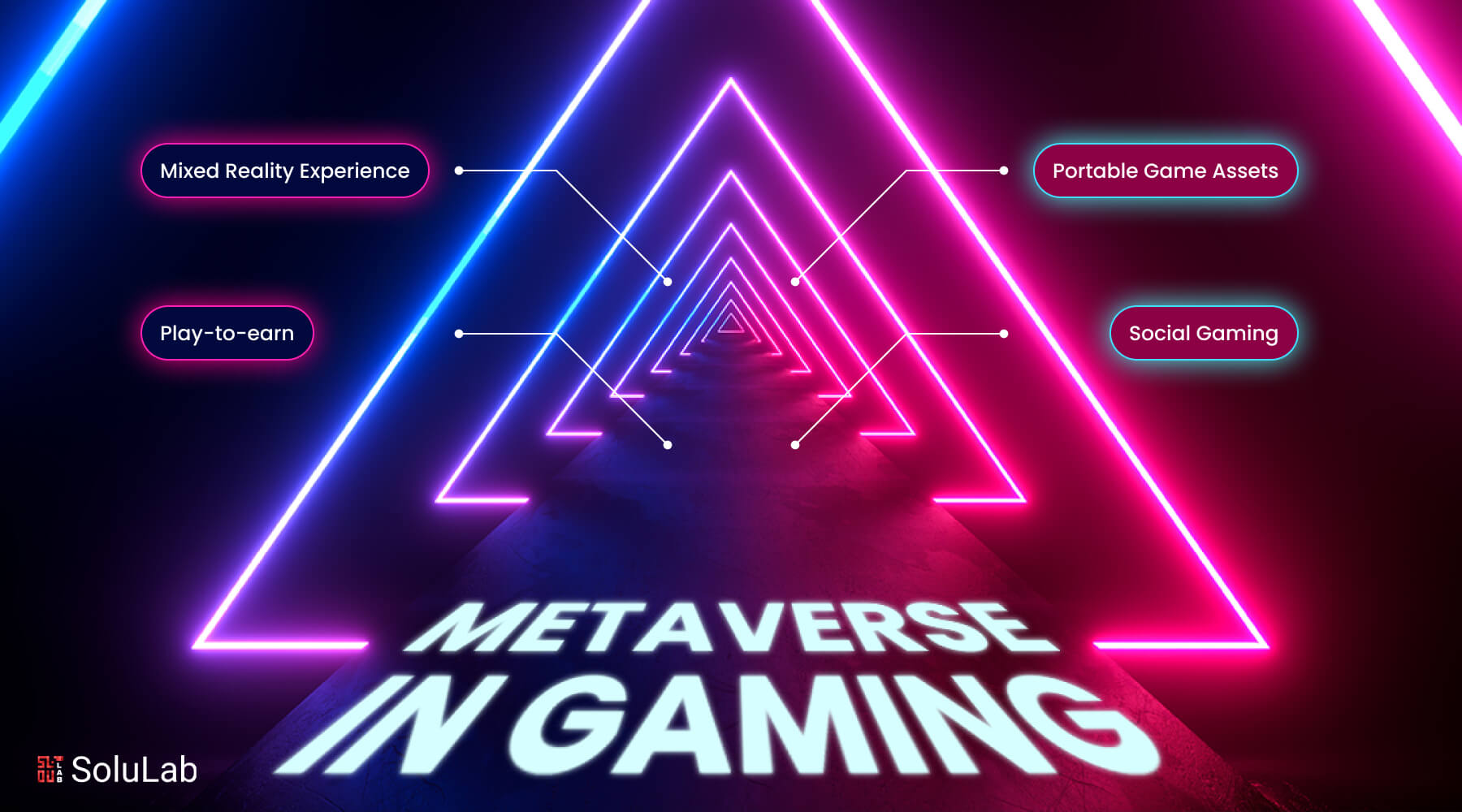
Metaverse gaming comprises social gaming, play-to-earn games, portable game assets, and mixed reality experiences. These games provide immersive encounters as well as the development of one-of-a-kind digital goods.
Social gaming changes the virtual world via making interactions with other players an integral component of the experience. It is fast growing in online gaming, fostering communities and developing bonds via shared activities and goals. Players participate in games that promote teamwork, communication, and sociability, as well as competitiveness. This trend is pushing increased demand for multiplayer games in which friends and strangers may join, communicate, and go on virtual journeys together.
The rise of social gaming indicates a trend towards enhanced metaverse experiences. Using technologies like artificial intelligence (AI) and augmented reality (AR), these games are more than just pleasures; they provide deep involvement by including digital avatars, in-game economies, and real-time interactions between players.
As part of this emerging sector, dedicated developers are using blockchain technology to make safe transactions while also providing special digital assets like non-fungible tokens (NFTs). The worldwide metaverse industry is anticipated to grow to $1,527.55 billion by 2029, demonstrating the enormous potential for merging social features into virtual worlds and offering a future in which online gaming is inextricably linked to powerful social networks.
Play-to-earn games are altering how players engage with virtual worlds by permitting them to earn real-world currency for in-game products. Players accomplish activities and goals to earn digital assets like cryptocurrencies and NFTs (non-fungible tokens), which are valuable both within and outside the game.
This strategy not only makes gaming more enjoyable but also creates new opportunities for gamers to benefit. The metaverse expands this potential by providing a platform for trading assets with other crypto gamers. Gamers may also produce content or design their own sub-games.
With an estimated industry value of $800 billion by 2024, play-to-earn has quickly become the foundation of the metaverse gaming industry, converting it into a rich digital economy where everyone has the opportunity to earn.
A distinct variation in the gaming metaverse is provided by portable game assets, which shift from play-to-earn models. These items, such as enhanced avatars or weaponry, follow you into and out of virtual spaces.
No matter where they are utilized, gamers always maintain ownership of their digital goods because of NFT (Non-Fungible Token) regulations. This adaptability gives each object more worth beyond only its use in the game, improving the whole gameplay experience.
There is a lot of interest from both developers and players in using NFTs to represent these portable game elements. Because players can really see the return on their gaming investments and efforts, consumer satisfaction might rise as a result.
Additionally, it gives products access to additional exposure channels across various metaverse platforms. Although work has to be done on workable business models to fully realize the value of these NFT-based assets, it is clear that these assets have the potential to fundamentally change our understanding of ownership and trading in virtual environments.
Immersive gaming is made possible by the seamless blending of the real and virtual worlds in mixed-reality experiences. The Metaverse virtual reality game leverages both augmented reality (AR) and virtual reality (VR) technology to let players engage with realistic digital elements inside their real-world surroundings.
This innovative method pushes the limits of conventional gameplay and improves the entire gaming experience by incorporating real-world components into virtual surroundings.
In order to generate intriguing and extremely engaging gameplay, metaverse gaming uses mixed reality experiences as a crucial element, bridging the gap between the actual and virtual worlds.
With experiences that go much beyond conventional gaming frameworks, the universe of metaverse games is enormous and ever-evolving. These games can be distinguished from one another by a number of distinctive features:
A number of virtual game components might be revolutionized by the introduction of gaming in metaverse. The Metaverse, which mimics real-world situations, provides a more accessible platform without the need for specialist equipment, in contrast to typical AR and VR technologies.
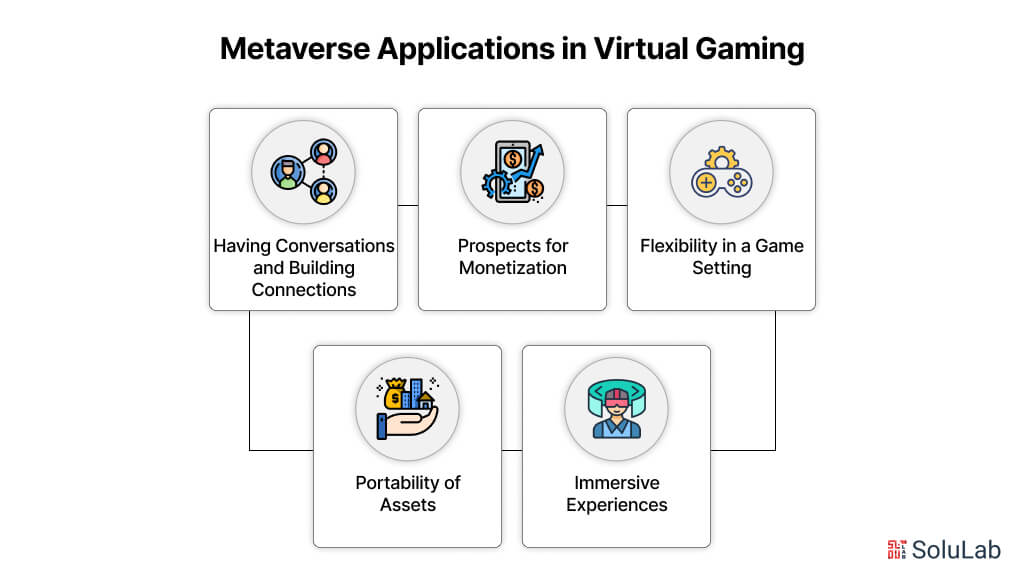
The following domains are significantly impacted by Metaverse application cases in the gaming industry:
Users interact with the world in the metaverse in ways that promote relationships. With multiplayer gaming, relationships may be forged, communication between users is facilitated, and connections with friends in real life are forged.
Within the metaverse, users may profit from profitable activities including trading virtual objects obtained in-game with other players and taking part in cryptocurrency games.
The game environment in the metaverse is incredibly flexible. In addition to creating content, adding new players, and starting subgames inside a league, users may also use their gameplay experiences as platforms for additional virtual gaming activities.
Because of its expandable nature, asset mobility in the metaverse is effortless. The ownership of equipment and avatar improvements obtained in one game can be transferred to another by users; however, NFT limitations apply.
Users can have immersive experiences in the Metaverse by utilizing MR and AR technology. Complete virtual reality experiences within the metaverse are made possible by mixed reality functions, which enable smooth transitions from augmented reality messages to mixed reality gaming.
The design, development, and commercialization of metaverse platforms and applications are receiving significant funding from well-known firms and R&D departments. These businesses are in a strong position to drive the metaverse gaming industry forward. If you’re looking to break into this sector, they’re also a great source of possible employment prospects.
A decentralized platform based on blockchain technology, Decentraland creates tools and apps for content creators to create games and other media. It was the first blockchain-powered digital world in the metaverse, having debuted in February 2020. You could be active in several facets of metaverse gaming if you work at Decentraland. Coins, VR, 3D design, and game design are a few examples.
The Ethereum blockchain was used to construct the Sandbox. You may construct, purchase, and trade real estate on this metaverse platform using a variety of decentralized land parcels to generate virtual assets. On your piece of land, you may develop play-to-earn games and generate things to earn tokens. Sandbox offers a variety of employment options, from marketing and talent recruitment to more technical roles like:
Fortnite is created by Epic Games. It makes significant investments in the metaverse, and many consider Epic to be one of the major participants in the metaverse’s future. You may build games like Fortnite, Fall Guys, or Rocket League if you work here. Perhaps you work on infrastructure-focused software, such as Unreal Engine, a 3-D graphics engine.
Read Blog: Navigating the Challenges of Building Metaverse Game Worlds
Facebook changed its name since it has made such a significant investment in the metaverse. Meta committed billions of dollars with the intention of transitioning to full immersion in the metaverse within the next several years. Additionally, it brought on a thousand new employees to create infrastructure and metaverse assets. Working here might involve creating and developing virtual environments similar to Meta’s Horizon Worlds, where you can socialize and play.
Microsoft is working on many metaverse apps that will work with Mesh, one of which is an augmented reality chipset that will make metaverse integrations easier to do. Additionally, the business landed a huge multibillion-dollar contract to create metaverse games supported by Microsoft. Possible positions that might become available include:
You may already access Roblox’s own metaverse and join the over 40 million users who explore the virtual world on a regular basis. Apart from being one of the first virtual worlds you can play in without VR gear, Roblox keeps making investments to develop easy-to-use metaverse gaming alternatives. If you apply for a job at Roblox, you could be able to work in marketing or accountancy, or in a role that is related to the metaverse. Typical employment consist of:
The business that created Pokemon Go is still creating and inventing games and platforms to enhance the metaverse and gaming experiences for users. With the goal of combining virtual and real-life experiences, it raised a significant amount of money in 2022 to construct a metaverse in the actual world.
Working for this startup, which describes itself as the “only planet-scale AR platform,” may lead to creative roles as a technical artist or user experience designer, or it could include exploring potential markets and supporting corporate development. In addition to marketing and operations management, other possible positions to think about include software engineers, accounting managers, and security engineers.
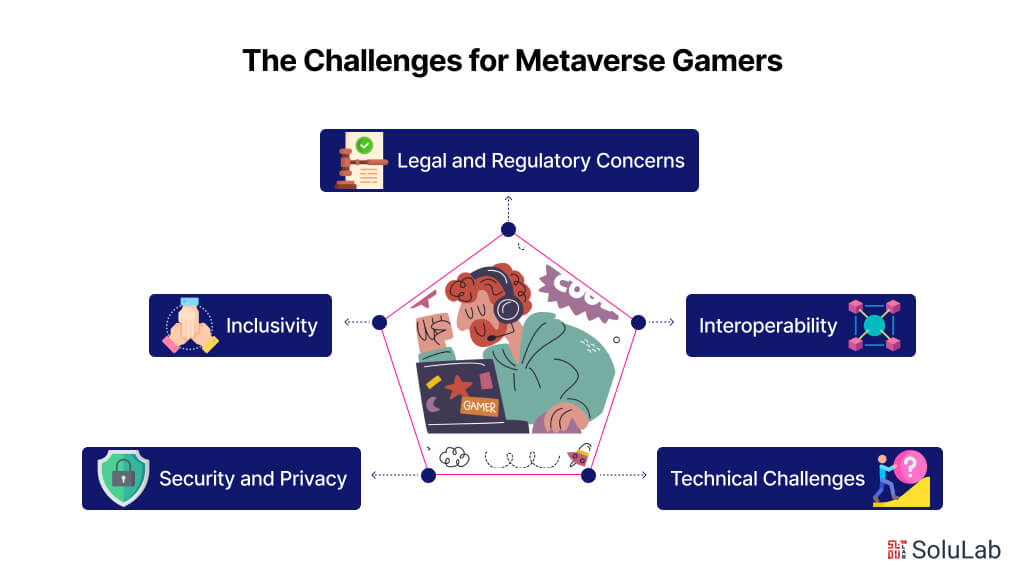
The creation and execution of gaming in metaverse present a number of difficulties, such as:
1. Technical Challenges: Creating a fully functional, networked metaverse is a difficult endeavor requiring a great deal of experience in fields like virtual reality, blockchain technology, and artificial intelligence.
2. Interoperability: Ensuring that various virtual environments and video games can easily communicate and exchange data is a significant problem. It necessitates creating universal standards and protocols that work with many systems.
3. Security and Privacy: Ensuring strong security and privacy safeguards will be essential to fostering user confidence since the metaverse will entail significant volumes of personal data and financial activities.
4. Legal and Regulatory Concerns: The use of virtual currencies, NFTs, and other digital assets gives rise to a number of legal and regulatory concerns, including those pertaining to intellectual property rights, taxes, and consumer protection.
5. Inclusivity: Some user groups may be left out of the metaverse, such as those with poor Internet connection or those who are unable to purchase the necessary gear. Long-term viability of the metaverse will depend on making sure it is inclusive and accessible to all users.
The idea of the metaverse is beginning to take shape, and web3 technology made possible by blockchain technology is being incorporated into it. Here is what the future of metaverse in game development will look like:

In a nutshell the metaverse offers immersive, networked experiences that go beyond conventional bounds, signaling a fundamental change in the game industry. The metaverse offers participants previously unheard-of chances for engagement, innovation, and ownership by utilizing advanced technology like blockchain, virtual reality, and augmented reality. Because players may delve into vast virtual worlds, participate in vibrant social interactions, and even make money from their in-game activities, the metaverse is a constantly changing and exciting area of the digital entertainment market. The metaverse’s potential will only grow as technology develops, offering gamers everywhere the chance to partake in even more revolutionary discoveries and experiences.
As a leading metaverse development company, SoluLab is at the forefront of this exciting evolution. Our team of experts specializes in creating customized metaverse environments that cater to a wide range of gaming and business needs. From conceptualization and design to development and deployment, SoluLab offers comprehensive solutions to help you realize your vision of a fully immersive, engaging virtual world. Ready to take your gaming experience to the next level? Contact us today to discover how we can help you bring your metaverse project to life.
The metaverse refers to a collective virtual shared space, created by the convergence of virtually enhanced physical reality and physically persistent virtual space, including the sum of all virtual worlds, augmented reality, and the Internet. In gaming, the metaverse offers an immersive environment where players can interact with each other and the game world in ways that go beyond traditional gaming experiences.
The metaverse enhances the gaming experience by providing a more immersive and interactive environment. Players can explore expansive virtual worlds, engage in real-time social interactions, participate in complex, user-generated content, and even own and trade virtual assets. This level of immersion and interaction makes the gaming experience more engaging and dynamic compared to traditional games.
Several advanced technologies are driving the development of the metaverse, including virtual reality (VR), augmented reality (AR), blockchain, and artificial intelligence (AI). VR and AR create immersive environments, while blockchain ensures secure ownership and transfer of digital assets. AI enhances the interactivity and responsiveness of the virtual world, making the metaverse a seamless and engaging experience.
Yes, the metaverse offers various opportunities for monetization. Players can earn through creating and selling virtual goods, participating in play-to-earn games, offering services, or even owning virtual real estate. Blockchain technology facilitates these transactions, ensuring that ownership and transfers of digital assets are secure and verifiable.
SoluLab is a leading metaverse development company that provides end-to-end solutions for creating immersive virtual environments. Our team of experts can help with everything from the initial concept and design to development and deployment, ensuring that your metaverse project is tailored to your specific needs and goals. Whether you’re looking to develop a new game or enhance an existing one, SoluLab has the expertise and experience to bring your vision to life. Contact us today to get started on your metaverse journey.


