Talk to an Expert

How are AI Agents Redefining Sales and Marketing

AI Agents in Sales and Marketing

Can you imagine a world where your sales never miss a beat, your marketing campaigns are always on point with your customers, and your business thrives on data-driven insights? Well, don’t just imagine, with the emergence of artificial intelligence (AI) you can make this happen with accuracy and efficiency. AI Agents in Sales and Marketing are evolving with the development of better customer involvement and higher conversion rates. AI is more than automation and virtual assistants, it can transform your future where every interaction is tailored to an individual’s needs.

In the present fast-paced world, the attention span is shrinking, and information overloading, making it even more important for businesses to focus on data-driven campaigns and offer values that resonate with existing customers and attract new ones. This blog will help you understand what AI Agents for Sales and Marketing are, how they enhance the traditional ways of sales and marketing, and how to use AI in sales.

What are AI Agents and What Do They Do?

AI Agents are intelligent software programs designed to automate and enhance tasks in sales and marketing particularly relevant for Gen AI in sales. They leverage artificial intelligence (AI) to analyze data, learn from patterns, and make decisions, ultimately improving efficiency and effectiveness which is crucial. AI gives insights they’d miss otherwise to 73% of consumers and dealers. 

Think of AI Agents in marketing as your virtual assistants, working tirelessly behind the scenes to streamline your processes and handle repetitive tasks like scheduling appointments, sending emails, and qualifying leads. In particular, AI SDR (Sales Development Representative) agents can elevate the early stages of customer engagement by automating lead qualification and outreach, ensuring that potential clients are properly identified and engaged.

AI agents’ examples go beyond simple automation. They can also help you to manage the complexities of and ensure a smooth launch. For example, they can automate outreach to potential investors, analyze market trends to identify ideal launch timing and personalize communication to maximize engagement. By leveraging AI in sales, you can streamline your sales process, optimize your marketing efforts, and increase your chances of success. 
Role of AI Agents in Sales and Marketing

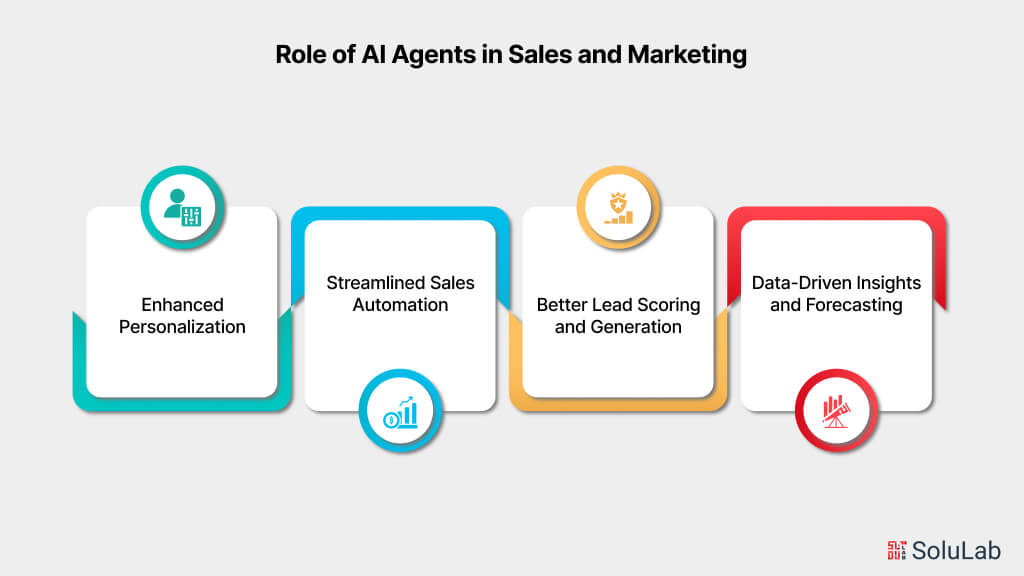
Role of AI Agents in Sales and Marketing

The relationship managers between consumers and businesses are becoming more associated with the touch of AI agents, which are prominent assets to artificial intelligence and sales. Essentially, AI use cases and applications show these agents play a complex role in today’s sales and marketing industries.

1. Enhanced Personalization

AI for startups can analyze a large turnover of consumer information such as; their demographic data, interconnect internet usage, and past orders. Since they can collect information about the customers, they can advise how to work and sell their products to every customer uniquely. Imagine how such a Generative AI in E-Commerce can benefit the overall relevancy and efficiency of a campaign by creating a stream of emails with products that correspond to the client’s purchase history.

2. Streamlined Sales Automation

For sales AI agents can be used to drive many of those time-wasting activities such as appointment making, follow-up e-mails, and even the qualification of prospects. This makes it gives the human salespeople more time to dedicate their time in brewing relationships, closing the sales, and coming up with more projects such as projects. Organizations can also manage the marketing AI agent because options for cost savings are nearly endless in terms of automation.

Read Our Blog: Role of AI Agents in Supply Chain and Logistics

3. Better Lead Scoring and Generation

The field of Cognitive Sciences can engage web and consumer data to detail possible customers with buying intentions. The qualified prospects are thus eagerly out there waiting to be contacted by the salespeople to enhance the chances of converting these leads into customers. By this marketing, AI agent makes it possible to get the right messenger to the most probable leads with the help of this efficient lead-scoring system to support outreach.

4. Data-Driven Insights and Forecasting

Another AI agent use cases is in the aspects of data analysis especially when dealing with large chunks of data to look for, patterns and trends beyond the reach of human perception and with the help of given data, be in a position to predict what will be ahead. This makes it possible for firms to invest in the right locations and channels, coordinate and develop the proper type of campaigns, and sometimes even concoct new products from information.

Benefits of AI Agents in Sales and Marketing

What directly pertains to business organizations is that such abilities of AI Agents for Sales and Marketing, which challenge business houses to huge strides are possibly the most fulfilling when explored. This is an insightful look at how agents AI helps sales and marketing teams:

Improved Targeting and Customer Insights:

  • They enable better targeting and a better understanding of the customer.
  • There is another area where artificial intelligence is very effective; it is for the examination of the clients’ larger data, their demographic data, past purchase data, World Wide Web use social media account data, etc.
  • With these realizations, marketers might design potent advertisements that have the motivation of pro-trial sentiments within particular client segments.
  • It can also translate to organizations ensuring that IOTs do not fail in meeting the client’s needs and wants because there are solutions available informing the clients what IOTs can offer.

Tailored Customer Experiences

  • Information and content are personalized, and Artificial Intelligence (AI) modifies the given choice and proposal.
  • This enhances the results of the relationship that the firm has with its clients as well as customer loyalty ultimately enhancing sales conversion rates.
  • The main stand of fortune of chatbots is the round-the-clock customer service and immediate personal response.

Simplified Procedures for Sales

  • Thus, AI frees the sales representatives’ time to engage in more productive activities instead of spending their time on lead scoring, lead qualification, and appointment scheduling.
  • More benefits can also be seen in the use of the AI sales intelligence system by the brokers since it provides information on the prospect and competitors.
  • This in turn will have higher possibilities of sale production and can also identify predictive difficulties before altering the revenue techniques.

Contact Us

Large-Scale Content Creation

  • By applying the Artificial Intelligence technique, firms would be confident that the messages that they post through the blogging websites, the interaction through social sites, and even on any products’ descriptions are identical.
  • This one may be favorable for the search engines and the generation of leads for a target client thus boosting site traffic.

Check Out Our Blog Post: Impact of AI on Copywriting

Advantage of Competition

  • Introducing AI into the strategic management system enables an organization to have an edge over a rival in business deals.
  • Therefore, adopting AI in the areas of marketing and sales leads to coming up with more potential customers, more chances of developing conversion rates, and enhanced relationships between the business and the customer.

In addition to the benefits, nearly 6 in 10 users believe they are on their way to mastering the technology. The importance of AI Agents in Sales provides and AI marketing agent insights to 34% of salespeople and helps 31% of sales reps write sales messaging.

Examples of AI Agents in Sales and Marketing

AI for startups is transforming sales and marketing through various means such as automating tasks, analyzing data, and personalizing interactions. Here are a few examples of AI agents in sales and marketing:

1. Chatbots

The latter is to greet the users of particular websites, answer their questions or inquiries, and filter leads 24/7. Also, they can schedule demos, make suggestions on what product they think the client should purchase, and handle simple sales.

2. Intelligent Content Engines

Targeted advertising involves the use of the user’s information and the pattern at which he or she surfs the internet to modify emails, social media posts, and web content. Due to this, customers shall be exposed to content that is relevant to them hence improving interaction.

3. Lead Prioritization and Scoring

This means that AI assesses talk sequences regarding prospects and assigns them a score based on their ability to sell. By focusing on strong leads, a sales representative can increase their productivity and impact positively on the system.

4. Market Trend Prediction

 AI involves a massive amount of data processing and utilizes it in the prediction of the consumers’ behavior and development of the market. This also makes marketers future-ready and prepares them for change, they can predict the market and its demands to alter marketing efforts.

Read Blog: AI Agents in Retail and E-Commerce

Importance of AI Agents in Sales and Marketing

Independent intelligent agents are a major force that is revolutionizing the methods of selling and marketing, speaking of agent artificial intelligence is no longer a fantasy. Here are the reasons behind the Importance of AI Agents in Sales and marketing AI agent:

1. Enhancing Human Capabilities: Currently, managers will hire AI developers to assist with the sales and marketing duties but they won’t replace the sales and marketing personnel. Instead, it is just smart helpers that automate some of the tedious work and provide immediate information. This makes human knowledge for doing business, relationship creation, and contract closure and thinking available.

2. Unlocking the Power of Personalization: Consumers require tangible personalization in the current age of big data. AI agents can therefore generate highly specific content, recommended services/products, and promotional messages based on the client’s behavior and past choices. Such laser-like focus is well appreciated by customers, improving the relations and boosting the actual conversions.

3. Predicting Customer Needs: The application of AI in sales and marketing gives those departments a type of ‘ peek’ into the future. Here, AI can predict what the consumers would want, and what they are most likely to purchase, forecasted from records and trend analysis of sales. This makes companies to be a step ahead ensuring they offer the right service to customers at the right time.

4. Encouraging Constant Customer Engagement: Customers Shift The rigid work schedules or what used to be called a 9-5 working week do not exist again. AI bots can provide support 24/7 and answer questions. This way client satisfaction and hence loyalty are achieved since a client gets the required information at the right time.

5. Optimal Resource Allocation: To say this, AI is beneficial for work on sales and marketing for employees as it makes this work more intelligent rather than increasing the load. AI optimizes everyone’s resource utilization since it provides accurate data and minimizes the amount of manual labor. He has put much effort into elaborating how teams can work to guarantee that they get the most out of their investment resources, specifically by focusing more on activities that produce a big impact.

Read Also: Voice AI Agents In Conversions and Sales

Sales and Marketing in the Future with AI

One can therefore be very sure that the increasing development and integration of AI Agents in Sales and Marketing will greatly affect sales and marketing in the future. Thus, as AI technology continues to improve,  we may expect to have even more sophisticated features that intertwine the relationship between humans and machines. Chatbots will evolve into comprehensive communicational companions that understand complex questions and respond accordingly. AI agent use case engines shall become even more anticipatory to envision the clients’ needs before they are identified. These frictionless consumer journey maps to be generated from this hyper-personalization will make customers happier they will buy like never before. These frictionless consumer journey maps to be generated from this hyper-personalization will make customers happier they will buy like never before.

AI use cases and applications will shift the traditional marketing and sales team to that of a consultation agency. For marketing, AI agents will give strategic insights into the consumers’ attitudes, competitors’ expectations, and market expectations, by analyzing large volumes of data in real time. In turn, the teams will be more prepared to adapt campaigns toward better performance, use data to their advantage, and stay relevant to occurrences. Sales and marketing is a field that will see a beautiful dance between AI’s unsurpassed analytical prowess and human hard-won knowledge shortly hence a level of consumer interaction that could barely be imagined.

AI Agent Solutions

The Final Word

It has to be recognized that AI Agents in Sales and Marketing are currently redefining the historical concept of ‘consumer connection’ at its most basic levels. It is possible to expect the day when intelligent automation delivers seamless, personalized, intelligent client experiences due to the existing AI advancements. Companies have huge opportunities in the future to grow sustainably, spike up their sales, and align more with their customers.

However, the factors that are required for the implementation of AI are the skill and the right approach. can help companies unleash their potential with the help of AI. Given the fact that they possess innovative strategies in developing applications that tackle key concerns, intending and committed consumers can seek the aid of an AI agent development company or hire an AI developer like SoluLab to comprehend the potential of the extensive area of application entailing AI in sales and marketing.

FAQs

1. What are the major advantages of using AI agents in marketing and sales functions?

The benefits that come with the use of AI agents include; persistent customer interaction, personalization of clients’ experiences, removal of monotonous tasks, insights, and increased efficiency for the marketing and selling teams.

2. How might the customer come across these AI agents’ presence and how might the agents adapt the experience?

One of the most important advantages is the possibility to adapt the information, the recommendation as well as the marketing and sale messages according to the client’s preferences and even behavioral characteristics that have been collected regarding him/ her. Due to the unique customer focus this creates, the level of engagement and possible conversions rises.

3. Will we see bots that will work more like real marketers and real salespeople?

AI bots are in no way intended to replace human experts. Instead, they are intelligent assistants, sparing the true knowledge for deal-making, relationship-closing, and strategic thinking.

4. What must be considered when using AI agents?

Note that structured and clean data is critical in successfully feeding it to the AI algorithms Integrating AI could lead to certain distortions to the existing organizational processes. Thus, there ought to be guidelines that companies must adhere to about the safeguarding of the identity and rights of their clients, especially in AI selection and operation.

5. How can SoluLab help firms that want to utilize AI for marketing and selling?

We can help define the demands and then recommend the right instruments. The data should not be created through integrating AI. The main benefit that can be mentioned here is that current CRM, marketing automation, as well as other company systems, can be integrated into the new system with the help of solutions providers.

How Can Generative AI Help Your Business in Sales?

Generative AI in Sales

Struggling to hit your sales targets despite having a strong team and a good product? Businesses today face similar challenges: stretched resources, long sales cycles, and low conversion rates. It’s frustrating to see efforts fall short, especially when competition is fierce and customer expectations are higher than ever.

However, generative AI is a tool that’s changing how businesses approach sales. From writing personalized emails and follow-ups to generating pitch content and analyzing buyer behavior, generative AI can save hours of manual effort while boosting efficiency.

Research shows that 51% of companies that are integrating AI are seeing revenues increase by 10% and 80% higher productivity.

In this blog, we’ll break down how generative AI can support your sales team, increase productivity, and improve close rates. If you’ve been wondering whether AI is worth the hype, this article will help you see its real-world potential.

What is Generative AI?

Generative AI, or Generative Adversarial Networks (GANs), is a subtype of artificial intelligence (AI) centered on developing new material or data from existing patterns and instances.

Unlike standard AI models, which are developed for specialized tasks such as categorization or prediction, generative AI seeks to produce innovative outputs that seem like human-created data.

Here’s a far more straightforward explanation:

“Generative AI involves deep-learning algorithms that can produce high-quality text, images, and additional content according to the data they were instructed on.”

The Role of Generative AI in Sales

Generative AI is reshaping sales by creating personalized content, improving customer interactions, and improving processes for faster conversions and better decision-making.

1. Personalized Sales Emails: Generative AI can craft highly personalized sales emails based on customer data, behavior, and interests. This helps sales teams engage prospects more effectively and improve open and response rates.

2. Automated Proposal Generation: It can instantly generate sales proposals tailored to client needs, saving time and ensuring consistency. This reduces manual work and speeds up the sales cycle significantly.

3. Chatbots and Virtual Assistants: AI-powered chatbots handle routine queries, qualify leads, and offer instant responses. This frees up human reps for complex tasks and ensures 24/7 customer engagement.

4. Data-Driven Insights: Generative AI analyzes large volumes of customer data to uncover trends and buying signals. Sales teams can use these insights to prioritize leads and refine their approach.

5. Sales Training and Roleplay: AI can simulate real customer scenarios for training purposes. Sales reps can practice conversations and get feedback, helping them improve their pitch and handle objections more confidently.

Generative AI in Sales: What the Stats Are Saying

As reported by McKinsey, around 75% of the benefits of utilizing Generative AI are observed in four major areas:

  • Customer Operations
  • Marketing & Sales
  • Software engineering
  • Research and Development (R&D)

The following data demonstrates how generative AI for sales and marketing is used:

  • According to a recent study, companies that use generative AI for sales outreach experience an average 25% increase in response rates 
  • As per Market.Us, the Generative AI in Sales Market size is expected to be worth around USD 873.2 Million by 2033, growing at a CAGR of 10.9%. 
  • Salesforce discovered that 84% of users said it helped increase sales at their organization by enhancing and speeding up customer interactions.
  • According to Gartner, by 2027, 95% of seller research workflows will begin with generative AI, up from less than 20% in 2024.
  • According to a HubSpot study of sales executives, 94% believe it boosts sales and can help locate new clients.

How to Use AI to Supercharge Your Sales Strategy?

Artificial intelligence (AI) is transforming sales, offering new ways to boost productivity, enhance customer engagement, and drive revenue growth. Here’s how you can effectively start using AI for sales strategies:

1. Lead Generation and Scoring

Artificial intelligence in sales and marketing can significantly improve lead generation by analyzing large amounts of data to identify potential customers. Platforms like Microsoft Dynamics 365 Sales, enhanced by AI capabilities, allows businesses to automate lead scoring and streamline the qualification process effectively.

AI-powered tools can assess the likelihood of leads converting into customers based on their past behaviors, interactions, and demographic information. This process, known as lead scoring, allows sales teams to prioritize high-value prospects and tailor their approach accordingly.

2. Personalized Customer Experiences

Generative AI in marketing and sales can create highly personalized content and communication strategies. By analyzing customer data, AI can generate customized emails, social media posts, and product recommendations that align with individual preferences and behaviors. This level of personalization helps build stronger relationships and increases the chances of closing sales.

3. Sales Forecasting

Accurate sales forecasting is crucial for planning and strategy. AI in sales enablement can analyze historical sales data, market trends, and economic indicators to predict future sales performance. This allows sales teams to make informed decisions, allocate resources effectively, and set realistic targets.

4. Chatbots and Virtual Assistants

AI-powered chatbots and virtual assistants can handle routine inquiries, provide instant responses to customer queries, and guide potential customers through the sales funnel. These tools are available 24/7, ensuring that customer interactions are efficient and consistent, ultimately freeing up sales representatives to focus on more complex tasks.

5. Enhanced Customer Insights

AI in sales and marketing can provide deeper insights into customer behavior and preferences. By analyzing data from various touchpoints, AI helps sales teams understand customer needs better and tailor their strategies accordingly. This leads to more effective communication and higher conversion rates.

6. Predictive Analytics

AI B2B sales tools can use predictive analytics to identify the best times to contact prospects, suggest optimal pricing strategies, and recommend upsell and cross-sell opportunities. By leveraging these insights, sales teams can improve their chances of closing deals and maximizing revenue.

By integrating AI for sales processes, you can unlock new levels of efficiency and effectiveness, ultimately driving better results for your business.

CTA1

Top Benefits of Using Generative AI in Sales

The benefits when implementing generative AI in sales are as follows:

  • Better Lead Generation: By analyzing customer data, generative AI for sales may more precisely identify potential leads, increasing conversion rates.
  • Personalized Customer Interactions: Sales teams may improve engagement and forge closer bonds with customers by creating customized messages and content that are based on their preferences.
  • Effective Sales Processes: By automating time-consuming chores like creating proposals or emails, sales representatives may concentrate on higher-value duties.
  • Improved Sales Forecasting: By analyzing past sales data and industry trends, generative AI for sales may produce more precise sales predictions that support strategic decision-making.
  • Cost Reduction: Generative AI lowers operational expenses related to sales operations by optimizing workflows and enhancing productivity.
  • Real-time Sales Support: AI-driven technologies may help sales representatives in real-time during client contacts, boosting productivity and closing rates.
  • Competitive Edge: By providing data-driven insights and more intelligent sales methods, leveraging innovative AI technologies provides firms with a competitive edge.
  • 24-hour Availability: Generative AI tools like chatbots and virtual assistants can operate round the clock without breaks. This ensures customers get instant support at any time, improving service quality and reducing the need for large support teams.

Generative AI Use Cases in Sales

Generative AI Use Cases in Sales

Generative AI applications in Sales are rapidly transforming the industry, offering numerous advantages that streamline processes and enhance outcomes. According to a HubSpot survey, the top uses of sales AI include content generation (18%), reaching out to potential prospects (16%), and analyzing data and research (16%). Here are 14 practical generative AI use cases in sales, categorized into content generation, task automation, and data analysis.

1. Content Generation

Earlier, sales representatives had to invest a lot of time and effort into creating pitches, sales emails, proposals, and lead-nurturing content manually. Now, generative AI can automate much of this work by using preset rules and customer data to generate these materials. This allows sales teams to focus more on high-value tasks like building and maintaining client relationships.

AI can also create automated drip campaigns and personalized message sequences sent over time through various channels to keep leads engaged without human involvement. Additionally, it can adjust messages based on lead interactions, assist with lead scoring, and ensure content stays relevant throughout the customer journey.

2. Task Automation

Lead Research Generative AI tools assist sales reps in researching leads within their CRM systems. For example, a sales representative at a technology startup in San Francisco could ask the AI tool to generate a list of top software development firms in the Bay Area. The tool compiles detailed profiles of these companies, including services offered, key contacts, and office locations. The sales rep can then import this information directly into the CRM system for future outreach and relationship building.

3. Proposal Generation

Generative AI marketing can aid sales teams in crafting proposals by generating customized content tailored to customer preferences and business insights. Sales representatives can input specific details about a client’s needs, such as industry, project scope, and desired outcomes. The AI tool then generates a comprehensive proposal document, including relevant information, pricing details, and value propositions customized to the client’s requirements. This streamlines the proposal creation process, ensuring consistency and accuracy in presenting sales offers to potential customers.

4. Contact Management

Generative AI can simplify CRM data entry for sales representatives, saving time in large enterprises with complex sales processes. Sales reps can use natural language prompts to efficiently input contact information. For instance, typing “schedule a demo with Acme Corporation for next Tuesday at 10 AM” would automatically create a calendar event and update the CRM with the scheduled demo details, including contact information and meeting notes.

5. Chatbots and virtual sales assistants

Virtual AI assistants and chatbots that help with customer inquiries, lead qualification, and even closing deals can be powered by generative AI. These AI-powered tools have human-like conversations and provide real-time answers to queries. In order to provide a smooth experience for both customers and sales teams, these solutions use natural language processing (NLP) technology to comprehend and react to complicated customer requests.

6. Real-time Sales Coaching

Generative AI tools can provide real-time coaching to sales reps by analyzing their interactions, such as emails, live chats, and video conferences. Organizations can customize their AI tools by feeding them large amounts of past sales interaction data. For example, if a customer asks about pricing, the AI tool can generate a cue card with effective responses based on successful past interactions. This assists sales reps in confidently and accurately addressing customer inquiries. Additionally, generative AI can identify ineffective behaviors, such as overselling during initial discussions, and highlight patterns leading to unsuccessful outcomes. This feedback empowers sales reps to refine their approach by emphasizing understanding customer needs before pitching product features.

7. Accurate Forecasting

Generative AI’s capability to analyze large volumes of unstructured data, such as sales interactions, can significantly improve forecast accuracy. For example, if a sales forecast predicts a surge in demand for a specific product line, the organization can ramp up inventory and allocate resources to meet anticipated customer needs. Conversely, inaccurate forecasts can result in excess inventory or shortages, impacting profitability and customer satisfaction. Generative AI tools analyze historical sales data, market trends, and customer preferences to predict demand more accurately.

8. Sales Analytics

Generative AI revolutionizes sales analytics by providing critical insights for informed decision-making and strategy refinement. It analyzes sales data to uncover patterns, trends, and key performance indicators, utilizing machine learning to predict future sales performance. Moreover, AI offers prescriptive analytics by providing actionable recommendations to enhance sales outcomes. Real-time analytics, sentiment analysis, pipeline assessment, and sales rep performance evaluation are among the areas where generative AI can empower sales teams with valuable insights.

9. Sentiment Analysis

Generative AI can evaluate customer feedback, reviews, and social media comments to assess sentiment and uncover potential insights. This enables sales teams to address customer concerns, leverage positive feedback, and refine sales messaging to better connect with their target audience.

10. Improve Reporting System 

With AI recommendations, managers can also share missing sales documents with the team via a document viewer to enhance accessibility and performance. AI tools can detect individuals experiencing a decline in performance and create personalized reports highlighting individual strengths and weaknesses, along with recommendations for improving performance.

Related: Generative AI in Customer Service

Generative AI vs. Traditional Sales Tools

Aspect Generative AI Traditional Sales Tools
Creativity Produces fresh content and concepts based on input data and detected patterns Depends on fixed templates and predefined strategies
Customization Delivers tailored recommendations and responses specific to individual needs Provides generic solutions and responses
Automation Automates the creation of content and customer interactions, minimizing manual effort Typically requires manual input and handling for each interaction
Learning Capability Continuously improves and learns over time through data analysis and feedback Has limited ability to adapt or improve without human intervention
Scalability Easily scales to manage large amounts of data and interactions May have difficulty managing increased workload without extra resources
Flexibility Rapidly adjusts to changing market trends and customer preferences Usually less flexible and requires significant reconfiguration to adapt
Insight Generation Generates insights and analytics from data patterns and customer interactions Provides basic reporting and analytical capabilities
Integration Seamlessly integrates with existing systems and workflows Integration might require significant customization and development
Cost-effectiveness Can reduce costs through automation and enhanced efficiency Initial costs might be higher, with the potential for long-term benefits
Innovation Promotes innovation by creating new ideas and approaches Relies on traditional methods and established techniques

How to Integrate Generative AI in Sales?

Implementing generative AI in sales requires a thoughtful approach that connects technology with your sales strategy to drive real results. Here’s how to do it effectively:

  • Align AI goals with sales objectives: Before implementation, ensure AI initiatives directly support your sales goals, like lead generation, conversion rates, or customer engagement. This keeps AI usage purposeful and ensures a measurable impact on business outcomes.
  • Ensuring data quality, consistency, and integration: Generative AI thrives on clean and consistent data. Organize, label, and centralize customer and sales data across systems to ensure accurate outputs and reliable performance from AI tools.
  • Understanding how AI will impact a sales team: Introduce AI in a way that supports rather than replaces your sales team. Train them to use AI tools to save time on repetitive tasks and focus more on building customer relationships.
  • 4. Integrating AI with existing sales technologies: Make sure generative AI tools can plug into your CRM, email platforms, and analytics systems. This creates a smooth workflow without disrupting your team’s current processes.

CTA2

Final Words

From creating personalized outreach and generating pitch content to analyzing customer data and forecasting trends, it brings speed, precision, and scale to your sales process. When implemented thoughtfully, it helps your team to focus more on relationships and closing deals rather than routine tasks. If done right, generative AI can boost productivity, efficiency, and revenue across your sales funnel.

ShopSmart partnered with SoluLab to improve its retail operations. By integrating generative AI, data analytics, and automated inventory systems, they boosted sales conversions, improved customer retention, and cut operational costs. The result: smarter retail experiences, optimized inventory, and faster decision-making across 500+ stores.

SoluLab, a top generative AI development company in the USA can help you integrate AI systems into your business to scale faster. Contact us today to discuss further. 

FAQs

1. How can Generative AI help my sales team?

Generative AI helps sales teams save time, reduce manual tasks, and improve personalization at scale. It can write tailored emails, summarize meeting notes, suggest next-best actions, qualify leads, and more. This allows representatives to focus more on building relationships and closing deals.

2. How does Generative AI support lead generation?

Generative AI can help identify ideal prospects by analyzing CRM and third-party data, scoring leads based on behavior, and crafting tailored outreach messages. It can even suggest follow-up actions and segment leads into nurture tracks, helping sales teams focus on the hottest opportunities.

3. Will Generative AI replace salespeople?

No, Generative AI is a tool, not a replacement. It enhances the work of sales teams by handling repetitive tasks and providing insights. Human creativity, trust-building, and strategic thinking are still critical parts of the sales process that AI can’t fully replicate.

4. How do I get started with Generative AI for my sales team?

Start small! Identify one or two areas where your sales process feels slow or repetitive. Then test GenAI tools like HubSpot AI, ChatGPT integrations, or Salesforce Einstein to automate those functions. Over time, expand as your team grows comfortable with AI support.

5. How can SoluLab help my business implement generative AI for sales effectively?

SoluLab specializes in developing and integrating AI solutions tailored to your specific business needs. They address key challenges to ensure that your generative AI implementation is smooth and effective. To explore our customized generative AI development services, contact us today!
