Talk to an Expert

How to Integrate Generative AI With Your CRM & ERP?


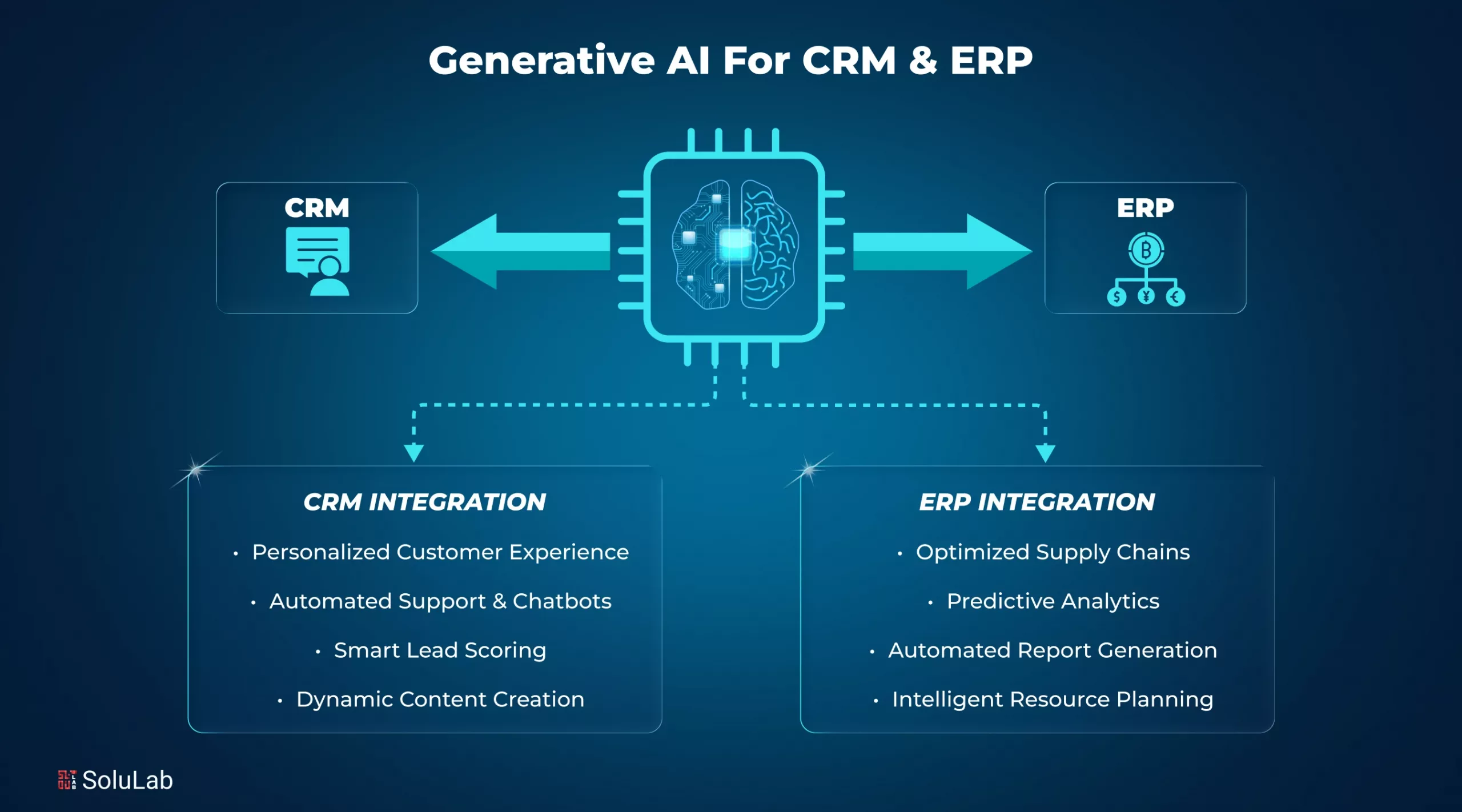
Generative AI For CRM and ERP

Every business collects mountains of data daily, yet most CRM and ERP systems struggle to turn it into actionable insights. Sales teams chase leads blindly, operations run on outdated forecasts, and customer service often feels reactive rather than proactive.

Generative AI can analyze such vast datasets, generate smart recommendations, automate repetitive tasks, and even draft reports or personalized messages. By integrating generative AI with your CRM and ERP, companies can unlock smarter workflows, faster decisions, and enhanced customer experiences, transforming the way business operates in the digital age.

According to recent McKinsey research, generative AI could increase sales productivity by 3 to 5 percent globally.

This blog will highlight the ways gen AI integration in your CRM and ERP can help your business, along with the process. Let’s get started! 

How Generative AI is Transforming CRM?

With the implementation of generative AI, your CRM can do more than just store customer data; it can draft emails, generate reports, and even predict what your clients need next, all automatically.

Platforms like Salesforce, HubSpot, and Microsoft Dynamics 365 are now supporting enterprise CRM AI integration, making it easier for businesses to scale personalized interactions and improve operational efficiency. 

Companies that implement generative AI report significant gains: 

Gartner predicts AI-driven CRM adoption will influence over 70% of marketing software investments by 2027, with measurable improvements in lead scoring, sales productivity, and customer engagement.

For businesses, integrating AI-powered CRM solutions isn’t just a tech upgrade; it’s a way to stay competitive, make smarter decisions, and create better experiences for every customer.
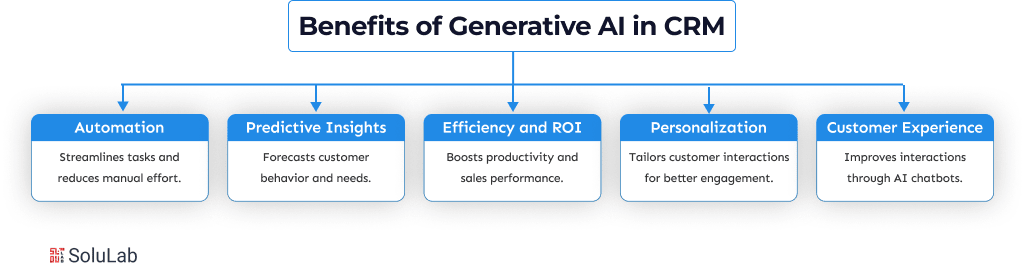
Benefits of Using Generative AI in CRM

Benefits of Generative AI in CRM

Businesses are exploring various Generative AI use cases in CRM, from automated email generation to predictive lead scoring, to drive better engagement and operational efficiency.

  • Automates Routine CRM Tasks

One of the biggest advantages of Generative AI implementation services is automation. Sales and marketing teams no longer need to spend hours drafting emails, creating reports, or scoring leads manually.

With AI-powered CRM solutions, workflows can automatically prioritize leads, send personalized follow-ups, and even generate proposals. Many businesses report saving up to 50% of manual effort when using these tools, freeing teams to focus on strategy and growth.

  • Enhances Personalization in CRM

Generative AI analyzes customer behavior and historical data to recommend products, customize marketing campaigns, and send timely communications. This advanced personalization helps increase engagement, loyalty, and conversion rates. Clearly, the benefits of implementing generative AI go beyond efficiency; they directly impact revenue and customer satisfaction.

  • Predictive Customer Insights

Predictive analytics powered by GenAI can identify customers at risk of churn, evaluate lead quality, and forecast future needs. The integration process of generative AI ensures these insights are fully connected to your CRM workflows, allowing teams to act proactively and retain more customers.

  • Improving Customer Experience 

AI chatbots and virtual assistants enhance customer interactions by providing instant, accurate responses. Through generative AI CRM integration, businesses can resolve inquiries faster, reduce wait times, and improve overall satisfaction. The result is a smoother, more efficient experience for both customers and teams.

  • Boosting Efficiency and ROI 

Enterprises using GenAI see measurable improvements in productivity, sales performance, and customer engagement. This proves the tangible benefits of AI-powered CRM for enterprises: better efficiency, higher ROI, and a competitive advantage.
CTA1

Step-by-Step Guide to Integrating Generative AI with CRM

Integrating generative AI into your CRM or ERP system doesn’t have to be overwhelming. By focusing on ERP optimization and following these steps, businesses can ensure a smooth implementation while maximizing ROI:

1. Assess Your CRM Needs and Readiness

Before implementing GenAI, evaluate your CRM setup. Check data quality, adoption levels, and current workflows. Identify areas where AI can bring value, such as automating reporting, lead scoring, or customer communication. This assessment is crucial for the successful implementation of generative AI, ensuring that the integration delivers tangible results and aligns with business objectives.

2. Choose the Right Generative AI Models and Tools

Select AI models that align with your business needs, such as OpenAI GPT, Google Bard, or proprietary solutions like Salesforce Einstein GPT. Make sure the platform supports easy API connections so your CRM can smoothly integrate with AI. This step is crucial for successful generative AI CRM integration.

3. Prepare Your CRM Data for GenAI

Good data is the backbone of AI success. Make sure your CRM data is clean, structured, and compliant with privacy rules like GDPR or CCPA. Accurate data ensures that AI can deliver reliable predictions and recommendations. A well-organized dataset is key to the integration process of generative AI.

4. Implement Generative AI in Your CRM

Select the integration approach for your platform. Decide how AI will connect to your existing systems:

  • APIs: Connect your AI model to CRM/ERP software via secure API endpoints.
  • Native Plugins: Use built-in AI plugins available for platforms like Salesforce or HubSpot.
  • Third-Party Middleware: Integrate through middleware platforms that act as bridges between AI models and enterprise software.

5. Testing and Deployment

Start small with pilot projects to check accuracy and gather user feedback. Look out for biases or errors and correct them early. Train your teams properly to ensure smooth adoption and effective Generative AI integration services.

6. Monitoring and Optimization

Keep track of key metrics like response time, lead conversion, and ROI. Continuous monitoring and fine-tuning of AI models help your CRM stay efficient and deliver better results. This is critical for effective generative AI integration.

Read Also: Enterprise AI Across Different Industries

Best Practices for Successful GenAI Integration in CRM

  • Prioritize Data Quality: Make sure your data is clean and relevant. Good input leads to accurate AI outputs.
  • Ensure Security and Compliance: Protect customer data and follow AI regulations. Use secure models and consent management.
  • Invest in Training: Teach teams how to use AI ethically and effectively to get the most from Generative AI implementation.
  • Maintain Human Oversight: Always have humans review important AI-generated content or decisions. Tools like the Crisp AI chatbot enable you to hand complex queries over to human agents.
  • Leverage Industry-Specific Tools: Choose AI tools that fit your industry for better results.
  • Adopt Ethical AI Practices: Use diverse datasets and perform regular audits to prevent bias.

Following these steps ensures that Generative AI integration solutions deliver maximum value.

Case Studies and Real-World Examples of GenAI in CRM

According to Forrester research, AI-powered CRM solutions will dominate marketing software spending by 2027.

Integrating Generative AI CRM solutions is not just theoretical; many leading companies have already seen measurable results. Here are some examples that show how generative AI implementation drives efficiency and productivity in real-world CRM scenarios:
  • Salesforce Einstein GPT

Salesforce Einstein GPT

Salesforce’s Einstein GPT uses AI to create personalized content for sales and customer service teams. This means emails, proposals, and follow-ups can be automatically tailored for each client. For example, Citi uses Einstein GPT to generate insights from customer data and improve workflow efficiency, allowing teams to focus on high-value tasks instead of manual reporting. This highlights the benefits of implementing generative AI in large enterprises.
  • HubSpot Breeze AI

HubSpot Breeze AI

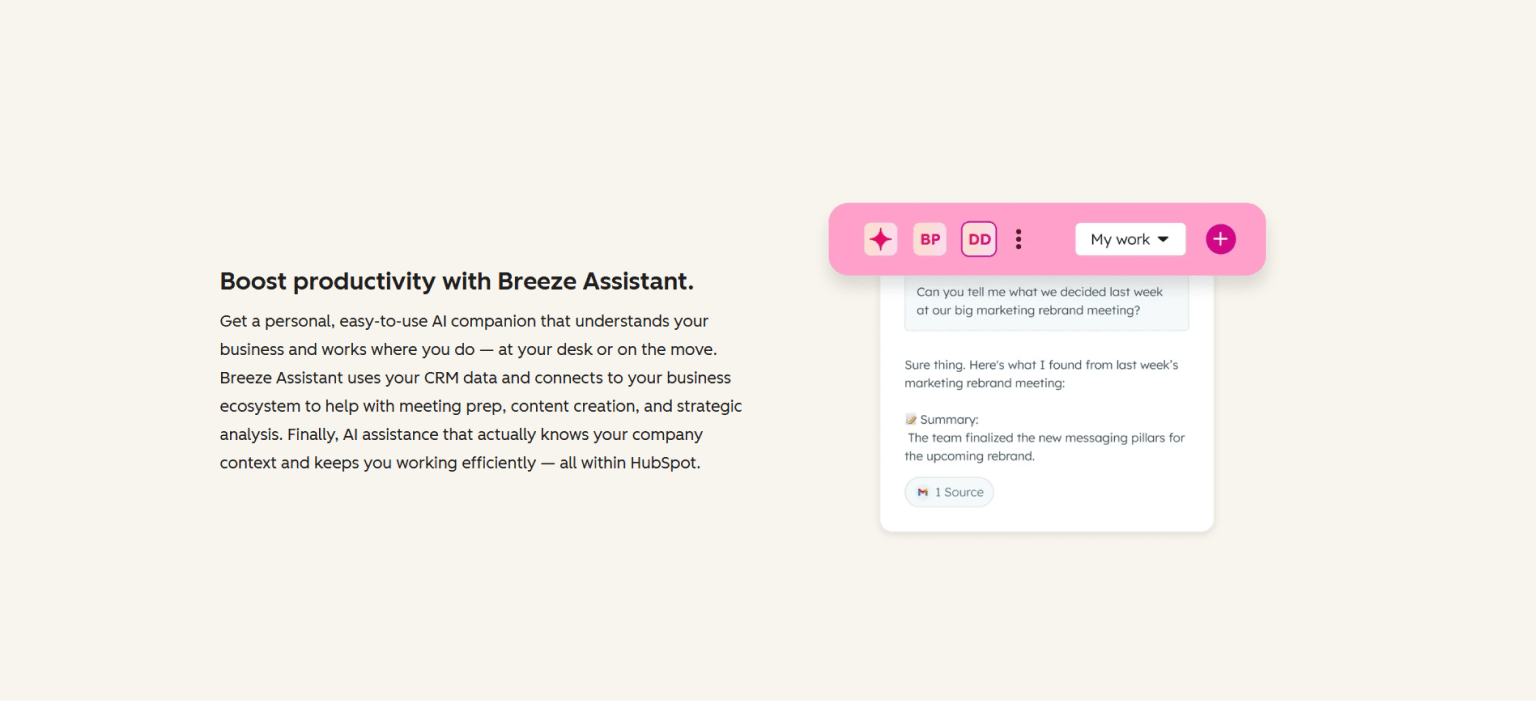
HubSpot’s Breeze AI automates marketing campaigns and content creation. Teams can quickly generate email drafts, social posts, and other marketing materials without starting from scratch. Companies using Breeze AI report up to 98% improvement in workflow efficiency, showing how AI-powered CRM solutions can save time and boost team productivity.
  • Microsoft Dynamics 365 Copilot

Microsoft Dynamics 365 Copilot

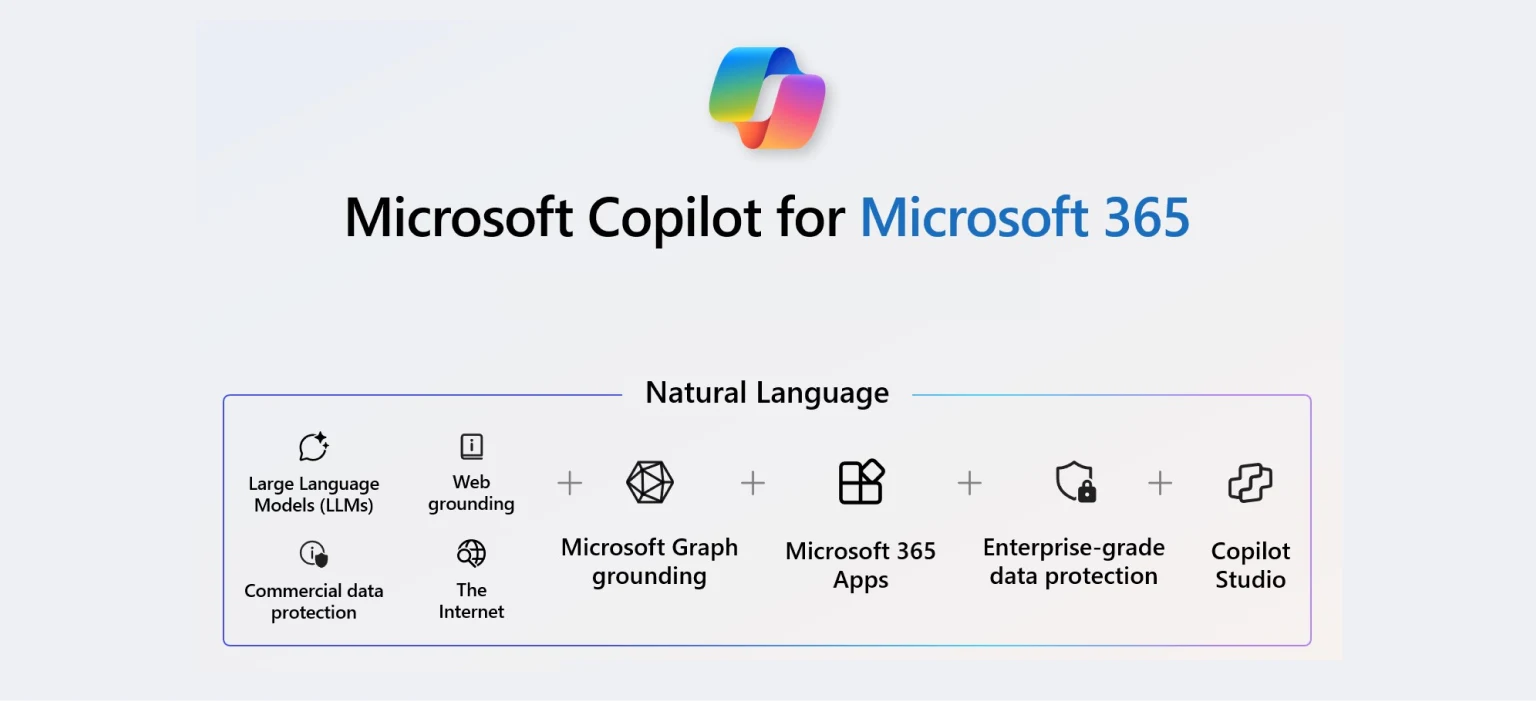
Microsoft Copilot integrates with Dynamics 365 to improve emails, meeting preparation, and CRM insights for sales teams. Summarizing customer interactions and suggesting next steps helps teams respond faster and make data-driven decisions. This is a clear example of how enterprise CRM AI integration can improve daily operations and customer engagement.

Tools and Platforms for Integrating Generative AI with CRM

When selecting models, consider the different applications of Generative AI that fit your industry, such as chatbots, content automation, or customer behavior prediction
  • Vendor-Specific: Salesforce Einstein GPT, HubSpot Breeze, Microsoft Copilot, Creatio GenCRM
  • General Tools: OpenAI APIs, Google Bard, IBM Watson
  • No-Code Options: Make.com, Composio AI SDR Kit
  • Open-Source Solutions: LangChain, CrewAI

CTA2

Conclusion

Integrating GenAI into your CRM transforms how businesses manage customers. By automating tasks, personalizing communications, predicting behaviors, and streamlining workflows, companies can boost productivity and customer satisfaction.

SoluLab, a leading Generative AI development company, with expertise in GPT-based models, predictive analytics, and workflow automation, helps businesses seamlessly integrate AI. We ensure our custom-made solutions render the best scalability, data security, and measurable results. 

Contact us for transforming your enterprise software into an intelligent, future-ready system!

FAQs

1. How can Generative AI implementation transform CRM operations?

Through Generative AI integration, CRM systems can automate tasks like drafting emails, generating reports, and scoring leads. This reduces manual work, enables predictive insights, and allows sales and marketing teams to focus on high-value activities, resulting in faster deal cycles and improved customer retention.

2. What are the benefits of implementing generative AI in business processes?

The benefits of implementing generative AI include operational efficiency, enhanced personalization, predictive insights, and smarter decision-making. Businesses see higher engagement, faster response times, and more accurate forecasting, all of which can directly impact revenue growth and customer satisfaction.

3. How does generative AI CRM integration enhance customer experience?

Generative AI CRM integration allows systems to automatically respond to inquiries, predict customer needs, and suggest personalized content. Teams can reduce response times, increase conversion rates, and provide a seamless experience, turning routine interactions into opportunities for engagement and loyalty.

4. How does enterprise CRM AI integration differ from traditional CRM upgrades?

Enterprise CRM AI integration embeds AI directly into CRM workflows, enabling real-time decision-making and predictive capabilities. Unlike standard CRM updates, it allows companies to automate complex processes, generate insights from large datasets, and scale personalized interactions across thousands of customers.

5. What is the cost of integrating generative AI with CRM?

The cost of integrating generative AI with CRM depends on the scale, tools, and complexity of your setup. While enterprise investment can be significant, the ROI often justifies it through efficiency gains, improved sales performance, higher customer satisfaction, and better data-driven decisions. Strategic planning and phased implementation reduce risk while maximizing value.

 

Top 7 Generative AI Integration Services For Your Business

Generative AI Integration Services for Businesses

Businesses today are under constant pressure to innovate, stay efficient, and personalize customer experiences. But doing all that manually? It’s time-consuming, expensive, and often inconsistent. Many companies feel stuck wanting to explore generative AI but not knowing where to begin or who to trust with integration. 

That’s where the right service provider makes all the difference. With the right generative AI integration, you can automate content creation, improve operations, and gain powerful insights—without reinventing the wheel. 

Spending on systems integration services is projected to grow, reaching $153.8 billion in 2024 and $183.42 billion by 2027 as generative AI accelerates the setup and integration of corporate software systems.

In this blog, we’ll walk you through the top 7 generative AI integration services that can help future-proof your business and give you the edge you’ve been looking for.

What is genAI, and why does it matter?

A subtype of AI called GenAI is designed to produce unique, human-like content.  Unlike traditional AI, which adheres to predetermined rules, GenAI learns from data patterns to produce text, graphics, code, music, and more.  Its importance lies in its capacity to:

  •  Automate daily tasks.
  •  Boost your creative flair and originality
  •  Boost productivity in all sectors
According to Microsoft, Generative AI is being used by 75% of knowledge workers this has grown to an unexpected scale from the past six months as there were only 46% of workers using AI.

GenAI tools are changing processes, decreasing manual labor, and creating endless opportunities in fields like gaming and content development.

Generative AI Market

How do Generative AI Integration Services Assist Businesses?

Generative AI business integration services are one of the most transformative services that are currently sweeping the market because they adapt advanced AI solutions into existing processes effortlessly while allowing businesses to operate efficiently.

These services leverage generative AI integration but are not limited to GPT-3 and GPT-4 to boost efficiency, streamline work, and support decisions. It can be said that this is one of the most comprehensive overviews of the advantages companies get from such services.

Two third of businesses are constantly raising their investments as 58% of users have shared a list of various advantages they notice every day by using GenAI. 

A. Customized Solutions

One of the key benefits of generative AI integration services involves their ability to provide a company with specific solutions that will be able to help it function more efficiently. These services can recommend and implement generative AI applications that smoothly integrate into the existing network since these services study the contemporary systems and understand the specific challenges that the company cannot overcome. This makes it a very good strategy for customization since it ensures minimal interferences while at the same time maximizing the advantages.

B. Optimizing the Flow of Operations

Through the use of generative AI integrations, employees can focus on better tasks since repetitive and dull tasks harm the organization. For instance, some businesses can employ the use of artificial assistants such as chatbots to handle many customer complaints at the same time while delegating complex problem-solving tasks to human staff. Since they are bright and quick to respond and assist as well this automation helps in enhancing the general customer experience while at the same time helping in better productivity.

Contact Us

C. Data-Based Perspectives

The capacity of generative AI to rapidly and efficiently analyze big amounts of data is still another benefit of integrating it. Of course, a big data set is where the actual value of AI algorithms shows through because it is only with them that pertinent information can be sought out, for instance. This integration of generative AI capacity assists firms in the use of data and analytics to make better decisions hence enhancing effectiveness and strategy in organization operations.

D. Flexibility and Scalability

When organizations grow they have different requirements. When you integrate generative AI services for the service-oriented architecture brings the flexibility required for change as dictated by customer demand. AI can be easily expanded by integrating the current and new tools and applications that do not necessarily have to replace the existing structures. Due to this flexibility, businesses are in a position to exploit new opportunities that happen to exist in the market as they are seen to emerge.

Which Business Industries Are Already Using Generative AI? 

Business Industries Using GenAI

A quickly advancing part of generative artificial intelligence, a future already affecting many different industries. It is said that this technology has the potential to disrupt the business world because it can enhance customers’ experiences and optimize such processes. Here are the sectors that are consistently using Generative AI for better customer experiences and efficiency

1. Healthcare: Generative AI in healthcare is playing a significant role in moving towards the customization of diagnoses and therapies. Through analysis of large amounts of client information including genetic data, medical records, and real-time health monitoring, generative AI models in healthcare can find out trends and anticipate the risk factors of illness. That is why it becomes easy to develop patient-specific treatment and preventive plans that the patient and the medical practitioners will embrace.

2. Gaming: While still fitting into a relatively novel category of machine learning tools, there is no doubt that generative AI has been rapidly adopted by various industry sectors, but none perhaps as quickly and visibly as the gaming industry, where it serves from the creation of personalized gaming experiences to the generation of procedural content. Concerning preprogrammed guidelines and player decisions, generative AI is susceptible to formulating new game environments, characters, or even whole levels.

Read Blog: How AI in Gaming is Changing the Future of Industry?

3. Finance: There is a high potential for using Generative AI in Insurance when it comes to risk management and fraud detection. Machine learning-based generative AI can recognize fraudulent actions in real time and further avoid financial loss both to organizations and customers through analysis of patterns in transactional histories for outlier recognition.

4. Education: Due to the need to deliver fun-based lessons to engage learners while at the same time enhancing the delivery of education by proposing personalized lessons, the education industry is incorporating generative AI. Often, tutoring programs based on generative AI can be designed such that they are effective according to a student’s pace and are capable of providing support by way of a tutor.

5. Retail: Self-organizing personalized experiences in the retail sector are appearing due to the use of generative AI in retail for content creation. Since most customers have their individual browsing and purchasing history reflected on the clique, generative AI models can recommend one product or service that another one depending on the customer’s history.

Top 7 Generative AI  Integration Services

Many organizations across many industries are already employing such innovative solutions to enhance their operations as generative AI technology advances, you can also leverage this with the help of a generative AI development company.  If the business dreams of proper utilization of this technology then generative AI automation spans across the range of making the customer care system efficient to the content creation process.

These are the top seven services that need to be incorporated to ensure the gen AI model is implemented in enterprises to provide an edge over competitors.

1. Generative AI Strategy Services

This is why a clear approach that shows how generative AI integration services are going to work within a particular business process has to be presented. This service involves assessing the workload, the skills of the employees, and the ethical implications of laying down blueprints for artificial intelligence. Currently, entities like Bain & Company as well as McKinsey can create bespoke tactics to help businesses understand which generative AI use cases could be optimally valuable.

Related: Effective Generative AI Strategy For Your Enterprise

2. Collection of Training Data for Generative AI

This is usually the case with GenAI models since they require large-quality datasets to be trained well. Clickworker’s generative AI training data services help enterprises get, clean, and label the data needed for learning. Firms can also reduce the time taken in training AI models by outsourcing data gathering so that more time is spent on creating models.

3. Developers of Hardware and Software for Generative AI

The generative AI integration training and deployment are computationally intensive tasks that inevitably need big computer power. Some major hardware solution vendors whose specialized HW is designed to satisfy the computing requirements of AI loads are NVIDIA and Google with their proprietary TPU. Companies may additionally ensure that, with the help of these superb providers, they have the proper infrastructure to support their generative AI plans.

4.  Foundation model Supplier

The GenAI use cases are based on foundation models, where the companies, which practice generative AI applications can use the trained models for any kind of application. Google has a BERT model, which is rather good for NLP, while OpenAI presents a strong language generation with well-known GPT-3 and GPT-4 models. Such foundation models help companies to incorporate generative AI solutions without a fresh lot of training as these models already have learned a fair amount of foundational knowledge.

5. Training and Development in Generative AI

Due to the nature of the Generative AI consulting company, getting them trained is challenging and may require large datasets and complex algorithms most of which businesses may not have in-house. Through companies such as H2O, model-building is simplified. ai, DataRobot, Microsoft Azure, and AWS SageMaker which has distinguished training as well as development facilities.

6. Reinforcement Learning with Human Feedback (RLHF)

Part of reinforcement learning called Reinforcement Learning with Human Feedback (RLHF) incorporates human feedback into an AI model. Services from such websites as Clickworker and Prolific can be used to gather opinions from people, which then help to fine-tune AI-driven algorithms to reflect human values and preferences. Through this method, the content is refined in terms of both quality and relevance and thereby the AI outputs are made more suitable for practical use.

7. Applications of Generative AI

That way, the presence of numerous existing applications makes it possible for companies that may wish to integrate generative AI into their operations within the shortest time possible to do so. Many of the manufacturers offer preset generative AI which tailor made for many areas of a business, such as customer support and content generation. By adopting these apps, businesses may design generative designs without effectively costly and time-consuming techniques.

GenAI Integration Services

How Can SoluLab Elevate Your Solutions Using Generative AI?

Integrating generative AI into your business isn’t just a trend; it’s a game-changer. The services we’ve listed above can help you improve operations, create personalized customer experiences, and stay ahead in a competitive market. 

Whether you’re in marketing, design, customer service, or software development, there’s a solution tailored for your needs. The key is choosing the right partner who understands your goals and can scale with your growth.

Amanbank, a leading Libyan bank with 750,000+ customers, partnered with SoluLab to build an intuitive mobile banking solution. Facing outdated onboarding, limited support, and inconsistent service, the bank adopted generative AI-powered chatbots and voice AI agents. These innovations enabled 24/7 multilingual support, personalized banking, automated KYC, and streamlined operations—enhancing customer experience and boosting digital transformation. 

SoluLab, a top generative AI development company, can help you solve your business problems. Contact us today to discuss further.

FAQs

1. What is generative AI? How does it work for businesses?

Generative AI is the new trend of technology for generating texts, images, and music according to data patterns from current data. It can assist in automating tasks, tailored content, and efficient workflow. 

2. How long does it take to integrate generative AI into a business?

It depends on the complexity of your operations and the type of AI service. For small businesses, basic integrations like AI chatbots or content tools can take 2–4 weeks. For larger systems—like AI-powered CRMs or workflow automation—it might take 2–3 months, including testing and training.

3. How can business benefits from Generative AI integration services?

Automation of content, better customer experiences, improved decision-making, predictive analysis, and gaining competition along with a lot more benefits can be gained with using Generative AI. 

4. How much does it cost to integrate generative AI services?

Costs can vary widely based on the service and scale. Basic tools start at ₹5,000–₹20,000/month. Custom enterprise-level integrations could range from ₹5 lakhs to ₹25 lakhs+, depending on the features, data requirements, and vendor expertise. 

5. How can SoluLab’s Generative AI Services benefit businesses?

SoluLab’s Generative AI services keep businesses empowered with automating tasks, valuable insights, and data-driven decision-making. This will help organizations with progressive growth in the market dynamics.
