Talk to an Expert

The Growth of AI Agents in Retail and E-Commerce

AI Agents for Retail and E-Commerce

There is a shift of great proportions taking place in the retail and e-commerce industries. The growth of artificial intelligence cannot be ignored. According to a research study, an improved experience has been expected for companies using AI for 50% of consumers demand prompt service, seamless communication, and custom service today and tomorrow. That is where AI bots enter to revolutionize what can be a highly complicated purchase

Understanding AI Agents 

Before proceeding to the analysis of the retail revolution, it is necessary to understand what artificial intelligence agents are. These sophisticated computer programs mimic talking, and the physical actions of a person based on the following: Bid a virtual assistant that knows what you want, knows in advance what you prefer, and assists one in the process of shopping. That is an AI agent’s strength.

The Role of AI Agents in Retail

The shop now performs a large assortment of functions other than making sales. Social media is turning into a focal medium for engagement experiences. The way AI Agents in Retail and E-commerce are changing the retail experience is as follows:

1. In-Store Navigation

The AI smart assistants offer enhanced methods of storefront orientation. Consumers can get information about products or pose questions concerning the availability of the goods. It also eradicates the process of having to search for sales personnel when engaging in in-store shopping.

2. Stock Management

AI in E-commerce must assess the sales data and the customers’ tendencies to predict the demand, and consequently enhance the inventory. This procedure is referred to as inventory optimization and stock management. This ensures that stores get the right stock at the right time and eliminates cases of stock shortages and overstocking.

3. Frictionless Checkout

Clients can take the products themselves and complete the purchase without assistance through the self-service terminal based on artificial intelligence. This has eased the checkout process and means that it takes less time to serve customers, as is the case with the regular checkout queues.

4. Customized In-business Promotions

With AI in E-commerce, it becomes possible to track a customer on the business premises using beacons and cameras mounted within the premises. This allows for focused in-store advertising where the client is given a personal offer or a discount.
AI Solutions

Role of AI Agents in E-Commerce

Unique facts related to the contemporary environment of buying and selling products online show that the role of AI in E-commerce is being developed comprehensively. An example of how AI is altering the game is shown below:

1. 24/7 Customer Support with Chatbots

How silly to wait to get help when you can simply turn to the help of Zoopla’s app! Some chatbots with artificial intelligence can deal with the return or small issues, as well as answer your questions 24/7.

2. Intelligent Search and Recommendations

Traditional methods of searching through many products listed can no longer be used because of smart search and recommendation engines. Requests in natural language are possible with the help of search engines based on artificial intelligence, and they find related information. While recommendation systems are centered on your browser history and previous transactions to offer you popular products.

3. Dynamic Pricing and Promotions

Using the data of competitors’ prices, market trends, and customer desire, AI agent use cases can dynamically change the prices effectively. This makes it possible for companies to offer what is known as differential pricing, which is a way of offering different clients different prices, hence attracting more clientele in the market and thus enhancing sales.

Read Also: Voice AI Agents In Conversions and Sales
Benefits of the AI Agents for Retail and E-Commerce

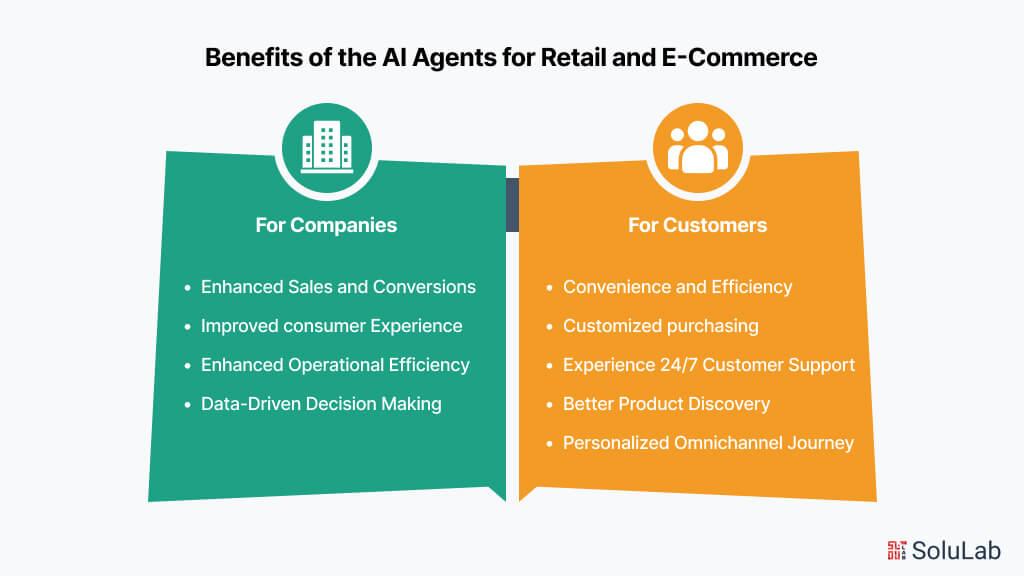
Benefits of the AI Agents for Retail and E-Commerce

There are multiple benefits when employing AI Agents in Retail and E-commerce for both the side of the company and the customer.

A. For Companies

  • Enhanced Sales and Conversions

Effective customer relations, targeted and personal information that is given, and special offers all improve conversion ratios and sales.

  • Improved consumer Experience

 AI agents bring fun to shopping, which makes the consumers shop again and again, and hence they are loyal.

  • Enhanced Operational Efficiency

AI stabilizes costs and enhances business performance through cost-effective activities such as a call center, delivery system, and stock control.

  • Data-Driven Decision Making

Big Data consists of big volumes of customer data that Artificial Intelligence processes and analyzes to provide organizations with useful information to improve organizational processes and make efficient decisions.

Read Also: AI Agents for Online Shopping 

B. For Customers

  • Convenience and Efficiency

AI agents identify funds and respond to inquiries without the need for clients to expend time and energy, as well as recommend other products pertinent to the client’s interests.

  • Customized purchasing Experience

Buyers benefit from having a purchasing process that is based on user preferences, and in turn are offered more interesting content and recommendations that reflect the use of artificial intelligence.

  • 24/7 Customer Support

 By implementing AI-powered chatbots, the customer is free from the agony of spending time on a line waiting for an attendant to attend to him/her whenever the customer needs assistance.

  • Better Product Discovery

Thus, AI helps customers find what they are interested in by offering further purchases and products that they are likely to need.

  • Personalized Omnichannel Journey

This is true because of the use of AI agents, blurring the differences between online and offline buying. Through their mobile devices, consumers can make purchases, research products, and get recommendations for products when they go to the store. This helps in getting the buying experience always uniform in every channel.

How are AI Agents Reshaping Retail and Commerce?

The impact of AI agents goes beyond practicality. Here is a breakdown of how it is changing the domain: 

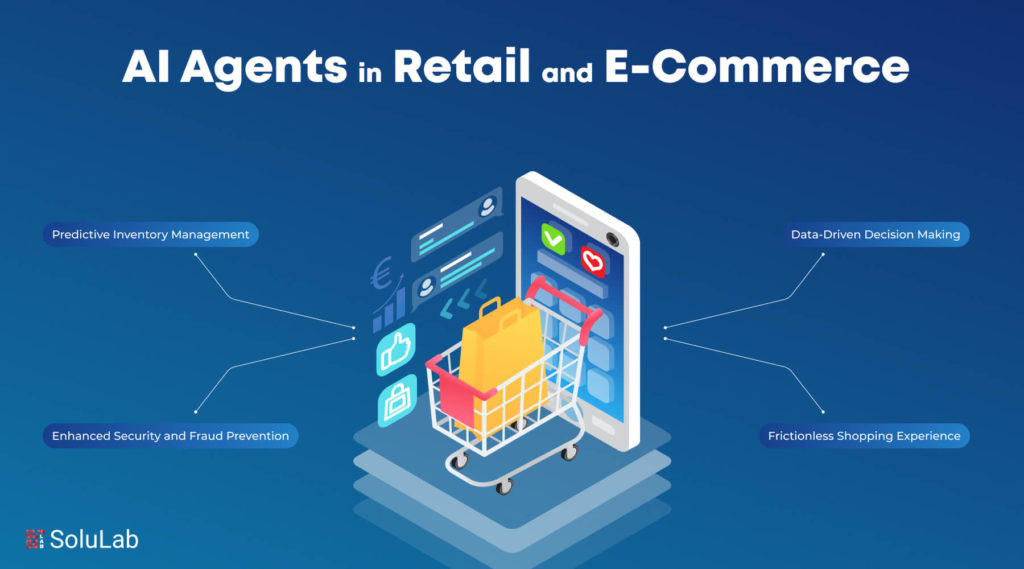
1. Data-Driven Decision Making

Internet sales and store sales information are collected by AI in large amounts. This allows the companies to determine the number of products to offer, pricing strategies, the appearance of the shops, and promotions based on statistical information, all of which enhance overall sales and customer satisfaction.

2. Frictionless Shopping Experiences

It equally reduces the complexity of procurement at the various touchpoints. AI agents make quick and less painful shopping achievable and enjoyable; from ‘saying’ the brand and model of a product on the Internet, to ‘checking out’ on your own at the point of purchase.

Related: AI Agents in Supply Chain and Logistics

3. Predictive inventory management

AI allows organizations to harmonize their inventory, in the physical as well as the online outlets that are connected through the company’s supply chain, and the consumer’s needs. Thus, instances of stockout or overstocking are unlikely, while sales and low wastage are likely because the right products are always available when required.

4. Enhanced Security and Fraud Prevention

Stores can employ analytics and cameras powered by artificial intelligence (AI) to monitor and report any form of attempt at theft by consumers. Another capability that belongs to the sphere of online AI is the prevention of fraudulent transactions and the protection of clients and companies.

The Future of AI Agents in Retail and E-Commerce

These new developments that result in better abilities of agents are shaking the very foundations of the modern retail and e-commerce markets. Stating that these talking shopping assistants are not something out of sci-fi, they are here now and are altering how people shop. However, having thrown such labels into the ring in this fluid field what does the future portend for AI agents? Have a look at it: 

  • Deeper Personalization and Contextual Awareness

AI will rise from just being a proposing entity to being a recommending one to truly create a unique purchasing experience. Just imagine you are in a store, and after entering it, you greet the in-store assistant who immediately informs you that it recognizes you as one of its regular customers and, based on your previous purchases and current circumstances, can recommend related products. For example, it may recommend shoes or belts to buy alongside the dress that you are buying.

  • Rise of AI-Powered Shopping

The Development of AI-Renowned Shopping Partners. The idea can be readily contemplated to have an online and offline shopping companion that accompanies you in your journeys. This AI assistant may look into the way you shop, suggest products based on what you need at the moment, or help you make a price comparison with other retailers. This way, people will get the advice suited to their needs, and all this will make shopping much easier as well as more informed.

Related: AI on the Fashion Industry

  • Smooth Integration with Augmented Reality (AR)

What AR technology may help to do is radically transform the concept of using objects. It is recommended to use augmented reality (AR) to ‘’virtually” put on clothes or to ‘’try” in advance how furniture will look in a living room. In this way, AI agents will be able to offer recommendations based on your virtual fitting and offer information on the products at the same time.

  • Voice Assistants

It may also be the case that simply picking items off the shelf, and placing them in a shopping cart, or even ordering products online, and getting offers tailored to your needs, could all be done with voice commands at some point in the future. Integrating with voice assistants will enhance availability as well as functionality, and they guarantee that shopping is as convenient as possible.

  • Emotion Recognition and Affective Computing

 It is mentioned that AI is advancing in distinguishing human feelings. Imagine an AI agent working in a shop that not only knows you are upset that you cannot find your preferred size fit, but can help you in a snap. Thus, you feel understood when an agent learns about your emotional state, allowing the shopping experience to be adjusted on your behalf.

Contact Today

The Final Word

AI Agents for Retail and E-commerce are changing the way people shop, starting from getting rid of checkouts by verifying the payments to customizing recommendations. Thus, while the future looks bright with prospects such as shopping assistants based on artificial intelligence, integration with augmented reality, and other things, some problems must be dealt with, including data anonymity and ethical questions. However, by utilizing AI agents as wisely as possible, companies can establish a future for shopping not as a mere simple exchange of value for value, but as an enjoyable show. 

Are you looking to hire an AI Developer for a solution to several artificial intelligence agents that you don’t know how to control? Well, Solulab is your answer. We can help you develop a correct approach to AI, implement top-level solutions, and ensure that AI utilization is ethical and responsible. Do not let yourself and your business be left out of the revolution of AI. Unlock the best of AI in retail and e-commerce through partnerships with SoluLab. The hope is to create a future where bill paying, or shopping in particular can be fun and where one gets what suits him or her.

FAQs

1. What are AI agents in retail and e-commerce?

AI agents are intelligent software systems that use machine learning and natural language processing (NLP) to automate tasks such as customer support, product recommendations, inventory management, and personalized marketing in retail and e-commerce platforms.

2. What are some common use cases of AI agents in online stores?

Some of the popular use cases of implementing AI agents in online stores include chatbots for customer support, virtual shopping assistants, dynamic pricing engines, AI-based product search and filtering, fraud detection, and automated order fulfillment.

3. How do AI agents improve customer experience in e-commerce?

AI agents offer 24/7 support, personalize recommendations based on browsing and purchase history, provide instant answers to queries, and help reduce wait times during peak shopping seasons. This leads to enhanced customer satisfaction and retention.

4. Are AI agents only beneficial for large retailers?

No, even small and mid-sized e-commerce businesses can benefit. Cloud-based AI solutions offer scalable, affordable tools for improving customer engagement, automating marketing, and streamlining operations.

5. In what ways can SoluLab deploy AI agents in my business?

SoluLab is a leading name for AI agent development tailored to your unique business needs, such as intelligent chatbots, personalized recommendation engines, inventory automation tools, and predictive analytics systems. Their team also ensures seamless integration with your existing digital ecosystem.

 

How are AI Agents Redefining Sales and Marketing

AI Agents in Sales and Marketing

Can you imagine a world where your sales never miss a beat, your marketing campaigns are always on point with your customers, and your business thrives on data-driven insights? Well, don’t just imagine, with the emergence of artificial intelligence (AI) you can make this happen with accuracy and efficiency. AI Agents in Sales and Marketing are evolving with the development of better customer involvement and higher conversion rates. AI is more than automation and virtual assistants, it can transform your future where every interaction is tailored to an individual’s needs.

In the present fast-paced world, the attention span is shrinking, and information overloading, making it even more important for businesses to focus on data-driven campaigns and offer values that resonate with existing customers and attract new ones. This blog will help you understand what AI Agents for Sales and Marketing are, how they enhance the traditional ways of sales and marketing, and how to use AI in sales.

What are AI Agents and What Do They Do?

AI Agents are intelligent software programs designed to automate and enhance tasks in sales and marketing particularly relevant for Gen AI in sales. They leverage artificial intelligence (AI) to analyze data, learn from patterns, and make decisions, ultimately improving efficiency and effectiveness which is crucial. AI gives insights they’d miss otherwise to 73% of consumers and dealers. 

Think of AI Agents in marketing as your virtual assistants, working tirelessly behind the scenes to streamline your processes and handle repetitive tasks like scheduling appointments, sending emails, and qualifying leads. In particular, AI SDR (Sales Development Representative) agents can elevate the early stages of customer engagement by automating lead qualification and outreach, ensuring that potential clients are properly identified and engaged.

AI agents’ examples go beyond simple automation. They can also help you to manage the complexities of and ensure a smooth launch. For example, they can automate outreach to potential investors, analyze market trends to identify ideal launch timing and personalize communication to maximize engagement. By leveraging AI in sales, you can streamline your sales process, optimize your marketing efforts, and increase your chances of success. 

Role of AI Agents in Sales and Marketing

Role of AI Agents in Sales and Marketing

The relationship managers between consumers and businesses are becoming more associated with the touch of AI agents, which are prominent assets to artificial intelligence and sales. Essentially, AI use cases and applications show these agents play a complex role in today’s sales and marketing industries.

1. Enhanced Personalization

AI for startups can analyze a large turnover of consumer information such as; their demographic data, interconnect internet usage, and past orders. Since they can collect information about the customers, they can advise how to work and sell their products to every customer uniquely. Imagine how such a Generative AI in E-Commerce can benefit the overall relevancy and efficiency of a campaign by creating a stream of emails with products that correspond to the client’s purchase history.

2. Streamlined Sales Automation

For sales AI agents can be used to drive many of those time-wasting activities such as appointment making, follow-up e-mails, and even the qualification of prospects. This makes it gives the human salespeople more time to dedicate their time in brewing relationships, closing the sales, and coming up with more projects such as projects. Organizations can also manage the marketing AI agent because options for cost savings are nearly endless in terms of automation.

Read Our Blog: Role of AI Agents in Supply Chain and Logistics

3. Better Lead Scoring and Generation

The field of Cognitive Sciences can engage web and consumer data to detail possible customers with buying intentions. The qualified prospects are thus eagerly out there waiting to be contacted by the salespeople to enhance the chances of converting these leads into customers. By this marketing, AI agent makes it possible to get the right messenger to the most probable leads with the help of this efficient lead-scoring system to support outreach.

4. Data-Driven Insights and Forecasting

Another AI agent use cases is in the aspects of data analysis especially when dealing with large chunks of data to look for, patterns and trends beyond the reach of human perception and with the help of given data, be in a position to predict what will be ahead. This makes it possible for firms to invest in the right locations and channels, coordinate and develop the proper type of campaigns, and sometimes even concoct new products from information.

Benefits of AI Agents in Sales and Marketing

What directly pertains to business organizations is that such abilities of AI Agents for Sales and Marketing, which challenge business houses to huge strides are possibly the most fulfilling when explored. This is an insightful look at how agents AI helps sales and marketing teams:

Improved Targeting and Customer Insights:

  • They enable better targeting and a better understanding of the customer.
  • There is another area where artificial intelligence is very effective; it is for the examination of the clients’ larger data, their demographic data, past purchase data, World Wide Web use social media account data, etc.
  • With these realizations, marketers might design potent advertisements that have the motivation of pro-trial sentiments within particular client segments.
  • It can also translate to organizations ensuring that IOTs do not fail in meeting the client’s needs and wants because there are solutions available informing the clients what IOTs can offer.

Tailored Customer Experiences

  • Information and content are personalized, and Artificial Intelligence (AI) modifies the given choice and proposal.
  • This enhances the results of the relationship that the firm has with its clients as well as customer loyalty ultimately enhancing sales conversion rates.
  • The main stand of fortune of chatbots is the round-the-clock customer service and immediate personal response.

Simplified Procedures for Sales

  • Thus, AI frees the sales representatives’ time to engage in more productive activities instead of spending their time on lead scoring, lead qualification, and appointment scheduling.
  • More benefits can also be seen in the use of the AI sales intelligence system by the brokers since it provides information on the prospect and competitors.
  • This in turn will have higher possibilities of sale production and can also identify predictive difficulties before altering the revenue techniques.

Contact Us

Large-Scale Content Creation

  • By applying the Artificial Intelligence technique, firms would be confident that the messages that they post through the blogging websites, the interaction through social sites, and even on any products’ descriptions are identical.
  • This one may be favorable for the search engines and the generation of leads for a target client thus boosting site traffic.

Check Out Our Blog Post: Impact of AI on Copywriting

Advantage of Competition

  • Introducing AI into the strategic management system enables an organization to have an edge over a rival in business deals.
  • Therefore, adopting AI in the areas of marketing and sales leads to coming up with more potential customers, more chances of developing conversion rates, and enhanced relationships between the business and the customer.

In addition to the benefits, nearly 6 in 10 users believe they are on their way to mastering the technology. The importance of AI Agents in Sales provides and AI marketing agent insights to 34% of salespeople and helps 31% of sales reps write sales messaging.

Examples of AI Agents in Sales and Marketing

AI for startups is transforming sales and marketing through various means such as automating tasks, analyzing data, and personalizing interactions. Here are a few examples of AI agents in sales and marketing:

1. Chatbots

The latter is to greet the users of particular websites, answer their questions or inquiries, and filter leads 24/7. Also, they can schedule demos, make suggestions on what product they think the client should purchase, and handle simple sales.

2. Intelligent Content Engines

Targeted advertising involves the use of the user’s information and the pattern at which he or she surfs the internet to modify emails, social media posts, and web content. Due to this, customers shall be exposed to content that is relevant to them hence improving interaction.

3. Lead Prioritization and Scoring

This means that AI assesses talk sequences regarding prospects and assigns them a score based on their ability to sell. By focusing on strong leads, a sales representative can increase their productivity and impact positively on the system.

4. Market Trend Prediction

 AI involves a massive amount of data processing and utilizes it in the prediction of the consumers’ behavior and development of the market. This also makes marketers future-ready and prepares them for change, they can predict the market and its demands to alter marketing efforts.

Read Blog: AI Agents in Retail and E-Commerce

Importance of AI Agents in Sales and Marketing

Independent intelligent agents are a major force that is revolutionizing the methods of selling and marketing, speaking of agent artificial intelligence is no longer a fantasy. Here are the reasons behind the Importance of AI Agents in Sales and marketing AI agent:

1. Enhancing Human Capabilities: Currently, managers will hire AI developers to assist with the sales and marketing duties but they won’t replace the sales and marketing personnel. Instead, it is just smart helpers that automate some of the tedious work and provide immediate information. This makes human knowledge for doing business, relationship creation, and contract closure and thinking available.

2. Unlocking the Power of Personalization: Consumers require tangible personalization in the current age of big data. AI agents can therefore generate highly specific content, recommended services/products, and promotional messages based on the client’s behavior and past choices. Such laser-like focus is well appreciated by customers, improving the relations and boosting the actual conversions.

3. Predicting Customer Needs: The application of AI in sales and marketing gives those departments a type of ‘ peek’ into the future. Here, AI can predict what the consumers would want, and what they are most likely to purchase, forecasted from records and trend analysis of sales. This makes companies to be a step ahead ensuring they offer the right service to customers at the right time.

4. Encouraging Constant Customer Engagement: Customers Shift The rigid work schedules or what used to be called a 9-5 working week do not exist again. AI bots can provide support 24/7 and answer questions. This way client satisfaction and hence loyalty are achieved since a client gets the required information at the right time.

5. Optimal Resource Allocation: To say this, AI is beneficial for work on sales and marketing for employees as it makes this work more intelligent rather than increasing the load. AI optimizes everyone’s resource utilization since it provides accurate data and minimizes the amount of manual labor. He has put much effort into elaborating how teams can work to guarantee that they get the most out of their investment resources, specifically by focusing more on activities that produce a big impact.

Read Also: Voice AI Agents In Conversions and Sales

Sales and Marketing in the Future with AI

One can therefore be very sure that the increasing development and integration of AI Agents in Sales and Marketing will greatly affect sales and marketing in the future. Thus, as AI technology continues to improve,  we may expect to have even more sophisticated features that intertwine the relationship between humans and machines. Chatbots will evolve into comprehensive communicational companions that understand complex questions and respond accordingly. AI agent use case engines shall become even more anticipatory to envision the clients’ needs before they are identified. These frictionless consumer journey maps to be generated from this hyper-personalization will make customers happier they will buy like never before. These frictionless consumer journey maps to be generated from this hyper-personalization will make customers happier they will buy like never before.

AI use cases and applications will shift the traditional marketing and sales team to that of a consultation agency. For marketing, AI agents will give strategic insights into the consumers’ attitudes, competitors’ expectations, and market expectations, by analyzing large volumes of data in real time. In turn, the teams will be more prepared to adapt campaigns toward better performance, use data to their advantage, and stay relevant to occurrences. Sales and marketing is a field that will see a beautiful dance between AI’s unsurpassed analytical prowess and human hard-won knowledge shortly hence a level of consumer interaction that could barely be imagined.

AI Agent Solutions

The Final Word

It has to be recognized that AI Agents in Sales and Marketing are currently redefining the historical concept of ‘consumer connection’ at its most basic levels. It is possible to expect the day when intelligent automation delivers seamless, personalized, intelligent client experiences due to the existing AI advancements. Companies have huge opportunities in the future to grow sustainably, spike up their sales, and align more with their customers.

However, the factors that are required for the implementation of AI are the skill and the right approach. can help companies unleash their potential with the help of AI. Given the fact that they possess innovative strategies in developing applications that tackle key concerns, intending and committed consumers can seek the aid of an AI agent development company or hire an AI developer like SoluLab to comprehend the potential of the extensive area of application entailing AI in sales and marketing.

FAQs

1. What are the major advantages of using AI agents in marketing and sales functions?

The benefits that come with the use of AI agents include; persistent customer interaction, personalization of clients’ experiences, removal of monotonous tasks, insights, and increased efficiency for the marketing and selling teams.

2. How might the customer come across these AI agents’ presence and how might the agents adapt the experience?

One of the most important advantages is the possibility to adapt the information, the recommendation as well as the marketing and sale messages according to the client’s preferences and even behavioral characteristics that have been collected regarding him/ her. Due to the unique customer focus this creates, the level of engagement and possible conversions rises.

3. Will we see bots that will work more like real marketers and real salespeople?

AI bots are in no way intended to replace human experts. Instead, they are intelligent assistants, sparing the true knowledge for deal-making, relationship-closing, and strategic thinking.

4. What must be considered when using AI agents?

Note that structured and clean data is critical in successfully feeding it to the AI algorithms Integrating AI could lead to certain distortions to the existing organizational processes. Thus, there ought to be guidelines that companies must adhere to about the safeguarding of the identity and rights of their clients, especially in AI selection and operation.

5. How can SoluLab help firms that want to utilize AI for marketing and selling?

We can help define the demands and then recommend the right instruments. The data should not be created through integrating AI. The main benefit that can be mentioned here is that current CRM, marketing automation, as well as other company systems, can be integrated into the new system with the help of solutions providers.

How Generative AI is Transforming the E-Commerce Industry?

Generative AI in the E-Commerce Industry

E-commerce is one of the businesses that has changed as a result of the emergence of generative AI. Generated artificial intelligence (AI) has the potential to completely transform the e-commerce sector by producing new material, including product descriptions, photos, and even whole new products. The market for generative AI alone is anticipated to grow to $110.8 billion USD by 2030. Furthermore, from less than 1% in 2021 to 10% in 2025, generative AI will contribute to the production of data.

In this blog, we will examine several applications of generative AI in e-commerce and what benefits it offers to merchants and brands.

Why is It Important to Implement Generative AI in E-Commerce?

E-commerce as a whole has continually adopted innovative online technologies, and Generative AI, an advanced machine learning (ML) technology, has piqued the attention of key industry stakeholders. It involves solution providers and entrepreneurs who are actively looking into the numerous benefits that Generative AI may offer to the e-commerce industry.

What makes this unique is that generative AI is now proving that it can provide an excellent user experience, indicating that users are ready to embrace this technology. Retailers are then more equipped to create customer journeys and use AI to benefit both consumers and staff. Retailers get a competitive edge from this strategic integration of generative AI, which boosts cost-effectiveness and profit margins.

Choosing to use generative AI for e-commerce offers companies a lot of promise for significant and profitable business results.

Generative AI in E-Commerce Use Cases

Generative AI in E-Commerce Use Cases

The rise in popularity of e-commerce may be attributed not only to its convenience and comfort but also to the tailored experiences that are available on several platforms, according to the unique tastes and passions of each user. Marketers examine traits that strongly connect with consumers across all industries. Aspects of consumer loyalty and growth in online retail and e-commerce include customization in product offerings, suggestions, search results, promotional mailings, and delivery choices. Equipped with this knowledge, online merchants pinpoint processes where using generative artificial intelligence (AI) technologies can result in significant returns on investment.

Businesses are using generative AI to improve operations, increase sales, and customize consumer experiences in the e-commerce space. It’s proven to be a game-changer. Here are a few instances in which generative AI is being used by e-commerce companies to their benefit.

1. Provide Product Suggestions in a Manner That Your Customers Like

Consumers are thrilled with the way customization makes them feel now that they’ve experienced it. Generative AI gives online retailers a number of options to suggest goods and services to customers based on their past purchases, browsing habits, wishlist items, most-searched products, and other data points. These options range from personalized product recommendations to tailored content, discounts, and deals.

These AI-powered solutions examine user information, past purchase histories, and more data sources to provide suggestions that are relevant to customers and fit with their preferences. For instance, you may offer material that your customers are more likely to look for or create customized discount plans based on the total cart values. 

Read Also: AI Agents for Online Shopping 

2. Organize Marketing Efforts That are Specific to Each Customer

A one-size-fits-all marketing strategy used to be able to get customers to your websites or physical businesses. However, modern times have changed, as have consumer expectations. Consumers no longer want to be the target of generic marketing campaigns for goods and services that they never seek out or need. 

If you are unable to provide the personalized experiences that they want, modern consumers will not hesitate to look at your rivals since they are aware of their true worth. Launch marketing initiatives that are specifically targeted. Based on behavioral and demographic information, you may divide your viewers into groups and target marketing campaigns according to their particular interests. You may guarantee certain sales and favorable returns on investment from your marketing initiatives in this way.

3. Consistent Product Descriptions to Enhance SEO Rankings

An online store is a digital hallway of limitless things that necessitates many exploring sessions just to locate a few choice items that appeal to a customer. This is where succinct yet informative product descriptions assist. The previous strategy was to have writers investigate descriptions, produce enticing fresh versions, and include the required SEO keywords. While this technique worked effectively, sellers sometimes uploaded contradictory product descriptions, costing them revenue and a valuable customer.

This is why, long before generative AI for eCommerce, businesses used A/B testing to determine the most compelling product descriptions. Furthermore, recent advances in generative AI technology allow them to standardize descriptions among vendors and retail sites. Writers may now give generative AI technologies explicit directions for writing product descriptions that are matched to your brand’s tone and are grammatically correct. 

4. Optimized Images of Products for Luxury Purchases 

Product photographs are an essential component of PDP sites, with each image necessitating a large team of models, photographers, designers, editors, and creatives for the shooting. This is one area where generative AI might help online businesses create tailored product websites using textual inputs and historical picture data. Adobe Firefly, Adobe’s latest invention in creative generative AI models, enables artists to express their ideas more efficiently and without limits. All you have to do is convey the desired image to transform your creative idea into reality. You may now create realistic photographs depending on a subject, style, location, or color that you define. 

The use of generative AI for e-commerce photos will allow marketers to produce visuals in real time. For example, an apparel business can create photos of people of all ages wearing their products in order to appeal to comparable customers. As users submit more personal data to generative AI models, the models’ searches will become more tailored to their specific environment. 

Generative AI Services

5. To Increase Sales, Track and Improve Product Pricing

It is common knowledge that before making a purchase, consumers research and contrast the costs of comparable goods on the Internet and in physical stores. When their favorite things are offered at a great price, they actually don’t mind the quest. Internet sellers should be aware of this price sensitivity and maintain flexibility in their pricing strategies at all times. 

You may monitor price changes made by competitors, examine pricing trends and demand patterns, and further improve product prices with generative AI algorithms to keep customers from switching to your rivals.

Related: AI Agents in Supply Chain and Logistics

6. Boost Supply Chain and Inventory Control

For good cause, discussions on modernizing the supply chain as well as inventory control have been going on. Following the outbreak, dead goods have overrun warehouse racks, and supply networks are beset with problems related to geographic constraints. Most brands find it difficult to achieve the ideal balance between supply and demand when combined with delayed delivery. Generative AI for e-commerce has the potential to improve visibility and tracking in a number of supply chain tech stack scenarios. 

7. Use AI’s Conversational Skills to Respond to Customer Inquiries

Even if chatbots seem like something from the past, conversational AI and generative AI may raise the bar on your present customer care and support. Apart from the benefits of not needing as much manpower and having a support agent available around the clock, chatbots have advanced significantly from 15-20 decision trees to unlimited ones. Online merchants may experiment with various conversational styles to fit the consumer, customize each message to encourage additional involvement and respond to inquiries with human-like empathy and emotions to make the interaction seem human-to-human with the use of sophisticated generative models. When all of these elements work together, your customers will have better chat experiences, which will increase cart completion rates and boost revenue. 

8. Increase the Number of Chances for Upselling and Cross-Selling

You’re probably already aware of generative AI’s powers in the areas of conversational search, product suggestions, and providing customers with tailored information based on their individual preferences, histories, and interests. Now, this material might lead to intelligent purchasing experiences and take the shape of words, photos, or other media. In the future, generative AI in online retail will be able to examine all of these existing data sets and recommend the next sensible step for a customer to take in their purchasing process. In an attempt to increase sales and return on investment, this leads to more chances for upselling and cross-selling. 

9. Creating Transaction Flows With Auto-fill for Every Client

Websites today have a general, set structure, which means that regardless of the user’s preferences and choices, they display the same graphics, information, and banners to all of them. Retailers can provide each consumer with a customized site experience based on their preferences thanks to generative AI for e-commerce. This implies that each consumer would view a personalized website with goods that are automatically filled in based on the client information kept in the backend. Furthermore, based on a shopper’s behavioral and demographic information, this would lead to a hyperscale degree of customization. 

10. Stop Phishing and Fraudulent Activity 

When spammers and hackers get access to your online business, it frequently leads to false returns or purchases, which lowers profit margins and erodes consumer confidence. By recognizing unknown users or those with suspect histories, generative AI algorithms in online retail may detect and prevent such illegal and fraudulent behaviors and prohibit them from accessing your online businesses. Over time, this results in cost and profit savings for companies. 

Read Blog: Generative AI in Supply Chain

How Can Generative AI Technologies be Integrated Into E-Commerce Operations?

Generative AI Technologies Integrated Into E-Commerce Operations

Implementing Generative AI solutions in e-commerce operations can significantly enhance various facets of the business, ranging from personalized customer experiences to optimizing supply chains. Below is a structured approach to implementing generative AI in e-commerce:

1. Define Objectives and Use Cases

  • Clearly outline the goals for leveraging generative AI in e-commerce.
  • Identify specific areas where generative AI can bring value, such as product recommendations, content generation, or supply chain optimization.

2. Data Collection and Preparation

  • Collect relevant data needed for training the generative AI model, including customer behavior, product information, and historical sales data.
  • Ensure data is cleaned, normalized, and prepared appropriately for training purposes.

Related:  Top Generative AI Use Cases

3. Select the Right Generative AI Model

  • Choose a generative AI model suitable for the identified use cases, such as GPT (Generative Pre-trained Transformer) or VAE (Variational Autoencoder).
  • Consider factors like model complexity, training time, and resource requirements during selection.

4. Training the Model

  • Train the selected generative AI model using the prepared dataset, utilizing significant computational resources as necessary.
  • Fine-tune the model to align with specific e-commerce requirements and desired outcomes.

5. Integrate with E-commerce Systems

  • Integrate the trained generative AI model with existing e-commerce systems, employing APIs or custom integrations as needed.
  • Ensure seamless compatibility with the current technology stack and platforms.

6. Monitor and Evaluate

  • Regularly monitor the performance of the Generative AI model, assessing its impact on crucial performance indicators such as conversion rates and revenue.
  • Adapt the model or implementation based on feedback and evolving business needs.

7. Ensure Data Security and Compliance

  • Pay careful attention to data security and compliance with regulations, particularly concerning customer data. Implement robust measures to safeguard sensitive information.

8. Scale and Iterate

  • Gradually scale the generative AI solution to cover more aspects of e-commerce operations.
  • Continuously iterate and improve the model based on new data and evolving business requirements.

By following this structured approach, businesses can effectively implement Generative AI solutions in their e-commerce operations, leading to enhanced customer experiences and improved business outcomes.

How Large Language Models Benefit the E-Commerce Industry?

Large Language Models (LLMs) are revolutionizing e-commerce through their adeptness in powering intelligent chatbots. These chatbots, trained on vast textual data, offer natural and engaging interactions, thereby enhancing various aspects of the customer experience and driving sales. Here’s a concise overview of how LLMs benefit the e-commerce sector:

  • Efficient Customer Support: LLM-powered chatbots like WotNot provide instant responses to customer inquiries, offering 24/7 support and streamlining customer service operations.
  • Personalized Product Recommendations: By analyzing user behavior, LLMs deliver tailored product recommendations, boosting engagement and sales.
  • Automated Content Generation: LLMs automate the creation of product descriptions and marketing copy, ensuring a constant stream of fresh content and enhancing brand appeal.
  • Improved Search Functionality: LLMs enable more precise search results, accelerating the product discovery process and enhancing the overall user experience.
  • Optimized Inventory Management: LLMs forecast product demand, helping businesses optimize inventory levels and minimize storage costs.
  • Effective Marketing Strategies: LLMs generate compelling ad copy and analyze campaign performance data, refining marketing strategies for better results.
  • Real-time Data Analytics: LLMs process extensive data sets, providing insights into customer behavior and market trends for informed decision-making.
  • Content Moderation: LLMs automatically detect and moderate user-generated content, ensuring a safe online environment.
  • Market Research: LLMs analyze online discussions and reviews, extracting insights for competitive intelligence and strategic decision-making.
  • Global Reach and Inclusivity: LLMs break language barriers, facilitating businesses in reaching a diverse audience and fostering inclusivity.
  • Cost Savings: LLMs automate tasks, reducing manual intervention and enhancing operational efficiency.
  • Streamlined Operations: LLMs streamline processes, reduce errors, and boost workflow efficiency, allowing teams to focus on strategic initiatives.

Future Outlook of Generative AI in E-Commerce

The future outlook for generative AI in e-commerce is brimming with potential, poised to revolutionize the industry’s landscape. As these AI algorithms advance, businesses can expect increasingly tailored and immersive customer journeys.

  • Augmented Reality (AR) and Virtual Reality (VR) Shopping Experiences: Combining AI with AR and VR technology promises to enrich the shopping experience, allowing customers to interactively visualize products in real-world settings before purchase, such as testing furniture placement in their homes.
  • AI-Powered Voice Assistants: The proliferation of smart home devices has spurred the use of voice assistants for shopping. Generative AI will fuel the development of more sophisticated voice assistants capable of understanding and catering to individual customer needs with personalized recommendations.
  • Hyper-Personalized Marketing: Generative AI’s data analysis capabilities enable the creation of hyper-personalized marketing strategies. This entails tailoring every facet of marketing campaigns, including ad creative and messaging, to match the unique preferences and behaviors of individual customers.
  • Enhanced Supply Chain Management: Generative AI holds promise for optimizing supply chain management by accurately forecasting demand, optimizing inventory levels, and proactively identifying potential disruptions in the supply chain.
  • Automated Customer Service: AI-powered chatbots, driven by Generative AI, will handle various customer service inquiries seamlessly, delivering instant responses around the clock. This not only enhances the customer experience but also drives down operational costs significantly.
  • New Product Development: Generative AI can aid in designing new products based on customer preferences and market trends, accelerating product development timelines and minimizing the risk of product failures.
  • Fraud Detection: Leveraging its pattern recognition capabilities, generative AI enhances e-commerce platform security by swiftly detecting and preventing fraudulent activities in real time, safeguarding both businesses and customers.

Hire GenAI Developers

Wrapping Up

In conclusion, the transformative impact of generative AI on the e-commerce industry is undeniable, with its ability to revolutionize customer experiences, streamline operations, and drive business growth. As AI algorithms continue to evolve, businesses must embrace these innovations to stay competitive in an increasingly digital marketplace. From personalized shopping experiences and hyper-targeted marketing campaigns to optimized supply chain management and enhanced fraud detection, the possibilities are vast and promising for those willing to harness the power of generative AI.

At SoluLab, we understand the pivotal role that AI plays in shaping the future of e-commerce. As a leading generative AI development company specializing in the e-commerce sector, we offer a dedicated team of experienced AI developers ready to tackle the unique challenges and opportunities presented by this dynamic industry. Whether you’re looking to integrate AI-powered chatbots, enhance your recommendation engine, or optimize your supply chain with predictive analytics, we have the expertise and resources to help you achieve your goals. Hire AI developers from SoluLab today and unlock the full potential of generative AI in your e-commerce operations. Contact us now to learn more!

FAQs

1. What is generative AI, and how does it apply to e-commerce?

Generative AI refers to algorithms that can generate new content, such as text, images, or audio, based on patterns learned from existing data. In e-commerce, this technology can be used for various purposes, including personalized product recommendations, automated content generation, and enhancing customer service through intelligent chatbots.

2. How does generative AI improve the shopping experience for customers?

Generative AI enhances the shopping experience by providing personalized recommendations tailored to each customer’s preferences and behavior. It can also streamline the search process, generate engaging content, and offer real-time assistance through AI-powered chatbots, ultimately making the shopping journey more convenient and enjoyable.

3. Is generative AI secure for e-commerce platforms?

While generative AI offers numerous benefits, ensuring security is paramount for e-commerce platforms. By implementing robust security measures such as encryption, authentication, and continuous monitoring, businesses can mitigate potential risks associated with AI-generated content and protect sensitive customer information from cyber threats.

4. How can businesses leverage generative AI to drive sales and revenue?

Businesses can leverage generative AI to drive sales and revenue by providing personalized product recommendations, optimizing marketing campaigns with targeted content, and improving customer engagement through interactive experiences. Additionally, generative AI can help businesses identify trends, forecast demand, and optimize inventory levels to maximize profitability.

5. What are the future prospects of generative AI in e-commerce?

The future prospects of generative AI in e-commerce are promising, with advancements in technologies like augmented reality, voice assistants, and supply chain management. As generative AI continues to evolve, businesses can expect more immersive shopping experiences, enhanced operational efficiency, and innovative solutions to meet the evolving needs of consumers.

6. How can SoluLab help businesses integrate generative AI into their e-commerce operations?

SoluLab is a leading AI development company specializing in the e-commerce sector. Our team of experienced AI developers can assist businesses in leveraging generative AI for personalized product recommendations, AI-powered chatbots, content generation, and more. By hiring AI developers from SoluLab, businesses can harness the full potential of generative AI to enhance their e-commerce offerings and drive growth. Contact us today to learn more about our services and how we can help transform your e-commerce operations with generative AI.
