Talk to an Expert

Generative AI 101: Transforming Beginners into Experts

Generative AI 101:A Beginners’ Guide

Generative AI has emerged as a transformative technology in recent years, revolutionizing various industries with its potential to create original content such as images, text, and even music. The advancements in generative AI have enabled machines to learn, create and produce new content, leading to unprecedented innovation across various sectors. As a result, many companies are now considering generative AI technology and hiring Generative AI Development Companies to leverage its benefits and enhance their operations with AI-led automation.

Generative AI is the new future AI that focuses on learning, analyzing, and producing original content through machine learning algorithms. This technology is transforming businesses’ operations and enhancing their ability to provide customized solutions. It has become a hot topic in the market, with many companies investing in this technology to leverage its benefits.

This blog will provide in-depth information about generative AI, how it works, the different types of generative AI models, and their applications in various industries. We will also discuss the tech stack used in Generative AI development services and how natural language processing (NLP), deep learning, and machine learning play a critical role in this technology. By the end of this blog, you will have a comprehensive understanding of generative AI and its significance in today’s digital landscape.

What is Generative AI?

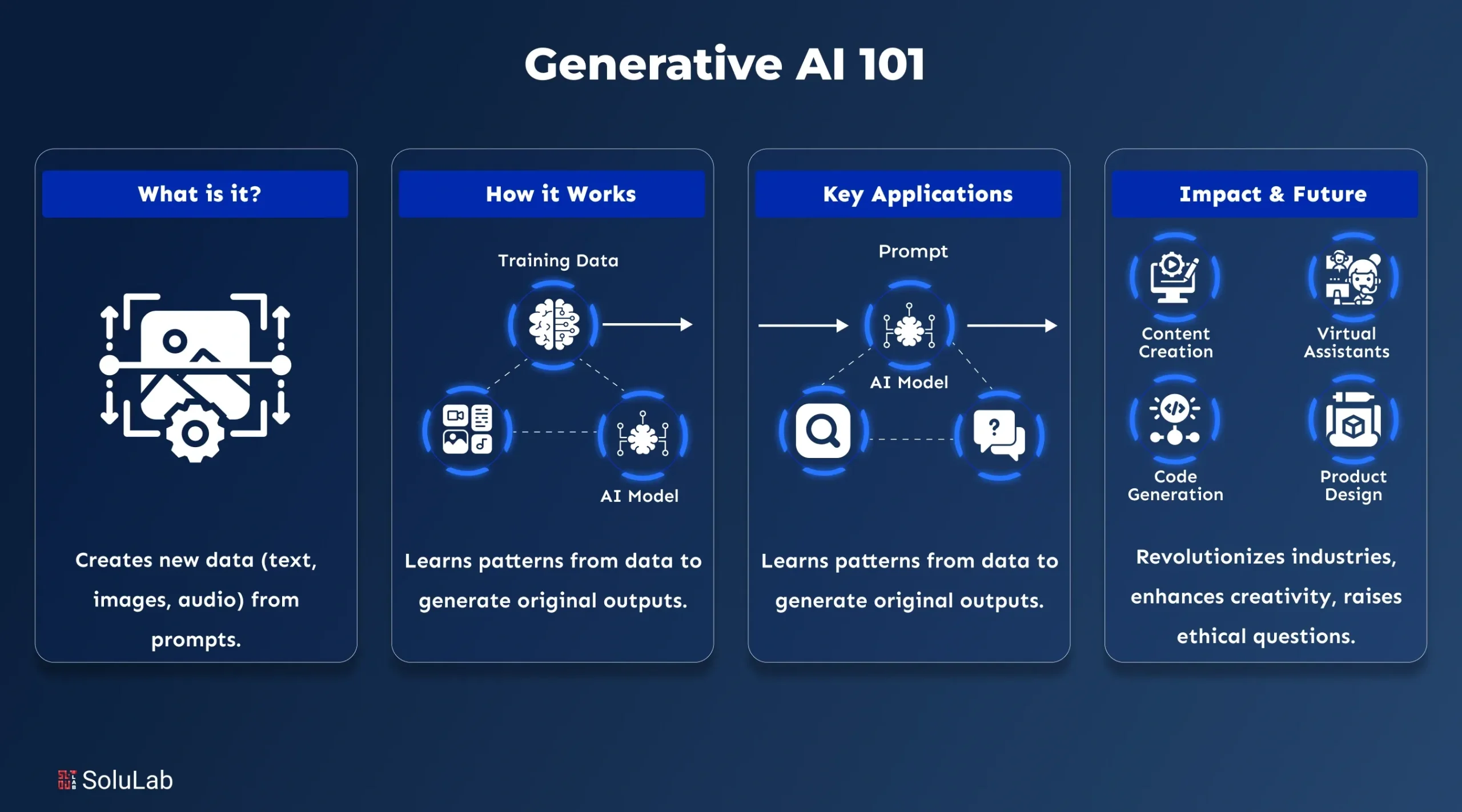
Generative AI is a field of artificial intelligence that involves using machine learning algorithms to create new data or content that did not exist before. Unlike traditional AI, which involves using pre-existing data to make predictions or decisions, Generative AI generates novel content, such as images, music, or text, based on a given input or set of rules.

Generative AI algorithms use various techniques, including deep learning, reinforcement learning, and probabilistic programming, to create new content. These algorithms work by learning patterns and relationships within the data and then using this knowledge to generate new content similar to the input data.

One of the most exciting aspects of Generative AI is its ability to create highly realistic and convincing content that can be difficult to distinguish from human-created content. This has led to many creative applications of Generative AI, from generating new music and art to creating virtual characters and entire worlds. 

How Does it Differ From Other Types of AI? (Supervised and Unsupervised Learning)

Generative AI differs in its output from other types of AI, such as supervised and unsupervised learning. While supervised and unsupervised learning are focused on learning patterns and making predictions based on existing data, generative AI is focused on creating new and original content that does not exist in the training data.

Supervised learning involves training a machine learning model on labeled data to make predictions or classifications based on new, unseen data. On the other hand, unsupervised learning involves finding patterns and relationships in unlabeled data without specific guidance or targets.

In contrast, generative AI models use unsupervised learning techniques to learn patterns and relationships in data, but the focus is on creating new content rather than making predictions or classifications. Generative models are trained to learn the underlying structure and characteristics of the data. They can then generate new, original content similar to the training data but not identical.

The Technologies Within Generative AI; Types of AI Models

The Technologies Within Generative AI; Types of AI Models

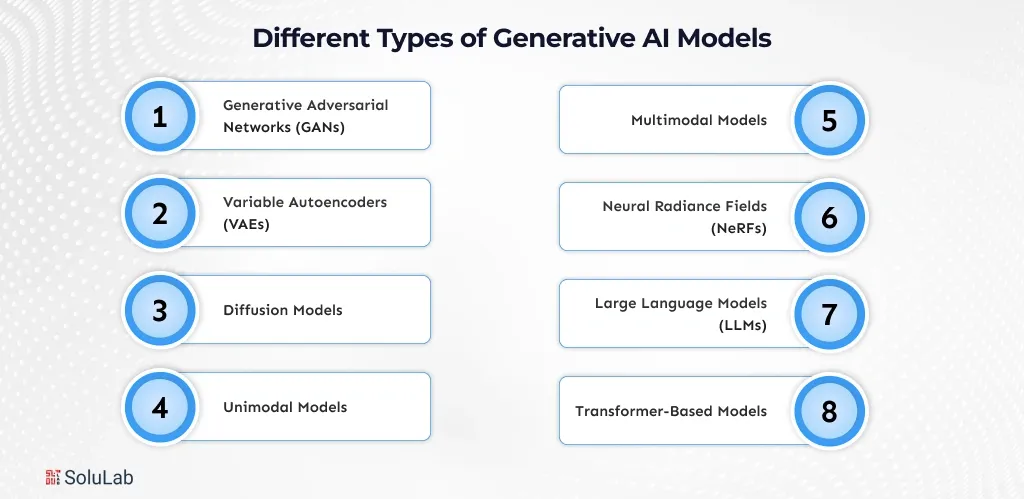
Though generative AI is a single technology that powers endless possibilities within various fields, it comprises different AI models responsible for different operations, and here they are.  

  • Generative Adversarial Networks (GANs)

Generative Adversarial Networks, or GAN for short, is a generative AI class that has recently gained much attention. GANs consist of two neural networks: a generator and a discriminator. The generator’s job is to create realistic outputs that mimic the input data, while the discriminator’s job is to identify whether the output is real or fake.

The GAN framework was first proposed in 2014 by Ian Goodfellow and his colleagues at the University of Montreal. They wanted to create a system to generate new samples similar to the original data. They came up with the idea of using two neural networks in competition with each other.

The generator network is trained to create new samples similar to the training data, while the discriminator network is trained to distinguish between real and fake data. The generator is then adjusted based on the feedback from the discriminator until it can create realistic outputs that fool the discriminator.

Related: Generative AI for Data Analysis and Modeling

Since its introduction, GANs have been used for various applications, including image and video generation, text generation, and music composition. With their ability to create realistic and diverse outputs, GANs quickly become one of the most exciting AI research areas.

How Do GANs Work?

A Generative Adversarial Network (GAN) consists of two neural networks: the generator and the discriminator. The generator produces new data, while the discriminator verifies whether the generated data is real or fake.

The generator takes a random input and creates new data, such as images or audio. Initially, the generated data is random and meaningless. The discriminator then receives both real and generated data and learns to differentiate between them.

The two networks are trained together in a competition: the generator tries to create data that can fool the discriminator into thinking it is real, while the discriminator tries to identify which data is real and which is generated correctly. Through this process, the generator learns to create more realistic data, and the discriminator becomes better at distinguishing between real and fake data.

Over time, the generator becomes skilled at creating data that is so realistic that it can often fool humans into thinking it is real. This technique has been used to generate realistic images, videos, and even music.

  • Autoencoders

Autoencoders are another generative AI model that has become increasingly popular recently. Autoencoders are neural networks trained to compress and reconstruct input data, such as images or text. This process of compression and reconstruction allows the autoencoder to learn a compressed representation of the input data that can then be used to generate new, similar data.

Autoencoders are often used for image and audio compression and image and text generation tasks. For example, an autoencoder can be trained to compress an image into a lower-dimensional representation, which can then be stored or transmitted more efficiently. When the compressed representation is decoded, the reconstructed image may not be an exact original copy. Still, a similar image will preserve the original’s essential features.

Recently, autoencoders have also generated highly realistic images and videos. For example, researchers have used autoencoders to create deepfake videos, which are videos that utilize AI face swaps to replace one person’s face with another. While deepfakes have been controversial, they demonstrate the potential of autoencoders and other generative AI models to create highly realistic and convincing content.

How Autoencoders Work?

Autoencoders are neural networks trained to encode input data into a lower-dimensional representation and then decode it back to the original input. This lower-dimensional representation is known as a “latent space” or “embedding,” It can be used for tasks such as data compression, denoising, and image generation.

To do this, the autoencoder consists of two main parts: an encoder and a decoder. The encoder takes the input data and compresses it into a lower-dimensional representation, while the decoder takes this compressed representation and reconstructs the original input data.

Using a loss function, the network is trained by minimizing the difference between the original and reconstructed inputs. During training, the network learns to extract the most important features of the input data and encode them in the latent space, allowing it to generate high-quality reconstructions.

Overall, autoencoders are a powerful tool for unsupervised learning and have numerous applications in various fields, including computer vision, natural language processing, and anomaly detection.

CTA 1

  • Variational Autoencoders (VAEs)

Autoencoders have been an essential tool in generative AI for quite some time. But the advancements in deep learning have led to the development of a new type of autoencoder – the Variational Autoencoder (VAE). Like the traditional autoencoder, the VAE is also an unsupervised learning algorithm that is used for dimensionality reduction and data compression. However, it differs from the traditional autoencoder as it uses probabilistic models to encode the input data and generate new samples from the encoded data distribution.

The VAE overcomes some of the limitations of traditional autoencoders, such as the generation of blurry images. It does this by introducing a probabilistic model that allows for generating realistic and diverse samples from the encoded data distribution. This allows VAEs to generate more realistic and diverse data, making it a powerful tool for generative AI.

How Do VAEs Work?

VAEs, or variational autoencoders, are a type of deep learning model that learns to generate new data by capturing a dataset’s underlying patterns and structures. Like regular autoencoders, VAEs have an encoder and a decoder network. However, VAEs use a probabilistic approach to generate new data rather than deterministic. During training, VAEs learn to encode an input data point into a set of latent variables or a probability distribution in the latent space. 

Then, using a sampling technique, the decoder network generates a new data point from the learned distribution. This process helps VAEs produce more diverse and realistic outputs than traditional autoencoders.

  • Transformers

The Transformer model is a generative AI model commonly used in natural language processing tasks such as translation and text summarization. It uses a unique architecture called the self-attention mechanism, which allows it to process information in parallel and capture long-range dependencies between words in a sentence.

In simpler terms, the Transformer model breaks down a sentence into smaller parts and assigns a weight to each word based on its relationship with other words in the sentence. This allows it to understand the context of the sentence and generate accurate translations or summaries. The Transformer model has proven to be highly effective in natural language processing tasks and has become a popular choice for many applications in the field of AI.

How Transformers Work?

Unlike traditional sequence-to-sequence models that rely on recurrent neural networks (RNNs) to process sequential data, the Transformer model uses a novel attention-based mechanism to process input sequences.

At a high level, the Transformer model breaks down input sequences into smaller, more manageable chunks called “tokens.” These tokens are then processed by a series of encoder and decoder layers that use self-attention to calculate the importance of each token in the sequence.

The Transformer model uses a multi-head self-attention mechanism to calculate a weighted sum of all input tokens during the encoding process. This lets the model focus on different parts of the input sequence simultaneously and capture more complex relationships between tokens. The resulting vector, representing the input sequence, is then passed through a series of feedforward layers to produce an encoded output.

During decoding, the Transformer model uses a similar multi-head self-attention mechanism to generate output tokens one at a time. At each time step, the model attends to the previously generated tokens and the encoded input sequence to predict the next token in the output sequence.

One of the key advantages of the Transformer model is its ability to handle longer input sequences more efficiently than RNN-based models. This is because the self-attention mechanism allows the model to process each token independently rather than sequentially. 

Additionally, the Transformer model has achieved state-of-the-art performance on a wide range of natural language processing tasks, including machine translation, language modeling, and text generation.

Despite its successes in natural language processing, the Transformer model is not limited to this domain. It has also been used for image generation, music generation, and other creative tasks that require generating complex and original content.

The Role of NLP, Deep Learning, and Machine Learning in Generative AI

NLP, deep learning, and machine learning are all key components of generative AI, playing different but complementary roles in generating new content.

NLP is particularly important for generative AI that deals with natural language, as it involves the processing and analyzing of textual data, such as sentences, paragraphs, and documents. NLP models are used to understand and extract meaning from textual data and generate new content based on that input. This is critical in applications such as chatbots, where the AI must be able to generate natural language responses based on user input.

On the other hand, deep learning is a machine learning type that uses artificial neural networks to analyze and learn patterns in data. This makes it well-suited for generating complex, high-dimensional data like images, music, and video. Deep learning models are trained on large datasets of real-world examples, which they use to generate new content similar in style and structure to the original data.

Related: Applications of Natural Language Processing

Finally, machine learning is the foundation of all generative AI, as it provides the algorithms and techniques necessary to train models on large datasets of real-world examples. Machine learning models learn from this training data, allowing them to generate new content similar in style and structure to the original data. By combining NLP, deep learning, and machine learning development techniques, researchers can create sophisticated generative models capable of producing new and original content in various applications, from art and music to natural language processing and beyond.

How Does Generative AI Work?

How Does Generative AI Work?

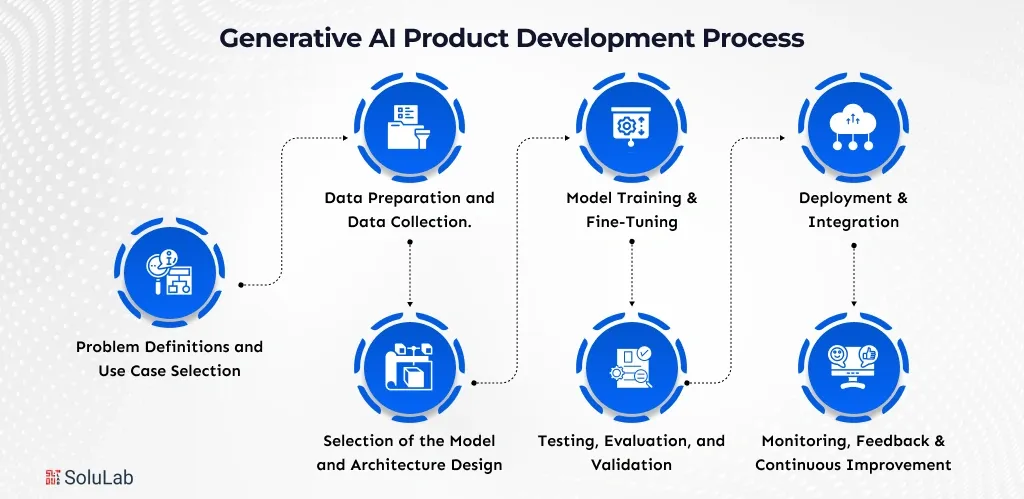
Here is a step-by-step overview of how generative AI works.

1. Training

To create a generative AI model, a large dataset is needed for the model to learn from. This dataset can be text, images, or any other data type the model will generate. The more data the model has to train on, the better it will be able to generate new content.

2. Preprocessing

Before the data is fed into the generative AI model, it must be preprocessed to make it easier for the model to understand. This can involve converting the data into a format that the model can work with, such as converting images into pixels or text into numerical vectors.

3. Model Architecture

There are several generative AI models, each with its architecture. The most common type of generative AI model is a Generative Adversarial Network (GAN), which consists of two neural networks: a generator and a discriminator. The generator creates new content based on the input it receives, while the discriminator evaluates the content and provides feedback to the generator.

4. Training the Model

Once the model architecture is defined, the model is trained using the preprocessed data. During training, the generator creates new content based on random inputs, and the discriminator evaluates the content to determine if it is real or fake. The generator then adjusts its output based on the feedback from the discriminator until it can create content from the real data.

5. Generating New Content

After training the model, it can generate new content based on its input. For example, a text-based generative AI model might be fed a sentence or a paragraph and then generate a new paragraph or story based on that input. Similarly, an image-based generative AI model might be fed an image and then generate a new similar image but not identical to the original.

Generative AI Examples/ Common Use Cases

Generative AI has many potential use cases, from generating realistic images and videos to creating natural language responses in chatbots. Some of the most common use cases for generative AI include the following:

1. Image and Video Generation:

Generative AI models, particularly those like Generative Adversarial Networks (GANs), are capable of producing images and videos that closely resemble real-world examples. This ability has revolutionized industries like entertainment, where CGI effects in movies and video games can now be created with astonishing realism. Additionally, generative models can be used in fields like fashion and design to generate new, unique patterns and styles for clothing, accessories, and interior design. Artists and creators can also leverage these models to generate novel artworks, pushing the boundaries of creativity and visual expression.

Related: Top 10 Generative AI Trends To Watch Out In 2025

2. Music Generation:

Generative AI has entered the realm of music composition, enabling the creation of original compositions or accompaniments. By analyzing existing musical patterns and structures, these models can generate new melodies, harmonies, and rhythms. This finds applications in various domains, including background music for videos, video games, and other multimedia projects. Musicians and producers can even use generative AI as a tool for inspiration, generating musical ideas that they can further develop into complete compositions.

3. Natural Language Processing:

In the realm of conversational AI, generative models have enhanced the capabilities of chatbots and virtual assistants. By training on large datasets of human interactions, these models can generate contextually relevant and engaging responses in natural language. This leads to more lifelike and productive interactions with users. Beyond customer support and information retrieval, generative AI is also utilized in applications like generating personalized emails, writing reports, and even crafting creative writing pieces, leveraging its ability to mimic human language patterns.

4. Text Generation:

Generative AI’s capacity to generate text based on input data has practical applications in content creation. Websites, blogs, and social media platforms can benefit from automatically generated articles, posts, and captions. News agencies can use generative models to quickly produce summaries of breaking stories or detailed reports. E-commerce platforms can automate the generation of product descriptions, enhancing the shopping experience for customers. This use case streamlines content production and frees up human resources for more strategic tasks.

5. Speech Synthesis:

Generative models play a pivotal role in text-to-speech (TTS) systems and voice assistants. By converting written text into synthesized speech, these models offer natural-sounding vocal interactions. They have applications in accessibility, helping visually impaired individuals access textual content through audio. Voice assistants powered by generative AI are increasingly integrated into smart devices, providing users with hands-free access to information, entertainment, and control over their environments.

Generative AI Applications in Various Industries

Generative AI Applications in Various Industries

Generative AI can transform many industries by providing new opportunities for innovation and growth. Here are some of the most promising applications of generative AI in various industries:

1. Healthcare

In healthcare, generative AI tools can be used in drug discovery and development, predicting disease outcomes, and medical imaging analysis. By analyzing large amounts of medical data, generative AI can identify potential drug candidates or predict how patients respond to different treatments. In addition, generative AI can analyze medical images, such as X-rays and MRIs, to help doctors diagnose diseases and conditions more accurately.

On top of it, generative AI can also be used in genetic research to see how gene expression changes in response to specific changes in genes. This could accelerate the development of gene therapies and enhance the treatment process by predicting which therapy patients’ genes best respond to.

Related: Generative AI for Healthcare

2. Retail

In the retail industry, generative AI tools can be used in product design, creating personalized customer experiences, and predicting product demand. By analyzing customer data, generative AI can help retailers create more personalized and engaging shopping experiences, such as recommending products based on a customer’s purchase history. In addition, generative AI can help retailers predict demand for products more accurately, enabling them to optimize inventory levels and avoid stockouts.

3. Banking and Finance: 

In the banking and finance industry, generative AI can be used in fraud detection, risk assessment, and portfolio optimization. By analyzing financial data, generative AI can detect patterns that indicate fraudulent activity or identify potential risks in a portfolio or account. In addition, generative AI can help financial institutions optimize their investment portfolios, maximizing returns while minimizing risk.

4. Media and Entertainment: 

In the media and entertainment industry, generative AI tools can be used in film and game design, music composition, and personalized content recommendations. By analyzing data on customer preferences, generative AI can help create more engaging and personalized content, such as recommending movies and TV shows based on a user’s viewing history. In addition, generative AI can be used to create new music or game levels, providing unique and engaging experiences for users.

5. Manufacturing: 

Generative AI can be used in product design, process optimization, and predictive maintenance in the manufacturing industry. By analyzing data on product performance, generative AI can help manufacturers optimize product design, improving functionality and reducing costs. In addition, generative AI can help manufacturers optimize their production processes, minimizing waste and improving efficiency. Finally, generative AI can be used to predict equipment failures, enabling manufacturers to perform maintenance before a breakdown occurs.

Related: Generative AI in the Manufacturing

6. Education:

In the education industry, generative AI can be used in adaptive learning, educational content creation, and student engagement. By analyzing data on student performance, generative AI can help educators create more personalized learning experiences, adapting the curriculum to each student’s needs. In addition, generative AI can be used to create educational content, such as quizzes and games, that engage students and reinforce learning.

7. Fashion:

Generative AIs can help designers to design fashionable clothes using generative AIs’ image generation capabilities; the tool can utilize huge amounts of data on fashion design and keep track of evolving trends to analyze customer requirements and accordingly design fashionable clothes.

Moreover, the generative AI-powered tools can help the designer to generate fashion models for their creative clothing; this eliminates the tedious, time-consuming, and costly photoshoot, allowing them to move forward with the product launch.

Read Blog: The Role of AI on the Fashion Industry

Opportunities and Ethical Advancements

Generative AI stands at the forefront of technological innovation, poised to revolutionize countless industries, while also embracing numerous prospects for growth. As we embark on this journey, it is essential to acknowledge certain limitations and uphold ethical considerations, ensuring a path of responsible development and utilization.

While generative AI’s potential is vast, it does require substantial amounts of data for model training. Recognizing this, efforts are underway to overcome challenges, particularly in sectors where data accessibility is limited. Additionally, the refinement of training data quality remains pivotal, as it profoundly influences the accuracy and dependability of the model’s outcomes.

Another aspect to address is the interpretability of these models. Unlike conventional rule-based systems, understanding the inner workings of generative AI models can be intricate. The journey towards enhancing transparency in the decision-making process is ongoing, enabling the identification and rectification of errors and biases.

From an ethical and legal vantage point, the ascent of generative AI brings forward crucial considerations that warrant attention to foster its responsible integration. Foremost among these concerns is the potential for bias within training data, which underscores the necessity for fair outcomes for all demographics. Additionally, the ability of this technology to craft convincing synthetic media prompts careful contemplation, guarding against potential misuses such as deceptive deep fakes and orchestrated disinformation campaigns.

The path ahead involves a comprehensive approach to surmounting these challenges and ethical concerns. Industry leaders are actively investing in research endeavors that aim to develop algorithms capable of mitigating biases in training data, concurrently enhancing the interpretability of the models. Companies are embracing responsible AI principles, prioritizing attributes like fairness, transparency, and accountability throughout the generative AI life cycle. Collaborations with regulators and policymakers are also underway to lay down guidelines and regulations, ensuring the technology’s ethical and prudent development and deployment. As we navigate this evolving landscape, the limitations we recognize become stepping stones toward a more ethically sound and transformative future powered by generative AI.

The Future of Generative AI 

Generative AI is a rapidly evolving field of artificial intelligence that enables machines to create new content, such as music, art, and even text-based content like stories and articles. With recent advancements in machine learning algorithms, we can expect even more impressive feats from generative AI in the coming years.

One of generative AI’s most significant potential benefits is its ability to revolutionize content creation. As language models become more sophisticated, we can expect to see more natural and human-like text generated by machines. This could have significant implications for industries such as marketing, advertising, and content production, where the ability to produce high-quality, engaging content quickly and at scale is highly valued.

In addition, generative AI could also play a critical role in scientific research, enabling researchers to simulate complex phenomena and generate new hypotheses rapidly. With the ability to create vast amounts of data quickly, generative AI could accelerate scientific breakthroughs in fields like medicine, physics, and engineering.

Despite its potential benefits, generative AI also raises significant ethical concerns. For example, there are concerns about how the widespread use of generative AI could impact the job market and lead to increased unemployment. Additionally, there are worries about how generative AI could be used to create fake news or misinformation, leading to societal instability and mistrust.

To sum up, generative AI’s future is full of opportunities and challenges. As technology continues to evolve, we can expect to see more impressive feats of creativity and innovation from machines. However, ensuring that these advancements are developed and deployed ethically and responsibly is essential to avoid any unintended negative consequences.

CTA 2

Conclusion

In conclusion, generative AI is an exciting and rapidly evolving field of artificial intelligence with a vast range of applications. From creating music and art to generating text-based content, generative AI has the potential to revolutionize content creation and scientific research.

As we have explored in this beginner’s guide, generative AI is powered by advanced machine learning algorithms, NLP, LLMs, and AI models that enable machines to learn and mimic human creativity. However, with these advancements come significant ethical concerns, such as job displacement and the potential for misinformation.

As we move forward, it is important to continue to research and develop generative AI responsibly and ethically, to maximize the benefits while minimizing any negative consequences. With careful planning and collaboration between researchers, policymakers, and society as a whole, we can ensure that generative AI is developed and deployed in a way that benefits everyone.

SoluLab, a leading Generative AI development company, offers comprehensive services catering to diverse industries and business verticals. Their skilled and experienced team of Artificial Intelligence developers leverages state-of-the-art Generative AI technology, software, and tools to create custom solutions that address unique business needs. From improving business operations to optimizing processes and enhancing user experiences, SoluLab’s Generative AI solutions are designed to unlock new possibilities for businesses.

Their team of experts is well-versed in various AI technologies, including ChatGPT, DALL-E, and Midjurney. Businesses can hire the best Generative AI developers from SoluLab to produce custom, high-quality content that sets them apart from competitors. To explore these innovative solutions and take their business to the next level, interested parties can contact SoluLab today.

FAQs

1. What is the difference between generative AI and other types of AI?

Generative AI is a type of AI that can create new content, such as music, art, or text-based content, while other types of AI are designed to perform specific tasks, like image recognition or natural language processing.

2. How does generative AI work?

Generative AI works by using advanced machine learning algorithms to analyze and learn patterns in existing data. It then uses this information to create new content that mimics human creativity.

3. What are some potential applications of generative AI?

Generative AI has a vast range of potential applications, including content creation, scientific research, and even video game development. It could also be used in areas such as personalized medicine, where it could be used to generate tailored treatments for individual patients.

4. Can generative AI be used in enhancing cybersecurity?

Yes, generative AI can play a role in enhancing cybersecurity. It can be used to simulate and predict potential cyber threats, helping security experts identify vulnerabilities and develop effective countermeasures. Additionally, generative AI can assist in creating realistic phishing attack simulations, which can be used to train employees to recognize and respond to phishing attempts effectively.

5. How can generative AI enhance the creative process?

Generative AI can significantly enhance the creative process by providing artists, writers, musicians, and designers with novel ideas and inspiration. It can serve as a powerful tool to help creators overcome creative blocks and explore new artistic directions. By collaborating with generative AI, creators can push the boundaries of their imagination and discover innovative ways to express their artistic visions.

Generative AI Landscape: 2025 Trends and Beyond


Generative AI Landscape: A Comprehensive Look at Current and Emerging Trends

In recent years, generative AI technology has become prevalent across numerous areas.  Generative AI employs natural language processing, enormous training datasets, and more advanced AI technologies such as neural networks and deep learning to produce unique content

Content generation models like ChatGPT are becoming more recognizable to both IT experts and laypeople, but this example of generative AI barely scratches the surface of what this technology can achieve and where it’s headed.

In this blog on the generative AI environment, we’ll look at what generative AI is capable of and how it arose and got so popular. We’ll also look at current trends in the generative AI competitive landscape and anticipate what customers might expect from this technology shortly.

What is Generative AI?

Generative AI is a subfield of artificial intelligence (AI) with an emphasis on creating algorithms and models that can generate fresh data that reflects human-created content. Unlike traditional AI systems that are designed for specific tasks and follow predefined rules, generative AI models can produce novel output by learning from large datasets. These models can create new content, such as images, text, music, videos, and more, without direct human intervention, making them particularly valuable for creative tasks and problem-solving in various domains.

At the heart of generative AI are advanced machine learning techniques, primarily Generative Models. These models learn patterns and structures from input data to generate new data that is statistically similar to the training examples. Among the most popular generative models are Generative Adversarial Networks (GANs), Variational Autoencoders (VAEs), and Autoregressive Models.

Generative Adversarial Networks (GANs): Introduced by Ian Goodfellow and his team in 2014, GANs consist of two neural networks – the generator and the discriminator – engaged in a game-like competition. The generator generates synthetic data, whereas the discriminator distinguishes between actual and false data. The generator learns to produce more realistic output over time as it tries to “fool” the discriminator, leading to the generation of increasingly realistic content. GANs have been exceptionally successful in generating high-quality images, art, and even synthesizing realistic human faces.

Read Also: Top 10 Generative AI Development Companies

Why is Generative AI Becoming More Popular Now?

Generative AI is growing rapidly for two reasons: 1) advanced neural networking algorithms have evolved, and 2) models and computational capacity are becoming more available.  Google developed the groundwork for today’s generative AI when it originally announced the Transformer neural network design in 2017. With transformers, it became feasible to design higher-quality language models with more adjustable characteristics that could be trained more efficiently. Predictive text tools and primitive AI chatbots began to appear and mature around this period.

However, generative AI models stayed prohibitively costly despite the invention of transformers and associated neural networking architecture. Processing generative AI queries requires power resources that most businesses lacked or did not have exposure to. Beginning in 2022, computational power and the AI platform infrastructure layer started catching up to the processing needs for generative AI tools, allowing more firms to build generative AI solutions. More crucially, current generative AI developers will be able to expand their models to additional users at a reasonable cost.

Meanwhile, new neural networking approaches, such as diffusion models, appeared to lessen the entry hurdles for generative AI research. Because generative AI requires less energy and money, the generative AI ecosystem has grown to encompass several existing tech businesses and generative AI startups. The Generative AI landscape is evolving as current models are made available to more users via APIs and open-source software, resulting in the development of new applications and use cases regularly.

CTA 1

Leaders in the  Generative AI Landscape

OpenAI is the undisputed leader in the generative AI sector, with a market capitalization of approximately $30 billion. OpenAI is primed for continuous expansion and third-party investments to drive that development, thanks to its tight collaboration with Microsoft, its newest GPT-4 model, its immensely popular ChatGPT application, and ongoing advances in other types of content production.

Amazon and IBM are also pushing the generative AI situation, but Microsoft and Google are the most visible of the main firms right now. Microsoft now has an advantage over Google in terms of content production, AI aid, cybersecurity, and coding support tools. 

Google has long been a trailblazer in the generative AI arena. While Google’s actual release of generative AI tools has been delayed, its dedication to extensive testing and AI ethics implies that its planned solutions will be strong and successful when they are ultimately published.

Use Cases of Generative AI Landscape

Use Cases of Generative AI Landscape

The generative AI application landscape is vast and diverse, encompassing a wide range of use cases across various industries. Let’s explore some compelling applications that showcase the transformative power of generative AI:

  • Personal Usage: Generative AI systems are often used for textual content production by recreational users; particular use cases include Q&A, travel and event planning, discussion, and research.
  • Developer Tasks: Generative AI technologies may be used to forecast code sequences, assist with problem-solving, document existing code, and automate jobs.
  • Art Generation and Creative Expression: Generative AI has revolutionized the world of art and creative expression. Artists can now collaborate with AI algorithms to produce unique artworks, blending human creativity with machine intelligence. Generative models like GANs can generate paintings, sculptures, and other visual art forms that captivate audiences worldwide.
  • Natural Language Generation and Chatbots: Language models, such as the ones based on GPT-3, have opened up new possibilities in natural language generation. These models can write human-like articles, and stories, and even generate code snippets. Additionally, they power interactive chatbots that can engage in meaningful conversations and provide personalized assistance to users.

Read Also: Top 25 Generative AI Use Cases

  • Image-to-Image Translation: Generative models are capable of translating images from one domain to another. For instance, they can convert sketches into realistic images or turn satellite images into maps. This technology finds applications in architectural design, urban planning, and style transfer in the fashion industry.
  • Medical Image Synthesis and Analysis: In the healthcare domain, generative AI plays a vital role in medical image synthesis. It can generate synthetic medical images that augment limited training data, improving the accuracy of medical image analysis and assisting in disease diagnosis.
  • Content Creation and Data Augmentation: Generative models are valuable for content creators, writers, and marketers. They can automatically produce blog posts, marketing materials, and social media content. Additionally, these models aid in data augmentation, generating synthetic data to expand training datasets for better model performance.
  • Drug Discovery and Material Design: Generative AI is transforming drug discovery by generating molecular structures with desired properties, potentially speeding up the drug development process. Similarly, in material design, generative models assist in creating new materials with specific characteristics and properties.
  • Video Generation and Editing: Advancements in generative AI have extended into the realm of video generation and editing. Models can generate realistic videos from limited input, alter video content in various ways, and even create deep fake videos for entertainment and special effects.
  • Virtual Avatars and Virtual Reality: Generative AI is leveraged to create realistic virtual avatars for use in virtual reality (VR) and augmented reality (AR) applications. These avatars enhance immersive experiences and interactions within virtual worlds.
  • Fashion and Product Design: In the fashion and product design industries, generative AI is employed to create unique and aesthetically appealing designs. It can assist designers in generating new clothing styles, accessories, and even automotive designs.
  • Game Development and Level Design: Game developers utilize generative AI to create procedural content, such as levels, landscapes, and characters, providing players with more dynamic and engaging gaming experiences.

Read Our Blog: From Theory to Reality: Real-World Applications of Generative AI and GPT

Generative AI Applications Across Industries

Generative AI Applications Across Industries

As the generative AI application landscape continues to expand and evolve, various industries and departments have recognized the potential of this technology and integrated it into their operations. Let’s explore some of the key sectors where generative AI is making a significant impact:

  • Marketing and Sales

Generative AI is reshaping marketing and sales strategies by enabling automated content creation. Marketers use language models to generate engaging blog posts, social media content, and personalized product descriptions. Additionally, generative AI aids in predictive customer analytics, allowing businesses to target specific customer segments with tailored marketing campaigns, increasing conversion rates and customer engagement.

  • Customer Service and Contact Centers

In customer service, generative AI powers intelligent chatbots and virtual assistants capable of understanding and responding to customer queries in real time. These AI-powered agents provide instant support, improve response times, and reduce the workload on human agents, leading to enhanced customer satisfaction and efficient contact center operations.

  • Graphic Design and Video Production

Generative AI revolutionizes graphic design and video production, automating the creation of visual content. Graphic designers leverage generative models to generate diverse design ideas, logos, and branding materials. In video production, AI-driven tools assist in generating animations, special effects, and even automated video editing, streamlining the creative process and reducing production costs.

  • Healthcare

Generative AI in healthcare is employed for medical image synthesis and analysis. Models generate synthetic medical images, aiding in medical research, diagnostic accuracy, and training of healthcare professionals. Additionally, generative AI supports drug discovery by generating molecular structures with desired properties, accelerating the development of potential new drugs.

  • Pharmaceuticals

Pharmaceutical companies use generative AI to optimize drug discovery and development processes. AI-driven models analyze vast datasets to identify potential drug candidates, predict drug interactions, and simulate molecular structures. This streamlines the drug development pipeline, leading to faster and more cost-effective pharmaceutical research.

  • Biology, Chemistry, and Biophysics

Generative AI plays a crucial role in advancing research in biology, chemistry, and biophysics. It assists in protein folding prediction, generating molecular structures for drug design, and simulating complex biological processes. These applications have the potential to revolutionize drug development and our understanding of biological systems.

  • Entertainment

The entertainment industry leverages generative AI for content creation, personalization, and recommendation systems. Streaming platforms use AI algorithms to suggest relevant content based on viewers’ preferences, enhancing user experience. Moreover, generative AI powers interactive storytelling and game development, creating immersive virtual worlds and dynamic gaming experiences.

  • Legal and Government

In the legal and government sectors, generative AI aids in legal document analysis, contract generation, and natural language processing. AI-powered chatbots handle initial client interactions, assisting with legal inquiries and providing relevant legal information. Additionally, generative models assist in analyzing large volumes of legal texts and documents, streamlining legal research and decision-making processes.

  • Fashion, Retail, and E-commerce

Generative AI transforms retail industries and fashion by assisting in designing new clothing styles, accessories, and even store layouts. AI-powered recommendation systems provide personalized product suggestions to customers, improving cross-selling and upselling opportunities. In e-commerce, generative AI facilitates virtual try-on experiences, allowing customers to visualize products before purchase.

As generative AI continues to evolve, its applications across various industries will expand, unlocking new opportunities for automation, creativity, and enhanced customer experiences. The competitive landscape will witness fierce competition among tech giants and startups, driving further innovation and advancements in the field. The integration of generative AI in industries promises to reshape the future of work and revolutionize how we interact with technology.

Generative AI: The Future Landscape

Generative AI: The Future Landscape

Generative AI has emerged as one of the most promising and transformative fields within artificial intelligence. Over the years, this technology has demonstrated its capabilities in generating realistic content, sparking creativity, and revolutionizing various industries. As we look ahead to the future, the landscape of generative AI holds even greater potential, with advancements poised to reshape the way we interact with technology and unlock novel applications across diverse domains. In this exploration of the future generative AI landscape, we’ll delve into key trends and developments that are set to drive this field forward.

  • The Impact of Generative AI on Education

Teachers and parents are concerned because students have been using programs like ChatGPT to respond to homework problems or create essays. While these huge language models may not “know” the solutions to educational tasks, their training has enabled them to effectively anticipate a sequence of text for a variety of inputs, allowing students to utilize these tools to solve educational challenges. Of course, this might have a detrimental influence on students’ education; yet, if education institutions understand how to incorporate AI solutions as assistive tools for learning, it might also help students and instructors.

Similar to how classroom technology has evolved in the past — overhead projectors, anyone? – generative AI will need changes in instructors’ pedagogical approaches. For example, virtual learning is an intriguing and rapidly expanding field of generative AI. AI games and AI storytelling solutions are now available, providing teachers with instructional support and entertaining new methods to convey educational information to pupils.

However, there is still the problem of AI-based copying. Teachers can utilize one of the numerous free AI content plagiarism checker that have recently been developed to counteract students’ inclination to rely on ChatGPT and related programs to perform their assignments. Though not perfect, these methods may successfully assess what percentage of information has been intentionally created. Users may expect these plagiarism-detecting programs to change as educational issues increase.

  • Virtual Reality and Generative AI

Video and 3D models are among the most rapidly expanding generative AI model forms today. This innovation will undoubtedly improve games and entertainment industries, but many people are more interested in the influence these models will have on virtual reality (VR) and augmented reality (AR) technologies — the metaverse. As they progress, these more advanced models will employ generative AI technologies to produce realistic experiences that make virtual reality seem real.

  • Career Changes and Opportunities

Generative AI technologies are already enhancing some sorts of work and may eventually replace certain types of employment. However, the ordinary working professional need not be concerned as long as they are prepared to pivot and expand on their abilities when employment demands alter. For example, many authors now concentrate on SEO writing, which is creating material that performs well in search results. This is the sort of material that generative AI models can generate through algorithmic training. 

It will be crucial for writers to gain new strategic abilities, such as editing planning as well as quality assurance management of the content, and to collaborate with organizations that value human creativity and research as massive language models grow more capable.  On the bright side, using these tools should make simple chores like taking notes and sending emails easier. You can simplify meeting documentation even further with an AI meeting note taker, which captures and organizes key discussion points automatically. Employees will be better able to concentrate on higher-value strategic tasks than ever before if they have time saved up as a result of these chores being removed from their workloads.

  • Applications for Embedded AI

A lot of major tech firms are presently experimenting with AI assistants that direct users’ web search experiences, including Microsoft. Additionally, several of the top generative AI businesses, including Cohere and Glean, provide consumers with corporate search solutions that are driven by AI. Many businesses will start to integrate enterprise search technologies into their websites and software applications as their features and functionalities continue to grow to improve the self-service user experience for both consumers and workers.

  • Contextualized Generative AI

The bulk of generative AI models available today contain language and time-based restrictions. As the need for generative AI increases globally, more and more of these providers will need to guarantee that their tools can accept inputs and produce outputs that are compatible with multiple language and cultural settings.

Furthermore, as time goes on, consumers will demand increasingly precise, real-time information from generative AI models. Although ChatGPT is now the most well-liked content creation and big language model accessible, it could soon lag behind rivals like Bard that are connected to the internet and provide replies based on up-to-date information. ChatGPT, in comparison, is presently using data that will expire in September 2021.

CTA 2

Bottom Line: The Generative AI Landscape

The generative AI landscape is a dynamic and rapidly evolving domain within artificial intelligence. This revolutionary field centers around developing algorithms and models capable of generating new content, encompassing images, text, music, and videos, among others. As generative AI matures, it is shaping industries and sparking innovation across a wide range of applications.

In the generative AI application landscape, several prominent use cases stand out. From art generation and content creation to medical image synthesis and drug discovery, generative AI is leaving its mark in diverse sectors. Creative industries, such as graphic design and video production, are benefiting from AI-generated content, automating tedious tasks and fostering creative collaborations between human designers and AI algorithms. In customer service and contact centers, generative AI-powered chatbots provide efficient and personalized support, enhancing customer experiences. Moreover, generative AI is transforming the entertainment industry, driving the creation of lifelike virtual avatars and dynamic storytelling experiences.

The generative AI competitive landscape is marked by intense competition among major tech giants, startups, and academic institutions. Companies like Google, Facebook, and OpenAI are at the forefront, investing heavily in research and development to push the boundaries of generative AI capabilities. Additionally, startups specializing in generative AI are emerging, providing niche solutions for specific industry needs. The pursuit of innovation and advancements in generative AI is supported by academic research, with research papers published at major AI conferences driving the field’s progress.

As the generative AI landscape continues to evolve, we can expect further breakthroughs in enhancing realism and creativity. Models will be more adept at generating content that closely resembles human creations, creating novel opportunities in virtual reality, gaming, and artistic expression. The responsible and ethical usage of generative AI will gain prominence, with a focus on mitigating biases, maintaining transparency, and safeguarding privacy. Furthermore, interdisciplinary integration with other AI technologies will lead to powerful synergies, opening up new frontiers in fields like healthcare, education, and human-computer interaction.

In conclusion, the generative AI landscape presents a thrilling frontier of innovation and transformation. With its vast array of applications and intense competition, the future of generative AI promises to shape industries, foster creativity, and revolutionize how we interact with technology. Striking a balance between ethical AI practices and cutting-edge advancements will be instrumental in harnessing the full potential of generative AI for a better, more interconnected world.

SoluLab, a leading Generative AI Development Company, offers comprehensive Generative AI development services tailored to diverse industries and business verticals. Their team of skilled and experienced artificial intelligence developers harness state-of-the-art Generative AI technology, software, and tools to craft bespoke solutions that cater to each client’s unique business needs. From streamlining business operations to optimizing processes and elevating user experiences, SoluLab’s Generative AI solutions are designed to unlock new possibilities for businesses, setting them apart from competitors. To leverage the power of ChatGPT, DALL-E, Midjurney, and more, businesses can hire Generative AI programmers from SoluLab.

Contact SoluLab today to explore how their expertise can help propel your business forward with custom, high-quality content that stands out in the market.

FAQs

1. What is generative AI, and how does it differ from other AI technologies? 

Generative AI is a branch of artificial intelligence focused on developing algorithms and models that can generate new content, such as images, text, music, and videos, imitating and resembling human creations. Unlike traditional AI, which follows predefined rules for specific tasks, generative AI models can produce novel output by learning from large datasets. This ability to generate content makes it particularly valuable for creative tasks and problem-solving in various domains.

2. What are some of the popular applications of generative AI? 

Generative AI finds applications across diverse industries. Some popular applications include image generation, text generation, medical image synthesis, drug discovery, content creation, language translation, virtual avatars in gaming and virtual reality, and fashion design. Additionally, generative AI is transforming customer service with intelligent chatbots and enhancing marketing strategies with automated content creation.

3. How is the generative AI competitive landscape evolving? 

The generative AI competitive landscape is characterized by intense rivalry among tech giants, startups, and research institutions. Major companies like Google, Facebook, and OpenAI invest heavily in research and development to advance generative AI capabilities. Startups are also emerging, providing specialized generative AI solutions for various industries. Academic institutions and research labs contribute significantly through published papers and open-source initiatives, driving further innovation.

4. What can we expect from the future of generative AI? 

The future of generative AI holds immense promise. Advancements in deep learning techniques and access to large datasets will lead to even more realistic and creative content generation. Ethical AI practices will gain prominence, focusing on mitigating biases and ensuring transparency in AI decision-making. Additionally, interdisciplinary integration with other AI technologies will result in powerful synergies and new applications across industries such as healthcare, education, and entertainment.

5. How can businesses and industries benefit from generative AI? 

Generative AI offers numerous benefits to businesses and industries. It can streamline content creation processes, augment creativity, and enhance customer experiences through personalized interactions. In healthcare, generative AI aids in medical image analysis, disease diagnosis, and drug discovery, leading to improved patient care and treatment options. Moreover, generative AI can revolutionize marketing strategies, virtual reality experiences, and product design, providing companies with a competitive edge in the market.
[/fusion_text][/fusion_builder_column][/fusion_builder_row][/fusion_builder_container]

What is GPT? A Comprehensive Guide to OpenAI’s Language Model

What is GPT? A Comprehensive Guide to OpenAI's Language Model

As technology continues to advance at an unprecedented pace, language models have emerged as a powerful tool in the realm of artificial intelligence. Among these models, one stands out as a frontrunner in the field: GPT, or Generative Pre-trained Transformer. Developed by OpenAI, GPT has revolutionized how machines understand and generate human language.

GPT is built upon the foundation of language models designed to comprehend and generate human-like text. What sets GPT apart is its utilization of the Transformer architecture, a groundbreaking neural network model that has proven instrumental in various natural language processing tasks. By harnessing the power of Transformers, GPT has achieved exceptional performance and versatility.

Throughout this guide, we will navigate the evolution of language models, tracing their development from early iterations till now to understand how these push generative AI development. We will explore the training process of GPT, shedding light on the pre-training objectives that equip it with an innate understanding of language.

Additionally, we will provide an in-depth analysis of the various versions of GPT, highlighting their distinctive features and improvements. From GPT-1 to GPT-3.5, each iteration brings new capabilities and pushes the boundaries of what language models can achieve.

Moreover, we will examine the diverse applications of GPT across different industries and sectors. From natural language understanding and generation to content creation and translation, GPT has proven its prowess in various domains. We will explore real-world examples and success stories that demonstrate the impact of GPT in practice.

However, the power of GPT also comes with ethical considerations and challenges. We will delve into these topics, discussing biases, responsible AI practices, and OpenAI’s approach to safety and transparency. Understanding the ethical implications of GPT is crucial for ensuring its responsible deployment in society.

Lastly, we will gaze into the future and speculate on future advancements. OpenAI’s plans for upcoming versions of GPT and the emerging trends in language models will shape the landscape of AI and redefine the possibilities of human-machine interaction.

What is GPT?

GPT, or Generative Pre-trained Transformer, is a cutting-edge language model created by OpenAI. It is designed to understand and generate human-like text based on extensive training on large amounts of data. GPT uses a transformer architecture, which allows it to process and analyze text in a highly efficient and effective manner.

GPT’s strength lies in its ability to generate coherent and contextually appropriate text based on a given prompt or input. By leveraging its extensive training, GPT can generate human-like responses, engage in conversations, provide detailed explanations, and even exhibit a degree of creativity in generating text.

Considering these abilities, its applications are getting diverse and far-reaching. It has been used in various business operations to optimize processes and accelerate overall productivity. GPT has significantly advanced natural language processing appications and opened up new possibilities for human-computer interaction.

Overall, GPT represents a groundbreaking achievement in language modeling, offering remarkable language understanding and generation capabilities. Its ability to generate coherent and contextually relevant text has transformed various industries and continues to shape the future of AI-driven communication and interaction.

CTA 1

Understanding Language Models and Their Applications

Language models lie at the heart of natural language processing, enabling machines to understand and generate human language. These models are designed to analyze and predict the probability of words or sequences of words based on the context provided. By capturing the statistical patterns and structures of language, they can generate coherent and contextually appropriate text.

The applications of language models are vast and diverse. They are crucial in various fields, including machine translation, sentiment analysis, question-answering systems, text summarization, and more. Language models form the backbone of many AI-driven applications, empowering them to comprehend and communicate with users in a human-like manner.

1. Evolution of Language Models and the Significance of GPT

Over the years, language models have undergone remarkable advancements, fueled by the progress in deep learning and the availability of vast amounts of textual data. The field has witnessed significant breakthroughs, from simple n-gram models to recurrent neural networks (RNNs) and convolutional neural networks (CNNs).

However, the introduction of GPT marked a turning point in the development of language models. GPT revolutionized the field by introducing the Transformer architecture, which overcame many limitations of previous approaches. Transformers are based on self-attention mechanisms that allow models to efficiently capture global dependencies and long-range contextual information.

2. The Underlying Technology of GPT (Transformer Architecture)

The Transformer architecture is the cornerstone of GPT’s success. Unlike traditional models that rely on sequential processing, Transformers leverage parallel processing and attention mechanisms to capture dependencies between words more efficiently and effectively.

The Transformer architecture in GPT has a key component; the attention mechanism. It allows the model to weigh the importance of each word in the input sequence when generating an output. This self-attention mechanism enables the model to incorporate global context and capture long-range dependencies, leading to more accurate predictions and better language understanding.

Additionally, the Transformer architecture employs multiple layers of self-attention and feed-forward neural networks, creating a deep and expressive model capable of capturing complex linguistic patterns. Using residual connections and layer normalization helps alleviate the vanishing gradient problem and facilitates the training of deep architectures.

3. Training Process and Pre-training Objectives of GPT

Pre-training and fine-tuning are the two phases of the GPT training process. During pre-training, the model is exposed to a massive corpus of text data and learns to predict the next word in a sentence. This unsupervised pre-training phase allows GPT to develop a general understanding of language and capture various linguistic structures.

The pre-training objective is usually based on unsupervised learning techniques such as masked language modeling or predicting the next sentence in a document. GPT acquires vast world knowledge and linguistic patterns by learning from billions of sentences, making it a powerful language model.

GPT is trained on specific downstream tasks with labeled data in the subsequent fine-tuning phase. This step allows the model to specialize in a particular domain or task, enhancing its performance and adaptability to specific applications.

GPT can leverage its general language understanding to excel in various language processing tasks by combining pre-training and fine-tuning, providing impressive results across various applications.

In the next section, we will explore the different versions of GPT and delve into the unique features and advancements introduced with each iteration, showcasing the evolution of this remarkable language model.

GPT Versions, Key Highlights, and Features

GPT has seen several iterations, each building upon the successes of its predecessors and introducing new features and enhancements. Let’s take a closer look at the major versions of GPT:

GPT-1:

The initial release of GPT introduced the Transformer architecture and gained attention for its impressive performance in language generation tasks. While limited in size compared to subsequent versions, GPT-1 demonstrated the potential of the Transformer model.

Key Highlights and Features: 

The introduction of the Transformer architecture in GPT-1 brought significant improvements over traditional language models. It allowed for more efficient processing of long-range dependencies and better capture of contextual information.

GPT-2: 

Considered a significant leap forward, GPT-2 stunned the AI community with its ability to generate coherent and contextually relevant text. It boasted a massive model size and was trained on a massive dataset, resulting in high-quality language generation. However, due to concerns about potential misuse, OpenAI initially restricted access to the full model.

Key Highlights and Features: 

GPT-2 made headlines for its size and impressive language generation capabilities. It demonstrated the ability to generate coherent paragraphs, produce creative text, and even mimic the writing style of specific authors or genres. GPT-2 also showcased the potential risks of generating realistic but potentially misleading or harmful content.

GPT-3: 

GPT-3 marked a breakthrough in terms of size and performance. With a staggering number of parameters, GPT-3 outperformed previous versions across a wide range of language tasks. Its unparalleled ability to generate natural-sounding text and perform context-based language understanding solidified GPT’s reputation as a state-of-the-art language model.

Key Highlights and Features: 

GPT-3 pushed the boundaries of language models with its massive scale, containing billions of parameters. This increased model size led to remarkable improvements in language understanding and generation. GPT-3 showcased its versatility across various tasks, including question-answering, translation, summarization, and more.

GPT-3.5: 

The latest iteration of GPT, GPT-3.5, represents OpenAI’s ongoing efforts to refine and enhance the model. While not a complete overhaul, GPT-3.5 introduces important improvements in fine-tuning capabilities, prompt engineering, and mitigating biases. These enhancements address some of the limitations and challenges observed in earlier versions.

Key Highlights and Features: 

GPT-3.5 focuses on refining and addressing limitations observed in GPT-3. It includes advancements in fine-tuning capabilities, enabling users to adapt the model to specific domains with less labeled data. GPT-3.5 also emphasizes prompt engineering, providing users with better control and guidance in generating desired outputs. Additionally, efforts to mitigate biases have been made, ensuring more responsible and fair language generation.

GPT-4: 

OpenAI’s latest iteration of the groundbreaking language model. GPT-4 pushes the boundaries of language processing with its enhanced capabilities and improved performance compared to its predecessors. 

Key Highlights and Features: 

The key highlight of GPT-4 lies in its larger model size, allowing it to handle more complex language tasks and generate even more accurate and contextually nuanced responses.

Comparison of GPT-4 with Previous Versions and its State-of-the-Art Capabilities

Let’s examine the key advancements and the state-of-the-art capabilities of GPT-4 compared to previous versions.

  • Model Size and Capacity:

GPT-4 boasts a larger model size and capacity compared to previous versions. With more parameters and increased computational power, GPT-4 can handle more complex language tasks and generate even more nuanced and contextually accurate responses.

  • Context Understanding:

GPT-4 demonstrates enhanced context understanding capabilities. It can capture and interpret deeper contextual relationships, understand nuances, and generate more effective responses that align with the given context. This improvement enables GPT-4 to generate higher-quality and more coherent text, delivering a more human-like conversation experience.

  • Few-shot and Zero-shot Learning:

GPT-4 exhibits remarkable few-shot and zero-shot learning abilities. Few-shot learning refers to the model’s capability to generalize from limited examples. In contrast, zero-shot learning allows GPT-4 to perform tasks that haven’t been explicitly trained. GPT-4 can adapt and apply its learned knowledge to new tasks with minimal or no additional training, making it more versatile and efficient in various real-world scenarios.

  • Multimodal Capabilities:

GPT-4 showcases advancements in multimodal capabilities, which involve understanding and generating text with other modalities such as images, audio, or video. GPT-4 can generate more contextually relevant and comprehensive responses by incorporating visual or auditory inputs. This opens up possibilities for applications like image captioning, video summarization, or interactive storytelling, where GPT-4 can provide more engaging and accurate descriptions.

  • Customization and Personalization:

GPT-4 places a stronger emphasis on customization and personalization. It offers improved methods for fine-tuning the model, allowing users to adapt GPT-4 to specific domains or tasks. This customization enables users to obtain more tailored and domain-specific responses, making GPT-4 a more effective tool across various industries and applications.

  • Ethical Considerations:

GPT-4 addresses ethical considerations and responsible AI practices, as with previous versions. OpenAI continues prioritizing fairness, transparency, and mitigating biases in GPT-4. Ongoing research and collaborations aim to improve ethical guidelines, ensuring the responsible use of GPT-4 and minimizing potential risks associated with language models.

Read Also: Top 10 ChatGPT Development Companies

In summary, GPT-4 represents a significant advancement in language modeling. With its larger model size, improved context understanding, few-shot and zero-shot learning capabilities, multimodal abilities, and emphasis on customization and personalization, GPT-4 pushes the boundaries of what language models can achieve. By addressing ethical considerations and responsible AI practices, GPT-4 aims to provide a powerful and versatile tool while promoting fairness and transparency in its usage.

GPT Applications and Use Cases

GPT’s remarkable capabilities have made it a versatile language model with a wide range of applications. Its ability to understand and generate human-like text has paved the way for numerous use cases across various industries. Let’s explore some of the key applications of GPT:

1. Natural Language Understanding and Generation

GPT’s core strength lies in its natural language understanding and generation capabilities. It can comprehend and respond to complex queries, making it ideal for virtual assistants, chatbots, and customer support systems. GPT’s ability to generate coherent and contextually relevant text enables more engaging and interactive human-machine conversations.

2. Content Creation and Writing Assistance

GPT has proven to be a valuable tool for content creators and writers. It can assist in generating ideas, expanding on existing content, and providing suggestions for improved writing. GPT’s language generation abilities help streamline the content creation process and inspire creativity.

3. Language Translation and Multilingual Applications

With its multilingual proficiency, GPT is well-suited for language translation tasks. It can translate text between different languages, facilitating effective communication across language barriers. GPT’s ability to understand and generate text in multiple languages opens doors for multilingual applications, such as multilingual chatbots or translation services.

4. Sentiment Analysis and Text Classification

GPT’s language understanding capabilities make it valuable for sentiment analysis and text classification tasks. It can analyze the sentiment expressed in a piece of text, allowing businesses to gauge customer opinions and sentiment on social media or in customer feedback. GPT can also classify text into predefined categories, enabling automated sorting and categorizing of large volumes of text data.

5. Question Answering Systems and Information Retrieval

GPT’s language understanding and knowledge representation make it an ideal candidate for question-answering systems. It can process questions and provide accurate and relevant answers by drawing from its vast knowledge base. GPT’s ability to retrieve and summarize information makes it useful for information retrieval tasks, assisting users in accessing relevant information efficiently.

6. Creative Writing and Storytelling

GPT’s language generation capabilities have fascinated creative writers and storytellers. It can generate imaginative narratives, simulate dialogues, and even mimic the writing style of specific authors or genres. GPT’s creative potential sparks inspiration and is a valuable tool for writers exploring new ideas and storytelling techniques.

Read Blog: Impact of AI on Copywriting

7. Research and Academic Applications

Researchers and academics leverage GPT for various applications. It can assist in literature reviews, automated summarization of research papers, and even generate code or scientific explanations. GPT’s language understanding and generation abilities contribute to advancing research in various domains.

8. Other Applications

Beyond the aforementioned use cases, GPT finds applications in various fields, including virtual gaming, virtual reality, content recommendation systems, automated email responses, and much more. Its versatility and adaptability make it valuable for diverse industries and sectors.

Read Our Blog: Top 25 Generative AI Use Cases

GPT’s applications continue to expand as researchers and developers explore new ways to leverage its capabilities. The possibilities are vast, and GPT’s impact on communication, creativity, and problem-solving is set to grow as the model evolves and matures.

In the next section, we will dive into the training process of GPT, shedding light on its pre-training objectives and the massive datasets that fuel its language understanding.

Training Process of GPT

Pre-Training: Building a Foundation for Language Understanding

The training process of GPT involves two key phases: pre-training and fine-tuning. In the pre-training phase, GPT develops a foundational language understanding by exposing the model to a vast corpus of text data. Let’s delve into the details of GPT’s pre-training process:

  • Massive Datasets: 

GPT is trained on massive datasets comprising billions of sentences collected from diverse sources on the internet. These datasets provide the model with various language patterns, structures, and contexts. The vast amount of training data enables GPT to learn the statistical relationships between words and capture the nuances of human language.

  • Unsupervised Learning: 

Pre-training in GPT is an unsupervised learning process, meaning the model does not require labeled data or explicit guidance during this phase. Instead, GPT learns by predicting the next word in a sentence or by identifying missing or masked words. This self-supervised learning approach allows GPT to develop a general understanding of language and learn from the inherent patterns present in the training data.

  • Transformer Architecture: 

GPT’s pre-training process leverages the power of the Transformer architecture. The Transformer’s self-attention mechanism enables GPT to capture long-range dependencies, understand contextual relationships, and consider the global context when making predictions. This architecture allows GPT to process and analyze vast amounts of training data in a parallel and efficient manner.

Fine-Tuning: Specialization for Specific Tasks

After pre-training, GPT undergoes a fine-tuning phase to adapt the model for specific tasks or domains. Fine-tuning helps GPT to specialize and improve its performance on targeted applications. Here’s an overview of the fine-tuning process:

  • Task-Specific Datasets: 

During fine-tuning, GPT is trained on task-specific datasets that are carefully curated and labeled for the specific application. These datasets contain examples of the desired task, such as question answering, language translation, or sentiment analysis. Fine-tuning allows GPT to learn from the labeled data and adapt its language understanding and generation abilities to the target task.

  • Transfer Learning: 

Fine-tuning in GPT follows the concept of transfer learning. The knowledge and understanding gained during pre-training serve as a strong foundation for the model to grasp the target task’s specifics quickly. By fine-tuning, GPT refines its language representations and adapts them to the nuances and requirements of the specific application.

  • Iterative Optimization: 

The fine-tuning process involves iterative optimization of the model’s parameters using techniques such as gradient descent. GPT learns to generalize from the task-specific data through multiple training iterations and improves its performance in generating accurate and contextually relevant outputs for the given task.

Continuous Improvement and Iterations:

The training process of GPT is a continuous cycle of improvement and iterations. OpenAI continually refines and enhances the model, exploring new techniques, larger datasets, and more sophisticated architectures to push the boundaries of language understanding and generation.

GPT’s training process, encompassing pre-training and fine-tuning, enables the model to develop a comprehensive understanding of language. The vast amounts of data, combined with the power of the Transformer architecture, allow GPT to capture linguistic patterns, context, and semantic relationships, making it a powerful language model.

Read Our Recent Press Release: SoluLab is thrilled to introduce its new practice of Generative AI Consulting & Development Services

The next section will delve into the ethical considerations surrounding GPT, discussing the challenges and approaches to addressing biases, fairness, and responsible model use.

Tips and Best Practices for Using GPT

Utilizing GPT effectively requires an understanding of its capabilities, limitations, and best practices. Here are some tips and best practices to consider when using GPT:

1. Clearly Define the Task: 

Before using GPT, clearly define the task or objective you want to achieve. GPT performs best when it has a specific context or prompts to work with. Clearly articulate your requirements to ensure the generated output aligns with your desired outcome.

2. Provide Sufficient Context: 

GPT relies on context to generate meaningful responses. When using GPT, provide sufficient context or background information to help the model understand the context and generate relevant outputs. Including relevant details and clarifications can improve the quality of the generated text.

3. Iterate and Refine: 

GPT may not always generate the desired output in the first attempt. It can be helpful to iterate and refine your prompts or queries to elicit more accurate and contextually appropriate responses. Experiment with different phrasings or structures to guide GPT towards the desired outcome.

4. Verify and Fact-Check: 

While GPT strives to provide accurate information, verifying and fact-checking the generated content is important, particularly in applications that involve factual accuracy. Cross-reference the information with reliable sources to ensure the validity of the generated text.

5. Be Mindful of Bias: 

Despite efforts to mitigate biases, GPT may still exhibit subtle biases inherited from its training data. When using GPT, be mindful of potential biases in the generated output. Carefully review and evaluate the content to ensure fairness, and inclusivity, and avoid reinforcing harmful stereotypes or discriminatory language.

6. Consider User Feedback: 

OpenAI encourages users to provide feedback on problematic outputs or biases they encounter while using GPT. By actively engaging with user feedback, OpenAI can identify areas for improvement and work towards addressing biases or shortcomings in the model.

7. Fine-Tune for Specific Tasks: 

If you can access fine-tuning capabilities, consider fine-tuning GPT for your specific task or domain. Fine-tuning helps GPT adapt and specialize for specific applications, improving performance and more tailored outputs.

8. Follow Ethical Guidelines: 

Adhere to ethical guidelines and responsible AI practices when using GPT. Avoid using GPT to generate harmful, misleading, or illegal content. Respect user privacy, ensure data protection, and use GPT to uphold ethical standards and societal norms.

Check Out Our Blog: The Role of AI in Modern Cybersecurity

9. Stay Informed and Updated: 

Keep up with the latest advancements and developments in the field of GPT and language models. Stay informed about updates, new releases, and improvements to ensure you leverage the most up-to-date versions of GPT and benefit from the latest features and enhancements.

10. Experiment and Explore Creativity: 

GPT’s language generation capabilities offer opportunities for creative exploration. Experiment with different prompts, writing styles, or creative applications to unlock the full potential of GPT. Embrace the creative aspect of GPT and use it as a tool to inspire and explore new possibilities.

Read Also: Top 10 Generative AI Development Companies

By following these tips and best practices, you can maximize the value and effectiveness of GPT in your applications while ensuring responsible and ethical use of the technology. To complement this guide with practical training, Datacamp offers beginner-to-advanced ChatGPT courses and tracks focused on prompt engineering, safe AI use, and business use cases. Through hands-on lessons and projects, you’ll learn to craft effective prompts, troubleshoot responses, and apply generative AI to workflows like data cleaning, marketing, and customer support.

Ethical Considerations and Challenges

As an advanced language model, GPT brings forth important ethical considerations and challenges. It is crucial to address these concerns to ensure the responsible and beneficial use of the technology. In this section, we will explore the key ethical considerations associated with GPT and the approaches taken to mitigate them:

  • Bias and Fairness

One significant concern in language models like GPT is the potential for bias in the generated text. Language models learn from vast amounts of data, including text from the internet, which may contain societal biases. These biases can manifest in the model’s output, leading to unfair or discriminatory language generation.

To address this issue, OpenAI is actively reducing biases in GPT. They are investing in research and engineering to improve the fairness and inclusivity of the model. Efforts include carefully curating and augmenting training data to mitigate biases and conducting rigorous evaluations to identify and rectify potential biases.

  • Responsible Use and Avoiding Misinformation

GPT’s language generation capabilities raise concerns about the potential for misuse or the generation of misleading or harmful content. OpenAI recognizes the importance of responsible use and is committed to preventing malicious uses of the technology.

To mitigate these risks, OpenAI has implemented safety mitigations in the design of GPT models. They have established usage policies and guidelines to avoid generating certain types of content, such as hate speech, misinformation, or illegal content. OpenAI also encourages feedback from users to identify and rectify any unintended harmful outputs.

  • Transparency and Explainability

Another aspect of responsible use is transparency and explainability. It is crucial to understand how GPT arrives at its generated outputs and to have mechanisms in place to interpret and explain its decision-making process.

OpenAI is actively researching and developing to enhance transparency and explainability in GPT. They are exploring techniques to provide users with better insights into the model’s internal processes, allowing for increased interpretability and understanding of its outputs.

  • User Education and Awareness

Promoting user education and awareness is essential in the responsible use of GPT. OpenAI strives to provide clear guidelines and documentation to users, highlighting the model’s capabilities, limitations, and potential ethical considerations. By educating users about best practices and potential risks, OpenAI aims to empower users to make informed decisions when utilizing GPT.

  • Collaboration and External Audits

OpenAI recognizes the importance of collaboration and external scrutiny in ensuring the responsible development and deployment of GPT. They actively seek external input through partnerships, collaborations, and public consultations. External audits and evaluations are conducted to assess the safety, fairness, and ethical implications of GPT.

  • Evolving Ethical Frameworks

The field of Artificial Intelligence ethics is evolving, as are the ethical frameworks surrounding language models like GPT. OpenAI is committed to staying up-to-date with the latest research and developments in AI ethics. They continuously refine their approach to align with evolving ethical standards and address emerging challenges.

Read Our Latest Case Study: Digital Learning Platform

By proactively addressing these ethical considerations and promoting responsible use, OpenAI aims to foster a positive and beneficial impact of GPT while mitigating potential risks and ensuring fairness, transparency, and accountability.

GPT in the Real World

GPT’s remarkable language understanding and generation capabilities have significantly impacted various industries and sectors. Let’s explore how GPT is being utilized in the real world:

  • Customer Support and Chatbots: 

GPT has revolutionized customer support systems by enabling more conversational and natural interactions. Chatbots powered by GPT can understand customer queries, provide relevant information, and offer personalized assistance, enhancing the customer experience and improving efficiency in handling customer inquiries.

Related: Generative AI for Customer Service

  • Content Generation and Curation: 

GPT assists content creators and marketers in generating high-quality content at scale. It can generate blog posts, social media captions, and product descriptions, reducing the time and effort required for content creation. GPT’s language generation abilities help streamline content curation by summarizing articles, generating headlines, and recommending relevant content to users.

  • Language Translation and Localization: 

GPT’s multilingual capabilities have facilitated language translation and localization tasks. It can translate text between languages accurately and efficiently, enabling businesses to expand their reach and cater to diverse global audiences. GPT’s language understanding allows for contextually relevant translations, improving the quality of localized content.

  • Virtual Assistants and Voice Interfaces: 

GPT is vital in powering virtual assistants and voice interfaces, providing users with intelligent and human-like interactions. Virtual assistants equipped with GPT can understand and respond to user commands, perform tasks, and provide information through voice-based interfaces, making technology more accessible and user-friendly.

  • Research and Data Analysis: 

GPT aids researchers and data scientists in various domains. It can assist in analyzing large volumes of text data, summarizing research papers, and extracting key information from scholarly articles. GPT’s language understanding and generation capabilities contribute to advancements in natural language processing, healthcare research, and scientific discovery.

  • Creative Writing and Storytelling: 

GPT’s language generation abilities have captivated writers, authors, and storytellers. It serves as a valuable tool for creative writing, helping generate ideas, character dialogues, and even entire storylines. GPT’s creative potential sparks inspiration and assists writers in exploring new narrative possibilities.

  • Education and E-Learning: 

GPT finds applications of AI in education and e-learning platforms. It can provide personalized tutoring, answer students’ questions, and generate educational content. GPT’s language understanding and generation capabilities enhance the learning experience, enabling interactive and adaptive educational environments.

CTA 2

The Future of GPT and Language Models

The future of GPT and language models holds tremendous possibilities for further advancements and innovation. Ongoing research and development efforts aim to enhance GPT’s capabilities and address existing limitations. Here are some key future directions for GPT:

1. Improved Context Understanding

Researchers are focused on enhancing GPT’s context understanding abilities. This involves developing techniques to capture deeper contextual relationships, understand nuances, and improve coherence in the generated text. Advancements in context modeling will enable GPT to generate more accurate and contextually appropriate responses.

2. Customization and Personalization

Personalization is a crucial area of focus for future GPT advancements. The ability to customize GPT’s responses based on user preferences, personality, or specific domains will enhance its usefulness across various applications. Efforts are underway to develop techniques allowing users to fine-tune GPT models for specific tasks or tailor the output to meet individual needs.

3. Enhanced Control and Fine-Grained Generation

Improving control over GPT’s generated output is a significant research direction. Techniques such as conditional generation and style transfer aim to give users more control over the generated text’s tone, style, or characteristics. The fine-grained generation will enable precise manipulation of attributes like sentiment, formality, or creativity, expanding GPT’s utility in diverse creative and professional contexts.

4. Multimodal Capabilities

Integrating multimodal capabilities into GPT is an exciting avenue of exploration. Combining textual understanding with visual or audio inputs will allow GPT to generate richer and more contextually relevant responses. Multimodal AI in GPT can revolutionize applications like image captioning, video summarization, or interactive storytelling.

5. Ethical and Responsible AI Development

As GPT and other language models advance, ethical considerations and responsible artificial intelligence development remain paramount. Ongoing research focuses on developing frameworks to identify and mitigate biases, ensure transparency and fairness, and establish robust guidelines for the responsible use of language models. Collaboration with diverse stakeholders and external audits will play a crucial role in shaping ethical standards and guidelines for the future of GPT.

6. Domain-Specific Specialization

Further advancements in fine-tuning techniques will enable GPT to specialize in specific domains or industries. Customizing GPT for domain-specific tasks such as legal document analysis, medical diagnosis, or financial forecasting will enhance its performance and relevance in specialized fields.

7. Collaboration and Open-Source Initiatives

OpenAI encourages collaboration and open-source initiatives to accelerate the progress of GPT and foster innovation. By providing researchers and developers with access to GPT models and sharing resources, collective knowledge and expertise can be harnessed to drive advancements and address challenges more effectively.

Read Our Latest Case Study: Enhancing the Travel Experience through AI

Conclusion

GPT (Generative Pre-trained Transformer) offers remarkable language capabilities that have transformed various industries, from customer support to content creation. By harnessing its power responsibly and staying informed, we can leverage GPT’s potential to improve communication, creativity, and productivity in a collaboration of AI-human future.

SoluLab, a team of skilled experts proficient in various AI technologies, including ChatGPT, DALL-E, and Midjurney, has developed powerful generative AI models tailored to meet the specific needs of companies. For those seeking Generative AI Development Services or wanting to hire a generative AI developer, SoluLab is the ideal choice. Contact SoluLab today for more information.

FAQs

1. What is GPT and how does it work?

GPT, or Generative Pre-trained Transformer, is a language model developed by OpenAI. It uses deep learning techniques to generate human-like text based on the input it receives. GPT works by pre-training on a diverse dataset of internet text, allowing it to predict and generate text for various applications.

2. What are the common applications of GPT?

GPT can be used in numerous applications, including chatbots, content creation, translation services, and more. Businesses can leverage GPT for automated customer support, personalized content generation, and enhanced user experiences through AI solutions.

3. Why should businesses consider using GPT?

GPT offers several benefits for businesses, such as automating repetitive tasks, improving customer engagement, and generating high-quality content. Companies looking to innovate can Hire Generative AI Developers to integrate GPT into their operations, enhancing productivity and efficiency.

4. How can GPT improve customer service?

GPT can be utilized to create intelligent chatbots that provide instant responses to customer inquiries, resolve issues, and offer personalized recommendations. By incorporating GPT into customer service platforms, businesses can deliver superior customer experiences and streamline their support processes.

5. What are the limitations of GPT?

While GPT is highly advanced, it has limitations, such as occasional generation of incorrect or biased content, reliance on the quality of training data, and the need for substantial computational resources. To mitigate these issues, companies should work with dedicated developers who can fine-tune and monitor GPT applications.