Talk to an Expert

The Role of Blockchain Technology in dApp Development

Blockchain Technology in dApp Development

Businesses everywhere are continuously looking for innovative methods to remain ahead of the constantly evolving technology market. The advent of decentralized apps and blockchain technology in recent years has given organizations new opportunities to modernize their processes, enhance security, and look into new revenue sources. 

In this blog, we will explore the pivotal role that blockchain technology plays in the development of dApps. From the fundamental principles that underpin blockchain to the unique attributes that make dApps a revolutionary concept, we delve into the symbiotic relationship between these two technological marvels. As we unravel the layers of this intricate alliance, we will witness how blockchain empowers dApp developers to create secure, transparent, and tamper-proof applications that have the potential to redefine industries.

What is dApps in Blockchain?

Decentralized Applications, or dApps, stand at the forefront of the blockchain revolution, embodying the ethos of decentralization and reshaping the traditional landscape of application development. Unlike conventional applications that rely on centralized servers, dApps leverage the power of blockchain networks to operate in a trustless, transparent, and distributed manner.

Core Characteristics of dApps

  • Decentralization

At the heart of every dApp is the principle of decentralization. These applications operate on a peer-to-peer network of computers, eliminating the need for a central authority or intermediary. This not only enhances security by removing single points of failure but also fosters a more democratic and inclusive ecosystem.

  • Open Source Code

dApps are built on open-source code, making their underlying logic and functionalities accessible to the public. This transparency not only ensures community involvement in development but also allows users to verify the integrity of the application and understand how it operates.

  • Blockchain Integration

Integral to the concept of dApps is their integration with blockchain technology. The blockchain serves as a tamper-resistant and immutable ledger, recording every transaction and action within the application. This not only enhances security but also instills a high level of trust among users.

  • Tokenization

Tokens based on blockchain technology are widely used in dApps to facilitate exchanges of value within the application. These tokens can represent various assets or functionalities and are often used to incentivize users and developers. Smart contracts, self-executing code on the blockchain, facilitate the creation and management of these tokens.

How dApps Differ from Traditional Applications?

  • Elimination of Intermediaries

Unlike traditional applications that rely on central servers and intermediaries to facilitate transactions or data storage, dApps operate directly between users on a peer-to-peer network. By doing away with the necessity for middlemen, expenses are cut and efficiency is increased.

  • Immutable Record Keeping

The use of blockchain ensures that all transactions and data within a dApp are recorded in an immutable and transparent manner. This not only enhances accountability but also provides a verifiable history of all interactions within the application.

  • Enhanced Security

Decentralization and blockchain technology contribute to the robust security architecture of dApps. The distributed nature of the network makes them resistant to single points of failure or hacking, providing users with a higher level of confidence in the security of their data and assets.
CTA

Synopsis of Business Prospects with Blockchain DApp Development Company

Initially, the basic architecture of cryptocurrencies was intended to be supported by blockchain technology. But nowadays, it’s developed into a versatile tool used in many other sectors. DApps, or decentralized apps, are at the center of this transformation. Businesses benefit from dApps in blockchain through some unparalleled benefits in terms of efficiency, security, and transparency as they function on a decentralized network.
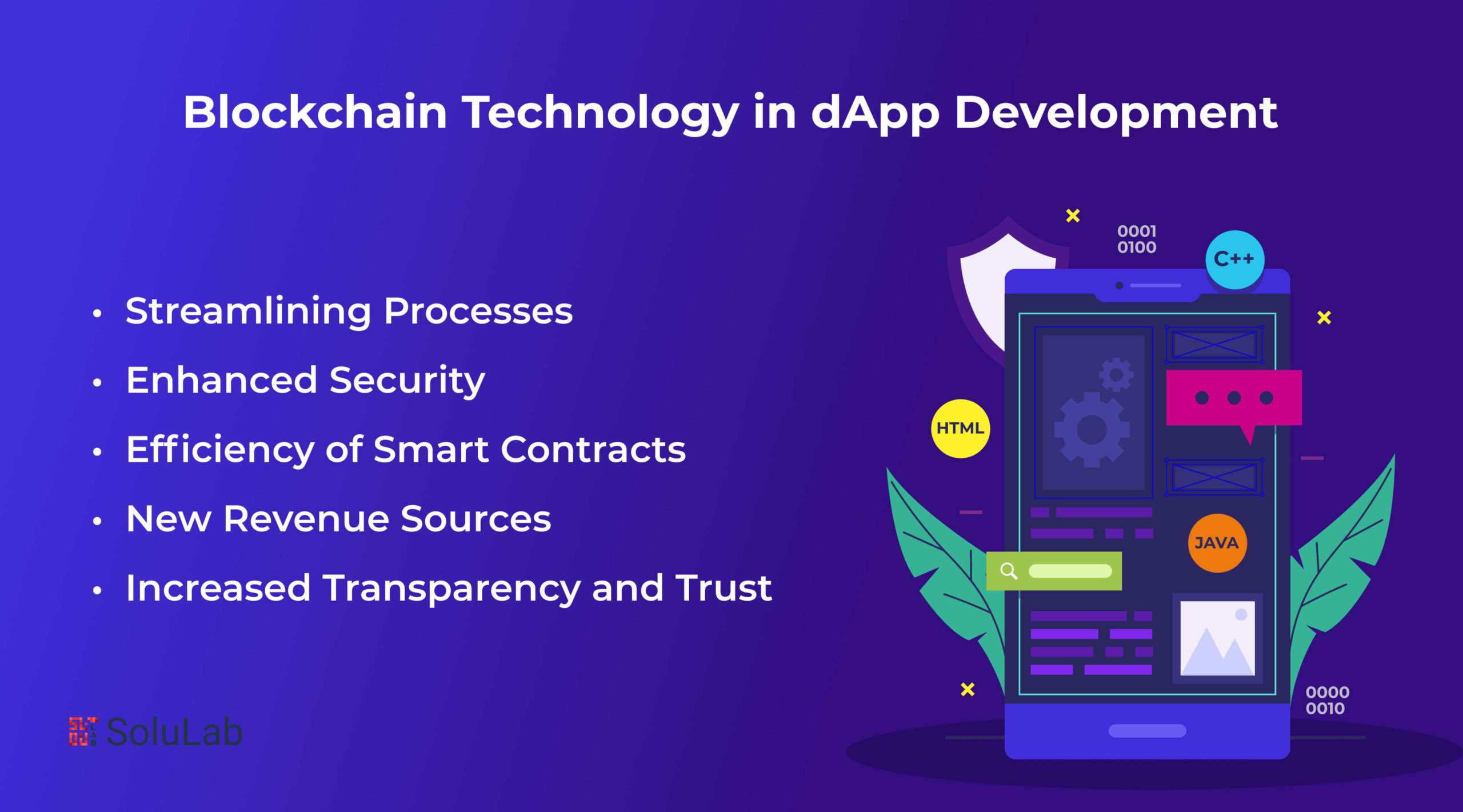
  • Streamlining Processes: Developing blockchain-based DApps offers several business options, one of which is the capacity to streamline processes. Diverse business processes can be improved and automated using DApps, eliminating the need for middlemen and lowering the possibility of mistakes.
  • Enhanced Security: Organizations are placing a higher priority on security as a result of the rise in data breaches and cyber threats. Because blockchain technology is decentralized, there is less chance of unwanted access or manipulation because data is maintained in a tamper-resistant way.
  • Efficiency of Smart Contracts: Smart contracts do away with the necessity for middlemen in contractual procedures since they are self-executing programs that have the contents of the agreement directly encoded into their code. The creation of smart contracts speeds up transactions and lowers expenses for companies.
  • New Revenue Sources: Businesses may investigate new revenue sources using blockchain-based decentralized application development, especially by issuing tokens or establishing decentralized marketplaces. These changes may present fresh approaches to revenue generation and company growth.
  • Increased Transparency and Trust: Successful business relationships are built on trust. Blockchain-based DApps build an unchangeable, transparent ledger that promotes confidence among users and stakeholders. Increased brand reputation and consumer loyalty may result from this improved openness.

Benefits of Blockchain in dApp Development

Benefits of Blockchain in dApp Development

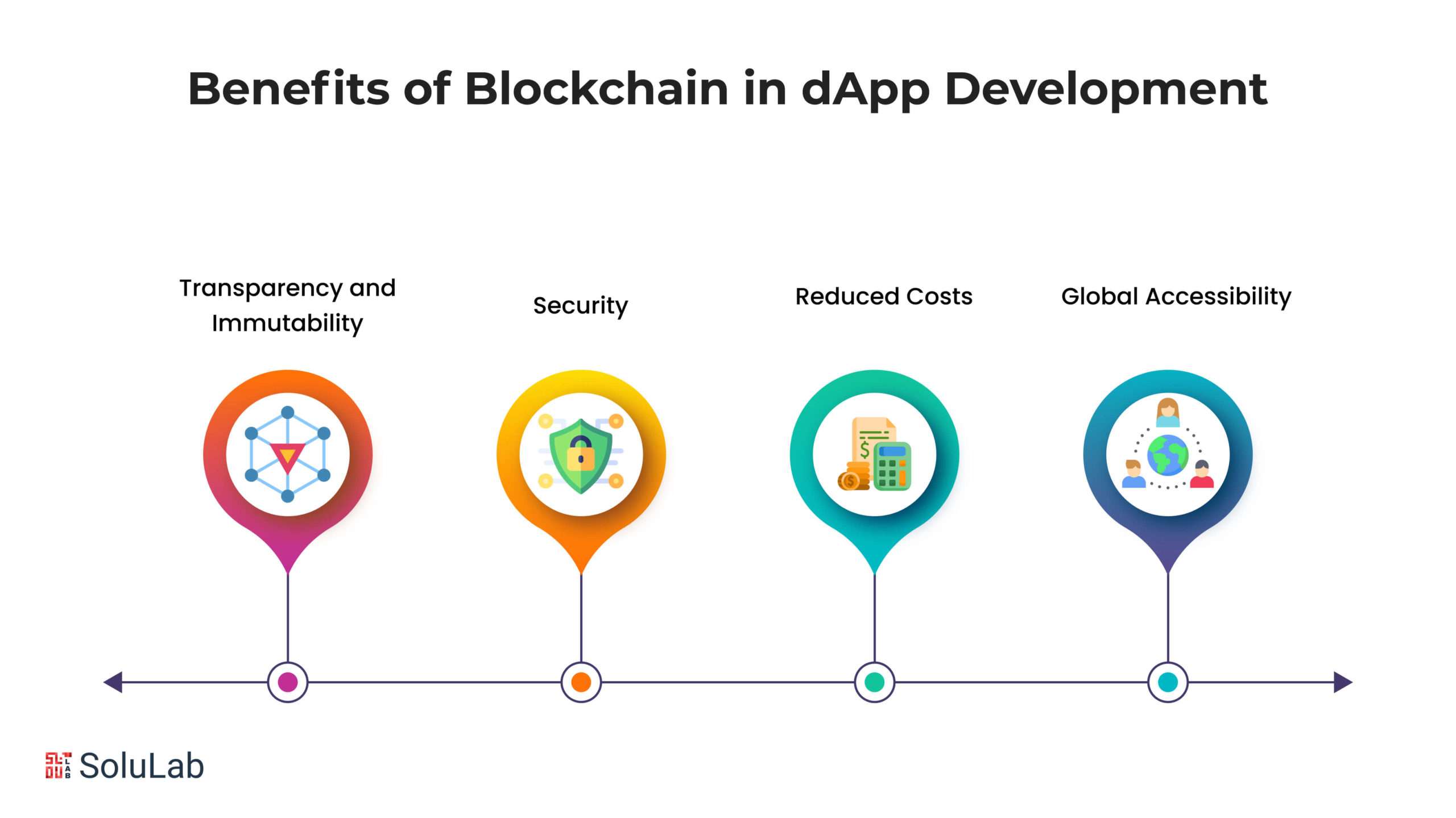
The development of Ethereum DApps is changing how decentralized apps will be used in the future. The following advantages are driving the growing popularity of blockchain-based DApps:

  • Transparency and Immutability: Every transaction on a blockchain is publicly recorded, ensuring transparency. Since data cannot be altered or withdrawn after it has been collected, security and trust are increased.
  • Security: Since DApps are decentralized, fraud and hackers cannot affect them. There isn’t a single location where dishonest people can go.
  • Reduced Costs: DApps may significantly reduce running costs by doing away with middlemen and using smart contracts to automate processes. 
  • Global Accessibility: From any place with an internet connection, DApps offer limitless utilization of financial systems and services.

The Business Power of Decentralization

Keeping up with transformational technology is critical to maintaining competitiveness in the fast-paced world of business. Decentralization has emerged as a key factor influencing how businesses will operate in the future, particularly when it comes to the creation of blockchain-based DApps. This section will examine how companies might profit from decentralization, with an emphasis on the growth prospects and advantages of developing blockchain applications for companies and daily operations.

Opening Up New Growth Paths

Adopting decentralized solutions through the appropriate blockchain DApp development firm is a strategic requirement for organizations looking to grow and diversify. Blockchain technology’s decentralization opens up new development opportunities for companies that were previously limited by conventional centralized systems.

  • International Market Access: Companies may easily grow internationally with decentralized application development. A blockchain DApp development company makes it easier to create systems that are efficient, safe, and cross-border, giving companies the confidence to enter undiscovered areas.
  • Tokenization for Capital Generation: Businesses have a special chance to tokenize assets thanks to the tokenization idea. This improves liquidity and creates opportunities for creative fundraising techniques. A DApp development firm specializes in building blockchain applications that easily include tokenization, enabling companies to investigate various forms of finance.
  • Community Involvement and Loyalty: Long-term company success depends on cultivating a devoted clientele. DApps in blockchain provide a feeling of community participation by introducing features like token-based rewards and decentralized governance. This strengthens consumer advocacy and loyalty in turn, laying the groundwork for long-term company expansion.

How DApps on Blockchain Can Change Businesses Operations?

Traditional corporate procedures have been revolutionized by blockchain DApps, increasing operational efficiency. Reputable blockchain DApp development firms understand how important decentralized apps are to changing how businesses operate.

  • Decentralized Data Management: Sensitive data is handled by businesses in enormous quantities. Decentralized data management solutions are provided by blockchain DApps, guaranteeing that data is easily auditable, safely kept, and impervious to manipulation. This simplifies compliance procedures while simultaneously improving data security.
  • Smart Contracts for Smooth Transactions: Transaction processes may be sped up and automated by incorporating smart contracts into corporate operations. A blockchain DApp development company focuses on creating smart contracts that are suited to certain business requirements and enable transactions that are quicker, more dependable, and more affordable.
  • Supply Chain Transparency: Companies in a variety of sectors are realizing the value of supply chain openness. The proficiency of a blockchain DApp development company guarantees businesses may utilize decentralized solutions to get complete visibility in their supply chains, thus boosting confidence among interested parties.

Innovations in Technology Creating Business Opportunities

To ensure ongoing success in the fast-paced world of blockchain DApp development and company today, it is imperative to stay ahead of the curve. Technological developments, especially in the area of blockchain DApp development, create new commercial prospects.

  • Blockchain Integration: The smooth integration of blockchain technology is the cornerstone of the strategy used by a strong blockchain DApp development business. This fundamental technology guarantees the development of transparent, safe, and decentralized networks. The company’s specialty is utilizing blockchain technology to its fullest extent, providing companies with a strong platform for expansion.
  • Decentralized Storage Solutions: A blockchain DApp development business incorporates modern decentralized storage solutions into DApp development, realizing the value of data security and accessibility. In addition to guaranteeing data integrity, this offers companies with great scalable storage alternatives.
  • Interoperability: In an interconnected digital ecosystem, interoperability is essential. A blockchain DApp development business gives top priority to developing DApps that are compatible with current platforms and systems. This promotes a unified IT landscape, enabling companies to profit from blockchain without interference.
  • Consensus Mechanisms: Selecting the right consensus mechanisms is essential to guaranteeing blockchain networks’ dependability and efficiency. An advanced consensus mechanism is assessed and put into practice by a blockchain in DApp development, which customizes it to meet the unique requirements of each DApp. This tactical approach improves the general robustness and usefulness of blockchain technologies.

DApps for Banking and Finance

DApps built on blockchain technology are revolutionizing the financial sector. One of the most notable use cases is in decentralized finance (DeFi).

DeFi DApps provide a variety of financial services, such as lending, borrowing, trading, and yield farming, without the need for traditional banks or intermediaries. Users can interact directly with DeFi protocols, which are managed by smart contracts.

Furthermore, the stability and reliability of the market have been enhanced by smart contract-governed stablecoins like USDC and DAI, which are based on blockchain technology. This might offer a more inclusive and effective financial system, especially in places where traditional banks are not easily accessible.

DApps for Healthcare

Healthcare is another sector that might benefit from DApps. Electronic health records (EHRs), which provide secure, interoperable, and immutable medical data, may be stored using blockchain technology. In order to improve privacy and trust, patients have authority over their health data and can provide access to medical personnel, researchers, and insurance companies.

The supply chain for pharmaceuticals and medical equipment may operate more efficiently thanks to DApps. Transparent, unchanging data eventually improves patient safety by guaranteeing the quality and legitimacy of prescriptions and prohibiting the sale of counterfeit items.

DApps for Supply Chain Management

Distributed ledger apps (DApps) built on the blockchain offer a robust traceability and transparency approach for supply chain management. All supply chain participants may track an item’s progress in real-time from manufacture to delivery by using a shared ledger.

In industries like food and luxury goods, where authenticity and quality are vital, this technology is quite beneficial.

The billion-dollar annual expenditures that businesses incur due to counterfeit goods may be significantly reduced. By scanning a product’s QR code, customers may verify its validity and feel more at ease about their purchases.
Challenges and Limitations of DApps in Blockchain Challenges and Limitations

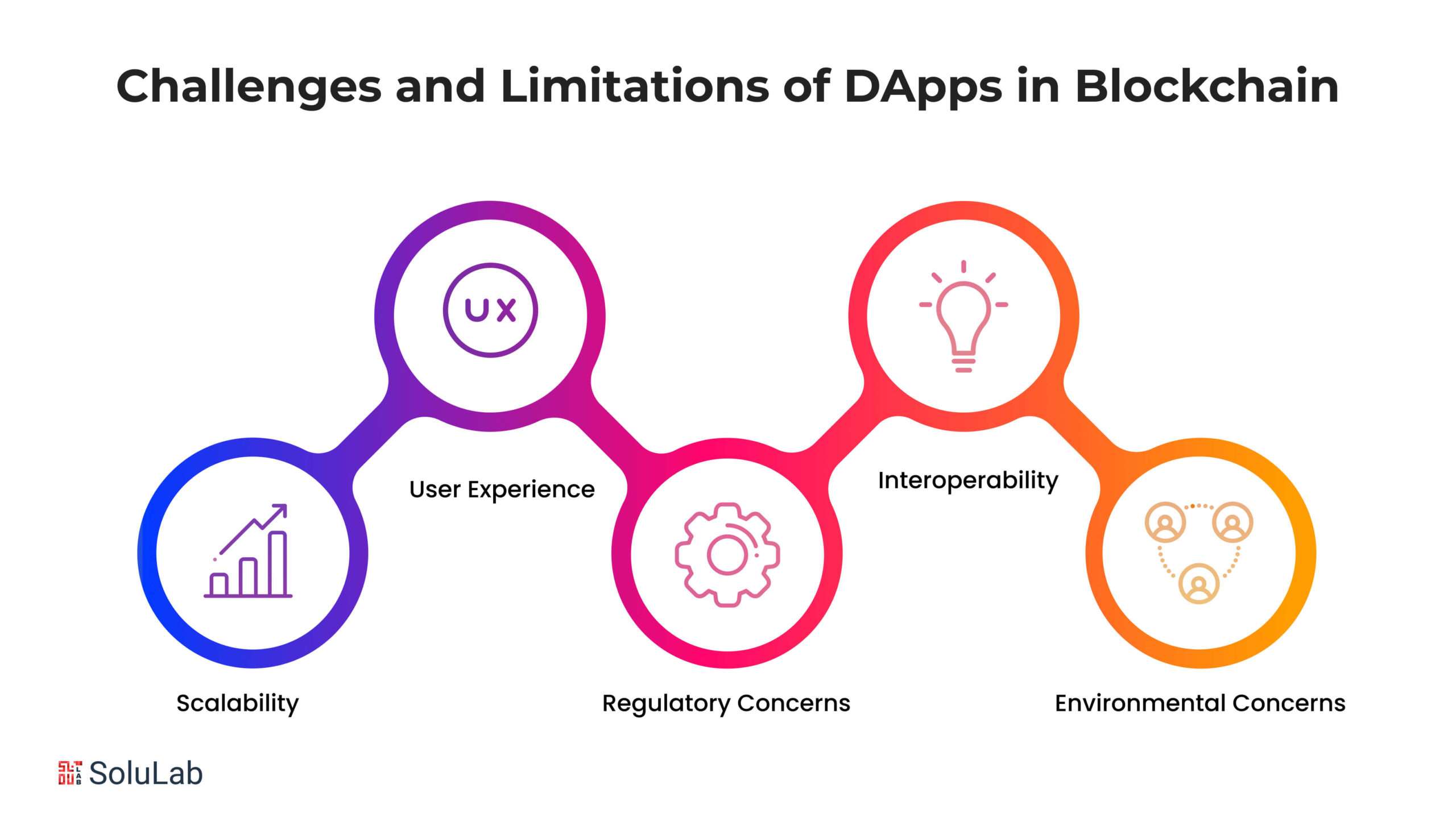
DApps provide a number of advantages, but they also present certain challenges and disadvantages.

  • Scalability: In certain blockchain networks, like Ethereum, scalability issues lead to high gas prices and slow transaction processing times.
  • User Experience: Due to their complexity, DApps might not be widely adopted. User interfaces are being improved on a continuous basis.
  • Regulatory Concerns: It may be challenging to comply with regulations because DApps occasionally operate in legal limbo.
  • Interoperability: The inability of different blockchain networks to readily join may hinder the efficient flow of assets and data.
  • Environmental Concerns: Proof-of-work-based blockchains, like Ethereum and Bitcoin, need a lot of energy. It is essential to transition to consensus approaches that are more ecologically friendly.

The Development of DApps in the Future

The future of DApp development is really bright. Hire Dapp Developers who are committed to removing present barriers and enhancing DApp usability and accessibility.

Future developments and trends affecting DApps include the following:

  • Layer 2 Solutions: Layer 2 solutions aim to reduce transaction costs and handle scalability issues. Examples of these are sidechains and Ethereum’s Optimistic Rollups.
  • Cross-Chain Compatibility: Developers are searching for ways to improve interoperability in order to facilitate the seamless transfer of assets and data between different blockchain networks.
  • Non-Fungible Tokens, or NFTs: As NFTs gain popularity, more possibilities become available to artists, collectors, and producers. DApps are an essential part of the NFT ecosystem.
  • Decentralized Identity: By giving users control over their data, DApps may be crucial to decentralized identity solutions.
  • Governance and DAOs: In a variety of DApps and organizations, Decentralized Autonomous Organizations (DAOs) are gaining popularity as a mechanism for community-driven governance.

How to Pick a Trusted Blockchain App Development Company?

Selecting the top blockchain DApp development company requires avoiding common blunders and carefully weighing a number of important considerations:
  • Experience and Expertise: Seek out businesses that have a strong grasp of developing DApps and a track record of developing blockchain systems. Look through their portfolio to see the technologies and projects that are relevant to you.
  • Technical Proficiency: Verify that the business is knowledgeable about the blockchain systems and technology that you find appealing. Check their knowledge of consensus methods, the creation of smart contracts, and other crucial blockchain elements.
  • Historical Projects and Case Studies: Examine the organization’s past projects and case studies to evaluate the caliber of their output, punctuality, and customer contentment. This will shed light on their reliability as well as capabilities.
  • Team Competency: Assess the development team’s abilities and background. A competent and experienced staff is essential to the creation of a successful DApp. Seek out a group of people who are knowledgeable with decentralized technologies, blockchain, and pertinent programming languages.
  • Scalability: Take into account the company’s capacity to expand your DApp as your enterprise expands. In order to ensure that your DApp can meet future needs, scalability is essential for handling more users and data.
  • Security Measures: When developing a blockchain, security is crucial. Make sure that the business adheres to security best practices, carries out extensive testing, and security audits, and puts safeguards in place to keep your DApp safe from hacker attacks and vulnerabilities.
  • Budget and Cost: Although it’s important, value should take precedence over the cheapest price. Make sure the pricing structure fits inside your budget by understanding it. You can prevent unforeseen costs by using a pricing plan that is clear and open.
  • Client References and Reviews: Request references and reviews from prior customers. This will offer information on the company’s standing, ability to communicate, and general level of client happiness.
  • Support and Maintenance: Find out what post-development support and maintenance services the organization provides for blockchain development. A reputable business should offer continuing assistance to resolve any problems and maintain your DApp current with emerging technologies.

CTA

Concluding Thoughts

DApps built on the blockchain are unquestionably creating new opportunities. They offer cost-effectiveness, security, and transparency in several businesses. DApps should be utilized more extensively as layer 2 solutions, interoperability, and user-friendly interfaces continue to progress, even though there are still challenges.

DApps have the potential to completely transform current procedures and provide people, businesses, and industries with a more open, effective, and inclusive future thanks to their expanding popularity and capabilities. With the power of blockchain technology and the inventiveness of DApp developers working together, we seem to be heading toward a decentralized, promising, and exciting future.

The most effective option is to go with SoluLab as your blockchain DApp development company. Our skilled group has a proven track record of developing advanced decentralized apps. To guarantee the reliability of your DApp, we place a high priority on security, scalability, and regulatory compliance. Our commitment to your pleasure is evidenced by our transparent pricing policy, customer-focused methodology, and stellar client testimonials. More than just a development service, SoluLab is a dApp development company. It is a reliable partner dedicated to brilliantly and creatively realizing your blockchain idea. For a smooth and fruitful DApp development experience with an emphasis on ongoing support and maintenance, hire blockchain developers from SoluLab today! Contact us now!

FAQs

1. What is the significance of blockchain technology in dApp development?

Blockchain technology provides the foundational infrastructure for developing decentralized applications (dApps). Its core features such as decentralization, transparency, and immutability enable dApps to operate autonomously without the need for intermediaries. Smart contracts, decentralized storage, and tokenization are key blockchain components that empower dApp development by automating processes, securing data, and facilitating monetization.

2. What are the main advantages of decentralized applications (dApps)?

Decentralized applications offer several advantages, including enhanced security due to their distributed nature, transparent governance mechanisms, and increased user autonomy. Unlike traditional applications, dApps are not controlled by a single entity, reducing the risk of censorship and manipulation. Additionally, dApps enable users to interact directly with one another, fostering a more peer-to-peer ecosystem.

3. How do smart contracts contribute to dApp development?

Smart contracts are self-executing contracts with the terms of the agreement directly written into code. In dApp development, smart contracts automate various processes, eliminating the need for intermediaries and reducing the risk of fraud or manipulation. They enable secure and transparent execution of transactions, ranging from simple payments to complex financial agreements, within the decentralized ecosystem of dApp.

4. What are the challenges associated with blockchain-based dApp development?

Despite its potential, blockchain-based dApp development faces several challenges. Scalability remains a significant issue, with current blockchain networks struggling to handle large-scale transactions efficiently. Moreover, regulatory uncertainty and compliance requirements vary across jurisdictions, posing legal hurdles for dApp developers. Additionally, achieving widespread user adoption and overcoming the learning curve associated with decentralized technologies are ongoing challenges.

5. How Does SoluLab Assist in Blockchain and dApp Development?

SoluLab offers comprehensive blockchain development services, specializing in decentralized application (dApp) creation. With seasoned developers proficient in Ethereum, Hyperledger, and EOSIO, SoluLab ensures tailored solutions aligned with clients’ needs. From ideation to deployment, SoluLab provides end-to-end support, incorporating modern technologies and offering post-deployment maintenance. Trusted for its expertise and commitment to client success, SoluLab stands as a reliable partner in navigating the complexities of blockchain-based dApp development.

Top 10 dApp Development Companies 2026

Struggling to find the right dApp development company for your blockchain project? With hundreds of agencies claiming to be the best, it’s overwhelming to figure out who truly delivers secure, scalable, and user-friendly decentralized applications.

The wrong choice can lead to security breaches, wasted time, and money. And in the fast-paced world of Web3, even a small delay can cost you your competitive edge.

The global dApp market was valued at US $13.2 billion in 2023, expected to grow at a CAGR of 21.8%, reaching ≈US $81.9 billion by 2033.

In this blog, we’ll explore the Top 10 dApp Development Companies for 2026, based on technical expertise, innovation, security standards, and client satisfaction. Whether you’re building a DeFi platform, NFT marketplace, or DAO-based solution, these companies have a proven track record of excellence.

Key Criteria to Shortlist Top dApp Development Companies

Choosing the right dApp development company can make or break your project. Here’s a quick guide to the key criteria you should consider before finalizing your tech partner:

1. Technical Expertise: Look for companies with a strong command of blockchain development platforms like Ethereum, Solana, or Polygon. A technically sound team ensures your dApp functions smoothly, scales efficiently, and integrates with smart contracts and DeFi systems.

2. Security & Auditing Standards: A reliable dApp company follows best practices in security protocols and conducts rigorous audits. This helps prevent hacks, vulnerabilities, and data breaches, crucial for maintaining user trust and safeguarding transactions.

3. Portfolio & Case Studies: A well-documented portfolio with successful case studies shows the team’s capabilities. It reflects their experience in handling similar projects, their approach to solving problems, and the tangible impact they’ve delivered.

4. Innovation & Customization: Top companies go beyond cookie-cutter solutions. They understand your unique business goals and offer custom features that give your dApp a competitive edge through creative UX, gamification, or interoperable modules.

5. Client Reviews & Reputation: Online reviews, testimonials, and third-party ratings offer real-world insights into the company’s reliability, delivery timelines, and overall professionalism. A strong reputation usually reflects consistent client satisfaction.

6. Post-Development Support: After launch, your dApp may need updates, patches, or scaling. A good development partner provides reliable maintenance, bug fixing, and technical support to keep your platform running smoothly.

7. Cost-Efficiency: While you shouldn’t compromise on quality, a transparent pricing model and the ability to deliver value within budget are essential. The right company offers a balance between affordability and premium service.

8. Expertise and Experience: Years of hands-on blockchain development, especially in building decentralized applications, add credibility. Experienced teams are better equipped to handle unexpected challenges and guide you with strategic insights.

Top 10 dApp Development Companies to Consider in 2026

As the world of decentralized applications (dApps) continues to expand, keeping up with all the different companies can be challenging. However, with a little guidance, navigating the space can become much more manageable. Below is the list of top dapp development companies in 2026.

1. SoluLab

SoluLab is a software development company specialising in creating decentralised applications (dApps). With their extensive service offerings, which include frontend design, backend integration, and smart contract implementation.

By prioritising user-centric design and scalable architecture, SoluLab can produce outstanding dApps. Their proficiency in blockchain technology and zeal for providing solutions make them a top option for companies wishing to create dApps. Solulab has the knowledge to support you in achieving your objectives, whether you want a custom-built dApp or want to incorporate blockchain technology into an already-existing application.


$25-$49


50-249


2014


Los Angeles, CA, USA


Disney, Mercedes Benz, Goldman Sachs

2. ConsenSys

ConsenSys is a global leader in Ethereum-based dApp development, known for powering some of the most widely used Web3 tools like MetaMask and Infura. With deep expertise in smart contract development, DeFi solutions, and blockchain infrastructure, ConsenSys helps enterprises and startups build scalable, secure dApps.

Its suite of tools supports seamless development, testing, and deployment. Ideal for businesses seeking enterprise-grade Ethereum solutions, ConsenSys is trusted for its innovation, security, and strong contribution to the blockchain ecosystem.


$99


250


2014


Brooklyn, NY


JPMorgan Chase, ING, Microsoft, EY

3. EOSIO

EOSIO, developed by Block. One is a high-performance blockchain platform designed for rapid dApp development. Known for its fast transaction speeds, low latency, and scalable architecture, EOSIO supports a wide range of use cases from gaming to enterprise apps.

They offer comprehensive blockchain consulting, development, and integration services, empowering businesses to leverage the benefits of decentralized applications. It’s ideal for businesses that require high throughput, cost-effective operations, and customizable smart contract capabilities without sacrificing performance.


$150


100


2018


Maryland, USA


Block.one, Bitfinex, Tether

4. ChromaWay

ChromaWay has developed dApps that are tailored to meet the varied requirements of different industries, including finance, gaming, and supply chain management. Their extensive understanding and proficiency in blockchain technology enable them to create decentralized, transparent, and highly secure dApps.

Through ChromaWay’s exceptional support, businesses can change their operations and create innovative DApps that provide tangible benefits to their customers.


$50


100


2014


Stockholm, Sweden


Tezos, Ergo, IDB

Nadcab Labs

5. Nadcab Labs

Nadcab Labs is a well-known blockchain development company specializing in dApp development, token creation, DeFi solutions, and NFT platforms. With a technical team and a focus on customized blockchain solutions, Nadcab Labs delivers secure and scalable decentralized applications tailored to business needs.

They bring expertise in Ethereum, Hyperledger, Binance Smart Chain, and other leading blockchain platforms. Known for their affordable pricing and fast turnaround time, they’re ideal for startups, enterprises, and entrepreneurs looking to build dApps with practical use cases and real-world impact.


$50-99/hr


200


2017


Uttar Pradesh, India

6. Altoros

Altoros is a global software development company specializing in blockchain technology and dApps. They offer a range of services, from consulting to deployment, and cater to various industries.

Altoros stands out from competitors by using open-source technologies and adhering to industry best practices. Their team of skilled professionals provides innovative solutions tailored to clients’ needs. With exceptional services and expertise, Altoros is a top choice for blockchain technology and DApp development.


$60


150


2001


CA, United States


Allstate, Siemens, Huawei

BCG X

7. BCG X

BCG X, the tech build and design arm of Boston Consulting Group, combines deep strategy with tech execution. They specialize in building enterprise-grade decentralized apps that align with complex business needs.

With a focus on innovation, UX, and scalability, BCG X is perfect for large enterprises and legacy firms aiming to lead digital transformation through blockchain technology.


$200-$400


3000


2022


Boston, Massachusetts, USA

8. OpenXcell

OpenXcell is a software development company that provides dApp development solutions for businesses across various industries. Their team of blockchain experts utilizes advanced technologies to create secure and scalable dApp.

OpenXcell prioritizes innovation and follows an agile development approach, making them an ideal partner for any upcoming project. Their service offerings include smart contract development, frontend design, and backend integration.


$35


100


2008


NY, USA


Motorola, Dupont, Ubisoft

9. Intellectsoft

Intellectsoft is a software development company that offers a wide range of services, specializing in blockchain and dApp development. They provide complete solutions for creating decentralized applications for startups and enterprises.

They focus on delivering user-friendly, secure, and scalable DApps that enable businesses to adopt blockchain technology. With its blockchain and dApp development expertise, Intellectsoft is committed to providing innovative and reliable solutions that help companies to stay ahead of the competition.


$55


150


2007


Miami, FL


Mitsubishi, Fleet Nurse, Eurostar

10. Belitsoft

Belitsoft is a recognized company that specializes in creating unique DApp solutions for businesses. Their extensive offerings include dApp implementation, smart contract development, and blockchain consultancy.

Belitsoft has extensive experience and skill in developing decentralized apps, prioritizes security, and adapts to meet the unique needs across different industries. Through creative dApps that improve productivity and efficiency, their committed team of experts is dedicated to advancing digital transformation.


$40


50


2004


Warsaw, Poland


ElearningForce, Insly, Crimson

dApp development Compnany

Conclusion

Choosing the right blockchain dApp development company is crucial for building secure, scalable, and future-ready decentralized applications. Whether you’re a startup exploring Web3 or an enterprise seeking blockchain integration, these companies offer tailored solutions to meet your needs. Before finalizing a partner, evaluate them based on key factors like security standards, portfolio, client feedback, and cost-efficiency.

DLCC partnered with SoluLab to build two innovative platforms—Prime Product and Tokenet—designed to change traditional finance. With features like dual-custody onboarding, real-time collateral management, live crypto charts, and secure trading, DLCC now enables seamless crypto lending, borrowing, and trading worldwide. The result? A user-friendly, transparent, and secure DeFi ecosystem that captured a wide user base and simplified capital access from credible lenders.

SoluLab, a top dApp development company in the USA, can help you turn your blockchain vision into reality with customized, scalable solutions. Contact us today to discuss further.

FAQs

1. How is DApp different from a traditional app?

A decentralised network, usually a blockchain, is used to host a form of programme known as a Dapp, or decentralised application. Dapps are more secure and censorship-resistant than regular apps because they employ a distributed network of nodes to execute processing and storage instead of centralised servers.

2. What programming languages are commonly used for Dapp development?

Solidity, which is used for Dapps based on Ethereum, and JavaScript, which is used for Dapps based on other blockchain platforms, are the two programming languages that are most frequently used for Dapp development.

3. How do smart contracts work in Dapps?

Smart contracts are self-executing agreements that are designed to carry out certain activities automatically when predetermined criteria are satisfied. Smart contracts are used in Dapps to enforce the network’s rules and regulations and guarantee the security and transparency of all transactions.

A smart contract may be set up, for instance, to automatically transfer money from one account to another when a specific need is satisfied, such as when a product is delivered.

4. What are some popular Dapp platforms and frameworks?

Some popular Dapp platforms and frameworks include Ethereum, EOS, TRON, and Hyperledger Fabric. These platforms provide developers with the tools and infrastructure needed to build and deploy Dapps on their respective networks.
