Talk to an Expert

How Central Bank Digital Currency Development is Transforming Global Economies?

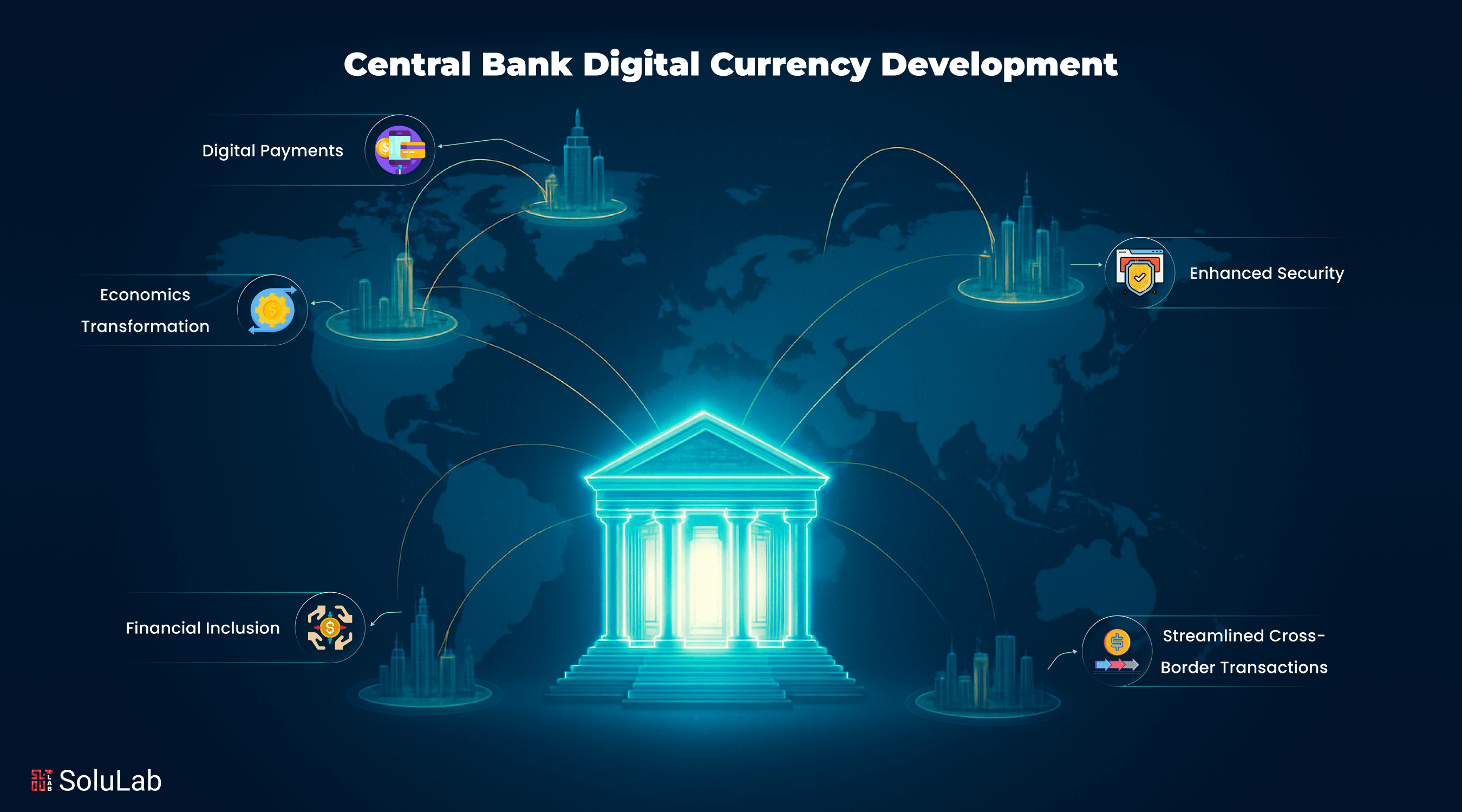
Central Bank Digital Currency DevelopmentThe world of finance is experiencing a deep digital shift. Banking systems are changing fast, fueled by advances in blockchain, mobile payments, and digital finance infrastructure. From contactless payment to artificial intelligence-based financial services, economies are shifting toward quicker, safer, and more accessible financial systems.

At the heart of this shift is the emergence of Central Bank Digital Currencies (CBDCs)—official digital forms of national fiat currencies. In contrast to cryptocurrencies, CBDCs marry central banks’ trust with blockchain technology’s efficiency and transparency.

If you are looking for in depth information on the concept of CBDCs, the article is for you! 

What is a Central Bank Digital Currency (CBDC)?

A CBDC is a digital version of the national currency of a nation, issued and controlled by the central bank. In contrast to cryptocurrencies, CBDCs are legal tender, providing the confidence of fiat money with the efficiency of blockchain.

Key Features:

  • Issued by central banks
  • Supported by national fiat reserves
  • Works digitally but with regulation
  • Secure, programmable, and traceable
Feature Physical Currency CBDC
Form Paper/coins Digital-only
Storage Wallets/safes Digital wallets
Issuer Central bank Central bank
Traceability Low High
Programmability No Yes

Function of Central Banks:

Central banks are both the issuer and regulator, promoting monetary stability and control over policy through the utilization of CBDCs.

How CBDCs Differ from Cryptocurrencies?

Though both Central Bank Digital Currencies (CBDCs) and cryptocurrencies are in digital format and utilize distributed ledger or blockchain technology, there are major differences between them with regard to control, objective, and trust framework.

1. Issuing Authority

Central Bank Digital Currencies are issued and supported by a nation’s monetary or central bank authority, thereby being legal tender. It ensures they are accepted and recognized nationwide, just like physical currency.

Conversely, digital currencies such as Bitcoin and Ethereum are developed by decentralized groups or networks. They do not have a central issuer, implying there’s no government or institution assuring their use or value.

2. Legal Status and Regulation

CBDCs are considered legal tender within a country. This implies that citizens and businesses are bound by law to accept them as payment. They fall under a rigid regulatory system controlled by the central bank.

Cryptocurrencies, on the other hand, tend to operate in a legal gray. They are classified in most places as digital assets or commodities and not as currencies. They are governed by changing regulations, and they are prohibited or banned in some nations.

3. Centralization vs. Decentralization

CBDCs are under the central control of the issuing authority, providing the central bank with full control of transactions, distribution, and monetary policy implementation. Centralization provides more effective policy tools but is a concern with respect to privacy of data and surveillance systems.

Cryptocurrencies are inherently decentralized. They run on peer-to-peer networks where no one has authority. This provides censorship resistance and transparency but restricts the capability to monitor or reverse transactions.

4. Volatility and Stability

CBDCs aim to replicate the value of its nation’s fiat currency, so they remain stable in value. By way of illustration, 1 digital rupee or digital dollar is always equivalent to its physical equivalent.

Most cryptocurrencies, by contrast, are extremely volatile. Their values change according to market demand, speculation, and outside factors. Such volatility makes them good investments but impractical as a means for daily transactions or salary payments.

Parameter CBDC Cryptocurrency
Issuer Central Bank Decentralized (no issuer)
Legal Status Legal tender Not universally accepted
Regulation Fully regulated Partially or unregulated
Volatility Stable Highly volatile
Use Cases National payments, G2P, trade Investment, DeFi, NFTs

CBDCs maintain centralized control and monetary oversight, while cryptocurrencies like Bitcoin or Ethereum offer decentralized, permissionless alternatives.

Why Are Governments Considering CBDCs Now?

As cash use wanes and digital payments surge, central banks worldwide are acting proactively to:

  • Keep monetary control in a more digital world
  • Push back against the rise of unregulated cryptocurrencies and stablecoins
  • Enhance financial inclusion and policy effectiveness
  • Upgrade payment systems for domestic commerce and cross-border trade

Crypto Development Company

CBDCs are not a fad—they’re redefining the future of money, making financial systems smarter, more inclusive, and resilient.

1. Monetary Policy Efficiency and Control

CBDCs enable real-time monitoring and control of the money stock, enhancing the efficacy of central bank monetary policy implementation and oversight.

2. Counter to Waning Cash Use

As digital payments have surpassed cash use worldwide, CBDCs provide a state-supported option for digital payment systems versus private ones.

3. Counter to Stablecoins & Cryptocurrencies

CBDCs guarantee national control over money, countering the influence of unregulated stablecoins and crypto tokens.

4. Economic Modernization

They facilitate the digitalization of financial infrastructure to foster innovation, efficiency, and inclusion.

How CBDC Development Is Facilitating Global Economies?

CBDC development is reshaping economies by strengthening monetary policy, boosting inclusion, enabling faster payments, ensuring transparency, and driving financial innovation.

1. Improving Monetary Policy Implementation

CBDCs make it possible for instant policy implementation—tweaking interest rates or managing liquidity in near real time.

2. Increasing Financial Inclusion

In remote or underserved areas, CBDCs facilitate safe and convenient digital wallets without requiring bank accounts.

3. Simplifying Cross-Border Payments

CBDCs minimize friction on international payments, reducing costs and accelerating settlements.

4. Fighting Financial Crime and Tax Evasion

By enhancing traceability and transparency, CBDCs facilitate tracking of illicit behavior and enhancing tax compliance.

5. Enhancing G2P Payments

Stimulus checks, pensions, and subsidies can be distributed directly to citizens by governments via programmable CBDC wallets.

6. Encouraging Innovation in Financial Services

CBDCs enable programmable money, paving the way for:

  • Smart contracts
  • DeFi integrations
  • Custom digital banking solutions

7. Revolutionizing the Way the World Does Business

From cross-border trade settlements to online marketplaces, CBDCs reframe financial infrastructure for speed, cost-effectiveness, and trust.

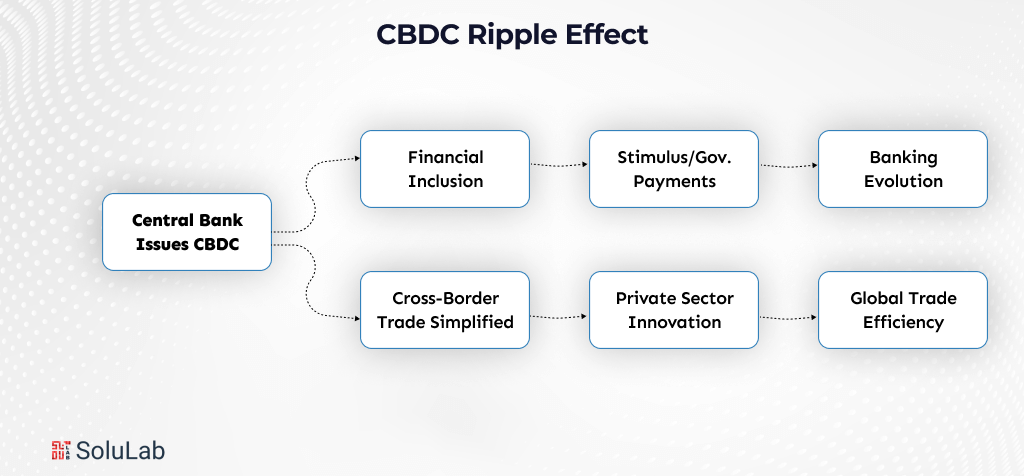
CBDC Ripple Effect 

The use of Central Bank Digital Currencies (CBDCs) creates a ripple effect on various sectors of the economy. When a central bank launches a CBDC, it not only digitalizes money but also:
CBDC Ripple Effect

  • Encourages financial inclusion through giving access to secure digital payments to unbanked communities
  • Streamlines cross-border trade by facilitating quicker, cheaper, and more transparent international transactions
  • Enhances government operations, particularly in the distribution of welfare and direct payments to citizens
  • Fosters private sector innovation via programmable money and fintech integration
  • Reverses the conventional banking model, reshaping commercial banks’ and payment service providers‘ roles
  • Enhances global trade efficiency through standardized, interoperable, and transparent payment systems

Generally, CBDC use unleashes a chain reaction of financial modernization, touching every aspect from individual transactions to international trade and policymaking.

The Future of CBDCs

CBDCs are shaping the future of money, with 130+ nations testing digital currencies, global collaborations advancing cross-border use, and long-term potential to transform monetary policy and economies.

1. Global Momentum: Over 130+ countries are experimenting with CBDCs, with flagship initiatives like China’s e-CNY, India’s Digital Rupee, and the EU’s Digital Euro leading the way.
2. Collaborative Innovation: Strategic projects such as mBridge and the BIS Innovation Hub are building multi-CBDC platforms, paving the path for fast, low-cost, and secure cross-border payments.
3. Transformational Impact: Beyond payments, CBDCs promise to redefine monetary policy, strengthen financial inclusion, and accelerate the world’s shift toward cashless, fully digital economies.

Conclusion

Central Bank Digital Currencies are not yet another financial experiment—they’re a foundational change in how the world understands, holds, and uses money. For governments and businesses alike, the news is clear: embracing CBDCs is no longer a choice—it’s a requirement. Early movers will find a competitive advantage in defining the future of financial infrastructure.

As a leading blockchain development company, SoluLab helps governments, financial institutions, and enterprises design and deploy secure, scalable, and compliant CBDC solutions. With deep expertise in blockchain architecture, smart contracts, digital wallets, and regulatory integrations, we empower organizations to unlock the full potential of digital currencies.

If your organization is exploring the potential of Central Bank Digital Currency, contact us to turn vision into reality!

FAQs

1. How can organizations prepare for CBDC integration?

Businesses and financial institutions should focus on upgrading digital infrastructure, ensuring compliance with regulations, and adopting blockchain-based solutions that support seamless CBDC transactions.

2. Are CBDCs already in use globally?

Yes. Countries like China (Digital Yuan), Nigeria (eNaira), and the Bahamas (Sand Dollar) have launched CBDCs. Many others, including the U.S. and European Union, are actively testing or researching them.

3. Will CBDCs replace traditional cash completely?

Not in the near future. CBDCs are expected to coexist with cash and digital payment systems, giving citizens more flexibility while allowing governments to gradually reduce reliance on physical money.

4.How can businesses prepare for a CBDC-driven future?

Businesses should stay updated on regulatory changes, adopt digital-friendly payment systems, and explore blockchain integration to remain competitive as CBDCs reshape financial ecosystems.

5. Why should countries adopt CBDCs if digital banking already exists?

Unlike traditional digital banking, CBDCs are sovereign, programmable, and universally accessible, offering stronger financial inclusion and enabling direct monetary policy tools for governments.

Why Invest in Cryptocurrency Wallet Development [2025 Guide]

Rise of Crypto Wallet

At this stage of technology, cryptocurrency wallets have changed traditional traditional financial transactions and processes, which makes them a disruptive force. The increased demand for digital currencies has led to significant demand for crypto wallets and other digital secure and meaningful means for solutions. Businesses in the Bitcoin sector also enjoy the benefits offered by digital assets to grow using cryptocurrency wallets.

The global community of cryptocurrencies has experienced cryptocurrency wallet app development and growth in the previous few years. Consequently, there has been a notable increase in the requirement for secure and safe storage options. The most recent trends of cryptocurrencies will be discussed in this article, including the meaning of cryptocurrency wallets and its working. They are safe havens that safeguard users’ private keys for controlling and giving them access. Earlier cryptocurrency market size was marked at $6.75 billion and reached up to $8.42 billion in 2023 and is projected to grow to $61.87 billion by 2031 growing at a CAGR of 24.8%.

What Exactly are Cryptocurrency Wallets?

Cryptocurrency wallets are made to keep your private keys safe so that you can always easily access your funds. They allow you to transmit, acquire, and make use of your cryptocurrencies in a way you can with Bitcoin and Ethereum. You can transmit and receive cryptocurrencies at the same time protect and keep your private keys secure.

Along with private keys, you also get a password that grants you access to cryptocurrency holdings. Since cryptocurrency lacks a physical token such as coins, cash, and bills it still is a very abstract value to store. On a bigger blockchain, it is nothing further than a single piece of code. 

What is it that you possess when you buy a Bitcoin? A public key and a private key, but if you lose your private key you can lose your grant to access cryptocurrency. Likewise, the complete privilege of the crypto is granted to the owner of a private key. The most essential feature of cryptocurrency wallets is to keep your private keys safe.

How does Cryptocurrency Wallets Work?

How does Cryptocurrency Wallets Work?

Applications for PCs and mobile devices such as tablets, phones, etc are known as cryptocurrency wallets. To connect to the blockchain system for the cryptocurrency you are using an internet connection. Cryptocurrencies are fragments of data scattered over a database; they are not stored anyplace, the wallets locate all the pieces linked to your public address and compute within the app’s user interface for you.  

Coins that are held by users are not technically stored in a crypto wallet. Rather it is the secret to their money, which is kept on open blockchain systems. A user must utilize a private key provided with a collection of unique numbers to validate their wallet address before they can carry out any kind of transaction. The type of wallet a user possesses can have an impact on both speed and security. In general, crypto wallets give a user the ability to start, sign, and then publish the transaction to the network. Here is a simple step-by-step breakdown of how crypto wallets work in practice:

  • Through the wallet interface, a transaction is initialized
  • The interface shows you the facts of any possible transaction or the “intent” of a digital proposition. 
  • Click Confirm, on the wallet interface
  • Your private key is used by the wallet to sign the transaction
  • Once the transaction is signed, it is later transmitted to the network but only possible with an internet connection. 

Top 4 Types of Cryptocurrency Wallets 

The top wallets for cryptocurrency are categorized into two categories, hot wallets which are based on the internet, and cold wallets which can work offline and come in the form of physical devices. Here are the types of best cryptocurrency wallets:

1. Smartphone Wallets

Mobile wallets are a type of hot wallet, which helps users to send and receive cryptocurrency anywhere they have access to a phone number and the internet connection, smoothly, and securely. With the benefits, mobile wallets do hold drawbacks which include of course losing your device and fraud, malware, and hacking.

2. Web Wallets

Web wallets save your private keys on a server that is run by a third party, like a cryptocurrency exchange that is consistently online. Web wallets can be particularly convenient because they allow users to gain their funds from anywhere as long as they have an internet connection. Due to this third-party involvement, it can make your ID and passwords prone to hacking.  

3. Paper Wallets

A paper wallet is a type of cold wallet. As the name suggests, paper wallets are an offline wallet solution in which private keys are printed, written down, and kept safe as it becomes unable to hack them. No third party can hand over your private keys, as well as QR codes make it easier to access. Apart from all these benefits, paper wallets take more time and work. 

4. Hardware Wallets

Hardware wallets are yet another popular kind of cold wallet. These wallets are beneficial for people who prefer a more high-tech solution providing a more secure placement for private keys. This is also known as the safest way to store cryptocurrency, these private keys are used to sign transactions offline and they can only be uploaded online to the blockchain and are easily accessible at electronics stores. 

Crypto-Wallet-Market-Size

Rise of Non-Custodial Wallets

Non-custodial wallets are an excellent option for cryptocurrency pursuits who wish to break free from the control of centralized entities since they provide unmatched individual control. If for any reason one component of any entity fails, it will not have any impact on non-custodial wallets, as they are not vulnerable to a single point of failure. In addition, money in a self-custodial wallet cannot be frozen or taken by a centralized organization. 

Anyone with an internet connection, and anyone in the world can easily set up a wallet without any KYC restrictions, this promotes accessibility and inclusivity, hence, making the smooth movement of bitcoin funds possible. They provide you with exclusive access to the growing decentralized finance Defi ecosystem thanks to direct engagement, which is an advantage not provided in custodial wallets. 

Read Also: Hot vs Cold Crypto Wallets

Impact of Cryptocurrency Wallet Development Services 

Since the acceptance of cryptocurrencies is still in its early stages, crypto wallet development services have gained more significance in recent years. More people are investing in cryptocurrencies, which in return has increased the demand for cryptocurrency wallets. Here are some of the major impacts of cryptocurrency wallet development and a reason why you should be interested in it:

1. For starters, it provides customers with a useful and very secure method to manage their digital portfolio. It is getting harder for individuals to maintain their investments among several platforms as the cryptocurrencies rise.

2. Secondly, the security offered by cryptocurrency wallets is superior to other traditional banking systems. Traditional system holders are prone to the danger of being victims of security lapses, fraud, and hacking. Also, crypto users access full control over their digital assets and can make use of multiple-factor authentication.

3. Another major impact is the power of completely transforming the financial sector. Crypto wallets allow its users to access and manage these digital assets. Cryptocurrencies present a decentralized alternative for establishing financial institutions. The more companies use cryptocurrencies, the more development it will offer to the crypto wallets. 

4. Lastly, business owners, developers, and investors can find business potential in developing cryptocurrency wallets. Creating cryptocurrency wallets can also benefit businesses since it allows them to broaden their product offerings and penetrate new markets.

Read Also: How to Create a Wallet like Phantom?

Why is Artificial Intelligence Required for Wallet Development?

The development of Bitcoin wallets has significantly advanced with the incorporation of artificial intelligence. Users can step into a safer future for transactions, efficient workflow, and personalized experiences with AI-powered solutions. These digital wallets are constantly developing thanks to AI. Here is the breakdown of roles played by AI for wallet development:

1. Wise Transaction Monitoring

Cryptocurrency wallet development solutions with AI abilities can track payments in real time and offer relevant data. By making use of transactional data and proper analysis of recent market trends, these wallets can provide personalized recommendations, minimize transaction costs, and forecast future market movements. It gives people the potential to wisely decide and make the most out of their cryptocurrencies. 

2. Fraud Detection and Risk Management

AI systems are quite good at managing risks and looking out for potential fraud and threats in cryptocurrency wallets. Artificial intelligence is capable of analyzing market situations, behavioral trends, and historical data. Assisting in identifying possible weak points of fraudulent activity is another important role played by AI this helps in shielding users from monetary loss. To ensure safe transactions, AI-powered systems might check counterparties’ legitimacy and reputation. 

3. Multi-Factor Verification

In many situations, biometrics can also be faked, this is where multi-factor verification comes in and turns out to be very useful. Robust MFA systems require a special code that will be sent to your phone or email in addition to password and fingerprint verification and can be powered by AI. Once this extra step of precaution is done, it can lower the possibility of unwanted access and guarantee that only legitimate users can use it for cryptocurrency holdings. 

4. Simplifying User Experience

Capabilities of facial and voice recognition, biometrics of behavior, and natural language processing within artificial intelligence make the identification process simpler and user-friendly. Biometric identifiers allow users to safely access their wallets, doing away the need for complex passwords and increasing ease. 

What are the Factors Affecting Cryptocurrency Wallet App Cost?

Factors Affecting Cryptocurrency Wallet App Cost

The basic price of developing a cryptocurrency wallet app based on blockchain starts from $15,000, for a wallet with additional sophisticated features it might cost you $200,000. However, the criteria of the costs of a wallet depend upon the following factors:

1. Size of the App: Generally there are three sizes that businesses are offered when it comes to designing a cryptocurrency wallet. The small size nearly costs $15,000-$30,00 as it only compromises 10 to 30 experts. Whereas the mid-scale wallets would cost you around $30,000-$70,000 because they are a good team of 50+ employees. Lastly, the large-scale wallets would cost you a good $60,000-$150,000 as it is a huge team of 500+ employees working together.

2. App Type: The finest decentralized cryptocurrency wallet is essential for any crypto business to be operational. Before starting the process of building the wallet, the business needs to choose the type of software. These software are divided into two categories one is cryptocurrency-based solutions such as ICOs, wallets, and Dapps, while another is non-cryptocurrency-based solutions such as logistics and banking. 

3. App Complexity: You need to make sure your blockchain app is explicit about the issues customers are facing, and the solutions you can provide along with the resources it might require. This will assist you in locating the best cryptocurrency wallet development solutions. These are some of the major variables that affect the complexity of an app:

  • Platform
  • Information Technology 
  • Integration of APIs
  • UI/UX Design

4. Team Size: The number of team members working on your project is something you should always take into account while planning the construction of a Bitcoin wallet. If you require more workers, the cost is more likely to increase. That is why it becomes important to hire internal specialists, make use of independent contractors, and use a knowledgeable cryptocurrency wallet. Your choice will affect the price.

Read Also: Why Every Business Should Integrate POS Crypto Wallets?

Best Crypto Wallets and Trends of 2025 

Even though crypto wallet development solutions perform differently than stuffing cash into billfold, they offer a secure location to keep the cryptocurrency safe and secure. For this, the first step becomes determining several possibilities that fit best for you and your requirements. Here is a breakdown of the best crypto wallets in 2025 be they hot or cold that will help you make a more informed decision:

A. Hot Wallets 

  • Coinbase Wallet Web3
  • MetaMask
  • Exodus Wallet

B. Cold Wallets

  • Ledger Crypto Wallet
  • Elliptical Wallet
  • Safe Pal Crypto Wallet

Major Benefits of Cryptocurrency Wallets

India is trading cryptocurrencies regularly, which is why the expected growth rate (CAGR) is expected to reach 54.11% from 2024 to 2032. This growth is not alone driven by growing recognition but many other factors like investment choice, the development of the Indian economy, and government initiatives also play a role in this along with the rise of cryptocurrency wallets. Apart from top wallets and the rise of cryptocurrency here are some major trends taking place in 2025:

  • Improved Security Features

Developers are giving top priority to advanced safety measures in 2025 so that they can safeguard the digital assets of users from potential attacks online. Utilization of physical verification procedures such as fingerprints and face recognition along with multi-signature wallets authentication which requires several authorizations before transitioning.

  • Decentralized Payment Systems

 The shift towards decentralization has become quite significant in 2025. Decentralized wallets are becoming popular due to their ability to provide users with complete control over their money and private keys. This development is in line with the larger push for greater autonomy and transparency in financial operations as well as the movements towards Decentralized Finance (DeFi)

  • Development of Mobile Wallets

The year 2025 has seen and continues to see a major trend in the development of mobile wallets due to the ever-growing popularity of smartphones. Blockchain mobile wallets allow users to conveniently manage their digital assets while on the go. Wallets are being optimized by developers for mobile devices, making sure they are responsive, lightweight, and rich in features. 

  • Integration of Traditional Systems

 Another development in 2025 to the eye is the merging of conventional financial services with blockchain technology. To facilitate the integration between blockchain technology and conventional financial systems, users can link their wallets to credit cards, bank accounts, and other financial services

  • Reciprocal Cooperartion

In 2025, cross-chain compatible blockchain wallets have come out as an advancement of wallets, that allow users to manage various cryptocurrencies from various blockchains under one wallet. This feature also encourages higher acceptance and utilization of digital assets with a streamlined user experience and offers smooth transactions across every top blockchain platform.

Crypto Wallet Services

Why You Should Choose SoluLab as Your Wallet Development Company?

Cryptocurrency wallets have now become necessary tools for people and companies that wish to store, manage, and transact digital assets securely and quickly in the transforming digital ecosystem today. What are you waiting for them? Partnering up with SoluLab a blockchain development company can help you fully utilize the potential of cryptocurrencies through cryptocurrency wallet app development.

With our proficiency in AI-driven solutions, customized development, and steadfast dedication to security, we can be your best choice when it comes to assisting you in creating a reliable and user-friendly wallet application that will satisfy your tailored requirements.

Contact us today to discuss how you can be a part of the cryptocurrency development journey and make good use of it!

FAQs

1. What are Cryptocurrency Wallets?

A digital platform that allows safe and secure storage, sharing, receiving, and maintenance of digital assets. This in a way provides a gateway to the bitcoin realm which in return enhances the transactions seamlessly. 

2.  Why Do I Need a Crypto Wallet?

If you are willing to invest and become a part of popular bitcoins and cryptocurrencies you are going to need a crypto wallet. It allows for safe administration and provides a user-friendly interface making it convenient to assess your assets digitally. 

3. Which is Considered the best wallet for cryptocurrency in India?

A hot wallet, Exodus is being considered the best type of cryptocurrency wallet in India as of recent demand and trends as it provides users with a stacking option which makes it easier to earn a passive income.

4. If I Want A Secure Wallet Out of All Which One Should I Go For?

Ledger Live, a cold non-custodial wallet is considered the safest of all because of the secure hardware wallet design, offline storage of private keys, and regular security audits promising protection for your digital assets. 

5. Does Cryptocurrency Wallets Only Store Bitcoins?

No, cryptocurrency wallets can also store multiple cryptocurrencies apart from bitcoin. Some of the wallets let you store various digital assets, like Litecoin, Ethereum, and other popular tokens.

4 Big Problems to Solve in Crypto


4 Big Problems to Solve in Crypto

The cryptocurrency industry has grown tremendously over the past decade, evolving from a niche concept into a disruptive financial innovation. However, despite its rising popularity, the crypto sector still faces several critical challenges that must be addressed to achieve mainstream adoption.

In this blog post, we will examine four of the most pressing issues in cryptocurrency that require urgent solutions. By highlighting these challenges, we hope to spur constructive discussions on how the crypto industry can overcome obstacles and realize its full potential.

Understanding Cryptocurrency

Before diving into the specific challenges, it is essential to understand what cryptocurrency is and how it works. Cryptocurrencies like Bitcoin and Ethereum are digital assets that use cryptography and blockchain technology to enable secure peer-to-peer transactions. They operate independently of central banks and financial institutions.

Cryptocurrencies allow users to transfer value online without intermediaries. Transactions are validated and recorded on a decentralized public ledger called the blockchain. Cryptocurrencies offer an innovative approach to finance, commerce, and value storage.

Read Also: Best Crypto Wallets of 2023

Challenge #1: Lack of Understanding of What Cryptocurrency is and How It Works

Explaining the Concept of Cryptocurrency

One of the biggest roadblocks preventing mainstream cryptocurrency adoption is a need for more understanding among the general public about cryptocurrencies and their function. Surveys indicate that most people have heard about cryptocurrencies but must comprehend the technology and its potential benefits and risks.

Many must grasp complex concepts like blockchain, cryptography, decentralization, and token economics. There needs to be clarity around the differences between different cryptocurrencies and tokens. Some associate crypto with volatile speculation, which is used for payments, smart contracts, DeFi, NFTs, and more.

To address this challenge, it is crucial to educate the public about the fundamentals of cryptocurrency. Efforts should be made to simplify and demystify the technology, explaining its benefits, risks, and potential applications in a language accessible to everyone. Educational initiatives, both online and offline, can play a vital role in raising awareness and fostering a better understanding of cryptocurrencies. among the general population. This can be achieved through various means, such as informative articles, videos, workshops, and dedicated courses.

Furthermore, the collaboration between cryptocurrency projects, industry leaders, and educational institutions can help develop standardized educational materials covering cryptocurrency’s basics. These materials should explain the technical aspects and highlight real-world use cases and potential benefits for individuals and businesses.

In addition to educational efforts, addressing the misconceptions and negative stereotypes associated with cryptocurrencies is essential. Clearing up misconceptions about illegal activities, money laundering, and the overall security of cryptocurrencies can help build trust and credibility.

Read Our Blog: Top 10 Decentralized Crypto Exchanges to Consider in 2023

Moreover, governments and regulatory bodies can play a crucial role in promoting cryptocurrency education by incorporating it into school curricula and providing resources for public awareness campaigns. By integrating cryptocurrency education into mainstream education systems, we can ensure that future generations are well-equipped to understand and navigate this emerging financial landscape.

Ultimately, widespread understanding and cryptocurrency awareness will foster greater acceptance and adoption. Through education and knowledge-sharing, we can bridge the gap and pave the way for cryptocurrencies to become a part of our everyday lives.

Moreover, the collaboration between industry experts, educational institutions, and regulatory bodies can help develop comprehensive educational programs that cover topics such as blockchain technology, decentralized finance, tokenomics, and the different types of cryptocurrencies available in the market. By promoting financial literacy and providing clear and concise information, we can bridge the knowledge gap and empower individuals to make informed decisions regarding cryptocurrency usage.

The Need for Widespread Education on Cryptocurrencies

Educating the masses is crucial for cryptocurrency to gain trust and acceptance. The crypto community needs to create more user-friendly materials explaining key concepts for beginners. Simplifying technical jargon and making information accessible is vital.

Schools and colleges should consider adding cryptocurrency and blockchain technology to their curriculums. Platforms offering free crypto education can engage learners through incentives like tokens. Government awareness campaigns and celebrity endorsements can further spur public understanding.

Additionally, industry leaders and experts need to engage in educational initiatives actively. Hosting workshops, webinars, and conferences that cater to beginners and advanced users can significantly contribute to the dissemination of knowledge. These events can provide valuable insights into the latest developments, trends, and best practices in the cryptocurrency space.

To address the negative stereotypes associated with cryptocurrencies, promoting transparency and accountability within the industry is crucial. Strict regulations and guidelines can help weed out fraudulent activities and protect investors. By showcasing cryptocurrencies’ legitimate use cases and success stories, we can challenge the misconceptions and build a positive narrative around this innovative technology.

CTA 1

Challenge #2: Volatility

Understanding Market Volatility in Cryptocurrency

Unlike stable fiat currencies, cryptocurrencies are highly volatile assets. Their prices can fluctuate wildly within short periods. For instance, in 2021, the value of Bitcoin rose from around $30,000 to nearly $70,000 before dropping back below $33,000 by January 2022.

Such extreme volatility is driven by speculative trading, lack of regulations, and sensitivity to news or social media hype. Massive price swings hurt cryptocurrencies’ viability as stable exchange and value storage mediums. Additionally, it creates challenges for businesses and individuals looking to use cryptocurrencies for everyday transactions.

To address this challenge, market participants and regulatory bodies are working towards implementing measures that can help mitigate volatility. One approach is the development of stablecoins, which are cryptocurrencies pegged to a stable asset like fiat currency or commodities. Stablecoins aim to provide stability in value by maintaining a 1:1 ratio with the underlying asset, reducing the impact of price fluctuations.

Moreover, introducing derivatives and futures markets specific to cryptocurrencies allows traders to hedge their positions and manage risk more effectively. These financial instruments allow investors to speculate on price movements without owning the underlying cryptocurrency directly. By offering tools for risk management, derivatives markets contribute to stabilizing the overall cryptocurrency market.

Furthermore, increased regulatory oversight can help address volatility by promoting transparency and reducing market manipulation. Regulations such as know-your-customer (KYC) and anti-money laundering (AML) requirements can enhance investor protection and foster market integrity. Clear guidelines on trading practices and establishing regulatory frameworks can instill confidence in the market, attracting more institutional investors and reducing the influence of speculative trading.

Developing decentralized finance (DeFi), protocols also aims to create more stability within the cryptocurrency ecosystem. Through smart contracts, DeFi platforms offer various financial services, such as lending, borrowing, and yield farming. These protocols are designed to be transparent, autonomous, and resistant to censorship, giving users more control over their assets and reducing reliance on centralized intermediaries.

Read Our Blog Post: Blockchain Verification Process: Explained

While volatility remains a challenge, the continued efforts of industry participants, regulators, and technological advancements are gradually addressing this issue. As the cryptocurrency market matures and becomes more regulated, we can expect increased stability, making cryptocurrencies a more reliable medium of exchange and store of value. It is essential for users to stay informed and educated about the risks associated with volatility while taking advantage of the potential benefits offered by cryptocurrencies.

Ways to Cope with Crypto Market Volatility

Experts believe cryptocurrency markets will stabilize as they mature over time. But in the meantime, several measures can help cope with volatility:

  • Diversifying investments across various crypto assets can balance risk.
  • Using dollar cost averaging and limit orders can smooth out buying at optimal prices.
  • Derivatives like futures contracts and options trading allow hedging against price changes.
  • Holding stablecoins pegged to fiat can hedge volatility during downturns.

Robust crypto regulations and increased institutional adoption should also infuse stability and credibility over the long term.

Challenge #3: Lack of Regulatory Frameworks

Importance of Legal Regulations in the Crypto Sector

The cryptocurrency industry currently operates with unclear and inconsistent regulatory oversight. The decentralized nature of cryptocurrencies makes them difficult to regulate using traditional legal frameworks designed for fiat currencies and financial systems.

However, rational regulations are necessary for the crypto sector’s stability and security. They provide legitimacy alongside guardrails that protect investors and consumers. Laws also help prevent the use of cryptocurrency for illegal activities, such as money laundering and fraud. Without explicit regulatory frameworks, the industry can be susceptible to market manipulation and scams, eroding trust and hindering mainstream adoption.

Read Also: Top 10 Blockchain Platforms of 2023

To address this challenge, many countries and jurisdictions are working towards developing comprehensive regulatory frameworks tailored explicitly to cryptocurrencies and blockchain technology. These frameworks aim to balance fostering innovation and protecting market participants.

One key aspect of these regulatory efforts is the establishment of know-your-customer (KYC) and anti-money laundering (AML) requirements for cryptocurrency exchanges and service providers. By implementing robust identity verification processes, regulators can mitigate the risks associated with illicit activities and ensure a more secure environment for users.

Moreover, regulatory frameworks can provide guidelines for initial coin offerings (ICOs) and token sales, helping to distinguish between legitimate projects and fraudulent schemes. This can help investors make more informed decisions and reduce the likelihood of falling victim to scams.

In addition to protecting investors, regulations also play a crucial role in promoting market integrity. They can set standards for transparency, disclosure, and reporting, ensuring that market participants operate fairly and accountable. This can help prevent market manipulation and insider trading, ultimately fostering a healthier and more trustworthy ecosystem.

However, it is essential to strike the right balance when implementing regulations. More relaxed rules can stifle innovation and hinder the growth of the industry. Therefore, regulators must collaborate closely with industry participants to develop practical yet flexible frameworks to accommodate technological advancements and evolving market dynamics.

As the cryptocurrency industry continues to evolve, more jurisdictions are expected to establish clear regulatory frameworks. These regulations will provide much-needed stability and security and pave the way for the broader adoption of cryptocurrencies by institutions and the general public. By creating a level playing field and ensuring compliance, regulatory frameworks can contribute to the long-term success and sustainability of the crypto sector.

Current State of Regulatory Frameworks in Cryptocurrency

Many governments still need to decide how to regulate cryptocurrencies. Regulatory approaches vary from outright bans to no rules at all. Some countries only regulate banks and businesses dealing in crypto, not individuals.

Cryptocurrencies require global coordination to ensure consistency and effectiveness in regulatory efforts. International cooperation can help prevent arbitrage, where businesses move operations to jurisdictions with less stringent regulations.

One example of international collaboration in the cryptocurrency space is the Financial Action Task Force (FATF). The FATF is an intergovernmental organization that sets standards and promotes the implementation of measures to combat money laundering and terrorist financing. In 2019, the FATF issued guidance on virtual assets and virtual asset service providers, urging member countries to adopt and enforce regulations in line with their recommendations.

Read Also: Top NFT Development Companies To Look At In 2023

Some countries have taken proactive steps to establish comprehensive regulatory frameworks. For instance, Japan has implemented a licensing system for cryptocurrency exchanges, ensuring they comply with KYC and AML requirements. This has helped bolster consumer protection and strengthen market integrity in the country.

Similarly, Switzerland has emerged as a favorable destination for cryptocurrency businesses due to its clear regulatory framework. The country has established a regulatory sandbox, allowing innovative crypto projects to operate under certain conditions while complying with regulations.

On the other hand, some jurisdictions have chosen to ban or heavily restrict cryptocurrencies. China, for example, has implemented strict measures to limit cryptocurrency activities within its borders. This approach aims to mitigate risks associated with speculative trading and potential financial instability.

In the United States, regulatory oversight of cryptocurrencies falls under various agencies, including the Securities and Exchange Commission (SEC) and the Commodity Futures Trading Commission (CFTC). The SEC has focused on enforcing securities laws in the context of initial coin offerings, while the CFTC has asserted jurisdiction over certain crypto derivatives.

Amidst the evolving landscape, there is an ongoing debate about the optimal level of regulation. Some argue for a light-touch approach that allows for innovation and experimentation, while others advocate for stricter rules to protect investors and maintain market stability.

CTA 2

Challenge #4: Uncertainty Regarding Taxation

The Complexity of Cryptocurrency and Taxation

The novel nature of cryptocurrencies also needs clarification regarding how to tax their usage and transactions. Cryptocurrencies do not cleanly fit into existing tax structures. For example, it remains to be seen if crypto should be treated as a currency, commodity, security, or property for tax purposes.

Their volatility complicates calculating capital gains tax on cryptocurrency sold after increasing value. Tax requirements also vary substantially between countries and jurisdictions, adding to the complexity for individuals and businesses operating in cryptocurrency. The lack of clear guidelines and harmonization across borders creates uncertainty and can deter potential investors and users from fully participating in the crypto market.

One of the challenges in establishing a comprehensive taxation framework for cryptocurrencies is determining the appropriate valuation method for calculating capital gains or losses. With the highly volatile nature of cryptocurrencies, their value can fluctuate significantly within short periods. This challenges tax authorities in accurately assessing the taxable amount when a cryptocurrency is sold or exchanged.

To address these challenges, some countries have developed specific guidelines for cryptocurrency taxation. For example, the Internal Revenue Service (IRS) in the United States considers cryptocurrencies as property and applies capital gains tax rules when they are sold or exchanged. In Japan, cryptocurrencies are treated as a legal means of payment, and profits from cryptocurrency trading are subject to income tax.

Read Our Blog Post: Top 10 Layer 1 Blockchains in 2023

However, there still needs to be a global consensus on cryptocurrency taxation. This creates a fragmented landscape where individuals and businesses may face different tax obligations depending on location. As the crypto industry continues gaining mainstream adoption, regulators increasingly need to collaborate and establish more transparent and consistent guidelines on cryptocurrency taxation.

The current state of regulatory frameworks in cryptocurrency is characterized by multiple approaches, ranging from outright bans to partial regulations focused on businesses rather than individuals. The lack of international coordination and clarity regarding taxation further complicates the landscape. Governments and regulatory bodies must work together to develop comprehensive and harmonized frameworks that promote innovation, protect investors, and clarify taxation.

Possible Solutions to Crypto Taxation Uncertainty

Industry experts have called for updated international taxation guidelines and frameworks aimed at cryptocurrency. Setting clear, reasonable tax policies could help boost adoption and participation in the crypto economy. It would also allow citizens to meet tax obligations on crypto activity seamlessly.

In addition, integrating cryptocurrency into mainstream tax software and services can make filing easier for taxpayers. Overall, removing ambiguity around crypto taxes is critical for users and regulators.

Conclusion

Addressing these challenges requires concerted efforts from all stakeholders in the cryptocurrency ecosystem. With increased collaboration, education, regulation, and taxation clarity, cryptocurrency can gain mainstream traction and deliver on its full potential. The future looks bright for crypto as an innovative technology that can transform finance and global commerce.

SoluLab, a leading provider of high-end cryptocurrency development services, offers comprehensive solutions tailored to meet the diverse requirements of businesses across various industries. From initial consultation and proof-of-concept preparation to pilot development and full-fledged crypto creation, SoluLab’s team of experts efficiently manages tasks, ensuring optimal results within a short timeframe. By leveraging their uniquely crafted solutions, businesses can significantly enhance their return on investment (ROI). For top-quality cryptocurrency development solutions, businesses can rely on SoluLab’s expertise. Contact SoluLab today to explore the possibilities for your crypto venture.

FAQs

1. What are the significant challenges currently faced by the crypto sector?

The crypto sector faces several challenges, but four of the most significant ones are scalability, security, regulatory compliance, and mainstream adoption. These issues hinder the industry’s growth and require immediate attention to ensure long-term success.

2. Why is scalability a challenge in the crypto sector?

Scalability refers to the ability of a blockchain network to handle an increasing number of transactions without compromising speed and efficiency. As the popularity of cryptocurrencies grows, the existing blockchain networks, such as Bitcoin and Ethereum, face scalability issues, resulting in slow transaction processing times and high fees. This challenge requires innovative solutions to improve the scalability of blockchain networks and accommodate the rising demand.

3. How does security pose a threat to the crypto sector?

Security is a significant concern in the crypto sector due to the prevalence of hacking attempts, scams, and fraudulent activities. The decentralized nature of cryptocurrencies makes them attractive targets for malicious actors seeking to exploit vulnerabilities in exchanges, wallets, and smart contracts. Implementing robust security measures, such as multi-factor authentication and cold storage solutions, is crucial to protect users’ funds and maintain the industry’s integrity.

4. What are the regulatory challenges faced by the crypto sector?

The crypto sector operates in a rapidly evolving regulatory landscape, with countries having varying regulations or outright bans on cryptocurrencies. This lack of consistent and unambiguous rules creates uncertainty for businesses and investors, limiting the industry’s growth and innovation. To foster a healthy crypto ecosystem, the sector needs cohesive and balanced regulations addressing consumer protection, anti-money laundering (AML) concerns, and investor security.

5. Why is mainstream adoption a critical challenge for cryptocurrencies?

Achieving mainstream adoption is vital for cryptocurrencies to become widely accepted and used in everyday transactions. Currently, cryptocurrencies face barriers in terms of user-friendliness, complexity, and limited merchant acceptance. For mass adoption to occur, cryptocurrencies must offer seamless user experiences, stable prices, and easier integration with existing payment systems. Overcoming these challenges will enable cryptocurrencies to become a mainstream medium of exchange and store of value.
