Talk to an Expert

How Central Bank Digital Currency Development is Transforming Global Economies?

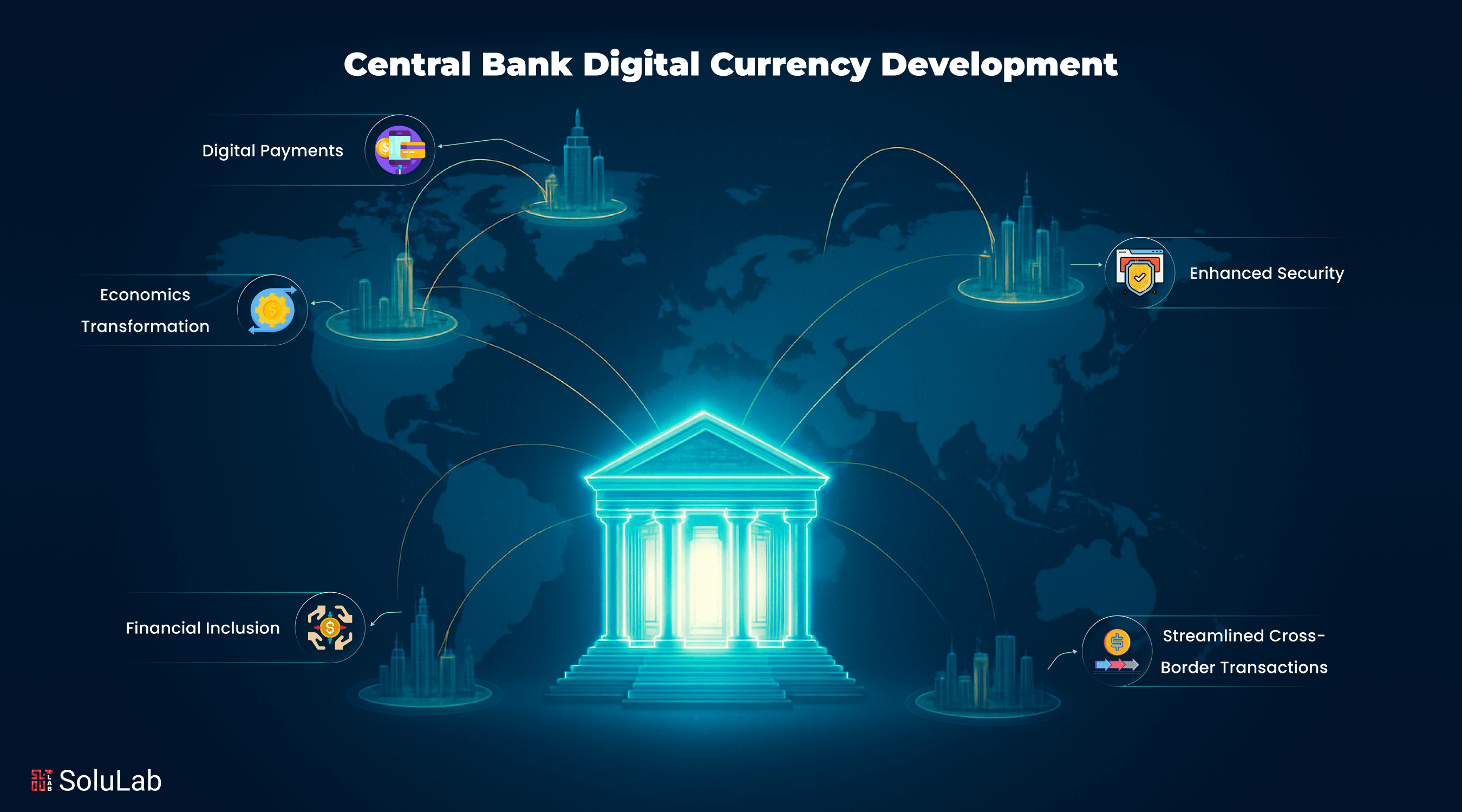
Central Bank Digital Currency DevelopmentThe world of finance is experiencing a deep digital shift. Banking systems are changing fast, fueled by advances in blockchain, mobile payments, and digital finance infrastructure. From contactless payment to artificial intelligence-based financial services, economies are shifting toward quicker, safer, and more accessible financial systems.

At the heart of this shift is the emergence of Central Bank Digital Currencies (CBDCs)—official digital forms of national fiat currencies. In contrast to cryptocurrencies, CBDCs marry central banks’ trust with blockchain technology’s efficiency and transparency.

If you are looking for in depth information on the concept of CBDCs, the article is for you! 

What is a Central Bank Digital Currency (CBDC)?

A CBDC is a digital version of the national currency of a nation, issued and controlled by the central bank. In contrast to cryptocurrencies, CBDCs are legal tender, providing the confidence of fiat money with the efficiency of blockchain.

Key Features:

  • Issued by central banks
  • Supported by national fiat reserves
  • Works digitally but with regulation
  • Secure, programmable, and traceable
Feature Physical Currency CBDC
Form Paper/coins Digital-only
Storage Wallets/safes Digital wallets
Issuer Central bank Central bank
Traceability Low High
Programmability No Yes

Function of Central Banks:

Central banks are both the issuer and regulator, promoting monetary stability and control over policy through the utilization of CBDCs.

How CBDCs Differ from Cryptocurrencies?

Though both Central Bank Digital Currencies (CBDCs) and cryptocurrencies are in digital format and utilize distributed ledger or blockchain technology, there are major differences between them with regard to control, objective, and trust framework.

1. Issuing Authority

Central Bank Digital Currencies are issued and supported by a nation’s monetary or central bank authority, thereby being legal tender. It ensures they are accepted and recognized nationwide, just like physical currency.

Conversely, digital currencies such as Bitcoin and Ethereum are developed by decentralized groups or networks. They do not have a central issuer, implying there’s no government or institution assuring their use or value.

2. Legal Status and Regulation

CBDCs are considered legal tender within a country. This implies that citizens and businesses are bound by law to accept them as payment. They fall under a rigid regulatory system controlled by the central bank.

Cryptocurrencies, on the other hand, tend to operate in a legal gray. They are classified in most places as digital assets or commodities and not as currencies. They are governed by changing regulations, and they are prohibited or banned in some nations.

3. Centralization vs. Decentralization

CBDCs are under the central control of the issuing authority, providing the central bank with full control of transactions, distribution, and monetary policy implementation. Centralization provides more effective policy tools but is a concern with respect to privacy of data and surveillance systems.

Cryptocurrencies are inherently decentralized. They run on peer-to-peer networks where no one has authority. This provides censorship resistance and transparency but restricts the capability to monitor or reverse transactions.

4. Volatility and Stability

CBDCs aim to replicate the value of its nation’s fiat currency, so they remain stable in value. By way of illustration, 1 digital rupee or digital dollar is always equivalent to its physical equivalent.

Most cryptocurrencies, by contrast, are extremely volatile. Their values change according to market demand, speculation, and outside factors. Such volatility makes them good investments but impractical as a means for daily transactions or salary payments.

Parameter CBDC Cryptocurrency
Issuer Central Bank Decentralized (no issuer)
Legal Status Legal tender Not universally accepted
Regulation Fully regulated Partially or unregulated
Volatility Stable Highly volatile
Use Cases National payments, G2P, trade Investment, DeFi, NFTs

CBDCs maintain centralized control and monetary oversight, while cryptocurrencies like Bitcoin or Ethereum offer decentralized, permissionless alternatives.

Why Are Governments Considering CBDCs Now?

As cash use wanes and digital payments surge, central banks worldwide are acting proactively to:
  • Keep monetary control in a more digital world
  • Push back against the rise of unregulated cryptocurrencies and stablecoins
  • Enhance financial inclusion and policy effectiveness
  • Upgrade payment systems for domestic commerce and cross-border trade

Crypto Development Company

CBDCs are not a fad—they’re redefining the future of money, making financial systems smarter, more inclusive, and resilient.

1. Monetary Policy Efficiency and Control

CBDCs enable real-time monitoring and control of the money stock, enhancing the efficacy of central bank monetary policy implementation and oversight.

2. Counter to Waning Cash Use

As digital payments have surpassed cash use worldwide, CBDCs provide a state-supported option for digital payment systems versus private ones.

3. Counter to Stablecoins & Cryptocurrencies

CBDCs guarantee national control over money, countering the influence of unregulated stablecoins and crypto tokens.

4. Economic Modernization

They facilitate the digitalization of financial infrastructure to foster innovation, efficiency, and inclusion.

How CBDC Development Is Facilitating Global Economies?

CBDC development is reshaping economies by strengthening monetary policy, boosting inclusion, enabling faster payments, ensuring transparency, and driving financial innovation.

1. Improving Monetary Policy Implementation

CBDCs make it possible for instant policy implementation—tweaking interest rates or managing liquidity in near real time.

2. Increasing Financial Inclusion

In remote or underserved areas, CBDCs facilitate safe and convenient digital wallets without requiring bank accounts.

3. Simplifying Cross-Border Payments

CBDCs minimize friction on international payments, reducing costs and accelerating settlements.

4. Fighting Financial Crime and Tax Evasion

By enhancing traceability and transparency, CBDCs facilitate tracking of illicit behavior and enhancing tax compliance.

5. Enhancing G2P Payments

Stimulus checks, pensions, and subsidies can be distributed directly to citizens by governments via programmable CBDC wallets.

6. Encouraging Innovation in Financial Services

CBDCs enable programmable money, paving the way for:

  • Smart contracts
  • DeFi integrations
  • Custom digital banking solutions

7. Revolutionizing the Way the World Does Business

From cross-border trade settlements to online marketplaces, CBDCs reframe financial infrastructure for speed, cost-effectiveness, and trust.

CBDC Ripple Effect 

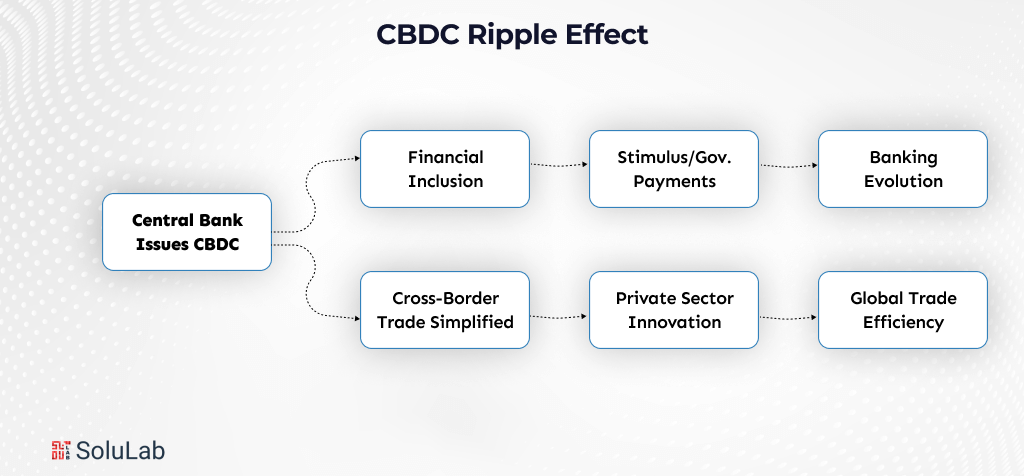
The use of Central Bank Digital Currencies (CBDCs) creates a ripple effect on various sectors of the economy. When a central bank launches a CBDC, it not only digitalizes money but also:
CBDC Ripple Effect

  • Encourages financial inclusion through giving access to secure digital payments to unbanked communities
  • Streamlines cross-border trade by facilitating quicker, cheaper, and more transparent international transactions
  • Enhances government operations, particularly in the distribution of welfare and direct payments to citizens
  • Fosters private sector innovation via programmable money and fintech integration
  • Reverses the conventional banking model, reshaping commercial banks’ and payment service providers‘ roles
  • Enhances global trade efficiency through standardized, interoperable, and transparent payment systems

Generally, CBDC use unleashes a chain reaction of financial modernization, touching every aspect from individual transactions to international trade and policymaking.

The Future of CBDCs

CBDCs are shaping the future of money, with 130+ nations testing digital currencies, global collaborations advancing cross-border use, and long-term potential to transform monetary policy and economies.

1. Global Momentum: Over 130+ countries are experimenting with CBDCs, with flagship initiatives like China’s e-CNY, India’s Digital Rupee, and the EU’s Digital Euro leading the way.
2. Collaborative Innovation: Strategic projects such as mBridge and the BIS Innovation Hub are building multi-CBDC platforms, paving the path for fast, low-cost, and secure cross-border payments.
3. Transformational Impact: Beyond payments, CBDCs promise to redefine monetary policy, strengthen financial inclusion, and accelerate the world’s shift toward cashless, fully digital economies.

Conclusion

Central Bank Digital Currencies are not yet another financial experiment—they’re a foundational change in how the world understands, holds, and uses money. For governments and businesses alike, the news is clear: embracing CBDCs is no longer a choice—it’s a requirement. Early movers will find a competitive advantage in defining the future of financial infrastructure.

As a leading blockchain development company, SoluLab helps governments, financial institutions, and enterprises design and deploy secure, scalable, and compliant CBDC solutions. With deep expertise in blockchain architecture, smart contracts, digital wallets, and regulatory integrations, we empower organizations to unlock the full potential of digital currencies.

If your organization is exploring the potential of Central Bank Digital Currency, contact us to turn vision into reality!

FAQs

1. How can organizations prepare for CBDC integration?

Businesses and financial institutions should focus on upgrading digital infrastructure, ensuring compliance with regulations, and adopting blockchain-based solutions that support seamless CBDC transactions.

2. Are CBDCs already in use globally?

Yes. Countries like China (Digital Yuan), Nigeria (eNaira), and the Bahamas (Sand Dollar) have launched CBDCs. Many others, including the U.S. and European Union, are actively testing or researching them.

3. Will CBDCs replace traditional cash completely?

Not in the near future. CBDCs are expected to coexist with cash and digital payment systems, giving citizens more flexibility while allowing governments to gradually reduce reliance on physical money.

4.How can businesses prepare for a CBDC-driven future?

Businesses should stay updated on regulatory changes, adopt digital-friendly payment systems, and explore blockchain integration to remain competitive as CBDCs reshape financial ecosystems.

5. Why should countries adopt CBDCs if digital banking already exists?

Unlike traditional digital banking, CBDCs are sovereign, programmable, and universally accessible, offering stronger financial inclusion and enabling direct monetary policy tools for governments.

Top 8 ISO 20022 Cryptocurrencies to Look at in 2025

Top 8 ISO 20022 Cryptocurrencies

Ever feel lost trying to figure out which cryptocurrencies have long-term potential beyond hype?
With thousands of coins out there, most won’t survive the next regulatory wave.

Global finance is evolving, and not every crypto is built to survive in a regulated, bank-friendly future. But some are. ISO 20022, the global standard for financial messaging, is becoming the bridge between traditional banking and digital assets. And a select few cryptocurrencies are already aligned with it.

In this blog, we’ll reveal the Top 8 ISO 20022-Compliant Cryptocurrencies you should keep an eye on for 2025 — coins designed to work with the system, not against it.

What is ISO 20022?

ISO 20022 is a standard that facilitates the exchange of financial information between institutions, ensuring a more structured, efficient, and interoperable system for financial transactions. It provides a universal format for messages, including payment instructions, securities transactions, and fund transfers.

In simpler terms, ISO 20022 enables different financial systems to communicate with each other in a standardized manner, thereby improving transparency, reducing errors, and accelerating transactions.

While it’s widely used in traditional finance (banks, payment processors). Adoption of ISO 20022 Coins and Crypto is accelerating global interoperability, aligning with major cross‑border messaging systems like SWIFT and SEPA. This integration improves cross-border payments, regulatory compliance, and real-time processing.

Why ISO 20022-Compliant Matters in Crypto? 

Why ISO 20022-Compliant Matters in Crypto

ISO 20022 is a globally agreed communications standard used by banks and other financial institutions to communicate data-rich, standard, and secure data. ISO 20022-compliant cryptocurrencies will be better off as traditional finance switches to this industry standard.

 This is the reason why it matters:

  • Interoperability with Banks: Regulatory cryptos would be ideal for payments and institutions because they are easy to integrate with global banking systems.
  • Regulatory Readiness: Coins in ISO 20022 are more likely to meet future regulations, and this appeals to governments and other major investors as well.
  • Accelerated Institutional Adoption: Cryptocurrencies that comply with the ISO have a better probability of being the by financial institutions.
  • Improved information management: Additional information on the transaction promotes automation, fraud detection, and compliance.

Top 8 ISO 20022-Compliant Cryptocurrencies of 2025

ISO-aligned coins may become more widely used and trusted, specifically by institutions, as more than 70 countries accept the standard. Here are the Most Popular ISO 20022 20022-compliant cryptocurrencies you should know: 

  • Cardano (ADA)

Cardano (ADA) provides a secure and effective platform for developing smart contracts and dApps. It prioritizes interoperability, sustainability, and scalability while improving upon previous blockchains. 

The Cardano Computation Layer (CCL), which runs smart contracts, and the Cardano Settlement Layer (CSL), which handles cryptocurrency transactions, are the two primary components of this network. Ouroboros, a Proof-of-Stake technique that enables users to receive rewards through staked ADA currency, keeps the network safe.

  • Ripple (XRP)

A cryptocurrency and digital payment system named Ripple (XRP) seeks to make international financial transactions easier. The Ripple Protocol Consensus Algorithm (RPCA), which XRP employs, enables verified nodes to process payments quickly and effectively without the need for energy-intensive mining.

By providing quick, international payments and money transfers, Ripple offers crypto-friendly banks and other financial organizations a more affordable alternative to the conventional SWIFT network. In the Ripple network, XRP serves as a bridge currency that facilitates simple value exchange between various fiat currencies through the XRP / USD pair.

CTA1

  • Stellar (XLM)

Stellar (XLM), a cryptocurrency and decentralized payment network, promotes financial inclusion and low-cost cross-border transactions. This Ripple-based infrastructure connects banks, payment processors, and users globally. Stellar’s Stellar Consensus Protocol (SCP) instantly confirms transactions through a community of authorized nodes, eliminating resource-intensive mining.

Stellar employs Lumens (XLM) to bridge currencies and improve cross-border transactions. Lumens preserve the connection and prevent spam. Stellar focuses on tiny transactions and develops digital assets via its decentralized exchange. It helps uninsured persons use financial services for money transfers and tokenized assets.

  • Algorand (ALGO)

Algorand (ALGO) is a cryptocurrency platform for dApp development. Though decentralized, it’s Just Proof of Stake (PPoS) that validates transactions. Algorand’s PPoS lets users have an equal chance to produce and review newer blocks, keeping the network secure and lower resource-intensive than mining-based systems.

The ALGO network exchanges, confirms, and rewards transactions with Algorand. Algorand is appropriate for financial services, DeFi, and asset tokenization since it processes multiple transactions. The platform’s safe and efficient blockchain makes it a strong contender. 

  • IOTA (MIOTA)

IOTA (MIOTA) is an IoT cryptocurrency and ledger system. The IOTA Foundation proposed “IOTA Rebased” as a major update. This upgrade converts the network from a Layer 1 IOTA blockchain to a Move-based object ledger.

The update aims to scale, decentralize, and program the network. Developers can create dApps straight on the main network. The Move programming language will be used to construct Layer 1 smart contracts in IOTA. This will simplify blockchain applications in supply chain management, asset tokenization, and digital identity.

  • Quant (QNT)

The purpose of Quant (QNT) is to enhance communication between various blockchains and conventional financial institutions. Data distributing, cross-chain operations, and the creation of decentralized applications (dApps) on several blockchains are all made possible by Overledger, the foundational platform. 

By providing safe and effective communication and value exchange between blockchains, this technology improves the scalability, liquidity, and functionality of the whole sector. The native currency, QNT, is used to reward network users who contribute to network maintenance, pay transaction fees, and access Overledger services. The deflationary nature of QNT, which has a fixed supply, increases its value.

  • XDC Network (XDC)

XDC Network (XDC) is a cryptocurrency network for supply chain management, trade financing, and safe and effective cross-border transactions. The XinFin Composite Blockchain, upon which XDC is based, combines elements of publicly and privately managed blockchains to produce an adaptable and interconnected system.

XDC Network maintains the network’s security and decentralization by utilizing XinFin Delegated Proof of Stake, or XDPoS, to guarantee speedy transaction confirmations. Payment for transactions, platform service access, and network decision-making are all accomplished with the XDC token. Practical applications are the main focus of XDC, particularly in logistics and trade finance.

  • Hedera Hashgraph (HBAR)

The Hashgraph consensus technique is used by Hedera Hashgraph (HBAR) to offer great speed, security, and equity. It supports the development and operation of decentralized applications (dApps) in social networking, gaming, supply chain management, and banking.

Hedera uses a directed acyclic graph (DAG) in place of a conventional blockchain to reach consensus, enabling faster transactions with minimal power consumption. The system’s token, HBAR, is used to stake to protect the network, pay transaction fees, and take action in decision-making. Its deflationary method and fixed supply contribute to its value preservation.

Benefits of ISO 20022 Compliance For Crypto

The ISO 20022 is changing traditional finance communications with crypto. Its implementation introduces order, transparency, and universal harmony, and makes digital assets effective, compliant, and reliable in the financial environment.

1. Increased Cross-Border Payment Efficiency: The ISO 20022 simplifies message structures by cutting friction in cross-border payments. Payments with cryptocurrencies are faster, more precise, and cheaper, allowing smooth interoperability between blockchain networks and the rest of the financial institutions across the globe.

2. Regulatory and Institutional Alignment: There is standardization of the messaging, which facilitates the achievement of global compliance standards by crypto platforms. This will open up the space to institutional players who will operate with more confidence, knowing that their operations are within the regulator’s expectations.

3. Trust and Fairness: Transactions can be easily traced and audited when the data is structured and standardized. This brings transparency, minimizes the chances of fraud, and increases the level of trust among the users, regulators, and other financial partners dealing with crypto assets.

4. Improved Compatibility with the Legacy Finance (TradFi): ISO 20022 fulfills the blockchain-to-legacy system communication gap. Through it, crypto users can more easily integrate into bank and financial systems, speeding mainstream adoption and usage of digital currencies.

How will ISO 20022 Impact Crypto Regulation in 2025?

Impact Of ISO 20022 on Crypto Regulation

ISO 20022 might become a game-changer for how cryptocurrencies are regulated and integrated in 2025. Here’s what you need to know:

  • ISO 20022 will standardize crypto messaging: ISO 20022 introduces a universal messaging format for financial institutions. Once applied to cryptocurrency transactions, it can simplify communication, reduce errors, and boost transparency—making it easier for crypto regulations to take shape across global markets.
  • Better compliance with cryptocurrency laws and regulations: With clear transaction metadata and structured information, regulators can track suspicious activities. This helps cryptocurrency development companies stay compliant with cryptocurrency laws and regulations, while building trust.
  • Increased institutional adoption of cryptocurrency: Standardization through ISO 20022 aligns crypto with traditional finance protocols. As a result, banks and large financial institutions may feel more secure entering the cryptocurrency market—helping crypto go mainstream.
  • Enhanced interoperability across platforms: ISO 20022 supports richer data formats, enabling communication between crypto exchanges, banks, and payment providers. This can lead to a more integrated financial system where digital assets move.
  • Encouragement for more global crypto frameworks: As countries adopt ISO 20022, it will push for crypto regulations and help establish a global framework, easing cross-border compliance and launching crypto services globally.

CTA2

Conclusion

As the global financial system moves toward ISO 20022 adoption, cryptocurrencies aligned with this standard are gaining serious attention. From improved interoperability to faster cross-border transactions, these ISO-compliant cryptocurrencies could show how value moves globally. 

For investors, developers, and institutions alike, keeping an eye on this evolving list of ISO 20022-compliant cryptocurrencies in 2025 isn’t just smart, it’s strategic. As innovation accelerates, these coins may become key players in bridging crypto with mainstream financial systems.

NovaPay Nexus partnered with SoluLab to integrate multi-crypto support, enhance security, and build a user-friendly interface. The result? A decentralized, fee-free payment solution empowering businesses with full control and privacy. NovaPay Nexus now drives wider adoption of ISO-compliant cryptocurrencies across industries, redefining how secure digital payments are made.

SoluLab, a top cryptocurrency development company, can help you bring your blockchain vision to life. Have an idea in mind, let’s connect!

FAQ

1. Is ISO 20022 mandatory for cryptocurrency adoption?

Adoption, however, improves compatibility with conventional finance. Cryptocurrencies that are ISO-compliant are better positioned to comply with international cryptocurrency laws and regulations, as well as future ones.

2. How do I buy ISO 20022 coins?

Major exchanges offer ISO 20022 Coins and Crypto for purchase. Before purchasing compliant coins, do extensive research using reputable bitcoin coin market platforms.

3. What is the Future of ISO 20022 and Cryptocurrency Integration?

With ISO 20022 Coins and Crypto enabling safe, standardized messaging and opening up possibilities for greater integration into banking and regulated finance systems, the future is bright.

4. Will other cryptocurrencies adopt ISO 20022?

To stay competitive and follow changing bitcoin rules and regulations globally, many projects may adopt ISO standards as regulatory pressure increases.

5. How does ISO 20022 affect cross-border transactions?

It improves international payments’ efficiency, speed, and transparency. While keeping to international crypto rules and financial messaging standards, ISO-compliant cryptocurrencies can expedite cross-border transactions.

Top 10 Cryptocurrency Companies in Singapore

Singapore is recognized as a leading crypto hub in the Asia-Pacific region. With its wide clarity on crypto regulations, open arms to technology, and tax benefits, it attracts many cryptocurrency startup companies. The Monetary Authority of Singapore (MAS) maintains the balance between investor protection, innovation, and customer security. These vibrant changes positioned Singapore cryptocurrency companies at the top in 2026. 

As of January 2024:

1. Over  19 crypto-licensed service providers operate across Singapore.

2. Crypto assets are taxed under Income Tax, not GST, in most retail cases.

3. MAS grants licenses under the Payment Services Act (PSA) to crypto and payment service providers.

These crypto-friendly approaches made Singapore stand out in global technology development. Companies like Circle, Coinbase, and many more are bringing new changes to the crypto space. Let’s get to know what more cryptocurrency companies in Singapore are driving the innovation.

How Singapore Empowers Cryptocurrency: Regulation, Tax Relief & Recent Developments?

Singapore actively supports the growth of the crypto industry through clear policies and tech-forward initiatives.

  • Regulatory Clarity: MAS licenses digital payment token (DPT) services under the Payment Services Act, supporting innovation with accountability.
  • Tax Benefits: No capital gains tax applies on crypto profits unless the crypto is used as business income.
  • Government-backed Pilots: Initiatives like Project Guardian explore tokenized financial assets with global banks and major exchanges.
  • Public-Private Collaboration: MAS works closely with global players like JPMorgan, DBS, and crypto firms to test new blockchain use cases.
  • Consumer Risk Management: Recent MAS guidelines include limits on crypto advertising and safeguards for retail traders.

Top 10 Cryptocurrency Companies in Singapore

Circle

1. Circle

Circle is known as one of the top innovative cryptocurrency companies in Singapore. Although it was established in 2023, its digital payment services reached the users, making it one of the top companies.

Operates the USDC stablecoin, the second-largest stablecoin with a $32 billion market cap.
Recently partnered with Grab to explore Web3 wallets in Southeast Asia.
Licensed under Singapore’s Major Payment Institution (MPI) framework in June 2023.
Opened new offices in Hong Kong and Singapore to expand Asia-Pacific presence.
Launched Cross-Chain Transfer Protocol (CCTP) for secure stablecoin transfers across chains.

Coinbase

2. Coinbase

Coinbase is one of the safest crypto platforms in Singapore. The company’s main services include buying, selling, and storing cryptocurrency.

Secured its Digital Payment Token license from MAS in October 2023.
Expanded Coinbase Wallet with support for localized staking and DeFi tools in Asia.
Announced a regional talent hub in Singapore for Web3 development in 2024.
Partnered with Standard Chartered for institutional custody integration.
Rolled out educational modules to promote safe crypto investing in Southeast Asia.

imToken

3. imToken

imToken is one of the old cryptocurrency development companies in Singapore. It was established in 2016 and provides wallet services across the country.

Hosts over 12 million users managing crypto across 150+ countries globally.
Integrates EVM compatibility and support for 12 blockchains including Ethereum, Arbitrum, and BSC.
Rolled out biometric security features for wallet login and transaction approvals.
Partnered with Chainlink to bring price oracles to the wallet interface.
Added seamless DApp discovery features to support the expanding DeFi ecosystem.

Alpha Impact

4. Alpha Impact

Alpha Impact was established in 2020 and allows social and crypto trading. It is known as a Singapore non-custodial, blockchain platform.

Provides copy trading tools for over 100 verified crypto traders with transparent analytics.
Integrated social feed and educational content to guide beginner investors with verified trading insights.
Launched a new revenue-sharing model for successful trades copied by the community.
Added support for real-time portfolio tracking across multiple centralized exchanges.
Built new risk-scoring algorithms based on historical trading and volatility metrics.

Beoble

5. Beoble

Beoble is similar to Alpha Impact, however, it provides web3 social modules too. It was established in 2021 and lets users connect with wallet-to-wallet messaging.

Offers end-to-end encrypted wallet-to-wallet messaging for NFT and token transactions.
Partnered with multiple Web3 games to offer in-game messaging powered by Beoble.
Introduced an SDK for developers to integrate wallet chat into decentralized apps.
Raised $2.1 million in seed funding in early 2024 to expand their platform.
Focused on user-owned data architecture aligned with decentralized identity protocols.

Cobo

6. Cobo

Cobo is well well-known cryptocurrency development company in Singapore. It specializes in digital assets custody and wallet infrastructure solutions.

Custody provider for over 500 institutional clients managing billions in digital assets.
Offers Wallet-as-a-Service used by exchanges, miners, and asset managers.
Launched Argus, a digital asset management platform with on-chain fund monitoring tools.
Completed $40M Series B round led by top-tier investors like DST Global.
Certified for SOC 2 Type I & II, and licensed in the US, HK, and SG.

Blockonomics

7. Blockonomics

Blockonomics offers unique services that allow users to pay with crypto tokens for goods and services. It provides Bitcoin-related payment solutions.

Bitcoin-only payment gateway with support for merchant invoicing and decentralized checkout.
Over 10,000 merchants use Blockonomics globally, including 1,200+ in Asia.
Recently added support for zero-confirmation payments and dynamic fee management.
Launched an updated merchant dashboard with real-time settlement tracking.
Committed to privacy-first payments without custodial accounts or KYC.

Blockhead

8. Blockhead

Blockhead is known for providing research, analysis, and media details on the crypto market.

Covers Web3 news from Asia-Pacific with multilingual content and live market commentary.
Published exclusive stories on crypto regulation and exchange activity in Southeast Asia.
Offers curated Web3 newsletters read by 20,000+ global subscribers.
Added AI tools to summarize blockchain whitepapers and DAO proposals.
Hosted Web3 event series featuring MAS and industry experts in Singapore.

Goka

9. Goka

Goka is also one of the seed funding companies that was established in 2022 with a focus on NFT and Web3 development.

Develops real-world-friendly composable NFTs for brand activations and loyalty programs.
Helped over 60 campaigns tokenize physical and digital promotions across Asia.
Offers drag-and-drop NFT minting tools for marketing teams.
Recently partnered with FMCG brands for coupon-to-NFT experiences.
Emphasizes low gas fees and user-first UI in its NFT creation interface.

IQ Labs

10. IQ Labs

IQ Labs was established in 2021 known as a Singapore-based start-up cryptocurrency company that mainly works on frameworks and protocols in the DeFi space.

Focuses on modular DeFi tools enabling permissionless lending, yield farming, and collateralization.
Launched IQ-Token Framework to create interoperable smart money legos.
Partnered with LayerZero for the cross-chain deployment of liquidity pools.
Active contributor to open-source DeFi DAO governance models.
Grew developer base by 180% in 2024 through hackathons and grants.

Quick Analysis Table on These 10 Cryptocurrency Companies

These 10 cryptocurrency companies in Singapore are well-known for their services. Let’s know some more key details on these. 

Company Specialization Recent Development
Circle Stablecoin payments and USDC infrastructure Cross-chain stablecoin transfers via CCTP
Coinbase Crypto trading and wallet platform MAS license and new institutional custody integrations
imToken Multichain decentralized wallet Biometric security and DApp discovery features
Alpha Impact Copy trading and crypto social network Revenue-sharing and real-time tracking tools
Beoble Wallet-to-wallet encrypted messaging SDK and Web3 game integrations
Cobo Institutional custody and security tools Argus platform and expanded licensing across regions
Blockonomics Bitcoin payments gateway Zero-confirmation and privacy-first checkout updates
Blockhead Web3 news and journalism AI whitepaper summaries and live crypto events
Goka Composable NFTs and brand promotions NFT loyalty tools for FMCG and real-world redemption
IQ Labs DeFi protocol development IQ-token framework and cross-chain liquidity tools

Cryptocurrency Development Company

Conclusion

Singapore continues to lead the global crypto charge with policy clarity, innovation hubs, and a vibrant startup ecosystem. The ten companies above reflect the diversity and ambition of Singapore’s blockchain scene. Whether it’s crypto payments, DeFi development, or user-focused apps, these firms are shaping the future of finance.

Planning to start your own crypto venture? SoluLab, one of the top cryptocurrency development service providers, helps startups build robust, secure, and scalable blockchain platforms. From smart contracts to DeFi apps and token launches, we’ve partnered with entrepreneurs and enterprises globally. Let us be your tech backbone while you lead the vision. Contact SoluLab today and take the first step into the crypto future.

FAQs

1. Why is Singapore a top place for cryptocurrency companies?

Singapore offers clear crypto laws, tax benefits, and strong government support. The Monetary Authority of Singapore (MAS) gives licenses under the Payment Services Act. This helps crypto companies grow in a safe and secure way.

2.  Which is the best cryptocurrency development company in Singapore?

Cobo is considered one of the best for cryptocurrency development. It provides secure wallets and custody services to big institutions. Their Argus platform helps track digital assets safely.

3. What are some recent changes in crypto laws in Singapore?

Recently, MAS added strict rules on crypto ads for retail users. They also launched Project Guardian with global banks to explore tokenized assets. Tax laws remain clear—crypto income is taxed, but no GST for regular users.

4. How are companies like Circle and Coinbase growing in Singapore?

Circle has launched cross-chain transfers and partnered with Grab for Web3 wallets. Coinbase now has a local license and works with banks like Standard Chartered. Both companies are expanding their teams and tech in the Asia-Pacific region.

5. What other cryptocurrency companies are active in Singapore besides these 10?

Some other names include Zilliqa, Coinhako, Bybit, Vauld, and Paxos. These companies are also offering services like crypto trading, wallets, and blockchain infrastructure in the region.

6. How can I start my own cryptocurrency startup in Singapore?

To start, you need a solid tech partner and a clear business idea. SoluLab can help with everything, from smart contracts to secure crypto wallets. Their team builds trusted crypto products for global clients. Get started with SoluLab

4 Big Problems to Solve in Crypto


4 Big Problems to Solve in Crypto

The cryptocurrency industry has grown tremendously over the past decade, evolving from a niche concept into a disruptive financial innovation. However, despite its rising popularity, the crypto sector still faces several critical challenges that must be addressed to achieve mainstream adoption.

In this blog post, we will examine four of the most pressing issues in cryptocurrency that require urgent solutions. By highlighting these challenges, we hope to spur constructive discussions on how the crypto industry can overcome obstacles and realize its full potential.

Understanding Cryptocurrency

Before diving into the specific challenges, it is essential to understand what cryptocurrency is and how it works. Cryptocurrencies like Bitcoin and Ethereum are digital assets that use cryptography and blockchain technology to enable secure peer-to-peer transactions. They operate independently of central banks and financial institutions.

Cryptocurrencies allow users to transfer value online without intermediaries. Transactions are validated and recorded on a decentralized public ledger called the blockchain. Cryptocurrencies offer an innovative approach to finance, commerce, and value storage.

Read Also: Best Crypto Wallets of 2023

Challenge #1: Lack of Understanding of What Cryptocurrency is and How It Works

Explaining the Concept of Cryptocurrency

One of the biggest roadblocks preventing mainstream cryptocurrency adoption is a need for more understanding among the general public about cryptocurrencies and their function. Surveys indicate that most people have heard about cryptocurrencies but must comprehend the technology and its potential benefits and risks.

Many must grasp complex concepts like blockchain, cryptography, decentralization, and token economics. There needs to be clarity around the differences between different cryptocurrencies and tokens. Some associate crypto with volatile speculation, which is used for payments, smart contracts, DeFi, NFTs, and more.

To address this challenge, it is crucial to educate the public about the fundamentals of cryptocurrency. Efforts should be made to simplify and demystify the technology, explaining its benefits, risks, and potential applications in a language accessible to everyone. Educational initiatives, both online and offline, can play a vital role in raising awareness and fostering a better understanding of cryptocurrencies. among the general population. This can be achieved through various means, such as informative articles, videos, workshops, and dedicated courses.

Furthermore, the collaboration between cryptocurrency projects, industry leaders, and educational institutions can help develop standardized educational materials covering cryptocurrency’s basics. These materials should explain the technical aspects and highlight real-world use cases and potential benefits for individuals and businesses.

In addition to educational efforts, addressing the misconceptions and negative stereotypes associated with cryptocurrencies is essential. Clearing up misconceptions about illegal activities, money laundering, and the overall security of cryptocurrencies can help build trust and credibility.

Read Our Blog: Top 10 Decentralized Crypto Exchanges to Consider in 2023

Moreover, governments and regulatory bodies can play a crucial role in promoting cryptocurrency education by incorporating it into school curricula and providing resources for public awareness campaigns. By integrating cryptocurrency education into mainstream education systems, we can ensure that future generations are well-equipped to understand and navigate this emerging financial landscape.

Ultimately, widespread understanding and cryptocurrency awareness will foster greater acceptance and adoption. Through education and knowledge-sharing, we can bridge the gap and pave the way for cryptocurrencies to become a part of our everyday lives.

Moreover, the collaboration between industry experts, educational institutions, and regulatory bodies can help develop comprehensive educational programs that cover topics such as blockchain technology, decentralized finance, tokenomics, and the different types of cryptocurrencies available in the market. By promoting financial literacy and providing clear and concise information, we can bridge the knowledge gap and empower individuals to make informed decisions regarding cryptocurrency usage.

The Need for Widespread Education on Cryptocurrencies

Educating the masses is crucial for cryptocurrency to gain trust and acceptance. The crypto community needs to create more user-friendly materials explaining key concepts for beginners. Simplifying technical jargon and making information accessible is vital.

Schools and colleges should consider adding cryptocurrency and blockchain technology to their curriculums. Platforms offering free crypto education can engage learners through incentives like tokens. Government awareness campaigns and celebrity endorsements can further spur public understanding.

Additionally, industry leaders and experts need to engage in educational initiatives actively. Hosting workshops, webinars, and conferences that cater to beginners and advanced users can significantly contribute to the dissemination of knowledge. These events can provide valuable insights into the latest developments, trends, and best practices in the cryptocurrency space.

To address the negative stereotypes associated with cryptocurrencies, promoting transparency and accountability within the industry is crucial. Strict regulations and guidelines can help weed out fraudulent activities and protect investors. By showcasing cryptocurrencies’ legitimate use cases and success stories, we can challenge the misconceptions and build a positive narrative around this innovative technology.

CTA 1

Challenge #2: Volatility

Understanding Market Volatility in Cryptocurrency

Unlike stable fiat currencies, cryptocurrencies are highly volatile assets. Their prices can fluctuate wildly within short periods. For instance, in 2021, the value of Bitcoin rose from around $30,000 to nearly $70,000 before dropping back below $33,000 by January 2022.

Such extreme volatility is driven by speculative trading, lack of regulations, and sensitivity to news or social media hype. Massive price swings hurt cryptocurrencies’ viability as stable exchange and value storage mediums. Additionally, it creates challenges for businesses and individuals looking to use cryptocurrencies for everyday transactions.

To address this challenge, market participants and regulatory bodies are working towards implementing measures that can help mitigate volatility. One approach is the development of stablecoins, which are cryptocurrencies pegged to a stable asset like fiat currency or commodities. Stablecoins aim to provide stability in value by maintaining a 1:1 ratio with the underlying asset, reducing the impact of price fluctuations.

Moreover, introducing derivatives and futures markets specific to cryptocurrencies allows traders to hedge their positions and manage risk more effectively. These financial instruments allow investors to speculate on price movements without owning the underlying cryptocurrency directly. By offering tools for risk management, derivatives markets contribute to stabilizing the overall cryptocurrency market.

Furthermore, increased regulatory oversight can help address volatility by promoting transparency and reducing market manipulation. Regulations such as know-your-customer (KYC) and anti-money laundering (AML) requirements can enhance investor protection and foster market integrity. Clear guidelines on trading practices and establishing regulatory frameworks can instill confidence in the market, attracting more institutional investors and reducing the influence of speculative trading.

Developing decentralized finance (DeFi), protocols also aims to create more stability within the cryptocurrency ecosystem. Through smart contracts, DeFi platforms offer various financial services, such as lending, borrowing, and yield farming. These protocols are designed to be transparent, autonomous, and resistant to censorship, giving users more control over their assets and reducing reliance on centralized intermediaries.

Read Our Blog Post: Blockchain Verification Process: Explained

While volatility remains a challenge, the continued efforts of industry participants, regulators, and technological advancements are gradually addressing this issue. As the cryptocurrency market matures and becomes more regulated, we can expect increased stability, making cryptocurrencies a more reliable medium of exchange and store of value. It is essential for users to stay informed and educated about the risks associated with volatility while taking advantage of the potential benefits offered by cryptocurrencies.

Ways to Cope with Crypto Market Volatility

Experts believe cryptocurrency markets will stabilize as they mature over time. But in the meantime, several measures can help cope with volatility:

  • Diversifying investments across various crypto assets can balance risk.
  • Using dollar cost averaging and limit orders can smooth out buying at optimal prices.
  • Derivatives like futures contracts and options trading allow hedging against price changes.
  • Holding stablecoins pegged to fiat can hedge volatility during downturns.

Robust crypto regulations and increased institutional adoption should also infuse stability and credibility over the long term.

Challenge #3: Lack of Regulatory Frameworks

Importance of Legal Regulations in the Crypto Sector

The cryptocurrency industry currently operates with unclear and inconsistent regulatory oversight. The decentralized nature of cryptocurrencies makes them difficult to regulate using traditional legal frameworks designed for fiat currencies and financial systems.

However, rational regulations are necessary for the crypto sector’s stability and security. They provide legitimacy alongside guardrails that protect investors and consumers. Laws also help prevent the use of cryptocurrency for illegal activities, such as money laundering and fraud. Without explicit regulatory frameworks, the industry can be susceptible to market manipulation and scams, eroding trust and hindering mainstream adoption.

Read Also: Top 10 Blockchain Platforms of 2023

To address this challenge, many countries and jurisdictions are working towards developing comprehensive regulatory frameworks tailored explicitly to cryptocurrencies and blockchain technology. These frameworks aim to balance fostering innovation and protecting market participants.

One key aspect of these regulatory efforts is the establishment of know-your-customer (KYC) and anti-money laundering (AML) requirements for cryptocurrency exchanges and service providers. By implementing robust identity verification processes, regulators can mitigate the risks associated with illicit activities and ensure a more secure environment for users.

Moreover, regulatory frameworks can provide guidelines for initial coin offerings (ICOs) and token sales, helping to distinguish between legitimate projects and fraudulent schemes. This can help investors make more informed decisions and reduce the likelihood of falling victim to scams.

In addition to protecting investors, regulations also play a crucial role in promoting market integrity. They can set standards for transparency, disclosure, and reporting, ensuring that market participants operate fairly and accountable. This can help prevent market manipulation and insider trading, ultimately fostering a healthier and more trustworthy ecosystem.

However, it is essential to strike the right balance when implementing regulations. More relaxed rules can stifle innovation and hinder the growth of the industry. Therefore, regulators must collaborate closely with industry participants to develop practical yet flexible frameworks to accommodate technological advancements and evolving market dynamics.

As the cryptocurrency industry continues to evolve, more jurisdictions are expected to establish clear regulatory frameworks. These regulations will provide much-needed stability and security and pave the way for the broader adoption of cryptocurrencies by institutions and the general public. By creating a level playing field and ensuring compliance, regulatory frameworks can contribute to the long-term success and sustainability of the crypto sector.

Current State of Regulatory Frameworks in Cryptocurrency

Many governments still need to decide how to regulate cryptocurrencies. Regulatory approaches vary from outright bans to no rules at all. Some countries only regulate banks and businesses dealing in crypto, not individuals.

Cryptocurrencies require global coordination to ensure consistency and effectiveness in regulatory efforts. International cooperation can help prevent arbitrage, where businesses move operations to jurisdictions with less stringent regulations.

One example of international collaboration in the cryptocurrency space is the Financial Action Task Force (FATF). The FATF is an intergovernmental organization that sets standards and promotes the implementation of measures to combat money laundering and terrorist financing. In 2019, the FATF issued guidance on virtual assets and virtual asset service providers, urging member countries to adopt and enforce regulations in line with their recommendations.

Read Also: Top NFT Development Companies To Look At In 2023

Some countries have taken proactive steps to establish comprehensive regulatory frameworks. For instance, Japan has implemented a licensing system for cryptocurrency exchanges, ensuring they comply with KYC and AML requirements. This has helped bolster consumer protection and strengthen market integrity in the country.

Similarly, Switzerland has emerged as a favorable destination for cryptocurrency businesses due to its clear regulatory framework. The country has established a regulatory sandbox, allowing innovative crypto projects to operate under certain conditions while complying with regulations.

On the other hand, some jurisdictions have chosen to ban or heavily restrict cryptocurrencies. China, for example, has implemented strict measures to limit cryptocurrency activities within its borders. This approach aims to mitigate risks associated with speculative trading and potential financial instability.

In the United States, regulatory oversight of cryptocurrencies falls under various agencies, including the Securities and Exchange Commission (SEC) and the Commodity Futures Trading Commission (CFTC). The SEC has focused on enforcing securities laws in the context of initial coin offerings, while the CFTC has asserted jurisdiction over certain crypto derivatives.

Amidst the evolving landscape, there is an ongoing debate about the optimal level of regulation. Some argue for a light-touch approach that allows for innovation and experimentation, while others advocate for stricter rules to protect investors and maintain market stability.

CTA 2

Challenge #4: Uncertainty Regarding Taxation

The Complexity of Cryptocurrency and Taxation

The novel nature of cryptocurrencies also needs clarification regarding how to tax their usage and transactions. Cryptocurrencies do not cleanly fit into existing tax structures. For example, it remains to be seen if crypto should be treated as a currency, commodity, security, or property for tax purposes.

Their volatility complicates calculating capital gains tax on cryptocurrency sold after increasing value. Tax requirements also vary substantially between countries and jurisdictions, adding to the complexity for individuals and businesses operating in cryptocurrency. The lack of clear guidelines and harmonization across borders creates uncertainty and can deter potential investors and users from fully participating in the crypto market.

One of the challenges in establishing a comprehensive taxation framework for cryptocurrencies is determining the appropriate valuation method for calculating capital gains or losses. With the highly volatile nature of cryptocurrencies, their value can fluctuate significantly within short periods. This challenges tax authorities in accurately assessing the taxable amount when a cryptocurrency is sold or exchanged.

To address these challenges, some countries have developed specific guidelines for cryptocurrency taxation. For example, the Internal Revenue Service (IRS) in the United States considers cryptocurrencies as property and applies capital gains tax rules when they are sold or exchanged. In Japan, cryptocurrencies are treated as a legal means of payment, and profits from cryptocurrency trading are subject to income tax.

Read Our Blog Post: Top 10 Layer 1 Blockchains in 2023

However, there still needs to be a global consensus on cryptocurrency taxation. This creates a fragmented landscape where individuals and businesses may face different tax obligations depending on location. As the crypto industry continues gaining mainstream adoption, regulators increasingly need to collaborate and establish more transparent and consistent guidelines on cryptocurrency taxation.

The current state of regulatory frameworks in cryptocurrency is characterized by multiple approaches, ranging from outright bans to partial regulations focused on businesses rather than individuals. The lack of international coordination and clarity regarding taxation further complicates the landscape. Governments and regulatory bodies must work together to develop comprehensive and harmonized frameworks that promote innovation, protect investors, and clarify taxation.

Possible Solutions to Crypto Taxation Uncertainty

Industry experts have called for updated international taxation guidelines and frameworks aimed at cryptocurrency. Setting clear, reasonable tax policies could help boost adoption and participation in the crypto economy. It would also allow citizens to meet tax obligations on crypto activity seamlessly.

In addition, integrating cryptocurrency into mainstream tax software and services can make filing easier for taxpayers. Overall, removing ambiguity around crypto taxes is critical for users and regulators.

Conclusion

Addressing these challenges requires concerted efforts from all stakeholders in the cryptocurrency ecosystem. With increased collaboration, education, regulation, and taxation clarity, cryptocurrency can gain mainstream traction and deliver on its full potential. The future looks bright for crypto as an innovative technology that can transform finance and global commerce.

SoluLab, a leading provider of high-end cryptocurrency development services, offers comprehensive solutions tailored to meet the diverse requirements of businesses across various industries. From initial consultation and proof-of-concept preparation to pilot development and full-fledged crypto creation, SoluLab’s team of experts efficiently manages tasks, ensuring optimal results within a short timeframe. By leveraging their uniquely crafted solutions, businesses can significantly enhance their return on investment (ROI). For top-quality cryptocurrency development solutions, businesses can rely on SoluLab’s expertise. Contact SoluLab today to explore the possibilities for your crypto venture.

FAQs

1. What are the significant challenges currently faced by the crypto sector?

The crypto sector faces several challenges, but four of the most significant ones are scalability, security, regulatory compliance, and mainstream adoption. These issues hinder the industry’s growth and require immediate attention to ensure long-term success.

2. Why is scalability a challenge in the crypto sector?

Scalability refers to the ability of a blockchain network to handle an increasing number of transactions without compromising speed and efficiency. As the popularity of cryptocurrencies grows, the existing blockchain networks, such as Bitcoin and Ethereum, face scalability issues, resulting in slow transaction processing times and high fees. This challenge requires innovative solutions to improve the scalability of blockchain networks and accommodate the rising demand.

3. How does security pose a threat to the crypto sector?

Security is a significant concern in the crypto sector due to the prevalence of hacking attempts, scams, and fraudulent activities. The decentralized nature of cryptocurrencies makes them attractive targets for malicious actors seeking to exploit vulnerabilities in exchanges, wallets, and smart contracts. Implementing robust security measures, such as multi-factor authentication and cold storage solutions, is crucial to protect users’ funds and maintain the industry’s integrity.

4. What are the regulatory challenges faced by the crypto sector?

The crypto sector operates in a rapidly evolving regulatory landscape, with countries having varying regulations or outright bans on cryptocurrencies. This lack of consistent and unambiguous rules creates uncertainty for businesses and investors, limiting the industry’s growth and innovation. To foster a healthy crypto ecosystem, the sector needs cohesive and balanced regulations addressing consumer protection, anti-money laundering (AML) concerns, and investor security.

5. Why is mainstream adoption a critical challenge for cryptocurrencies?

Achieving mainstream adoption is vital for cryptocurrencies to become widely accepted and used in everyday transactions. Currently, cryptocurrencies face barriers in terms of user-friendliness, complexity, and limited merchant acceptance. For mass adoption to occur, cryptocurrencies must offer seamless user experiences, stable prices, and easier integration with existing payment systems. Overcoming these challenges will enable cryptocurrencies to become a mainstream medium of exchange and store of value.

Cryptocurrency Development – How To Create Your Own Crypto?

Cryptocurrency Development - How To Create Your Own Crypto?

Cryptocurrencies are now a trend; over 320 million all around the world regularly use cryptocurrencies. Cryptocurrencies provide features that traditional currencies lack; lite-speed transactions, no paperwork, and cross-border payment are some of the cryptocurrency benefits. 

Likewise, you should develop your cryptocurrency if your business requirements are higher than an average crypto user. Through cryptocurrency development, you can build currencies for specific purposes, to raise funds and many other purposes. But you need to make sure first –

Coin or Token?

Cryptocurrency development takes ample time, development skills, technicality, resources and strategies to get established and be successful. 

Tokens also require development skills; however, developing tokens is not complex as cryptocurrency development. 

The basic difference between cryptos and tokens is – tokens are based on an existing blockchain network, whereas one blockchain system can only have one cryptocurrency. 

Cryptocurrencies have broader usability; tokens have limited usefulness than cryptos. Unlike cryptos, tokens are minted in the process of transaction validation. 

The usefulness of tokens are like – 

  • Fund Raising
  • Coin Representation or wrapped coin
  • Stable Coins

Wrapped coins are tokens which represent a coin in a different network. Stablecoins are the best of both sides; they follow the price of a tangible asset, like the gold US dollar. 

As per development difficulty, you can choose to go for a token instead of a different blockchain with cryptocurrency.

Also, tokens are a good choice for beginners due to their lower time requirements, strong demand, and straightforward features. However, if your interest leans more toward broader digital assets, you can explore other options — just make sure to consider the implications of cryptocurrency tax, especially as your portfolio grows.

Every development has its essential elements; the same goes for cryptocurrency development. Based on your budget, you can consult with an outsourcing team to work on your project, have an in-house team, and hire a cryptocurrency wallet developer

Having an in-house team is a plus; consulting a cryptocurrency development company is also wonderful if having complexities with resources. A technical outsourcing team will do everything with profound excellence. 

Steps To Create Your Own Cryptocurrency

Consensus Mechanism

The foremost step in developing a cryptocurrency is the consensus mechanism selection. A consensus mechanism allows or disallows any particular transaction in a network. 

Proof-of-work and Proof-of-stake are examples of consensus mechanisms. All these different mechanisms are made differently to maintain transactions and secure the blockchain network and other activities. 

Selection of a consensus mechanism for a new cryptocurrency is tough; you must keep yourself ahead of the competition. Similarly, a consensus mechanism decides the amount of transaction speed, carbon emission and electricity consumption of a blockchain network. 

So, choose your consensus mechanism wisely. 

A Blockchain Platform

A blockchain platform is a house for a cryptocurrency; you must think about the blockchain platform you’re going to choose. 

The blockchain part will require veteran development skills and technical knowledge. Development intensity will increase or decrease depending on whether you choose forking or a new blockchain network development.

A veteran blockchain development team is a must for a high-end blockchain network and a high-end cryptocurrency. 

You can recruit technical geeks for an in-house team or hire a cryptocurrency development company based on your requirements. 

Node Creation

For any decentralized or ledger technology, nodes play an essential role in making transactions happen. These nodes are basically working hardware like computers with blockchain software, maintaining the whole network and the cryptocurrency. 

Alongside consensus machine selection, this task also examines your decision-making abilities. The functional ability, the nature and the objectives of nodes will determine the usefulness of the blockchain network and the cryptocurrency. 

Also, node creation is the core of blockchain architecture, and blockchain can’t be edited once it’s established into the main set. So, everything related to blockchain selection, node creation, to other things related to blockchain must be properly planned and examined. 

API Integration

The attraction of more users and increasing cryptocurrency adoption is something very much API dependent. In case you’re building a cryptocurrency and a new blockchain network, API selection and implementation should be done very carefully. 

You can also take help from existing third-party cryptocurrency API. MetaMask is a very popular name here; there are many other players too. You can gradually start with third-party APIs, and later, you build for yourself; that’s up to you. 

UI/UX Design

User interface and experience are the crucial components which directly interact with users; an intuitive user experience increases impression and usability. 

Back-end and Front-end programming, web server and everything related to interface and usability must be worth using, as a new cryptocurrency will require a USP to attract new adoptions. 

Complete Legal Works

Cryptocurrencies have been controversial since the beginning. The legal aspects of it were unchecked after the masses started realizing its good sides. 

Governments worldwide are reacting differently to cryptocurrencies, implying different legal rules and regulations over crypto circulation. 

So, you should look into the legal aspects of cryptocurrency based on your location. If you’re a USA resident, make sure you consult with a legal financial advisor to understand the regulations. 

Ending Thoughts 

Proper planning, development methodology and budget prediction are crucial for cryptocurrency or token development. Choose a cryptocurrency development methodology that works best with your budget and development team. 

If you’re not a developer but building a cryptocurrency, you should gain some in-depth cryptocurrency knowledge. Working with developers with overall cryptocurrency knowledge will help you to provide feedback on development. 

Read Also: How to Create your own NFT Marketplace: Step-by-Step Guide

Summarizing all the things, gather your best resources and follow these steps to create your own cryptocurrency!

Author Bio

Akash Guha is a content writer with a grasp of different web content creation. He has an interest towards writing website content for multiple industries like blockchain, mental health and finance. Also, he is aimed to write simple and easy-to-understand content. 


How to Create a Cryptocurrency from Scratch and Start an ICO?

Create Cryptocurrency and Start an ICO

Most people agree that starting an Initial Coin Offering (ICO) is a quick and straightforward method to raise money for your enterprise. However, there is more to it than meets the eye, as the regulations around cryptocurrencies make launching an ICO risky, technically challenging, and difficult to market. This page provides an extensive guide on how to start an ICO, including detailed instructions on how to Create Your Own Cryptocurrency and the ICO process. You will also find alternatives to help you decide the best fundraising option for you. Whether you’re looking to build your own cryptocurrency or understand how to create cryptocurrency, this guide covers everything you need to know to start an ICO successfully.

How to Set Up an Initial Coin Offering?

Let’s discuss the ten steps you must take to construct an initial coin offering (ICO) now that you have made the decision to launch your cryptocurrency.

1. White paper

A white paper is a research-based document that explains your project’s technical details and reasoning. You are making this thing, but why? Which issues are you trying to resolve? How are you going to tackle those issues? What use will your token for cryptocurrencies serve?

The creation of a peer-to-peer electronic currency system is covered in length in the 2008 Bitcoin whitepaper written by the anonymous Satoshi Nakamoto. After outlining the possible issues (double spending) that the Bitcoin network could encounter, Nakamoto provides technical information on timestamp servers and proof-of-work schemes to address this problem.

In the same way, a founder should make every effort to include every detail in a white paper. Peers who could be interested in investing in or supporting the initiative will review the white paper closely. Technically and commercially speaking, the white paper is perhaps the most significant document. 

Your ICO might not succeed if the audience is not persuaded by your whitepaper.

2. Token utility and tokenomics

To decide whether to invest in a cryptocurrency, potential buyers want to understand the utility of your token. A cryptocurrency token without practical use may end up as a meme coin, intended solely for trading purposes. For some systems, tokens are often used as a medium of exchange. Native tokens of layer one (L1) are used to pay gas fees, while discount tokens are issued by cryptocurrency exchanges. Many decentralized apps offer tokens with attached voting rights. Tokenomics is an essential aspect that investors thoroughly investigate. Is your token inflationary, like Cosmos’ ATOM, or hardcapped, like Bitcoin? What portion of the tokens is allocated to early investors and the development team? Do these investors have a vesting term and a cliff period? Tokenomics directly impacts a token’s market price, making these questions crucial when considering how to create a cryptocurrency or how to start an ICO. Whether you want to know how do you make your own cryptocurrency or understand the ICO process, these factors are vital to the success of your Initial Coin Offering (ICO). Understanding how to create an ICO and build crypto involves addressing these key aspects to attract and retain investors.

3. Legal Compliance

We can’t emphasize this section enough. Ensuring legal compliance is crucial; otherwise, the authorities may eventually knock on your door. 

To safeguard oneself against the unpredictable regulatory environment around cryptocurrencies and token sales, creators must give legal compliance top priority while organizing an ICO launch.

  • First and foremost, creators need to think about the jurisdiction in which they plan to introduce the initial coin offering (ICO), as laws differ widely between nations. You might need to comply with disclosure laws and register the ICO launch with securities regulators in some areas.
  • Second, creators must remember that, depending on the jurisdiction in which the ICO is launched, it may be subject to know-your-customer (KYC) and anti-money laundering (AML) compliances.
  • Lastly, taxes should not be overlooked. Tax laws pertaining to ICOs and cryptocurrencies are currently in the process of being formulated. Therefore, in order to lower the danger of legal ramifications and cultivate confidence with possible investors, it is imperative to confer with a legal and financial specialist.

4. Team

It should go without saying that any project or business must have the correct staff. Any idea’s most challenging aspect is its execution, and without a qualified team, your vision will be just that—a notion.

A team of software and blockchain engineers, UI/UX designers, copywriters, sales and marketing executives, and other professionals will be needed for your blockchain project. Adding really credible individuals to your advisory board will benefit your project in many ways.

By setting aside a portion of the ICO’s earnings and tokens for your team, you may encourage them. 

5. Choosing the Right Blockchain

There are a plethora of blockchains available. It will be your responsibility as a founder to choose a blockchain that aligns with your values and mission. The first blockchain that springs to mind when considering a platform for an initial coin offering (ICO) is Ethereum. ICO launches were made possible in the first place by Ethereum’s power.

In terms of total value locked and active users, Ethereum remains the world’s most popular smart contract platform. It is regarded as one of the world’s safest public blockchains as well. But because of Ethereum’s widespread use, the blockchain is congested, which causes sluggish transactions and expensive gas costs. 

You might introduce your tokens on an Ethereum layer-two (L2) rollup such as Base or Optimisim if high gas costs are an issue. L2s are gaining traction over time because they let users benefit from Ethereum’s security without having to pay its expensive gas costs.

Poygon and BNB Chain are two well-liked alternative blockchains. ICO producers particularly prefer the BNB Chain because of its interaction with Binance, the largest cryptocurrency exchange in the world. Binance offers its cryptocurrency investors access to newly issued tokens on the BNB Chain through Binance Launchpad, a specialized BSC ICO platform.

Cryptocurrency Services

6. Creating Smart Contracts

Smart contracts control the Create Cryptocurrency on blockchains such as Ethereum and BNB Chain. For your ICO to be launched, a smart contract must be created. Tokens on Ethereum are created using the most widely used token standard, which is ERC-20.

You won’t have any trouble designing a smart contract if you have a team of engineers and programmers. You can generate how to make your own cryptocurrency with ThirdWeb and other no-code alternatives if you don’t have a lot of resources.

Code libraries such as OpenZeppelin can also be used to expedite the generation of smart contracts. These libraries offer a databank of deployable, tested, and community-reviewed code.

7. Auditing your Smart Contract

Any flaws and vulnerabilities in your code will be found through auditing. Before releasing your smart contract to the blockchain, you should audit it, especially if it was created for an initial coin offering (ICO).

Since you are working with someone else’s money, you must take all required precautions to guarantee the security of investment cash. If not, you can end up in hot water.

Additionally, auditing will guarantee that there are no hiccups or technological issues during the ICO process. You might submit your smart contract for public evaluation and consider offering bug bounties, or you can get in touch with reputable auditing services. 

8. Protect your ICO Proceeds

An address for your wallet that will receive ICO funds must be included when setting up your smart contract. 

It is advised that you utilize hardware wallets with the strongest security available. A multi-sig hardware wallet may also be used if your team is larger and you have more founding members.

Moreover, you may program the smart contract to distribute the ICO funds to several wallet addresses in order to spread out the risk in the event that one wallet is hacked. It is important to always prioritize security in the realm of cryptocurrency.

You’ve probably heard the proverb “Better safe than sorry.”

9. Marketing

Get the best cryptocurrency initial coin offering (ICO) via marketing. No matter how great your idea is, consider this: if potential investors are unaware of your project, they will not have the opportunity to invest in it.

A strong website’s branding is the foundation of effective marketing. The public face of your initiative will be your website. You might even designate your website as your ICO’s minting page.

In the present day, increasing brand awareness through blogs, videos, and social media is essential. Because the caliber of the information is so great, you will need to make an investment to get seen. Employing copywriters, community managers, social media moderators, and content producers will be beneficial.

Remember that among enthusiasts of cryptocurrency, Twitter and Discord are the most widely used social media sites. To reach more people, if you have the money, you may employ influencers and purchase advertisements.

Related: ICO Vs IPO: What’s the Difference?

10. Creating a Good Product

Sometimes developing a product that people want to use is the greatest approach to promote your initial coin offering (ICO). You can make your idea so popular that enough people would be eager to invest in your initial coin offering (ICO). This was shown with Ethereum’s layer-two rollup, Arbitrium. 

The goal of Arbitrium was to provide a scaling solution for Ethereum that anybody could use and expand upon. People were excitedly awaiting the introduction of Arbitirum’s ARB token when the company announced its formation. Arbitirum didn’t need to worry about marketing because their accomplishments are enough to speak for themselves.

How Much Does It Cost to Launch an ICO?

By now, you probably know that starting an initial coin offering (ICO) is not inexpensive. It is not possible to cite an exact number here. It truly relies on your spending limit and your objectives. How much it costs to how to create a cryptocurrency

These are a few costs you could have for your impending initial coin offering:

  • Employee costs
  • Attorney fees
  • costs for consultations
  • Gas costs for contract deployment and testing
  • Hardware wallet costs
  • Advertising and influencer costs
  • Expenses for websites: domains, hosting

Why Launch an ICO?

Why Launch an ICO

Here are some points to help you decide on your crypto ICO.

1. Blockchain Industry

Do you have any projects involving blockchain technology? Should blockchain be used in your project at all? Fundamentally, blockchain technology is just a sophisticated database that can be adjusted to emphasize decentralization and transparency and can be created to be open source. Founders must remember that not every idea is a good fit for blockchain technology

It can make sense to start an initial coin offering (ICO) if your project is centered around blockchain technology or if operating in a decentralized or peer-to-peer environment is important to you.

2. Cryptocurrency Tokens

Is a crypto token even necessary for your project? This is the most typical mistake that most entrepreneurs make. By no means is using blockchain technology a requirement to Create Cryptocurrency.

The process of developing, marketing, and maintaining cryptocurrency tokens and smart contracts is fraught with several hazards and complexities. Rather than dealing with market risks, token marketing, tokenomics, hacks, and cryptocurrency, your team could be better off investing time and money into developing a workable product or service.

Above all, a project ought to have value even in the absence of its coin. A project will eventually collapse (and take its token down with it) if the only reason it is unique is that its cryptocurrency token is gaining attention in the marketplace.

It could make sense to start an ICO if your cryptocurrency token will have a notable usefulness.

3. Regulations

Before establishing an ICO, founders need to consider the legislation pertaining to cryptocurrency in their operational regions. The US Securities and Exchanges Commission (SEC) has been pursuing a number of cryptocurrency creators for allegedly trading “unregistered securities” despite not registering with the agency. As of this writing, there is a great deal of uncertainty around crypto regulations. The US SEC is adamant about policing cryptocurrency and initial coin offerings.

There are now solutions that can shield you from regulatory scrutiny and provide you with some of the advantages of an initial coin offering (ICO). Later in this post, we’ll discuss those choices.

Alternatives to ICOs

There are alternatives to ICOs that you should be aware of. Learn about them here before making your final decision.

1. Initial Exchange Offering (IEO)

IEO stands for initial exchange offering, which is sold on a cryptocurrency exchange.

ICOs and IEOs are comparable. You build a smart contract for your freshly produced tokens, but you want to issue the tokens through a cryptocurrency exchange rather than sending investors to a mint page.

Because the cryptocurrency exchange may decide to do due diligence on the coin issuer’s smart contract before listing the coins, IEOs are thought to be safer for investors than ICOs. Investors will have an additional degree of security from this third-party due diligence, which might provide legitimacy to the token sale.

Related: ICO vs. STO: What’s the Difference?

2. Security Token Offering (STO)

The term “STO” describes the controlled selling of cryptocurrency tokens. Since the cryptocurrency tokens are categorized as “securities” in this case, they have to abide by regulations imposed by market watchdogs like the US SEC.

Promoters of STOs will need to adhere to disclosure regulations, which entails disclosing to the public, prior to token offerings, the business strategy, associated risks, team makeup, and other confidential information.

Founders may proceed with their fundraising without fear of regulatory scrutiny in the future when they utilize STO.

ICO Development Company

Conclusion

Creating a cryptocurrency from scratch and starting an ICO can be a complex yet rewarding process. By carefully planning each step, from conceptualizing your unique value proposition to executing a successful ICO, you can tap into the immense potential of the cryptocurrency market. Partnering with a professional cryptocurrency development company can simplify this journey. Such companies offer comprehensive cryptocurrency services, including technical development, compliance, and marketing, ensuring your project stands out in a competitive landscape.

To maximize the effectiveness of your ICO, consider engaging an ICO Development Company that provides specialized ICO development services. These experts can guide you through the intricacies of the ICO process, from smart contract development to token distribution, and help you navigate regulatory requirements. By leveraging these cryptocurrency solutions, you can build a robust and secure platform that attracts investors and achieves your business goals.

For those looking to build crypto projects, SoluLab offers comprehensive support and expertise. From helping you how to create a cryptocurrency to guiding you through the process of how to start an ICO, SoluLab ensures that your project is poised for success in the rapidly evolving digital landscape.

FAQs

1. How do you make your own cryptocurrency?

To make your own cryptocurrency, you’ll need to define your unique value proposition, select a blockchain platform, write the necessary code, create smart contracts, and test the cryptocurrency thoroughly. Collaborating with a development team or hiring a cryptocurrency development company can streamline this process.

2. How to create a cryptocurrency?

Creating cryptocurrency involves choosing the right blockchain, developing the digital currency through smart contracts, and setting up a secure environment for transactions. Comprehensive planning and professional expertise are crucial to ensure a successful launch.

3. What are the steps to make your own cryptocurrency?

The steps to make your own cryptocurrency include conceptualizing your idea, selecting a blockchain platform, developing the cryptocurrency, implementing smart contracts, conducting thorough testing, and preparing for the launch. It’s beneficial to work with experts who offer cryptocurrency services to navigate these steps efficiently.

4. How do you create a cryptocurrency from scratch?

To create a cryptocurrency from scratch, you need to define your project’s goals, choose the right blockchain technology, write and deploy the smart contracts, ensure the security of the platform, and plan for the launch. Engaging with a cryptocurrency development company can help manage these tasks effectively.

5. What is the process to start an Initial Coin Offering (ICO)?

The ICO process involves defining your project, creating a whitepaper, developing the cryptocurrency, marketing the ICO, and ensuring compliance with legal regulations. Partnering with an ICO Development Company can help manage these tasks and provide specialized ICO development services.

6. How to create an ICO and what are the necessary steps?

Creating an ICO involves several steps: drafting a comprehensive whitepaper, developing the token, setting up a secure environment for the ICO, marketing the ICO, and ensuring regulatory compliance. Professional services can help guide you through the process of how to start an ICO, from inception to execution.

7. What are the key elements to consider when you build crypto and start an ICO?

When you build crypto and start an ICO, consider factors such as the uniqueness of your cryptocurrency, the choice of blockchain, smart contract development, security measures, regulatory compliance, and effective marketing strategies. Utilizing cryptocurrency solutions can enhance the chances of a successful ICO.
