Talk to an Expert

Building Virtual Assistants – A Guide to Chatbot Development

Chatbot Development

In the era of digital transformation, businesses are constantly seeking innovative ways to enhance customer interactions, streamline processes, and boost productivity. One such technology that has gained prominence is Chatbot Development. AI-powered chatbots, often referred to as Intelligent Virtual Assistants, have become integral components of modern business strategies. In this comprehensive guide, we will delve into the world of Chatbot Development, exploring key concepts, strategies, and best practices to build intelligent virtual assistants that deliver meaningful value.

Understanding the Landscape: Chatbot Development and AI Integration

Chatbots are artificial conversational tools designed to simulate human-like interactions. They have evolved from basic rule-based systems to sophisticated AI-powered models capable of natural language processing (NLP) and machine learning (ML).

The Evolution of Chatbots

The roots of chatbots can be traced back to the early days of computing when simple rule-based systems governed interactions. These early chatbots followed predefined scripts, responding to specific keywords or phrases. Over time, advancements in Artificial Intelligence (AI), particularly in the realms of Natural Language Processing (NLP) and Machine Learning (ML), have propelled chatbots into a new era of sophistication.

Rule-Based vs. AI-Powered Chatbots

Traditional rule-based chatbots operate within the constraints of predefined rules and scripts. While effective for straightforward tasks, they often fall short in handling nuanced conversations or adapting to changing user needs. The advent of AI-powered chatbots marked a paradigm shift. These intelligent virtual assistants leverage NLP to understand the intricacies of human language, enabling them to interpret user intent, context, and sentiment.
Chatbot development services

Key Components of Chatbot Functionality

  • Natural Language Processing (NLP):

NLP forms the bedrock of chatbot intelligence. It enables chatbots to comprehend and interpret human language, breaking down user queries to discern intent and extract relevant information. As NLP algorithms evolve, chatbots become increasingly adept at understanding context, leading to more natural and contextually relevant conversations.

  • Machine Learning (ML):

Machine Learning empowers chatbots to go beyond static rule sets. ML algorithms allow chatbots to learn from user interactions, adapting and improving their responses over time. This continuous learning loop enhances the chatbot’s ability to handle a wide range of queries and provide personalized experiences.
Applications of Chatbots

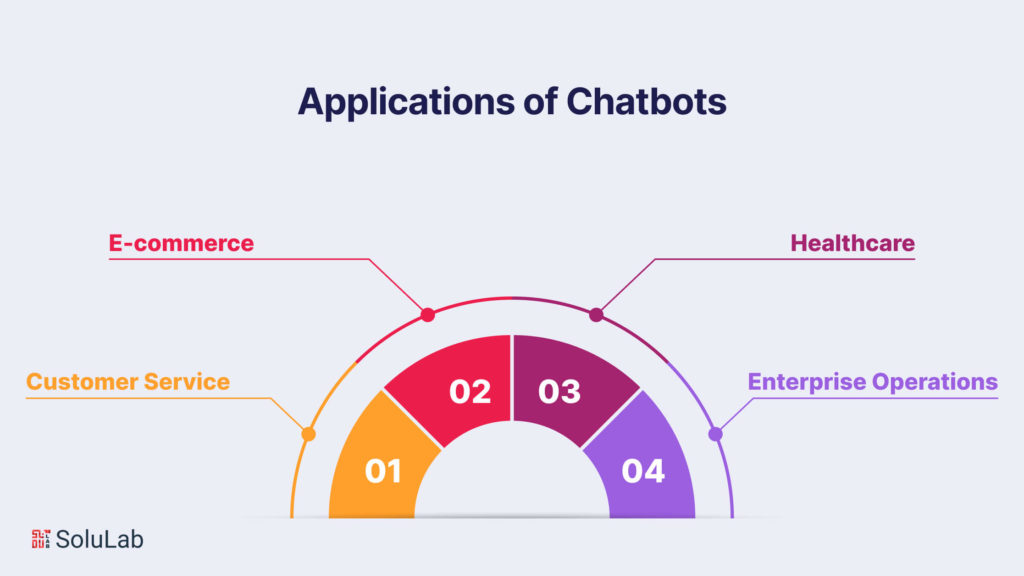
Applications of Chatbots

  • Customer Service:

Chatbots are widely employed in customer service to provide instant responses to frequently asked questions, troubleshoot issues, and guide users through processes. This not only improves customer satisfaction but also frees up human agents for more complex tasks.

  • E-commerce:

In the realm of e-commerce, chatbots facilitate seamless shopping experiences. They assist users in finding products, offer personalized recommendations, and even handle the checkout process, streamlining the customer journey.

  • Healthcare:

Chatbots play a crucial role in the healthcare sector, offering virtual assistance for symptom checking, medication reminders, and general health inquiries. They contribute to improved accessibility and health awareness.

  • Enterprise Operations:

Within enterprises, chatbots are deployed to automate routine tasks, assist employees with internal queries, and enhance collaboration. They serve as digital assistants, boosting efficiency and productivity.
Advanced Features Implementation in Chatbot Development

Advanced Features Implementation in Chatbot Development

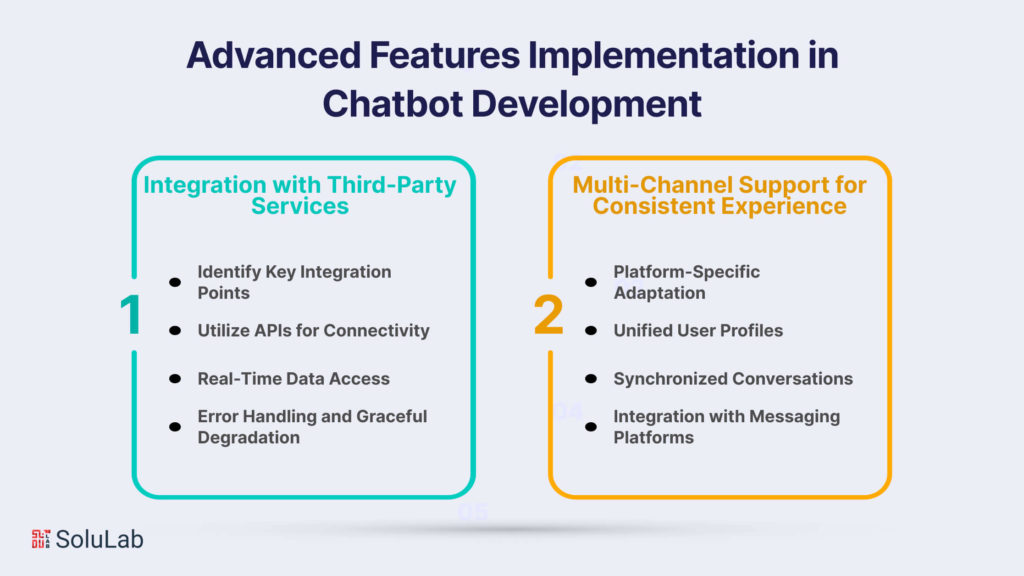
In the rapidly evolving landscape of chatbot development, integrating advanced features is paramount to providing a seamless and sophisticated user experience. Two crucial aspects of this advancement are the integration with third-party services and ensuring multi-channel support for a consistent user experience.

A. Integration with Third-Party Services

One of the hallmarks of a robust chatbot is its ability to seamlessly integrate with third-party services. This feature expands the bot’s capabilities beyond predefined responses, allowing it to access external data and perform tasks that enhance user interactions. Here’s how you can effectively implement integration with third-party services:

1. Identify Key Integration Points:

Define the specific functionalities and data sources from third-party services that align with your chatbot’s objectives. This could include integrating with CRM systems, payment gateways, or external databases.

2. Utilize APIs for Connectivity:

Leverage Application Programming Interfaces (APIs) to establish connectivity between your chatbot and external services. Ensure that the APIs used are secure, well-documented, and capable of handling the expected data volume.

3. Real-Time Data Access:

Enable real-time data access to ensure that the information provided by the chatbot is up-to-date. This is particularly crucial for applications such as e-commerce transactions, where real-time inventory and pricing information are essential.

4. Error Handling and Graceful Degradation:

Implement robust error handling mechanisms to manage situations where third-party services may be temporarily unavailable. Additionally, design the chatbot to gracefully degrade its functionality if certain integrations are not accessible, ensuring a consistent user experience.

B. Multi-Channel Support for Consistent Experience

Modern users interact with brands across various channels, necessitating a chatbot that provides a consistent and cohesive experience irrespective of the platform. Implementing multi-channel support ensures that users can seamlessly transition between different touchpoints while maintaining continuity in their interactions.

1. Platform-Specific Adaptation:

Customize the chatbot’s interface and interaction style based on the specific characteristics of each channel. For example, interactions on a website might differ from those on a social media platform, considering the varying user expectations and interface designs.

2. Unified User Profiles:

Implement a unified user profile system that consolidates user data from different channels. This allows the chatbot to recognize users across platforms, providing a personalized experience based on their historical interactions and preferences.

3. Synchronized Conversations:

Enable synchronized conversations, allowing users to seamlessly switch between channels without losing context. This is particularly important for complex interactions where users may initiate a conversation on one channel and continue it on another.

4. Integration with Messaging Platforms:

If deploying a chatbot on messaging platforms like Facebook Messenger or WhatsApp, ensure seamless integration. Leverage platform-specific features such as quick replies and rich media to enhance the user experience within these channels.

In conclusion, the successful implementation of advanced features, such as integration with third-party services and multi-channel support, is pivotal in elevating the capabilities of your chatbot. By strategically incorporating these elements, you not only enhance the functionality and versatility of your chatbot but also provide users with a consistent and engaging experience across various touchpoints.
Strategies for Effective Chatbot Development

Strategies for Effective Chatbot Development

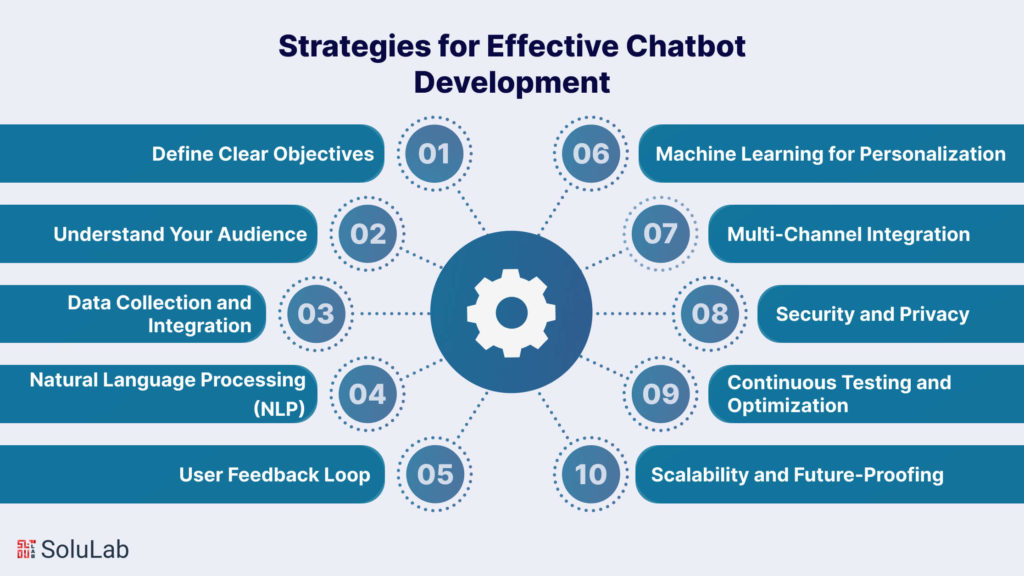
Effective chatbot development involves a combination of technical prowess, user-centric design, and a commitment to continuous improvement. Here, we delve into detailed strategies to guide your chatbot development process:

1. Define Clear Objectives:

Start by establishing clear objectives for your chatbot. Identify the specific tasks it will perform, whether it’s answering customer queries, providing product information, or facilitating transactions. Clearly defined goals will guide the development process and ensure the chatbot meets user expectations.

2. Understand Your Audience:

Conduct comprehensive audience research to understand the demographics, preferences, and communication styles of your target users. This information is crucial for tailoring the chatbot’s language, tone, and functionality to align with user expectations.

3. Data Collection and Integration:

Implement robust data collection mechanisms to gather valuable insights into user behavior and preferences. Integrate your chatbot with existing databases and systems to access real-time data, ensuring that the information provided is accurate and up-to-date.

4. Natural Language Processing (NLP):

Leverage advanced Natural Language Processing (NLP) techniques to enhance the chatbot’s ability to understand and respond to user queries in a natural and conversational manner. Regularly update the language model to stay current with linguistic trends and nuances.

5. User Feedback Loop:

Establish a continuous feedback loop by collecting user feedback and analyzing it systematically. Use this feedback to identify areas for improvement, address user concerns, and enhance the overall user experience. Regularly iterate on the chatbot based on user input.

6. Machine Learning for Personalization:

Implement machine learning algorithms to personalize user interactions. Analyze user data to predict preferences, offer tailored recommendations, and create a more engaging and personalized experience. This dynamic adaptation is key to keeping users actively engaged.

7. Multi-Channel Integration:

Ensure your chatbot is seamlessly integrated across various channels, including websites, mobile apps, and social media platforms. This multi-channel approach provides users with a consistent experience and expands the reach of your chatbot to meet users where they are.

8. Security and Privacy:

Prioritize data security and user privacy. Implement robust security protocols to protect user data and communicate these measures transparently to build trust. Stay informed about data protection regulations and ensure compliance to safeguard user information.

9.Continuous Testing and Optimization:

Establish a comprehensive testing strategy throughout the development lifecycle. Conduct usability testing, performance testing, and A/B testing to identify and address any issues. Regularly optimize the chatbot based on performance metrics and user feedback.

10. Scalability and Future-Proofing:

Design your chatbot with scalability in mind to accommodate future growth in user interactions. Stay abreast of emerging technologies and industry trends to future-proof your chatbot against evolving user expectations and technological advancements.

Measuring Performance in Chatbot Development

As the adage goes, “what gets measured gets managed.” In the realm of chatbot development, measuring performance is essential for ensuring the effectiveness of the bot and continually enhancing the user experience. This involves monitoring key performance indicators (KPIs) such as response time and user satisfaction, while also establishing user feedback loops for iterative improvement.

A. KPIs: Response Time, User Satisfaction

1. Response Time: Response time refers to the time it takes for the chatbot to generate and deliver a response to the user query.

  • Measurement: Track the average response time and set benchmarks for acceptable levels based on the complexity of queries.
  • Importance: Swift responses contribute to a positive user experience, enhancing user engagement and satisfaction.

2. User Satisfaction: User satisfaction gauges how content users are with their interactions with the chatbot.

  • Measurement: Implement surveys or rating systems to collect direct feedback on user satisfaction. Analyze sentiment from user interactions for a more nuanced understanding.
  • Importance: User satisfaction is a holistic metric that reflects the overall performance and user-friendliness of the chatbot.

B. User Feedback Loops for Iterative Improvement

1. Establishing Feedback Mechanisms:

  • Methods: Implement user feedback mechanisms such as surveys, in-chat feedback options, or post-interaction email surveys.
  • Frequency: Regularly prompt users for feedback after interactions or at key touchpoints.

2. Analyzing Feedback:

  • Quantitative Analysis: Aggregate numerical ratings and quantitative feedback to identify trends and patterns.
  • Qualitative Analysis: Pay attention to qualitative feedback for insights into specific pain points or areas of improvement.

3. Iterative Improvement:

  • Continuous Iteration: Use feedback as a basis for iterative development. Regularly update the chatbot based on user suggestions and pain points identified through feedback.
  • Prioritization: Prioritize feedback based on impact and feasibility, focusing on changes that will have the most significant positive effect on user satisfaction.

4. Adapting to User Preferences:

  • Personalization: Leverage user feedback to personalize interactions. If users consistently request certain features, consider implementing them to enhance user engagement.
  • User-Centric Design: Use feedback to inform the design process, ensuring that the chatbot aligns closely with user expectations and preferences.

Future Trends in Chatbot Development

Future Trends in Chatbot Development

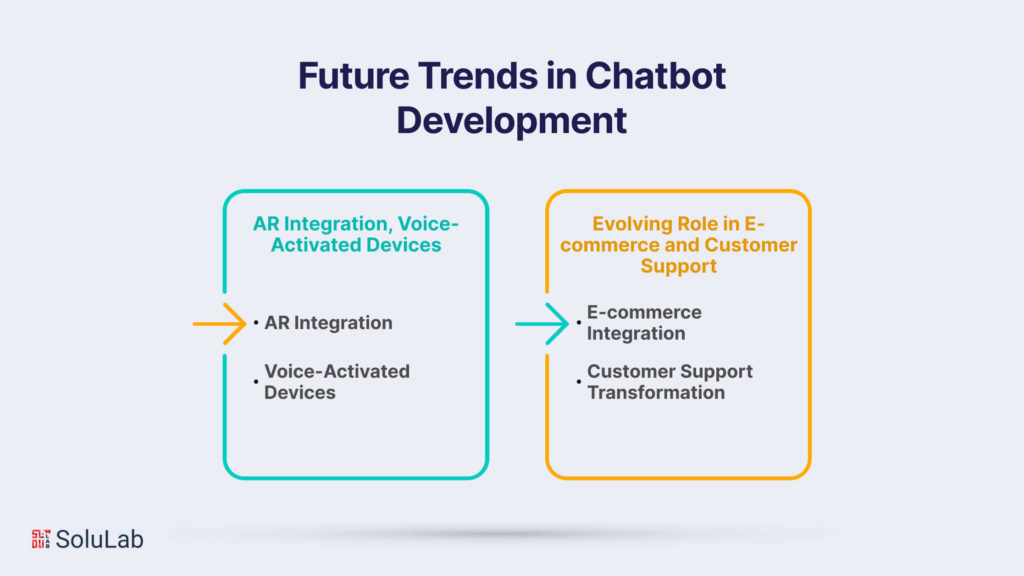
The landscape of chatbot development is continuously evolving, driven by technological advancements and changing user expectations. Two prominent future trends shaping the trajectory of chatbots are the integration of Augmented Reality (AR) and Voice-Activated Devices, as well as their evolving role in E-commerce and Customer Support.

A. AR Integration, Voice-Activated Devices

1. AR Integration: Augmented Reality (AR) integration involves overlaying digital information, such as visuals or data, onto the real-world environment perceived through a device’s camera.

  • Implementation: Chatbots will increasingly leverage AR to provide visual assistance. For instance, in retail, users might use a chatbot to virtually try on clothing items or visualize furniture in their living spaces.
  • Benefits: AR-enhanced chatbots enhance user engagement by providing more immersive and interactive experiences. This is particularly valuable in industries like retail, education, and healthcare.

2. Voice-Activated Devices: The integration of chatbots with voice-activated devices allows users to interact with bots using voice commands.

  • Implementation: Voice-activated chatbots are becoming prevalent in smart speakers, smartphones, and other IoT devices. Users can perform tasks, get information, or make requests through natural language voice interactions.
  • Benefits: Voice-activated chatbots enhance accessibility and convenience. Users can engage with the chatbot hands-free, enabling seamless integration into daily activities.

B. Evolving Role in E-commerce and Customer Support

1. E-commerce Integration:

  • Contextual Recommendations: Chatbots will play a crucial role in providing personalized product recommendations based on user preferences and behavior. This will enhance the overall shopping experience, making it more intuitive and tailored to individual needs.
  • Conversational Commerce: Chatbots will facilitate conversational commerce, allowing users to make purchases directly within chat interfaces. Integration with payment gateways and inventory systems will streamline the transaction process.

2. Customer Support Transformation:

  • Advanced Issue Resolution: Chatbots will evolve to handle more complex customer queries by leveraging advanced Natural Language Processing (NLP) and machine learning. This will reduce the workload on human agents, allowing them to focus on more intricate issues.
  • Seamless Handovers: The integration of chatbots with human agents will become more seamless. Chatbots will intelligently recognize when a query requires human intervention and smoothly transfer the conversation to a live agent.
  • Proactive Engagement: Chatbots will proactively engage users based on predictive analytics and historical interactions. This anticipatory approach will enhance customer satisfaction by addressing potential issues before they escalate.

AI-Chatbot development services

Conclusion

In conclusion, the landscape of AI-powered chatbot development is dynamic and evolving. From custom solutions for enterprises to voice-activated assistants and immersive experiences in virtual reality, the potential for innovation is vast. By understanding the key components, strategies, and challenges, businesses can embark on a journey to create executive virtual assistants that not only meet current needs but also pave the way for the future of human-computer interaction. 

As technology continues to advance, the role of intelligent virtual assistants in shaping the digital landscape is set to become even more profound, redefining the way we communicate, work, and engage with information. Are you aiming to take the forefront in the Conversational AI revolution? SoluLab stands as your top-tier AI development service and chatbot development company. With a demonstrated history of innovation and specialized expertise, we excel in creating state-of-the-art chatbot solutions tailored to meet your specific requirements. Collaborate with SoluLab to leverage the capabilities of AI-driven virtual companions and stay ahead in the ever-evolving realm of technology.

FAQs

1. What is the role of Augmented Reality (AR) in chatbot development?

Augmented Reality (AR) in chatbot development enhances user experiences by overlaying digital information in the real-world environment. This can be applied in various industries, allowing users to virtually try on products, visualize items in their surroundings, and engage with immersive content.

2. How do voice-activated devices integrate with chatbots?

Voice-activated devices integrate with chatbots by allowing users to interact through natural language voice commands. This hands-free approach enables seamless engagement with chatbots on smart speakers, smartphones, and other IoT devices, offering users a more convenient and accessible interaction method.

3. What benefits do AR-enhanced chatbots bring to users?

AR-enhanced chatbots provide more immersive and interactive experiences. Users can visualize products in real-world scenarios, facilitating better decision-making. This technology is particularly valuable in industries like retail, education, and healthcare, where visualizing information is crucial.

4. How can chatbots transform the e-commerce experience?

Chatbots transform e-commerce by offering contextual recommendations based on user preferences and behavior. They facilitate conversational commerce, enabling users to make purchases directly within chat interfaces. This enhances the overall shopping experience by making it more personalized and intuitive.

5. What advancements can we expect in customer support through chatbots?

Chatbots in customer support will advance in handling more complex queries using advanced Natural Language Processing (NLP) and machine learning. They will seamlessly integrate with human agents, recognizing when a query requires human intervention. Proactive engagement will also become a norm, addressing potential issues before they escalate.

6. How do chatbots contribute to seamless multi-channel experiences?

Chatbots contribute to seamless multi-channel experiences by adapting their interface and interaction style based on specific channel characteristics. Unified user profiles enable users to transition between channels without losing context, ensuring consistent and personalized interaction across various touchpoints.

7. What key performance indicators (KPIs) should be monitored for chatbot success?

Key performance indicators for chatbots include response time, measuring the speed of generating and delivering responses, and user satisfaction, gauging how content users are with their interactions. Monitoring these KPIs is crucial for assessing the effectiveness of the chatbot and ensuring a positive user experience.

Future of Conversational AI: Trends and Innovations in Chatbot Development

The Future of Conversational AI: Trends and Innovations in Chatbot Development

In an age where digital interactions have become integral to our lives, the rise of conversational AI, powered by chatbots, has been nothing short of transformative. These intelligent virtual agents have transcended their initial role as simple chat interfaces and have evolved into sophisticated conversational partners. As we look ahead, the future of conversational AI promises even greater marvels, with an array of trends and innovations poised to redefine the way we interact with technology.

To comprehend the breathtaking future of conversational AI, it’s essential to grasp its present state. Chatbots, with their ability to engage users in dynamic, human-like conversations, are already omnipresent across industries. They assist in customer support, streamline e-commerce experiences, offer healthcare advice, and even provide financial guidance. But the real excitement lies in what lies ahead.

Emerging Trends in Chatbot Development

Emerging Trends in Chatbot Development

  • Advancements in Natural Language Processing (NLP)

The heartbeat of conversational AI is Natural Language Processing, and it’s beating stronger than ever. With the advent of deep learning and the surge in NLP models, chatbots are getting better at understanding the nuances of human language. This means more accurate responses, improved sentiment analysis, and the capacity to converse fluently in multiple languages.

For chatbot developers, the advancement in NLP models like GPT-3 has been a game-changer. These models can comprehend context, generate coherent responses, and even exhibit a semblance of common sense. As a result, users are now interacting with chatbots that feel more human-like, making the conversational experience smoother and more intuitive.

A key development in NLP is multilingual chatbots. These bots can seamlessly switch between languages, breaking down language barriers and facilitating global communication. Whether you’re conversing in English, Spanish, or Mandarin, chatbots can comprehend and respond in your preferred language.

In addition, the impact of chatbots is becoming proficient at sentiment analysis. They can gauge the emotional tone of a conversation, allowing them to respond more empathetically. This capability has significant implications for industries such as customer service, where understanding and responding to customer emotions is crucial.

The ongoing advancements in NLP empower chatbots to engage users on a deeper level, opening doors to more sophisticated applications across various sectors.

  • Personalization and User Experience

Imagine a chatbot that knows you better than you know yourself. The future of chatbots is all about personalization. These virtual assistants will be context-aware, able to remember past interactions, and even predict your needs.

What does this mean for you? A more user-centric experience. If you’re a regular customer of an e-commerce platform, your chatbot might remember your preferences, previous purchases, and even the items you were browsing but didn’t buy. This level of personalization allows chatbots to offer tailored recommendations and make your shopping experience smoother.

In healthcare, context-aware chatbots can take into account your medical history, current symptoms, and even your emotional state to provide more relevant advice. In finance, they can help manage your investments based on your risk tolerance and financial goals.

Read Our Blog: Top 10 AI Development Companies

User-centric design principles are at the forefront of chatbot development. These bots will adapt to your unique needs and preferences, making the digital experience feel more intuitive and human-like.

As chatbots become adept at understanding context and providing personalized assistance, they’re set to become an indispensable part of our daily lives.

  • Integration with Voice Assistants

Voice-controlled smart speakers and devices are on the rise. It’s a natural progression for chatbots to extend into the realm of voice assistants. This integration is blurring the lines between chatbots and voice-activated virtual assistants like Siri, Alexa, and Google Assistant.

Picture this: You’re in the kitchen, your hands covered in flour, and you need a recipe. You don’t have to touch your phone or computer. You simply say, “Hey [Your Favorite Voice Assistant], find me a bread recipe.” In seconds, you have the recipe spoken to you step by step. This is the future of voice-controlled chatbots.

Voice-controlled chatbots can also be part of your smart home. You can ask them to adjust your thermostat, play music, or even lock your doors—all through natural language commands.

The implications of this integration go beyond convenience. It’s shaping the future of voice commerce, enabling you to make purchases, book services, and complete tasks with a simple voice command. It’s a transformative development that promises a future where technology is seamlessly integrated into our lives.

  • Multimodal and Rich Media Integration

In the world of future chatbots, it’s not just about text-based conversations. It’s also about rich media experiences. Chatbots are expanding their repertoire to include images, videos, and interactive content.

Visual chatbots are becoming increasingly common. They can process images you send, analyze them, and provide information or assistance based on those images. For instance, you can take a picture of a plant in your garden, and a chatbot can identify the plant species and offer care instructions.

But it doesn’t stop at static images. Chatbots are venturing into videos and animations, providing engaging content that goes beyond words. Whether it’s educational content, product demonstrations, or entertainment, chatbots are becoming versatile content deliverers.

For marketers, this opens up new horizons. Interactive content, guided tours, and immersive experiences can be delivered through chatbots. Imagine exploring a virtual art gallery guided by a chatbot, or trying on virtual clothes with a chatbot helping you choose the perfect outfit.

The implications are profound in fields like e-learning, where chatbots can deliver dynamic and interactive lessons. From tutorials to simulations, chatbots are turning learning into a more engaging and personalized experience.

As chatbots evolve to incorporate rich media, their capacity to engage users will expand, making them essential in various domains like education, marketing, and customer support.

CTA1

  • AI Ethics and Responsible AI

As chatbots grow more sophisticated, ethical considerations become paramount. We must ensure that the power of AI is harnessed responsibly, protecting user privacy, mitigating bias, and upholding transparency.

One of the core ethical concerns in chatbot development is data privacy. Chatbots often handle sensitive information, from personal health data in healthcare chatbots to financial information in banking chatbots. Ensuring compliance with data protection regulations is essential. Users must have confidence that their data is secure and used responsibly.

Read Blog: How to Build an AI-Powered Chatbot For Your Business?

Bias mitigation is another significant challenge. Chatbots learn from vast datasets, and if those datasets contain biases, the chatbot may inadvertently perpetuate them. This can result in discriminatory or unfair behavior. Developers must actively work to eliminate biases and ensure that chatbots treat all users fairly.

Transparency and explainability are ethical imperatives. Users should understand that they’re interacting with a chatbot and not a human. Furthermore, chatbots should be able to explain their reasoning and decision-making processes when necessary.

As we move into the future, the responsible development of chatbots is central to their success. Responsible AI doesn’t just protect users; it also ensures that chatbots continue to gain trust and provide valuable services.

Industry-Specific Applications

Industry-Specific Applications

The potential of chatbots isn’t confined to any single domain. Their adaptability and versatility make them valuable across various industries, from healthcare to finance and beyond. Let’s explore how chatbots are making a significant impact in these sectors.

  • Healthcare

Healthcare chatbots are becoming a vital tool in providing medical information, remote consultations, and even mental health support. They offer a unique blend of accessibility, efficiency, and empathy. Here’s how they are revolutionizing healthcare:

1. Virtual Health Assistants: Chatbots in Healthcare are playing the role of virtual health assistants, helping users monitor their health, set medication reminders, and even track symptoms.

2. Telemedicine Support: Telemedicine is on the rise, and healthcare chatbots are an integral part of this trend. They can help users schedule appointments, connect with doctors, and offer pre-consultation guidance.

3. Mental Health Support: Mental health chatbots are offering users a listening ear. They provide support, coping strategies, and even early intervention for mental health issues.

  •  E-commerce

E-commerce chatbots are streamlining the online shopping experience and driving sales. They are the virtual shop assistants of the future. Here’s how they are reshaping the world of online retail:

1. Enhanced Customer Service: E-commerce chatbots offer real-time customer support, answering product-related queries, assisting with order tracking, and resolving issues swiftly.

2. Personalized Shopping Experiences: These chatbots analyze user preferences and past shopping behaviors to recommend products that align with individual tastes, boosting sales and customer satisfaction.

Read Our Blog: AI Use Cases and Applications in Key Industries

  • Customer Support

Customer support chatbots are reducing response times and enhancing customer experiences. They provide efficient, round-the-clock assistance. Their applications include:

1. Automated Issue Resolution: These chatbots can handle routine customer inquiries, such as password resets, order tracking, and billing inquiries, leaving human agents to tackle more complex issues.

2. Improved Self-Service Options: By guiding users through troubleshooting steps or providing step-by-step instructions, customer support chatbots empower users to resolve issues independently.

  • Finance

Chatbots are becoming financial advisors and fraud detectors in the finance industry. They offer a range of benefits, from investment guidance to security. Here’s how they’re transforming finance:

1. Chatbots for Financial Advice: Personal finance chatbots assist users in budgeting, saving, and making informed investment decisions based on their financial goals and risk tolerance.

2. Fraud Detection and Prevention: In the battle against financial fraud, chatbots can actively monitor accounts for suspicious activity and alert users to potential threats.

The versatility of chatbots is what makes them so powerful. They are customizable to fit the specific needs and requirements of various industries. Whether it’s healthcare, e-commerce, customer support, or finance, chatbots are becoming essential tools for enhancing services, reducing costs, and improving user experiences.

Read Blog: AI in Finance: The Future of Smart Investments and Risk Management

Innovations in Chatbot Platforms

The future of conversational AI is not solely reliant on chatbots themselves but also on the platforms that enable their development and deployment. In this section, we’ll explore some significant innovations in chatbot platforms that are propelling the technology forward.

  • Low-Code/No-Code Chatbot Development

Traditionally, chatbot development required a deep understanding of programming and AI. However, the emergence of low-code and no-code development platforms has democratized chatbot creation, making it accessible to non-technical users.

1. Accessibility for Non-Technical Users: Low-code and no-code platforms allow individuals with minimal programming knowledge to design and develop chatbots. This means that subject matter experts and business professionals can directly contribute to chatbot creation.

2. Rapid Prototyping: These platforms enable the rapid prototyping of chatbots. This results in quicker development cycles, allowing businesses to experiment and innovate at a faster pace.

  • Open-Source Solutions

Open-source chatbot platforms are fostering community-driven development and collaborative innovation. These platforms, often backed by communities of developers, offer several advantages.

1. Benefits and Limitations: Open-source solutions provide transparency, customization, and a wide range of pre-built components. However, they may require a deeper technical understanding and ongoing maintenance.

2. Community-Driven Development: The collaborative nature of open-source development means that numerous contributors work on improving and extending these platforms. This leads to a wealth of options and innovations.

Read Our Blog: 10 Benefits of Incorporating Generative AI in the Manufacturing Process

Open-source chatbot platforms are becoming pivotal in the landscape of Conversational AI, especially in contexts where unique requirements demand customization and community-driven solutions.

These innovations in chatbot platforms are pivotal in shaping the future of conversational AI. They make the development process more inclusive and empower businesses and individuals to create and deploy chatbots that address their specific needs and preferences.

As chatbot platforms continue to evolve and become more accessible, we can expect an even wider range of applications, from small business chatbots to enterprise-level virtual assistants, all tailored to meet unique requirements.

The innovations in low-code/no-code development and open-source solutions are setting the stage for a more dynamic and diverse chatbot ecosystem. These platforms are the foundation upon which future chatbots will be built, expanding their reach and relevance across various industries and applications.

Challenges and Future Directions

Challenges and Future Directions

As we explore the fascinating world of conversational AI and chatbot development, it’s imperative to recognize the challenges and chart the course for future directions. The road ahead is filled with opportunities, but it’s also beset with hurdles that demand our attention.

  • Data Privacy and Security

The rise of chatbots means that more of our personal data is being processed and stored. This intensifies the need for robust data privacy and security measures.

1. Compliance with Regulations: Developers must ensure that chatbots adhere to data protection regulations like GDPR and HIPAA, depending on the industry they serve.

2. Protecting User Data: Users must have confidence that their data is being handled responsibly. This involves secure data storage, encryption, and secure data transmission.

Read Blog: Top 7 Generative AI Integration Services For Your Business

  • Interoperability and Standards

The chatbot ecosystem is expanding, and as it does, interoperability and standards become crucial.

1. Developing Cross-Platform Standards: Chatbots should seamlessly work across various platforms, devices, and operating systems. Standards and interoperability agreements must be established to ensure chatbots can interact cohesively in this diverse landscape.

2. Ensuring Chatbot Compatibility: A user’s experience should not be fragmented when switching between different chatbots. Standardized communication protocols can make sure chatbots understand and build upon each other’s interactions.

  • The Road to AGI (Artificial General Intelligence)

The grand vision for chatbots is the development of Artificial General Intelligence, or AGI, which would endow them with human-like cognitive abilities.

1. The Long-Term Vision: AGI chatbots aim to not just understand context but also reason, learn from experience, and exhibit human-like common sense. Achieving AGI is a significant undertaking with profound implications.

2. Ethical Considerations: The pursuit of AI-powered chatbots involves addressing ethical challenges, such as ensuring the responsible use of advanced AI and mitigating any negative impacts.

As we look to the future of conversational AI and chatbot development, we must remain mindful of these challenges and tread carefully as we embark on the path to AGI. Responsible development and adherence to ethical guidelines will be paramount.

CTA2

Conclusion

The future of conversational AI and chatbot development is a journey marked by innovation, inclusion, and responsibility. We’re on the brink of an era where chatbots will be more human-like, more versatile, and more intertwined with our daily lives.

These AI-driven virtual companions will transform industries, streamline processes, and improve user experiences. They’ll enhance healthcare, revolutionize e-commerce, refine customer support, and offer invaluable financial guidance. But we must not forget the ethical considerations that come with these advancements. Privacy and security, interoperability, and responsible AI development are all non-negotiable aspects of our journey into the future of chatbots.

Looking to lead the way in the Conversational AI revolution? SoluLab is your premier AI development service and chatbot development company. With a proven track record of innovation and expertise, we specialize in crafting cutting-edge chatbot solutions that cater to your unique needs. Partner with SoluLab to harness the power of AI-driven virtual companions and stay ahead in the dynamic world of technology.

FAQs

1. What is conversational AI, and how does it differ from traditional chatbots?

Conversational AI refers to artificial intelligence systems designed for human-like interactions. While traditional chatbots are rule-based and follow predetermined scripts, conversational AI leverages advanced natural language processing (NLP) and machine learning to engage in more dynamic, context-aware conversations, making interactions feel more human-like and intuitive.

2. What industries can benefit from chatbot integration, and in what ways?

Chatbots have versatile applications across various industries. In healthcare, they assist with appointment scheduling and provide telemedicine support. E-commerce benefits from chatbots by offering personalized shopping experiences and efficient customer support. In customer service, chatbots automate issue resolution, and in finance, they offer financial advice and help detect fraud.

3. What are low-code/no-code platforms, and how do they affect chatbot development?

Low-code/no-code platforms are tools that simplify the development of applications, including chatbots, by reducing the need for extensive programming knowledge. They empower non-technical users to create chatbots, resulting in quicker development cycles and greater accessibility for a wide range of users, including business professionals and subject matter experts.

4. What ethical considerations should be addressed in chatbot development?

Ethical considerations in chatbot development include data privacy and security to protect user information, the development of standards and interoperability to ensure seamless chatbot interactions, and the responsible pursuit of Artificial General Intelligence (AGI) to mitigate potential negative impacts. Transparency, fairness, and bias mitigation are also crucial in ethical chatbot development.

5. What does the future hold for chatbots, and how will they continue to evolve?

The future of chatbots is characterized by enhanced user personalization, integration with voice assistants, the adoption of rich media, and a focus on responsible AI development. Chatbots are expected to expand their reach in various industries, offering more dynamic and diverse applications. Further innovations in natural language processing, along with ethical considerations, will shape their evolution.


The Impact of Chatbots on Lead Generation and Sales Conversion

The Impact of Chatbots on Lead Generation and Sales Conversion

In today’s digital age, businesses are constantly seeking innovative ways to streamline their operations and improve customer engagement. The advent of chatbots has brought a new dimension to the world of lead generation and sales conversion. These virtual assistants, powered by artificial intelligence (AI), are becoming increasingly popular tools for businesses looking to enhance their customer service, capture leads, and boost sales. In this article, we’ll explore the role of chatbots in lead generation and sales conversion, focusing on strategies, their impact, and the crucial process of lead qualification.

Chatbots for Lead Generation: A New Frontier

Chatbots have evolved from being basic conversation tools to sophisticated agents capable of interacting with customers in meaningful and personalized ways. They have found their place in various industries, from e-commerce and customer service to healthcare and finance, and they are now an essential part of lead generation strategies.

Understanding Chatbots 

Chatbots are nothing but AI-driven software programs designed to simulate human conversational behavior. They can communicate with users in a natural language, providing information, answering questions, and guiding them through specific tasks. In the context of lead generation, chatbots serve as proactive and 24/7 salespersons, ready to engage with potential customers whenever they visit a website or interact on social media platforms.

The integration of chatbots into lead generation strategies brings several advantages:

1. Real-time Engagement: Chatbots can initiate conversations with website visitors, capturing leads in real-time and offering immediate assistance.

2. Personalization: Through AI algorithms, AI-powered chatbots can tailor their responses and recommendations based on the user’s behavior and preferences, creating a more personalized user experience.

3. Scalability: Chatbots can handle multiple conversations simultaneously, ensuring that no lead is left unattended even during high-traffic periods.

4. Consistency: Chatbots provide a consistent level of service, ensuring that all visitors receive the same quality of information and assistance.

5. Data Collection: Chatbots can collect valuable data from users during conversations, helping businesses better understand their audience and fine-tune their lead generation strategies.

6. Cost-Effective: Using chatbots is often more cost-effective than hiring and training a large team of human agents for lead generation.

Implementing Chatbots for Lead Generation

The successful implementation of chatbots for lead generation depends on several key factors:

  • Clear Objectives

Before deploying chatbots, businesses must define their lead generation goals. Are they looking to increase the number of leads, improve lead quality, or both? Having clear objectives will guide the design and functionality of the chatbot.

  • Target Audience

Understanding the target audience is crucial. Businesses need to know who their potential customers are, what their pain points are, and what kind of content or assistance would be most valuable to them.

Read Blog Post: How to Build an AI-Powered Chatbot For Your Business?

  • Seamless Integration

Chatbots should seamlessly integrate with existing lead generation processes and technologies, such as CRM systems. This ensures a smooth transition of captured leads into the sales funnel.

  • Conversational Design

The chatbot’s conversational design plays a critical role in its effectiveness. It should be user-friendly, engaging, and capable of guiding users through the lead generation process.

  • Data Security

With data privacy concerns on the rise, it’s essential to implement robust security measures to protect the information collected by chatbots.

Lead Generation Strategies with Chatbots

Lead Generation Strategies with Chatbots

Incorporating chatbots into B2B lead generation strategies requires careful planning and execution.. Here are some effective lead generation strategies that leverage chatbots:

  • Proactive Engagement

Chatbots can initiate conversations with website visitors by asking if they need assistance or offering relevant information. This proactive approach can convert passive visitors into leads.

  •  Interactive Content

Using chatbots to guide users through interactive content, such as quizzes or assessments, can be an excellent way to collect lead information while providing value to the user.

  • Forms Simplification

Chatbots can simplify the lead capture process by filling out forms on behalf of the user, making it more convenient and increasing the likelihood of lead submission.

Read Our Blog: Top 10 AI Development Companies

  • Lead Nurturing

Chatbots are not limited to initial lead capture; they can also engage in lead nurturing by sending follow-up messages, relevant content, and personalized recommendations to keep potential leads engaged.

  • Data Collection

Through natural conversations, chatbots can collect data about users’ preferences, pain points, and purchase intentions, helping businesses refine their lead generation strategies.

  • Qualification

Chatbots can assess lead quality by asking qualifying questions. This ensures that only the most promising leads are forwarded to the sales team, saving time and resources.

CTA1

Chatbots and Sales Conversion: Bridging the Gap

While chatbots play a vital role in lead generation, their impact extends beyond the initial acquisition of leads. They can significantly contribute to the sales conversion process by assisting, nurturing, and qualifying leads.

  • Seamless Handover to Sales

Once a lead is captured by a chatbot, it can be seamlessly handed over to the sales team. Chatbots can provide sales representatives with a detailed lead profile, including the user’s preferences and interactions, enabling a more personalized and effective approach.

  • Lead Nurturing

Chatbots can continue to engage with leads, offering valuable content and assistance as they move through the sales funnel. This ongoing interaction keeps leads warm and increases the chances of conversion.

  • Sales Support

In the e-commerce industry, chatbots often assist users during the checkout process, answering product-related questions and addressing concerns. This real-time support can be the difference between an abandoned shopping cart and a successful sale.

  • Data-Driven Sales Insights

Chatbots can provide valuable data and insights to the sales team, such as the common pain points and objections raised by leads. This information can inform the sales strategy and help address potential concerns more effectively.

Lead Qualification with Chatbots: Separating the Wheat from the Chaff

One of the most critical aspects of lead generation is lead qualification. Not all leads are created equal, and businesses need to prioritize their efforts on leads with the highest potential for conversion. Chatbots are instrumental in this process.

  • Automated Lead Scoring

Chatbots can assign scores to leads based on their interactions, the information provided, and their behavior. This automated lead scoring system helps businesses identify which leads are most likely to convert.

  • Qualifying Questions

Chatbots can ask a series of qualifying questions to determine a lead’s readiness to make a purchase. These questions can be customized to suit the specific needs of the business and industry.

Read Our Blog Post: Top 10 AI Consulting Companies

  • Behavioral Analysis

By analyzing the user’s behavior and engagement patterns, chatbots can assess the level of interest and commitment a lead has toward the product or service. This information guides the sales team in their approach.

  • Customer Segmentation

Chatbots can segment leads into different categories, such as hot leads, warm leads, and cold leads. Each category can receive tailored communication and marketing efforts.

  • Lead Routing

Chatbots can automatically route hot leads to the most experienced sales representatives, ensuring that the most promising opportunities are handled by the best-equipped team members.

Measuring the Impact of Chatbots on Lead Generation and Sales Conversion

Impact of Chatbots on Lead Generation and Sales Conversion

The impact of chatbots on lead generation and sales conversion can be measured through various metrics and KPIs. Here are some key performance indicators that businesses can track to evaluate the effectiveness of their chatbot strategies:

  • Lead Capture Rate

This metric measures the percentage of website visitors who engage with the chatbot and provide their contact information, thus becoming leads.

  • Conversion Rate

The conversion rate indicates the percentage of leads generated by the chatbot that eventually make a purchase or complete a desired action.

Check Out Our Blog: Top 10 Enterprise AI Development Companies

  • Response Time

A faster response time from the chatbot typically leads to better engagement and a higher likelihood of capturing leads.

  • Lead Quality

Evaluating the quality of leads generated by the chatbot is crucial. It’s not just about quantity; it’s about capturing leads with a genuine interest in the product or service.

  • Sales Increase

The ultimate goal of chatbots is to boost sales. Monitoring the increase in sales attributed to chatbot interactions is a clear indicator of their impact.

  • Customer Satisfaction

Feedback and satisfaction ratings from users who interacted with the chatbot can provide insights into its performance and effectiveness.

  • Cost Savings

Comparing the cost of implementing and maintaining a chatbot to the revenue generated can determine the ROI of chatbot-driven lead generation and sales conversion efforts.

Real-World Success Stories

To illustrate the real-world impact of chatbots on lead generation and sales conversion, let’s take a look at a few success stories from different industries.

  • E-commerce Giant: Amazon

Amazon uses chatbots on its website to assist customers in finding products, answering questions, and guiding them through the purchase process. These chatbots have significantly improved customer engagement and streamlined the buying process, resulting in higher conversion rates and increased sales.

Read Also: Top 10 AI Development Companies

  • HealthTech Startup: HealthBot

HealthBot, a health tech startup, developed a chatbot that provides users with personalized health and wellness recommendations. Users can input their health goals and receive tailored advice and product recommendations. This not only captures leads but also increases sales of related health products.

  • Software Company: Salesforce

Salesforce, a leading CRM software company, employs chatbots to qualify leads based on their website interactions. By asking a series of questions and analyzing user behavior, the chatbot identifies high-potential leads and routes them to the appropriate sales team, resulting in improved lead quality and higher conversion rates.

Challenges and Considerations

Challenges and Considerations

While chatbots offer numerous benefits for lead generation and sales conversion, businesses must also address certain challenges and considerations:

  • User Experience

A poorly designed chatbot can frustrate users and deter them from engaging further. It’s crucial to create a seamless and enjoyable user experience.

  •  Data Privacy

Collecting user data comes with the responsibility of safeguarding it. Businesses must ensure that their chatbots adhere to data protection regulations and maintain user privacy.

Read Also: Top Artificial Intelligence Solution Companies 

  • Human Touch

Chatbots can never fully replace the human touch in sales and customer service. They should complement, not replace, human interaction.

  •  Continuous Learning

Chatbots must continuously learn and adapt to user behavior and preferences. This requires ongoing maintenance and updates.

  • Integration Challenges

Integrating chatbots with existing systems and processes can be complex. Ensuring a smooth flow of data and communication is essential.

The Future of Chatbots in Lead Generation and Sales Conversion

Future of Chatbots in Lead Generation and Sales Conversion

As technology continues to advance, chatbots are poised to become even more integral to lead generation and sales conversion. Here are some trends and developments to watch for in the near future:

  • Enhanced Personalization

Chatbots will leverage more advanced AI algorithms to deliver hyper-personalized experiences, catering to each user’s unique preferences and needs.

Know More: How to Build a Multilingual Chatbot in 2025?

  •  Multilingual Capabilities

Chatbots will become more proficient in multiple languages, making them valuable tools for global businesses looking to capture leads from diverse regions.

  •  Voice-Based Chatbots

The rise of voice assistants like Siri and Alexa will lead to the development of chatbots that can engage in voice-based conversations, opening up new opportunities for lead generation and sales.

  • Integration with Virtual Reality

Virtual reality and augmented reality will create opportunities for chatbots to interact with users in immersive, 3D environments, further enhancing the lead generation experience.

  • Improved Analytics

Chatbots will provide even more sophisticated analytics and insights to businesses, allowing for data-driven decision-making and improved lead-generation strategies.

CTA2

Conclusion

Chatbots have emerged as powerful tools in lead generation and sales conversion. Their ability to engage users in real-time, streamline lead capture, nurture leads, and qualify prospects makes them indispensable in the modern business landscape. By carefully implementing chatbots and continuously improving their functionality, businesses can unlock new possibilities for growth, enhance customer satisfaction, and boost their bottom line. As technology continues to advance, the role of chatbots in lead generation and sales conversion is only expected to grow, making them an essential part of any forward-thinking business strategy.

SoluLab, a trusted company specializing in artificial intelligence development, offers pioneering AI solutions that cater to the unique requirements of diverse industries. Their proficient team of AI developers creates customized solutions, including intelligent chatbots, predictive analytics, and machine learning algorithms. Integrating chatbots into business processes and services provides a practical means to introduce automation and improve efficiency. SoluLab excels in providing chatbot development services, creating a variety of chatbots with innovative designs and robust architecture for industries such as eLearning, Healthcare, Fintech, and many more. Contact SoluLab for chatbot development.

FAQs

1. What is the role of chatbots in lead generation?

Chatbots play a pivotal role in lead generation by engaging with website visitors, capturing contact information, and initiating real-time conversations. They can proactively qualify and nurture potential leads, enhancing the overall lead-generation process.

2. How can chatbots improve sales conversion rates?

Chatbots can improve sales conversion rates by providing personalized recommendations, answering customer queries, and assisting during the purchase process. Their ability to offer round-the-clock support ensures that potential customers receive timely and relevant information, increasing the likelihood of conversion.

3. Are chatbots suitable for all industries and businesses?

Chatbots can be beneficial for a wide range of industries, including e-commerce, healthcare, finance, and more. However, their effectiveness depends on the specific business objectives and target audience. A well-designed chatbot can be customized to suit the needs of most businesses.

4. How do chatbots qualify leads, and what are the benefits of lead qualification?

Chatbots qualify leads by asking a series of predefined questions that assess the lead’s readiness to make a purchase. The benefits of lead qualification include prioritizing sales efforts, saving time and resources, and improving the chances of closing deals with high-quality leads.

5. What key metrics should businesses track to measure the impact of chatbots on lead generation and sales conversion?

Businesses should track metrics such as lead capture rate, conversion rate, response time, lead quality, sales increase, customer satisfaction, and cost savings to measure the impact of chatbots on lead generation and sales conversion. These metrics provide insights into the effectiveness and ROI of chatbot strategies.