Talk to an Expert

Guide to Tokenization of Carbon Credits in 2026

Understanding The Carbon Credit Tokenization

By 2030, tokenized assets are predicted to have a $16 trillion worldwide market capitalization. Real-world asset tokenization has the potential to transform several sectors, including carbon credits, real estate, equities, and the arts. With the invention, the potential applications of blockchain technology in several industries have advanced significantly.   

Creative ways to support environmental sustainability are emerging as the globe struggles with the pressing issues of climate change. One of the most promising of these is the tokenization of carbon credits, which uses blockchain technology to make the carbon market more open, effective, and accessible. This blog explores everything you need to know about carbon credit tokenization including how it works, its advantages, fundamentals, and use cases.

What are Carbon Credits?

Before we talk about tokenizing, let’s have a better knowledge of what are carbon credits. Permits known as carbon offsets or carbon credits allow companies to release a specific quantity of greenhouse gases, or carbon dioxide. One ton of carbon dioxide (CO2) is equal to one carbon credit. As per the report provided by Ecosystem’s marketplace annual report, the voluntary carbon credit market reached a valuation of over $2 billion by 2022.

By giving businesses financial incentives to decrease their carbon footprint, the carbon credit system seeks to lower greenhouse gas (GHG) emissions. Businesses are given a fixed quantity of credits under this system, which gradually diminishes, and they are free to sell any extra credits to third parties. The cap-and-trade concept which was effectively employed to reduce sulfur pollution in the 1990s, is the foundation of this system. The framework’s worldwide applicability was further strengthened in November 2021 when negotiations decided to create an offset trading market for global credit carbons at the Glasgow COP26 climate summit. 

What is the Role of Banks in Carbon Credit Tokenization?

Banks have a big part to play in the new market for tokenizing carbon credits, and moving quickly, they can become disruptive forces when it comes to virtual asset markets. Here are the major features of banks in carbon credit tokenization:

  • Technology and Market Leadership 

Leading this modern technology businesses set an example for others to look up to and depict a dedicated environment leading towards enhanced responsibilities 

  • Increasing Consumer Demand 

Early adoption of carbon credit tokenization by banks would enable them to meet this demand and draw in a new market of customers who are economically aware. 

  • Dedication to Addressing Climate Change

By actively participating in the creation of carbon credit tokenization methods, banks may show their dedication to addressing climate change in line with international imperatives. 

  • Tokenized Securities for New Income Source

Banks can develop new tokenized securities, such as green bonds or structured products linked to the tokenized carbon credits, and gain from improved branding and reputation, particularly if concerns about climate change gain traction.

Read Blog: What Makes Germany a Natural Fit for Carbon Credit Tokenization?

Top 5 Use Cases of Carbon Credit Tokenization

The potential of tokenized credit carbons in practical applications is being demonstrated by these top 5 real-world use cases of carbon credit tokenization:

  • Verra

Leading worldwide carbon standard organization Verra has been at the forefront of the tokenization of carbon credits. Verra is streamlining its Verified Carbon Standard (VCS) credits by collaborating with blockchain platforms. To make it simpler for companies and individuals to trade carbon credits and offer their emissions, this effort seeks to improve the carbon market’s transparency, accessibility, and liquidity. 

  • Flow Carbon 

A platform for buying and retiring carbon credits is provided by Flow Carbon to both individuals and organizations. Additionally, its platform offers tools for monitoring and validating the effects of such credits, and initiatives. Through easily accessible and traceable carbon credit exchanges, Flow Carbon is dedicated to advancing climate action. 

  • Moss

Moss works to protect Brazilian rainforests, especially the Amazon. Moss has made it possible for people and organizations to contribute to the conservation of the rainforest by tokenizing carbon credits that are produced from the maintenance of this important environment. They immediately support the preservation of the most important environmental resources in the world by using Moss tokens. 

  • Klima DAO

The decentralized autonomous organization (DAO) dedicated to climate action is Klima DAO. By minting Klima tokens and buying carbon credits, Klima DAO establishes a direct connection between the cryptocurrency community and the carbon market. This strategy combines the realms of blockchain technology and environmental sustainability by encouraging people and businesses to invest in carbon credits along with promoting climate-positive initiatives. 

  • Celo

Celo’s mobile-first blockchain infrastructure is being used to investigate the possibility of tokenizing carbon credits. Celo hopes to increase accessibility and inclusivity of climate action by including carbon credit tokenization within its platforms, particularly for people and communities in countries that are developing who might not otherwise have access to carbon trading. 

Tokenized Carbon Credits: A New Asset Class for Climate Action

Tokenized carbon credits represent verified greenhouse gas reductions on the blockchain. Each token denotes one metric ton of carbon dioxide avoided or removed from the atmosphere.

These credits are created by bridging existing credits from carbon registries into crypto tokens. Rigorous verification ensures the environmental integrity of each tokenized credit.

For organizations, tokenized credits offer a blockchain-based tool to offset residual emissions and meet sustainability goals. They also allow individuals to compensate for their personal carbon footprints.

Trading these tokens unlocks liquidity, transparency and standardization in carbon markets plagued by fragmented trading and data inconsistencies.

On blockchain platforms, tokenized credits become a fluid digital asset class enabling seamless transactions. This gives corporations, governments and individuals equal access to carbon as an investable commodity.

CTA1

Tokenizing Carbon Credit: The Process 

Carbon credit tokenization converts real-world carbon credits into digital tokens using blockchain technology. This unlocks new potential for carbon markets. The tokenization process involves:

  • Verifying the carbon reductions of projects like renewable energy or reforestation. Audits rigorously quantify the emissions avoided.
  • Recording the verified impacts on a blockchain. This immutable ledger in blockchain provides permanent transparency.
  • Issuing tokens representing carbon credits via smart contracts. These automate minting and transferring the tokens.

Once tokenized, the credits become digital assets that can be freely bought, sold, and traded. Participants across the carbon markets can purchase the tokens to offset emissions or trade them on decentralized exchanges.

In this way, tokenization provides open access to carbon markets for a wider range of stakeholders. It allows more individuals and organizations to engage in sustainable practices and contribute to reducing global greenhouse gas emissions.

The automation and transparency of blockchain technology also streamlines carbon credit transactions. This democratizes participation and enhances efficiency in mitigating climate change.
Benefits of Tokenized Carbon Credits

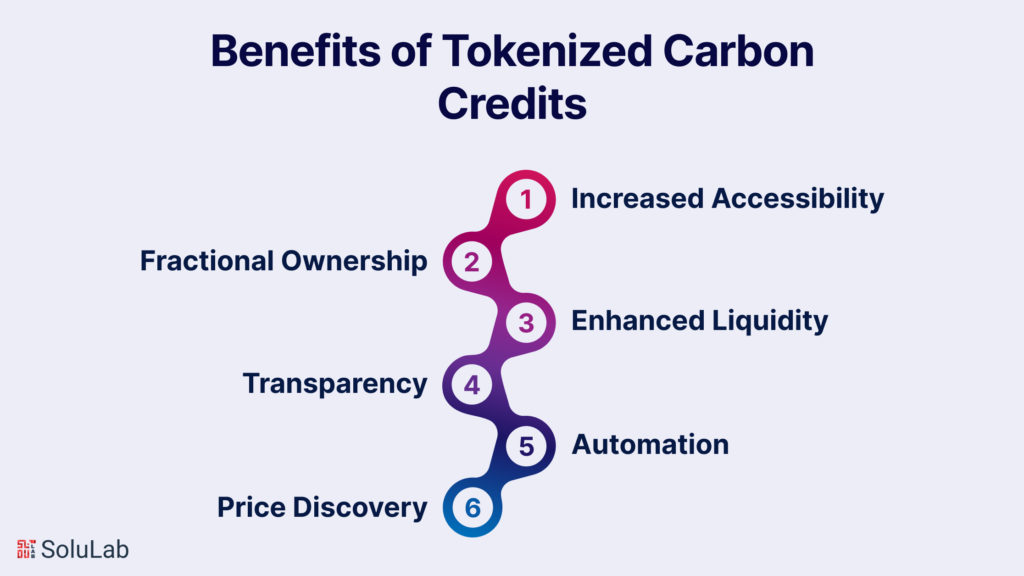
Benefits of Tokenized Carbon Credits

Tokenization unlocks several key benefits:

  • Increased Accessibility

Carbon markets become more accessible as tokenization removes geographical restrictions. Anyone across the world can purchase, trade, and retire tokenized carbon credits through digital platforms.

  • Fractional Ownership

Each credit can be split into smaller tokenized units, allowing individuals with limited budgets to offset their footprint.

  • Enhanced Liquidity

Tokens can be seamlessly traded on decentralized exchanges, eliminating intermediaries and reducing costs.

Read Also: Top 10 Asset Tokenization Development Companies

  • Transparency

The blockchain provides an immutable record of a credit’s origins and ownership history, preventing double-counting or other fraud.

  • Automation

Smart contracts automate credit issuance, payments, transfers, and retirement, streamlining the process.

  • Price Discovery

Tokenization provides transparent pricing data, increasing market efficiency and competition.

The Future of Tokenized Carbon Markets

By harnessing blockchain technology, tokenized carbon markets have the potential to engage a broader range of stakeholders in emissions reduction. Individuals can measure and offset their personal footprints, while companies large and small can more efficiently manage their climate impact.

Standardization and mainstream adoption of tokenized credits could significantly scale voluntary carbon markets. This would catalyze progress on global emissions goals, ultimately accelerating the worldwide transition to a low-carbon economy.

Check Our Blog Post: The Ultimate Guide To Creating a Carbon Credit Marketplace
Launching an Impactful Carbon Credit Tokenization Project

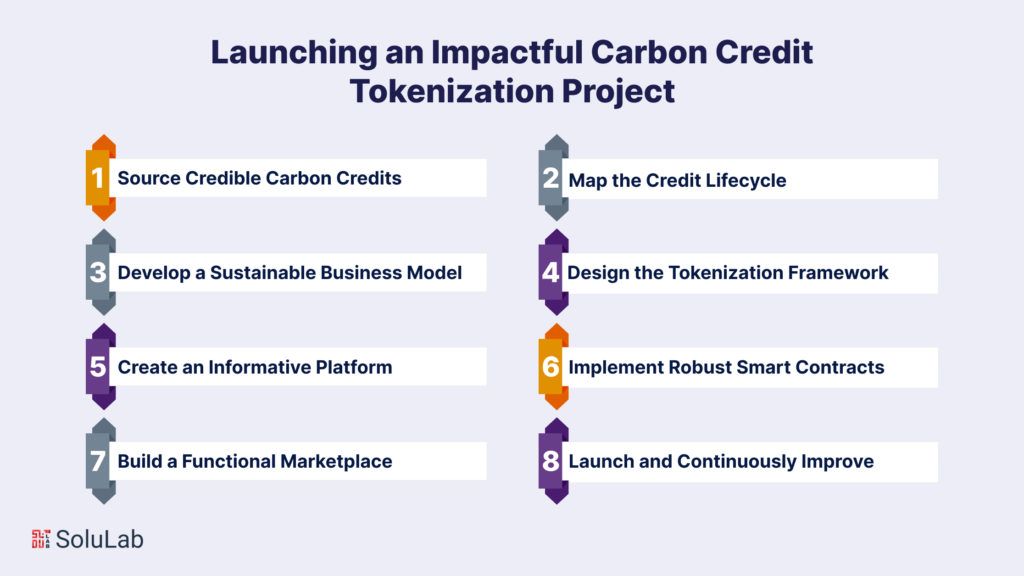
Launching an Impactful Carbon Credit Tokenization Project

Tokenizing carbon credits can drive transparency and efficiency in carbon markets. But executing an effective project requires strategic planning across many fronts. Here is a step-by-step guide:

1. Source Credible Carbon Credits

First, determine where your carbon credits will originate. If you run a company with internal offsets, tokenize those. If operating a market platform, carefully select reputable partner projects. Start small and local before expanding globally.

2. Map the Credit Lifecycle

Plan how credits will be generated, verified, listed, purchased, tokenized, and retired. Select standard-setters to ensure credibility. Outline how data flows through each stage.

3. Develop a Sustainable Business Model

Consider transaction fees, subscriptions, commissions, and consulting services. Combine approaches to generate revenues sustainably. Provide ongoing value to users.

4. Design the Tokenization Framework

Choose the optimal blockchain, token standard, minting approach, and accepted currencies. Prioritize security and energy efficiency.

Read Our Blog Post: A Guide to Asset Tokenization

5. Create an Informative Platform

Develop a user-friendly site and compelling content that educates audiences on your vision. Integrate marketing to attract early adopters.

6. Implement Robust Smart Contracts

Work with experienced developers to program airtight smart contracts. Conduct meticulous auditing to identify vulnerabilities.

7. Build a Functional Marketplace

Allow seamless credit listings, purchases, payments, and transfers. Make registering and transacting intuitive for users.

8. Launch and Continuously Improve

Deploy after rigorous testing. Get user feedback. Regularly add features and upgrades to increase value. With proper planning, carbon credit tokenization can enable transparent and democratized climate action. By following best practices, your project can empower markets to drive impact.

CTA2

Conclusion

In conclusion, the concept of carbon credit tokenization presents a promising pathway toward a more sustainable and environmentally conscious future. As we grapple with the pressing issues of climate change and the urgent need to reduce greenhouse gas emissions, this innovative approach allows us to harness the power of blockchain technology to efficiently trade and track carbon credits. By tokenizing these credits, we unlock the potential for a more transparent and accessible carbon market, making it easier for businesses and individuals to contribute to global efforts in reducing carbon footprints. It is a significant step forward in the fight against climate change, offering a scalable solution that can help us achieve our collective environmental goals.

With blockchain emerging as a game-changer for carbon markets, SoluLab brings unmatched experience in tokenizing climate solutions. Having delivered sustainability applications on major protocols like Ethereum and Polygon, SoluLab provides comprehensive services from designing high-impact programs to developing robust smart contracts for transparent credit issuance. Their full-stack developers help seamlessly integrate tokenized credits into DeFi ecosystems for enhanced liquidity. For any organization pursuing tokenized carbon markets, SoluLab is the partner of choice to architect end-to-end technical solutions that unlock the vast potential of blockchain for planetary impact. Contact SoluLab today to explore how we can help your organization leverage blockchain for sustainable success.

FAQs

1. What is carbon credit tokenization, and how does it work?

Carbon credit tokenization is a process of representing and trading carbon credits using blockchain technology. It involves converting carbon credits, which are essentially certificates representing a reduction in greenhouse gas emissions, into digital tokens. These tokens are then recorded on a blockchain, creating a transparent and immutable ledger of carbon credit transactions. This technology allows for the efficient and secure trading of carbon credits, making it easier for businesses and individuals to buy, sell, and transfer these credits.

2. What are the benefits of using carbon credit tokens?

Carbon credit tokenization offers several key benefits. It enhances transparency by providing a tamper-proof record of carbon credit transactions, making it easier to verify the legitimacy of credits. It also increases accessibility, allowing a wider range of participants to engage in carbon credit trading. Additionally, it improves efficiency by reducing administrative costs associated with traditional carbon credit markets. Ultimately, this technology encourages greater participation in the fight against climate change by simplifying the process of offsetting emissions.

3. Are carbon credit tokens a viable solution for combating climate change?

Carbon credit tokenization is a promising tool in the fight against climate change. By streamlining the carbon credit market and making it more accessible, it can encourage businesses and individuals to offset their carbon emissions more effectively. While it’s not a standalone solution, it is a valuable component of broader efforts to reduce greenhouse gas emissions and transition to a more sustainable future.

4. How can I get involved in carbon credit tokenization as an individual or a business?

Individuals and businesses interested in carbon credit tokenization can start by researching blockchain platforms and organizations that facilitate carbon credit token trading. You can also reach out to accredited carbon credit project developers to purchase or invest in carbon credits. Engaging with carbon offset initiatives and seeking out platforms that support carbon credit tokenization is a great way to get started and contribute to environmental sustainability.

5. What challenges and regulatory concerns exist in the world of carbon credit tokenization?

Carbon credit tokenization faces challenges related to the credibility of carbon credit projects, potential issues with double counting of emissions reductions, and the need for comprehensive regulatory frameworks. To address these concerns, it’s essential for governments, organizations, and the blockchain community to work collaboratively in setting industry standards and ensuring that carbon credit tokenization adheres to best practices in the field. This ongoing effort is crucial to maintain the integrity of carbon credit markets and achieve meaningful environmental impact.

 

The Complete Guide to Carbon Credit NFT Marketplace 

The Complete Guide to Carbon Credit NFT Marketplace 

In an era marked by growing environmental consciousness, innovative solutions are emerging to combat climate change. One such innovation is the Carbon Credit NFT Marketplace, a cutting-edge platform that combines the power of Non-Fungible Tokens (NFTs) with the vital mission of carbon credit trading. 

In this comprehensive guide, we will explore the world of carbon credits, delve into the exciting realm of NFTs, and unveil the potential of Carbon Credit NFT Marketplaces.

The Carbon Credit Conundrum

The Kyoto Protocol, established in 1997, and the subsequent Paris Agreement of 2015, represented global agreements that outlined targets for international CO2 emissions reduction. Having garnered ratification from all but six nations, these agreements have led to the establishment of national emission targets and the corresponding regulatory frameworks.

As these new regulations come into effect, there is an escalating demand for businesses to seek strategies for diminishing their carbon emissions. Presently, most interim solutions involve engagement in carbon markets.

Read Our Blog: Top 10 Carbon Crypto Companies to Watch Out in 2025

Carbon credits are a vital component of our battle against climate change. They represent a measurable reduction in greenhouse gas emissions and are a key tool in encouraging individuals and organizations to reduce their carbon footprint. These credits are traditionally traded as certificates or permits, often within complex markets. 

However, the traditional approach to carbon credit trading has its limitations, such as a lack of transparency and accessibility. This is why Carbon Credit NFTs come forward as a perfect new-age solution to reduce the carbon footprint and also gain financial benefits in the process.

Carbon credits enable enterprises to diminish their environmental impact by securing financial backing for conservation initiatives worldwide. They also offer the possibility of secondary trading, allowing a company to sell any excess credits to others for financial gain.

An exemplary illustration of this phenomenon is embodied by Elon Musk’s Tesla. Surprisingly, Tesla generated an impressive $518 million in revenue during the initial quarter of 2021 by selling carbon credits to traditional automakers.

Understanding the Operational Framework of Carbon Credit NFTs

Understanding the Operational Framework of Carbon Credit NFTs

Carbon Credit NFTs representing carbon credits, operate on a unique and innovative system that combines blockchain technology, environmental conservation, and the principles of tokenization. This mechanism serves as the backbone of this emerging solution for tackling climate change. Let’s delve into the working mechanism of Carbon Credit NFTs:

  • Carbon Credit Tokenization: The process begins with the conversion of traditional carbon credits into digital tokens, specifically Non-Fungible Tokens (NFTs). Each NFT corresponds to a specific quantity of carbon emissions that have been reduced or offset through verified environmental projects.
  • Blockchain Infrastructure: Carbon Credit NFTs are built on blockchain technology, which provides a decentralized and immutable ledger for recording and verifying transactions. Popular blockchain platforms like Ethereum are often used for this purpose.
  • Project Verification: Before a carbon credit is tokenized as an NFT, it undergoes a rigorous verification process. This process ensures that the carbon reduction project adheres to established environmental standards and that the emissions reductions are accurately quantified.

CTA1

  • NFT Minting: Once verified, the carbon credits are minted as NFTs. Each NFT is unique and indivisible, representing a specific carbon reduction accomplishment.
  • Marketplace Integration: These Carbon Credit NFTs are then integrated into a specialized marketplace. This marketplace allows buyers and sellers to trade these tokens, thereby facilitating the exchange of carbon credits in a digital format.
  • Smart Contracts: Smart contracts, self-executing code on the blockchain, govern the rules and conditions of trading within the Carbon Credit NFT marketplace. They automate the process, ensuring that transactions are executed when predefined criteria are met, such as the transfer of ownership upon purchase.
  • Ownership and Verification: Ownership of Carbon Credit NFTs is recorded on the blockchain, providing a transparent and immutable ledger of who possesses which credits. Verification of the legitimacy of these NFTs can be easily conducted by referencing the blockchain’s historical data.

Check Out the Blog: Best Tron NFT Marketplace Platforms of 2025

  • Environmental Impact Tracking: The NFTs serve as a traceable record of the environmental impact that has been achieved through carbon reduction projects. Buyers of these NFTs can easily quantify and track their contribution to emissions reduction.
  • Secondary Market: One notable feature is the ability to trade Carbon Credit NFTs in the secondary market. Companies and individuals can buy and sell these tokens, creating a dynamic ecosystem that encourages continued carbon reduction efforts.
  • Eco-Incentives: Some Carbon Credit NFTs may incorporate eco-incentives, such as rewards or benefits for holders who actively engage in sustainable practices. This encourages ongoing participation in emissions reduction initiatives.

Facts and Benefits of Carbon Credit NFT Marketplace 

Facts and Benefits of Carbon Credit NFT Marketplace 

The emergence of Carbon Credit NFT Marketplaces has brought forth a range of benefits that are both environmentally impactful and financially lucrative. Let’s delve into some key benefits, supported by relevant facts and figures:

  • Transparency and Accountability

Fact: According to a report by EY (formerly Ernst & Young), blockchain technology, often employed in NFTs and carbon credit marketplaces, enhances transparency and traceability, reducing fraud and errors in carbon credit trading by up to 99%.

Benefit: Carbon Credit NFT Marketplaces provide an immutable ledger that tracks the entire lifecycle of carbon credits, ensuring transparency and accountability. This instills confidence in carbon credit buyers and investors. Moreover, the core motive of moving towards digital solutions is to offer a transparent system and framework to the beneficiaries. 

Read Also: How to Build an NFT Marketplace from Scratch?

  • Accessibility and Democratization

Fact: The World Bank reports that carbon pricing initiatives, including carbon credit markets, are currently implemented or scheduled for implementation in over 60 jurisdictions globally.

Benefit: Carbon Credit NFT Marketplaces democratize access to carbon credits. Individuals and smaller organizations can now participate in emissions reduction efforts, helping to spread the burden of sustainability more widely.

  • Incentivizing Emissions Reduction

Fact: The International Emissions Trading Association (IETA) estimates that carbon pricing mechanisms, including carbon credits, can potentially reduce global greenhouse gas emissions by up to 19 GtCO2e per year by 2030.

Benefit: The main motive of Carbon Credit NFTs is to provide modern solutions that can incorporate incentives for carbon reduction, motivating companies and individuals to actively engage in sustainable practices and accelerate emissions reductions.

  • Market Efficiency

Fact: A study by the Environmental Defense Fund found that carbon pricing, which includes carbon credit markets, has the potential to drive over $200 billion in clean energy investments annually.

Benefit: Carbon Credit NFT Marketplaces create a more efficient market for carbon credits, facilitating investment in clean energy and sustainable projects while spurring economic growth.

Check Our Press Release: SoluLab Empowers Companies with Carbon Credit Marketplace to Foster Environmental Responsibility

  • Global Impact

Fact: The United Nations Framework Convention on Climate Change (UNFCCC) states that the sale of carbon credits generated by the Clean Development Mechanism (CDM) reached a cumulative $400 billion by 2020.

Benefit: Carbon Credit NFT Marketplaces contribute to the global effort to combat climate change by mobilizing substantial investments in environmental projects, helping nations meet their emission reduction targets.

  • Reduced Environmental Impact

Fact: A report by McKinsey & Company indicates that carbon offsetting programs, which carbon credits support, have the potential to reduce emissions by 11 to 20 gigatons per year by 2030.

Benefit: Carbon Credit NFTs enable individuals and companies to take direct action in reducing their carbon footprint, thus aiding in achieving substantial emissions reductions.

  • Innovation and Technological Advancement

Fact: The adoption of blockchain technology in carbon credit markets is rising. According to MarketsandMarkets, the global blockchain market size is projected to reach $39.7 billion by 2025, indicating rapid technological advancement.

Benefit: Carbon Credit NFT Marketplaces drive innovation by merging blockchain technology with environmental conservation, fostering new solutions for a sustainable future.

Use Cases of Carbon Credit NFT Marketplaces

Use Cases of Carbon Credit NFT Marketplaces

Carbon Credit NFT Marketplaces are poised to revolutionize the way carbon credits are traded and utilized. Here are some use cases of how these innovative platforms are making a difference in the fight against climate change and for better understanding, we will accompany these with real-world examples.

  • Corporate Carbon Neutrality

Large corporations seeking to achieve carbon neutrality can utilize Carbon Credit NFT Marketplaces to purchase verified carbon credits, thereby offsetting their emissions.

Example: A tech giant purchases Carbon Credit NFTs equivalent to the emissions generated by its data centers, ensuring it meets its sustainability commitments.

Have A Look at Our Blog: What are the Benefits of Using Digital Identity with Blockchain in the Future?

  • Eco-Friendly Consumer Products

Companies producing eco-friendly products can showcase their commitment to sustainability by including Carbon Credit NFTs with their merchandise like customized clothing, allowing customers to offset the carbon footprint of their purchases.

Example: A clothing brand includes Carbon Credit NFTs in the purchase of each organic cotton custom t-shirt, enabling customers to contribute to reforestation projects.

  • Carbon Credit Gifting

Individuals can gift Carbon Credit NFTs to friends and family, promoting environmental awareness and encouraging carbon offsetting as a thoughtful gesture.

Example: A person gifts Carbon Credit NFTs to commemorate a loved one’s birthday, symbolizing their commitment to a greener future.

  • Sustainable Supply Chains

Companies can ensure their supply chains are sustainable by collaborating with suppliers who use Carbon Credit NFTs to offset emissions associated with production and transportation.

Example: An automobile manufacturer partners with suppliers who utilize Carbon Credit NFTs to offset emissions from raw material extraction to vehicle assembly.

Read Also: How To Launch Your Own NFT Marketplace Website in Less Than 2 Days?

  • Climate-Focused Investment

Investors can diversify their portfolios by acquiring Carbon Credit NFTs, supporting carbon reduction projects while potentially benefiting from the appreciation of NFT values.

Example: An environmentally conscious investor purchases Carbon Credit NFTs representing emissions reductions from renewable energy projects, aligning their investments with their values.

  • Green Crypto Transactions

Cryptocurrency exchanges and platforms can integrate Carbon Credit NFTs into their transaction processes, allowing users to offset the carbon emissions generated by crypto transactions.

Example: A crypto exchange offers users the option to purchase Carbon Credit NFTs along with Bitcoin, reducing the carbon footprint associated with cryptocurrency mining.

  • Government Carbon Offset Programs

Governments can leverage Carbon Credit NFT Marketplaces to administer and enhance their carbon offset programs, ensuring transparency and efficiency.

Example: A national environmental agency partners with a Carbon Credit NFT Marketplace to facilitate carbon credit trading among local businesses and individuals.

Read Also: Metaverse NFT – Foundation Of Next Blockchain Revolution!

  • Carbon Credit Crowdfunding

Crowdfunding platforms can enable campaigns that fund carbon reduction projects by selling Carbon Credit NFTs, allowing individuals to collectively support environmental initiatives.

Example: A crowdfunding campaign raises funds to reforest an area by selling Carbon Credit NFTs, providing backers with a tangible environmental impact.

Future of Carbon Credit NFT Marketplace 

The future of the Carbon Credit NFT Marketplace holds immense promise as it converges two transformative forces: carbon credit trading and blockchain-based Non-Fungible Tokens (NFTs). This innovative fusion is set to redefine how we address climate change and carbon emissions in the years to come.

Firstly, the integration of NFT technology into carbon credit markets is gaining momentum. According to a report by Statista, revenue in the NFT industry is reported to reach US$1,601.00m in 2023. This surge highlights the growing interest in NFTs and their potential applicability to carbon credits. In the future, Carbon Credit NFTs could become a widely accepted and accessible means of trading and offsetting carbon emissions.

Secondly, blockchain technology is revolutionizing the transparency and integrity of carbon credit transactions. Blockchain’s immutable ledger and smart contracts enable real-time tracking, verification, and trading of Carbon Credit NFTs, ensuring the legitimacy and impact of each credit. This transparency is vital for building trust among participants and verifying emissions reductions.

Furthermore, global commitments to carbon neutrality are expected to drive the adoption of Carbon Credit NFTs. The Paris Agreement aims to limit global warming to well below 2 degrees Celsius, and countries are setting ambitious targets to achieve carbon neutrality. To meet these goals, companies and individuals will increasingly turn to Carbon Credit NFT Marketplaces to offset their carbon emissions, further fueling the growth of this innovative ecosystem.

CTA2

Conclusion

In conclusion, the future of the Carbon Credit NFT Marketplace is marked by technological advancements, increased participation, and a growing demand for sustainable practices. As blockchain and NFT technologies continue to mature, and as the world becomes more committed to addressing climate change, Carbon Credit NFTs are undeniably the need of the hour. 

SoluLab, a distinguished leader in carbon credit marketplace development, is your go-to partner for top-tier carbon credit NFT marketplace development services and solutions. Their team of seasoned experts has a proven track record of creating exceptional Carbon NFTs tailored to diverse business models. When you opt for SoluLab to spearhead your Carbon Credit NFT marketplace development, you unlock a world of advantages.

In the ever-evolving landscape of Carbon Credit NFT marketplaces, trust in SoluLab’s expertise to lead the way. With a commitment to excellence and a history of success, SoluLab is your gateway to harnessing the full potential of carbon credit NFTs. Join hands with SoluLab today and embark on a journey toward sustainable and profitable environmental impact through cutting-edge blockchain technology.

FAQs

1. What is a Carbon Credit NFT Marketplace?

A Carbon Credit NFT Marketplace is a digital platform where Non-Fungible Tokens (NFTs) are used to represent and trade carbon credits. It provides a transparent and efficient way to buy, sell, and trade carbon credits, which can help individuals and organizations offset their carbon emissions.

2. How do Carbon Credit NFTs differ from traditional carbon credits?

Carbon Credit NFTs are a digital form of carbon credits represented by unique tokens on a blockchain. They offer enhanced transparency, traceability, and accessibility compared to traditional paper or digital certificates. NFTs make it easier to verify the authenticity of carbon credits and facilitate secondary trading.

3. What are the benefits of using Carbon Credit NFTs?

Carbon Credit NFTs offer several advantages, including transparency, accessibility, and the potential for incentives. They provide a clear record of carbon offsetting efforts, enable wider participation in carbon markets, and can incorporate rewards or benefits for carbon reduction activities.

4. How can I participate in a Carbon Credit NFT Marketplace?

To participate, you can start by creating an account on a carbon credit NFT marketplace platform. Then, you can browse available Carbon Credit NFTs, purchase them, and track your carbon offsetting contributions.

5. What types of projects qualify for carbon credits in NFT form?

Carbon credit projects must meet specific environmental standards and verification processes to qualify for tokenization as NFTs. Common projects include renewable energy initiatives, reforestation, methane capture, and energy efficiency projects.

6. How can I ensure the authenticity of the Carbon Credit NFTs I purchase?

Authenticity is ensured through blockchain technology. Each Carbon Credit NFT is recorded on a blockchain ledger, providing an immutable record of its origin and ownership. Additionally, verification mechanisms validate the legitimacy of the carbon credits.

7. Are there risks associated with investing in Carbon Credit NFTs?

Like any investment, there are risks, such as market volatility and the potential for fraudulent projects. It’s essential to conduct due diligence, verify project credentials, and choose reputable Carbon Credit NFT Marketplaces.
