Talk to an Expert

10 Types of Real-World Smart Contracts Built with Blockchain

Top 10 Real-World Smart Contracts Built with Blockchain

Have you ever signed a contract without a middleman’s involvement? That’s exactly where smart contracts play a key role. These digital contracts operate on a blockchain network, facilitating transactions without the need for lawyers or third parties. Contracts happen more smoothly and automatically once both parties meet the conditions. 

Smart contracts for businesses are known for quick payments, data management, and transparency. Let’s check the details in the following discussion to know how smart contacts work and what they offer.  

Smart Contracts vs Traditional Contracts

Traditional Contracts are mainly based on people’s conditions and statements. Someone has to review two or multiple parties, legal dealings, and disputes. This takes a long time, resulting in the project delay, adding extra cost, and confusion. Also, middlemen such as lawyers, brokers, all add layers of time and expense to the process.

This is why businesses nowadays are looking for smart contracts that change the dealings completely. They work like a vending machine, simple and automatic. You put in money, and the machine gives you the product. No need for anyone to stand in the middle. The system follows a clear rule: ‘If the condition is met, the action happens.’

This makes smart contracts faster, easier, and more reliable. Once written, they run on the blockchain. No one can change or delete them. Everything stays recorded, secure, and visible to everyone involved. There’s no room for mistakes or delays.

How Smart Contracts Solve Real Business Problems?

Smart contracts are transforming how businesses operate. They bring speed, accuracy, and trust to everyday transactions. By removing middlemen and automating workflows, companies save time and cut costs. These digital agreements ensure that once conditions are met, actions are carried out without delays or manual checks.

Here’s how smart contracts in blockchain bring real value to businesses:

  • Removes the Need for Intermediaries: Traditional deals often require brokers, lawyers, or agents. Smart contracts replace them by automating tasks, reducing delays, and service fees.
  • Executes Tasks Automatically and Instantly: Once conditions are fulfilled, the contract acts. No approvals or follow-ups needed; this speeds up decisions and transactions.
  • Protects Data with Built-in Security: All records are stored on a blockchain. This makes them tamper-proof, encrypted, and impossible to modify after creation.
  • Improves Accuracy and Eliminates Human Error: Manual work can lead to mistakes. Smart contracts run on pre-set logic and code, ensuring tasks are carried out exactly as planned.
  • Offers Transparent and Auditable Workflows: Every transaction is recorded on a public or permissioned ledger. This allows anyone with access to verify what happened, building trust across parties.
  • Supports Complex Business Operations: From real estate sales to multi-party financing deals, smart contracts can manage layered logic and interactions without losing speed or security.
  • Reduces Operational and Legal Costs: With fewer people involved and less paperwork, businesses cut down on legal and administrative expenses.

Leading companies use blockchain platforms like Ethereum, Hedera, and Hyperledger to build these smart systems. Faster business processes, greater reliability, and fewer disputes. As more industries adopt blockchain and smart contracts, efficiency and trust become the new standard in digital operations.

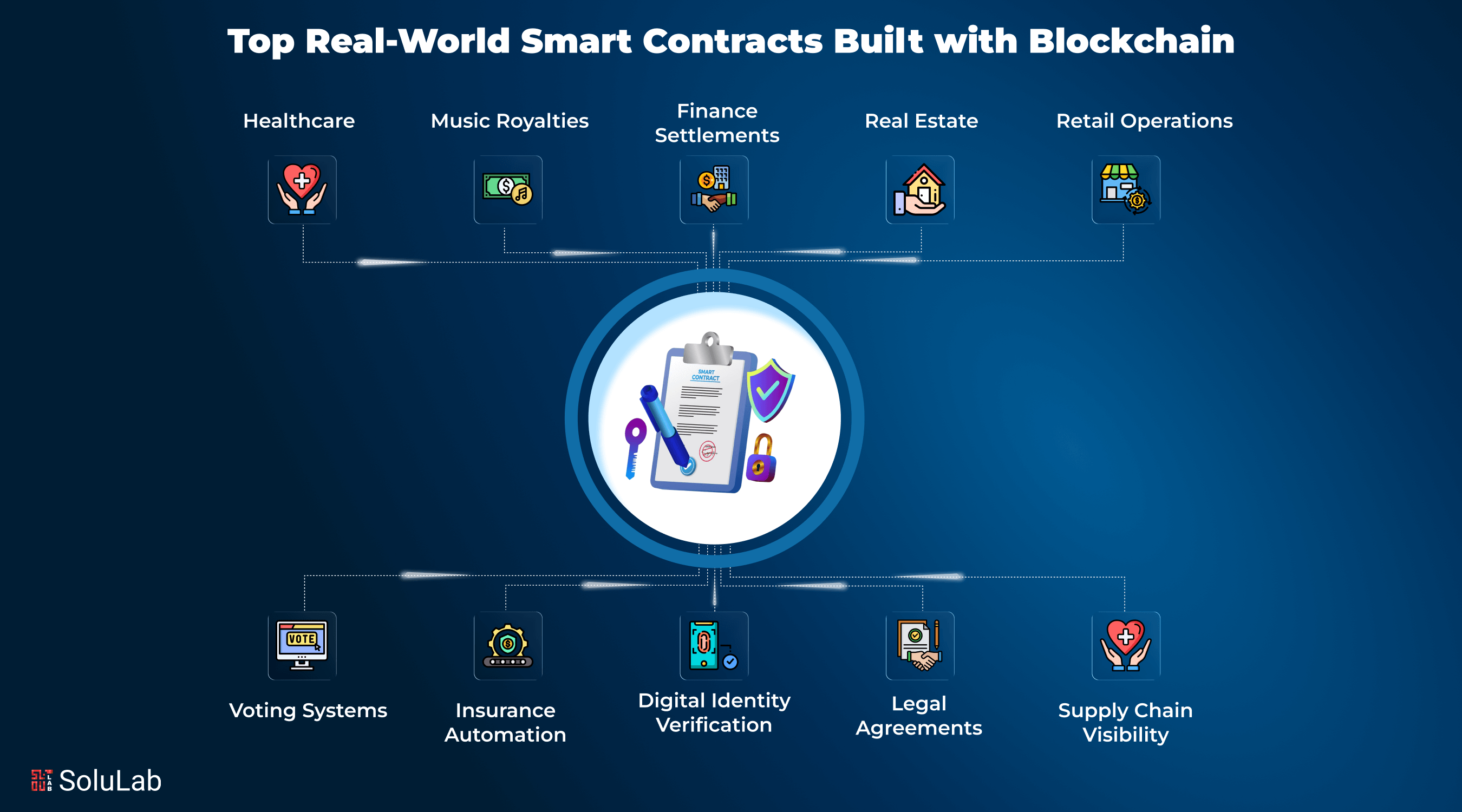
10 Major Real-World Applications of Smart Contracts

1. Healthcare and Clinical Trials

Hospitals store sensitive data that needs protection and quick access. Smart contracts help store medical records on the blockchain. Only the patient can grant access using a private key. This ensures safety and accuracy in diagnosis.

In clinical trials, researchers use smart contracts to automate data entry, patient consent, and trial protocols. They also simplify billing and insurance claims. This cuts administrative costs and improves patient outcomes.

2. Music Royalties and Creator Payments

Musicians often wait months to receive royalty payments. Smart contracts fix this by making instant payments. When a song is streamed, artists and producers get their share right away.

Platforms like Tune.fm use tokens to pay creators directly. Artists can even mint exclusive content as NFTs and sell them to fans. This gives artists better control and a new revenue model.

3. Trade Finance and Cross-Border Settlements

International trade involves banks, shippers, and regulators. Delays are common. Smart contracts automate every step, from document checks to payment release. They also verify shipment tracking and reduce fraud.

Banks use smart contracts to speed up cross-border transactions. Projects like AllianceBlock link blockchain-based finance with traditional banking. This builds a safer, faster global trade environment.

4. Real Estate Transactions and Tokenized Ownership

Buying or selling property requires paperwork and legal checks. Smart contracts on blockchain simplify this by automating payment, ownership transfer, and escrow services. Everything is handled digitally, reducing human error.

Real estate firms use blockchain to offer fractional ownership. Buyers can purchase property shares as tokens. This opens new investment opportunities for people with limited budgets in the form of asset tokenization.

5. Retail Operations and Inventory Tracking

Retailers often spend time managing payroll, inventory, and vendor payments. Smart contracts automate these tasks. This helps store owners save time and money.

For example, Dropp allows retailers to accept micropayments in digital currencies. Retailers also use blockchain tags to track inventory in real time, improving supply chain visibility and reducing theft or losses.

Smart Contract Development Company

6. Voting Systems and Digital Elections

Smart contracts help secure digital voting systems. Each vote is recorded on the blockchain and encrypted. No one can alter it. Voter identity is verified digitally.

This makes elections faster, cheaper, and more transparent. Voter turnout may increase as people can vote online. Some governments are testing blockchain-based elections to ensure fairness and cut costs.

7. Insurance Automation and Claims Processing

Filing insurance claims takes time and often causes disputes. Smart contracts automate claims based on policy rules. Once a condition is met, like a flight delay or hospital admission, the contract pays out automatically.

This cuts down waiting time and reduces fraud. Insurance companies can also use smart contracts to create or renew policies without manual processing.

8. Legal Agreements and Corporate Governance

Legal documents usually take days to process. Smart contracts help create and manage business agreements digitally. Once both parties agree, the system executes the contract.

This reduces legal fees and processing delays. Companies also use smart contracts for tasks like board voting, fund transfers, or performance bonuses.

9. Digital Identity Verification

Third parties often manage digital identities. Smart contracts enable users to securely store and manage their identities on the blockchain. Only trusted apps can access this data.

This improves security, privacy, and user control. Banks use smart contracts for KYC. Healthcare providers use them to access patient data. Governments use them to manage citizen records.

10. Supply Chain Visibility and Escalation Handling

Smart contracts help businesses track goods from source to delivery. Each movement is logged. If anything goes wrong, the contract triggers alerts or penalties.

Platforms like Datahash help prevent fraud in wine supply chains by verifying product origins. These systems reduce losses and improve trust between partners.

Why is There a Need for Smart Contract Integration for Enterprises? 

Enterprises want more control, speed, and security. Manual systems are slow and prone to error. Smart contracts help automate workflows and maintain compliance.

Smart contracts also reduce dependency on third parties. Every action is recorded, making audits easier. Data stays secure and transparent, even across multiple parties.

With growing global operations, businesses need reliable automation. Smart contracts offer just that- faster actions, better records, and less risk.

Industry Leaders Already Using Smart Contracts

Global companies are already using smart contract services for enhanced dealings and partnerships. The following are some leading smart contract-using companies across the globe. Let’s check out how Smart Contacts are changing the business lifestyle. 

  • Uniswap

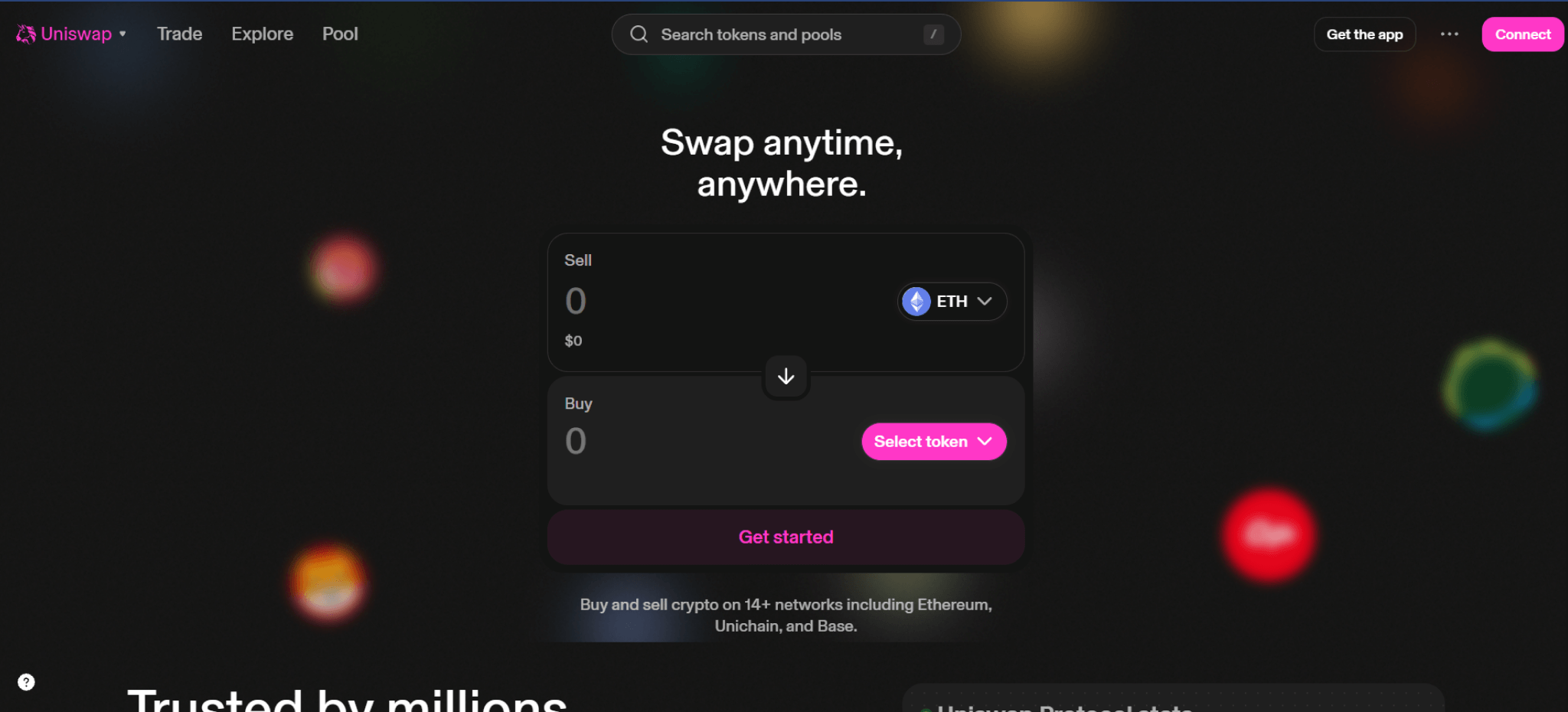
Uniswap is a decentralized crypto exchange that replaced the need for traditional brokers. Every trade is handled automatically using smart contracts. When a user swaps tokens, the contract checks the price, matches the order, and completes the transaction, without a middleman. This has allowed billions in crypto trading to happen in a trustless, secure, and permissionless way. Smart contracts made it possible to build a fully automated financial system that runs 24/7.
Uniswap

  • Chainlink

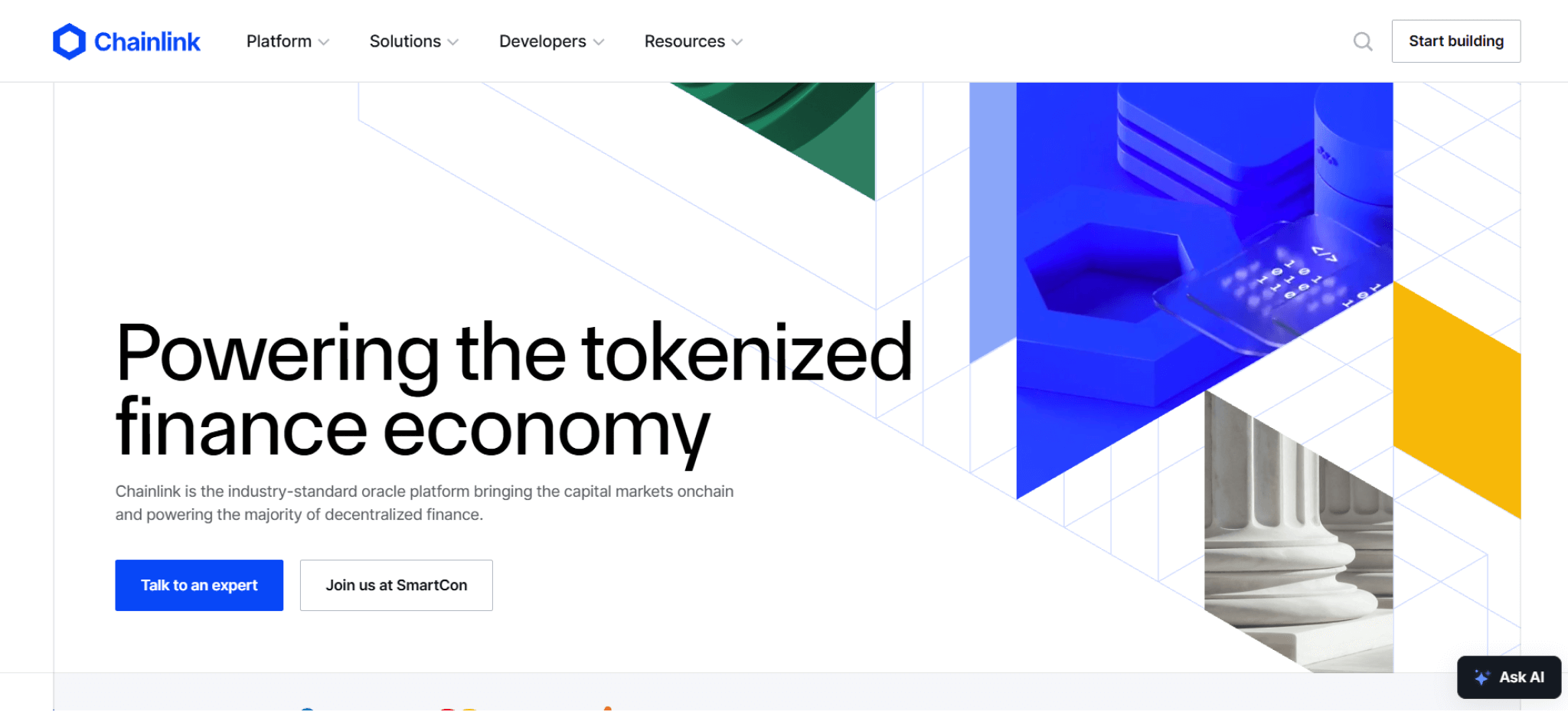
Chainlink solved one of the biggest challenges for smart contracts: getting real-world data into blockchain. It acts as a bridge between on-chain and off-chain systems. For example, a smart insurance contract can use Chainlink to check weather data and trigger payouts for crop damage. Without smart contracts and Chainlink’s oracles, this kind of automation would need multiple parties. Chainlink has opened the door for smart contracts in industries like gaming, insurance, and decentralized finance.
Chainlink

  • OpenSea

OpenSea is the largest NFT marketplace. Each digital item listed or sold runs through smart contracts. These contracts manage ownership, payments, royalties, and even resale commissions automatically. Artists get paid instantly when their NFTs are sold or resold. Smart contracts made this creator-first economy possible by cutting out platforms that used to take high fees and slow down payments.

Opensea

  • IBM + Food Trust

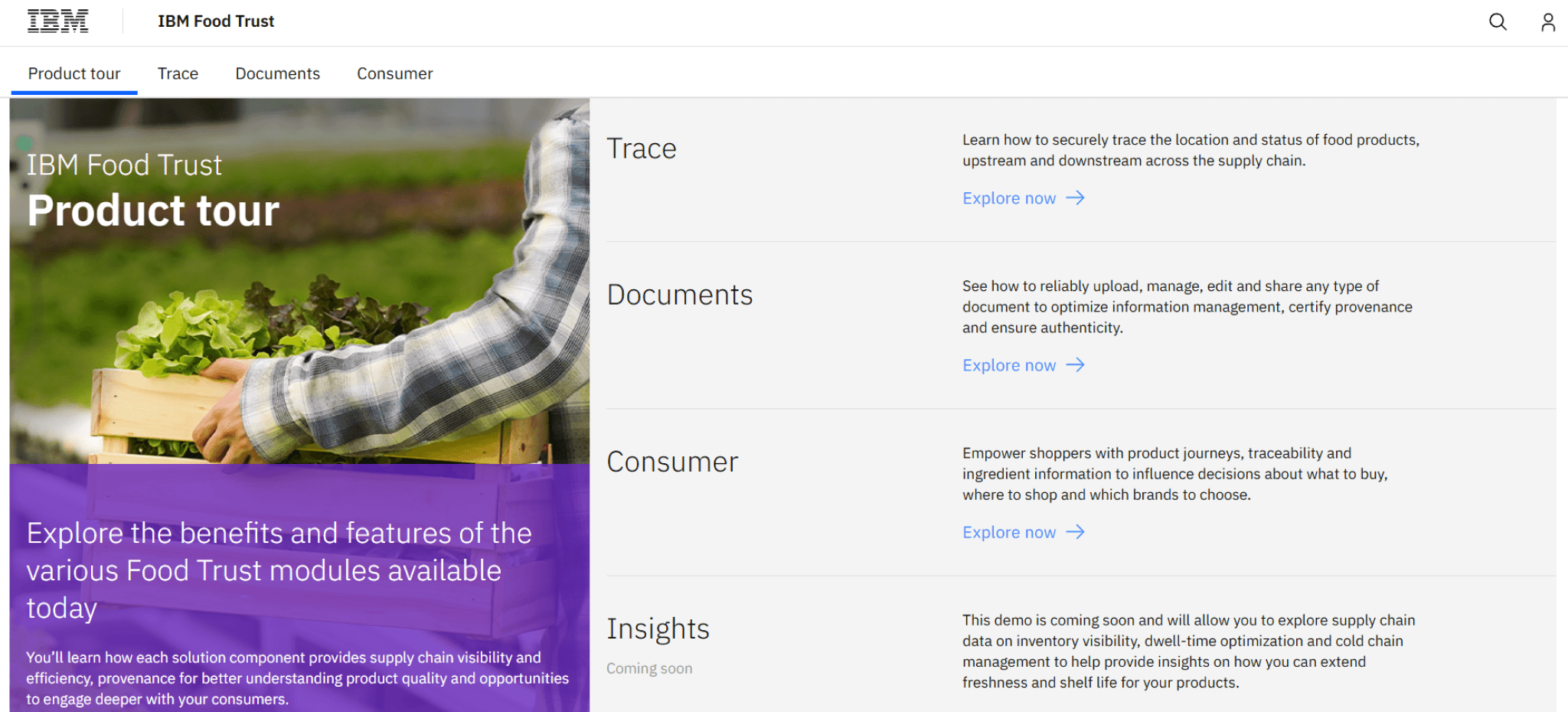
IBM Food Trust uses blockchain and smart contracts to trace food products from farm to store. This helps retailers and consumers track where their food comes from. For instance, when a shipment of lettuce leaves a farm, a smart contract records it. If a recall is needed later, companies know exactly where it went. Smart contracts also automate alerts and speed up responses in case of contamination. This makes the food supply chain safer and more transparent.
IBM + Food Trust

The Road Ahead for Smart Contracts in Blockchain

Blockchain with Smart contracts is just getting started. Developers are making them easier to build and more scalable. Future industries like education, logistics, and public services will also benefit. With better coding practices and legal clarity, adoption will grow. 

Key shifts to expect in the coming years:

  • Cross-chain compatibility will let smart contracts work across multiple blockchains with ease.
  • Low-code tools will allow non-developers to create and launch smart contracts quickly.
  • Integration with IoT will bring automation to industries like manufacturing and smart homes.
  • Legal recognition of smart contracts will improve their validity in courts and regulatory systems.
  • Wider enterprise adoption will simplify operations in sectors like banking, healthcare, and education.

Smart contracts for businesses are changing the way deals are handled, handling data, and running systems.

Blockchain Development Company

Conclusion

As per the above details, we get to know that smart contracts are not just some technological term. They are transforming the business dealings, payment transactions, data, and trust. This automatic system decreases the cost while increasing the transparency, speed, and real-time execution. 

SoluLab is one of the top smart contract development companies. We offer smart contract development solutions tailored for enterprises in different industries. If you are ready to build a smart contract blockchain, contact us today. 

FAQs

1. What are smart contracts in blockchain, and how do they work?

Smart contracts are digital agreements on blockchain. Once conditions are met, they auto-execute tasks like payments or data updates, without needing middlemen like brokers or lawyers.

2. How do smart contracts help businesses?

Smart contracts reduce paperwork, cut costs, and speed up operations. They automate agreements, making business dealings secure, transparent, and error-free across finance, real estate, healthcare, and other industries.

3. Can smart contracts be used in real estate?

Yes. Smart contracts handle payments, ownership transfer, and escrow services. They remove legal delays, reduce errors, and allow fractional property ownership through tokenization for easier investments.

4. Are smart contracts safe to use?

Smart contracts run on encrypted blockchain networks. Once deployed, they cannot be changed. This makes them tamper-proof, transparent, and secure, reducing the risks of fraud or manipulation in business processes.

5. Which companies are already using smart contracts?

Uniswap, Chainlink, OpenSea, and IBM Food Trust use smart contracts for trading, data feeds, NFTs, and supply chain tracking. This is proving real-world success in blockchain-powered automation.

How Blockchain Anonymity Is Maintained?

How is Blockchain anonymity maintained?

An assumption persists since long that cryptocurrencies such as Bitcoin were a refuge for criminals. This was because of their significant properties of being untraceable and being completely anonymous.

Meanwhile, as businesses and the general public grew more familiar with blockchain technology, it was becoming clear that the public transaction record of Bitcoin was, in reality, a gold mine of information for authorities. However, the issue of how anonymous cryptocurrency remains unanswered.

Difference between anonymity and privacy

To fully grasp the issue we’ll be discussing in this essay; we must first define those two – in reality, quite distinct – ideas. Anonymity “describes circumstances in which the actor’s name is unknown.” There is no mention of concealing the deed itself. In contrast, privacy is described as “the capacity of a person or group to seclude themselves, or information about themselves, and therefore express themselves selectively.”

Anonymity is about concealing the “who,” while privacy is about hiding the “what.” Anonymity in the context of blockchains refers to the capacity for parties to trade data without revealing any off-chain identifying information or previous transactions they have completed. Bitcoin, for example, is partly anonymous (each address is nothing more than a public key hash that seems random) but not private at all (we know all transactions done from/to that address

Blockchain Anonymity

Cryptocurrencies have sparked much interest from people, companies, and hackers, with Bitcoin once worth more than $5,000 per unit. Anonymity is one of the benefits of Bitcoin and other cryptocurrencies. However, there are worries that internet money transactions may not be as private as many would want.

There are many types of cryptocurrencies, the most popular being Bitcoin, Litecoin, and Ethereum. Altcoins are cryptocurrencies that were launched after the popularity of Bitcoin. Bitcoin, the father of all cryptocurrencies, mandates that the ledger, or record of transactions, be open to the public, making all transactions public knowledge. Many people are concerned about their anonymity and privacy as a result of this. In this post, we will look at some of the ways that cryptocurrency anonymity has been handled.

Bitcoin is regarded as pseudonymous

Fortunately, the blockchain doesn’t record everything. This means that the identities of the people involved in the transaction are not recorded. As a result, rather than being anonymous, bitcoin is pseudonymous. In many instances, though, one’s personal identity can be connected to one’s bitcoin address.

Bitcoin transactions with a person knowing that your identity exposes information that may be used for the identification of your past and future blockchain activities. Suppose, you send bitcoins to an online store, an exchange, or any business that collects client identification information. In that case, you allow them to connect that identity to your blockchain pseudonym, possibly exposing previous transactions you are involved in.

As a result, Bitcoin offers the ideal paper trail for law enforcement, tax authorities, and compliance experts. Because of this traceability, bitcoin theft becomes a much less appealing endeavor.

Of course, tools that launder bitcoin such as mixers,’ or tumblers’ have emerged. These services try to sever the paper trail by swapping one set of bitcoins for another, each with distinct addresses and transaction histories. But, these services come with limitations. They do not scale effectively for big quantities, and the laundering process is often traceable on the blockchain.

How can you purchase cryptocurrency anonymously?

  • Purchase it from a street vendor

This may seem suspicious, and it may even be counterintuitive to reveal your real identity at the time of purchase. However, if you do your homework, it is not as risky as it appears to be actually.

Bitcoin was exchanged in a particular manner in the early days. Bitcoin meetings would be held. Holders of the cryptocurrency would scream out prices. On the other hand, buyers used to come forward. After agreeing upon a particular price, cash would be exchanged for Bitcoin, sent immediately.

You may utilize services like Facebook, Localbitcoins.com, or Meetup.com to locate vendors in your area that you can get in touch with to exchange Bitcoin for cash. Additionally, you should utilize Tor, a VPN, and burner accounts to maintain more anonymity when you are searching and signing up for such events.

  • Purchase it at cryptocurrency or Bitcoin ATM

Purchasing Bitcoin at a cryptocurrency ATM isn’t always the greatest financial decision. To buy coins, Bitcoin ATMs mostly utilize APIs directly connected to cryptocurrency exchanges, and the person operating the ATM will surely charge a service fee for making the transaction.

They are, nevertheless, helpful for purchasing bitcoin secretly. However, one should choose their Bitcoin ATM wisely since some demand you to establish an account, thereby, exposing your name. You can go in, put some money in, and receive some bitcoin on a paper wallet for those who don’t. One may then transfer this Bitcoin to their preferred wallet using a mixer service. This will conceal its origin further and protect one’s identity.

Purchasing bitcoin by not disclosing your name is one thing. But, what one does with it may still expose your identity. Therefore, it’s important to be aware of how you’re utilizing your bitcoin at all times.

Techniques for preserving blockchain anonymity

1. Decentralized: Not under the control of governments

One of the most significant advantages of blockchain technology is its decentralized nature. Nobody has complete control over it. The blockchain of Bitcoin, for example, is maintained by hundreds of thousands of nodes. Hacking one percent, or even half, of the computer nodes, will not give you control over bitcoin.

To get power, you must launch a 51 percent assault on the whole blockchain. According to studies, a successful assault would cost $1.4 billion and months of effort. But, in exchange, you would have momentary control over the network and nothing to show for it monetarily since the coins would lose value immediately.

Blockchain communities rule themselves because they have such a high degree of security and no centralized authority. After all, self-rule was the original aim of bitcoin, and the policy was successfully handed down to all subsequent blockchain initiatives.

2.  VPNs and Tor

The best VPN and Tor services are both intended to protect the user and may be used to preserve anonymity. These technologies are utilized for both safety and privacy by researchers, journalists, businesses, governments, and others. Many bitcoin users with comparable worries utilize them as well. For example, many ransomware decryption tools are hosted on Tor as secret services.

VPNs are often used to conceal personal information while requesting bitcoin transactions. Both VPN and Tor can conceal a user’s personal information during a transaction by utilizing an alternative IP address or geolocation, which is occasionally customizable by the user. These technologies make it impossible for an attacker or analyst to observe traffic by correlating IP addresses and transactions. It may also be used to communicate with others, such as merchants while concealing your address from them.

VPNs are often used to conceal personal information while requesting bitcoin transactions. Both VPN and Tor can conceal a user’s personal information during a transaction by utilizing an alternative IP address or geolocation, which is occasionally customizable by the user. These technologies make it impossible for an attacker or analyst to observe traffic by correlating IP addresses and transactions. It may also be used to communicate with others, such as merchants while concealing your address from them.

3. CoinJoin

Typically, the back-end technology of decentralized mixers is the most frequently utilized technology. Gregory Maxwell proposed the CoinJoin protocol in 2013. The fundamental idea is that a group of payers combine their money and make a collective payment, obscuring the connection between payer and payee.

CoinJoin is made feasible because not every input in a transaction must originate from the same wallet or user. Because the signatures needed to verify a transaction are independent for each input, many users may agree to execute a single transaction to numerous unconnected payees. As a result, the information regarding which input paid which payee is not part of the blockchain and can be avoided.

CoinJoin is a critical tool for preserving anonymity since it serves as the foundation for numerous methods and implementations. SharedCoins, Darkwallet, CoinShuffle, PrivateSend, and JoinMarket are a few examples of implementations.

4. Ecosystems of Blockchain

Secure blockchain ecosystems can reduce many of the security risks associated with blockchain technology. However, using bitcoins to purchase items on Amazon does not provide much privacy. Amazon already has your name and address.

However, blockchain ecosystems that prioritize user privacy can remove all such risks. Blockchains may create secure chains that enable transparent, anonymous transactions ranging from product descriptions to purchasing and selling.

In the e-commerce industry, merchants post their products on the blockchain and enable customers to evaluate and verify the components used in their production. The transit of products from the shop to the delivery destination may be monitored safely without revealing any unnecessary addresses. Payments are made possible by digital currencies, and internet reviews help consumers discover the finest purchasing sites.

5. CryptoNote

A ring signature is a digital signature that enables one member in a group to sign on their behalf. This phase adds security by making it computationally difficult to identify which group members’ keys were used to generate the signature.

Conclusion

Bitcoin is a decentralized payment system that offers a method for obtaining numerous anonymous credentials, bitcoin addresses that may be used to conduct and receive payments. However, the previous study has shown that the system that utilizes such addresses may provide information about their owners. Furthermore, because all transactions conducted by the system are publicly accessible for study in the blockchain, it is possible to cluster various addresses belonging to the same user and classify certain usage.

Furthermore, if one of the cluster’s addresses can be linked to a real person, the payment history of the whole cluster may provide important information about that user. Although interesting research has been conducted in this area, the dynamism of the bitcoin ecosystem, which constantly modifies and improves bitcoin usage, implies that some of the hypotheses assumed for those blockchain analyses may not hold completely. Thus blockchain analysis still presents interesting open questions.

– Contact Us –

SoluLab being the top 3 Blockchain developers can help you build the perfect blockchain ecosystem.

Reach Out To Us Today

How Smart contracts can help in mergers and acquisitions?

Introduction

Blockchain technology is one of the emerging technologies which enables users to store data in distributed ledger and decentralised networks. Blockchain technology has an application called smart contracts. Blockchain technology is limitless. Also, it helps people to imagine a world where all transactions take place digitally. Several nations are working on blockchain-based solutions.

With the use of digital currency on the blockchain, one would be able to track all the transactions, and further, it can be stored on the distributed ledger. A distributed ledger can be shared among different users in a blockchain network. 

Blockchain has transformed several industries, and the legal sector is one of them in which it can make massive transformations. Merger and Acquisitions is one of the essential tasks, and it involves several legal works. Blockchain and smart contracts can make mergers and acquisitions hassle-free and straightforward. 

With the use of smart contracts, several tasks in mergers and acquisitions would be automated.  Blockchain would make the process of M&A faster, confidential and more straightforward. Also, it won’t be needing much validation, and even when a particular set of conditions would be fulfilled, the transaction will be done. Hence blockchain can be really advantageous for merger and Acquisition. In the below section, more emphasis is laid on the working of smart contracts.

How do smart contracts work?

A smart contract is analogous to the legal contract, it is a self-executing contract, in which several terms of agreements are hardcoded. A smart contract can be defined as the digital version of the standard paper, which automatically verifies when the conditions are fulfilled. Smart Contracts were invented by Nick Szabo, who is an American computer scientist and digital currencies researchers.

Every smart contract is executed in the blockchain network, and the same code of the smart contract can be founded in different nodes of the network. Also, it ensures transparency and facilitation and improves contractual terms’ performance.

An advantage of smart contracts is that it does not require any middlemen. Since every code of the smart contract is self-executable and verified by the nodes available in the network. Also, the removal of middlemen contracts helps to reduce the cost of counterparties.

Blockchain and Smart Contracts

Smart contracts are based on the blockchain technology and also known as the blockchain 2.0 version. A blockchain is a record or collection of blocks that are linked together with the use of cryptography. Blockchain technology is entirely different from the conventional database, as it does not have any centralized authority. All the data in blockchain stored is shared among all the nodes of the network. Also, the main advantage of blockchain is to control failures and attacks. 

In the blockchain, data cannot be altered since if any alteration is needed to be done, it needs to happen in each node of the blockchain. All the transactions are stored in a block, and that block is linked with the chain. A new Block is formed when a hash of the previous block is created. A block is added to the blockchain in chronological order, and every block contains the cryptographic hash of the last block.

How do smart contracts operate?

For building any smart contract, one needs to determine the terms of contracts, like different terms of the contract. Once the contractual terms become fixed or finalized, all these conditions are written in the form of code. Every code in a smart contract would have several conditional statements that describe the legal terms of the contracts.

How can we make use of smart contracts for Mergers and Acquisitions?

For every big business, Mergers and Acquisitions play an essential role. All these significant transitions happen in incredible amounts of stress. During Mergers and Acquisitions, several concerns for employees as well as for company culture arise. Also, there are large numbers of technical concerns that arise with mergers and acquisitions. 

In the current scenario, due diligence is a huge task during Merger and Acquisitions deals. But with the use of blockchain, several legal advisors and financial advisors won’t be needing a considerable time spent on recording data. Also, it will save a significant amount of money. With the use of self-driving blockchain-based contracts, merger parties would save huge time, and further improvement can be done, which needs a human touch.

Advantages of smart contract in Mergers and Acquisitions

  • It reduces the cost – Several processes enabled using smart contracts require fewer intermediaries and interventions.
  • Less number of Intermediaries – Smart contracts would be able to reduce reliance on other party intermediaries. 
  • It reduces execution risk – Smart contract reduces the manipulation, non-performance, and errors during execution. Also, it can be managed automatically on the network instead of an individual party
  • Smart contracts increase accuracy – All the automated transactions are not only fast but also less prone to errors.

Importance of Blockchain

Distributed ledgers and several databases, does not require full trust in each other. Also, it maintains the consensus.  Blockchain is a category or another form of distributed ledger technology. Several ways in which Blockchain can improve mergers and acquisitions.

It increases integrity and transparency

  1. It would be tough to alter data or delete any transactions.
  2. No intervention of any third party.
  3. One could be able to trace activities and transactions.
  4. Automates the auditing

Blockchain could be useful and preconstitute evidence for the agreement that takes place between two different parties. All several variables are taken in consideration such as price, timestamp, and fixed content.

Blockchain increases efficiency and interoperability

Blockchain prevents several issues like double spending, overwritten duplicate files. Since there is no middle man, one does not need to have a central administrator for maintenance of files. Also, blockchain is the best solution for interoperability.

Blockchain leads to privacy and flexibility

With the use of blockchain, one would be able to modulate powers and accesses. In Merger and Acquisition, several parties are involved, such as lawyers, investment bankers, mediators, tax and several accounting experts, guarantors, and appraisers. Every different role has its rights. 

Blockchain makes networks more secure

In blockchain several nodes are there in the network, hence if anyone node fails, the network will still work.

It brings more understanding

With the use of machine learning and APIs, one can make calls to different data sources.

How you can use SPA as a smart contract

Smart contract as SPA would map the individual transaction, which makes tax considerations and due diligence. Contracts used for acquisitions would make the mechanism simpler. Also, it will help to avoid all the misunderstandings. 

In M&A transactions, smart contracts would be able to replace earnouts, and it will present an example of how blockchain can revolute infrastructure. Earnouts are considered to be essential. Smart contracts used for M&A will reduce the risk in a huge amount. Also, during the intervals, all the earnings would be automated. Once the conditions would be satisfied, the payment would be made automatically. 

Also, smart contracts would be quite complex, if more details and conditions would be established. However, the underlying work would be the same; underlying agreement and enforcement are systematic.

With the use of smart contracts, one can build algorithms that would be automatically indexed, and every transaction would be modeled. In order to make things easier, one can store information on a distributed ledger. In a distributed ledger, an individual would be able to make a review of the transaction efficiently, and it would also bring more clarification on several complicated transactions.

What kind of Blockchain would be useful for mergers and acquisitions?

A consortium blockchain would bring more confidentiality in the infrastructure; also, a confidential shareholder vote would be necessary. With the use of blockchain, once, can have complete transparency, and it will make work more hassle-free. 

Also, with the use of a distributed ledger of transactions, it will reduce the work of reviewers like accountants, CFOs and lenders. 

Conclusion

Blockchain technology is fascinating, and it still needs to experiment in the M&A deal. Also, it faces several obstacles, like cultural resistance. Also, very fewer people have shown interest in blockchain technology and use cases. It would require several test cases to run to make authorities more comfortable with the blockchain.

Also, with the use of smart contracts, several transactions would be automated when the conditions will be completed. Also, a basic structure would be there that will automatically pay buyers and sellers once the deal is made. Also, with the use of blockchain contracts, one would be able to trigger the payment. 

Smart contracts would also be able to reduce the potential burden on administrators and would make it more appealing for both parties involved in the deal. With the use of blockchain and smart contracts, you can make M&A easier. Also, for more information, you can contact companies like SoluLab for more information. Also, several developers would assist you in building it for your firm. You can make work automated with the use of blockchain.

Quick Read: Underlying Problems of Smart Contracts And How To Deal With Them

What Opportunities Smart Contracts Can Bring To The Music Industry?

Blockchain in music industry is one of the trending benefits for the entire media industry. Blockchain in music and media protects content and rights from digital theft. Smart contracts ensure that the sale of music content has appropriate digital authorization. It also ensures necessary digital protection in case of theft and plagiarism. Smart contracts also help in receiving royalties for the music content published and released. In short, smart contracts add value and enhance the operability of all operations that take place within the music industry. 

Traditional Challenges Faced in The Music Industry   

Consider a chain of operation in music industry where, the process starts from songwriters,  performers, publishers and ends with fans. Each operation starting from creation of music until it reaches the fans involves multiple parties. These parties include labelling companies, profession digital marketers, digital aggregators, producers, recording facilities, etc.

Read More: Can Blockchain Make a Wave in Music, Media and Entertainment?

Traditionally, there existed a huge constant confusion between parties due intervention by multiple parties. 

For example, a songwriter asks where is their money? A publisher focuses only on collecting royalties and says ask the professionals. A labelling partner focuses only on promoting the content and they say they don’t know. A professional says they only know the songwriter and does not know what is going on with the publisher and labelling partners. It finally leaves an aggregator in confusion about who owns the song. At the end, a song writer is still left with the question, how long song a will it take to reach their fans? and where is their money? 

You see the confusion here? It is due to loss of information somewhere in between the chain of command or supply chain or due to manipulation of data and operations, etc. All these confusions can be eliminated completely with the usage of smart contracts. 

Opportunities from Smart Contracts in the Music Industry 

Blockchain music media entertainment

Safeguarding and protecting Intellectual Property Rights (IPR)

Smart contracts in music industry monitor each and every song released on blockchain platform. This in turn, assigns a unique number to each song authorized and published. This unique number allows artists to have control over their music content. And, ensure that their music is not digitally copied or stolen. Smart contracts also encrypt songs with public or private encryption according to the requirement. This encryption does not allow money launderers to get a hold of a digital copy of the IPR of a song. 

Music artists get to be entrepreneurs 

Music artists can control and monitor royalty payments with smart contracts in real-time. This ensures that publishers, labelers, performance artists and all necessary personnel get paid on time. It also allows receiving royalties or song bought from licensee or franchisee on-time without delay. Music artists can now conveniently make their own decisions without having to hire a middle-manager to handle decision-making. 

Earning creatively with blockchain based music startups 

Smart contracts allow music artists to provide free streaming to fans in their own Convenient time and platform. This cuts down middlemen which reduces the cost of subscription packages and premium privileges in live-streaming of music events. Using smart contracts, music artists can predict how much money they could earn from copyrights using data management systems for accuracy integrated with smart contracts. 

Faster P2P transactions allow direct payments 

One-touch, instantaneous payments is possible with smart contracts as it is decentralized. There is no central authority that has to verify and pass through transactions. Peers can directly connect with each other. For instance, the recording studio can instantly connect with publishers and labelers to acquire trademark and copyrights for the music. Simultaneously, fans can pay for the song. Blockchain ensures equal division of  money gets paid in equal share accordingly between the recording studio, publishers, labelers and music artists, etc.  

P2P payments become more faster and easier if music artists wish to use smart contracts that allow cryptocurrencies as one of the payment options too. 

Direct connection between music artists and fans 

Music artists can directly connect with their fans at any point of time and day to acquire feedback, suggestions, ideas or just interact. Say goodbye to the traditional obstacles of waiting to authorize music artists to interact with fans. Fans and music artists can transact and transfer files among each other quickly and easily with smart contracts without any restriction. 

Transparency in royalty payments and ownership 

Smart contracts in music industry allow music creators to receive payments directly without any third-party intervention to handle their transactions. Thus, the payment is received in real time without any legal restrictions. Also, data manipulation is not possible with smart contracts as it uses blockchain. In order to change an information, the complete system has to be re-structured or re-programmed which is not logically encouraged. 

Blockchain-based projects that are providing opportunities for the music industry 

Choon 

Allows music artists to gain income with an increase of 80% from their investment through decentralized distribution approach. 

Bitsong 

Provides decentralized platform for streaming of music. Music artists can directly receive donations from their fans. 

Revelator 

Allows key personnel to monitor copyrights of the music at all times to ensure digital security and protection of the music content. 

BitTunes 

Offers a bitcoin-based platform to share music files and also allows fan themselves to stream songs digitally with appropriate protection. 

Over to you!  

Traditionally, Blockchain development for music industry can play important role in an artist’s life. A music artist also didn’t have the freedom of speech in their song content due to various regulatory limitations. Now, using blockchain and smart contracts, music artists have complete freedom to express emotions through their songs. In addition, smart contracts in music industry record all operations in real-time. Hence, all involved get real-time updates on the progress of the published song at each stage. This enhances transparency, trust and confidence between studio managers, artists and fans.

Use smart contracts and gear your song with freedom. Let us know, what are the other opportunities you think that smart contracts will bring music industry. 

Underlying Problems of Smart Contracts And How To Deal With Them

It has been observed that the smart contract technology has got a lot of benefits to offer to its users. Be it elimination of the middlemen for exchange of the money or some other thing that is of certain value, blockchain based smart contracts are beneficial. Though blockchain has brought a great revolution in the industries, it certainly got some factors which are causing negative impact as well.

As we crunch the numbers Ethereum 3% smart contract failure might be considered as only a minor loss but when its causing harm to currency worth billions of dollars it is certainly a cringeworthy moment. A fresh example of this is the ICON June 2018 bug which allowed any of is user to enable as well as disable the transactions and having that authority to holdup million of dollars of transactions would definitely affect most of the people but in the previous years there were more incidents reported.

Botch incident

One of the major botches was of the Distributed Autonomous Organisation (DAO) that occur in the year 2016 where through blockchain smart contract hacks, a whopping 3.6 million Ether were drained; due to which, the founders of the Ethereum were forced to take some measures and to create some policies so as to recover the lost funds.

Certainly, time is required so as to eliminate faults in a technology that has been recently introduced and same goes in the case of smart contract development services. But one cannot deny that the flaws which are related to issue such as funds, important information such as the data and other security things makes the technology simply riskier to use than its worth. There are a lot of projects which have faced one problem or the other and restoring their faith again in the technology is quite difficult.

Security issues

Security issues have always surfaced for many of the companies that offers the blockchain smart contracts but even a slightest mistake can cause heavy losses when it comes to smart contracts. Features such as verification of the smart contracts and the auditing are being introduced. Currently these options are being preferred for the security purposes and are at the frontier position at the market with cost around in thousands of dollars.

These can be effective for a mere number of cases but when it comes to global level where the need to blockchain is increasing day by day these solutions are certainly not going to be good enough and an alternative solution is definitely required to fulfil the needs and demand.


Quantstamp has taken a step forward in this field as it has introduced a security auditing protocol for the smart contracts.  The salient feature of this is that with the help of the verification software along with the bug finders the smart contract of the clients will be examined.

Companies do try to solve these smart contract development problems, but the main issue is the scalability which is a major problem due to which they are not able to address certain issues. Another solution that has come up for this problem is the engineered solution which is developed by CertiK. Talking about this engineered solution it is a platform for the verification for the several components of the blockchain system which includes smart contracts as well.


CertiK is expected to bring that revolution as it does not require the presence of bugs for the verification. Whether the item is hacker-resistant or not will be proved mathematically by it. CertiK works on the principle of the layer-based system therefore what happen according to this is a certain task is divided into several smaller fragments so that with is the task can be easily solved and that too in decentralised fashion.

CertiK has already made a mark with its previous achievements such as development of one of the worlds first hacker-resistant operating system. The reason behind this success is the strong team of CertiK . The team is a combination of academic and corporate members consisting of professors from prestigious universities like Yale and Columbia university and have some of the skilled and prominent software engineers from the topmost companies such as Facebook, Google etc.

Fate of Technology

So overall when we see blockchain certainly there are some issues when it comes to trust and being corruptible which may raise eyebrows of many but if these bugs are eliminated from the technology then it is quite beneficial to use the technology and as a matter of fact there is no denial in the fact that blockchain is the future. Blockchain can be considered as a prominent safe for storing billions of dollars if these faults are eliminated and we come up with the proper solution for them. The solutions such as the verification one needs to be strong enough to restore the faith of people who have lost it due to the previous incidents and should attract new users too.
