Talk to an Expert

Revolutionising Real Estate With Blockchain Technology

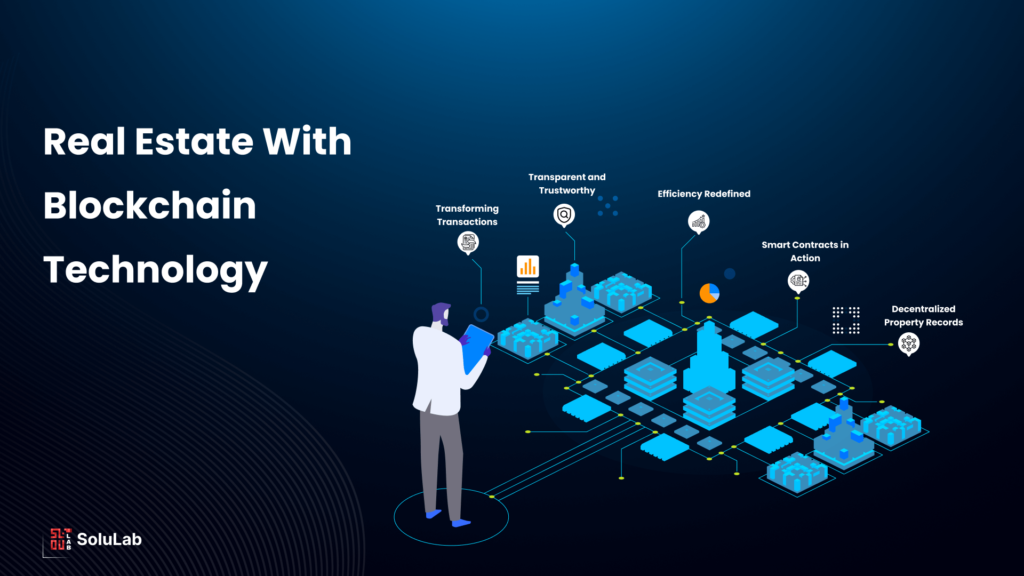
Real Estate With Blockchain Technology

Blockchain technology, a groundbreaking innovation originally devised for the cryptocurrency realm, has now transcended its initial confines and is making significant inroads into diverse industries. One sector where its transformative potential is particularly conspicuous is the real estate industry. This introduction aims to provide a concise yet comprehensive overview of blockchain technology, its relevance in real estate, and the challenges facing the real estate industry today.

At its core, blockchain is a decentralized, distributed ledger that records transactions across a network of computers securely and transparently. Utilizing cryptographic principles, each block in the chain is linked to the previous one, creating an immutable and tamper-resistant record. This technology ensures trust and transparency by eliminating the need for intermediaries and central authorities, offering a peer-to-peer approach to transactions.

The real estate industry is confronted with a myriad of challenges, ranging from cumbersome and time-consuming processes to issues of transparency and fraud. Traditional methods of property transactions involve numerous intermediaries, leading to inefficiencies, delays, and increased costs. Additionally, the lack of transparency in property records and the susceptibility to fraudulent activities have created a pressing need for innovative solutions.

What are the Fundamental Principles of Blockchain?

Blockchain, at its core, is a decentralized and distributed ledger technology that underpins a secure and transparent system for recording and verifying transactions. The fundamental principles of blockchain include decentralization, transparency, immutability, and consensus. Unlike traditional centralized systems, blockchain operates on a network of nodes, each contributing to the validation and verification of transactions. 

The decentralized nature of blockchain ensures that no single entity controls the entire network, fostering trust and eliminating the need for intermediaries.

A. Decentralization and Security Aspects

Decentralization is a cornerstone of blockchain, ensuring that data is not stored in a single location but is distributed across the network. This mitigates the risk of a single point of failure and enhances the system’s resilience. Security in the blockchain is achieved through cryptographic techniques, making it nearly impossible for malicious actors to tamper with or alter the stored information. The use of consensus mechanisms, such as proof-of-work or proof-of-stake, further fortifies the integrity of the blockchain network.

B. Blockchain in Real Estate

The application of blockchain in the real estate sector has the potential to revolutionize traditional processes, offering benefits that include increased transparency, efficiency, and security. One notable advantage is the reduction of fraud, as blockchain’s immutability ensures that once a transaction is recorded, it cannot be altered. Additionally, smart contracts, self-executing agreements with predefined rules, automate and streamline various real estate processes, eliminating the need for intermediaries and reducing the risk of errors.

Real Estate Tokenization Services

What is the Transformative Impact of Blockchain on Real Estate?

Blockchain technology has emerged as a revolutionary force across various industries, and the real estate sector is no exception. Its decentralized and transparent nature brings forth a myriad of benefits, fundamentally reshaping the way property transactions are conducted. This article delves into the profound impact of blockchain on real estate, exploring key aspects such as transparency, smart contracts, and the tokenization of real estate assets.

1. Transparency and Trust in Property Transactions

One of the primary advantages of integrating blockchain in real estate is the enhanced transparency it brings to property transactions. Traditional real estate processes often involve multiple intermediaries, leading to a lack of transparency and increased potential for fraud. With blockchain, a decentralized and tamper-proof ledger ensures that all transaction data is securely recorded and easily accessible to relevant parties.

Blockchain technology promotes trust by providing a single source of truth for property records. This transparency mitigates the risk of fraudulent activities, as every transaction is verifiable and cannot be altered retroactively. Real estate stakeholders, including buyers, sellers, and regulatory bodies, can confidently rely on the accuracy and immutability of the information stored on the blockchain, fostering a more trustworthy and efficient property transaction ecosystem.

2. Smart Contracts Revolutionizing Deal Processes

Smart contracts, enabled by blockchain technology, are automating and revolutionizing deal processes in the real estate industry. These self-executing contracts automatically enforce and execute the terms of an agreement when predefined conditions are met. This eliminates the need for intermediaries, streamlining the overall transaction process and reducing the potential for errors or disputes.

Smart contracts in real estate facilitate quicker and more secure transactions, as they eliminate the need for manual verification and approval. From property sales to lease agreements, the automation provided by smart contracts not only increases efficiency but also reduces transaction costs. This innovation is a testament to the transformative power of blockchain in simplifying complex real estate processes.

3. Tokenization of Real Estate Assets

The concept of tokenization involves representing real-world assets, such as real estate properties, as digital tokens on a blockchain. This fractional ownership model allows investors to buy and trade fractions of real estate assets, providing liquidity and access to a broader pool of potential investors.

Blockchain facilitates the tokenization of real estate assets by dividing them into tradable tokens, each representing a share of the property. This democratizes real estate investment, allowing individuals to participate in high-value properties with smaller investments. Asset Tokenization not only enhances liquidity but also reduces the barriers to entry, opening up new opportunities for both investors and property owners.
What are the Key Challenges Associated With the Adoption of Blockchain Technology in the Real Estate Industry?

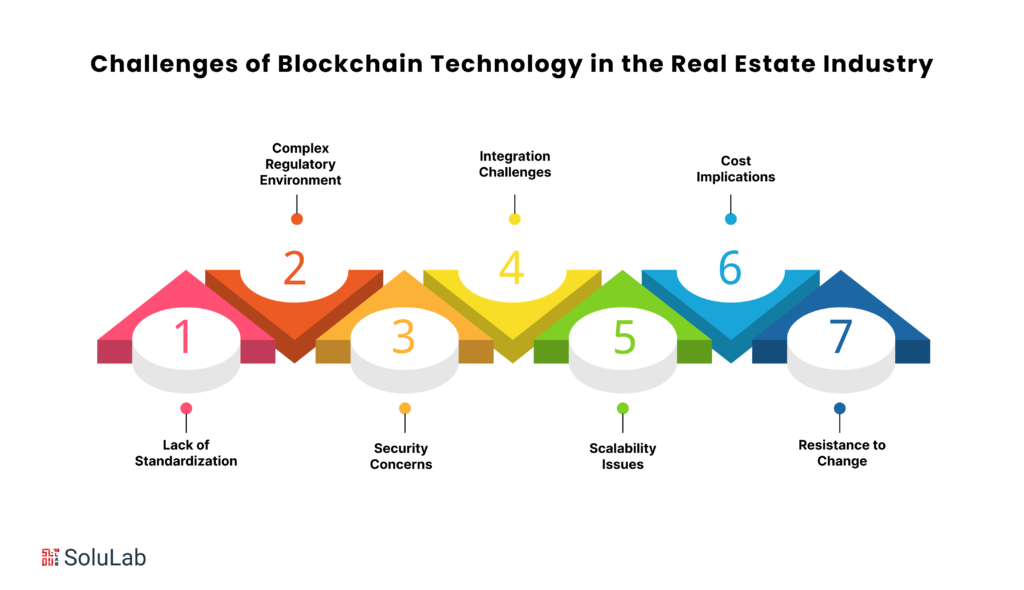
Challenges of Blockchain Technology in the Real Estate Industry

The adoption of blockchain technology in the real estate industry has gained significant traction, promising transformative benefits and revolutionizing traditional processes. However, like any innovation, it is not without its challenges and concerns. In this article, we delve into the key obstacles associated with incorporating blockchain in real estate and explore potential solutions.

1. Lack of Standardization

One major challenge in the integration of blockchain in real estate is the absence of standardized protocols. The industry requires universally accepted standards to ensure interoperability, data consistency, and seamless collaboration between different stakeholders.

2. Complex Regulatory Environment

Real estate transactions are subject to a myriad of regulations, varying across jurisdictions. Navigating this complex regulatory landscape poses a significant hurdle for the widespread adoption of blockchain in real estate. Developing a framework that aligns with existing regulations is crucial for fostering trust and compliance.

3. Security Concerns

While blockchain is renowned for its robust security features, the real estate industry’s adoption is hindered by the fear of cyber threats and unauthorized access. Building trust in the technology necessitates implementing robust security measures, and encryption techniques, and educating stakeholders on the resilience of blockchain against cyber attacks.

4. Integration Challenges

Many real estate processes are deeply entrenched in traditional systems, making the integration of blockchain a daunting task. Overcoming technical challenges and seamlessly integrating blockchain applications in real estate workflows requires a comprehensive strategy, skilled professionals, and a phased approach.

5. Scalability Issues

As the real estate industry generates vast amounts of data, scalability becomes a concern. Ensuring that blockchain technology can handle the scale of transactions and data storage required for real estate applications is vital for its successful adoption.

6. Cost Implications

Initial setup costs and infrastructure investment can be a deterrent for real estate businesses considering blockchain adoption. Convincing stakeholders of the long-term benefits and potential cost savings is essential for overcoming this challenge.

7. Resistance to Change

Resistance to change is a common hurdle in any industry, and real estate is no exception. Overcoming skepticism and convincing stakeholders, including property owners, buyers, and regulatory bodies, about the advantages of blockchain in real estate is a critical aspect of its successful implementation.

How is Blockchain Technology Reshaping the Future of the Real Estate Industry?

In recent years, the real estate industry has witnessed a paradigm shift with the integration of blockchain technology. This transformative force is not only reshaping traditional processes but also paving the way for numerous emerging trends that promise to redefine the sector. Let’s delve into the future trends of Blockchain in Real Estate, exploring potential advancements, innovations, and the benefits that this revolutionary technology brings to the industry.

A. Emerging Trends in Blockchain and Real Estate

  • Tokenization of Real Estate Assets

Blockchain facilitates the fractional ownership of real estate through tokenization. This allows investors to own a share of high-value properties, making real estate investment more accessible and liquid.

  • Smart Contracts Streamlining Transactions

Smart contracts, powered by blockchain, automate and streamline various processes in real estate transactions, from property listings to payments and contract execution. This not only reduces the need for intermediaries but also enhances transparency and security.

  • Decentralized Property Listings

Blockchain enables the creation of decentralized and tamper-proof property listings, preventing fraudulent activities and ensuring the authenticity of property information. This contributes to a more trustworthy and efficient real estate market.

B. Potential Advancements and Innovations

  • Enhanced Security and Transparency

Blockchain’s immutable and decentralized nature ensures the security of sensitive data in real estate transactions. This reduces the risk of fraud and ensures that all parties involved have access to a transparent and unalterable record of the transaction history.

  • Blockchain-Based Real Estate Platforms

Innovative platforms are emerging, utilizing blockchain for property transactions, rental agreements, and property management. These platforms enhance efficiency, reduce costs, and provide users with a seamless and secure experience.

  • Integration with Emerging Technologies

The integration of blockchain with other emerging technologies like AI and Internet of Things (IoT) is on the horizon. This convergence can lead to intelligent property management systems, automated maintenance, and even predictive analytics for property values.
What are the Risks and Mitigations in Harnessing Blockchain for Real Estate?

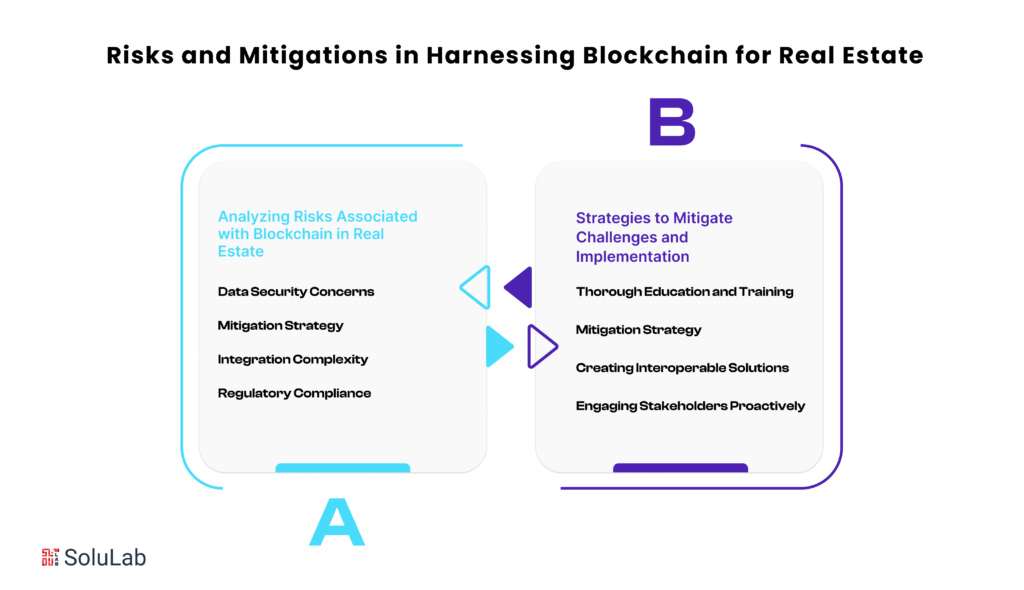
Risks and Mitigations in Harnessing Blockchain for Real Estate

Blockchain technology has emerged as a revolutionary force in various industries, including real estate. Its decentralized and secure nature promises to streamline processes, enhance transparency, and reduce fraud. However, as with any innovative technology, implementing blockchain in real estate is not without its challenges. In this section, we delve into the risks associated with blockchain in real estate and explore effective strategies to mitigate these challenges for a successful implementation.

A. Analyzing Risks Associated with Blockchain in Real Estate

  • Data Security Concerns

The decentralized nature of blockchain is both its strength and potential weakness. While it minimizes the risk of a single point of failure, it introduces concerns related to data security. Unauthorized access to sensitive information could compromise the integrity of real estate transactions.

  • Mitigation Strategy

Employing robust encryption protocols and implementing permissioned blockchain networks can enhance data security, ensuring that only authorized parties have access to sensitive information.

  • Integration Complexity

The existing real estate infrastructure may not seamlessly integrate with blockchain technology, leading to complexities in implementation. This could result in disruptions to ongoing processes and hinder the adoption of blockchain.

  • Regulatory Compliance

The real estate industry is subject to stringent regulations that may vary across regions. Adhering to these regulations while incorporating blockchain poses a significant challenge, potentially leading to legal issues and setbacks.

B. Strategies to Mitigate Challenges and Ensure Successful Implementation

  • Thorough Education and Training

Educating stakeholders, including real estate professionals, on the benefits of blockchain in real estate is crucial. Training programs should cover both the conceptual understanding of blockchain technology and its practical applications.

  • Mitigation Strategy

Elaborating with educational institutions and industry experts to develop targeted training programs can ensure that all parties involved possess the necessary knowledge to harness the benefits of blockchain.

  • Creating Interoperable Solutions

Developing blockchain solutions that seamlessly integrate with existing real estate systems is essential. Interoperability ensures a smooth transition and minimizes disruptions during the implementation phase.

  • Engaging Stakeholders Proactively

Involving all relevant stakeholders in the planning and implementation process fosters collaboration and addresses concerns at an early stage. Proactive engagement ensures that everyone is aligned with the objectives of integrating blockchain in real estate.

How is Blockchain Technology Reshaping the Global Real Estate Landscape?

Blockchain technology has rapidly gained traction across various industries, and the real estate sector is no exception. The adoption of blockchain in real estate has witnessed a global surge, with notable benefits reshaping traditional practices. This article delves into an overview of the international adoption of blockchain in real estate, highlighting regional variances and success stories that underscore the transformative potential of this technology.

A. Overview of International Adoption of Blockchain in Real Estate

  • Transforming Transactions

Blockchain in real estate streamlines property transactions by providing a decentralized and transparent ledger. This ensures secure and tamper-proof documentation, reducing the risk of fraud and enhancing trust among the parties involved.

  • Efficient Title Management

Blockchain facilitates efficient title management, minimizing the complexities associated with verifying property titles. Smart contracts, powered by blockchain, automate the transfer of ownership, ensuring accuracy and speed in title transfers.

  • Tokenization of Assets

Blockchain enables the tokenization of real estate assets, dividing them into tradable digital tokens. This fractional ownership model enhances liquidity in the real estate market, allowing smaller investors to participate in high-value properties.

B. Regional Variances and Success Stories

  • North America

North America has witnessed significant adoption of blockchain in real estate. The use of blockchain technology for transparent and efficient property transactions has gained momentum, with success stories emerging from major cities like New York and Toronto.

  • Europe

European countries are exploring blockchain applications in real estate to address regulatory challenges and improve transactional efficiency. Pilot projects in countries like Sweden showcase the potential for blockchain in streamlining property registration processes.

  • Asia-Pacific

In the Asia-Pacific region, blockchain adoption in real estate is growing, driven by initiatives in countries like Singapore and Japan. Blockchain’s role in enhancing transparency and reducing fraud is particularly crucial in markets with high property investment activities.

  • Middle East and Africa

The Middle East and Africa are embracing blockchain for land registry systems and property transactions. Blockchain’s ability to reduce paperwork and streamline processes aligns with the region’s vision for modernizing real estate practices.

White Label Real Estate services

Conclusion

In conclusion, SoluLab- a blockchain development company, has emerged as a pioneering force in revolutionizing the real estate industry through the transformative power of blockchain technology. The integration of blockchain in real estate has ushered in a new era of transparency, efficiency, and security, fundamentally reshaping traditional practices.

SoluLab’s commitment to harnessing blockchain technology in real estate is evident in its innovative blockchain development solutions and customizable platforms. The company’s expertise extends to diverse blockchain use cases in real estate, offering tailored applications that cater to the specific needs of clients. Whether it’s streamlining property transactions, enhancing data security, or optimizing workflow efficiency, SoluLab’s solutions leverage the full potential of blockchain technology to bring about tangible improvements in the real estate landscape.

As the real estate industry continues to evolve, blockchain technology remains a cornerstone of this transformation. SoluLab’s initiatives exemplify the impact and adaptability of blockchain in real estate, providing a glimpse into the future of a more transparent, efficient, and secure property ecosystem. In essence, the strategic incorporation of blockchain technology by SoluLab marks a pivotal moment in the ongoing narrative of how innovation is reshaping the dynamics of the real estate industry.

FAQs

1. How is Blockchain Technology Transforming the Real Estate Industry?

Blockchain in Real Estate is revolutionizing traditional practices by introducing transparent and secure transaction processes. This technology ensures tamper-proof record-keeping, reducing fraud and enhancing trust among stakeholders.

2. What Are the Key Benefits of Integrating Blockchain in Real Estate?

The Benefits of Blockchain in Real Estate include increased transparency, reduced paperwork, faster transactions, and enhanced security. Smart contracts, a blockchain application in real estate, automate and enforce agreements, streamlining processes.

3. Can You Explain Blockchain Use Cases in Real Estate?

Blockchain technology in real estate finds diverse applications. These use cases encompass property tokenization, ensuring fractional ownership, and establishing immutable property records. This decentralized approach adds efficiency to transactions and minimizes disputes.

4. How Does Blockchain Ensure Security in Real Estate Transactions?

Blockchain applications in real estate bring unparalleled security by employing cryptographic techniques. Each transaction is recorded in a block, linked to the previous one, making alteration virtually impossible. This tamper-resistant structure safeguards sensitive information.

5. How Does Blockchain Streamline Property Transactions?

Blockchain technology in real estate expedites property transactions by eliminating intermediaries and reducing the need for manual verification. This leads to faster and more cost-effective processes, making property acquisition and transfer more efficient.

6. Are There Any Challenges Associated with Implementing Blockchain in Real Estate?

While the benefits of blockchain in real estate are significant, challenges include regulatory concerns and the need for industry-wide adoption. Overcoming these obstacles is crucial for maximizing the potential of blockchain technology in the real estate sector.

15 Blockchain Companies Shaping the Real Estate Industry

15 Blockchain Companies Shaping the Real Estate Industry

Properties for vacation rentals. parking areas even ideal residences They will all soon be bought on a blockchain. Indeed, the use of real estate crypto tokens to connect buyers, sellers, and investors as well as learn about properties is growing in popularity. But why is the real estate industry expected to benefit so significantly from blockchain? First and foremost, it fosters trust by enhancing transparency by utilizing distributed ledger technology (DLT). Trust is crucial in real estate, whether it be in a listing, an agent, or a website. Blockchain technology for real estate also streamlines contract procedures, saves time, and lowers expenses.

Blockchain in the Real Estate Industry

Blockchain is the leading technology in real estate since it has a built-in system of trust. Global real estate firms use blockchain in real estate through its ledger and smart contract features to transparently and effectively make renting, purchasing, investing, and even financing possible.

A unified database of leases and acquisitions is more important than ever because of the enormous daily rate of real estate crypto tokens. Blockchain is able to do that. Brokers and agents would be able to access the whole transaction history of a property if the traditional Multiple Listing Service database was upgraded to a blockchain-based one.

Blockchain is being embraced by the expanding property-sharing business in addition to assisting the traditional real estate industry. The 15 blockchain real estate tokenization companies listed below leverage the booming technology to expand their clientele.

CTA1

15 Blockchain Real Estate Companies Shaping the Real Estate Industry

1. SoluLab

One of the best blockchain development businesses with over 50 million active app users and a 97% customer success rate that rivals the competition. The Fortune 500 companies and high-growth startups SoluLab has collaborated with include Walt Disney, Goldman Sachs, Mercedez Benz, the University of Cambridge, Georgia Tech, and others.

SoluLab, led by management executives from Goldman Sachs & Citrix, aims to reduce costs by over 50% for the client with a faster hiring process than other market participants. Through cutting-edge technologies like the cloud, chatbots, blockchain, the internet of things, artificial intelligence, augmented and virtual reality, machine learning, and more, SoluLab’s award-winning enterprise software solutions offer full-spectrum, 360-degree services to startups, small businesses, and large corporations.

2. SafeWire

The expanding problem of wire fraud that real estate companies, agents, clients, and other industries confront as a result of hacker activity has a solution in SafeWire, which ClosingLock recently bought. The SafeWire platform uses a blockchain network to assure security for risky transactions from the time they are sent until the moment they are received & processed, decreasing the amount of money, clients, and time lost as a result of wire fraud.

3. Vairt

With the aid of Vairt, customers can create and diversify a worldwide real estate network and generate side income. When investing in fractional real estate, the robust platform provides several tools and resources to ensure the greatest results. This includes neighborhood and property insights, market overviews, real estate analysis, and long-term assistance, all of which operate on a blockchain network for the highest level of security.

4. RealT

Through a completely compliant, token-based blockchain network, the RealT fractional real estate investing platform enables investors from all over the world to invest in the American real estate market. With permissionless Ethereum & RealTokens, the platform enables investors to purchase tokenized real estate and preserve access to cash flows as well as low maintenance ownership. It provides landlords access to weekly rent payments through the xDai, Ethereum, or US-Dollar stablecoin.

5. PropertyClub

A real estate network called PropertyClub uses blockchain to improve how people advertise, look for, purchase, sell, & invest in properties. Via cryptocurrencies like Bitcoin or the company’s own PropertyClub Coin, the organization transacts real estate digitally using smart contracts.

6. ManageGo

For landlords, ManageGo uses blockchain technology. Property managers and owners may handle payments, fully conduct credit background checks, and manage maintenance tickets with the aid of ledger-backed software.

7. RealBlocks

RealBlocks leverages blockchain real estate companies to open up new real estate investment opportunities. Instead of purchasing complete portfolios or assets, investors can purchase fractional stakes on its platform. RealBlocks assists in lowering costs, accelerating procedures, and offering liquidity choices through tokenization that is implemented utilizing blockchain technology.

8. SMARTRealty

Smart real estate contracts are used by SMARTRealty to create and uphold agreements for the purchase and renting of real estate. The business’s smart contracts assist in setting rules that, if not followed, automatically dissolve a contract, whether it be for paying rent, establishing mortgages, or buying a home.

9. Propy Inc

Smart contracts are used by the real estate marketplace Propy to carry out property deals. Using a series of smart contracts, the company’s platform enables buyers, sellers, and agents to move the real estate market forward more quickly.

10. ShelterZoom

The entire real estate offer & acceptance process is managed by Docuwalk, the document management system provided by ShelterZoom, using blockchain technology. To provide an unchangeable financial record, the safe online platform logs each step taken to close a real estate deal.

11. StreetWire

Through an encrypted ledger that is under the control of the data supplier, StreetWire develops secure and trustworthy solutions for the real estate sector. Its platform makes real estate transactions speedier and more transparent.

12. CPROP

Building blockchain data applications with an emphasis on finding new opportunities, lowering risk, and discovering problems in the real estate sector are what CryptoProperties, also known as CPROP, do. The technology developed by CPROP is used in a variety of real estate fields, such as brokerage deals, investment management, property development, finance, and insurance.

13. The Crypto Realty Group

The Crypto Realty Group is a consultancy firm that collaborates with financial consulting and crypto escrow businesses to assist clients in purchasing and reselling local, national, and worldwide residential, and commercial using local real estate crypto tokens.

14. Blocksquare

While its white-label platform may be used to establish investment platforms, Blocksquare is among the real estate tokenization companies. Their protocol can be applied to digitize the value of real estate assets. The business claims that businesses of all sizes can benefit from its blockchain infrastructure.

15. RealtyBits

RealtyBits makes it easier to invest in real-world assets like real estate using blockchain technology. A user’s account can be created for free and validated in under a minute. Following their initial investment, RealtyBits offers a dashboard that enables them to keep an eye on their assets. One of the company’s investors is Coinbase.

How is Blockchain Technology Changing the Real Estate Industry?

More blockchain use in commercial real estate could have a favorable impact on the sector. Quite a few real estate companies employ blockchain because it is a relatively young technology. But when people become aware of its potential advantages, it can gain popularity. The following are possible uses of blockchain in real estate, particularly within the commercial real estate industry.

  • Faster, More Secure Transactions: Numerous characteristics of blockchain in real estate can result in speedier, more secure transactions. You don’t need to wait for financial institutions to file paperwork because every activity is recorded on a public ledger. Additionally, the use of blockchain in commercial real estate makes it impossible for records to be altered. Consumers currently depend on financial organizations to safeguard their private information, but blockchain in real estate could provide an additional layer of protection. Financial institutions are often targets for data breaches, but with blockchain, property records and ownership data would be less vulnerable to such attacks.
  • Smart Contracts: By minimizing paperwork and the stages required to purchase property, using blockchains in commercial real estate to expedite processes instantly creates chances to cut expenses. Smart contracts built on the blockchain are utilized in the process to help automate it. If/then statements that advance real estate blockchain projects at the proper point can be used in blocks of a ledger. For instance, the smart contract might stipulate that the buyer won’t get a formal price offer until the property has been thoroughly inspected and assessed by an expert.
  • Lower Costs: Another significant benefit of blockchain in real estate is the reduction of transaction costs. By minimizing paperwork and reducing the complexity of purchasing property, blockchain can lower expenses in commercial real estate deals. You can even purchase property tokens on some platforms that use blockchain in real estate, allowing investors to buy a portion of a property with cryptocurrencies, bypassing traditional brokers and their fees.
  • Asset Tokenization: Blockchain technology has the potential to revolutionize how real estate investments are crowdfunded. Currently, ownership of properties funded by crowdfunding is distributed among the investors. A real estate company, for instance, might offer 100 shares. Once fully funded, they use the investor’s funds to buy or construct an asset that will produce income.
  • Tracking Asset Ownership: The structure would be slightly changed by asset tokenization to provide investors & developers more flexibility. You could buy a token that is recorded in a public ledger rather than a portion of the real estate. You now have a fully transparent record of when and how much you spent on the token. You have evidence that you made an investment and the tokens are yours, in case your ownership is ever questioned.
  • Selling Your Real Estate Investment Tokens: Asset tokenization will also make it simpler for you to sell your investment to a third party. Investment agreements currently allow other owners to restrict you from selling your stake without their consent. Even if you are allowed to sell your share without permission, you will still need to complete a tonne of paperwork in order to transfer your ownership to another investor.

CTA2

Final Words

The real estate blockchain, tokenization, as well as cryptocurrency businesses, are all still in their infancy, as are the majority of other blockchain and tokenization integrations into the real world. Although the future seems promising, several obstacles must yet be overcome before the technology can be widely used. As was already said, tokenized real estate, which is arguably the most significant prospective utilization of real estate blockchain projects, is plagued by an extremely unliquid market, a near-total lack of asset trading between platforms, as well as a lack of institutional adoption.

Software wallets like Exodus Wallet and Trust Wallet impress with their user-friendly interfaces and elegant designs. These wallets prioritize security without sacrificing user convenience, making them popular choices for crypto enthusiasts of all levels.

Finally, it should be emphasized that the metaverse’s real estate market is booming. It’s difficult to say whether this is a short-lived trend or a wise investment, similar to real estate crypto tokens. Real-world & metaverse real estate have not yet been connected, but in the future, it’s conceivable that things will start to converge in manners we can only begin to fathom between the “meatspace” real world and the metaverse.

SoluLab, a prominent blockchain development company, specializes in empowering businesses of all sizes, from startups to enterprises, with secure and decentralized blockchain solutions. With a comprehensive range of blockchain development services, SoluLab meticulously assesses each organization’s potential for harnessing blockchain technology to bolster trust and transparency. The company’s expertise extends to the realm of real estate tokenization, offering a gateway to novel opportunities in development and investment. Whether one is a property owner aiming to raise capital through tokenization or an investor seeking portfolio diversification, SoluLab guides the way. As a leading advocate of real estate tokenization development services, SoluLab’s adept professionals are dedicated to delivering top-tier services, enabling clients to unlock the full value of their real estate assets. For a seamless transition into fractional ownership and heightened liquidity, connect with SoluLab today.

FAQs

1. What is the role of blockchain companies in the real estate industry?

Blockchain companies in the real estate industry play a pivotal role by leveraging blockchain technology to enhance transparency, security, and efficiency in property transactions. They provide solutions that streamline processes like property title verification, smart contracts, and secure data sharing among stakeholders.

2. How do blockchain companies simplify property ownership transfers?

Blockchain companies use smart contracts to automate and facilitate property ownership transfers. These self-executing contracts automatically process transactions once predefined conditions are met, reducing the need for intermediaries and expediting the transfer process.

3. What benefits do blockchain companies bring to real estate professionals?

Blockchain companies introduce efficiency gains for real estate professionals by reducing paperwork, minimizing the risk of errors, and expediting transactions. This enables professionals like agents, brokers, and lawyers to focus more on strategic tasks rather than administrative burdens.

4. What future trends can we expect from blockchain companies in real estate?

In the future, we can anticipate further integration of blockchain technology with artificial intelligence, enabling predictive analytics for property market trends. Additionally, increased regulatory support for blockchain-based property transactions and wider adoption of tokenization could reshape the way real estate is bought and sold.

5. What is SoluLab’s expertise in the blockchain industry?

SoluLab is a leading blockchain development company with extensive experience in creating cutting-edge solutions for various industries, including real estate. Their team of experts specializes in developing custom blockchain applications, smart contracts, decentralized apps (DApps), and more, providing innovative solutions that transform the real estate landscape.

6. How does SoluLab contribute to the real estate industry’s digital transformation?

SoluLab empowers the real estate sector by leveraging blockchain technology for enhanced transparency, security, and efficiency. Through their tailored solutions, they enable seamless property transactions, secure data sharing, and automated processes that streamline operations and improve customer experiences.

7. Can SoluLab assist in tokenizing real estate assets?

Absolutely! SoluLab excels in real estate tokenization development. They can create digital tokens backed by physical real estate assets, enabling fractional ownership, liquidity, and broader investment opportunities. This innovative approach enhances accessibility to real estate investments and opens doors for a wider range of investors.

Top 20 Real Estate Startups using Blockchain

Top 20 Blockchain Based Real Estate Startups

Blockchain technology’s inherent system of trust makes it absolutely perfect for real estate. It is precisely the reason why several estate companies have started to incorporate blockchain technology into their business. Real estate companies all around the world are using blockchain’s smart contracts & distributed ledger capabilities to transparently as well as efficiently facilitate buying, renting, investing, and even lending.

The demand for blockchain services in the real estate sector has dramatically risen over the past few years, which is exactly why there has been a rise in the number of blockchain-based startups in the field of real estate. So, it will be a very good idea to have a look at the top 20 blockchain-based startups in the field of real estate.  

1.  Propy Inc.

1

Propy is a Silicon Valley leader in real estate transactions and offers management for brokers and agents. We cover the entire transaction process securely and simply, from offer to close. Brokerages across the country trust Propy SaaS platform for our automated notifications, e-signature, analytics, and compliance tracking to ensure that property deals are closed quicker, easier, and cheaper.

2.  Harbor Inc

2

Harbor is a digital investment management platform for alternative assets that streamlines onboarding and subscription processing, simplifies investor communications, and unlocks enhanced liquidity options through branded private marketplaces. Harbor’s easy-to-use software enables issuers and broker-dealers to remove friction and inefficiencies from the fundraising process and ongoing investor and placement agent management. 

3.  ShelterZoom

3

ShelterZoom launched an industry-first, blockchain-based real estate online offer and acceptance platform to enable buyers and buyer agents to submit offers from any online real estate listing website instantly. Since then ShelterZoom has built an end-to-end product suite enabling secure transaction management and the first email extension to tokenize attachments, allowing senders to revoke download and share permissions to their files even after they have pressed Send.

4.  UBITQUITY 

4

UBITQUITY offers a simple user experience for securely recording, tracking, and transferring deeds with our SaaS blockchain platform. We are helping financial institutions, title, and mortgage companies benefit from reduced title search time, increased confidence, and transparency.

5.  Blocksquare

5

Blocksquare, real estate companies can create and offer tokenized real estate investment deals directly on their websites. According to Blocksquare CEO Denis Petrovcic, tokenized blockchain for real estate tears down the financial barriers between investors and properties. Blocksquare’s tokenization model allows selling a real estate asset to up to 100 buyers.

6.  ATLANT

6

ATLANT is addressing two of the most pertinent problems in real estate with its decentralized blockchain platform: Tokenized Ownership and global P2P Rentals. Everybody can buy or sell even the smallest part of the property by buying or selling the corresponding PTO tokens.

7.  CPROP

7

CPROP is a blockchain-based real estate transaction management system that allows the buyer, seller, and their respective service providers to transparently and securely close real estate deals. The platform promises to clearly display each step of the entire transaction process, accompanied by information about all required documents to complete the transaction.

8.  SMARTRealty

8

SMARTRealty applies smart contract technology to everyday real estate transactions such as rental, purchase, and sale. Two parties conclude a real estate sales, purchase, or rental agreement via the SmartRealty platform by using smart contract technology. The agreement includes all necessary terms and conditions, such as payment dates and amounts, the validity period of the agreement, penalties, termination, etc

9.  Imbrex

9

Imbrex connects vendors, buyers, and agents over a powerful open network that rewards you for your contributions. Imbrex combines three innovative technologies – The Blockchain, Data Distribution, and Digital Currencies – to create the world’s most advanced Global Real Estate Listing Service. And it’s completely free.

Instead of money, imbrex uses a digital currency, the Imbrex token, which enables frictionless transactions. Users are paid in imbrex tokens to list properties or provide market data, and tokens can be exchanged within the platform for features and services.

10.  Blocknative

10

Blocknative is a real-time Web3 infrastructure company, that enables dynamic user experiences and better decisions via pre-chain insights. Blocknative democratizes access to Memolo data across multiple chains, including Ethereum, xDai, Polygon, Binance Smart Chain, and Bitcoin, empowering users to see what is happening and what will happen next on public blockchain networks.

11.  Everyrealm Inc.

11

Everyrealm is building the gateway to the entire metaverse ecosystem. Their mission is to become the leading and most trusted metaverse & NFT innovation and investment platform by building or buying companies in order to grow.

12.  Rex  

12

Rex is a technology, investment, and real estate company whose mission is to empower the billions of people who use real estate to work, play, and call home. Rex has launched Tech Ventures Real Estate (TVRE), a venture to disrupt real estate – the world’s largest asset class. TVRE leverages Rex’s access to 10k+ apartments, an in-house startup studio, and an elite tech team that conceives of launches, and scales revenue-generating businesses at an industry-leading pace. 

13.  RealBlocks

13

RealBlocks has built an advanced alternative investment experience for fund managers and their investors worldwide through its online platform. RealBlocks is a pioneer in using Web3 Blockchain Technology to offer a fully digital, white-label solution for today’s fund managers wishing to expand their firm’s investor base by allowing them to offer more funds in more locations with lower investor minimums.

14.  RealtyBits

14

RealtyBits is a Y-Combinator-backed finance platform powered by blockchain. Their goal is to create a decentralized platform for investors to purchase commercial properties, and to open up investment in American real estate assets to global investors. By enabling real estate funds to raise capital through cryptocurrency investments, they hope to lower the costs of investing in commercial real estate.

15.  Global REIT

15

Global REIT is modeled after the Real Estate Investment Trust (REIT), a popular real estate investment tool. Global REIT plans to leverage blockchain to pay investors in their REIT token dividends, increasing the liquidity of their investments. By tokenizing a successful investment vehicle, they can provide investors new to crypto with a more stable and liquid asset.

16.  Nobul

16

Nobul is the world’s first and only technology-driven real estate marketplace where every agent, from every brokerage, can compete for the consumer’s business. They deliver consumer choice, agent accountability, and overall real estate transparency.       

17.  The Bee Token

17                              

Beenest is a part of the growing movement of home-sharing platforms like Airbnb working to decentralize home sharing and make it more egalitarian for both homeowners and renters. They leverage their token, The Bee Token, to facilitate transactions on the platform. 

18.  Wealth Migrate

18

Wealth Migrate is a digital marketplace for real estate that allows investors to crowdfund different real estate assets. Their wealth coin will help facilitate transactions on their recent blockchain integrations to the platform.

19.  Meridio

19

Meridio is a platform to create, manage, and trade fractional ownership shares in real estate assets. Investors gain access to a variety of properties with greater liquidity and lower capital requirements than traditional real estate investing. Asset owners and investors benefit from the easy-to-use web application that houses property dashboards, due diligence, and peer-to-peer trades. Their mission is to make real estate investing simple and accessible to all.

20.  SwissRealCoin 

20

SwissRealCoin is the flagship project of Crypto Real Estate. It is a token closely linked to Swiss Commercial Real Estate, and its value is tied to real-world assets. Their primary goal is to automate the management of real estate assets through digital platforms powered by their token.

Closing Thoughts

All the startups mentioned have made significant contributions to the real estate sector by making effective use of the potential of blockchain technology. However, the fullest potential of blockchain technology in the real estate sector has not yet been utilized, but it is expected that better utilization will take place in the time to come.

How Blockchain Technology can Advance Leasing in Commercial Real Estate

Why Blockchain in Commercial Real Estate is the next big thing? Blockchain based smart contracts are transforming commercial real estate. With the help of  blockchain technology people are able to advance leasing. It also helps to easily carry out buy and sale transactions in commercial real estate. The real estate industry is all about record keeping, keeping track of transactions and transfer of funds from one party to another. Even the top-notch companies that operates with the highest levels of efficiency in these transactions are prone to errors, because the process is highly complicated and demands  lots of involvement from companies.

Commercial Real Estate Challenges Involved In Leasing

For the clients, doing research on previous property transactions is tiring process. And often, they need to obtain the services of a lawyer to make the process smooth. There is no central point of reference in the real estate market where all clients can conduct their research on property transfers before making a final purchase. Its difficult for those who are selling or leasing out their properties,to keep up with client’s details and payments, because its intricate and also requires a lot of work in the commercial real estate market.

blockchain technology in construction industry

Blockchain To Advance Leasing In Commercial Real Estate

Blockchain development system will empower for systematic and organised record keeping. Also, one can easily access and quickly go through all the information required for owners and clients. Since everyone in the system have access to the records, accountability will also be guaranteed. 

Blockchain technology keeps information well secured; this will increase the trust in the system because the records will be genuine . Without this, the due diligence process will continue to prove dull for new buyers, thereby slowing down real estate processes.

Commercial real estate (CRE) industry has lately adapted blockchain technology.  

CRE executives have realized that blockchain-based smart contracts can play a huge role in their industry. Blockchain technology can reconstruct core CRE operations such as property deals like buying, selling, sales, leasing, financing and management transactions.

smart contract in real estate leasing

Where do real estate and blockchain actually intersect? 

You can best evaluate this answer through the eyes of a certain applications within the real-estate industry. Blockchain technology within has benefitted commercial real estate by improving database management and information management. Also, it has improved efficiency for multiple listing services (MLS) and smart contract (leasing). Blockchain technology has created many opportunities while reducing some of the challenges.

Read More: Blockchain can fix the issues of construction industry – hype or reality?

Blockchain For Real Estate Leasing And Purchase And Sale Transactions

blockchain in leasing

Common Database

Shared databases are important  for leasing and purchase and sale transactions. One important example is a multiple listing service, which gathers property-level data and  information from private databases of brokers and agents. It also improves property search process. 

Multiples bodies can modify database

Negotiating and managing real estate properties involves multiple entities, such as investors, tenants, owners, lenders, operators and service providers and alter number of information.    

Lack of trust among organization

Is difficult  to develop trust  among participants in leasing and purchase and sale transactions because they are new to each other and might even face data integrity concerns. Although, with the help of blockchain technology identity risk can be reduced by making digital identities, and more transparent record keeping system for real estate titles and financing.

Read More: Decentralised Platform for Real Estate Property Listing

Opportunity for Disintermediation

Trusted intermediaries through blockchain can be disintermediated, due to heightened  security and transparency in title management, and auto confirmation by government land registries.  

Transaction Dependence 

Many real estate transactions have conditional clauses and can be executed through smart contracts. For instance, the conclusion of a purchase-sale transaction could be dependent on loan approvals or title clearances. The entire process of property title management can be made transparent and relatively cheaper with blockchain in real estate.  In all, a blockchain development company can ease leasing and subsequent property and cash flow management

Conclusion :

Blockchain real estate

Blockchain technology will make leasing much easier for real estate  companies. Real estate agent is the one who carries out all the finance related activities, he i involved in buying and selling of properties. If the company is dealing with many clients the process becomes complicated and elaborated, also it involves lots of company’s engagement and efforts. 

With the help of blockchain in real estate platform, clients can make any kind of payments directly made to the owner, eliminating the need for ascertaining payment. This would make the process effortless, efficient and systematic. It would also be easy to keep track of clients on what date and time they have made the payment. Blockchain in construction and real estate industry can handle any type of debt with ease.
