Talk to an Expert

Metaverse Use Cases and Benefits

Use Cases and Benefits of Metaverse

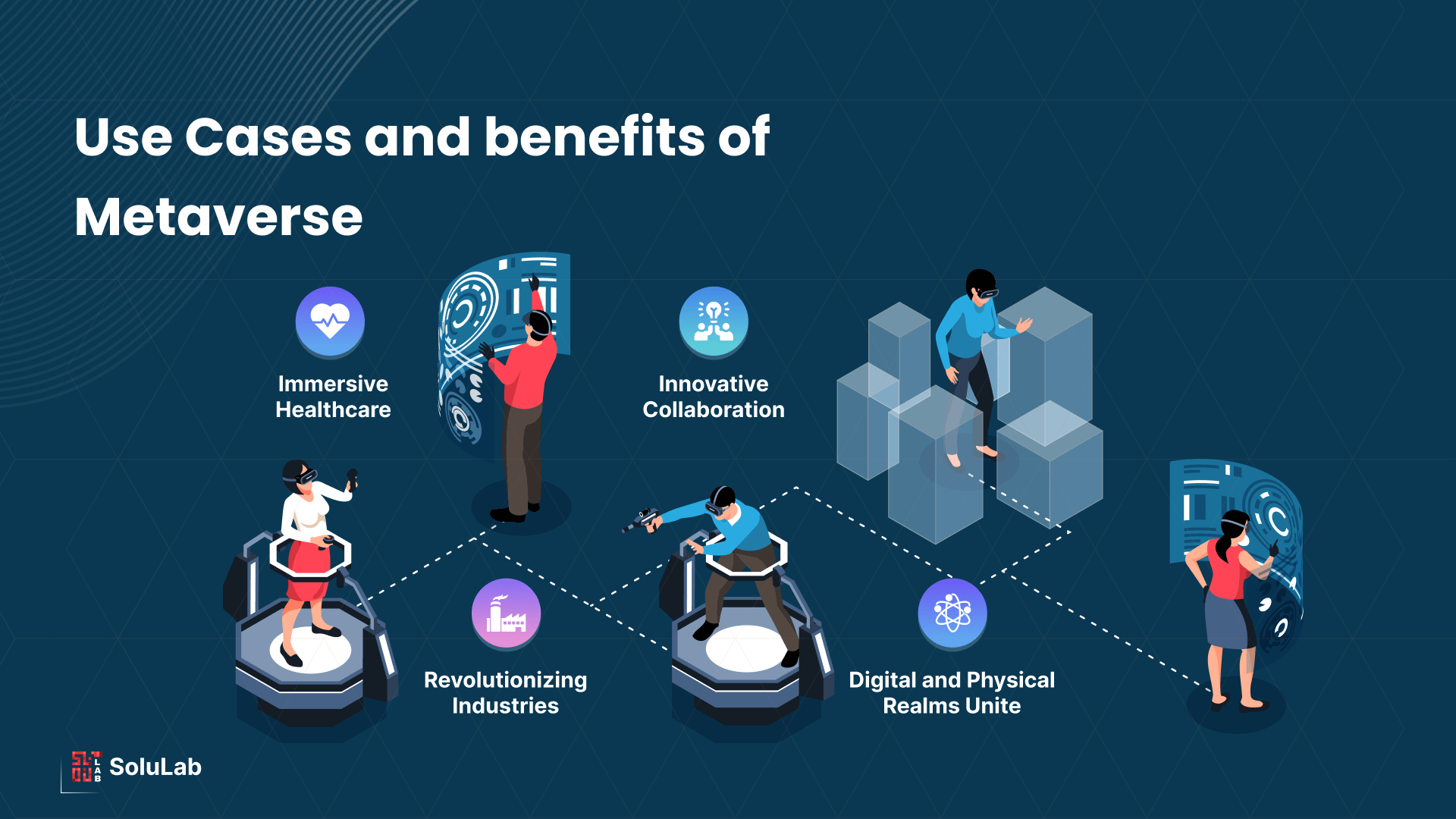
The Metaverse, a convergence of physical and digital realities, has the potential to revolutionize many industries. This exploration will examine a variety of Metaverse use cases across industries, highlighting the ways in which virtual and physical realms can be mutually beneficial.

One of the most promising Metaverse use cases is in the healthcare industry. Virtual reality (VR) and augmented reality (AR) can be used to create immersive experiences that can help patients with a variety of conditions. For example, VR can be used to create realistic simulations of surgical procedures, which can help surgeons to practice and improve their skills. AR can be used to provide patients with real-time information about their condition, which can help them to better understand their treatment and make informed decisions.

The Metaverse can also be used to improve education. VR and AR can be used to create immersive learning experiences that can make it easier for students to understand complex concepts. For example, VR can be used to create simulations of historical events or natural disasters, which can help students to develop a better understanding of the world around them. AR can be used to provide students with real-time information about their surroundings, which can help them to learn more effectively.

The Metaverse has the potential to transform the way we work. VR and AR can be used to create collaborative workspaces that allow people to work together from anywhere in the world. This can improve productivity and reduce travel costs. VR can also be used to create simulations of real-world environments, which can help employees to learn new skills and improve their performance.

The Metaverse can also be used to create new forms of entertainment. VR and AR can be used to create immersive experiences that can transport users to new worlds. This can make for more engaging and immersive entertainment experiences.

The Metaverse is still in its early stages of development, but it has the potential to revolutionize many industries. By merging physical and digital realities, the Metaverse can create new opportunities for businesses and consumers alike.

Related: Guide on 7 Layers of the Metaverse

Understanding Metaverse Use Cases

In the expansive landscape of the Metaverse, use cases are manifold. From education and entertainment to commerce and beyond, the Metaverse offers a myriad of applications. Its versatility lies in its ability to bridge geographical gaps, foster collaboration, and create immersive experiences for users.

For example, in the education sector, the Metaverse can be used to create virtual classrooms that allow students from all over the world to learn together. This can be a great way to reduce barriers to education and provide students with access to a wider range of learning opportunities. Additionally, the Metaverse can be used to create interactive simulations and games that can help students learn in a more engaging way.

In the entertainment sector, the Metaverse can be used to create immersive virtual worlds where users can interact with each other and explore new environments. This can be a great way to escape from the real world and have fun with friends. Additionally, the Metaverse can be used to create new forms of entertainment, such as concerts and sporting events, that can be enjoyed by people all over the world.

In the commerce sector, the Metaverse can be used to create virtual stores where users can shop for products and services. This can be a great way for businesses to reach new customers and expand their reach. Additionally, the Metaverse can be used to create new forms of customer engagement, such as virtual product demos and customer service.

These are just a few examples of the many ways that the Metaverse can be used. As the technology continues to develop, we can expect to see even more innovative and creative applications for the Metaverse in the years to come.

Metaverse Development Services

Benefits of the Metaverse

The benefits of the Metaverse extend beyond virtual realms. Enhanced collaboration, connectivity, and economic opportunities define the Metaverse’s positive impact. Users experience a new dimension of interconnectedness, ushering in an era where physical and virtual realities converge seamlessly.

  • Enhanced collaboration: The Metaverse allows people from all over the world to collaborate in real time, regardless of their physical location. This can be a game-changer for businesses, as it allows teams to work together more efficiently and effectively. For example, a team of designers could collaborate on a new product design, or a team of engineers could collaborate on a new software development project.
  • Connectivity: The Metaverse also provides a new way for people to connect with each other. For example, people can attend virtual concerts, sporting events, or even parties. This can be a great way for people to stay connected with friends and family who live far away.
  • Economic opportunities: The Metaverse also creates new economic opportunities. For example, businesses can sell virtual goods and services, or they can charge users for access to their virtual worlds. This can be a lucrative business, as the Metaverse is expected to grow to a multi-trillion dollar market in the coming years.

The Metaverse is still in its early stages of development, but it has the potential to revolutionize the way we live, work, and play. By providing new ways for people to collaborate, connect, and create, the Metaverse has the potential to make the world a more interconnected and prosperous place.
Healthcare Metaverse Use Cases

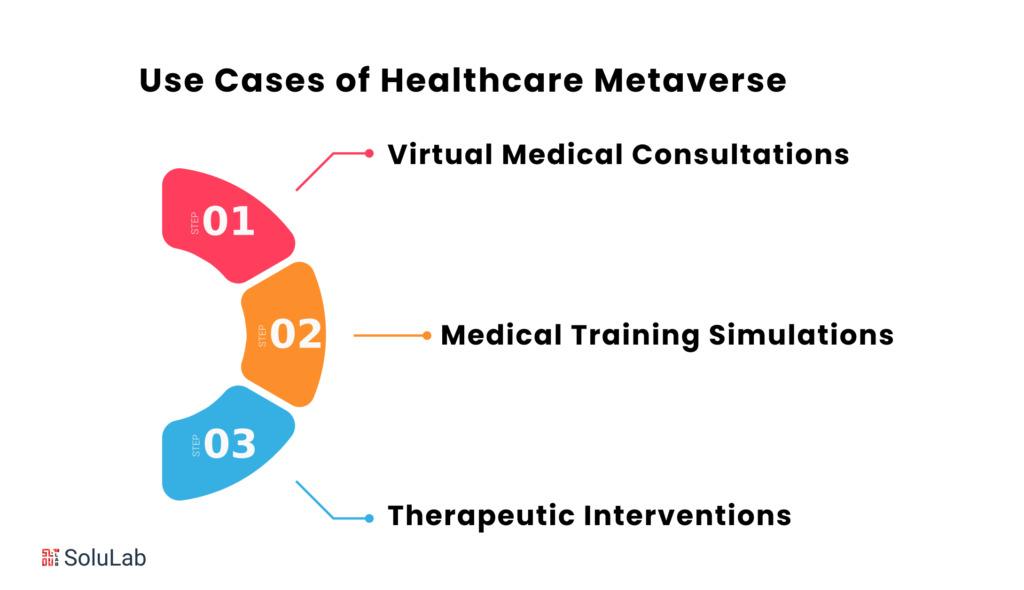
Use Cases of Healthcare Metaverse

In healthcare, the Metaverse emerges as a catalyst for change. From Healthcare Metaverse Use Cases like virtual medical consultations to training simulations and therapeutic interventions, the Metaverse is redefining patient care. This section delves into the tangible impacts, offering insights into improved accessibility, skill development for medical professionals, and innovative mental health treatments within the virtual realm.

1. Virtual Medical Consultations

Virtual consultations redefine healthcare accessibility by providing patients with real-time interaction with healthcare providers, eliminating geographical constraints, and enhancing healthcare delivery. This can be especially beneficial for patients who live in rural areas or who have difficulty traveling to see a doctor. Virtual consultations can also be more convenient for patients who work full-time or have other commitments that make it difficult to schedule appointments.

In addition to improving accessibility, virtual consultations can also help to reduce costs for patients. By eliminating the need for travel, patients can save money on gas, parking, and other transportation costs. Additionally, virtual consultations can often be completed more quickly than in-person appointments, which can save patients time and money.

Virtual consultations can also provide a more comfortable and convenient experience for patients. Patients can feel more relaxed and at ease in their own homes, and they can access the care they need without having to leave their homes. This can be especially beneficial for patients who are feeling ill or who have mobility issues.

Overall, virtual consultations offer a number of benefits for patients, including improved accessibility, reduced costs, and a more comfortable and convenient experience. As virtual healthcare continues to evolve, it is likely that virtual consultations will become an increasingly common way for patients to access healthcare.

2. Medical Training Simulations

In the Metaverse, medical professionals can immerse themselves in realistic training simulations that not only enhance their skills, but also provide a risk-free environment for honing expertise. For example, a surgeon can practice a complex procedure on a virtual patient, without the risk of harming a real person. This can help to improve surgeons’ confidence and skills, and ultimately lead to better patient outcomes.

In addition to surgical training, the Metaverse can also be used for other types of medical training, such as practicing patient communication, diagnosing diseases, and prescribing medications. This can help to improve the overall quality of care that patients receive.

The Metaverse is still in its early stages of development, but it has the potential to revolutionize medical training. By providing a safe and realistic environment for practicing, the Metaverse can help to improve the skills of medical professionals and ultimately lead to better patient outcomes.

3. Therapeutic Interventions

Virtual reality Metaverse is becoming a powerful tool in mental health treatment. Immersive therapy sessions in the Metaverse offer therapeutic interventions, providing new avenues for mental health support.

Industrial Metaverse Use Cases

Industries are undergoing a profound transformation through Industrial Metaverse Use Cases. Virtual prototyping, remote maintenance, and training simulations for industrial workers reshape how industries operate and innovate. As we navigate through these applications, witness the Metaverse as a catalyst for efficiency, collaboration, and groundbreaking advancements in manufacturing and beyond.

1. Virtual Prototyping in Manufacturing

Manufacturers leverage the Metaverse for accelerated product development. Virtual prototyping becomes a cost-effective and efficient means of testing and refining products.

The Metaverse is a virtual world where people can interact with each other and with digital objects. It is still in its early stages of development, but it has the potential to revolutionize the way we design, manufacture, and sell products.

One of the most significant ways that the Metaverse can be used to accelerate product development is through virtual prototyping. Virtual prototyping allows manufacturers to create digital models of their products that can be used to test and refine designs before they are ever built. This can save manufacturers a significant amount of time and money, as it eliminates the need to create physical prototypes.

In addition to saving time and money, virtual prototyping can also help manufacturers to improve the quality of their products. By being able to test and refine designs in a virtual environment, manufacturers can identify and correct potential problems before they occur. This can lead to products that are safer, more reliable, and more efficient.

The Metaverse is still a new technology, but it has the potential to revolutionize the way we design, manufacture, and sell products. By leveraging the Metaverse, manufacturers can accelerate product development, improve product quality, and reduce costs.

Related: Generative AI in the Metaverse

2. Remote Maintenance and Repairs

Field technicians can benefit from virtual assistance in the Metaverse in a number of ways. For example, virtual assistants can provide real-time guidance and support to technicians who are working on complex or unfamiliar tasks. This can help to reduce the risk of errors and improve the efficiency of the maintenance and repair process. Additionally, virtual assistants can be used to monitor the performance of equipment and identify potential problems before they become serious. This can help to prevent downtime and keep operations running smoothly.

Here are some specific examples of how virtual assistance can be used to improve field maintenance and repairs:

  • A virtual assistant can provide step-by-step instructions to a technician who is working on a complex repair. The assistant can also provide real-time feedback to the technician, helping them to avoid mistakes.
  • A virtual assistant can monitor the performance of equipment and identify potential problems. The assistant can then alert the technician to the problem so that it can be addressed before it becomes serious.
  • A virtual assistant can provide remote support to technicians who are working in remote locations. This can help to reduce the need for technicians to travel to the site of the problem, which can save time and money.

Overall, virtual assistance can be a valuable tool for field technicians. It can help to improve safety, efficiency, and productivity.

3. Training Simulations for Industrial Workers

Industrial workers are increasingly using virtual environments to enhance their skills. Safety training and emergency response simulations are two common uses for virtual environments. These simulations can help workers prepare for real-world scenarios by providing them with a safe and controlled environment in which to practice their skills.

For example, a worker who is training for a job in a hazardous environment may use a virtual environment to practice responding to a hazardous materials spill. The worker can learn how to identify the hazardous materials, how to safely contain the spill, and how to evacuate the area. This type of training can help workers to stay safe in the event of a real-world hazardous materials spill.

Another common use for virtual environments is emergency response simulations. These simulations can help workers to prepare for a variety of emergencies, such as fires, floods, and earthquakes. Workers can learn how to respond to the emergency, how to evacuate the area, and how to provide first aid. This type of training can help workers to save lives in the event of a real-world emergency.

Virtual environments are a valuable tool for industrial workers. They can help workers to learn new skills, prepare for emergencies, and stay safe in the workplace.

Metaverse Use Cases in Healthcare

The intersection of the Metaverse and healthcare is a testament to innovation. Metaverse Use Cases in Healthcare redefine how patients access medical services, how professionals hone their skills, and how therapeutic interventions are conducted. Join us in uncovering a world where the Metaverse becomes a dynamic space for better health outcomes, bridging the gap between virtual and physical realities.

1. Digital Health Records in a Virtual Environment

The Metaverse hosts secure and accessible health records, streamlining healthcare systems and providing a comprehensive digital platform for managing patient data. This integration allows patients to access their health records from anywhere, at any time, and gives healthcare providers a single, centralized view of patient data. The Metaverse also offers a number of other benefits for the healthcare industry, including:

  • Improved patient care: By providing patients with access to their health records, the Metaverse can help to improve patient care by enabling patients to be more involved in their own care and to make informed decisions about their health.
  • Reduced costs: By streamlining healthcare systems, the Metaverse can help to reduce costs by eliminating the need for duplicate records and by making it easier for healthcare providers to communicate with each other.
  • Increased efficiency: By providing a single, centralized view of patient data, the Metaverse can help to improve efficiency by reducing the time that healthcare providers spend searching for patient information.

The Metaverse is still in its early stages of development, but it has the potential to revolutionize the healthcare industry. By providing secure and accessible health records, the Metaverse can help to improve patient care, reduce costs, and increase efficiency.

2. Patient Education and Engagement

Patients enter interactive learning platforms within the Metaverse. Health awareness campaigns gain momentum as patients engage in virtual spaces for education. These virtual spaces provide a safe and engaging environment for patients to learn about their conditions and treatments. They can also connect with other patients and share their experiences. This can help to reduce feelings of isolation and loneliness, and can also provide patients with a sense of community.

In addition to providing educational resources, virtual spaces can also be used to deliver healthcare services. For example, patients can meet with their doctors or therapists in a virtual setting. This can be helpful for patients who live in rural areas or who have difficulty traveling to a doctor’s office. Virtual spaces can also be used to conduct clinical trials and research. This can help to improve the quality of healthcare and make it more accessible to patients.

The Metaverse is still in its early stages of development, but it has the potential to revolutionize healthcare. By providing patients with a safe, engaging, and accessible environment for learning and healthcare, the Metaverse can help to improve the quality of life for patients around the world.

3. Global Collaborations in Medical Research

The Metaverse is a virtual world where people can interact with each other and with digital objects. It has the potential to revolutionize medical research by making it possible for researchers from all over the world to collaborate in real time. Virtual laboratories and shared research spaces can be created in the Metaverse, where researchers can access the same data and tools, regardless of their location. This can greatly accelerate the pace of medical research and lead to new breakthroughs in the treatment of diseases.
For example, a team of researchers from the United States, Europe, and Asia could collaborate on a new drug development project in the Metaverse. They could share data, access the same research tools, and hold virtual meetings to discuss their progress. This would be much more difficult to do in the real world, where travel and communication can be expensive and time-consuming.

The Metaverse also has the potential to make medical research more accessible to people in developing countries. With virtual laboratories and shared research spaces, researchers in these countries can access the same resources as their counterparts in developed countries. This could help to level the playing field and lead to better healthcare outcomes for everyone.

The Metaverse is still in its early stages of metaverse development, but it has the potential to revolutionize medical research. By making it possible for researchers from all over the world to collaborate in real time, the Metaverse can accelerate the pace of medical research and lead to new breakthroughs in the treatment of diseases.

Metaverse Use Cases in Manufacturing

Metaverse Use Cases in Manufacturing

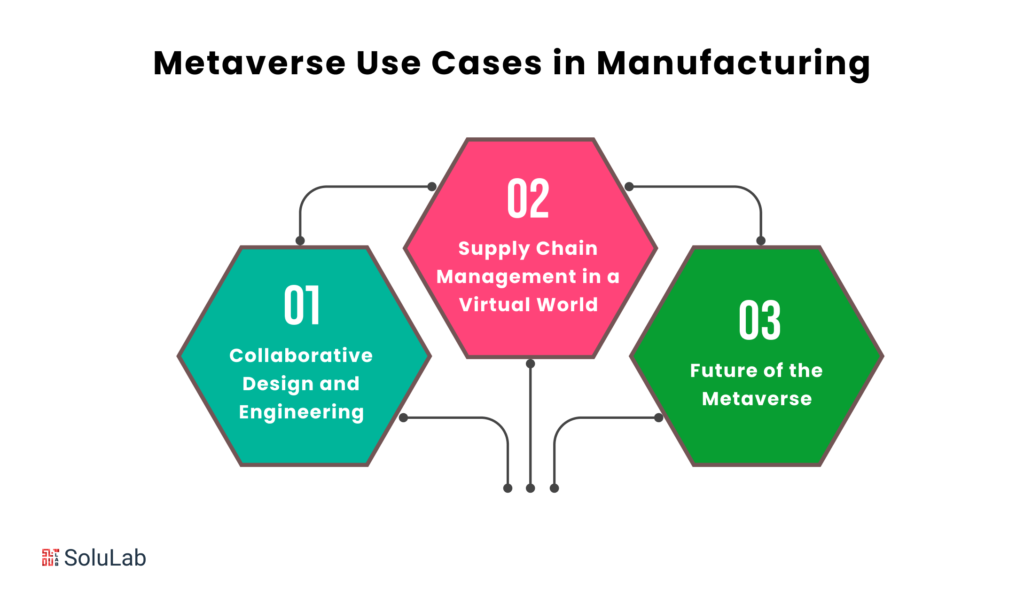
Manufacturing sees a paradigm shift through Metaverse Use Cases in Manufacturing. From supply chain optimization to collaborative design and engineering, the Metaverse becomes a catalyst for efficiency and innovation. This section explores how manufacturers navigate the digital realm to streamline processes, reduce downtime, and unlock new possibilities in the manufacturing landscape.

1. Supply Chain Management in a Virtual World

Manufacturers are optimizing supply chain management within the Metaverse, a digital world where users can interact with each other and with virtual objects. Enhanced visibility and transparency are redefining how supply chains operate in the digital realm.

In the Metaverse, manufacturers can track their products in real time, from the point of origin to the point of sale. This level of visibility allows manufacturers to identify and address potential problems early on, which can help to improve efficiency and reduce costs.

Additionally, the Metaverse can be used to create virtual simulations of supply chains. These simulations can be used to test different scenarios and to identify potential risks. This information can then be used to make better decisions about how to manage the supply chain.

The Metaverse is still in its early stages of development, but it has the potential to revolutionize supply chain management. By providing enhanced visibility and transparency, the Metaverse can help manufacturers to improve efficiency, reduce costs, and mitigate risk.

2. Collaborative Design and Engineering

Global teams collaborate seamlessly in the Metaverse for design and engineering.

With the Metaverse, global teams can collaborate in real time on product development projects, regardless of their physical location. This allows for more efficient and innovative product development, as teams can work together more closely and share ideas more easily.

For example, a team of engineers in the United States could work with a team of designers in Europe to design a new product. Using the Metaverse, the engineers and designers can see each other’s work in real time and make changes as needed. This would not be possible if the teams were working in different physical locations, as it would take too long to send files back and forth and make changes.

The Metaverse also allows for more immersive collaboration. Teams can use virtual reality (VR) headsets to experience the product they are designing in a realistic way. This can help them to identify potential problems and make improvements to the design. Overall, the Metaverse has the potential to revolutionize product development by making it more efficient, innovative, and immersive.

Related: Top Metaverse Development Companies in 2024

3. The Future of the Metaverse

As technology advances, the Metaverse will evolve, shaping the future of virtual realities. Predictions suggest a profound impact on industries and society, marking an era where the boundaries between physical and digital fade away.

The Metaverse is a concept of a persistent, immersive, and shared virtual world that is accessible through different devices. It is often compared to the internet, but it is more than just a collection of websites. The Metaverse is a place where people can interact with each other, create content, and experience new things.

The Metaverse is still in its early stages of development, but it has the potential to revolutionize many industries. For example, the Metaverse could be used for education, healthcare, retail, and entertainment. In education, the Metaverse could provide students with a more immersive and interactive learning experience. In healthcare, the Metaverse could be used to provide patients with remote care and to train medical professionals. In retail, the Metaverse could be used to create virtual stores and to allow customers to try on clothes and furniture before they buy them. In entertainment, the Metaverse could be used to create new forms of gaming, social media, and entertainment.

The Metaverse will also have a profound impact on society. As the Metaverse becomes more popular, people will spend more time in virtual worlds. This could lead to a decline in face-to-face interaction and a rise in social isolation. However, the Metaverse could also be used to connect people from different cultures and backgrounds. It could also be used to promote social change and to educate people about important issues.

The Metaverse is still a new concept, but it has the potential to change the world in many ways. As the Metaverse evolves, it will be interesting to see how it impacts industries and society.

Hire Metaverse Developers

Conclusion

In concluding our exploration of Metaverse Use Cases, it’s evident that we stand at the threshold of a transformative era. The seamless integration of physical and virtual worlds has unlocked an array of applications across industries, bringing forth benefits that resonate globally.

The Benefits of Metaverse are far-reaching, extending from enhanced collaboration and immersive experiences to economic opportunities. The Metaverse serves as a conduit for connectivity, reshaping how individuals, industries, and technologies interact.

In the realm of Healthcare Metaverse Use Cases, the virtualization of medical consultations, training simulations, and therapeutic interventions has ushered in a new frontier. Patients experience improved accessibility, medical professionals refine their skills, and mental health treatments become more immersive.

Similarly, in Industrial Metaverse Use Cases, the applications are transformative. From virtual prototyping and remote maintenance to training simulations for industrial workers, the Metaverse is redefining how industries operate and innovate.

In the healthcare sector, the integration of digital health records, patient education platforms, and global collaborations in medical research within the Metaverse showcases the potential to revolutionize the healthcare landscape. Simultaneously, in manufacturing, supply chain optimization and collaborative design and engineering are paving the way for unprecedented efficiency.

As we look ahead, the Metaverse’s trajectory is marked by continuous evolution and technological advancements. The collaboration between industries, individuals, and technology is paramount, and here, SoluLab emerges as a key player in shaping this future. As a leading Metaverse Development Company, SoluLab is at the forefront of driving innovation within the Metaverse. Their expertise in blockchain and technology solutions positions them as pioneers, facilitating businesses and industries to navigate the dynamic landscape of the Metaverse with precision and foresight.

In conclusion, the Metaverse is not just a technological evolution; it’s a paradigm shift that holds the promise of reshaping our reality. The diverse use cases we’ve explored only scratch the surface of its potential. As we pioneer tomorrow with the Metaverse, embracing the collaboration between physical and virtual realities, we set the stage for a future where the possibilities are boundless, and SoluLab stands as a guide in this exciting journey of technological evolution.

FAQs

1. What exactly is the Metaverse, and how does it differ from virtual reality?

The Metaverse is a collective virtual shared space, merging augmented reality and virtual reality. It differs from virtual reality in that it encompasses interconnected virtual and physical realities, creating a more immersive and interactive experience.

2. How are industries leveraging the Metaverse, and what benefits does it offer in terms of collaboration and innovation?

Industries are leveraging the Metaverse for diverse applications, from collaborative design and training simulations to supply chain optimization. The benefits include enhanced collaboration, efficiency, and innovative solutions.

3. Can you elaborate on the healthcare Metaverse use cases and how they are transforming patient care?

Healthcare Metaverse use cases include virtual medical consultations, training simulations, and therapeutic interventions. These applications enhance accessibility, medical training, and mental health treatments, transforming patient care delivery.

4. How is the Metaverse contributing to the advancement of global medical research and collaboration?

The Metaverse facilitates global collaborations in medical research through virtual laboratories and shared research spaces. This accelerates knowledge exchange, collaboration, and advancements in medical research on a global scale.

5. In what ways is SoluLab involved in shaping the Metaverse, and how can businesses benefit from their expertise?

SoluLab is a key player in shaping the Metaverse, providing expertise in blockchain technology solutions. Businesses can benefit from their guidance to navigate the dynamic Metaverse landscape, fostering innovation and precision in their operations.

6. Are there specific challenges associated with Metaverse adoption in industries, and how can these challenges be addressed?

Challenges in Metaverse adoption include technological integration and potential security concerns. Addressing these challenges involves careful planning, robust cybersecurity measures, and ongoing collaboration between technology providers and industries.

7. What predictions can be made about the future of the Metaverse, especially in terms of technological advancements and societal impact?

The future of the Metaverse holds exciting possibilities with continuous technological advancements. Predictions include more immersive experiences, widespread adoption across industries, and a profound impact on how society interacts with digital and physical realities.

 

10 Real-World Use Cases of the Metaverse in 2025

Internet technology is always evolving and providing consumers with amazing options. We have all seen the power of digital progress, from utilizing static webpages to interacting with Web 2 experiences. The next step in this progression is the Metaverse. The original Metaverse idea, which Neal Stephenson conceived in 1992, has been updated with the help of IT specialists from all across the world. The phrase was first used by him in a science-fiction book, and it is now commonplace in modern technology.

The idea of the Metaverse technology has been around for more than ten years, but it has recently gained popularity due to announcements of similar initiatives from major corporations like Facebook and Microsoft. As more individuals become aware of this permanent shared virtual world’s intriguing possibilities, the excitement surrounding it intensifies. The metaverse platforms gained popularity amid the recent epidemic when individuals tended to avoid face-to-face connection, businesses embraced remote working rules, and digital communication methods were widely used. People were interested in learning more about the Metaverse and its uses as a result of its emergence.

Both controlled and decentralized metaverses may be created by businesses. But now that other businesses are already reaping the rewards of blockchain technology, there is a greater need for a blockchain-based Metaverse. Blockchain technology is also required for Metaverse development, as the web’s future is decentralized. As a result, blockchain use cases such as NFTs and cryptocurrencies will have a greater influence than they do now. For a more in-depth assessment of Metaverse’s value, this blog will look at the top 10 real-world use cases of the Metaverse in 2025.

Read Our Blog: Building Worlds Beyond Reality: A Guide to Metaverse Development

What is Metaverse Technology?

Metaverse technology represents a groundbreaking evolution in the way we interact with digital spaces and one another. Essentially, it’s a collective virtual shared universe that encompasses multiple interconnected virtual and augmented reality environments. In 2025, the Metaverse is rapidly moving from a science fiction concept to a tangible reality with profound real-world use cases.

One of the most prominent applications of the Metaverse development is in the realm of remote work and collaboration. As businesses continue to adapt to hybrid and remote work models, the Metaverse provides a platform for immersive and dynamic virtual meetings, conferences, and collaboration spaces. Instead of flat video calls, employees can gather in 3D virtual environments, enhancing communication and fostering a stronger sense of presence.

Furthermore, the Metaverse is transforming education by offering immersive and interactive learning experiences. Instructors can conduct classes in virtual classrooms, museums, or historical simulations, making learning engaging and accessible to a global audience. Students can explore historical events, conduct virtual experiments, and interact with classmates and teachers as if they were physically present. Overall, the Metaverse is poised to revolutionize the way we work, learn, socialize, and entertain ourselves in 2025 and beyond.

Why Does Metaverse Matter in 2025?

In 2025, the Metaverse stands at the crossroads of our digital future, poised to redefine our relationship with technology and the virtual world. It represents the culmination of years of technological advancements, merging augmented and virtual reality, blockchain, artificial intelligence, and social connectivity into a cohesive digital tapestry. The significance of the Metaverse in 2025 cannot be overstated, as it represents a seismic shift in how we perceive, interact with, and leverage the digital landscape.

Read Our Blog: Tech Stack of a Metaverse Developer

Metaverse services offer an immersive, interconnected, and experiential realm where the boundaries between the physical and the digital blur. It’s a space where individuals can traverse a myriad of virtual environments, socialize, work, learn, and entertain themselves in ways that were once confined to the realm of science fiction. In this section, we’ll explore why the Metaverse matters in 2025 and how its transformation can impact our lives and society at large!

  • Digital Evolution: In 2025, the Metaverse marks a significant leap in our digital evolution. It represents a convergence of augmented and virtual reality, blockchain technology, and social connectivity, creating a seamless and immersive online environment. This evolution opens up new possibilities for human-computer interaction and digital experiences.
  • Reshaping the Workplace: As remote and hybrid work models become the norm, the Metaverse is redefining the workplace. It provides a platform for more engaging and productive remote collaboration, offering virtual office spaces, interactive meetings, and training environments that transcend the limitations of traditional video conferencing.
  • Educational Innovation: The Metaverse is revolutionizing education. It offers immersive learning experiences that appeal to students of all ages. Whether exploring historical events, conducting virtual science experiments, or attending virtual classes, the Metaverse is making education more accessible, engaging, and adaptable to individual needs.
  • Entertainment Hub: 2025 sees the Metaverse as an entertainment hub like no other. It blurs the lines between gaming, social media, and digital events. Users can attend concerts, explore virtual theme parks, or participate in interactive storytelling experiences, making entertainment more interactive and social.
  • Economic Opportunities: The Metaverse is creating an entirely new digital economy. Virtual real estate, digital assets, and Metaverse-based businesses are booming. Entrepreneurs, content creators, and investors are exploring this landscape, offering economic opportunities that extend beyond traditional online commerce.

The Top 10 Real-World Use Cases of the Metaverse in 2025

The concept of the Metaverse is all-encompassing, with its reach extending to numerous industries, including education, gaming, tourism, healthcare, and more. So, let’s delve into some essential Metaverse use cases that have widespread relevance across various sectors in 2025:

  • Gaming

Gaming is at the forefront of Metaverse examples in 2025. The Metaverse offers gamers an unprecedented level of immersion and interaction. Players can seamlessly traverse interconnected virtual worlds, share experiences with friends, and even monetize their in-game achievements. 

Read Also:  Metaverse NFT Marketplace Development

Game developers are leveraging the Metaverse to create expansive and persistent virtual realms that provide players with endless adventures and social interactions. This enhances not only the gaming experience but also opens up new revenue streams through virtual item sales and in-game advertising. As the Metaverse continues to evolve, gaming is set to become even more dynamic, social, and profitable.

  • Travel and Tourism

In 2025, the travel and tourism industry is undergoing a Metaverse-driven revolution. Travelers can now explore virtual replicas of destinations before making bookings, providing a more informed and engaging trip-planning process. Virtual tourism experiences enable individuals to visit exotic locations, historical sites, or cultural events from the comfort of their homes, making travel accessible to those with physical limitations or budget constraints. 

Virtual travel agents and concierge services have emerged, offering personalized recommendations and immersive travel experiences, reshaping the way we explore the world in the digital age. The Metaverse is transforming the very essence of travel, making it more inclusive, informative, and enjoyable.

  • Private Digital Space

Private digital spaces are becoming increasingly important in 2025, as individuals seek secure and personalized environments within the Metaverse development services. These spaces offer users a sanctuary where they can control access to their data, engage in confidential conversations, and host private gatherings. 

From secure virtual boardrooms for sensitive corporate discussions to private VR chat rooms for personal interactions, the Metaverse empowers users to curate their digital surroundings in a way that prioritizes privacy and security. This development ensures that users can enjoy the benefits of the Metaverse while safeguarding their personal and sensitive information.

CTA1

  • Real Estate

The real estate industry is undergoing a transformative shift in 2025 thanks to the Metaverse. Virtual property tours and immersive 3D property showcases are now standard practices, allowing potential buyers and renters to explore properties from anywhere in the world. 

Real estate developers are also investing in virtual real estate within the Metaverse, creating digital properties that can be bought, sold, and developed. This not only expands investment opportunities but also blurs the line between physical and virtual property ownership. The Metaverse is redefining the way we buy, sell, and experience real estate, making it a dynamic and innovative sector to watch.

Read Our Blog Post: Metaverse NFT – Foundation Of Next Blockchain Revolution!

  • Industry and Manufacturing

In the realm of industry and manufacturing, the Metaverse is streamlining operations and enhancing efficiency. Manufacturers are using virtual simulations and digital twins within the Metaverse to optimize production processes, reduce waste, and identify potential issues before they occur in the physical world. 

Additionally, remote monitoring and maintenance of industrial equipment have become more accessible through Metaverse-powered interfaces, reducing downtime and improving overall productivity. The Metaverse ecosystem is revolutionizing how industries operate, making them more agile, cost-effective, and environmentally sustainable.

  • Banking and Finance

The banking and finance sector in 2025 is leveraging the Metaverse applications to provide innovative financial services. Virtual banks and blockchain-powered financial platforms are enabling secure and efficient digital transactions within the Metaverse. Users can manage their digital assets, conduct cross-border transactions, and explore investment opportunities within a seamless virtual financial ecosystem. 

The Metaverse also enhances financial education through immersive simulations, enabling users to make informed investment decisions. As the Metaverse continues to evolve, it promises to democratize access to financial services and redefine the way we interact with money.

  • Healthcare

In the field of healthcare, the best Metaverse experiences are revolutionizing patient care and medical training. Telemedicine has reached new heights, with doctors and patients meeting in virtual clinics for consultations, diagnosis, and treatment. Medical practitioners are also using the Metaverse for training and simulation, allowing healthcare professionals to practice surgical procedures and emergency responses in a risk-free environment. 

Furthermore, patient data management and privacy are enhanced through secure virtual healthcare records. The Metaverse applications in business are making healthcare more accessible, efficient, and safe, transforming the way we receive and deliver medical services.

  • Social Media

Social media platforms have embraced the Metaverse in 2025 to provide users with immersive and interactive experiences. Users can create personalized avatars, socialize in virtual spaces, and attend virtual events and concerts. The Metaverse projects blur the lines between different social media networks, allowing users to seamlessly connect with friends and followers across various platforms. 

It also introduces new monetization opportunities for content creators, who can host virtual meet-and-greets, sell virtual merchandise, and engage with their audiences in innovative ways. The Metaverse is redefining social media as a dynamic and immersive space for both personal connections and professional engagement.

  • Remote Working

Remote working has been transformed by the Metaverse development in 2025. Virtual offices, meeting spaces, and collaborative environments are now the norm. Instead of conventional video calls, employees can meet in 3D virtual spaces, enhancing communication and fostering a stronger sense of presence. 

The Metaverse also enables employees to create customizable digital workstations and collaborate on projects in real-time, regardless of their physical location. This evolution has not only made remote work more engaging but has also improved productivity and work-life balance.

  • Education and Learning

Education is experiencing a profound transformation in 2025, thanks to the Metaverse technology. Virtual classrooms, immersive historical simulations, and interactive learning experiences are now commonplace. Students can explore diverse subjects through virtual field trips, conduct science experiments in digital laboratories, and engage with peers and instructors in lifelike virtual environments. 

This approach not only enhances learning engagement but also makes education more accessible to a global audience, regardless of geographical limitations. The Metaverse is reshaping the future of education by providing students and educators with powerful tools for interactive and personalized learning experiences.

Benefits of Metaverse Technology

Benefits of Metaverse Technology

In recent years, the concept of the Metaverse has gained significant traction, and it’s not just confined to the realm of science fiction anymore. The Metaverse is fast becoming a tangible reality with profound implications for a wide range of industries and aspects of our lives. In this section, we’ll explore the myriad of Metaverse benefits and why it’s generating so much excitement.

  • Collaboration Without Borders

One of the standout advantages of the Metaverse is its ability to facilitate collaboration among individuals or teams, regardless of where they are in the world. This is a game-changer for remote work and global partnerships. Virtual offices and meeting spaces within the Metaverse allow colleagues to collaborate seamlessly, bridging geographical gaps and making remote work more efficient than ever before.

Read Our Blog: Top 15 Metaverse Startups to Watch out in 2025

  • Innovative Learning Environments

Education is undergoing a radical transformation thanks to the Metaverse. It offers educators and learners alike immersive and interactive learning experiences. Whether it’s exploring historical events, conducting virtual science experiments, or attending classes in lifelike virtual environments, the Metaverse is making education more engaging and accessible.

  • Revolutionized Entertainment

Entertainment is another domain that’s seeing a profound shift thanks to the Metaverse. It blurs the lines between gaming, social media, and digital events, offering users novel and interactive experiences. Whether you’re attending virtual concerts, exploring digital theme parks, or participating in interactive storytelling experiences, the Metaverse promises entertainment like you’ve never experienced before.

  • New Economic Opportunities

The Metaverse is not just reshaping how we interact; it’s also fostering a thriving digital economy. It’s creating job opportunities and enabling digital entrepreneurship. Virtual real estate, digital assets, and Metaverse-focused businesses are booming, offering exciting prospects for those looking to innovate in this space.

  • Improved Healthcare

In the healthcare sector, the Metaverse is enhancing telemedicine, medical training, and patient data management. It’s making healthcare services more accessible and efficient, allowing doctors and patients to connect in virtual clinics, medical professionals to practice procedures in risk-free digital environments, and ensuring secure management of patient data.

  • Enhanced Social Media Engagement

Social media is undergoing a metamorphosis within the Metaverse. It’s redefining the way we socialize by offering immersive virtual spaces for users to interact, attend events, and engage with content creators in entirely new ways. Social media is becoming a more dynamic and immersive space for both personal connections and professional engagement.

Read Also: Top 10 Metaverse Development Companies in 2025

  • Optimized Remote Work

With remote work becoming increasingly prevalent, the Metaverse is stepping in to optimize the experience. Virtual offices, collaborative environments, and 3D virtual spaces for meetings make remote work more engaging and productive. It’s not just about video calls; it’s about creating a virtual workspace that feels like a physical one, boosting productivity and work-life balance.

  • Personalized Learning

In education, the Metaverse is enabling personalized learning experiences. It caters to individual student needs and preferences, allowing learners to explore subjects through virtual field trips, conduct science experiments in digital laboratories, and engage with peers and instructors in lifelike virtual environments.

  • Privacy and Security

Within the Metaverse, private digital spaces offer users control over their data and online interactions. This heightened level of privacy and security ensures that individuals can enjoy the benefits of the Metaverse while safeguarding their personal and sensitive information.

The Future of Metaverse Technology

The Future of Metaverse Technology

As we journey further into the digital age, the Metaverse applications are poised to play an increasingly integral role in our lives. Its current capabilities offer a mere glimpse into the boundless potential of this emerging technology. Here, we’ll peer into the crystal ball and explore what the future holds for the Metaverse.

1. Hyper-Realistic Virtual Environments

Imagine stepping into a virtual world that is indistinguishable from reality. While we’re not quite there yet, advancements in hardware, software, and sensory technologies are rapidly pushing the boundaries of what’s possible. In the not-so-distant future, the Metaverse could provide hyper-realistic virtual environments that engage all our senses—sight, sound, touch, taste, and smell. This immersive experience would revolutionize not only gaming and entertainment but also areas like virtual tourism and training simulations.

2. Blockchain Integration

Blockchain technology is set to become an even more integral part of the Metaverse. Decentralized ledgers offer unparalleled security and transparency, making them ideal for managing digital assets, virtual property, and in-game currencies. Expect to see an increased convergence of blockchain and the Metaverse, enabling users to truly own and trade digital assets within virtual spaces, from rare virtual collectibles to virtual real estate.

Read Our Blog Post: A Future Based On Metaverse – A Solulab Take

3. AI-Driven Personalization

Artificial intelligence will play a pivotal role in shaping the Metaverse of the future. AI-driven personalization will ensure that virtual experiences are tailored to each user’s preferences and needs. Whether it’s curating content, adapting learning materials, or creating unique gaming challenges, AI will make the Metaverse an incredibly individualized space.

4. Cross-Platform Integration

The silos between different virtual worlds and platforms will continue to crumble. Interoperability will become the norm, allowing users to seamlessly transition between various Metaverse spaces. Think about traveling from a virtual work meeting to a virtual concert and then to a virtual classroom—all within the same overarching Metaverse. This seamless integration will make the Metaverse a more cohesive and comprehensive digital universe.

5. Expanded Real-World Applications

Beyond entertainment and work, the Metaverse will extend its influence into other real-world applications. From urban planning and architecture to healthcare simulations and disaster preparedness drills, the Metaverse will be an indispensable tool for training, testing, and experiencing real-world scenarios in a safe and controlled digital environment.

6. Ethical and Regulatory Challenges

As the Metaverse matures, it will inevitably face ethical and regulatory challenges. Issues like data privacy, digital ownership rights, and virtual identity protection will come to the forefront. Policymakers, businesses, and users will need to navigate these complex issues to ensure the responsible and ethical development of the Metaverse.

In closing, the future of Metaverse technology is a thrilling frontier filled with possibilities. It’s a realm where reality and imagination intersect, where we redefine how we interact with the digital world and each other. As we continue this journey, it’s crucial to approach the development and adoption of Metaverse technology with foresight, responsibility, and a commitment to creating a digital landscape that benefits us all. The Metaverse is not just the future—it’s a canvas on which we can paint the dreams and innovations of tomorrow.

CTA2

Conclusion

In the ever-evolving landscape of technology, the Metaverse stands as a testament to human innovation and imagination. In this blog, we’ve delved into ten real-world Metaverse use cases and applications in 2025, witnessing the profound impact it has across various industries. From transforming remote work and revolutionizing education to reshaping how we entertain, socialize, and engage with the digital world, the Metaverse has become an indispensable part of our lives.

As we navigate this digital frontier, it’s clear that the Metaverse is not just a fleeting trend—it’s a seismic shift in how we interact with technology and each other. The benefits are undeniable, from enhanced digital experiences to new economic opportunities and improved healthcare. However, it’s crucial to tread carefully, addressing ethical, privacy, and regulatory challenges along the way. The Metaverse is not just a destination; it’s a journey, and in the years to come, we can expect its use cases and applications to continue evolving, unlocking new possibilities and reshaping our reality in ways we’re only beginning to fathom.

In the fast-paced digital landscape of 2025, businesses are seeking innovative ways to leverage the Metaverse and redefine their online presence. That’s where SoluLab, a leading Metaverse development company, steps in as your trusted partner. With a team of top Metaverse developers, SoluLab brings unparalleled expertise and a proven track record in creating immersive and impactful Metaverse services for businesses.

The Metaverse is not just a buzzword; it’s a game-changer for companies looking to engage customers, optimize operations, and stay ahead in the digital race. SoluLab understands this, and our commitment to excellence shines through our comprehensive suite of Metaverse solutions. Whether you need to hire top Metaverse developers to build immersive virtual experiences, integrate Metaverse capabilities into your existing platforms, or develop custom Metaverse applications, SoluLab’s team has the skills and vision to turn your ideas into reality.

We don’t just stop at development; we offer end-to-end Metaverse services, including consulting, strategy, design, and maintenance. Our deep industry knowledge and technical prowess ensure that your Metaverse initiatives align with your business objectives and deliver tangible results. So, if you’re looking to unlock the immense potential of the Metaverse for your business, look no further than SoluLab. We are not just a service provider; we are your trusted partner on your Metaverse journey.

FAQs

1. What exactly is the Metaverse?

The Metaverse is a collective virtual shared space, merging augmented and virtual reality, where users can interact with each other and digital objects in real time. It’s a convergence of various technologies to create a comprehensive digital universe.

2. How does the Metaverse benefit businesses?

The Metaverse benefits businesses by offering immersive marketing, enhanced collaboration, new revenue streams, and innovative customer engagement. It can transform the way companies operate and interact with customers.

3. Is the Metaverse only for gaming and entertainment?

While gaming and entertainment are prominent Metaverse use cases, they extend far beyond that. The Metaverse has applications in education, healthcare, remote work, social media, and numerous other industries.

4. What are the privacy and security concerns in the Metaverse?

As with any digital environment, privacy and security are paramount concerns. The Metaverse must address issues related to data privacy, identity protection, and cybersecurity as it continues to evolve.

5. How can businesses get started with Metaverse development?

Businesses can begin by partnering with Metaverse development companies like SoluLab, which offer a range of services, including consulting, development, and maintenance. Collaborating with experienced experts can help navigate the complexities of Metaverse development.

6. What’s the future of the Metaverse?

The future of the Metaverse holds exciting possibilities, including hyper-realistic virtual environments, increased blockchain integration, AI-driven personalization, and expanded real-world applications. It’s a rapidly evolving landscape with limitless potential for innovation and growth.
