Talk to an Expert

How Non-Fungible Tokens Are Changing the Digital World?

How Non-Fungible Tokens Are Changing the Digital World?

In recent years, the digital landscape has witnessed a transformation that has left the world in awe. A new wave of innovation and disruption has swept through the realms of art, entertainment, real estate, and more, reshaping the way we perceive and interact with the digital world. Non-Fungible Tokens (NFTs), heralded as the future of digital ownership and representation, have played an instrumental role in this paradigm shift. NFTs have transcended the boundaries of traditional digital assets and have introduced a concept that is poised to redefine the very essence of ownership, authenticity, and value in the virtual realm. This phenomenon is not merely a passing trend but a substantial force that is rewriting the rules of the digital world. In this blog, we will explore how Non-Fungible Tokens are leaving an indelible mark on the digital landscape, ushering in a new era of possibilities and reshaping the way we perceive, create, and trade in the digital space.

Understanding NFTs

The advent of Non-Fungible Tokens (NFTs) has brought about a transformative shift in the digital world. To grasp the full extent of their impact on the digital realm, it is essential to delve into the fundamentals of NFTs, understanding what makes them unique, how they are created, and the implications for ownership and authenticity.

A. What Makes an NFT Unique?

NFTs derive their uniqueness from their cryptographic properties and the underlying blockchain technology. Unlike traditional digital assets, NFTs are indivisible, irreplaceable, and cannot be exchanged on a one-to-one basis. Each NFT is a distinct entity with a specific digital signature, making it impossible to forge or replicate. This uniqueness is at the core of NFTs’ value proposition in the digital world.

The impact of NFTs on the digital world is profound in the way they confer ownership and authenticity to digital content. Artists, creators, and even individuals can mint NFTs to represent digital art, music, videos, and virtual assets, establishing a sense of ownership that was previously elusive in the digital realm.

B. How are NFTs Created?

The process of creating NFTs is a testament to the revolutionary power of blockchain technology. NFTs are generated through a process called minting, which involves registering a digital asset on a blockchain. This process creates a unique token associated with the asset, effectively transforming it into an NFT.

The ownership and provenance of NFTs are stored securely on the blockchain, providing a transparent and immutable record of transactions. As a result, the creation and transfer of NFTs are not only secure but also entirely transparent, enhancing trust and authenticity in the digital world.

C. Ownership and Authenticity in the Digital Realm

The impact of NFTs on the digital world extends to the concepts of ownership and authenticity. Prior to NFTs, establishing ownership and proving the authenticity of digital assets were significant challenges. NFTs provide a solution to these issues by allowing creators and buyers to assert ownership with confidence.

Ownership of NFTs is cryptographically verified and recorded on the blockchain, eliminating doubts about the legitimacy of ownership claims. This has profound implications for artists, creators, and collectors, who can now monetize their digital works with a sense of security that was previously unattainable.

In essence, NFT in the digital world has transformed by introducing a novel, secure, and transparent method of asserting ownership and authenticity for a wide range of digital assets. This newfound assurance has opened up exciting possibilities for creators, collectors, and investors, reshaping the way we interact with and perceive the value of digital content.

CTA1

NFTs in Art and Creativity

The world of art and creativity has been profoundly impacted by the emergence of Non-Fungible Tokens (NFTs). Here, we explore how NFTs have revolutionized this space, serving as a game-changer for digital artists while also making significant waves in traditional art markets.

A. NFTs as a Game-Changer for Digital Artists

Digital artists, who have long grappled with the challenge of proving ownership and authenticity of their creations, have found a lifeline in NFTs. NFTs provide a groundbreaking solution, enabling artists to mint their digital works as unique tokens on blockchain platforms.

This development has been nothing short of revolutionary. Digital artists can now attach a sense of rarity and ownership to their creations, allowing them to sell their art directly to a global audience. With NFTs, artists have the potential to earn royalties every time their work is sold or traded on NFT marketplaces.

The impact of NFTs on the digital world in the realm of art is immense. It has democratized the art world, breaking down traditional barriers to entry and recognition for digital artists. Through NFTs, artists can gain more control over their work and financial opportunities they may have struggled to find in the past.

B. Impact on Traditional Art Markets

The emergence of NFTs has not only transformed the digital art landscape but also made waves in traditional art markets. This disruption stems from the growth of NFT marketplaces and the way they have reshaped the dynamics of buying and selling art.

NFT marketplaces, such as OpenSea, Rarible, and SuperRare, have become the platforms of choice for trading NFT art. NFT marketplace development and features have made it easier for artists to mint NFTs, connect with collectors, and secure the value of their digital creations. As NFT marketplaces have matured, they have provided a seamless bridge between digital and traditional art markets, enhancing accessibility and liquidity for art buyers and sellers.

The art world has had to adapt to this evolving landscape. Traditional art institutions and galleries are increasingly exploring partnerships with NFT marketplaces to connect with a broader, tech-savvy audience. As a result, the impact of NFTs on the digital world is not confined solely to the digital realm but extends its influence to the broader art industry.

In brief, NFTs have ushered in a new era of possibilities for artists and collectors alike. They have democratized the art world, providing digital artists with opportunities and control, while also disrupting traditional art markets and opening doors for collaboration and innovation. The NFT marketplace development services have played a pivotal role in these transformations, reshaping how we perceive and engage with art in the digital age.
NFTs in the Gaming Industry

NFTs in the Gaming Industry

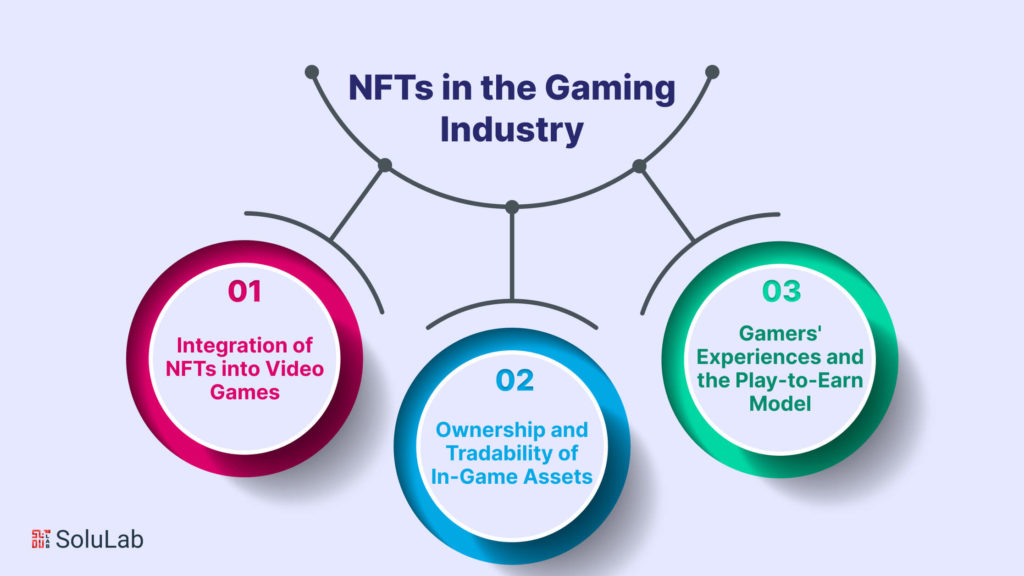
The gaming industry has been significantly impacted by the introduction of Non-Fungible Tokens (NFTs), leading to novel experiences and economic opportunities for both players and developers. Here, we explore the integration of NFTs into video games, ownership and tradability of in-game assets, and how NFTs have given rise to the “play-to-earn” model.

A. Integration of NFTs into Video Games

Traditionally, in-game assets like skins, weapons, and character outfits were owned by the game developers, limiting players’ control over their investments. With the advent of NFTs, these assets can now be tokenized and owned by players as verifiable digital possessions. Game developers are leveraging blockchain technology to create unique NFTs representing these in-game items.

This integration allows players to buy, sell, and trade their assets in a decentralized marketplace. These assets can be used across multiple games that support the same standards, providing players with a sense of ownership and control over their digital collections.

B. Ownership and Tradability of In-Game Assets

NFTs enable true ownership of in-game assets. Players have the freedom to trade, sell, or even lend their digital items, giving them a stake in the gaming ecosystem beyond their gameplay skills. This has led to a thriving secondary market for in-game assets, where players can monetize their investments by selling rare or sought-after items to other players.

Moreover, ownership of in-game assets becomes truly provable through the blockchain, reducing the risk of fraud or counterfeit items. The transparent and immutable nature of the blockchain ensures that the asset’s history and authenticity can be easily verified, making it a safe and trustworthy environment for players and collectors.

C. Gamers’ Experiences and the Play-to-Earn Model

NFTs pioneered the notion of “play-to-earn” in the gaming industry. Traditionally, gamers spent countless hours playing without direct financial gains. With NFTs, they can now accumulate valuable in-game assets that have real-world value. This shift has attracted a new audience of players who see gaming as a way to generate income.

In play-to-earn games, players can earn NFTs through gameplay, and these NFTs can be sold on marketplaces for cryptocurrencies or exchanged for other digital or real-world assets. This model has the potential to empower players, particularly in regions with limited economic opportunities, to earn a living by engaging in their favorite pastimes.

However, the play-to-earn model also comes with challenges, including concerns about the balance between gameplay and income generation, the potential for pay-to-win scenarios, and the need for regulations to protect players from exploitation.

In short, the integration of NFTs into the gaming industry has brought about a paradigm shift in the way players perceive and interact with in-game assets. The ownership, tradability, and play-to-earn model are transforming the gaming experience, opening new doors for both gamers and developers. As NFTs continue to evolve, they are likely to shape the future of gaming in ways that we have yet to fully explore.

NFTs in Real Estate and Virtual Land

The innovation of Non-Fungible Tokens (NFTs) extends beyond the realms of digital collectibles and gaming, venturing into the world of real estate and virtual land. This development brings forth the tokenization of real-world assets, virtual land ownership within metaverse platforms, and its potential impact on the real estate industry.

A. Tokenization of Real-World Assets

NFTs have paved the way for the tokenization of real-world assets, such as real estate properties. Tokenization involves breaking down physical assets into digital tokens, making them easily tradable and divisible. Through NFTs, individuals can hold digital ownership rights to specific portions or properties within the real estate market.

This tokenization opens up a range of possibilities, from enabling fractional ownership where multiple investors can hold shares in a single property to simplifying the process of buying and selling real estate. NFTs offer transparency and security by recording ownership and transaction history on a blockchain, reducing the need for intermediaries and enhancing trust in real estate transactions.

Real estate NFTs are often listed on NFT marketplaces, facilitating easy trade and providing a global platform for investors and buyers. Businesses and developers looking to engage in real estate tokenization can hire top NFT developers to create customized NFT marketplace development services that cater to their specific needs.

B. Virtual Land Ownership in Metaverse Platforms

Metaverse platforms, immersive virtual environments where people interact and socialize in digital spaces, have seen a surge in virtual land ownership through NFTs. Within metaverse worlds, parcels of virtual land are represented as NFTs, allowing users to purchase, develop, and trade virtual real estate.

Virtual land in metaverses serves various purposes, from creating digital businesses and virtual storefronts to hosting events and social gatherings. Some popular metaverse platforms include Decentraland, The Sandbox, and Somnium Space, where virtual land ownership has become a fundamental aspect of the user experience.

This development has encouraged businesses and entrepreneurs to invest in virtual land, further boosting the metaverse’s growth. Virtual landowners can develop their properties to generate revenue or simply hold them as digital assets with the potential for appreciation.

C. The Potential Impact on the Real Estate Industry

The integration of NFTs in real estate and virtual land ownership has the potential to disrupt the traditional real estate industry. Here are some of the potential impacts:

  • Accessibility: Real estate tokenization can lower the barriers to entry, making it possible for a broader range of investors to participate in real estate markets.
  • Efficiency: NFTs can streamline the buying and selling process by reducing paperwork and the involvement of intermediaries.
  • Globalization: NFTs enable cross-border investments, allowing investors to diversify their portfolios across different countries.
  • Liquidity: Fractional ownership and NFT-based real estate can increase liquidity, making it easier for investors to exit their positions.
  • Metaverse Integration: As virtual land ownership becomes more popular, the metaverse may emerge as a new dimension for real estate transactions and business opportunities.

In brief, NFTs have brought real estate into the digital age, offering new avenues for investment and diversification. The tokenization of real-world assets and virtual land ownership within metaverse platforms have the potential to revolutionize the real estate industry and redefine how we interact with both physical and digital properties. Businesses looking to leverage this trend can explore the services of top NFT developers to create their own NFT marketplace development solutions.
Challenges and Controversies

Challenges and Controversies

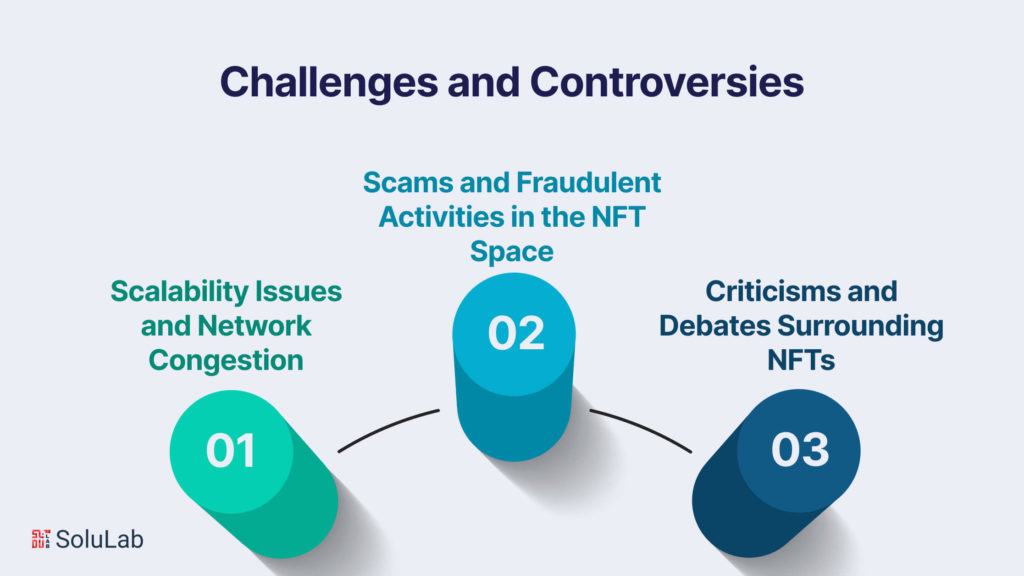
While Non-Fungible Tokens (NFTs) have gained significant attention and adoption, they are not without their share of challenges and controversies. In this section, we’ll explore some of the key issues that have emerged.

A. Scalability Issues and Network Congestion

One of the primary concerns associated with NFTs is the scalability of blockchain networks, particularly Ethereum. As NFTs gained popularity, they led to network congestion and increased transaction fees. The limited capacity of Ethereum and other blockchains has resulted in slow transaction times and high gas costs, making it less accessible for creators and collectors. These scalability issues have prompted discussions about the need for blockchain upgrades and the exploration of Layer 2 solutions to improve the overall NFT ecosystem.

Developers and blockchain communities are actively working on addressing these scalability challenges, but until a scalable solution is widely implemented, network congestion remains a significant hurdle for NFT enthusiasts.

B. Scams and Fraudulent Activities in the NFT Space

The rapid growth of the NFT market has attracted the attention of scammers and fraudsters. There have been instances of fake NFT listings, counterfeit art, and even fraudulent NFT marketplaces. These activities undermine trust in the NFT ecosystem and can lead to financial losses for unsuspecting buyers and creators.

It’s crucial for participants in the NFT space to exercise caution, conduct due diligence, and be aware of the risks associated with fake NFTs and deceptive practices. Emerging NFT marketplaces and services must implement rigorous verification and authentication processes to reduce the prevalence of scams.

C. Criticisms and Debates Surrounding NFTs

NFTs have sparked various criticisms and debates within the digital, artistic, and environmental communities. Some common criticisms include:

  • Environmental Concerns: The energy consumption associated with blockchain networks, particularly in the case of proof-of-work chains like Ethereum, has raised concerns about the carbon footprint of NFTs. These concerns have led to discussions about transitioning to more eco-friendly blockchain technologies.
  • Speculative Bubbles: Some argue that the NFT market has seen speculative bubbles, with overinflated prices for digital assets that may not hold long-term value. The concern is that this speculative behavior could lead to a market crash.
  • Exclusivity and Elitism: NFTs are seen by some as a means for wealthy individuals and celebrities to profit from their digital assets, leaving little room for emerging artists and creators. The question of whether NFTs are democratizing or exacerbating inequalities is a topic of ongoing debate.
  • Lack of Regulation: The lack of regulatory oversight in the NFT space has raised questions about consumer protection, copyright infringement, and legal challenges in case of disputes.

In response to these criticisms, the NFT community and industry are actively engaged in discussions about how to address these issues. This includes exploring more energy-efficient blockchain alternatives, promoting inclusivity supporting emerging artists, and advocating for responsible and ethical practices in the NFT space.

In conclusion, while NFTs have opened up new opportunities and possibilities, they are not immune to challenges and controversies. Addressing scalability, fraudulent activities, and criticisms are essential steps for the NFT ecosystem to mature and establish itself as a sustainable and responsible part of the digital world.
The Future of NFTs

Future of NFTs

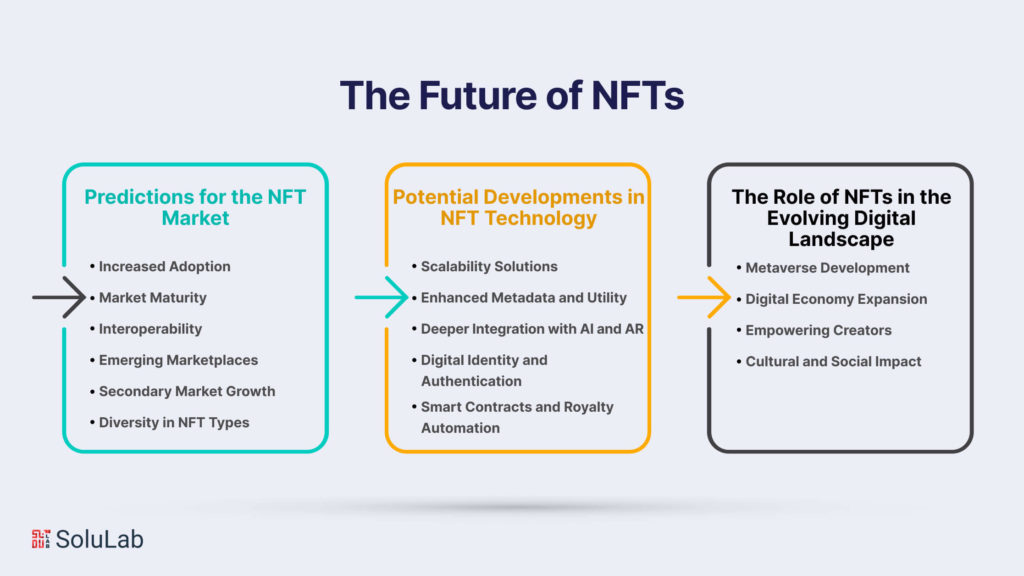
As Non-Fungible Tokens (NFTs) continue to reshape various industries and capture the imagination of creators and collectors, it’s essential to consider what the future holds for this innovative technology. In this section, we’ll explore predictions for the NFT market, potential developments in NFT technology, and the evolving role of NFTs in the digital landscape.

A. Predictions for the NFT Market

The NFT market has shown remarkable growth, and its trajectory is likely to continue in the coming years. Here are some predictions for the NFT market:

  • Increased Adoption: NFTs are expected to see broader adoption in industries beyond art and gaming. Sectors like fashion, education, and healthcare may incorporate NFTs for provenance, authentication, and unique experiences.
  • Market Maturity: As the NFT market matures, we can anticipate increased regulation and standardization to address challenges related to fraud, copyright issues, and environmental concerns. This regulatory clarity may help build trust among users.
  • Interoperability: The development of cross-chain NFT solutions may promote interoperability between different blockchain ecosystems, making it easier for users to access and trade NFTs across multiple platforms.
  • Emerging Marketplaces: NFT marketplaces will continue to evolve, offering features such as social interactions, virtual exhibitions, and new ways to showcase and trade digital assets.
  • Secondary Market Growth: The secondary market for NFTs is expected to grow as collectors and investors seek opportunities for trading, flipping, and investing in digital assets. High-value NFTs may appreciate over time.
  • Diversity in NFT Types: New forms of NFTs, such as time-based NFTs, multi-chain NFTs, and NFTs representing real-world assets, will likely emerge, expanding the diversity of the market.

B. Potential Developments in NFT Technology

NFT technology is not static; it continues to evolve and expand its capabilities. Some potential developments include:

  • Scalability Solutions: Scalability issues will drive the development of Layer 2 solutions and the transition to more energy-efficient blockchains, reducing environmental concerns.
  • Enhanced Metadata and Utility: NFTs may become more programmable and dynamic, with metadata that can be updated, and NFTs can carry additional utility beyond ownership, such as granting access to exclusive content or experiences.
  • Deeper Integration with AI and AR: NFTs may be used in conjunction with artificial intelligence (AI) and augmented reality (AR) technologies, creating interactive and adaptive digital experiences.
  • Digital Identity and Authentication: NFTs may play a role in digital identity verification, helping to secure online interactions and protect users’ data and assets.
  • Smart Contracts and Royalty Automation: Smart contracts linked to NFTs will enable automated royalty payments to creators whenever their NFTs are resold, enhancing the fairness of the digital art market.

C. The Role of NFTs in the Evolving Digital Landscape

NFTs are poised to play an integral role in the ongoing transformation of the digital landscape:

  • Metaverse Development: NFTs will become foundational to metaverse environments, enabling users to own, create, and trade digital assets within these immersive virtual worlds.
  • Digital Economy Expansion: NFTs will extend beyond collectibles and art, infiltrating the digital economy as integral components in e-commerce, virtual real estate, and decentralized finance (DeFi) systems.
  • Empowering Creators: NFTs will empower creators and artists by providing more direct access to their audiences, bypassing intermediaries, and granting them greater control over their work and intellectual property.
  • Cultural and Social Impact: NFTs will continue to influence and shape cultural trends, art movements, and the ways we connect and interact in digital spaces.

In conclusion, the future of NFTs appears bright, with the potential for broader adoption, technological advancements, and a growing role in shaping the evolving digital landscape. As NFTs continue to mature, they will bring new opportunities and challenges, ultimately redefining how we perceive and interact with the digital world.

CTA2

Conclusion

In conclusion, the rise of Non-Fungible Tokens (NFTs) has ushered in a transformative era, reshaping how we interact with digital assets and the broader digital world. The impact of NFTs goes well beyond the creative and collectible realms, reaching into areas such as real estate, digital identity, and the metaverse. The emergence of NFT marketplace platforms and white-label NFT marketplace solutions has laid the foundation for a vibrant ecosystem where creators and collectors can connect, exchange, and create value in entirely new ways. These innovations have provided opportunities for entrepreneurs to explore and develop niche marketplaces tailored to specific industries and niches.

As we journey forward, the enduring significance of NFTs in the digital realm becomes more evident. The potential for NFTs to disrupt, innovate, and influence various facets of our digital lives is substantial. This is a world where the boundaries of ownership, creativity, and entrepreneurship are being redefined. It’s a world where opportunities for innovation are boundless, and where the role of NFTs in shaping the future of the digital landscape remains central. The NFT ecosystem continues to evolve, promising a future where the possibilities are as diverse as the digital assets themselves.

SoluLab, a leading blockchain and software development company, plays a pivotal role in the dynamic world of Non-Fungible Tokens (NFTs). As NFTs continue to transform the digital landscape, SoluLab has been at the forefront of innovation, offering NFT marketplace development solutions and white-label NFT marketplace services that empower businesses and entrepreneurs to explore the vast potential of this groundbreaking technology. With a strong commitment to blockchain technology, SoluLab is enabling clients to create custom NFT marketplaces that cater to specific industries and niches, ensuring they stay ahead in the rapidly evolving NFT ecosystem. Their expertise and dedication contribute to the enduring significance of NFTs, driving the digital realm toward a future that is more inclusive, innovative, and interconnected.

FAQs

1. What exactly is an NFT?

An NFT, or Non-Fungible Token, is a digital asset representing ownership or proof of authenticity of a unique item or piece of content, stored on a blockchain. Unlike cryptocurrencies like Bitcoin or Ethereum, NFTs are indivisible and each one has its own distinct value.

2. How can I create my own NFT?

To create your own NFT, you can use various NFT marketplaces like OpenSea, Rarible, or Mintable. You’ll need a digital wallet, connect it to a compatible marketplace, and then follow the platform-specific steps to mint your NFT. You’ll typically need to upload your digital content, set metadata, and determine any royalties for future resales.

3. Are NFTs environmentally friendly?

NFTs on certain blockchains, like Ethereum, have faced criticism for their environmental impact due to energy-intensive proof-of-work consensus mechanisms. However, the industry is actively exploring more eco-friendly solutions through the adoption of proof-of-stake blockchains and Layer 2 scaling solutions to mitigate these concerns.

4. How can NFTs be used in the real estate industry?

NFTs have the potential to revolutionize real estate by enabling the tokenization of property, making it easier to buy, sell, and trade real estate assets. They also offer fractional ownership opportunities, which can lower barriers to entry for real estate investment and make property ownership more accessible to a wider audience.

5. What are white label NFT marketplace solutions?

White label NFT marketplace solutions are customizable platforms provided by companies like SoluLab that allow businesses to create their own NFT marketplaces. They offer a pre-built infrastructure with the flexibility to be tailored to specific needs, industries, and branding, facilitating entrepreneurs and businesses in launching their NFT trading platforms more efficiently.

How Generative AI is Shaping the Future of AR and VR Experiences?

How Generative AI is Shaping the Future of AR and VR Experiences?

Augmented Reality (AR) and Virtual Reality (VR) have witnessed significant advancements over the years, transforming how we interact with digital content and the physical world. These immersive technologies have applications in various fields, from gaming and entertainment to healthcare and education. However, the true potential of AR and VR lies in their ability to deliver lifelike, engaging experiences, and this is where Generative AI comes into play.

Generative AI, a subset of Artificial Intelligence, has been instrumental in pushing the boundaries of AR and VR by enabling the creation of highly realistic, interactive, and adaptive digital content. In this blog, we’ll explore how Generative AI is shaping the future of AR and VR experiences and its exciting possibilities.

The Role of Generative AI in Augmented Reality (AR) and Virtual Reality (VR) Learning

The Role of Generative AI in Augmented Reality (AR) and Virtual Reality (VR) Learning

Before delving into the exciting possibilities of augmented reality (AR) and virtual reality (VR) in education, it’s essential to recognize the pivotal role that Generative Artificial Intelligence (AI) plays in shaping the future of learning within these immersive realms.

At its core, Generative AI harnesses advanced neural networks to create dynamic content tailored to the individual needs and preferences of students. In the context of AR and VR, this technology acts as a virtual tutor, available 24/7, capable of adapting to each student’s unique learning journey within these interactive environments.

  • Unprecedented Personalization

Generative AI trends take personalized learning to new heights, surpassing the limitations of traditional teaching methods. The one-size-fits-all approach of textbooks and standardized curricula falls short of meeting the diverse learning needs of students.

In AR and VR, Generative AI ensures that learning materials are dynamically customized in real time. This means that students receive content aligned with their current knowledge levels and learning preferences, promoting more effective and engaging learning experiences.

Imagine a student immersed in an AR mathematics lesson. Generative AI, driven by machine learning algorithms, continuously evaluates the student’s progress within the virtual environment. If the AI detects areas of struggle, it generates additional practice problems or offers alternative explanations until the student comprehends the concept. Conversely, if the student is advancing rapidly, the AI can introduce more advanced topics or challenges to maintain their engagement and motivation.

  • Adaptive Learning Paths in AR and VR

Generative AI empowers educators to implement adaptive learning paths within AR and VR experiences. It can analyze students’ responses to AR/VR quizzes, assignments, and interactions with virtual learning materials to create personalized educational journeys. This approach ensures that students receive the appropriate level of challenge and support, thereby preventing boredom or frustration within these immersive environments.

For instance, consider an AR or VR language learning application enriched by Generative AI. The system can assess a student’s vocabulary and grammar proficiency within the virtual space. If a student excels in vocabulary but struggles with grammar, the AI may recommend tailored exercises and resources to address the grammar deficiency. As the student progresses, the AI dynamically adjusts the difficulty level, ensuring a learning experience that remains engaging and beneficial.

  • Real-time Guidance and Support through Generative AI and AR

Generative AI not only delivers tailor-made content but also provides immediate feedback and assistance within augmented reality (AR) environments. This means that students no longer have to wait for a teacher’s response or corrections; they receive real-time guidance. This feature not only accelerates the learning process but also bolsters students’ confidence as they can promptly correct errors and reinforce their understanding.

In a science class, for example, a student might be conducting a virtual experiment in an AR setting. Generative AI closely observes the student’s actions, identifying any misconceptions or errors in the experiment. Almost instantly, the AI offers feedback and suggests necessary adjustments. This iterative process ensures that students learn through their mistakes, a potent educational tool made possible by Generative AI and AR.

  • Ongoing Enhancement in AR Learning

Generative AI and Augmented Reality don’t limit themselves to customizing content; they also actively improve the teaching materials themselves. Over time, as it gathers data on how students interact with various learning resources in AR, it can optimize those resources for maximum educational effectiveness.

Imagine an online history course enriched by Generative AI within an AR framework. As students engage with the course materials, which might include textbooks, videos, and interactive timelines, the AI continuously monitors their preferences. If students exhibit a preference for video content to learn about historical events, the AI could generate more video-based modules. Similarly, if students respond positively to interactive timelines, the AI can create additional interactive content to reinforce their understanding. This dynamic optimization of AR learning materials by Generative AI ensures that the educational experience remains engaging and effective.

  • Accessibility and Inclusivity Amplified by Machine Learning in Education

One of the most promising facets of Machine Learning in education is its capacity to render learning more accessible and inclusive. This technology, driven by Machine Learning algorithms, proves to be a game-changer for students with varying learning needs, including those with disabilities, by accommodating their requirements. In effect, this fosters an all-encompassing learning environment where every student can not only participate but also excel.

Consider, for instance, a visually impaired student engaged in the study of literature. Thanks to Machine Learning, educational materials can be transformed to meet the specific needs of this student. Machine Learning algorithms can convert text into audio, providing the student with the option to listen to literary works. Moreover, the technology can offer detailed audio descriptions of visual elements within these literary works, enriching the student’s understanding of the content.

In tandem, Machine Learning can adjust the reading pace to align with the student’s preferences, ensuring comprehension without any undue haste. Essentially, Machine Learning is revolutionizing the entire educational landscape, transforming learning into a highly adaptive, personalized, and inclusive experience. This empowerment extends to both students and educators, enabling them to embark on educational journeys that are uniquely tailored to individual needs and aspirations. In doing so, Machine Learning paves the way for a more equitable and effective education system that caters to the diverse needs of every learner.

Related: Role AI in Transforming Education Industry

Defining Augmented Reality and Virtual Reality

Virtual Reality (VR) refers to a computer-generated, three-dimensional environment that a person can explore and interact with. When engaged in VR, an individual becomes an integral part of this virtual world, fully immersed in the computer-generated environment. Within this space, the person can manipulate objects and execute actions that influence the happenings within the virtual environment. VR technology primarily relies on devices such as headsets or goggles to create this immersive experience.

Conversely, Augmented Reality (AR) is an enhanced version of reality where a person’s direct or indirect view of the real physical world is enriched by the addition of computer-generated images. These digital elements are superimposed over the user’s perception of the real world, effectively enhancing their current reality. In simpler terms, AR users observe digital layers of information overlaid on real-world images, enhancing their overall perception of reality.

CTA1

AR technology comes in various forms:

  • Location-based AR: This system delivers supplementary information to users based on their geographic location, which holds immense potential, particularly in industries such as automotive and transportation.
  • Projection-based AR: In this instance, AR software projects light onto a physical object, creating an interactive interface within the real-time environment.
  • Superimposition-based AR: This form of AR permits users to either entirely or partially replace the actual image with new elements, thus augmenting their perspective. Superimposition-based AR is well-suited for applications in the fashion industry, architecture, and design.

Real-life Generative AI Use Cases in Enhancing Learning Experiences

Real-life Generative AI Use Cases in Enhancing Learning Experiences

The value of Generative AI in enhancing the learning experience becomes clearer when illustrated through concrete examples. These real-life Generative AI use cases provide insights into how these new technologies can aid educators in delivering knowledge more effectively and engagingly.

1. Healthcare: Traditionally, learning about healthcare necessitated real-life apprenticeships in hospitals. However, with the advent of Generative AI in healthcare education, students can engage in virtual surgeries and medical procedures, gaining valuable experience without any risk to patients. This makes healthcare learning safer and more efficient.

2. Chemistry: Teaching complex concepts in chemistry can be challenging. Generative AI introduces a new approach where students can perform experiments, mix substances, and gain a hands-on understanding of chemistry. This not only enhances safety but also reduces costs as schools no longer need to purchase various chemical substances for laboratory experiments.

3. History and Geography: The rich narratives of ancient civilizations can be daunting to students. Generative AI can bring history and geography to life through augmented and virtual reality. Virtual field trips transport students to distant lands and historical eras in a matter of minutes, making learning engaging and cost-effective.

4. Physics: Teaching classical mechanics and scientific theories can be dry and theoretical. With Generative AI, students can immerse themselves in virtual environments where they can put theory into practice. Whether it’s exploring the cosmos or experiencing interstellar journeys, Generative AI makes complex subjects more accessible.

5. Manual Work: Many vocational fields involve heavy machinery and tools, making hands-on training challenging in a traditional classroom. Generative AI, particularly in VR, enables students to safely engage in activities like driving trucks, conducting construction tasks, or simulating high-risk professions such as firefighting and coast guard operations.

6. Art and Culture: Generative AI, specifically superimposition-based AR, can be used to create engaging art and culture learning experiences. With AR, students can interact with famous artists’ styles and learn about artistic history. AI and VR allows them to attend cultural events and even travel back in time to witness historical performances.

Related: Generative AI Art

7. Language Learning: The best way to learn a new language is through immersion, often requiring travel. Generative AI can change this by offering virtual trips to foreign countries, enabling language learners to practice with native speakers and explore local cultures.

It’s important to note that the applications of Generative AI in education extend far beyond these seven examples. Furthermore, the potential for creating virtual classrooms where students from around the world can access top-tier educators remains an exciting prospect, although it is still evolving. These use cases illustrate the transformative potential of leveraging Generative AI in making learning more immersive, engaging, and accessible across various fields of study.

How Generative AI Enhances Realism in AR and VR Environments?

Generative Artificial Intelligence (AI) is revolutionizing Augmented Reality (AR) and Virtual Reality (VR) by significantly enhancing the realism of the environments experienced within these immersive technologies. Through the clever use of Generative AI, AR and VR experiences have become more convincing, engaging, and lifelike than ever before.

Generative AI, particularly through Generative Adversarial Networks (GANs), plays a pivotal role in creating hyper-realistic surroundings. GANs consist of two neural networks – a generator and a discriminator – that work in tandem to produce lifelike content. The generator creates synthetic data, such as images or 3D models, while the discriminator evaluates this content for authenticity. Through repeated iterations and fine-tuning, GANs can generate images and environments that are almost indistinguishable from reality.

In AR, this technology ensures that digital elements seamlessly blend with the physical world. For example, AR apps can superimpose virtual furniture into your living room, appearing so realistic that you might forget it’s not actually there.

In VR, Generative AI facilitates the creation of immersive, lifelike worlds. Whether exploring a historical era, visiting a far-off planet, or undergoing surgical training, AI and VR environments feel incredibly real, thanks to AI’s ability to generate detailed textures, landscapes, and interactive elements.

Ultimately, Generative AI is the magic wand that transforms AI and VR from mere technological novelties into powerful tools that offer users experiences that feel, look, and interact with the world just like reality. This not only enriches entertainment and gaming but also holds significant promise in domains such as education, training, and design.

The Role of AR and VR in Training and Simulation

The Role of AR and VR in Training and Simulation 

Augmented Reality (AR) and Virtual Reality (VR) have emerged as transformative tools in the realm of training and simulation. These immersive technologies offer a unique and highly effective way to prepare individuals for various real-world scenarios, both in professional and educational contexts.

In training and simulation, AR and VR excel in several key ways:

  • Safe and Controlled Environments: AR and VR provide controlled, safe, and repeatable environments for training. Professionals in fields like medicine, aviation, and the military can rehearse complex procedures and emergency scenarios without real-world risks.
  • Realistic Simulations: VR, in particular, offers incredibly realistic simulations. Trainees can immerse themselves in highly detailed virtual environments that mimic real-world settings, complete with interactive elements. This level of realism enhances muscle memory and helps individuals develop practical skills.
  • Hands-On Learning: Both AR and VR enable hands-on learning. Trainees can manipulate virtual objects, perform tasks, and interact with simulated elements, making the learning experience more engaging and effective.
  • Cost-Efficiency: AR and VR reduce the need for physical resources, equipment, and facilities, saving costs associated with real-world training. This is especially valuable in industries with expensive or limited resources.

Related: How Generative AI is Revolutionizing Art?

  • Customization and Adaptability: AR and VR simulations can be customized to suit specific training needs. Training programs can be adapted to various skill levels and learning speeds, allowing for a more personalized training experience.
  • Repetitive Practice: Trainees can practice procedures as many times as needed until they achieve proficiency, which is particularly valuable in industries where repetition is critical, such as surgery or military exercises.
  • Remote Training: AR and VR technologies enable remote training and collaboration, breaking down geographical barriers. Experts from around the world can guide and assess trainees, making it easier to access specialized knowledge and instruction.

In brief, AR and VR have revolutionized training and simulation by offering highly realistic, safe, and cost-effective learning environments. These immersive technologies not only accelerate skill acquisition but also provide a flexible and adaptable platform for individuals to become experts in their respective fields.

CTA2

Concluding Remarks

The integration of generative AI in virtual reality and augmented reality is propelling these immersive technologies into the forefront of the digital era. The dynamic capabilities of Generative AI have ushered in a new era of hyper-realism, personalization, and interactivity within AR and VR experiences. It has rendered what was once considered the stuff of science fiction into a tangible, transformative force for a multitude of industries.

As we look to the future, the horizon for AR and VR powered by Generative AI is brimming with possibilities. These technologies are poised to redefine education, enabling personalized and engaging learning journeys, while also revolutionizing training and simulation by providing realistic, cost-effective, and risk-free environments for skill development. Furthermore, the potential applications span far beyond education, from healthcare to gaming, industry, and beyond. 

SoluLab worked on OmniSoft is a pre-made solution that may be customized for you. We have developed a solution that satisfies every requirement of our customers, you can host conferences, seminars, and other events in addition to business meetings in a metaverse. Our tools and infrastructures are designed to manage big teams so you can keep doing what you need to. With this, we can assist you in transferring your physical board rooms, conference rooms, and offices to the online space. We also provide avatars of your favorite characters to add to the excitement. 

FAQs

1. How does AI function in AR and VR?

Tracking and recognition are two of the most basic applications of AI in VR and AR. Behind the scenes, AI algorithms are actively working on tasks like object tracking, gesture detection, and facial recognition. 

2. Is AR a form of AI?

No AI and AR are not the same thing. Through the realistic augmented reality activity that air technology offers, consumers can see products in their environment and make better selections.

3. Which technology powers AR and VR?

Rendering and 3D modeling are used in AR to produce virtual imagery. They may be superimposed on the actual environment. Both the geometry and appearance of the virtual objects define them.

4. Which algorithm does virtual reality use?

POV-Ray is a freeware, standalone, outstanding renderer that uses a text file describing the scene in a scripting language called POV-Ray scene description language (SDL) as input to produce three-dimensional photo-realistic graphics. 

5. How does SoluLab’s expertise contribute to the development of Generative AI solutions for AR and VR applications? 

SoluLab offers experienced Generative AI developers who can integrate advanced AI models and algorithms to maximize the potential of Generative AI. This collaboration leads to groundbreaking advancements in education, training, and entertainment, shaping the future of AR and VR experiences.

The Impact of the Metaverse on Education and Learning

The Impact of the Metaverse on Education and Learning

The digital age has ushered in a wave of technological innovations that are transforming the way we live, work, and interact with the world around us. One of the most exciting and potentially revolutionary concepts to emerge in recent years is the Metaverse. A term that was once confined to the realms of science fiction and virtual gaming has now become a tangible and increasingly significant part of our digital reality.

The Metaverse, often described as a virtual, interconnected universe, has the power to change not only how we socialize and entertain ourselves but also how we educate and learn. In this blog, we will embark on an exploration of the Metaverse learning’s profound impact on education and learning.

So, let’s get started!

Understanding the Metaverse

Before we delve into its implications for education, it’s essential to grasp what the Metaverse is. In essence, the Metaverse is a digital universe, an expansive, interconnected realm where users can interact with each other and computer-generated environments. It blurs the lines between the physical and digital worlds, offering diverse experiences that can include social interactions, gaming, commerce, and, intriguingly, education.

Imagine a world where students can explore ancient civilizations in a virtual history class, collaborate on scientific experiments with peers from across the globe, or even conduct job interviews in a completely immersive virtual environment. This is the promise of the Metaverse in Education.

The Current Educational Landscape

To appreciate the potential impact of the Metaverse development, it’s essential to consider the current state of education. Traditional education methods have evolved over the centuries but remain largely classroom-centered, with students and teachers physically present. The internet and online learning platforms have brought about significant changes, offering flexibility and access to a wealth of resources.

However, challenges persist. Some students face barriers to access, and the one-size-fits-all approach to education doesn’t cater to individual learning styles. This is where the Metaverse comes into play, offering innovative solutions to these longstanding issues.

CTA1

The Potential of the Metaverse in Education

The concept of the Metaverse, a virtual, interconnected universe, has taken the world by storm, capturing the imagination of innovators and educators alike. Beyond its applications in gaming and entertainment, the Metaverse holds immense potential for the realm of education. In this section, we will delve deeper into the possibilities it offers and how it might reshape the way we teach and learn.

  • Immersive and Interactive Learning: The Metaverse provides an unprecedented level of immersion. Students can virtually step into historical events, explore complex scientific concepts, or even practice language skills in virtual environments. This immersive learning can make educational content more engaging and memorable.
  • Accessibility and Inclusivity: The Metaverse has the potential to bridge the digital divide. With the right infrastructure, students from all backgrounds can access the same high-quality educational experiences, creating a more inclusive learning environment.

Read Our Blog: Is Metaverse the Future of Digital Connection?

  • Personalized Learning Journeys: In the Metaverse, learning can be tailored to the individual. Smart algorithms can adapt content and experiences to match each student’s pace and preferences, making education more effective and enjoyable.
  • Collaboration and Social Learning: Just as in the physical world, students can collaborate and learn from one another. The Metaverse enables social interactions and group projects, enhancing the social aspects of learning.

The potential is vast, and as the technology matures, we are likely to see even more innovative applications in education.

How Does the Metaverse in Education Differ from the Internet and Virtual Reality?

How Does the Metaverse in Education Differ from the Internet and Virtual Reality?

The integration of the Metaverse into education represents a significant departure from both the traditional Internet and virtual reality (VR). The Metaverse creates interactive and immersive environments where students can engage with one another and computer-generated worlds. It goes beyond the traditional internet by offering real-time interactions, socialization, and a sense of presence, similar to in-person experiences. In education, this translates to dynamic, 3D learning spaces and experiences that closely resemble real-world interactions, with the involvement of Metaverse development companies providing cutting-edge technological advancements. While there are similarities, there are also crucial differences that set the Metaverse apart. Let’s explore these distinctions:

Interactive and Immersive Environments

  • Metaverse: The Metaverse creates interactive and immersive environments where students can engage with one another and computer-generated worlds. It goes beyond the traditional internet by offering real-time interactions, socialization, and a sense of presence, similar to in-person experiences. In education, this translates to dynamic, 3D learning spaces and experiences that closely resemble real-world interactions.
  • Internet: The traditional internet primarily offers static web pages and resources. While it supports e-learning platforms, communication tools, and content sharing, the experience is generally two-dimensional and lacks the depth and immersion that the Metaverse provides.
  • Virtual Reality (VR): VR, on the other hand, is immersive but often isolating. It transports users to entirely virtual environments, but these are usually solitary experiences, making collaborative learning and social interaction more challenging.

Real-time Collaboration

  • Metaverse: The Metaverse enables real-time collaboration and communication within a virtual space. In educational settings, this means students and teachers can interact with each other, engage in discussions, and participate in group activities just as they would in a physical classroom.
  • Internet: While the Internet offers communication tools like email, chat, and video conferencing, these are typically separate from the learning content and often asynchronous. They lack the seamless integration and real-time interactivity that the Metaverse provides.
  • Virtual Reality (VR): VR experiences often lack real-time collaboration features, making them less suitable for synchronous group learning, discussions, and teamwork.

Read Also: Top 15 Metaverse Startups

Multi-sensory Learning

  • Metaverse: The Metaverse offers multi-sensory learning experiences by allowing students to engage with content through sight, sound, and sometimes touch. This enhances the retention and understanding of complex subjects.
  • Internet: The Internet primarily relies on text, images, and videos, offering a limited range of sensory input compared to the Metaverse.
  • Virtual Reality (VR): VR provides immersive sensory experiences, primarily focusing on sight and sound. However, it may lack the same depth of interactivity and the social aspects found in the Virtual Reality Metaverse.

Versatility and Integration

  • Metaverse: The Metaverse is versatile, as it integrates various technologies, including AR and VR, to provide a broad range of educational experiences. It supports diverse learning styles and can cater to a wide array of subjects and disciplines.
  • Internet: The Internet relies on external tools and platforms for specific learning needs, making it less seamless for educators and learners.
  • Virtual Reality (VR): VR is specialized for immersive experiences but may not have the same versatility for a wide range of educational applications as the Metaverse.

In brief, the Metaverse in education stands out by offering interactive, immersive, and real-time learning experiences with an emphasis on collaboration and multi-sensory engagement. While the traditional internet and VR have their respective strengths, the Metaverse combines elements of both to create a transformative educational environment that provides students with a truly unique and holistic learning experience.

Benefits of the Metaverse in Education

Benefits of the Metaverse in Education

Technology has played a vital role in reshaping education, from virtual cloud-based classrooms and webinars to self-paced learning environments, microlearning applications, and now, with the integration of AR and VR, the introduction of immersive learning experiences. In this section, we’ll focus on the Metaverse’s impact on education and explore its key benefits in the educational sector.

  • Flexible Learning with Interactive Curricula

Explaining concepts interactively in a virtual environment simplifies understanding. For instance, comprehending the solar ecosystem becomes much easier when one can virtually traverse the galaxy, witnessing planet placements and orbits. 

Similarly, understanding rocket launches can be made more accessible by virtually experiencing the process from a space launch station. A virtual 3D classroom setup allows students to observe every detail, from pre-launch preparations to final assembly and technical aspects. Professions demanding practical skills, such as medical surgeries and astrophysics experiments, can be effectively practiced when education converges with the Metaverse.

  • Gamified Learning for Engagement

Gamification keeps learners motivated and engaged. The Metaverse in education can support focused learning by rewarding learners with badges and recognition for completing tasks.

For example, students can explore various geographical areas within the Metaverse to understand their features and environments. They can then create avatars based on the culture of their chosen location and even design the area according to their preferences.

Check Our Blog Post: Metaverse AI: Integrating Artificial Intelligence into Virtual Worlds

  • Interactive Teaching Methods

Effective teaching is essential to making learning interesting. The Metaverse offers numerous opportunities for educators to experiment and engage their students. Realistic social interactions in immersive scenarios enhance collaboration and problem-solving skills. 

Avatars can be used to explain concepts through role-playing techniques, bringing real-life situations into the educational experience. Creating different scenarios within the Metaverse facilitates hands-on, realistic learning experiences.

  • Easy and Rapid Information Discovery

The Metaverse, when used in education, widens access to knowledge. Courses, once created, can be accessed by multiple learners, saving time and resources.

Personalized search results and advanced social collaboration tools enable individualized learning paths that are easily comprehensible and accessible.

Application of Metaverse Technology in Education

Application of Metaverse Technology in Education

As the Metaverse continues to evolve, it’s making its presence felt in the field of education. With various top Metaverse platforms gaining traction, the possibilities for enhancing the learning experience are growing rapidly. Let’s explore some of the most promising use cases of the Metaverse technology in education.

  • Virtual Classrooms

Metaverse platforms offer an immersive alternative to traditional classrooms. Students and teachers can interact within a virtual environment, attending classes as avatars. This concept brings a new level of engagement, enabling students to explore and interact with the subject matter. Leading platforms such as “Metaverse” and “Decentraland” are increasingly used to create virtual classrooms and lecture halls.

  • Field Trips and Experiential Learning

The Metaverse opens up new horizons for experiential learning. Students can take virtual field trips to historical sites, explore ecosystems, or even journey to outer space. Platforms like “Roblox” and “Minecraft” provide tools for educators to create immersive, educational experiences.

  • Career and Technical Training

Metaverse technology can be particularly beneficial for technical and vocational training. Simulated environments, resembling real-world workplaces, enable students to gain practical experience. For example, medical students can practice surgeries, and aviation students can learn to operate aircraft. Platforms like “Second Life” and “Sansar” have been used to create such training simulations.

Read Also: How Will Metaverse Change the World? A New Era of Connectivity and Innovation!

  • Language Learning

Learning a new language becomes more engaging and effective in the Metaverse. Students can interact with native speakers in virtual environments, participate in role-playing scenarios, and practice language skills in realistic settings. “AltspaceVR” and “VRChat” are platforms that facilitate language exchange and practice.

  • Collaborative Projects

Metaverse platforms foster collaboration among students and educators, no matter where they are located. Group projects, workshops, and discussions become more dynamic and interactive. “High Fidelity” and “Engage” are platforms that promote collaborative learning experiences.

  • Customized Learning Paths

One of the most significant advantages of Metaverse technology is the ability to provide personalized learning experiences. Advanced AI algorithms can tailor educational content and experiences to individual preferences and learning styles. Leading platforms, such as “Facebook Horizon” and “Rec Room,” use Artificial Intelligence (AI) to adapt content to each learner’s unique needs.

  • Gamified Education

Gamification is an effective way to keep students engaged and motivated. The Metaverse supports the integration of gamification elements, offering rewards, badges, and competitive elements to encourage active learning. “VRChat” and “Mozilla Hubs” enable the gamification of educational content.

Incorporating Metaverse technology in education is a game-changer, offering a wide array of opportunities for creating immersive, engaging, and personalized learning experiences. As the Metaverse continues to expand and innovate, we can expect even more creative applications that revolutionize the way we teach and learn. These top Metaverse platforms, each with its unique features and capabilities, are at the forefront of this educational transformation.

Features of Metaverse in Education

Features of Metaverse in Education

We have been emphasizing that Metaverse learning represents a distinct world offering experiences similar to the real world. However, there are key differences when comparing it to conventional classroom settings and remote learning. Let’s delve into these distinctions.

Learner’s Time and Location

  • Traditional learning necessitates both teacher and learner to be physically present at the same time and location. Remote learning provides flexibility in learning from different places, but it doesn’t grant the same flexibility regarding time for learners and teachers.
  • In contrast, the Metaverse offers complete flexibility. Learners can engage from anywhere, at any time, using smart wearable devices and robust internet connectivity. This empowers teachers to innovate teaching methods for both synchronous and asynchronous learning.

Learner Identity

  • Conventional and screen-based classrooms can only identify learners based on their real identities, limiting the scope for creative expression.
  • The Metaverse allows individuals to create avatars, representing themselves in imaginative, immersive ways, irrespective of background, race, or appearance.

Read Our Blog: Metaverse NFT – Foundation Of Next Blockchain Revolution!

Interaction Among Learners

  • In a traditional classroom, learners interact with teachers and peers in person, which can be challenging in remote or screen-based learning, leading to social isolation and limitations in collaboration.
  • The Metaverse overcomes these limitations by enabling learner avatars to interact with teacher and peer avatars, facilitating real-time feedback, socialization, expert assistance in concept comprehension, personalized support, and more.

Learning Scenarios

  • Conventional learning environments provide limited practical learning opportunities, such as labs and role-playing.
  • Screen-based learning primarily supports theoretical learning methods, lacking the engagement of hands-on experiences.
  • In contrast, the Metaverse can create realistic scenarios, allowing learners to actively participate in real-world situations, and providing practical and safe learning environments.

Learning Resources and Activities

  • Conventional and screen-based learning often rely on static learning materials like textbooks, images, videos, and similar resources.
  • The Metaverse equips learners with dynamic learning scenarios, offering the resources required to create and learn through hands-on activities and participation.

Check Our Blog Post: Metaverse Use Cases and Benefits

Learning Assessment

  • Conventional and screen-based learning frequently rely on summative assessments in the form of tests and scores, making real-time, impactful feedback a challenge.
  • The Metaverse in education facilitates both formative and summative assessments through learning analytics, providing comprehensive assessments and immediate feedback, thus contributing to more effective learner growth.

Future Trends and Developments of Metaverse in Education

Future Trends and Developments of Metaverse in Education

As the Metaverse continues to gain prominence in education, it’s essential to look ahead at the future-based developments that promise to reshape the landscape further. Let’s explore the potential trends, with a focus on the integration of augmented reality (AR) and the evolution of virtual reality and augmented reality in education.

  • Enhanced Personalization

Future Metaverse applications in education will prioritize even greater personalization. Advanced AI algorithms will adapt content to the specific needs, preferences, and learning styles of individual students, providing tailored educational experiences.

  • Immersive Learning Ecosystems

The Metaverse will increasingly become an immersive learning ecosystem. It will encompass a wide range of educational content, resources, and activities, enabling students to explore, interact, and learn in virtual environments.

  • Integration of Augmented Reality (AR)

AR technology will play a pivotal role in the Metaverse’s educational future. AR devices will seamlessly blend digital content with the real world, enabling students to access information, engage in interactive learning, and gain real-time insights through smart glasses or augmented reality applications.

  • Expanded Accessibility

The Metaverse will bridge geographical and socioeconomic gaps in education. It will provide access to high-quality educational experiences, connecting students and educators worldwide. The use of low-cost devices and platforms will make the Metaverse accessible to a broader audience.

Read Our Blog: Tech Stack of a Metaverse Developer

  • Gamification and Engagement

Gamification will continue to be a significant trend, making learning more engaging and interactive. Virtual badges, achievements, and competitive elements will motivate students to remain focused and complete educational tasks in the Metaverse.

  • Enhanced Social Interaction

Future Metaverse platforms will focus on further enhancing social interaction in virtual spaces. Students will collaborate, communicate, and learn with peers from diverse backgrounds, fostering cross-cultural interactions and global perspectives.

  • Integration with Traditional Education

The future of the Metaverse in education will involve greater integration with traditional educational institutions. Universities, schools, and training centers will incorporate Metaverse technologies into their curricula, offering blended learning experiences.

Read Also: Web 3 vs Metaverse: What’s The Difference

  • Learning Analytics and Real-time Feedback

Advanced learning analytics tools will provide in-depth insights into student progress. Educators can track student performance, identify areas for improvement, and provide real-time feedback to enhance the learning experience.

  • Seamless AR and VR Integration

The lines between virtual reality (VR) and augmented reality (AR) will blur as they converge into Mixed Reality (MR). This integration will allow for more seamless transitions between fully immersive virtual environments (VR) and augmented real-world experiences (AR).

  • Lifelong Learning and Professional Development

Metaverse technology will extend beyond K-12 and higher education, offering a platform for lifelong learning and continuous professional development. Professionals in various fields can engage in immersive training and skill development experiences.

Thus, the future based on Metaverse in Education is bright and dynamic. It will offer unparalleled personalization, immersive learning environments, and seamless integration of Augmented Reality (AR) and VR technologies. These trends will not only transform how we teach and learn but also open up new horizons for education in the digital age. As the Metaverse evolves, educators, students, and institutions must adapt to harness its full potential for the betterment of education worldwide.

CTA2

Conclusion

The Metaverse is on the verge of revolutionizing education and learning, offering a rich tapestry of opportunities for students and educators alike. As we’ve explored throughout this blog, the Metaverse provides immersive, interactive, and personalized learning experiences that surpass what the traditional internet and virtual reality can offer. The potential for bridging geographical divides, enhancing collaboration, and providing multi-sensory education is a tantalizing prospect. However, it’s not without its challenges. Privacy concerns, equitable access, and integration with traditional education systems must be carefully addressed as we journey into this new frontier. As we step into the Metaverse’s educational realm, the key to its success lies in collaboration, innovation, and the dedication of Metaverse development companies to shape the future of education.

SoluLab, a leading Metaverse development company, plays a pivotal role in crafting the future of the Metaverse. With expertise in a multitude of technologies, SoluLab is also a renowned Metaverse game development company that can bring your immersive experiences to life. We offer the capability to hire Metaverse developers who are dedicated to shaping your vision, ensuring that your Metaverse projects are built to the highest standards. Our comprehensive range of Metaverse development services encompasses design, development, and deployment, making them a one-stop solution for all your Metaverse needs. SoluLab is committed to pushing the boundaries of innovation in the Metaverse and continues to lead the way in creating transformative educational experiences.

FAQs

1. What is the Metaverse, and how can it benefit education?

The Metaverse is a virtual, interconnected universe that offers immersive, interactive learning experiences. It benefits education by providing personalized, multi-sensory, and real-time collaborative learning, transcending traditional Internet and VR limitations. SoluLab, a leading Metaverse Development Company, helps in realizing the potential of the Metaverse for education by offering innovative solutions and experiences.

2. What are the challenges of integrating the Metaverse into education?

Challenges include privacy concerns, equitable access, and the integration of the Metaverse with traditional education systems. SoluLab, as an experienced Metaverse Development Company, addresses these challenges by developing secure and accessible solutions that seamlessly blend with existing educational structures.

3. How can I hire dedicated Metaverse developers for my educational project?

SoluLab offers the opportunity to hire Metaverse developers who are experts in Metaverse development. They can work on your educational project, ensuring that it meets your unique requirements and delivers the desired learning experiences.

4. Can the Metaverse be used for creating educational games?

Yes, the Metaverse is an ideal platform for creating immersive educational games. SoluLab, a Metaverse game development company, specializes in designing and developing educational games that engage students and enhance learning.

5. What services does SoluLab offer for Metaverse development in education?

SoluLab provides a wide range of Metaverse development services, including design, development, and deployment. We create customized Metaverse solutions for educational institutions, ensuring that students and educators can make the most of this innovative technology.

Smart Industry And Applications of AR/VR in Manufacturing

AR and VR in Manufacturing

In 2022, the global market for augmented reality (AR) and virtual reality (VR) in manufacturing stood at an estimated value of USD 8.2 billion. This figure is projected to experience substantial growth, reaching approximately USD 74.1 billion by 2032, representing a remarkable compound annual growth rate (CAGR) of 24.62% from 2023 to 2032.

AR and VR manufacturing, a form of automation, seamlessly integrates digital technology into the production line. By combining the physical world with computer-generated graphics, data, and interactive elements.

Immersive Tech in Manufacturing

Immersive reality technology is revolutionizing the manufacturing industry by providing solutions for maintenance practices. This technology, including AR and VR in manufacturing, offers unique capabilities to enhance efficiency, accuracy, and safety in maintenance operations. AR VR applications in manufacturing empower maintenance professionals with powerful tools to optimize their workflows, providing real-time information, facilitating remote collaboration, and offering immersive training experiences. These advancements lead to improved maintenance practices, reduced downtime, and increased productivity in the manufacturing sector.

A. Augmented Reality

Augmented Reality (AR) technology is revolutionizing the manufacturing industry by providing technicians with real-time information about their work environments. AR in manufacturing enables technicians to overlay digital information onto the physical world, allowing them to see and interact with data in a way that was previously impossible. AR applications in manufacturing include the use of connected goggles or glasses, allowing technicians to view detailed instructions, schematics, and other relevant information while working on a task. This information can be drawn from various data sources, including sensors, databases, and even the technician’s knowledge.

One of the key AR in manufacturing examples is that it allows technicians to make faster and more accurate decisions. With access to all relevant information at their fingertips, technicians can quickly identify and resolve problems without referring to manuals or other documents. This significantly reduces downtime and improves productivity.

Another advantage of Augmented Reality (AR) is its application in training new technicians. By providing trainees with a virtual environment to practice their skills, AR helps them learn more quickly and effectively, reducing the time required for training and ensuring new technicians are fully prepared for their jobs.

Overall, Augmented Reality (AR) is a powerful tool that has the potential to transform the manufacturing industry. By providing technicians with real-time information and enabling them to interact with their environment in a new way, AR can improve efficiency, productivity, and safety in the manufacturing sector.

Here are some specific examples of how AR is being used in the manufacturing industry today:

  • Technicians can use AR to view assembly instructions for complex products.
  • AR can be used to provide remote support to technicians who are working on-site.
  • AR can be used to create interactive training simulations for new technicians.
  • AR can be used to track and manage inventory in real-time.
  • AR can be used to improve safety by providing technicians with warnings about potential hazards.

As AR technology continues to develop, it is likely that we will uses for this technology in the manufacturing industry.

B. Virtual Reality

VR in manufacturing offers a captivating experience by presenting a distinct and immersive environment to the user. Unlike traditional media, VR virtual reality transports the viewer to a virtual realm that may differ significantly from their physical surroundings. This technology can create entirely new and imaginative worlds or provide a remarkably realistic portrayal of existing environments, making it a valuable tool in smart industries.

In smart industry settings, VR is typically facilitated through the use of a headset, enabling users to fully interact with the virtual environment being presented. The headset serves as a gateway to this digital realm, allowing the user to manipulate objects, explore landscapes, and engage in activities as if they were physically present within the virtual space. This immersive technology is integral to smart manufacturing industry 4.0, where precision, GenAI in Manufacturing, and innovation are key.

One of the most prevalent VR in manufacturing applications is to facilitate a close analogue of interaction with a real-world element, such as a part, component, or machine. In this context, VR enables users to manipulate and examine virtual representations of physical objects with a high degree of accuracy and detail. This capability is particularly valuable for training purposes, allowing users to practice complex procedures and gain familiarity with equipment in a safe and controlled environment.

The key difference between AR and VR lies in the environment they create. While AR overlays digital information onto the physical world, VR places the user in an entirely new and isolated environment. This immersive experience allows users to engage with virtual objects and scenarios as if they were physically present within the virtual space, illustrating the difference between VR and AR in practical applications.

VR in manufacturing has the potential to be in various industries and applications. In addition to its use in training and education, VR is gaining traction in fields such as entertainment, healthcare, engineering, and architecture. By providing realistic and interactive experiences, VR enables users to visualize complex concepts, practice skills, and explore new possibilities in a safe and immersive environment.

As VR virtual reality technology continues to advance, we can expect even more immersive experiences in the years to come. This technology has the potential to transform how we interact with the digital world and open up new frontiers of creativity, collaboration, and learning, particularly in smart manufacturing industry 4.0 contexts.

C. Mixed Reality

Mixed reality (MR) is a technology that seamlessly blends the real world with the virtual world, creating an immersive environment that allows users to interact with both. It combines elements of AR and VR in manufacturing and other sectors, with different implementations leaning more toward one technology or the other.

In smart industries, users can still see and interact with the physical environment around them, but they can also interact with virtual objects and information overlaid onto the real world. This integration offers significant benefits of AR VR in manufacturing, as it allows for a more immersive and interactive environment that combines the best of AR and VR technology. Additionally, Customer Service Automation can be enhanced by leveraging these immersive technologies, providing users with instant, interactive support and improving overall service efficiency.

For example, a technician using mixed reality in a smart manufacturing industry 4.0 setting might see the physical components of a machine they are working on, while also viewing virtual instructions and diagrams overlaid onto those components. This AR/VR in manufacturing application helps identify problems and perform maintenance tasks more efficiently.

Mixed reality is also applicable in entertainment, education, and training. Users can play games that allow them to interact with virtual characters and objects in the real world or explore virtual worlds overlaid onto real-world locations. For the smart industry, mixed reality technology creates immersive training experiences that enable users to practice real-world tasks in a safe and controlled environment.

One of the key benefits of AR VR in manufacturing and mixed reality is the immersive experience it offers, allowing users to interact with both real and virtual worlds simultaneously. This interaction enhances the sense of presence and realism, crucial for smart manufacturing industry 4.0.

Though still a relatively new technology, mixed reality has the potential to affect how we interact with the world around us, from AR VR application in manufacturing to various other sectors. As this technology continues to develop, more creative uses will likely emerge, pushing the boundaries of what’s possible in  AI in Manufacturing, smart industries and beyond.

AR - VR in Manufacturing

Immersive Technology Benefits 

Immersive technologies, encompassing augmented reality (AR), virtual reality (VR), and mixed reality (MR), present a plethora of advantages for practices across the manufacturing landscape. Each technology offers unique capabilities and benefits, empowering maintenance technicians and other personnel to work more efficiently, effectively, and safely especially when combined with Data Annotation for precise and accurate information.

AR in maintenance offers a number of benefits, including:

1. Generally unobtrusive: AR and VR in manufacturing allows technicians to work without cumbersome headsets or other equipment, enabling them to focus on their tasks without distraction. This can increase productivity and reduce errors, as technicians are not burdened with additional equipment that can get in the way.

2. A lower barrier to entry: AR VR application in manufacturing makes it easier for technicians of all skill levels to use the technology, as they do not need to learn a new interface or operating system. This reduces training time and cost, and makes it easier for companies to find qualified technicians.  Additionally, integrating a Multi Signature Wallet into the process ensures secure and controlled access to sensitive data, further enhancing the safety and reliability of the technology in industrial environments.

3. Real-time: Augmented Reality (AR) provides data that helps technicians identify problems early on, preventing costly downtime. It also aids in learning how to operate and maintain equipment more effectively, leading to increased productivity, reduced maintenance costs, and improved equipment reliability.

4. Quick access: AR in manufacturing helps technicians avoid repeating mistakes and identify trends in equipment performance. It also tracks the effectiveness of maintenance procedures, helping technicians improve their skills and knowledge, and assisting companies in identifying areas for improvement in maintenance procedures.

5. Transmits institutional knowledge: AR applications in manufacturing bridge the gap between experienced and new technicians, ensuring that the knowledge and skills of the older generation are not lost. This maintains a high level of expertise within the workforce and reduces the time and cost associated with training new technicians.

6. More accessible: AR in manufacturing examples demonstrate how technology can help technicians unfamiliar with specific equipment to perform maintenance tasks more effectively and efficiently. This reduces training time and cost, and aids companies in finding qualified technicians.

Benefits of VR in maintenance include:

1. Virtual Access: With VR in manufacturing, engineers and technicians can remotely inspect and interact with parts, components, equipment, and machinery as if they were physically present. This eliminates the need for costly and time-consuming travel and on-site visits, making it easier for teams in smart industries to collaborate and make decisions quickly. Integrating AI-powered RFX into these processes further streamlines decision-making by automating and optimizing request-for-quote (RFQ) and proposal (RFP) processes. VR virtual reality enables real-time monitoring and remote diagnostics, allowing experts to provide guidance and support from anywhere in the world. This significantly improves maintenance efficiency and reduces downtime, fitting into the smart manufacturing industry 4.0 framework.

2. Reduced Costs: VR in manufacturing can significantly cut costs associated with travel and on-site visits. By eliminating the need for engineers and technicians to travel physically, companies can save money on transportation, accommodation, and other expenses. Additionally, VR virtual reality reduces the need for physical prototypes, which can be expensive and time-consuming to produce.

3. Virtually Represent Parts: VR in manufacturing allows engineers and designers to create virtual prototypes of parts, products, and components based on technical drawings and data, enabling teams to visualize and test designs before they are physically manufactured. This helps identify potential issues early on and reduces the risk of costly mistakes. Smart industry applications of VR virtual reality also include creating virtual showrooms for customers to experience products in a realistic and engaging way.

4. Effective Communication: VR in manufacturing provides a more immersive and interactive way for manufacturers and customers to communicate. Instead of discussing components based on technical drawings or CAD models, teams can use VR virtual reality to view and interact with components in a “real world” setting. This improves understanding, reduces miscommunication, and streamlines the product development process. Virtual reality also creates interactive training modules, providing employees with a more engaging and memorable learning experience.

5. Fully Immersive Training: VR in manufacturing can be used to provide fully immersive training simulations, allowing employees to practice and learn new processes and procedures in a safe, risk-free environment. By eliminating the risk of error or injury, VR virtual reality training can improve employee confidence and competence. It can also simulate dangerous or high-risk scenarios, providing experience and knowledge without putting employees in harm’s way. Integrating Robotic Process Automation with VR can further streamline training processes, ensuring that repetitive tasks are automated, and allowing employees to focus on more complex scenarios. Understanding the difference between AR and VR or the difference between VR and AR enhances how these technologies can be utilized effectively for training and development.

Mixed reality benefits include:

1. Full Interactivity: AR and VR in manufacturing enable full interactivity for remote maintenance, allowing technicians to access and control on-site equipment as if they were physically present. Using AR and VR technology, technicians can view virtual representations of the equipment in real-time, aiding in quicker and more efficient diagnostics and repairs. This integration of AR VR application in manufacturing enhances the benefits of AR VR in manufacturing, aligning with smart industries and the smart manufacturing industry 4.0.

2. Access to the Best Talent: Remote maintenance facilitated by AR/VR in manufacturing allows companies to tap into global talent pools, as technicians can remotely manage equipment from any location. This eliminates the need for travel to remote sites, leveraging AR and VR in manufacturing to access top-tier expertise without geographical constraints.

3. Real-Time Collaboration: AR and VR technology enhances real-time collaboration and communication among team members by enabling remote access and control of equipment. This ar vr application in manufacturing helps improve problem-solving capabilities and maintenance efficiency, contributing to the smart industry landscape.

4. Error Reduction: By providing technicians with a real-time view of equipment through AR and VR technology, remote maintenance reduces errors. Technicians can use AR in manufacturing and VR virtual reality to view virtual representations of equipment, leading to more accurate problem identification and quicker fixes, which aligns with the benefits of AR VR in manufacturing.

5. More Efficient Maintenance: The use of AR/VR in manufacturing boosts maintenance efficiency by enabling technicians to diagnose and repair issues remotely. This reduces the need for on-site visits, saving time and money while improving repair speed and accuracy. The integration of smart manufacturing industry 4.0 principles ensures that maintenance processes are streamlined and effective.

AR & VR in Manufacturing Market Size

Immersive Technology Use Cases

Immersive technology, encompassing augmented reality (AR), virtual reality (VR), and mixed reality (MR), has maintenance procedures and workflows in the manufacturing sector. These technologies unlock a range of benefits, empowering maintenance technicians and other personnel to operate more efficiently, accurately, and safely.

Uses of AR include:

1. Real-time Performance Data: With AR and VR in manufacturing, real-time performance data for equipment is displayed through a heads-up display, allowing technicians to monitor critical metrics such as temperature, pressure, and vibration at a glance. This capability, exemplified by AR applications in manufacturing, helps in early issue identification and proactive measures to prevent equipment failures.

2. Personnel Information: Augmented Reality (AR) provides ready access to information about personnel on the floor, including availability, specialization, training, and current location. This feature of AR in manufacturing facilitates efficient task assignment, ensuring the right personnel handle specific maintenance tasks.

3. Step-by-Step Maintenance Instructions: The system offers step-by-step maintenance instructions through AR VR application in manufacturing, guiding technicians through complex procedures. This reduces the risk of errors and ensures that maintenance tasks are performed correctly and consistently, showcasing AR in manufacturing examples.

4. Effective Decision-Making: AR and VR in manufacturing enhance decision-making by providing real-time data and insights. Technicians can quickly assess situations, identify root causes, and determine the best course of action, improving the overall efficiency of maintenance processes.

5. Predictive Maintenance: The system provides insights into potential failure conditions for equipment, enabling more proactive and predictive maintenance. By analyzing historical data and monitoring key indicators, AR and VR technology helps in identifying at-risk components and taking preventative actions.

6. Enhanced Training: AR applications in manufacturing support more effective training processes by offering interactive virtual simulations and tutorials. This immersive training environment enhances understanding and retention, making Augmented Reality (AR) a powerful tool for technician education.

7. Support for All Skill Levels: The system aids in maintenance for personnel who may not be familiar with the equipment. By providing real-time guidance and step-by-step instructions through AR and VR in manufacturing, it empowers technicians of all skill levels to perform tasks efficiently and effectively.

Virtual reality uses include:

1. Global Inspection and Vetting: Utilize VR in manufacturing and Augmented Reality (AR) technologies to conduct comprehensive vetting and inspection of processes from anywhere in the world. This approach eliminates the need for costly and time-consuming on-site visits, allowing for efficient evaluation of suppliers, manufacturers, and partners, regardless of their geographic location. Smart industries benefit from real-time examination of facilities, machinery, and products, identifying potential issues and ensuring compliance with standards, making smart manufacturing industry 4.0 a reality.

2. Remote Interaction with Large Parts: Interact with parts that are too large or heavy to be transported efficiently using VR virtual reality and AR in manufacturing. Engineers, designers, and quality control professionals can examine and assess these parts remotely, identifying defects, performing measurements, and making design modifications without physical handling. Integrating AI Automation with AR VR applications in manufacturing also facilitate collaboration among team members from different locations, enhancing productivity.

3. Collaborative Design and Prototyping: VR and AR technologies enable collaboration on parts that have not yet been built. Teams can interact with digital prototypes, review designs, and identify potential issues before physical manufacturing. This streamlines the product development process, reduces costs, and allows engineers and designers to make informed decisions early on, showcasing the difference between AR and VR in product development.

4. Virtual Facility Planning: VR and AR technologies allow businesses to plan and redesign floor footprints and facilities virtually. By creating realistic simulations of facilities, companies can optimize space utilization, improve workflow, and enhance operational efficiency. This eliminates the need for costly physical changes and facilitates collaboration among stakeholders, exemplifying smart industries and smart manufacturing industry 4.0.

5. Design and Component Development: Design parts and components virtually with AR and VR in manufacturing. Engineers and designers can collaborate in real-time to create, modify designs, assess functionality, and conduct stress tests. This results in faster, more efficient product development cycles and demonstrates the difference between VR and AR in design and development.

6. Immersive Training: VR and AR provide immersive training environments for new hires and upskilling existing technicians. Trainees can learn and practice complex procedures in a safe, controlled environment without needing physical equipment. AR VR application in manufacturing facilitates remote training, allowing organizations to train employees from different locations effectively.

Mixed reality uses include:

1. Building a Global Workforce: By leveraging AR and VR in manufacturing, companies can build a skilled and knowledgeable technical workforce that transcends geographical barriers. AR VR application in manufacturing enables seamless collaboration among technicians, allowing them to communicate and interact as if they were physically present in the same room. This fosters a sense of unity and enhances teamwork, aligning with the vision of smart industries and smart manufacturing industry 4.0.

2. Step-by-Step Maintenance Training: Implement a maintenance training program that uses AR/VR in manufacturing to provide comprehensive, step-by-step instructions. This training empowers technicians with the knowledge and skills needed to perform maintenance tasks effectively, ensuring that equipment and systems are well-maintained and functioning optimally. The benefits of AR VR in manufacturing include enhanced training and improved maintenance practices.

3. Work Tracking System: Establish a work tracking system enhanced by AR and VR technology to boost efficiency and effectiveness. This system allows technicians to track work progress, monitor maintenance schedules, and identify potential issues. Seamless communication between technicians and management is facilitated, keeping everyone informed about maintenance activities and contributing to smart industry practices.

4. Efficient Personnel and Process Management: Develop strategies for resource allocation, personnel utilization, and process optimization using AR and VR in manufacturing. These strategies will improve operational efficiency, reduce costs, and enhance productivity, supporting the goals of smart industries and the smart manufacturing industry 4.0.

5. Real-Time Communication Solutions: Implement real-time communication tools that leverage AR VR applications in manufacturing to facilitate instant, seamless communication among technicians, management, and stakeholders. Tools such as video conferencing and instant messaging will enable real-time information sharing, problem-solving, and decision-making, enhancing collaboration and responsiveness.

AR app development services

Conclusion

The integration of AR and VR in manufacturing is revolutionizing the smart industry by enhancing efficiency, safety, and productivity. From AR applications in manufacturing that provide real-time data overlays to VR in manufacturing that allows for immersive training and simulation, these technologies are reshaping the smart manufacturing industry 4.0. The benefits of AR VR in manufacturing include reduced downtime, improved quality control, and enhanced worker training, making them indispensable tools for modern industries. AR/VR in manufacturing offers practical solutions to complex challenges, such as visualizing assembly processes, facilitating remote assistance, and streamlining maintenance tasks.

AR in manufacturing examples include overlaying digital instructions on physical machinery, while VR virtual reality is used for training workers in a risk-free environment. The difference between AR and VR lies in their approach: AR augmented reality enhances the real world with digital elements, while VR creates an entirely virtual environment. At SoluLab, we specialize in developing AR technology development for the smart manufacturing industry 4.0. Our expertise in AR VR application in manufacturing ensures that our clients can harness the full potential of these technologies. Whether you’re looking to explore ar vr use cases in manufacturing or want to understand what is augmented reality ar, SoluLab is here to guide you through the digital transformation journey. Partner with us to stay ahead in the rapidly evolving world of smart industries.

FAQs

1. What is the role of AR and VR in manufacturing?

AR and VR are transforming the manufacturing sector by enhancing productivity, safety, and operational efficiency. These technologies offer immersive experiences and real-time data visualization, making them vital tools in smart industries.

2. What are some common AR applications in manufacturing?

Common AR applications in manufacturing include providing real-time data overlays for assembly processes, maintenance guidance, and quality control. These ar in manufacturing examples demonstrate how Augmented Reality (AR) can streamline operations and improve accuracy.

3. How do AR and VR technologies benefit the Smart Manufacturing Industry 4.0?

The benefits of AR VR in manufacturing for Smart Manufacturing Industry 4.0 include reduced downtime, enhanced worker training, and improved quality assurance. These technologies enable manufacturers to optimize processes and adapt to changing demands more efficiently.

4. Can you provide some AR/VR use cases in manufacturing?

Some ar vr use cases in manufacturing include virtual prototyping, immersive training environments, and augmented maintenance procedures. These applications help in reducing errors and improving overall production efficiency.

5. What is the difference between AR and VR in manufacturing?

The difference between AR and VR lies in their approach: AR augmented reality enhances the real world with digital overlays, while VR virtual reality creates an entirely simulated environment. Both have unique applications in the manufacturing industry.

6. Why should manufacturers consider adopting AR and VR technology?

Manufacturers should consider adopting ar and VR technology due to its potential to increase efficiency, reduce costs, and enhance worker safety. The ar vr application in manufacturing offers solutions to traditional challenges, making it a, suitable strategy for modern smart industries.

7. How is AR in manufacturing driving innovation in smart industries?

AR in manufacturing is driving innovation by enabling real-time data access, improving decision-making, and enhancing product quality. This integration is key to advancing the smart industry and maintaining competitiveness in the evolving market.
