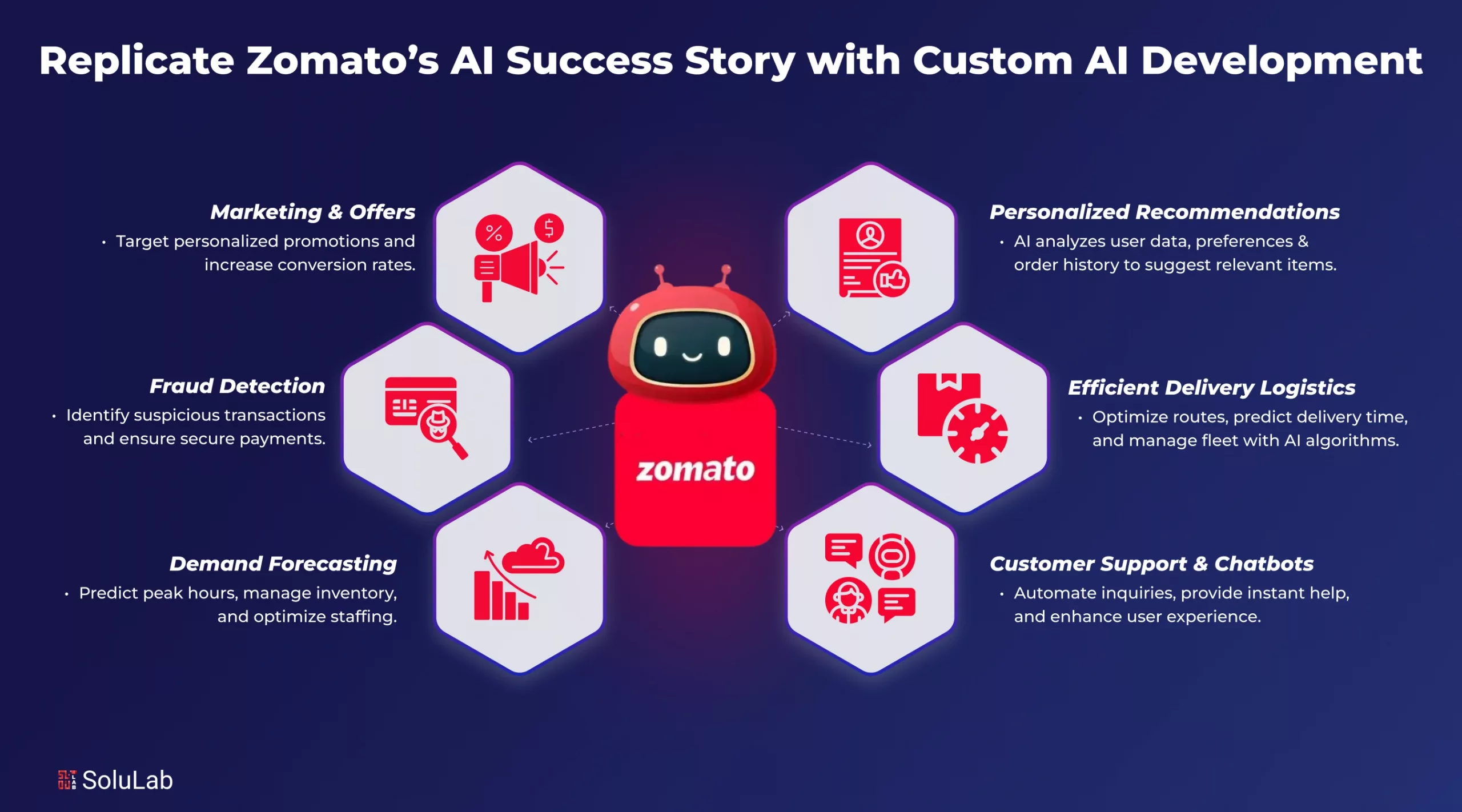
Talk to an Expert

How Can Businesses Replicate Zomato’s AI Success Story with Custom AI Development?

Replicate Zomato’s AI Success Story with Custom AI Development

Today’s, customers want fast, healthy, and personalized food choices. That’s why many restaurants now use AI tools like AI food analysis and AI nutrition recommendation systems to create smarter menus and improve user experience.

The AI in the food and beverage industry is worth over $15 billion in 2025 and is expected to reach $263 billion by 2034. Brands using AI-powered food delivery apps already see up to 40% higher revenue and stronger customer loyalty.

Even major players like Zomato are using intelligent systems to improve food recommendations, delivery accuracy, and user satisfaction. For companies that want to scale, save time, and serve better, investing in AI in food business tools is no longer optional; it’s the next big growth step that you should consider seriously.

What Is an AI-Powered Recommendation System in Food Apps?

An AI-powered recommendation system in food apps uses artificial intelligence to study food data and help users make better choices. It doesn’t just guess what’s healthy. It looks at real details like ingredients, cooking methods, calories, and nutrients through food analysis.

In simple terms, this system rates or recommends food based on its quality and nutritional value. Think of it as a smart guide that reads the label, checks what’s inside, and tells your customers if it’s a good choice.

For example, your app could show a Smart Choice badge when the AI nutrition recommendation system finds high-fiber, protein-rich, and low-fat ingredients, or it could highlight Limit Intake when it detects deep-fried or high-sugar dishes. The user doesn’t see the technical part; they just see clear and data-backed advice. 

That’s what builds trust and keeps them returning. From a business perspective, these systems don’t just improve user experience; they boost conversions and brand credibility. When users trust your food app’s insights, they’re more likely to order again, recommend it to others, and stay loyal.

But developing this kind of custom AI solution requires:

  • Clean data pipelines to collect ingredient and nutrition data
  • AI algorithms that turn food details into useful insights
  • A simple, intuitive interface that displays results clearly

And, this is where AI companies truly create an impact. It’s not only about automation, it’s about giving customers confidence and helping your platform stand out in a crowded market.

How AI Food Analysis Improves Customer Ratings and Reviews?

In today’s food industry, customers don’t just want a tasty meal, but also trust. They care about what’s in their food, how it’s rated, and whether your food delivery app or platform truly understands their preferences. 

That’s where AI food analysis makes all the difference. When your business uses it, you’re showing customers that transparency and health matter. Here’s how this creates measurable business impact:
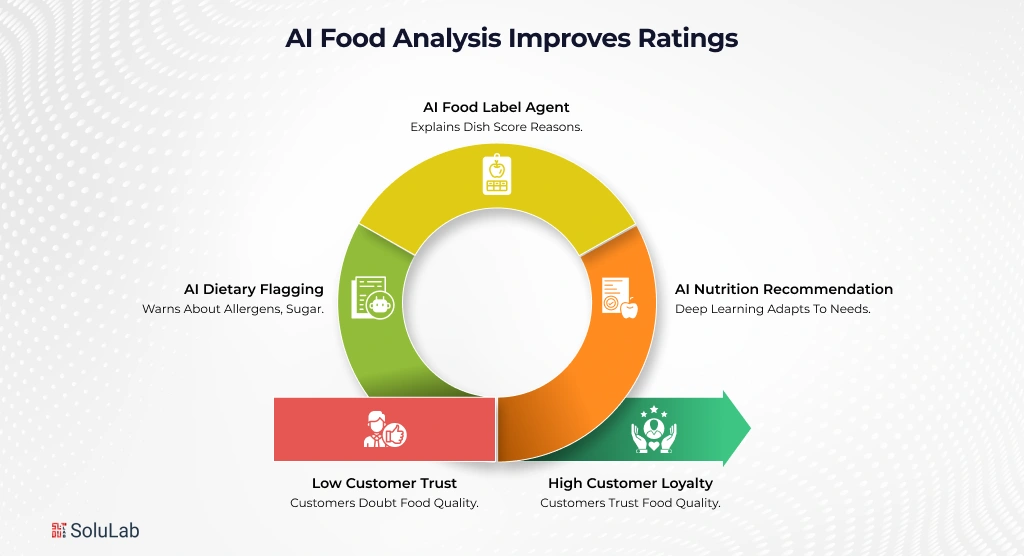
AI Food Analysis Improves Ratings

1. Builds stronger trust and loyalty

People return to platforms that feel honest. When your rating system is powered by AI nutrition recommendation using a deep generative model, users see that your app learns and adapts to their needs instead of showing random ratings. This drives retention and repeat orders, with a direct boost to revenue.

2. Generates better reviews and organic growth

A smart AI food label agent helps customers understand why a dish scored high or low. When users realize that your delivery app is actually analyzing real nutritional data, they start talking about it, and that creates powerful, authentic word-of-mouth marketing.

3. Reduces complaints and friction

With AI application, your system can flag dishes that might not fit a user’s dietary needs. Just imagine that your food delivery app warns users about high sugar or allergens before they even order, you avoid refunds, and improve customer satisfaction.

With these, every rating, reorder, or skip helps your AI food analysis system get smarter. For example, if Dish #457 receives a low health score and zero reorders, the model learns to adjust its predictions. Over time, this creates a self-improving recommendation engine that gives your platform a serious competitive edge.

For food tech businesses, this is a trust-building system powered by artificial intelligence. By adding AI in food business, like food analysis, nutrition recommendation systems, and AI-powered food label scanners, you not only enhance user experience but also position your brand as transparent, data-driven, and customer-first.

Key Features to Add While Building an AI Nutrition Recommendation System

Building an AI-powered food delivery app isn’t just about using the latest tech; it’s about creating something people can trust, understand, and rely on. From a business standpoint, these features directly impact adoption, engagement, and brand reputation. Below are the must-have elements that make your AI in customer service solutions stand out and perform at scale.

1. Transparent Scoring Logic

Trust begins with clarity, and your app should explain why a dish received a certain rating. Just by integrating an AI-powered food label scanner, you can break down ingredients and highlight details like High Sugar, Low Fiber, or Grilled vs. Fried. This gives users visibility into how their food is evaluated and reinforces credibility.

2. Dynamic Feedback Loop

Your AI system shouldn’t work in isolation but it should learn directly from real user behavior by allowing customers to rate, review, or even challenge recommendations. Their feedback should feed into a continuous learning pipeline that retrains your AI nutrition recommendation system in real time. This ongoing cycle keeps your platform evolving, understanding preferences, improving suggestions, and delivering more relevant nutrition guidance over time. 

3. Vendor Integration & Data Quality

AI is only as good as the data behind it, but to ensure accuracy, connect your AI food label agent to verified data sources. You should partner with restaurants, vendors, and kitchens to maintain up-to-date ingredient details and nutrition profiles. Reliable data eliminates guesswork and ensures your AI product gives results that users can trust.

4. Contextual Personalization

Nutrition isn’t one-size-fits-all, and that’s why your system should understand each user’s unique profile, their allergies, diet preferences, fitness goals, and order history. By using insights, your model can tailor suggestions to fit every lifestyle. Hire AI developer for personalization that transforms your app from a generic food tracker into a true digital nutrition advisor. When users feel the system gets them, retention and trust follow naturally.

5. Scalable Architecture

As your user base grows, so will data, requests, and recommendations. Your smart food delivery app must be ready for that. Build your recommendation engine on a microservices architecture so it’s flexible, efficient, and easy to update. A scalable setup keeps your food delivery app fast and reliable, even with thousands of users engaging at once, ensuring seamless performance during peak times.

6. Compliance and Transparency

The food and wellness sectors demand strict regulatory compliance, so your platform must track how every decision is made, ensure traceability, and meet food labeling standards. Avoid black box AI models that hide logic from users or regulators, as being open about how your AI works strengthens your reputation and meets legal requirements, essential for long-term growth in the AI in food industry.

Many agencies over-prioritize model accuracy and ignore user experience. But the truth is, even the smartest algorithm fails if users can’t trust or understand it. The real power of AI in the food business lies in combining intelligence with simplicity, creating systems that inform, engage, and inspire confidence.

How Zomato Used AI-Powered Rating Systems in Their App?

X Post (1)

A good example of how AI is applied in the food industry in real life is Zomato’s Healthy Mode. This feature uses an AI-powered rating system to score each dish from Low to Super based on detailed nutrition data. It’s a perfect example of how Zomato AI changed the way people view food choices online.

Zomato collected data from ingredients, cooking methods, and restaurant partners, then it used it in AI food analysis to understand nutrition value and freshness. This information powered their recommendation system, helping users pick better meals without needing to read long food labels.

They also used a food label scanner inside the app to show users why a dish was rated healthy. It didn’t just say good for you, it explained why. That’s the kind of smart feature that builds trust and keeps users coming back.

For restaurant partners, Zomato created dashboards that used AI agents to align menus with the same scoring logic. It helped vendors adjust their recipes and highlight healthier dishes directly on the app.

The biggest takeaway for any business in the food business space is Don’t try to launch everything at once. Zomato started small, city by city, testing and improving their model before scaling.

This approach can work for your brand, too. Whether you run a delivery app, a nutrition startup, or a food-tech platform, we can personalize choices, increase engagement, and create a competitive edge.

How to Implement Custom AI in Your Business?

Building an AI app in the food industry starts with a clear and structured roadmap. Whether you’re creating a delivery app that adapts in real-time, the core goal remains to empower users with intelligent choices while improving business efficiency and scalability.

Below is a practical breakdown of how businesses can move from concept to full-scale AI implementation.
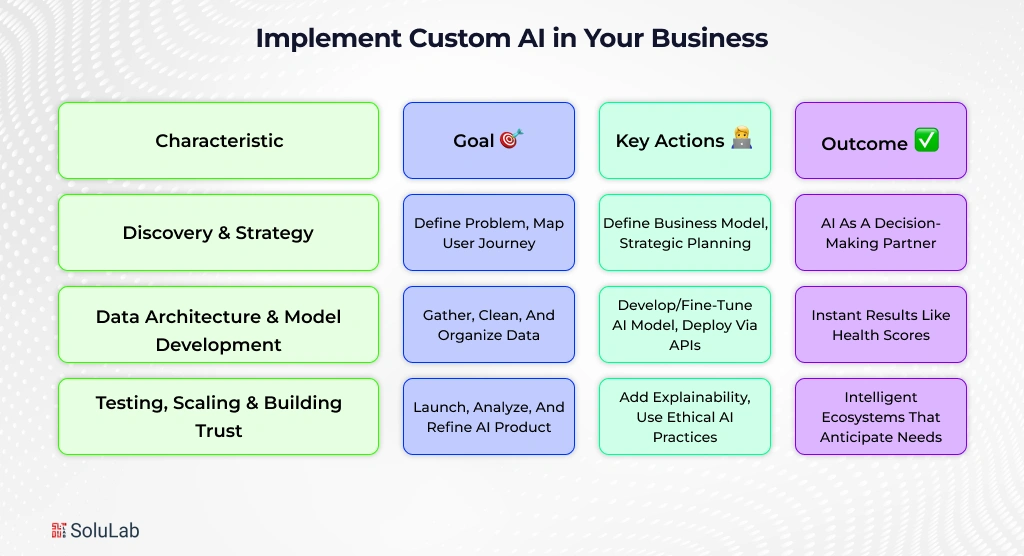
Implement Custom AI in Your Business

1. Discovery & Strategy

Start by clearly defining your problem statement. For example, how can we help users identify the healthiest food options within 5 seconds and Once you have your vision, map out your complete user journey, like app screens, restaurant dashboards, vendor data flows, and feedback loops with an AI consulting company.

At this stage, define your business model, like subscription-based, freemium, or AI integration for food label agent as an add-on feature. The goal is to design the product around real user needs, not just algorithms, as strategic planning here ensures your AI becomes a decision-making partner, not just a background tool.

2. Data Architecture & Model Development

Data is the backbone of your AI product. So, gather structured and unstructured data like ingredient lists, preparation methods, delivery patterns, and customer preferences. Then, clean and organize it into scalable data lakes that support AI food analysis models. 

Next, develop or fine-tune your AI model, training it on real-world data to deliver accurate nutritional insights. To enhance accuracy further, apply AI nutrition recommendations using a deep generative model, which fills gaps in missing or incomplete datasets by learning from similar entries.

Once your model is trained, deploy it via APIs that provide instant results like Health Scores, Nutrient Breakdown, or Smart Suggestions. This turns your product into a self-learning, adaptive intelligence engine.

3. Testing, Scaling & Building Trust

Now launch your AI product in controlled regions or select vendor clusters first. Analyze how users interact with your recommendation engine, like what they tap, skip, or re-order. This feedback loop helps refine your model continuously.

As you scale, add layers of explainability that let users see why a dish scored high or low. For example, show ingredient-level logic from your AI-powered food label scanner to build credibility. And use ethical AI practices such as transparent scoring and bias checks that aren’t optional.

By following this framework, your food delivery apps evolve from simple transactional systems to intelligent ecosystems that anticipate user needs, personalize experiences, and drive consistent business growth.
AI Development Services (2)

Conclusion

If there’s one takeaway from Zomato’s Healthy Mode, is that AI is a growth engine. Businesses that use AI in food industry operations are seeing higher customer trust, faster decision-making, and stronger brand loyalty. By integrating transparent AI systems like an AI nutrition recommendation system, companies can make their apps not only smarter but also more human, helping users make better choices while improving engagement and retention.

The future of food and wellness is moving toward intelligence-led personalization. Whether you run a smart food delivery app or a large retail chain, AI in the food business can help you create more value for customers and new revenue streams for your company. 

So, if you want to be the next success story like Nugget Zomato AI, now is the time to act. Let SoluLab, a leading AI development company, build the AI foundation your business needs to lead the future of the AI-powered food delivery apps revolution.

FAQs

1. What makes an AI-powered food label scanner different from a normal diet app? 

A typical diet app only shows calories or basic nutrition data. But an AI-powered food label scanner uses smart AI food analysis to go deeper; it studies ingredients, cooking style, and portion size to give more accurate and personalized insights. It doesn’t just scan, it learns and gets smarter with every user interaction, making it more valuable for both users and businesses.

2. Can small or mid-sized businesses afford an AI nutrition recommendation system?

Absolutely. You don’t need millions to start, but to begin with a small MVP focused on one key feature, like personalized meal scoring or label scanning. With open-source tools and quality data, you can build a scalable AI nutrition recommendation system that grows over time. This approach reduces cost, shows early results, and builds investor and customer confidence.

3. How can we make our AI food business more transparent and trustworthy?

Transparency with your customer builds trust. By integrating an AI food label agent, your system can explain why a food item is rated a certain way, like low sugar, grilled, or high in protein. When users understand the reason behind a rating, they trust the system more, which strengthens your brand reputation.

4. Is this technology only useful for food delivery apps?

Not at all. The same technology applies across the food and beverage industry, from wellness apps and retail stores to restaurants and meal-kit brands. Any business that deals with food data can use AI to make better recommendations, improve user experience, and drive more engagement.

5. What’s the first step to start using AI in our food delivery app?

Start with your data. Collect consistent and clean data from suppliers, menus, and customer feedback. Build a simple scoring model using that data, test it with real users, and keep improving. That’s the foundation for any serious AI in a food delivery app, and it’s how businesses turn simple apps into smart, revenue-generating platforms.

How Is AI Upgrading the Legal Industry and Making Law Smarter?

Artificial Intelligence in Legal Industry

Lawyers and legal teams often spend countless hours going through case files, contracts, and endless paperwork. 

However, Legal work isn’t getting easier. Case files are growing. Clients want results faster. And your time? It’s too valuable to waste on outdated methods.

AI in law is no longer optional. Using AI tools is a must to save hours on research, routine tasks, improving accuracy, and even predicting legal outcomes. The global legal AI market is projected to reach $2.5 billion by 2028, growing at a CAGR of 35%.

From contract analysis to legal analytics, AI tools are improving how law firms operate, reducing costs, and enhancing client service. In this blog, we’ll walk you through AI’s benefits, ways to use it, and 5 AI tools for legal practice. 

What is AI in law?

The usage of artificial intelligence technologies (such as machine learning, natural language processing, and automation) to carry out legal activities that are done by humans can be called AI in law.

AI does not replace lawyers but enables them to do legal research, analyze contracts, review documents, and even forecast the result of cases. It is eliminating routine tasks, increasing accuracy, and saving money, and thus, making law firms and legal departments more efficient.

Benefits of Using AI in the Legal Industry

In the legal industry, AI is improving efficiency, efficiency, and process automation, lowering time and price. Plus, used to make better decisions more quickly, thus allowing firms to provide faster, smarter, more customer-centric legal services.

  • Increased Efficiency: AI applications can automate simple, legal activities such as contract reviews and the fight of legal data, reducing time and person-hours of work. This enables the lawyers to practice more in terms of strategy and issues related to a specific client.
  • Cost Reduction: Law firms do not have to be so dependent on billable hours, as AI tools allow them to do repetitive work. This reduces the cost of operations and enables the clients to gain access to cheap legal solutions.
  • Improved Client Service: AI allows law firms to be more reactive and responsive to clients through faster turnaround times and data-driven insight, increasing satisfaction and sustaining relationships over time.
  • Improved Decision-Making: Smart legal decisions may be made with the analysis of huge legal databases, precedents, and up-to-date case data using AI tools. This will enable deployment of legal teams to evaluate risks and develop better arguments.

Top 7 Ways to Use AI in the Legal Industry

Generative AI in the legal industry is changing how legal professionals work. From research to fraud detection, here are seven practical AI use cases in legal businesses that drive efficiency and accuracy.

Top Ways to use AI in Legal Industry

1. AI for Legal Research and Case Law Analysis

AI in legal businesses helps analyze case law, past judgments, and legal precedents within seconds. It reduces manual research hours and uncovers relevant case references, and improves how AI and law now work together.

2. Summarizing Legal Narratives

Generative AI in the legal industry can convert lengthy legal documents or transcripts into concise summaries. This is especially useful for lawyers who need to digest complex information quickly without missing important points.

3. Reviewing Legal Documents

AI tools scan contracts and agreements to spot errors, inconsistencies, or missing clauses. These tools improve compliance and reduce human oversight in document review, a common use case in legal businesses.

4. Drafting Communications 

AI tools can draft routine legal communications, memos, and client emails. This speeds up internal operations and frees up time for more strategic work by demonstrating smart AI use cases in legal businesses.

5. Legal Chatbots

AI-powered legal chatbots can answer FAQs, guide clients, or assist in form filling. They enhance customer support, offer 24/7 availability, and are now a staple AI use case in legal businesses.

6. Reviewing Discovery

During litigation, AI can filter through massive volumes of documents in the discovery phase to identify relevant evidence. This accelerates case preparation and reduces costs, another key example of AI and law working in sync.

7. Fraud Detection

AI algorithms detect patterns and anomalies in financial transactions and legal documents. This helps law firms and legal departments prevent fraud and ensure regulatory compliance, proving how vital AI in legal businesses has become.

Top 5 AI Tools for the Legal Industry

Artificial Intelligence in Legal Practice is being quickly adopted by the legal sector. These are the top 5 artificial intelligence (AI) tools for legal practice that are improving the effective and intelligent operation of law firms.

Top AI Tools for the Legal Industry

1. Spellbook, the Best AI Tool for Law Firms Overall

Spellbook’s direct integration with Microsoft Word enables lawyers to use GPT-4 to prepare contracts. It is the greatest AI tool for legal practice overall because it can comprehend legal language, provide real-time recommendations, and minimize manual labor.

2. ChatGPT

ChatGPT is a flexible tool for writing memoranda, conducting legal research, and summarizing case law. Despite not being designed with legal work in mind, its conversational style and flexibility make it an effective element of AI in the legal field.

3. The Lex Machina

Lex Machina offers insights into lawyers, courts, and case outcomes using data analytics. With its strong, predictive analytics, it boosts fighting tactics and shows the developing importance of AI in the legal sector.

4. Reuters Thomson

AI-enhanced solutions from Thomson Reuters include Quick Check for quick analysis and Westlaw Edge for legal research. Its advanced technologies make difficult research easier, revealing the true potential of AI in legal practice.

5. LawGeex

Contract reviews are automated by LawGeex, which compares papers to pre-established policies. One of the most useful AI technologies for legal practice in today’s digital law firms, it increases speed, accuracy, and compliance.

What is the Future of AI in Law?

With the development of technology, AI will not only simplify repetitive tasks but will also help in legal strategy, risk assessment, as well as predict the result of cases. Machine learning and natural language processing tools will process huge amounts of data in less time than humans. 

Enabling lawyers to make better decisions. There will be virtual legal assistants who will receive the client inquiries, and they will attend to and assist in case preparation. AI can also improve access to justice in spaces where legal advice is out of reach in developed nations by providing low-cost access to justice services. 

Yet, questions concerning the privacy of data, algorithmic discrimination, and ethical applications of AI are also brought up in the future. Law firms will balance the use of technology and human decision-making. 

Possible changes in regulatory frameworks might also become the means of regulating the use of AI in legal contexts.

AI Development Company (2)

Conclusion

Law firms adopting AI-driven solutions are gaining a competitive edge by saving time, reducing costs, and delivering better client service. While AI won’t replace lawyers, it empowers them to focus on high-value strategic work. 

As AI in legal practice continues to evolve, firms that use it early will lead the way in efficiency, innovation, and shaping the future of legal services. Digital Quest, a travel business, partnered with SoluLab to develop an AI-powered chatbot using Generative AI. The chatbot enhanced customer engagement by offering real-time, personalized travel recommendations and hassle-free reservations.

SoluLab, an AI development company, can help you automate your legal firm to reduce costs and manual work. Get in touch with us today!

FAQs

1. Can AI replace lawyers in the future?

No, AI will assist lawyers rather than replace them. While AI can undertake repetitive jobs in the legal field, human judgment and legal knowledge are still crucial.

2. Is AI in legal services legal and ethical?

When applied properly, AI in legal practice is both morally and legally acceptable. It improves compliance while ensuring fairness through human oversight, striking a balance between ethics and AI-driven legal sector solutions.

3. What is the best legal AI tool?

Spellbook’s smooth contract drafting makes it one of the greatest AI tools for legal practice. For particular AI use cases, there are also Lex Machina and LawGeex. Still in doubt, then connect with our experts 

4. The Impact of Artificial Intelligence on Law Firms’ Business?

In the legal sector, artificial intelligence improves client service, reduces expenses, and increases efficiency. It is changing how law firms operate and demonstrating the practical advantages of artificial intelligence in the legal sector.

5. How to implement AI in the law business?

Start by determining which duties, such as contract review or research, AI can automate. To optimize AI’s contribution to the legal sector and enhance operations, select tools that are in line with clear objectives.

Why Is Saudi Arabia Investing in AI Doctor Clinics?

Saudi Arabia Investing in AI Doctor Clinics

What if your next doctor’s visit began not with a long wait in the lobby, but with an AI system that could instantly review your medical history, analyze your symptoms, and suggest possible treatments—before you even met a physician?

This isn’t science fiction anymore! Saudi Arabia has already launched its first AI-only medical clinic, showing how artificial intelligence can move from supporting tools to front-line healthcare delivery. The move reflects more than just a fascination with technology; it’s part of a larger strategy to improve patient access, cut costs, and position the country as a global leader in healthcare innovation.

For MedTech companies, healthcare providers, and investors, the rise of AI doctor clinics in Saudi Arabia raises an important question: Is this the future of healthcare, and how can businesses prepare to be part of it?

What Do We Mean by an AI Doctor?

An AI Doctor isn’t a robot in a white coat, but it’s a smart digital healthcare assistant powered by artificial intelligence, machine learning, and medical data analytics. Instead of replacing human doctors, it acts as a virtual specialist, working alongside healthcare professionals to improve the accuracy, speed, and accessibility of care.

The idea is already gaining momentum with the rise of AI doctor clinics, such as the first-of-its-kind in Saudi Arabia. These clinics use AI systems as front-line digital assistants, guiding patients through initial assessments, analyzing medical data in real time, and supporting doctors in delivering personalized treatment.

What Can an AI Doctor Do?

  • Interpret Medical Reports

AI can analyze lab tests, X-rays, MRIs, and CT scans quickly and accurately, highlighting anomalies that might otherwise take hours for human review.

  • Diagnose Symptoms

By processing patient-reported symptoms and health records, AI doctors can suggest possible conditions, supporting early diagnosis and minimizing misdiagnosis.

  • Recommend Treatments

AI systems are trained on vast medical databases and global research. They provide evidence-based treatment recommendations, ensuring patients receive the most updated options.

  • Provide Real-time Health Monitoring

Through wearables and IoT devices, AI doctors monitor vital signs like heart rate, oxygen level, and blood sugar continuously, offering 24/7 support and emergency alerts.

  • Promote Preventive Healthcare

AI analyzes lifestyle data, predicts risks, and advises on healthier habits, helping patients prevent illnesses before they become severe.

  • Assist Doctors, Not Replace Them

AI handles repetitive tasks such as data analysis and documentation, freeing doctors to focus on complex decisions and patient interaction.

What Can an AI Doctor Do


Why Saudi Arabia’s First AI Doctor Clinic Matters?

Saudi Arabia’s AI-only clinic is significant because it aligns with the country’s Vision 2030 plan to diversify its economy and strengthen its healthcare infrastructure.

Key benefits include:

  • Speed: Faster medical checkups and immediate report processing.
  • Precision: Reduced diagnostic errors compared to traditional methods.
  • Cost-Effectiveness: Lower operational costs make healthcare more affordable.
  • Accessibility: Rural and remote regions can benefit from AI-enabled consultations.

This clinic is not about replacing doctors—it’s about providing them with smarter tools to enhance patient care.

Check Out Our Blog Post: Generative AI in Healthcare

How Saudi Vision 2030 Promotes AI in Healthcare?

Saudi Arabia’s Vision 2030 is all about shaping a smarter, healthier, and more self-reliant future. One of the key pillars of this vision is healthcare transformation, and Artificial Intelligence (AI) is at the heart of it.

The launch of AI doctor clinics is not just about technology—it’s about improving lives, building trust in local systems, and creating opportunities for the future. Here’s how it fits into Vision 2030:

1. Making Advanced Healthcare Accessible

Vision 2030 wants every citizen to benefit from the latest medical innovations. With AI-driven tools, people can get faster diagnoses, accurate treatment suggestions, and 24/7 healthcare support without waiting for long hospital queues. Simply put, AI brings world-class healthcare closer to home.

2. Becoming Less Dependent on Foreign Healthcare

For years, many Saudis had to travel abroad for specialized treatments. Vision 2030 changes this by building advanced medical solutions inside the Kingdom. AI doctor clinics mean fewer trips overseas and more trust in local healthcare facilities. It’s a step towards self-reliance and making Saudi Arabia a regional hub for healthcare excellence.

3. Training and Empowering Local Talent

Vision 2030 is not just about machines—it’s about people. By introducing AI in healthcare, the government is creating new learning opportunities for doctors, nurses, and young Saudi professionals. Universities and training centers are focusing on AI in medicine, ensuring that the next generation of healthcare leaders is homegrown.

4. Attracting Global Investments and Start-ups

AI healthcare isn’t just good for patients—it’s good for the economy too. Saudi Arabia is opening doors for foreign investors and healthcare tech start-ups by creating a supportive ecosystem. The AI doctor clinic is a clear signal to the world: Saudi is ready to lead in digital health innovation. This encourages global companies to invest, collaborate, and innovate in the Kingdom.

Book A Free Discovery Call

Why Are AI Doctor Clinics the Next Big Opportunity in Healthcare?

AI doctor clinics go beyond being a tech experiment—they represent a scalable, patient-centric model that addresses critical gaps in today’s healthcare systems. By combining advanced GenAI with clinical expertise, these clinics offer faster, more accessible, and cost-effective care. For MedTech companies and healthcare providers, they open doors to both innovation and revenue growth.

Key Reasons AI Doctor Clinics Are a Breakthrough:

1. Accessibility at Scale: AI-powered clinics can serve more patients with fewer resources, reducing wait times and improving healthcare reach in underserved regions.

2. Cost Efficiency: Automating initial diagnostics and routine monitoring lowers operational costs while keeping care quality high.

3. Patient-Centric Care: With real-time monitoring and predictive analytics, AI clinics personalize treatments and promote preventive healthcare.

4. 24/7 Availability: Unlike traditional clinics, AI-driven systems provide round-the-clock support, improving patient trust and satisfaction.

5. Faster Clinical Decisions: AI analyzes medical data instantly, supporting doctors in delivering quicker and more accurate diagnoses.

6. New Business Models: From subscription-based care to telehealth integrations, AI doctor clinics create fresh revenue streams for MedTech innovators.

7. Global Momentum: Early adopters like Saudi Arabia are proving the model works, paving the way for international adoption and market expansion.

Major Use Cases of AI in Healthcare

Saudi Arabia’s AI doctor clinic is a real-world example of how technology is reshaping medicine. Some areas of impact include:

1. AI in Healthcare Applications

AI tools help detect diseases early, offer online consultations, and analyze health records, making the patient experience smoother and more reliable.

2. AI in Treatment Planning

Data-driven algorithms allow AI systems to create personalized treatment plans, improving recovery outcomes for patients with chronic or complex illnesses.

3. AI in Drug Discovery and Development

Pharmaceutical research that once took decades can now be accelerated with AI drug discovery. This shortens the time it takes to develop new medicines and vaccines.

4. AI-Powered Chatbots

Patients can access round-the-clock medical guidance through AI chatbots, reducing unnecessary hospital visits and improving patient engagement.

5. Generative AI in Healthcare

By analyzing patient data, generative AI in healthcare industry can provide customized lifestyle and treatment recommendations and even assist in creating synthetic medical data for research.

6. AI Agents in Healthcare

AI agents in the healthcare sector assist doctors by analyzing reports, predicting outcomes, and supporting decision-making, helping reduce errors in complex cases.

Read Our Blog: AI Agents in Healthcare for Cancer HIV COVID

7. Integrating AI into Healthcare

Hospitals and clinics worldwide are moving toward smart healthcare ecosystems, where AI seamlessly works alongside doctors and nurses.

How AI Doctor Clinics Benefit Patients?

AI-powered clinics are designed with patients in mind, making healthcare more accessible, affordable, and efficient. Here’s how they truly make a difference:

How AI Doctor Clinics Benefit Patients

1. Faster Medical Consultations – No Long Waiting Hours

In traditional clinics, patients often wait for hours before meeting a doctor. AI clinics speed up the process by analyzing symptoms quickly and providing initial assessments within minutes. This means patients get help faster, and doctors can focus on more complex cases.

2. Lower Treatment Costs

Healthcare can be expensive, especially when it involves multiple tests or specialist visits. AI clinics reduce costs by using smart tools that cut down on unnecessary procedures and make diagnoses more precise. This makes healthcare more affordable for families without compromising on quality.

3. 24/7 Access to Healthcare Advice

AI doctor systems are available around the clock, so whether it’s late at night or early in the morning, patients can still get reliable medical guidance. This is especially helpful for parents with small children, elderly patients, or people managing chronic conditions.

4. Personalized Therapy and Nutrition Counseling

AI doesn’t just look at symptoms—it can also track patient history, lifestyle, and medical records. This allows clinics to offer personalized treatment plans, including custom diet charts, exercise routines, and therapy sessions. Instead of a one-size-fits-all approach, patients get care that is tailored to their unique needs.

Read Blog: How Is AI Healthcare in the UAE Elevating Medical Efficiency?

5. Video Consultations for Underserved Areas

Not everyone lives near a big hospital or specialist doctor. AI clinics bridge this gap by providing video consultations, bringing healthcare access to remote and rural areas. Patients in small towns or villages can talk to specialists without needing to travel long distances.

Global Developments in AI-Driven Healthcare

AI in healthcare isn’t confined to one region—its adoption is accelerating across the world, reshaping how care is delivered:

  • China: Hospitals are leveraging AI for predictive diagnosis and robotic-assisted surgeries, making advanced treatments more accessible.
  • United States: From cancer detection to genomics and patient management systems, AI is powering precision medicine and improving outcomes.
  • Europe: Healthcare systems are adopting AI to streamline electronic medical records and enable predictive analytics that support proactive care.
  • Saudi Arabia: With the launch of its first AI-specialized medical clinic, the country is positioning itself as a leader in next-generation healthcare innovation.

AI’s global footprint highlights one clear message: the future of healthcare is being redefined everywhere, and MedTech is at the center of it.

The Future of AI in Healthcare

The launch of Saudi Arabia’s AI-only clinic could be a glimpse into what’s next for global healthcare. Similar models may soon emerge worldwide, unlocking new possibilities such as:

  • AI-assisted robotic surgeries that enhance precision and reduce recovery times.
  • Predictive healthcare platforms capable of detecting illnesses before symptoms appear.
  • Smart hospitals are powered by AI-driven systems that optimize operations and patient care.
  • AI-enabled mental health support delivered through intelligent virtual therapy assistants.

Over the next decade, AI is set to move beyond being an experimental add-on. It will likely evolve into a trusted healthcare partner—supporting doctors, patients, and entire health systems in ways once thought impossible.

AI Development Company

Conclusion

Saudi Arabia’s first AI doctor clinic is more than a headline; it’s a world healthcare revolution. By applying AI to treatment planning, drug discovery, diagnosis, and patient care, Saudi Arabia is showing the world how to create a smarter, faster, and less expensive medical system with technology.

If you are a start-up, clinic, or hospital, it is time that you collaborate with SoluLab, a leading name for AI development, to create customized healthcare solutions. From treatment platforms to chatbots with artificial intelligence capabilities, SoluLab keeps healthcare facilities ahead of their time. Contact us now!

FAQs

1. What is the first all-AI clinic on Earth?

It is a Saudi clinic with artificial intelligence that manages diagnosis and treatment assistance, not usual human doctors.

2. How does an AI doctor function?

AI learns from medical records and symptoms, then provides diagnoses and treatment suggestions using advanced algorithms.

3. Is an AI doctor safe?

Yes. It has learned from millions of medical cases and is guided by physicians. Human physicians can intervene for complex cases.

4. What is distinctive about Saudi Arabia’s clinic?

It is the world’s first AI-powered clinic, establishing a new world standard for healthcare access and innovation.

5. Will human doctors be replaced by AI?

No. Computers help doctors with diagnosis and planning for treatment, but human judgment remains necessary for surgery, emergencies, and patient reassurance.

6. What can help a patient with AI? 

Patients enjoy faster consultations, cost savings, personalized treatments, and round-the-clock medical access. 

7. Why should startups or hospitals opt for SoluLab?

SoluLab provides safe, scalable, and customized AI healthcare products that result in smooth adoption and lasting success.

Building Virtual Assistants – A Guide to Chatbot Development

Chatbot Development

In the era of digital transformation, businesses are constantly seeking innovative ways to enhance customer interactions, streamline processes, and boost productivity. One such technology that has gained prominence is Chatbot Development. AI-powered chatbots, often referred to as Intelligent Virtual Assistants, have become integral components of modern business strategies. In this comprehensive guide, we will delve into the world of Chatbot Development, exploring key concepts, strategies, and best practices to build intelligent virtual assistants that deliver meaningful value.

Understanding the Landscape: Chatbot Development and AI Integration

Chatbots are artificial conversational tools designed to simulate human-like interactions. They have evolved from basic rule-based systems to sophisticated AI-powered models capable of natural language processing (NLP) and machine learning (ML).

The Evolution of Chatbots

The roots of chatbots can be traced back to the early days of computing when simple rule-based systems governed interactions. These early chatbots followed predefined scripts, responding to specific keywords or phrases. Over time, advancements in Artificial Intelligence (AI), particularly in the realms of Natural Language Processing (NLP) and Machine Learning (ML), have propelled chatbots into a new era of sophistication.

Rule-Based vs. AI-Powered Chatbots

Traditional rule-based chatbots operate within the constraints of predefined rules and scripts. While effective for straightforward tasks, they often fall short in handling nuanced conversations or adapting to changing user needs. The advent of AI-powered chatbots marked a paradigm shift. These intelligent virtual assistants leverage NLP to understand the intricacies of human language, enabling them to interpret user intent, context, and sentiment.

Chatbot development services

Key Components of Chatbot Functionality

  • Natural Language Processing (NLP):

NLP forms the bedrock of chatbot intelligence. It enables chatbots to comprehend and interpret human language, breaking down user queries to discern intent and extract relevant information. As NLP algorithms evolve, chatbots become increasingly adept at understanding context, leading to more natural and contextually relevant conversations.

  • Machine Learning (ML):

Machine Learning empowers chatbots to go beyond static rule sets. ML algorithms allow chatbots to learn from user interactions, adapting and improving their responses over time. This continuous learning loop enhances the chatbot’s ability to handle a wide range of queries and provide personalized experiences.

Applications of Chatbots

Applications of Chatbots

  • Customer Service:

Chatbots are widely employed in customer service to provide instant responses to frequently asked questions, troubleshoot issues, and guide users through processes. This not only improves customer satisfaction but also frees up human agents for more complex tasks.

  • E-commerce:

In the realm of e-commerce, chatbots facilitate seamless shopping experiences. They assist users in finding products, offer personalized recommendations, and even handle the checkout process, streamlining the customer journey.

  • Healthcare:

Chatbots play a crucial role in the healthcare sector, offering virtual assistance for symptom checking, medication reminders, and general health inquiries. They contribute to improved accessibility and health awareness.

  • Enterprise Operations:

Within enterprises, chatbots are deployed to automate routine tasks, assist employees with internal queries, and enhance collaboration. They serve as digital assistants, boosting efficiency and productivity.

Advanced Features Implementation in Chatbot Development

Advanced Features Implementation in Chatbot Development

In the rapidly evolving landscape of chatbot development, integrating advanced features is paramount to providing a seamless and sophisticated user experience. Two crucial aspects of this advancement are the integration with third-party services and ensuring multi-channel support for a consistent user experience.

A. Integration with Third-Party Services

One of the hallmarks of a robust chatbot is its ability to seamlessly integrate with third-party services. This feature expands the bot’s capabilities beyond predefined responses, allowing it to access external data and perform tasks that enhance user interactions. Here’s how you can effectively implement integration with third-party services:

1. Identify Key Integration Points:

Define the specific functionalities and data sources from third-party services that align with your chatbot’s objectives. This could include integrating with CRM systems, payment gateways, or external databases.

2. Utilize APIs for Connectivity:

Leverage Application Programming Interfaces (APIs) to establish connectivity between your chatbot and external services. Ensure that the APIs used are secure, well-documented, and capable of handling the expected data volume.

3. Real-Time Data Access:

Enable real-time data access to ensure that the information provided by the chatbot is up-to-date. This is particularly crucial for applications such as e-commerce transactions, where real-time inventory and pricing information are essential.

4. Error Handling and Graceful Degradation:

Implement robust error handling mechanisms to manage situations where third-party services may be temporarily unavailable. Additionally, design the chatbot to gracefully degrade its functionality if certain integrations are not accessible, ensuring a consistent user experience.

B. Multi-Channel Support for Consistent Experience

Modern users interact with brands across various channels, necessitating a chatbot that provides a consistent and cohesive experience irrespective of the platform. Implementing multi-channel support ensures that users can seamlessly transition between different touchpoints while maintaining continuity in their interactions.

1. Platform-Specific Adaptation:

Customize the chatbot’s interface and interaction style based on the specific characteristics of each channel. For example, interactions on a website might differ from those on a social media platform, considering the varying user expectations and interface designs.

2. Unified User Profiles:

Implement a unified user profile system that consolidates user data from different channels. This allows the chatbot to recognize users across platforms, providing a personalized experience based on their historical interactions and preferences.

3. Synchronized Conversations:

Enable synchronized conversations, allowing users to seamlessly switch between channels without losing context. This is particularly important for complex interactions where users may initiate a conversation on one channel and continue it on another.

4. Integration with Messaging Platforms:

If deploying a chatbot on messaging platforms like Facebook Messenger or WhatsApp, ensure seamless integration. Leverage platform-specific features such as quick replies and rich media to enhance the user experience within these channels.

In conclusion, the successful implementation of advanced features, such as integration with third-party services and multi-channel support, is pivotal in elevating the capabilities of your chatbot. By strategically incorporating these elements, you not only enhance the functionality and versatility of your chatbot but also provide users with a consistent and engaging experience across various touchpoints.

Strategies for Effective Chatbot Development

Strategies for Effective Chatbot Development

Effective chatbot development involves a combination of technical prowess, user-centric design, and a commitment to continuous improvement. Here, we delve into detailed strategies to guide your chatbot development process:

1. Define Clear Objectives:

Start by establishing clear objectives for your chatbot. Identify the specific tasks it will perform, whether it’s answering customer queries, providing product information, or facilitating transactions. Clearly defined goals will guide the development process and ensure the chatbot meets user expectations.

2. Understand Your Audience:

Conduct comprehensive audience research to understand the demographics, preferences, and communication styles of your target users. This information is crucial for tailoring the chatbot’s language, tone, and functionality to align with user expectations.

3. Data Collection and Integration:

Implement robust data collection mechanisms to gather valuable insights into user behavior and preferences. Integrate your chatbot with existing databases and systems to access real-time data, ensuring that the information provided is accurate and up-to-date.

4. Natural Language Processing (NLP):

Leverage advanced Natural Language Processing (NLP) techniques to enhance the chatbot’s ability to understand and respond to user queries in a natural and conversational manner. Regularly update the language model to stay current with linguistic trends and nuances.

5. User Feedback Loop:

Establish a continuous feedback loop by collecting user feedback and analyzing it systematically. Use this feedback to identify areas for improvement, address user concerns, and enhance the overall user experience. Regularly iterate on the chatbot based on user input.

6. Machine Learning for Personalization:

Implement machine learning algorithms to personalize user interactions. Analyze user data to predict preferences, offer tailored recommendations, and create a more engaging and personalized experience. This dynamic adaptation is key to keeping users actively engaged.

7. Multi-Channel Integration:

Ensure your chatbot is seamlessly integrated across various channels, including websites, mobile apps, and social media platforms. This multi-channel approach provides users with a consistent experience and expands the reach of your chatbot to meet users where they are.

8. Security and Privacy:

Prioritize data security and user privacy. Implement robust security protocols to protect user data and communicate these measures transparently to build trust. Stay informed about data protection regulations and ensure compliance to safeguard user information.

9.Continuous Testing and Optimization:

Establish a comprehensive testing strategy throughout the development lifecycle. Conduct usability testing, performance testing, and A/B testing to identify and address any issues. Regularly optimize the chatbot based on performance metrics and user feedback.

10. Scalability and Future-Proofing:

Design your chatbot with scalability in mind to accommodate future growth in user interactions. Stay abreast of emerging technologies and industry trends to future-proof your chatbot against evolving user expectations and technological advancements.

Measuring Performance in Chatbot Development

As the adage goes, “what gets measured gets managed.” In the realm of chatbot development, measuring performance is essential for ensuring the effectiveness of the bot and continually enhancing the user experience. This involves monitoring key performance indicators (KPIs) such as response time and user satisfaction, while also establishing user feedback loops for iterative improvement.

A. KPIs: Response Time, User Satisfaction

1. Response Time: Response time refers to the time it takes for the chatbot to generate and deliver a response to the user query.

  • Measurement: Track the average response time and set benchmarks for acceptable levels based on the complexity of queries.
  • Importance: Swift responses contribute to a positive user experience, enhancing user engagement and satisfaction.

2. User Satisfaction: User satisfaction gauges how content users are with their interactions with the chatbot.

  • Measurement: Implement surveys or rating systems to collect direct feedback on user satisfaction. Analyze sentiment from user interactions for a more nuanced understanding.
  • Importance: User satisfaction is a holistic metric that reflects the overall performance and user-friendliness of the chatbot.

B. User Feedback Loops for Iterative Improvement

1. Establishing Feedback Mechanisms:

  • Methods: Implement user feedback mechanisms such as surveys, in-chat feedback options, or post-interaction email surveys.
  • Frequency: Regularly prompt users for feedback after interactions or at key touchpoints.

2. Analyzing Feedback:

  • Quantitative Analysis: Aggregate numerical ratings and quantitative feedback to identify trends and patterns.
  • Qualitative Analysis: Pay attention to qualitative feedback for insights into specific pain points or areas of improvement.

3. Iterative Improvement:

  • Continuous Iteration: Use feedback as a basis for iterative development. Regularly update the chatbot based on user suggestions and pain points identified through feedback.
  • Prioritization: Prioritize feedback based on impact and feasibility, focusing on changes that will have the most significant positive effect on user satisfaction.

4. Adapting to User Preferences:

  • Personalization: Leverage user feedback to personalize interactions. If users consistently request certain features, consider implementing them to enhance user engagement.
  • User-Centric Design: Use feedback to inform the design process, ensuring that the chatbot aligns closely with user expectations and preferences.

Future Trends in Chatbot Development

Future Trends in Chatbot Development

The landscape of chatbot development is continuously evolving, driven by technological advancements and changing user expectations. Two prominent future trends shaping the trajectory of chatbots are the integration of Augmented Reality (AR) and Voice-Activated Devices, as well as their evolving role in E-commerce and Customer Support.

A. AR Integration, Voice-Activated Devices

1. AR Integration: Augmented Reality (AR) integration involves overlaying digital information, such as visuals or data, onto the real-world environment perceived through a device’s camera.

  • Implementation: Chatbots will increasingly leverage AR to provide visual assistance. For instance, in retail, users might use a chatbot to virtually try on clothing items or visualize furniture in their living spaces.
  • Benefits: AR-enhanced chatbots enhance user engagement by providing more immersive and interactive experiences. This is particularly valuable in industries like retail, education, and healthcare.

2. Voice-Activated Devices: The integration of chatbots with voice-activated devices allows users to interact with bots using voice commands.

  • Implementation: Voice-activated chatbots are becoming prevalent in smart speakers, smartphones, and other IoT devices. Users can perform tasks, get information, or make requests through natural language voice interactions.
  • Benefits: Voice-activated chatbots enhance accessibility and convenience. Users can engage with the chatbot hands-free, enabling seamless integration into daily activities.

B. Evolving Role in E-commerce and Customer Support

1. E-commerce Integration:

  • Contextual Recommendations: Chatbots will play a crucial role in providing personalized product recommendations based on user preferences and behavior. This will enhance the overall shopping experience, making it more intuitive and tailored to individual needs.
  • Conversational Commerce: Chatbots will facilitate conversational commerce, allowing users to make purchases directly within chat interfaces. Integration with payment gateways and inventory systems will streamline the transaction process.

2. Customer Support Transformation:

  • Advanced Issue Resolution: Chatbots will evolve to handle more complex customer queries by leveraging advanced Natural Language Processing (NLP) and machine learning. This will reduce the workload on human agents, allowing them to focus on more intricate issues.
  • Seamless Handovers: The integration of chatbots with human agents will become more seamless. Chatbots will intelligently recognize when a query requires human intervention and smoothly transfer the conversation to a live agent.
  • Proactive Engagement: Chatbots will proactively engage users based on predictive analytics and historical interactions. This anticipatory approach will enhance customer satisfaction by addressing potential issues before they escalate.

AI-Chatbot development services

Conclusion

In conclusion, the landscape of AI-powered chatbot development is dynamic and evolving. From custom solutions for enterprises to voice-activated assistants and immersive experiences in virtual reality, the potential for innovation is vast. By understanding the key components, strategies, and challenges, businesses can embark on a journey to create executive virtual assistants that not only meet current needs but also pave the way for the future of human-computer interaction. 

As technology continues to advance, the role of intelligent virtual assistants in shaping the digital landscape is set to become even more profound, redefining the way we communicate, work, and engage with information. Are you aiming to take the forefront in the Conversational AI revolution? SoluLab stands as your top-tier AI development service and chatbot development company. With a demonstrated history of innovation and specialized expertise, we excel in creating state-of-the-art chatbot solutions tailored to meet your specific requirements. Collaborate with SoluLab to leverage the capabilities of AI-driven virtual companions and stay ahead in the ever-evolving realm of technology.

FAQs

1. What is the role of Augmented Reality (AR) in chatbot development?

Augmented Reality (AR) in chatbot development enhances user experiences by overlaying digital information in the real-world environment. This can be applied in various industries, allowing users to virtually try on products, visualize items in their surroundings, and engage with immersive content.

2. How do voice-activated devices integrate with chatbots?

Voice-activated devices integrate with chatbots by allowing users to interact through natural language voice commands. This hands-free approach enables seamless engagement with chatbots on smart speakers, smartphones, and other IoT devices, offering users a more convenient and accessible interaction method.

3. What benefits do AR-enhanced chatbots bring to users?

AR-enhanced chatbots provide more immersive and interactive experiences. Users can visualize products in real-world scenarios, facilitating better decision-making. This technology is particularly valuable in industries like retail, education, and healthcare, where visualizing information is crucial.

4. How can chatbots transform the e-commerce experience?

Chatbots transform e-commerce by offering contextual recommendations based on user preferences and behavior. They facilitate conversational commerce, enabling users to make purchases directly within chat interfaces. This enhances the overall shopping experience by making it more personalized and intuitive.

5. What advancements can we expect in customer support through chatbots?

Chatbots in customer support will advance in handling more complex queries using advanced Natural Language Processing (NLP) and machine learning. They will seamlessly integrate with human agents, recognizing when a query requires human intervention. Proactive engagement will also become a norm, addressing potential issues before they escalate.

6. How do chatbots contribute to seamless multi-channel experiences?

Chatbots contribute to seamless multi-channel experiences by adapting their interface and interaction style based on specific channel characteristics. Unified user profiles enable users to transition between channels without losing context, ensuring consistent and personalized interaction across various touchpoints.

7. What key performance indicators (KPIs) should be monitored for chatbot success?

Key performance indicators for chatbots include response time, measuring the speed of generating and delivering responses, and user satisfaction, gauging how content users are with their interactions. Monitoring these KPIs is crucial for assessing the effectiveness of the chatbot and ensuring a positive user experience.

The Roots of Data Revolts Against AI: What Does it Mean?

The Roots of Data Revolts Against AI What Does it Mean

In the rapidly changing digital landscape, the growth of Artificial Intelligence (AI) has been nothing short of remarkable. From AI-powered chatbots revolutionizing customer service to the top AI solution companies pioneering cutting-edge innovations, the impact of AI is undeniable. However, this journey has not been without its challenges. The rise of AI has also sparked discussions about the ethical implications and responsible integration of this technology. This blog will delve into the nuances of the AI revolution, exploring the role of various AI-related entities and their impact on the digital ecosystem.

The Rise of Artificial Intelligence

Artificial Intelligence (AI) has become an integral part of the modern technological landscape, revolutionizing the way businesses operate and transforming various industries. This section provides insights into the evolution of AI, its impact on customer interactions through AI-powered chatbots, and the transformative role it plays across different sectors.

  • Understanding the Evolution of AI

Artificial Intelligence (AI) has undergone significant evolution, from its early stages of rule-based systems to the complex deep learning models of today. This evolution has been driven by advancements in computing power, data availability, and algorithmic innovations. The initial stages of AI development focused on basic tasks such as decision-making and problem-solving. However, with the introduction of machine learning and neural networks, AI has expanded its capabilities to encompass complex data analysis, pattern recognition, and natural language processing.

  • AI-Powered Chatbots: Enhancing Customer Interactions

AI-powered chatbots have revolutionized customer interactions, providing businesses with efficient and effective ways to engage with their audience. These chatbots leverage natural language processing and machine learning algorithms to understand and respond to customer queries, thereby offering personalized and seamless experiences. The integration of AI-powered chatbots has streamlined customer service operations, allowing businesses to provide round-the-clock support and instant solutions to customer queries and concerns.

  • Analyzing the Impact of AI Revolution in Different Sectors

The AI revolution has made a significant impact across various sectors, including healthcare, finance, retail, and manufacturing. In healthcare, AI has enabled the development of predictive models for disease diagnosis and treatment planning, leading to more accurate and efficient healthcare services. In the financial sector, AI has facilitated the automation of routine tasks, fraud detection, and risk management, enhancing operational efficiency and security. Similarly, in the retail industry, AI has enabled personalized shopping experiences, recommendation systems, and inventory management optimization, leading to improved customer satisfaction and increased sales.

Top AI Solution Companies: Driving Innovation and Integration

Top AI Solution Companies: Driving Innovation and Integration

Amid the dynamic AI landscape, numerous top AI solution companies have emerged, leading the charge in driving innovation and integration. This segment highlights the services and offerings provided by these companies and their pivotal role in supporting businesses through digital transformation.

  • Overview of Leading AI Solution Providers

Several leading AI solution companies have emerged, offering a diverse range of AI-based products and services. These companies specialize in developing AI solutions tailored to specific industry requirements, including data analysis, automation, and predictive modeling. Some of the top AI solution companies include Google, Microsoft, IBM, Amazon Web Services (AWS), and Salesforce, among others.

  • Services and Offerings by Top AI Solution Companies

Top AI solution companies offer a wide array of services and offerings, including AI-powered data analytics, machine learning algorithms, natural language processing tools, and AI-driven automation solutions. These services cater to the specific needs of businesses, providing them with valuable insights, predictive analytics, and automation capabilities to streamline their operations and drive business growth. Additionally, AI solution companies offer consultancy services, training programs, and customized AI solutions to address complex business challenges and opportunities.

  • Role of AI Solution Companies in Digital Transformation

The role of AI solution companies in digital transformation is instrumental in driving innovation and integration across industries. These companies play a crucial role in helping businesses adopt and implement AI technologies, enabling them to leverage data-driven insights and automation to enhance their operational efficiency and competitiveness. By providing customized AI development solutions, consultancy services, and ongoing support, AI solution companies empower businesses to navigate the complexities of digital transformation and stay ahead in an increasingly competitive marketplace.

AI Development Company

AI Consulting Companies: Navigating Businesses Through AI Integration

AI consulting companies are crucial in guiding businesses through the intricate process of AI integration. This section delves into the significance of AI consulting in organizational development and emphasizes the collaborative strategies adopted by businesses and consulting firms for successful AI implementation.

  • Importance of AI Consulting in Organizational Development

AI consulting companies play a vital role in guiding businesses through the process of AI integration and adoption. These consulting firms provide expert guidance and strategic insights to help businesses identify the right AI solutions and develop customized strategies for successful implementation. By understanding the unique requirements and challenges of each business, AI consulting companies offer tailored solutions that align with the organization’s objectives and goals, facilitating a seamless transition to AI-driven operations.

  • Leveraging Expertise from AI Consulting Companies

Businesses can leverage the expertise and knowledge of AI consulting companies to gain a deeper understanding of AI technologies, their potential applications, and their impact on business operations. These consulting firms offer comprehensive assessments, feasibility studies, and roadmaps for AI implementation, enabling businesses to make informed decisions and investments in AI solutions that best align with their long-term objectives. By collaborating with AI consulting companies, businesses can gain access to a pool of AI experts, data scientists, and industry specialists, ensuring a holistic approach to AI integration and development.

  • Collaborative Strategies for AI Implementation and Integration

AI consulting companies work collaboratively with businesses to develop and implement effective strategies for AI integration. These strategies encompass the identification of AI use cases, data collection and analysis, AI model development, and deployment, as well as ongoing monitoring and optimization. By fostering collaboration and communication between cross-functional teams, AI consulting companies facilitate the seamless integration of AI technologies into existing business processes, enabling businesses to achieve operational excellence, cost optimization, and enhanced decision-making capabilities.

Exploring the Landscape of AI Development Companies

AI development companies are at the forefront of AI innovation, contributing to the development and deployment of cutting-edge AI solutions. This segment provides an overview of these leading companies, their innovations, and their contributions to shaping future technologies.

  • Overview of Top AI Development Companies

AI development companies are at the forefront of AI innovation, driving the development and deployment of cutting-edge AI solutions across industries. These companies specialize in AI software development, algorithm design, and machine learning model development, catering to the diverse needs of businesses seeking to leverage AI for enhanced productivity, efficiency, and competitive advantage. Some of the top AI development companies include OpenAI, DeepMind, and UiPath, among others.

  • Innovations and Technologies by AI Development Companies

AI development companies are known for their innovative approaches to Artificial Intelligence technology, including advancements in natural language processing, computer vision, and reinforcement learning. These companies continuously strive to push the boundaries of AI research and development, exploring new techniques, algorithms, and models that can address complex business challenges and opportunities. By staying at the forefront of AI research, AI development companies contribute to the continuous evolution and advancement of AI technologies, fostering a culture of innovation and excellence.

  • AI Development Companies and the Shaping of Future Technologies

The contributions of AI development companies are instrumental in shaping the future of technology, as they continue to drive advancements in AI research, development, and deployment. These companies are actively involved in addressing the evolving needs and demands of businesses, offering tailored AI solutions that can optimize operations, enhance decision-making, and drive innovation. By collaborating with AI development companies, businesses can tap into a wealth of AI expertise and knowledge, gaining access to state-of-the-art AI technologies that can propel them toward sustainable growth and success.

Decoding the AI Revolution: Challenges and Opportunities

Decoding the AI Revolution: Challenges and Opportunities

The AI revolution presents a myriad of challenges and opportunities for businesses, particularly in terms of workforce dynamics, ethical considerations, and harnessing the potential of AI technologies. This section sheds light on the implications of the Artificial Intelligence revolution and how businesses can navigate this transformative era.

  • Impact of the AI Revolution on Workforce Dynamics

The AI revolution has led to significant changes in workforce dynamics, impacting the nature of work, job roles, and skill requirements. As AI technologies continue to automate routine tasks and streamline business operations, there is a growing need for upskilling and reskilling the workforce to adapt to the changing demands of the digital era. While AI presents opportunities for increased efficiency and productivity, it also poses challenges related to job displacement, skill gaps, and workforce restructuring, necessitating a comprehensive approach to workforce development and management.

  • Addressing Ethical and Regulatory Concerns in AI Implementation

As AI technologies become more pervasive across industries, there is a growing need to address ethical and regulatory concerns related to data privacy, security, and bias in AI decision-making. Businesses and AI stakeholders must prioritize ethical considerations in AI development and deployment, ensuring that AI systems adhere to ethical guidelines and regulatory frameworks to protect user data and privacy. By implementing transparent and accountable AI practices, businesses can build trust and credibility with their stakeholders and foster responsible AI integration and usage.

  • Harnessing the Opportunities Presented by the AI Revolution

While the AI revolution presents challenges, it also offers numerous opportunities for businesses to innovate, grow, and thrive in an increasingly competitive marketplace. By embracing AI technologies, businesses can leverage data-driven insights, predictive analytics, and automation capabilities to streamline their operations, optimize their resources, and deliver enhanced customer experiences. The AI revolution also enables businesses to explore new market opportunities, develop innovative products and services, and expand their reach to new customer segments, driving sustainable growth and profitability in the digital age.

Enterprise AI Development Companies: Advancing Organizational Efficiency

In the quest for enhanced organizational efficiency, enterprise AI development companies play a pivotal role. This segment emphasizes the importance of these companies in optimizing enterprise-level operations and implementing AI solutions tailored to meet complex business challenges.

  • Role of Enterprise AI Development Companies in Business Optimization

Enterprise AI development companies play a critical role in advancing organizational efficiency by offering AI solutions and services tailored to the specific needs of enterprises. These companies focus on addressing complex business challenges, such as process automation, data analysis, and decision-making, by leveraging AI-driven technologies and applications. By partnering with enterprise AI development companies, businesses can optimize their operations, improve productivity, and achieve cost-effective solutions that drive business success and sustainability.

  • Implementing AI Solutions for Enterprise-Level Challenges

Enterprise AI development companies offer a comprehensive suite of AI solutions designed to address enterprise-level challenges and opportunities. These solutions encompass AI-driven data analytics, predictive modeling, intelligent automation, and cognitive computing, enabling businesses to make informed decisions, streamline their operations, and enhance their competitive edge. By integrating AI solutions, businesses can unlock valuable insights, mitigate risks, and capitalize on emerging opportunities, positioning themselves as industry leaders and innovators in their respective domains.

  • Driving Innovation and Scalability through Enterprise AI Development

Enterprise AI development companies are instrumental in driving innovation and scalability across industries, empowering businesses to explore new horizons and opportunities for growth. These companies specialize in developing scalable AI solutions that can adapt to the evolving needs and demands of enterprise-level operations, enabling businesses to achieve long-term sustainability and success. By harnessing the power of AI technologies, businesses can foster a culture of innovation, creativity, and agility, driving continuous improvement and transformation within their organizations.

Unveiling the Artificial Intelligence Model

Unveiling the Artificial Intelligence Model

The artificial intelligence model serves as the backbone of AI operations, encompassing a diverse range of components and frameworks designed to simulate human intelligence. This section provides insights into the functionality of an Generative AI models and its applications across various domains.

  • Components and Framework of an Artificial Intelligence Model

The artificial intelligence model encompasses a set of interconnected components and frameworks designed to simulate human intelligence and cognitive functions. These components include data collection and preprocessing, algorithm development and training, model testing and validation, and deployment and optimization. The framework of an artificial intelligence model is structured to enable the seamless integration of data-driven insights and machine learning capabilities, facilitating the development of predictive models, recommendation systems, and decision-making tools that can enhance business performance and outcomes.

  • Understanding the Functionality of an AI Model

The functionality of an AI model revolves around its ability to process and analyze vast amounts of data, extract meaningful patterns and insights, and generate predictive outcomes and recommendations. AI models leverage sophisticated algorithms and machine learning techniques to learn from data, adapt to changing environments, and make intelligent decisions based on predefined objectives and criteria. By understanding the functionality of an AI model, businesses can harness the power of data-driven insights and automation to optimize their operations, enhance their decision-making capabilities, and drive sustainable growth and profitability.

  • Exploring the Applications of AI Models in Different Domains

AI models find applications in various domains, including finance, healthcare, manufacturing, and retail, among others. In finance, AI models are utilized for risk management, fraud detection, and algorithmic trading, enabling businesses to optimize their investment strategies and minimize financial risks. In healthcare, AI models support disease diagnosis, treatment planning, and patient care management, empowering healthcare professionals to deliver personalized and efficient healthcare services. Similarly, in manufacturing and retail, AI models facilitate supply chain optimization, inventory management, and demand forecasting, leading to improved operational efficiency and customer satisfaction.

Generative AI: A Catalyst for Innovation and Creativity

Generative AI has emerged as a catalyst for fostering innovation and creativity, enabling businesses to explore new dimensions of creative design and multimedia production. This segment explores the concept of generative AI, its emerging trends, and its transformative applications in different industries.

  • Understanding the Concept of Generative AI

Generative AI refers to a subset of artificial intelligence that focuses on creating and generating new content, such as images, text, and multimedia, based on existing data and patterns. Generative AI models utilize deep learning techniques, including generative adversarial networks (GANs) and variational autoencoders (VAEs), to generate realistic and creative outputs that mimic human creativity and imagination. By simulating human-like behaviors and cognitive processes, generative AI fosters innovation and creativity, enabling businesses to explore new possibilities and avenues for product development and design.

  • Emerging Trends and Applications of Generative AI

Generative AI is witnessing a surge in popularity across various industries, driven by its applications in creative design, content generation, and multimedia production. In the field of creative design, generative AI is used for generating realistic images, 3D models, and visual artwork, allowing designers and artists to explore new aesthetics and design concepts. In content generation, generative AI facilitates the development of personalized content, storytelling, and multimedia presentations, enhancing user engagement and brand storytelling. Additionally, in multimedia production, generative AI enables the creation of realistic animations, special effects, and virtual environments, enhancing the overall visual appeal and immersive experience for users and audiences.

  • Leveraging Generative AI for Innovative Use Cases

Businesses can leverage generative AI for innovative use cases, such as product design, virtual prototyping, and creative marketing campaigns, to foster innovation and differentiation in the marketplace. By incorporating generative AI tools and models, businesses can streamline their creative processes, accelerate product development cycles, and introduce novel concepts and designs that resonate with their target audience. Generative AI also empowers businesses to personalize user experiences, deliver interactive content, and create immersive virtual environments, fostering deeper engagement and emotional connections with their customers and stakeholders.

Exploring the Role of Generative AI in Shaping Future Technologies

Generative AI plays a crucial role in advancing data analysis, pattern recognition, and creative design capabilities, significantly impacting the trajectory of future technologies. This section highlights the implications of generative AI and its collaborative integration with existing technologies.

  • Role of Generative AI in Advanced Data Analysis and Pattern Recognition

Generative AI plays a critical role in advancing data analysis and pattern recognition capabilities, enabling businesses to extract meaningful insights, trends, and correlations from complex datasets. By leveraging generative AI models, businesses can analyze large volumes of structured and unstructured data, identify hidden patterns and anomalies, and derive actionable insights that drive strategic decision-making and business performance. Generative AI also facilitates predictive modeling, forecasting, and trend analysis, empowering businesses to make informed predictions and projections that support long-term planning and growth.

  • Implications of Generative AI in Creative Design and Multimedia Production

The implications of generative AI in creative design and multimedia production are far-reaching, as businesses increasingly rely on AI-driven tools and technologies to enhance their creative capabilities and storytelling techniques. Generative AI enables businesses to automate the design process, streamline content creation, and generate personalized multimedia experiences that resonate with their target audience. By harnessing generative AI, businesses can unlock new dimensions of creativity, aesthetics, and user engagement, fostering a culture of innovation and experimentation in their creative endeavors and multimedia productions.

  • Collaboration and Integration of Generative AI with Existing Technologies

The collaboration and integration of generative AI with existing technologies are essential for driving innovation and fostering a cohesive digital ecosystem that supports business growth and sustainability. Businesses can integrate generative AI tools and models with their existing AI infrastructure, data analytics platforms, and creative design software, enabling seamless data exchange and collaboration across different departments and teams. By fostering a collaborative environment, businesses can leverage the collective expertise and insights of AI specialists, data scientists, and creative professionals, fostering cross-functional collaboration and knowledge sharing that drive continuous improvement and excellence.

Hire AI Developers

Conclusion

In conclusion, the evolution of Artificial Intelligence (AI) has ushered in a new era of technological advancement and innovation, redefining the way businesses operate and transforming various industries. The widespread adoption of AI-powered chatbots, the rise of top AI solution companies, and the pivotal role of AI consulting services have revolutionized the business landscape, paving the way for a more efficient and streamlined future.

Enterprise AI development companies have played a significant role in advancing organizational efficiency, providing tailored AI solutions to address complex business challenges and drive growth. The unveiling of the artificial intelligence model has provided businesses with a comprehensive framework to leverage data-driven insights and machine learning capabilities, propelling them towards optimized operations and enhanced decision-making.

Furthermore, the emergence of Generative AI as a catalyst for innovation and creativity has unlocked new dimensions of creative design and multimedia production. Generative AI trends and tools have empowered businesses to foster a culture of innovation, drive continuous improvement, and enhance customer experiences, thereby securing a competitive edge in the market.

Through strategic implementations and collaborative efforts with leading AI development companies like SoluLab, businesses can harness the full potential of AI technologies, drive sustainable growth, and differentiate themselves in an increasingly competitive landscape. By leveraging the expertise of dedicated AI developers and consulting services, businesses can navigate the complexities of the AI revolution, capitalize on emerging opportunities, and chart a successful path toward a more prosperous and technologically advanced future.

FAQs

1. What are the key benefits of integrating AI-powered chatbots into business operations?

The key benefits of integrating AI-powered chatbots into business operations include enhanced customer engagement, round-the-clock support, personalized interactions, and streamlined customer service operations.

2. How can businesses determine the right AI consulting services to meet their specific needs and objectives?

Businesses can determine the right AI consulting services by considering factors such as expertise, industry experience, tailored solutions, and a proven track record of successful AI integration and implementation.

3. What are the primary factors to consider when hiring dedicated AI developers for a project?

When hiring dedicated AI developers, businesses should consider factors such as technical proficiency, experience in AI development, adaptability to project requirements, and a collaborative approach to problem-solving.

4. How does Generative AI contribute to the enhancement of creative design and multimedia production?

Generative AI contributes to the enhancement of creative design and multimedia production by enabling automated design processes, personalized content generation, and the creation of immersive virtual environments that resonate with audiences.

5. What are the potential ethical implications and challenges associated with the widespread adoption of AI technologies?

The widespread adoption of AI technologies raises ethical implications and challenges related to data privacy, security, and bias. Businesses must prioritize transparent and accountable AI practices to build trust and credibility with stakeholders.

6. How can businesses effectively leverage the capabilities of the artificial intelligence model to optimize their decision-making processes?

Businesses can effectively leverage the capabilities of the artificial intelligence model by harnessing data-driven insights, predictive analytics, and automation to optimize their operations, enhance decision-making, and drive sustainable growth.

7. What are the emerging trends in AI development and how do they impact the future of various industries?

Emerging trends in AI development impact the future of various industries by enabling advanced data analysis, pattern recognition, and creative design solutions that drive innovation, efficiency, and competitiveness across different domains.

Future of Conversational AI: Trends and Innovations in Chatbot Development

The Future of Conversational AI: Trends and Innovations in Chatbot Development

In an age where digital interactions have become integral to our lives, the rise of conversational AI, powered by chatbots, has been nothing short of transformative. These intelligent virtual agents have transcended their initial role as simple chat interfaces and have evolved into sophisticated conversational partners. As we look ahead, the future of conversational AI promises even greater marvels, with an array of trends and innovations poised to redefine the way we interact with technology.

To comprehend the breathtaking future of conversational AI, it’s essential to grasp its present state. Chatbots, with their ability to engage users in dynamic, human-like conversations, are already omnipresent across industries. They assist in customer support, streamline e-commerce experiences, offer healthcare advice, and even provide financial guidance. But the real excitement lies in what lies ahead.

Emerging Trends in Chatbot Development

Emerging Trends in Chatbot Development

  • Advancements in Natural Language Processing (NLP)

The heartbeat of conversational AI is Natural Language Processing, and it’s beating stronger than ever. With the advent of deep learning and the surge in NLP models, chatbots are getting better at understanding the nuances of human language. This means more accurate responses, improved sentiment analysis, and the capacity to converse fluently in multiple languages.

For chatbot developers, the advancement in NLP models like GPT-3 has been a game-changer. These models can comprehend context, generate coherent responses, and even exhibit a semblance of common sense. As a result, users are now interacting with chatbots that feel more human-like, making the conversational experience smoother and more intuitive.

A key development in NLP is multilingual chatbots. These bots can seamlessly switch between languages, breaking down language barriers and facilitating global communication. Whether you’re conversing in English, Spanish, or Mandarin, chatbots can comprehend and respond in your preferred language.

In addition, the impact of chatbots is becoming proficient at sentiment analysis. They can gauge the emotional tone of a conversation, allowing them to respond more empathetically. This capability has significant implications for industries such as customer service, where understanding and responding to customer emotions is crucial.

The ongoing advancements in NLP empower chatbots to engage users on a deeper level, opening doors to more sophisticated applications across various sectors.

  • Personalization and User Experience

Imagine a chatbot that knows you better than you know yourself. The future of chatbots is all about personalization. These virtual assistants will be context-aware, able to remember past interactions, and even predict your needs.

What does this mean for you? A more user-centric experience. If you’re a regular customer of an e-commerce platform, your chatbot might remember your preferences, previous purchases, and even the items you were browsing but didn’t buy. This level of personalization allows chatbots to offer tailored recommendations and make your shopping experience smoother.

In healthcare, context-aware chatbots can take into account your medical history, current symptoms, and even your emotional state to provide more relevant advice. In finance, they can help manage your investments based on your risk tolerance and financial goals.

Read Our Blog: Top 10 AI Development Companies

User-centric design principles are at the forefront of chatbot development. These bots will adapt to your unique needs and preferences, making the digital experience feel more intuitive and human-like.

As chatbots become adept at understanding context and providing personalized assistance, they’re set to become an indispensable part of our daily lives.

  • Integration with Voice Assistants

Voice-controlled smart speakers and devices are on the rise. It’s a natural progression for chatbots to extend into the realm of voice assistants. This integration is blurring the lines between chatbots and voice-activated virtual assistants like Siri, Alexa, and Google Assistant.

Picture this: You’re in the kitchen, your hands covered in flour, and you need a recipe. You don’t have to touch your phone or computer. You simply say, “Hey [Your Favorite Voice Assistant], find me a bread recipe.” In seconds, you have the recipe spoken to you step by step. This is the future of voice-controlled chatbots.

Voice-controlled chatbots can also be part of your smart home. You can ask them to adjust your thermostat, play music, or even lock your doors—all through natural language commands.

The implications of this integration go beyond convenience. It’s shaping the future of voice commerce, enabling you to make purchases, book services, and complete tasks with a simple voice command. It’s a transformative development that promises a future where technology is seamlessly integrated into our lives.

  • Multimodal and Rich Media Integration

In the world of future chatbots, it’s not just about text-based conversations. It’s also about rich media experiences. Chatbots are expanding their repertoire to include images, videos, and interactive content.

Visual chatbots are becoming increasingly common. They can process images you send, analyze them, and provide information or assistance based on those images. For instance, you can take a picture of a plant in your garden, and a chatbot can identify the plant species and offer care instructions.

But it doesn’t stop at static images. Chatbots are venturing into videos and animations, providing engaging content that goes beyond words. Whether it’s educational content, product demonstrations, or entertainment, chatbots are becoming versatile content deliverers.

For marketers, this opens up new horizons. Interactive content, guided tours, and immersive experiences can be delivered through chatbots. Imagine exploring a virtual art gallery guided by a chatbot, or trying on virtual clothes with a chatbot helping you choose the perfect outfit.

The implications are profound in fields like e-learning, where chatbots can deliver dynamic and interactive lessons. From tutorials to simulations, chatbots are turning learning into a more engaging and personalized experience.

As chatbots evolve to incorporate rich media, their capacity to engage users will expand, making them essential in various domains like education, marketing, and customer support.

CTA1

  • AI Ethics and Responsible AI

As chatbots grow more sophisticated, ethical considerations become paramount. We must ensure that the power of AI is harnessed responsibly, protecting user privacy, mitigating bias, and upholding transparency.

One of the core ethical concerns in chatbot development is data privacy. Chatbots often handle sensitive information, from personal health data in healthcare chatbots to financial information in banking chatbots. Ensuring compliance with data protection regulations is essential. Users must have confidence that their data is secure and used responsibly.

Read Blog: How to Build an AI-Powered Chatbot For Your Business?

Bias mitigation is another significant challenge. Chatbots learn from vast datasets, and if those datasets contain biases, the chatbot may inadvertently perpetuate them. This can result in discriminatory or unfair behavior. Developers must actively work to eliminate biases and ensure that chatbots treat all users fairly.

Transparency and explainability are ethical imperatives. Users should understand that they’re interacting with a chatbot and not a human. Furthermore, chatbots should be able to explain their reasoning and decision-making processes when necessary.

As we move into the future, the responsible development of chatbots is central to their success. Responsible AI doesn’t just protect users; it also ensures that chatbots continue to gain trust and provide valuable services.

Industry-Specific Applications

Industry-Specific Applications

The potential of chatbots isn’t confined to any single domain. Their adaptability and versatility make them valuable across various industries, from healthcare to finance and beyond. Let’s explore how chatbots are making a significant impact in these sectors.

  • Healthcare

Healthcare chatbots are becoming a vital tool in providing medical information, remote consultations, and even mental health support. They offer a unique blend of accessibility, efficiency, and empathy. Here’s how they are revolutionizing healthcare:

1. Virtual Health Assistants: Chatbots in Healthcare are playing the role of virtual health assistants, helping users monitor their health, set medication reminders, and even track symptoms.

2. Telemedicine Support: Telemedicine is on the rise, and healthcare chatbots are an integral part of this trend. They can help users schedule appointments, connect with doctors, and offer pre-consultation guidance.

3. Mental Health Support: Mental health chatbots are offering users a listening ear. They provide support, coping strategies, and even early intervention for mental health issues.

  •  E-commerce

E-commerce chatbots are streamlining the online shopping experience and driving sales. They are the virtual shop assistants of the future. Here’s how they are reshaping the world of online retail:

1. Enhanced Customer Service: E-commerce chatbots offer real-time customer support, answering product-related queries, assisting with order tracking, and resolving issues swiftly.

2. Personalized Shopping Experiences: These chatbots analyze user preferences and past shopping behaviors to recommend products that align with individual tastes, boosting sales and customer satisfaction.

Read Our Blog: AI Use Cases and Applications in Key Industries

  • Customer Support

Customer support chatbots are reducing response times and enhancing customer experiences. They provide efficient, round-the-clock assistance. Their applications include:

1. Automated Issue Resolution: These chatbots can handle routine customer inquiries, such as password resets, order tracking, and billing inquiries, leaving human agents to tackle more complex issues.

2. Improved Self-Service Options: By guiding users through troubleshooting steps or providing step-by-step instructions, customer support chatbots empower users to resolve issues independently.

  • Finance

Chatbots are becoming financial advisors and fraud detectors in the finance industry. They offer a range of benefits, from investment guidance to security. Here’s how they’re transforming finance:

1. Chatbots for Financial Advice: Personal finance chatbots assist users in budgeting, saving, and making informed investment decisions based on their financial goals and risk tolerance.

2. Fraud Detection and Prevention: In the battle against financial fraud, chatbots can actively monitor accounts for suspicious activity and alert users to potential threats.

The versatility of chatbots is what makes them so powerful. They are customizable to fit the specific needs and requirements of various industries. Whether it’s healthcare, e-commerce, customer support, or finance, chatbots are becoming essential tools for enhancing services, reducing costs, and improving user experiences.

Read Blog: AI in Finance: The Future of Smart Investments and Risk Management

Innovations in Chatbot Platforms

The future of conversational AI is not solely reliant on chatbots themselves but also on the platforms that enable their development and deployment. In this section, we’ll explore some significant innovations in chatbot platforms that are propelling the technology forward.

  • Low-Code/No-Code Chatbot Development

Traditionally, chatbot development required a deep understanding of programming and AI. However, the emergence of low-code and no-code development platforms has democratized chatbot creation, making it accessible to non-technical users.

1. Accessibility for Non-Technical Users: Low-code and no-code platforms allow individuals with minimal programming knowledge to design and develop chatbots. This means that subject matter experts and business professionals can directly contribute to chatbot creation.

2. Rapid Prototyping: These platforms enable the rapid prototyping of chatbots. This results in quicker development cycles, allowing businesses to experiment and innovate at a faster pace.

  • Open-Source Solutions

Open-source chatbot platforms are fostering community-driven development and collaborative innovation. These platforms, often backed by communities of developers, offer several advantages.

1. Benefits and Limitations: Open-source solutions provide transparency, customization, and a wide range of pre-built components. However, they may require a deeper technical understanding and ongoing maintenance.

2. Community-Driven Development: The collaborative nature of open-source development means that numerous contributors work on improving and extending these platforms. This leads to a wealth of options and innovations.

Read Our Blog: 10 Benefits of Incorporating Generative AI in the Manufacturing Process

Open-source chatbot platforms are becoming pivotal in the landscape of Conversational AI, especially in contexts where unique requirements demand customization and community-driven solutions.

These innovations in chatbot platforms are pivotal in shaping the future of conversational AI. They make the development process more inclusive and empower businesses and individuals to create and deploy chatbots that address their specific needs and preferences.

As chatbot platforms continue to evolve and become more accessible, we can expect an even wider range of applications, from small business chatbots to enterprise-level virtual assistants, all tailored to meet unique requirements.

The innovations in low-code/no-code development and open-source solutions are setting the stage for a more dynamic and diverse chatbot ecosystem. These platforms are the foundation upon which future chatbots will be built, expanding their reach and relevance across various industries and applications.

Challenges and Future Directions

Challenges and Future Directions

As we explore the fascinating world of conversational AI and chatbot development, it’s imperative to recognize the challenges and chart the course for future directions. The road ahead is filled with opportunities, but it’s also beset with hurdles that demand our attention.

  • Data Privacy and Security

The rise of chatbots means that more of our personal data is being processed and stored. This intensifies the need for robust data privacy and security measures.

1. Compliance with Regulations: Developers must ensure that chatbots adhere to data protection regulations like GDPR and HIPAA, depending on the industry they serve.

2. Protecting User Data: Users must have confidence that their data is being handled responsibly. This involves secure data storage, encryption, and secure data transmission.

Read Blog: Top 7 Generative AI Integration Services For Your Business

  • Interoperability and Standards

The chatbot ecosystem is expanding, and as it does, interoperability and standards become crucial.

1. Developing Cross-Platform Standards: Chatbots should seamlessly work across various platforms, devices, and operating systems. Standards and interoperability agreements must be established to ensure chatbots can interact cohesively in this diverse landscape.

2. Ensuring Chatbot Compatibility: A user’s experience should not be fragmented when switching between different chatbots. Standardized communication protocols can make sure chatbots understand and build upon each other’s interactions.

  • The Road to AGI (Artificial General Intelligence)

The grand vision for chatbots is the development of Artificial General Intelligence, or AGI, which would endow them with human-like cognitive abilities.

1. The Long-Term Vision: AGI chatbots aim to not just understand context but also reason, learn from experience, and exhibit human-like common sense. Achieving AGI is a significant undertaking with profound implications.

2. Ethical Considerations: The pursuit of AI-powered chatbots involves addressing ethical challenges, such as ensuring the responsible use of advanced AI and mitigating any negative impacts.

As we look to the future of conversational AI and chatbot development, we must remain mindful of these challenges and tread carefully as we embark on the path to AGI. Responsible development and adherence to ethical guidelines will be paramount.

CTA2

Conclusion

The future of conversational AI and chatbot development is a journey marked by innovation, inclusion, and responsibility. We’re on the brink of an era where chatbots will be more human-like, more versatile, and more intertwined with our daily lives.

These AI-driven virtual companions will transform industries, streamline processes, and improve user experiences. They’ll enhance healthcare, revolutionize e-commerce, refine customer support, and offer invaluable financial guidance. But we must not forget the ethical considerations that come with these advancements. Privacy and security, interoperability, and responsible AI development are all non-negotiable aspects of our journey into the future of chatbots.

Looking to lead the way in the Conversational AI revolution? SoluLab is your premier AI development service and chatbot development company. With a proven track record of innovation and expertise, we specialize in crafting cutting-edge chatbot solutions that cater to your unique needs. Partner with SoluLab to harness the power of AI-driven virtual companions and stay ahead in the dynamic world of technology.

FAQs

1. What is conversational AI, and how does it differ from traditional chatbots?

Conversational AI refers to artificial intelligence systems designed for human-like interactions. While traditional chatbots are rule-based and follow predetermined scripts, conversational AI leverages advanced natural language processing (NLP) and machine learning to engage in more dynamic, context-aware conversations, making interactions feel more human-like and intuitive.

2. What industries can benefit from chatbot integration, and in what ways?

Chatbots have versatile applications across various industries. In healthcare, they assist with appointment scheduling and provide telemedicine support. E-commerce benefits from chatbots by offering personalized shopping experiences and efficient customer support. In customer service, chatbots automate issue resolution, and in finance, they offer financial advice and help detect fraud.

3. What are low-code/no-code platforms, and how do they affect chatbot development?

Low-code/no-code platforms are tools that simplify the development of applications, including chatbots, by reducing the need for extensive programming knowledge. They empower non-technical users to create chatbots, resulting in quicker development cycles and greater accessibility for a wide range of users, including business professionals and subject matter experts.

4. What ethical considerations should be addressed in chatbot development?

Ethical considerations in chatbot development include data privacy and security to protect user information, the development of standards and interoperability to ensure seamless chatbot interactions, and the responsible pursuit of Artificial General Intelligence (AGI) to mitigate potential negative impacts. Transparency, fairness, and bias mitigation are also crucial in ethical chatbot development.

5. What does the future hold for chatbots, and how will they continue to evolve?

The future of chatbots is characterized by enhanced user personalization, integration with voice assistants, the adoption of rich media, and a focus on responsible AI development. Chatbots are expected to expand their reach in various industries, offering more dynamic and diverse applications. Further innovations in natural language processing, along with ethical considerations, will shape their evolution.


What is an AI Powered Chatbot?

AI Powered Chatbot

Even prior to the pandemic, the chatbot industry had been experiencing consistent growth. However, as the statistics indicate, the crisis significantly accelerated the industry’s adoption. In 2020, the chatbot market was valued at $17.17 billion, and it is projected to reach a staggering $102.29 billion by 2026, representing a compound annual growth rate (CAGR) of 34.75% during the forecast period from 2021 to 2026. The pandemic has highlighted the importance of data-driven decision-making, with 74% of decision-makers reporting increased reliance on data compared to pre-COVID times. However, only 30% of them excel at making data-driven decisions. The pandemic’s efficiency in exposing gaps in business workflows has caused 78% of decision-makers to invest in new technologies as a direct response to COVID-19.

CTA

How AI Powers Chatbots?

Understanding natural language processing (NLP) and machine learning (ML), two key AI building blocks is crucial to comprehending how chatbots work.

The term “natural language processing” (NLP) describes a computer system’s capacity to comprehend and decipher human discourse. It entails dissecting linguistic components, including words and phrases, to derive meaning. Chatbots can grasp user inquiries thanks to NLP and answer in a way that seems natural and kind.

A subset of artificial intelligence (AI) called machine learning (ML) aims to make it possible for computers to learn from experience and advance without explicit programming. Chatbots can study and comprehend patterns in enormous volumes of data thanks to ML algorithms, which help them improve over time.

What is the Role of NLP in Enabling Chatbots to Understand and Respond to User Queries?

NLP plays a crucial role in enabling chatbots to understand and respond effectively to user queries. Through NLP techniques, chatbots can break down user input, identify the intent behind the message, and extract relevant information.

Chatbots equipped with NLP algorithms employ techniques such as entity recognition, part-of-speech tagging, and syntactic parsing. These techniques allow chatbots to identify important keywords, understand the grammatical structure of sentences, and extract relevant entities or entities. As a result, chatbots can comprehend user queries in a more accurate and nuanced manner.

NLP also enables chatbots to handle variations in user language, including slang, misspellings, and abbreviations. By employing techniques like stemming and lemmatization, chatbots can normalize and understand different forms of words, ensuring a higher level of accuracy in their responses.

What is the Role of ML in Improving Chatbot Performance Through Data Analysis and Pattern Recognition?

Machine Learning(ML) plays a significant role in improving chatbot performance by analyzing data and recognizing patterns. ML algorithms enable chatbots to learn from past interactions and apply that knowledge to future conversations.

Through ML, chatbots can analyze vast amounts of data, including historical chat logs and user interactions, to identify patterns and extract meaningful insights. This analysis helps chatbots understand user preferences, predict user intent, and deliver more personalized responses.

ML algorithms also enable chatbots to continuously improve their performance. By leveraging techniques like supervised learning, unsupervised learning, and reinforcement learning, chatbots can refine their responses based on feedback and optimize their conversational AI abilities. This iterative learning process helps chatbots become more accurate, efficient, and capable of providing valuable assistance to users.

Read Case Study

What are the Features and Capabilities of AI-powered Chatbots ?

AI-powered chatbots have changed the way businesses interact with their customers by offering advanced features and capabilities that go beyond traditional rule-based chatbots. Let’s explore some of the key features and capabilities that make AI-powered chatbots stand out:

  • Ability to Gather and Utilize User Data for Personalized Interactions

AI-powered chatbots can gather and analyze user data to provide personalized interactions. By integrating with customer relationship management (CRM) systems or leveraging data from previous interactions, chatbots can access user preferences, purchase history, and other relevant information. 

This allows them to tailor responses and recommendations based on individual user profiles, creating a personalized and engaging experience.

For example, a chatbot in an e-commerce store can recommend products based on a user’s browsing history and past purchases. By understanding user preferences and behavior, the chatbot can provide personalized product suggestions, increasing the likelihood of conversion.

DO YOU KNOW?
Chatbot usage statistics indicate a wonderful 67% growth between 2018 and 2020, highlighting the significant incorporation of chatbots in various industries.

  • Contextual Understanding to Maintain Conversational Flow and Continuity

Ai-powered chatbots are designed to understand and maintain context during conversations. They can comprehend the context of a user’s queries and provide relevant responses, ensuring a smooth conversational flow.

Chatbots achieve contextual understanding through techniques like session management, where they retain information from previous interactions to provide consistent and coherent responses. This allows chatbots to remember user inputs, preferences, and even specific questions asked earlier, creating a seamless user experience.

For instance, if a user asks a chatbot about flight options and later follows up with a question like “What are the prices?”, the chatbot can understand the context and provide prices related to the previous flight options discussed. This contextual understanding enhances user satisfaction and eliminates the need for users to repeat information.

AI-powered chatbots can also handle interruptions or changes in the conversation flow gracefully. They can recognize topic shifts, respond appropriately, and seamlessly transition back to the previous context if needed. This capability enhances the conversational experience and mimics human-like interactions.

Org. Use Chatbots

What are the Benefits of AI-powered Chatbots?

AI-powered chatbots have become a game-changer for businesses, offering numerous benefits and advantages that significantly enhance customer service and support. Let’s explore some of the key benefits of incorporating AI-powered chatbots into customer interactions:

  • 24/7 Availability and Instant Response Times

One of the significant advantages of AI-powered chatbots is their ability to provide round-the-clock customer support. Unlike human agents with limited working hours, chatbots are available 24/7, ensuring that customers can get assistance whenever they need it. This availability eliminates the frustration of waiting for business hours or being put on hold, leading to higher customer satisfaction.

Moreover, AI-powered chatbots can offer instant response times. They can provide immediate answers to frequently asked questions, eliminating the need for customers to wait for a human agent to become available. Quick response times contribute to a positive user experience and demonstrate a commitment to customer service.

  • Efficient Handling of Customer Inquiries and Issue Resolution

AI-powered chatbots excel in efficiently handling customer inquiries and resolving issues. They can handle a large volume of inquiries simultaneously, ensuring that customers don’t experience long wait times or delays in getting assistance.

Chatbots can provide accurate and relevant information based on their training and access to data sources. By leveraging machine learning and natural language processing, they can understand user queries, identify the intent behind them, and provide appropriate responses. This leads to faster issue resolution and reduces the need for customers to reach out to human agents for basic inquiries.

Additionally, AI-powered chatbots can guide customers through troubleshooting steps, provide step-by-step instructions, or offer solutions to common problems. By delivering self-service options, chatbots empower customers to resolve issues independently, further enhancing efficiency and reducing support costs.

What are the Applications of AI-powered Chatbots?

AI-powered chatbots have found widespread applications across various industries, changing the way businesses interact with customers and streamline their operations. Let’s explore some of the key applications of AI-powered chatbots:

1. Customer Support and Service

AI-powered chatbots are extensively used for customer support and service. They can handle a wide range of customer inquiries, provide instant responses, and assist with common issues. 

Chatbots can offer 24/7 support, ensuring customers receive assistance at any time. They can also provide personalized recommendations, track order statuses, and handle returns or refunds, enhancing the overall customer experience.

2. E-commerce and Sales

Chatbots are valuable tools for e-commerce businesses. They can engage customers in personalized conversations, recommend products based on preferences and purchase history, and provide real-time product information. 

Chatbots can also assist in completing transactions, offering payment options, and answering questions about shipping and delivery. By guiding customers through the sales process, chatbots contribute to increased conversions and revenue generation.

3. Information Retrieval and FAQs

Chatbots excel in providing quick and accurate information retrieval. They can answer frequently asked questions (FAQs) and guide users to relevant resources or web pages. By utilizing natural language processing, chatbots can understand user queries, extract key information, and provide precise responses. This application is particularly useful for businesses with extensive knowledge bases or information-heavy websites.

DO YOU KNOW?
In the forecast period between 2021 and 2026, the chatbot market, which was valued at billion, is anticipated to experience tremendous growth, reaching an astounding $102.29 billion. During this period, the compound annual growth rate (CAGR) is predicted to be an impressive 34.75%.

4. Appointment Scheduling and Reservations

AI-powered chatbots can handle appointment scheduling and reservation requests. They can access calendars, check availability, and book appointments or make reservations on behalf of customers. Chatbots can also send reminders and notifications to ensure customers don’t miss their appointments. This automation streamlines the booking process and reduces administrative tasks for businesses.

5. Virtual Assistants and Personal Productivity

Chatbots can act as virtual assistants, helping users with personal productivity tasks. They can set reminders, manage to-do lists, send notifications, and even provide recommendations for time management or productivity improvement. Chatbots can integrate with various productivity tools and platforms, becoming a central hub for users’ daily activities.

6. Lead Generation and Qualification

Chatbots play a crucial role in lead generation and qualification for businesses. They can engage website visitors, collect contact information, and qualify leads based on predefined criteria. 

By initiating conversations, chatbots can gather valuable insights about potential customers, identify their needs, and provide recommendations or offers. This application streamlines the lead generation process and enables businesses to capture valuable leads.

7. Healthcare and Telemedicine

AI-powered chatbots are making significant contributions to the healthcare industry. They can assist in patient triage, providing initial assessments based on symptoms, and directing patients to appropriate resources or healthcare professionals. 

Chatbots can also offer medication reminders, answer basic health-related questions, and provide lifestyle recommendations. In telemedicine applications, chatbots can facilitate virtual consultations, collect patient information, and assist with appointment scheduling.

Chatbot Market

What are the Considerations and Challenges in Implementing AI-powered Chatbots?

Implementing AI-powered chatbots can bring numerous benefits to businesses, but it also involves several considerations and challenges that need to be addressed for successful deployment. Let’s explore some key considerations and challenges in implementing AI-powered chatbots:

  • Data Privacy and Security

One of the primary considerations when implementing AI-powered chatbots is ensuring the privacy and security of user data. Chatbots interact with customers, collect information, and store data. 

It’s crucial to have robust data protection measures in place to safeguard sensitive information and comply with relevant data privacy regulations. Businesses need to implement secure data storage, encryption, and access controls to protect user data and build trust with customers.

  • Natural Language Understanding and Accuracy

AI-powered chatbots heavily rely on natural language processing (NLP) to understand and respond to user queries. However, achieving high accuracy in natural language understanding can be challenging. Chatbots need to accurately interpret user intent, context, and nuances in language to provide relevant responses. 

It requires extensive training, fine-tuning, and testing to improve the accuracy of chatbot interactions. Continuous monitoring and refinement are essential to enhance the chatbot’s language capabilities and deliver satisfactory user experiences.

  • Integration with Existing Systems

Integrating AI-powered chatbots with existing systems and processes is another consideration. Chatbots may need to access databases, customer relationship management (CRM) systems, or other software applications to provide accurate and up-to-date information. 

Seamless integration ensures that chatbots have access to the necessary data and can provide comprehensive and personalized responses to users. Businesses should assess their existing infrastructure and ensure compatibility and smooth integration with chatbot platforms.

  • Scalability and Performance

As chatbot usage grows, scalability becomes a critical consideration. Businesses need to ensure that their AI-powered chatbots can handle increasing user demand without compromising performance. 

Chatbots should be capable of handling a large volume of concurrent conversations, providing quick response times, and maintaining a seamless user experience. Scalability can be achieved through robust architecture, efficient resource allocation, and effective load-balancing techniques.

  • User Experience and Human Handover

Designing a user-friendly and intuitive chatbot interface is crucial for a positive user experience. Chatbots should be able to guide users effectively, understand complex queries, and provide clear and concise responses. However, there may be instances where chatbots cannot handle certain queries or when human intervention is required. 

Implementing a smooth handover process from chatbot to human agents ensures that users receive appropriate assistance when needed. Finding the right balance between automated interactions and human support is crucial for a satisfactory user experience.

  • Continuous Improvement and Maintenance

AI-powered chatbots require ongoing monitoring, maintenance, and improvement. Regular analysis of chatbot performance, user feedback, and user interactions can provide insights for enhancing the chatbot’s capabilities. 

Businesses should establish processes to gather user feedback, track key metrics, and iterate on the chatbot’s functionality and responses. Continuous improvement ensures that chatbots stay relevant, accurate, and effective in meeting user needs.

In conclusion, an AI-powered chatbot is an advanced technological solution that combines the power of artificial intelligence and natural language processing to interact with users and provide automated assistance. These chatbots have gained increasing popularity due to their ability to understand and respond to user queries in a human-like manner. By leveraging technologies such as machine learning, NLP applications, sentiment analysis, and predictive analytics, AI-powered chatbots offer a wide range of features, benefits, and applications.

They can personalize interactions, gather and utilize user data, and maintain contextual understanding to ensure a seamless conversational flow. AI-powered chatbots have changed customer service and support by offering 24/7 availability, instant response times, and efficient handling of customer inquiries and issue resolution. They find applications across various industries, including e-commerce, healthcare, customer support, lead generation, and more.

AI Chatbot solution

How SoluLab Can Improve Your Chatbot Development Journey?

In conclusion, AI-powered chatbots are transforming the way businesses interact with customers by providing real-time, personalized responses, streamlining customer service, and improving operational efficiency. As AI continues to evolve, businesses can harness its power to enhance user experiences and optimize various processes. A great example of this is InfuseNet, a recent case study we published, which demonstrates how companies can leverage AI for data-driven decision-making. InfuseNet integrates advanced AI models like GPT-4 and FLAN, allowing real-time data processing from over 80 sources. By fine-tuning AI models with proprietary data, businesses can achieve unprecedented innovation and efficiency while ensuring data security through encrypted, self-hosted solutions.

If you’re looking to develop an AI-powered chatbot designed to your business needs, SoluLab, an experienced AI chatbot Development Company, is here to help. With expertise in building intelligent AI solutions, we empower businesses to enhance customer interactions, reduce operational costs, and drive growth. Whether you’re looking to Hire AI Developers or partner with a trusted Development Company to bring your AI chatbot vision to life, SoluLab can guide you through the entire process, ensuring your business stays ahead in the competitive market.

FAQs

1. What is an AI-powered chatbot?

An AI-powered chatbot is a computer program that utilizes artificial intelligence (AI) technologies to interact with users through conversational interfaces. These chatbots are designed to understand natural language, analyze user input, and provide automated responses or assistance.

2. How does an AI-powered chatbot work?

AI-powered chatbots work by employing various technologies such as natural language processing (NLP), machine learning (ML), and deep learning algorithms. They learn from user interactions and data, allowing them to understand user intent, generate appropriate responses, and provide relevant information or services.

3. What are the key features of an AI-powered chatbot?

The key features of an AI-powered chatbot include natural language understanding, context awareness, personalization, scalability, and integration with other systems or platforms. These features enable chatbots to deliver accurate responses, maintain conversational flow, provide specific experiences, handle high user volumes, and integrate with existing software or databases.

4. How is an AI-powered chatbot different from a rule-based chatbot?

An AI-powered chatbot differs from a rule-based chatbot in terms of its capabilities and intelligence. While rule-based chatbots follow predetermined rules and responses, AI-powered chatbots can learn and adapt through machine learning algorithms. They can understand complex queries, provide more nuanced responses, and improve their performance over time.

5. What are the benefits of using an AI-powered chatbot?

There are several benefits of using an AI-powered chatbot. They include improved customer service and support, 24/7 availability, instant response times, personalized interactions, increased efficiency and productivity, reduced operational costs, and enhanced user experiences.

How to Build an AI-Powered Chatbot For Your Business?

Build AI chatbot

Want to build your artificial intelligence chatbot? They are making waves across education and consumer service. We are going to walk you through the exciting journey of developing a chatbot—from concept to dialog. We will show you how to pick the best resources, design engaging conversations, and even train your AI-powered chatbot to grow and change. Get ready to build informative, entertaining, amazing chatbots!

What are Chatbots?

Have you ever used a virtual assistant or visited some website to ask for help and never really had to talk to a person? Chances are, you are talking with a chatbot. Chatbots are programs designed to mimic human conversation. They range from simple, rule-based applications that provide preset responses to basic questions to complex AI-driven bots.

One of the techniques creating an AI chatbot uses is Natural Language Processing, NLP, which helps them understand all sublimities in human language. This helps chatbots to gauge and assess questions, answer them naturally, and improve with time.

Chatbots are now across the board in messaging apps, websites, and even in phone calls. This is how businesses take orders, answer frequently asked questions, and deal with customer service. AI use cases have applied even in educational settings, giving individualized instruction and answering questions.

What are the Different Types of Chatbots?

We can’t deny the presence of chatbots in our digital lives. Given the many chatbots out there, it is only understandable to be interested in the different types of Chatbots and how they differ from one another. Today, we will consider six well-known chatbot categories:

1. Menu-driven chatbots

 Just think of a vending machine that speaks for itself. Well, most of the time, menu-driven chatbots are that. These simple bots present their user with a set of choices in the form of buttons or menus. After the user has selected an option, they receive a hard-coded response, guiding them through some specific function or answering an FAQ. For such basic transactions, like booking an appointment or ordering, they work great.

2. Rule-based Chatbots

They, too, use a predefined set of rules and keywords. While processing the user’s inputs, they look for terms that have pre-written responses related to them. In case the user’s question matches any of the recognized keywords, the chatbot responds with the appropriate response, which can be seen in AI agent use cases Even though menu-driven bots are less flexible compared to complicated ones, they still are incapable of answering complex requests or phrasing known queries differently.

3. AI-Powered Chatbots

Now we enter the age of intelligent dialogue. AI chatbots follow a method of natural language processing to identify the communications made by the user and try to infer what they want to say. The power of AI chatbot can detect synonyms, paraphrase, consider the context of the conversation, and adjust accordingly based on how the user responded previously. All this provides for a better user experience since it allows more organic, human-like dialogues and the perfect example would be chatbots in healthcare.

4. Voice-Activated Chatbots

 Imagine talking to your phone or giving voice commands to a virtual assistant. That is what voice-activated chatbots can do. These chatbots allow users to communicate by using their voices through speech recognition technology that converts spoken words to text. They are designed hands-free for applications where typing is a hassle—for example while driving or cooking.

5. Generative AI Chatbots

Embracing the Future! Generative AI chatbots push the boundaries of this technology. The complex bot, in line with machine learning algorithms, generates new formats of text, like scripts or poems, and provides a better understanding of the intent of the user. They even tailor material according to the available information about users, offering a unique and engaging experience. 

6. Hybrid Chatbots

The hybrid AI chatbot holds an advantage for both rule-based and AI-driven methodologies. They are capable of handling basic jobs and frequently asked questions with pre-established guidelines and easily escalating complicated queries to AI modules for deeper comprehension. Their adaptiveness enables them to provide a strong, effective conversational experience to a broader spectrum of users.

What is an AI-powered Chatbot?

Imagine a computer program keeping a meaningful dialogue with you, understanding what you intend to do, and even learning new things. That explains what is an AI chatbot. They are not ordinary chatbots but much more advanced compared to their basic relatives. Indeed, to deeply understand human language, they use artificial intelligence, more especially natural language processing.

Enterprise AI Chatbot works with NLP and allows AI chatbots to read your messages, assess the situation, and get what you mean. AI-powered chatbots learn the tone of the message, understand synonyms, and even use experience learned from previous conversations to make their responses more intelligent in the future. This power of chatty ability with a helpful friend becomes a more real flowing one, less like talking to a computer.

AI-powered chatbots have several advantages that enable companies to respond to complex inquiries, provide customer care, and individualize user experiences 24/7. They can replace teachers in the classroom, working according to the needs of students with their very own peculiarities and providing answers with meaning for them. You must build an AI-powered chatbot to make new ways of engaging with technology—from the eased execution of day-to-day activities to having interesting conversations.

How to Build an AI Chatbot?

The area of chatbots is developing in leaps and bounds. It revolutionizes communication in many various industries. Ever felt the urge to create your AI-powered friend? Now you’ll get the breaking of how to create an AI chatbot

Step 1: Set Your Goals

Clearly define what your chatbot is trying to achieve before you start designing your chatbot. What problem is it going to solve? Who is your target audience?  Your idea of these will dictate the design and training data. Some examples include the following:

  • Customer Service: Answer frequently asked questions, troubleshoot, and direct users to relevant resources.
  • Education: Allow Students to go through personalized learning curves, field questions, and provide comments. 
  • Sales and Marketing: Organize leads, answer product questions, and walk customers through the sales funnel.

CTA1

Step 2: Choosing the Development Method

The two main paths to consider are:

  • Codeless platforms: These are best for beginners and have inbuilt themes, graphical discussion builders, and drag-and-drop interfaces, making them quite user-friendly. This will help support fewer complicated functionalities but reduce technical expertise in return.
  • Coding with Frameworks: Microsoft Bot Framework and Rasa are two frameworks that allow additional freedom to a developer while making a customized chatbot. This way gives considerable customization and system integration but requires experience in programming.

Step 3: Design the Conversation Flow

Think about your chatbot as a sort of digital storyteller. Give life to the flowchart in an outline detailing how users will make their way through your bot. Here are a few things you might want to consider:

  • You should come up with a friendly, instructive introduction for your chatbot.
  • You should consider what kind of questions your bot must be able to answer.
  • You should have short and clear responses that answer various user questions.
  • Design the conversation to allow consumers to discover its many capabilities and blob around it.

Step 4: Get Your Chatbot Started

This is where the life of your chatbot begins! In this training phase, you feed your bot data that helps it recognize user intent and linguistic patterns. Among the sources are: 

  • Conversation Scripts: Hand-write exemplar dialogues that illustrate the different user inquiries and intended chatbot replies.
  • Chat logs: In case you have already anonymized customer chat data, then this could be a brilliant training tool.
  • Public Datasets: There are a lot of publicly available datasets that provide pre-labeled text data to train chatbots.

Step 5: Testing and Refining

Test it a lot. Tweak the responses of your chatbot, understand where it fails, and simulate user interaction. The following are some ways to test:

  • Internal Testing: Conduct internal testing within your team to identify technological issues and strange dialogue flows.
  • Beta-testing the chatbot with a limited number of outside users will give you input on its efficacy and usability.

Step 6: Analytics and Deployment

Now that you are satisfied with the performance, it is time to bring your HR chatbot into action. Deploy it before your target audience; integrate it with a website, messaging app, or any other platform of your choice. Not to forget, you need to monitor its performance. Track user interactions, identify areas of development, and update your chatbot frequently with new information and features.

Dos and Don’ts While Building a Chatbot

Designing a successful AI chatbot requires careful thought. To help, here is a summary of important dos and don’ts:

 Dos:

  • Clearly state what you want your chatbot to achieve. What kind of tasks is it able to do? Who is it helping? Avoid developing a chatbot with no clear goal in mind.
  • Give users a user-friendly experience. Keep the interactions easy to follow, concise, and clear. Avoid confusing users with complex menus or jargon.
  • Do use Natural Language Processing fully to determine the intent of the user and modify the response accordingly. Avoid using simple keyword matching that can often lead to frustrating misunderstandings.
  • Be very clear about your chatbot’s constraints. Make sure to tell users where they might need to connect with a human agent. Don’t make the chatbot seem like a super-human in some way. It will only lead to frustration and shattered confidence.
  • Test, elicit user feedback, and analyze the data to improve your chatbot further. Avoid letting your chatbot go stale. Keep in touch with the new developments in NLP and the requirements expressed by users.

Don’t’s:

  • Avoiding a soul-less, robotic personality. Do give your chatbot a personality fitting your target market or brand.
  • Abandon users when they make mistakes or misinterpret. Create mistake-handling systems for unforeseen inquiries and tactful raising of complicated problems.
  • Make sure to test well before the release. Have hard internal and external testing to find and fix problems within conversational  AI flow and functionality.
  • Don’t Build an insular chatbot. To provide a more holistic experience, explore how you can integrate your chatbot with other platforms such as CRM or your knowledge base.
  • Don’t Install and forget! Use analytics tools to test, regularly, the performance of your chatbot. View user interaction, highlight areas of improvement, and update your chatbot based on user feedback.

Why Do You Need a Chatbot?

What clients want in this fast-moving world is instant satisfaction. Chatbots are virtual assistants who, 24 hours a day, 7 days a week, respond to inquiries, help fix issues, or simply engage with your audience. But why, in particular, should your business create your own AI chatbot? Here are some compelling reasons:

  • Chatbots free human agents from more challenging jobs to be in a position to answer frequently asked questions, resolve common problems, and even set up appointments. Customers will end up being happier because of the quicker response times.
  • Since chatbots are always available—unlike human agents who require breaks!—they can ensure that your consumers always have support available by making sure there is reliable support around the clock, including on weekends and holidays.
  • Chatbots can gather information from users and modify their responses in line with such information. Imagine a bot able to remember previous purchases a customer made and suggest relevant products.
  • Capturing vital client information, chatbots can capture website visitors, answer questions about products, and even qualify the lead for you. This automates your sales process and lets you use your time with high-value prospects.
  • Chatbots are cost-effective for customer service compared to other more traditional methods. They can handle large amounts of inquiries, cutting down operational costs and the need for additional staff.

CTA2

The Final Word

This artificial intelligence bot personalizes user experiences and speeds up customer service for future communication. Building your chatbot is a goal you can reach no matter the level of experience as a developer with available tools and resources and understand the types of Chatbots.  As always, the secret is knowing who your audience is, what your objective is, and how to keep improving your work. As you embark on this thrilling adventure, keep in mind the dos and don’ts we have talked about. You can build a chatbot that automates tasks and makes meaningful connections with users if you take serious effort and thought to make it work for them. 

Now that you’re ready to jump into the revolution of AI chatbots? It’s your time now to hire an AI developer or AI chatbot development company like SoluLab to experience the difference in technology, the era of powerful and engrossing communication.

FAQs 

1. Are chatbots hard to build?

How difficult it would be depends on how you approach the task. No-code platforms’ UI is easy for a beginner to understand, and then again, the code method through frameworks offers more personalization. Programming skills are essential.

2. What are examples of chatbots in live applications?

Chatbots are everywhere! While educational chatbots provide a personalized experience in learning, customer service chatbots answer all your questions on websites. Chatbots are also used extensively in messaging apps for information and entertainment purposes.

3. How can I ensure users get a good experience with my chatbot?

Using NLP, focus on clarity, brevity of speech, and natural interactions in the conversations. Always test thoroughly, elicit user feedback, and constantly refine your chatbot’s responses.

4. What are some limitations of AI chatbots?

Even as Natural Language Processing(NLP) continues improving, chatbots might sometimes miss complex questions or very subtle nuances in language. Be forthright in the admission of your limitations, and always provide a path for more complex issues to be handled by human actors.

5. Can SoluLab help me make a chatbot?

Of course! A team of energetic AI enthusiasts, SoluLab, is here to walk with you in the process of developing a chatbot.  SoluLab can collaborate with you on developing a chatbot that will enhance user experience—right from defining your goals to choosing the best platform and establishing captivating conversation flows.
