Talk to an Expert

How AI in Real Estate Is Upgrading Property Buying and Selling?

Artificial Intelligence in Real Estate

What if you could get accurate property prices in seconds, find listings tailored to your preferences, or automate tenant screening? That’s exactly what AI is making possible in today’s real estate world.

AI is changing how properties are bought, sold, rented, and managed. From chatbots that handle customer queries to predictive analytics that forecast property value trends, AI is bringing speed, efficiency, and precision to the industry.

In this blog, we’ll break down the top use cases and real-world examples of AI in real estate to show you exactly how it’s changing the game. Whether you’re a buyer, seller, or investor, this is worth knowing.

What is AI in Real Estate?

AI in real estate refers to the use of artificial intelligence technologies, like machine learning, predictive analytics, and computer vision, to improve various aspects of the property industry. 

Buying or selling property has always been complex—long searches, vague valuations, and endless paperwork. For real estate professionals and homebuyers alike, the process can be time-consuming and confusing.

From helping buyers find the right property faster through personalized recommendations to automating property valuations, AI is changing how the sector operates.

Global AI in the real estate market grew from US$222.6 bn in 2024 to $303.1 bn in 2025, at a CAGR of 36.1%.

Real estate companies use AI for market forecasting, lead generation, chatbots for customer service, and even for analyzing images or floor plans to extract insights. It’s also being used to evaluate land prices, detect fraud in documentation, and optimize property listings, making the buying, selling, and renting process much more efficient and data-driven.
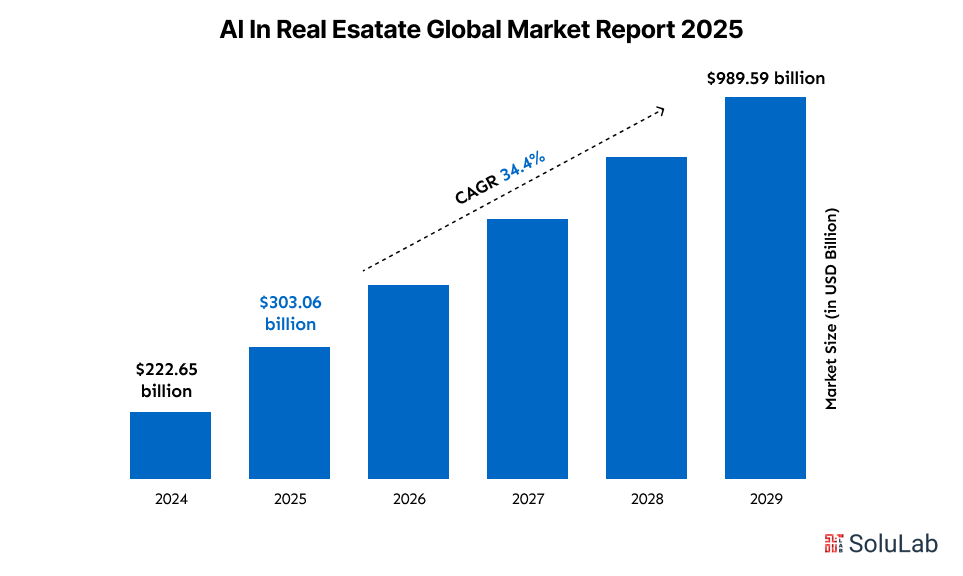
AI In Real Esatate Global Market Report

How Does AI Work In Real Estate?

1. Property Recommendations: AI analyzes user behavior, preferences, and past searches to offer personalized property suggestions. This helps buyers or renters find suitable options faster, improving the overall experience and reducing time spent on irrelevant listings.

2. Price Prediction & Valuation: Using historical data, market trends, and location-based insights, AI tools can estimate property prices more accurately. This helps buyers avoid overpaying and allows sellers to price their property competitively based on real-time market data.

3. Chatbots & Virtual Assistants: AI-powered chatbots provide instant customer support by answering queries, scheduling site visits, and sharing property details 24/7. They are very helpful for virtual real estate assistants and ensure smoother communication for both buyers and sellers.

4. Fraud Detection: AI systems can scan documents, verify identities, and detect inconsistencies in property listings or transactions. This reduces the risk of fraud and ensures transparency in the real estate buying or renting process.

5. Predictive Maintenance in Smart Buildings: Enabled systems in smart buildings monitor equipment performance and predict maintenance needs. This helps property managers reduce downtime, save costs, and offer a better living or working experience for occupants.
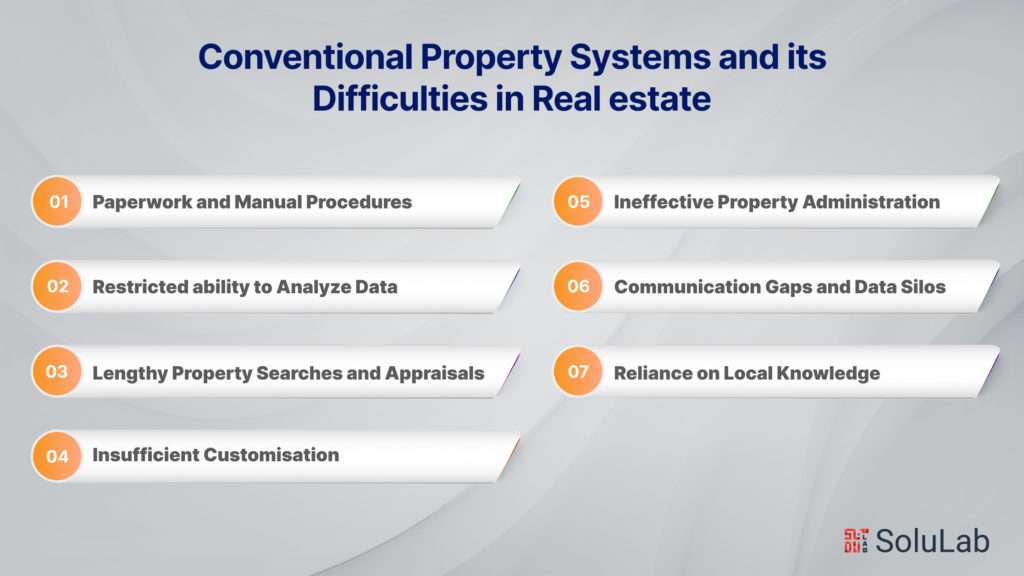
Conventional Property Systems and the Difficulties They Encountered

Conventional Property Systems and its Difficulties in Real estate

The global economy has traditionally relied heavily on the real estate sector, which links buyers and sellers looking to purchase homes, businesses, or assets for investment. Real estate has traditionally been bought, sold, and managed mostly via manual labour that requires human skill and effort. But the incorporation of artificial intelligence (AI) has had a big influence on the real estate industry lately, changing the way properties are looked for, assessed, and maintained.

  • Paperwork and Manual Procedures

Real estate transactions used to need a lot of paperwork and human labour. Administrative duties took up a significant amount of time for real estate agents, ranging from filling up property listings to handling contracts and paperwork. Due to the manual process’s time-consuming nature and increased chance of error, real estate transactions experienced delays and inefficiencies.

  • Restricted ability to Analyze Data

It was common for traditional real estate systems to lack advanced data analysis features. In order to make conclusions about property assessments, market trends, and investment prospects, real estate professionals had to depend on their expertise and intuition. Inadequate data analysis resulted in poor decision-making as important insights from big datasets were not fully exploited.

  • Lengthy Property Searches and Appraisals

Finding the ideal property for a buyer requires either manually perusing listings or physically seeing many houses. Variations in property prices resulted from the subjective and human appraisers who conducted many property appraisals. Inefficiencies in the real estate market were caused by these laborious and arbitrary procedures.

  • Insufficient Customisation

Property searches and suggestions in AI for real estate systems were frequently impersonal. It was difficult for buyers and investors to identify houses that exactly met their requirements and tastes since they had to rely on generic ads and suggestions.

  • Ineffective Property Administration

Managing a property required a lot of work and entailed balancing a number of duties, including upkeep, collecting money, and communicating with tenants. It was difficult to streamline property management procedures with traditional methods, which might have resulted in inefficiencies and higher expenses for managers and owners of real estate.

  • Communication Gaps and Data Silos

Various real estate business stakeholders frequently dealt with disjointed, non-integrated data systems. Property transactions were delayed and complicated as a result of the breakdown in communication and lack of transparency that resulted between buyers, sellers, brokers, and property management firms.

  • Reliance on Local Knowledge

Conventional real estate systems mostly depended on local knowledge and experience. Although local knowledge is vital, it may restrict prospects for investors and companies to thrive by restricting the possibilities for larger industry insights and trends.

These difficulties offer chances for AI integration to rectify these flaws and realize the full potential of the real estate market as it develops. In the real estate sector, artificial intelligence (AI)-powered solutions may boost productivity by streamlining procedures, enhancing data analytic skills, offering personalized experiences, and more. Real estate professionals may more fully recognize the benefits of artificial intelligence (AI) and seize the chances for innovation and expansion by being aware of the shortcomings of conventional methods.

Real Estate Tokenization Services

What Flaws in the Current Real Estate Systems Can AI Fix?

The following are some ways that AI integration can successfully handle the issues raised by conventional real estate systems:

  • Automation and Digitalization:

By digitizing paperwork and automating manual operations, artificial intelligence (AI) lessens the administrative strain on real estate workers. This expedites real estate transactions, reduces mistakes, and simplifies processes.

  • Advanced-Data Analytics:

AI is capable of swiftly and correctly analyzing large datasets, which yields insightful information on market trends, investment prospects, and property appraisals. Decisions about real estate are becoming more educated and data-driven.

  • Improved Property Search:

AI-driven solutions provide effective methods for finding properties, saving time and effort for investors and purchasers. The process of finding a property may be made better by machine learning algorithms, which can recommend properties that fit certain needs and preferences.

  • Personalization:

AI-powered systems have the ability to customize real estate suggestions by adjusting listings based on user preferences. This guarantees that guests locate homes that suit their particular requirements, improving their experience as a whole.

  • Effective Property Management:

By automating processes like rent collecting, maintenance scheduling, and tenant communication, artificial intelligence (AI) may improve property management. Smoother property operations and cost savings result from this.

  • Communication and Data Integration:

AI systems are able to combine data from several sources, which promotes improved stakeholder transparency and communication. As a result, there are fewer misconceptions, hold-ups, and data silos in the real estate industry.

  • Broader Market Insights:

Artificial intelligence goes beyond regional specialization to provide broader market insights. By analyzing data from larger geographic regions and spotting new trends, it enables investors to investigate potential new growth prospects.

By streamlining processes, strengthening data analysis, personalizing interactions, and increasing overall efficiency, AI integration has the potential to completely transform conventional real estate systems. The real estate sector may overcome its past obstacles and open up new avenues for development and innovation by embracing Hybrid AI technology.

Use cases for AI in the Real Estate Sector

The real estate sector has been greatly influenced by AI, which has produced a variety of use cases that have improved client experiences, reduced procedures, and improved decision-making. Here are a few thorough examples of AI applications in the real estate sector:
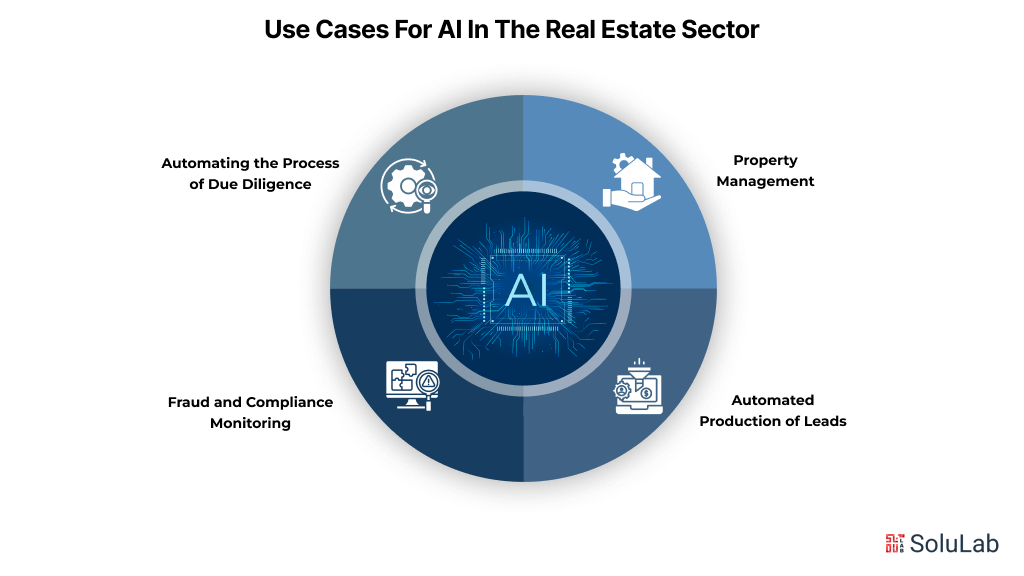
Use cases for AI in the Real Estate Sector

1. Property Management

In the real estate market, efficient property management software is crucial, especially for complex and rental property managers. However, AI has created a new solution that has improved property management and the real estate business. AI technology can automate many property management operations, reducing property managers’ workloads. Automation reduces their burden and reduces human mistakes, which can cause late rental payments, accounting issues, and tenant conflicts. AI could improve property management in the real estate industry.

2. Automated Production of Leads

AI for real estate lead generation has improved conversion rates and reduced procedures.  Manual lead classification and examination often result in inefficiencies and missed opportunities.  Real estate automates lead generation with machine learning.  AI systems evaluate large databases for leads based on web behavior, property preferences, and demographics.  This lets agents better target prospects and adapt marketing campaigns.  AI’s predictive analytics can help agents prioritize high-potential leads and manage resources.

3. Fraud and Compliance Monitoring

Artificial intelligence and machine learning are being used to address the challenges caused by the rise of AI-generated content and edited images in real estate listings. AI’s ability to detect and assess fraud ensures listing data accuracy and helps brokers, administrators, and MLS providers maintain corporate integrity. By applying AI for fraud detection, real estate agents can proactively address Fair Housing Act compliance issues and reduce the chance of erroneous listings. This use case shows how AI guards against legal issues while maintaining real estate confidence and openness.

4. Automating the Process of Due Diligence

Because human data input is inaccurate, AI offers a solution. It checks loan applications and leasing agreements for flaws using big datasets. The loan approval process relies on AI to identify discrepancies between paper values. By adopting this step, you improve due diligence and reduce loan sanctioning fraud. Automation of due diligence by AI shows its revolutionary potential to improve accuracy and minimize risk in complex real estate deals.

Real World Examples of AI in Real Estate

AI is already improving the real estate industry through platforms that use data-driven insights and automation to improve decision-making, pricing, and customer experiences. Here are some real-world examples:

  • Zillow

Zillow uses AI for its “Zestimate” feature, which provides real-time property valuations by analyzing data from public records, user-submitted information, and market trends. It also uses AI to match buyers with suitable listings based on their behavior.

  • Entera

Entera is a real estate investment platform that uses AI to help institutional investors find, evaluate, and buy residential properties at scale. It analyzes market trends, property data, and investment potential to recommend profitable deals.

  • Trulia

Trulia uses AI to personalize home search experiences by learning user preferences and delivering relevant property recommendations. It also integrates machine learning to provide neighborhood insights, pricing trends, and commute analysis for better decision-making.

AI Development Services

Conclusion

AI is changing the real estate industry by making processes faster, smarter, and more customer-centric. For investors, buyers, and sellers alike, these advancements mean better decision-making and increased efficiency. As the technology evolves, its role in real estate will only grow stronger, making it essential for industry players to use AI tools to stay competitive and meet the demands of a data-driven market.

Digital Quest, a travel business, partnered with SoluLab to develop an AI-powered chatbot using Generative AI. The chatbot enhanced customer engagement by offering real-time, personalized travel recommendations and hassle-free reservations. It also integrated user feedback and multi-language support, resulting in improved user experience and high ROI.

SoluLab, a leading AI development company in the USA, can help your business make smarter real estate decisions and choose the most effective tools for your needs. Get in touch with us today to explore how we can support your goals.

FAQs

1. What are the benefits of AI in real estate?

Discover the advantages of AI for real estate, including improved property valuation accuracy, enhanced customer experience through personalized recommendations, and optimized property management processes.

2. How is AI used in property valuation?

Learn how AI algorithms analyze vast datasets, including market trends, property characteristics, and comparable sales data, to generate accurate property valuations and assist in investment decisions.

3. What are some practical applications of AI in real estate transactions?

Explore the various applications of AI in real estate transactions, such as automated document processing, predictive lead scoring for sales and marketing, and virtual property tours using AI-powered virtual reality (VR) technology.

4. How does AI assist in property management?

Understand how AI tools and platforms help property managers streamline operations, optimize maintenance schedules, predict equipment failures through predictive maintenance, and improve tenant satisfaction through personalized services.

5. What does the future hold for AI in real estate?

Explore future trends and advancements in AI technology that are poised to transform the real estate industry, such as AI-powered real estate investment platforms, predictive analytics for property market forecasting, and AI-driven sustainability solutions for buildings.

AI Use Cases and Applications in Key Industries

AI Use Cases

Artificial intelligence is becoming more and more popular every day. The power of software or systems to reason and gain knowledge from experience is known as artificial intelligence. Over the past several years, applications of AI have advanced dramatically and are now used in practically every industry. Artificial intelligence for industrial applications AI is particularly transformative, optimizing processes, enhancing productivity, and providing real-time insights for better decision-making. 

Organizations frequently require assistance in addressing issues such as an abundance of data, erratic decision-making, inefficient resource allocation, and the requirement for instantaneous insights. These problems can slow down growth, reduce productivity, and undermine an organization’s ability to succeed as a whole. However, the use of AI lessens these difficulties and drives companies to previously unheard-of heights of performance. To fully leverage these advantages, it’s essential to understand how many application of AI are there and implement them strategically across various business operations.

AI is a crucial ally in this age of digital acceleration, with specific use cases available for all major businesses. AI’s revolutionary influence is changing conventional paradigms in a variety of industries, including manufacturing, retail, healthcare, and finance. Businesses may use artificial intelligence (AI) to improve resource efficiency, get insights into customer behavior and market trends, and simplify operations by utilizing machine learning (ML), predictive analytics, and sophisticated automation. Grand View Research projects that the worldwide AI market will grow at a 38.1% CAGR to reach $1,811.8 billion by 2030, from $136.6 billion in 2022.

This article focuses on significant AI-using businesses that have benefited greatly from their use and yet have a ton of room to develop. But first, let’s define artificial intelligence for the purposes of this discussion.

The Function of Artificial Intelligence in Business Management

John McCarthy, an American computer scientist and cognitive researcher, created the phrase artificial intelligence in 1956 and describes it as “the technical and scientific method of making intelligent machines.”

AI is the capacity of a computer or a computer-controlled robot to execute tasks often associated with intelligent entities, most notably humans. As a result, it exhibits tremendous talents like reasoning, finding meaning, and learning from experience.

Artificial intelligence for industrial applications AI revolutionizes company operations by automating jobs, evaluating data, and improving decision-making. AI improves operational efficiency by automating repetitive operations, streamlining supply chains, forecasting maintenance needs, and providing individualized customer experiences. It is critical in decisions based on data support, cybersecurity, and talent acquisition, all of which stimulate industry-wide innovation. AI’s ongoing learning capabilities enable adaptation to changing business landscapes, solidifying its position as a revolutionary force in attaining increased productivity, cost savings, and a competitive advantage for enterprises managing the complexity of today’s business environment. Companies must identify current business uses and application of AI to fully leverage its potential.

AI Use Cases in Different Industries

Let’s take a look at some of the AI use cases by industry.

Healthcare

The use cases of AI in healthcare include:

  • Medical Imaging: Artificial intelligence analyzes X-rays and CT scans with greater speed and accuracy, making it easier to diagnose illnesses such as pneumonia and TB. The use cases of AI in healthcare help to detect lung nodules, reduce the likelihood of missing malignant growths, and detect osteoporosis in X-rays.
  • Personalized Therapy: Artificial intelligence uses patient data, genetic information, and lifestyle variables to identify illness risks and customize treatment strategies. Future of AI in healthcare industry helps to pick the best chemotherapy treatments based on genetic profiles and remotely monitor patients, identifying early indicators of illnesses such as heart disease and diabetes.
  • Electronic Health Records (EHRs): AI analyzes electronic health records (EHRs) to find patterns and trends, anticipate illness risks, and implement individualized preventative efforts. It studies medical history, lifestyle, and genetic information to predict risks like diabetes or heart disease, as well as trends in prescription data to prevent hazardous drug responses.

Related: AI Agents in Healthcare

Retail and E-Commerce

AI use cases in retail and e-commerce comprise of:

  • Personalized Shopping Experience: AI analyzes user behavior, preferences, and previous purchases to provide personalized product recommendations based on individual insights. This improves the browsing experience, increases client engagement, and promotes revenue by providing goods that are personalized to individual preferences.
  • Dynamic Price Optimization: Retailers utilize AI algorithms to monitor real-time market circumstances, rival pricing, and client demand. Artificial intelligence use cases in e-commerce allow for dynamic pricing modifications, assuring appropriate pricing strategies for remaining competitive, maximizing earnings, and efficiently responding to market variations.
  • Chatbots for Customer Service: AI-powered chatbots are used to manage client inquiries, give immediate assistance, and help in order tracking. By providing timely replies, these virtual assistants help to improve customer service and build a favorable company image as a part of AI in retail use cases

Read Also: How Generative AI is Transforming the E-Commerce Industry?

Food Technology

AI in the food industry has several use cases, such as:

  • Supply Chain Optimization: Artificial intelligence improves the food supply chain by anticipating demand, controlling inventories, and streamlining logistics. This reduces waste, ensures timely delivery, and improves efficiency in transferring food from fields to customers.
  • Quality Control and Inspection: AI-powered technologies are used in food processing to ensure quality. Computer vision algorithms may identify flaws, contamination, or anomalies in food goods, ensuring that only high-quality commodities reach the marketplace.
  • Menu Modification in Restaurants: AI is used in the restaurant business to adapt Digital menu based on client preferences, dietary restrictions, and past ordering history. This improves the eating experience, boosts consumer pleasure, and enables businesses to provide specialized meal selections.

CTA1

Banking and Financial Services

AI in banking and finance use cases include the following:

  • Fraud Detection and Prevention: Artificial intelligence is used in banking and finance to detect fraud in real time by studying transaction patterns, recognizing abnormalities, and reporting possibly fraudulent activity. Machine learning algorithms respond to changing fraud tendencies, improving the security of financial transactions.
  • Credit Scoring and Risk Assessment: AI-powered credit scoring uses other sources of information and ML algorithms to improve the accuracy of creditworthiness assessments for individuals and enterprises. This results in improved risk management, allowing financial institutions to make educated lending decisions.
  • Anti-Money Laundering (AML) Compliance: AI is used to improve AML compliance by simplifying the examination of massive volumes of transaction data. 

Supply Chain and Logistics

AI in logistics and supply chain use cases include:

  • Management of Warehouse Layout and Space Utilization: By evaluating data on demand for goods and inventory levels, AI-driven logistics management improves warehouse operating efficiency. AI makes the most use of available space by cleverly reorganizing shelves and racks to accommodate a variety of item sizes and storage requirements.
  • Tracking and Monitoring Shipments: AI enables effective real-time tracking and monitoring of shipments, providing prompt notifications for any delays or problems. Innovative algorithms examine shipping data to anticipate possible issues and facilitate preventative action.
  • Resource Management: AI improves resource management by distributing tasks among human workers as efficiently as possible by evaluating workload data, such as order quantities and processing times. This guarantees that tasks correspond with workers’ abilities and availability, minimizing bottlenecks and improving overall productivity.

Travel

Applications of AI in the travel industry include:

  • Personalized Itineraries: Artificial intelligence allows travel businesses to develop customized itineraries based on individual interests. AI is a smart travel adviser who curates optimal experiences personalized to each traveler based on their money, time limits, and social media interests.
  • Real-time Travel Updates and Suggestions: Artificial intelligence enables travel businesses to provide real-time information and tailored recommendations based on location and interests. As a virtual tour guide, AI in travel recommends hidden gems such as quiet cafés, lesser-known art galleries, and breathtaking vistas, enriching the vacation experience with unique insights.
  • Booking Assistance: AI-powered chatbots help passengers with inquiries during the booking procedure. These chatbots offer prompt and exact assistance, providing price information, assisting passengers in comparing choices, and allowing them to make well-informed selections based on their tastes, schedules, and budgets.

Real Estate

The use cases of AI in real estate include:

  • Automated Property Valuation: AI algorithms use historical data, local market circumstances, and property qualities to assess how much real estate is worth. This impartial technique eliminates subjective biases, resulting in accurate appraisals for buyers, sellers, lenders, and investors.
  • Portfolio Optimization in Real Estate Investment: AI uses machine learning to examine large datasets and forecast property prices, rental revenue, and market volatility. AI-powered risk assessment algorithms generate diverse portfolios by monitoring market volatility and economic indicators and then optimizing the risk-reward balance via dynamic changes and real-time data processing.
  • Automatic Lead Generation: Artificial intelligence in real estate simplifies and enhances the identification of possible prospects. Machine learning algorithms use varied datasets to identify prospects based on demographics, internet activity, and property preferences. AI uses predictive analytics to forecast the possibility of lead conversion, allowing agents to set priorities for high-potential leads and manage resources more efficiently, resulting in faster procedures and higher conversion rates.

Media and Entertainment

AI in media and entertainment has the following uses:

  • AI-powered Music Recommendation Systems: It creates personalized profiles based on user data such as listening history and preferences. These profiles are used to make individualized suggestions that take into account genre, mood, artist, and pace. Platforms such as Spotify utilize AI algorithms to study user activity and build tailored playlists for a better music discovery experience.
  • AI in Game Design and Play: AI raises game design by enhancing non-player characters (NPCs) and refining mechanisms, resulting in realistic and demanding levels that improve the player’s experience. What industries use artificial intelligence? In the gaming industry, AI provides difficult opponents with greater immersion in gameplay and develops generating material, such as new stages and characters, to ensure a continually fresh and exciting gaming experience.
  • Editing Movies: Artificial intelligence is essential for making effective movie trailers and editing full-length films. AI excels at finding high-impact emotionally charged situations, which helps editors create captivating trailers. Furthermore, AI is useful in editing complete films, using face recognition to identify significant actors and essential plot-related moments, hence speeding the editing process for feature-length projects.

Read Our Blog Post: How Parallel AI Transform Business Operations

Manufacturing

The applications of AI in manufacturing involves:

  • Defect Detection: AI improves defect detection in production by adding self-learning capabilities into existing systems, reducing false alarms and tedious manual inspections. This incorporation of artificial intelligence helps manufacturers to increase productivity, eliminate manual interventions, and improve overall product quality.
  • Assembly Line Integration: AI-automated assembly lines simplify operations in contemporary manufacturing, reducing the need for human involvement while assuring efficient, consistent, and error-free output. This automation boosts efficiency, decreases mistakes, and increases total production by allowing machines to do activities in a predetermined order. 
  • Predictive Analytics: By evaluating sensor data and maintenance records, AI systems may forecast equipment breakdowns and schedule repair tasks in advance. This predictive strategy avoids unwanted downtime and lowers maintenance expenses.

Read Blog: 10 Benefits of Incorporating Generative AI in the Manufacturing Process

Automotive

The applications of AI in automotive are:

  • Intelligent Traffic Management: It uses artificial intelligence to evaluate real-time traffic data from GPS and Security Cameras. AI systems use this data to optimize traffic flow, reduce congestion, and increase road safety. Adaptive traffic signal control systems automatically modify signal timings in response to real-time traffic circumstances, reducing bottlenecks. Dynamic route planning suggests alternate routes to drivers, minimizing travel time. Furthermore, AI-driven accident detection systems identify accidents quickly, allowing for timely reactions and effective rerouting.
  • Enhanced Navigation: AI-powered navigation goes beyond typical GPS to provide optimum routes by using real-time data such as traffic, weather, and road conditions. These adaptive algorithms automatically change routes to avoid congestion and accidents, giving drivers more efficient routes. 
  • Personalized Customer Experience: AI creates individualized consumer experiences in the automobile sector by adapting conversations and services to individual preferences. AI systems analyze data such as previous purchases and driving behaviors to produce tailored suggestions for car features and maintenance schedules. This increases consumer involvement, loyalty, and satisfaction. Furthermore, AI-powered chatbots offer quick support, guiding clients through tasks such as purchasing or troubleshooting, resulting in a smooth and customized experience.

Education

AI has favorably influenced the education business by transforming learning methods and providing several applications AI cases. Here are some of the cases:

  • Personalized Learning: AI adapts information and learning routes to each student’s specific requirements, increasing engagement and improving learning results. This strategy guarantees that students get focused and adaptable educational experiences.
  • Intelligent Tutoring: AI-driven tutoring systems provide tailored assistance and feedback to students, improving their learning experience. These AI in education systems cater to individual learning methods, offering focused support and improving comprehension in a variety of areas.
  • Learning Analytics: AI investigates learning analytics by evaluating student performance data to identify patterns and trends. Educators may use these insights to develop data-driven interventions, highlight areas for growth, and provide individualized assistance to increase overall student achievement.

Fashion

The applications of AI in fashion are:

  • Trend Predicting and Purchasing: AI is critical in the fashion business, using data from a variety of sources to forecast trends. By analyzing consumer behavior and preferences through social media, previous sales information, and fashion blogs, AI algorithms enable intelligent purchase decisions. This guarantees that fashion companies fit their collections with current and new trends, increasing their market relevance.
  • Design and Product Development: AI technologies are incorporated into the design and development process to provide design recommendations, optimize patterns for material efficiency, and generate virtual prototypes. AI in fashion speeds the creative process, allowing designers to experiment with different materials, designs, and colors. The consequence is more efficient design iterations and improved product development in the fashion sector.
  • Style and Visual Merchandising: Artificial intelligence improves visual merchandising by suggesting style options based on consumer preferences and fashion trends. Whether at a real shop or online, AI recommends product pairings and outfit ideas, as well as virtual try-ons. This tailored strategy engages clients by providing an engaging and visually appealing buying experience.

Related: Artificial Intelligence in Fashion Industry

Information Technology

AI in information technology includes the following use cases:

  • IT Support and Helpdesk Automation: AI-powered chatbots and virtual assistants improve IT assistance by effectively managing user questions and technical challenges, such as password resets and complex device installations. Pursuing an ITIL certification course can further equip IT professionals with the frameworks needed to align such automated service processes with globally recITIL certification courseognized best practices.
  • Cybersecurity and Threat Detection: Artificial intelligence continually analyzes network traffic and user activity, detecting irregularities and possible security issues. Automated incident response activities and proactive threat mitigation help to build a strong cybersecurity posture, decreasing reaction times and protecting sensitive data from cyber-attacks.
  • IT Asset Management: AI enables effective IT asset management by automating asset detection, tracking usage trends, and anticipating maintenance requirements. It helps in maintaining an up-to-date inventory while also assuring compliance with license agreements and regulatory regulations. AI-driven asset management enhances IT services, reduces expenditures on procurement, and better allocates resources.

Legal Businesses

Applications of AI in legal business include:

  • Contract Analysis: Artificial intelligence in business simplifies contract analysis by optimizing the evaluation and extraction of relevant provisions, decreasing manual work, and increasing efficiency in legal document scrutiny.
  • Legal Research: AI assists legal study by evaluating voluminous legal texts, case law, and precedents. This speeds up the research process, giving legal practitioners useful insights and allowing for better-informed decision-making.
  • E-discovery: In legal procedures, AI algorithms make e-discovery easier by effectively evaluating and classifying enormous amounts of electronic documents, emails, and digital evidence, ensuring a full investigation of digital materials.

Read Our Blog: AI Agents in Legal Industry

Hospitality

AI assists hospitality firms in several ways:

  • Personalized Suggestions: AI algorithms may assess client preferences, prior bookings, and previous searches to make specific suggestions for hotels, eating options, and activities, therefore improving the entire guest experience.
  • Revenue Management: Artificial intelligence can assess market trends, historical data, and patterns of demand to help hotels and resorts improve pricing strategies, enhance occupancy rates, and boost revenue.
  • Guest Sentiment Analysis: AI in hospitality algorithms may gather sentiment from customer reviews, social media comments, and feedback to detect areas for advancement, permitting businesses to increase visitor happiness and respond to any problems quickly.

CTA2

Conclusion

As AI advances to the next level, it increasingly emerges as the most powerful driving factor for a technological revolution. AI promotes efficiency in industries such as healthcare, retail, finance, logistics, entertainment, and manufacturing, enabling decision-making and improving consumer experiences for enterprises. The application of AI spans across sectors, opening up a world of endless possibilities. What we have seen and may imagine only touches the surface of AI’s vast possibilities, underscoring its critical role in redefining the landscape of technological breakthroughs. We are living in an era in which robots are learning to comprehend and predict what humans desire or are likely to do in the future.

As an AI development company, SoluLab stands ready to meet your needs for innovative solutions by offering a team of highly skilled AI developers. Whether you’re looking to hire AI developers for advanced machine learning algorithms, natural language processing systems, or intelligent automation, we provide unparalleled expertise to drive your business forward. With a commitment to crafting customized solutions tailored to your specific requirements, SoluLab ensures that you stay ahead of the curve in the rapidly evolving landscape of artificial intelligence. Elevate your operations, enhance customer experiences, and unlock new opportunities with our dedicated team. Contact us today to hire AI developers and embark on your journey towards AI-driven success.

FAQs

1. What are some common artificial intelligence use cases and applications in 2025?

In 2025, AI is omnipresent across various industries. Common use cases include personalized healthcare diagnostics and treatment planning, predictive maintenance in manufacturing, AI-driven cybersecurity for threat detection and response, autonomous vehicles for transportation and logistics, and AI-powered virtual assistants enhancing customer service across multiple sectors.

2. How does AI benefit the healthcare industry in 2025?

AI will revolutionize healthcare in 2025 by enabling personalized treatment plans through predictive analytics, improving diagnostic accuracy with advanced imaging analysis, streamlining administrative tasks with AI-driven chatbots, and facilitating remote patient monitoring through wearable devices and telemedicine solutions.

3. What role does AI play in enhancing cybersecurity in 2025?

AI serves as a crucial tool in bolstering cybersecurity defenses in 2025. Its applications include threat detection and response, anomaly detection in network traffic, behavior analysis to identify malicious activities, and predictive modeling to anticipate future cyber threats, thus enabling proactive defense measures.

4. How is AI transforming the manufacturing sector in 2025?

In 2025, AI will transform manufacturing operations by optimizing production processes through predictive maintenance, enhancing quality control with computer vision and machine learning algorithms, enabling autonomous robotics for tasks such as assembly and material handling, and facilitating demand forecasting and supply chain management.

5. What are some examples of AI applications in daily life in 2025?

AI will permeate daily life in 2025 through various applications such as personalized recommendations in entertainment and e-commerce platforms, smart home devices for automation and convenience, language translation services facilitating global communication, AI-powered virtual assistants for scheduling, reminders, and task management, and intelligent navigation systems for efficient travel and commuting.
