


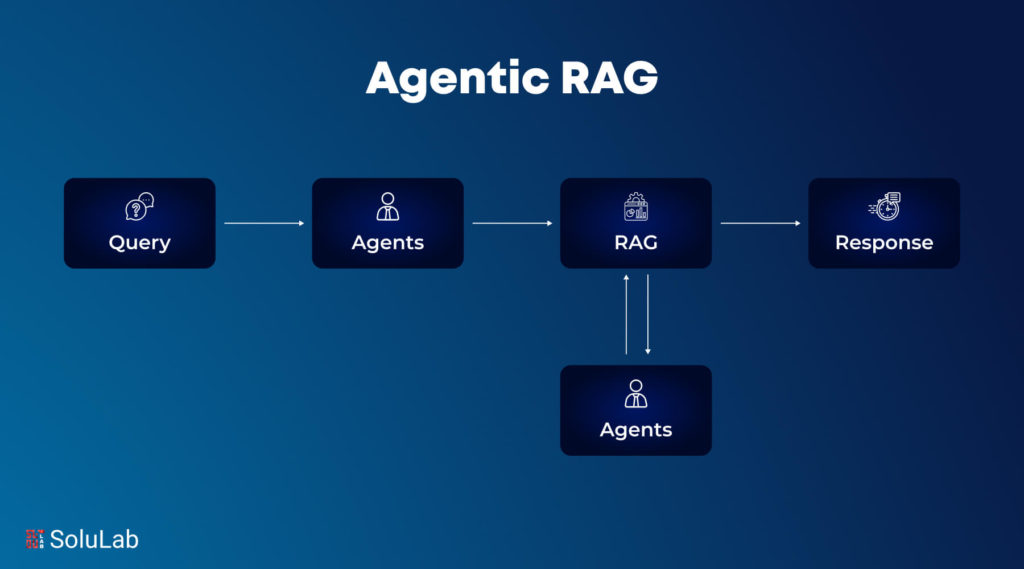
Large Language Models (LLMs) have revolutionized our interaction with information. However, their dependence on internal knowledge alone can limit the accuracy and depth of their responses, especially for complex queries. Retrieval-Augmented Generation (RAG) addresses this limitation by enabling LLMs to access and process information from external sources, resulting in more grounded and informative answers.
While standard RAG excels at handling simple queries across a few documents, agentic RAG takes it a step further and emerges as a formidable solution for question answering. The key differentiator of agentic RAG is the introduction of AI agents. These agents act as autonomous decision-makers, analyzing initial findings and strategically selecting the most effective tools for further data retrieval. This multi-step reasoning capability empowers agentic RAG to tackle intricate research tasks, such as summarizing, comparing information across multiple documents, and even formulating follow-up questions – all in an organized and efficient manner. This newfound agency transforms the LLM from a passive responder to an active investigator, capable of delving deep into complex information and delivering comprehensive, well-reasoned answers. agentic RAG holds immense potential for applications such as research, data analysis, and knowledge exploration.
Agentic RAG represents a significant leap forward in the field of AI-powered research assistants and virtual assistants. Its ability to reason, adapt, and leverage external knowledge paves the way for a new generation of intelligent agents that can significantly enhance our ability to interact with and analyze information.
In this article, we will delve into agentic RAG, exploring its inner workings, applications, and benefits for users. We will unpack the concept of agentic RAG, its key differences from traditional Agentic RAG types, the integration of agents into the RAG framework, their functionality within the framework, implementation strategies, real-world use cases, and finally, the challenges and opportunities that lie ahead.
The recent developments in information retrieval and natural language processing (NLP), particularly with LLM and RAG, have ushered in a transformative era of efficiency and sophistication. These advancements have made significant strides in four key areas:
Optimizing information retrieval within RAG systems is pivotal for performance. Recent breakthroughs focus on developing reranking algorithms and hybrid search methodologies to enhance search precision. By employing multiple vectors for each document, a granular content representation is achieved, allowing for improved relevance identification.
To minimize computational costs and ensure response consistency, semantic caching has emerged as a key strategy. It involves storing answers to recent queries along with their semantic context. This enables similar requests to be efficiently addressed without repeated LLM calls, facilitating faster response times and consistent information delivery.
This goes beyond text-based LLM and Retrieval-Augmented Generation (RAG) systems, integrating images and other modalities. It facilitates access to a wider range of source materials and enables seamless interactions between textual and visual data. This leads to more comprehensive and nuanced responses.
These advancements set the stage for further exploration into the complexities of agentic RAG, which will be delved into in detail in the forthcoming sections.
These advances pave the way for captivating explorations of agentic RAG, which will be comprehensively examined in subsequent sections.
Agentic RAG (Agent-based RAG implementation) revolutionizes question answering through an innovative agent-based framework. Unlike traditional approaches that solely rely on large language models (LLMs), agentic RAG employs intelligent agents to adeptly tackle complex questions. These agents act as skilled researchers, navigating multiple documents, synthesizing information, and providing comprehensive and accurate answers. The implementation of agentic RAG is scalable, allowing the addition of new documents managed by their sub-agents.
Imagine a team of expert researchers, each with specialized skills, working together to meet your information needs. Agentic RAG offers precisely that. Whether you need to compare perspectives from different documents, explore intricate details within a specific document, or create summaries, agentic RAG agents excel at handling these tasks with precision and efficiency. Incorporating NLP applications into agentic RAG enhances its capabilities and broadens its use cases.
At its core, agentic Retrieval-Augmented Generation (RAG) changes question-answering with its robust and flexible approach. It leverages the collaborative intelligence of diverse agents to conquer intricate knowledge hurdles. Through its capabilities for planning, reasoning, employing tools, and ongoing learning, agentic RAG transforms the pursuit of comprehensive and accurate knowledge acquisition.
By comparing agentic RAG and traditional RAG, we can gain valuable insights into the evolution of retrieval-augmented generation systems. In this article, we will focus on the key features that distinguish agentic RAG from its traditional counterpart, highlighting the advancements it brings.
The distinct capabilities of agentic RAG highlight its potential to revolutionize information retrieval. By enabling AI systems to actively interact with and explore intricate environments, agentic RAG empowers these systems to engage more effectively with their surroundings. This leads to improved decision-making and efficient task completion through enhanced information retrieval capabilities.
Within a RAG framework, agents display diverse usage patterns tailored to specific tasks and objectives. These patterns highlight the agents’ adaptability and versatility when interacting with RAG systems. Key usage patterns of agents in an RAG context include:
Agents can leverage existing RAG pipelines as tools to accomplish specific tasks or produce outputs. By utilizing these established pipelines, agents can simplify their operations and benefit from the capabilities inherent in the RAG framework.
Agents can operate autonomously as RAG tools within the framework. This autonomy allows agents to generate responses independently based on input queries, without relying on external tools or pipelines.
Agents can retrieve relevant tools from the RAG system, such as a vector index, based on the context provided by a query at query time. This tool retrieval enables agents to adapt their actions according to the unique requirements of each query.
Agents can analyze input queries and select appropriate tools from a predefined set of existing tools within the RAG system. This query planning enables agents to optimize tool selection based on the query requirements and desired outcomes.
When the RAG system offers a wide range of tools, agents can assist in selecting the most suitable one from the candidate tools retrieved based on the query. This selection process ensures that the chosen tool closely aligns with the query context and objectives.
Within a RAG framework, agents can leverage these usage patterns to execute various tasks effectively. By combining and customizing these patterns, complex RAG applications can be tailored to meet specific use cases and requirements. Harnessing these patterns enhances the overall efficiency and effectiveness of the system, enabling agents to accomplish their tasks seamlessly.
RAG agents can be classified into distinct categories based on their functional capabilities. This spectrum of capabilities ranges from simple to complex, resulting in varying costs and latency. These agents can fulfill diverse roles such as routing, planning one-time queries, employing tools, utilizing ReAct (Reason + Act) methodology, and coordinating dynamic planning and execution.
The routing agent makes use of a Large Language Model (LLM) to choose the best downstream retrieval augmented generation RAG pipeline. This decision-making process involves agentic reasoning, where the LLM analyzes the input query. This allows it to select the most appropriate RAG pipeline. This process exemplifies the core and basic form of agentic reasoning.
When determining the best routing for a query, two options arise: using a summarization retrieval augmented generation pipeline or a question-answering RAG pipeline. The agent analyzes the input query to ascertain whether it should be directed to the summary query engine or the vector query engine, both of which are configured as tools.
In query planning, a complex query is decomposed into smaller, parallelizable subqueries. These subqueries are then executed across various RAG pipelines, each utilizing different data sources. The responses obtained from these pipelines are amalgamated to form the final comprehensive response. This process involves breaking down the query, executing the subqueries across suitable pipelines, and synthesizing the results into a cohesive response.
Read Blog Also: Use Cases Of AI Agents
In a standard Retrieval-Augmented Generation framework, a query is submitted to retrieve the most relevant documents that align semantically with the query. However, there are situations where additional information is necessary from external sources, such as APIs, SQL databases, or applications with API interfaces. This additional data acts as contextual input to enrich the initial query before it undergoes processing by the Large Language Model (LLM). In such scenarios, the agent can also leverage a RAG model.
ReAct: Integrating Reasoning and Actions with LLMs
Elevating to a more advanced level requires the incorporation of reasoning and actions executed iteratively for complex queries. This essentially consolidates routing, query planning, and tool utilization into a single entity. A ReAct agent capably handles sequential, multi-part queries while maintaining an in-memory state. The process unfolds as follows:
The most widely adopted agent is currently ReAct, but there is a growing need to handle more complex user intents. As more agents are deployed in production environments, there is an increasing demand for enhanced reliability, observability, parallelization, control, and separation of concerns. This necessitates long-term planning, execution insight, efficiency optimization, and latency reduction.
At their core, these efforts aim to separate high-level planning from short-term execution. The rationale behind such agents involves:
This necessitates both a planner and an executor. The planner typically utilizes a large language model (LLM) to craft a step-by-step plan based on the user query. The executor then executes each step, identifying the tools needed to accomplish the tasks outlined in the plan. This iterative process continues until the entire plan is executed, resulting in the presentation of the final response.
Constructing an agentic Retrieval-Augmented Generation necessitates specialized frameworks and tools that streamline the creation and coordination of multiple agents. Although building such a system from the ground up can be intricate, there are several existing alternatives that can simplify the implementation process. In this regard, let’s delve into some potential avenues.
LlamaIndex serves as a solid foundation for the development of agentic systems. It offers a wide range of functionalities to empower developers in creating document agents, managing agent interactions, and implementing advanced reasoning mechanisms like Chain-of-Thought.
The framework provides pre-built tools that facilitate interaction with diverse data sources, including popular search engines such as Google and repositories like Wikipedia. It seamlessly integrates with various databases, including SQL and vector databases, and allows for code execution through Python REPL.
LlamaIndex’s Chains feature enables the seamless chaining of different tools and LLMs, promoting the creation of intricate workflows. Additionally, its memory component aids in tracking agent actions and dialogue history, fostering context-aware decision-making.
To enhance its utility, LlamaIndex includes specialized toolkits tailored to specific use cases, such as chatbots and question-answering systems. However, proficiency in coding and a good understanding of the underlying architecture may be required to fully utilize its potential. Integrating llmops practices can further streamline the operations and maintenance of LLM-based systems, ensuring efficiency and reliability.
Similar to LlamaIndex, LangChain provides a comprehensive set of tools for creating agent-based systems and managing interactions between them. It seamlessly integrates with external resources within its ecosystem, allowing agents to access various functionalities like search, database management, and code execution. LangChain’s composability allows developers to combine diverse data structures and query engines, enabling the construction of sophisticated agents that can access and manipulate information from multiple sources. Its versatile framework is adaptable to the complexities of implementing agentic RAGs.
Challenges: While LlamaIndex and langchain retrieval augmented generation offer robust capabilities, their coding requirements may pose a steep learning curve for developers. They must be prepared to invest time and effort to fully understand and leverage these frameworks to maximize their potential.
With the rapid evolution of the AI landscape, agentic RAG systems have emerged as indispensable instruments in the realm of information retrieval and processing. However, like any nascent technology, agentic RAG comes with its own set of challenges and opportunities. In this section, we delve into these challenges, explore potential solutions, and unveil the promising prospects that lie on the horizon for agentic RAG. Incorporating meta llama into these discussions can provide deeper insights and enhance the capabilities of agentic RAG systems.
While agentic RAG holds immense potential, it is not without its challenges. Here are some key challenges and considerations to take into account:
Despite the challenges, agentic RAG presents exciting opportunities for innovation and growth in the field of information retrieval and processing. Here are a few key opportunities to consider:
While agentic RAG systems face significant obstacles, they simultaneously offer promising avenues for groundbreaking advancements. By proactively addressing these challenges and embracing opportunities for innovative problem-solving and collaborative efforts, we can unlock the full potential of agentic RAG, fundamentally transforming our future interactions with and utilization of information.
In conclusion, AI Development Company represents a significant advancement in the field of Retrieval-Augmented Generation (RAG), offering enhanced capabilities over traditional RAG methods. By integrating rag agent LLM and ai agent rag technologies, rag agents can more effectively retrieve and generate relevant information, streamlining complex processes and improving efficiency. You can hire AI Developers to Understand what retrieval augmented generation and exploring the different agentic RAG types allow for a comprehensive comparison between agentic RAG and traditional RAG, highlighting the superior adaptability and performance of the former.
The applications of retrieval-augmented generation (RAG) are vast, ranging from sophisticated retrieval augmented generation pipelines to practical retrieval-augmented generation use cases across various industries. Retrieval augmented generation examples illustrate its transformative impact, particularly when implemented with frameworks like langchain retrieval augmented generation. As businesses and developers continue to explore and leverage these technologies, the distinction between Traditional RAG vs Agentic RAG becomes increasingly clear, underscoring the importance of adopting these innovative solutions. SoluLab stands ready to assist in harnessing the full potential of Agentic RAG, providing expert guidance and development services to navigate this cutting-edge landscape.
1. What is Retrieval-Augmented Generation (RAG)?
Retrieval-Augmented Generation (RAG) is a method that combines retrieval mechanisms with generative models to improve the accuracy and relevance of generated responses by incorporating external information.
Agentic RAG types include various implementations that integrate AI agents and LLMs (Large Language Models) to enhance retrieval and generation capabilities, providing more accurate and contextually relevant outputs.
AI Agent RAG, or Agentic RAG, utilizes intelligent agents and advanced LLMs to streamline and enhance the retrieval and generation process, making it more efficient compared to traditional RAG methods.
Retrieval-augmented generation use cases include customer support automation, content generation, data analysis, and personalized recommendations, where the RAG pipeline integrates external data for improved outcomes.
A retrieval-augmented generation example is a customer service chatbot that retrieves relevant information from a database and generates accurate, context-specific responses to customer queries.
A rag agent LLM (Large Language Model) plays a crucial role in RAG by enhancing the generative capabilities through advanced language understanding and generation, making the retrieval process more efficient and accurate.
Langchain retrieval augmented generation contributes by providing a robust framework for integrating retrieval and generation processes, ensuring seamless and efficient implementation of RAG pipelines.


