Talk to an Expert
Get in Touch

How Machine Learning is influencing Energy Industry?

Nowadays Machine Learning (ML) is helping energy companies analyze massive amounts of data. Most of the data on energy consumption is collected through IoT devices, such as sensors.

To analyze such Big Data and get insights, you need to find a data science consulting company to collect that unstructured data first.. After, transforming it to structured format, store and then apply advanced machine learning algorithms to find correlations. That is why use of machine learning in the Energy industry is not an easy solution.

The biggest advantage of ML in the energy sector (energy-tech) is that algorithms can be trained on the new data sets. It would definitely help to scale such a solution. But how exactly Machine Learning could help? Some of the use cases below.

Machine Learning use cases in Energy industry

Anomaly detection in energy consumption – to ensure smooth operation and prevent unexpected events.

It is hard to see where the electricity is being used in the electricity consumption data. This makes it hard to detect a malfunctioning piece of equipment. If one of these systems fails or is misconfigured this could cause negative effects, such as fire. 

The Machine Learning algorithms can constantly monitor, analyze energy consumption, detect emerging problems and assist in the analysis to improve performance. It also helps to avoid big financial losses.

Developed an machine learning algorithm can automatically define the type of object (e.g. supermarket, high school) and then, based on energy consumption detect and categorize anomalies in real time. 

Such a solution in real time automatically finds an anomaly in energy consumption and informs users who can make decisions very quickly. It helps to avoid big financial losses.

Energy demand prediction – the most popular application of Machine Learning in Energy industry

Another use of machine learning algorithms is to determine energy demand will be on a particular day. This is done by tracking how daily energy consumption changes for individual customers over time.

Machine learning models are able to generate very accurate energy demand and consumption forecasts. Those predictions could be used by facilities and building managers, energy companies and utilities companies to deploy energy-saving policies. Manufacturing companies with prediction help can make plans of how to optimize the particular operations and energy storage systems.

Indicating the optimal energy price using machine learning in energy industry

Price optimization models use the power of neural networks to predict demand for energy consumption and make optimized pricing recommendations to help the energy companies meet target goals. It has several benefits over expert-based pricing system:

  • Such models could analyze huge amounts of data (Big Data) that are unmanageable for people.
  • They are able to learn non-linear correlations between energy supply and demand to make counterintuitive pricing recommendations.
  • Transparent big data-driven pricing strategy and recommendations that are easy to monitor.
  • Saves pricing managers time from routine work and allows them to make only high-level decisions.

Business recommendation engine

To support decision making processes. Providing customer-oriented solutions that understand the changing needs of customers and automatically generate recommendations. Such recommendations could support decision making in areas of pricing, energy production and selling areas. Business departments could use it as a support and quantitative reference.

Machine Learning in Energy industry helps to optimize Contracted Capacity

Machine Learning algorithms through elaborate selection the optimal contracted capacity (CC) helps to minimize total cost of energy expenses.

Energy disaggregation (signals disaggregation)

Separation of profiles of individual receivers from the energy profile signal to better consumption behavior improve energy efficiency.

And many more cases where ML could help: Select the optimum size of energy storage, Scale EV charging station, Calibration of photovoltaics (PV), Selection of optimal tariffs of the distribution system operator, Defining the relationship between power quality and customer productivity and correlation of receiver failures with power quality parameters

Business Intelligence software could help you to analyze gathered data and turn it into insight

Using ML solutions you could collect a lot of signals and information. Some of the results could be integrated in application for autonomous work but some data needs to be analyzed by business users. Business intelligence services provide well-built reporting and data processing infrastructure is able to ensure the collection, integration, measurement and analysis of data in order to draw useful conclusions from it. Companies can use these insights to make more appropriate decisions. Intelligent reporting helps companies to make effective decisions based on data in the following business areas:

Analysis of historical data

Historical data on energy consumption can help to monitor and track energy consumption over time and take appropriate actions in terms of energy consumption.

Additionally historical data will help you to understand seasonalities and track trends that are significant in energy consumption, sales and production.

Analysis of energy production

BI solutions must help in the analysis of power generation and power outages and help solve problems in real time.

Real time energy monitoring

Modern Business Intelligence softwares is able to extract data from data sources in real time. This feature together with built-in notification system and machine learning signals could inform decision makers about different abnormous events.

Benefits that companies can get through the use of intelligent data solutions with machine learning in energy industry

Better data quality – bad information or data on past or current activities may lead to wrong decision making. An appropriate reporting system with  features helps companies to achieve better data quality and make smart decisions more effective.

Flexible reporting: 

System users will be able to analyze data anywhere at any time. Mobile reports will allow you to make key decisions regardless of where the decision maker is.

Data Governance: 

Responsible for determining information and data quality, setting good standards, and ensuring that the information and quality is achieved at a very good level. Effective Business Intelligence solution ensures that these processes are carried out in an orderly fashion.

Efficient Master Data Management: 

Business Intelligence (BI) helps to properly maintain data in companies database and data warehouse. Master Data Management (MDM) provides companies with valuable information about company’s key business entities and areas such as vendors, customers, products, etc. Companies from the Energy industry rely heavily on this kind of data for critical and proper decision making.


Pros of Leveraging Machine Learning for the Real Estate Industry

Some of the latest advancement in the field of Machine Learning (ML) has really opened doors to solve some long-lived problems in a very elegant way and Real estate vertical is not an exception. The more I see its application and outcome, the more I am convinced to directionally use it for long lived elegant solutions to some of the harder problems of this sector.

Machine learning is a sub area of machine learning, which gives computers the ability to learn with­out explicit programming. The traditional way of solv­ing a problem has been to codify a rule based system based on expert inputs. But this only works properly when experts have complete knowledge of all the rules of the ecosystem. 

When the complexity of the system is beyond a point, then orchestration of which signal is influencing an outcome in what way is beyond control. In such complex systems these rule based tra­ditional expert driven systems start to fail. In such an evolving and complex situation, use of machine learning techniques have proved to be much more effective.

For real estate platforms, ML techniques can be used for various important use cases.

Benefits of us­ing ML techniques:

  1. Automated valuation ma­chines/ Price estimators:

The price of a house is influenced by various factors like location, brand, size, amenities, construction quality, age, facing, interiors etc. To have a rule based approach to determine which factor is influencing price how much is almost impossible beyond a point, and in such cases, machine learn­ing based approach scores really high. If you train your models with huge number of listings data with price, the system will automatically figure out what is best for a given input data.

  1. Fraud content detection in listings:

In a country like India, where there is no central source of listings (MLS), it is very important to have a quality control on the list­ings quality to deliver a higher qual­ity experience. To verify millions of listings on the platform manually is non-scalable. The machine learning approach has really proved to be a boon in such a case wherein we have trained millions of listing data (im­age and other content) and reached a level where the identification of real estate images, their classification started happening automatically. Even on the non-image listing con­tent the NLP along with ML works really well.

  1. Lead scoring:

This is a classic problem across verticals. The good thing about real estate is if the jour­ney is longer, the user provides many signals before transacting a proper­ty, which enables us to the lead scor­ing in an effective way. If one com­bines the click stream data on the website along with CRM data col­lected at various states of journey in sales, then a very effective lead scor­ing system can be developed which can be used to effectively utilize the sales productivity.

  1. Sentiment analysis on user gen­erated content:

Real estate is such a big decision that before going for transaction users discuss and measure the decisions on various parameters. In case you have a platform, which has a lot of UGC, then you can use machine learning to come up with the sentiment analysis of a given de­velopment, neighbourhood, develop­er, etc. This can be further leveraged for better decision making and repu­tation management.

There are many such applications of ML in real estate e.g. Under­standing the context of conversation from a recorded audio conversation, Automatic response by bots on real estate queries based on the knowledge base across platforms etc. So far, we have just explored the obvious use cas­es, but the possibilities are immense.

5 ways that Machine Learning is transforming the Transport Industry

Since its inception Machine Learning (ML) has been gradually improving the efficiency of supply chain and logistics operations. But, in its early days owing to limited interest and knowledge, high implementation costs, and lack of clear ROI, its true potential was yet to be fathomed. Things have changed since. 

As we step in 2020, businesses will leverage machine learning as a tool that directly impacts a supply chain’s chain profitability. Statistics say that machine learning has the potential to create an additional $2.6T in value by 2020 in marketing and sales, and up to $2T in manufacturing and supply chain planning.

From empowering enterprises to drive prescriptive analytics, mitigate risks, expedite resolution of delays to prevent vehicle breakdowns, machine learning technologies will see greater adoption in 2020.

Driving Prescriptive Analytics

Data analytics has come a long way and we are now living in the age of Analytics 4.0 involving the use of machine learning algorithms along with data analytics. Earlier we were limited to diagnostic analytics but integrating ML algorithms savvy enterprises are moving towards prescriptive analytics which predicts the outcomes along with the solutions. There are several factors affecting ETAs, especially in the long-haul transportation industry and some of them are beyond human capabilities to avoid such as natural calamities but using prescriptive analytics we can always predict the occurrences of such calamities and plan logistics activities accordingly.

Expediting Resolution of Delays

Machine learning-powered transportation platforms crawl through historical data of already travelled delivery routes and generate critical insights to boost fleet productivity and reduce costs. Say, one of your delivery trucks needs to travel through points A, B and C to reach a customer’s destination. Referring to historical data, ML can benchmark the time taken to reach point B from A and point C from B. In case the duration to reach any of these points exceeds the already set threshold, it will immediately trigger alerts and help transportation stakeholders take quick action. This eliminates the chances of further delays.

Ensuring Highly Secure Routes

In industries like manufacturing, where truckers need to travel in between cities located thousands of kilometres apart to deliver goods and raw materials, theft and pilferage are major problems. This especially happens when trucks travel through poorly connected areas. Machine learning can bring significant improvements here.

Machine learning algorithms analyze historical data to understand repeated unscheduled stoppages in a particular route that could have been the reason behind thefts and pilferage. Similarly, it can measure past KPIs of 3PLs logistics providers and rule out the ones that have a history of making unnecessary stoppages in poorly connected locales. An advanced logistics management platform powered by machine learning can eliminate chances of theft and pilferage by more than 50% and save millions of dollars’ worth of cargo.

Generating Accurate ETAs

If you are planning to battle your competition using customer experience as a weapon, then generating accurate ETAs should be on your priority list. Customers not only need their goods to be delivered in-full but also on-time. ML algorithms help enterprises deliver shipments on time by predicting ETAs based on certain KPI’s and data. Getting this efficiency is never easy and is an ever-learning process, which is what ML is all about. ML-algorithms consider some of the most exhaustive constraints like driver-route mapping, pickup windows, delivery windows, no-entry time windows, unavoidable delays, tonnage, and more while generating ETAs.

Predicting Vehicle Breakdowns

It’s a bit futuristic but by the end of the year 2020, we might see ML being used in determining the health of a vehicle i.e. how disparate vehicle parts are performing at a particular time and situation. Savvy enterprises are making this happen by embedding the data needed to determine failure into ML-algorithms. It’s still a work-in-progress as of now but is definitely a way ahead for improving transportation as it can lower the total cost of ownership by accurately predicting vehicle breakdowns.

A key reason behind a spike in adoption of machine learning is RoI. McKinsey found that 82% of enterprises adopting machine learning has gained a financial return from their investments. So, for the providers of machine learning technologies and the transportation industry, 2020 is going to a win-win.

Influence of Machine Learning in Manufacturing Industry

Major companies including GE, Siemens, Intel, Funac, Kuka, Bosch, NVIDIA and Microsoft are all making significant investments in machine learning-powered approaches to improve all aspects of manufacturing. The technology is being used to bring down labour costs, reduce product defects, shorten unplanned downtimes, improve transition times, and increase production speed.

So-called “smart manufacturing” (roughly, industrial IoT and ML) is projected to grow noticeably in the 3 to 5 years, according to TrendForce. The firm estimates that the global smart manufacturing market will be well over $200 billion this year and will increase to over $320 billion by 2020. That is a projected compound annual growth rate of 12.5 per cent. Similarly, the International Federation of Robotics estimated by 2019 the number of operational industrial robots installed in factories will grow to 2.6 million from just 1.6 million in 2015.

This article will focus on how four of the leading companies in the world of manufacturing are using cutting edge ML to make interesting improvements to factories and robotics. It will focus on two main themes:

  1. The different ways machine learning is currently be used in manufacturing
  2. What results the technologies are generating for the highlighted companies (case studies, etc)

From what our research suggests, most of the major companies making the machine learning tools for manufacturing are also using the same tools in their own manufacturing. This makes them the developer, the test case and the first customers for many of these advances. This is a trend that we’ve seen in other industrial business intelligence developments as well.

This same in-house ML development strategy may not be possible for smaller manufacturers, but for giants like GE and Siemens it seems to be both possible and (in many cases) preferred to dealing with outside vendors. In either case, the examples below will prove to be useful representative examples of ML in manufacturing.

Concluding Thoughts on Machine Learning in Manufacturing

Automation, robotics, and complex analytics have all been used by the manufacturing industry for years. For decades entire businesses and academic fields have existed for looking at data in manufacturing to find ways to reduce waste and improve efficiency. Manufacturing is already a reasonably streamlined and technically advanced field.

As a result – unlike some industries (such as taxi services) where the deployment of more advanced ML is likely to cause massive disruption – the near term use of new ML technology in the manufacturing industry is more likely to look like evolution than a revolution.

Greater industrial connectivity, more widely deployed sensors, more powerful analytics, and improved robots are all able to squeeze out noticeable but modest improvements in efficiency or flexibility.

We are seeing these newer applications of machine learning produce relatively modest reductions in equipment failures, better on-time deliveries, slight improvements in equipment, and faster training times in the competitive world of industrial robotics. These improvements may seem small but when added together and spread over such a large sector the total potential saves is significant. According to the UN, worldwide value added by manufacturing (the net outputs of manufacturing after subtracting the intermediate inputs) was $11.6 trillion 2015. This is why companies are spending billions on developing ML tools to squeeze a few extra percentage points out of different factories.

Long-term, the total digital integration and the advanced automation of the entire design and production process could open up some interesting possibilities. Customization is rare and expensive while high-volume, mass produced goods are the dominant model in manufacturing, since currently the cost of redesigning a factory line for new products is often excessive.

Consumers for the most part have been willing to make the trade off because mass produced goods are so much cheaper. If technology that makes manufacturing more flexible is widely deployed, causing customization to become cheap enough, that could create a real shift in numerous markets. Instead of most shoes coming in a dozen sizes, they might be made in an infinite number of sizes – each order custom-fitted, built, and shipped within hours of the order being placed.

5 ways Machine Learning is used in Telecom Industry

Machine Learning (ML) is becoming more prevalent every day. Telecommunication companies are not avoiding these features, in fact, these computing processes are becoming extremely popular. 

Soon machine learning will infiltrate every industry and bring technologies to new heights. The telecom industry is ahead of the trend. Well-established companies such as AT&T, CenturyLink, Comcast, Spectrum, and Verizon are leading the way for machine learning.

HOW ARE THESE BIG BRANDS AND OTHER TELECOM COMPANIES IMPLEMENTING MACHINE LEARNING?

Telecom companies are implementing these new processes in various ways. The 5 ways that Machine Learning (ML) are being utilized by the industry are data-driven business decisions, network and infrastructure optimization, preventative maintenance, robotic process automation, and verification or fraudulent detection. Each of these will be further explained in this article. 

1.  DATA-DRIVEN BUSINESS DECISIONS

Machine learning can assist leaders in making efficient and swift data-driven business decisions. A trend that has been seen with location-based intelligence is the ability to sift through copious amounts of data and have machine assistance with data interpretation and application. ML can be used as a connective thread in location-based intelligence, and with machine learning together they can discover hidden patterns, automate processes, predict analytics in customer value, product development, process optimization, and more. 

2.  NETWORK AND INFRASTRUCTURE OPTIMIZATION

Machine learning allows for an optimized network and infrastructure. According to TechSee, 63% of telecom operators have invested in ML to improve and optimize their infrastructure. These computing processes can analyze and make corrections in real-time and provide continual service in ways better than a third-party director could enable. This creates a Self-Organizing Network (SON), or a network that can self-configure, self-optimize, and self-heal.

Once the root cause of an issue is resolved a corrective action will be made, and machine learning will allow for this to be implemented into daily computing processes. It will also enable the system to be able to predict when a similar issue will arise and be able to handle it preventatively.

3.  PREVENTATIVE MAINTENANCE

If an electrical company could prevent thousands of homes from losing power, there would be a lot of happy customers. For telecom companies, preventing outages or network disruptions are extremely satisfying to end-consumers. Machine learning supports company monitoring of equipment which can be proactive and anticipate the failure of various sorts. Predictive analytics is what makes these processes possible. Collective data is processed through sophisticated algorithms and compared with historical information to predict future results and apply preventative maintenance. These techniques can be applied to various forms of telecom equipment, i.e., data centers, cell towers. Maintenance that is performed proactively creates happy customers, which allows other forms of customer service to be focused on such as immediately responsive bots.

4.  ROBOTIC PROCESS AUTOMATION – CUSTOMER SERVICE BOTS AND VIRTUAL ASSISTANTS

One way that machine learning serves consumers for telecom companies is with robotic process automation. This can be seen in customer service bots, virtual assistants, and other processes.  

Customer service can be improved with responsive chatbots. With a high influx of customer interaction, it may not be feasible for human employees to provide immediate responses. Machine learning allows chatbots to cross-reference previous customer inquiries and respond accordingly with solutions to customer complaints or issues.

5.      VERIFICATION OR FRAUDULENT DETECTION

Algorithms that employ machine learning allows for immediate responses to fraudulent activity such as theft or illegal access. This is possible by the algorithms learning what normal or regular computing trends are and be able to identify and investigate anomalies from large sets of data more quickly than human analysts.

Machine learning has impacted telecom companies in a plethora of ways. Utilizing these computing processes allows for vast data sets to be analyzed quickly, be able to detect when issues arrive, and manage data efficiently. Adopting these processes is essential for company growth. Being able to process data quickly saves time and money.

Current Trends and Future Scopes of Machine Learning in the Education Sector

Current Trends and Future Scopes of Machine Learning in the Education Sector

Machine Learning are the two interesting terms that are buzzing around. These two upgraded technologies have made our lives faster. Machines are upgraded with Machine learning which are meeting with the standards of human knowledge and intelligence in every field. Technological Revolution led to a greater and quicker deal of things that made lives easier.

For example – suggesting similar and relevant pictures on Facebook, Online shopping portals, Google Maps and many more are because of Machine learning technology. Apart from these sources, Machine learning is also introduced in the Education sector by introducing human intelligence to understand various factors in education.

Current Trends of ML in the Education Sector

  • Machine learning in the education sector helped the institutions to adopt the cloud technology which has reduced various operational costs.
  • It helped in segmenting the entire process of education online and led to easy access of the subjects through various integrated software’s.
  • It leads to the development of artificial instructors, virtual facilitators, intelligent tutors, interactive websites, delivery systems and many more.
  • The advent of digital- enabled classrooms, cloud-based content, e-books, online assessments and many more were developed due to the deployment of Machine learning in the educational field.
  • Virtual and Augmented Reality is one of the finest developments which can be accessed from Machine learning. Many universities and colleges are using this upgraded technology to explain the life-like experience in diverse subjects like history, science, geology and many more. This AR/VR technology helped the students to interact with various topics through animations, images HD movies etc. This technology had become the best support system to the teachers and educators in achieving highly reliable subject oriented experience.
  • Adaptive learning techniques, speech recognition, analyzing the problems are one of the best developments that can be seen in the educational sector through Machine learning technology.
  • Personalizing the data became easier through Machine learning technology. Huge data that have been saved in books and registers are shifted directly to intelligent systems which will record, analyze and provide appropriate insights through upgraded technology.
  • Online Assessments are one such example where the entire world uses in the educational sector to assess the student. Because of development in technology, a student got a chance to take the assessment, upload the assessment, learn them anywhere. These assessments are available at multiple platforms and are provided by a detailed interactive personalized dashboard which helped the teachers to assess the performance of the student appropriately.
  • ML technology became a very good source to specially-abled students to get educated well. Due to the advancements in technology, many specially-abled students got a chance to learn the subject through speech recognition, VR technology and helped them to overcome the toughest topics easily and perfectly.

In 2018, many changes were observed in EdTech. Many institutes have already adopted this technology and proved many advanced improvements in their system. It helped the entire education system to train the students in developing their skills and grow according to the developing world.

Future Scopes of ML in the Education Sector

According to the latest statistics, 16% of U.S jobs were lost in last decade due to the advancement in the EdTech and about 13.6 million new jobs were created to deal with the growing trend and every university is proposed to teach Machine Learning techniques to the students. The future of Machine learning is quite promising in this industry and shows a lot of growth in the coming years.

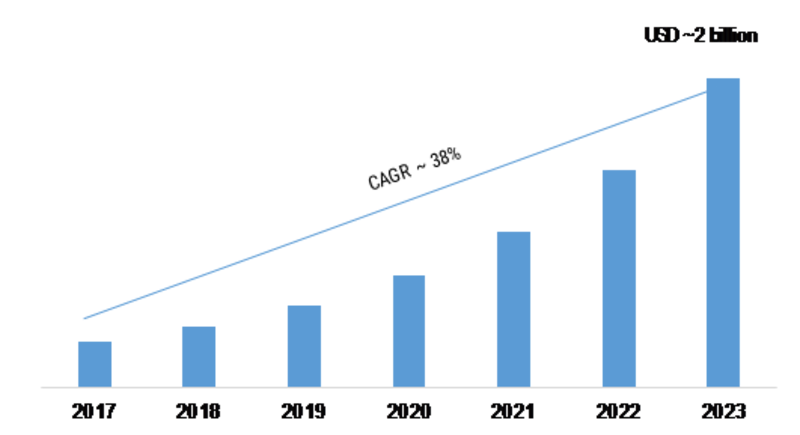
According to Market Research Future (MRFR), there will be 38% i.e. USD 2 billion dollars of growth in the education market by 2023. Almost all the countries will adopt the new and upgrading techniques of ML.

The prominent players in the market of ML in the education sector:

  • IBM Corporation
  • Microsoft Corporation
  • Google
  • com, Inc.,
  • Cognizant
  • Pearson
  • Bridge-U
  • DreamBox Learning
  • Fishtree
  • Jellynote
  • Jenzabar, Inc.,
  • Knewton, Inc.,
  • Metacog, Inc.,
  • Querium Corporation.
  • Century-Tech Ltd
  • Blackboard, Inc.,
  • Third Space Learning
  • Quantum Adaptive Learning, LLC

Apart from today’s development, many new changes are going to be seen in the future. Many ML software is going to be introduced to provide additional support to the education system which will show personalized learning and complete student engagement in various subjects.

  • With the help of ML technology, many new machines will be introduced which will have abilities like data identifying, data processing, learning, speech recognition, personalized learning, assessing etc.
  • ML will assist the student. Robots with these technologies will replace the professors and tutors.
  • Each student will get assessed by one personal tutor i.e one personal robot who will assist the student completely and teach them according to the student’s capability.
  • Highly customized and interactive software’s will get developed with the help of virtual and augmented reality technology.
  • Digital platforms will grow to a larger extent. Students will have the chance to access digital platforms for learning. Students will also get a chance to use tablets, smartphones, and wearable devices which will be used to assess the student and help the student to teach and learn various concepts in education. Digital platforms will accelerate the student’s performance and help them to understand the concepts clearly.
  • The new technology will minimize the time in all administrative tasks and helps the institutions to assess the student quickly in order to design his/ her personalized learning plan.
  • By 2023, there will be a lot of growth in applications and systems like Content Delivery Systems, Natural Learning Process, On-Cloud technologies.
  • With the help of ML technology, a student will have higher chances to learn and monitor the student. Highly interactive tools help the student and teacher to analyze and assess the students’ performance in various subjects.
  • Online education or E-Learning will become the major and crucial part of the education system. It will create Immersive experience in a student’s life and provides various adaptive techniques which will enable the student to focus on methods and reasons rather than traditional facts and myths.

The use of ML in EdTech will be a game changer in the coming future. Deployment of these technologies will give a chance to have a special focus on the students by providing both experimental and analytical learning process which will ultimately lead the students to understand the concept well. It will also bring many new opportunities to maintain the management, reduce the effort and learning gaps between the student and teachers.

7 ways Machine Learning will impact the Finance Industry

ML and accountants

As digital transformation continues to make headlines, nearly all business professionals agree that advanced technologies are going to significantly change the way we live and work over the next decades.

One of the most widely discussed digital trends in the enterprise is the use of machine learning to automate procedural tasks. 

As the backbone of the enterprise, finance has been leading the charge in leveraging machine learning to deliver real-time insights, inform decision making and drive efficiency across the enterprise. Therefore, finance will be one of the first business units to see the impact of these technologies on day-to-day activities—in everything from automating payments to calculating risk and maintaining records.

  • Clearing invoice payments

Today, accounts receivable or treasury clerks struggle to clear invoice payments when customers combine invoices in one payment, pay incorrect amounts or do not include invoice numbers with their payments. To clear the invoice, the employee either has to manually add up various invoices that might match the payment amount, or contact the customer to clarify some information. In the case of a short payment, the employee either has to ask for approval to accept the short payment or request the remaining amount from the customer. 

An intelligent system could help by immediately suggesting invoices that might match the paid amount and, based on established thresholds, automatically clear the short payments or automatically generate a delta invoice.

  • Auditing expense claims

Another transactional finance task that could benefit from ML-enhanced automation is expense claim auditing. Finance employees must ensure that receipts are genuine, match claimed amounts and are in line with company policy. While the claim process can be simplified using state-of-the-art travel-and-expense solutions, the auditing is still manual.

What if machine learning could support this process, audit 100 percent of all claims, and send only questionable claims to a manager for approval? The machine could read receipts (even in a foreign language), ensure they are genuine, and match them against the policy. 

  •  Determining bonus accruals

Today, the accounting team spends a significant amount of time determining bonus accruals. The team looks at the current headcount salaries and bonus plans, and tries to forecast all KPIs in compensation plans. Based on that, finance managers try to calculate the most accurate accrual (and maybe add a buffer, just in case). But in fact, we often find out later that, the accuracy is more a matter of luck.

Deploying ML solutions, we could leave this calculation to a machine that uses all available system data and predictive analytics capabilities to come up with an unbiased accrual. Additionally, this would give accounting teams more time during the precious closing period for activities that require human intervention or judgment. 

  • Mapping risk assessments

In assessing commercial proposals for services projects, finance teams are tasked with evaluating each project individually based on the customer characteristics, such as maturity, industry, size, current system landscape and so on, as well as the complexity of the products to be implemented. To make this assessment, finance often relies on managers who have experience with similar projects. While this works to some extent, these decisions are still limited by these individuals’ perspectives.

Machine learning could instead allow teams to access all of the implementation projects the company has ever completed, anywhere in the world, over the last 40 years. Using this data, teams could then map the proposed project against all historical projects and come up with a better-informed risk assessment. This could in turn allow finance managers to provide a better offer to customers using a lower risk uplift, or ensure that there is enough cover in case the risk is high. This capability could significantly increase the company’s revenue and margin.

  • Calculating detailed analytics

Today, almost everybody in financial planning and analysis receives countless calls asking for information such as, “What was our revenue last quarter for this product?” or “What has our growth been over the last five years in this line of business?”

Digital assistants can already answer questions on weather forecasts, stock quotes and so forth. What if they could provide the latest financial results and give decision makers instant access to information? What if finance teams could speak to their ERP systems the way we are already speaking to Siri or Alexa and get an immediate response or a clarifying question? For instance: “For which region?” “In EUR or USD?” or even, “I will send a detailed report to your inbox immediately.”

  • Automating approval workflows

Today, approval workflows are mostly based on two-dimensional matrices that list various conditions based on which approval levels are triggered. But these approval workflows do not consider the broader circumstances. Is the requestor new in the role and might require more supervision? Have previous requests from this requestor been rejected/approved? Is this an exception we usually grant in this scenario? 

Intelligent workflows could allow finance teams to distinguish and filter out the true exceptions from the standard low-risk exception that is usually approved anyway. This way, employees do not need to wait for approvals and feel empowered, while still limiting the risk to the corporation.

  • Transforming the finance role

One of the first questions asked of any CFO looking to leverage these technologies is how will this impact jobs in finance? First, the skills required of those in the finance function will drastically change. Transactional jobs will become less critical, while business partnering, cross-functional knowledge and tech savviness will become more important. These systems must be built, maintained and integrated into existing operational systems and processes. However, while the resources required for these transactional tasks will be fewer, the fast-changing business models driven by digitization will require additional finance resources to be developed and supported.

Many other functions besides finance, including HR, procurement and legal, will be equally affected. The best thing leaders can do to prepare for the impact of machine learning technology is to strive to develop a learning culture, so employees can stay ahead of what is coming. Now is the time for CFOs to educate and prepare themselves on this topic, so they can lead their teams in adapting when the time is right. 

All You Need to Know About Initial Exchange Offering (IEO)

Initial Exchange Offering

What is an IEO?

As the name suggests, an Initial Exchange Offering (IEO) is conducted on the platform of a cryptocurrency exchange. Compared to Initial Coin Offerings (ICOs), IEO is managed by a crypto exchange of the startup that wants to raise funds by the tokens, which are newly issued.

Token issuers have to pay a listing fee along with a percentage of the tokens sold during the IEO as the token sale is conducted on the exchange’s platform. 

In exchange, after the IEO exchange is completed, the tokens of the crypto startups are sold on the exchange’s platforms, and their coins are listed. As the cryptocurrency exchange takes a percentage of the tokens sold by the startup, the exchange is incentivized to help with the token issuer’s marketing operations.

IEO participants do not send contributions to a smart contract, such as governs an ICO. Instead, they have to create an account on the exchange’s platform where the IEO is conducted. The contributors then fund their exchange wallets with coins and use those funds to buy the fundraising company’s tokens.

How to participate in an IEO?

Even though IEOs are currently relatively peculiar in the world of cryptocurrency, it’s not that difficult to find one that you prefer.

Usually, the first step is to participate in an IEO typically begins with verifying if the project you are interested in is definitely conducting an IEO. As soon as you have found the IEO of your choice, it’s important to figure out which exchanges are hosting the IEO as there can be more than one. You can also join Crypto Airdrops before the token sale.

Naturally, another step is to develop an account on the cryptocurrency exchange and go throughout the KYC and AML verification strategy.

Once the process of signing up is over, you have to determine what cryptocurrencies you can use as a contribution and fund your account.

In the end, just wait for the IEO to start purchasing your tokens!

Advantages of Initial Exchange Offering(IEO)

Ease of offering

Any type of startups who are looking to offer tokens can benefit from an efficient and more simple way to launch IEOs on the exchange platform. Although the fundraising company has to pay a certain fee to the exchange, the price to conduct AML/KYC and other activities are brought down.

One more reason is that exchange platforms already have an existing customer base, that’s why there is no need to focus on the customer base from the beginning from day one.

Trust

Trust is one of the significant advantages of IEO. The crowd sale works on the crypto exchange platform. Therefore the counterparty is accountable for screening every project which is looking to launch an IEO for fundraising.

Exchanges make sure to vet token issuers without any harm to keep their good reputation. Hence, it can always eliminate dubious and fraud projects from raising funds through different exchange platforms.

One of the best example to understand is the RAID project, about how IEO brings trust in the system. Bittrex recently announced that it had canceled the RAID project just hours before the beginning of crowdsale. The reason asked for the explanation, Bittrex team said that the OP.GG ended the partnership with RAID, which was earlier a vital part of that project. It was a rational decision to make for Bittrex not to take risks launching something that was not in the best interest of its customers.

The popular platforms always perform careful and persistent checks on the project and the team supporting it and carefully and deciding to allow to launch an Initial Exchange Offering.

Security

Token Issuers should not worry about the safety of the crowdsale, as the exchange platform administers the smart contracts of token sales and have defined security standards.

Additionally, the exchange platforms also organize the process of AML/KYC to make sure the complete security of the project, and also prevent it from dubious and scam users.

Quick preparation process

Because of trustable exchange platform status, it takes less time to be identified and established. Here, an exchange itself promotes and supports your project.

Easily entering new markets

With the help of an exchange platform, it’s easier to enter the market and promote your IEO. Because of its active user, it eases the way into a new marketplace.

Exchange handles the KYC/AML process

To meet all legal regulations takes time, but a swap can expedite the process and manage it all by itself. With this, you can focus on implementing your project.

Eliminates the risk of scamming

IEO removes the risk of fraud and scams in the fundraising process. As the fundraising process is done through a proper crypto exchange, there are lesser chances of loss of funds to the scammers.

Best IEO (Initial Exchange Offering)

Now that you are aware of what exactly is IEO, we will see some of the best picked IEO. Nowadays, lots of projects are launching their IEO every day on various exchange platforms. We have vetted some of the best handpicked IEO and prepared a list below.

As everyone knows, it is sensible to do your research and choose the best investment for your funds. Below mentioned is just a factual list and is based on the features, concept, launchpad, team, market, and many other factors. Let’s start with the list:

Troy (IEO Over)

Troy is a blockchain-based project, Troy seeks to redefine the current experience of trading as we all are aware about. Troy gives crypto brokers services for professional traders and institutional clients.

Elrond (IEO Over)

A new kind of public blockchain infrastructure, Elrond is designed in a way to be efficient, secure, scalable and interoperable. One of the Elrond’s vital contribution is a authentic State Sharding approach: efficiently partitioning the chain state into multiple pieces, handled in parallel by different validators.

Deep Cloud (IEO Over)

Deep Cloud is a next generation decentralized cloud AI-driven computing platform for running decentralized applications.

Wink (WIN) (IEO Over)

A gaming platform of blockchain to play, socialize and stake. With the help of behavioral mining, modern token economy design, and other incentive mechanisms, Wink has created an ecosystem that provides top-notch gaming experiences, enables developers to build DApps that drive adoption, and engages users as active stakeholders to participate.

ULTRA (UTA) (IEO Over)

Ultra is bringing the blockchain revolution, this revolution is going to change the gaming industry and developing an ecosystem for the future of games distribution. With innovative technology, Ultra plans to disrupt the gaming industry by giving back power into the hands of developers and players, paving the way for a world-class game publishing platform.

AllSesame (IEO Over)

AllSesame is a decentralized Social Food Network which is powered by Blockchain. AllSesame Token is a Blockchain Ecosystem, it is designed to create the most Socialized Global Food Delivery Marketplace, which is developed using blockchain technology.  

Why will IEO replace ICO?

The first introduction of the concept of IEO was done in 2017, and since then, it is creating a lot of hype in the crypto world. In the year 2019, Binance will relaunch IEO with BTT (Bittorent tokens).

One of the significant reasons that IEO may replace ICO ultimately is its trust issue. A secured exchange platform conducts fundraising of IEO. ICOs are carried out at the token issuer’s site. Since the exchanges administer crowd sale, they only accept projects which are adequately verified. Exchanges do not take any risk as their reputation is also at stake. There are few other benefits as well which includes,

The crypto exchanges do all KYL/AML verification in IEO, but an ICO varies from project to project.

In IEO, the exchange also does marketing for your project, which is included in their fees. This is not the case in ICO.

In IEO, all token sales are automatically listed by the exchange platforms, which is not the case in ICO.

Ethereum is the primary payment source in ICOs and is issued through smart contracts only. In IEO, investors do not have to send their crypto to smart contracts. Instead, smart contracts are managed by the crypto exchanges. 

As mentioned earlier, IEO is an unsafe and risky business that takes many efforts to succeed, usually, when we talk about American and European projects willing to do IEO in Asia. The mentality is different. Hence, if you want your project to develop, it’s better considering professional guidance. 

Quick Read: A Complete Guide to IEO Marketing

Ways in Which Blockchain is Influencing Supply Chain Management

Managing supply chains nowadays is extraordinarily complicated as stakeholders have to maintain paper-based trails. Depending on the type of product, the supply chain covers hundreds of stages, various geographical locations, multiple stakeholders and entities and a multitude of payments and invoices.

Due to the lack of transparency across supply chains, the blockchain presents an opportunity to transform the supply chain and logistics industry.

To understand how blockchain can transform the supply chain, let’s look at the challenges in the supply chain, how the unique features of blockchain could help and examples of real blockchain applications impacting supply chains.

Challenges in the Supply Chain and Logistics Industry

If we go a hundred years back, the supply chain did not seem complicated because commerce used to take place on a small scale and was therefore simple.

Now, businesses have widened globally, making the supply chain management complex. It is not possible for the consumers to know the actual worth of the product due to the lack of transparency in the ecosystem.

Have you ever imagined where the food you eat originates from? Let’s consider the case of the food supply chain.

The supply chain in the food industry is defined by connecting:

  • Crop Origination
  • Food Processing at Refineries
  • Distribution of processed food to retailers
  • Selling of Food Items to Consumers

Because the food supply chain comprises millions of people worldwide along with tons of food crops and raw materials, it becomes difficult for both food manufacturers and consumers to know where the different components of the food item belong to.

The issues persist in the supply chain because of the following reasons:

  • Lack of Traceability

Traceability represents an exact picture of where the products are within the circulating supply chain at a specific time. Currently, every member within the supply chain network manages their own system and databases, making it complicated to do predictive monitoring and analyze where the product was at a particular time.

  • Documentation and Regulatory Compliance

The supply chain’s contracts can be quite complex due to the involvement of paper-based trails for the change of ownership, letters of credit, bills of lading, pro-for-mas and complicated payment terms. Maintaining the records on the paper is cumbersome as it becomes challenging to find the old records.

  • Counterfeits

Due to the lack of transparency, various counterfeits cases in the supply chain process are reported every year. According to the organization for Economic Cooperation and Development, pirated and counterfeit imports cost around half-trillion dollars per year in the global economy. 

The counterfeited products not only affect the economy, but it could affect lives as well. Due to the lack of available information about the origin and all stages of the project, products hardly meet the quality standards.

  • High Costs

Presently, supply chain management involves multiple intermediaries such as lawyers and regulators; it adds extra high costs to the ecosystem. The supply chain process requires middlemen to bring trust to the system.

How does Blockchain affect Supply Chain?

Before we make you understand how Blockchain is used in logistics, let’s first discuss what blockchain is.

Remember that the blockchain’s use is not restricted to a cryptocurrency like Bitcoin. In reality, the blockchain is a distributed digital ledger that keeps the log of all transactions occurring on the network in a transparent, yet secure way. It can be used for many applications that include the exchange of information, tracking, contracts/agreements, and payment.

Each transaction on the block and multiple copies of the ledger are distributed over nodes in the network, maintaining transparency. Since each block is linked to a block before and after it, the blockchain offers high security. Changing one block would lead to the change in all blocks on the network, making it difficult for hackers to corrupt the blockchain ledger.

Therefore, blockchain can enhance the efficiency and transparency of supply chains and impact everything from the warehouse to delivery and payment.

Every time a product changes hands within the supply chain, the transaction corresponding to it can be documented with timestamps, thereby maintaining a complete history of the product from manufacturing to sale. As a result, time delays, human errors and added costs could be reduced that affect the supply chains today.

Here’s how blockchain can have an impact on the supply chain process:

  • Recording the quantity and transfer of products as they change hands between supply chain nodes.
  • Tracking change orders, buy orders, shipment notifications, trade documents and receipts from the blockchain ledger.
  • Linking physical products to bar codes, RFID or serial numbers and storing them on the blockchain.
  • Sharing information about processing or manufacturing process, delivery, assembly and maintenance of products with vendors and suppliers transparently on the blockchain.

By implementing blockchain in the supply chain, you will be able to know who you are dealing with, where the product has been sourced from, who processed or manufactured it and if the payment is fair or not.

Benefits offered by the implementation of Blockchain in Supply Chain

  • Provenance Tracking:

Many multinational companies and big organizations do not even have backstories of their products in the supply chain because of no traceability. It may result in high costs and customer relations issues, affecting the brand’s reputation.

Using a blockchain supply chain solution, data sharing, provenance tracking, and record-keeping become more effective and simpler. Since the transactions saved on the blockchain ledger can neither be removed or altered, both consumers and stakeholders can trace the history of any product from its origin through the last mile.

  • Cost Reduction:

As blockchain allows real-time tracking of a product within the supply chain without the involvement of intermediaries, the cost of moving items can be reduced.

Removing middlemen from the process prevents extra costs, counterfeits or frauds and reduces the chances of product duplicacy. Instead of depending on financial intermediaries like banks, payments can be processed directly between the parties of the supply chain with crypto payments.

  • Increased transparency:

Blockchain’s immutable ledger prevents information tampering and allows suppliers and retailers to view the point of origin for each order. Enhanced visibility also implies that manufacturers can verify the inventory to combat counterfeit trade.

  • Trust Building:

Parties involved in the supply chain need to trust each other to maintain the credibility and authenticity of a product. A blockchain-based supply chain solution brings trust in the system with time-stamped records saved at all times, enabling each stakeholder to access any previous or current record.

Blockchain Supply Chain Use Cases

  • Oil Supply Chain

UAE’s state-owned oil company, Abu Dhabi National Oil Company (ADNOC), has launched a supply chain system pilot program on the blockchain. It aims to track oil from the oil well to customers while automating transactions simultaneously.

They have planned to expand the chain by including investors and customers, bringing more transparency to the process.

ADNOC produces approximately 3 million barrels of oil every day. Implementing blockchain technology will allow everyone to track oil produced, thereby reducing costs and time associated with the shipment.

  • Food Safety

Since it is complicated to know the origin of an outbreak, retailers have to throw out the inventories of produce forcefully. Companies including Walmart, JD.com and Tsinghua University are working together to enhance food transparency and shipment efficiency with blockchain technology. 

Tsinghua University manages the research and maintains the blockchain development while Walmart and JD.com manage production and shipment of products. The aim is to offer food safety by allowing manufacturers, processors, and retailers to track the end-to-end shipment of food products to improve the recall process and reduce counterfeits.

  • Diamond Tracking

Conflict or blood diamonds are mined under unsuitable and violent conditions and produced heavily in Africa. Sales of such diamonds are often used to fund conflicts in the region.

De Beers is one of the world’s largest diamond producers that has taken initiatives to end the sale of blood diamonds with blockchain supply chain solutions.

With their project Tracr, De Beers could track 100 diamonds from the diamond mine to cutter, polisher, and jeweler. Photos related to the diamond’s progress can be uploaded to the blockchain that includes quality, location, and color.

  • Wine Supplies with a Blockchain Logistics Tool

According to the Interprofessional Council of Bordeaux Wine, around 30,000 illegitimate bottles of wines are sold every hour in China. Wines are adulterated with a variety of harmful additives that can be detrimental to health. 

Original, in collaboration with TagltSmart, conducted the pilot program that tracked over 15,000 wine bottles. The goal is to put an end to illegitimate wine with blockchain’s capabilities to offer transparency.

Consumers can know details related to the purchase of each bottle by scanning a QR code on it.

  • Pharma Supply Chain

The Blockchain solution allows the UNO to track the distribution of free drugs from the warehouse through the last mile and identify losses and inefficiencies.

Conclusion: 

The blockchain technology has the potential to reconstruct the supply chain and transform the way we produce, promote, buy and consume the goods. Transparency, security, and traceability offered by the blockchain can make our economies safer and reliable and promote trust and honesty. Get in touch with a team of blockchain experts today to add value to your product’s supply chain and enhance the brand’s reputation.

What can IoT (Internet of Things) do for Healthcare Industry?

Before the Internet of Things, patients’ interactions with doctors were limited to visits, and tele and text communications. There was no way doctors or hospitals could monitor patients’ health continuously and make recommendations accordingly.

Internet of Things (IoT)-enabled devices have made remote monitoring in the healthcare sector possible, unleashing the potential to keep patients safe and healthy, and empowering physicians to deliver superlative care. It has also increased patient engagement and satisfaction as interactions with doctors have become easier and more efficient. Furthermore, remote monitoring of patient’s health helps in reducing the length of hospital stay and prevents readmissions. IoT also has a major impact on reducing healthcare costs significantly and improving treatment outcomes.

IoT is undoubtedly transforming the healthcare industry by redefining the space of devices and people interaction in delivering healthcare solutions. IoT has applications in healthcare that benefit patients, families, physicians, hospitals and insurance companies.

IoT for Patients

Devices in the form of wearables like fitness bands and other wirelessly connected devices like blood pressure and heart rate monitoring cuffs, glucometer etc. give patients access to personalized attention. These devices can be tuned to remind calorie count, exercise check, appointments, blood pressure variations and much more.

IoT has changed people’s lives, especially elderly patients, by enabling constant tracking of health conditions. This has a major impact on people living alone and their families. On any disturbance or changes in the routine activities of a person, alert mechanism sends signals to family members and concerned health providers.

IoT for Physicians

By using wearables and other home monitoring equipment embedded with IoT, physicians can keep track of patients’ health more effectively. They can track patients’ adherence to treatment plans or any need for immediate medical attention. IoT enables healthcare professionals to be more watchful and connect with the patients proactively. Data collected from IoT devices can help physicians identify the best treatment process for patients and reach the expected outcomes.

IoT for Hospitals

Apart from monitoring patients’ health, there are many other areas where IoT devices are very useful in hospitals. IoT devices tagged with sensors are used for tracking real time location of medical equipment like wheelchairs, defibrillators, nebulizers, oxygen pumps and other monitoring equipment. Deployment of medical staff at different locations can also be analyzed in real time.

The spread of infections is a major concern for patients in hospitals. IoT-enabled hygiene monitoring devices help in preventing patients from getting infected. IoT devices also help in asset management like pharmacy inventory control, and environmental monitoring, for instance, checking refrigerator temperature, and humidity and temperature control.

IoT for Health Insurance Companies

There are numerous opportunities for health insurers with IoT-connected intelligent devices. Insurance companies can leverage data captured through health monitoring devices for their underwriting and claims operations. This data will enable them to detect fraud claims and identify prospects for underwriting. IoT devices bring transparency between insurers and customers in the underwriting, pricing, claims handling, and risk assessment processes. In the light of IoT-captured data-driven decisions in all operation processes, customers will have adequate visibility into underlying thought behind every decision made and process outcomes.

Insurers may offer incentives to their customers for using and sharing health data generated by IoT devices. They can reward customers for using IoT devices to keep track of their routine activities and adherence to treatment plans and precautionary health measures. This will help insurers to reduce claims significantly. IoT devices can also enable insurance companies to validate claims through the data captured by these devices.

Redefining Healthcare

The proliferation of healthcare-specific IoT products opens up immense opportunities. And the huge amount of data generated by these connected devices hold the potential to transform healthcare.

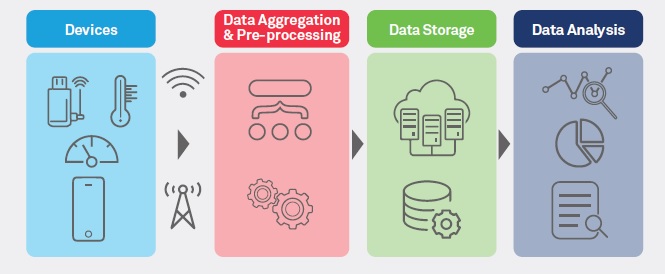
IoT has a four-step architecture that are basically stages in a process (See Figure 1). All four stages are connected in a manner that data is captured or processed at one stage and yields the value to the next stage. Integrated values in the process brings intuitions and deliver dynamic business prospects.

Step 1: First step consists of deployment of interconnected devices that includes sensors, actuators, monitors, detectors, camera systems etc. These devices collect the data.

Step 2: Usually, data received from sensors and other devices are in analog form, which need to be aggregated and converted to the digital form for further data processing.

Step 3: Once the data is digitized and aggregated, this is pre-processed, standardized and moved to the data center or Cloud.

Step 4: Final data is managed and analyzed at the required level. Advanced Analytics, applied to this data, brings actionable business insights for effective decision-making.

IoT is redefining healthcare by ensuring better care, improved treatment outcomes and reduced costs for patients, and better processes and workflows, improved performance and patient experience for healthcare providers.

The major advantages of IoT in healthcare include:

  • Cost Reduction: IoT enables patient monitoring in real time, thus significantly cutting down unnecessary visits to doctors, hospital stays and re-admissions
  • Improved Treatment: It enables physicians to make evidence-based informed decisions and brings absolute transparency
  • Faster Disease Diagnosis: Continuous patient monitoring and real time data helps in diagnosing diseases at an early stage or even before the disease develops based on symptoms
  • Proactive Treatment: Continuous health monitoring opens the doors for providing proactive medical treatment
  • Drugs and Equipment Management: Management of drugs and medical equipment is a major challenge in the healthcare industry. Through connected devices, these are managed and utilized efficiently with reduced costs
  • Error Reduction: Data generated through IoT devices not only help in effective decision making but also ensure smooth healthcare operations with reduced errors, waste and system costs

Healthcare IoT is not without challenges. IoT-enabled connected devices capture huge amounts of data, including sensitive information, giving rise to concerns about data security.

Implementing apt security measures is crucial. IoT explores new dimensions of patient care through real-time health monitoring and access to patients’ health data. This data is a goldmine for healthcare stakeholders to improve patient’s health and experiences while making revenue opportunities and improving healthcare operations. Being prepared to harness this digital power would prove to be the differentiator in the increasingly connected world.

WhatsApp Telegram