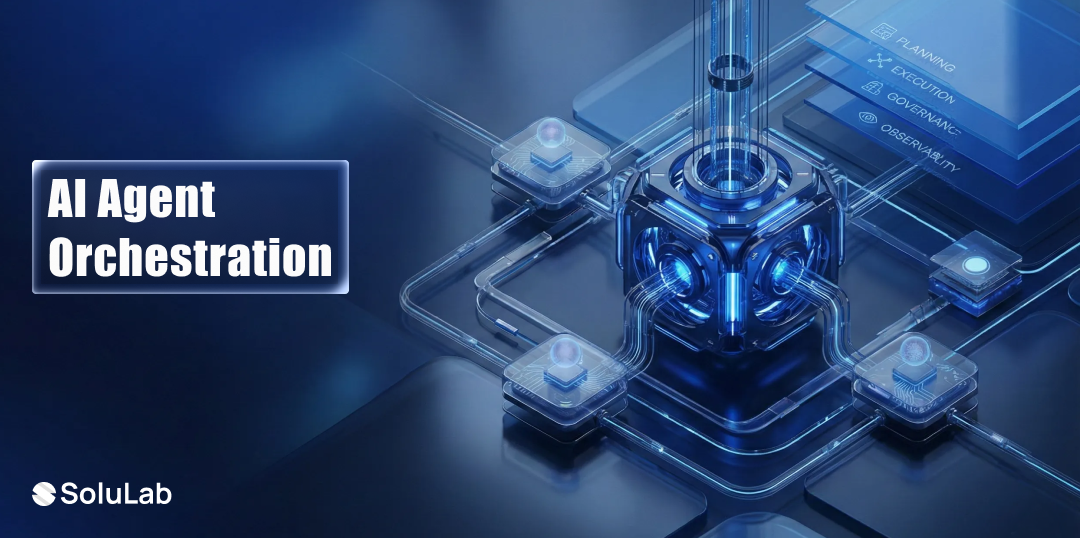
Most enterprises are already experimenting with AI agents, helpdesk bots, coding copilots, and email summarizers, but very few have turned these isolated wins into a coherent, multi-agent system that actually moves the P&L. The missing piece is AI agent orchestration: the architecture, tooling, and governance that make dozens of specialized agents work together safely and reliably across your existing stack.
Why AI Agents Alone Are Not Enough?
Over the last two years, generative AI has proven its productivity upside across industries. McKinsey estimates that generative AI could add up to 2.6–4.4 trillion USD in economic value annually, with the biggest gains in knowledge work and complex decision-making. Case studies show knowledge workers completing tasks 25–40% faster with higher quality when assisted by AI tools.
Yet on the ground, many CTOs see a different picture:
- Fragmented pilots: A few bots in customer support, a code assistant in engineering, some ad hoc automations in finance—none talking to each other.
- Tool sprawl: Multiple vendors, duplicative capabilities, inconsistent security, and governance.
- Local, not systemic impact: Individual workflows improve, but there is no measurable, enterprise-wide productivity lift.
IBM’s own “client zero” implementation illustrates both the potential and the pattern. By rolling out AI agents across more than 70 business areas, IBM reports about 3.5 billion USD in productivity gains in two years, automating up to 94% of simple HR tasks and cutting IT support interactions by 70%. They achieved this by integrating agents into a single orchestration platform, not by scaling standalone bots.
The lesson is clear: the ROI comes not from more agents, but from orchestrated agents.
What Is AI Agent Orchestration Actually?
AI agent orchestration is the layer that coordinates multiple agents, models, tools, and data sources so they can collaboratively execute complex workflows end-to-end. Think of it as the “control plane” for your agentic AI stack.
At a minimum, a serious orchestration layer needs to provide:
1. Task planning and routing
- Break down user goals into steps, select the right agent or tool for each step, and handle dependencies between them.
2. Tool and API integration
- Connect to your existing SaaS, internal microservices, RPA bots, data warehouses, and vector databases via secure APIs and connectors.
3. Context management
- Maintain shared memory across agents (state, user preferences, business rules) using embeddings, vector stores, and structured knowledge graphs.
4. Observability and governance
- Trace every agent action, log inputs/outputs, enforce security and compliance, and apply rate limits and guardrails.
5. Human-in-the-loop control
- Escalate edge cases to humans, require approvals for high-risk actions, and learn from feedback to refine policies.
Platforms like IBM Watsonx Orchestrate showcase this approach: they act as a multi-agent supervisor, router, and planner, connecting prebuilt and custom agents to over 80 enterprise applications with built-in observability and governance.
Three Adoption Paths: Greenfield, Modernization, and Integration
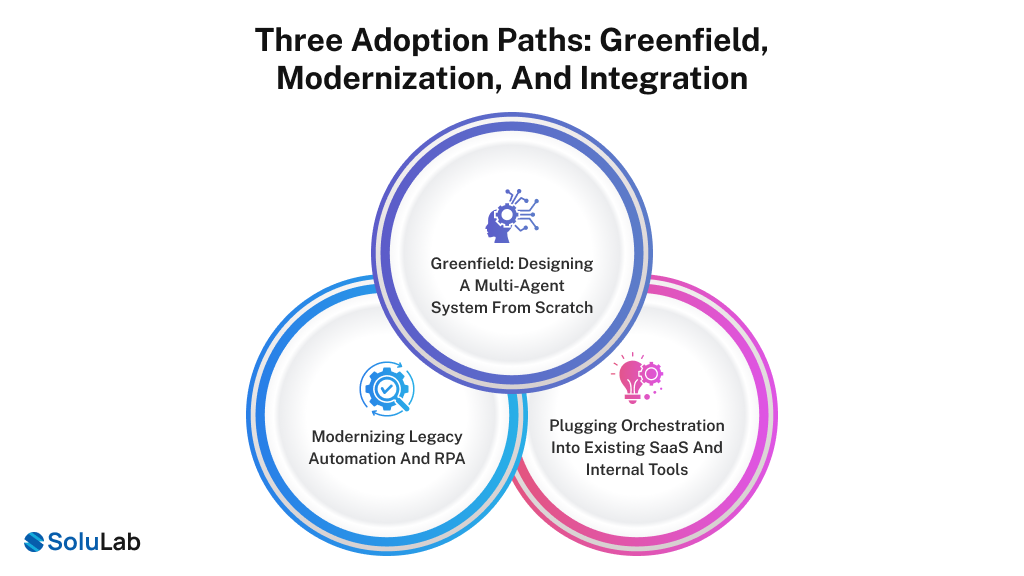
Enterprises usually meet multi-agent orchestration from one of three angles. You may recognize your own environment in one or all of them.
1. Greenfield: Designing a Multi-Agent System from Scratch
In greenfield initiatives, you typically start from an AI agent for business goal (“automate 60% of order-to-cash”), then design an agentic architecture around it.
A robust greenfield design usually includes:
- Orchestrator agent
A central planner that interprets user intents, decomposes tasks, calls tools, and coordinates specialist agents.
- Specialist agents
Focused agents for domains like pricing, contract generation, payments, or support, each with clear capabilities and access scopes.
- Tooling layer
Connectors to ERPs, CRMs, ticketing tools, data lakes, and RPA flows.
- Memory and knowledge layer
Vector databases, embeddings, and structured domain knowledge powering retrieval-augmented generation and rule execution.
- Control plane
Policies, observability, and safety rails: who can invoke what, which actions need approval, and how failures are handled.
Technically, AI agent orchestration framework often involves:
- LLM frameworks: LangChain, Semantic Kernel, or similar for agent logic and tool calling.
- Container orchestration: Kubernetes for scaling agents and tools.
- Event and workflow engines: Kafka, temporal engines, or BPM for durable, long-running workflows.
- Multi-model strategy: Combining general-purpose LLMs with domain-tuned models (or IBM Granite families) for specific tasks.
The upside of greenfield: you can bake in governance, telemetry, and cost controls from day one, instead of retrofitting them later.
2. Modernizing Legacy Automation and RPA
Many enterprises already rely heavily on RPA solutions and rule-based workflows. Here, agent orchestration becomes an “intelligence layer” above existing bots.
Instead of ripping and replacing, you can:
- Keep RPA and existing automations as tools
Treat bots like callable services that agents can invoke as needed.
- Use agents to handle unstructured work
Let LLM-based agents parse emails, documents, chats and convert them into structured actions for RPA bots.
- Introduce dynamic decision-making
Replace brittle rule trees with agents that can reason over context, policies, and historical data.
- Add observability and governance
Centralize logs and decisions across old and new automations into a single view.
Reports from IBM and others show that when you combine AI agents with traditional automation, you can move from narrow task automation to end-to-end process automation, with executives expecting agents to autonomously execute most transactional workflows in the next 1–2 years.
3. Plugging Orchestration into Existing SaaS and Internal Tools
The third path is where most organizations start: orchestrating across their current SaaS and internal applications.
A practical pattern looks like this:
- Abstract your SaaS and internal APIs into a consistent tool catalog
For example, “create_sales_order,” “update_ticket_status,” “generate_invoice,” each with permission rules.
- Deploy orchestrator agents that understand business workflows
For instance, a “Revenue Ops Orchestrator” that spans CRM, billing, and support, or an “Employee Lifecycle Orchestrator” across HRIS, ITSM, and identity systems.
- Use a shared context layer
Centralized identity, roles, and policies, plus unified customer or employee profiles.
- Provide a single experience layer
Chat, UI, or API endpoints where humans request outcomes (“onboard this engineer in London”) and the orchestrator agents handle the rest.
This is where IBM’s integration strategy is illustrative: Watsonx Orchestrate ships preintegrated with dozens of enterprise applications and supports 150+ agents and tools in its catalog, enabling cross-application workflows that previously required manual swivel-chair work.
Architectural Deep Dive: How Orchestrated Agents Actually Work
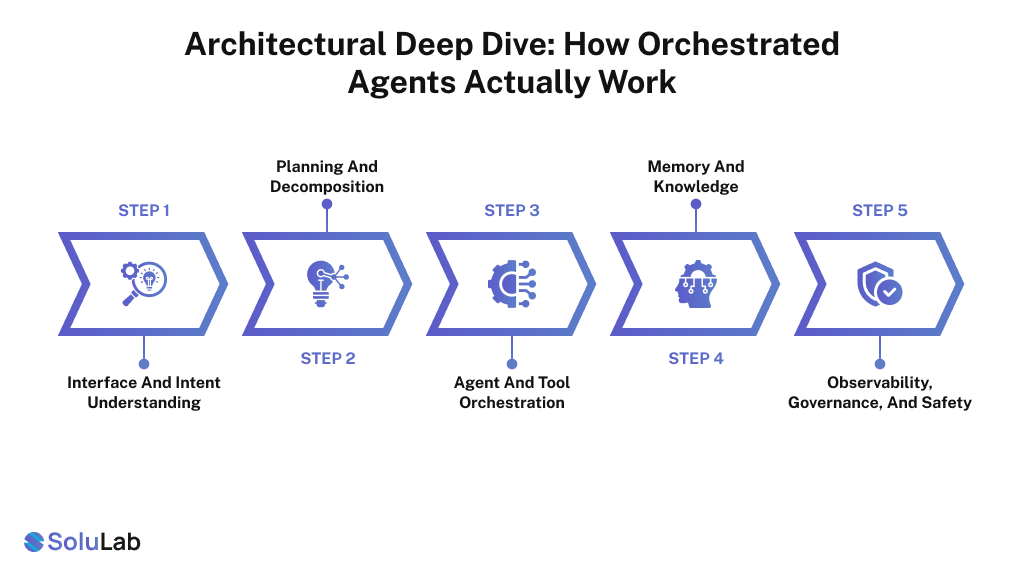
From an engineering lens, an orchestrated agentic system typically has these layers:
1. Interface and intent understanding
- Channels: chat, REST APIs, UI forms.
- Models: LLMs that interpret user goals and map them to high-level actions or workflows.
2. Planning and decomposition
- Planners: LLM-based or classical planners that break goals into ordered tasks.
- Policies: constraints, SLAs, and compliance rules informing which tasks are allowed, in what sequence, and under which conditions.
3. Agent and tool orchestration
- Orchestrator: decides which agent or tool handles each step, passes the right context, and monitors execution.
- Tools: business microservices, SaaS APIs, RPA bots, retrieval endpoints, and traditional ML models.
4. Memory and knowledge
- Short-term memory: conversation and session state.
- Long-term memory: vector stores for unstructured data, plus structured knowledge graphs and MDM systems.
5. Observability, governance, and safety
- Logging and tracing for every call, metric dashboards, and anomaly detection.
- Policy enforcement: PII redaction, access control, rate limiting, audit trails, and human approval checkpoints.
In practice, you might use an LLM framework to define agents as modular components, Kubernetes to scale them, and an orchestration platform (like Watsonx Orchestrate or a custom service) as the supervising control plane.
Where the Value Shows Up in the P&L?
Fundamental orchestration patterns can impact both cost and growth levers:
1. Productivity and throughput
- IBM’s internal rollout suggests multi-billion-dollar productivity gains across HR, IT, finance, and sales by compressing workflows from hours to minutes.
- External studies show AI-assisted knowledge workers completing tasks up to 25–45% faster, and consultants delivering 40% higher quality outputs.
2. Quality and reliability
- Agents can enforce consistent application of policies, pricing rules, and compliance checks, reducing human error in repetitive decisions.
3. Employee and customer experience
- Multi-agent orchestration supports “follow-the-user” experiences where context moves seamlessly across channels and departments, improving CSAT and reducing bounce.
4. Innovation velocity
- With a shared orchestration layer, teams can plug in new models or agents without redoing integrations, dramatically reducing time-to-market for new automations.
The strategic question shifts from “Should we use AI agents?” to “How fast can we deploy orchestrated agents across core processes without losing control?” This further raises the need for understanding the challenges of AI agent orchestration patterns.
Common Failure Modes to Avoid
From what we see in the market and analyst research, the same anti-patterns repeat:
1. Agent sprawl without orchestration
- Teams launch vertical-specific agents (HR, sales, IT) with no common control plane, causing duplication and security risks.
2. No observability
- Enterprises cannot answer basic questions like “Which agents are running?”, “What data did they touch?”, or “Why did this decision happen?”.
3. Over-reliance on a single LLM
- Lock-in and cost issues when one model is used for everything instead of assigning model responsibilities by domain and risk profile.
4. Governance as an afterthought
- Policies, approvals, and audit trails bolted on late, making regulators and CISOs uncomfortable.
Orchestration-first design flips this: you start with governance, observability, and integration, then proliferate agents as controlled, observable components. The AI agent orchestration challenges can be overcome with an expert development partner.
How We Help You Build Orchestrated Agent Systems?
If you are a CTO, Head of Data/AI, or product leader evaluating agentic AI, you likely have three overlapping priorities:
- Capture productivity and growth upside quickly.
- Avoid fragmentation, security risks, and vendor lock-in.
- Keep your architecture flexible enough to adopt better models and tools over the next 2–3 years.
Our team works as an engineering partner in the process of AI agent orchestration to design, build, and deploy orchestrated agentic systems across these three adoption paths:
1. Greenfield multi-agent systems
- Architecture design for orchestrator and specialist agents, memory, and workflows.
- Implementation using your preferred LLM frameworks, clouds, and security standards.
2. Modernization of legacy automation and RPA
- Wrapping existing bots and workflows as tools in an agentic architecture.
- Gradually replacing brittle rule trees with AI agents, without disrupting current operations.
3. Cross-SaaS and internal tool orchestration
- Building a unified agent and tool catalog over your existing SaaS and internal APIs.
- Implementing orchestrator agents that execute complex, cross-system workflows with observability and governance.
We typically start AI agent orchestration steps with a focused, 6–10 week orchestration pilot targeting one high-impact process (for example, sales order-to-cash, IT service triage, or employee onboarding), then scale the architecture once a measurable uplift in cycle time, error rate, or cost is proven.
We recently rendered a centralized AI orchestration platform that manages 14+ autonomous agents to unify automation, intelligence, and compliance at scale.
If you want to explore how agent orchestration could look in your specific environment, greenfield, modernization, or integration-first, we can help you map a reference architecture, identify quick wins, and design a roadmap for AI agent development that moves you from isolated agents to an orchestrated, enterprise-grade agentic AI fabric.
FAQs
A single AI agent handles one task. Orchestration enables multiple agents to plan, delegate, validate, and execute tasks together—making AI systems scalable and enterprise-ready.
Orchestration allows AI agents to operate with goals, memory, and rules—enabling them to act independently while staying aligned with business policies and human oversight.
Scaling starts with a focused AI PoC, followed by integrating AI agent use cases, adding governance, defining workflows, and continuously optimizing for performance and reliability.
A basic orchestration PoC can be built in weeks, while enterprise-scale deployments typically evolve over a few months based on complexity and integration needs.
AI agent development services help enterprises design, build, and deploy purpose-built AI agents that can be orchestrated securely across workflows, systems, and teams.