Talk to an Expert

How to Choose the Best Whitelabel NFT Development Company?

How to Choose the Best Whitelabel NFT Development Company?

The world of NFTs (Non-Fungible Tokens) has taken the digital landscape by storm, revolutionizing how we perceive and trade digital assets. As the demand for NFTs continues to surge, the need for robust NFT marketplaces and platforms has become increasingly evident. This is where whitelabel NFT development companies come into play, offering customizable solutions to create your own NFT marketplace. In this comprehensive guide, we’ll explore the intricacies of selecting the best whitelabel NFT development company to ensure your venture’s success.

What is a Whitelabel NFT Development Company?

A Whitelabel NFT Development Company is a specialized entity in the NFT (Non-Fungible Token) ecosystem that focuses on providing customizable solutions for creating NFT marketplaces. These companies offer ready-made software, tools, and services that empower businesses and entrepreneurs to swiftly launch their own NFT platforms. Rather than constructing a marketplace from the ground up, clients can procure a whitelabel solution and adapt it to their brand’s unique requirements.

The term “whitelabel” denotes that the solution is provided in a way that allows clients to rebrand and customize it as if it were their own product. In the context of NFT development, a whitelabel solution refers to a pre-built NFT marketplace platform that can be tailored to match a specific brand’s identity and requirements. This approach is particularly advantageous for businesses seeking to enter the NFT market promptly without the extensive time and resources required for custom development.

Whitelabel NFT development companies are proficient in developing white-label NFT marketplace software and offer services catered to this specific niche. They possess expertise in blockchain technology, including knowledge of various blockchain networks such as Ethereum, Binance Smart Chain, and others commonly used for NFT development. Their solutions often come with a range of features and functionalities that can be customized to meet the client’s needs. Additionally, reputable Whitelabel NFT development companies provide ongoing support and maintenance to ensure the platform remains secure and up-to-date.

Read Our Blog Post: Why Should You Start Your Own NFT Marketplace Business?

A whitelabel NFT development company specializes in providing customizable NFT marketplace solutions to businesses and entrepreneurs looking to establish their presence in the NFT space quickly and efficiently. Their expertise lies in crafting pre-built NFT platforms that can be rebranded and tailored to match the client’s specific requirements, making them an invaluable resource for those looking to navigate the burgeoning world of NFTs.

Why Choose a Whitelabel NFT Solution?
Why Choose a Whitelabel NFT Solution?

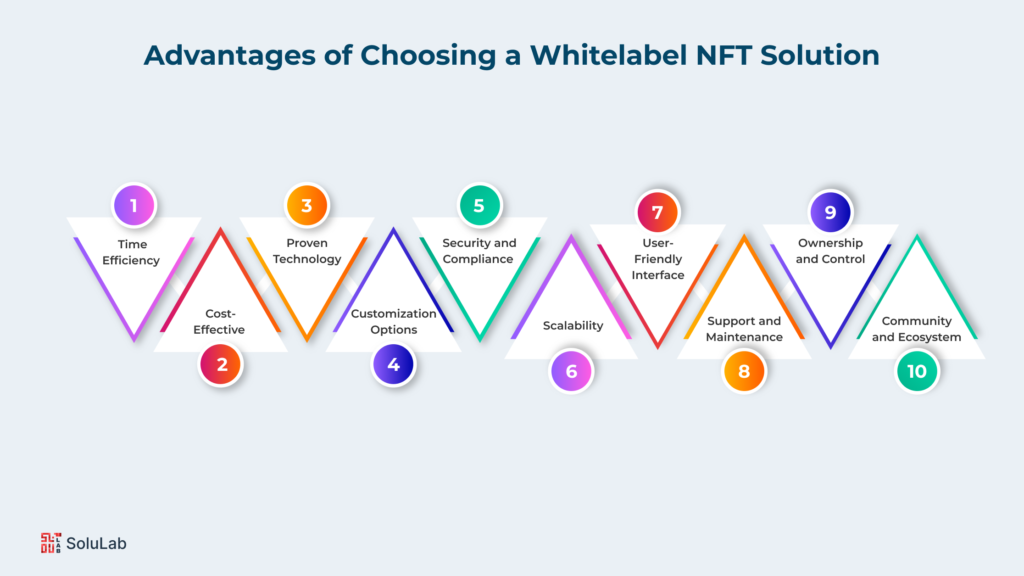
Advantages of Choosing a Whitelabel NFT Development Company

  • Time Efficiency: Building a custom NFT marketplace from scratch can be a time-consuming process, involving extensive development, testing, and refinement. Whitelabel solutions significantly reduce development time, allowing you to launch your NFT platform faster and seize opportunities in the market swiftly.
  • Cost-Effective: Developing a bespoke NFT platform can be expensive due to the associated development, testing, and ongoing maintenance costs. Whitelabel solutions are often more budget-friendly, as they leverage pre-existing technology and infrastructure.
  • Proven Technology: Whitelabel NFT solutions are built on tested and proven technology. When you choose a reputable whitelabel NFT development company, you can leverage their experience and expertise to ensure a stable and secure platform. This is especially crucial in the NFT space, where security and reliability are paramount.

Check Our Blog Post: Top NFT Development Companies To Look At In 2024

  • Customization Options: While whitelabel solutions come with pre-built features and functionalities, they are highly customizable. This means you can tailor the platform to match your brand’s identity and meet your specific requirements. You retain control over the design, features, and user experience.
  • Security and Compliance: Security is of utmost importance in the NFT space, given the value of digital assets being traded. Whitelabel NFT development companies typically implement robust security measures, including encryption, multi-factor authentication, and regular security audits. Moreover, they often stay updated with regulatory changes and can help ensure your platform complies with relevant laws and regulations.
CTA1

  • Scalability: Your NFT marketplace should be prepared to handle increased traffic and transaction volumes as your user base grows. Reputable whitelabel solutions are designed to be scalable, allowing your platform to expand seamlessly without significant disruptions.
  • User-Friendly Interface: A user-friendly and easy to use interface is vital for attracting and retaining users. Many whitelabel NFT solutions come with well-designed user interfaces that provide an intuitive and visually appealing experience for your users.
  • Support and Maintenance: Establishing and maintaining an NFT marketplace requires ongoing support and maintenance. Reliable whitelabel NFT development companies offer support services to address any issues or updates that may arise. This ensures that your platform remains up-to-date, secure, and responsive to user needs.
  • Ownership and Control: When you choose a whitelabel NFT marketplace, you retain ownership and control over your platform. This means you can make decisions about its future development, monetization strategies, and branding without being tied to a third-party platform’s limitations.
  • Community and Ecosystem: Whitelabel NFT development companies often have established communities and ecosystems of users and developers. Joining such an ecosystem can provide you with valuable networking opportunities, partnerships, and insights into industry trends.

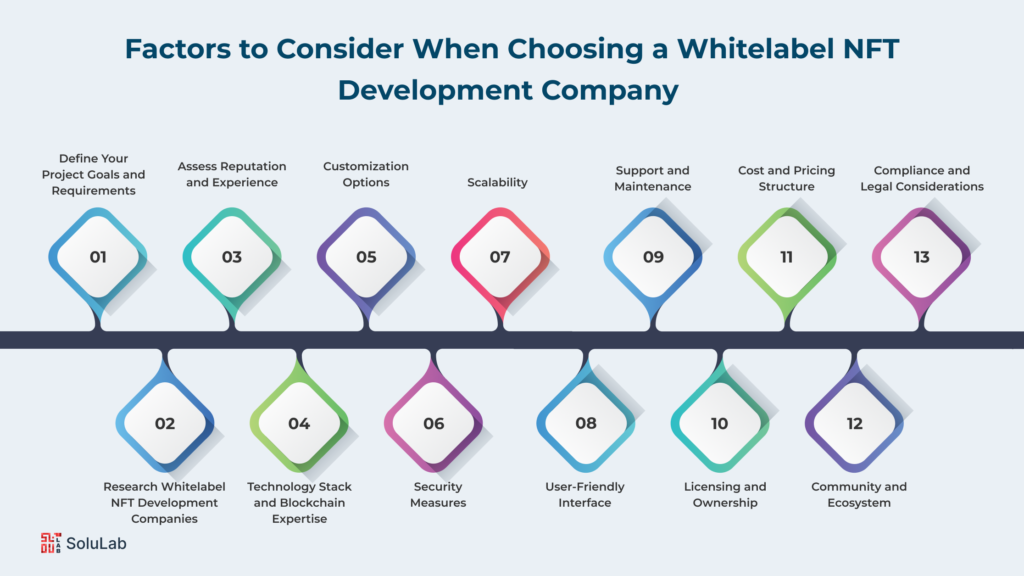
Key Factors to Consider When Choosing a Whitelabel NFT Development Company
Key Factors to Consider When Choosing a Whitelabel NFT Development Company

Selecting the best whitelabel NFT development company is a pivotal decision that can significantly impact the success of your NFT marketplace venture. 

1. Define Your Project Goals and Requirements

Before you start your search for a whitelabel NFT development company, you must have a clear understanding of your project’s goals and requirements. Ask yourself:

  • What is the niche or industry you’re targeting with your NFT marketplace (e.g., art, music, gaming, collectibles)?
  • What specific features and functionalities do you need in your NFT platform?
  • What is your budget for development, maintenance, and ongoing support?
  • Do you have any legal or regulatory considerations, such as compliance with local laws or licensing agreements?
  • Having a well-defined project scope and goals will guide your search and help you identify the company that can best meet your needs.

2. Research Whitelabel NFT Development Companies

Start your research by identifying a list of potential whitelabel NFT development companies. You can do this through a number of means:

  • Online searches: Use search engines and NFT-related forums and communities to find companies that offer whitelabel NFT solutions.
  • Industry referrals: Seek recommendations from industry peers, fellow entrepreneurs, or NFT enthusiasts who have experience working with such companies.
  • NFT marketplaces: Explore existing NFT marketplaces to see if they offer whitelabel solutions or partnerships with development companies.
  • Compile a list of companies that seem promising and align with your project goals.

Know More: How to Build the Best White-Label NFT Marketplace?

3. Assess Reputation and Experience

The reputation and experience of a whitelabel NFT development company are crucial factors to consider. Here’s how to assess them:

  • Portfolio: Review the company’s portfolio of past projects. Look for successful NFT marketplaces they have developed and launched. Pay attention to the diversity of industries and niches they have worked in.
  • Client testimonials: Seek out client testimonials and reviews. Reach out to past clients if possible to gather feedback about their experiences with the company.
  • Case studies: Some companies provide detailed case studies of their projects, highlighting challenges and solutions. Review these to gain insights into their problem-solving abilities.
  • A reputable and experienced company is more likely to deliver a high-quality product and provide reliable support.

4. Technology Stack and Blockchain Expertise

Since NFTs are blockchain-based, it’s crucial that the NFT development company has expertise in blockchain technology. Evaluate:

  • Their knowledge of blockchain networks: Ensure they are well-versed in the blockchain network you plan to use for your NFT marketplace, whether it’s Ethereum, Binance Smart Chain, Flow, or another.
  • Smart contract proficiency: NFTs rely on smart contracts for functionality. Assess the company’s capability to create and audit smart contracts for security and reliability.
  • Scalability: Inquire about their ability to design a scalable NFT platform that can handle growing user traffic and transaction volumes.
  • A solid understanding of blockchain technology is essential to ensure the security and efficiency of your NFT marketplace.

Related: 5 Best White Label NFT Marketplaces In The World

5. Customization Options

NFT marketplaces should be highly customizable to align with your brand identity and specific requirements. Evaluate:

  • The degree of customization offered by the whitelabel NFT solution. Can you modify the platform’s design, features, and functionalities to suit your vision?
  • User interface and user experience (UI/UX): Ensure that the platform’s UI/UX can be tailored to create an engaging and user-friendly environment.
  • White labeling options: Confirm that you have the freedom to rebrand the platform completely, so it appears as your unique product.
  • Customization is essential to differentiate your NFT marketplace from competitors and align it with your brand.

6. Security Measures

The security of your NFT marketplace is paramount, as it deals with valuable digital assets. Inquire about the security measures the company implements, including:

  • Encryption: Data encryption to protect user information and transactions.
  • Multi-factor authentication (MFA): Additional layers of security to prevent unauthorized access.
  • Regular security audits: Routine assessments to identify and address vulnerabilities.
  • Compliance with industry standards: Ensure that the company follows security best practices and complies with relevant industry standards.
  • Security breaches can lead to significant reputational and financial damage, so this aspect should not be overlooked.

7. Scalability

Your NFT marketplace should be capable of accommodating increased traffic and transaction volumes as your user base grows. Assess:

  • The platform’s scalability options: Can it handle growing demand without performance degradation or downtime?
  • Load testing: Inquire if the company conducts load testing to ensure the platform’s ability to handle peak usage periods.
  • Scalability ensures that your NFT marketplace can evolve and expand along with your success.

Read Also: How will White-Label NFT Marketplace Development Benefit your Business?

8. User-Friendly Interface

A user-friendly interface is crucial for attracting and retaining users. Evaluate:

  • The platform’s user interface (UI) design: Is it intuitive, visually appealing, and easy to navigate?
  • User experience (UX): Does the platform provide a seamless and enjoyable experience for users?
  • A well-designed UI/UX can significantly impact user engagement and conversion rates.

9. Support and Maintenance

Building and maintaining an NFT marketplace is an ongoing process. Inquire about the support and maintenance services offered by the company, including:

  • Response time for addressing issues or inquiries.
  • Availability of ongoing updates and improvements.
  • Technical support channels and their responsiveness.
  • A reliable support system ensures that your NFT marketplace remains secure and up-to-date.

10. Licensing and Ownership

Understand the licensing terms and ownership rights associated with the whitelabel solution. Ensure that:

  • You have full control and ownership of your NFT marketplace to avoid legal complications in the future.
  • Licensing agreements are clear and align with your business goals and objectives.
  • Legal clarity is essential to protect your long-term interests.

11. Cost and Pricing Structure

While cost-effectiveness is a key advantage of whitelabel solutions, carefully review the pricing structure and associated fees. Be aware of:

  • Initial development costs.
  • Ongoing maintenance and support fees.
  • Any hidden or unexpected costs that may arise during development and operation.
  • Budget transparency is crucial for managing your financial resources effectively.

Related: What are the Key Features of the White-Label NFT Marketplace?

12. Community and Ecosystem

A strong community and ecosystem can be valuable in the NFT space. Consider whether the whitelabel NFT development company has:

  • An active user community or developer community.
  • Partnerships or collaborations within the NFT industry.
  • A network of experts and enthusiasts who can provide insights and support.
  • Being part of a thriving community can open doors to networking opportunities and industry trends.

13. Compliance and Legal Considerations

NFTs are subject to various regulatory considerations in different jurisdictions. Ensure that the whitelabel solution complies with relevant laws and regulations in your target market. Consult with legal experts if needed to address compliance issues effectively.
CTA2

Conclusion

Choosing the best whitelabel NFT development company is a critical decision that can greatly impact the success of your NFT marketplace. Carefully evaluate each company’s reputation, experience, technology stack, customization options, security measures, and support services.

Remember that the NFT space is continuously evolving, so staying informed about the latest trends and developments is essential. With the right whitelabel NFT development company and a well-thought-out strategy, your NFT marketplace can thrive in this exciting and dynamic ecosystem, opening up new opportunities for your brand and users alike.

On the path towards a future driven by NFTs, SoluLab stands as a reliable partner, leading businesses towards success by leveraging its proficiency in whitelabel NFT marketplace development services. With innovation as its guiding force, SoluLab empowers enterprises to explore new horizons, revolutionize commerce, and establish their unique presence in the digital realm.

Together with SoluLab, you embark on a transformative journey—a journey characterized by innovation driving advancement and turning aspirations into reality. Connect with SoluLab today to enter the realm of white-label NFT marketplaces, where the possibilities are endless, and opportunities know no bounds.

FAQs

1. What is a Whitelabel NFT Development Company?

A whitelabel NFT development company specializes in providing ready-made, customizable solutions for creating NFT marketplaces. These solutions allow businesses to launch their NFT platforms quickly, without building them from scratch.

2. Why should I choose a whitelabel NFT solution over custom development?

Whitelabel NFT solutions are often more cost-effective and time-efficient compared to custom development. They leverage pre-existing technology, reduce development time, and offer customization options, making them a practical choice for entering the NFT market swiftly.

3. What factors should I consider when choosing a whitelabel NFT development company?

Consider factors such as the company’s reputation, experience, technology stack, customization options, security measures, scalability, user interface, support, legal considerations, and pricing structure.

4. How important is security when selecting a whitelabel NFT development company?

Security is crucial in the NFT space due to the value of digital assets. Ensure that the company implements robust security measures, including encryption, multi-factor authentication, and regular security audits, to protect your platform and users.

5. Can I customize a whitelabel NFT solution to match my brand’s identity?

Yes, one of the advantages of whitelabel NFT solutions is their high degree of customization. You can often tailor the platform’s design, features, and functionalities to align with your brand’s identity and specific requirements.

6. What blockchain expertise should a whitelabel NFT development company have?

The company should have proficiency in blockchain technology, including knowledge of the specific blockchain network you plan to use (e.g., Ethereum, Binance Smart Chain). They should also be skilled in creating and auditing smart contracts.

7. How can I ensure ongoing support and maintenance for my whitelabel NFT platform?

When choosing a whitelabel NFT development company, inquire about their support and maintenance services. Ensure they offer timely responses to issues, regular updates, and technical support to keep your platform secure and up-to-date.

8. Is scalability a feature provided by white-label NFT marketplaces?

Indeed, white-label NFT marketplace solutions are intentionally crafted to be scalable, capable of handling a burgeoning user base, surges in transactions, and the growing inventory of NFTs. The foundational infrastructure is primed for high performance, simplifying the process for businesses to manage heightened demand and extend their reach within the market.

How to Build the Best White-Label NFT Marketplace?

How to Build the Best White-Label NFT Marketplace?

The world of digital assets is continually evolving, and at the forefront of this evolution lies the concept of white-label NFT marketplaces. These innovative platforms have garnered significant attention for their ability to revolutionize the way non-fungible tokens (NFTs) are bought, sold, and traded. In this exploration, we delve into the core components of white-label NFT marketplaces, highlighting their benefits and shedding light on key terms that shape this dynamic landscape.

At its essence, a white-label NFT marketplace is a pre-built, customizable platform that enables individuals or businesses to create their own NFT marketplace without developing the software from scratch. This approach offers a ready-to-use framework that can be tailored to suit specific branding, features, and requirements. White-label solutions provide the foundation for launching a personalized NFT marketplace, complete with functionalities like listing, bidding, and trading NFTs seamlessly.

The allure of white-label NFT marketplaces lies in their versatility and speed-to-market. By leveraging a white-label solution, entrepreneurs and enterprises can bypass the complexities of coding and programming, allowing them to focus on strategic aspects such as user experience, branding, and monetization strategies. This accelerated approach significantly reduces development time and costs while ensuring a professional, feature-rich marketplace that aligns with the organization’s vision.

Getting Any Results in Your Search for the Ideal White-Label NFT Platform?

In the ever-evolving realm of NFTs, the quest for the ideal white-label marketplace platform demands careful consideration of various factors. As you navigate the vast landscape of options, it’s crucial to assess and compare the offerings of these platforms to ensure a seamless NFT journey. Are you ready to dive into the process of selecting the perfect white-label NFT platform? Let’s explore three key areas that warrant your attention.

  • Evaluating Features of the Best White-Label Marketplace Platforms

When you’re seeking the optimal white-label NFT platform, features take center stage. The platform’s capabilities should align with your unique requirements, whether you’re an artist, creator, or enterprise. 

Consider essential features such as user-friendly interfaces, secure payment gateways, robust search and filtering options, and integration with multiple blockchain networks. The ability to facilitate smooth interactions between buyers, sellers, and collectors is pivotal. A well-structured platform ensures that your NFT marketplace becomes a thriving hub for creative exchange.

  • Comparing Costs and Pricing Models

Financial considerations play a pivotal role in your decision-making process. As you delve into the world of white-label NFT platforms, comparing costs and pricing models is essential. Some platforms charge a percentage of each transaction, while others offer subscription-based pricing. 

It’s imperative to comprehend the fee structures and their implications on your potential earnings. Striking a balance between the features you require and the pricing that fits your budget ensures a sustainable and lucrative NFT venture.

  • Analyzing Scalability, Customization Options, and Support Services

Scalability is the cornerstone of a successful NFT marketplace. Will the platform be able to handle increased traffic as your user base grows? Moreover, customization options are paramount. Your NFT marketplace should reflect your brand’s identity, allowing you to tailor the platform’s look and feel to resonate with your target audience. 

While you’re at it, delve into the realm of support services. A responsive and knowledgeable support team ensures that you can swiftly navigate any technical hiccups or inquiries that arise on your NFT journey.

As you embark on the journey of selecting the ideal white-label NFT platform, remember that your choice will shape your NFT venture’s trajectory. By thoroughly evaluating features, comparing pricing models, and analyzing scalability and support, you’ll be equipped to make an informed decision that aligns with your vision. So, are you prepared to step into the realm of white-label NFT platforms and usher in a new era of creative exchange? Your NFT journey awaits.

How Do You Select the Right Technology Stack for Your White-Label NFT Marketplace?

How Do You Select the Right Technology Stack for Your White-Label NFT Marketplace?

Selecting the technology stack for your white-label NFT marketplace is a crucial first step in building a successful platform. The right stack ensures efficiency, scalability, and compatibility with the latest trends. Consider the following factors when making your decision:

Exceptional Design and User Experience (UX)

  • Craft an Intuitive User Interface

Your NFT marketplace should have a user-friendly interface that makes navigation and usage seamless. Intuitive design enhances user engagement and encourages exploration.

  • Implement Responsive Design

Users access platforms from various devices. Create a responsive design that adapts to different screen sizes, ensuring a consistent experience for desktop and mobile users.

CTA1

Features and Functionality Should Your White-Label NFT Marketplace Embrace

  • User Registration and Authentication

Implement secure and user-friendly registration and login processes. Consider two-factor authentication for added security.

  • NFT Listing and Management

Enable users to easily list, manage, and showcase their NFTs. Include features like high-quality images, descriptions, and customizable metadata.

Search and Discovery: Enhance user experience with robust search and discovery mechanisms, including filters, categories, and sorting options.

  • Secure Transactions and Payments

Implement a secure payment gateway that supports various cryptocurrencies. Ensure transaction history and details are transparent and easily accessible.

  • Wallet Integration

Seamless integration of users’ crypto wallets simplifies transactions and asset management. Compatibility with popular wallet providers is crucial.

  • Social Sharing and Engagement Features

Enable users to share NFTs on social media platforms, fostering community engagement and increasing visibility.

  • Analytics and Reporting

Provide users with insightful data on their NFT performance, sales, and user engagement. Analytics help users make informed decisions.

Read Our Blog Post: White Label NFT Marketplace – The Best Way of Launching NFT Platform

Effective Customization and Branding

  • Utilize White-Labeling Options

A white-label NFT marketplace offers customization possibilities. Allow users to personalize their storefronts, profiles, and listings, aligning with their brand identity.

  • Offer Custom Themes and Templates

Provide a range of themes and templates that users can choose from to create a unique and attractive storefront.

Security and Privacy Measures 

  • Blockchain Integration for Transparency

Leverage blockchain’s transparency to ensure the provenance and authenticity of NFTs. Users can verify ownership and history through blockchain records.

  • Secure Smart Contracts

Implement secure and audited smart contracts to guarantee the execution of transactions and the automatic distribution of royalties.

  • Data Encryption and Privacy Settings

Prioritize user data protection by encrypting sensitive information and providing privacy settings for user profiles and transaction histories.

Building the best white-label NFT marketplace involves careful consideration of technology, design, features, and security. By following these steps, you’ll be well on your way to creating a platform that offers an exceptional user experience and supports the growth of the NFT ecosystem.

Read Also: 5 Best White Label NFT Marketplaces In The World

How to Choose a White-Label NFT Marketplace Development Company?

How to Choose a White-Label NFT Marketplace Development Company?

  • Researching Potential Partners

When selecting a white-label NFT marketplace development company, thorough research is essential. Start by identifying potential partners through online searches, industry forums, and recommendations. Look for companies that specialize in blockchain technology, NFT development, and white-label solutions. Compile a list of potential candidates to proceed with.

Read Blog: What are the Key Features of the White-Label NFT Marketplace?

  • Evaluating Experience and Portfolio

The experience of the development company is a critical factor. Examine their portfolio to gauge their expertise in creating NFT marketplaces. Review their previous projects to see if they align with your vision and requirements. Look for features, designs, and functionalities they’ve implemented in their previous works to ensure they match your expectations.

  • Client Reviews and Testimonials

Client reviews and testimonials provide insights into the development company’s performance from the perspective of those who have worked with them before. Search for reviews on platforms like Clutch, Upwork, or Google, as well as on social media and industry-related forums. Positive reviews and satisfied clients are indicators of a reliable and capable partner.

  • Cost and Pricing Models

While cost shouldn’t be the sole determinant, it’s a crucial aspect to consider. Different development companies might offer varying pricing models, such as fixed pricing, hourly rates, or project-based quotes. Compare these pricing models against your budget and project requirements. Remember that a balance between cost and quality is vital; a lower cost may not always translate to the best results.

What are the Future Trends in White-Label NFT Marketplaces?

What are the Future Trends in White-Label NFT Marketplaces?

  • Integration of Emerging Blockchain Technologies

As white-label NFT marketplaces guide to evolve, the integration of emerging blockchain technologies will play a significant role. Blockchain networks beyond Ethereum, such as Polkadot and Solana, are gaining traction for their scalability and interoperability features. 

These networks offer improved transaction speeds and reduced fees, addressing some of the limitations of the current NFT ecosystem. This integration opens the door for artists, collectors, and investors to explore new possibilities while maintaining the security and authenticity that blockchain technology provides.

  • Enhanced User Experience through AI and AR

The future of white-label NFT marketplaces will likely see the integration of Artificial Intelligence (AI) and Augmented Reality (AR) technologies to enhance user experiences. AI can personalize recommendations based on user preferences, increasing engagement and discoverability. 

AR, on the other hand, can allow users to visualize NFTs in real-world settings, enabling a more immersive interaction with digital assets. This fusion of AI and AR will transform the way users interact with NFTs, making the experience more interactive and dynamic.

  • Cross-Platform Compatibility

With the increasing adoption of NFTs, cross-platform compatibility will become a prominent trend. White-label NFT marketplaces will likely focus on creating seamless experiences across different devices and platforms, including desktop, mobile, and even gaming consoles. 

This ensures that users can access and manage their NFTs from various sources, promoting broader engagement and utility of these digital assets.

Read Our Blog: White Label NFT Marketplace: Find Out Its Pros And Cons

  • NFT Fractional Ownership Models

Fractional ownership of NFTs is poised to revolutionize the NFT marketplace landscape. This trend involves breaking down ownership of a high-value NFT into smaller, tradable fractions.

Investors can own a portion of valuable NFTs, making the market more accessible to a wider range of participants. White-label NFT marketplaces are expected to incorporate secure fractional ownership mechanisms, enabling users to invest in premium NFTs without committing to the entire purchase.

How to develop the best White-Label NFT Marketplace?

How to develop the best white-label NFT marketplace?

Developing the best white-label NFT marketplace involves a strategic approach encompassing several key steps:

  • Pre-Development Strategy: Market Research and USP

Before initiating development, thorough market research is essential to identify trends and gaps in the NFT marketplace landscape. Defining a unique selling proposition (USP) will set your platform apart. Understanding the target audience, popular niches, and potential competitors helps tailor the marketplace’s features and design.

  • Choosing the Development Approach: Custom vs. Pre-Built

Decide whether to build from scratch or leverage pre-built solutions. Custom development offers more flexibility and tailored features, while pre-built platforms save time and costs. Partnering with a reputable white-label NFT marketplace development company is crucial for technical expertise and guidance.

Read Also: How will White-Label NFT Marketplace Development Benefit your Business?

  • Design and Functionality Planning: User-Centric Approach

User experience (UX) and user interface (UI) design play a pivotal role. Intuitive navigation, appealing aesthetics, and seamless interactions are vital. Plan features like user registration, NFT listing, auctions, wallet integration, search mechanisms, and analytics dashboards to ensure a comprehensive marketplace.

  • Technical Development: Front-End and Back-End

The front-end development involves implementing UI/UX designs and ensuring responsive interfaces for various devices. On the back end, establish a robust database architecture and integrate NFT smart contracts for secure ownership verification. Implement user authentication, real-time auction mechanics, payment gateways, and wallet management.

  • Testing and Launch: Quality Assurance and Promotion

Rigorous testing of functionality, security, and performance is crucial. Conduct soft launches and beta testing to gather user feedback and make necessary refinements. Develop a marketing strategy involving content marketing, SEO, social media campaigns, and partnerships with artists to create buzz around the launch.

  • Post-Launch Optimization and Maintenance

Continuously gather user feedback and iterate on the platform. Monitor and maintain the marketplace by fixing bugs, implementing security updates, and enhancing scalability. Consider potential revenue streams such as transaction fees, premium features, or subscription models to sustain the platform.

  • Cost Analysis and ROI

Conduct a comprehensive cost analysis, factoring in development, maintenance, and operational expenses. Assess potential revenue streams to calculate the return on investment (ROI) over time, ensuring the marketplace’s sustainability.

  • Future Trends and Innovation

Stay attuned to emerging trends in NFT marketplaces, such as virtual reality (VR) and augmented reality (AR) integrations, fractional ownership, and enhanced discoverability. Be prepared to adapt and innovate to remain competitive in the evolving landscape.

CTA2

Conclusion

In the realm of NFT marketplaces, the quest for the ideal solution culminates in the creation of the best white-label NFT marketplace. Assembling this pinnacle of innovation requires a thorough understanding of the market’s nuances and an adept approach to development. A paramount consideration lies in the choice of a reliable partner, such as SoluLab, a pioneering white-label NFT marketplace development company.

The journey commences with comprehending the significance of a white-label NFT platform. This endeavor isn’t solely about technology; it’s about crafting an experience that resonates with users and creators alike. While cost remains a factor, it pales in comparison to the value derived from a platform that seamlessly blends customization, security, and user-friendliness.

Building the best white-label NFT marketplace necessitates transcending the ordinary. It demands harnessing cutting-edge technology while staying attuned to the pulse of the NFT ecosystem. In this pursuit, a trusted partner like SoluLab emerges as a guiding light. Their expertise in white-label NFT marketplace development ensures that every facet – from smart contracts to user interfaces – is meticulously curated to foster success. Contact SoluLab today to embark on your NFT journey.

FAQs

1. What is a white-label NFT marketplace?

A white-label NFT marketplace is a platform that allows businesses to create their own branded NFT marketplace without having to build it from scratch. It provides pre-built solutions that can be customized to match the brand’s identity.

2. Why should I consider a white-label NFT marketplace?

A white-label NFT marketplace offers a cost-effective and time-efficient solution for launching your own NFT platform. It eliminates the need for extensive development and allows you to focus on branding and user experience.

3. What factors contribute to building the best white-label NFT marketplace?

The best white-label NFT marketplace is built on a reliable platform, offers robust customization options, ensures security for NFT transactions, provides user-friendly interfaces, and offers scalability as your platform grows.

4. How much does it cost to create a white-label NFT marketplace?

The cost of a white-label NFT marketplace can vary depending on the features, customization, and complexity you require. It’s recommended to consult with a white-label NFT development company for a tailored quote.

5. What is the role of a white-label NFT development company in this process?

A white-label NFT development company that specializes in creating customizable NFT marketplace solutions. They handle the technical aspects, security, and customization, allowing you to focus on branding and marketing.

6. Can I customize the look and feel of my white-label NFT marketplace?

Yes, most white-label NFT marketplace solutions offer extensive customization options, including branding, design, and user interface adjustments, ensuring your marketplace aligns with your brand identity.

