Talk to an Expert

NFT Gaming Marketplaces: Creating Opportunities for Game Developers

NFT Gaming Marketplaces: Creating Opportunities for Game Developers

In the rapidly evolving landscape of digital entertainment, the emergence of Non-Fungible Tokens (NFTs) has sparked a revolutionary shift in the way we perceive and engage with virtual assets. Within the realm of gaming, NFTs have opened up a world of unprecedented opportunities for game developers, players, and digital asset enthusiasts. NFT Gaming Marketplaces have emerged as dynamic hubs that facilitate the creation, trade, and exploration of NFT-based gaming assets. These marketplaces not only empower developers to monetize their creations but also offer players the chance to own and trade digital collectibles with real value. This blog delves into the intricate dynamics of NFT Gaming Marketplaces, exploring the myriad features, benefits, and challenges that define this burgeoning sector within the gaming industry.

What is NFT Gaming?

NFT Gaming has emerged as a groundbreaking phenomenon within the gaming industry, offering unique opportunities for both game developers and players alike. By leveraging the blockchain’s decentralized and secure infrastructure, NFT Gaming introduces a new way to own and trade in-game assets, fostering a sense of ownership and value among gamers. This section delves into the fundamental aspects of NFT Gaming and its significance in revolutionizing the traditional gaming landscape

Understanding NFT Gaming

NFT gaming refers to the integration of non-fungible tokens (NFTs) within the gaming industry, enabling the creation of unique, verifiable, and scarce digital assets. These assets, represented by NFTs, can be utilized within various gaming ecosystems, providing players with true ownership of in-game items and assets. By leveraging blockchain technology, NFT gaming introduces a paradigm shift in the way game developers and players interact, allowing for the creation, exchange, and utilization of digital assets with inherent value and authenticity

Read Our Blog : NFTs in Gaming: Unlocking the Future of Virtual Collectibles

Exploring the Role of NFTs in Gaming

The role of NFTs in gaming is multifaceted, encompassing aspects such as asset ownership, digital scarcity, and enhanced gameplay experiences. NFTs enable game developers to create and deploy unique in-game assets that can be bought, sold, and traded by players. These assets can range from virtual goods, such as weapons and skins, to digital collectibles and game items, providing players with a sense of ownership and exclusivity. Additionally, NFTs facilitate the creation of robust gaming economies, allowing for the seamless exchange of digital assets between players, fostering a vibrant and interconnected gaming community.
CTA1

Significance of NFT Gaming Marketplaces

NFT gaming marketplaces play a pivotal role in the evolution of the gaming industry, serving as platforms for the exchange and distribution of NFT-based assets. These marketplaces enable game developers to showcase and monetize their creations while providing players with access to a diverse array of digital collectibles and in-game items. With the rise of NFT gaming marketplaces, developers can tap into new revenue streams and establish direct relationships with their player base. Moreover, these marketplaces foster a thriving ecosystem where players can discover, purchase, and trade NFTs, fostering a sense of engagement and immersion within the gaming community.

 Read Also : How is Gaming Contributing to the NFT Industry?

NFT Gaming Market Overview

With the continuous growth of NFTs in the gaming sector, it becomes crucial to understand the overarching impact these digital assets have had on the industry. This section explores the evolution of NFTs within the gaming industry, highlighting the transformative role they play in enhancing gaming experiences. By offering insights into the advantages NFTs provide to game developers, this segment aims to underscore the importance of integrating NFTs into modern gaming platforms.

  • Evolution of NFTs in the Gaming Industry

The adoption of NFTs within the gaming industry has witnessed a significant evolution, marking a transition from traditional in-game assets to digital assets with inherent value and scarcity. With the introduction of NFTs, game developers have been able to create and tokenize unique virtual assets, offering players verifiable ownership and control over their in-game items. This shift has propelled the gaming industry into a new era, where players can collect, trade, and utilize NFTs across various gaming platforms, fostering a dynamic and interconnected gaming landscape.

  • Impact of NFTs on the Gaming Ecosystem

The integration of NFTs has had a transformative impact on the gaming ecosystem, revolutionizing the way players interact with digital assets and virtual economies. NFTs have enabled game developers to introduce innovative gameplay mechanics, allowing players to truly own and manage their in-game items. Additionally, the implementation of NFTs has led to the emergence of vibrant gaming communities where players can participate in the creation and exchange of digital assets, fostering a sense of inclusivity and engagement. The integration of NFTs has not only enhanced the overall gaming experience but has also introduced new avenues for creativity, collaboration, and monetization within the gaming industry.

Read Also : The Future of NFT Marketplaces: Trends and Innovations

  • Advantages of NFTs for Game Developers

NFTs offer numerous advantages for game developers, providing them with a platform to create and distribute unique digital assets within their gaming ecosystems. One of the key advantages of NFTs is their ability to enable true ownership and scarcity of in-game assets, allowing developers to offer players exclusive and valuable digital collectibles. Moreover, NFTs facilitate direct player engagement, enabling developers to establish direct relationships with their player base and foster a sense of community and loyalty. Additionally, the integration of NFTs allows for the seamless integration of digital assets across different gaming platforms, providing developers with the opportunity to expand their reach and explore new avenues for growth and monetization.
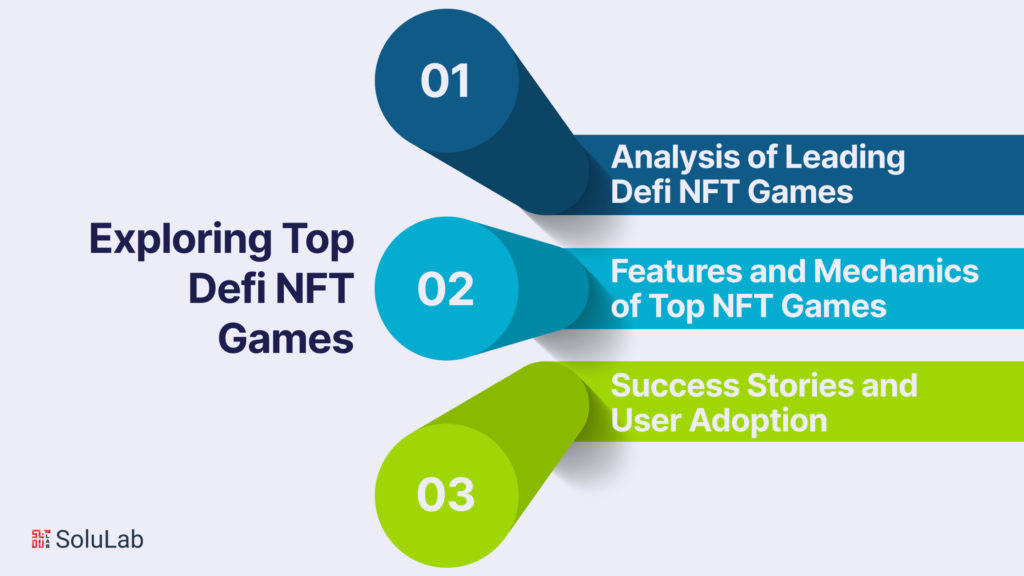
Exploring Top Defi NFT Games

The rise of decentralized finance (DeFi) NFT Game has captured the attention of the gaming community worldwide. This section aims to delve into some of the leading top DeFi NFT Games that have garnered significant attention and user adoption. By analyzing the features, mechanics, and success stories of the top DeFi NFT Games, this segment aims to offer a comprehensive understanding of the innovative gameplay experiences they provide.

  • Analysis of Leading Defi NFT Games

The landscape of top DeFi NFT Games is characterized by a diverse array of titles and platforms, each offering unique gameplay experiences and opportunities for players and developers alike. These games leverage the principles of decentralized finance (DeFi) to integrate NFTs, enabling players to participate in various gaming activities while engaging with digital assets of tangible value. Through the analysis of leading top DeFi NFT Games, developers can gain insights into successful game mechanics, engagement strategies, and monetization models, facilitating the creation of immersive and rewarding gaming experiences.

  • Features and Mechanics of Top NFT Games

Best NFT Games encompass a range of features and mechanics designed to offer players engaging and interactive gameplay experiences. These games often incorporate elements such as play-to-earn models, asset trading, and digital ownership, providing players with avenues for skill development, asset accumulation, and social interaction within the gaming community. Moreover, Best NFT Games integrate blockchain technology to ensure transparent and secure asset management, fostering a sense of trust and reliability among players. By exploring the features and mechanics of Best NFT Games, developers can identify successful gameplay elements and leverage them to create compelling gaming experiences for their audiences.

 Read Also: How is Gaming Contributing to the NFT Industry?

  • Success Stories and User Adoption

Success stories within the realm of top DeFi NFT Games highlight the potential for innovation and growth within the gaming industry. These stories often showcase the journey of developers and players who have successfully leveraged NFTs to create valuable and immersive gaming experiences. Through successful user adoption, these games have been able to cultivate vibrant gaming communities, establish robust in-game economies, and provide players with opportunities for skill development and asset accumulation. By examining success stories and user adoption rates, developers can gain valuable insights into the strategies and tactics that have contributed to the success of top DeFi NFT Games, enabling them to implement similar practices within their own game development endeavors.
Building NFT Games in the Metaverse

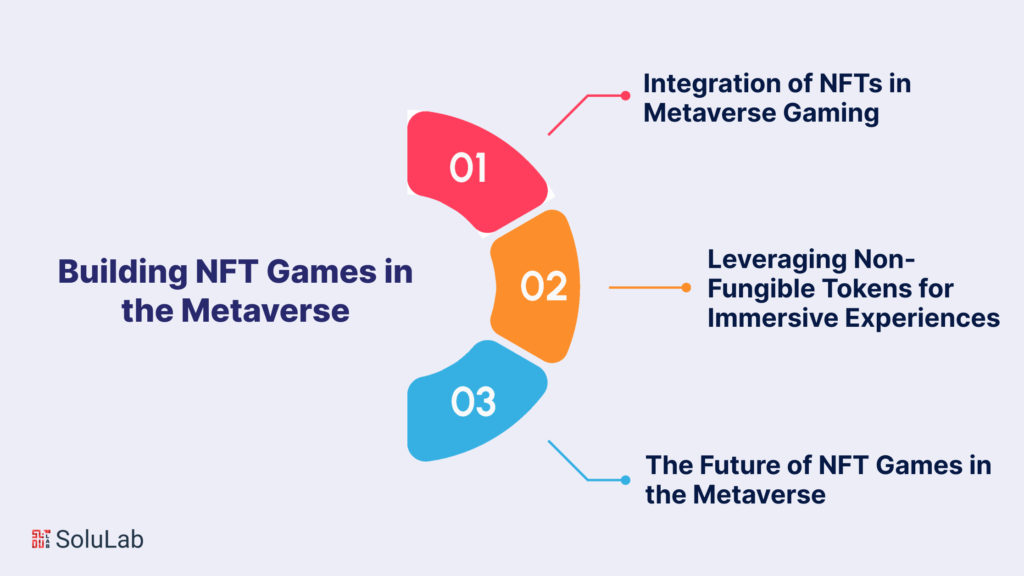
Building NFT Games in the Metaverse

The concept of the metaverse has gained traction in recent years, creating new avenues for NFT integration within virtual environments. This section focuses on the integration of NFTs within the metaverse gaming experience and the unparalleled immersive opportunities they present. By exploring the potential of non-fungible tokens in the metaverse, this segment provides valuable insights into the future of gaming and digital asset ownership.

  • Integration of NFTs in Metaverse Gaming

The integration of NFTs within the metaverse has opened up new possibilities for immersive and interactive gaming experiences. By leveraging NFTs, developers can create and distribute unique in-game assets that players can utilize and trade within virtual environments. This integration allows for the seamless transfer of digital assets between different metaverse platforms, enabling players to engage with a diverse array of NFTs and virtual goods. Moreover, the integration of NFTs in the metaverse fosters a sense of digital ownership and exclusivity, allowing players to personalize and enhance their virtual identities and experiences.

  • Leveraging Non-Fungible Tokens for Immersive Experiences

The use of non-fungible tokens (NFTs) in metaverse gaming is instrumental in creating immersive and authentic gameplay experiences for players. NFTs enable developers to introduce unique and scarce virtual assets within the metaverse, providing players with a diverse array of digital collectibles, virtual land, and in-game items. Through the integration of NFTs, players can engage in activities such as virtual asset trading, customization of avatars, and participation in virtual events, fostering a sense of creativity and social interaction within the metaverse. Additionally, the integration of NFTs allows for the creation of personalized and exclusive virtual experiences, enabling players to express their individuality and identity within virtual worlds.

      Read Also : Top NFT Trends That Will Build Revenue Streams to the Business

  • The Future of NFT Games in the Metaverse

The future of NFT Games in the metaverse is characterized by a continuous evolution of immersive and interactive gaming experiences, enabled by the integration of blockchain technology and NFTs. As the metaverse continues to expand and evolve, NFT Games are expected to play a pivotal role in shaping the landscape of virtual economies, social interactions, and digital experiences. The future of NFT Game in the metaverse holds promises of enhanced gameplay mechanics, decentralized governance models, and collaborative storytelling, allowing players to participate in dynamic and engaging virtual environments. Moreover, the future of NFT Games in the metaverse is anticipated to witness the emergence of innovative gameplay elements, interactive narratives, and collaborative gameplay experiences, fostering a sense of community and engagement among players and developers alike.

NFT Gaming Platforms and Marketplaces

The emergence of various NFT gaming platforms and marketplaces has laid the foundation for a thriving ecosystem of digital asset trading and ownership. This section highlights the key features and characteristics of NFT gaming platforms, offering a detailed comparison of the best NFT marketplaces available for game developers. By examining the use cases of NFT marketplace integration in the gaming sector, this segment provides valuable insights into the potential of these platforms for the gaming industry.

  • Features and Characteristics of NFT Gaming Platforms

NFT gaming platforms are essential components of the NFT gaming ecosystem, serving as hubs where developers, players, and NFT collectors converge to explore and engage with digital assets. These platforms offer various features and characteristics that facilitate the creation, trade, and management of NFTs within the gaming context. Notable features may include NFT creation tools, marketplace functionalities, asset verification mechanisms, and user-friendly interfaces. Additionally, they often integrate blockchain technology to ensure asset ownership, scarcity, and authenticity, granting players and collectors the confidence to participate in NFT-based gaming activities.

  • Comparison of the Best NFT Marketplaces for Game Developers

Game developers seeking to explore NFT opportunities must carefully evaluate and select the best NFT marketplaces that align with their objectives. Each NFT marketplace presents its unique set of offerings, including marketplace fees, target audiences, and supporting blockchain networks. By comparing the best NFT marketplaces, developers can make informed decisions regarding the platforms most suitable for their game-related NFTs. The choice of marketplace often depends on factors such as transaction costs, marketplace popularity, target audience, and blockchain interoperability, among others. Understanding these marketplace distinctions aids developers in optimizing the reach and impact of their NFT gaming assets.

      Check Our Blog :How is Gaming Contributing to the NFT Industry?

  • Use Cases of NFT Marketplace Integration for Gaming

The integration of the best NFT marketplaces within gaming ecosystems extends beyond the mere trading of virtual assets. best NFT marketplaces present developers with a spectrum of use cases that can be harnessed to enhance in-game experiences and economic ecosystems. Game developers can utilize the best NFT marketplaces to mint, sell, and distribute in-game assets and NFT collectibles. Furthermore, they can implement interoperable NFTs to facilitate asset cross-utilization across various gaming titles or even metaverse environments. In addition, developers can leverage the best NFT marketplaces to establish dynamic player-driven economies, fostering active participation and virtual asset ownership. The diverse use cases of NFT marketplace integration serve as essential building blocks for the development of NFT-driven gaming ecosystems.

NFT Development Companies and Solutions

Amid the growing interest in NFT gaming, several development companies have stepped up to provide comprehensive solutions for game developers. This section provides an overview of leading NFT development companies and their services tailored to meet the specific needs of game developers. By shedding light on the solutions and offerings available for NFT gaming, this segment aims to guide developers in leveraging the expertise of industry-leading professionals for their gaming projects.

  • Overview of Leading NFT Development Companies

In the rapidly evolving NFT landscape, a multitude of NFT development companies offer solutions and services to game developers. These companies vary in terms of expertise, blockchain specialization, and service portfolios. By exploring an overview of leading NFT development companies, developers can identify strategic partnerships and service providers who can assist them in navigating the complexities of NFT integration. Such partnerships can range from minting NFTs to building custom best NFT marketplaces, integrating blockchain technology, or providing consultation services for optimizing NFT adoption within gaming projects.

  • Services and Offerings for Game Developers

NFT development companies cater to the diverse needs of game developers by offering an array of services and solutions. These services may encompass NFT creation, blockchain integration, smart contract development, marketplace development, and customized solutions tailored to specific gaming projects. Service providers understand the critical role they play in aiding developers to conceptualize, create, and launch NFT gaming assets that resonate with the gaming community. The NFT development industry also emphasizes the importance of security, authenticity, and transparency to instill confidence in both developers and players, ensuring that NFT assets uphold the expected standards of quality and value.

  • Building NFT Gaming Solutions with Industry Experts

Collaborating with NFT development companies and industry experts presents game developers with the opportunity to harness in-depth knowledge and insights. These collaborations often result in the creation of innovative NFT gaming solutions that are well-received by the gaming community. Industry experts can guide developers through the entire process of NFT integration, from ideation to execution, ensuring that NFT assets seamlessly align with the game’s objectives. By leveraging the expertise of NFT development companies and industry leaders, developers can refine their NFT strategy, enhance in-game experiences, and drive the success of their NFT gaming endeavors.
Creating NFT Games: Opportunities and Challenges

Creating NFT Games: Opportunities and Challenges

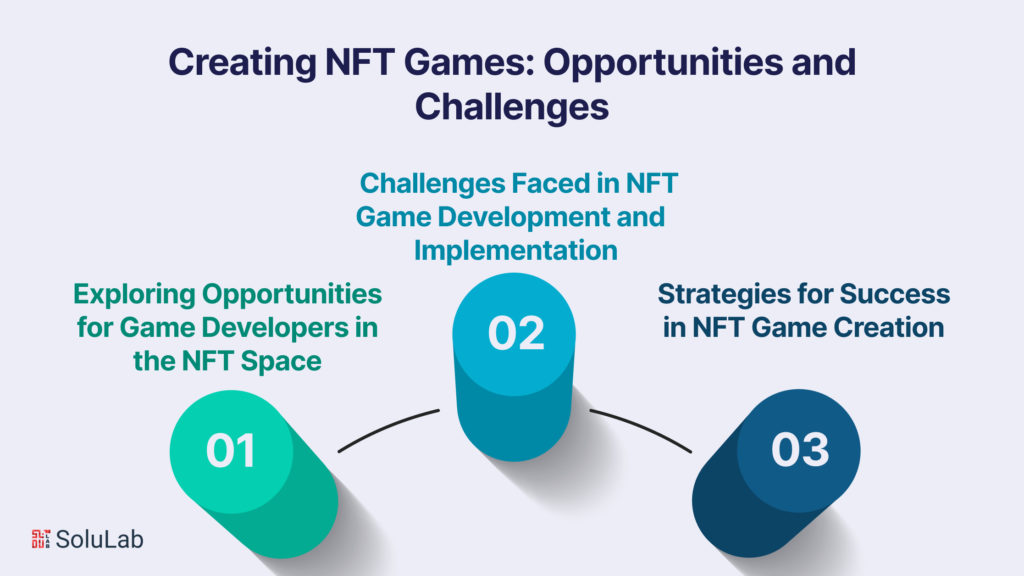
While NFT gaming presents numerous opportunities for game developers, it also brings forth a set of unique challenges that developers must navigate. This section explores the various opportunities within the NFT gaming space, emphasizing the strategies developers can employ to make the most of these opportunities. Simultaneously, it delves into the challenges faced in NFT game development and implementation, providing insights into the best practices for overcoming these obstacles.

  • Exploring Opportunities for Game Developers in the NFT Space

The NFT space presents game developers with an array of opportunities, providing a unique set of benefits that can elevate their projects. NFTs enable developers to monetize digital assets, attract a broader audience, enhance player engagement, and even create play-to-earn mechanics. Moreover, NFTs are instrumental in fostering a sense of ownership among players, transforming in-game assets into tangible digital collectibles. By exploring these opportunities, developers can make informed decisions about the role of NFTs within their games and their potential for growth and sustainability.

      Read  Our Blog  : Best Play To Earn NFT Games In 2023

  • Challenges Faced in NFT Game Development and Implementation

Despite the vast potential of NFTs in the gaming industry, developers must also navigate challenges unique to the NFT landscape. These challenges may include scalability issues, concerns regarding blockchain network congestion, and the need to ensure robust security measures to safeguard digital assets. Additionally, developers may encounter player skepticism and regulatory challenges related to digital asset ownership. It is essential for game developers to recognize and address these challenges, working towards practical solutions to ensure the successful integration of NFTs within their gaming projects.

  • Strategies for Success in NFT Game Creation

NFT Game creation necessitates a strategic approach to navigate the complexities of blockchain technology and digital asset integration. Developers must devise strategies to optimize in-game experiences, engage players, and establish successful economies within their NFT-driven gaming environments. Strategies for success encompass factors such as designing appealing NFT assets, implementing clear and user-friendly NFT mechanics, and fostering an active player community. Furthermore, developers should consider the importance of collaborating with industry experts, leveraging NFT marketplaces, and exploring interoperable NFTs to extend the reach and utility of in-game assets. By embracing these strategies, developers can embark on their NFT game creation journey with confidence and a well-defined plan for success.
The Future of NFT Gaming

The Future of NFT Gaming

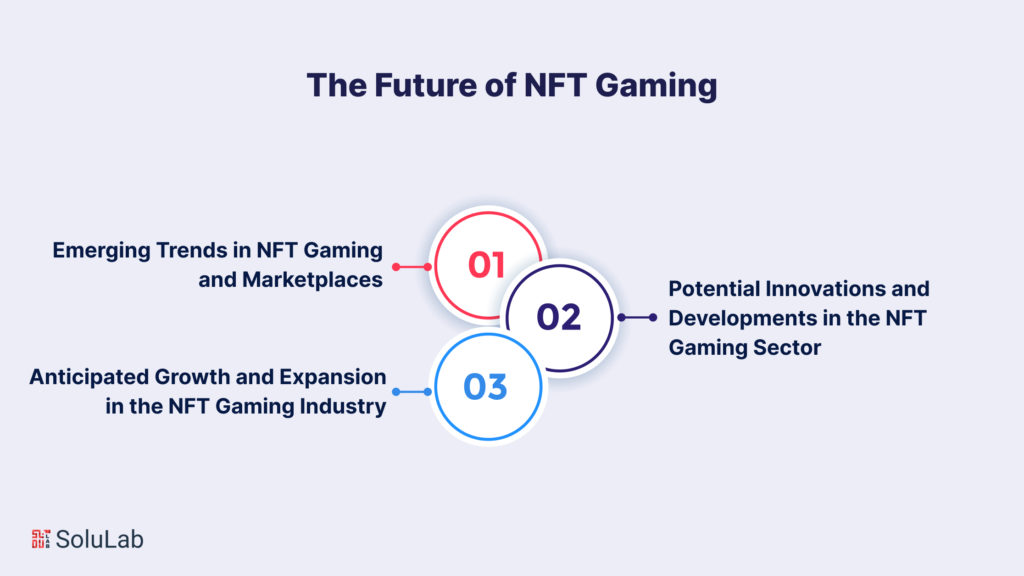
As the NFT in gaming sector continues to evolve, it is essential to keep an eye on the emerging trends and innovations shaping the industry’s future. This section offers a comprehensive analysis of the latest trends and advancements in NFT gaming and marketplaces. By predicting the future growth and expansion of the NFT gaming industry, this segment aims to provide readers with a holistic understanding of the sector’s potential.

  • Emerging Trends in NFT Gaming and Marketplaces

The NFT gaming industry is marked by continuous innovation and evolving trends that shape the future of gaming ecosystems. Emerging trends within the NFT gaming landscape often include the integration of blockchain interoperability, the use of cross-chain NFTs, and the development of decentralized in-game marketplaces. Developers must stay attuned to these trends to remain competitive and provide players with engaging and relevant gaming experiences.

Check this Blog : Top NFT Trends That Will Build Revenue Streams to the Business

  • Potential Innovations and Developments in the NFT Gaming Sector

Innovations and developments within the NFT gaming sector hold the potential to transform the industry, introducing novel gameplay mechanics, advanced asset customization, and enhanced social interactions within gaming communities. Developers are exploring the possibilities of leveraging augmented reality (AR) and virtual reality (VR) technologies to offer immersive and interactive gaming experiences that blur the lines between physical and digital worlds. Additionally, the integration of artificial intelligence (AI) and machine learning (ML) within NFT gaming platforms is anticipated to introduce personalized and dynamic gameplay elements, fostering a sense of adaptability and player engagement.

  • Anticipated Growth and Expansion in the NFT Gaming Industry

The NFT gaming industry is poised for substantial growth and expansion, driven by the increasing adoption of blockchain technology, the rising interest in digital collectibles, and the growing community of NFT enthusiasts. As players and developers recognize the value and potential of NFTs in the gaming space, the industry is expected to witness the launch of innovative NFT projects, the establishment of robust gaming economies, and the proliferation of cross-platform gaming experiences. The anticipated growth and expansion in the NFT gaming industry highlight the significance of sustainable and future-forward strategies that foster innovation, inclusivity, and meaningful player interactions.

CTA2

Conclusion

In the ever-evolving landscape of NFT Gaming Marketplaces, the possibilities seem boundless, promising a future where digital experiences blend seamlessly with tangible value and ownership. As the bridge connecting the vision of developers with the reality of users, SoluLab has been instrumental in shaping the very foundations of this transformative industry. Our extensive expertise in NFT marketplace development, coupled with our commitment to innovation, has positioned us as a key player in the realm of NFT gaming. Through our comprehensive white-label NFT marketplace solutions, we empower game developers to unleash their creativity, drive engagement, and unlock new revenue streams in the world of gaming. Our dedicated team of NFT developers continues to pave the way for groundbreaking solutions that redefine the gaming industry, enabling the creation of immersive, secure, and value-driven gaming experiences.

By harnessing the power of NFTs, we enable seamless integration and collaboration between gamers, developers, and investors, fostering an ecosystem that thrives on trust, transparency, and innovation. Our white-label NFT game marketplace development services offer a gateway for game developers to showcase their creations and connect with a global community of players and enthusiasts. With a focus on user-centric design and cutting-edge technology, our solutions are tailored to meet the diverse needs of the modern gaming landscape, fostering an environment that nurtures creativity and growth.

As the world of NFT gaming continues to evolve, we remain committed to pushing the boundaries of what’s possible, striving to deliver best-in-class solutions that redefine the gaming industry’s future. SoluLab is not just a provider of services but a partner in the journey toward creating immersive gaming experiences that captivate audiences, drive engagement and unlock new dimensions of value and interaction. With our NFT Gaming marketplace development services, we aim to revolutionize the way gaming experiences are created, shared, and valued, ushering in an era of limitless opportunities for game developers, players, and enthusiasts alike.

FAQs

1. What is the significance of NFTs in the gaming industry?

NFTs, or Non-Fungible Tokens, have revolutionized the gaming industry by enabling the creation of unique in-game assets that players can own, trade, and use across various gaming platforms. They provide a means for gamers to truly own their digital assets, fostering a new era of digital ownership and value exchange within the gaming ecosystem.

 2. How can game developers leverage NFTs to enhance player engagement?

Game developers can leverage NFTs to create rare and unique in-game items, characters, and digital collectibles that players can buy, sell, and trade on NFT gaming marketplaces. By incorporating NFTs, developers can offer players a sense of ownership and value, driving increased engagement and fostering a vibrant gaming community.

3. What are the key features to consider when building NFT gaming platforms?

Key features to consider when building NFT gaming platforms include seamless integration with blockchain technology, secure and transparent transaction processing, user-friendly interfaces for buying and selling NFTs, robust asset management systems, and efficient trading functionalities to facilitate smooth and secure transactions.

4. How do NFT gaming marketplaces contribute to the growth of the gaming industry?

NFT gaming marketplaces contribute to the growth of the gaming industry by providing a platform for gamers and developers to create, trade, and collect unique digital assets. They foster a decentralized ecosystem that empowers players and content creators, leading to increased engagement, innovative gaming experiences, and new monetization opportunities within the gaming industry.

5. What are the benefits of using white-label NFT marketplace solutions for game development?

White-label NFT marketplace solutions offer game developers a customizable and cost-effective way to launch their own best NFT marketplaces without the need for extensive development resources. These solutions provide a ready-made platform that can be tailored to specific branding and functionality requirements, enabling developers to enter the NFT gaming market quickly and efficiently.

6. How can NFT development companies assist in the creation of innovative gaming experiences?

NFT development companies specialize in creating tailored solutions for integrating NFTs into gaming platforms. They offer expertise in blockchain technology, smart contract development, and NFT integration, enabling game developers to incorporate unique and valuable digital assets into their games, thereby enhancing player engagement and creating novel gaming experiences.

7. What are the best practices for integrating NFTs into the gaming ecosystem for maximum impact?

Best practices for integrating NFTs into the gaming ecosystem include ensuring a seamless user experience, implementing robust security measures to protect digital assets and transactions, offering engaging and valuable in-game NFTs, fostering a vibrant and supportive gaming community, and continuously innovating to stay ahead of evolving industry trends and player preferences.

How to Choose the Best Whitelabel NFT Development Company?

How to Choose the Best Whitelabel NFT Development Company?

The world of NFTs (Non-Fungible Tokens) has taken the digital landscape by storm, revolutionizing how we perceive and trade digital assets. As the demand for NFTs continues to surge, the need for robust NFT marketplaces and platforms has become increasingly evident. This is where whitelabel NFT development companies come into play, offering customizable solutions to create your own NFT marketplace. In this comprehensive guide, we’ll explore the intricacies of selecting the best whitelabel NFT development company to ensure your venture’s success.

What is a Whitelabel NFT Development Company?

A Whitelabel NFT Development Company is a specialized entity in the NFT (Non-Fungible Token) ecosystem that focuses on providing customizable solutions for creating NFT marketplaces. These companies offer ready-made software, tools, and services that empower businesses and entrepreneurs to swiftly launch their own NFT platforms. Rather than constructing a marketplace from the ground up, clients can procure a whitelabel solution and adapt it to their brand’s unique requirements.

The term “whitelabel” denotes that the solution is provided in a way that allows clients to rebrand and customize it as if it were their own product. In the context of NFT development, a whitelabel solution refers to a pre-built NFT marketplace platform that can be tailored to match a specific brand’s identity and requirements. This approach is particularly advantageous for businesses seeking to enter the NFT market promptly without the extensive time and resources required for custom development.

Whitelabel NFT development companies are proficient in developing white-label NFT marketplace software and offer services catered to this specific niche. They possess expertise in blockchain technology, including knowledge of various blockchain networks such as Ethereum, Binance Smart Chain, and others commonly used for NFT development. Their solutions often come with a range of features and functionalities that can be customized to meet the client’s needs. Additionally, reputable Whitelabel NFT development companies provide ongoing support and maintenance to ensure the platform remains secure and up-to-date.

Read Our Blog Post: Why Should You Start Your Own NFT Marketplace Business?

A whitelabel NFT development company specializes in providing customizable NFT marketplace solutions to businesses and entrepreneurs looking to establish their presence in the NFT space quickly and efficiently. Their expertise lies in crafting pre-built NFT platforms that can be rebranded and tailored to match the client’s specific requirements, making them an invaluable resource for those looking to navigate the burgeoning world of NFTs.

Why Choose a Whitelabel NFT Solution?

Why Choose a Whitelabel NFT Solution?

Advantages of Choosing a Whitelabel NFT Development Company

  • Time Efficiency: Building a custom NFT marketplace from scratch can be a time-consuming process, involving extensive development, testing, and refinement. Whitelabel solutions significantly reduce development time, allowing you to launch your NFT platform faster and seize opportunities in the market swiftly.
  • Cost-Effective: Developing a bespoke NFT platform can be expensive due to the associated development, testing, and ongoing maintenance costs. Whitelabel solutions are often more budget-friendly, as they leverage pre-existing technology and infrastructure.
  • Proven Technology: Whitelabel NFT solutions are built on tested and proven technology. When you choose a reputable whitelabel NFT development company, you can leverage their experience and expertise to ensure a stable and secure platform. This is especially crucial in the NFT space, where security and reliability are paramount.

Check Our Blog Post: Top NFT Development Companies To Look At In 2024

  • Customization Options: While whitelabel solutions come with pre-built features and functionalities, they are highly customizable. This means you can tailor the platform to match your brand’s identity and meet your specific requirements. You retain control over the design, features, and user experience.
  • Security and Compliance: Security is of utmost importance in the NFT space, given the value of digital assets being traded. Whitelabel NFT development companies typically implement robust security measures, including encryption, multi-factor authentication, and regular security audits. Moreover, they often stay updated with regulatory changes and can help ensure your platform complies with relevant laws and regulations.

CTA1

  • Scalability: Your NFT marketplace should be prepared to handle increased traffic and transaction volumes as your user base grows. Reputable whitelabel solutions are designed to be scalable, allowing your platform to expand seamlessly without significant disruptions.
  • User-Friendly Interface: A user-friendly and easy to use interface is vital for attracting and retaining users. Many whitelabel NFT solutions come with well-designed user interfaces that provide an intuitive and visually appealing experience for your users.
  • Support and Maintenance: Establishing and maintaining an NFT marketplace requires ongoing support and maintenance. Reliable whitelabel NFT development companies offer support services to address any issues or updates that may arise. This ensures that your platform remains up-to-date, secure, and responsive to user needs.
  • Ownership and Control: When you choose a whitelabel NFT marketplace, you retain ownership and control over your platform. This means you can make decisions about its future development, monetization strategies, and branding without being tied to a third-party platform’s limitations.
  • Community and Ecosystem: Whitelabel NFT development companies often have established communities and ecosystems of users and developers. Joining such an ecosystem can provide you with valuable networking opportunities, partnerships, and insights into industry trends.

Key Factors to Consider When Choosing a Whitelabel NFT Development Company

Key Factors to Consider When Choosing a Whitelabel NFT Development Company

Selecting the best whitelabel NFT development company is a pivotal decision that can significantly impact the success of your NFT marketplace venture. 

1. Define Your Project Goals and Requirements

Before you start your search for a whitelabel NFT development company, you must have a clear understanding of your project’s goals and requirements. Ask yourself:

  • What is the niche or industry you’re targeting with your NFT marketplace (e.g., art, music, gaming, collectibles)?
  • What specific features and functionalities do you need in your NFT platform?
  • What is your budget for development, maintenance, and ongoing support?
  • Do you have any legal or regulatory considerations, such as compliance with local laws or licensing agreements?
  • Having a well-defined project scope and goals will guide your search and help you identify the company that can best meet your needs.

2. Research Whitelabel NFT Development Companies

Start your research by identifying a list of potential whitelabel NFT development companies. You can do this through a number of means:

  • Online searches: Use search engines and NFT-related forums and communities to find companies that offer whitelabel NFT solutions.
  • Industry referrals: Seek recommendations from industry peers, fellow entrepreneurs, or NFT enthusiasts who have experience working with such companies.
  • NFT marketplaces: Explore existing NFT marketplaces to see if they offer whitelabel solutions or partnerships with development companies.
  • Compile a list of companies that seem promising and align with your project goals.

Know More: How to Build the Best White-Label NFT Marketplace?

3. Assess Reputation and Experience

The reputation and experience of a whitelabel NFT development company are crucial factors to consider. Here’s how to assess them:

  • Portfolio: Review the company’s portfolio of past projects. Look for successful NFT marketplaces they have developed and launched. Pay attention to the diversity of industries and niches they have worked in.
  • Client testimonials: Seek out client testimonials and reviews. Reach out to past clients if possible to gather feedback about their experiences with the company.
  • Case studies: Some companies provide detailed case studies of their projects, highlighting challenges and solutions. Review these to gain insights into their problem-solving abilities.
  • A reputable and experienced company is more likely to deliver a high-quality product and provide reliable support.

4. Technology Stack and Blockchain Expertise

Since NFTs are blockchain-based, it’s crucial that the NFT development company has expertise in blockchain technology. Evaluate:

  • Their knowledge of blockchain networks: Ensure they are well-versed in the blockchain network you plan to use for your NFT marketplace, whether it’s Ethereum, Binance Smart Chain, Flow, or another.
  • Smart contract proficiency: NFTs rely on smart contracts for functionality. Assess the company’s capability to create and audit smart contracts for security and reliability.
  • Scalability: Inquire about their ability to design a scalable NFT platform that can handle growing user traffic and transaction volumes.
  • A solid understanding of blockchain technology is essential to ensure the security and efficiency of your NFT marketplace.

Related: 5 Best White Label NFT Marketplaces In The World

5. Customization Options

NFT marketplaces should be highly customizable to align with your brand identity and specific requirements. Evaluate:

  • The degree of customization offered by the whitelabel NFT solution. Can you modify the platform’s design, features, and functionalities to suit your vision?
  • User interface and user experience (UI/UX): Ensure that the platform’s UI/UX can be tailored to create an engaging and user-friendly environment.
  • White labeling options: Confirm that you have the freedom to rebrand the platform completely, so it appears as your unique product.
  • Customization is essential to differentiate your NFT marketplace from competitors and align it with your brand.

6. Security Measures

The security of your NFT marketplace is paramount, as it deals with valuable digital assets. Inquire about the security measures the company implements, including:

  • Encryption: Data encryption to protect user information and transactions.
  • Multi-factor authentication (MFA): Additional layers of security to prevent unauthorized access.
  • Regular security audits: Routine assessments to identify and address vulnerabilities.
  • Compliance with industry standards: Ensure that the company follows security best practices and complies with relevant industry standards.
  • Security breaches can lead to significant reputational and financial damage, so this aspect should not be overlooked.

7. Scalability

Your NFT marketplace should be capable of accommodating increased traffic and transaction volumes as your user base grows. Assess:

  • The platform’s scalability options: Can it handle growing demand without performance degradation or downtime?
  • Load testing: Inquire if the company conducts load testing to ensure the platform’s ability to handle peak usage periods.
  • Scalability ensures that your NFT marketplace can evolve and expand along with your success.

Read Also: How will White-Label NFT Marketplace Development Benefit your Business?

8. User-Friendly Interface

A user-friendly interface is crucial for attracting and retaining users. Evaluate:

  • The platform’s user interface (UI) design: Is it intuitive, visually appealing, and easy to navigate?
  • User experience (UX): Does the platform provide a seamless and enjoyable experience for users?
  • A well-designed UI/UX can significantly impact user engagement and conversion rates.

9. Support and Maintenance

Building and maintaining an NFT marketplace is an ongoing process. Inquire about the support and maintenance services offered by the company, including:

  • Response time for addressing issues or inquiries.
  • Availability of ongoing updates and improvements.
  • Technical support channels and their responsiveness.
  • A reliable support system ensures that your NFT marketplace remains secure and up-to-date.

10. Licensing and Ownership

Understand the licensing terms and ownership rights associated with the whitelabel solution. Ensure that:

  • You have full control and ownership of your NFT marketplace to avoid legal complications in the future.
  • Licensing agreements are clear and align with your business goals and objectives.
  • Legal clarity is essential to protect your long-term interests.

11. Cost and Pricing Structure

While cost-effectiveness is a key advantage of whitelabel solutions, carefully review the pricing structure and associated fees. Be aware of:

  • Initial development costs.
  • Ongoing maintenance and support fees.
  • Any hidden or unexpected costs that may arise during development and operation.
  • Budget transparency is crucial for managing your financial resources effectively.

Related: What are the Key Features of the White-Label NFT Marketplace?

12. Community and Ecosystem

A strong community and ecosystem can be valuable in the NFT space. Consider whether the whitelabel NFT development company has:

  • An active user community or developer community.
  • Partnerships or collaborations within the NFT industry.
  • A network of experts and enthusiasts who can provide insights and support.
  • Being part of a thriving community can open doors to networking opportunities and industry trends.

13. Compliance and Legal Considerations

NFTs are subject to various regulatory considerations in different jurisdictions. Ensure that the whitelabel solution complies with relevant laws and regulations in your target market. Consult with legal experts if needed to address compliance issues effectively.

CTA2

Conclusion

Choosing the best whitelabel NFT development company is a critical decision that can greatly impact the success of your NFT marketplace. Carefully evaluate each company’s reputation, experience, technology stack, customization options, security measures, and support services.

Remember that the NFT space is continuously evolving, so staying informed about the latest trends and developments is essential. With the right whitelabel NFT development company and a well-thought-out strategy, your NFT marketplace can thrive in this exciting and dynamic ecosystem, opening up new opportunities for your brand and users alike.

On the path towards a future driven by NFTs, SoluLab stands as a reliable partner, leading businesses towards success by leveraging its proficiency in whitelabel NFT marketplace development services. With innovation as its guiding force, SoluLab empowers enterprises to explore new horizons, revolutionize commerce, and establish their unique presence in the digital realm.

Together with SoluLab, you embark on a transformative journey—a journey characterized by innovation driving advancement and turning aspirations into reality. Connect with SoluLab today to enter the realm of white-label NFT marketplaces, where the possibilities are endless, and opportunities know no bounds.

FAQs

1. What is a Whitelabel NFT Development Company?

A whitelabel NFT development company specializes in providing ready-made, customizable solutions for creating NFT marketplaces. These solutions allow businesses to launch their NFT platforms quickly, without building them from scratch.

2. Why should I choose a whitelabel NFT solution over custom development?

Whitelabel NFT solutions are often more cost-effective and time-efficient compared to custom development. They leverage pre-existing technology, reduce development time, and offer customization options, making them a practical choice for entering the NFT market swiftly.

3. What factors should I consider when choosing a whitelabel NFT development company?

Consider factors such as the company’s reputation, experience, technology stack, customization options, security measures, scalability, user interface, support, legal considerations, and pricing structure.

4. How important is security when selecting a whitelabel NFT development company?

Security is crucial in the NFT space due to the value of digital assets. Ensure that the company implements robust security measures, including encryption, multi-factor authentication, and regular security audits, to protect your platform and users.

5. Can I customize a whitelabel NFT solution to match my brand’s identity?

Yes, one of the advantages of whitelabel NFT solutions is their high degree of customization. You can often tailor the platform’s design, features, and functionalities to align with your brand’s identity and specific requirements.

6. What blockchain expertise should a whitelabel NFT development company have?

The company should have proficiency in blockchain technology, including knowledge of the specific blockchain network you plan to use (e.g., Ethereum, Binance Smart Chain). They should also be skilled in creating and auditing smart contracts.

7. How can I ensure ongoing support and maintenance for my whitelabel NFT platform?

When choosing a whitelabel NFT development company, inquire about their support and maintenance services. Ensure they offer timely responses to issues, regular updates, and technical support to keep your platform secure and up-to-date.

8. Is scalability a feature provided by white-label NFT marketplaces?

Indeed, white-label NFT marketplace solutions are intentionally crafted to be scalable, capable of handling a burgeoning user base, surges in transactions, and the growing inventory of NFTs. The foundational infrastructure is primed for high performance, simplifying the process for businesses to manage heightened demand and extend their reach within the market.

How to Build the Best White-Label NFT Marketplace?

How to Build the Best White-Label NFT Marketplace?

The world of digital assets is continually evolving, and at the forefront of this evolution lies the concept of white-label NFT marketplaces. These innovative platforms have garnered significant attention for their ability to revolutionize the way non-fungible tokens (NFTs) are bought, sold, and traded. In this exploration, we delve into the core components of white-label NFT marketplaces, highlighting their benefits and shedding light on key terms that shape this dynamic landscape.

At its essence, a white-label NFT marketplace is a pre-built, customizable platform that enables individuals or businesses to create their own NFT marketplace without developing the software from scratch. This approach offers a ready-to-use framework that can be tailored to suit specific branding, features, and requirements. White-label solutions provide the foundation for launching a personalized NFT marketplace, complete with functionalities like listing, bidding, and trading NFTs seamlessly.

The allure of white-label NFT marketplaces lies in their versatility and speed-to-market. By leveraging a white-label solution, entrepreneurs and enterprises can bypass the complexities of coding and programming, allowing them to focus on strategic aspects such as user experience, branding, and monetization strategies. This accelerated approach significantly reduces development time and costs while ensuring a professional, feature-rich marketplace that aligns with the organization’s vision.

Getting Any Results in Your Search for the Ideal White-Label NFT Platform?

In the ever-evolving realm of NFTs, the quest for the ideal white-label marketplace platform demands careful consideration of various factors. As you navigate the vast landscape of options, it’s crucial to assess and compare the offerings of these platforms to ensure a seamless NFT journey. Are you ready to dive into the process of selecting the perfect white-label NFT platform? Let’s explore three key areas that warrant your attention.

  • Evaluating Features of the Best White-Label Marketplace Platforms

When you’re seeking the optimal white-label NFT platform, features take center stage. The platform’s capabilities should align with your unique requirements, whether you’re an artist, creator, or enterprise. 

Consider essential features such as user-friendly interfaces, secure payment gateways, robust search and filtering options, and integration with multiple blockchain networks. The ability to facilitate smooth interactions between buyers, sellers, and collectors is pivotal. A well-structured platform ensures that your NFT marketplace becomes a thriving hub for creative exchange.

  • Comparing Costs and Pricing Models

Financial considerations play a pivotal role in your decision-making process. As you delve into the world of white-label NFT platforms, comparing costs and pricing models is essential. Some platforms charge a percentage of each transaction, while others offer subscription-based pricing. 

It’s imperative to comprehend the fee structures and their implications on your potential earnings. Striking a balance between the features you require and the pricing that fits your budget ensures a sustainable and lucrative NFT venture.

  • Analyzing Scalability, Customization Options, and Support Services

Scalability is the cornerstone of a successful NFT marketplace. Will the platform be able to handle increased traffic as your user base grows? Moreover, customization options are paramount. Your NFT marketplace should reflect your brand’s identity, allowing you to tailor the platform’s look and feel to resonate with your target audience. 

While you’re at it, delve into the realm of support services. A responsive and knowledgeable support team ensures that you can swiftly navigate any technical hiccups or inquiries that arise on your NFT journey.

As you embark on the journey of selecting the ideal white-label NFT platform, remember that your choice will shape your NFT venture’s trajectory. By thoroughly evaluating features, comparing pricing models, and analyzing scalability and support, you’ll be equipped to make an informed decision that aligns with your vision. So, are you prepared to step into the realm of white-label NFT platforms and usher in a new era of creative exchange? Your NFT journey awaits.

How Do You Select the Right Technology Stack for Your White-Label NFT Marketplace?

How Do You Select the Right Technology Stack for Your White-Label NFT Marketplace?

Selecting the technology stack for your white-label NFT marketplace is a crucial first step in building a successful platform. The right stack ensures efficiency, scalability, and compatibility with the latest trends. Consider the following factors when making your decision:

Exceptional Design and User Experience (UX)

  • Craft an Intuitive User Interface

Your NFT marketplace should have a user-friendly interface that makes navigation and usage seamless. Intuitive design enhances user engagement and encourages exploration.

  • Implement Responsive Design

Users access platforms from various devices. Create a responsive design that adapts to different screen sizes, ensuring a consistent experience for desktop and mobile users.

CTA1

Features and Functionality Should Your White-Label NFT Marketplace Embrace

  • User Registration and Authentication

Implement secure and user-friendly registration and login processes. Consider two-factor authentication for added security.

  • NFT Listing and Management

Enable users to easily list, manage, and showcase their NFTs. Include features like high-quality images, descriptions, and customizable metadata.

Search and Discovery: Enhance user experience with robust search and discovery mechanisms, including filters, categories, and sorting options.

  • Secure Transactions and Payments

Implement a secure payment gateway that supports various cryptocurrencies. Ensure transaction history and details are transparent and easily accessible.

  • Wallet Integration

Seamless integration of users’ crypto wallets simplifies transactions and asset management. Compatibility with popular wallet providers is crucial.

  • Social Sharing and Engagement Features

Enable users to share NFTs on social media platforms, fostering community engagement and increasing visibility.

  • Analytics and Reporting

Provide users with insightful data on their NFT performance, sales, and user engagement. Analytics help users make informed decisions.

Read Our Blog Post: White Label NFT Marketplace – The Best Way of Launching NFT Platform

Effective Customization and Branding

  • Utilize White-Labeling Options

A white-label NFT marketplace offers customization possibilities. Allow users to personalize their storefronts, profiles, and listings, aligning with their brand identity.

  • Offer Custom Themes and Templates

Provide a range of themes and templates that users can choose from to create a unique and attractive storefront.

Security and Privacy Measures 

  • Blockchain Integration for Transparency

Leverage blockchain’s transparency to ensure the provenance and authenticity of NFTs. Users can verify ownership and history through blockchain records.

  • Secure Smart Contracts

Implement secure and audited smart contracts to guarantee the execution of transactions and the automatic distribution of royalties.

  • Data Encryption and Privacy Settings

Prioritize user data protection by encrypting sensitive information and providing privacy settings for user profiles and transaction histories.

Building the best white-label NFT marketplace involves careful consideration of technology, design, features, and security. By following these steps, you’ll be well on your way to creating a platform that offers an exceptional user experience and supports the growth of the NFT ecosystem.

Read Also: 5 Best White Label NFT Marketplaces In The World

How to Choose a White-Label NFT Marketplace Development Company?

How to Choose a White-Label NFT Marketplace Development Company?

  • Researching Potential Partners

When selecting a white-label NFT marketplace development company, thorough research is essential. Start by identifying potential partners through online searches, industry forums, and recommendations. Look for companies that specialize in blockchain technology, NFT development, and white-label solutions. Compile a list of potential candidates to proceed with.

Read Blog: What are the Key Features of the White-Label NFT Marketplace?

  • Evaluating Experience and Portfolio

The experience of the development company is a critical factor. Examine their portfolio to gauge their expertise in creating NFT marketplaces. Review their previous projects to see if they align with your vision and requirements. Look for features, designs, and functionalities they’ve implemented in their previous works to ensure they match your expectations.

  • Client Reviews and Testimonials

Client reviews and testimonials provide insights into the development company’s performance from the perspective of those who have worked with them before. Search for reviews on platforms like Clutch, Upwork, or Google, as well as on social media and industry-related forums. Positive reviews and satisfied clients are indicators of a reliable and capable partner.

  • Cost and Pricing Models

While cost shouldn’t be the sole determinant, it’s a crucial aspect to consider. Different development companies might offer varying pricing models, such as fixed pricing, hourly rates, or project-based quotes. Compare these pricing models against your budget and project requirements. Remember that a balance between cost and quality is vital; a lower cost may not always translate to the best results.

What are the Future Trends in White-Label NFT Marketplaces?

What are the Future Trends in White-Label NFT Marketplaces?

  • Integration of Emerging Blockchain Technologies

As white-label NFT marketplaces guide to evolve, the integration of emerging blockchain technologies will play a significant role. Blockchain networks beyond Ethereum, such as Polkadot and Solana, are gaining traction for their scalability and interoperability features. 

These networks offer improved transaction speeds and reduced fees, addressing some of the limitations of the current NFT ecosystem. This integration opens the door for artists, collectors, and investors to explore new possibilities while maintaining the security and authenticity that blockchain technology provides.

  • Enhanced User Experience through AI and AR

The future of white-label NFT marketplaces will likely see the integration of Artificial Intelligence (AI) and Augmented Reality (AR) technologies to enhance user experiences. AI can personalize recommendations based on user preferences, increasing engagement and discoverability. 

AR, on the other hand, can allow users to visualize NFTs in real-world settings, enabling a more immersive interaction with digital assets. This fusion of AI and AR will transform the way users interact with NFTs, making the experience more interactive and dynamic.

  • Cross-Platform Compatibility

With the increasing adoption of NFTs, cross-platform compatibility will become a prominent trend. White-label NFT marketplaces will likely focus on creating seamless experiences across different devices and platforms, including desktop, mobile, and even gaming consoles. 

This ensures that users can access and manage their NFTs from various sources, promoting broader engagement and utility of these digital assets.

Read Our Blog: White Label NFT Marketplace: Find Out Its Pros And Cons

  • NFT Fractional Ownership Models

Fractional ownership of NFTs is poised to revolutionize the NFT marketplace landscape. This trend involves breaking down ownership of a high-value NFT into smaller, tradable fractions.

Investors can own a portion of valuable NFTs, making the market more accessible to a wider range of participants. White-label NFT marketplaces are expected to incorporate secure fractional ownership mechanisms, enabling users to invest in premium NFTs without committing to the entire purchase.

How to develop the best White-Label NFT Marketplace?

How to develop the best white-label NFT marketplace?

Developing the best white-label NFT marketplace involves a strategic approach encompassing several key steps:

  • Pre-Development Strategy: Market Research and USP

Before initiating development, thorough market research is essential to identify trends and gaps in the NFT marketplace landscape. Defining a unique selling proposition (USP) will set your platform apart. Understanding the target audience, popular niches, and potential competitors helps tailor the marketplace’s features and design.

  • Choosing the Development Approach: Custom vs. Pre-Built

Decide whether to build from scratch or leverage pre-built solutions. Custom development offers more flexibility and tailored features, while pre-built platforms save time and costs. Partnering with a reputable white-label NFT marketplace development company is crucial for technical expertise and guidance.

Read Also: How will White-Label NFT Marketplace Development Benefit your Business?

  • Design and Functionality Planning: User-Centric Approach

User experience (UX) and user interface (UI) design play a pivotal role. Intuitive navigation, appealing aesthetics, and seamless interactions are vital. Plan features like user registration, NFT listing, auctions, wallet integration, search mechanisms, and analytics dashboards to ensure a comprehensive marketplace.

  • Technical Development: Front-End and Back-End

The front-end development involves implementing UI/UX designs and ensuring responsive interfaces for various devices. On the back end, establish a robust database architecture and integrate NFT smart contracts for secure ownership verification. Implement user authentication, real-time auction mechanics, payment gateways, and wallet management.

  • Testing and Launch: Quality Assurance and Promotion

Rigorous testing of functionality, security, and performance is crucial. Conduct soft launches and beta testing to gather user feedback and make necessary refinements. Develop a marketing strategy involving content marketing, SEO, social media campaigns, and partnerships with artists to create buzz around the launch.

  • Post-Launch Optimization and Maintenance

Continuously gather user feedback and iterate on the platform. Monitor and maintain the marketplace by fixing bugs, implementing security updates, and enhancing scalability. Consider potential revenue streams such as transaction fees, premium features, or subscription models to sustain the platform.

  • Cost Analysis and ROI

Conduct a comprehensive cost analysis, factoring in development, maintenance, and operational expenses. Assess potential revenue streams to calculate the return on investment (ROI) over time, ensuring the marketplace’s sustainability.

  • Future Trends and Innovation

Stay attuned to emerging trends in NFT marketplaces, such as virtual reality (VR) and augmented reality (AR) integrations, fractional ownership, and enhanced discoverability. Be prepared to adapt and innovate to remain competitive in the evolving landscape.

CTA2

Conclusion

In the realm of NFT marketplaces, the quest for the ideal solution culminates in the creation of the best white-label NFT marketplace. Assembling this pinnacle of innovation requires a thorough understanding of the market’s nuances and an adept approach to development. A paramount consideration lies in the choice of a reliable partner, such as SoluLab, a pioneering white-label NFT marketplace development company.

The journey commences with comprehending the significance of a white-label NFT platform. This endeavor isn’t solely about technology; it’s about crafting an experience that resonates with users and creators alike. While cost remains a factor, it pales in comparison to the value derived from a platform that seamlessly blends customization, security, and user-friendliness.

Building the best white-label NFT marketplace necessitates transcending the ordinary. It demands harnessing cutting-edge technology while staying attuned to the pulse of the NFT ecosystem. In this pursuit, a trusted partner like SoluLab emerges as a guiding light. Their expertise in white-label NFT marketplace development ensures that every facet – from smart contracts to user interfaces – is meticulously curated to foster success. Contact SoluLab today to embark on your NFT journey.

FAQs

1. What is a white-label NFT marketplace?

A white-label NFT marketplace is a platform that allows businesses to create their own branded NFT marketplace without having to build it from scratch. It provides pre-built solutions that can be customized to match the brand’s identity.

2. Why should I consider a white-label NFT marketplace?

A white-label NFT marketplace offers a cost-effective and time-efficient solution for launching your own NFT platform. It eliminates the need for extensive development and allows you to focus on branding and user experience.

3. What factors contribute to building the best white-label NFT marketplace?

The best white-label NFT marketplace is built on a reliable platform, offers robust customization options, ensures security for NFT transactions, provides user-friendly interfaces, and offers scalability as your platform grows.

4. How much does it cost to create a white-label NFT marketplace?

The cost of a white-label NFT marketplace can vary depending on the features, customization, and complexity you require. It’s recommended to consult with a white-label NFT development company for a tailored quote.

5. What is the role of a white-label NFT development company in this process?

A white-label NFT development company that specializes in creating customizable NFT marketplace solutions. They handle the technical aspects, security, and customization, allowing you to focus on branding and marketing.

6. Can I customize the look and feel of my white-label NFT marketplace?

Yes, most white-label NFT marketplace solutions offer extensive customization options, including branding, design, and user interface adjustments, ensuring your marketplace aligns with your brand identity.

What are the Key Features of the White-Label NFT Marketplace?

What are the Key Features of the White-Label NFT Marketplace?

You must select the best provider because the white-label NFT market handles everything. You must look for them if you want a trustworthy and high-quality NFT marketplace. There are several sellers available, and you must pick the top one. Launching your white-label NFT marketplace opens the door to a new chapter in your professional life if you find the perfect partner.

The white-label NFT marketplace is a tested, ready-to-deploy platform for buying, selling, and bidding NFTs in the form of digital collectibles. Thanks to cutting-edge blockchain technology, you may trade NFTs with ease using the White-label NFT marketplace.

What is the White-label NFT Marketplace?

The exclusive and customized white-labeled NFT marketplace was created to list and trade digital assets in the form of NFTs. Any digital asset, including artwork, films, pictures, the metaverse, and other digital treasures, may be one of the NFTs listed. In other words, the Whitelabel NFT marketplace serves as a ready-to-use NFT marketplace for exchanging goods and services. The platform can be modified to meet the specific needs of each client’s business. After developers offer their NFTs in an auction or open bid based on their desires, users exchange NFTs for cryptocurrencies in the market. To increase traffic and establish a name for their marketplace, clients can customize a white-label NFT marketplace based on their business needs.

In the cryptocurrency industry, white-label NFT Marketplace Development has emerged as the go-to method for making millions of dollars. Because there are financial advantages to developing a white-label NFT Marketplace, entrepreneurs opt for its creation.

Read Also: How will White-Label NFT Marketplace Development Benefit your Business?

Key Features of the White-Label NFT Marketplace

Key Features of the white-label NFT marketplace

A White Label NFT Marketplace is a better option than a custom NFT platform development because of its benefits and features. Launching a white-label NFT marketplace is less expensive and takes longer than building an NFT marketplace from scratch. Establishing a Whitelabel NFT Marketplace will let the platform owners rapidly and profitably run a successful NFT business.

1. Suitability for a Wallet

It is a fully operational white-label solution. It will be equipped with all the necessary capabilities and characteristics. The simplicity of a marketplace and digital wallet benefits users.

Users of your marketplace can connect their current digital wallets with your trading platform even if they have already registered for one.

2. Affordable in Many Different Ways

You won’t need as much time as you think to start a business and create the supporting application. First of all, creating an app from scratch takes a long time. Due to the numerous layers of complexity involved, developing the NFT market will be expensive.

Read Also: Benefits Of An NFT Marketplace On Cardano

It costs money to integrate APIs and functions. However, the price may vary depending on your marketplace’s API and services.

However, the white-label approach provides advantages because you may employ the offered solution immediately. It follows that starting from scratch is not essential.

3. Integrated Security Measures

To prevent any security breaches, your marketplace should have multiple layers of security protection. Data integrity is of the utmost importance. Thus the marketplace will provide a wide range of security features, including 2FA, encryption, and firewall integration, in addition to KYC verification.

4. Multi-Currency Support

Allow investors to choose whether or not they want to trade NFTs on your platform. As a result, the ready-made, also known as a white-label marketplace, supports several currencies rather than just one or two. In the end, investors shouldn’t be discouraged from selecting from a range of currencies, including cryptocurrencies and fiat currencies, by your marketplace platform.

5. The Rapid Development of Technology

Building your NFT market from scratch will take a lot of time. The construction of a typical white-label NFT marketplace platform takes three months. Nonetheless, it depends on the platform’s complexity and special features, it could take more than 12 months or longer. On the other hand, even with complex capabilities, building a white-label NFT marketplace will always take much less time.

6. Having Qualities that are Exceptional and Unusual

Any marketplace platform will have a unique set of characteristics that set it apart and make it appealing. Even though you could do it on your own, in the case of a solution it saves time. Additionally, as most of the NFT marketplace is open source, you can add customized features to suit your unique requirements.

CTA1

Establish a White-label Marketplace NFT

Your NFT marketplace is about to go live. That is a wise decision. But exactly how? Numerous firms around the world are struggling with this issue. The two simplest ways to start are to start from scratch or to launch a white-label NFT marketplace. There are numerous ways to launch your Whitelabel NFT marketplace.

One of the best NFT marketplace growth strategies is the first one because it enables you to create a special marketplace from the beginning. It can rank among the leading NFT marketplaces in the cryptocurrency industry if all goes according to plan. However, take into account the cost of building one. 

Additionally, it will require a large workforce, further complicating financial matters. Because a white-label NFT platform requires less price than a current marketplace, it is advised to choose one.

Read Our Blog: What are some White-Label NFT Marketplace Solutions?

Top 9 White-label NFT Marketplace Solutions

Selecting a solution provider to work with on the development of your NFT marketplace is difficult nowadays. We’ll pick the best 5 white label NFT marketplace services based on our criteria to help you throughout the process.

1. NFT Kred – White label NFT Marketplace

NFT Kred is very much on the top of our list of the top-ranked white label NFT marketplace solutions right now as it is 100% white label and has no transaction costs it has a high price tag.

The platform has a lot more features, is secure, and has a support crew that can answer any issues you may have. With its subscription service for medium-sized projects, which charges $10k per month, for example, You could develop up to 50 white-label NFT hubs, sell NFTs on both your NFT hub and OpenSea, and customize your store with the built-in theme customizer or with custom CSS.

Overall, if you feel that the price of NFT Kred won’t put a major dent in your budget, it is about as good a solution as there is for NFT projects (for example, high-budget NFT gaming projects)

2. Opensea Clone

The first NFT market built on the Ethereum blockchain network is Opensea Clone. A very well NFT platform currently is Opensea, which also has the most active users and is the first NFT marketplace to exceed the billion-dollar mark. Business owners and investors initially use an Opensea clone to create and promote a white-label NFT Marketplace. In response to the popularity of the Opensea NFT marketplace platform, several cryptopreneurs have developed their own NFT marketplaces. 

Read Also: 5 Best White Label NFT Marketplaces In The World

3. Curios – Web3 tools for Businesses and all creators 

Curios is one name that has recently come up, and fortunately, for good reason. They already power 8,366 NFT marketplaces, owing to their robust API and feature set.

The platform provides a broad range of customization options and the ability to build bespoke pages using CSS. For buyers who have not yet made a cryptocurrency wallet, Curios supports custodial wallets, which buyers can use to buy NFTs without possessing any prior knowledge of cryptocurrency. You could even create your own email marketing flow using custom email templates.

4. Rarible Clone

Rarible is one of the NFT markets that works effectively and has a large user base. Rarible is one of the top NFT markets with a large audience under its wing. A blockchain network called Ethereum serves as the basis for the Rarible platform. With the introduction of crypto cats, Rarible entered the cryptocurrency market in 2017. Rarible Clone refers to the most exclusive NFT trading platform with a wide variety of domains and much more. Rarible surpasses Opensea as the most well-known White Label NFT Marketplace due to its extensive user base.

5. Niftify – Create and Operate your NFT Business in a few minutes.             

Niftify, recently launched on September 5 following the early access phase, is rapidly gaining attention due to its acceptable feature set and simple onboarding process. When you use the platform for the first time, you’ll be impressed with the variety of templates available to you and its engaging UI/UX; however, the focus is heavily on the ‘sufficient’ part of their features offering because this is where they fall short of their competitors.

Moreover, compared to NFTICALLY and NFTify, their community is rather smaller and has fewer active users, which could be problematic when you’re first started out.

Read Also: The Complete Guide to White-Label NFT Marketplace

6. Foundation Clone

Foundation Clone script called a White Label NFT Auction MarketPlace comes with features that are precisely identical to those of the Foundation platform. Using Foundation Clone Script, NFT lovers can make and sell digital artworks as NFTs on a particular platform. A customizable NFT marketplace, the Foundation white label script needs to carry out trading and the formation of NFT over the Ethereum Blockchain Network. It can be used to create a community-operated NFT marketplace identical to the Foundation.

7. Solanart Clone

The Solanart clone script provides the same functions as the Solanart NFT Marketplace, which is used to exchange Solana for digital assets called NFTs. The main reason Solanart was established was to support artists and creators by giving them the best place to sell their work. Built on the Solana blockchain network, the Solanart marketplace is a fully functional marketplace. Solanart helps makers and artists in monetizing their NFTs as digital assets.

8. Solsea Clone

Built on the Solana blockchain, the Solsea Clone Script creates a marketplace with all the end-to-end functionalities of the Solsea NFT Marketplace. You can modify our white-label, fully customizable Solsea NFT Marketplace to your company’s needs. Due to the Solana blockchain network on which it is built, the Solsea marketplace operates faster than most markets.

9. Nifty Gateway Clone

Nifty Gateway Clone is a platform specifically designed for creators and artists. The Ethereum blockchain network serves to power the NFT market. The marketplace has caught the eye of the artist community from all over the world as it assists them in finding the audience and was specifically created for the arts. Launch a Nifty gateway clone on different blockchain networks and add your name to the NFT group.

White Label Marketplace NFT Development

Users all over the world have begun to focus on other things. White-label NFT systems are currently taking over as they are easy to use, quick to utilize, and affordable. The white-label NFT market includes metamask integration, wallet integration, customization, and other API integrations with trade charts for highlighting price volatility and integration with recent NFT trends.

Read more: How to Build an NFT Marketplace on Ethereum Blockchain?

 White-label NFT platforms can be combined with popular auction sites and built using various technologies which include Binance smart chain, Polygon, Ethereum, and others. This is because it is so user-friendly and customizable. Additionally, the White Label NFT Development platform has an advantage thanks to the following features.

  • Simple Plugging and Play

Users can quickly undertake the NFT marketplace using the White Label NFT marketplace solution.

  • Changeable and Adaptable

Users can customize and set up the White Label NFT Development Platform however they want.

  • High-Quality Security Options

A white-label NFT marketplace has been specifically built with reliable security features, unlike a regular NFT marketplace.

  • Possibility of an Intuitive Program

The interactive UX or UI can be modified to meet the demands of the white-label NFT business of the user.

  • Wallet with NFT Built-In

The platform gets linked to many NFT wallets to maintain and trade NFTs.

  • Chain-Wide Adaptation 

The NFT market is flexible because the platform can be customized as per the user’s requirements. 

Benefits of the White Label NFT Platform in Business

You can establish your own NFT marketplace platform with bespoke features and functions to make NFT trading simple with the help of White Label NFT Marketplace.

  • Establish a Brand Identity

Users select branded products because they believe in the brands. Therefore, offering competent services promotes brand equity by strengthening brand recognition and is essential for validating and appreciating a brand.

  • Boost Brand Recognition

Building brand recognition and awareness are essential to an organization’s success. You may increase your brand’s and identity’s customer awareness with marketing and advertising. We offer mobile- and SEO-friendly building services for NFT marketplaces. These factors influence your reputation and level of service.

CTA2

Conclusion 

In conclusion, In the rapidly evolving landscape of blockchain and digital assets, understanding the intricacies of White-Label NFT Marketplaces is crucial for both businesses and creators alike. These platforms are reshaping the way we perceive and interact with digital ownership, providing a gateway to tokenize unique content and assets, from digital art to collectibles and beyond. By delving deeper into the key features of White-Label NFT Marketplaces, you gain the knowledge needed to navigate this exciting new frontier. So, whether you’re an artist looking to monetize your digital creations or a business seeking to tap into the NFT market’s potential, stay informed, and keep exploring the endless possibilities that this technology offers.

Exploring the key features of a White-Label NFT Marketplace opens the door to a world of limitless possibilities in the realm of digital assets and collectibles. As this innovative technology continues to evolve, it empowers businesses and individuals to create, trade, and tokenize unique digital assets, unlocking new avenues for creativity and financial growth. Embracing the potential of a White-Label NFT Marketplace development can be a game-changer for those looking to stay at the forefront of the digital revolution.

If you’re ready to embark on this exciting journey and want to harness the power of a White-Label NFT Marketplace, look no further than SoluLab. With their expertise in blockchain and NFT development, SoluLab is your trusted partner in turning your vision into reality. Contact SoluLab today and let their team of experts guide you through the exciting world of White-Label NFT Marketplaces, helping you build a future that’s uniquely yours.

FAQs 

1. How does a White-Label NFT Marketplace benefit business growth?

The white-label NFT marketplace comprises a secure NFT wallet that trades and stores NFTs. White-label NFT marketplaces help organizations by permitting them to access an integrated wallet and saving companies valuable time and money by eliminating the requirement to add innovative attributes to the existing platform.

2. What is the best way to make money from a White-Label NFT Marketplace?

The primary purpose for creating a powerful brand is to monetize the white-label NFT marketplace. To accomplish this, you can begin with numerous monetization options using a white-label solution. In addition, you can levy a commission on your marketplace on every NFT purchase and sale.

3. How long does it take to launch a White-Label NFT Marketplace Platform?

Establishing a typical white-label NFT marketplace online platform takes approximately three months. Nevertheless, it depends on the platform’s special features and complexity, and it could take up to one year or longer. 

4. Why should you opt for White-Label NFT marketplace Development?

One of the primary reasons you must opt for NFT marketplace development is that it presents users with extensive transparency and openness. All transactions are documented on the blockchain, which makes them readily accessible and effortless to verify. It assists purchasers in making informed choices about which assets they should buy. 

How will White-Label NFT Marketplace Development Benefit your Business?

How Will White Label NFT Marketplace Development Benefit your Business?

In the dynamic realm of digital commerce, non-fungible tokens (NFTs) have emerged as a disruptive force, transforming how we perceive and trade digital assets. As the popularity of NFTs soars, businesses are seeking innovative ways to tap into this trend and unlock new revenue streams. This guide delves into the world of white label NFT marketplace development, unraveling their advantages in the development process and exploring a plethora of options to create a winning marketplace. Join us on a journey to discover the potential of white-label NFT marketplace development and its profound impact on the digital landscape.

Demystifying NFT Marketplaces

Before delving into the intricacies of white-label NFT marketplace development solutions, let’s reiterate the essence of NFTs and their significance in the digital domain. Non-fungible tokens are unique digital assets built on blockchain technology, offering proof of ownership and authenticity for digital items. Unlike cryptocurrencies, NFTs cannot be interchanged on a one-to-one basis, making each token a distinct digital entity. This distinctiveness has sparked a paradigm shift, turning digital art, music, virtual real estate, and more into coveted items of ownership.

NFT marketplaces are the virtual hubs where these unique tokens change hands, creating a marketplace for digital collectibles. However, as the NFT landscape evolves, so does the complexity of these marketplaces. Enter white label nft marketplace development solution—a concept gaining momentum as businesses seek to capitalize on the NFT frenzy.

Unveiling the Power of White-Label NFT Marketplaces

White-label NFT marketplaces offer businesses a pre-designed and customizable platform that can be tailored to align with their brand identity and quickly introduced to the market. The term “white label” indicates that the brand produces only the label, while other elements, such as software, are sourced from a third-party provider. This approach accelerates the time it takes to enter the market and significantly reduces development efforts.

Read Also: What is White Label NFT Marketplace, and How Does it Work?

For businesses aiming to venture into the digital commerce landscape, white-label NFT marketplaces offer an enticing solution. By harnessing white-label solutions, businesses can establish a tailored NFT for businesses that resonate with their audience and embody their brand identity. This approach also brings cost savings, enabling businesses to allocate resources effectively and focus on other crucial aspects of their operations.

Advantages of White-Label NFT Marketplaces: Paving the Path to Success

Advantages of White-Label NFT Marketplaces: Paving the Path to Success

  • Accelerated Time-to-Market

While traditional marketplace development can be time-consuming, a white-label NFT marketplace expedites the process. With the underlying framework already in place, customization becomes the primary focus. This streamlined approach ensures that businesses can seize market opportunities swiftly, ensuring they stay ahead in a rapidly evolving landscape.

  • Cost-Efficient Innovation

Developing an NFT marketplace from scratch entails intricate coding, testing, and debugging. The financial implications of building an entire marketplace can be daunting, particularly for startups and small businesses. White-label solutions alleviate this burden by offering a cost-efficient way to create a fully functional marketplace without exorbitant development costs.

  • Enhanced Security and Trust

Security is paramount in the NFT space, where valuable digital assets are at stake. White-label NFT marketplace solutions come equipped with pre-configured security measures and protocols, minimizing the risk of vulnerabilities. Trust is crucial in the digital landscape, and white-label solutions ensure users’ assets remain secure.

Read Our Blog: What are the Key Features of the White-Label NFT Marketplace?

  • Customization and Scalability

White label nft marketplace development solution strikes a balance between scalability and customizability. While the core framework is pre-built, businesses can tailor various elements to align with their branding and user experience requirements. This flexibility guarantees that the marketplace caters to the specific needs and preferences of the target audience.

  • Simplified Integration

Integrating complex features like wallet compatibility, payment gateways, and user interfaces can be intricate and time-consuming. White-label solutions often come with these integrations pre-configured, allowing businesses to concentrate on delivering a seamless user experience rather than grappling with technical complexities.

CTA1

The White-Label NFT Marketplace Development Process: Blueprint for Success

The White-Label NFT Marketplace Development Process: Blueprint for Success

Creating a successful white-label NFT marketplace solution involves a structured process that encompasses various stages. This journey transforms a concept into a fully functional platform, ensuring businesses can capitalize on the NFT craze effectively.

1. Selecting the Optimal Blockchain Network

Choosing the right blockchain network is pivotal, as it impacts the marketplace’s performance, scalability, and compatibility. Ethereum, Binance Smart Chain, and Flow are among the popular choices, each with its strengths and trade-offs. Selecting the ideal network lays the foundation for a successful marketplace.

2. Designing Platform Tokens

Platform tokens serve as the backbone of the NFT marketplace, facilitating transactions within the platform. The choice between ERC-721 and ERC-1155 standards depends on the nature of the digital assets to be traded. The creation of platform tokens is a critical step that ensures seamless user interactions.

3. Crafting Smart Contracts

Smart contracts are the heart of any NFT marketplace development, automating and securing transactions within the platform. These self-executing contracts ensure transparency, eliminate intermediaries, and enhance security. Developing robust smart contracts requires a team well-versed in blockchain technology.

4. User-Centric Interface

The user interface (UI) plays a pivotal role in user engagement and satisfaction. A well-designed and intuitive UI enhances user experience, encouraging visitors to explore the platform further. IPFS storage is often integrated to securely store NFT data, contributing to the overall user experience.

Read Our Blog Post: What are some White-Label NFT Marketplace Solutions?

5. Rigorous Testing and Quality Assurance

Thorough testing is imperative before launching the marketplace. This phase includes beta testing, security audits, and quality assurance to identify and rectify any issues that might compromise the platform’s performance, security, or user experience.

6. Launch and Ongoing Support

With testing complete, the marketplace is ready for launch. Users from around the world can access the platform and begin trading NFTs. An efficient support team ensures that users’ queries and concerns are addressed promptly, fostering a positive user experience.

Navigating the NFT Landscape: Exploring Leading White-Label NFT Marketplace Solutions

The white-label NFT marketplace space offers a multitude of options to businesses seeking to establish their presence in the NFT realm. A diverse range of solutions, each with its unique features and capabilities, empowers businesses to create tailored marketplaces that resonate with their audience. The white-label NFT marketplace space is a great option for businesses looking to establish themselves in the NFT world. There are many different solutions available, each with its own unique features and capabilities. This allows businesses to create tailored marketplaces that appeal to their target audience. Benefits of using a white-label NFT marketplace include:

  • Reduced costs: White-label marketplaces are typically much cheaper to set up and maintain than custom-built marketplaces.
  • Quicker time to market: White-label marketplaces can be up and running in a fraction of the time it would take to build a custom marketplace.
  • Scalability: White-label marketplaces can be easily scaled up or down to meet the needs of your business.
  • Flexibility: White-label marketplaces offer a high degree of flexibility, allowing you to customize the platform to meet your specific requirements.

Read Our Blog: 9 Trending White-Label NFT Marketplace Solutions

If you’re looking to get into the NFT world, a white-label marketplace is a great option. With so many different solutions available, you’re sure to find one that’s perfect for your business. Let’s dive into some prominent white-label NFT marketplace solutions that have captured the attention of the digital commerce landscape:

Navigating the NFT Landscape: Exploring Leading White-Label NFT Marketplace Solutions

1. Opensea Clone: Empowering Market Entrants

The Opensea Clone, inspired by the pioneering NFT marketplace development Opensea, serves as a foundation for entrepreneurs and investors to develop their NFT marketplaces. Leveraging the Ethereum blockchain, Opensea Clone replicates the success of the original platform, enabling businesses to create NFT marketplaces using a proven model. As Opensea continues to shape the NFT landscape, Opensea Clones offers a streamlined path for businesses to venture into the NFT market.

2. Rarible Clone: Navigating the NFT Horizon

Built on the Ethereum blockchain, the Rarible platform has amassed a substantial following. Rarible Clone solutions provide a similar experience, enabling users to trade a diverse range of NFTs within the Ethereum ecosystem. As Rarible continues to soar in popularity, Rarible Clones presents a compelling proposition for businesses aiming to capitalize on the NFT revolution.

3. Enjin Clone: Embracing Blockchain Innovation

The Enjin Clone stands out as a unique solution that mirrors the Enjin platform’s ability to facilitate the trade of digital assets on the Ethereum blockchain. A versatile marketplace, the Enjin Clone accommodates a multi-chain ecosystem, empowering businesses to create NFT marketplaces that seamlessly interact with various blockchain networks. Customizability and adaptability are hallmarks of the Enjin Clone, ensuring businesses can tailor their marketplace to suit their vision.

4. Sorare Clone: Fusing NFTs and Sports

For businesses interested in the convergence of NFTs and sports, the Sorare Clone offers an avenue to explore collectible football-related items. Utilizing the Ethereum blockchain, the Sorare Clone introduces a fantasy football game that unites users across the globe. Tailored to football enthusiasts, this specialized marketplace focuses on NFTs related to the world’s most beloved sport, creating a unique space for fans and collectors.

Read Also: 5 Best White Label NFT Marketplaces In The World

5. SuperRare Clone: Nurturing Creativity

The SuperRare Clone empowers businesses to launch NFT marketplace development akin to the popular SuperRare platform. Built on the Ethereum blockchain, the SuperRare Clone offers a range of functionalities, including purchasing, bidding, selling, and creating digital artworks. Artists, creators, and collectors can leverage the SuperRare Clone to showcase their creative expressions and connect with a community that values digital artistry.

A Vision of the Future: Redefining Commerce with White-Label NFT Marketplaces

The realm of digital commerce stands on the cusp of transformation, propelled by NFTs and blockchain technology. In this ever-evolving landscape, white-label nft marketplace stands as a testament to adaptability and efficiency. As businesses aspire to harness the potential of NFTs and engage with a global audience, white-label solutions emerge as a bridge between ambition and accomplishment.

The journey from ideation to a fully functional marketplace is a labyrinth of challenges, and the white-label approach serves as a guiding light. With reduced development time, enhanced security, scalability, and customization, the white-label nft marketplace empowers businesses to navigate the intricate NFT landscape with confidence.

An Opportunity Unveiled: Navigating the Future with SoluLab

As NFTs continue to redefine industries, businesses require a trusted partner to navigate this transformative journey. SoluLab, a distinguished blockchain and white-label NFT marketplace development company, specializes in delivering cutting-edge solutions for white-label NFT marketplace development. Boasting a team of seasoned experts well-versed in blockchain technology, SoluLab empowers businesses to materialize their visions into NFT marketplaces that resonate with their target audience.

SoluLab’s ethos revolves around innovation, security, and scalability, ensuring that your white-label NFT marketplace development company becomes a beacon of success in a competitive landscape. Collaborating with SoluLab opens doors to the limitless potential of NFTs, facilitating the establishment of a digital commerce ecosystem that transcends geographical boundaries.

In a world where innovation is the currency of progress, SoluLab’s proficiency in white-label NFT marketplace development propels businesses toward uncharted realms of growth. Embark on a transformative journey and partner with SoluLab to materialize your aspirations in the era of digital innovation.

CTA2

Conclusion

The emergence of NFTs has unleashed a paradigm shift in digital ownership and commerce. White-label NFT marketplaces offer businesses a conduit to embrace this revolution, providing a versatile, cost-effective, and customizable solution. By embracing the potential of white-label NFT marketplaces, businesses bridge the gap between imagination and execution, navigating the intricate NFT landscape with poise. As NFTs reshape industries, white-label solutions stand as the bedrock for businesses to thrive in a world ripe with possibilities.

In the journey toward an NFT-powered future, SoluLab emerges as a trusted ally, guiding businesses toward success through its expertise in white-label NFT marketplace development. With innovation as its compass, SoluLab propels businesses to venture into uncharted territories, reshaping commerce and carving their niche in the digital ecosystem.

Together with SoluLab, you embark on a journey of transformation—a journey that embodies innovation propels progress, and realizes visions. Connect with SoluLab today to step into the world of white-label NFT marketplaces, where the future is boundless and opportunities are limitless.

FAQs

1. What is a white-label NFT marketplace?

A white-label NFT marketplace is a fully prepared solution that businesses can customize and brand as their own. It allows them to quickly enter the NFT market without the extensive time and resources required for building a marketplace from scratch. Essentially, businesses focus on their unique branding and offerings, while the underlying software and infrastructure are provided by a third-party provider.

2. How does white-label NFT marketplace development save time and resources?

Developing an NFT marketplace from scratch demands significant time, effort, and expertise. White-label solutions come with pre-built frameworks, smart contracts, and security measures, reducing development time significantly. This enables businesses to enter the market faster and allocate resources towards other crucial aspects of their operations.

3. What are the cost benefits of using a white-label NFT marketplace?

Traditional NFT marketplace development involves extensive coding, testing, and ongoing maintenance costs. With white-label solutions, development costs are significantly lower due to the existing infrastructure. Businesses can allocate their budgets more efficiently, ensuring a faster return on investment and reduced financial risks.

4. How does white-label NFT marketplace development ensure security?

Security is a top concern in the NFT space due to the high-value digital assets involved. White-label solutions usually come with pre-configured security layers and protocols that have been thoroughly tested. This helps in minimizing security vulnerabilities, protecting user data, and ensuring the safe trading of NFTs within the marketplace.

5. Can I customize a white-label NFT marketplace according to my brand?

Yes, white-label NFT marketplace solutions offer a high degree of customization. While the core framework is pre-built, businesses can customize various elements such as the user interface, branding, color scheme, and features to align with their brand identity and user experience preferences.

6. Do white-label NFT marketplaces offer scalability?

Absolutely. White-label NFT marketplace solutions are designed to be scalable, accommodating a growing number of users, transactions, and NFTs. The underlying infrastructure is already optimized for performance, making it easier for businesses to handle increased demand and expand their market presence.

7. What kind of ongoing support is provided with white-label NFT marketplaces?

Reputable white-label NFT marketplace providers offer ongoing technical support to ensure smooth operations. This includes addressing technical issues, implementing updates, and providing assistance whenever needed. Having a reliable support system ensures that businesses can maintain their marketplace’s functionality and address user concerns effectively.

8. Can white-label NFT marketplace development cater to specific industry niches?

Yes, white-label NFT marketplace solutions can be tailored to specific industry niches and use cases. Whether it’s art, gaming, music, virtual real estate, or any other niche, white-label solutions provide the flexibility to design a marketplace that caters to the unique needs and preferences of the target audience.

BSC NFT Marketplace Development: Everything You Need to Know

BSC NFT Marketplace Development: Everything you Need to Know

The best BSC NFT marketplace will continue to expand due to its exceptional characteristics. To complete a set, investors and NFT enthusiasts will go to every possible extent, which includes buying digital artwork, trading cards, and postcards. The idea of developing an NFT marketplace or launching an NFT app is excellent since it addresses the shortcomings of its target market. However, you should be aware of both the intended use of your platform and the preferences of different collector audiences (buyers and sellers). Understanding the worth of each product offered on your NFT platform is crucial.

Is NFT an Unmissable Opportunity for Uniqueness and Innovation?

The development of the top BSC NFT marketplace offers individuals a unique opportunity to display and showcase their treasures to promote efficient digital asset management. The NFT market is growing worldwide and has the most users and transactions. The non-fungible token (NFT) market encourages creators to sell their works as NFTs, which can be any digital asset, including artwork, music, photos, metaverse, films, cards, etc. In the NFT market, users can purchase, sell, or exchange NFTs in return for cryptocurrencies. The majority of them choose to create their NFT marketplace on the BSC based on the benefits of the blockchain network.

Read Also: Binance Business Model and Revenue Sources Explained

What is BSC? 

BSC is a smart contract-based platform that works with various blockchain-based software. They can be created and run on BSC considerably more conveniently and effectively. A white-label platform is being developed as part of the best BSC NFT marketplaces that enable users to buy, sell, and exchange NFT items using BNB coins and BEP20 tokens development. Here, learn everything related to Binance Smart Chain.

  • Binance Chains (Home of BNB currencies) have risen to prominence in the cryptocurrency industry more quickly than was anticipated. Binance launched the Binance chain to the public for the first time in 2019. And Binance has since ensured to offer the quickest and most decentralized trading. A fully functional decentralized development environment based on cutting-edge Blockchain technology is offered by Binance Smart Chain.
  • Additionally, Binance Chain has been designed to facilitate cross-chain compatibility, which ensures users benefit from both chains to the fullest extent possible. 
  • BSC (a blockchain network) supports the operation of an NFT marketplace. 
  • Since the BSC is the network of interest for modern business people, many white-label BSC-based NFT marketplaces offer first-rate development options and distinctive features.

CTA 1

What are the Interesting Features of BSC?

What are the Interesting Features of BSC?

These are several features offered by the binance smart chain NFT marketplace: 

  • Transactional Speed

Network congestion comes from the growing number of binance smart chain NFT marketplace, which is a bigger risk. Also, that decreases the speed of transactions. However, the best BSC NFT marketplaces significantly reduce congestion and expedite platform transactions. The platform’s quick transaction speed is one of its primary features. This will eventually grab the attention of the intended audience.

  • Top-Notch Security

The security promised to users is a crucial concern with every online transaction. The platform has much to gain from binance smart chain NFT marketplace interoperable functionality. The marketplace is protected from numerous bugs and cyberattacks by the platform’s enhanced level of security standards.

  • Smart Contracts Integration 

The Smart Contract Integration on the NFT BSC marketplace helps to mandate that platform activities take place in a much more secure setting. This update to the NFT project with Appdupe ensures that all hacking and phishing attacks will be completely prevented.

  • Compatibility with EVM

Adaptability to EVM Decentralization is extremely important for the marketplace since it allows individuals to exchange NFT (Non-fungible tokens- digital assets and collectibles) without middlemen, such as digital assets and collectibles (mediator). BSC is also interoperable with the Ethereum Virtual Machine (EVM).

  • Comparatively Low Gas Prices

The NFT marketplace’s primary function is a transaction, and for each such buy or sell, a transaction or gas fee must be paid to the platform. This process is followed only to control the energy used to verify the NFT transactions. Transaction costs for BSC are significantly lower than for Ethereum.

Read Our Blog Post: How to Build an NFT Marketplace from Scratch

  • Decentralization and Data History 

Users can conduct transactions effectively with one another in a decentralized marketplace to buy or sell NFTs without the involvement of a third party. Also, it displays all of the digital asset’s statistical data going back to the day that particular NFT was first minted till the present day.

  • Various Payment Gateways

With multiple payment gateways, the platform’s viability is boosted, and the user can select the method that works best for them. MetaMask, TrustWallet, and several others are just a few of the payment gateways it offers.

  • Authentic Wallet Support

The development of the NFT BSC marketplace includes a cryptocurrency wallet that is used for more than just asset exchange. They also work by safely keeping these digital files. The best BSC NFT marketplace development enables seamless buy or sell transactions between wallets from all over the world.

  • Cross-chain Interoperability

One of the key factors contributing to the popularity of BSC is cross-chain interoperability, which has had a significant impact. This facilitates data and value movement between several blockchain networks.

Why Build NFT Marketplace on BSC? 

NFT projects encountered delayed transactions and high transaction costs on well-established blockchain networks. The main network that works around all these concerns is BSC. Building the top BSC NFT Marketplace reduces time. The BSC offers strong security for risk management while enabling cross-chain connectivity.

  • Since NFT increased its customer base, a lot of investors have been able to access the BSC NFT Marketplace, causing platform congestion. Because it substantially benefits both platform owners and users, binance smart chain NFT is the ultimate solution for NFT Marketplace advancement. Successful BSC Network initiatives have a good probability of working with Binance officially. A few MVB winners had previously been added to Binance.
  • BSC NFT marketplaces have much-simplified functionality. In other words, users must initially sign up with the required information to be specified.
  • They then need to contribute funds after linking their digital wallet. Sellers or creators must start by minting their NFTs before anything else.
  • Once this is complete, they can list their NFTs with the necessary criteria, including a description and either a bidding option or a buying option.
  • When the price is fixed, the counterparty or interested purchasers buy the digital assets directly. Otherwise, they’ll be allowed to participate in the auction and purchase NFT.

Read Our Blog: How to Build an NFT Marketplace like Binance?

What are the Interesting Attributes of an NFT Marketplace on BSC?

What are the Interesting Attributes of an NFT Marketplace on BSC?

The top BSC NFT marketplace is a substantial global market. In other words, there are many possible niches for platform development. They include performing music, athletics, memes, video games, arts, and more. Despite the misunderstanding, it is a reality that three-quarters of the problem can be handled by identifying the appropriate blockchain network. However, you must adhere to some must-have features to develop an NFT marketplace that will draw customers of the crypto market to your side.

  • Storefront

A virtual exhibitory is akin to an NFT marketplace storefront since both are used in eCommerce applications. A storefront’s main function is to provide users with access to all the necessary details about the NFTs displayed on the platform. This covers things like bids, owners, pricing histories, and previews.

  • Smart Filters & Advanced Search

The BSC NFT marketplaces have extensive and intelligent filter options that enable users or investors to find the needed NFTs based on product pricing, best-selling status, and many more.

  • Selling Or Auction

One shall decide whether to sell the digital assets at a set price or a bid price while listing their NFTs. The buyers directly purchase the digital assets when the purchase price is fixed. The new buyers are required to participate in the auction in the reverse case of bidding. After the auction, the bidders who placed the highest bid will get non-fungible tokens.

Read Also: How To Launch Your Own NFT Marketplace Website in Less Than 2 Days?

  • Wallet Assistance

The integration of users’ preferred wallets is supported by the NFT marketplace built on BSC. A wallet is a place where they can keep their digital assets to buy or sell them easily.

  • Compatibility with Crypto Wallets

A cryptocurrency wallet that enables different wallets for users is being developed for the NFT marketplace. The user will store, buy or sell, and exchange digital assets and other cryptocurrencies via their crypto wallet. Moreover, they may help them from any part of the world due to a wide range of gateways. The platform includes third-party wallets like MetaMask, TrustWallet, MyEtherWallet, and others.

  • Ratings And Reviews

The platform’s newly added feature helps the NFTs listed on the marketplace gain more traction. Due to the reviews and rating panel’s transparency, the platform is more dependable and trustworthy.

How to Create an NFT Marketplace on BSC?

How to Create an NFT Marketplace on BSC?

Since the exchange of non-fungible tokens is booming, many people are concentrating on developing their own NFTs. Aspiring business owners can now utilize this by setting up an NFT marketplace on BSC to capitalize on the current trend.

The distinctive qualities Binance Smart Chain has developed inside its network have drawn many NFT enthusiasts. It speeds up transactions and makes cross-chain compatibility possible. Along with facilitating cross-chain compatibility, it also speeds up transactions. Creating an NFT platform on the BSC will enable users to buy and sell their NFTs for BEP and BNB tokens. Similar to this, you have a variety of alternatives when selecting BSC for your NFT platform.

Generally speaking, two different strategies have been used to develop the NFT market. The following explains these;

  • From Scratch

This approach to development takes more time and costs a significant amount of money. The NFT trading platform must be built from scratch, including designing, programming, testing, and deploying. It will take a lot more time, money, and careful planning and design to build the NFT marketplace. Merging tech stacks and indispensable applications after developing, testing, and launching the area where users must create blockchain networks. They provide users the freedom to experiment successfully even though it takes time.

  • White Label Solution

White-label solutions save time and money while providing the user with a successful platform that is personalized. The procedures for creating new solutions from the pre-made ones are as follows;

  • Find Your Niche

First, decide on a niche for the site. The development of your marketplace derives from the necessity for in-depth market and niche-specific marketplace research.

  • Creating User-friendly Interface 

Build a user-friendly, interactive interface for the platform so users can conduct trades smoothly.

  • Smart Contracts Integration 

Automate processes initiated on the platform by integrating smart contracts, considerably enhancing platform security.

Read Our Blog: Everything You Need to Know About Metaverse NFT Marketplace Development

  • BSC Storage System 

The platform’s storage system must be established, which will store the complete database and all of the information from the digital collections. We employ the InterPlanetary File System (IPFS), which is currently under development and has a massive storage capacity.

  • Work on Platform Programming 

Advance the project to a thorough testing phase after completing the front-end and back-end coding required for platform functionality.

  • Testing is Mandatory 

Verify that all flaws and potential problems have been fully resolved once the NFT platform is tested.

  • Exceptional Developers 

The development phase is complete once your BSC-based NFT marketplace appears online and starts to generate revenue. When the produced project receives a periodic update.

CTA 2

Conclusion

In conclusion, SoluLab stands out as a leading provider of innovative blockchain solutions, offering a range of exceptional services including NFT marketplace on binance smart chain development, NFT marketplace development, and the ability to hire NFT developers. With its expertise and commitment to staying at the forefront of technology, SoluLab has established itself as a trusted partner for businesses seeking to leverage the power of blockchain.

SoluLab is recognized for its notable expertise in Binance Smart Chain NFT marketplace development, capitalizing on the advantages of this popular blockchain network, such as high scalability, fast transaction confirmations, and low transaction fees. Their proficient team of developers comprehends the intricacies of BSC, enabling seamless integration into clients’ projects and unlocking the full potential of this cutting-edge technology. Renowned as a prominent Binance Smart Chain development company, SoluLab efficiently caters to diverse project requirements, displaying resilience in adapting to changes and approaching challenges with versatility and innovation.

SoluLab also offers the opportunity to hire NFT developers, providing clients with dedicated professionals who deeply understand NFT technology. By accessing SoluLab’s pool of talented developers, businesses can expedite their NFT-related projects and gain a competitive edge in the market. SoluLab’s developers are well-versed in the latest trends and best practices, ensuring the delivery of high-quality solutions that meet clients’ specific needs.

Despite the number of NFT markets developed and launched globally, only the best one is noticed by the audience. Several BSC NFT marketplaces have been formed in the cryptocurrency industry on various blockchain networks, but the binance smart chain NFT marketplace has grown the fastest. You can accomplish this, enter the NFT market, and have more monetization prospects in the NFT marketplace on BSC.  

FAQs

1. What is BSC NFT marketplace development, and why is it important?

BSC NFT marketplace development refers to the process of creating a digital platform on the Binance Smart Chain (BSC) network that allows users to buy, sell, and trade non-fungible tokens (NFTs). BSC NFT marketplaces have gained significant popularity due to the advantages of the BSC network, such as low transaction fees and fast transaction confirmations. 

2. What are the key features of a BSC NFT marketplace?

A BSC NFT marketplace typically includes essential features such as user registration and authentication, NFT listing and browsing, smart contract integration for secure transactions, bidding and auction functionalities, wallet integration for seamless token transfers, royalty management, and a robust search and filtering system. 

3. How does BSC NFT marketplace development differ from other blockchain networks?

BSC NFT marketplace development stands out due to the unique advantages the Binance Smart Chain network offers. Unlike other blockchain networks, BSC provides faster block confirmations and lower transaction fees, making it more cost-effective and efficient for NFT transactions. Additionally, BSC supports the Ethereum Virtual Machine (EVM), enabling easy portability of existing Ethereum-based NFT projects to the BSC network. 

4. What are the benefits of using BSC for NFT marketplace development?

Choosing BSC for NFT marketplace development offers several benefits. Firstly, the low transaction fees on the BSC network make it more economically viable for users, especially those involved in high-volume NFT trading. Secondly, the fast block confirmations on BSC ensure quick and efficient transactions, enhancing the overall user experience.

Top 15 White Label NFT Marketplace Companies in 2025

Top 15 White Label NFT Marketplace Companies in 2023

NFTs have received a lot of attention during the past several years. Following the development of blockchain technology, this tendency occurred. A new technology called blockchain has been getting a lot of interest. Numerous businesses and industries are employing this technology because they understand how important it is for protecting data and transactions. The NFTs’ triumph did not come about overnight. Over time, it has amassed a powerful market empire. Now, a horde of business owners are swarming to the NFT area to launch their new ventures. For all of those business owners, developing a white label NFT marketplace is among the best approaches to launch a company.

White Label NFT marketplace Overview

White-labeling is the process of redesigning an already existing product. It’s more equivalent to changing the name of an already-existing product. In the business sector, this behaviour is quite legal. You can customise the platform using the white-label nft marketplace in order to suit your unique ideas and interests.

Above all, the white-label nft marketplace development offers a ready-made answer. You are not required to put out immediate time and effort as an entrepreneur in building the platform. Pre-built solutions are easily customizable to look precisely how you want them to. They are readily available. White label nft marketplace versions of the popular NFT markets, including OpenSea, Rarible, & Foundation, are available.

Due of its low cost, this choice is the most preferred by business owners. On a tight budget, you might be able to get this solution for your company.

What Makes White Label NFT Marketplace Special?

A white label-based NFT marketplace platform is the most well-liked platform in the crypto sector for generating billion-dollar gains. As a result, the most popular justification for business owners to pick it is to build a white-label NFT marketplace.

Cost-effective Platform

The biggest benefit of a white-label NFT marketplace is its much cheaper cost when compared to creating a custom solution. The early development expenditures of creating an NFT marketplace from scratch will be reduced, to start. With a white-label NFT marketplace, you won’t have to pay continuing maintenance fees as you would with such a custom marketplace because your service provider will look after the platform and be accessible anytime you need them.

Built-in Security

Due to the unique nature of each NFT token, more care must be taken when establishing ownership of these NFT tokens. As a result, when creating security measures for the NFT market, extra consideration must be given. Data security and integrity, for instance, could be compromised by subpar data encryption techniques. On the other side, a white-label NFT marketplace has built-in security and doesn’t require any more work. Furthermore, you won’t have to worry about the effort and price of security auditing because the development company thoroughly tested & audited the white-label NFT marketplace platform.

Seamless Customizations

You may get the customization & flexibility of a custom NFT shop with a white-label NFT marketplace without the expensive cost or protracted development time. To guarantee to ensure your NFT marketplace properly reflects the branding of your game, it contains specific features dedicated to your NFT project as well as a configurable design and domain name. By personalizing your NFT marketplace, you may stand out from other gaming projects, give your customers more value, and boost your revenue per transaction & conversion rate.

Read more: White Label NFT Marketplace – The Best Way of Launching NFT Platform

Top 15 White Label NFT Marketplace

1. Appdupe 

A notable creator of white-label NFT markets is AppDupe. Finest white label NFT marketplace have been developed and delivered by the company at the leading edge of the industry.

The end-to-end functionality of their specialised NFT marketplace platform will be catered to your unique business requirements.

They have a youthful, talented staff of experts who can design your ideal solution in accordance with your requirements. When selecting an NFT marketplace development company, this ought to be at the top of your list.

2. Askgalore

Additionally, Askgalore Digital is a white label NFT marketplace development company that aids business owners in creating their own NFT marketplaces. By offering a practical and secure solution, they assist young business owners in launching their own enterprises in the NFT sector.

The company is knowledgeable with a variety of blockchain technologies, including TRON, Solana, PolkaStarter, Ethereum, and Binance Smart Chain. Additionally, their partnerships with top security companies ensure that you may provide a secure white-label NFT marketplace platform.

3. TurnkeyTown

When it comes to delivering high-caliber services, TurnkeyTown is like Picasso. The business focuses in providing top-notch services for the development of NFT markets.

Their clients have gained the finest earnings and return on investment as a result. The white-label NFT marketplace platform will support the NFT marketplace’s operations with personalisation and best-in-class features.

4. Netset Software

Another leading NFT marketplace development business with many years of experience is Netset Software Company. They have offered thorough solutions based on numerous blockchain networks throughout the years, including Ethereum, Polygon, Solana, Cardano, Binance Smart Chain, PolkaStarted, and many others, including Ethereum, Polygon, Solana, Cardano, and others.

The most widely used White-label options include OpenSea clones, Foundation clones, Rarible clones, SuperRare clones, and others. You may get any of these choices, though, if you get in touch with them.

5. Clarisco

Spend money on their white-label NFT marketplace  to earn a sizable income. They provide full-service NFT development, giving you the option to decide what kind of blockchain network to utilise to create your NFT marketplace.

Additionally, they offer special services if you wish to construct a multi-chain NFT marketplace. To find out more about them, you ought to speak with them at least once.

6. Chaincella

Due to their enormous advantages, businesses are being driven to use white-label solutions. Chaincella, a different renowned NFT marketplace development firm, offers white-label fully prepared NFT marketplace development.

Personalization and their user-centric approach set them apart from the competitors. They are wholly committed to helping their clients get the best services available. You may quickly learn all about them simply by visiting their attractive website.

7. INORU

INORU is an established company that provides a variety of services to assist business owners in starting their NFT Company. They start by thinking ideas for their white-label NFT marketplace, and they’ll thoroughly evaluate the platform before making it public.

They ensure that the client obtains the best services available and offer exceptional customer service. Additionally, their ready-to-use, affordable white-label solution makes it simple for you to launch an NFT marketplace.

8. Coinfactory

The top white label development services for blockchain and NFT markets are provided by Coinfactory.

They offer the most straightforward method for immediately starting an NFT marketplace. Why spend more than six hours building an NFT marketplace when you have a readily available solution? is the company’s guiding principle.

They respect your time and help you by providing a script that has already been written for launching your NFT business.

9. Sellbitbuy

Using blockchain networks including Ethereum, Flow, Matic, BSC, and many others, a top NFT marketplace development business provides NFT marketplace development services.

Any of the following blockchains will be integrated to produce your fully functional NFT marketplace. Their improved security, which is suited even for next-generation devices, is a key aspect of their services.

Therefore, if maintaining the trust of your consumers is still a top priority for you, this is a great option for growing your NFT market.

10. Sofocle

Another well-established white label NFT marketplace developer that prioritises offering security services to its clients is Sophocles.

Their primary objective in developing their white-label NFT marketplace platform is to deliver services that are secure and technically sound.

Their pre-built NFT solution enables you to create a solid foundation for your NFT business. You can visit the website to find out more about their products and services since it is accessible to the general public.

11. BitDeal

As evidenced by its enhanced security requirements, which include a cyber security check, penetration test, bug bounty, as well as other new components in the Crypto Exchange Script process, BitDeals satisfies the needs of the global market.

They also make it easy for business owners to build up their NFT trading platforms by offering more straightforward source codes for Bitcoin exchanges.

12. Maticz

Maticz offers startups and other businesses wishing to enter the global digital trade sector high-quality blockchain development services.

Their white-label solutions are effective in a wide range of industries, providing dependable solutions to broaden the company universe.

13. Knownorigin

KnownOrigin is one of the oldest and biggest NFT Marketplaces in the world and is built on the Ethereum Blockchain. enabling the discovery, collection, purchase, and sale of NFTs of digital art. Artists can create unique, one-of-a-kind digital treasures in the form of NFTs using the KnownOrigin platform. Blockchain technology enables an innovative method of defining digital ownership.

14. Blockchain apps Developer

The Blockchain app developer wants to restructure your company to be much more profitable and favourable on the NFT platforms. They work in the most reliable way possible to assist their client in developing their exclusive secondary market. They are committed to expanding your business by offering technology solutions that are compatible with the blockchain.

15. CryptoCurrency Exchange Script

The CryptoCurrency Exchange Script is a script development company that offers top-notch services in creating a marketplace for clone scripts to support NFT markets. They offer a large number of clone scripts available that may be modified and launched. They lay the foundation for better NFT marketplace development strategies that incorporate cutting-edge technology elements.

The programming language is a fantastic option for developing your NFT Marketplace, and the Cryptocurrency Exchange script is one of the best.

Final Thoughts

There is no indication that the white-label NFT marketplace is slowing down or declining. There is no doubting the popularity and profitability of online markets.

These platforms have exceeded the $700 million deal as predicted, and their current prices are in the billions, showing that the market is becoming extremely promising. This encourages everyone, even commoners, to take part in the service. Because of increasing sales and tradability, NFT white label markets have a promising future.

Your firm may be able to expand its horizons as it explores the new market opportunity of digital trading in the modern tech world if you invest in a white-label NFT Marketplace development alongside your convenient company.

White Label NFT Marketplace – The Best Way of Launching NFT Platform

White Label NFT Marketplace The Best Way of Launching NFT Platform

In today’s digital age, technology and the most recent breakthroughs are increasing exponentially. NFTs have received a lot of criticism, similar to any other Web3-based technology. The transformation and development of the white label NFT marketplace from an exotic phrase to a watchword for 2022 is just amazing.

These criticisms were unfounded because the NFT market crossed the billion dollar threshold in 2021. For Web3 firms hoping to cash in on the NFT boom, NFT-based business models seem to be the next “big thing.”

According to them, the development of the NFT market is more promising than that of other models. This blog will examine the growth of the white label NFT marketplace and explain why it’s thought to be a wise move for business owners to enter the profitable NFT industry. Let’s spend some time getting to know the white label NFT marketplace development before going into more detail about the subject.

Importance of NFT Marketplaces?

The “NFT marketplace” is a digital platform that allows NFT trading, where members have unlimited freedom to buy, sell, or exchange digital assets according to the forum’s structure. Some of the best NFT marketplaces available at the moment include Foundation, OpenSea, Rarible, Binance, Nifty Gateway, and Axie Infinity.

Business Model of NFT Marketplace

Owners of NFT marketplace platforms make money by charging commissions on all transactions that are successful on those platforms. Its ability to produce significant revenue has been the primary impetus for startups and business owners to launch their NFT ventures.

NFT Marketplace Development 

Your strategy will determine the actual cost of creating a feature-rich NFT marketplace. The quantity of features, tech stacks, integration with both a third-party API, development time, developer cost, and amount of customisation are a few noteworthy aspects. To start the process of developing your NFT marketplace, there are two options.

Development From Scratch

Starting a full-fledged NFT marketplace company from scratch is difficult and technically challenging. However, creating such platforms needs ongoing financial support and technical know-how. It might cost between $80K and $100K to construct the market from the ground up (even more). For existing business owners for whom investing extra money is not a concern, this solution is suitable. But this approach is unsuitable for business owners looking for a cost-effective answer. Keep trying; a right fit substitute is out there in the form of the “white label NFT marketplace.”

Using White-label Solutions

A pre-made and scalable system, the White Label NFT Marketplace enables the trading of NFTs, including a wide range of collectibles & digital assets. For business owners and entrepreneurs who wish to quickly enter the market with their NFT endeavour, these options make the process simpler.

By selecting this option, one can create a platform that is similar to a well-established NFT marketplace (such as OpenSea, Rarible, etc.), receive all of its features and functionalities, adapt it to suit their company’s needs, and launch it to great success.

Essenstial Features of a White label NFT Marketplace

Your NFT marketplace must undoubtedly include eye-catching features if you want it to stand out among industry titans like OpenSea and others and make a good impression on the target market. The following features are a must-have when using the white label NFT marketplace:

  • Enticing storefront
  • Enhanced filter option
  • Advanced token search
  • Wallet integration
  • Bidding option
  • Multiple payment gateways
  • Fund management
  • NFT ranking
  • Fiat currency support
  • Multi-device compatibility

Read more: White Label NFT Marketplace: Find Out Its Pros And Cons

Why White Label NFT Marketplace is the Right Pick for you

Now let’s examine each of the advantages of the white label NFT market individually. Let’s begin:

Time and Cost 

By choosing white-label technologies, you can establish an NFT marketplace while saving money and resources. As a result, building a white-label NFT market is less expensive than starting from scratch.

Customizable as per Specifications

The ability to customise it is the key bonus feature that lends white-label NFT marketplace creation more credibility. The platform owner can adjust the platform with the assistance of the development team in accordance with the latter’s business requirements. In the eyes of users, the platform becomes much more distinctive as a result.

Impeccable Security Layers are Assured

The white-label NFT marketplace solution has robust security mechanisms (by default) that safeguard it from all kinds of cyberattacks and other vulnerabilities. Moreover, the users who visit your platform feel elated to use it for conducting NFT trading.

Tested Multiple Times

Since the white-label NFT marketplace is a pre-made solution, it would have been tested by subject matter experts thoroughly multiple times, and there is no chance for any bugs and technical hiccups.

Integration Of wallet

The white-label NFT marketplace completely satisfies the platform users by integrating a wallet by default. The feature saves entrepreneurs from shedding more dollars from their pockets to develop a new wallet and integrate it into the platform.

Best White-label NFT platforms of 2023

The white label NFT marketplace solutions that might simplify your marketplace launch procedure must be known in order to leverage the spectacular NFT marketplace business model. The following is a list of white label NFT marketplace solutions available in different countries that consumers highly esteem for their potential and ability to make business operations simpler. Let’s get going:

OpenSea Clone

OpenSea

With increasing user traffic and a comparatively high level of market tradability, OpenSea continues to be one of the biggest decentralised NFT marketplace whitelabel ever. It was the first NFT marketplace to cross the $1 billion threshold in the digital arena thanks to an expanding user base. The platform generated well over $3.5 billion in NFT trading in August 2021, shocking NFT enthusiasts around the world. Popular investors like Mark Cuban, Kevin Durant, and others have contributed to the marketplace’s valuation reaching over $1 billion, placing it above rival NFT platforms. Due to OpenSea’s unparalleled fame, the 20th Century Fox partners produced and marketed an unique edition of Deadpool Two exclusive virtual posters.

Rarible Clone

Rarible

Developed on the Ethereum blockchain, Rarible launched CryptoKitties in 2017 to enter the cryptocurrency industry. It is also recognised as the world’s first and most well-known NFT marketplace. It gave makers and collectors an additional preference and area to collaborate in order to comprehend and adjust to their distinct demands. In addition to that, but despite stiff competition from other marketplaces, Rarible has up until now managed to keep its originality. Technology can advance quickly because to the platform’s user-friendly design. Rarible Clone is the most exclusive NFT marketplace with a variety of domains. The Rarible clone has alluring features, such as finding collections, sophisticated filter choices, tailored feeds, etc.

Enjin Clone

enjin marketplace

Similar to the Enjin platform, an exclusive White Label NFT platform dubbed Enjin Clone enables trading of digital assets from other domains through the Ethereum Blockchain Network. It is a fully-customizable asset trading solution that has the best features. The execution of the required changes by businesspeople with the idea of successfully operating the NFT marketplace as Enjin in the blockchain space will make this ready-made, completely tested solution deployable.

Foundation Clone

Foundation

The third item on the list is Foundations clone, an easily available option that enables hassle-free buying, selling, and minting of digital assets. It is a practical option for business owners due to the inclusion of major features including digital asset listing, trade performance tracking, & multi-currency compatibility. Additionally, the solution aids business owners in developing an ideal community-focused NFT platform that is comparable to the Foundation NFT marketplace. In terms of choices for producing income, business owners can expand their clone’s revenue stream by including new revenue models like service fees, listing fees, as well as sales, which might make their enterprise a complete success.

Create Your Own White label NFT Marketplace In Just 48 Hours With us Solulab

You receive a fully customized NFT marketplace platform with support for different blockchains when you use Solulab’s custom NFT marketplace. where you may exchange your NFTs and give the purchasers a seamless bidding and purchasing experience. The main characteristics of the marketplace & reasons for integrating them into your own nft marketplace are listed below:

Features:

Launching an White-label NFT platform can help you increase your online visibility in the world of cryptocurrency trading. Utilize the integrated NFT marketplace to create, list, and sell your favorite works of art.

  • Admin Dashboard: Keep track of your buyers & NFT collections, and use powerful analytics to completely control transactional reporting.
  • Buyer Website and Application: Centralised setting for viewing and bidding on NFTs. Simple NFT transactions using FIAT money.

Versatility:

Solulab’s White-label NFT Marketplace target Tailor-made Solutions for almost Every Business around the market:

  • Art 
  • Sports
  • Digital Collectibles
  • Games
  • Accessories
  • GIFs

Development process

Extend the functionalities of the NFT marketplace platform with various tools to shine bright in the digital asset industry.

  • Blockchain Networks: Most stable and reliable multiple blockchain platforms to aid money transfer, process smart contracts, etc.
  • Smart Contracts: Implement swift sale agreements with your buyers using different smart contract techniques.
  • Wallets: Allow payments for your NFTs through various payment options.

What makes us different?

There are several key attributes of our feature-packed White-label NFT marketplace:

  • Minimal Gas Fees
  • Customizable (Centralised & Decentralised)
  • Royalties
  • Multiple Blockchain Support
  • Lazy Minting
  • Rent Ecosystem
  • Variable Platform Fees
  • Multi-Wallet Support

Conclusion

Today, there is a growing acceptance of the possibilities of non-fungible tokens. They have shown themselves to be adaptable and effective, able to inspire and determine the future of practically any business. We haven’t even begun to scratch the surface of NFTs’ remarkable superpowers, therefore it is reasonable to say that they will be with us for a very long time, possibly forever.

The necessity for as well as interest in the creation of more NFT marketplace platforms to expedite transactions and unite NFT evangelists will also be sparked by the NFTs’ increasing popularity. Numerous factors need to be considered while developing an NFT platform, including the target market, key features, development stages, marketplace security, the details and potential of the underlying blockchain technology, etc.


White Label NFT Marketplace: Find Out Its Pros And Cons

White Label NFT Marketplace Find Out Its Pros And Cons

The importance of succeeding within the competition is growing along with the reach of NFTs. The requirements of the NFT marketplace are an additional important factor to take into account. New NFT marketplaces are necessary as a result of the emergence of new producers, ideas, and initiatives. A White-label NFT marketplace is a monumental notion that has emerged to help overcome these obstacles.

Because they produce so many prosperous company magnates around the world, NFT markets are incredibly alluring to a wide range of end consumers. By using the white label solution strategy, you consciously participate in the NFTs market’s fierce competition. Contact the best white label products, such as the clones of Rarible, OpenSea, Sorare, Enjin, and others.

NFTs are the FUTURE, must have been something we’ve all heard. The internet world will present this new generation with thousands of different options, as Indian entrepreneur Anuj Jasani has stated. Unquestionably, it is opening up a gold mine for such untold numbers of business owners, artists, and NFT lovers. In the meantime, interest in using the NFT marketplace to invest has never subsided. To put it simply, it has begun to spread as wildfire rather than merely lighting up. With that in mind, if you want to investigate the vast Web 3.0 field, you may also learn a lot about white-label NFT businesses by reading this comprehensive blog.

What Is White Label NFT Marketplace?

We always attempt to avoid taking the long path while considering a task in order to get there more quickly. Now, we can use the same scenario here. Yes, you can obtain the whole source code for the in-use platform. You can rebrand them and introduce them in the lucrative NFT marketplace with just a little process. It sounds so plausible, doesn’t it?

What if I told you—the business owners—that you could alter it and deploy it any way you pleased? And its white-label NFT marketplace solution’s primary specialization encourages all entrepreneurs to launch their businesses at this very moment. So, are you prepared to seize your backup plan to go a bit closer to the NFT marketplace?

Can you White-Label The Pre-Existing NFT Platforms?

Without a doubt, everyone who wants to advance into this futuristic realm can do so on the web 3.0 spectrum. The web 3.0 space seems to have a lot of tricks in its sleeve that will stun viewers and transport them to a mesmerized state. The innovative blockchain technology enables NFT users to trade digital assets in a practical and simple manner. So you can pick the platform you want to copy and introduce it to this booming industry. To avoid having to start from scratch, all a potential entrepreneur needs to do is obtain the source code solution.

Find out the pros and cons of the White-label NFT Marketplace if you have already decided to use it.

Pros & Cons Of White-label NFT platform:

Pros & Cons Of White-label NFT platform

Without a doubt, it is a blessing for all business owners who want to further the development of the white-label NFT industry. Entrepreneurs can enjoy a wide range of additional benefits in addition to personalizing the features and enhancing the functionalities of their digital collectible trading platform.

Pros Of White-Label NFT Platform

1. Creating A Unique Brand Identity

It’s the brand that lingers in the minds of NFT traders and motivates them to use it in the future. In that circumstance, businesspeople such as you can lead in a significant way by developing a distinctive brand identity inside this cutthroat industry. Everything depends on the time and effort you put into curating and customizing your white-label solutions. With these amazing methods, staying at the top is very likely.

2. Increasing Your Brand Awareness

In addition to developing your brand identity inside this cutthroat NFT market, it’s critical for you to maintain your top position. In such a scenario, it is necessary to be able to raise brand awareness through the use of marketing strategies that will enable one to attract lots of NFT fans to their NFT marketplace. So, are you also prepared to establish a solid foundation and enhance your business’s reputation?

3. Effective Data

These NFTs’ data are heavily distributed across a decentralized network, protecting user information and making it visible to observers.

4. Agile Development

As we’ve mentioned, the simplest method is part of this white-label solution. You may then see the agile development method as a result of this. So you just envision your ideal NFT marketplace, seize the white-label product, and dash into your imaginative NFT world.

5. Highly Scalable

Because it tends to provide your NFT user with a flawless flow, there is no reason to consider its procedure in this top NFT marketplace. Additionally, it is capable of handling over 50,000 active NFT trades in a single instant.

Cons Of White-Label NFT Platform

1. Cost Fluctuations

The final cost of the procedure, however, cannot be determined if you go thru the NFT development procedure using a white-label solution because everything depends on the entrepreneurs’ preferences. One can either increase the number of features or remove those that are not essential for their NFT business. Additional security measures, as well as other development services, will be included with the respective costs. Additionally, it is established by the length of time required for the development process. It is considerably less than the scratch technique, but the choice is entirely up to you as the entrepreneur.

2. Humongous Web3 Development Team

To begin with, this is hardly a one-man project. Because you and other businesspeople will dive into this ocean. As a result, before entering the ocean, you must take everything into account and make the appropriate plans (NFT space). However, pushing into the blockchain development company may cost you more than you had anticipated. Still, it has been demonstrated that having a professional, enormous Web3 development corporation in your possession will immediately boost your venture.

Read more: The Complete Guide to White-Label NFT Marketplace

What Makes The Platform Special?

A white label-based NFT marketplace Software is the most well-liked platform in the crypto sector for generating billion-dollar gains. As a result, the most popular justification for business owners to pick it is to build a white label NFT marketplace.

1 Cost-effective Platform

The biggest benefit of a white-label NFT marketplace is its much cheaper cost when compared to creating a custom solution. The early development expenditures of creating an NFT marketplace from scratch will be reduced, to start. With a white-label NFT marketplace, you won’t have to pay continuing maintenance fees as you would with such a custom marketplace. Your service provider will look after the platform and be accessible anytime you need them.

2 Built-in Security

Due to the unique nature of each NFT token, more care must be taken when establishing ownership of these NFT tokens. As a result, when creating security measures for the NFT market, extra consideration must be given. Data security and integrity, for instance, could be compromised by subpar data encryption techniques. On the other side, a white label NFT marketplace has built-in security and doesn’t require any more work. Furthermore, you won’t have to worry about the effort and price of security auditing because the development company thoroughly tested & audited the white-label NFT marketplace platform.

3 Seamless Customizations

You may get the customization & flexibility of a custom NFT shop with a white-label NFT marketplace without the expensive cost or protracted development time. To guarantee to ensure your NFT marketplace properly reflects the branding of your game, it contains specific features dedicated to your NFT project as well as a configurable design and domain name. By personalizing your NFT marketplace, you may stand out from other gaming projects, give your customers more value, and boost your revenue per transaction & conversion rate.

How to create your own White Label Marketplace solutions

The platform’s owner has control over it, as well as the administration may add, remove, and modify features following their needs and preferences. A white label NFT marketplace has the advantage of requiring significantly less time to design and enabling companies to launch their platforms quickly. The steps to follow are as follows:

  • Blockchain Selection – This phase comprises choosing the best blockchain network for such an NFT market after conducting research. The ideal network should be chosen because each chain has distinct advantages over the long run.
  • Create Platform Tokens — At this point, a token standard must be developed for the NFTs included in the platform. The coin can follow either the ERC721 or the ERC1155 specifications.
  • Create and Integrate the Necessary Smart Contracts – Smart contracts are employed to carry out transactions and operations in a decentralized market. However, all of them operate automatically and do not require supervision or observation. For any decentralized white label market, they are a definite necessity. The invention and use of smart contracts are essential.
  • IPFS Storage Unification – User information is preserved on the blockchain ledger, whereas commercially available NFTs are stored in IPFS. You can integrate IPFS further into the market once you’ve put up the platform.
  • Design an Easy-to-Use Interface – The NFT marketplace’s user interface (UI) must be appealing and simple. Enhancing the site’s visual appeal benefits users and boosts site traffic. The UI is the first thing visitors notice when they arrive at a website, and a subpar UI might hurt the site’s popularity.
  • Run the Test in Beta Mode – In this area, the market is put to so many tests. The product is thoroughly tested by the testing team on a test network. With this method, the system is guaranteed to be free of faults, flaws, and errors.
  • Launch – You may now start promoting your service & opening up access to users worldwide. Visitors can always get assistance from qualified support staff with questions or issues.

Monetize The White-label Platform

The core of your bitcoin business is platform monetization. The white-label NFT Marketplace stands out more.

  • Commission – You may charge a commission for creating, putting available for sale, & purchasing NFT through your marketplace platform. As a result, the commission fee is one of the ways that the NFT marketplace makes money.
  • Listing Fee – You can set a price in your NFT Marketplace’s shop for listing user NFTs, & the marketplace fee is determined by the NFT’s pricing value.
  • Ad Spaces – To monetize your business, you must develop specific Advertising sections for companies within your marketplace platform.

Conclusion

From 2014 through 2022, NFTs progress slowly, but applications will be abundant. Some companies take advantage of the phenomenal expansion of NFT marketplaces to accelerate their growth. Surprisingly, the approaching years will bring a crew of new innovators and new ventures that will be highly profitable. But today, these issues are unimportant because there is a ready-made NFT marketplace solution. You now know the highlights of white label technology, including its features, benefits, and range. As a result, you now have the chance to look for and organize your tasks for building an NFT marketplace. You can use a white label NFT marketplace from a variety of top-tier leading organizations to expand your business.

Along with that, set out on your successful adventure among developers, industry leaders, and subject matter experts in the field of cryptocurrency. Create a champion for your company and embrace the potential income that will blow the competition away.


The Complete Guide to White-Label NFT Marketplace

The Complete Guide to White Label NFT Marketplace

The murky picture of NFTs has suddenly become crystal obvious as a result of the enormous growth in NFT sales over the past year. By beginning the development of your White-Label NFT Marketplace, you can become the Picasso in your artistic business talent.

The development of technologies has always led to changes in investment decisions throughout time. Gary Vaynerchuck compared non-fungible Tokens (NFTs) to beanie babies, but they are unique blockchain-linked digital assets that have revolutionized investment decisions since early 2021.

What Is A White-label NFT Marketplace Platform?

White label NFT marketplace is a pre-built, modifiable NFT platform that is tailored to your unique business requirements. Similar to NFT platforms, White label NFT Marketplace exchanges NFTs from diverse domains. With their crypto sphere businesses, the majority of entrepreneurs choose white label NFT marketplace creation over NFT platform development.

The relevance of NFTs is evident from their scarcity and singularity. The site cannot be used by a third party / anonymous user to sell fake work. As an outcome, the market will initially check the legitimacy of the NFTs and the owners. They operate in the same way to auction houses that demand authentication of a product before bidding. The platform will next evaluate the NFTs to discover who owns them and whether they are genuine.

What Makes The Platform Special?

A white label-based NFT marketplace Software is the most well-liked platform in the crypto sector for generating billion-dollar gains. As a result, the most popular justification for business owners to pick it is to build a white label NFT marketplace.

1 Cost-effective Platform

The biggest benefit of a white-label NFT marketplace is its much cheaper cost when compared to creating a custom solution. The early development expenditures of creating an NFT marketplace from scratch will be reduced, to start. With a white-label NFT marketplace, you won’t have to pay continuing maintenance fees as you would with such a custom marketplace because your service provider will look after the platform and be accessible anytime you need them.

2 Built-in Security

Due to the unique nature of each NFT token, more care must be taken when establishing ownership of these NFT tokens. As a result, when creating security measures for the NFT market, extra consideration must be given. Data security and integrity, for instance, could be compromised by subpar data encryption techniques. On the other side, a white label NFT marketplace has built-in security and doesn’t require any more work. Furthermore, you won’t have to worry about the effort and price of security auditing because the development company thoroughly tested & audited the white-label NFT marketplace platform.

3 Seamless Customizations

You may get the customization & flexibility of a custom NFT shop with a white-label NFT marketplace without the expensive cost or protracted development time. To guarantee to ensure your NFT marketplace properly reflects the branding of your game, it contains specific features dedicated to your NFT project as well as a configurable design and domain name. By personalizing your NFT marketplace, you may stand out from other gaming projects, give your customers more value, and boost your revenue per transaction & conversion rate.

Read more: 9 Trending White-Label NFT Marketplace Solutions

Pros & cons of an NFT marketplace white-label solution

Weighing the advantages and disadvantages can help you choose whether a white-label NFT marketplace is indeed the best choice for you in order to fully understand what you’re getting into.

Pros

  • For the best user experience, a white label NFT marketplace must be created with all the necessary features and functionalities.
  • The NFT market may be customized with your branding to make it uniquely yours. The white label NFT marketplace solution supplier can work to create a unique NFT marketplace with your demands in mind depending on your needs.
  • You can quickly build your personal branded NFT marketplace by customizing a white label NFT marketplace, which is already made.
  • Your NFT marketplace won’t be created from the start because white label NFT marketplaces are pre-made, which lowers the overall development expenses.

Cons

  • Because it’s pre-made, creating wholly new, personalized features that are targeted to your business requirements can be difficult and take some time.
  • You may experience problems where your NFT marketplace is difficult to differentiate from other NFT marketplaces utilizing the same solution, depending on the level of customization permitted within the UI/UX of the white label NFT marketplace solution. 

Monetize The White-label Platform

Your cryptocurrency business’s foundation is monetizing a platform. A platform that shines brighter is the white-label NFT platform.

  • Commission For making, offering for sale, and purchasing NFT via your marketplace platform, you can charge a commission fee. As a result, one of the sources of income for the NFT marketplace platform is the commission fee.
  • Listing Fee In your NFT Marketplace’s shop, you can charge a price for listing user NFTs, and the platform fee is based on the NFT’s pricing value.
  • Ad Spaces Within your marketplace platform, you must implement customized Advertising areas for brands so that you can monetize your operation.

We can start creating now that we have a general understanding of how to make money with white-label NFT markets.

Route to the NFT Marketplace Platform

The first and most important stage in creating an NFT marketplace platform must be selecting your specialization. Due to the size of NFT markets, people have a lot of possibilities. Furthermore, it means that particular NFT platforms concentrate only on that one element. For instance, you can swap your NFT sports collectibles on marketplaces for NFT sports. Similar to this, a number of specifications focus on various NFT use cases, including gaming, virtual worlds, music, art, or crypto arts.

The following step is to choose the perfect blockchain network. Several blockchain networks are available to you, like Ethereum, TRON, Polygon, Cardano, BSC, and many others. More customers will come to your marketplace if you select a smart blockchain with superior features & low transaction fees. Unfortunately, users have been put off by Ethereum’s prohibitive gas charge.

Move Forward with A White-label Service Provider

White-labeling (in general) has been practiced for a long time, however, the White-label NFT marketplace platform could be a novel idea. By developing the services or products themselves, white labeling offers businesses an easy option to broaden their service offerings to potential clients.

Many businesses don’t want to invest time or money developing internal resources that could be better used elsewhere. You can focus on your area of expertise while simultaneously offering your clientele outstanding real-time customer support by integrating a white-label NFT marketplace platform. Although creating your platform from start may be appealing to you, doing so will take time and money away from your primary business. Additionally, there is no assurance that your target audience will favorably evaluate your finished product. Spending money on a pre-built, tried-and-true white label solution will help you save time, money, and labour.

This is among the most important benefits of white labeling. White labelling can assist you in creating new revenue streams by expanding the services you provide to your clientele. It’s also a fantastic technique to attract new clients to your business.

In any industry, historically, smaller players have had a hard time competing with bigger names. They simply lack the staff necessary to offer the services as larger businesses can. White labeling can help even the playing field in this situation.

You have more control over the promotion side when using a white-label NFT marketplace platform. It has historically been challenging to decline a customer’s request for a new service when you lack the resources or time to do so. White labelling enables you to swiftly and simply add the categories of NFTs that your clients require.

Picking out an NFT Marketplace solution

We’ll aim to select the white label NFT marketplace solution upon the following standards in order to make the list as impartial as possible:

Reliability: The solution has to be dependable, stable, and have acceptable performance and levels of bugs.

Features: The solution must offer a sufficient number of components essential to an NFT marketplace’s operations. If more important advanced features are offered, bonus points are added.

Cost: the overall cost of operating your own NFT (transaction costs, subscription costs, or one-time payment).

Support: if a problem arises during in-store operations, assistance must be given promptly and accurately. Cost: The marketplace must be less expensive than competing white label NFT marketplace solutions.

Best white label NFT marketplace solutions

The difficult aspect now is choosing a solution provider to entrust with the creation of your NFT marketplace. We’ll select the top 5 white label NFT marketplace services based on our criteria to assist you with the entire process.

1. Solulab White label marketplace 

Solulab White label marketplace

Within minutes, launch and manage your NFT business. Despite being out there for a while, the Solulab White Label Marketplace is gradually becoming popular thanks to its great feature selection and simple onboarding process.

When using the platform for the first time, you’ll be astounded by how many templates are offered, as well as how engaging the UI/UX is. Solulab is ranked also as the best NFT marketplace development firm solulab has successfully collaborated with a number of companies, including Cigna, Centene, Merck, Biosplice, Quest Diagnostics, City Block Health, and others, demonstrating its expertise through notable launches like White label NFT Marketplace, CEX/DEX, etc.

2. NFTically 

NFTically White-Label NFT Marketplace

Another appealing option for NFT business owners. Although it doesn’t really paint the whole picture, the platform outperforms NFTify in terms of the sheer amount of functionalities and features provided.

The platform is notorious for having unstable performance that doesn’t truly match its high price tags. It is difficult to promote NFTICALLY to novices to the NFT market because, if you’re just getting started, it’s likely that you won’t be using a platform’s complete feature set anyhow. Add to those other problems with high transaction fees & expensive membership plan rates.

3.  Curios 

Curios White-Label NFT Marketplace

Curios are one term that has recently come up, and fortunately, with good reason. They presently power 8,366 NFT marketplaces, thanks to their strong API and feature-rich platform.

The platform offers a wide range of customization possibilities, including the ability to create bespoke pages using CSS. For purchasers who haven’t yet made a cryptocurrency wallet, Curios provides custodial wallets, which customers may use to buy NFTs without having any prior knowledge of cryptocurrency. You can even construct your own email marketing strategy using custom email templates.

4. NFTify

NFTify NFT marketplaces

For anyone wishing to launch their NFT business, the recognized NFT marketplace solution is the best option. The platform has a tonne of functionality, including first-on-the-market capabilities such as built-in bulk NFT upload, and custom payment token, with compatibility for three widely used chains (Ethereum, BNB, Polygon, and Cardano).

The nicest aspect about NFTify is that it is completely free with just a 2.5% transaction charge to keep the platform running. It has a strong community of NFT marketplace entrepreneurs supporting it as well as responsive customer service. It is simpler to import existing NFT collections to certain other NFT marketplaces as OpenSea & Rarible since NFTify gives you full control over your NFTs through your own smart contract.

5. NFT Kred 

NFT Kred NFT marketplaces

NFT Kred, which boasts being 100% white label and having no transaction fees, is pretty much up there on our list of the finest white label NFT marketplace options right now, but it has a hefty price tag.

The platform has a tonne of features, is reliable, and has a helpful crew that can address any queries you may have. You can build up to 50 white label NFT hubs including its subscription plan for moderate projects, which costs $10k per month, sell NFTs both on your NFT hub and OpenSea, and design your store with both the designed theme customizer or even with custom CSS. Overall, NFT Kred is about as excellent a solution as it gets for NFT projects (high-budget NFT gaming projects, for example), for those who believe that the pricing won’t make a significant difference in your budget. 

Conclusion

The NFTs industry has exploded & this is never going to slow down, making it the most popular issue in 2021 and 2022. The market value of NFTs exceeded a billion dollars in 2021, and it is anticipated that NFTs will surpass and set new records in 2022 as opposed to 2021. Entrepreneurs who use white label NFT marketplace to build their cryptocurrency businesses will reap millions in revenues. Your world-class NFT platform will be planned by Maticz, a white label NFT marketplace development business, on a variety of blockchain networks such as Ethereum, Binance Smart Chain, Tron, Cardano, Polygon, Solana, and much more.
