Talk to an Expert

Exploring GameFi NFTs and Their Impact on the Gaming Universe

Impact of GameFi NFTs on the Gaming Universe

The gaming sector has a rich history of embracing cutting-edge technologies, and the recent surge in GameFi NFTs introduces a thrilling avenue for exploration. The intersection of GameFi and NFTs holds the promise of reshaping player ownership, establishing fresh revenue channels, and inspiring inventive game designs.

In this blog post, we will explore the realm of blockchain gaming, demystify the integral role played by NFTs in video games, and analyze how this fusion is transforming the gaming panorama. So, let’s dive into the world of GameFi NFTs and uncover the latest developments in blockchain gaming.

Keeping Pace With the Evolution of Blockchain Gaming

The synergy between blockchain gaming and the ascent of NFTs has introduced a revolutionary approach to game development, distribution, and monetization. Through blockchain gaming, there is a decentralized governance of game assets, providing players with a level of independence and ownership not found in conventional gaming structures.

The incorporation of NFTs as in-game assets has intensified the momentum of this emerging landscape, unlocking fresh gameplay dynamics and presenting unique value propositions for both players and game developers.

Understanding NFTs in GameFi

NFTs, distinct and indivisible digital assets recorded on a blockchain, play a crucial role in gaming by serving as digital representations of in-game assets, offering players a genuine sense of ownership and influence.

Through the transformation of virtual items into NFTs, players can seamlessly transfer them across different games, trade them on digital marketplaces, or earn rewards through play-to-earn initiatives. The decentralized nature of the blockchain establishes a self-sustaining gaming economy, enabling players to engage as contributors, traders, and creators.

NFTs in GameFi manifest in various forms, primarily falling into:
  • In-game assets: These NFTs represent tangible items within a game, such as weapons, skins, characters, and virtual real estate. Each asset comes with distinct attributes, functionalities, and significance in the game’s universe. Tokenizing these assets into NFTs ensures authentic ownership and control for players over their digital belongings.
  • Governance tokens: Certain games issue governance tokens as NFTs, endowing players with voting rights and influence over the game’s direction and development. These tokens foster decentralization, enabling players to actively participate in decision-making processes shaping the game’s future in the realm of GameFi.

NFT gaming development services

What is GameFi?

GameFi, a term coined from the fusion of gaming and decentralized finance (DeFi), signifies the amalgamation of blockchain technology and financial mechanisms within gaming. This convergence empowers players to earn rewards, engage in the trade of in-game assets, and participate in decentralized governance structures.

NFTs within the gaming sphere, particularly in the context of GameFi projects, deliver numerous advantages for both players and developers. These distinct digital assets offer genuine ownership and lucrative prospects, characterized by:

  • Ownership and Autonomy: NFTs ensure authentic digital ownership, providing players the freedom to manage, trade, or sell their in-game assets according to their preferences.
  • Interoperability: NFTs facilitate seamless collaboration across platforms, enabling assets to traverse different games or ecosystems. This not only enhances player experiences but also fosters creativity.
  • Monetization: Through the tokenization of in-game assets and the freedom to transfer and trade them, NFTs create new avenues for revenue generation. This benefits developers and players alike, as players can now earn value through their gaming endeavors.

Convergence of Traditional Gaming with Blockchain Technology

The journey of the gaming industry has been remarkable, progressing from the era of arcade machines and basic 8-bit graphics. Technological advancements have propelled gaming from a niche hobby to a global industry worth billions of dollars. Concurrently, the foundational business models and player experiences in gaming have undergone significant transformations.

Conventional gaming typically relies on diverse revenue streams, encompassing the sale of physical or digital game copies, microtransactions within games, and subscription-based earnings for online gaming. In these models, developers and publishers exert substantial control over the digital assets within the game, with players often having restricted rights to utilize or monetize in-game items. The trading of these assets proves challenging and lacks official support beyond certain gaming communities.

The Gaming Industry’s Ongoing Transformation

In recent decades, the gaming sector has undergone substantial expansion and transformation. The integration of cutting-edge technologies such as Virtual Reality (VR), Augmented Reality (AR), and esports has propelled the industry to unprecedented levels, ushering in a new era of inventive gameplay experiences. The infusion of Blockchain Technology and the incorporation of NFTs introduce a novel aspect to gaming, unlocking fresh possibilities for player interaction, engagement, and financial gains.

In the contemporary landscape, the use of NFTs empowers game developers to craft distinct and verifiable digital assets, granting players enhanced control over their in-game possessions. These assets can be exchanged, sold, or utilized across various games and platforms, providing players with increased autonomy and establishing realistic in-game economies. Simultaneously, this evolution creates new avenues for revenue generation, benefitting both developers and players in the gaming ecosystem.
Exploring the GameFi Landscape

Exploring GameFi Landscape

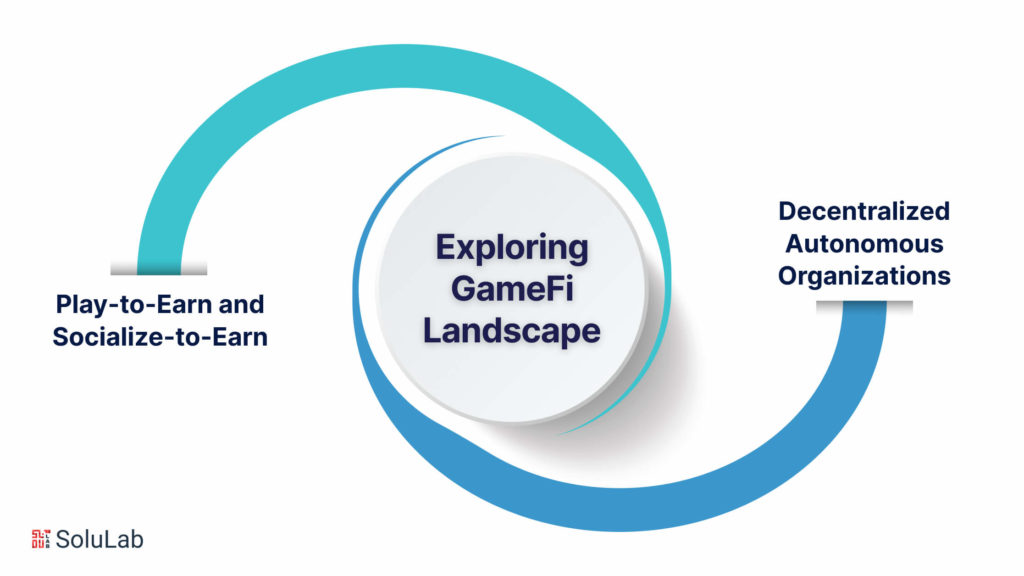
GameFi is positioned to revolutionize the gaming industry, introducing fresh opportunities for player ownership, inventive game development, and revenue generation. By providing players with greater authority over their in-game assets and incorporating innovative mechanics such as play-to-earn, socialize-to-earn, and Decentralized Autonomous Organizations (DAOs), GameFi fundamentally alters the dynamics among developers, players, and games. This transformation signals a more decentralized and democratic future for the gaming sphere.

  • Play-to-Earn and Socialize-to-Earn

The Play-to-Earn model represents a groundbreaking gaming approach, allowing players to earn rewards through active participation, especially in games integrated with blockchain technology. Unlike traditional in-game purchases, Play-to-Earn NFT games enable players to accumulate valuable assets during gameplay, which can subsequently be traded or sold in online marketplaces.

Socialize-to-Earn stands out as an innovative model, placing a strong emphasis on players’ social interactions and engagement within the game. This framework actively encourages players to construct, share, and actively participate in game communities, offering tangible rewards in the form of in-game assets and governance tokens.

  • Decentralized Autonomous Organizations (DAOs)

Frequently incorporated in GameFi initiatives, Decentralized Autonomous Organizations (DAOs) operate based on rules encoded in smart contracts on a blockchain. These entities facilitate decentralized decision-making, typically empowering players and stakeholders to influence game development and other project aspects through voting on proposals, utilizing governance tokens as voting power. This decentralization not only instills a sense of player agency but also nurtures community-driven game development.

DeFi Fusion with Gaming in the GameFi NFTs Realm

An additional dimension of GameFi involves its potential to seamlessly blend DeFi elements into gaming experiences. GameFi and DeFi exhibit numerous commonalities, including decentralized governance, tokenization, and community-driven decision-making.

Through the integration of DeFi into gaming ecosystems, developers unlock novel avenues for players to earn, trade, and invest in assets. Games are increasingly incorporating DeFi tools like liquidity pools, decentralized exchanges (DEXs), and DeFi protocols to cultivate a more dynamic in-game economy.

This amalgamation can manifest in diverse ways, such as enabling players to stake in-game assets for rewards, providing liquidity in game-specific tokens or NFT markets, or even incorporating synthetic assets to introduce innovative in-game mechanics within the realm of GameFi NFTs.

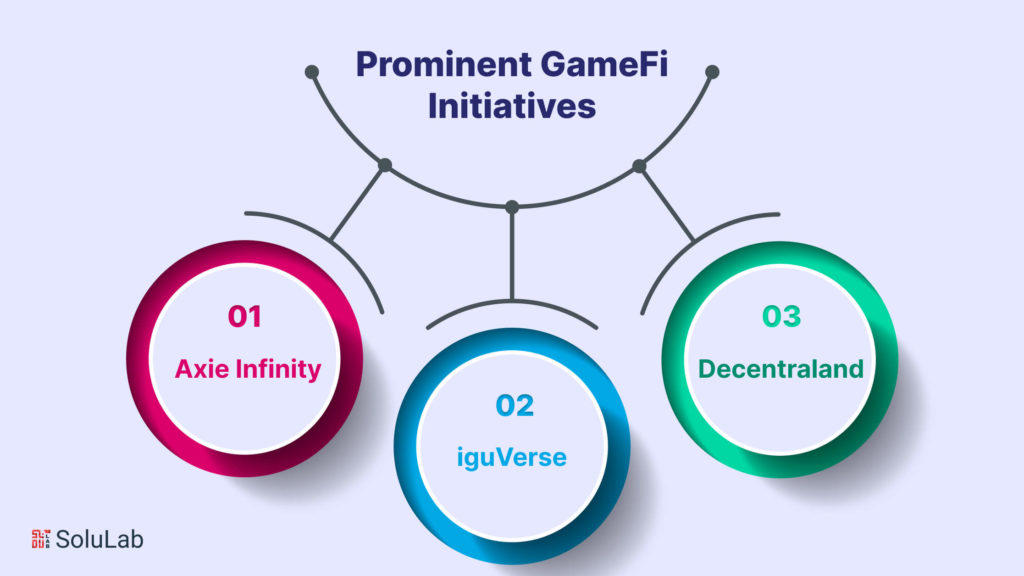
Summing up these components, a variety of gaming ventures have surfaced and achieved acclaim, including Axie Infinity, Decentraland, and iguVerse, to name a few. These initiatives exemplify the capacity of GameFi to revolutionize established gaming frameworks, providing innovative and captivating gaming encounters.
Prominent GameFi Initiatives

Prominent GameFi Initiatives

In recent times, several noteworthy GameFi ventures have attracted substantial attention, serving as compelling demonstrations of the capabilities of NFTs and blockchain technology in the gaming realm. Notable among these are Axie Infinity, Decentraland, and iguVerse, exemplifying the viability and influence of this emerging sector.

  • Axie Infinity

Axie Infinity stands out as a blockchain-based game that revolves around the collection, breeding, and battling of fantasy creatures known as Axies. Participants in Axie Infinity can earn rewards in the form of Smooth Love Potion (SLP) tokens by engaging in battles and completing diverse tasks. These tokens are tradable or sellable on cryptocurrency exchanges, or they can be utilized to breed new Axies, subsequently offered as NFTs on the marketplace.

The implementation of the Play-to-Earn model within Axie Infinity has garnered a substantial following, with players not only enjoying the game but also viewing it as a means of generating income. The success of Axie Infinity illustrates how NFT gaming can democratize the industry, providing players with influence through a decentralized and player-centric economy.

  • iguVerse

iguVerse represents a GameFi platform dedicated to establishing an interconnected ecosystem of blockchain-based games. Players have the opportunity to earn rewards and collect NFTs across various games within the iguVerse framework, with the flexibility to trade, sell, or utilize them as interoperable assets in other games on the platform.

This approach underscores the potential of cross-game NFT integration and blockchain gaming, offering a glimpse into a more dynamic and immersive future for the gaming industry. It envisions a scenario where players can seamlessly transition their assets and rewards across multiple games within the iguVerse ecosystem.

  • Decentraland

Decentraland serves as a virtual world built on the Ethereum blockchain, providing users with a platform to create, own, and trade digital assets. At its core, Decentraland leverages NFTs to represent virtual land parcels known as LAND, where users can construct various content, including art galleries, casinos, and games.

The decentralized nature of Decentraland fosters an open economy, enabling players to trade and monetize digital assets such as LAND, wearables, or in-game items. The incorporation of DeFi elements, such as staking and governance, adds complexity to Decentraland’s metaverse experience, showcasing the transformative potential of blockchain and NFTs in the realms of gaming and virtual reality.

These thriving GameFi projects underscore the diverse and promising landscape that NFTs and blockchain technologies are shaping within the gaming industry. As developers increasingly embrace these technologies and players recognize their advantages, the gaming landscape will undoubtedly continue to evolve, pushing the boundaries of what can be achieved.

GameFi’s Journey to Mainstream Acceptance

Major players in the gaming industry, such as Ubisoft, Konami, Atari, and others, have taken strides in the realm of NFT gaming, either by releasing NFT collections or outlining plans to integrate NFTs into their games. However, these endeavors have faced pushback from gamers, developers, and even employees within these companies.

Valve Corporation, the entity behind the widely used digital game distribution platform Steam, has implemented a prohibition on games featuring NFTs or blockchain-based currencies. This resistance highlights a discord between the growing interest in NFTs and gaming and the skepticism persisting across various sectors of the industry.

In contrast, Valve’s competitor, the Epic Games Store, has signaled a willingness to embrace NFT games. This disparity in policies reflects the ongoing uncertainty and debate within the industry about the role and potential impact of NFT in gaming.

Ubisoft, a significant gaming developer and publisher, stands as an illustration of mainstream adoption. The company has already entered the NFT space by establishing its Ubisoft Quartz platform. This platform utilizes the energy-efficient Tezos blockchain to generate, store, and manage in-game NFT assets known as Digits. While Ubisoft’s foray into the NFT gaming realm has faced certain backlash, it underscores the ongoing discourse within the gaming industry concerning the significance of NFTs and their potential for transformation.
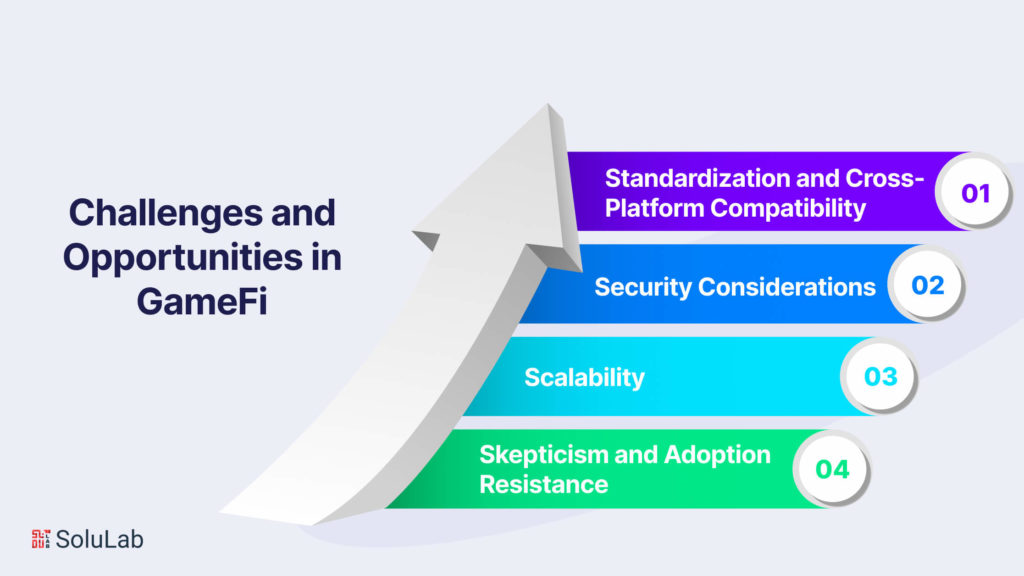
Navigating Challenges and Opportunities in GameFi

Challenges and Opportunities in GameFi

While the potential of NFTs in gaming is evident, several uncertainties and obstacles must be addressed, including standardizing assets across platforms and seamlessly integrating gaming NFT marketplaces. Nonetheless, the gaming industry’s evolution and the increasing interest in NFTs create opportunities for ever-more immersive and interactive gaming experiences.

  • Standardization and Cross-Platform Compatibility

A key challenge in adopting NFTs in gaming revolves around the absence of standardization and cross-platform compatibility. To facilitate smooth trading and transfer of NFT assets across diverse games and platforms, consensus and agreements among game developers are imperative.

Solution: Collaborative efforts among game developers, platforms, and stakeholders can foster industry-wide agreements, laying the groundwork for universal interoperability standards. The introduction of new token standards, such as ERC-1155 for Ethereum, and evolving protocols can establish frameworks supporting cross-platform NFT compatibility.

  • Security Considerations

With the rising popularity and value of NFT assets and blockchain games, security risks escalate. Potential hacks and breaches pose significant financial risks for both developers and players.

Solution: Developers must implement robust security measures, including secure smart contract development, regular audits, and adherence to security best practices. These measures are crucial to safeguarding platforms and players from malicious actors.

  • Scalability

Scalability remains a prominent concern in the blockchain space, influencing the potential growth and adoption of NFTs in gaming. The ability of networks to handle increased demand becomes critical for smooth gameplay and effective asset management as blockchain gaming platforms gain popularity.

Solution: The implementation of Layer 2 scaling solutions, such as sidechains and state channels, can alleviate scalability concerns by offloading transactions and data from the main blockchain. Developers may also explore newer, more scalable blockchain networks better suited for large-scale gaming applications.

  • Skepticism and Adoption Resistance

Skepticism and resistance toward NFTs and blockchain gaming persist among gamers and developers, fueled by controversy and unclear benefits, hindering widespread adoption.

Solution: Raising awareness and educating the gaming community about the advantages and possibilities of NFTs and blockchain gaming is crucial to overcoming resistance. Highlighting successful case studies, like Axie Infinity or Decentraland, and creating more user-friendly gaming experiences can contribute to winning over a broader audience.

While these challenges pose complexities for NFT in gaming, the industry is actively exploring innovative solutions. This ongoing exploration pushes the boundaries of gaming and strengthens the potential for seamless NFT integration.
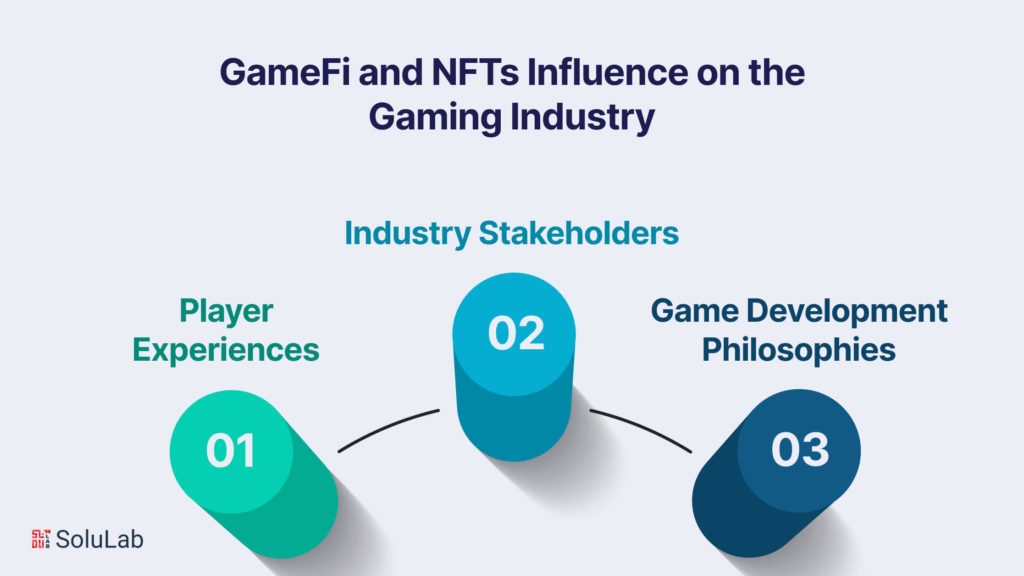
Influence of GameFi and NFTs on the Gaming Industry

GameFi and NFTs Influence on the Gaming Industry

The rise of NFTs and GameFi has ignited substantial interest and advancements in the gaming sector, poised to create far-reaching implications for the industry. The influence of NFTs and GameFi on the gaming arena is discernible through various lenses, encompassing player interactions, industry participants, and the fundamental principles governing game development.

  • Player Experiences

NFTs and GameFi introduce players to unprecedented levels of ownership and influence over in-game assets. As these assets undergo tokenization and become tradeable, players gain the ability to monetize their time, skills, and efforts within games by engaging in buying, selling, or trading digital goods. Notably, the Play-to-Earn model transforms gaming into a source of income for many players, particularly those residing in regions with limited economic opportunities.

Moreover, the cross-chain interoperability and the prospect of transferring NFT assets between games contribute to a more interconnected and adaptable gaming experience. Players are no longer confined to a singular game world, as their distinctive assets can seamlessly travel with them across various platforms and virtual environments.

  • Industry Stakeholders

The ascent of NFTs and GameFi has ushered in new revenue streams and business models for game developers and publishers. This includes the creation, sale, and monetization of NFT assets or the utilization of blockchain-based economies.

However, not all industry stakeholders and gaming communities have universally embraced NFTs and blockchain technology. Concerns regarding environmental impact, financial risks, and potential scams have fueled skepticism and controversy within the gaming industry.

Nevertheless, with advancing technology and the maturation of NFTs and GameFi, industry stakeholders will persist in exploring innovative approaches to gaming that unlock new possibilities for both players and developers.

  • Game Development Philosophies

The introduction of NFTs and GameFi signifies a fundamental shift in game development philosophies, emphasizing player-centric design and the democratization of content creation. Through the tokenization of in-game assets, developers empower players to assume roles as creators, traders, and entrepreneurs within the gaming ecosystem.

This change in approach places increased value in the hands of players, resulting in more substantial interactions with games and providing developers with stronger incentives to craft captivating virtual worlds. It establishes a symbiotic connection between players and developers, where each group contributes to the success and advancement of the other.

Charting the Future Trajectory of GameFi

As GameFi undergoes continuous expansion and gains momentum, several pivotal trends are poised to intricately shape its future, reimagining the gaming landscape. These trends encompass cross-chain interoperability, the incorporation of virtual reality (VR) and augmented reality (AR), and the amalgamation of artificial intelligence (AI) and machine learning within blockchain gaming.

  • Cross-chain Interoperability

The significance of cross-chain interoperability cannot be overstated, as it facilitates seamless interaction and exchange between diverse blockchain networks and their respective assets. In the realm of GameFi, this interoperability translates into a more cohesive and unified gaming experience, enabling players to utilize items, assets, and currencies across various games and platforms effortlessly. VR and AR integration

The domains of virtual and augmented reality hold vast potential for the gaming industry, offering the capability to craft immersive and captivating experiences. When intertwined with NFTs and blockchain technology, VR and AR possess the capacity to further transform the gaming panorama by integrating distinctive digital assets into highly interactive environments.

As VR and AR technologies become more accessible and sophisticated, gaming experiences rooted in the principles of GameFi will continue evolving, presenting players and developers with an unparalleled level of immersion and interaction within virtual worlds.

  • AI and Machine Learning in Blockchain Gaming

Artificial intelligence and machine learning are already making strides in diverse sectors, and gaming is no exception. In the context of GameFi, AI and machine learning can play a pivotal role in enhancing gameplay and establishing highly adaptive, intelligent systems within blockchain-based games.

Innovative applications of AI and machine learning may encompass procedurally generating unique game assets eligible for minting as NFTs, crafting intelligent non-player characters (NPCs) that learn from player interactions, or even shaping entire game worlds that evolve based on player choices.

As GameFi advances, the convergence of these technologies and trends, coupled with NFTs and blockchain, possesses the potential to redefine the gaming future and push the boundaries of immersive, interactive experiences.
NFT gaming marketplace development services

Concluding Remarks

NFTs have introduced a surge of creativity and potential in the gaming sector, granting players unprecedented authority and influence over their in-game possessions. The fusion of blockchain technology with gaming is ushering in a novel era, empowering players to engage in decentralized economies, contribute to communities, and monetize their gaming exploits.

While obstacles such as security concerns, standardization issues, and resistance to adoption persist, the growth prospects within this domain are considerable. This transformative journey is steering traditional game development philosophies towards player-centric designs, fostering the democratization of content creation. Ultimately, the ascent of GameFi is not merely transforming our interactions with games; it is fundamentally reshaping the entire gaming industry. It is creating a more inclusive, equitable, and democratic landscape for everyone to partake in and relish.

SoluLab, a NFT game development company, stands at the forefront of GameFi NFT development, offering innovative solutions to empower gaming projects with the transformative potential of blockchain technology. Leveraging our expertise, we provide tailored services to seamlessly integrate NFTs into gaming ecosystems, fostering player-centric experiences and decentralized economies. Whether it’s ensuring cross-chain interoperability, enhancing security measures, or implementing cutting-edge technologies like AI in blockchain gaming, SoluLab is committed to driving the evolution of GameFi. Elevate your gaming venture with SoluLab’s comprehensive GameFi NFT solutions – where innovation meets immersive gameplay. Let’s redefine the future of gaming together. Connect with us today!

FAQs

1. What is GameFi, and how does it differ from traditional gaming?

GameFi, short for Game Finance, represents the integration of blockchain technology and financial mechanisms into gaming. Unlike traditional gaming, GameFi introduces decentralized economies, player ownership of in-game assets as NFTs, and novel revenue streams through play-to-earn models.

2. How do NFTs enhance player experiences in GameFi?

NFTs in GameFi provide players with unparalleled ownership and control over in-game assets. These assets, tokenized on the blockchain, can be traded, sold, or utilized across different games and platforms, introducing a new level of autonomy and monetization for players.

3. What challenges does GameFi face, and how are they being addressed?

Challenges in GameFi include standardization, security concerns, scalability, and skepticism. Solutions involve industry collaborations for standardization, robust security measures, Layer 2 scaling solutions, and heightened awareness and education about the benefits of NFTs in gaming.

4. How does SoluLab contribute to GameFi NFT development?

SoluLab is a leading force in GameFi NFT development, offering tailored solutions to seamlessly integrate NFTs into gaming ecosystems. Our expertise spans cross-chain interoperability, and security enhancements, ensuring a transformative and player-centric gaming experience.

5. What trends are shaping the future of GameFi?

The future of GameFi is influenced by trends such as cross-chain interoperability, the integration of virtual and augmented reality, and the application of Artificial Intelligence and Machine Learning in blockchain gaming. These trends promise to redefine the gaming landscape with more immersive and interactive experiences.

What is GameFi? A Guide to Crypto Games & Play-to-Earn

GameFi

In a global survey, a substantial 75% of respondents confessed that their initial foray into cryptocurrency was solely motivated by GameFi. This remarkable figure indicates that three out of every four cryptocurrency investors worldwide commence their crypto journey driven by the allure of GameFi. 

Regarding GameFi’s success, numerical facts hold more weight than mere words. In 2021, the global play-to-earn (P2E) market was estimated to be valued at approximately USD 777 million. This figure is projected to witness an exponential surge over the next decade. With millions of individuals actively participating in P2E games on a regular basis, this industry presents an attractive business opportunity. Some of the most renowned GameFi projects, like Axie Infinity, boast an impressive 2.7 million active monthly users, showcasing the enormous potential of this market.

How Does GameFi Work?

GameFi, a fusion of “gaming” and “finance,” changing how people play and earn simultaneously. It allows players to engage in games and accrue cryptocurrency rewards, blurring the line between entertainment and financial gain.

1. The Gaming Element

Begin your gaming journey by selecting a game that aligns with your interests, be it a mystical fantasy adventure or a peaceful farming simulation. As you play, engage in missions or challenges to progress through the game.

2. Earning Through Play

During gameplay, you have the opportunity to acquire in-game items such as swords, skins, or even virtual land. These items are frequently represented as NFTs, which are distinctive digital tokens. Remarkably, you have the ability to sell these items on various marketplaces for actual currency.

3. The Role of Cryptocurrency

Many GameFi platforms incorporate their own distinctive virtual currency. Engaging in the game allows players to acquire this currency, which can subsequently be utilized within the game itself or traded for alternative cryptocurrencies or even conventional currencies like fiat money.

4. Investing to Earn More

In some games, you can enhance your gaming experience by purchasing unique items or engaging in cryptocurrency “staking.” This investment strategy can yield increased rewards as you progress through the game.

5. Community and Governance

In numerous GameFi games, players have the ability to influence the direction of the game’s development. Through the use of earned tokens, players can participate in voting processes to express their opinions on proposed new features or modifications within the game.

game type

How are GameFi Platforms Different from Regular Video Games?

In the gaming world, players can engage in GameFi games, which feature distinct mechanics and prerequisites. To participate, players must possess crypto wallets for token storage. Additionally, these wallets must be funded with cryptocurrency before commencing gameplay. Some games may also require the purchase of starter characters to initiate the gaming journey. Traditional games also provide digital currency and assets that players can utilize to enhance their characters and augment their gaming experience. However, these assets are restricted to the game’s ecosystem and lack external value beyond the gaming platform. As a result, players cannot engage in trading or monetizing these assets, rendering them economically disadvantageous. In contrast, GameFi platforms offer players tokens and assets, often in the form of NFTs or cryptocurrencies. Even if certain blockchain games employ virtual tokens, players have the ability to exchange their in-game assets for NFTs when necessary. Furthermore, players can seamlessly transfer their earnings to their crypto wallets or NFT marketplaces, converting them into traditional money, making the concept of GameFi play-to earn a significant aspect of modern gaming.

1. Earning Real Value

In traditional video games, players typically engage with in-game currencies and items that have no monetary value.

In contrast, GameFi platforms offer players the opportunity to earn cryptocurrency and non-fungible tokens (NFTs) while playing. These digital assets can be traded on marketplaces for money, allowing players to monetize their gaming experience.

2. Ownership of Assets

In conventional video games, items and characters obtained through gameplay are confined within the game’s virtual. However, GameFi, empowered by blockchain technology, changing this concept by granting players genuine ownership of their acquired assets. Unlike traditional games, GameFi allows players to freely trade or sell these assets, empowering them with unprecedented control and flexibility. This model is often referred to as Play-to-Earn (P2E), highlighting the financial opportunities available to players..

DO YOU KNOW? 34% of respondents from India indicated that they actively engage in play-to-earn (P2E) games, solidifying India’s position as the country with the most significant GameFi fan base.

3. Play-to-Earn Model

In video games, the traditional pay-to-play and free-to-play models have long dominated the industry. However, GameFi changing this domain by presenting a novel play-to-earn model. This concept allows players to be compensated for their gaming efforts with digital assets that possess monetary value.

4. Decentralization

GameFi platforms often function on decentralized networks, unlike regular games controlled and managed by specific companies. This decentralized structure ensures that GameFi platforms are not subject to the control of a single entity.

5. Investment Opportunities

GameFi offers a unique investment opportunity that transcends the traditional spending model of regular games. Here, players have the ability to inject capital into in-game assets or cryptocurrencies, transforming their gaming experience into a potential source of financial return.

CTA1

6. Community Governance

In traditional video games, the game studio makes all the decisions regarding development and updates. In contrast, GameFi crypto often incorporates token-based voting systems, enabling players to actively participate in changing the game’s future through their votes. This approach gives players a voice in the decision-making process, fostering a sense of ownership and community engagement within the gaming ecosystem.

GameFi Use cases

In P2E gaming, popular online and metaverse app activities include:

  • Creating and Selling Virtual Assets: Players can design and sell unique in-game items, such as digital pets or virtual real estate, to other players in exchange for digital assets. This endeavor can be especially profitable for skilled developers capable of creating highly sought-after items.
  • Trading: Gamers can engage in trading in-game virtual assets with other players. This activity can be particularly appealing to those interested in collecting rare or exclusive virtual items.
  • Staking: Some GameFi platforms offer staking options, allowing players to stake their digital assets in exchange for participating in game governance or specific in-game activities. What is GameFi? Staking provides players with a means to generate passive income while contributing to the development and growth of the game or metaverse.

Benefits of GameFi

Benefits of GameFi

The benefits of GameFi platforms are numerous and varied. Here are some of the key advantages:

  • Play-to-earn model: GameFi platforms offer a unique play-to-earn model that allows players to earn valuable cryptocurrency tokens or NFTs by playing games. This can provide a fun and engaging way to earn money, and it can also help to offset the costs of gaming.
  • Ownership of in-game assets: GameFi platforms often allow players to own their in-game assets, such as characters, items, and land. This can give players a sense of ownership and control over their gaming experience, and it can also make it possible for them to trade or sell their assets to other players, driving interest in GameFi Development.
  • Transparency and fairness: GameFi platforms are often built on blockchain technology, which provides a high level of transparency and fairness. This can help to ensure that all players are treated equally, and it can also help to prevent cheating and fraud.
  • Potential for passive income: Some GameFi platforms offer players the opportunity to earn passive income by staking their tokens or NFTs. This can provide a way to generate income even when you’re not actively playing the game, showcasing Examples of GameFi Platforms that maximize user engagement and rewards.
  • Innovation and creativity: GameFi platforms are constantly innovating and creating new ways to engage and reward players. This can help to keep gaming fresh and exciting, and it can also lead to the development of new and gaming experiences involving GameFi Activities.
  • Community-driven development: GameFi platforms are often driven by their communities, which helps to ensure that the games are developed in a way that meets the needs and desires of the players. This can help to create games that are more fun, engaging, and rewarding.

DO YOU KNOW? In regions like Hong Kong and the UAE, GameFi has gained considerable popularity, engaging 29% and 27% of gamers, respectively, in this gaming trend

GameFi Risks

GameFi has sparked controversy due to various factors, with one of the primary concerns running around Environmental, Social, and Governance (ESG) risks.

For instance, there is apprehension regarding the environmental impact of GameFi; the energy consumption associated with blockchain networks has raised flags. Despite the controversies, GameFi’s allure continues to resonate with gamers, developers, and investors, fueling its growth in popularity. As the market segment matures, it is anticipated that regulators will address concerns related to the connection between GameFi and gambling. Appropriate safeguards will need to be implemented to ensure the gaming ecosystem adheres to local laws and regulations, highlighting various GameFi use cases.

GameFi Examples

All entities, including items, creatures, cards, and currencies, are tokenized and eligible for trading on marketplaces.

1. Axie Infinity

Axie Infinity, a strategy game featuring unique, axolotl-inspired digital pets known as Axies, offers players an engaging experience. Players can purchase Axies from other players on the open market, forming teams of three and engaging in battles through various game modes. Victories in battles and successful mission completions reward players with the game’s native currency, SLP. This currency has multiple in-game applications, including crafting runes and charms and breeding new Axies, adding depth and strategy to the gameplay. Additionally, the integration of decentralized finance (DeFi) elements enhances the overall player experience by providing new ways to earn and trade assets.

2. Gods Unchained

Gods Unchained, a collectible trading card game (TCG), allows players to buy, sell, and trade NFT cards with varying rarities. Each card features unique abilities and statistics, enabling players to create customized decks. Within the game, players can engage in battles against one another using their decks. By winning these battles, players ascend the leaderboards and earn GODS tokens. These tokens can be utilized for purchasing new card packs or staked as part of the game’s governance mechanism.

3. Sorare

Sorare, a fantasy sports game, brings together global enthusiasts who collect NFT player cards. These cards serve as gateways to tournaments mirroring real-life player performances across prominent sports leagues worldwide. Much like traditional fantasy sports leagues, Sorare players immerse themselves in league participation, curating their line-ups for each game day. Points are awarded based on the combined performance of their line-up and the rarity of each card. As card rarities ascend, so do the point boosts, offering players a better experience. Furthermore, new cards are introduced through exciting auction-style formats, while tournament victories are celebrated with additional card rewards for the winning players. This captivating experience exemplifies the concept of game finance, merging entertainment with financial opportunities in the gaming world.

How To Earn Money by Playing Games Online?

To earn money through GameFi, a combination of skill, strategy, and luck is required. Before joining any platform, it’s crucial to research popular and reputable GameFi platforms and understand their tokenomics (economic models). Crypto experts advise new gamers to start by investing a small amount of time and resources to test the platform’s withdrawal policies and procedures and assess its reliability without risking significant losses. Once a GameFi platform is chosen, players will need to create an account, usually involving providing basic personal information and setting up a wallet address for winnings. The process for cashing out earnings varies from platform to platform. Some have minimum withdrawal limits that must be met, and platforms may charge a withdrawal fee for converting tokens or cryptocurrency into fiat currency or other digital assets, often using a gamefi token for transactions.

How to Get Started with GameFi?

To get started with GameFi, follow these easy steps:

1. Choose a game: There are many different GameFi games to choose from, so take some time to browse and find one that interests you. Consider factors such as the game’s genre, graphics, gameplay, and tokenomics.

2. Create a wallet: You will need a cryptocurrency wallet to store your in-game assets and tokens. There are many different wallets available, so choose one that is reputable and secure.

3. Purchase cryptocurrency: You will need to purchase cryptocurrency to use in GameFi games. The most popular cryptocurrency for GameFi is Ethereum, but there are also many other cryptocurrencies that are supported.

4. Connect your wallet to the game: Once you have purchased cryptocurrency, you will need to connect your wallet to the game. This will allow you to transfer cryptocurrency into the game and start playing.

5. Start playing: Once your wallet is connected, you can start playing the game. Be sure to read the game’s documentation to learn how to play and how to earn rewards.

6. Withdraw your earnings: Once you have earned rewards, you can withdraw them to your wallet. The process for withdrawing rewards will vary depending on the game, allowing you to enjoy the benefits of GameFi.

Here are some additional tips for getting started with GameFi:

  • Do your research: Before you invest in any GameFi game, be sure to do your research and make sure that it is a legitimate project. There are many scams in the GameFi space, so it is important to be careful.
  • Start small: When you first start playing GameFi, it is a good idea to start small. This will help you to learn the ropes of the game and to avoid losing too much money.
  • Have fun: GameFi is a great way to earn rewards while having fun. So be sure to relax and enjoy yourself.

CTA2

The Growth and Future of GameFi

GameFi platforms took the gaming and blockchain world by storm in 2021 and continue to hold their ground, chaning the gaming industry with their “play-to-earn” model. Today, players have an array of play-to-earn games to choose from across various blockchains like Ethereum, Polygon, Harmony, and Solana, thanks to the widespread acceptance of GameFi. A report by DappRadar reveals the existence of over 1,400 blockchain-centric games, showcasing GameFi’s growing popularity. While GameFi’s roots can be traced back to the early days of cryptocurrency, it has only recently captured the attention of mainstream gamers. A shining example of GameFi’s success is Axie Infinity, which made history in August 2021 by becoming the first blockchain game to register over $1 billion in token sales. According to activeplayers.io, Axie Infinity had an impressive average of 2,670,416 daily players in April 2022, symbolizing GameFi’s escalating global popularity.

The global gaming community is increasingly warming up to GameFi platforms, and experts anticipate that GameFi will carve out a significant share of the $175 billion video games market. As of now, GameFi’s market capitalization stands at approximately US $55.38 billion, according to data from crypto.com. The enticing earning opportunities presented by GameFi platforms have been instrumental in broadening their fanbase. Some industry experts even forecast that gaming will pave the way for blockchain adoption on a larger scale. This sentiment resonates with the broader understanding of crucial blockchain concepts, such as tokenization, NFTs, and in-game currency, among gamers worldwide.

Gamefi players data

GameFi is undoubtedly at the dawn of a promising future, as evidenced by the success stories of Axie Infinity and other GameFi platforms operating on different blockchain protocols. However, predicting the novel features and technological advancements that will change future GameFi platforms is challenging, given the continuous evolution of blockchain technology. Future blockchain innovations promise to bring smarter solutions, but their impact on GameFi and their potential to enrich and monetize existing experiences remain an exciting mystery. As blockchain technology continues to evolve, GameFi platforms will likely incorporate more sophisticated features and technologies, offering gamers immersive and rewarding experiences. This leads to the question, how does GameFi work in this growing changing world?

Let’s Create Your Next Big Success In Crypto Gaming!

In summary, GameFi is upgrading the gaming industry by combining blockchain technology with gaming to offer players opportunities to earn rewards through play-to-earn models. The rise of crypto games is opening new doors for both gamers and developers, offering a decentralized, player-driven economy. As this space continues to evolve, businesses need to harness its potential to stay competitive.

At SoluLab, we specialize in GameFi and crypto game development, helping businesses create engaging, blockchain-powered gaming experiences. We understand the challenges of developing secure, scalable, and immersive crypto games, and our expert team is equipped to solve these by offering end-to-end solutions, from concept to deployment. Whether you’re looking to build a GameFi platform or integrate play-to-earn features, we are here to ensure your project succeeds by combining deep blockchain expertise with game design. Let SoluLab be your partner in driving the future of gaming forward as a play-to-earn development company.

Schedule a free consultation 

FAQs

1. What is GameFi?

GameFi refers to a combination of gaming and decentralized finance (DeFi) that enables players to earn rewards through blockchain-based games. It creates a unique ecosystem where gaming and finance intersect, allowing players to monetize their gaming activities.

2. How does GameFi work?

GameFi operates by utilizing blockchain technology to provide players with ownership of in-game assets. Players earn gamefi tokens through various GameFi activities, including playing games, trading assets, and participating in decentralized finance (DeFi) Platforms. These tokens can then be traded or sold on various platforms.

3. What are some Examples of GameFi Platforms?

Several popular platforms exemplify the GameFi play-to earn model, including Axie Infinity, Decentraland, and Sorare. Each platform offers unique gameplay experiences that allow players to earn cryptocurrency while engaging with the game’s ecosystem.

4. What are the benefits of GameFi?

The benefits of GameFi include genuine ownership of in-game assets, the potential for passive income through staking, and the ability to trade assets freely. Additionally, players can engage in a decentralized economy that enhances their gaming experiences and rewards.

5. What is game finance?

Game finance refers to the financial aspects of gaming, particularly in the context of blockchain technology. It encompasses various economic models, including Play-to-Earn (P2E) structures that allow players to earn money through their gaming activities.

6. How is GameFi related to decentralized finance (DeFi)?

GameFi is closely related to decentralized finance (DeFi) as it utilizes blockchain technology to create a player-driven economy. This integration allows players to earn and trade assets in a decentralized manner, providing them with financial opportunities within the gaming space.

7. What is GameFi Development?

GameFi Development involves creating blockchain-based games that incorporate elements of finance, allowing players to earn rewards through gameplay. This field includes designing engaging game mechanics, ensuring secure transactions, and integrating gamefi tokens for a seamless gaming experience.
