Talk to an Expert

How Will The Latest Ethereum Update “ERC-4337” Change Web3?

How will the latest Ethereum update "ERC-4337" Change Web3?

With its upgrade, unveiled at ETH Denver on March 1, 2023, and proposed by Ethereum co-founder Vitalik Buterin and others in September 2021, EIP-4337 and ERC-4337, Ethereum intends to change the routing of users into the cryptocurrency space. 

EIP-4337 and ERC-4337 are referred to as superchargers designed to boost web3 adoption and make Smart Accounts available to all web3 enthusiasts. This means that each cryptocurrency wallet can have its own unique authorization logic to suit the requirements of different users or programs. Contract accounts are the next step in wallet evolution needed to enhance web3’s user experience. 

Let’s examine ERC-4337 to better understand what it is, why it matters, and what it might portend for Web3.

Understanding ERC-4337

The term “request for comment” (or “ERC”), which stands for “Ethereum request for comment,” was developed by the Internet Engineering Task Force to communicate significant technical notes and requirements to a group of engineers and users.

Yoav Weiss, a security researcher at the Ethereum Foundation, observed, “The next billion users are not going to write twelve words on a piece of paper. Normal people don’t do that”. He said,” we need to give them better usability; they shouldn’t need to think about cryptographic keys.”

In order to change how users engage with wallet services, Ethereum introduced the ERC-4337 standard in 2023. The Ethereum update is known as ERC-4337, or “Ethereum Request for Comment 4337,” makes account abstraction possible. Account abstraction, to put it simply, is the suggestion to enable consumers to use smart contract wallets rather than EOAs. As a result, users are no longer required to conduct transactions using EOAs.

Yet why? What can’t EOAs do that contract accounts can? EOAs cannot compare to smart contracts in terms of flexibility. Several rules and configurations can be specified in the code of any smart contract.

In contrast to externally owned accounts (EOAs), account abstraction lets users use any cryptographic signature of their choice and authorize transactions securely over mobile devices. This allowed users to deploy smart contract wallets with flexible verification logic. Users could then add additional controls or features to their accounts, like two-factor authentication or alternatives for recovery with a friend or attorney.
How does Account Abstraction work?

There are two classifications of accounts available for Ethereum:

1. Contract Accounts (CA)—accounts managed by code rather than by private keys—cannot start transactions on their own. A contract account can be compared to a piece of code (smart contract) that lives on the blockchain and controls how the account operates.

2. Externally Owned Accounts (EOAs)- Consider EOAs as individuals (although a person could have many EOAs). They are the kind of account most Ethereum users choose to open, i.e., MetaMask and Coinbase Wallet.

EOAs are presumably already familiar to you. An EOA is your MetaMask wallet. Public and private cryptographic keys that manage account actions are included in EOAs. Nevertheless, contract accounts lack a private key. These smart contracts are driven by the internal logic of the code; users do not manage them. The main lesson from this is that users control what EOAs do, while code defines what contract accounts do. This is significant because, in contrast to EOAs, smart contracts may do any task that can be performed using code.

Read also: How to Create ERC-721 NFT Token?

Human mistake is at the root of the EOA problem; if users misplace their private keys, there is no way to get them back. By combining an EOA account with a CA, Account Abstraction handles the problems of an EOA account and constructs built-in mechanisms that permit users to maintain access to their cryptocurrency. A social recovery system is one of these built-in mechanisms. Multiple users can regain access to that account if someone loses their private key. Additionally, Account Abstraction allows users to create multi sig wallets, which require numerous users to sign off on transactions and grant access to an account to a group of users.
Why is ERC-4337 used?

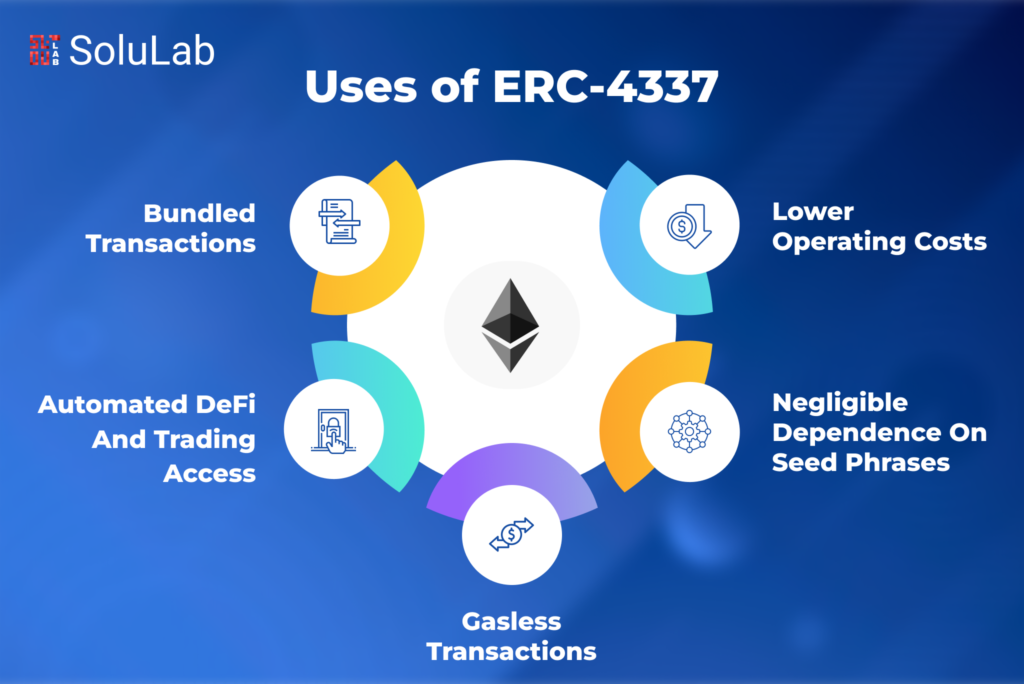
Uses of ERC-4337

ERC-4337 resolves these major issues with current wallet structures:

Retrieve private keys 

The terrifying aspect of web3 is that it’s possible to forget the key with a crypto bit and lose access to one’s wallet. Using the “social recovery system” enabled by ERC-4337 development, authorized individuals can regain access to your wallet if they misplace their private keys. Several Account Recoveries choices, such as a normal Google or Bank account, are provided by this upgrade. Using reinvented cryptographic key storage, they transform your mobile device into something as useful as a hardware cryptocurrency wallet.

Negligible dependence on seed phrases

ERC-4337 Seed phrases, account managing code, and other developer-specific qualities are hidden away, resulting in a clear and usable user interface.ERC-4337 is anticipated to introduce “Group-Access” wallets for smart accounts. This implies that if you forget your seed phrase, you can contact the guardian contracts or accounts you previously chose to help you regain access. 

Users may now protect their wallets with 2FA (two-factor authentication) and biometrics, greatly enhancing their security and usability. Some users of Web 3 are there to safeguard themselves against the kind of institutional intrusion that security methods like biometrics imply. 

Furthermore, those users and others might not want to give up seed phrases because they offer an extra layer of security. Moreover, this measure would remove dependence on private keys through key abstraction. The seed phrase won’t even be required if someone attempts to build up a wallet after the ERC-4337 in order to reclaim the account if necessary. 

Gasless transactions

The ERC-4337 standard supports gasless transactions, further permitting the bundling of transactions to speed up and improve efficiency. With the help of this functionality, NFT collections and associated DAOs can sponsor users’ gas costs, lowering the cost of transactions.

This functionality also makes it possible to pay transaction fees using the tokens associated with an application, thus lowering transaction costs. To make this a primary feature, entire blockchains like Avalanche and its subnets have been created.

Automated DeFi and trading access

The level of involvement required to collect and trade NFTs is one of the most challenging aspects. Analyzing floor prices, timing mints, and tracking metrics all require almost constant effort.

However, ERC-4337 permits AI trading, adjusting yield farming positions, and automated trading with a monthly spend limit. Users of all levels may find trading NFTs much simpler and more accessible thanks to these features.

Bundled transactions

Sign-offs are required for every EOA transaction. Additionally, it may be tedious. With account reflection, it tends to be feasible to package exchanges and send them as one to save time and gas expenses.

User-specific benefits of ERC-4337

ERC-4337 would advance the idea of “Trustless Banks.” ERC-4337 smart accounts offer a number of advantages, some of which are listed here.

  • This innovation brings together all of the other aspects of Account Abstraction that other EIPs had in mind.
  • The decentralized relay system here is more secure and resistant to censorship.
  • They provide conventional mobile user onboarding.
  • Less likely a human error due to the deployment of smart contract wallets.
  • Modifications are simple to implement on other chains that are consistent with the Ethereum Virtual Machine.
  • The adaptability to activate features similar to those found in banks, such as auto-pay, account recovery, and multi-factor authentication.
  • Compatibility with upcoming signature schemes like Quantum resistance and BLS (Boneh-Lynn-Shacham), making the network less vulnerable to attacks.

Concluding remarks

How we communicate about ERC-4337 is crucial to realizing its potential. Anyone can start trading NFTs, join crypto newsletters, play web3 games, and create new smart account wallets with ERC-4337. ERC-4337 provides numerous features that traditional banks typically offer their customers without requiring trust. In general, ERC-4337 has the potential to revolutionize all industries. It might accelerate Ethereum’s daily transaction volume and active addresses in time. Additionally, with simple onboarding, gas-fee-specific revenue generation may improve.


CTA

Can phygital NFTs bridge the gap between Web2 and Web3?


                                       Credits: Azuki Golden Skateboard

With NFTs, the concept of phygital presents endless opportunities to the space. By definition, phygital bridges the gap between the physical world and the digital one.

It focuses on giving users a hybrid experience in terms of user interface and experience. Currently, this idea mainly exists for the fashion and luxury goods industry as it is easier for companies to link their digital offerings to that physically. Furthermore, Morgan Stanley predicts that the metaverse could bring the fashion and luxury goods industry an additional 50 billion dollars in sales by 2030.

Having physical goods linked to the digital world extends the utility of either physical or digital ownership. This is a great way for the community to feel that they are able to represent the project on both channels. In addition, it can also help to securitize the underlying physical goods by having ownership registered on the blockchain. A couple of NFT projects are at the forefront of venturing into the phygital realms with their unique proposition.

You can also read : An Ultimate Guide To NFT Gaming Development

NFT projects venturing into phygital

Azuki

Azuki launched a Proof of Skate (POS) initiative with the bidding of their golden skateboards for each of the top 8 bidders. They aim to bridge the gap between web2 and web 3 by introducing Physical Backed Tokens (PBT):

“The PBT standard is a solution which enables decentralized authentication and tracking of the full ownership lineage of physical items, all completely-chain and without a centralized server. This introduces trustless authentication. No entity has singular rights to authenticate or verify ownership of items — everyone is free to authenticate, verify, and build experiences on top of this technology.”

This was a huge success as the highest bid was 309 ETH and the total revenue of $2.5m. Each golden skateboard comes with a unique emblem with significance from Azuki lore, and also holders get to be enshrined in the Ruins world drop as part of Azuki mythology. The token pushes the boundary between physical ownership and trustless authentication. It is now easier for anyone to view the entire ownership of the skateboard since it is able to keep track of who has owned the item in the past, which is useful for the fine art world of establishing its provenance.

RTFKT

CloneX SZN 1 launched a Forging Mechanic for their existing NFT holders to redeem exclusive physical items from their NFTs collectibles such as fashion items (sneakers, hats, jackets, etc). What differentiates how RTFKT launch its phygital experience is the introduction of Near Field Communication:

“All forgeable items with the exception of Socks and Caps are equipped with NFC tags, allowing owners to link their physical to their NFT. This allows for new possibilities and unlocks in the future such as new items to mint or token-gated physical events.”

The launch of the Forging event is a huge success and the project was able to generate a revenue of $11.34m, with the top three fashion items being T-shirts (36%), Shoes (23.6%), and caps (12.9%). RTFKT launched its physical fashion items successfully because of Nike’s manufacturing expertise; this is an example of how existing fashion brands can tap into Web3 audiences through NFTs.

You can also read: Top 5 Fintech sources — Enhance your industry knowledge

Cult & Rain

Cult & Rain was created as a phygital Web3 fashion brand co-founded by fashion creative director George Yang. This project aims to create both physical and digital wearables such as luxury sneakers and varsity jackets paired with NFTs. With connections to the factory that produces for both LVMH and Kering, the corresponding physical product will be produced in Italy after the claiming of the NFTs is done.

Having a direct-to-consumer model avoids overproduction, which is a main issue for the traditional fashion industry. The digital asset sold as an NFT allows holders to experience the utility of its matching physical luxury product ensuring that they are of good quality.

How to have a successful Phygital plan?

With various projects having their phygital experience included for their community, how can projects measure success to ensure that phygital fit into the long-term of the brand instead of it being a once-off marketing tactic? Personally, I feel that there are a couple of key considerations:

  • An innovative bridge between physical and digital — It is not enough to just allow holders to claim merchandise physically just by holding the NFT. People are expecting more, especially with the foundation of blockchain in NFTs, and projects are pushed to think of ways to stand out. A great example is Azuki, where they introduced the PBT concept to the idea of being able to pass on ownership easily without someone having to verify the physical item.
  • Physical to resonate with the brand — Projects also need to bear in mind that the physical item needs to resonate with the brand and its vision. RTFKT does it well because they are acquired by Nike, which is known for its merchandise like shoes, shirts, and caps thus reinforcing to their holders that they are able to deliver on that end.
  • Physical to be part of the long-term roadmap — Using phygital as a marketing tactic works great as it is the buzzword in the NFT space. However, for a project to truly embrace the concept, it needs to be part of the roadmap where holders can get consistent utility from holding the physical despite already having the digital aspect.

It is great that projects are slowly starting to steer away from the typical merchandise launch and embracing the phygital concept. More web2 people will be willing to move towards web3 if they are able to see the value and tangible perks of owning the NFTs. How can projects incorporate phygital into their business model and continue bridging the gap between web2 and web3? A lot of trial and error is probably needed since we are early in this space.

Credit : Medium


What Is Web 3 & Why Is It Called the Internet of the Future?

If the promises of Web 3 come true, we might witness the most dramatic shifts society has ever seen.

                                              Photo by Bermix Studio on Unsplash

“This machine is a server. DO NOT POWER IT DOWN!!” — Tim Berners-Lee 1990

Let’s start at the beginning. The web was created in 1990. Its first version, Web 1, was simple. You open a web browser, type in a website and hit enter. Once the website loads on the screen, you can browse around.

No one controlled Web 1. As long as you have an internet connection, you can access web pages to read, browse, and buy stuff. Web 1 obeyed a standard, global, and open protocol: HTTP.

But the user experience was limited. We would visit websites to explore but never to create content on our own. That privilege was for a select few: programmers. In Web 1, most of us were merely consumers of content created by others.

This version of the web lasted until 2004. Then Facebook came, and with it, the social media revolution or what’s known as Web 2. Instead of simply browsing, Facebook, Twitter, and Youtube allowed anyone to create content. No coding skills were needed. People can write posts, upload pictures, share and like videos, and connect with other people. In Web 2, you are a consumer and creator.

Web 2 is the era we live in. And while it changed our lives in many good ways, it created several problems.

Instead of a free and open web, the internet is now entirely controlled by a few companies. Financial inequality grew as owners of Web 2 platforms — Zuckerberg & friends — became the big winners. In contrast, the rest of us are unpaid participants.

When we post, like, share, and comment, we either don’t make any money or get a tiny fraction of the value we add. Yet, we — the users — are the pumping heart of these platforms. Without us, they’re nothing.

In Web 2, we have no control over our data, where it’s stored, and with whom it’s shared. Platform owners collect and sell our data to various companies, sometimes without even our consent. And what do we get from this sweet deal? Nothing tangible except custom ads and recommendations.

This absence of ownership leads to a lack of privacy and anonymity. Users who live under oppressive regimes are at serious risk when using Web 2 platforms. Governments can track users and block entire websites to quench unwanted ideas and opinions.

And, of course, we have the issue of censorship. We’ve seen how Web 2 platforms suspend accounts, delete posts, and ban users just because their opinions don’t align with the “politics” of the platform.

To fix these problems and more, some entrepreneurs and engineers are creating the next generation of the web: Web 3.

Web 3 is decentralised. This means the network runs on millions of computers worldwide, not some localised data centres owned by companies. This decentralised network is inspired by the blockchain — the technology behind Bitcoin and cryptocurrencies.

You can also read : Making Real Estate investments liquid with blockchain technology

Applications built with Web 3 protocols — known as dapps (decentralised apps) — cannot be shut down by entities, corporations, or governments. Anyone with a computer can take part in running the network.

In Web 3, users and builders alike can earn money and make a good living. This is possible because dapps and other Web 3 services are powered by cryptocurrency tokens. Every time you use, improve, and interact, you earn tokens. The more you participate, the more tokens you accumulate. The tokens you earn will appreciate. You can either hold onto your earnings or exchange them against fiat currencies.

In today’s business world, most of us cannot invest in startups and early ventures either because we don’t have enough capital or we live in the wrong countries — think Tunisia, Pakistan, and so on. Web 3 breaks this inequality. Thanks to decentralisation, people from anywhere and from any social layer can invest in projects in their infancy.

Because Web 3 is built on the principle of shared ownership, everyone has “skin in the game”. When a Web 3 platform grows and succeeds, all win, not just a select few. In Web 3, you are a user, a creator, but most importantly, an owner.

“Web 3 is an internet owned by users and builders, orchestrated with tokens” — Chris Dixon.

Let’s recap:

Web 1: read-only but is open to everyone.Web 2: You can read and create, but it’s centralised. You are not an owner. Power and ownership belong to a handful of companies and individuals.Web 3: the best of the two worlds. It’s decentralised and open. Browse, create, and own.

In Web 3, you own your data. You can even get paid to lease it. This level of control is possible due to digital private keys. Your data are the equivalent of a digital safe deposit. Only you have the keys to open the safe.

Do you want custom ads and news feeds? Easy. Sell some of your data to advertisers, so they know a bit more about you. Select who can access your data and who can’t. Select the bits you want to share and the bits you want to keep secret. You are in total control.

“With Web 3, we finally have private property on the internet.” — Naval Ravikant.

Web 3 applications are built with open-source software. Open-source means anyone can access the code, read, edit, and improve it. This transparency is unlike the software Web 2 companies build.

Picture the difference between open-source and corporate software as homegrown vegetables versus processed food. One food you know everything about, the other is packed with unknown chemicals.

Companies that don’t use open-source will struggle with problems that other companies have already solved. They will waste time and resources reinventing the wheel.

With open-source software, you solve each problem once. Suppose someone builds a piece of software to solve a specific issue. In that case, another engineer can simply reuse that code, improve it, or tweak it for their personal use case.

If a community grows unhappy with a Web 3 platform, they can simply clone the entire software then build the features they want using their new copy. In software jargon, this is known as forking. Open-source software gets forked all the time.

There is yet another powerful feature of open-source: composability. Entrepreneurs and programmers won’t need to build applications from scratch. Instead, they can combine various pieces of open-source code to create custom software that matches their goals. Applications plug into each other like lego blocks. Because of their composability, Web 3 projects move forward dramatically fast.

“Composability is to software what compound interest is to finance.” — Chris Dixon.

Composability is a powerful concept not only in open-source but in all sorts of creative endeavours. Web 3 communities can write books, movie scripts, or create art collectively instead of working solo.

Imagine if the next Star Wars movies are owned and managed by die-hard fans on a Web 3 platform. They get to vote and decide how to move the story forward. I bet the result would be more exciting than the sequels we’ve seen so far.

We know how difficult it is for talented people to monetise their passions. Scientists lack funding. Artists don’t sell. Web 3 will change that. People would monetise their passions, whatever that passion is. Thanks to non-fungible tokens (NFTs), painters, poets, scientists, and musicians can sell digital rights to their creations or share ownership with a dedicated community.

When we build markets that truly reward creative people, two things happen. First, creative people are paid what they deserve. Second, many people are inspired to follow their passion instead of abandoning their dreams. As a result, there will be an explosion of smart people doing creative things. And society as a whole will prosper like never before.

Products built with Web 3 protocols won’t need any marketing. Users, who are owners, do the marketing. When people own part of a venture, when they have skin in the game and participate, they will speak about it, spread the word, and motivate others to join.

The most powerful feature of Web 3 is the DAO (decentralised autonomous organisations). A DAO is like a government built on top of Web 3 protocols. DAOs don’t have a central authority, or a prime minister, or a president. Instead of restricting power to a few, everybody can vote on decisions. DAOs let people govern, work, hire, design, and allocate resources collectively.

DAOs are more transparent than traditional organisations since all the funding, decision-making, and transactions live in open and public databases. Yes, publicly traded companies issue financial statements every quarter. But, a DAO’s balance sheet is accessible at any time — down to every single transaction. These features make DAOs corruption-proof.

An Uber-like DAO is owned by drivers and riders, not some corporate magnates. As a DAO member, you have a saying in the governance and decisions. You can cast your votes on what features to add and how to improve services. Whereas in Web 2, you and I have no say on running the platforms we use. Web 3 gives you the chance to own a piece of every platform you use because decisions and governance are community-driven.

“Instead of putting taxi drivers out of a job, Web 3 puts Uber out of a job and lets taxi drivers work with the customer directly.” — Vitalik Buterin.

The best thing about DAOs is they offer a playground to test different types of governance and decision making. We get to experiment, permutate and improve the way we lead quickly. As a leader, you’ll have the chance to observe and study DAOs. Then, steal the best decision-making protocols and implement them in your organisation. Whether you work in the military, NGOs or run an entire government, DAOs will help you lead better.

You can also read : 4 big problems to solve in crypto

Of course, a transition to Web 3 will have its challenges. Some people think that community-driven governance is great in some situations but not so great in others. Could a big community be as forward-looking and risk-taking as a person or a small group of people? Would a DAO give rise to risky and bold ideas such as the iPhone, SpaceX, or psychedelics research? We must address these questions and challenges to move forward with a Web 3 that works for everyone.

For the majority to join the Web 3 revolution, pioneers must offer far more compelling products and services than existing ones. At the moment, Web 2 companies have too big of an advantage. With their vast earnings, billions of users, and cutting-edge infrastructures, they still outpace any competition. Also, don’t expect corporations to sit idle while Web 3 destroys their centralised empires. They will fight back and in sneaky ways.

“Pushing against Web 3 is basically pushing against a future that is collectively owned by everyone instead of a select few.” — Naval Ravikant.

On paper, Web 3 is a winner by design. But for a Web 3 future to happen, leaders and builders seeking a just and equal society must take the first steps. I’m talking programmers, entrepreneurs, investors, scientists, and politicians. Only then will the masses follow.

Web 3 is decentralised, community-driven, secure, and private. It is built with software that is open and composable. Its products and services will be of quality and reach like anything we’ve seen in Web 2. Web 3 promotes democracy at all levels of society. In Web 3, we cease to be exploited; everybody wins. Whether you’re an employee busting long hours, or an underpaid artist, or a leader struggling to make the right decisions, Web 3 will improve your life. That’s why, sooner or later, you and I, and everybody else, will naturally forsake today’s web for a better web.

Credit : Medium

The Search Engines of Web3


What is the most crucial piece of Web3 infrastructure apart from the network nodes? I would argue the block explorer.

For most users of Web3, the block explorer is the interface that allows them to see the blockchain they are using. Be that the transactions created when they send cryptocurrencies or NFTs, or to see what their smart contracts are doing once running in the wild. Without them, users feel blind as to what is really happening.

It’s not just Web3 power users that make use of them. Most Web3 wallets and centralised exchanges use them to display proof that transactions have taken place. Hence if you remove the block explorers from Web3, you’re leaving users in the dark as to what’s really going on.

There are parallels with search engines here in as much as block explorers index transactions on blockchains in a similar vein to how search engines index websites. Both are used as entry points by users to find the information they want. However, is the whole analogy of search engines and block explorers simply there because of the search engines place as the primary tool we use to locate our way around the web?

Is the block explorer in its current form too much of a Web2 paradigm?

Most blockchain networks have a leading block explorer for their platform. For instance, on Ethereum it’s Etherscan, on Solana it’s Solscan. With the success of the underlying blockchain platforms, these block explorer platforms have become critical infrastructure in their own right supporting these networks. Hence if they go down, many users of these blockchain networks are left in the dark. The underlying blockchain may be fine, but if the block explorer used by a user’s wallet is unavailable, as far as the users are concerned the whole network may as well be down, as they lose visibility of what’s going on all of a sudden.

This centralisation risk is why we need to get away from the model we have now, decentralised services need to become the norm for users who wish to query any data from blockchains.

Pure decentralisation in this context can mean fully decentralised API services such as what The Graph Protocol is trying to achieve. However, as we see with the growth of centralised exchanges, we’re likely to see centralised block explorer offerings continuing to prosper. This isn’t a bad thing as long as there’s an adequate choice and a level of standardisation among these services.

For instance, members of the Ethereum community standardised API endpoints for block explorers to easily link blocks, transactions and accounts ensuring that any applications sourcing this data can use multiple potential block explorer backends.

You can also read : What are Blockchain Layers?

Unlike the singular internet or web, there are multiple public blockchains. Each one requires its own infrastructure to support its users such as node software, developer libraries and of course block explorers.

Whilst public blockchain networks really heavily on cryptography techniques to function, much of the data contained within them is not encrypted. This facilitates data provenance allowing people to easily demonstrate cryptocurrencies, tokens or NFTs that they hold. It also means that the smart contracts deployed upon them are visible to everyone.

In this current phase of adoption, this means that block explorers can easily provide a great deal of information about the data contained within. This can include metrics such as the most valuable tokens, NFT sales and various other data. This is no different to interpreting data contained on a website — it’s there for anyone to consume.

However, as the technology matures, there are two trends that are going to force block explorers to evolve. The first of these is interoperability and bridging of assets between blockchains. These could be between disparate chains or layer 2 networks.

When you have an asset that moves between different blockchain networks, you need mechanisms to track this. This is where so-called multi-chain explorers become relevant. It’s going to be much harder to track an asset moving from one blockchain to another if there’s not a seamless experience where users can jump between views of blockchain transactions residing on different blockchains from one location. The last thing they’re going to want to have to do is to bring up two different blockchain explorers and compare hexadecimal strings.

There are examples of bridges being supported in block explorers, but no good solutions to the multi-chain view of the world exist currently.

The other trend that is likely to have a significant impact is the evolution of privacy technology. It’s unclear at the current time what the happy medium of the right amount of privacy on blockchains is. However, generally speaking, the more privacy, the better it is for the end-user and businesses who want to protect their IP.

You can also read : How is Blockchain Linked with the Real Estate Industry?

With privacy in place, the amount of information that can be conveyed by the current generation of block explorers drops significantly. Only those individuals involved with specific transactions will be able to make sense of them. I think of this as equivalent to having encrypted websites, where the only people who can view them are those who have been permissioned to do so cryptographically.

This isn’t a bad thing, but it will create some challenges for the current breed of block explorers. To address this perhaps more localised block explorer instances will become the norm that are permissioned for specific groups of companies or individuals. Or maybe the existing platforms will evolve to provide mechanisms for users to consume data via a token associated with keys they own.

The exact approach remains to be seen, but we’ll no doubt see solutions starting to emerge in the coming months. With this additional perspective, whilst the current breed of block explorers could be considered the search engines of Web3, this narrative may not be the aptest for the long term.

After all, unlike websites, the data contained within public blockchain networks is likely to become private over time, and there are going to be a lot of discrete networks that data will need to be aggregated across by users.

Hence whilst right now block explorers are the search engines of Web3, it’s likely that more of the data flowing through blockchain networks will start to look like encrypted data packets, as we see flowing around the web currently, and the utility of an explorer for this use case is somewhat limited.

Users of the web don’t pay attention to the individual packets of data flowing around the internet, and whilst the ability to see transaction identifiers on blockchains will remain relevant, as more and more abstractions are built on these public ledgers, explorers are likely to become diagnostic tools for the technically inclined folk who need to understand what’s actually happening under the hood.

Other than centralised services, the entry point for many users will be via their wallets. Locating the services most applicable to them is unlikely to be via a block explorer. There will likely be new types of directory services built to cater for these needs which still need to be built out for Web3.

Have any questions or comments? We’d love to hear from you! If you want to find out more about blockchain, its growth, and newest developments, then check our blog or listen to our enlightening Web3 Innovators podcast.

Credit : Medium

WEB3 VS METAVERSE

WEB3 VS METAVERSE

  • They are built on similar technology; they both use AI(Artificial Intelligence) for advanced user interface and also semantic web
  • They are both in the early stages
  • They both evolve with changes in blockchain technology

You can also read : How is Blockchain Linked with the Real Estate Industry?

  • OBJECTIVE; web3 objective is to create a decentralized and democratic internet while metaverse wants to establish an interactive 3D reality for users’ effortless and realistic interactions.
  • APPLICATION; Web 3.0 is the process engine that uses the blockchain’s advances while metaverse uses web3 advances to function properly and grant access to users.
  • OWNERSHIP BATTLE; the goal of web3 is to make the internet a public-controlled property, an example is BTC, while the goal of a metaverse is to facilitate full ownership of one’s intellectual property
  • PERCEPTION OF REALITY; Web 3.0 is primarily concerned with who will rule and govern the internet in the future(this is because they want the people to rule), and the Metaverse is concerned with how users will interact with it.
  • APPLICATION; web3 has applications like Bitcoin(the first and largest cryptocurrency), Apple siri, and Opensea, while metaverse has features like online shopping, NFT, and video games.

You can also read : Can Life Exist on the Blockchain?

Why the Web 3.0 Matters and you should know about it

The cost of data breaches is projected to surpass $2.1 trillion US dollars by 2019.

You can also read : How Does the Blockchain Work?

                                                                    Web 2.0 > Web 3.0

You can also read : Blockchain for Finance, banking and Capital Markets

Credit : Medium
