
Talk to an Expert

Building Worlds Beyond Reality: A Guide to Metaverse Development

Building Worlds Beyond Reality: A Guide to Metaverse Development

The Metaverse technology is a collective virtual world that is made up of a network of 3D virtual worlds. It is a place where people can connect with each other and socialize in a variety of ways. In these shared virtual spaces, users can interact with each other through digital avatars. The metaverse allows for an immersive social experience that bridges the physical and digital worlds., enabling users to connect, communicate, and collaborate in ways that were previously not possible.

The concept of metaverse development services has gained significant attention in recent years, with technology companies investing heavily in its development. It is envisioned as a collective virtual shared space where people can engage in various activities, such as attending virtual events, exploring virtual environments, playing games, conducting business meetings, and even shopping.

One of the key aspects of the metaverse is the ability for users to customize their digital avatars, representing themselves in the virtual world. These avatars can be personalized to reflect the user’s appearance, preferences, and even abilities, allowing for self-expression and identity exploration.

Interaction in the metaverse is not limited to just visual representations. Users can communicate through voice chat or text messages, fostering real-time conversations and connections. Additionally, users can engage in virtual experiences together, participating in activities or events that simulate real-life interactions.

The metaverse also offers opportunities for businesses and creators to thrive. Companies can establish virtual storefronts, allowing users to browse and purchase products in a virtual environment. Moreover, content creators can develop and monetize virtual experiences, such as virtual concerts, art exhibitions, or even virtual tourism.

Read Also: Everything You Need to Know About Metaverse NFT Marketplace Development

However, the development and realization of a fully functional metaverse are still ongoing. Challenges such as technological limitations, privacy concerns, and ensuring inclusivity for all users need to be addressed. Nonetheless, the metaverse holds immense potential to reshape social interaction and redefine the way we connect with others in the digital age.

Some key characteristics of the metaverse include:

  • Persistent virtual worlds continue to exist even when users are not logged in.
  • Shared spaces where users can collaborate and interact together.
  • 3D environments that mimic aspects of the physical world.
  • Virtual economies are where users can create, buy, and sell digital assets.
  • Support for virtual reality headsets that allow for immersive experiences.

The metaverse has opened up new opportunities for social connection, entertainment, work, and commerce. Major technology companies like Meta (formerly Facebook) are investing heavily in developing metaverse platforms. However, the metaverse is still in its early stages, and there is ample room for growth and innovation.

CTA1

The Concept of Virtual Real Estate in the Metaverse

Virtual real estate refers to digital land, properties, and spaces that exist within metaverse environments. Just like physical real estate, virtual real estate can be bought, sold, developed, and monetized. Key differences include:

  • Virtual real estate exists entirely in digital form with no physical counterpart.
  • It requires significantly lower upfront capital to purchase compared to physical real estate.
  • Development costs are also comparatively lower for virtual real estate.
  • It allows for creative designs and structures not bound by real-world physics.

Virtual real estate enables new business models and revenue streams in the metaverse. For example, virtual plots of land can be rented out for advertising space, in-world virtual events can charge admission fees, and developers can sell customizable templates for virtual buildings and structures.

Read Our Blog: 5 Ways To Develop A Metaverse Digital Real Estate

The potential value lies in acquiring virtual real estate in popular metaverse environments where user traffic and engagement are high. With major tech investment driving metaverse growth, virtual real estate is poised to become a substantial market segment in the coming years.
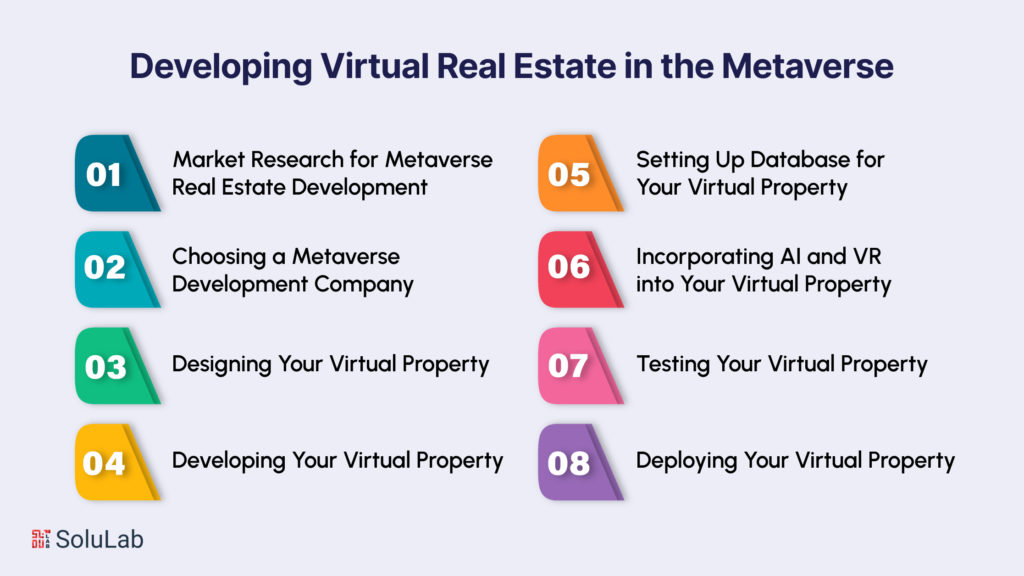
Steps to Developing Virtual Real Estate in the Metaverse

Steps to Developing Virtual Real Estate in the Metaverse

Step 1: Market Research for Metaverse Real Estate Development

Importance of Market Research

Conducting thorough market research is a critical first step when developing virtual real estate in the metaverse. As the metaverse matures, understanding user trends, behavior patterns, and emerging opportunities will be key to success.

Important reasons to conduct metaverse market research include:

  • Identifying the most popular metaverse platforms and environments.
  • Understanding user demographics and preferences.
  • Gauging demand for different types of virtual spaces and digital assets.
  • Analyzing the competitive landscape.
  • Projecting future growth areas and trends.

This data-driven approach helps developers recognize promising investment opportunities, align with user needs, and mitigate risks. Those who neglect market research may end up developing virtual properties that fail to attract users or generate revenue.

Conducting Effective Market Research

Useful methods of conducting metaverse market research include:

  • Surveys: Survey metaverse users about their interests, values, and needs.
  • Focus groups: Hold discussions with users to gain deeper qualitative insights.
  • Data analysis: Examine usage metrics and virtual asset transactions for various metaverse platforms.
  • Traffic estimation: Assess user traffic and popularity for specific metaverse environments.
  • Competitor benchmarking: Analyze competing virtual properties and development firms.

Read Also: Metaverse NFT – Foundation Of Next Blockchain Revolution!

Third-party data and reports can also provide valuable metaverse market insights. Useful sources include analytics firms, market research companies, real estate consultants, and industry associations.

Ongoing market research is also recommended even after initial development to identify new metaverse growth areas and inform future projects. With careful research, virtual real estate developers can make smart investments in the metaverse.

Step 2: Choosing a Metaverse Development Company

Considerations When Choosing a Metaverse Development Company

Once promising opportunities have been identified through market research, partnering with an experienced metaverse development company is key for bringing a virtual real estate project to life.

Here are some key considerations to evaluate when selecting a metaverse developer:

  • Technical expertise – Look for expertise in 3D modeling, VR/AR technologies, blockchain integration, gaming engines, and metaverse platform customization.
  • Design skills – Seek creative design capabilities for developing immersive and engaging virtual spaces.
  • Development portfolio – Review examples of past metaverse projects completed.
  • Domain experience – Prior experience building on specific metaverse platforms like Decentraland is valuable.
  • Quality assurance – Ensure the company has strong testing and bug-fixing capabilities.
  • Project management – Look for coordinated and structured development processes.
  • Support services – Post-launch maintenance and support should be offered.

Established real estate developers may partner with technology firms or outsource to specialist metaverse agencies. New startups focused exclusively on metaverse real estate are also emerging.

Thoroughly evaluating potential partners against key criteria will help identify the right metaverse developer for your project vision and needs.

Step 3: Designing Your Virtual Property

Key Elements of Virtual Property Design

The design process lays the foundation for bringing your virtual real estate vision to life. Key design elements to consider include:

  • Concept and Aesthetics – Develop an overarching design theme and visual style.
  • Architecture – Design the layout, structures, landscapes, and infrastructure.
  • 3D modeling – Create detailed and realistic 3D models of the property.
  • Customization – Incorporate customizable spaces and assets for users.
  • Functionality – Enable core functionalities like navigation, interactions, transactions, etc.
  • Scalability – Allow room to expand the property as needed.

Creative and strategic design is crucial for driving user engagement. Analyzing the successes and failures of existing virtual properties can provide valuable design insights.

User Engagement and Community Building in Design

Designing specifically for user engagement and community building is key. Useful strategies include:

  • Incorporating public spaces for users to socialize and interact
  • Enabling users to customize personal spaces to drive ownership
  • Designing scavenger hunts, contests, and games on the property
  • Creating event spaces for live performances, parties, and other activities
  • Allowing for user-generated content creation and sharing
  • Integrating real-time communication features like chat
  • Providing services and amenities that support community building

User engagement can make or break a virtual property. Evaluating design choices through the lens of the user experience is key to fostering an active and thriving community.

Step 4: Developing Your Virtual Property

Process of Virtual Property Development

Once the design phase is complete, the hard work of bringing the property to life begins. The development process typically involves:

  • Creating all required 3D models and artwork assets
  • Programming core functionalities like navigation, physics, transactions
  • Integrating interactive elements and mini-games
  • Building in social features for communication and collaboration
  • Developing the backend architecture and databases
  • Implementing security protections and access controls
  • Conducting alpha and beta testing
  • Fixing bugs and issues prior to launch

For large virtual properties, developing in phases may be more feasible than completing everything at once. The process requires close collaboration between real estate owners and technical developers.

Related: Top 10 Metaverse Development Companies in 2024

Monetization Strategies for Virtual Properties

There are several potential monetization strategies to consider building into virtual properties:

  • Renting out space for advertising, events, stores, etc.
  • Charging for access to premium amenities and features.
  • Offering paid customization options.
  • Facilitating in-world transactions and taking a percentage.
  • Selling virtual merchandise and collectibles.
  • Enabling virtual property and asset trading.

Monetization models should align closely with design elements and the overall user experience. Striking the right balance is key for generating revenue while maintaining engagement.

Step 5: Setting Up Database for Your Virtual Property

Importance of Database in Virtual Real Estate

Behind every metaverse virtual property is a robust backend database infrastructure. This serves several crucial functions, including:

  • Storing user account data and authentication credentials securely
  • Managing virtual asset ownership and inventory
  • Processing in-world transactions
  • Saving user-generated content and creations
  • Supporting persistent world states when users go offline
  • Providing access to property analytics and metrics

Without the database layer, virtual real estate could not deliver persistent and interconnected user experiences.

Steps to Set Up a Database for Your Virtual Property

Key steps involved in setting up the database include:

1. Structuring data into tables like users, assets, transactions, etc.

2. Choosing the right database technology like SQL, NoSQL, blockchain, etc.

3. Establishing data security protections, backups, and recovery processes

4. Developing APIs and schemas for interfacing with the application layer

5. Creating admin dashboards for monitoring and managing data

6. Integrating analytics to derive insights from property data

7. Load testing data infrastructure to ensure smooth performance

The optimal database architecture will depend on factors like the scale of users and data, the complexity of transactions, and security needs. Proper setup is well worth the investment for smooth operations.

Step 6: Incorporating AI and VR into Your Virtual Property

Role of AI and VR in the Metaverse

Integrating artificial intelligence (AI) and virtual reality (VR) can greatly enhance metaverse real estate properties in the following ways:

  • Immersion – VR allows users to deeply immerse themselves in the virtual environment.
  • Realism – AI and physics simulations make interactions more lifelike.
  • Personalization – AI can customize experiences to user preferences.
  • Automation – AI bots can automate tasks like customer service.
  • Analytics – AI derives insights from user data to improve the property.

As AI and VR advance, they will enable more seamless blending between virtual and physical spaces. Those leveraging these technologies early will gain a competitive edge.

Read Our Blog: A Future Based On Metaverse – A Solulab Take

Effective Use of AI and VR in Virtual Real Estate

Here are some examples of effective AI and VR incorporation:

  • Let users view property remotely in VR before purchasing.
  • Create AI assistants to guide and engage users.
  • Generate personalized recommendations for users based on data.
  • Use AI bots as virtual staff for information, sales, and support.
  • Incorporate VR gaming zones with simulated physics.
  • Enable voice commands via AI assistants.
  • Use data analytics to improve property design and features.

Gradual integration and consistent testing are key to smooth adoption. When thoughtfully implemented, AI and VR can greatly boost customer satisfaction and business performance.

Step 7: Testing Your Virtual Property

Importance of Testing in Virtual Real Estate Development

Thorough testing is crucial for identifying issues before launch. Testing virtual real estate provides the following benefits:

  • Fixes software bugs and glitches before users encounter them.
  • Ensures design elements are functioning as intended.
  • Validates proper integration with metaverse platforms.
  • Confirms stability, security, and performance can scale.
  • Allows time to improve complex features.
  • Reduces potential for problems post-launch.

Insufficient testing often results in virtual properties riddled with issues that drive users away. Investing in comprehensive testing pays dividends through smooth operations and increased customer satisfaction.

Read Also: Top 15 Metaverse Startups to Watch out in 2024

How to Conduct Effective Testing?

Some tips for effective testing include:

  • Develop a detailed test plan covering all key functions and use cases.
  • Conduct unit, integration, system, and user acceptance testing to ensure the quality and functionality of a product.
  • Automate testing where possible for faster results.
  • Conduct public beta testing to catch issues before launch.
  • Test on multiple platforms and devices.
  • The stress test at scale to validate robustness.
  • Fix high-priority bugs first before launch.

Allocate sufficient time and resources for testing – at least 25% of the overall project timeline. Leverage user feedback to keep improving the property even after launch.

Step 8: Deploying Your Virtual Property

Process of Deployment in Virtual Real Estate

When ready for launch, deploying a virtual property involves:

1. Integrating with the target metaverse platform.

2. Allocating sufficient computing resources.

3. Establishing monitoring and alert systems.

4. Creating operational procedures and documentation.

5. Developing a deployment schedule and rollout plan.

6. Running final tests before going live.

7. Providing user support during the launch phase.

8. Tracking issues and performance post-launch.

Gradual rollout to subsets of users is recommended to minimize risk. Allowing Gradual rollout to subsets of users is recommended to minimize risk. Allocating technical staff for ongoing monitoring and quick issue resolution is key. Leverage user feedback to continually refine and optimize the live property.

Read Our Recent Blog: Metaverse AI: Integrating Artificial Intelligence into Virtual Worlds

Maintaining and Updating Your Virtual Property Post-Deployment

Launching is only the beginning – ongoing maintenance and updates are critical for success. Post-deployment priorities include:

  • Monitoring performance metrics and usage data.
  • Quickly resolving any emerging issues or bugs.
  • Regularly creating new content and features.
  • Communicating frequently with users.
  • Releasing updates and bug fixes.
  • Improving designs based on user feedback.
  • Balancing stability with innovation.

Dedicate resources for ongoing development, not just a one-time launch. The most successful virtual properties continually evolve and improve over time. Leverage data and user input to determine high-impact maintenance priorities post-deployment.

Future of Metaverse Real Estate Development

Virtual real estate is still in its early days, but its future potential is vast. As metaverse platforms grow more advanced and immersive, demand for virtual property will rise across industries like retail, hospitality, offices, and housing. Truly persistent 3D social worlds will become mainstream within the next decade.

Real estate developers who gain competency early will have a first-mover advantage as the market matures. Creative developers who provide best-in-class user experiences will see their virtual properties appreciate substantially in value over time. The next few years represent an exciting inflection point for the metaverse real estate industry.

Opportunities and Challenges in Metaverse Real Estate Development

While the metaverse presents groundbreaking opportunities, it also poses new challenges, including:

  • Nascent technology still requires maturation.
  • Fragmentation across multiple emerging platforms.
  • Unclear regulatory environments and rights of ownership.
  • Lack of standards and best practices.
  • Evolving user preferences and behaviors.

Agility, creativity, and a tolerance for uncertainty will be key success factors. The rewards will be substantial for those bold enough to pioneer virtual real estate development amidst such challenges during these early frontier times.

In the realm of metaverse development, SoluLab’s commitment to crafting tailored solutions that align with unique business goals and creative aspirations sets it apart. Whether it’s creating immersive virtual environments, interactive experiences, or leveraging blockchain for decentralized applications within the metaverse, SoluLab’s proven track record makes it a trusted partner on the journey to building worlds beyond reality estate.

CTA2

Conclusion

In the ever-evolving landscape of technology, the concept of the metaverse has emerged as a beacon of innovation, offering a glimpse into a world beyond reality estate. As we explored the metaverse guide, it’s clear that this digital universe holds immense potential for reshaping how we interact, collaborate, and experience the digital realm.

The metaverse is not just a realm of entertainment; it’s a space where businesses, communities, and individuals can come together to create, explore, and thrive. With the power to blend virtual and physical experiences seamlessly, the metaverse offers a new horizon for connection, engagement, and imagination.

As we conclude this exploration of the metaverse, one thing is clear: the metaverse isn’t just a vision of the future; it’s a transformative force shaping the present. Embracing metaverse development isn’t just about creating virtual worlds; it’s about crafting meaningful experiences that resonate with people on a profound level.

To embark on a journey into the metaverse, partnering with a trusted and experienced metaverse development agency is essential. SoluLab stands as a beacon in this realm, with its deep understanding of immersive technologies, innovation-driven approach, and a team of skilled developers and designers. With SoluLab’s expertise, businesses and creators can navigate the complexities of metaverse development, translating visionary concepts into tangible experiences that captivate audiences.

So, whether you’re a business seeking to engage customers in new ways, a content creator envisioning immersive narratives, or an individual yearning for new dimensions of interaction, you can hire the best Metaverse developers from SoluLab. And with SoluLab as your metaverse development partner, the journey to building worlds beyond reality estate becomes an exhilarating reality in itself. Ready to take the leap into the Metaverse? Contact SoluLab today to embark on this exciting journey!

FAQs

1. What is metaverse development?

Metaverse development refers to the process of creating immersive digital environments that blend virtual and physical experiences. It involves using technologies like augmented reality (AR), virtual reality (VR), blockchain, and other emerging tech to build interactive and interconnected virtual worlds where users can engage, socialize, create content, and even conduct business.

2. What are the key components of a metaverse?

A metaverse comprises various components, including virtual environments, avatars, interactive objects, social features, and digital economies. These elements come together to create a seamless and interconnected digital universe where users can explore, interact, and collaborate.

3. How can businesses benefit from metaverse development?

Businesses can leverage metaverse development to engage customers in novel ways, enhance brand experiences, and create new revenue streams. It opens doors to immersive marketing, virtual events, product launches, and interactive customer interactions, enabling deeper connections with the audience.

4. What role does blockchain play in the metaverse?

Blockchain technology adds transparency, security, and ownership to the metaverse. It can be used to authenticate digital assets, enable secure transactions, and build decentralized applications within the metaverse. This empowers users with true ownership of digital items and enhances trust within virtual ecosystems.

5. Why should I choose SoluLab for metaverse development?

SoluLab stands out as a reputable metaverse development company with a proven track record in immersive technologies and innovation. With a team of skilled developers and designers, SoluLab offers tailored solutions that align with your unique creative vision and business goals. Their expertise spans virtual environments, interactive experiences, and the integration of cutting-edge technologies like AR, VR, and blockchain.

6. What kind of experiences can be created in the metaverse?

The metaverse offers a wide range of experiences, from virtual events and social gatherings to interactive storytelling, gaming, education, and even virtual commerce. Users can explore vast landscapes, connect with others, attend concerts, participate in workshops, and engage in activities that were previously limited by physical constraints.

7. How can I get started with metaverse development?

To embark on metaverse development, you can begin by defining your goals and vision for the virtual world you want to create. Partnering with a metaverse development agency like SoluLab can help you navigate the complexities of technology, design, and user experience, ensuring that your metaverse aligns with your objectives and resonates with your target audience.

 

Top Metaverse Development Companies in 2025

The term “metaverse” has become a buzzword in the past decade, with computer titans such as Google, Facebook (Meta), and Microsoft contributing to metaverse initiatives. The metaverse is growing as a vast decentralized virtual environment of the future as the excitement around it builds. Bloomberg estimates that the worldwide Metaverse income opportunity will be worth $800 billion by 2024. The major market for online game makers and gaming gear may exceed $400 billion, with the balance made up of live entertainment and social media prospects.

Businesses are keen to expand their metaverse ventures since active users increase on a daily basis and more individuals invest in it. Gartner predicts that by 2026, 30% of the world’s enterprises will have adopted goods and services to get ready for the metaverse.

As a result, in this article, we will look at the top 10 metaverse development companies in 2025. This list has been assembled based on our extensive analysis and research to help businesses pick the best metaverse company for their unique needs.

So, without any further ado, let’s get started!

How Did We Compile the List of Top Metaverse Development Companies?

Although choosing the best metaverse development companies was a challenging task, we have come up with great results by considering the following factors:

1. Years of experience in metaverse development

2. Client testimonials and feedback

3. Quality of delivered metaverse products and solutions

4. Team size and expertise

5. Range of industries served by the company

6. The number of successful metaverse projects completed

7. Expertise in understanding business requirements and market trends

8. Technology stack and innovative approaches to metaverse development

So, if you want to dive into the metaverse and create compelling virtual experiences, these top metaverse development companies are the ones to watch and collaborate with. Now, let’s explore these top metaverse platforms and metaverse development companies to comprehend how they are shaping the future.

Here are the Top 10 Metaverse Development Companies in 2025.

1. SoluLab

SoluLab stands out as a top metaverse development company, specializing in crafting bespoke applications infused with custom metaverse elements using blockchain technology. Their team, composed of top-rated metaverse developers, is adept at delivering a range of services including metaverse social media, NFT marketplaces, gaming metaverse, and 3D space development. Committed to establishing decentralized gaming, social, and commercial environments within the metaverse, SoluLab’s expertise extends across blockchain, AR/VR, Web3, and the Metaverse, ensuring tailored solutions for their clients.

With a focus on innovation, SoluLab’s skilled metaverse experts leverage their in-depth knowledge of metaverse technologies to create unique platforms such as metaverse social media networks, NFT marketplaces, and immersive gaming experiences. Specializing in 3D space development, they excel in constructing virtual environments that captivate users across diverse applications. Through a fusion of modern technology and a dedication to decentralized and interactive experiences, SoluLab remains the best metaverse development company on our list.


$25-$49


50-249


2014


Los Angeles, CA, USA


Excalibur, Titans

2. Capgemini

Capgemini is a multinational metaverse company known for its consulting, technology, and professional services expertise. They provide metaverse development services incorporating blockchain-specific features like automation, privacy, transparency, and user sovereignty. Capgemini assists clients in creating virtual worlds for businesses to engage with their customers effectively.


$49


270,000


1967


Paris, France


Coca-Cola, Nestle, ExxonMobil, Airbus, Unilever

3. Suffescom Solutions

Suffescom Solutions Inc. is a leading metaverse development company that offers custom metaverse development services using technologies like blockchain, AR/VR, and Web3. Their highly experienced experts specialize in building high-quality web3 and Metaverse applications. Suffescom Solutions can help you leverage the potential of the metaverse to enhance your business.


$90


50-249


2011


Mohali, India


L’Oreal, Starbucks, Yamaha, Sennheiser, Fox Sports

4. Infosys

Infosys, one of India’s largest IT firms, has unveiled the Infosys metaverse foundry to help companies navigate the convergence of technologies such as XR, DLT, AI, and IoT. Along with business consultancy, It is one of India’s top metaverse development companies, which provides augmented reality (AR) and virtual reality (VR) solutions. The Infosys metaverse foundry allows businesses to establish their metaverse environment and adapt to changing market trends.


$90


270,000


1981


Bangalore, India


Microsoft, Intel, Amazon, Apple, Google

5. Wipro

Wipro assists its clients in designing and creating their metaverse platforms to add value to their businesses. With a wide range of metaverse development services, It is giving tough competition to the top metaverse development companies in USA Wipro caters to clients across various industries. They help organizations fulfill their objectives by leveraging the power of the metaverse.


$90


190,000


1945


Bangalore, India


Citibank, PepsiCo, Cisco, GE, Nokia

6. TCS

TCS, a well-established IT company, has recently entered the metaverse development services arena and is also recognized as one of the top metaverse development company. Known for providing exceptional IT services, TCS focuses on delivering a metaverse work experience to individuals joining the company through virtual platforms. They offer various services, including mobile applications, IoT, cloud solutions, blockchain, and automation.


$90


500,000


1968


Mumbai, India


General Electric, American Express, Sony, Procter & Gamble, British Airways

7. Accenture

As a Fortune 500 company, Accenture is known for its expertise in app development, blockchain, cloud computing, and supply chain/operations management. Accenture is one of the top metaverse development companies providing services for connecting individuals to the digital world. They use metaverse technology to enhance meetings, learning sessions, and team gatherings, improving the recruitment experience.


$99


492,000


1989


Dublin, Ireland


Microsoft, SAP, IBM, Oracle, Salesforce

8. Decentraland

Decentraland is a browser-based 3D virtual world platform that allows content creators and businesses to explore new artistic mediums and business opportunities. The reason for being this metaverse company in the top 10 metaverse companies is Users can build and sell various apps, content, and virtual land in the metaverse using the MANA cryptocurrency based on the Ethereum blockchain. Decentraland offers a decentralized platform for immersive metaverse experiences.


$50


250


2017


CA, USA


N/A

9. NVIDIA

NVIDIA is a global leader in computer graphics hardware and is known for its expertise in gaming. It is proven that it is one of the best metaverse development companies in the USA NVIDIA Omniverse is a physically realistic, real-time simulation platform that enables artists, designers, engineers, and researchers to work in a virtual world. The platform has gained significant traction and is used by professionals from various organizations.


$50


23,000


1993


Santa Clara, USA


Adobe, BMW, Google, Microsoft, Tesla

10. Unity Software

Unity Software is a popular platform for developing 3D content. Also, it is among the top 10 metaverse companies, with Unity designers responsible for more than 70% of the top 1,000 mobile games worldwide. Unity can empower artists and creators in the metaverse by providing them with the necessary tools for content development.


$50


5,000


2004


San Francisco, USA


Ubisoft, Electronic Arts, LEGO, Coca-Cola, NASA

CTA 2

Benefits of Collaborating with Leading Metaverse Development Companies

When venturing into new territory, such as metaverse development, businesses often grapple with the decision of building an in-house team or outsourcing the project to seasoned professionals. Many entrepreneurs opt to engage top metaverse development companies for a host of compelling reasons. Let’s delve into the benefits of forging partnerships with these professional vendors.

1. Streamlined HR Efforts: Shifting the burden of assembling specialized teams onto outsourcing professionals minimizes the need for extensive recruitment efforts. Instead of navigating through numerous CVs and conducting multiple job interviews, businesses can focus on finding a reliable technical partner who aligns with their requirements and budget, leaving the outsourcing professionals to construct the ideal team for metaverse development.

2. Comprehensive Solutions: Opting for a single outsourcing vendor ensures a holistic approach to project needs. From in-depth research and analysis to software development, testing, and more, top metaverse development companies possess the necessary resources, including software, hardware, and skilled specialists, to execute full-cycle development. Alternatively, instead of hiring metaverse developers directly, you could engage a specialist developer recruitment agency to source the right talent, ensuring access to highly qualified professionals without the challenges of direct hiring.

3. Enhanced Time Efficiency: Unlike in-house teams, where unforeseen obstacles can disrupt timelines, experienced outsourcing vendors provide realistic estimations before project commencement. By incorporating timing requirements into the contract, businesses can achieve greater time efficiency and reduce the likelihood of delays and postponements often associated with managing in-house teams.

4. Cost-Effective: Predicting project expenditures can be challenging, especially when venturing into unfamiliar domains. Leading metaverse development companies, leveraging their expertise, can furnish accurate budget estimations, aligning with client expectations. Some firms even demonstrate flexibility, accommodating clients within their budget constraints.

5. Risk Mitigation: Complex projects like metaverse development come with inherent risks, ranging from personnel changes to technical issues. Engaging top metaverse development companies transfer the responsibility of troubleshooting and issue resolution to outsourcing service managers, reducing risks and ensuring timely product delivery.

Conclusion

In conclusion, the top metaverse development companies of 2025 have made significant contributions to shaping the metaverse landscape. Their expertise, creativity, and user-centric design have established them as frontrunners in this rapidly evolving field. As the metaverse crypto-list continues to expand, these companies will play a pivotal role in redefining digital interactions and shaping the future of immersive virtual experiences.

SoluLab emerges as a standout leader in metaverse development, offering comprehensive metaverse development services tailored to help businesses thrive in this dynamic realm. Their team of seasoned professionals, boasting expertise in blockchain development solutions, smart contracts, design, and project management, enables them to deliver secure and scalable metaverse development solutions.

It sets itself apart through its ability to create intuitive interfaces, implement groundbreaking features, and foster vibrant community engagement. By choosing SoluLab as your trusted metaverse development partner, you can embark on a transformative journey, unlock untapped growth opportunities, and tap into the full potential of this evolving technology.

FAQs

1. What is the Metaverse, and how does it work?

The Metaverse is a virtual environment where users can interact with each other and digital content in real-time. It is created using virtual reality (VR), augmented reality (AR), blockchain, and artificial intelligence. Users can navigate through the Metaverse using avatars and engage in various activities such as socializing, gaming, and commerce.

2. How can I get started in the Metaverse?

To get started in the Metaverse, you can begin by exploring existing virtual worlds and platforms that offer Metaverse experiences. You can create an account, customize your avatar, and start interacting with other users. Additionally, you can join communities, attend events, and discover opportunities to participate in virtual activities such as gaming, concerts, and marketplaces.

3. Is the Metaverse safe and secure for users?

Generative AI can introduce a great deal of automation and can improve areas of businesses such as marketing, sales, and IT department with content generation, well-structured codes, documentation, and intelligent decision-making to strategies campaigns and attract clients with enhanced customer-centric products.

4. Can I monetize my activities in the Metaverse?

Yes, you can monetize your activities in the Metaverse. Many virtual worlds and platforms allow users to buy, sell, sell virtual goods, participate in virtual economies, and earn real-world income through streaming content creation and business ventures. The Metaverse offers opportunities for individuals and businesses to generate revenue and economic value.

5. What industries can benefit from the Metaverse?

The Metaverse has the potential to benefit a wide range of industries. Some sectors that can leverage the Metaverse include gaming, entertainment, education, healthcare, real estate, retail, and advertising. The immersive and interactive nature of the Metaverse opens up new possibilities for engagement, collaboration, training, marketing, and customer experiences across these industries, revolutionizing how we interact with digital content and services.
