


In the landscape of e-commerce, where competition is fierce and consumer expectations continue to rise, staying ahead of the game is imperative for businesses. One transformative strategy that has gained prominence in recent years is the integration of Generative Artificial Intelligence (AI) into e-commerce operations. Generative AI, a subset of Artificial Intelligence (AI), possesses the remarkable ability to create new content, whether it’s text, images, videos, or even music.
In this blog, we delve into the strategies for effectively harnessing the power of Generative AI in e-commerce, exploring its profound impact on the digital shopping experience and the strategies that underpin its successful implementation.
Before delving into strategies for its application, it’s crucial to grasp the fundamental concepts of Generative AI and generative AI development.
At the core of Generative AI lies generative models—sophisticated algorithms and neural networks that are trained to generate data that resembles the input data they were trained on. These models are capable of producing new content that can be remarkably indistinguishable from human-created content. Two notable types of generative models are Generative Adversarial Networks (GANs) and Variational Autoencoders (VAEs).
Check Our Blog Post: Top 10 Generative AI Development Companies
Two essential concepts underpin the workings of Generative AI: training and inference.
Now that we’ve established the fundamental principles of Generative AI, let’s delve into the myriad applications it offers within the realm of e-commerce.
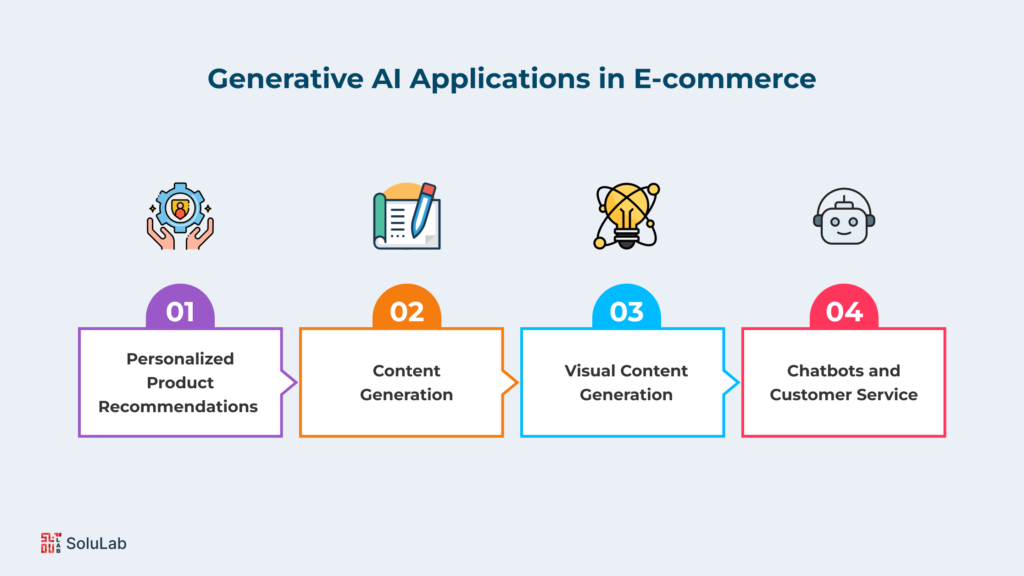
Generative AI’s versatility finds myriad applications in the e-commerce landscape, revolutionizing the way businesses interact with consumers and enhancing the overall shopping experience.
One of the most powerful applications of Generative AI in e-commerce is its ability to deliver personalized product recommendations. Through the analysis of user behavior, purchase history, and preferences, generative models can create tailored product suggestions for each customer. This level of personalization not only improves the likelihood of conversion but also enhances customer satisfaction by presenting products that align with individual tastes.
Read Also: Generative AI in the Manufacturing Process
Content is the lifeblood of e-commerce, from product descriptions to customer reviews and marketing copy. Ecommerce Generative AI can efficiently produce this content, saving businesses valuable time and resources. Furthermore, AI-generated content tends to be consistent and engaging, ensuring that product listings and marketing materials maintain a high standard across a vast product catalog.
In the visually-driven world of e-commerce, the ability to create compelling visual content is paramount. Generative AI development can generate product images, design eye-catching advertisements, and even produce video content. This not only streamlines the content creation process but also ensures a visually cohesive brand identity, captivating potential customers.

Enhancing customer service through AI-driven chatbots is another avenue where Generative AI development shines. Chatbots powered by Generative AI can provide instant responses to customer inquiries, whether they pertain to product queries, order tracking, or general inquiries. These chatbots operate round-the-clock, improving accessibility and engagement, while freeing up human agents for more complex tasks.
These applications represent just the tip of the iceberg when it comes to Generative AI’s potential in e-commerce. However, to effectively leverage these capabilities, businesses must implement well-thought-out strategies. In the next section, we’ll explore the essential strategies that underpin the successful integration of Generative AI and e-commerce operations.
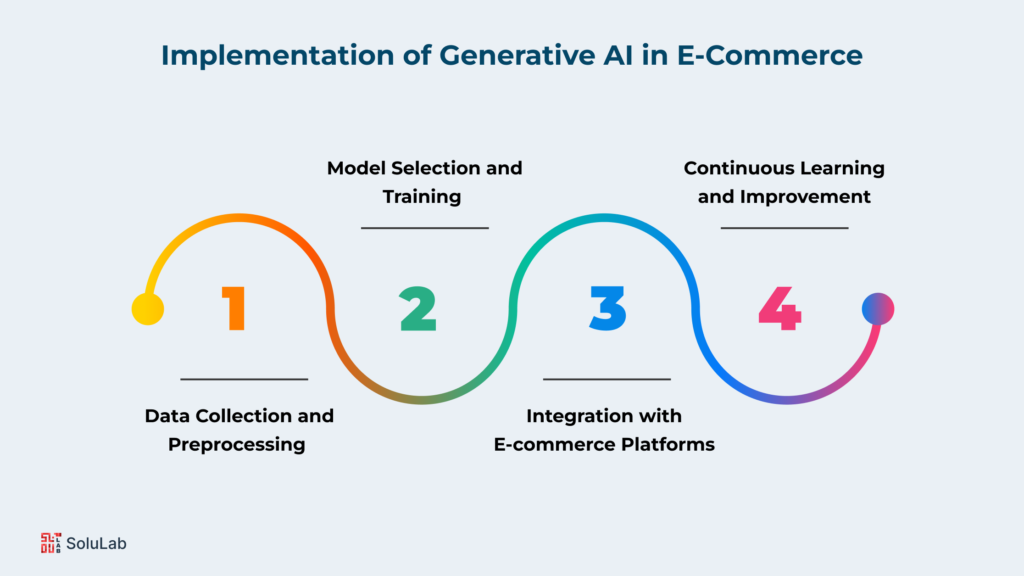
Implementing Generative AI in an e-commerce environment is a multifaceted endeavor, encompassing several crucial strategies and considerations.
The foundation of any successful Generative AI project is high-quality data. Businesses must invest in data collection methods that yield rich, diverse, and representative datasets. Additionally, data preprocessing is essential to clean, format, and prepare the data for training. Without quality data and preprocessing, the AI model’s performance will be compromised.
Selecting the appropriate generative model for a specific e-commerce task is paramount. The choice may depend on factors such as the type of content to be generated and the complexity of the task. Once a model is selected, it undergoes a rigorous training process. This process can be resource-intensive and time-consuming, but it’s the crucible in which the model acquires the knowledge necessary to generate high-quality content.
Read Our Blog: How Generative AI is Revolutionizing Art
For seamless operations, Generative AI solutions must integrate effectively with e-commerce platforms, such as Shopify, WooCommerce, or Magento. This integration ensures that AI-generated content and recommendations seamlessly flow into the customer experience, enhancing the overall shopping journey.
The AI journey doesn’t end with deployment. To stay relevant and effective, Generative AI models must undergo continuous learning and improvement. This involves periodic updates, retraining, and adaptation to changing customer preferences and market trends. Businesses that commit to ongoing refinement can maintain a competitive edge in the ever-evolving e-commerce landscape.
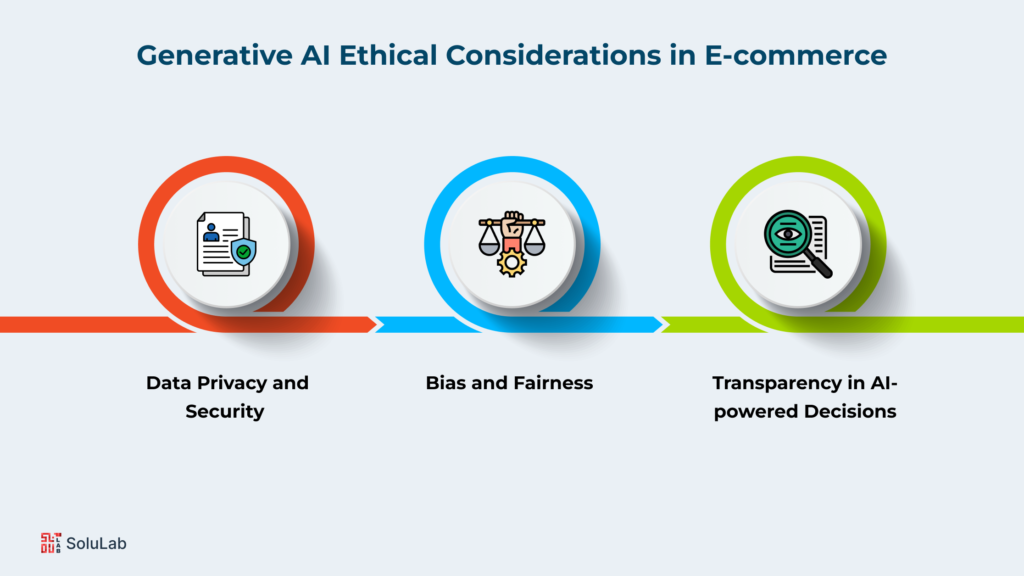
While Generative AI holds immense promise, it also comes with a set of ethical considerations that cannot be overlooked. In the next section, we’ll delve into these crucial aspects of responsible AI implementation in e-commerce.
The integration of Generative AI in e-commerce brings forth a series of ethical considerations that businesses must carefully navigate. Addressing these concerns is not only essential for maintaining consumer trust but also for ensuring fair and responsible AI practices.
Read Our Blog Post: 10 Ways Generative AI is Revolutionizing Healthcare
Maintaining ethical AI practices is not only a moral imperative but also a means to mitigate risks associated with public backlash, legal challenges, and reputational damage.
While Generative AI offers significant advantages, businesses must be aware of the challenges and potential pitfalls associated with its implementation.
The Generative AI landscape is continually evolving, and e-commerce is poised to experience further transformation in the years to come.
Read Our Blog: Generative AI and Human Creativity
In conclusion, Generative AI development solutions are a transformative force in e-commerce, offering businesses the means to enhance personalization, streamline content creation, and improve customer service. By adhering to ethical considerations, staying vigilant about potential challenges, and adapting to future trends, businesses can fully leverage the potential of Generative AI technology to create a dynamic and engaging digital shopping experience for consumers. As the e-commerce landscape continues to evolve, embracing Generative AI will be pivotal in staying competitive and relevant in the digital marketplace.
Solulab is a prominent software development company known for its innovative solutions and cutting-edge technology expertise. Specializing in areas like blockchain, IoT, and artificial intelligence, Solulab has established itself as a trusted partner for businesses looking to harness the power of emerging technologies. While not directly linked to Generative AI development, Solulab’s expertise in AI and machine learning can undoubtedly be leveraged to assist e-commerce companies in implementing Generative AI consulting services. By utilizing Solulab’s technical prowess and experience, e-commerce businesses can navigate the complexities of AI integration more effectively, ensuring that Generative AI tools enhance the shopping experience for their customers and boost their competitive edge in the digital marketplace.
Generative AI is a subset of artificial intelligence that can create new content, such as text, images, or videos, that closely resembles human-generated content. In e-commerce, it is used to personalize product recommendations, generate product descriptions, and create visual content like images and videos. It enhances the overall shopping experience by tailoring content to individual customer preferences.
Generative AI enhances the customer shopping experience by providing personalized product recommendations based on individual preferences and behavior. It also streamlines content creation, ensuring consistent and engaging product descriptions and marketing materials. AI-powered chatbots further improve customer service by providing instant responses to inquiries.
Implementing Generative AI in e-commerce comes with challenges such as obtaining high-quality training data, managing the computational resources required for model training, and addressing bias in AI-generated content. Additionally, businesses must navigate ethical considerations related to data privacy, security, and transparency.
Businesses can ensure the ethical use of Generative AI by prioritizing data privacy and security, implementing robust security measures, and complying with data protection regulations. They should also regularly monitor AI models for bias, mitigate bias when detected, and maintain transparency in AI-powered interactions with customers.
Future trends in Generative AI for e-commerce include the development of improved model architectures that enhance creativity and efficiency. Multimodal AI, capable of generating content across multiple modalities simultaneously, is also expected to gain prominence. Hyper-personalization and the dominance of AI-driven content in product listings and marketing materials are predicted to shape the future of e-commerce. So, to leverage this technology hire generative AI developers.


