
Talk to an Expert

Defi : The Influensive Trend in Blockchain- A Complete Guide

Defi The Influensive Trend in Blockchain- A Complete Guide

Decentralized Finance, often referred to as DeFi, has emerged as one of the most influential trends in the blockchain space. This revolutionary concept leverages blockchain technology to create a decentralized financial ecosystem that operates without traditional intermediaries like banks. In this comprehensive guide, we will delve into the world of DeFi, exploring its platforms, protocols, development companies, lending platforms, trading platforms, and how it all ties into the broader blockchain landscape.

What is DeFi?

Decentralized Finance, commonly known as DeFi, is a revolutionary movement within the blockchain ecosystem protocols that seeks to recreate traditional financial systems using blockchain technology. Unlike traditional finance, which relies on centralized intermediaries like banks and financial institutions, DeFi operates on decentralized platforms and smart contracts. 

It encompasses a wide range of financial services and applications, including lending, borrowing, trading, asset management, and more, all built on blockchain networks. DeFi platforms, protocols, and development companies play a pivotal role in enabling this ecosystem, while blockchain technology provides the foundation for its transparency and security. 

Furthermore, DeFi is closely intertwined with blockchain trends, as it leverages blockchain’s potential to disrupt traditional finance and expand into other industries beyond the financial sector. This transformative trend is redefining the way we think about and interact with financial services, offering users greater control and accessibility to their financial assets and transactions.

How Does DeFi Work?

DeFi applications are built on blockchain technology, which is a distributed ledger system that records transactions in a secure and transparent manner. Blockchain technology allows DeFi applications to operate without the need for a central intermediary.  Top DeFi protocols use smart contracts to automate transactions and interactions between users. 
Benefits of DeFi

Benefits of DeFi

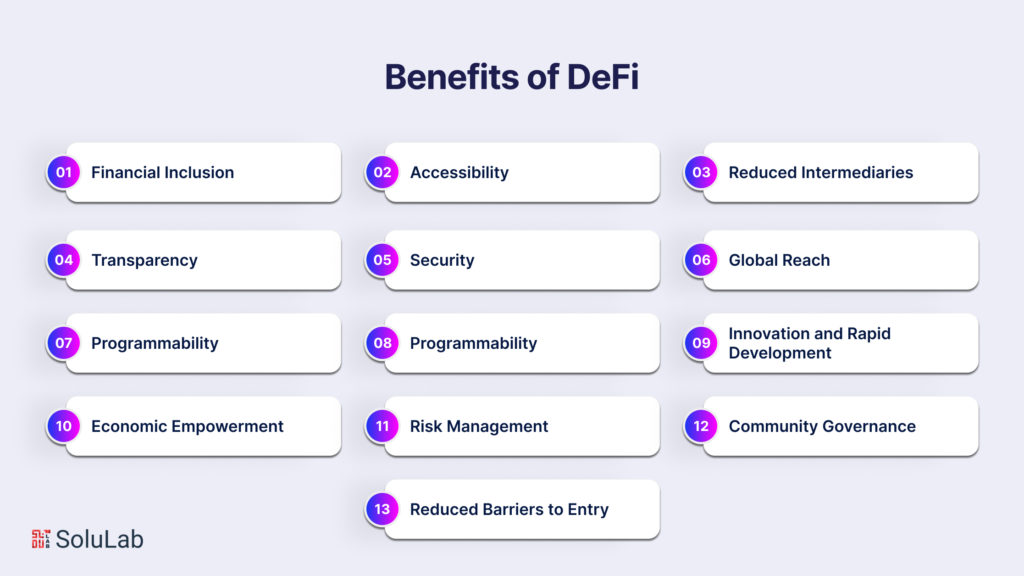
Decentralized Finance (DeFi) is transforming the financial landscape in numerous ways, offering a wide array of benefits to users, developers, and the global economy. 

  • Financial Inclusion

DeFi opens up financial services to anyone with internet access, enabling global financial inclusion. This is especially significant in regions with limited access to traditional banking. According to the World Bank, around 1.7 billion adults worldwide remain unbanked. DeFi can bridge this gap and empower individuals to access and manage their finances.

  • Accessibility

Unlike traditional financial markets with set trading hours, DeFi operates 24/7, allowing users to trade, lend, and borrow at their convenience. This accessibility provides flexibility and empowers users to make real-time financial decisions.

  • Reduced Intermediaries

Traditional financial systems rely on intermediaries like banks, brokers, and clearinghouses, which charge fees for their services. DeFi minimizes or eliminates these intermediaries, reducing costs for users. Smart contracts execute transactions automatically, bypassing the need for intermediaries and their associated fees.

  • Transparency

DeFi leverages blockchain technology to ensure transparent and immutable record-keeping. Every transaction is recorded on a public ledger, providing users with complete transparency. This transparency enhances trust, as users can independently verify all transactions.

  • Security

DeFi benefits from the security features of blockchain technology. Smart contracts, once deployed, are immutable, reducing the risk of tampering or fraud. The security of blockchain has contributed to a significant decrease in successful attacks on DeFi platforms.

  • Global Reach

Cross-border payments are a significant part of the global economy. DeFi enables seamless cross-border transactions, allowing users to send and receive funds globally without the delays and high fees associated with traditional cross-border banking services.

CTA1

  • Programmability

DeFi platforms are highly programmable, allowing developers to create customized financial solutions. This programmability has led to the development of a diverse range of applications, including yield farming, decentralized exchanges, automated trading bots, and more. Users can participate in these innovative financial services.

  • Yield Opportunities

DeFi platforms like Compound and Aave offer users the opportunity to earn interest on their assets. Users can participate in lending or liquidity provision, often earning yields that surpass traditional savings account rates by a significant margin. This opens up new avenues for passive income and wealth creation.

  • Innovation and Rapid Development

DeFi is characterized by its rapid pace of innovation. New projects, tokens, and protocols continually emerge, offering new financial products and services. The open-source nature of DeFi fosters competition and innovation, driving the development of cutting-edge solutions.

  • Economic Empowerment

DeFi can empower individuals to take control of their finances. Users are not reliant on centralized institutions; they have custody of their assets and can engage in financial activities autonomously. This increased agency can lead to greater financial empowerment and self-reliance.

  • Risk Management

DeFi platforms often allow users to set their own risk parameters. For example, users can choose the level of collateral required for loans, mitigating risk to some extent. Additionally, DeFi insurance projects offer coverage against smart contract vulnerabilities and hacks, further enhancing risk management.

  • Community Governance

Many DeFi projects employ decentralized governance mechanisms. Token holders have a say in protocol upgrades and decision-making. This approach promotes a more democratic and community-driven ecosystem.

  • Reduced Barriers to Entry

In traditional finance, launching financial products and services can be highly regulated and costly. DeFi reduces these barriers to entry for entrepreneurs and developers, making it easier to create and launch financial innovations.
Applications of Defi

Applications of Defi

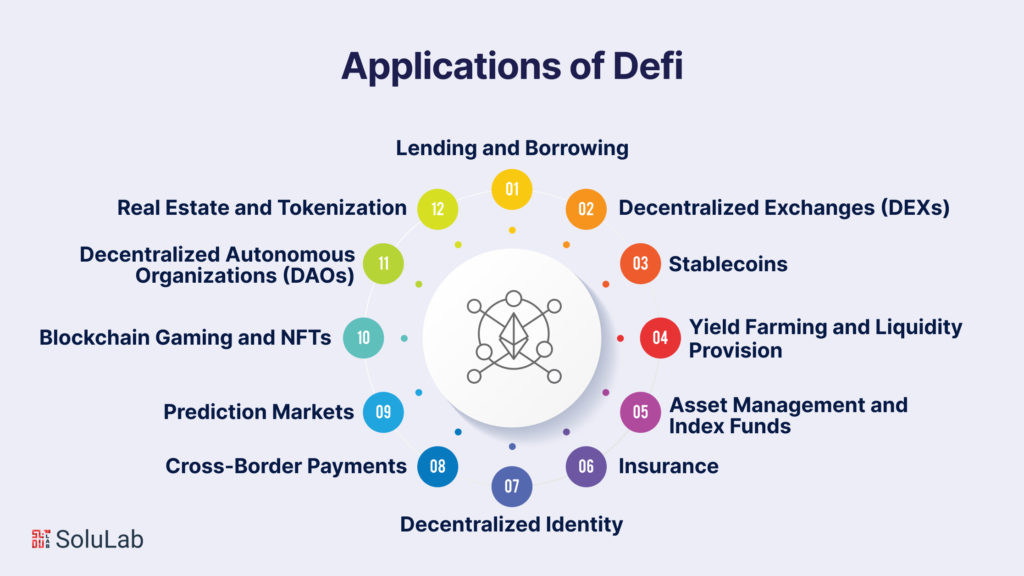
Decentralized Finance (DeFi) has a wide range of applications that are transforming the traditional financial landscape. These applications leverage blockchain technology to provide innovative and decentralized solutions to various financial services. Here are some key applications of DeFi:

  • Lending and Borrowing

DeFi lending platforms allow users to lend their crypto assets to earn interest, while borrowers can use their crypto holdings as collateral to secure loans. These platforms often offer more attractive interest rates than traditional banks.

Examples: Compound Finance, Aave, MakerDAO

  • Decentralized Exchanges (DEXs)

DEXs enable users to trade cryptocurrencies directly without the need for a centralized intermediary. They provide liquidity and allow for trustless and transparent trading.

Examples: Uniswap, SushiSwap, Balancer

  • Stablecoins

Stablecoins are digital currencies crafted with the intention of preserving a fixed value, frequently linked to a traditional currency such as the US dollar. They serve as a stable medium of exchange and a store of value within the volatile crypto market.

Examples: USDC, USDT, DAI

  • Yield Farming and Liquidity Provision

Yield farming encompasses the act of supplying liquidity to DeFi protocols in return for incentives. Users can earn tokens and interest by locking up their assets in liquidity pools.

Examples: Yearn.finance, Curve Finance, Balancer

  • Asset Management and Index Funds

DeFi allows users to create, manage, and invest in tokenized portfolios, enabling automated trading and diversification of assets.

Examples: Set Protocol, PieDAO

  • Insurance

DeFi insurance platforms provide coverage against smart contract vulnerabilities and hacks in the DeFi ecosystem, offering protection to users.

Examples: Nexus Mutual, Cover Protocol

  • Decentralized Identity

DeFi can be used to establish decentralized identity systems, giving users more control over their personal information.

Examples: uPort, SelfKey

  • Cross-Border Payments

DeFi facilitates cost-effective and rapid cross-border transactions, reducing the fees and delays associated with traditional international transfers.

Examples: Stablecoin-based remittance services

  • Prediction Markets

DeFi prediction markets enable users to create and participate in markets for predicting real-world events, offering a decentralized way to speculate on outcomes.

Examples: Augur, Gnosis

  • Blockchain Gaming and NFTs

DeFi and blockchain technology are integrated into the gaming industry, allowing players to buy, sell, and trade in-game assets and NFTs.

Examples: Axie Infinity, Decentraland

  • Decentralized Autonomous Organizations (DAOs)

DAOs are organizations governed by smart contracts and token holders, enabling decentralized decision-making and governance.

Examples: Yearn Governance, Compound Governance

  • Real Estate and Tokenization

DeFi can be used to tokenize real estate assets, making it easier for users to invest in properties and participate in real estate markets.

Examples: RealT, Propy
Blockchain and its Role in DeFi

Blockchain and its Role in DeFi

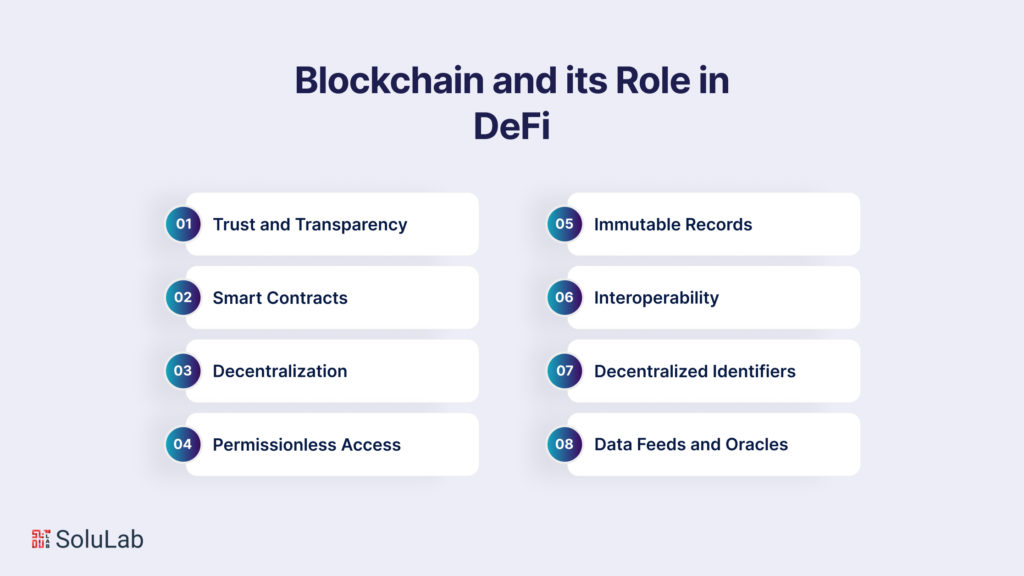
Blockchain technology plays a pivotal role in the success and functionality of Decentralized Finance (DeFi). It underpins the entire DeFi ecosystem, providing the infrastructure and key features necessary for its operation. Here’s how blockchain contributes to DeFi:

  • Trust and Transparency

Blockchain is a decentralized and distributed ledger technology. It records transactions in a secure and transparent manner across a network of nodes. This transparency ensures that all DeFi transactions are publicly verifiable, and participants can audit the transaction history. Users can trust that the information on the blockchain is accurate and tamper-proof.

  • Smart Contracts

DeFi relies heavily on smart contracts to automate and execute financial agreements without the need for intermediaries. These contracts are immutable and executed according to predefined rules, enhancing the security and reliability of financial transactions.

  • Decentralization

Blockchain networks, such as Ethereum, are decentralized, meaning there is no central authority or intermediary controlling the system. DeFi applications leverage this decentralization, eliminating the need for trusted third parties like banks. Users retain control of their assets and transactions, reducing counterparty risk.

  • Permissionless Access

DeFi platforms built on blockchain technology are generally permissionless, meaning anyone with an internet connection and the required assets can access and use these services. This inclusivity opens financial services to a global audience without regard for geographical location, background, or identity.

  • Immutable Records

Once a transaction has been added to a blockchain, it becomes immutable, i.e. it cannot be altered or deleted. This immutability enhances the security of financial transactions, making it difficult for fraudulent or unauthorized changes to occur.

  • Interoperability

Blockchain networks and protocols are often designed to be interoperable, allowing DeFi platforms to communicate and interact seamlessly. This interoperability enables various DeFi applications to work together and create a more interconnected financial ecosystem.

  • Decentralized Identifiers

Blockchain can provide a foundation for decentralized identity solutions, allowing users to control and manage their personal data and identity. This is particularly important in DeFi, where privacy and identity verification are essential.

  • Data Feeds and Oracles

To provide real-world data to smart contracts, DeFi projects often rely on oracles. These oracles are external data sources that feed information from the real world into the blockchain. They play a critical role in enabling smart contracts to respond to real-world events and conditions.

CTA2

Conclusion

Decentralized Finance (DeFi) is reshaping the financial landscape, offering a more inclusive and transparent way of managing assets and accessing financial services. As blockchain technology continues to advance, we can expect even greater innovation and adoption in both the DeFi space and across various industries. 

Bear in mind that the DeFi arena is ever-changing, and new entrants may come into play. Hence, it’s crucial to engage in comprehensive research and due diligence when deciding on a DeFi development company. With the right team and a forward-looking vision, your DeFi project has the potential to become a game-changing force in the financial realm.

If you’re still in search of the ideal DeFi development company, get in touch with Solulab without delay. Solulab boasts extensive experience in DeFi development services, a strong technical acumen, and a commitment to fostering innovation, making them an excellent option for businesses and entrepreneurs looking to embark on DeFi endeavors or enhance their existing DeFi solutions.

FAQs

1. What is DeFi, and how does it differ from traditional finance?

DeFi, short for Decentralized Finance, is a blockchain-based financial ecosystem that offers decentralized alternatives to traditional financial services like lending, borrowing, and trading. Unlike traditional finance, DeFi operates on blockchain technology, removing the need for intermediaries, providing transparency, and enabling users to have full control over their assets.

2. How do I get started with DeFi?

To start with DeFi, you need a crypto wallet, usually compatible with the Ethereum blockchain, as many DeFi projects are built on Ethereum. You can fund your wallet with cryptocurrencies, connect to a DeFi platform, and then explore and use various DeFi applications, such as lending, borrowing, or trading.

3. Are DeFi platforms safe and secure?

DeFi platforms prioritize security, but they are not immune to risks. Users should conduct thorough research, use reputable platforms, and follow best practices such as enabling two-factor authentication and using hardware wallets. Additionally, smart contract vulnerabilities and exploits have occurred, so it’s crucial to assess the risk before participating.

4. What is yield farming in DeFi?

Yield farming is a DeFi strategy where users provide liquidity to decentralized exchanges or lending platforms in exchange for rewards or interest. It involves staking assets in liquidity pools and earning tokens or a percentage of transaction fees. Yield farming can offer attractive returns but carries risks and should be approached with caution.

5. Can I earn passive income with DeFi?

Yes, DeFi offers opportunities for passive income. Staking assets in DeFi platforms, providing liquidity to DEXs, or participating in yield farming can all generate passive income. However, these strategies come with varying degrees of risk, so it’s essential to research and understand the potential rewards and risks associated with each method.

Top 10 Defi Lending Platforms in 2026

What if you could earn interest on your crypto, borrow funds instantly, or unlock liquidity without ever stepping into a bank? That’s exactly what DeFi lending platforms are making possible. By removing middlemen and using smart contracts, these platforms are reshaping how people access loans and earn passive income in the digital economy.

But with dozens of platforms out there, which ones truly stand out? In this blog, we’ll explore the top DeFi lending platforms you should know in 2026, how they work, and why they’re becoming a cornerstone of the decentralized finance movement.

What is a DeFi Lending Platform?

A DeFi Lending Platform allows users to lend or borrow cryptocurrency without going through a conventional bank. These platforms connect lenders and borrowers directly via blockchain technology, eliminating the need for banks to act as middlemen. For instance, you can deposit bitcoin into the platform and receive interest if you want to lend it. 

On the other hand, if you must borrow cryptocurrency, you can do so by offering some of your own cryptocurrency as security, which entails losing some of your holdings in order to obtain the loan. Smart contracts, which are automated, self-executing contracts that guarantee safe and transparent transactions without the involvement of conventional financial institutions, are used to manage this procedure.

Features of DeFi Lending Platforms

1. Smart Contract Automation

DeFi lending platforms utilize smart contracts to automate lending and borrowing processes, eliminating intermediaries. This enables instant loan disbursement and repayment, improving efficiency and lowering costs. 

2. Collateralization Borrowing

Borrowers are typically required to provide collateral exceeding the loan amount. This over-collateralization protects lenders against defaults and market volatility.

3. Peer-to-Peer (P2P) Transactions

DeFi lending allows direct P2P lending and borrowing without intermediaries. Users can negotiate terms or use protocols that match lenders and borrowers automatically, providing more flexibility and personalized lending options. 

4. Yield Generation & Token Incentives

Lenders earn interest on supplied assets, often at higher rates than traditional finance. Many platforms also offer native token rewards, governance rights, and staking opportunities to maximize returns and engagement. 

5. Transparency & Security

All transactions are recorded on-chain, ensuring auditability. Platforms implement AI-driven risk scoring, conduct security audits, and offer insurance/fail-safe protocols to minimize hacks and defaults. 

6. Global Accessibility

Anyone with a crypto wallet can lend or borrow, regardless of location or banking access. This 24/7 global availability opens financial opportunities for users in regions underserved by traditional banking.

Criteria for Selecting Top DeFi Lending Platforms

Choosing the right DeFi lending platforms is critical to a safe and pleasant experience. Here are some important elements to consider while assessing these platforms:

1. Security and Smart Contract Audits: Strong security measures and regular smart contract audits safeguard users’ cash from flaws and potential exploitation.

2. Interest Rates and APY: Reasonable interest rates and appealing Annual Percentage Yields (APY) give consumers with profitable chances to generate passive income or access low-cost borrowing.

3. Range of Supported Assets: A comprehensive range of supported cryptocurrencies broadens customers’ lending and borrowing possibilities, appealing to a larger audience.

4. User Interface and Experience: A straightforward and user-friendly interface improves the whole experience, ensuring it’s available to both novice and experienced people.

5. Liquidity and Volume: Platforms having high liquidity and trade volumes provide greater market depth, reduce slippage, and increase the effectiveness of lending and borrowing activities.

6. Collateralization Alternatives: Various collateral alternatives provide consumers freedom, allowing them to secure loans with a variety of cryptocurrencies.

7. Governance and Community Involvement: Active governance procedures and community engagement guarantee that users have a say in platform decision-making and future improvements.

8. Integration of Advanced Financial Instruments: Platforms that include features such as flash loans, margin trading, and defi yield farming provide users with advanced financial instruments for a variety of strategies.

How Does DeFi Lending Work?

Blockchain networks, mainly Ethereum, use a number of smart contracts to facilitate DeFi lending and borrowing. This is how the procedure usually goes

  • Lending Platforms: Consumers put their bitcoin into a lending platform, which aggregates these resources to give borrowers access to liquidity.
  • Interest Rates: The platform’s supply and demand dynamics are used to algorithmically compute interest rates.
  • Procedure for Borrowing: To ensure security, borrowers must provide collateral for loans, which is often greater than the loan amount.
  • Smart Contracts: These self-executing agreements automatically handle the loan’s conditions, such as interest payments and, if required, the liquidation of collateral.
  • Yield farming : Yield farming is the practice of lenders earning interest on their deposits, which can be substantially higher than that of ordinary savings accounts.

Top 10 DeFi Lending Platforms in 2026

Decentralized finance is growing rapidly, with sales expected to jump from $26.17 billion in 2024 to $37.04 billion by 2028. Here are the top 10 DeFi lending platforms in 2026:

1. Aave

Aave is widely regarded as one of the pioneers of the DeFi lending space. Its unique feature, “Flash Loans,” enables users to borrow assets without collateral as long as the borrowed funds are returned within a single transaction block. Within this crypto lending platform, you are presented with the opportunity to participate in token staking, resulting in a commendable Annual Percentage Yield (APY) that spans from 4% to 12%, albeit with the precise rate not being set in stone. Nexo’s distinctive strength comes to light in its unwavering support for stablecoins, boasting an ample APY of up to 12% tailored for cryptocurrencies such as Tether, USD Coin, and DAI. In a similar vein, the APY for Bitcoin lending platform rests at 4%, mirroring the standing of Polygon – a cryptocurrency that has earned recognition from Reddit users as a prime investment contender.

2. Compound

Compound is yet another best DeFi lending platform that operates on the Ethereum blockchain. Known for its user-friendly interface and wide range of supported assets, Compound offers both lenders and borrowers a seamless experience. It stands out for its algorithmic interest rate model, which adjusts borrowing and lending rates based on market demand. This creates a dynamic and efficient market for users to earn interest on their assets or borrow with competitive rates. Furthermore, Compound’s decentralized nature ensures that users retain full control over their funds without the need for intermediaries. This, combined with its integration with various wallets and dApps, solidifies Compound’s position as a prominent player in the DeFi world.

3. MakerDAO

MakerDAO- a key player in DeFi lending apps, is renowned for its stablecoin DAI, which is generated through overcollateralized loans using Ethereum-based assets as collateral. Users can lock their assets into the MakerDAO system and generate DAI as a loan against their collateral. This unique mechanism ensures the stability of the DAI token, making it a prominent player in the DeFi lending arena. Moreover, MakerDAO’s decentralized governance model allows MKR token holders to actively participate in decision-making, ensuring the system’s adaptability and security. The protocol’s ability to maintain the DAI’s value peg to the US Dollar, even during market volatility, has solidified its reputation as a cornerstone of the DeFi ecosystem. Its innovative approach to decentralized lending continues to shape the future of decentralized finance.

4. Uniswap

Uniswap is a leading DeFi lending platform built on Ethereum, enabling users to lend, borrow, and earn interest on their crypto assets without intermediaries. Known for its automated market maker (AMM) model, Uniswap uses smart contracts to facilitate seamless lending and borrowing. Users can provide liquidity to lending pools and earn interest or borrow against their crypto holdings. With competitive interest rates and low transaction fees, Uniswap has become a popular choice for yield farming and DeFi lending. Its user-friendly interface and wide range of supported tokens make it a preferred platform for both retail and institutional DeFi investors.

5. Balancer

Balancer is a DeFi lending protocol that also functions as an automated portfolio manager and liquidity provider. It allows users to create and manage customizable lending pools with up to eight tokens. Balancer’s smart pools automatically rebalance assets, enabling users to maximize returns through lending fees and interest. Its flexible pool structures and efficient pricing strategies make it a popular choice for yield farming, decentralized trading, and lending, offering users diverse earning opportunities.

6. SushiSwap

SushiSwap started as a decentralized exchange and has since expanded to include loan and borrowing services via its Kashi platform. Kashi enables customers to develop and administer their lending marketplaces, giving them greater flexibility and control. SushiSwap’s transition from a DEX to a versatile DeFi platform demonstrates its adaptability and ambition, making it a standout choice for DeFi fans.

7. Curve Finance

Curve Finance specializes in stablecoin lending and swapping, focusing on low slippage and high efficiency. The platform is designed to maximize stablecoin liquidity, making it ideal for users looking for stability and low risk. Curve’s innovative approach to stablecoin trading, as well as its efficient liquidity pools, has earned it a large following among the DeFi community.

8. Yearn Finance

Yearn Finance provides a variety of DeFi products, including financing, yield farming, and more. It is well-known for its automated yield optimization tactics, which shift user funds between lending platforms to optimize returns. Yearn.finance’s automation and optimization make it especially appealing to those looking to maximize their returns with minimal manual intervention. The platform’s novel methodology and significant community support position it as a major contender in the DeFi space.

9. Synthetix

Synthetix is a prominent DeFi lending platform known for its innovative synthetic asset issuance protocol. It allows users to lend and borrow synthetic assets (Synths) that mirror the value of real-world assets, including fiat currencies, cryptocurrencies, and commodities. By leveraging collateralized debt positions (CDPs), Synthetix enables users to mint Synths against their staked SNX tokens. The platform offers liquidity incentives and staking rewards, making it attractive for both lenders and borrowers. With its decentralized exchange (Synthetix Exchange), users can trade Synths without the need for traditional order books, ensuring low slippage and efficient pricing.

10. Lido

Lido is a DeFi lending platform that offers liquid staking services for various cryptocurrencies. It allows users to stake their assets while maintaining liquidity by receiving staked tokens (stTokens), which can be used in DeFi lending protocols for additional yield. Lido’s lending ecosystem provides users with the ability to earn rewards on staked assets while simultaneously accessing liquidity for borrowing or participating in other DeFi activities. The platform supports major cryptocurrencies like Ethereum (stETH), Polygon (stMATIC), and Solana (stSOL).

DeFi Lending Trends for 2026 and Future Predictions

Though the DeFi ecosystem is evolving with time, so are its other elements. Some major trends in DeFi lending you should be aware of in 2026 are:

1. AI Integration: Future DeFi lending protocols will leverage artificial intelligence and advanced analytics to enhance risk assessments and offer personalized lending decisions. By analyzing large datasets, these protocols will provide more accurate credit evaluations and optimize interest rates, making lending and borrowing fairer and more accessible.

2. Improved Interoperability: DeFi platforms will become more interconnected, enabling seamless asset transfers across different blockchains. This increased interoperability will expand liquidity and create a more unified DeFi ecosystem.

3. Enhanced Security Measures: To combat hacks and fraud, future protocols will incorporate sophisticated encryption, rigorous smart contract audits, and real-time threat detection, ensuring stronger protection for users’ assets.

4. Regulatory Compliance: As DeFi grows, compliance-friendly solutions will emerge, integrating legal requirements into protocols while preserving their decentralized nature. This will enhance trust and promote wider adoption.

5. User-Friendly Interfaces: The user experience will significantly improve with intuitive interfaces and streamlined interactions, making DeFi lending easier to use and attracting more participants.

6. Integration with Traditional Finance:  DeFi will increasingly bridge the gap with conventional finance, allowing users to interact with DeFi platforms using traditional currencies and services, further boosting its accessibility and appeal.

Conclusion

DeFi lending platforms offer unique features, catering to the diverse needs of traders, lenders, borrowers, and passive income seekers. Whether you aim to earn interest on crypto holdings, access liquidity, or engage in decentralized finance, there is a platform to help you achieve your financial goals.

When selecting a DeFi lending platform, prioritize security, liquidity, and user experience. Ensure the platform has a proven track record, transparent governance, and smart contract security.

For businesses seeking to develop a DeFi lending protocol, partnering with an experienced DeFi development company is essential. Choose a company with expertise in blockchain technology, smart contract development, and security protocols.

Get in touch with SoluLab, a leading DeFi lending development company, to discuss your project and turn your DeFi vision into reality.

FAQs

1. What sets DeFi lending platforms apart from traditional lending?

DeFi lending operates on blockchain technology, enabling trustless and transparent transactions without intermediaries.

2. How do users benefit from yield farming on DeFi lending platforms?

Yield farming allows users to earn additional tokens by providing liquidity to the platform, contributing to its growth.

3. What factors should users consider when selecting a DeFi lending platform?

Users should prioritize factors such as security, transparency, user experience, and the platform’s unique features.

4. How do decentralized governance models impact the user experience on these platforms?

Decentralized governance empowers users to participate in decision-making, fostering a sense of community and inclusivity.

5. Are these platforms suitable for users with limited technical knowledge?

Yes, many platforms prioritize user education and provide resources to help users, regardless of their technical expertise.

6. What role does smart contract technology play in DeFi lending?

Smart contracts automate lending processes, ensuring efficient and secure execution of lending agreements.

7. How do DeFi lending platforms contribute to financial inclusion?

By operating without geographical restrictions, DeFi lending platforms enable users worldwide to access financial services and opportunities.
