Talk to an Expert

CEX vs. DEX: Which Crypto Exchange is Right for You?

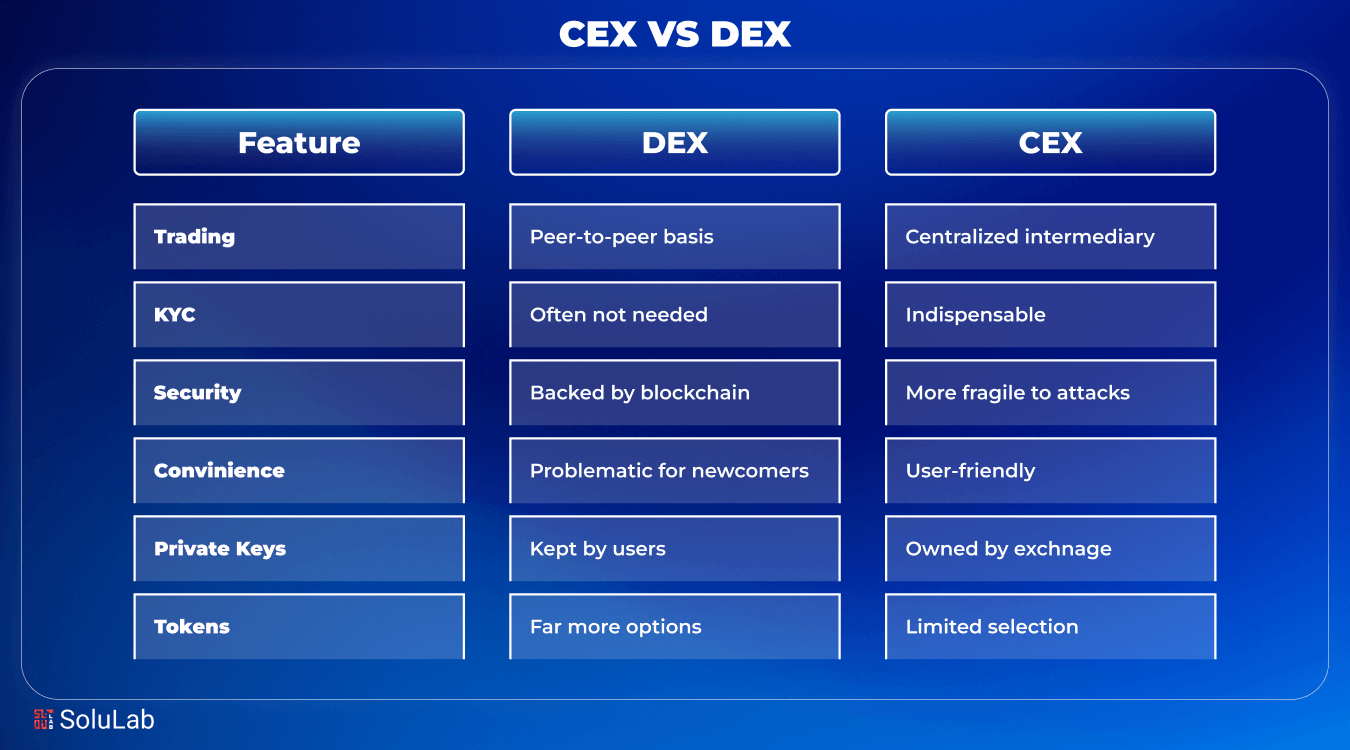
CEX VS DEX (2)

The global crypto market now serves over 560 million users, and that number is growing fast. With more institutions and enterprises exploring digital assets, one key decision stands out: should you build on a centralized exchange (CEX) or a decentralized exchange (DEX)?

Choosing between CEX vs DEX  isn’t just a technical decision. It affects how you manage compliance, user experience, custody of assets, liquidity, and scalability. For businesses building crypto platforms, understanding the real-world pros and cons of each model is critical.

Whether you’re launching a DeFi project, a fintech app, or an enterprise-grade crypto solution, this guide breaks down DEX vs CEX from a business-focused angle. You’ll get clarity on features, use cases, costs, and long-term strategies.

Why Build a Centralized Exchange (CEX)?

Centralized Exchange (CEX) development gives your business full control over security, user experience, and regulatory compliance. This type of crypto exchange is ideal for enterprises looking for fast transactions, strong liquidity, and smooth onboarding for users, especially when dealing with fiat currencies.

Benefits of a CEX

  • Faster transactions thanks to a well-optimized backend
  • Built-in tools for KYC/AML compliance, helping you stay legally compliant worldwide
  • Easier liquidity management, allowing you to offer tight spreads and competitive pricing
  • Fiat on/off ramps that make it easier for users to deposit or withdraw local currencies
  • Better UX control compared to Decentralized Exchanges (DEX)

Things to Consider Before Building a CEX

  • Since everything is stored in one place, there’s a single point of failure, which can raise security concerns
  • You’ll be responsible for handling all regulatory and licensing requirements
  • It uses a custodial model, which means your users must trust your platform to store their funds securely

A CEX is often the preferred choice for enterprises that want to launch quickly, integrate with banks, or offer a wide range of crypto-fiat services. However, it’s important to have strong security and compliance frameworks in place.

What is a Decentralized Exchange (DEX)?

A Decentralized Exchange (DEX) is a type of crypto exchange that allows users to trade digital assets directly, without any middlemen like banks or centralized companies. These exchanges are built on blockchain technology and powered by smart contracts, which means trades happen automatically, securely, and transparently.

Popular examples include Uniswap, PancakeSwap, and Curve. Users can swap tokens instantly through liquidity pools, with no sign-up, approval, or central control. This makes DEXs open, fast, and permissionless.

For enterprises, launching a DEX platform means giving users complete control over their assets, enhancing privacy, and minimizing regulatory dependencies. Partnering with a reliable Decentralized Exchange development company ensures your DEX is secure, scalable, and tailored to long-term business goals.

Benefits of a DEX

  • Users have full control over their assets at all times, with no need to rely on third-party custodians.
  • Trades on a DEX can’t be blocked, reversed, or tampered with, making the platform censorship-resistant.
  • Privacy is stronger, as KYC requirements are minimal or completely optional depending on your business model.
  • Anyone with a crypto wallet can access the platform, giving you immediate global reach.
  • Operational costs are lower due to reduced transaction fees and the removal of unnecessary intermediaries.

Things to Consider Before Building a CEX

  • The UI/UX can be challenging for non-technical users
  • Liquidity may be limited for newer tokens
  • No centralized support, users are responsible for their own wallets
  • Fiat integration is complex and often not supported
  • Risk of smart contract bugs or attacks if not built properly

If your focus is user privacy, global access, and decentralized control, building a DEX can set your platform apart. A leading Blockchain development company helps you create a secure and scalable DEX tailored to your enterprise needs.

CEX vs DEX: A Clear Comparison for Businesses

Choosing between a CEX vs DEX is more than just a tech decision; it’s a strategic move that affects compliance, user trust, scalability, and revenue.

Feature Business Impact
Custody of Assets CEXs hold user funds (centralized custody), while DEXs give users full control (non-custodial).
Liquidity Generally higher on centralized exchanges, making them better for high-volume trading.
KYC & AML CEXs fully support compliance, making them ideal for regulated industries.
Privacy DEXs offer better user privacy due to fewer onboarding requirements.
Speed & Fees CEXs are faster with lower latency. Some DEXs may charge higher gas fees depending on the network.
Development Complexity Easier to build and manage on a CEX. Decentralized exchange development may require complex smart contracts.
Smart Contract Risk Present mostly in DEXs due to their on-chain nature. Smart contract audits are critical.

For any enterprise, the decision between centralized vs. decentralized crypto exchanges should depend on:

  • Your regulatory compliance needs
  • The level of control you require
  • Your user base and market
  • How much security and transparency matter to your brand

Check Out Our Blog Post: How to Build Your Own DEX Like Aster

What Do Users Prefer in 2025?

The market in 2025 is split but growing fast. Most of the daily crypto trading volume (over 72%) still happens on centralized exchanges (CEXs). They’re easier to use, offer higher liquidity, and are trusted in regulated markets. But decentralized exchanges (DEXs) are catching up, especially in DeFi, Web3, and privacy-focused sectors.

As per Chainalysis, DEX trading volumes rose by 23% year-over-year in 2024, and 35% of that came from institutional wallets. This shows strong demand for decentralized platforms, especially in regions where users value control and transparency.

Today, many DeFi development companies are building hybrid exchanges or cross-chain DEXs. These platforms let users enjoy decentralization while still offering the liquidity and speed of CEXs. This mix is becoming the preferred approach for enterprises and startups launching in global markets.

When Should You Choose CEX or DEX?

Choosing between a centralized or decentralized exchange depends on your business goals and target audience. Here’s a quick guide:
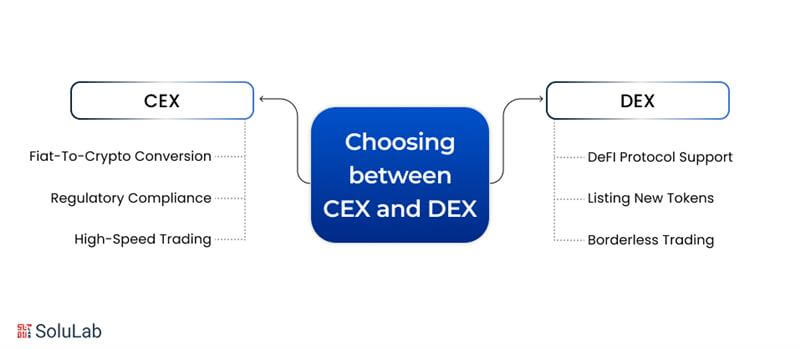
Choosing between CEX and DEX

You should choose a CEX (Centralized Exchange) if:

  • You need fiat-to-crypto conversion for users
  • You operate in a regulated market and require compliance tools
  • You want to support high-speed, high-volume trading

You should choose a DEX (Decentralized Exchange) if:

  • You are building or launching DeFi protocols
  • You want to list new or experimental tokens
  • You aim for non-custodial, borderless trading

A Blockchain development company can help you evaluate these options and design the right exchange architecture for your business goals. If you are interested in building your exchange?

Can You Combine CEX and DEX?

Yes, and many businesses are doing exactly that. A hybrid crypto exchange brings together the best of both worlds: the speed and easy user experience of a Centralized Exchange (CEX) and the security and transparency of a Decentralized Exchange (DEX).

These platforms often use smart contracts to handle settlements while keeping order books centralized. This setup improves liquidity, speeds up trading, and still maintains a level of trustless execution.

Projects like Serum and Injective follow this hybrid model. If you’re planning to build a hybrid platform, it’s also possible to integrate a Crypto Trading Bot that can operate across both CEX vs DEX models to maximize trading efficiency.
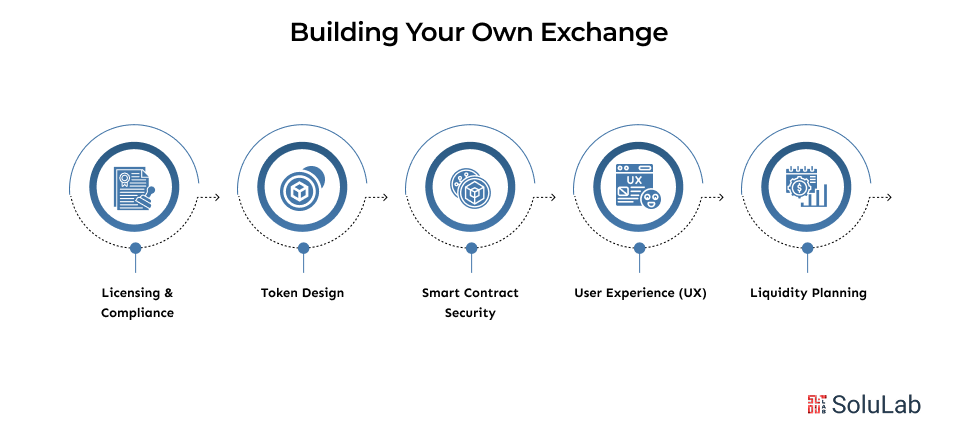
What to Know Before Building Your Own Exchange

Building Your Own Exchange

Before you build a crypto exchange, here are key things every business should consider:

  • Licensing & Compliance: Make sure you meet all regulatory requirements in your target regions.
  • Token Design: Define your tokenomics early; this affects how users trade and engage on your platform.
  • Smart Contract Security: Always get smart contracts fully audited to avoid hacks or exploits.
  • User Experience (UX): Design intuitive user flows to help users trade easily, especially on mobile.
  • Liquidity Planning: Without liquidity, even the best exchanges fail. Plan how you’ll source or incentivize liquidity.

Partnering with a trusted Cryptocurrency Development Company ensures your platform is secure, compliant, and ready to scale.

Cost to Build a Centralized or Decentralized Exchange

The cost of building a crypto exchange depends on the type, Centralized (CEX) or Decentralized (DEX), and the features you need.

Exchange Type Estimated Cost Range Key Cost Factors
Centralized Exchange (CEX) $120,000 – $350,000 Margin trading, KYC/AML compliance, fiat ramps, backend infrastructure
Decentralized Exchange (DEX) $80,000 – $250,000 Smart contract development, UI/UX for on-chain trading, security audits, tokenomics
  • A CEX requires more backend systems and centralized control features.
  • A DEX may look simpler, but it needs strong smart contracts and liquidity mechanisms for success.

Working with an experienced white label exchange development company helps reduce risk, manage costs better, and ensure your platform is compliant and scalable from day one.

How SoluLab Helps Enterprises Build CEX and DEX Platforms?

At SoluLab, we build both Centralized Exchanges (CEX) and Decentralized Exchanges (DEX) tailored to enterprise needs.

  • For CEX platforms, we deliver secure fiat integration, high-performance trading engines, and intuitive admin dashboards.
  • For DEX platforms, we build with automated market makers (AMMs), liquidity pools, and DAO-based governance.
  • We also support hybrid exchange models that offer the best of both worlds.

As a leading cryptocurrency exchange development company in the USA, we combine our experience in DeFi, smart contracts, and AI integration to help enterprises launch faster, scale securely, and stay future-ready.

DEX Development Services

Conclusion

There’s no one-size-fits-all answer in the CEX vs DEX crypto conversation. The best choice depends on your business goals, customer expectations, regulatory requirements, and long-term growth plans.

Whether you want full control with a Centralized Exchange, or transparency and self-custody with a Decentralized Exchange, success comes down to building the right foundation. With a trusted Decentralized Exchange development Partner, your company can confidently launch in the competitive world of Crypto Exchanges and stay ahead.

Let’s help you build it right. Contact us to get started!

FAQs

1. How does DEX vs CEX affect enterprise-level trading or investing?

For businesses, CEXs provide smoother onboarding, regulatory compliance, and deep liquidity. But DEXs offer security, transparency, and lower counterparty risk, making them ideal for DeFi-native firms.

2. What should I know about CEX vs DEX crypto platforms before building one?

CEX platforms need user KYC, support, and backend management. DEX platforms rely more on smart contracts, wallet integration, and on-chain liquidity. Your platform’s vision should guide this decision.

3. What are the top decentralized crypto exchange businesses are using in 2025?

Some of the leading DEXs include Uniswap, PancakeSwap, dYdX, and Curve. These platforms are open-source and serve as benchmarks for enterprises planning to build similar infrastructure.

4. Why are crypto exchanges important for blockchain businesses? 

They form the core infrastructure of the crypto economy, enabling token liquidity, fundraising (through IEOs/IDOs), and user onboarding. A reliable exchange boosts brand trust and transaction volume.

5. Which is a better crypto exchange for startups: CEX or DEX?

It depends on your audience and market. If you’re targeting retail users and require regulatory ease, go with a CEX. If you’re DeFi-focused, looking for transparency and low-cost operations, a DEX may be better.

6. How do I choose the right Crypto Exchange development company?

Look for a team with proven experience in exchange architecture, smart contract development, security audits, and regulatory readiness. SoluLab builds both CEX and DEX platforms from scratch with custom features for enterprises.

Top 10 Decentralized Crypto Exchanges to Consider in 2026

Investors have long favored traditional investment avenues, but there’s a notable shift towards decentralized cryptocurrency investments today. With the global adoption of digital currencies, the rise of cryptocurrency exchanges has been meteoric. These platforms facilitate the buying and selling of digital assets. However, given the industry’s nascent stage and lack of full regulation, investors must choose reputable exchanges. It’s noteworthy that over half of decentralized exchanges currently employ smart contracts to enhance security and transparency, underlining the surge in decentralized exchange (DEX) usage.

In this blog, we’ll delve into the leading decentralized crypto exchanges reshaping how traders engage with digital assets. We’ll examine their distinctive features, advantages, and potential growth prospects in the good crypto exchange market. So, let’s get started!

What is a Decentralized Crypto Exchange?

A decentralized exchange crypto that functions without the need for a middleman or centralized authority is called a DEX, or decentralized exchange. Smart contracts on blockchain networks enable users to transact cryptocurrency with one another directly.

Because the best decentralized cryptocurrency exchange doesn’t retain customer cash, they are less vulnerable to attacks and provides more security and transparency. Top-rated crypto exchanges encourage self-custody by allowing users to keep ownership of their assets and private keys.

Conventional trading procedures have been mostly replaced by decentralized trading advantages. Liquidity pools have replaced conventional order books, and using trade volume as a guide, Automated Market Makers (AMMs) are essential in bringing together cryptocurrency buyers and sellers on the most popular DEX crypto app platform.

Read Our Blog Post: How to Build Your Own DEX Like Aster

Why Invest in Decentralized Crypto Exchanges?

Investing in the best decentralized exchange crypto can offer several advantages over traditional centralized exchanges. Here are some reasons why investors may consider this option:

1. Enhanced Privacy and Security: Decentralized good crypto exchanges prioritize user privacy and security. Since users trade directly from their wallets, there’s no need to share personal information or undergo KYC procedures. This feature ensures that sensitive data is not stored in a centralized database, reducing the risk of data breaches and identity theft.

2. Resilience to Censorship: A decentralized exchange operates globally and isn’t controlled by any central authority. This makes it highly resistant to censorship, allowing users to trade freely without restrictions tied to geography or other external factors.

3. Financial Inclusivity: Decentralized cryptocurrency exchanges are accessible to anyone with an internet connection, bridging the gap between users from different parts of the world. This inclusivity fosters financial freedom, enabling individuals in underserved regions to access a wide range of cryptocurrencies and financial services.

4. Control over Funds: In traditional exchanges, users must entrust their funds to a centralized entity, creating potential vulnerabilities. With DEXs, users retain full control over their private keys and funds, reducing the risk of theft or loss due to exchange-related issues. This shift has increased demand for the best crypto wallet tools that enable secure, self-managed storage and seamless DEX integration.

5. Opportunities for Passive Income: Many decentralized exchanges embrace decentralized finance (DeFi) protocols, offering users opportunities to earn passive income. Users can participate in liquidity pools, provide liquidity to various trading pairs, and earn rewards for their contributions.

6. Lower Fees: DEXs often boast lower fees compared to their centralized counterparts. Since there are no intermediaries involved, users can avoid hefty withdrawal, deposit, and trading fees, making decentralized exchanges more cost-effective for frequent traders.

7. Fast and Efficient Transactions: Decentralized exchanges benefit from leveraging blockchain technology to execute transactions directly between users’ wallets. This approach eliminates the need for order books and central clearing, resulting in faster and more efficient trading processes.

8. Reduced Counterparty Risk: In traditional exchanges, users face counterparty risk when trading with other individuals. In trading on DEXs, trades occur directly between wallets, significantly reducing the risk of default by the counterparty.

9. Support for Various Tokens: Decentralized trading advantages often support a wide range of tokens, including newly launched and lesser-known cryptocurrencies. This broad selection allows users to access unique investment opportunities not always available on centralized platforms.

10. Community Governance: Some DEXs embrace community governance models, where users have a say in the decision-making processes of the platform. This democratic approach ensures that the DeFi development aligns with the community’s best interests.

Top 10 Decentralized Crypto Exchanges in 2026

1. CoinBase

Coinbase has more than 110 million cryptocurrency investors, making it the top US-based exchange. BTC, ETH, SOL, and LTC are among the more than 240 cryptocurrencies that are supported by the exchange. Only well-known and highly capitalized, altcoins are often supported for trade. Base Advanced and Coinbase are two separate platforms. It provides. With features like real-time, charting, future traits, Limited orders, and other sophisticated tools, the latter is intended for experienced traders, whereas the former is easier to use.

Although the coin base is well linked by individual investors, institutional cryptocurrency, investors can also benefit from using it. The services include thorough reporting, specialized account management, and sophisticated trading tools. For major market participants, the OTC desk makes it possible to conduct huge trades without producing notable price swings.

2. Uniswap

Uniswap stands out in the top decentralized exchanges, capturing the attention of numerous cryptocurrency enthusiasts. Operating as a fully decentralized token exchange on Ethereum, Uniswap offers a straightforward and efficient platform for trading ERC20 tokens. Its innovative Automated Market Maker system democratizes market making, allowing anyone to provide liquidity and earn fees without the need for traditional order books. This unique approach has propelled Uniswap to become one of the most popular decentralized exchanges in the crypto-to-crypto exchange sphere.

An appealing feature of Uniswap is its user-friendly interface, catering to newcomers and seasoned traders alike. With a wide selection of ERC20 tokens available, users have ample opportunities to diversify their portfolios. Moreover, Uniswap is known for its low fees compared to traditional exchanges, making it an attractive option for cost-conscious traders seeking efficient trading solutions within the decentralized finance sector.

3. Curve Finance

Curve Finance, a decentralized exchange tailored for stablecoins, is renowned for its low fees and deep liquidity, catering specifically to traders dealing with stable assets. Its algorithm is engineered to minimize slippage, ensuring that substantial orders do not cause significant price fluctuations. Many investors opt for Curve Finance to stake their stablecoins, attracted by its low-risk staking rewards and consistent performance. With a variety of stablecoin pairs available, including popular options like USDT, USDC, DAI, and TUSD, traders can easily swap between different stable assets on this decentralized cryptocurrency exchange platform.

What sets Curve Finance apart is its focus on maintaining a stable price curve, achieved through an innovative bonding curve mechanism. This mechanism ensures minimal market price impact even with large trades, facilitating efficient and precise price discovery. As a result, traders benefit from a seamless stablecoin trading experience with minimal slippage, making Curve Finance an appealing choice for those navigating the decentralized finance world.

0x protocol facilitates seamless peer-to-peer exchange of ERC20 tokens on the Ethereum blockchain with minimal friction. Serving as an open standard and common building block, it promotes interoperability among decentralized applications trading advantages integrating exchange functionality. Acting as a liquidity aggregator, 0x draws liquidity from various sources, including other DEX crypto app, to offer traders optimal trading conditions such as low slippage and competitive prices.

A standout feature of 0x is its ability to aggregate liquidity from multiple trading on DEXs, ensuring traders access to a deep and diverse market. Additionally, 0x boasts a flexible and extensible smart contract architecture, empowering developers to craft tailored trading experiences and implement bespoke features to cater to their users’ specific requirements. This adaptability fosters innovation, enabling the creation of unique trading strategies and tools within the 0x ecosystem.

5. IDEX

IDEX emerges as a leading contender for the title of the best decentralized crypto exchange benefits, offering a unique hybrid model that seamlessly combines the speed of centralized exchanges with the security of decentralized ones. By separating trade matching from on-chain settlement, IDEX provides users with a trustless, real-time trading experience while ensuring blockchain-based settlement for enhanced security and audibility. Its intuitive interface has made it a popular choice among both seasoned traders and newcomers to the crypto space, offering full control over funds by enabling trading directly from wallets without the need to deposit onto the exchange.

With IDEX, users benefit from a range of trading options to suit their preferences, including limit, market, and stop-loss orders, facilitating effective strategy execution. Moreover, the decentralized cryptocurrency platform provides advanced charting tools and real-time market data, empowering traders to make well-informed decisions. Notably, IDEX prioritizes scalability by leveraging off-chain order books and settling trades on the blockchain, ensuring fast and efficient trade execution without congesting the underlying blockchain network. This commitment to scalability guarantees users a seamless trading experience even during periods of high market activity.

6. PancakeSwap

PancakeSwap reigns as the top choice among decentralized exchanges for trading Binance Smart Chain tokens, boasting widespread popularity for its low fees and user-friendly interface, particularly appealing to beginners entering the crypto-to-crypto exchange space. Operating akin to Uniswap, PancakeSwap employs an Automated Market Maker system, enabling users to provide liquidity and earn fees effortlessly.

A standout feature of PancakeSwap is its unique “yield farming” functionality, enticing investors eager to maximize their returns within the DeFi market by allowing them to stake their tokens for additional rewards. Additionally, PancakeSwap offers its native token, CAKE, facilitating governance participation and earning extra rewards through staking activities. With a growing community of users and developers, PancakeSwap continues to innovate, introducing new features and solidifying its status as one of the top 10 decentralized crypto exchanges.

7. Huobi (iToken)

Huobi’s iToken stands out as a tier-one exchange with a web 3.0 wallet app, doubling up as a decentralized exchange (DEX). This innovative platform supports multiple blockchain standards, facilitating cross-chain trading and interoperability. Users benefit from a seamless and secure trading experience, gaining access to various tokens across different blockchain networks.

A notable feature of Huobi’s iToken is its robust staking rewards program, allowing users to stake their tokens and earn attractive yields. This program has garnered popularity among investors seeking stablecoins and passive income opportunities due to its low-risk nature. Additionally, iToken offers a comprehensive range of trading tools and features, including advanced order types, real-time market data, and customizable trading interfaces. Its intuitive user interface ensures effortless navigation for both experienced traders and beginners, empowering users to make informed investment decisions in the crypto exchange United States.

8. Kucoin (Halo)

Kucoin’s decentralized app, Halo, stands out as the best decentralized crypto exchange, supporting seven blockchain standards and offering a unique ‘smart wallet tracker’ feature. This feature enables users to monitor whale investors’ token movements, providing valuable insights into market trends and aiding in more informed investment decisions. Alongside this, Halo provides a user-friendly interface and a diverse array of trading tools, including real-time market data, detailed charts, price alerts, and seamless trade execution, catering to both experienced traders and beginners.

Moreover, Kucoin’s Halo app emphasizes community engagement, offering a social trading feature where users can connect, share strategies, and discuss market insights. This collaborative environment fosters knowledge sharing and skill enhancement among traders. Whether users seek to track influential investors, access advanced trading tools, or engage in social trading, Kucoin’s Halo delivers a seamless and rewarding experience, combining the benefits of a Web 3.0 wallet with those of a decentralized cryptocurrency exchange.

9. SushiSwap

Founded in 2020, SushiSwap has quickly emerged as a prominent decentralized crypto exchange, supporting over 400 tokens and offering a range of yield services such as liquidity pools and vaults for users to earn passive income. Its unique automated market-making (AMM) protocol allows users to provide liquidity to trading pairs and earn fees in return.

SushiSwap’s offering extends to vaults and automated yield farming strategies designed to optimize users’ returns. By depositing tokens into a vault, users can leverage various yield farming opportunities across different protocols. These vaults automatically allocate funds to the most profitable strategies, ensuring optimal returns while mitigating risk. Alongside its yield services, SushiSwap is renowned for its community-driven ethos. Governed by decentralized autonomous organizations (DAOs), the platform enables token holders to actively participate in decision-making processes, ensuring that the crypto exchange in the United States evolves in line with the needs and preferences of its community members.

10. ApeSwap

ApeSwap, an emerging decentralized exchange, is swiftly gaining prominence in the DeFi space by offering cross-chain swaps, staking, farming, and other popular DeFi tools. Founded by a team of dedicated developers and community members, ApeSwap aims to provide users with a seamless and secure platform to access various DeFi services.

A standout feature of ApeSwap is its cross-chain swaps, enabling users to effortlessly swap tokens between blockchain networks like Binance Smart Chain and Ethereum. This functionality expands users’ opportunities across multiple networks without the need to convert tokens, opening new avenues for decentralized exchange benefits. With its user-friendly interface, a diverse range of services, and robust security measures, ApeSwap is poised to secure a spot among the top 10 decentralized crypto exchanges. Whether users seek token swaps, staking, farming, or governance participation, ApeSwap promises a rewarding and inclusive DeFi experience.

Conclusion

As the cryptocurrency market grows, decentralized exchanges for crypto become increasingly popular among investors and traders. These platforms offer a range of advantages, including enhanced privacy, resistance to censorship, and opportunities for passive income. SoluLab, a leading technology services provider, recognizes the importance of the best DEX crypto exchanges and offers comprehensive services to support their development and implementation.

SoluLab offers superior decentralized exchange development services, providing all the necessary features and functionalities tailored to specific business needs. Their decentralized exchange platform ensures seamless trading and secure transactions with cutting-edge software. By unlocking the potential of decentralized finance, businesses can stay ahead in the ever-evolving market. SoluLab also provides customized cryptocurrency exchange development services, offering one-stop solutions for various crypto exchange platforms, all equipped with high-security standards and multiple payment models.

In conclusion, SoluLab is at the forefront of the decentralized crypto exchange revolution, providing businesses with the necessary tools and expertise to navigate this dynamic and rapidly evolving industry. By leveraging SoluLab’s services, companies can unlock the full potential of decentralized exchanges and harness the power of cryptocurrency exchange, contact SoluLab today.

FAQs 

1. What Constitutes a Decentralized Crypto Exchanges?

A decentralized crypto exchange is a marketplace that can be accessed in the decentralized world where crypto traders can trade directly. DEX is known as the working model that made the crypto idea of a financial deal outside banks, brokers, and middlemen a reality. Currently used DEXs include Uniswa and Sushiwap both working on the Ethereum network.

2. What is the oldest and most used cryptocurrency?

The first and by far the most commonly known cryptocurrency is referred to as Bitcoin and it was launched in 2009. Now there are more than 25,000 cryptocurrencies available in the market among them 40 have a market capitalization of over $1 billion.

3. What is the major difference between a Centralized Crypto exchange and a Decentralized one?

CEX users can have an option to hold funds and keys as guardians while DE Users have an added option of having a hold on their keys and funds and not necessarily use non-custodial wallets.

4. Does Binance come under Centralized or Decentralized?

Binance comes under the largest group of decentralized exchanges available in the market all around the globe. It is operated by and registered with the Binance Holding Ltd.

5. How can SoluLab assist in blockchain development projects related to decentralized exchanges?

SoluLab offers comprehensive blockchain development services, including expertise in building decentralized exchanges (DEXs) and other blockchain-based solutions. Our team of experienced developers can help you design, develop, and deploy a custom.
