Talk to an Expert

ICO vs. STO: What’s the Difference?


ICO vs. STO: What’s the Difference?

Initial Coin Offerings (ICOs) and Security Token Offerings (STOs) have made significant waves in the world of fundraising and investment within the blockchain and cryptocurrency industry. However, these two fundraising methods differ significantly in their nature, regulatory aspects, and potential benefits. 

In this blog post, we’ll delve into the distinctions between ICOs and STOs, exploring their characteristics, advantages, and drawbacks. Understanding these differences is crucial for entrepreneurs, investors, and blockchain enthusiasts to make informed decisions in the evolving crypto landscape.

What is ICO (Initial Coin Offering)?

ICOs are fundraising events where cryptocurrency tokens are issued to investors in exchange for capital. The primary purpose of ICOs is to raise funds for new blockchain projects or decentralized applications (DApps). These tokens typically represent future access to the project’s products or services.

ICOs gained immense popularity around 2017, with projects like Ethereum, EOS, and Tezos raising substantial amounts through token sales. These events often attracted global attention and investment due to the potential for high returns.

ICOs offer several advantages, including accessibility for a wide range of investors, quick fundraising, and potential for exponential growth. However, they are also associated with significant drawbacks, such as a lack of regulatory oversight, potential scams, and volatility in token prices.

ICOs have faced increasing regulatory scrutiny in various countries, leading to legal challenges and restrictions. Governments have been concerned about fraudulent projects and the need to protect investors.

What is STO (Security Token Offering)?

STOs, on the other hand, are a more regulated and secure method of fundraising. They involve issuing tokens that are backed by real-world assets, such as equity in a company, real estate, or commodities. STOs are designed to comply with existing securities regulations.

Several successful STOs have demonstrated the viability of this fundraising method. Projects in real estate, art, and venture capital have used STOs to tokenize assets and offer fractional ownership.

STOs offer advantages such as improved investor protection, transparency, and compliance with legal frameworks. However, they also require more regulatory compliance, which can be costly and time-consuming for issuers.
Difference between ICO and STO

Difference between ICO and STO

STOs differ from ICOs in several crucial ways. Firstly, STOs are security offerings, subject to securities regulations, while ICOs are often utility token sales. Secondly, STOs are typically backed by tangible assets, providing investors with more security and potential for dividends or profit-sharing.

Key Differences Between ICOs and STOs

Initial Coin Offerings (ICOs) and Security Token Offerings (STOs) are both methods of raising capital in the cryptocurrency and blockchain space. However, they have distinct differences in terms of their nature, regulation, and purpose. Here are the key differences between ICOs and STOs:

Read Blog Post: 10 Best Defi Exchanges 2024

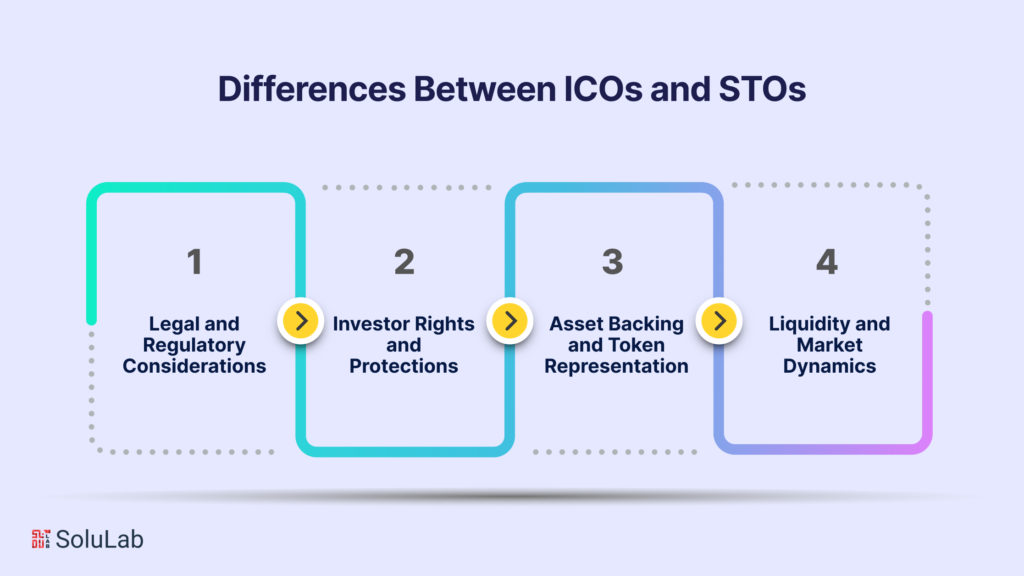
1. Legal and Regulatory Considerations

  • ICOs often operate in a legal grey area, while STOs are subject to securities regulations.
  • ICOs may face legal consequences for non-compliance with securities laws.

2. Investor Rights and Protections

  • STO investors typically have more rights and protections, such as ownership shares and potential dividends.
  • ICO investors often have limited rights and rely on the project’s success for returns.

CTA1

3. Asset Backing and Token Representation

  • ICO tokens may not necessarily be backed by tangible assets or represent ownership.
  • STO tokens are backed by real assets, offering a clear value proposition to investors.

4. Liquidity and Market Dynamics

  • ICO tokens often trade on cryptocurrency exchanges, which can lead to extreme price volatility.
  • STO tokens may have a more stable price due to their asset-backed nature, but liquidity can be lower.

What to Choose: ICO or STO?

What to Choose: ICO or STO?

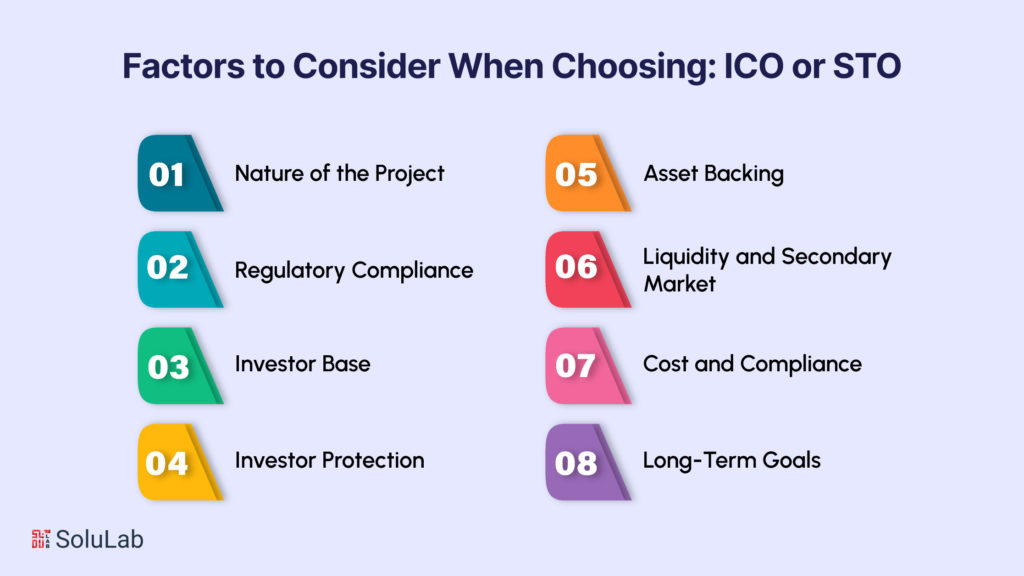
Choosing between an Initial Coin Offering (ICO) and a Security Token Offering (STO) depends on several factors, including the nature of your project, regulatory considerations, and your target audience. Here are some key factors to consider when deciding which fundraising method to choose:

1. Nature of the Project

  • If your project involves a utility token that provides access to a specific product or service within your platform (e.g., a decentralized application or ecosystem), an ICO development may be suitable.
  • If your project involves asset-backed tokens, such as company equity, real estate, or revenue-sharing, and you want to comply with securities regulations, an STO is more appropriate.

Read Also: 7 Most Successful ICOs of All Time

2. Regulatory Compliance

  • Consider the regulatory environment in your jurisdiction and the jurisdictions of your potential investors. STOs are typically subject to securities regulations, which can be complex and vary from country to country. Ensure you have legal counsel to navigate these regulations.
  • ICOs may have fewer regulatory requirements but could still face legal scrutiny in some jurisdictions.

3. Investor Base

  • Determine your target investor base. If you want to attract a broad and global audience of retail investors, an ICO may be more suitable.
  • If you are targeting accredited or institutional investors who are comfortable with regulatory compliance, an STO may be the better choice.

4. Investor Protection

  • If you prioritize strong investor protection and transparency, an STO is more likely to provide these features due to securities regulations.
  • ICOs have historically been associated with a higher risk of fraud and less legal protection for investors.

5. Asset Backing

  • Consider whether your project involves tangible assets or revenue streams that can back your tokens. If so, an STO can provide a direct link between the tokens and the underlying assets.
  • If your tokens are primarily utility-based and don’t represent ownership or assets, an ICO may be more appropriate.

6. Liquidity and Secondary Market

  • Evaluate how you plan to provide liquidity to your investors. Security tokens are typically designed to be more liquid, potentially allowing trading on traditional securities exchanges.
  • ICO tokens may face liquidity challenges and may not be listed on major exchanges.

Read Also: How To Write A Compelling ICO Whitepaper That Actually Sells?

7. Cost and Compliance

  • Be aware that conducting an STO can be more expensive and time-consuming due to regulatory compliance requirements, legal fees, and the need for thorough due diligence.
  • ICOs may have lower upfront costs, but they may require significant marketing efforts to attract investors.

8. Long-Term Goals

  • Consider your long-term goals for the project. STOs may offer a more structured path to traditional financial markets and long-term sustainability.
  • ICOs may provide more flexibility but can also be riskier and less predictable in terms of future outcomes.

Check Out Our Blog: Top 25 Smart Contract Companies To Look For in 2024

Future Trends and Developments

The crypto fundraising landscape continues to evolve, and several trends are shaping the future of ICOs and STOs:

1. Hybrid Models: Some projects are exploring hybrid models that combine elements of ICOs and STOs to strike a balance between fundraising and regulatory compliance.

2. Secondary Markets: The development of secondary trading platforms for security tokens could improve liquidity and provide investors with more options for buying and selling tokens.

3. Regulatory Clarity: As regulatory frameworks become more defined, the crypto industry may see increased participation from traditional financial institutions and mainstream investors.
Blockchain and the Future of ICOs and STOs

Blockchain and the Future of ICOs and STOs

Understanding these blockchain trends and their potential impact on ICOs and STOs is essential for stakeholders in the crypto fundraising space. As the technology matures, we can anticipate exciting developments that will shape the future of token offerings and the broader blockchain industry.

Blockchain technology continues to evolve, presenting opportunities and challenges for ICOs and STOs. As the underlying technology for both fundraising methods, the future of blockchain plays a pivotal role in shaping their trajectories.

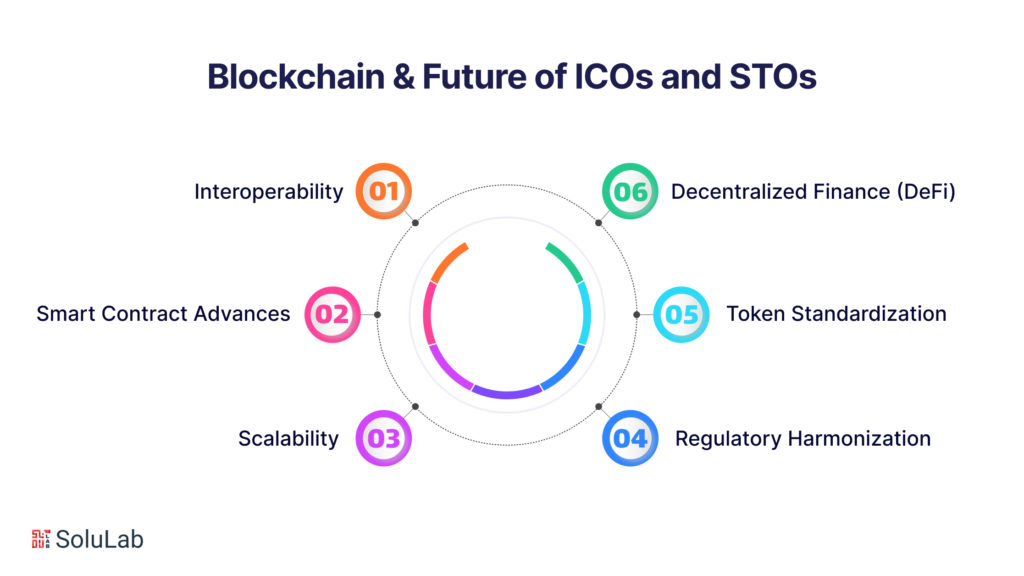
1. Interoperability: Interoperability between different blockchain networks is becoming a key focus. This will allow assets from one blockchain to be traded on another, potentially increasing liquidity for tokens from both ICOs and STOs.

Read Blog Post: Top 10 STO Development Companies in 2024

2. Smart Contract Advances: Smart contracts are at the heart of ICOs and STOs. As blockchain technology matures, we can expect more advanced and secure smart contract platforms, reducing the risk of contract vulnerabilities.

3. Scalability: Scalability issues have plagued blockchain networks, affecting transaction speeds and costs. Solving these issues will enhance the efficiency of token offerings, making them more accessible and cost-effective.

4. Regulatory Harmonization: The crypto industry seeks harmonization of regulatory frameworks globally. A cohesive approach to regulation could reduce uncertainty and promote a more favorable environment for both ICOs and STOs.

5. Token Standardization: Standardisation of token types can simplify the token creation process and enhance interoperability. Ethereum’s ERC-20 and ERC-1400 standards are examples of how standardization can facilitate token issuance.

6. Decentralized Finance (DeFi): DeFi platforms have gained traction, offering new opportunities for fundraising and investment. DeFi projects are increasingly exploring ICO and STO models within their ecosystems.

CTA2

Concluding Remarks

In conclusion, comprehending the distinctions between Initial Coin Offerings (ICOs) and Security Token Offerings (STOs) is crucial within the blockchain and cryptocurrency arena. ICOs once celebrated for their rapid fundraising potential, faced regulatory uncertainties and concerns about investor safeguarding. Conversely, STOs have emerged as a more regulated and secure fundraising approach, offering investors tangible asset-backed ownership and compliance with securities laws, which has garnered institutional interest and bolstered trust in the crypto fundraising landscape.

Looking forward, expect to witness the emergence of hybrid fundraising models blending ICO and STO elements, the growth of secondary markets to enhance token liquidity, and increasing regulatory clarity. As blockchain technology matures, the crypto fundraising landscape will continually adapt, providing innovative opportunities. For entrepreneurs and investors, a deep understanding of these distinctions will serve as a compass in navigating the dynamic world of ICOs and STOs successfully. Whether you’re seeking capital or investment opportunities, staying informed and compliant will be paramount in this evolving blockchain ecosystem protocol.

SoluLab is a prominent company in the blockchain technology and software development sector, offering expertise in various industries, including decentralized finance, supply chain management, and healthcare. SoluLab has earned a reputation for delivering innovative blockchain solutions. In the context of ICOs and STOs, SoluLab provides crucial technical support and development services. They assist startups and enterprises in launching ICOs and STOs by offering secure smart contract development and wallet creation while ensuring compliance with regulatory frameworks, which is particularly vital for STOs. SoluLab serves as a valuable partner for those navigating the complex landscape of blockchain-based fundraising, offering ICO development services and STO development services, all while adhering to regulatory standards. Contact SoluLab today to explore their comprehensive blockchain solutions.

FAQs

1. What is the primary difference between an ICO and an STO?

An ICO (Initial Coin Offering) is a fundraising method where cryptocurrency tokens are issued, often as utility tokens, without direct ownership rights. In contrast, an STO (Security Token Offering) involves the issuance of tokens backed by real-world assets, such as equity or property, offering investors ownership rights and potential dividends.

2. Why are ICOs often associated with regulatory challenges?

ICOs have faced regulatory challenges due to their lack of compliance with securities laws in many jurisdictions. This lack of oversight has raised concerns about investor protection, leading to increased regulatory scrutiny.

3. What are the benefits of participating in an STO for investors?

Investors in STOs typically gain ownership rights in the underlying asset, such as shares in a company or real estate. This can provide more security and the potential for dividends or profit-sharing, making STOs appealing to those seeking traditional investment features.

4. Are ICOs still a viable fundraising method in today’s regulatory landscape?

ICOs have evolved in response to regulatory challenges. Some projects conduct compliant ICOs, while others opt for alternative fundraising methods like STOs. The viability of an ICO development company depends on the project’s nature and its ability to navigate regulatory requirements.

5. How do secondary markets impact the liquidity of security tokens from STOs?

Secondary markets, such as security token exchanges, can significantly impact the liquidity of tokens from STOs. They provide a platform for investors to buy and sell security tokens, potentially increasing liquidity and tradability compared to traditional assets.

6. What trends can we expect in the ICO and STO space shortly?

The future of ICOs and STOs will likely see increased regulatory clarity, hybrid fundraising models, and the integration of blockchain technology into traditional financial systems. Institutional involvement and a focus on compliance are also expected to shape the industry’s direction.

What are Security Token Offerings?

Security Token Offering (STO)

Traditional real-world assets are devoid of a number of characteristics, including liquidity, divisibility, and accessibility. certain factors make certain asset classes less popular with individual investors and inappropriate for short-term trading.

Finding a possible buyer or seller within a budget is a tedious step in the buying and selling process for illiquid assets like real estate. After that, there is a drawn-out registration process, broker fees, and other costs that the buyer or seller must pay.

In this case, security tokens seem to be an innovative solution for each of these issues with conventional assets. These digital tokens give consumers better accessibility, a quicker settlement time, and increased asset liquidity. 

Token investors feel more confident when government agencies are involved and adhere to stringent regulations. Because of this, it is anticipated that by 2030, the trading volume of security tokens will increase by more than $162 trillion.

In this blog, we will get to know everything about Security Token Offerings (STOs) and analyze the idea of security tokens. So, without any further ado, let’s get started!

What are Security Tokens offerings?

Security Token Offerings (STOs) are a method of fundraising where companies issue digital tokens, representing ownership in assets or a company, on a blockchain, similar to Initial Public Offerings (IPOs) but with the added benefits of blockchain technology.

STOs are comparable to initial coin offerings (ICOs), but the tokens issued in an STO are regarded as securities and are governed by financial authorities, meaning that they are intended to offer the same protections as conventional securities, like stocks and bonds.

Benefits of Security Tokens Offerings

Security tokens are digital assets that represent ownership or other rights in an asset, such as equity, real estate, or other forms of investment. These tokens are created through a process known as a Security Token Offering (STO), which provides a regulated and secure way to raise capital. Here are some of the key benefits of security tokens:

1. Regulatory Compliance

Security tokens are issued in compliance with regulatory frameworks, ensuring that the offerings adhere to legal standards. This compliance reduces the risk of legal issues and provides a level of trust and security for investors.

2. Enhanced Liquidity

Security tokens can be traded on various security token offering platforms, providing enhanced liquidity compared to traditional assets. This increased liquidity makes it easier for investors to buy and sell tokens, creating a more dynamic and accessible market.

3. Fractional Ownership

Security tokens allow for fractional ownership of high-value assets. This means that investors can purchase small fractions of expensive assets, such as real estate or fine art, making it easier for more people to invest in these markets.

4. Reduced Costs

The use of blockchain technology in security token offerings can significantly reduce the costs associated with issuing and trading securities. This includes lower transaction fees, reduced paperwork, and decreased administrative costs.

5. Transparency and Security

Blockchain technology provides a transparent and immutable ledger of all transactions. This transparency enhances security and trust, as investors can verify the authenticity and history of the tokens they are purchasing.

6. Global Access

Security token offerings provide global access to investment opportunities. Investors from around the world can participate in STOs, broadening the investor base and increasing the potential for raising capital.

7. Automated Compliance

Smart contracts can automate compliance processes, ensuring that all transactions meet regulatory requirements. This automation reduces the risk of human error and increases the efficiency of the compliance process.

8. Increased Market Efficiency

The tokenization of assets can lead to more efficient markets by reducing the barriers to entry and enabling faster and more secure transactions. This efficiency benefits both issuers and investors.

9. Diversification Opportunities

Investors can diversify their portfolios by investing in a wide range of tokenized assets. This diversification can help mitigate risk and increase potential returns.

10. Security Token Offering Services

Utilizing professional security token offering services ensures that the entire process of issuing and managing security tokens is handled by experts. These services include legal compliance, token issuance, marketing, and post-offering support.

Types of Security Tokens Offerings

There are three kinds of security tokens:

  • Asset-backed tokens
  • Equity tokens
  • Debt tokens

1. Aset-backed Tokens

Real-world assets including commodities, precious metals, or real estate are represented by asset-backed tokens. Depending on the asset it signifies, the token’s price changes in real-time. Investors may use these security tokens to use a variety of asset types to diversify their portfolios. You may divide your money, for instance, and put it into gold, silver, or oil tokens.

2. Equity Tokens

Equity tokens, as the name suggests, are shares of a publicly traded firm. To own a portion of businesses worth at billions or trillions of dollars, you may purchase these security tokens. In contrast to conventional stock exchanges, as soon as your payment is verified, the assets will be registered in your name on the blockchain. Additionally, firms can obtain money to grow their operations by selling equity tokens.

Related: Top 10 STO Development Companies

3. Debt Tokens

Security tokens known as “debt tokens” stand as substitutes for loans made by investors to businesses. In this case, the investor gets paid interest or a dividend in line with the amount given. Regarding these tokens, the borrower and lender have mutually decided upon the interest rate, interest payout schedule, and other relevant terms and conditions. Purchasers of security tokens also have the choice to select tokens with the best interest rate and features, such as daily interest distributions.

Security Tokens vs. Utility Tokens

Here are the differences between security tokens and utility tokens:

Criteria Security Tokens Utility Tokens
Definition Signify ownership stakes in real-world assets Grant access to specific features within a platform
Investment Investors expect returns based on the asset’s performance Value is derived from their utility within the platform
Regulation Governed by securities regulations, such as STOs Regulatory status is often ambiguous and unclear
Legal Rights Provide holders with legal rights, including voting and profit-sharing Offer access rights and limited governance
Stability Generally more stable and less speculative in value Typically more speculative, influenced by market demand
Underlying Asset Supported by tangible assets with intrinsic value Value comes from their utility within the platform
Issuance Issued through regulated processes like STOs Commonly created through ICOs or TGEs

STO vs. ICO: Understanding the Differences

In the world of blockchain and cryptocurrency, Security Token Offerings (STOs) and Initial Coin Offerings (ICOs) are two prominent fundraising methods. While both are used to raise capital for blockchain projects, they have distinct differences in terms of regulatory compliance, investor protection, and the nature of the tokens offered. Here’s a detailed comparison of STOs and ICOs:

Security Token Offerings (STOs)

1. Regulatory Compliance: STOs are regulated by financial authorities and must comply with securities laws. This ensures greater transparency and legal protection for investors.

2. Investor Protection: Due to regulatory oversight, STOs offer enhanced security and protection for investors, reducing the risk of fraud and scams.

3. Token Type: Security tokens represent ownership in an asset, such as equity, debt, or real estate. They often come with rights to dividends, profit sharing, or voting.

4. Market Accessibility: STOs are generally more attractive to institutional investors due to regulatory compliance and perceived security, but this can also mean higher barriers to entry for smaller investors.

5. Fundraising Process: The process of launching an ICO involves significant legal and regulatory preparations, making it more complex and costly compared to an ICO.

6. Secondary Market: Security tokens can be traded on regulated exchanges, providing liquidity to investors, but this trading is subject to regulatory oversight.

CTA1

Initial Coin Offerings (ICOs)

1. Regulatory Environment: ICOs operate in a relatively unregulated environment, which allows for quicker and simpler fundraising but comes with higher risks of legal issues and regulatory crackdowns.

2. Investor Risk: The lack of regulation in ICOs means there is less protection for investors, increasing the potential for fraud and scams.

3. Token Type: ICOs typically offer utility tokens, which provide access to a product or service within a blockchain ecosystem but do not represent ownership or investment in an asset.

4. Market Accessibility: ICOs are generally accessible to a wider range of investors, including retail investors, due to lower entry barriers and fewer regulatory requirements.

5. Fundraising Process: Launching an ICO is relatively straightforward and less expensive, involving the creation of a whitepaper and a token sale to raise funds.

6. Secondary Market: Utility tokens can be traded on cryptocurrency exchanges, providing liquidity, but these markets are often less regulated and more volatile than traditional securities markets.

Choosing between an STO and an ICO depends on various factors, including the nature of the project, regulatory considerations, and the target investor base. STOs offer greater regulatory compliance and investor protection, making them suitable for projects seeking institutional investment and long-term sustainability. ICOs, on the other hand, provide a faster and more accessible fundraising route, ideal for projects looking to quickly raise capital and reach a broad audience. Understanding these differences is crucial for both project creators and investors to make informed decisions to choose the best security token in blockchain technology.

What Qualifies As A Security? Howey Test Explanation

Tokenizing assets on the blockchain results in security tokens. However, what exactly do you view as security in the first place?

Generally, a set of legal standards and guidelines are used to determine if an asset meets the requirements to be classified as a security. This is especially true in the US within the Securities Act of 1933. The “Howey Test,” which was developed by the US Supreme Court in the famous 1946 case of SEC v. W.J. Howey Co., is the one that is most frequently used.

The Howey Test states that an asset is deemed a security if it satisfies the following requirements:

  • Investment of Money: Either money or another concrete or measurable item (like goods or services) is invested. 
  • Common Enterprise: The investment has been made in a “common enterprise.” This typically indicates a relationship between the promoter’s and investors’ fortunes.
  • Expectation of Profit: Investors anticipate making money on their investments.
  • Efforts of Others: It is anticipated that the income would mostly originate from the labor of others. This usually indicates that the investor is depending on the management work or industry knowledge of an outsider, such as a promoter or business.

How Do STOs Work?

How Do STOs Work?

Launching a Security Token Offering (STO) involves a series of steps, broadly divided into six phases:

1. Preparation

The initial stage of an STO involves conceptual development and the selection of underlying assets. At this stage, a core team is formed, and advisors are appointed. The project’s whitepaper is drafted, detailing the chosen technologies and service providers. Capital requirements are assessed, and the target investor base is identified.

2. STO Design

During this phase, a corporate finance advisor is brought on board to determine the type of security, its structure, the duration of the offering, and valuations related to token issuance. A legal advisor is also appointed to manage investor requirements and regulatory compliance. Lockup periods for the tokens are set, and initial documentation, including a term sheet, is prepared.

3. Selection of Technology

The technical team selects a blockchain platform suitable for the project. A technology service provider is engaged to create the necessary digital security tokens. This provider also offers features for investors to complete their KYC/AML verification and provides a portal that supports crypto wallets.

4. Choosing Financial Service Providers

A reliable broker is appointed to manage the sale of securities, while a custodian is selected for safekeeping purposes. Transfer agents are onboarded to oversee the token issuance, and payment providers are chosen to support payment-related services during the capital-raising process.

5. Raising Capital

The project’s offering documents are shared with potential investors for review. Online marketing activities, including social media campaigns, promote the upcoming STO. Interested initial investors sign the offering documents and transfer funds to the issuer. Once this is complete, investors receive tokens in their wallets.

6. Token Listing

Token listing involves adding tokens to an exchange or trading platform. Token issuers complete the necessary documentation with the respective exchanges. A market maker is appointed to provide liquidity for the listed security tokens, ensuring a smooth trading experience for investors. Token issuers are also required to regularly publish reports to keep investors informed about the firm’s progress.

Read Also: ICO Vs IPO

How To Participate In An STO? A Step-By-Step Guide

Purchasing securities is subject to legal restrictions and involves risk. Consult an authorized financial advisor before making investments.

In four easy steps, you may possibly participate in STO:

1. Find the Right STO for You

Investigate sites such as Securitize or STOmarket to find STOs in different sectors.

Importantly, don’t take shortcuts! Research the STO thoroughly:

  • Project Details: Read the whitepaper to understand the project’s goals, the underlying asset, and the token’s utility.
  • Team Expertise: Examine the history and experience of the team in related domains.
  • Token Economics: Examine the token supply, distribution strategy, and possible profits in token economics.
  • Underlying Asset: For asset-backed tokens, understand the asset’s value and potential risks.
  • Seek Guidance: Seek Guidance: To get a second perspective, think about speaking with a financial advisor who specializes in STOs.

2. Register on a Regulated Platform

Look for a platform with a good reputation that hosts the STO you’re interested in. You may compile a list of security token issuing platforms with the use of a website such as The Tokenizer. After locating a platform, finish the registration procedure by giving personal details and accepting the rules. It is required to undergo AML (Anti-Money Laundering) and KYC (Know Your Customer) checks.

3. Fund Your Account

Platforms typically support either fiat currencies (USD, EUR) or cryptocurrencies (ETH, BTC). Check the platform’s options before committing.

Transfer the necessary funds into your platform account based on the STO’s minimum investment amount.

4. Invest in the STO and Receive Your Tokens

When the STO goes live, use the funds in your account to purchase the desired amount of security tokens.

The security tokens will be placed into your platform wallet or an external cryptocurrency wallet that is compatible when your transaction is successful.

CTA2

Conclusion

Security Token Offerings (STOs) represent a revolutionary approach to raising capital by leveraging blockchain technology to create compliant, secure, and transparent investment opportunities. Unlike traditional fundraising methods, STOs offer numerous advantages, including enhanced liquidity, reduced costs, and global access to a diverse investor base. By providing a regulated and efficient means of investing in a wide array of asset classes, STOs are reshaping the financial landscape and paving the way for more inclusive and accessible investment opportunities.

However, launching an STO is not without its challenges. Navigating the complex regulatory challenges, ensuring robust security measures, and managing the technical intricacies of blockchain technology can be daunting. This is where SoluLab steps in. As a leading STO development company, SoluLab offers comprehensive services to guide you through every phase of your STO journey. From conceptualization and compliance to token issuance and post-offering support, our team of experts ensures a seamless and successful STO launch. Contact us today to learn how SoluLab can help you utilize the full potential of security token offerings.

FAQs

1. What is the difference between an STO and an ICO?

An STO (Security Token Offering) involves issuing tokens that are backed by real assets, such as equity, debt, or real estate and are regulated by securities laws. This offers greater investor protection and transparency. An ICO (Initial Coin Offering), on the other hand, typically issues utility tokens that provide access to a product or service within a blockchain ecosystem and operate in a less regulated environment, which can lead to higher risks of fraud and scams.

2. How can I find reliable STOs to invest in?

To find reliable STOs, explore reputable platforms like STOmarket or Securitize, which list STOs across various industries. Thoroughly research each STO by reading the whitepaper, understanding the project’s goals and underlying assets, analyzing the token economics, and evaluating the team’s expertise. Consulting a financial advisor with experience in STOs can also provide valuable insights.

3. What are the steps involved in registering on an STO platform?

The registration process on an STO platform typically involves finding a platform with a good reputation, completing the registration by providing personal information, and agreeing to the platform’s terms. You will need to undergo KYC (Know Your Customer) and AML (Anti-Money Laundering) checks, which require submitting your government ID, proof of address, and other necessary documentation.

4. What types of currencies can I use to fund my STO investment?

Most STO platforms support funding through both fiat currencies (like USD or EUR) and cryptocurrencies (such as ETH or BTC). It’s important to check the specific platform’s supported currencies and funding options before committing to an investment. Ensure you have the necessary funds available in your platform account based on the STO’s minimum investment amount.

5. How do I receive my security tokens after investing in an STO?

Once the STO goes live and you have used the funds in your account to purchase the desired amount of security tokens, the tokens will be deposited into your platform wallet. Some platforms may also allow you to transfer the tokens to a compatible external crypto wallet for added security and flexibility. Make sure to follow the platform’s guidelines for storing and managing your security tokens.