


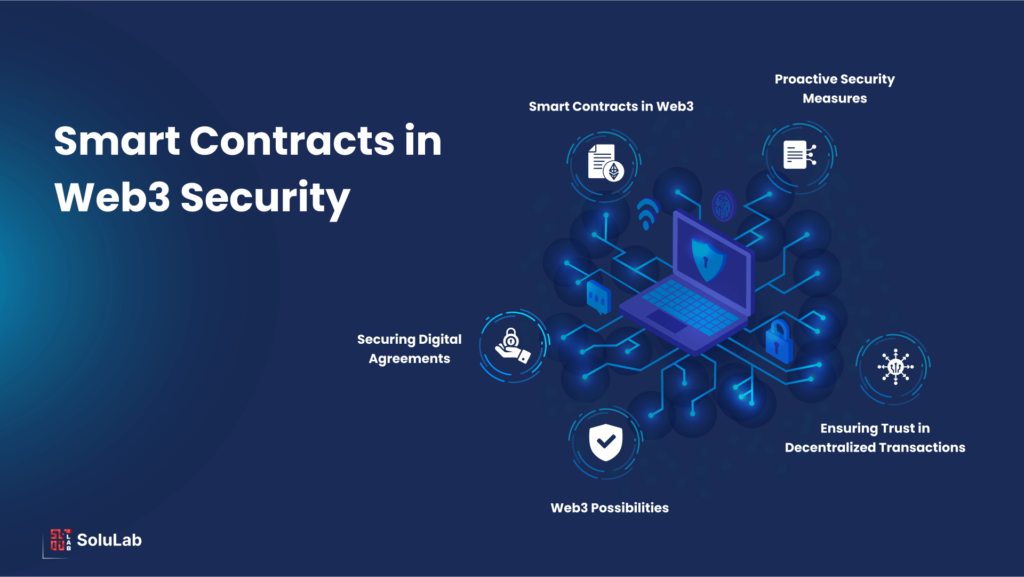
The evolution of blockchain technology has ushered in a new era marked by decentralization and transparency. At the forefront of this paradigm shift are Web3 smart contracts, revolutionizing the way agreements are executed in a trustless environment. This comprehensive guide navigates the intricate landscape of Smart Contracts in Web3, with a keen focus on security and safeguarding against potential risks.
Board on a journey of exploration as we delve into the intricacies of Web3 Smart Contracts. Uncover the foundational concepts, principles, and functionalities that shape these digital agreements on decentralized platforms. From their role in revolutionizing transactions to the fundamental mechanisms governing them, gain a comprehensive understanding of Web3 Smart Contracts.
Web3 smart contracts are self-executing agreements that are stored on a blockchain and can be used to automate a wide range of tasks. They are the digital equivalent of traditional contracts, but they have a number of advantages, including:
In a Web3 environment, smart contracts are not limited to financial transactions. They can be used to automate a wide range of tasks, including:
Smart Contracts in Web3 play a pivotal role in reshaping traditional business models. They act as the building blocks of decentralized applications, executing predefined rules without the need for manual intervention. This allows for greater efficiency, transparency, and security than traditional, centralized systems.
For example, in the finance industry, smart contracts can be used to automate the execution of financial transactions, such as loan origination and settlement. This can save time and money for both businesses and consumers. In the art world, smart contracts can be used to create NFTs that are tamper-proof and impossible to counterfeit. This gives artists and collectors greater confidence in the authenticity and value of their digital assets.
The decentralized nature of Web3 smart contracts introduces a layer of security by design. As these contracts operate on a blockchain, every transaction and execution is recorded and tamper-resistant. This transparency not only enhances security but also instills confidence in users engaging with decentralized platforms.
For example, in the DeFi space, smart contracts are used to power a variety of financial applications, such as lending, borrowing, and trading. The security of these applications is critical, and smart contracts can help to ensure that transactions are executed as intended and that funds are protected.
Overall, smart contracts are a powerful tool that can be used to improve the efficiency, transparency, and security of a wide range of businesses and industries. As the Web3 ecosystem continues to grow, we can expect to see even more innovative and groundbreaking applications of smart contracts.
Security is paramount in the decentralized realm of Web3 Smart Contracts. In this segment, we navigate through the critical considerations that underpin the security landscape. Explore the vulnerabilities, challenges, and the imperative need for robust security practices to ensure the integrity of Web3 Smart Contracts. Join us in deciphering the layers of security woven into the fabric of decentralized transactions.
Smart Contracts in Web3, while transformative, are not without their set of challenges. Security vulnerabilities are among the foremost concerns that developers and stakeholders must address. Common challenges include:
Smart Contracts in Web3: Smart contracts are self-executing digital contracts that are stored on a blockchain and enforced by code. They have the potential to revolutionize many industries by automating transactions and removing the need for intermediaries. However, smart contracts are not without their challenges.
Security Vulnerabilities: One of the biggest challenges facing smart contracts is security vulnerabilities. The decentralized nature of Web3 smart contracts means that they are not subject to the same level of security scrutiny as traditional software. This can make them more vulnerable to attack. Even seemingly minor errors in the code can lead to critical security breaches.
External Dependency Risks: Smart contracts often rely on external data sources, such as oracles. These oracles provide real-world data to the smart contract, which is then used to execute the contract. However, these dependencies introduce vulnerabilities, as the accuracy and security of the oracle’s data become crucial. If the oracle’s data is incorrect or malicious, it can lead to the smart contract being executed incorrectly or in a way that was not intended.
Unintended Consequences: The immutability of blockchain, while a strength, can also pose challenges for smart contracts. Once a smart contract is deployed, it cannot be altered. This means that any bugs or vulnerabilities in the contract will be permanent. This can lead to unintended consequences, such as funds being lost or contracts being executed incorrectly.
Smart contracts are a powerful new technology with the potential to revolutionize many industries. However, it is important to be aware of the challenges that smart contracts face, such as security vulnerabilities, external dependency risks, and unintended consequences. By understanding these challenges, developers and stakeholders can take steps to mitigate them and ensure that smart contracts are used safely and securely.
To fortify Web3 Smart Contract Security, adherence to best practices is imperative.
Code Audits: Regularly conduct thorough code audits to identify and rectify vulnerabilities. This practice ensures the early detection and mitigation of potential security risks.
Secure Development Standards: Adhere to secure coding standards such as those provided by organizations like ConsenSys and OpenZeppelin. Following these standards enhances the resilience of smart contracts against common security threats.
Multi-Signature Wallets: Implement multi-signature wallets to add an extra layer of security. This ensures that critical operations require multiple approvals, minimizing the risk of unauthorized access.
In addition to the best practices listed above, there are a number of other steps that can be taken to improve the security of Web3 smart contracts. These include:
Related: Top 10 Smart Contract Development Companies in 2024
By following these best practices and taking additional steps to secure their smart contracts, developers can help protect their users and their assets from security threats.
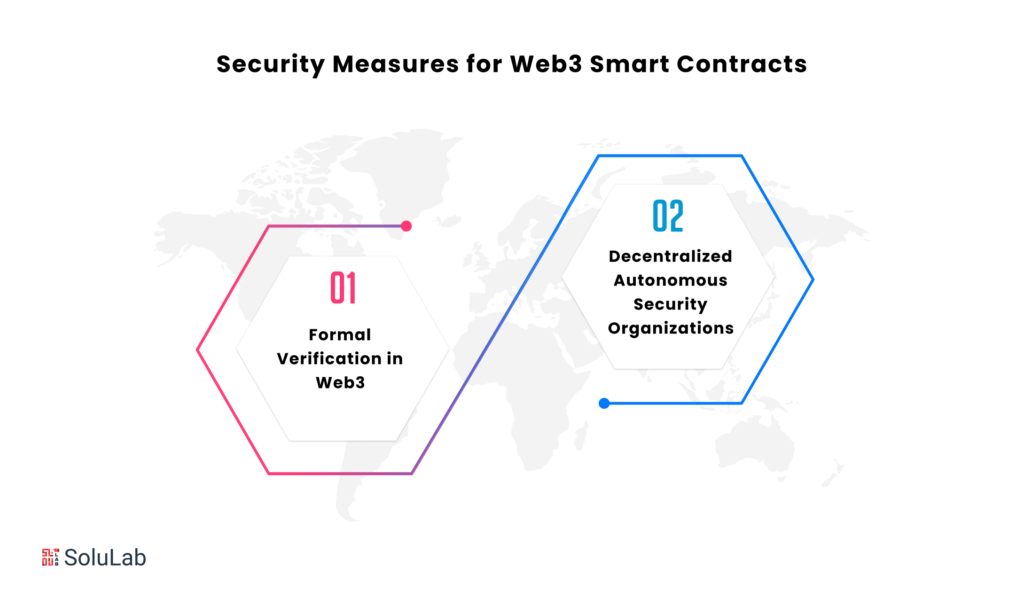
Beyond the basics lies a domain of advanced security measures tailored for Web3 Smart Contracts. In this segment, we delve into sophisticated techniques and practices designed to fortify the defenses of digital agreements. From formal verification to the emergence of Decentralized Autonomous Security Organizations (DASOs), uncover the cutting-edge methods paving the way for enhanced security in Web3 Smart Contracts.
Formal verification is a rigorous mathematical technique for proving the correctness of computer programs. It is used to ensure that smart contracts are free of errors that could lead to security vulnerabilities or financial losses.
The process of formal verification begins with a formal specification of the smart contract. This specification describes the behavior of the contract in a precise, mathematical way. The specification is then used to generate a proof of correctness. The proof shows that the code of the smart contract implements the specification correctly.
Formal verification is a very powerful tool for ensuring the security of smart contracts. It can be used to find errors that would be difficult or impossible to find using traditional testing methods. However, formal verification is also a complex and time-consuming process. It is not always feasible to use formal verification for every smart contract.
In practice, formal verification is often used to verify the most critical parts of a smart contract. This can help to ensure that the most important security features are working correctly. Formal verification can also be used to verify smart contracts that are used in high-stakes environments, such as financial trading.
Formal verification is an important tool for ensuring the security of smart contracts. However, it is not a silver bullet. It is important to use formal verification in conjunction with other security measures, such as testing and code review.
DASOs represent a collaborative approach to Smart Contract Security in Web3. These decentralized entities pool resources and expertise to continuously monitor and audit smart contracts. DASOs provide an additional layer of security through collective intelligence, reducing the reliance on centralized security audits.
DASOs are typically composed of a group of security experts, auditors, and dedicated developers who work together to identify and mitigate security vulnerabilities in smart contracts. DASOs use a variety of tools and techniques to audit smart contracts, including static analysis, dynamic analysis, and manual review.
DASOs can provide a number of benefits for smart contract developers, including:
DASOs are still a relatively new concept, but they are gaining traction in the Web3 ecosystem. As the number of smart contracts in use continues to grow, the need for security audits will also grow. DASOs can play an important role in ensuring the security of smart contracts and the broader Web3 ecosystem.
Peek into the crystal ball of the future as we forecast Web3 Smart Contract Security. In this segment, we analyze emerging trends, technological advancements, and industry-wide standardization efforts poised to shape the future of security in decentralized transactions. Join us in envisioning a secure and innovative future for Web3 Smart Contracts.
The future of Smart Contracts in Web3 holds promising advancements in security.
These advancements in security will make smart contracts more reliable and trustworthy and will help pave the way for their widespread adoption.

Smart contracts are self-executing digital contracts that run on the blockchain. They are foundational to Web3 and are redefining how we interact with digital platforms. Smart contracts allow us to create new forms of digital interactions that are more secure, efficient, and transparent. For example, smart contracts can be used to create: Decentralized applications (dApps), Non-fungible tokens (NFTs), Decentralized finance (DeFi), Supply chain management, and Voting systems The possibilities are endless. Smart contracts are still in their early stages of development, but they have the potential to revolutionize the way we interact with the world. Security is critical for Smart Contracts
Security is critical for smart contracts. Because smart contracts are self-executing, they cannot be changed once they are deployed. This means that any vulnerabilities in a smart contract can be exploited by malicious actors. There are a number of best practices that can be used to secure smart contracts, including Secure coding standards, Regular audits, Automated security tools, and Industry-wide standardization efforts. SoluLab is a Web3 development company that offers a suite of Web3 services, backed by a team of seasoned Web3 developers. Our commitment is to craft a secure and innovative Web3 experience tailored to your needs.
Web3 Smart Contracts are digital agreements executed on decentralized finance platforms, such as Ethereum or Polkadot. Unlike traditional contracts, they operate autonomously, removing the need for intermediaries and leveraging blockchain technology for transparency and immutability.
The decentralized nature of Web3 Smart Contracts ensures transparency and immutability in transactions. Every operation is recorded on the blockchain, reducing the risk of fraud and providing a tamper-resistant record of all activities.
Common challenges include code vulnerabilities, external dependency risks, and the potential for unintended consequences due to the immutability of blockchain. Addressing these challenges requires proactive security measures and regular audits.
Businesses can enhance security by adhering to secure coding standards, conducting regular code audits, implementing multi-signature wallets, and exploring advanced measures such as formal verification and collaboration with Decentralized Autonomous Security Organizations (DASOs).
Past incidents underscore the importance of thorough code audits, secure coding practices, and community collaboration. Learning from these incidents is crucial for improving the overall security posture of Smart Contracts in Web3.
Automated security tools, leveraging artificial intelligence and machine learning, streamline the identification and mitigation of security vulnerabilities. These tools contribute to early detection and enhance the overall security of Web3 Smart Contracts.
SoluLab is highlighted for its expertise in Web3 Development Services. As a trusted Web3 Development Company, SoluLab provides a team of skilled Web3 Developers dedicated to ensuring the integrity and security of Smart Contracts in the Web3 landscape.


