Talk to an Expert

Security Tokens vs Utility Tokens vs NFTs – How different are they?

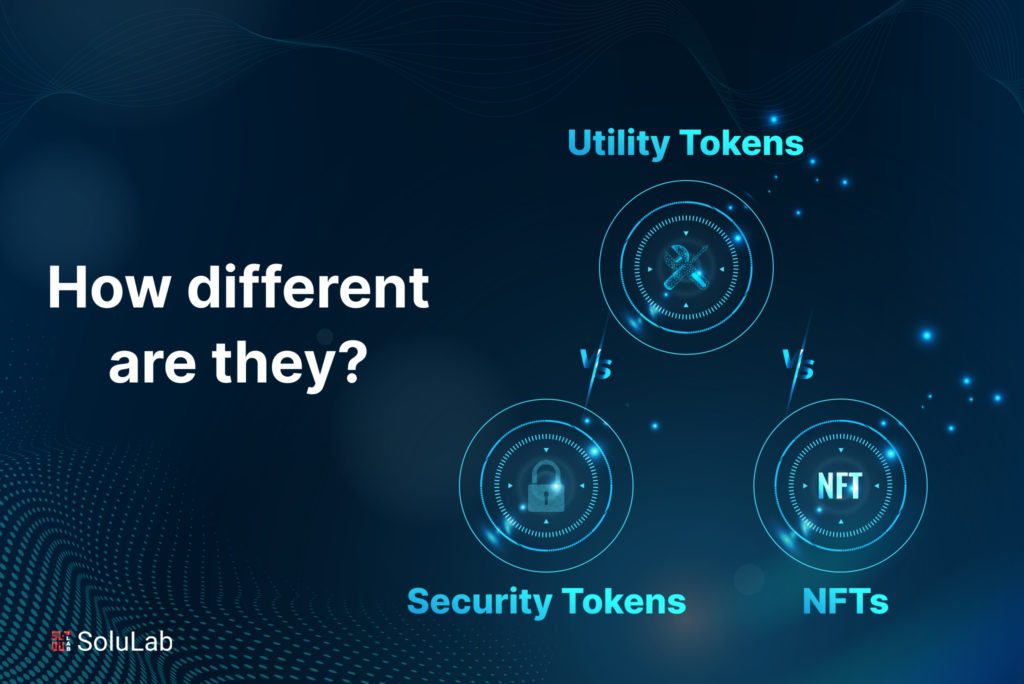
Security Tokens vs Utility Tokens vs NFTs - How different are they?

In the dynamic realm of blockchain and cryptocurrencies, the advent of digital tokens has revolutionized traditional concepts of value, ownership, and interaction. The evolution has ignited a necessity for a profound understanding of the triad of digital tokens: security tokens, utility tokens, and NFTs (Non-Fungible Tokens).

This article embarks on a comprehensive journey, unraveling the intricacies that define each token category. By delving into their attributes, use cases, and distinguishing features, we gain a holistic perspective of their impact on the digital landscape.

The Rise of Digital Tokens

Blockchain technology’s meteoric rise has ushered in the era of digital tokens, reshaping financial systems and digital transactions. Tokens, and cryptographic entities safeguarded by decentralized ledgers, introduce transparency, security, and peer-to-peer trust to digital transactions. These digital representations of value have given rise to an array of tokens, each tailored to distinct purposes and applications.

Within the labyrinth of digital tokens, distinct categories emerge, each bearing unique functionalities and implications. Proficiency in discerning these categories is imperative, enabling stakeholders to make informed decisions and partake in the evolving digital economy. As the technology matures, the ability to differentiate between security tokens, utility tokens, and NFTs becomes pivotal.

Understanding Security Tokens

So, what is a security token? Security token symbolizes ownership in tangible or intangible assets, akin to traditional securities. These tokens offer fractional ownership, affording holders a share in the underlying asset’s value and potential returns. Notably, security tokens undergo regulatory scrutiny, aligning them with established securities regulations.

Security tokens stand out by adhering to regulatory frameworks. Compliance ensures transparency, investor protection, and safeguards against illicit activities, thereby bolstering the credibility of the tokenized ecosystem. The alignment with regulations presents security tokens as a bridge between the worlds of traditional finance and the innovative blockchain landscape.

The practicality of security tokens finds resonance across domains, including real estate, venture capital, and private equity. Tokenization imbues these markets with enhanced liquidity and accessibility, empowering diverse investors to partake in traditionally exclusive spheres. For instance, a historically illiquid asset like real estate becomes more accessible and divisible through security token offerings (STO) and STO development services.

What Is A Utility Token?

Utility tokens serve as digital keys granting access to decentralized platforms or services. Their primary function centers on enabling interaction within a specific ecosystem, rather than conferring ownership rights. These tokens act as the lifeblood of blockchain networks, stimulating engagement and utilization.

Top Utility tokens assume the mantle of powering decentralized applications, incentivizing user engagement and ecosystem participation. This symbiotic relationship fuels the platform’s evolution, nurturing its growth. For instance, the Ethereum network employs Ether (ETH) as a utility token to facilitate smart contract execution and transactions within the platform.

Challenges associated with utility tokens stem from balancing their intrinsic utility with potential investment aspirations. Their value is intrinsically linked to the network’s vitality, posing the challenge of sustaining demand. Critics also raise concerns about the potential for regulatory crackdowns on utility tokens that might be deemed securities.
CTA1

Delving into NFTs (Non-Fungible Tokens)

NFTs stand as unparalleled digital assets representing ownership of specific items, ranging from digital art to collectibles. Each NFT is indivisible, bearing a distinct identity that sets it apart from its fungible counterparts. This uniqueness is a core feature enabled by the underlying blockchain technology.

The artistic landscape experiences a seismic shift with NFTs, empowering artists to tokenize their creations and directly connect with collectors. NFTs’ influence stretches beyond art into collectibles, gaming artifacts, and even tokenized real-world assets. For instance, the NFT for a virtual land parcel in a metaverse holds inherent scarcity and value.

NFTs instigate the inception of novel digital economies, facilitating direct interactions between creators and collectors. Their emergence bridges the chasm between physical and virtual ownership, paving the way for innovative economic models. NFT development services enable creators to monetize their digital works directly, bypassing intermediaries and opening avenues for new revenue streams.

Intersection and Evolution

Instances of Hybrid Tokens: As the boundaries between different token types blur, hybrid tokens emerge as captivating entities. These tokens combine the features of security, utility, and NFTs, embodying a fusion of functions. Imagine an investment token that grants access to exclusive features in a platform while also representing ownership in a digital art piece. These instances of hybrid tokens underscore the creative prowess of blockchain technology in accommodating diverse needs.

Adaptation to Changing Trends: Blockchain trends are as dynamic as the digital era itself. Utility tokens have undergone a metamorphosis, adapting from simple transactional tools to integral components of decentralized platforms. Security tokens, initially associated with regulatory hurdles, have embraced evolving compliance standards. NFTs once limited to art and collectibles, now embrace domains like gaming and virtual real estate. The evolution of token types mirrors the pulse of technological progress, highlighting their ability to remain relevant in a swiftly changing landscape.

Potential Future Developments: The crystal ball of blockchain’s future holds intriguing prospects. Some speculate the convergence of token types into holistic digital asset classes, while others envision platforms offering seamless token swaps to cater to diverse needs. As the technology matures, regulations become clearer, and user demands evolve, the lines between security tokens, utility tokens, and NFTs may blur further, fostering a harmonious ecosystem.

Pros and Cons of Each Token Type: Security Tokens vs Utility Tokens vs NFTs

Each token type brings its unique advantages and challenges, and making informed decisions involves understanding the specific goals, risk tolerance, and preferences of stakeholders.

Security Tokens:

Pros:

  • Regulatory Compliance: Security tokens are subject to regulations that provide investor protection. This regulatory oversight can enhance trust and credibility, making them more appealing to traditional investors.
  • Institutional Acceptance: The regulated nature of security tokens often attracts institutional investors who are more comfortable with established legal frameworks and compliance measures.
  • Fractional Ownership: Security tokens allow fractional ownership of assets, enabling broader participation in high-value investments that might otherwise be inaccessible.

Cons

  • Accessibility Constraints: The stringent regulations and compliance requirements can create entry barriers for smaller investors or projects, limiting the democratization of investment opportunities.
  • Time and Cost: The process of regulatory compliance and issuance of security tokens can be time-consuming and expensive, deterring startups with limited resources.
  • Liquidity Challenges: Despite regulatory clarity, the liquidity of security tokens in secondary markets might be limited due to complex regulations and the nature of the assets.

CTA2

Utility Tokens: 

Pros

  • Ecosystem Engagement: Utility tokens serve as the lifeblood of decentralized platforms, incentivizing users to engage, interact, and contribute to the ecosystem’s growth.
  • Flexible Use Cases: The versatility of utility tokens allows them to be integrated into a wide range of applications, from gaming and social media to governance and access to services.
  • Community Ownership: Utility tokens enable a sense of community ownership, aligning the interests of users and creators toward the platform’s success.

Cons:

  • Value Volatility: The value of utility tokens can be highly volatile, driven by market sentiment and speculative trading, which might overshadow their primary functional purpose.
  • Regulatory Uncertainty: The evolving regulatory landscape could lead to debates about whether certain utility tokens should be classified as securities, potentially exposing projects to legal risks.
  • Functionality Necessity: The success of utility tokens hinges on their utility within the platform; if the functionality doesn’t resonate with users, the token’s value might decline.

NFTs: 

Pros:

  • Digital Ownership: NFTs revolutionize digital ownership, providing a secure and verifiable way for creators to monetize their digital content, fostering a new digital art and collectibles market.
  • Interoperability: NFTs can be used across multiple platforms and applications, enabling cross-ecosystem utilization and creating new opportunities for creators.
  • Unique Scarcity: The concept of unique scarcity adds value to NFTs, as each token represents a distinct piece of content, making them highly attractive to collectors and enthusiasts.

Cons:

  • Sustainability Concerns: The carbon footprint of some NFTs, especially those minted on certain blockchains, has raised environmental concerns, prompting discussions about more eco-friendly solutions.
  • Speculative Nature: Similar to utility tokens, the value of NFTs can be speculative, with significant price fluctuations that might not always align with the artistic or intrinsic value of the content.
  • Long-Term Value: While NFTs have seen remarkable success, questions about the long-term value of digital assets remain, especially as the market matures and the novelty wears off.

Read Also: Top NFT Development Companies To Look At In 2025

Factors to Consider When Choosing Tokens

As the digital token landscape diversifies, making choices becomes a blend of art and science. 

1. Consider your investment goals, risk appetite, and familiarity with blockchain technology. 

2. Evaluate the project’s purpose, team, technology, and roadmap.

3. Dive into the regulatory landscape, understanding how it impacts each token type.

4. Stay informed, for in the realm of digital tokens, each choice shapes the unfolding narrative of blockchain’s journey.

CTA3

Concluding Remarks

As the worlds of regulation and technology continue to evolve, the realm of security tokens stands as a bastion of legitimacy and protection. The embrace of regulatory compliance not only elevates investor confidence but also paves the way for institutional adoption, gradually bridging the gap between traditional finance and the decentralized future. Yet, the path of security tokens may seem arduous, with compliance demands and accessibility constraints urging us to tread thoughtfully.

As we conclude our exploration of security tokens, utility tokens, and NFTs, let us remember that the choices we make in this intricate ecosystem sculpt the future narrative of blockchain technology. With each choice, we contribute to an ever-expanding canvas, painting strokes of innovation, challenges, and discoveries. The journey is intricate, the potential boundless, and the promise of the blockchain era resonates with the echoes of these digital tokens that illuminate the path ahead.

Just as these tokens converge at an intersection of innovation, SoluLab stands at the crossroads of technological expertise, creative vision, and client-centric solutions. With a commitment to embracing novel trends and adapting to changing landscapes, SoluLab mirrors the dynamism of the digital token realm – a versatile entity that navigates intricacies with finesse.

SoluLab, a renowned leader in NFT development services, offers comprehensive solutions tailored to businesses and individuals venturing into the world of non-fungible tokens. Their team of expert developers and blockchain enthusiasts is committed to delivering high-quality, customizable services, whether for artists, brands, or platforms seeking asset tokenization, NFT collectibles creation, or bespoke marketplace development. Security, scalability, and innovation are their core focus, making SoluLab the ideal partner for harnessing the full potential of NFT solutions. With SoluLab, you can unlock the power of STO development services, tokenize physical assets, attract investors, and establish your presence as a global market leader. To become a frontrunner in the NFT realm, leverage SoluLab’s premium NFT token development services, creating unique tokens that stand out and drive the success of your NFT project. Contact SoluLab today to explore the limitless possibilities of blockchain technology.

FAQs

1. What distinguishes security tokens from other types of digital tokens?

Security tokens are a subset of digital tokens that represent ownership in a real-world asset, such as company shares or real estate. Unlike utility tokens that grant access to a platform’s features, security tokens are subject to regulatory compliance, providing investors with legal protection. While utility tokens emphasize functionality, security tokens emphasize ownership rights and adhere to established regulations.

2. Can a token serve both utility and investment purposes?

Yes, there are instances of hybrid tokens that combine elements of security, utility, and NFTs. These tokens offer investors ownership rights while granting access to platform features or unique digital content. The fusion of functions underscores the versatility of blockchain technology, catering to diverse user needs within a single token.

3. How do NFTs go beyond digital art and collectibles?

While NFTs gained prominence through digital art and collectibles, their potential extends far beyond these realms. NFTs can represent ownership in virtual real estate, in-game items, event tickets, music royalties, and more. The unique scarcity and verifiable ownership provided by NFTs open doors to innovative applications in various industries, reshaping how we perceive and trade digital assets.

4. How do I choose the right type of token for my project or investment?

Choosing the right token type involves assessing your goals, risk tolerance, and the nature of your project. If seeking legitimacy and compliance, security tokens might be suitable. For platform participation, utility tokens provide functionality, while NFTs cater to unique ownership and authenticity. Careful evaluation of regulatory considerations, market trends, and user preferences will guide your decision-making process.

Non fungible token (NFT) is the technology, every industry is hoping on!

A  Non fungible token or NFT is one of the hottest topics of discussion about blockchain technology in recent times. They have already earned a lot of popularity within a quick span of time similar to the DeFi and Bitcoin Halving in the summers of 2020.NFTs happen to be the emerging trend in the cryptocurrency industry as a means for creating and propagating very exciting opportunities for different collectors as well as brands. Let us delve a bit deeper into the topic to understand what NFTs are.

What is a Non Fungible Token ?

What is non fungible tokens

A non fungible token is a cryptographic token representing something unique and possesses individual characteristics which set them apart. Stating in basic terms, non-fungible tokens represent uniqueness and cannot be equated or replicated with any similar asset. Owning an NFT is something like owning a special type of collectible antique or work of art. These tokens are like digital assets that generate very good value due to their uniqueness.

Fungibility refers to the ability of any asset to be interchanged or exchanged with another similar type of asset. It implies the presence of certain equality between the two assets in terms of value. On the other hand, non-fungibility might look quite similar and belong to the same category, but they are different from each other in terms of the information they hold, thereby making each one unique.

A Brief History of Non Fungible Tokens.

Some experiments were conducted with the emergence of colored coins in the Bitcoin network before Cryptokitties which is a period unironically referred to as ‘0 BC’. One of the first new illustrations was referred to as ‘Rare Pepe’ built on the Bitcoin counterparty system. After some time, a very rare set of ‘Rare Pepe’ was auctioned in New York that was sold at a good price. The first Ethereum-based non fungible token experiment was CryptoPunks. It consisted of 10000 unique punk collectibles where each of them had unique features and characteristics. 

CryptoPunks was first built by Larva Labs which was featured as an on-chain marketplace. It could be accessed and used by different crypto wallets like MetaMask. This, in turn, reduced the entry barrier for interacting with NFTs for crypto users. It was Cryptokitties that marked the incidence of an era that pushed non-fungible tokens into the mainstream to finally launch in the latter half of the year 2017. 

The debut of Cryptokitties was at the ETH Waterloo hackathon with a primitive on-chain game. There were many in that gaming community who labeled Cryptokitties as ‘not a real game,’ but the team playing found their way around the design constraints of blockchain quite well. Between the years 2018 and 2019, there was a massive exponential growth of NFTs which is referred to as the ‘NFT Cambrian Explosion.’ NFTs are lower in volume than other crypto markets, their trade volumes are increasing at a good pace.

How Does a Non Fungible Token Work?

Traditional artworks like paintings possess a lot of value since they are one of a specific kind. But with digital files, they can be very easily limitlessly duplicated. With the help of a non-fungible token, the artwork can be “tokenized” for the creation of a digital certificate of ownership which when can be easily bought and sold. 

Similar to cryptocurrency, a clear record of ownership is stored on a shared ledger referred to as the blockchain. These records cannot be forged easily since the ledger where they are stored is maintained by a huge network of computers all around the world. A non-fungible token can also contain smart contracts which might provide the artist a cut of any future sale of the token.

Most of the non-fungible tokens are a part of the Ethereum or ETH blockchain at a high level. ETH is a cryptocurrency, similar to Bitcoin or Dogecoin. But their blockchain also supports non-fungible tokens. These tokens store extra information which in turn makes them work differently from an Ethereum coin. Here it is important to notice that other blockchain might implement their own different versions of non-fungible tokens.

What are Non Fungible Token Standards?

Understanding the standards for NFTs is of immense importance since it has a significant role to play when it comes to enhancing their power. The standards offer assurance to the developers that the involved assets would be behaving in a certain manner. Moreover, the standards help describe the working of the interactions when the NFTs try to interact with the basic functionality of the assets. Here are the two common standards for non fungible token. 

ERC721 – It is the most popular standard for NFTs and was brought to existence by Cryptokitties. ERC721 is a blockchain game developed on Ethereum which happens to be a unique game allowing the players to buy, collect, breed, and sell virtual cats. ERC721 two simple methods that portray the essence of non-fungible tokens.

  1. It provides a mapping of distinctive identifiers to addresses.
  2. It provides authorization to transfer these assets.

ERC1155 – ERC1155 was developed by the Enjin Team and this Ethereum standard brings about the idea of semi-fungibility into the world of non-fungible tokens. With this standard for NFTs, IDs instead of representing individual assets, represent a class of assets. It is immensely beneficial because it brings in efficiency and lowers the efforts required for modifying smart contracts for a high volume of items.

Applications of Non Fungible Tokens.

A Non-fungible token has a wide array of applications because of its existence and trading on the blockchain network. To make it easier for the users to understand, here are a few major ways of using non-fungible tokens.

  • Constructing and curating collections
  • Using NFTs in games as well as other decentralized uses
  • It can be used to purchase or buy NFTs in a marketplace
  • Gifting NFTs to other people
  • Trading NFTs with others

Showcasing the public non-fungible token inventory by different means like social media platforms or other decentralized uses

What is the Worth of Non-Fungible Tokens?

It might sound quite wild but the truth is that people are paying millions of dollars for the non-fungible tokens. On the 19th of February 2021, an animated Gif of Nyan Cat which is nothing but a 2011 meme of a flying pop-tart cat was sold for more than 500,000 dollars. Sometime later, musician Grimes sold some of her digital art for more than about six million dollars.

It is not just about the art being tokenized and sold. Jack Dorsey, the founder of Twitter has promoted a non-fungible token of the first-ever tweet which had phenomenal bids of about 2.5 million dollars. A completely new record for digital art was created after Christie’s sale of a non-fungible token by digital artist Beeple for about 69 million dollars. 

Few Factors to Consider While Buying Non Fungible Tokens

After you have an idea about non-fungible tokens and their worth, would you consider buying them? If you are planning to buy one, then here are a few important factors to consider before you finally make your decision. 

  • The Market is Very New – We do not have a clear idea yet about the non-fungible token market, whether it will grow in the time to come or not. For instance, the sale of Beeple’s digital art valued more than 69 million dollars might completely lose its value in the future or rise further. Nobody knows since the market is relatively new. Though everything regarding crypto is hot and trending still we can definitely say anything about non-fungible tokens.  
  • Theft and Fraud – One of the biggest USPs of non-fungible tokens is their allowance to digital artists to claim ownership of their work. Before it was tough to earn anything from the files that people could download and share for free without the artist’s permission. But it does not mean non-fungible tokens are protected from fraud. There are several cases coming up where artists are complaining about their work being tokenized without their knowledge. 

Moreover, it is not yet clear how the artists would reclaim the ownership once it incorrectly enters into the blockchain in another person’s name. So, the chances of fraud and theft loom over. If you still wish to buy, check out for a trusted and reputed NFT exchange. At the same time, the buyers need to make sure that the non-fungible token has a high degree of artist verification along with good security credentials. 

  • Copyright – It is to be kept in mind while buying a non-fungible token that the copyright would not be owned by the buyer. In most cases, the artist has the copyright and can even claim royalties on sale. So, the buyers won’t be able to do everything as per their liking. So, it becomes crucial to understand all the terms involved before buying. 
  • Storage – Ultimately, you need to consider storing the non-fungible token you buy. We have learned that there is a possibility of NTF being stolen. But have you ever thought about the original file? You would not be able to store the individual assets in the blockchain ledger since the ledger stores the tokens and not the item. 

The non-fungible token usually contains a link or URL to the purchased item. Thus, digital art would be stored somewhere else. Now, if the stored file type stops working or the data gets corrupted, the buyer can be in deep trouble. So, the buyer needs to find a place to store the NFT which is again a vital factor to consider before buying.

Should You Buy a Non-Fungible Token?

Buying a non-fungible token does not mean owning the actual asset. Here is an example to understand. Nyan Cat meme’s creator sold a non-fungible token for 590,000 dollars but the person who bought it does not own the meme. The meme still belongs to the creator who had the creative as well as intellectual rights. 

The token’s owner has a record and a hash code showing the unique token’s ownership related to the particular asset. Anybody can download the meme and use it but none would be owning the token which means none would be able to sell the token. It is only the owner of the token who can sell it.  

All the factors to consider mentioned above can have solutions. But the industry is at the bud stage, thereby making it quite unclear about the solutions and whether they would be able to protect the interests of the early adopters of NFTs. Therefore, buying a non-fungible token right now can involve a lot of risks. 

The NFTs are themselves volatile and they belong to an already volatile cryptocurrency market. In addition to this, traditional art, as well as collectibles, are quite challenging to value and difficult to invest in if the buyer does not have a complete understanding of the market. 

It would not be a good idea to invest in non-fungible tokens just because you feel you are missing out on an investment opportunity. It would still make sense you are aware of the following. 

  • Have a very good understanding of the traditional art market
  • You are already in this field where you have a collection of art, sports trading cards, or anything else
  • You are not looking forward to making short cut money and see a long-term value in the investment

Finally, you should avoid investing in non-fungible tokens with your emergency fund since results can be disastrous. There is a high chance the non-fungible token market will see growth in the future where the NFTs will enhance in value but you should only go for it where there is a scope to bet cash on the chance of the investment failing.

Future of Non-Fungible Tokens.

Non fungible token hype.

Non-fungible tokens are at the budding stage and the technology behind them is under continuous changes as well as improvements due to the technical innovations. NFTs have their limitations and challenges that need proper tackling for much smoother incorporation, as well as usage. One of the crucial challenges is their inaccessibility to mainstream users, and it is only being used by tech adopters using blockchain platforms at present.

Another challenge is regarding the buying and selling of NFTs. Efficient platforms are required to be built to support larger transactions. But the future of NFTs looks quite promising which is evident from the total market of NFTs crossing 100 million dollars by July 2020. 

There are speculations that about 40 percent of new crypto users will make use of non-fungible tokens as an entry point. Surpassing the value of 4 billion dollars by the decentralized finance industry, it is quite obvious that the space for non-fungible tokens is all set to achieve exponential growth in the time to come. Let us wait to see how a non-fungible token grows.

SoluLab is one of the top 3 blockchain developers in the world. We create NFT marketplaces that get millions of traffic daily. Reach out to us today for your project’s free consultation.